Our Liturgical Calendar begins on the first Sunday of Advent. It ends in November on the Solemnity of Christ the King. November 2026 also ends in political chaos.
November 18, 2026 by Father Gordon MacRae
As October gave way to November and the Commemoration of All Souls this year, it seemed as though some of the light had gone out of our world. It was widely felt in a literal sense as we once again turned back our clocks to end Daylight Saving Time. We were led to believe and hope that Congress and the Senate might end the changing of the clocks this year, but the discussion descended into disagreement and so nothing changed.
The truth is that Daylight Saving Time no longer even exists for the reason it was imposed in the first place. In the United States, it was adopted as a temporary wartime measure in 1918 to conserve fuel during World War I. Austria and Hungary also adopted it framing it as a patriotic wartime necessity, then other nations followed suit. In 1919, it was repealed by Congress over President Woodrow Wilson’s veto. It seems foreign now that we could resolve contentious viewpoints then without lingering resentment and fears of retaliatory countermeasures between political parties.
In World War II, the time changes were imposed again and for the same reasons. Then they were standardized in federal law in 1966. My thirteen-year-old mind remembered that year more for the debut of Star Trek than for the artificial extension of light. The biannual time changes caused real time problems for airlines, railroads, and other transportation systems dependent on arrival and departure schedules. This year, the U.S. Congress passed permanent DST with a 308 to 117 margin. But it stalled in the Senate when President Trump supported the House version.
Where I live, turning the clock back one hour has real time consequences. At age 73, I have cataracts and only a small book light, which does not challenge earlier sunsets very well. I plan to purchase a better light, but that may take a month or longer. The diminishment of light leaves me struggling to write, but I will adjust.
In the United States, at least, there has simultaneously been a downward spiral of political darkness. In 2026, the long-contested U.S. midterm elections came on the day after the Commemoration of All Souls. We are tasked with remembering the souls of our beloved dead for the entire month of November, but politics and the election cycle have stunted that concern. We on the political right are feeling quite left out in the dark — literally. I am taking a much needed break from the rise and fall of our politics to refocus — as it should be — on the Gospel.
It did not take long for me to descend back into that mindset, however. The Gospel for the Solemnity of Christ the King this year (Matthew 25:31-46) contains a single verse that, if taken out of context, might send us right back into our partisan squabbling: “Then the king will say to those on the right, ‘Come, blest of my Father, inherit the kingdom prepared for you from the foundation of the world.’” In the passage, those on the left do not share so well. Resist the temptation to apply Sacred Scripture filtered through our partisan politics. It must be the other way around. There is enough darkness in our world without our misappropriation of the Word of God.
The Season of Advent is on the near horizon, and along with it will come words of great hope. The Prophet Isaiah famously summons us in Advent to witness to that hope: “The people who walked in darkness have seen a great light; for those who dwelt in a land of gloom, on them a light has shined.” (Isaiah 9:2)
Now Comes Christ the King
As the introduction to this post alludes, our Liturgical Calendar begins on the First Sunday of Advent and ends in November on the Solemnity of Christ the King. The Catholic Liturgical Calendar follows a three-year cycle for the Scriptural Readings of the Mass. The cycle is designated for years A, B, and C. The last Sunday in Ordinary Time is designated as the Solemnity of Christ the King as follows:
Year A: Matthew 25:31-46: A passage known as “The Judgment of the Nations.”
Year B: John 18:31-37: Christ the King stands before Pilate.
Year C: Luke 23:35-43: Dismas, the Good Thief Crucified Next to Christ the King.
Over recent years, I have written posts for all three aspects of the Kingship of Christ emphasized in our liturgy. The “Year B” Gospel passage of Christ before Pilate is a dialogue over the nature of Christ, his Kingship and his Kingdom. Though not included in the Gospel passage as rendered for the Mass, it ends with what is likely the most startling acclamation in all of Sacred Scripture. It was and is an eye-opener for the ages. The timing of it might seem especially important this year as Pilate asks the mob, “Shall I crucify your king? The Chief Priests Answered, ‘We Have No King but Caesar’”
The “Year C” Gospel passage is a soul-stirring dialogue between Jesus and the repentant thief ordered to be crucified alongside him. It is difficult to imagine the immense suffering taking place here as the repentant sinner ponders his fate while coming to recognize that his Redeemer lives in sacrifice right next to him. “Jesus, remember me when you come into your kingly power.” And Jesus said to him, “Truly I say to you today you will be with me in Paradise.” (Luke 39: 42-43)
In Year A, which is observed in 2026, the passage from the Gospel of Matthew is called the Judgment of the Nations. “When the Son of Man comes into his glory, and all the angels with him, before him will be gathered all the nations and he will separate one from another as a shepherd separates the sheep from the goats” (Matthew 25:31).
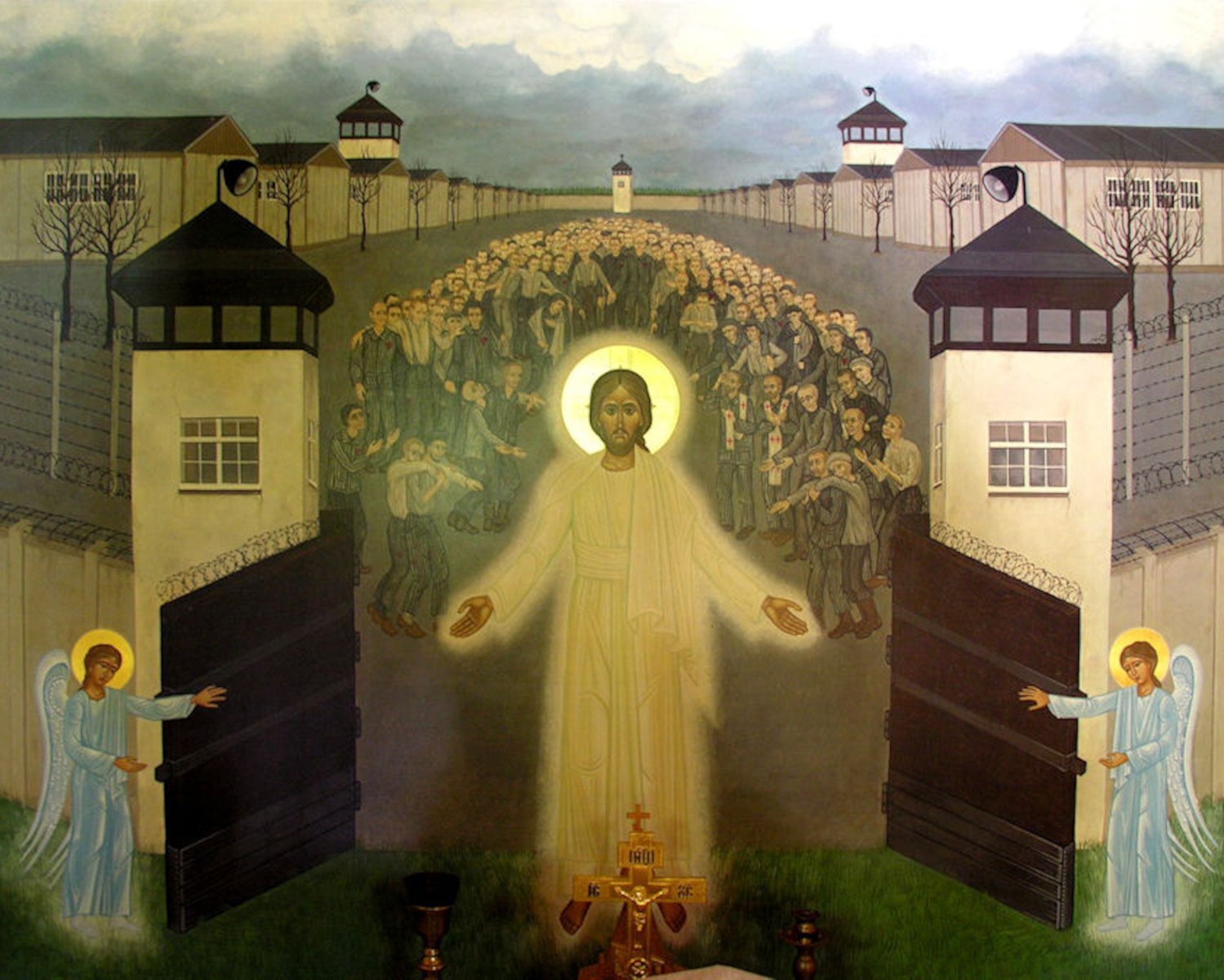
The image atop this post is one that we used at the end of my post, “The God of the Living and the Life of the Dead.” It was written for a previous observance of All Souls Day, which this year just happened to fall on the day before our contentious midterm election.
The image is one of Christ leading prisoners out of Dachau — or is it Purgatory? That image is how I most imagine Christ the King. It is a hopeful image, and one that reflects the Mind of God as revealed by the Prophet Ezekiel at Mass on the Solemnity of Christ the King this year:
“As a shepherd tends his flock when he finds himself among his scattered sheep, so will I tend my sheep. I will rescue them from every place where they were scattered when it was cloudy and dark ... The lost I will seek out; The strayed I will recover; The injured I will bind up; The sick I will heal.”
— Ezekiel 34:15-17
That describes the Mission of the Church as well, or at least what it should be. I once received in prison a letter from a lawyer who asked if I would be willing to talk with a young priest who was the subject of a catastrophic and very public failure. His bishop’s only public comments were that the priest would be expelled from ministry and would never function as a priest again. The lawyer, on the other hand, wanted to find spiritual and psychological treatment for him. I am still stricken by that confusion of roles and expectations. The lawyer called for healing while the shepherd called only for vengeance.
There is a lot in the readings for Christ the King that should give us pause about our own roles and expectations — not our expectations of faith, but rather faith’s expectations of us.
The Gospel for Christ the King, 2026, is from Matthew 25:31-46. The passage ends with a familiar condemnation, not of what some of us did in life, but of what we did not do:
“I was hungry and you gave me no food; I was thirsty and you gave me no drink; I was a stranger and you did not welcome me, naked and you did not clothe me; sick and in prison and you did not come to me ... Truly I say to you, as you did it not to one of the least of these, you did it not to me.”
— Matthew 25:42-46
It is interesting that , immediately following this passage in the Gospel According to Saint Matthew, the plot of the Pharisees and High Priest to kill Jesus unfolds and takes shape. There are certain things that human nature is loathe to hear, and one of them is to have our hypocrisy mirrored and laid bare. I am no exception. Welcoming the stranger and the alienated requires the strength of will to resist some potent peer pressure.
Some years ago, at about the time I first began writing posts for publication from prison, a man was moved into the housing unit where I lived. He was horribly disfigured and everyone just avoided him. He was living out in the open in an overflow bunk with no place to retreat from the scowls and stares of other prisoners. I was disgusted by the way he was shunned.
And then I awoke in the middle of the night disgusted with myself. While passing judgment on the avoidance and shunning of the crowd I was oblivious to my own. This is called spiritual blindness, among the most self-righteous of our sins. So after a sleepless night I went to him, pulled a chair up to his bunk as he sat alone, and talked for awhile. After some days, he trusted me enough to tell me that his disfigurement was the result of a suicide attempt involving a shotgun to his face. My heart went out to this broken man, and we remained friends for the entire time he was in prison.
The fact that my own life had once spiraled into what the Prophet Ezekiel described above as a place “cloudy and dark,” became in that instance a tool for aiding that man. I wrote of my own venture into cloudy and dark in “How Father Benedict Groeschel Entered My Darkest Night.” Had I never experienced such darkness, I could not have imagined what my friend was enduring.
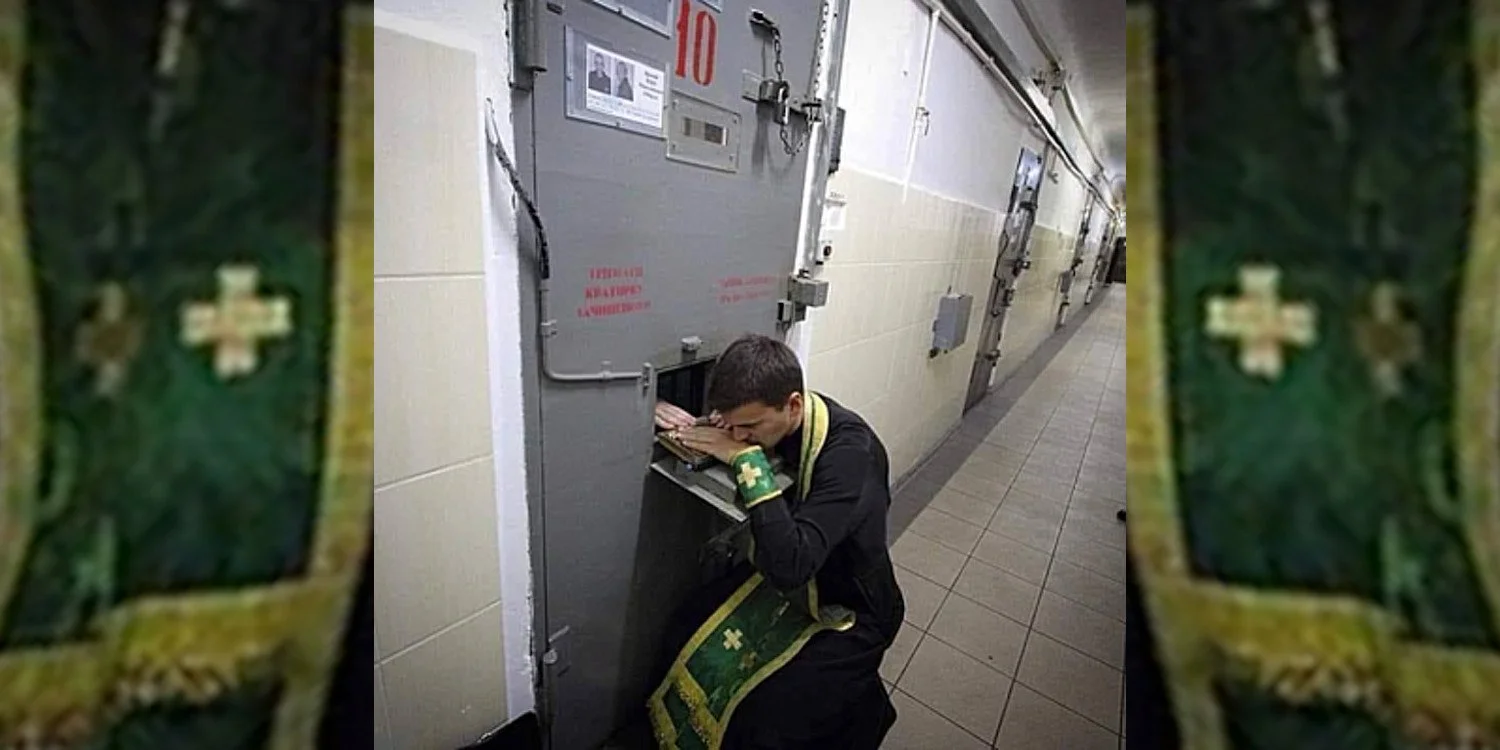
The image atop this segment of this post is one we have used before, but it is a perfect image for the Solemnity of Christ the King. “When I was in prison you came to me” is perhaps one of the Gospel’s most daunting challenges. The image depicts a priest hearing a confession through the food slot of a door in a supermax prison in solitary confinement. I like to think that this brave priest ministering to the darkness is someone who has come to terms with a hard truth. “If my life had veered even slightly from the path I was on, that could just as easily be me living behind that door. There but for the grace of God go I.”
Coming to terms with such a truth strips away all pretense of moral or spiritual superiority. As you know, my good friend, Pornchai Max Moontri spent many years behind such a door before he ended up here with me. It took some time for the demons he encountered to leave him, but they eventually did. He once described his coming to faith as the result of a long, slow exorcism.
After leaving this prison, Pornchai spent five grueling months in a Louisiana for-profit ICE detention facility, which was grossly overcrowded with detainees arrested at the U.S. southern border. He was fortunately able to reach out to me during that time. The for-profit ICE detention center sold food to detainees at highly inflated prices and allowed telephone calls at the rate of eleven cents per minute. What we all thought would be a two-week stay there turned into nearly six months at the height of the 2020 global pandemic. Many countries had closed their borders in fear of Covid infestation. Pornchai was heavily burdened with the prospect of remaining there for a long time. During a telephone call, I challenged him to find someone worse off than himself. It did not take him long. I had been providing funds for food for Pornchai. He asked me in a phone call if he could use some of those funds to give food to Trifah, a Vietnamese 18-year-old who had been in that facility for over a year. Both he and Pornchai were consigned to a huge room with70 other ICE detainees all rounded up at the southern border. All spoke Spanish. None spoke English. Trifah spoke only Vietnamese, and though Pornchai could not understand him, food for the hungry speaks a language of its own.
When Pornchai told me Trifah’s story, I told him that he must help him. At age 17 in Ho-Chi min city in Vietnam, Trifah stowed away aboard a container ship bound for Mexico. Upon arrival he paid his meager funds to a smuggler who promised to get him into the United States. The smuggler took his money and then took Trifah to the Rio Grande River and pushed him in. He was arrested by ICE agents as he emerged on the other side.
The disappointment and discouragement in Pornchai’s voice when he called me each day while in ICE custody were painful to hear. In the face of such suffering, Pornchai did something remarkable. He fulfilled the Gospel for Christ the King. There were a few young men around him who had been stranded there with nothing for many months with no funds, no food, and no way to call anyone. Their families impoverished in Central America did not even know where they were and they had no way to reach out to them. I felt embarrassed when Pornchai asked me if it was okay for him to share his food with them.
Then he made a list of their names, ICE detention numbers, and countries of origin for our helpers to call their Consulate and begin the process of obtaining travel documents for them to move on. The irony is that Pornchai, a foreigner even in the midst of foreigners, was able to help some of them.
On Christmas Eve, 2020, still in ICE detention, Pornchai and Trifah bought food to make Asian wraps — which they renamed “Asian Burritos” — for each of the other ICE detainees. Pornchai and Trifah were suddenly the most popular strangers and aliens in that strange land. When Trifah eventualy returned to his mother in Vietnam, he wrote to me and thanked me. He remained in contact with Pornchai via Facebook, which has a translation feature. Pornchai would then translate Trifah’s message into English to read it to me. Trifah promised me that he would engage in no further world tours.
“Come you who are blessed by My Father, inherit the Kingdom prepared for you from the foundation of the world. For I was hungry and you gave me food, I was thirsty and you gave me drink, a stranger and you welcomed me, naked and you clothed me, ill and you cared for me, in prison and you came to me.”
— Matthew 25:34-36
+ + +
Note from Father Gordon MacRae: Thank you for reading and taking to heart this post. If you ever feel that visiting the imprisoned is too daunting a Corporal Work of Mercy, just put that thought aside. Every time you come to this blog you fulfill that expectation. You may also like these related posts:
The Chief Priests Answered, ‘We Have No King but Caesar’
Dismas, the Good Thief Crucified Next to Christ the King
📢 📢 📢
To follow Beyond These Stone Walls in the public square, subscribe on this site or follow @TSWBeyond on X.
📢 📢 📢

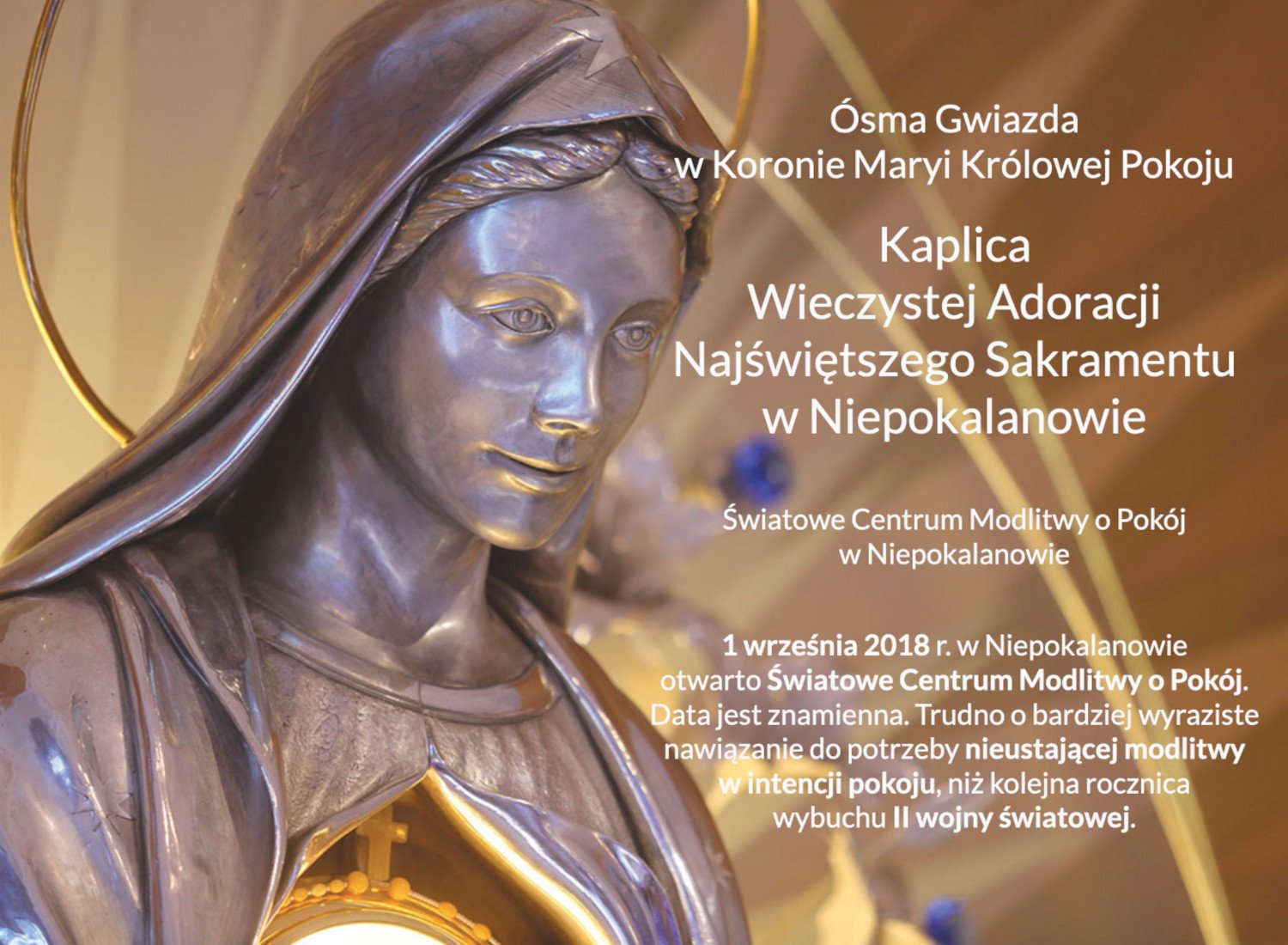

The Eucharistic Adoration Chapel established by Saint Maximilian Kolbe was inaugurated at the outbreak of World War II. It was restored as a Chapel of Adoration in September, 2018, the commemoration of the date that the war began. It is now part of the World Center of Prayer for Peace. The live internet feed of the Adoration Chapel at Niepokalanow — sponsored by EWTN — was established just a few weeks before we discovered it and began to include in at Beyond These Stone Walls. Click “Watch on YouTube” in the lower left corner to see how many people around the world are present there with you. The number appears below the symbol for EWTN.
Click or tap here to proceed to the Adoration Chapel.
The following is a translation from the Polish in the image above: “Eighth Star in the Crown of Mary Queen of Peace” “Chapel of Perpetual Adoration of the Blessed Sacrament at Niepokalanow. World Center of Prayer for Peace.” “On September 1, 2018, the World Center of Prayer for Peace in Niepokalanow was opened. It would be difficult to find a more expressive reference to the need for constant prayer for peace than the anniversary of the outbreak of World War II.”
For the Catholic theology behind this image, visit my post, “The Ark of the Covenant and the Mother of God.”