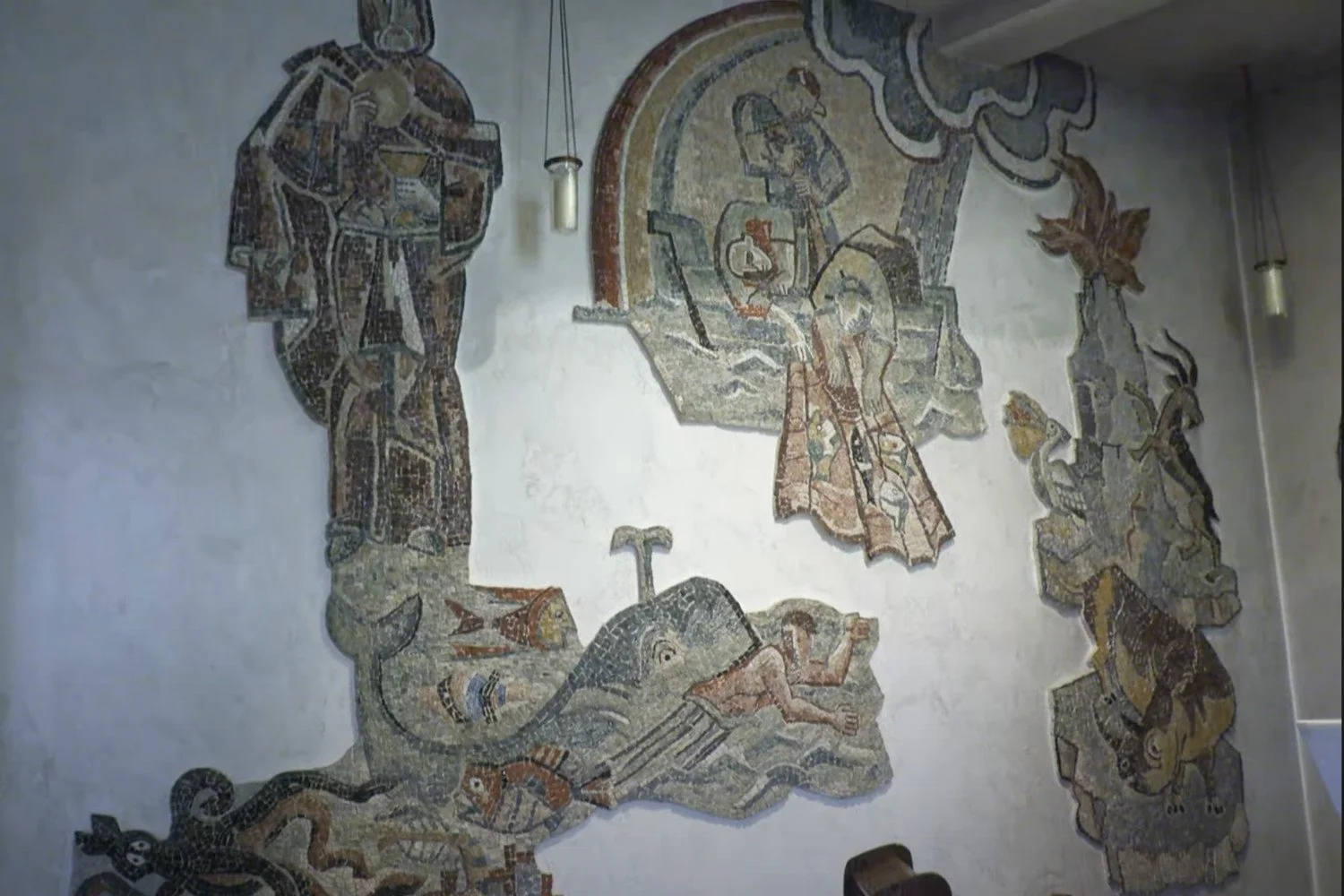
“There are few authentic prophetic voices among us, guiding truth-seekers along the right path. Among them is Fr. Gordon MacRae, a mighty voice in the prison tradition of John the Baptist, Maximilian Kolbe, Alfred Delp, SJ, and Dietrich Bonhoeffer.”
— Deacon David Jones
Saint Maximilian Kolbe is the Man in the Mirror
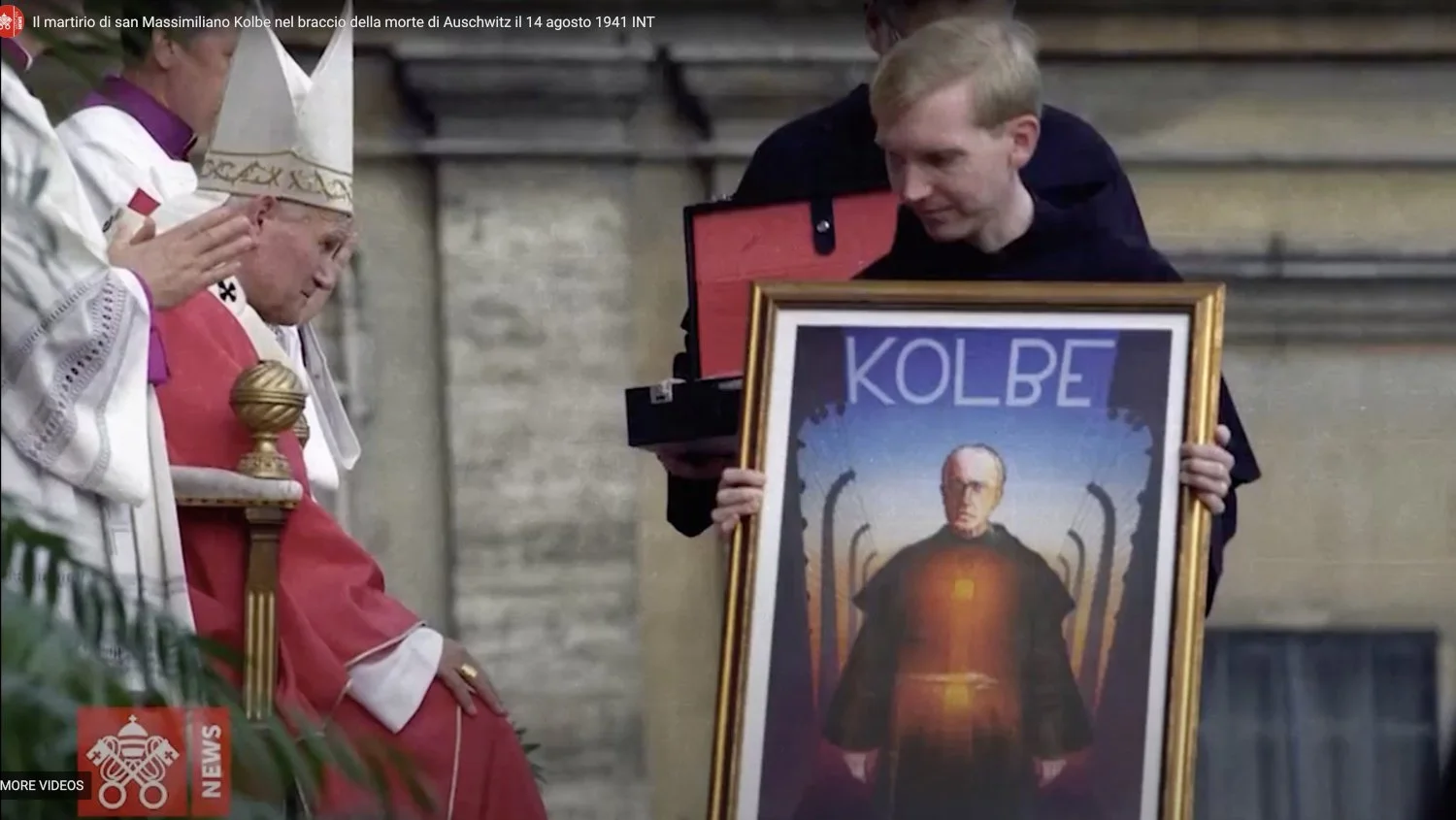
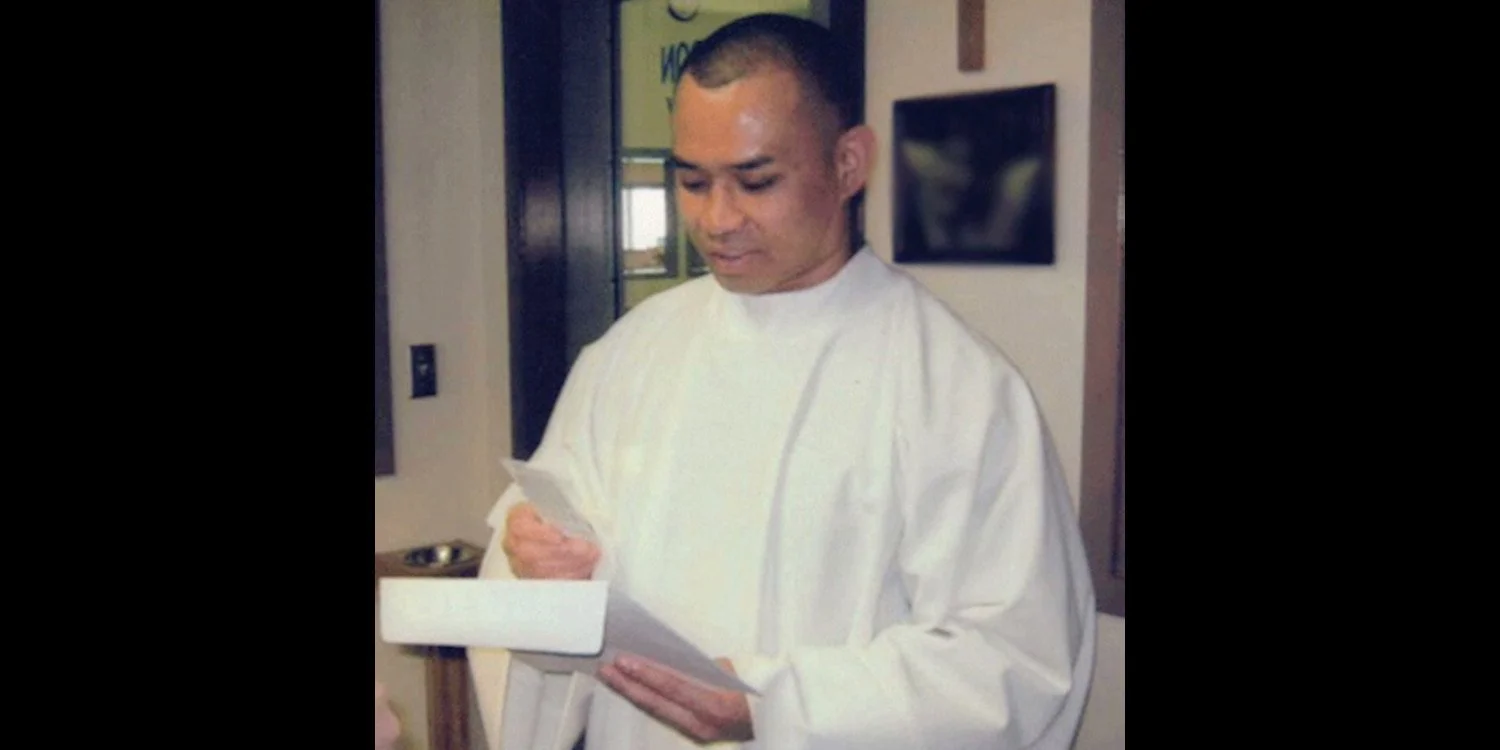
At the canonization of St Maximilian Kolbe, Pope John Paul II was gifted with a portrait of the new saint by Fr James McCurry, a friend of Beyond These Stone Walls.
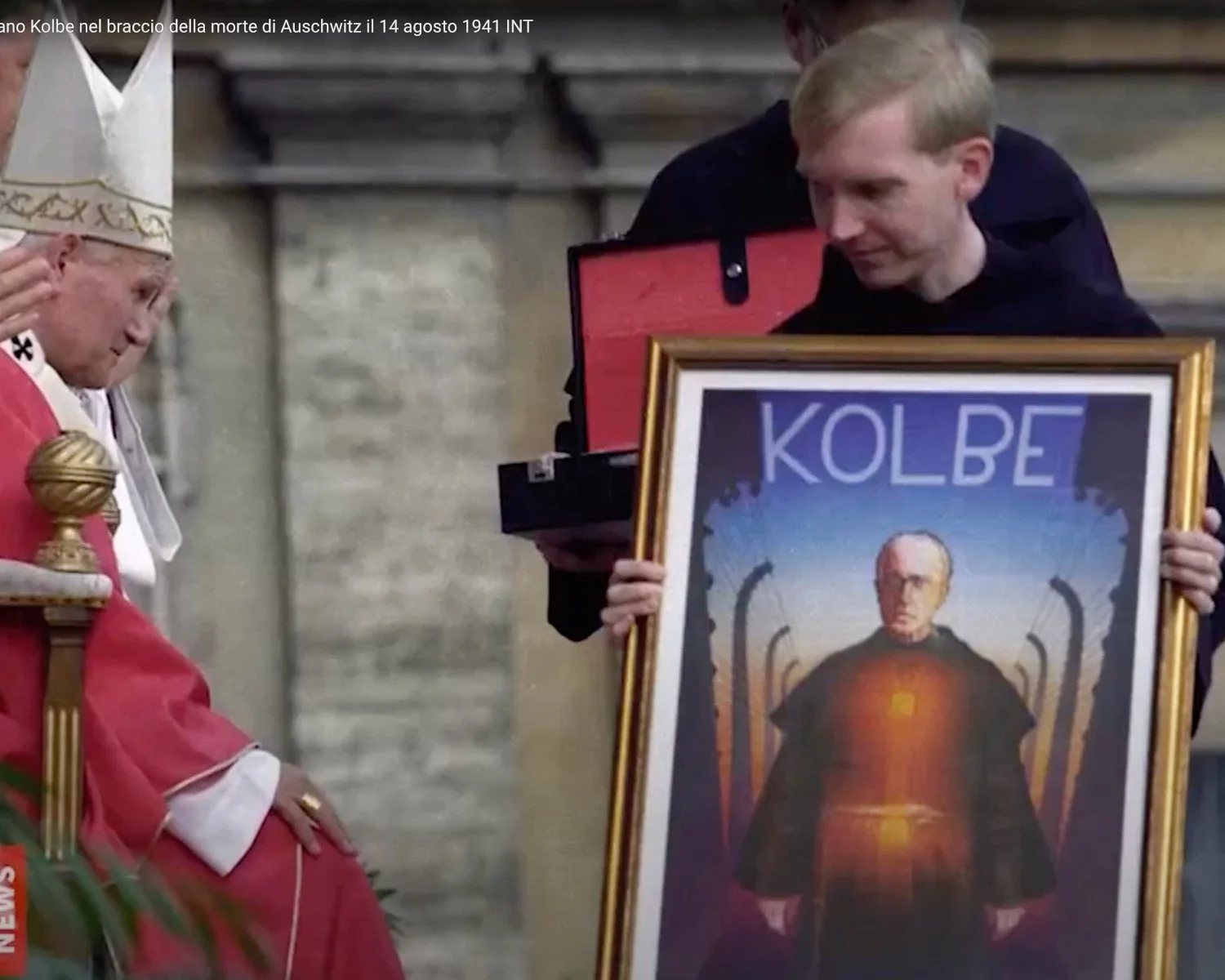
At the canonization of St Maximilian Kolbe, Pope John Paul II was gifted with a portrait of the new saint by Fr James McCurry, a friend of Beyond These Stone Walls.
August 12, 2026 by Father Gordon MacRae
As many of our readers know, this blog began early in the month of August in 2009. It came into being as a result of a phone call to Australia. The person I called in Sydney had read an article I wrote for Catalyst, the Journal of the Catholic League for Religious and Civil Rights. It was her daunting suggestion that I write a blog that would be published weekly from prison. I had no idea then how that could happen. I had already been in prison for 15 years then, and Pornchai Moontri had already been my roommate for two years.
So after my phone call to Australia, I returned to our cell and told Pornchai what had been suggested to me. Neither of us knew what a blog was. They did not exist when we first went to prison. But I told Pornchai of what had been described to me: that this could be our voice to the world from behind these prison walls. Neither of us were taking this seriously, but I asked Pornchai that if I went ahead with this project, what should I call it? He immediately suggested “These Stone Walls.”
I wrote a weekly post from 2009 to 2020 when somehow this blog ran into a wall of resistance. It had to be taken down and started anew. Both Pornchai and I thought it was the end of our voice in the wilderness, but just weeks later in September 2020 it was restored with a new name: Beyond These Stone Walls. It also had a new editor, and in the same week that all of this happened, Pornchai was taken away on September 8, 2020, at 5 AM. He was taken for ICE detention (Immigration and Customs Enforcement) where he prepared for his deportation to Thailand after 36 years in the U.S., 30 of them in prison. I wrote at the time of all that we had been facing in a widely acclaimed post, “Life Goes On Behind and Beyond These Stone Walls.”
Since then another six years have passed. Pornchai has been back in Thailand for six years at this writing, and I have now been writing these weekly posts for 17 years. At this time each year Pornchai and I both honor our patron saint, Maximilian Kolbe, who surrendered his life at Auschwitz to save the life of another prisoner.
What follows are the first three posts ever written for this blog. I think you will see why we combined them to publish anew here this month.
+ + +
St. Maximilian Kolbe and the Man in the Mirror
First published August 2009.
For someone on the outside looking in, it must seem an odd place to begin. Virtually every prison cell has one: a small stainless steel sink with a matching toilet welded to its side. Bolted to the cinderblock wall just above it is a small stainless steel mirror, dinged, dented, and scraped so badly that the image it reflects is unrecognizable.
I began each day in prison at the break of dawn by shaving in front of that mirror. That morning ritual had been repeated 5,412 times [when I first wrote of it in 2009. At this writing, I have been here for 11,750 days, but I no longer shave in front of that mirror. Rules for shaving changed sometime back. I now keep a close-cropped white beard, somewhat like the one Sean Connery wore, but without his cool Scottish accent.] Back then, I seldom cut myself shaving — a minor miracle as I could see very little of my self in that mirror. I often think of St. Paul’s cryptic image in his first letter to the Church in Corinth (13:12): “For now I see dimly, as in a mirror, but then I shall see face to face.” It is a hopeful image.
I sometimes find that my mind calculates dates and their meanings on a sort of autopilot. There came a day when I stood at the mirror to shave and realized that on that day — it was December 23, 2006 — I had been a priest in prison for the exact amount of time that I was a priest “on the streets” as prisoners like to describe their lives before prison.
From that day until now, I wonder which I see more of in that flawed mirror. Do I see the man who is a priest of 27 years? [Now 44 years] Or do I see only Prisoner 67546, the identity imposed upon me behind prison walls?
A strange thing happened on the day after I first reflected — as best I could in that mirror — on who I see. It was Christmas Eve, December 24, 2006, the day that the equation changed. It was the day that I was a priest in prison longer than anywhere else. That night at prison mail call, I had a few Christmas cards. One of them was from Father James McCurry, a Conventual Franciscan priest who once visited me in prison.
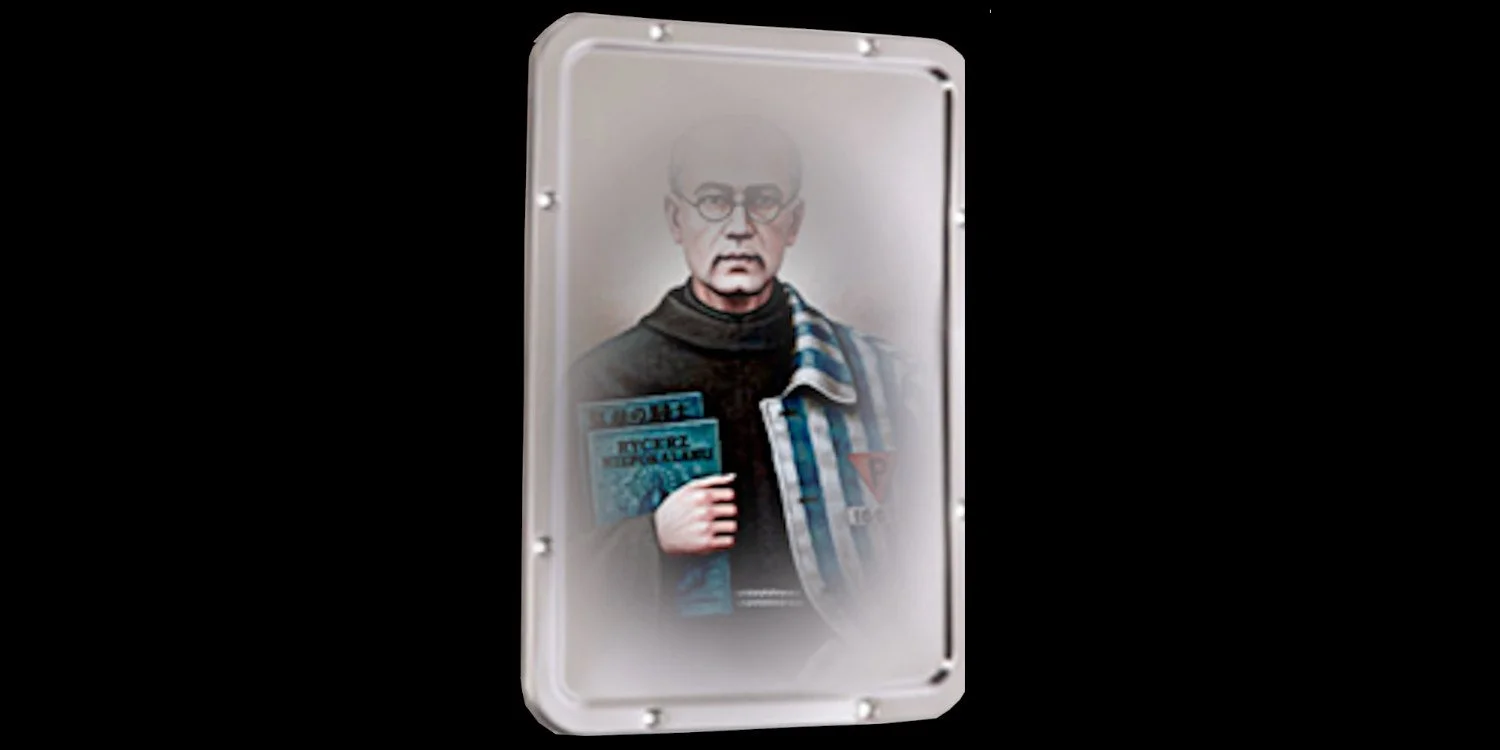
Inside Father McCurry’s Christmas card was a prayer card that is now one of my enduring treasures. It is taped to the stone wall just above the mirror in my cell and has been there ever since. In later years I was moved to other places, but the card always came with me. The holy card has an image of St. Maximilian Kolbe who offered himself for execution by starvation in place of another prisoner in Auschwitz in 1941. The card depicts Father Kolbe in his Conventual Franciscan habit. He has one sleeve in the striped jacket of his prison uniform with the number 16670 emblazoned across it. There is a scarlet “P” above the number indicating his Polish nationality. He was also a priest and a falsely accused prisoner. Does either designation extinguish the other? Father Kolbe is at once both, though only one identity was chosen by him.
The image is a haunting image for it captures fully that struggle I have so keenly felt. Father Maximilian appeared in my cell just a day after I asked the question of myself. Who am I? I thought at the time, that it was a rhetorical question, but it was a prayer. As such, it begged a reply — and got one.
Saint Maximilian and This Man’s Search for Meaning
Not long after that card first arrived, so did my friend Pornchai Moontri. He had just spent 13 years in solitary confinement in the Maine State Prison since he was age 18. When they could no longer hold him in the cruelty of such a place, they sent him here where he ended up with me. On the day he arrived in my cell, he dropped his trash bag of belongings, stared at the image above the mirror and asked, “Is this you?” That, too, was not a rhetorical question.
How I came to be in this prison is a story told elsewhere, by me and by others. How I “met” Father Maximilian Kolbe 60 years after he surrendered his life at Auschwitz is a story about actual grace. In his Catholic Catechism, Jesuit Father John Hardon defined actual grace as God’s gift of “the special assistance we need to guide the mind and inspire the will” on our path to God. Sometimes, it is very special.
My first years in prison are a blur in my memory. There is no point trying to find words to express the sense of loss, of alienation, of being cast into a dark abyss that was not of my own making — a loss that could not be grounded in any reality of my own. Thousands of days and nights had passed in the abyss before what Father Hardon described as “special assistance” crossed my path.
Someone, somewhere — I don’t know who — sent the prison’s Catholic chaplain (a layman then) a book entitled Man’s Search for Meaning by Viktor Frankl, M.D. Somewhere in my studies, I heard of this book, but only a prisoner can read it in the same light in which it is written. The chaplain called me to his office. He wanted to know whether he should recommend this book, but didn’t have time to read it. He wanted my opinion.
It had been years since anyone had asked my opinion on anything. I didn’t read Dr. Frankl’s book so much as devour it. I read it through three times in seven days. As a priest, I often counseled others that grace is a process and not an event. It is not always so. I was meant to read Man’s Search for Meaning at the precise moment that it landed upon my path. A week earlier, I would not have been ready. A week later may have been too late.
I was drowning in a solitary sea of hopelessness. I was not going to make it across. My priesthood and my soul were dying. The Book, as I have come to call it, is Viktor Frankl’s vivid account of how he alone among his family survived imprisonment in Auschwitz. This was an imprisonment imposed on him for who he was: a Jew.
There is a central message in this small book. A profound message, so clear in meaning, that it has within it the hallmark of inspired truth. Like Saul thrown from his mount, I remember sinking to the floor when I read it.
“There is a freedom that no one can ever take from you: The freedom to choose the person you are going to be in any set of circumstances.”
This changed everything. Everything! You will see how later. At the very end of his book, Dr. Frankl revealed the name of his inspiration for surviving Auschwitz. He wrote of Sigmund Freud’s cynical view that man is self-serving. And a man’s instinctual need to survive will trump “quaint notions” such as grace and sacrifice every time. For Dr. Frankl, Auschwitz provided the proof that Freud was wrong.
That proof was Father Maximilian Kolbe.
The Sacrifice of Saint Maximilian
“Greater love has no man than this: that a man lay down his life for another.”
— John 15:13
As a young priest in 1982, I was only vaguely familiar with the name Maximilian Kolbe. I remember reading of his canonization by Pope John Paul II, but Father Kolbe’s world was far removed from my modern suburban priesthood. I was far too busy to step into it.
I didn’t know that nearly two decades later, Father Kolbe’s life, death, and sainthood would be proclaimed triumphantly on the wall of my prison cell, and not only by me. I also didn’t know this would help define the person I choose to be in prison.
Being a Jew and not a Catholic, Dr. Viktor Frankl in Man’s Search for Meaning, said nothing about Maximilian’s sainthood or any miracles attributed to his intercession. Instead, Dr. Frankl was moved by the profound sacrifice of Maximilian, which defies the narcissism of our times.
For those unfamiliar with him, the story is simple.
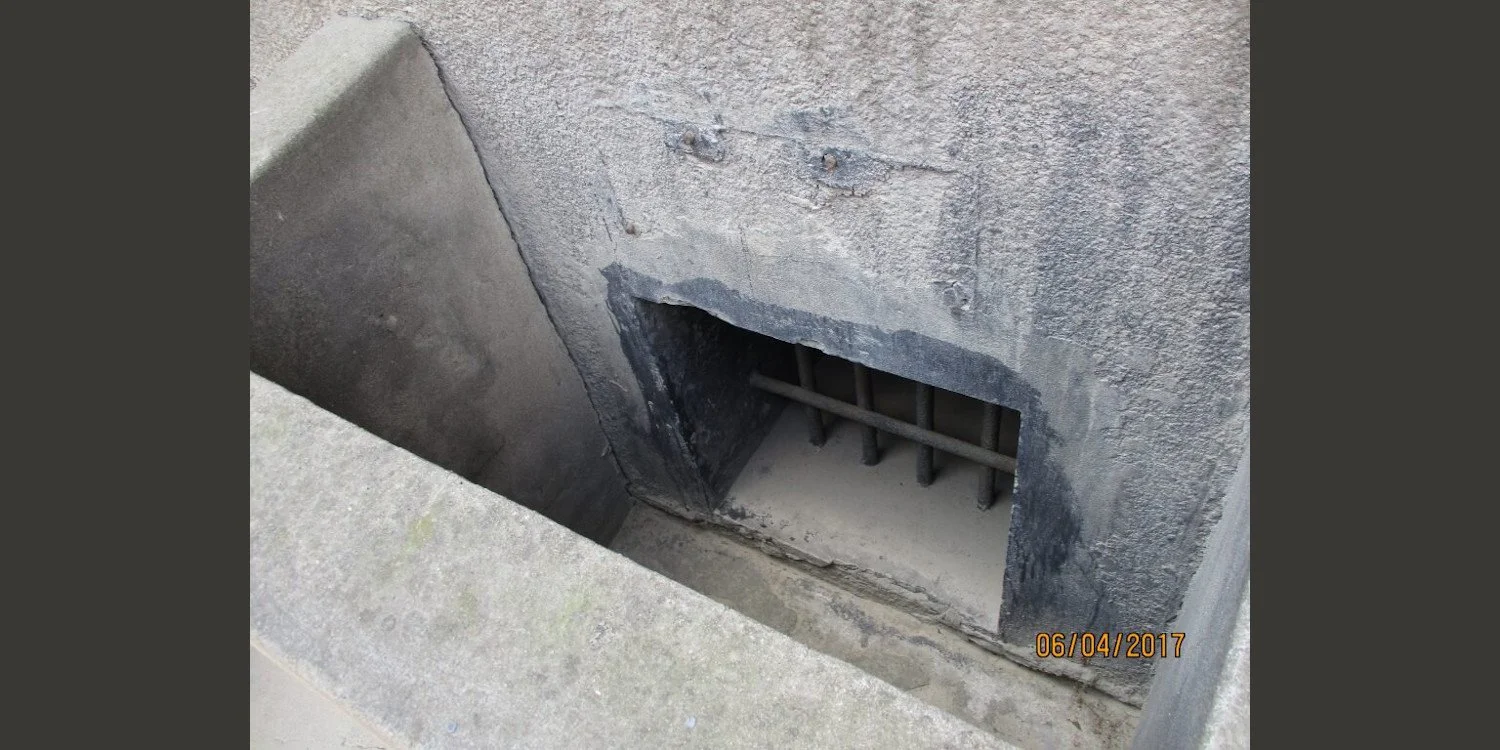
The prisoners of Auschwitz were packed into bunkers like cattle. To encourage informants, the camp had a policy that if any prisoner escaped, 10 others would be randomly chosen for summary execution.
At the morning roll call one day, a prisoner from Maximilian’s bunker was missing. Guards chose 10 men to be executed. The 10th fell to the ground and cried for the wife and children he would never see again. Father Kolbe spontaneously stepped forward and said,
“I am a Catholic priest, and I would like to take the place of this man.”
Two weeks later, he alone was still alive among the 10 prisoners chained and condemned to starvation. Maximilian was injected with carbolic acid on August 14, 1941, and his remains unceremoniously incinerated.
For the unbeliever, all that Maximilian was went up in smoke and ash in the bleak sky above Auschwitz. Viktor Frankl shared some other corner of that horrific prison. The story of the person Father Kolbe chose to be rippled through the camp. This story offered proof to Viktor Frankl that we can be as much inspired by grace as doomed by despair. We get to choose which will define us.
Within days of reading Man’s Search for Meaning and learning of Father Kolbe’s sacrifice, I received a letter from out of the blue. Conventual Franciscan Father James McCurry had been in an airport in Ireland when he heard an Irish priest nearby mention that he corresponds with a priest in a Concord, New Hampshire prison. Father McCurry said he was on his way to visit his order’s house in Granby, Massachusetts and would arrange to visit the Concord prison.
Weeks later, Father McCurry and I met in the prison visiting room. When I asked him what his “assignment” is, he said,
“Well I just finished a biography of St. Maximilian Kolbe. Have you heard of him?”
Father McCurry went on to say that he was involved in Father Maximilian’s Cause for Sainthood, and was officially appointed by the Vatican to be Vice-Postulator for Maximilian’s Cause. He had met the man whose life was saved by Father Kolbe.
A few years later, Father McCurry arranged a Father Maximilian Kolbe exhibit at the National Holocaust Museum. It was then that he sent me the card depicting Father Maximilian clothed in his Franciscan habit with one sleeve in his prison uniform. I keep the card above my mirror in my cell.
I can never embrace these stone walls. I can’t claim ownership of them. Passively acceding to injustice anywhere contributes to injustice everywhere. Father Maximilian never approved of Auschwitz.
One cannot understand how I now respond to these stone walls, however, without hearing of Father Maximilian’s presence here.
Above my mirror, he refocused my hope in the light of Christ. The darkness can never overcome it.
What hope and freedom there is in that fact! The darkness can never, ever, ever overcome it!
+ + +
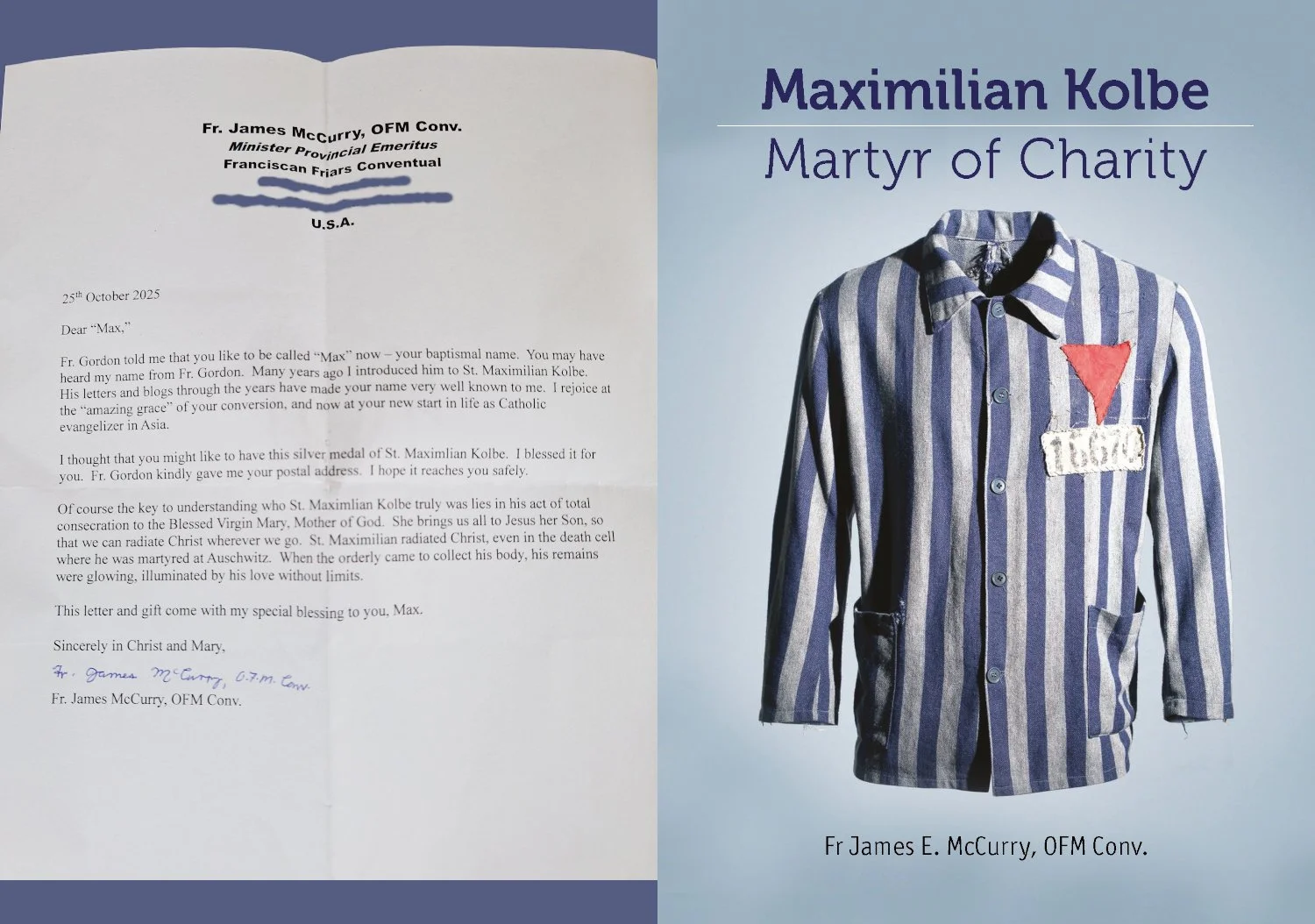
Note from Father Gordon MacRae: I will be offering Mass late at night on August 14, the Feast of Saint Maximilian Kolbe, which is also the Vigil of the Solemnity of the Assumption of Mary, his Immaculata and ours. Regarding the letter from Father James McCurry at the end of this post, I only just now realized that it had not come to me from our editor; rather, Father McCurry sent it by U.S. mail to Pornchai Maximilian in Thailand, where it arrived after weeks with all its wrinkles still intact. Pornchai was so proud of it that he quickly took a photo and mailed it to me in prison.
You may also like these related posts in honor of our Patron Saint:
Saint Maximilian Kolbe’s Gift of Noble Defiance
The Assumption of Mary and the Assent of Saint Maximilian Kolbe

Priesthood in the Real Presence and the Present Absence
A new Manual for Eucharistic Adoration from the Poor Clares and Saint Benedict Press has found a captive audience in Fr Gordon MacRae as he marks 34 years of priesthood.

A new Manual for Eucharistic Adoration from the Poor Clares and Saint Benedict Press has found a captive audience in Fr Gordon MacRae as he marks 34 years of priesthood.
June 1, 2016 by Fr. Gordon MacRae
“You have GOT to be joking!” That was my first reaction. In early April this year, I was summoned to a prison office to sign for “personal property.” I had no idea what it could be. I hadn’t ordered anything recently from the place where we in prison must purchase shoes, clothing, toiletries. So it had to be a book, but receiving books here also requires that I know in advance that the book is coming. I knew of nothing.
I signed for the mysterious item and returned to my cell where I sat down on a concrete stump — the same one I am typing upon at this moment. “You have GOT to be joking’” I said to myself as I perused the book in my hand and its cover letter. It was from Christian Tappe, Director of Marketing at Saint Benedict Press in Charlotte, North Carolina. The letter began:
“I am pleased to enclose this review copy of TAN Books’ Manual for Eucharistic Adoration… written by the Poor Clares of Perpetual Adoration. If you would like more information, or to schedule an interview…”
I was more bewildered than ever. It was the fourth time in the last year that a Catholic publisher has sent me a book to review on These Stone Walls. Are people actually reading TSW? But this particular book was a complete mystery. First off, I should not have received it at all. The shipment and cover letter were addressed to “Father” Gordon MacRae with no prison number (67546) as required on anything sent to me. In the ordinary course, either the use of a title or the absence of a number would cause the book to be rejected and returned to sender without my even knowing about it. But here it was, in my hand nonetheless.
My first impulse was to toss the book aside as useless, at least for me. My apologies to the Poor Clares who so lovingly wrote it, and to the publisher who so kindly sent it to me. I am a slow learner, so the nicely adorned book sat unopened in a corner of my cell for a month. I was simply too caught up in the glaring irony of it. There is no True Presence here to adore. There is only the present absence.
To make matters worse, and more mysterious, on the same day I received the Manual for Eucharistic Adoration I learned from lawyers that we had lost yet another effort at appeal of my wrongful conviction and imprisonment. It took one full year for the First Circuit Court of Appeals to notify us that they will not review an earlier decision to dismiss my appeal with no hearing on its merits or evidence. This has made the road to justice ever steeper and more treacherous. I am told that others will be taking this up to write about it.

In the Nighttime
So it was in the dim and murky light of continued injustice that I tossed aside the good sisters’ book about Eucharistic Adoration, and shrugged it off. But appearances can be deceiving, and you never know what apparently “useless” thing might have a profound influence on your view of the world — not only the world you live in, but the world that lives in you. Who you are is in large part a collision of these two worlds, and a person of faith risks great loss if the interior life is forfeited to live only in that other, more calamitous world. We have to live in and with both worlds, and we have to keep them in balance.
One day recently, I saw a vocation ad in Our Sunday Visitor for a community of sisters. The ad described them as a “monastic, cloistered and contemplative community,” and then added, “Find us on Facebook!” That, to me, seemed a collision of two worlds, but it works if the sisters can reflect in the latter world the light that shines in the former.
On June 5th I mark thirty-four years of priesthood. Twenty-two of them have been in a place where presence before the Blessed Sacrament is unavailable and simply impossible. It can only be imagined. It has been a long time since I wrote of the power of the True Presence in a place where it seems absent. In 2010 I wrote a post entitled “The Sacrifice of the Mass” (Part I and Part II), and it seemed a pivotal point not only for These Stone Walls, but for my life as a priest in extraordinary circumstances.
The two-part post described the utter deprivation of something many readers simply took for granted in their world. For my first seven years in this prison, Mass was unavailable to me, and without it I found myself growing ever more distant from my life as a priest. That post described the extreme efforts it took to gain the ability to offer Mass, beginning with what I today call a “spiritual offering.”
It wasn’t what you might think. It was along the lines of a “Spiritual Communion,” and I got the idea from reading Father Walter Ciszek’s book, He Leadeth Me. During twenty years in a Siberian prison accused of being a Vatican spy, Father Ciszek could only imagine the Mass. Sitting in the pitch dark at night on his bunk, he began to recite The Roman Canon in his mind, and to imagine himself present before the Blessed Sacrament. After reading this, I began to do the same, and my post, “The Sacrifice of the Mass” evolved from that. After I wrote that two-part post, a TSW reader sent me a letter, an excerpt of which follows:
“I cannot imagine what sustains your identity as a priest in that prison. There is nothing in that environment that in any way supports your priesthood. You are not ever in the company of other priests. Your diocese and fellow priests have cast you off. You see yourself each day in the mirror wearing the uniform of a prisoner, and you know in your mind, heart and soul that there has been no justice in your being forced to wear this role.
“And yet when I read your writings, your priesthood is always at the forefront, the part of you that shines the brightest, that speaks the loudest, that sustains not only you but apparently many of those around you in that place. Can you explain, Father MacRae, what exactly allows you to retain a priestly identity?”

Come Be My Light
I do not have an answer for this. After I wrote my recent post, “Mother Teresa of Calcutta: Pentecost Illumines the Night,” some readers wrote in comments that they are moved by my faith. It is not so obvious. At least, it is not obvious to me. I struggle with faith on a daily basis, and I found a kindred spirit in Saint Mother Teresa when I learned that she struggled as well. The truth is that it was the Poor Clares’ Manual of Eucharistic Adoration that caused me to look more deeply into the faith life of soon-to-be Saint Mother Teresa. The Manual includes an admonition from her, and it was this quote that prompted me to write “Mother Teresa of Calcutta: Pentecost Illumines the Night.”
“The time you spend with Jesus in the Blessed Sacrament is the best time you will spend on earth. Each moment that you spend with Jesus will deepen your union with Him and make your soul everlastingly more glorious and beautiful in heaven, and will help bring about everlasting peace on earth.”
Manual, p. 111
It was from writing that post that I fathomed the necessity of Eucharistic Adoration. It is not for us to be present to Him. It is for Him to be present to us in a way that “will deepen your union with Him.” That is the very purpose of the interior life, that other world that we must balance with our other foot in this world.
While writing my Pentecost post, I learned of the spiritual deprivation often experienced by Mother Teresa, but that deprivation never seemed able to diminish her commitment to serve the poor. Rather, the opposite happened. It was her service to the poor that brought her to the Paschal Mystery and kept her there, ever providing the beckoning of Christ that compelled her spiritual life. Mother Teresa sought union with Christ in the Blessed Sacrament, and brought Christ from there to the poor. It was never the other way around.

Eucharistic Adoration
So how could I, as a priest wrongly imprisoned for decades, possibly bring my interior life into this world where the True Presence is so overshadowed by the present absence? No matter what the source of the sense of emptiness is in your life, if you are reading this you know what I mean by “the present absence.” That is why God allowed Mother Teresa and others among our patron saints to suffer spiritual deprivation, and to endure it. It was so that we might emulate them as they serve as beacons in spiritual darkness. Their witness inspires hope in the dark, not just our rescue from it.
As has happened on so many nights in prison, I awoke one night recently, filled with an anxiety that has no name. It’s not related to anything I can identify. It’s just there, a natural side effect of the stifling nature of an American prison. I have a little battery-powered book light purchased from the same prison vendor from which we purchase clothing and other needs. Waking often in the night, I have gotten hundreds of times my money’s worth from that small light.
I switched on the light in that anxious night, and reached for my glasses and a book on a small shelf at the end of my iron bunk. I thought I had grabbed another book, but my hand landed on the previously untouched Manual for Eucharistic Adoration by the Poor Clares. It has a ribbon page marker so I opened to the ribbon and was struck by this admonition from Saint John Vianney, the Curé of Ars and the patron saint of priests:
“When you awake in the night, transport yourself quickly in spirit before the tabernacle, saying, ‘Behold, my God, I come to adore you, to praise, thank, and love you, and to keep you company with the angels.’”
Manual, p. 116
So that night I tried to imagine a time and a place in which being before the Blessed Sacrament was most meaningful to me. Sadly, it was long ago. It wasn’t during my years as a parish priest when time and again I passed by the sanctuary and tabernacle barely noticing, blindly going from one pastoral task to another, not even genuflecting, not even knowing that I failed to bring Christ with me because I failed to stop and enter into His Presence. At some point in my life as a priest, this world collided with that one, and demolished it. This has been the real priesthood scandal. Action somehow overshadowed contemplation to our priestly peril.
It was only years later, after year upon year of absence, that I became aware of this deprivation of the Presence of God. So in that night of prison anxiety my mind fled down the nights and down the days, past the parishes where I served, and the seminary I attended, to a Benedictine Abbey just twenty miles from this prison. The journey in my mind took me to 1977. I was a Capuchin then, attending school at Saint Anselm College, and my most special place on campus was a tiny alcove built into the Abbey Church.
There, before a magnificent granite tabernacle, I spent many hours in the Presence of the Lord. Last year, a reader found a photograph of the interior of the Saint Anselm Abbey Church and printed it for me. It is the opening graphic for this post. Then our Missionary of Mercy Friend, Father George David Byers, found a photo of the Blessed Sacrament alcove to the right of the main sanctuary. This is where I went back then, before the world shook lose the Holy Longing to be in His Presence. This is where I go now when I awaken in the night. Sometimes, now, I don’t think I awaken with anxiety and then go there. I think I now awaken just to go there.
In just a few months, These Stone Walls will mark seven years in publication, just one third the time that I have been in this prison. During that seven years, many readers have sent me letters and comments informing me that they have devoted an hour before the Blessed Sacrament to be in His Presence in my stead. You have bestowed upon me a most priceless gift, and for this I have much gratitude.
Now the Poor Clares of Perpetual Adoration, along with author Paul Thigpen and Saint Benedict Press, have provided a road map to the interior life, and a tool to converse with the Living Christ among us. I most highly recommend the Manual for Eucharistic Adoration and, if you are not there already, the restoration of the Lord’s Presence in your interior life.
I humbly thank you for thirty-four years of priesthood, even out here on the dark peripheries from which I write. Without you, I might have forgotten how to be a priest, and might today be just a prisoner. There are two kneelers before the Blessed Sacrament at Saint Anselm Abbey Church in Manchester, New Hampshire. Some night when anxiety awakens you in the dark, join me there. I’ll have the Manual for Eucharistic Adoration in my hands.