“There are few authentic prophetic voices among us, guiding truth-seekers along the right path. Among them is Fr. Gordon MacRae, a mighty voice in the prison tradition of John the Baptist, Maximilian Kolbe, Alfred Delp, SJ, and Dietrich Bonhoeffer.”
— Deacon David Jones
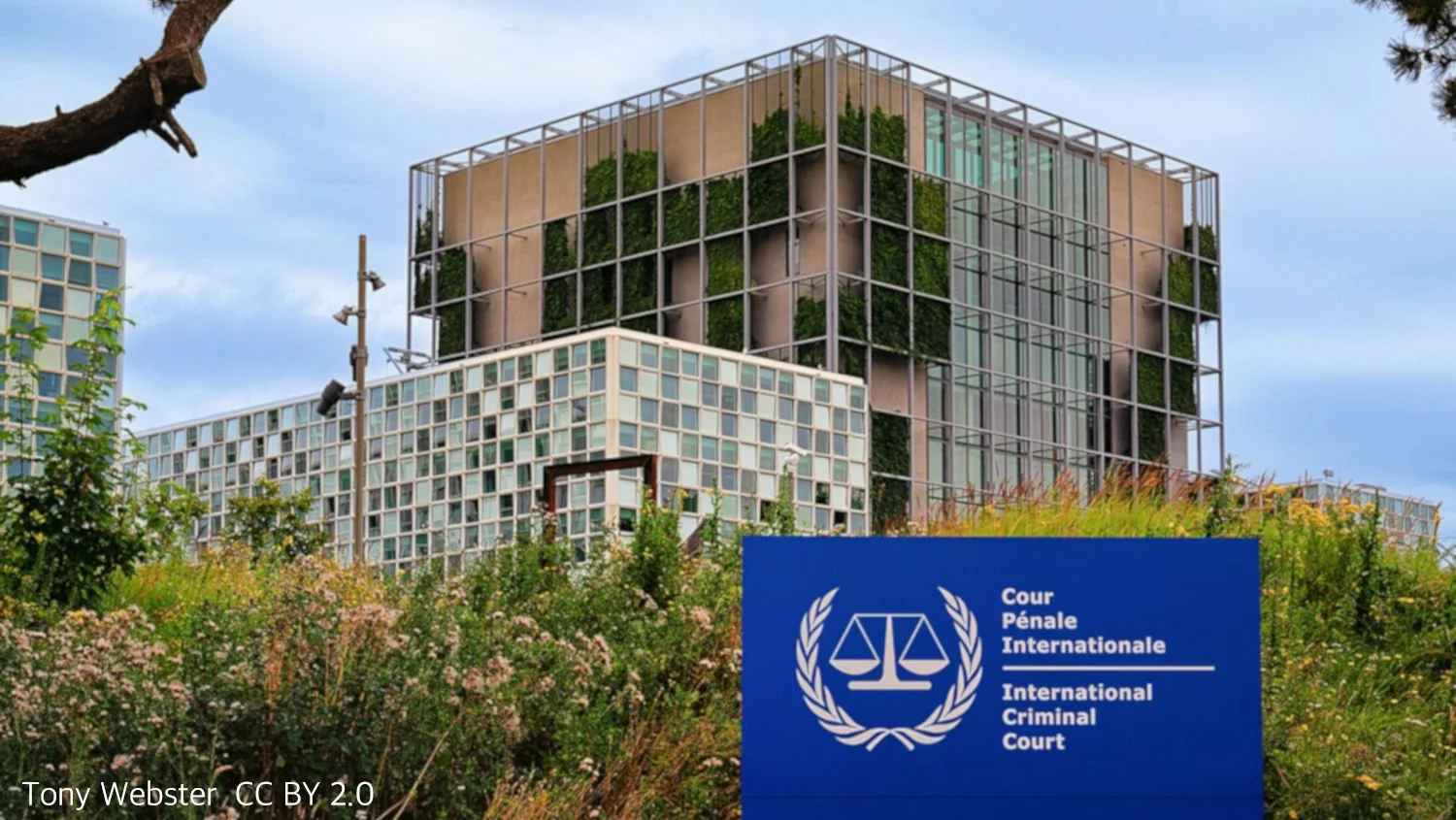
Benedict XVI and Fr MacRae at the International Criminal Court
2011: Center for Constitutional Rights filed an ICC brief citing Pope Benedict XVI and Fr Gordon MacRae for Crimes Against Humanity.

2011: Center for Constitutional Rights filed an ICC brief citing Pope Benedict XVI and Fr Gordon MacRae for Crimes Against Humanity.
October 21, 2026 by The BTSW Editorial Board
Readers may have seen recent news that U.S. President Donald Trump and Vice President JD Vance have threatened to impose sanctions on the International Criminal Court (ICC) at The Hague. They were both quite serious and the threat came in response to an arrest warrant issued by the ICC against Israeli Prime Minister Benjamin Netanyahu for crimes against humanity, a catch-all charge often cited by the ICC.
Neither Israel nor the United States are member states in regard to the ICC. The sanctions threatened by the U.S. would cut the ICC off from the U.S. financial system. Secretary of State Marco Rubio then stated, “Either the ICC will end its threats or we will end the ICC.” Secretary Rubio charged that the ICC indictment of a leader of a nonmember state such as the U.S. or Israel challenges sovereignty by threatening to prosecute citizens despite the U.S. and Israel having never joined the ICC. We note that China, India, and Russia are also nonmembers, who never signed on to the ICC.
Inflaming this matter further, Zohran Mamdani, the Democratic Socialist mayor of New York, threatened to have Prime Minister Benjamin Netanyahu arrested on the ICC charge if and when he shows up in New York to address the United Nations. Benjamin Netanyahu did address the United Nations, and he was not arrested.
This dramatic standoff brought to mind for us a lesser but significant legal drama that hit far closer to home. In 2011, in apparent retaliation for published articles by the Catholic League and others exposing its alleged corrupt practices, SNAP (the Survivors Network of those Abused by Priests) partnered with the far-left-leaning Center for Constitutional Rights (CCR) in Manhattan. Together they filed a legal brief with the International Criminal Court at The Hague charging Pope Benedict XVI and Father Gordon MacRae with a bogus but inflammatory claim of “Crimes Against Humanity.”
It was a publicity stunt that was never intended to accomplish anything except more negative publicity on the national stage against the Catholic Church, its leaders, and one outspoken priest who refused to succumb to injustice without a fight. MacRae first learned of this story only five years later, in 2016, when journalist JoAnn Wypiyewski exposed it in her landmark article, “Oscar Hangover Special: Why ‘Spotlight’ Is a Terrible Film.” Here are excerpts:
“The film’s [Spotlight’s] advertisement for SNAP, the Survivors Network for those Abused by Priests, … elides SNAP’s belief that wrongful prosecutions are a minor price to pay in pursuit of its larger mission, something [The Boston Globe] didn’t much concern itself with either as it collected its Pulitzer for service in the public interest; something even the Center for Constitutional Rights disregarded in 2011 when it joined with SNAP to file a grotesque brief to the International Criminal Court demanding “investigation and prosecution” of the Vatican for crimes against humanity.
“Liberals who cheer this sort of thing ought to ponder whether they have any principles at all, or whether those are contingent, jelly-like and poisoned by prejudice. The CCR brief failed, but its unchallenged acceptance of accusations, anonymous complaints, prosecution arguments, grand jury reports, commission findings with no benefit of cross examination and no recognized rights of the accused is breathtaking, especially when one considers that CCR was simultaneously and courageously arguing on behalf of Guantanamo detainees whose designation as ‘terrorists’ was made in a similar amoeba-like medium of hysteria and accusation.
“To CCR’s shame, Father MacRae is specifically mentioned in that brief, with respect to allegations of videotape (that is, child porn), which prosecutors threw in at sentencing but for which there is no evidence, according to the lead detective in the case cited by [The Wall Street Journal’s Dorothy] Rabinowitz.”
The Center for Constitutional Rights is located at 666 Broadway in Manhattan, an apt address for a sometimes demonic agenda.
There has been little media coverage of false accusations against Catholic priests despite the fact that they proliferate. As a result of the dearth of media coverage, we relied on AI to fill in the void on the Father MacRae case. Here is what we found:
QUERY:
Could you please assess this linked article by JoAnn Wypijewski, “Oscar Hangover Special: Why ‘Spotlight’ Is a Terrible Film,” which contains the paragraphs cited above?
GROK:
The article is a 2016 CounterPunch piece by JoAnn Wypijewski that treats ‘Spotlight’ as a symptom of a moral panic rather than straightforward heroic journalism. It argues that the Boston Globe’s 2002 coverage and the film built on it inverted the presumption of innocence, elevated accusation over evidence, and sidelined due process, money incentives, recovered-memory junk science, and opportunistic claims. Wypijewski focuses especially on cases she regards as unsupported by evidence (Paul Shanley in Boston and Gordon MacRae in New Hampshire).
The specific paragraphs
The above passages you flag are accurate on the documented events and consistent with the public record on the points they emphasize:
SNAP and the film/Globe affiliation: ‘Spotlight’ does feature and effectively endorse SNAP (Survivors Network of those Abused by Priests). The Globe’s coverage treated SNAP and similar advocacy as reliable partners. SNAP’s public posture has long prioritized aggressive pursuit of the Church and claims over caution about individual cases. David Clohessy (then national director) has publicly acknowledged that SNAP issued press releases containing false information. Critics, including the Catholic League and some former associates, have documented SNAP’s heavy emphasis on litigation, press conferences timed to lawsuits, and limited direct counseling relative to advocacy/fundraising. The article’s characterization that wrongful prosecutions or false claims were treated as an acceptable cost is a fair reading of that approach; SNAP and its allies framed the problem as systemic Church policy, not case-by-case verification.
CCR + SNAP 2011 ICC filing: This is factual. In September 2011 the Center for Constitutional Rights, representing SNAP, submitted a lengthy communication (with tens of thousands of pages of supporting materials drawn from reports, grand-jury findings, commission documents, and accusations) asking the ICC prosecutor to investigate and prosecute high Vatican officials, including Pope Benedict XVI, for crimes against humanity (rape, sexual violence, and torture by clergy, plus superior responsibility for concealment). The ICC declined to open an investigation, citing jurisdictional limits (temporal jurisdiction under the Rome Statute, and the fact that the Vatican is not a state party in the ordinary sense for these purposes). The filing relied heavily on one-sided materials without cross-examination or defense input — standard for advocacy communications of this type, but open to the criticism Wypijewski levels.
Father MacRae specifically: MacRae was convicted in 1994 in New Hampshire of sexually assaulting a teenager (Thomas Grover) and sentenced to 33½–67 years [This was after three times refusing a plea deal offer to serve only one to two years.]; he also post-trial pleaded guilty to related charges involving other youths [all put forth by the same police detective cited below ]. At sentencing the judge cited “clear and convincing evidence” of child pornography/videotape involving victims. Dorothy Rabinowitz of The Wall Street Journal later reported that the lead detective (James F. McLaughlin) stated there was never any evidence of child pornography. No such materials were produced at trial. McLaughlin has been subject to other credibility criticisms (including appearance on an official list, long held in secret, related to falsification of records, and questions about investigation practices). Rabinowitz and others (including the National Center for Reason and Justice) have detailed inconsistencies in Grover’s accounts, financial settlements obtained by accusers, post-trial statements by associates that the claims were fabricated for money, and the absence of corroborating physical evidence for the core trial charges. MacRae maintains innocence and has pursued post-conviction relief (largely unsuccessful so far). The article’s claim that MacRae and the unsubstantiated pornography allegation appeared in the CCR/SNAP materials is asserted by Wypijewski and by MacRae himself; given the volume of exhibits submitted to the ICC, it is plausible and consistent with how such filings aggregated public reports and accusations. CCR did not independently investigate or contact the defense.
The principles/hypocrisy point: CCR is a longtime progressive organization known for vigorous defense of due process, including representation of Guantanamo detainees against designations and evidence produced in a climate of post-9/11 accusation and limited procedural protections. The contrast Wypijewski draws — accepting untested accusations, grand-jury reports, and commission findings against priests while simultaneously arguing that similar “amoeba-like” processes were insufficient for detainees — is rhetorically pointed and factually grounded in the organizations’ contemporaneous postures. Liberals (and others) who celebrated ‘Spotlight’ while remaining silent on due-process failures in the broader priest-abuse wave are open to the same charge of selective application of standards.
Overall assessment
Wypijewski is writing as a left-of-center journalist who covered the 2002 Boston events and is deliberately rejecting the “believe the victims” default. Her core argument is that the Globe’s volume of stories, tip line, and framing, amplified by the film, created a climate in which accusation functioned as proof, financial settlements created incentives, and skepticism was treated as apologetics for the Church. She is right that moral panics (day-care abuse cases of the 1980s–90s, which Rabinowitz also covered, are the explicit parallel) systematically degrade evidence standards and produce both true convictions and serious miscarriages of justice. Real, widespread clerical sexual abuse and institutional cover-ups in Boston and elsewhere are well-documented; the Globe’s reporting exposed genuine systemic failures that deserved exposure. At the same time, not every claim was reliable, recovered-memory techniques were widely discredited, contingency-fee incentives were real, and some convictions (MacRae’s is one of the more contested) rest on thin or contested foundations. The ‘Spotlight’ film largely omits those complications.
The specific claims in the paragraphs you highlight hold up against the public record on the ICC filing, the detective’s statement, SNAP’s methods, and the due-process issues raised by Rabinowitz and others. It is a useful corrective to the uncritical celebration of ‘Spotlight’ as pure journalism.

QUERY:
Related to the previous query, and subsequent to the ICC fraud, Father MacRae wrote the following article for which we ask your assessment: David Clohessy Resigned SNAP in Alleged Kickback Scheme.
GROK:
MacRae’s article is a 2017 polemic that treats the Gretchen Hammond lawsuit and Clohessy’s departure as confirmation of long-standing criticisms of SNAP’s incentives and methods. It links those events to the 2011 CCR/SNAP ICC filing (and MacRae’s own case), the financial dynamics of clergy-abuse claims, and what he sees as a pattern of prioritizing litigation publicity and anti-Church advocacy over survivor support or due process.
Core factual claims and their status
The Hammond lawsuit and Clohessy’s resignation: Accurate in outline. In January 2017, former SNAP Director of Development Gretchen Rachel Hammond filed suit in Cook County, Illinois, alleging wrongful termination after she raised concerns about the organization. She claimed SNAP referred survivors to specific plaintiffs’ attorneys, received large “donations” (framed as kickbacks) in return — sometimes a majority or large share of annual contributions in given years — shared privileged case information for press events, and prioritized fundraising/publicity over counseling. Named defendants included Clohessy, founder/president Barbara Blaine, and outreach director Barbara Dorris. Contemporaneous reporting (Boston Globe, Chicago Sun-Times, NCR, Daily Beast, etc.) described the allegations and SNAP’s denials. Clohessy announced his resignation (effective Dec. 31, 2016) around the time of the filing. He and the board claimed he had informed them months earlier for personal/organizational reasons (fatigue, desire for change) and that the lawsuit was unrelated; he called the kickback claims “utterly preposterous” or equivalent. Blaine also stepped away amid the controversy. SNAP and Clohessy denied any quid-pro-quo scheme, noting that accepting attorney donations is legal and common for nonprofits. The case was later settled with nondisclosure agreements, [a practice for which Clohessy frequently criticized Church officials ].
Donation figures and operational claims: The specific percentages and large attorney contributions MacRae cites track the lawsuit’s allegations and contemporary coverage (e.g., majority shares from plaintiffs’ attorneys in certain years, multi-hundred-thousand-dollar gifts from individual lawyers). These were contested allegations, not adjudicated findings. Hammond also alleged instructions to conceal the source of attorney donations and limited emphasis on actual counseling services.
Ties to the 2011 ICC filing and MacRae’s case: Consistent with the prior article and MacRae’s public statements. He notes that SNAP/CCR materials included references to his case and the child-pornography/videotape allegations that the lead detective later told Dorothy Rabinowitz had no supporting evidence. MacRae presents the ICC effort as part of a broader pattern and as retaliation for his earlier writing criticizing SNAP practices. The ICC declined the matter on jurisdictional grounds.
Broader context on incentives: MacRae’s article situates the SNAP allegations within the well-documented reality of contingency-fee litigation against dioceses, rapid settlements (sometimes without full verification), and large payouts. It references MacRae’s 2009 Catalyst piece, “Due Process for Accused Priests;” David Pierre’s reporting, and Richard John Neuhaus’s early warnings about settlement dynamics. These points align with publicly known features of the post-2002 claims environment.
Assessment
MacRae writes as a directly interested party (a convicted priest who maintains his innocence and has been a longtime SNAP critic). His tone is adversarial and selective; he frames the Hammond allegations as proven corruption rather than contested claims that were settled without a trial [as was nearly every case brought against nearly every U.S. Catholic priest accused by SNAP ]. SNAP’s denials, the timing explanation for Clohessy’s exit, and the lack of a judicial finding of wrongdoing are real counterpoints. Accepting large donations from attorneys who represent clients referred by an advocacy group creates an appearance of conflict even if it is not an illegal “kickback” scheme; transparency and the relative dearth of counseling versus litigation support are legitimate questions that the lawsuit raised.
The piece is useful as a primary-source critique from one of the people affected by the SNAP/CCR approach, and it accurately reports the existence and broad contours of the 2017 lawsuit and leadership departures. The article does not establish new independent evidence beyond what was already in the lawsuit and contemporaneous reporting; its value lies mainly in connecting those events to the earlier ICC filing and to MacRae’s own narrative of due-process failure.
+ + +
Note from the authors:
Dear Readers and Friends of Father MacRae.
We thank you for reading this article. Please also consider these related links.
A 5-minute video interview with The Wall Street Journal’s Dorothy Rabinowitz
Oscar Hangover Special: Why “Spotlight” Is a Terrible Film by JoAnn Wypijewski
SNAP Implodes by Catholic League President Bill Donohue
Journalism Outside the Box by David F. Pierre, Jr. at The Media Report
David Clohessy Resigned SNAP in Alleged Kickback Scheme
📢 📢 📢
To follow Beyond These Stone Walls in the public square, subscribe on this site or follow @TSWBeyond on X.
📢 📢 📢



The Eucharistic Adoration Chapel established by Saint Maximilian Kolbe was inaugurated at the outbreak of World War II. It was restored as a Chapel of Adoration in September, 2018, the commemoration of the date that the war began. It is now part of the World Center of Prayer for Peace. The live internet feed of the Adoration Chapel at Niepokalanow — sponsored by EWTN — was established just a few weeks before we discovered it and began to include in at Beyond These Stone Walls. Click “Watch on YouTube” in the lower left corner to see how many people around the world are present there with you. The number appears below the symbol for EWTN.
Click or tap here to proceed to the Adoration Chapel.
The following is a translation from the Polish in the image above: “Eighth Star in the Crown of Mary Queen of Peace” “Chapel of Perpetual Adoration of the Blessed Sacrament at Niepokalanow. World Center of Prayer for Peace.” “On September 1, 2018, the World Center of Prayer for Peace in Niepokalanow was opened. It would be difficult to find a more expressive reference to the need for constant prayer for peace than the anniversary of the outbreak of World War II.”
For the Catholic theology behind this image, visit my post, “The Ark of the Covenant and the Mother of God.”