“There are few authentic prophetic voices among us, guiding truth-seekers along the right path. Among them is Fr. Gordon MacRae, a mighty voice in the prison tradition of John the Baptist, Maximilian Kolbe, Alfred Delp, SJ, and Dietrich Bonhoeffer.”
— Deacon David Jones
Science and Faith Are Not Mutually Incompatible
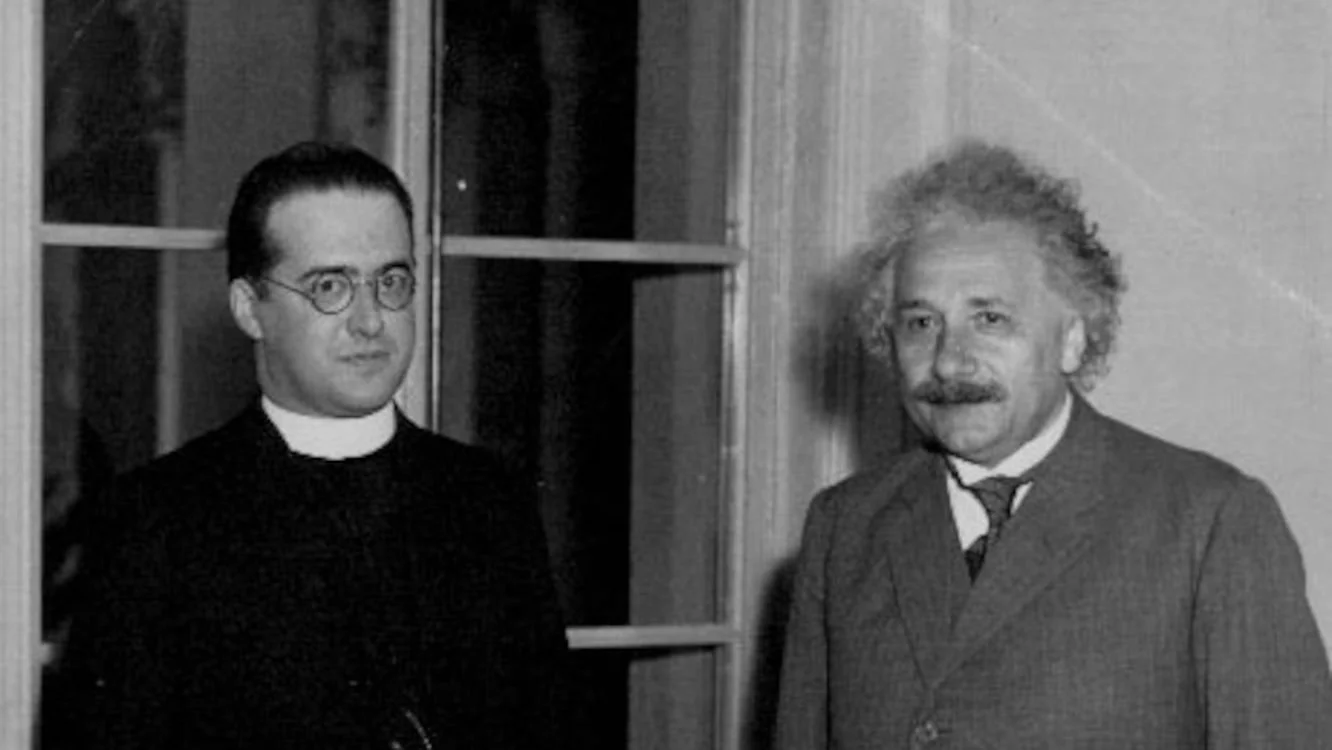
Albert Einstein honored Georges Lemaitre, the priest, physicist and mathematician whose Big Bang Theory is now the scientifically accepted origin of the universe.
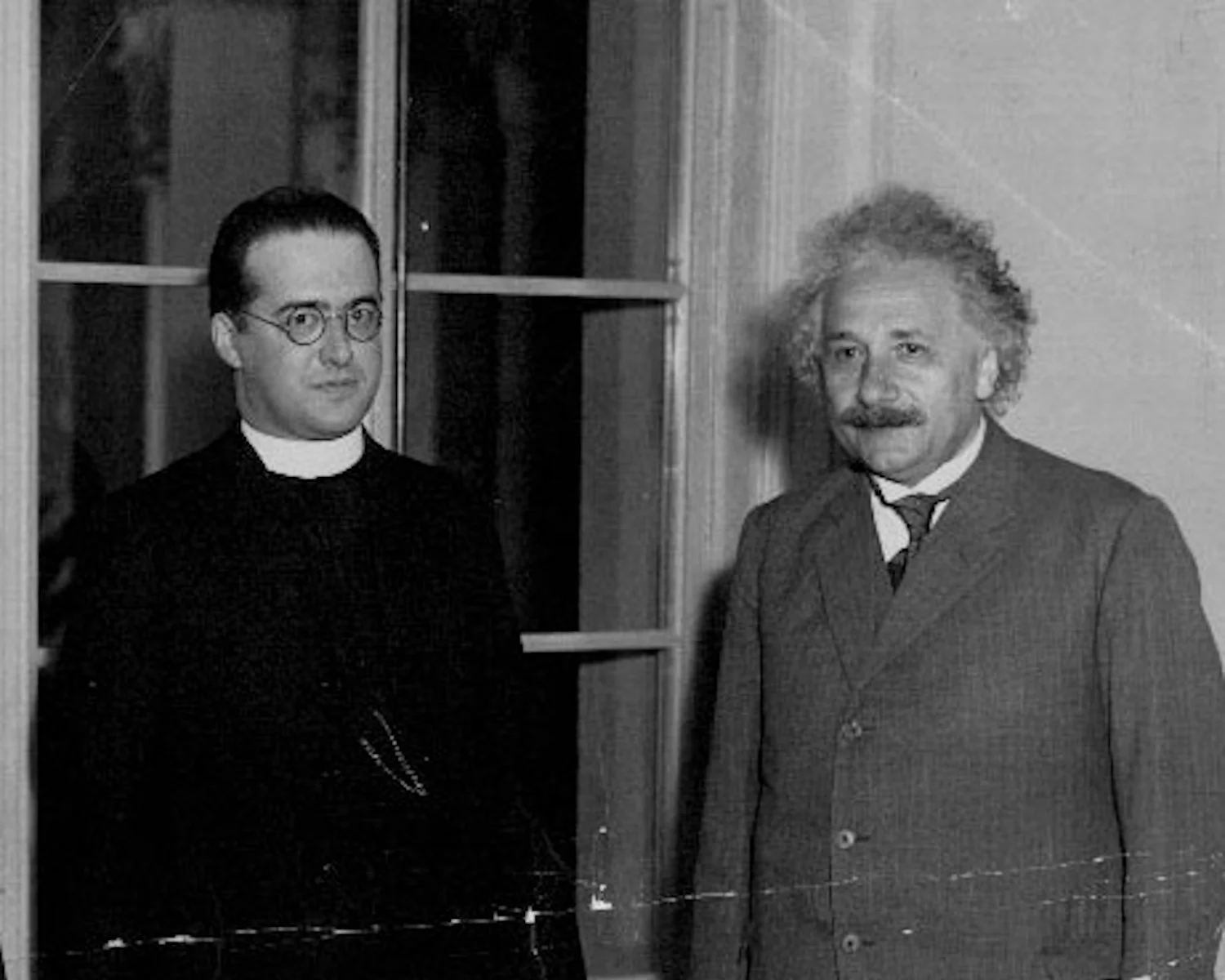
Albert Einstein honored Georges Lemaitre, the priest, physicist and mathematician whose Big Bang Theory is now the scientifically accepted origin of the universe.
March 11, 2026 by Father Gordon MacRae
In 2016, an issue of the former Catholic newspaper Our Sunday Visitor profiled some eye-opening research in an article entitled “Young People Are Leaving the Faith: Here’s Why” (August 27, 2016). It was an analysis of two national studies conducted by The Center for Applied Research in the Apostolate (CARA) to provide insight into the reasons why a third of “millennials” who were raised Catholic reject the faith of their parents as young adults.
In the CARA studies, “Millennials” are defined as those born in 1982 or later. The majority of the young adults who responded with comments on the research indicated that they left their faith for science, concluding that Catholicism cannot be reconciled with science at the high school and university level. They report finding little in the Catholic presentation of faith that challenges that view. The OSV summary included a sampling of the responses behind their decisions:
“As I learn more about the world around me and understand things that I once did not, I find the thought of an all-powerful being to be less and less believable.”
“Catholic beliefs aren’t based on fact… nothing can be disproved, but it certainly shouldn’t be taken seriously.”
“I realized that religion is in complete contradiction with the rational and scientific world, and to continue to subscribe to a religion would be hypocritical.”
“As I started to enjoy math and science more, I realized the discrepancy between religion and science… Catholicism especially did seem to clash fairly well.”
“[Faith] no longer fits into what I understand of the universe.”
These responses reflect a pattern of thought familiar to many parents of young adult Catholics and others concerned about the dismal conclusions of the CARA research. This is also one of the most common pleas I hear on a global scale from parents and grandparents and other readers of this blog.
I must seem to be an enigma to those who have left our faith or are pondering doing so. Judging from my posts of the last ten years, though it was never intended to be so, I seem to devote almost equal time to both faith and science. For example, we have recently collected in one place a number of posts dedicated to the understanding of Sacred Scripture. We called this collection, “The Bible Speaks.” Apparently it speaks quite loudly. There are presently some 43 titles in that collection, and some have broken records among the readership of this blog.
But there is a similar phenomenon that has been taking place in more recent years. I have also written several posts about science and especially the sciences of cosmology, astronomy and particle physics. One of my friends here who comes to the library where I work has asked me for copies of posts over the last few years. He recently complained of feeling a sense of whiplash, bouncing between science and religion, but he said he finds both to be fascinating. To demonstrate this phenomenon one recent post has broken all records in numbers of readers and especially in numbers of readers who come to it again and again, and who share it. That post is “Did Stephen Hawking Sacrifice God on the Altar of Science?” It seems that many people believed that he did, but I have made a case for the opposite. What strikes me most about that post is the unfathomable number of educational institutions of higher learning that are also sharing it and recommending it.
The same has held true for another recent post that blends principles of both science and faith entitled “The Higgs Boson God Particle: All Things Visible and Invisible.” Our Editor has observed and commented on the high number of academic institutions that have also been visiting religious titles on this blog. Some of these institutions are dedicated to scientific research, and yet here they are suddenly delving into the mysteries of Catholic faith. And yet no one is denouncing anything. They seem to come here to observe and to learn, not to refute.
True Believers
I have some firsthand experience with the challenging questions posed by science for the faith of younger Catholics. A decade ago at one university, the son of a reader of this blog, a science major, sent me a letter filled with questions. The previous summer, his mother had emailed him with a link to one of my forays into the science of cosmology entitled, “Science and Faith and the Big Bang Theory of Creation.” In his letter to me the student wrote that he pretty much just dismissed the post as irrelevant without having read it. He read his mother’s email, but didn’t bother clicking on the link until two months later. The student wrote that he grew up in a devout family that accepted Catholic teachings about the world and universe without question. He attended Catholic schools until switching to a public high school, then abandoned his faith in adolescence because his interest in science made faith seem irrelevant.
He believed, or rather was led to believe, that science and religion are mutually incompatible, unable to coexist in a person of science. “The bias fed to me in academia,” he wrote in a much later letter, “was that science is the new source of all faith, and to be taken seriously as a scientist requires setting aside the faith of my parents in this new world order.” And thus ended his identity as a Catholic. It is a troubling story given that for every convert entering the Catholic faith in America in recent years, more than six others left.
The exit of millennials is not at all for the reasons typically put forward by older Catholics who become disenchanted with their Church. In the CARA study, Catholic scandal and the Latin Mass are barely touched upon as influential reasons. And the millennials are not leaving to embrace some other faith. They now constitute the fastest growing expression of religious belief in America — the “Nones,” who self-identify with no religious affiliation at all. A decade ago in “A Crisis of Faith, Not of Worship,” a soul-stirring post at The Catholic Thing, (Aug. 24, 2016) Father Mark A. Pilon made this point well:
“The real underlying problem is simple: it’s a massive loss of faith… About thirty years ago, a reliable survey revealed that only about 30 percent of Catholics believed in the Real Presence of Christ in the Eucharist any longer. Why didn’t the bishops call an emergency meeting to reflect on this loss of faith, as they did in 2002 to deal with sexual abuse? … The highest priority has to be this basic question: What caused this massive loss of faith, and how do we work to resurrect that lost faith?”
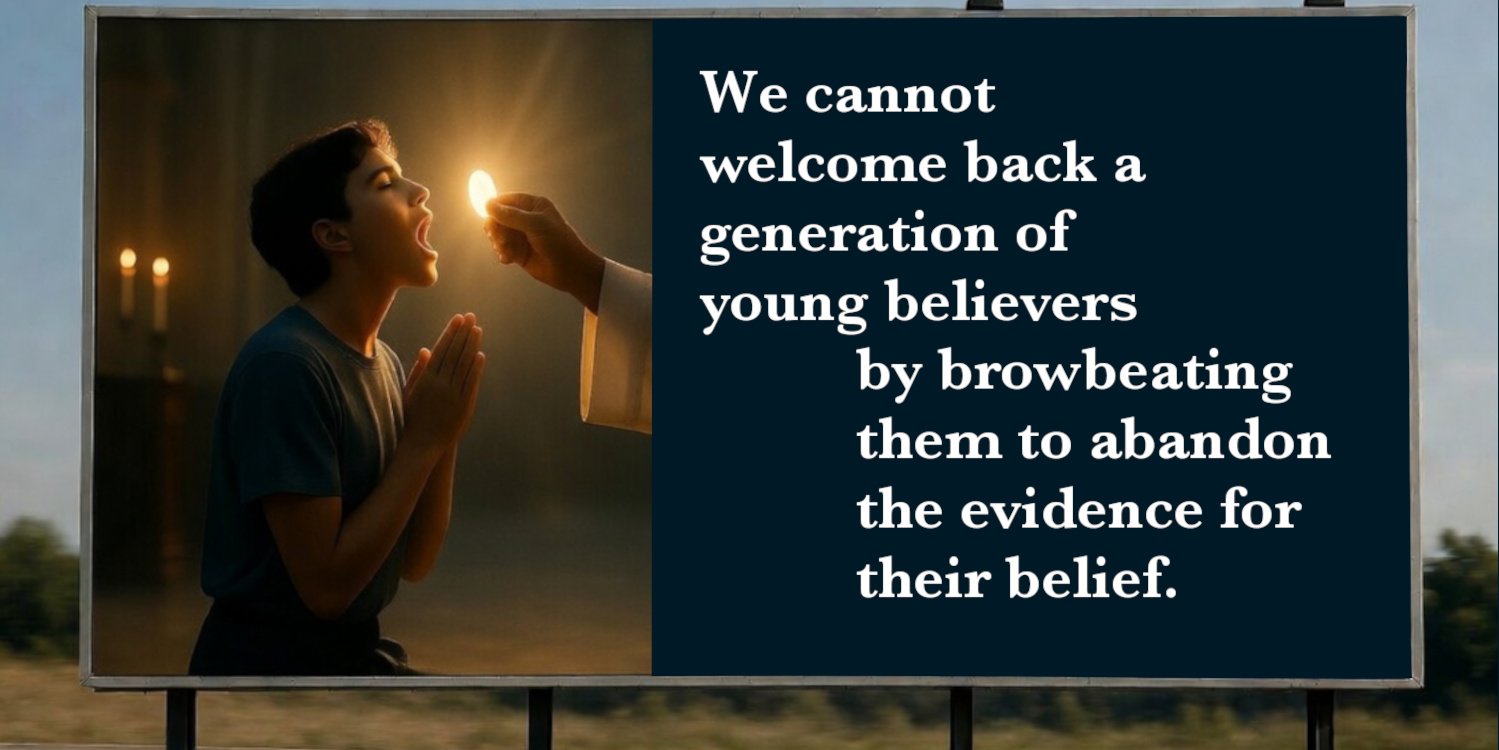
These are very relevant questions, but some have already begun to change. In early 2025 I wrote a post entitled “On the Great Biblical Adventure, the Truth Will Make You Free.” Something happened over the preceding year that signaled a great cultural change toward openness to religion and especially biblical studies. Book publishers have observed that Bible sales greatly increased by double digits toward the end of 2024. A lot of factors were proposed as contributing to this, including the election of 2024, the assassination attempts on the leading U.S. presidential candidate at that time, and later the assassination of Charlie Kirk, founder of Turning Point USA. These were inflection points causing broad swaths of America and elsewhere in the free world to pause and reassess where we are and where we are going. The biblical interest and its resulting growth of interest in faith also has continued to this day. For those who have suggested that Catholic leaders need to take advantage of this trend, a good start would be to moderate “climate change” as an example of our highest priority while abandoning other priorities, such as respect for life. Our hierarchy might also want to reconsider its revulsion for the Traditional Latin Mass and for those who find spiritual comfort in it, many of whom are younger Catholics. And a prohibition against kneeling to receive the True Presence of Christ is simply mind-boggling for true believers. We cannot welcome back a generation of young believers by browbeating them to abandon the evidence for their belief.
The Folly of Leaving Faith Behind for Science
The answer to the suspected disconnect between science and faith is not as simple as seeking relevancy by replacing faith with science. True believers in both find not only “common ground” but windows to the universe that will leave the believer in awe. The student who had been writing to me, for example, is now on his way back. As time wore on, his mother asked him what he thought about the post she sent him. He scurried to find “Science and Faith and the Big Bang Theory of Creation” buried in his inbox, and then he actually read it.
He later wrote that he was “bowled over” by it, and that it turned on its head the entire scientific orthodoxy that had been fed to him claiming that only freedom from religion could legitimately engage him with the world of science. Science with a bias against faith experience prevented him from seeing the bigger picture.
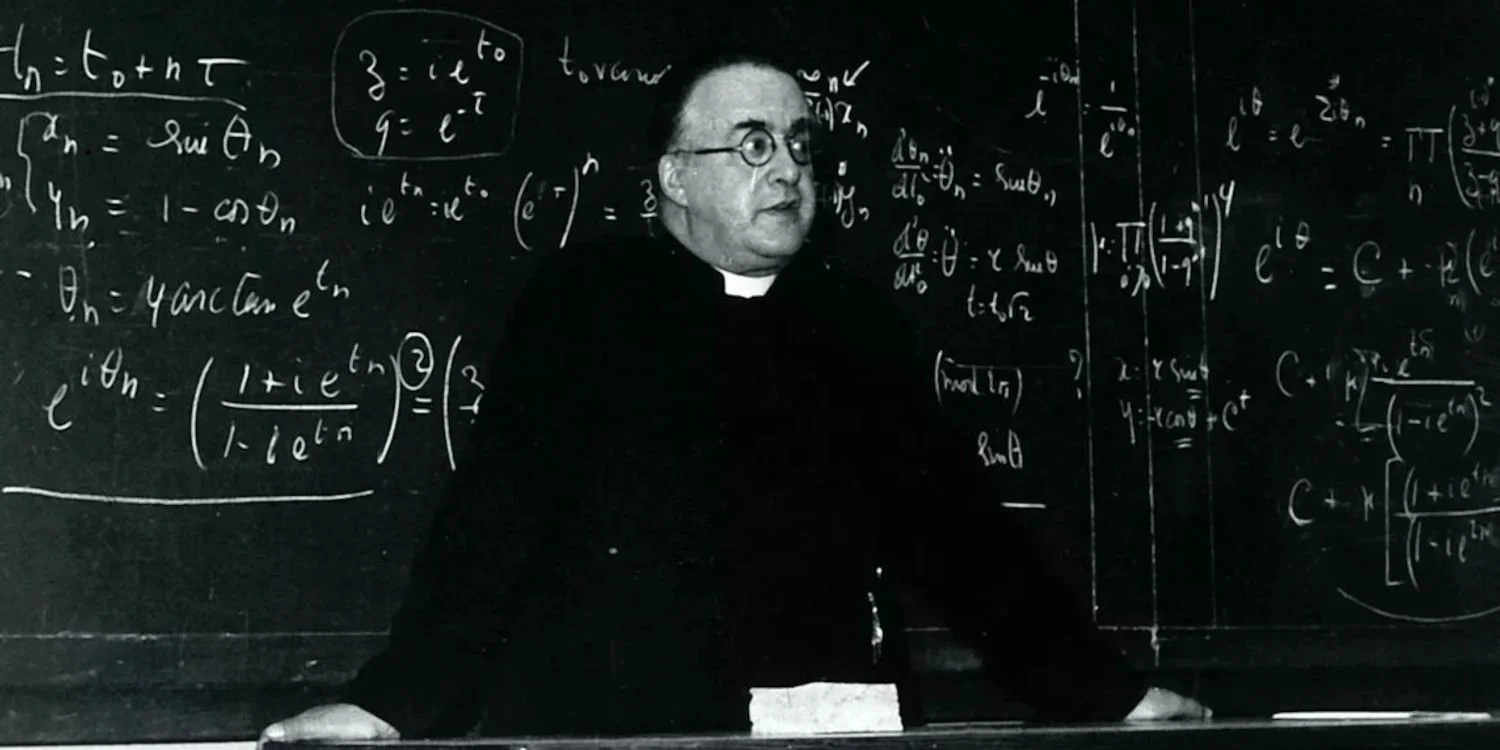
This student had many questions. First and foremost among them was this: “How is it that you, a person obviously well versed in science, could endure such injustice and still also believe in God?” It was a good question, but the answer requires something other than science’s doubts about faith. A better beginning question was the one I posed in return: “How is it that you, a science major in an American university, never before heard or read that the scientist now considered to be the Father of The Big Bang and Modern Cosmology was a Belgian astrophysicist who was also a Catholic priest?”
That question generated several letters over the last two years, suggesting BTSW posts that he has read and reread and shown to other science majors at his school. Before I get into that, however, I want to describe another development that I read some years ago by Beckie Strum in The Wall Street Journal: “U.S. Loses Top School Ranking to U.K.’s Oxford” (WSJ, Sept. 22, 2016).
For the first time, a university outside the United States was ranked the best university in the world, unseating the California Institute of Technology (Caltech) as number one. The U.K.’s Oxford University, the oldest college in the English speaking world, founded in the year 1096, took the top spot in the World University Rankings. Oxford knocked CalTech down to second place, MIT to fifth, and Harvard to sixth bin 2016. At this writing, Oxford has retained that place of primacy for a decade.
Oxford is also host to something missing from more narrowly focused American universities. Oxford is home to a research center called the Ian Ramsey Center for Science & Religion. Its Research Director at the time was Father Andrew Pinsent, a Catholic priest and particle physicist who was formerly on the science team at CERN, the European Council for Nuclear Research.
Father Andrew Pinsent holds a Ph.D. in particle physics from Oxford, a Ph.D. in philosophy from St. Louis University, and advanced degrees in theology from the Pontifical Gregorian University in Rome. He is a member of the United Kingdom Institute of Physics and the Vatican Conference for Scientists, and presently serves on the faculty and formation staff of a major U.S. seminary.
Father Pinsent has also been a guest writer at this blog. His post, “Fr Georges Lemaître, the Priest Who Discovered the Big Bang” was the final leverage that my university friend and correspondent needed to accept the fact that something essential has been missing from his education and exposure in both science and religion. The fact that his science education did not include the story of Georges Lemaitre — the astronomer, mathematician, physicist, and Catholic priest who changed the mind of Albert Einstein on the nature and origin of the universe — told him that it was science, and not faith, that deprived him of a wider world view.
This is a story that has been covered and uncovered at Beyond These Stone Walls in a series of science posts that has run parallel to our collection on Sacred Scripture. Reading these, and especially exploring Father Pinsent’s work, has opened my friend’s eyes as a young Catholic scientist, but it was a part of Father Andrew Pinsent’s guest post that more fully opened my own eyes when he wrote:
“What is to be done to help raise the profile of people like Fr Georges Lemaitre? Among Catholics with some kind of popular outreach, Fr Gordon MacRae, through his widely-read blog Beyond These Stone Walls, has done more than almost anyone I know in recent years to draw attention to Fr Lemaitre. Inspired in part by Fr Gordon’s work, my colleagues and I in England have put together a series of posters called the “Catholic Knowledge Network.”
— Fr Andrew Pinsent, “Fr Georges Lemaître, the Priest Who Discovered the Big Bang”
I think I have come to understand Father Georges Lemaitre’s science whose footprint in the history of modern cosmology is parallel to that of Albert Einstein. They were colleagues who became friends, primarily through Einstein’s great respect for Fr Lemaitre’s gifted mathematical and scientific mind. After a lecture about his theory of relativity at a European university in the 1930s, Einstein was approached by a science writer who asked him whether he thought anyone in the audience really comprehended his work. Einstein’s simple answer was “Lemaitre, certainly. As for the rest…”
The scientific dogma of the age was that the universe was static, eternal, and unchanging. Einstein also embraced this view, but it dismissed the beliefs of established religion that the universe was created from nothing.
However, Georges Lemaitre and Russian mathematician Aleksander Friedmann had more faith in Einstein’s mathematics than other scientists of their time. At first, Einstein payed little attention when they used his own equations to conclude that the universe is not static but expanding, and its rate of expansion is increasing when all established science said the opposite.
It was the American astronomer, Edwin Hubble (in whose honor the Hubble Space Telescope is named) who in 1929 discovered physical evidence that Lemaitre is right, that the universe is in fact expanding. Two years later in 1931, Father Georges Lemaitre concluded that the universe began “On a day without yesterday,” 13.8 billion years ago, with the explosion of a primordial atom from which space, time, and matter were created.
The idea was ridiculed, and “The Big Bang” was a pejorative term some scientists used to taunt the physicist priest. But he was right, and he turned science on its head with this revelation that has since been demonstrated with the discovery of cosmic background radiation emanating from The Big Bang.
Einstein, who first disagreed, ended up applauding the idea as “The most beautiful explanation of creation I have ever heard.” It was a bigger bang for science than even Einstein realized. It took the language of mathematics to comprehend that it points to what faith always told us: a universe arising out of nothing.
I think I finally came to some rudimentary understanding of the science behind this through the language of mathematics. For this I owe thanks to Robyn Arianrhod, and her book, Einstein’s Heroes: Imagining the World Through the Language of Mathematics (Oxford University Press 2005):
“In 1932, Lemaitre sowed the seeds of the Big Bang theory when he suggested that the universe had started as an explosion of a ‘primeval atom’ that… continued expanding from that explosive beginning. Some of the world’s most ancient creation myths have also imagined the world exploding from some sort of cosmic seed…”
“In 1970, English physicists Stephen Hawking and Roger Penrose showed that Einstein’s equations predicted the universe had expanded not from a tiny piece of matter located in an otherwise empty cosmos, but from a single point in four-dimensional spacetime. This meant that the Big Bang was not an ordinary explosion which took place at a specific three-dimensional location at a given time on the cosmic stage, but that Space and time themselves were actually created in the explosion, along with all matter and energy. Before this point … there was no time and no space. No geometry, no matter, nothing. The universe simply appeared out of nowhere. Out of nothing.”
— Einstein’s Heroes, p. 187
“The universe simply appeared out of nowhere. Out of nothing.” Take a moment to ponder that conclusion of science and it will sound a lot like a tenet of faith. Science, mathematics, and faith all open a window to the universe onto the same panoramic vista. And the awe this truth evokes is at one and the same time the comprehension of science and the inspiration of faith.
And as for my student-friend’s first question about the mystery of suffering in the light of faith, I can only gather up some prescientific humility to echo God against the protest of Job:
“Where were you when I laid the foundations of the earth?… Can you bind the chains of the Pleiades, or loose the cords of Orion?”
— Job 38: 4, 31

+ + +
Note from Father Gordon MacRae: Thank you for reading and sharing this post.
You might also like these other posts from Beyond These Stone Walls about the great adventure of science and faith:
On the Great Biblical Adventure, the Truth Will Make You Free
Science and Faith and the Big Bang Theory of Creation
The Higgs Boson God Particle: All Things Visible and Invisible

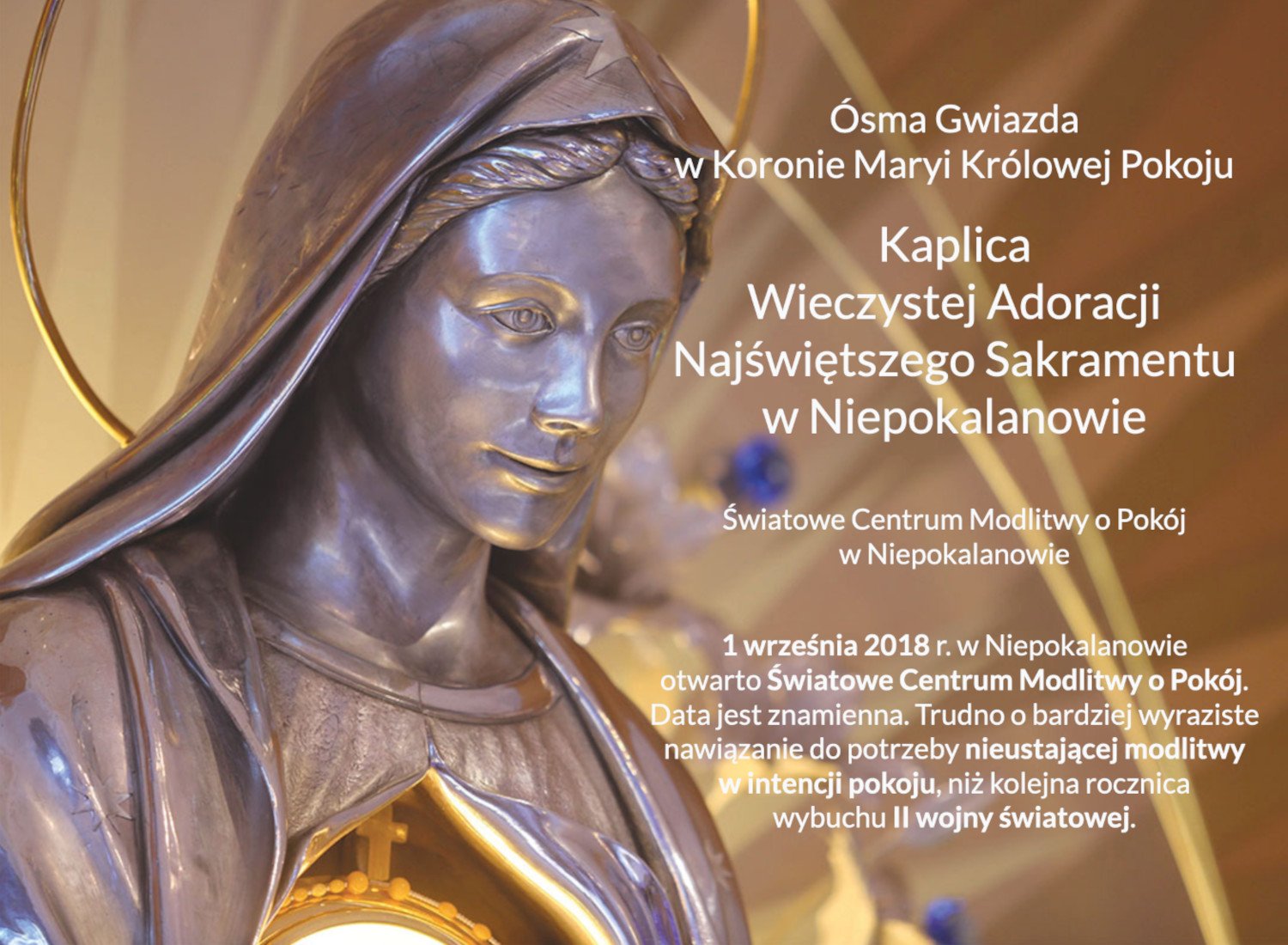

The Eucharistic Adoration Chapel established by Saint Maximilian Kolbe was inaugurated at the outbreak of World War II. It was restored as a Chapel of Adoration in September, 2018, the commemoration of the date that the war began. It is now part of the World Center of Prayer for Peace. The live internet feed of the Adoration Chapel at Niepokalanow — sponsored by EWTN — was established just a few weeks before we discovered it and began to include in at Beyond These Stone Walls. Click “Watch on YouTube” in the lower left corner to see how many people around the world are present there with you. The number appears below the symbol for EWTN.
Click or tap here to proceed to the Adoration Chapel.
The following is a translation from the Polish in the image above: “Eighth Star in the Crown of Mary Queen of Peace” “Chapel of Perpetual Adoration of the Blessed Sacrament at Niepokalanow. World Center of Prayer for Peace.” “On September 1, 2018, the World Center of Prayer for Peace in Niepokalanow was opened. It would be difficult to find a more expressive reference to the need for constant prayer for peace than the anniversary of the outbreak of World War II.”
For the Catholic theology behind this image, visit my post, “The Ark of the Covenant and the Mother of God.”

Science and Faith and the Big Bang Theory of Creation
The discovery of cosmic ripples from the birth of the Universe is evidence beyond reasonable doubt of the Big Bang theory first proposed by Fr Georges Lemaitre.

The discovery of cosmic ripples from the birth of the Universe is evidence beyond reasonable doubt of the Big Bang theory first proposed by Fr Georges Lemaitre (pictured above with Albert Einstein and Fr Andrew Pinsent)
June 18, 2025 by Father Gordon MacRae
“In the beginning God created the heavens and the earth. The earth was without form and void, and darkness was upon the face of the deep; and the Spirit of God was moving over the face of the waters. And God said, ‘Let there be light,’ and there was light.”
— Genesis 1:1-3
When my friend Augie was back in 2014, he used to like to stop by my room to compare notes about our favorite TV shows. We had been mesmerized by the return of Jack Bauer’s 24 back then, and we were eagerly awaiting the extra-terrestrial return of Falling Skies. One day when Augie came by my door he asked, “What do you think of The Big Bang Theory? “ I was so glad he asked. I launched into a 15-minute analysis of the science of modern cosmology and the meaning of the so-called Big Bang for both science and faith. When I finished, Augie looked dazed and said, “Umm…I meant the TV show!”
Then Mike Ciresi (“Coming Home to the Catholic Faith I Left Behind”) stopped by and asked, “What are you writing about this week?” “The Big Bang Theory,” I replied, hoping for another chance to spout off my explanation of the Cosmos. “Oh, I LOVE that show,” said Mike as he made a hasty retreat.
Okay, what had I been missing? Despite its being the most watched show on television, I had never seen an episode of the CBS hit, “The Big Bang Theory.” So I watched a few reruns. The show turned all social science on its head. I had no idea nerds were now “in!” And they even had girlfriends! Nerdhood had sure changed since I studied physics!
Alas, however, it was the OTHER Big Bang theory that I am taking on this week, but I implore you not to click me away just yet. I MUST write about this, and I hope you will read on. I am not quite as funny as Sheldon, Leonard, Howard and Raj, and of course Penny! I can only be that funny when I’m trying hard NOT to be funny! Like now!
I must write about the Big Bang theory for two reasons. First and foremost, a new discovery of cosmic microwave background radiation was big news a few years ago because it lent evidence beyond reasonable doubt to the truth of the science behind the Big Bang, a discovery first proposed by a Catholic priest who turned Twentieth Century cosmology on its head. I want to write about what this means for both the science of cosmology and the faith that we have all invested into a notion that this Universe was created by God. I will get back to that.
Finally, I must write about this because I was somehow thrown into the ring of debate about what it all means. My name showed up on a Facebook page for a quantum physics website. Mary Anne O’Hare posted in response to an article about the implications of so-called parallel universes and the “Many Worlds” theory:
“Gordon J. MacRae is one of the best authors who melds science with faith. Would be interested in his feedback.”
Thank you, Mary…I think! However, the ego bubble you built was burst just moments after I read your remark. BTSW reader Liz McKernan from England sent me a clipping from the (UK) Catholic Herald. It reminded me that my paranormal quest for science and truth beyond these stone walls is dwarfed by another priest, the U.K.’s Father Andrew Pinsent. He is one of the most accurate and prolific contemporary writers and bridge builders in the realm of science and faith. Liz McKernan’s clipping detailed Father Pinsent’s presentation to a packed room at the Newman Forum on “The Alleged Conflict Between Faith and Science.”

Are Science and Faith Mutually Exclusive?
When I decided to profile the work of Father Andrew Pinsent, I was surprised to learn (Ahem! Ahem!) that he also happens to be a reader of Beyond These Stone Walls. You also may recall a previous post of mine that revealed a connection between Father Georges Lemaitre and our friend, Pornchai Maximilian Moontri whose Belgian Godfather, Pierre Matthews, was a close family friend of Father Lemaitre. The photo above depicts Pierre Matthews and Fr. Lemaitre together during a family vacation. It came as a great shock to me to learn that Pornchai, my roommate of the previous 15 years, is probably the only person on Earth who can say that his Godfather’s Godfather is the Father of the Big Bang and Modern Cosmology.
Before I delve further into Father Andrew Pinsent’s defense of the truth about Catholic contributions to science, however, I want to comment on another television show I awaited with great anticipation. The FOX -TV production of Cosmos hosted by astrophysicist Neil deGrasse Tyson is terrific despite one very unfortunate and inaccurate anti-Catholic slur in its first segment: “The Roman Catholic Church maintained a system of courts known as the Inquisition and its sole purpose was to torment anyone who dared voice views that differed from theirs.”
It seems the Cosmos writers have been reading far too much of the sort of shoddy revisionist history put forth by novelists like Dan Brown. As the University of Dayton historian, Thomas Madden, pointed out, the Inquisition formed at a time when much of European society was in a perilous state of disorder, and the order it brought to anarchy saved thousands of lives. More importantly, Professor Madden wrote, “The Catholic Church as an institution had almost nothing to do with” the Inquisition.
The insinuation by a Cosmos background writer was that the Catholic Church has been hostile to science. However, the truth about the relationship between science and faith in the Twentieth Century demonstrates that just the reverse has more often been the case. For much of the later Twentieth Century, a fringe but vocally dominant number of scientists have been far more hostile to religion than religion has been to science. Few living scientists have done more than Father Andrew Pinsent to refute the attempts of this anti-religion fringe to replace faith in God with faith in science by always pointing to the “irrationality of believers.”
Father Pinsent, a doctoral-level physicist with a doctorate in Philosophy, has helped redeem science by exposing the truth about the great contributions to science by Catholic priests. His examples include the Jesuit astrophysicist, Fr Angelo Secchi; the father of the science of genetics, Msgr Gregor Mendel; and of course the astronomer and mathematician, Fr Georges Lemaitre. In this list, I cannot exclude Father Andrew Pinsent himself who after a career at the Ian Ramsey Centre for Science and Religion at Oxford is currently professor of Philosophy at one of the most prestigious Catholic seminaries in the United States, Mount St. Mary’s Seminary, also known as the Athenaeum.

Science from East of Eden
Still, I greatly respect and admire Neil deGrasse Tyson who went on in Cosmos to repair the damage somewhat by giving Fr Georges Lemaitre due credit as a foundational theorist of modern physics and cosmology right along with Albert Einstein.
The description of Father Lemaitre’s discovery as “The Big Bang” actually began as a term of mockery of his idea. The term first appeared in 1949, more than two decades after Lemaitre first proposed his theory. The prevailing winds of scientific thought for much of the first half of the Twentieth Century had settled on a belief that the Universe was not “created” at all, but had always existed, had no beginning, and will have no end. In that sense, for science, the Universe itself replaced God as eternal and without an origin. This was the accepted view, even by Einstein.
It was this predominant view that relegated the Judeo-Christian understanding of Creation to the shelf, treating it, and all religion, as a quaint anachronism stubbornly clinging to bygone days of scientific ignorance. Science attempted to remove all rational belief from our Biblical Creation account, and declared it to be a myth in the way we popularly understand myth. In mid-Twentieth Century science, God was obsolete, and some in philosophy were soon to follow with “God is dead!” Many in science held that if science could so undermine the very first awareness of man that God is Creator, all the rest of Judeo-Christian faith would eventually crumble.
Then, in the 1920s and 1930s, along came a brilliant mathematician-priest who subjected the conclusions of science to the rigors of mathematics. I wrote about the challenge this priest posed to the prevailing winds of science in “A Day Without Yesterday: Father Georges Lemaitre and the Big Bang.” Father Lemaitre was much respected by Albert Einstein, but far more for his mind than for his faith. At a 1933 conference in Brussels exposing his Theory of General Relativity, Einstein was asked if he believed it was understood at all by most of the scientists present. Einstein replied, “By Professor D. perhaps, and certainly by Lemaitre; as for the rest, I don’t think so.”
However, Einstein also had a fundamental disagreement with Father Lemaitre, though one — to the consternation of many in science — that was short-lived. Lemaitre used mathematics to present a model of the Universe based on Einstein’s own Theory of General Relativity which proposed that mass and energy create curvature of space-time causing particles of matter to follow a curved trajectory. Gravity, therefore, would bend not only matter, but light and even space itself. This had profound implications for science and was radically different from the reigning Newtonian physics which held that space is absolute and linear.
Even while demonstrating relativity, Einstein held to a “Steady State” theory of the Universe as being eternal, without beginning or end, and static. Using Einstein’s Theory of General Relativity, Father Lemaitre created a mathematical model for the origin of the Universe concluding in 1927 that the Universe — including space and time — came into existence suddenly, some 13.7 billion years ago, from an explosive expansion of a tiny singularity that he called the “Primeval Atom.” The Universe, and time, were born on a day without yesterday. Suddenly, a created Universe was back on the scientific table and is now the scientifically accepted truth.
Father Lemaitre conceived of nothing in existence but the relatively tiny speck into which was contained all matter and energy that we now know as the Universe. In an infinitesimal fraction of a second, the Universe came into being in a moment of immeasurable heat and light. The resistance to this view within the scientific community was enormous. As Father Andrew Pinsent himself once wrote to me:
“As late as 1948 astronomers in the Soviet Union were urged to oppose the Big Bang theory because they were told it was ‘encouraging clericalism.’ People tend to forget that the world’s first atheist state in effect banned the Big Bang and genetics, both invented by priests, for more than thirty years.”
Einstein studied Lemaitre’s 1927 paper intensely, but could find no fault in the mathematics behind his proposal. Einstein would not be a slave to mathematics, however, and simply could not conceive of his instinct about the mechanics of the Universe being wrong. “Your mathematics is perfect,” he told the priest, “but your physics is abominable.” Einstein would one day take back those words.
Two years later, in 1929, the astronomer Edwin Hubble — in whose honor is named the Hubble Space Telescope — demonstrated that the Universe was in fact not only not static, as Einstein insisted, but expanding. This lent scientific weight to Father Lemaitre’s Primeval Atom because if the Universe is expanding, then logic held that in the far distant past it must have been much, much smaller while containing the same matter, mass, and energy. In fact, Physicist Stephen Hawking would decades later calculate the density of the Primeval Atom in tons per square inch to be one followed by seventy-two zeros.
Lemaitre’s model traced the origin of the Universe back 13.7 billion years to a point of immeasurable mass and density that suddenly expanded giving birth not only to matter, but to the space-time continuum itself. Appearing at a symposium with Father Lemaitre in 1933, Einstein stood and applauded the priest declaring that his view — which is today called the Standard Model of Cosmology — “Is the most beautiful explanation of creation I have ever heard.”

Cosmic Ripples
“Let there be light!” was back in the parlance of scientific truth. Though not many cosmologists were ready to embrace the Biblical account of Creation as being the sudden appearance of immense light upon the command of God, the science suddenly supported a belief in a Universe with a genesis “created from nothing.” In 1965, Bell Laboratory technicians Arno Penzias and Robert Wilson detected the background radiation from the Big Bang. They were jointly awarded the Nobel Prize in Physics for their discovery of the background signature of Father Lemaitre’s expansion of the Universe on a day without yesterday.
Early in 2014, astronomers announced the discovery of Cosmic Microwave Background Radiation permeating the Universe caused from the ripples left over from the moment of the Big Bang 13.7 billion years ago. Even for the rigors of science and what constitutes proof, there is no longer reasonable doubt within reputable science that Father Georges Lemaitre was right.
But if you are having trouble bending your mind around all this, please don’t ask what God did before the Big Bang. On that day, time itself was created so there was no “before.” That’s a mind-boggling post for another day. And as for those theories about multiple worlds and parallel universes that Mary Anne O’Hare wanted my opinion on, the idea is theoretical, entirely without evidence, and not technically, at this juncture, in the realm of science. In a terrific book, Why Science Does Not Disprove God (William Morrow 2014) mathematician-author Amir D. Aczel described multiverse theory as a sort of “atheism of the gaps,” an attempt to plug theoretical scientific holes with anything BUT religious ideas. As G.K. Chesterton once said:
“People who do not believe in God do not believe in nothing. They believe in anything!”
The great contemporary priest-scientist, Father Robert Spitzer, SJ, wrote a wonderful book about God’s intervention in our science, Christ, Science, and Reason. Father Spitzer referred to Father Georges Lemaitre as “the founder of modern cosmology.” He quoted Albert Einstein as stating that Father Lemaitre’s discovery “is the finest description of Creation that I have ever heard.” We should find great hope in the fact that the Catechism of the Catholic Church and the findings of modern cosmology are now on the same page about the origin of the Universe as coming into existence “out of nothing.” We should have no fear after that. Surely, the God Who could do this would have no problem arranging eternal life for us who believe.
Another friend just came by to ask me what I am writing about. Finally, my moment had arrived! “What do you know about the Big Bang Theory?” I asked. The young man pondered the question for a moment then said, “I like Sheldon the best.” I can’t win!
+ + +
Important Message to Readers of Beyond These Stone Walls:
In 2020, 11 years after this blog began, we were forced to shut it down and start over. I described the circumstances for this in a 2020 post, “Life Goes On Behind and Beyond These Stone Walls.”
However, this transition left over 500 posts behind in the older version of this blog, but still discoverable in search engines, but without proper formatting.
Restoring and updating 500+ posts is a daunting task. So I choose posts to update based on how often they show up in reader searches. It amazes me that hundreds of our older posts are still being routinely read.
This week’s post was first published in 2014, but it shows up repeatedly in new searches. So we have restored and substantially updated it with new information for posting anew.
You may also like these related posts which have also been restored:
Life Goes On Behind and Beyond These Stone Walls
Fr Georges Lemaître, the Priest Who Discovered the Big Bang
“A Day Without Yesterday:” Father Georges Lemaitre and The Big Bang
The Eucharistic Adoration Chapel established by Saint Maximilian Kolbe was inaugurated at the outbreak of World War II. It was restored as a Chapel of Adoration in September, 2018, the commemoration of the date that the war began. It is now part of the World Center of Prayer for Peace. The live internet feed of the Adoration Chapel at Niepokalanow — sponsored by EWTN — was established just a few weeks before we discovered it and began to include in at Beyond These Stone Walls. Click “Watch on YouTube” in the lower left corner to see how many people around the world are present there with you. The number appears below the symbol for EWTN.
Click or tap here to proceed to the Adoration Chapel.
The following is a translation from the Polish in the image above: “Eighth Star in the Crown of Mary Queen of Peace” “Chapel of Perpetual Adoration of the Blessed Sacrament at Niepokalanow. World Center of Prayer for Peace.” “On September 1, 2018, the World Center of Prayer for Peace in Niepokalanow was opened. It would be difficult to find a more expressive reference to the need for constant prayer for peace than the anniversary of the outbreak of World War II.”
For the Catholic theology behind this image, visit my post, “The Ark of the Covenant and the Mother of God.”