“There are few authentic prophetic voices among us, guiding truth-seekers along the right path. Among them is Fr. Gordon MacRae, a mighty voice in the prison tradition of John the Baptist, Maximilian Kolbe, Alfred Delp, SJ, and Dietrich Bonhoeffer.”
— Deacon David Jones
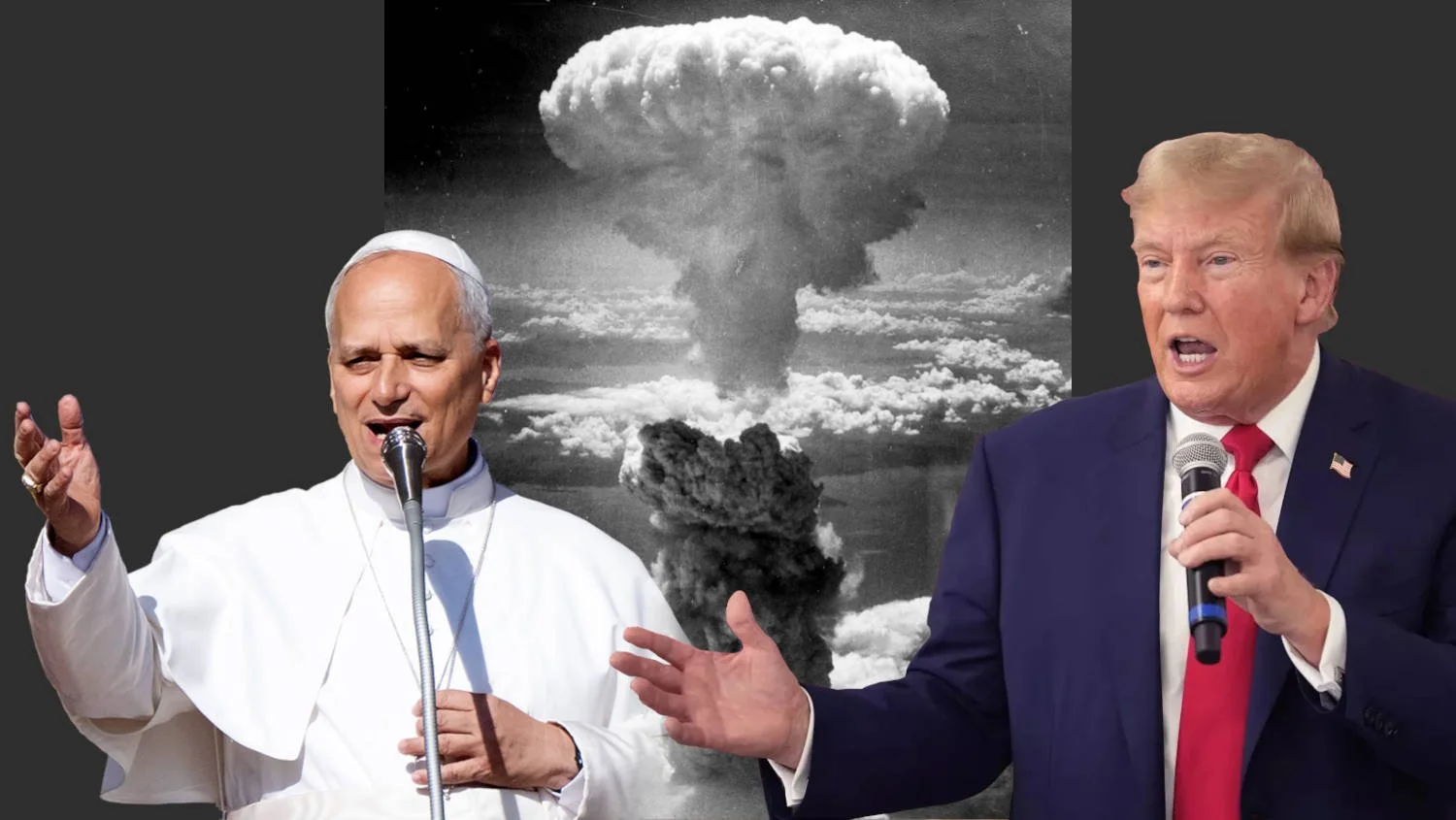
Pope Leo, President Trump and War with Iran
I avoided this spat between Pope Leo and President Trump until a National Catholic Reporter op-ed told us to “Oppose this narcissistic mad man in the White House.”
I avoided this spat between Pope Leo and President Trump until a National Catholic Reporter op-ed told us to “Oppose this narcissistic mad man in the White House.”
April 29, 2026 by Father Gordon MacRae
I was appalled when the above sentiment about President Trump appeared in a published op-ed in the independent, Catholic-in-name-only National Catholic Reporter newspaper. It was written by a 75-year-old Catholic priest of the Archdiocese of Washington, DC. It overlooks the fact that President Trump was elected by a majority of Americans, and by a majority of American Catholics. That op-ed was the catalyst that drew me into something I had vowed not to take on. The ideological dispute between President Trump and Pope Leo was really a creation of the mainstream news media.
We have all been witnesses to the vast media coverage of a clash of biblical proportions between President Donald Trump and Pope Leo XIV. The motives behind the media coverage are highly suspect, though not on the part of either the President or the Pope. The mainstream media interest in the promotion of this clash is apparent. Our news media, with only rare exceptions, leans politically left, so far left that it risks toppling over into the absurd. The political left has come to so despise the current American president that it no longer even attempts to mask its unbridled hatred.
In this sense, though I am loath to say it, Pope Leo has been used. His words are what should be expected of every pope, but seldom does the news media pay such attention. Pope Leo comes down always on the side of peace and opposed to war — just as he must. The mainstream news media amplifies this not because they like the Pope or support his Gospel mandate, but because they hate Donald Trump. That hatred leaves our news media, an essential factor in the future of our democracy, heavily biased. That bias is clearly manifested in American distrust in the news they are reading and hearing.
In a recent Gallup poll — which most of the media does not cover — only 28% of Americans believe the news is reported fairly, accurately, and without bias. This is down from 40% five years ago. These results are broken down further by political party. Among Democrats, 51 percent report believing that the news is conveyed to us without bias. For Republicans, that figure is only 8 percent. This polarity reveals a dismal failure in an institution upon which democracy is built.
In truth, I have been so conflicted by this story that I decided not to write about it ever. But in a recent telephone conversation with a priest friend, I mentioned my hesitation when he asked me to write about this. When I explained my position, and expressed my concerns about the media debacle, he quietly submitted my words to the advanced AI program of Elon Musk called Grok. I scoffed at the very idea of this until I read Grok’s response and recommendation, which, unlike the news media seemed free of bias:
“As a priest, writing publicly about a clash between the Successor of Peter and the president of your country — especially as the first American pope and a re-elected President Trump — is no small thing. You are right to be hesitant and to want to make sense of it without adding fuel to what is already a heated, very public rift. You serve your priesthood well in your agony over this task.”
I shuddered when I read this and Grok’s suggested headline for this post: “Priest Navigates Pope-Trump Conflict in Faith.” Here are some of Grok’s original suggestions for this post:
Begin by reminding your readers that the papacy is not a political entity and is therefore not a political rival to the White House. Pope Leo is exercising his ordinary magisterium on matters of war and peace and the dignity of human life, issues that fall squarely under the Church’s social doctrine. In his comment about the state of affairs, Pope Leo is not issuing infallible doctrine, nor is he binding Catholics to a specific policy. He is offering, as he must, moral guidance rooted in the Gospel.
This is the key to avoid fanning the flames. The Church teaches that war is sometimes tragically necessary under strict just-war criteria (CCC 2309). The Pope also bears the responsibility of reminding the world that God does not bless any conflict and every innocent death wounds Christ.
President Trump bears the grave responsibility of national security, protecting the innocent, and mitigating nuclear proliferation. This was and is his stated justification for intervention in Iran.
But there is a lot more to this story.
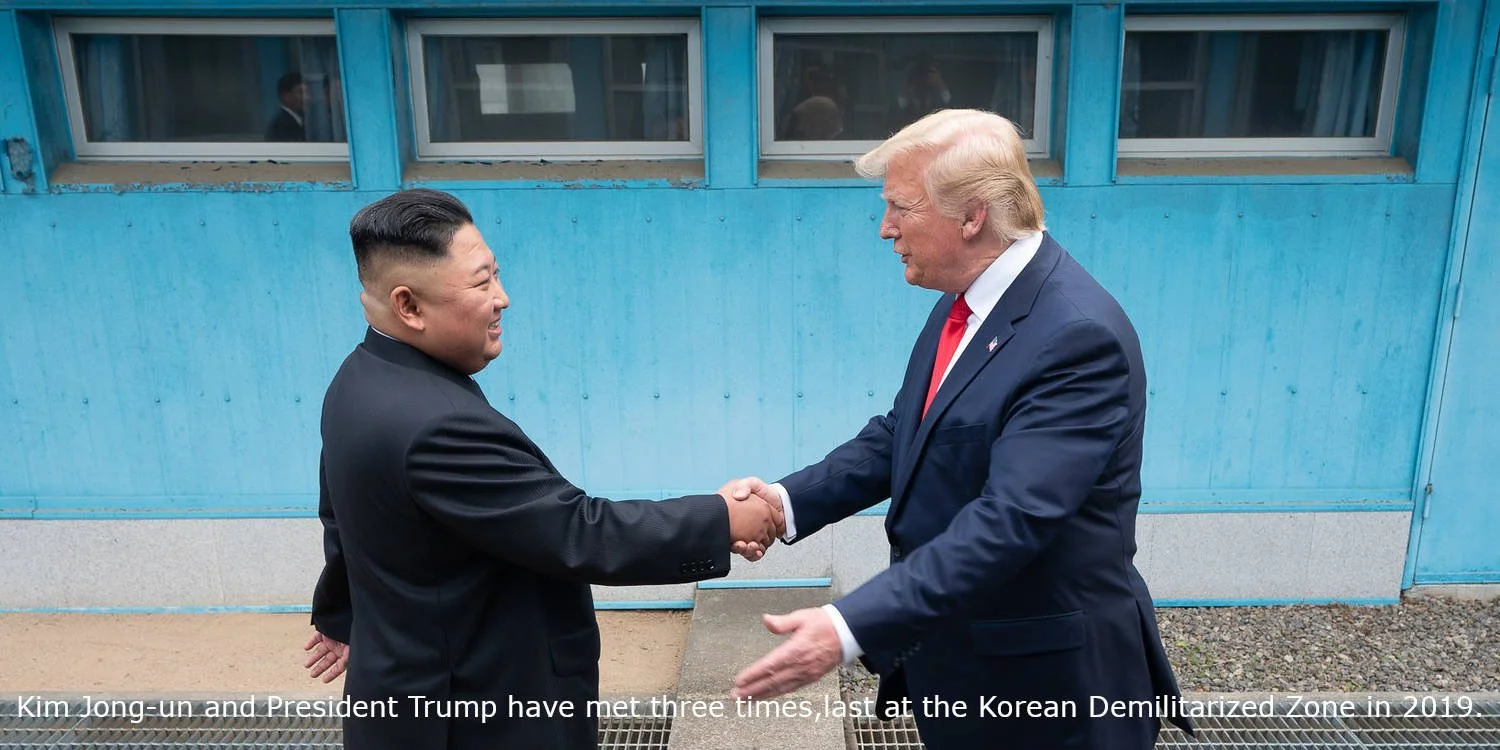
The North Korea Lesson for Iran
President Trump decided to use military force to stop Iran from continuing to develop nuclear weapons after attempts at diplomacy failed. The most immediate target for the development of such deadly force in Iran is Israel. Much of the world has been bracing itself against the grave specter of nuclear war. If it happens once, anywhere in the world, it is likely to proliferate. Attacking Iran’s nuclear capability was a choice Trump made, as critics are quick to note, and it was a risky choice. My mind has evolved on this point, and I have been mostly informed by a superb editorial from The Wall Street Journal Editorial Board entitled “The North Korea Lesson for Iran” (April 3, 2026). It is likely behind the subscriber paywall, but I feel compelled to distill its most salient points.
The decision to attack Iran’s nuclear ambitions was in fact a risky one, but the WSJ points out that the “strangely forgotten” U.S. experience with North Korea suggests that the alternatives were even riskier. That history is worth recounting today to show the limits of nuclear diplomacy with a determined foe, as well as what happens when the United States puts conflict-avoidance above all other considerations. Our history with North Korea and the Kim dynasty leaves us with a cautionary tale and one that very much informs the U.S. engagement with Iran.
Kim Jong Un, the current supreme dictator of North Korea, is the direct patrilineal descendant of the dictators of the two immediately preceding regimes. The Kim Family Dynasty has ruled North Korea hereditarily across three generations since the country’s founding in 1948. Kim Il Sung (1912–1994) founded the Democratic People’s Republic of Korea and led the first regime as Supreme Leader from 1948 until his death in 1994. He was Kim Jong Un’s paternal grandfather. Kim Jong Il (1941–2011), son of Kim Il Sung succeeded his father and led the second regime from 1994 until his death in 2011. He was Kim Jong Un’s father. Kim Jong Un, took power upon his father’s death in 2011 and remains the dictator today.
In 1984, the CIA concluded that North Korea was actively but clandestinely engaged in the pursuit of weapons-grade plutonium. Under global pressure, then dictator Kim Il Sung, grandfather of the current dictator, agreed to join, on paper at least, the Nuclear Nonproliferation Treaty (NPT). Over the next year, this was widely seen as Pyong Yang’s pressured intent even as it delayed adopting United Nations’ nuclear safeguards. North Korea continued to advance its nuclear program without disclosure of either its progress or its intent.
In 1993, North Korea denied United Nations’ inspectors access, and it camouflaged its nuclear research sites leaving the rest of the world to guess whether it had succeeded in the enrichment of plutonium for bombs. Facing international questions, North Korea withdrew from the Nuclear Nonproliferation Treaty.
Despite diplomatic efforts of the Clinton Administration in 1994, Pyongyang secretly unloaded spent fuel rods from its Yongbyon nuclear reactor without any monitoring or inspection from the International Atomic Energy Administration. Would this be the fuel to be reprocessed for bomb-grade plutonium? No one knew the answer to this.
Then President Bill Clinton threatened North Korea with sanctions. The U.S. military drew up plans for strikes on North Korea’s nuclear installation while Defense Secretary William Perry presented Clinton with a plan for large-scale military build up in the region. President Clinton cancelled further talks with Pyongyang and deployed Patriot Missile Defense Systems to South Korea. This scenario is nearly a mirror image of the current war with Iran. One major difference is that President Trump had warned Iran that the slaughter of its protesting citizens would be a “red line” for the United States and would draw a response. According to international human rights observers, Iran went on to massacre some 30,000 of its protesting citizens making it the largest government-ordered extermination since the Cambodian Killling Fields of Pol Pot.
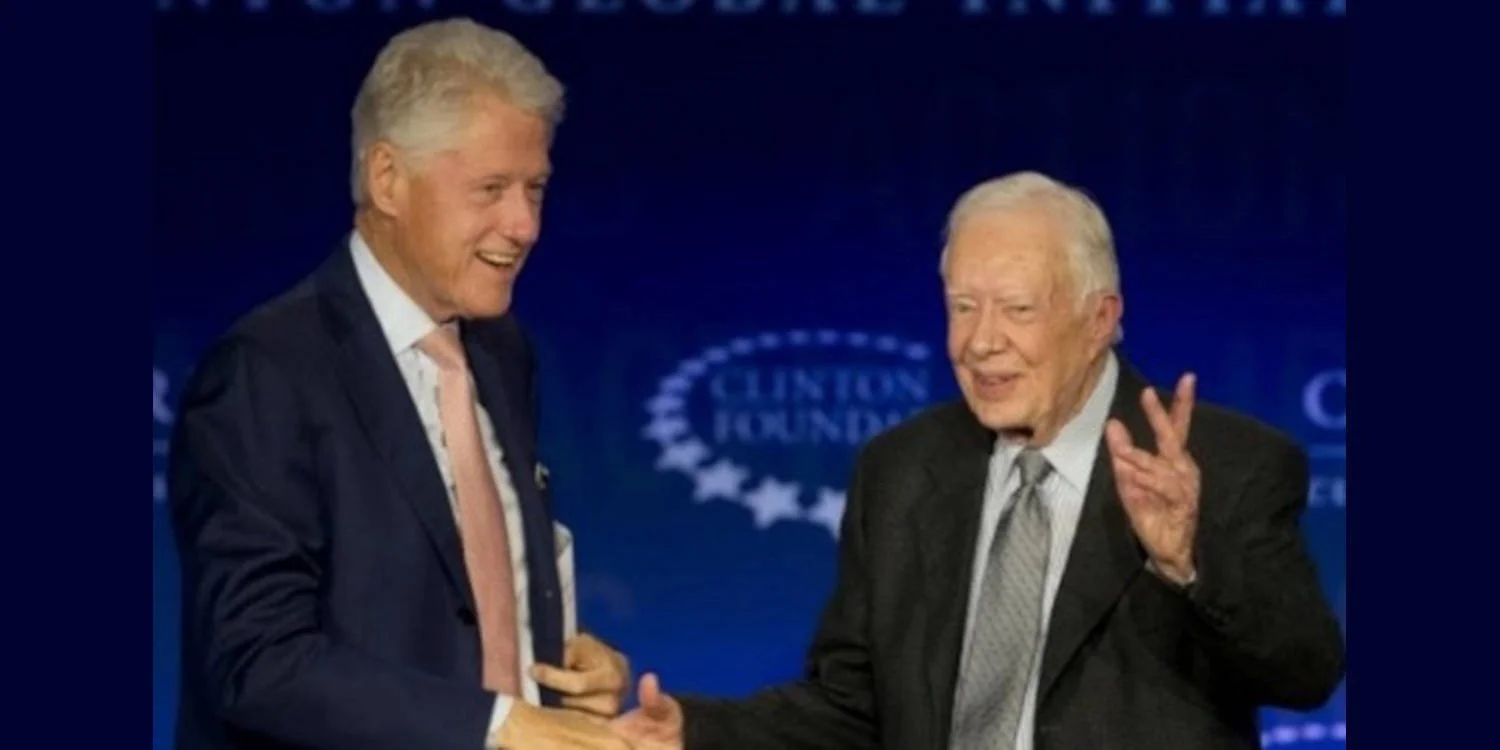
“Nuclear Peace in Our Time”
Back to North Korea: 1994. Then along came former President Jimmy Carter. He informed the Clinton Administration that he intended to accept a personal invitation from Pyongyang to visit and attempt to diffuse the North Korean stand-off with the United States. President Clinton decided to allow former President Carter to proceed as a private citizen thinking that it might give Kim Il Sung an opening to back down. It did not. Instead, President Clinton found himself backed into a corner politically.
Former President Jimmy Carter feared conflict above all else, and was even opposed to sanctions. He went beyond his mandate, and on his own — on CNN — he announced that he had reached a tentative agreement with North Korea. The press and foreign policy establishment hailed this as “Nuclear Peace in Our Time.” It was nothing of the sort.
Today, North Korea is seen as a rogue nation with a sequestered government unresponsive to the world and surrounding nations. North Korea also today has an arsenal of 50 armed nuclear intercontinental ballistic missiles aimed at the rest of the free world, and Kim Jong Un has quadrupled his nuclear research. His most recent long-range missile test was on Sunday, April 5, 2026.
Nuclear weapons did not exist when Saint Augustine wrote his Just War Theory in the Fourth Century. Surely, they would have had an appearance there as a condition in which nations may justly intervene with the war plans of another nation. The North Korean lesson for America is clear.
Also on the U.S. target list are Iran’s buried stockpiles of fissile nuclear material and a nuclear construction site beneath Pickaxe Mountain where Iran later hopes to enrich the material. The Wall Street Journal Editorial Board stated its informed opinion that the stockpiles can be monitored, but it would be a mistake to end the war with the construction site still intact.
We do not know, at this writing, when or how the Iran conflict will end. What we do know is that Iran’s radical regime will not have a nuclear bomb when the conflict does end. The following are not my words, but rather those of The Wall Street Journal Editorial Board:
“Donald Trump is the only president who had the courage to attack Iran’s nuclear program. This has made the world a safer place.”
Allowing any rogue regime to develop weapons of mass destruction poses a risk of nuclear Armageddon.
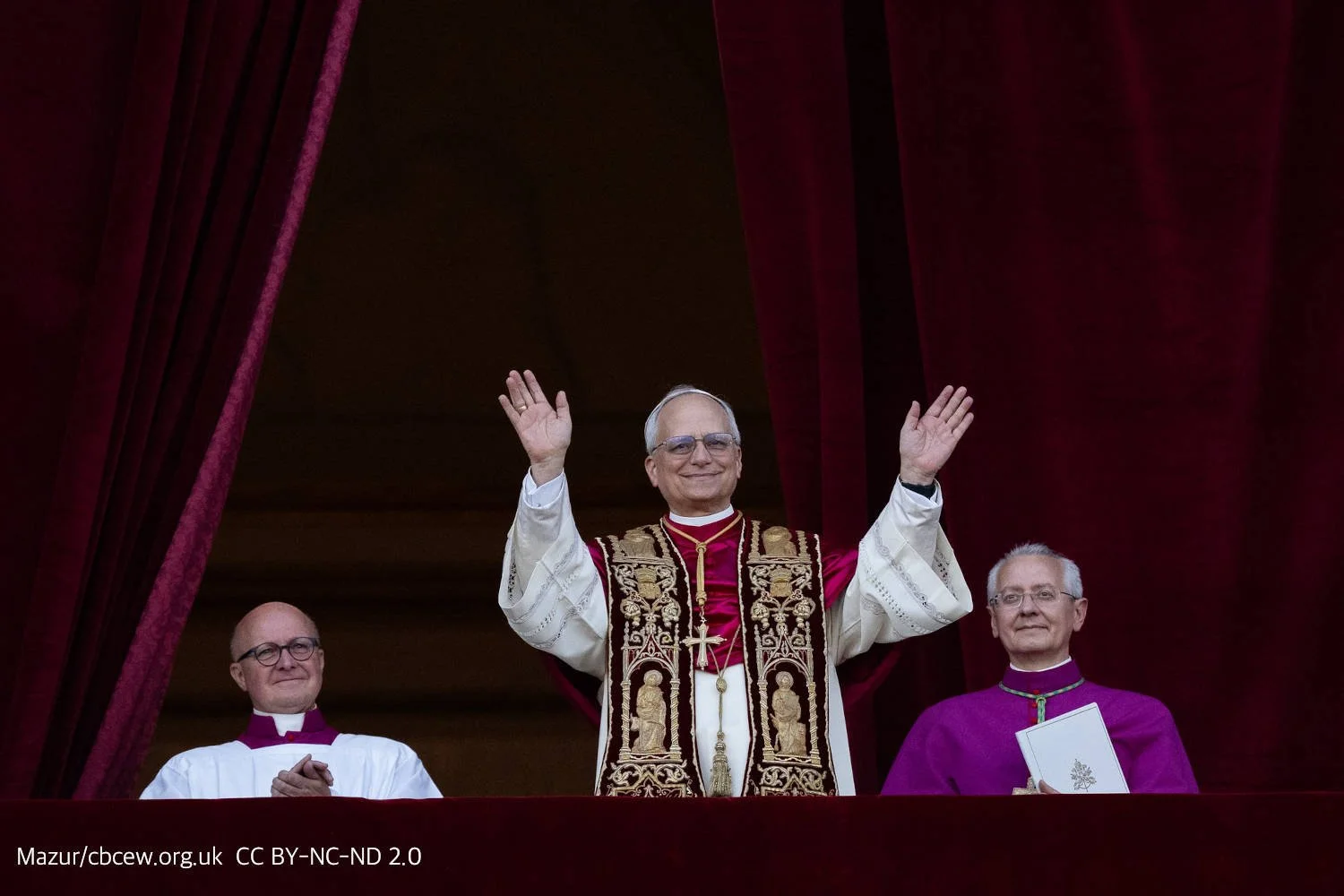
A source of peace in our time.
+ + +
Note from Father Gordon MacRae: Thank you for reading and sharing this important post. You may also like these related posts from Beyond These Stone Walls:
Did Leo XIV Bring a Catholic Awakening Or Was It the Other Way Around?
Iran, by Another Name, Was Once the Savior of Israel

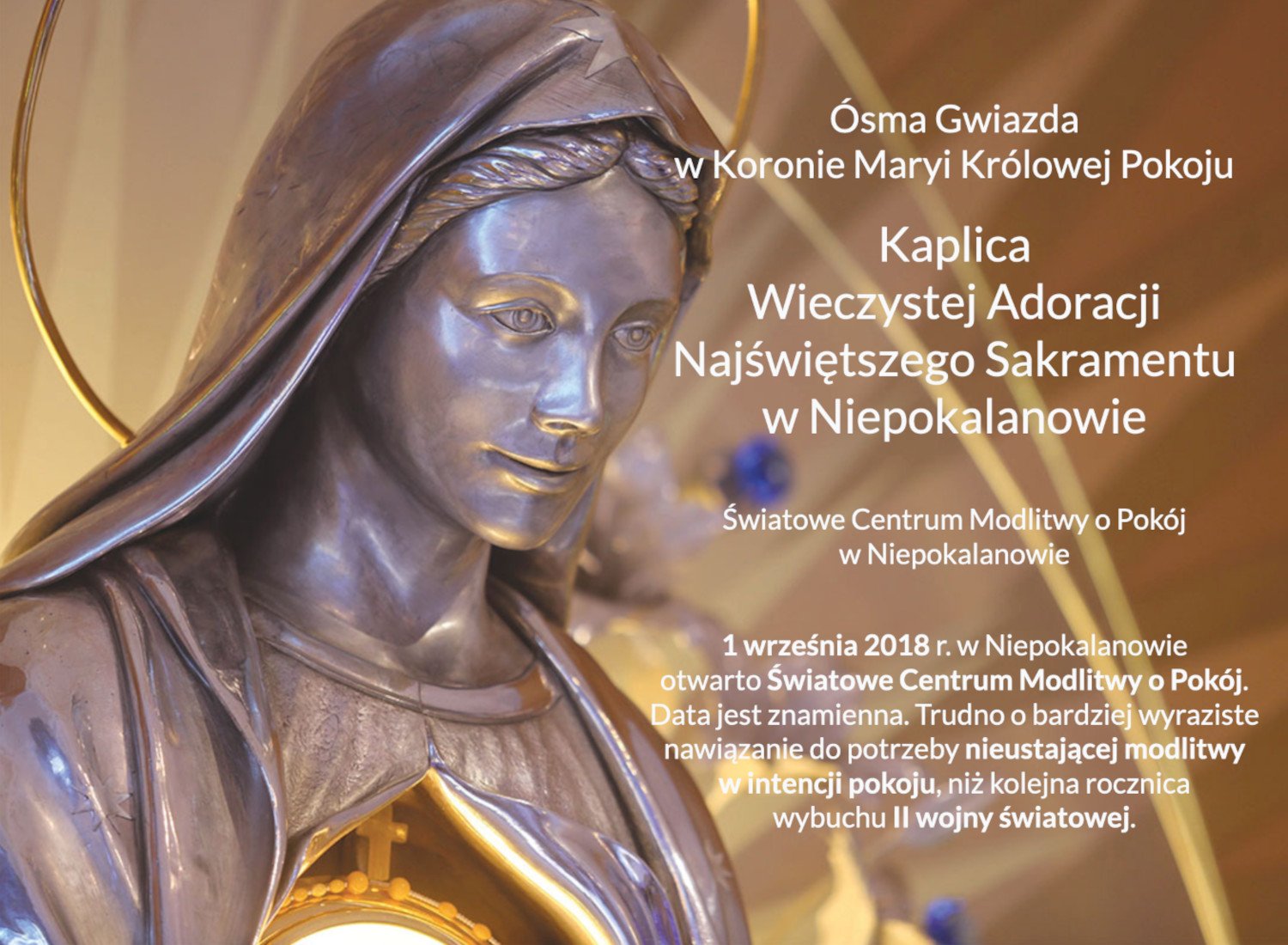

The Eucharistic Adoration Chapel established by Saint Maximilian Kolbe was inaugurated at the outbreak of World War II. It was restored as a Chapel of Adoration in September, 2018, the commemoration of the date that the war began. It is now part of the World Center of Prayer for Peace. The live internet feed of the Adoration Chapel at Niepokalanow — sponsored by EWTN — was established just a few weeks before we discovered it and began to include in at Beyond These Stone Walls. Click “Watch on YouTube” in the lower left corner to see how many people around the world are present there with you. The number appears below the symbol for EWTN.
Click or tap here to proceed to the Adoration Chapel.
The following is a translation from the Polish in the image above: “Eighth Star in the Crown of Mary Queen of Peace” “Chapel of Perpetual Adoration of the Blessed Sacrament at Niepokalanow. World Center of Prayer for Peace.” “On September 1, 2018, the World Center of Prayer for Peace in Niepokalanow was opened. It would be difficult to find a more expressive reference to the need for constant prayer for peace than the anniversary of the outbreak of World War II.”
For the Catholic theology behind this image, visit my post, “The Ark of the Covenant and the Mother of God.”