“There are few authentic prophetic voices among us, guiding truth-seekers along the right path. Among them is Fr. Gordon MacRae, a mighty voice in the prison tradition of John the Baptist, Maximilian Kolbe, Alfred Delp, SJ, and Dietrich Bonhoeffer.”
— Deacon David Jones
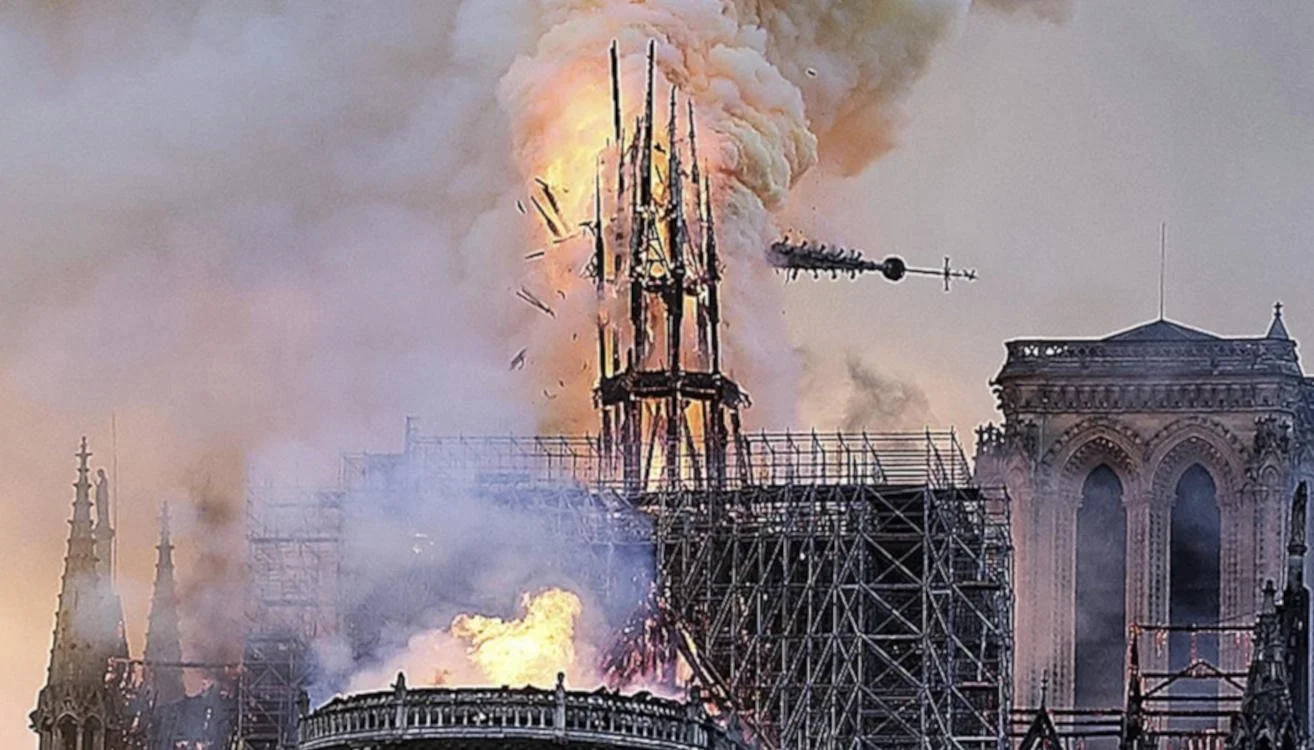
Notre Dame Burned but the Smoke of Satan Is More Subtle
The Paris Cathedral of Notre Dame burned in Holy Week 2019. We must now distinguish between that fire and the smoke of Satan that burns away the hearts of believers.

The Paris Cathedral of Notre Dame burned in Holy Week 2019. We must now distinguish between that fire and the smoke of Satan that burns away the hearts of believers.
October 28, 2025 by Father Gordon MacRae
Some time ago, I wrote a post about the great 19th Century French writer, Victor Hugo and his literary masterpiece, the title of which was incorporated into “Les Misérables: The Bishop and the Redemption of Jean Valjean.” Though written several years ago, it remains one of the most-read and visited posts at Beyond These Stone Walls.
It was never intended to be so, but its principal readership these days consists primarily of high school students looking for an angle on the story for book reports and term papers. They come to BTSW from China and India, England and South Africa, Argentina and Australia, and from across the vast North American continent. Some come from Poland, but virtually none from France or elsewhere in the European Union where the story of Les Misérables was born.
The student marauders of my post seem to find what they are looking for. Teachers across the world must be tiring of my revelation that Victor Hugo received resistance from his young adult son who wanted the character of the saintly French bishop Charles Francois Bienvenu Myriel, Bishop of Digne, written out of the first draft of Les Misérables.
The younger Hugo argued that no one in post-Revolution France would be able to relate to the character of a faithful, benevolent Catholic bishop. Victor Hugo’s son wanted to replace Bishop Bienvenu in the novel with someone whose benevolence and integrity the people of post-Revolution France could more easily envision. He wanted to replace the bishop with a lawyer. Catholic leaders might ponder the irony of that before handing oversight of the Church to their lawyers.
This story seems a harbinger of what Catholic Europe went on to become in the century and a half since Victor Hugo wrote Les Misérables in 1862. More than just the national identity of France has been absorbed by the European Union. The faith of France has also been transformed. Today only less than ten percent of Catholics in France and much of Europe — with the striking exception of Poland — openly practice their Catholic faith. In ways too many to count, the great Cathedral of Notre Dame de Paris had taken on the function of a mere museum.
Which brings me to the scene I witnessed from a distance — though with no less sorrow than if I had been there on Monday evening of Holy Week in 2019. I returned from work in the prison law library late in the afternoon to see a television screen filled with smoke and flames and hearts filled with sorrow as the great Paris Cathedral of Notre Dame was fully engulfed. It was night in Paris, and the torturous flames rose high above the city illuminating billows of dark smoke in a scene straight out of the Apocalypse. I watched in horror as the celebrated spire of Notre Dame collapsed into the flames.
As the news spread and the flames burned long into the night, the full weight of what was burning before the eyes of the world cast a pall over Holy Week, that most sacred time of year for Catholics. The next morning in The Wall Street Journal, architectural historian Michael J. Lewis described the scene as “A Hole in the Heart of Paris” (WSJ April 16, 2019).
Mr. Lewis approached the story as “a catastrophe” for world culture, and indeed it was. The mighty oak timbers of the roof, now entirely lost, were a monument to 13th century carpentry. The vast oak timber roof that endured for eight centuries could never be replaced in the same manner in which it was built. The timbers came from trees that even in the 12th Century were over 400 years old. France no longer even had oak trees that could produce such timbers.
The architectural marvel of Notre Dame was begun in the year 1163, six centuries before the birth of the United States. Let that sink in. Construction under three designers, each for whom Notre Dame was a life’s magnum opus, was not completed until two centuries later. Notre Dame survived the onslaught of the French Revolution. Rioters stormed the Cathedral to throw down the statues in the Gallery of Kings above its west façade “in the mistaken belief that these were French, not biblical kings,” according to Lewis. That was one of the first “No Kings” protests the modern world had seen.

The Bell-Ringer of Notre Dame
And it survived Victor Hugo’s other literary masterpiece, The Hunchback of Notre Dame — originally entitled simply “Notre Dame de Paris.” The cover for the 1831 novel featured a sketch of the iconic towers and the elegant spire that I saw live as it collapsed into flames on that Monday of Holy Week in 2019. Erected in a 19th Century renovation, the spire became, according to Michael J. Lewis, an “essential feature of the Paris skyline.”
The beloved novel, The Hunchback of Notre Dame, contained entire chapters about the marvel of the cathedral’s construction, magnificence, and “birds-eye view” of 15th Century Paris. While Notre Dame was the framework for Victor Hugo’s tale, at its heart were the rights and plight of one of literature’s most tragic and sympathetic figures, the deformed Quasimodo, abandoned as an infant at Notre Dame’s door. The novel quelled the post-Revolution mob and “aroused a swell of public sentiment for the ravaged” cathedral, according to Lewis.
The scene above is from the 1939 film, The Hunchback of Notre Dame starring Charles Laughton as Quasimodo. I watched that film as a child and was mesmerized, not by the cathedral itself, but by Quasimodo. His deformed figure pierced my heart at the age of eight, and stayed with me for a very long time. He found his home in the Church, but far beyond, or above, the eyes of the mob. I never watched the film again because I never wanted to see that image of such a severely broken man.
Now Notre Dame is fully restored. After that Holy Week fire nearly destroyed this beloved monument, a reader of the political site, Conservative Tree House, sent me this comment which was written on Monday of Holy Week that year, and intended for posting on BTSW but somehow never found its way into print. So here it is again, and it is especially apropos for this post:
“The architectural footprint of medieval cathedrals is the form of a cross. This afternoon when the burning cross photo from the police drone was posted, my heart sank. All I could see was the full structure ablaze. The photo caption stated that the aerial view showed the spread of the fire far more clearly than the ground view could capture.
“Tonight, having seen the online photos of the post-fire interior, and the miracle of that saved interior, the fiery cross photo reveals something else. Something entirely spiritual and miraculous. Today the blazing Cross of Jesus Christ, the unblemished, beloved, sacrificed Lamb of God, lit up the entire world on the Internet. Just hours before, all Christendom turned eyes and hearts toward the Last Supper, the Trial, the Scourging, the Cross, and the Crucified Christ.
“During the holiest time of the year, by way of a terrible fire and a photo taken by a drone in the sky, all eyes were on today’s reminder of the Sacrifice made at Calvary in preparation for the Resurrection of the Son of God.”
Bishop Athanasius Schneider suggested in a commentary that the devastating fire at Notre Dame represents “a conflagration” — a burning away — of faith across Europe. With the roof of the beloved Cathedral burned away, the view from above was one of an interior that is miraculously intact, as the commenter above states, but strewn with wreckage, its vast sacred art and relics rescued by teams of heroic Parisian firefighters.
I was moved to see the throngs of believers across Paris in prayerful vigil for Notre Dame. Perhaps Bishop Schneider was right. If this disaster is a symbol of the burning away of faith across Europe, then Paris has an opportunity here to lead the West through another French Revolution, a revolution against the demise of the nation’s Catholic heritage.
The Cathedral of Notre Dame burned, but the smoke of Satan is more subtle. In the centuries to follow the writing of the novel, it burned away much of the Catholic faith of all of Europe.
+ + +
Note from Father Gordon MacRae: I try to avoid, with mixed success, taking a partisan side in a political campaign. However, having studied for decades the works of Karl Marx and the rise of Communism, every alarm within me has been ringing loudly. A very large percentage of our readers hail from New York, and I would be negligent to ignore my concern for them. Catholic League President Bill Donohue has provided a great public service with this extended essay in the October, 2025 edition of the Catholic League Journal, Catalyst. He has graciously given us permission to reprint it for our readers.
The Inauthenticity of Zohran Mamdani

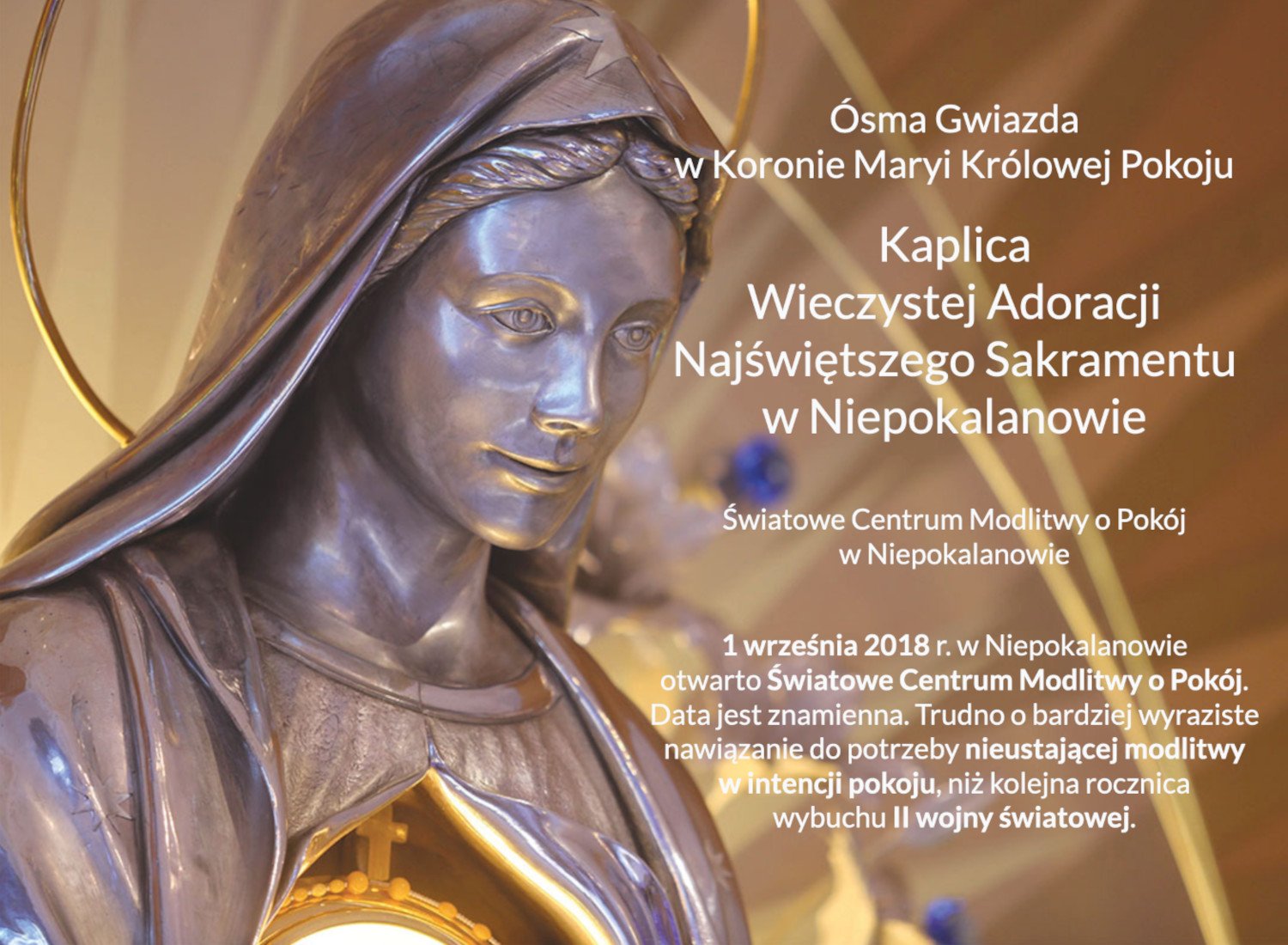

The Eucharistic Adoration Chapel established by Saint Maximilian Kolbe was inaugurated at the outbreak of World War II. It was restored as a Chapel of Adoration in September, 2018, the commemoration of the date that the war began. It is now part of the World Center of Prayer for Peace. The live internet feed of the Adoration Chapel at Niepokalanow — sponsored by EWTN — was established just a few weeks before we discovered it and began to include in at Beyond These Stone Walls. Click “Watch on YouTube” in the lower left corner to see how many people around the world are present there with you. The number appears below the symbol for EWTN.
Click or tap here to proceed to the Adoration Chapel.
The following is a translation from the Polish in the image above: “Eighth Star in the Crown of Mary Queen of Peace” “Chapel of Perpetual Adoration of the Blessed Sacrament at Niepokalanow. World Center of Prayer for Peace.” “On September 1, 2018, the World Center of Prayer for Peace in Niepokalanow was opened. It would be difficult to find a more expressive reference to the need for constant prayer for peace than the anniversary of the outbreak of World War II.”
For the Catholic theology behind this image, visit my post, “The Ark of the Covenant and the Mother of God.”