“There are few authentic prophetic voices among us, guiding truth-seekers along the right path. Among them is Fr. Gordon MacRae, a mighty voice in the prison tradition of John the Baptist, Maximilian Kolbe, Alfred Delp, SJ, and Dietrich Bonhoeffer.”
— Deacon David Jones
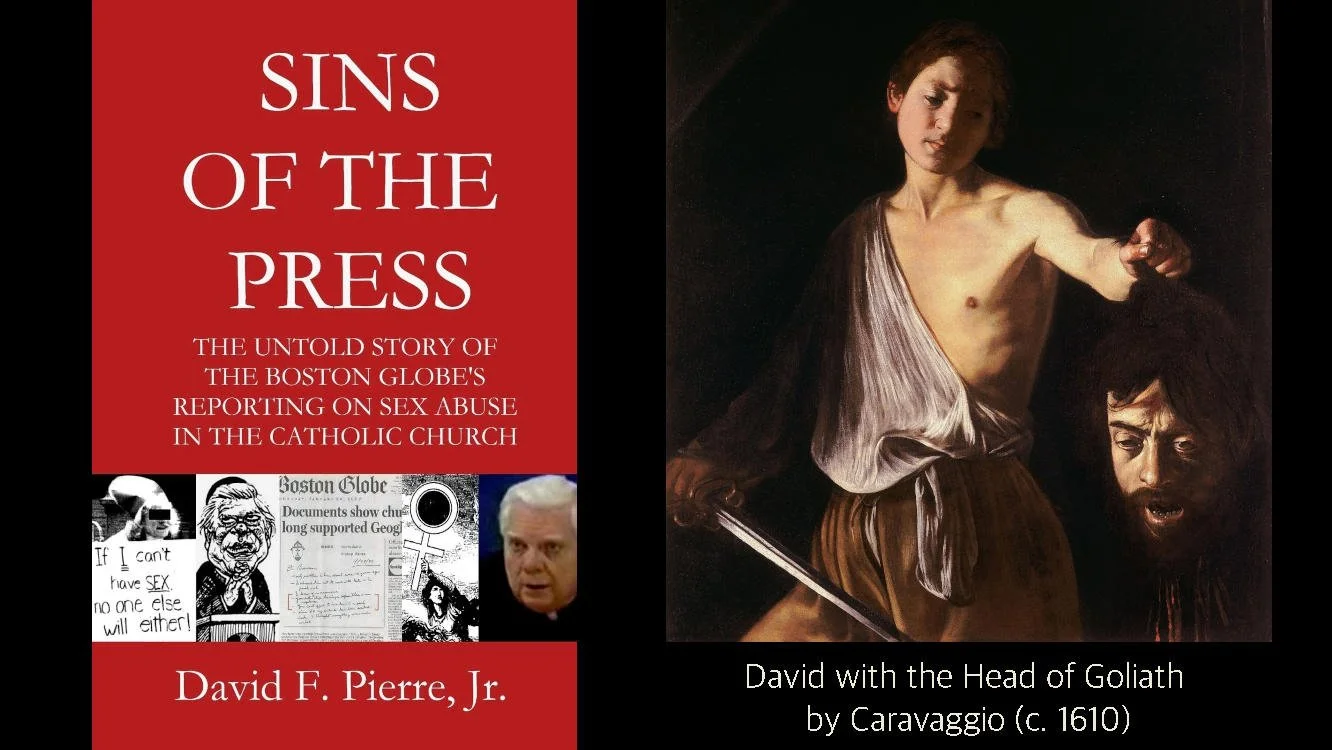
Sins of the Press: David and the Truth About Goliath
In his book, Sins of the Press, Catholic writer and media equalizer David F Pierre Jr, takes aim at a news Goliath: The Boston Globe’s Pulitzer-endorsed Prejudice.
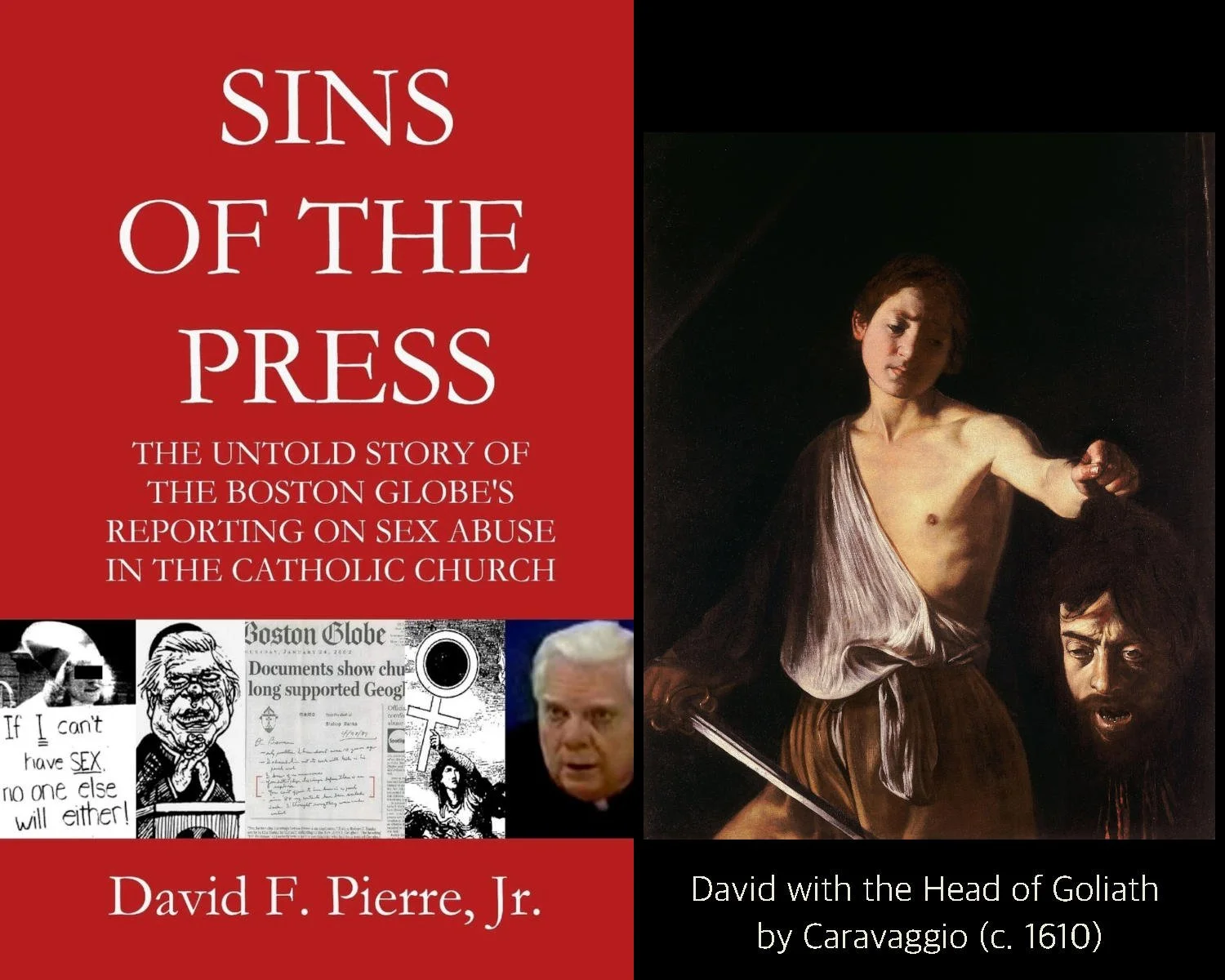
In his book, Sins of the Press, Catholic writer and media equalizer David F Pierre Jr, takes aim at a news Goliath: The Boston Globe’s Pulitzer-endorsed Prejudice.
October 15, 2025 by Father Gordon MacRae
Do you remember Robert McCall? He was The Equalizer, a retired espionage operative in a popular 1980s TV series. It was never clear whether he was CIA or MI6, but each week he placed his formidable skills in the service of some underdog up against powerful oppressors. With British actor Edward Woodward in the role of Robert McCall, The Equalizer managed to even the odds against a perfect storm of tyranny. He appeared rather benign, and at times he seemed a bit in over his head, but he was patient and bided his time. When he struck, the powerful and powerfully corrupt were unmasked and undone.
In a world of media atrocities, David F. Pierre, Jr. aims to be an equalizer. With the patience of Job, he waited a dozen years before loading his small stone of an expository book into a sling to take aim at a media Goliath, in this case The Boston Globe and its 2003 Pulitzer Prize for — don’t miss the irony in this — “Public Service.” Here’s how the Pulitzer Committee described its 2003 award to The Boston Globe…
“… for its courageous, comprehensive coverage of sexual abuse by priests, an effort that pierced secrecy, stirred local, national, and international reaction, and produced changes in the Roman Catholic Church.”
I found that description by the 2003 Pulitzer Committee to be incredibly tragic and sad. The recipients of that Pulitzer, The Boston Globe and its Spotlight Team, had an opportunity to pierce entrenched secrecy, to stir long dormant local, national and international reaction, and to produce substantive changes in the epidemic of sexual abuse from which millions in this culture have suffered. Indeed, that would have been a public service.
But the Globe let that opportunity pass for the creation of a moral panic aimed exclusively at the Catholic Church, and the Pulitzer Prize Committee chose to underwrite that fraud. It was an adventure in media narcissism, and David F. Pierre, Jr. struck the eye of that self-serving Goliath in Sins of the Press: The Untold Story of The Boston Globe's Reporting on Sex Abuse in the Catholic Church.
His publication of this book was timely. In the same year of the book’s release, Hollywood released its own version of The Boston Globe’s Pulitzer-endorsed prejudice with the film, “Spotlight” written by Thomas McCarthy, who also directed, and Josh Singer. Some have suggested that the film was on a par with the great 1976 Oscar winner, All the President’s Men that explored The Washington Post’s dogged pursuit of President Richard Nixon and the Watergate scandal. The claim was ludicrous.
David Pierre posted an exclusive here two weeks ago in “Hidden Evil: The Anti-Catholic Agenda of Bishop Accountability.” It exposed another venomous venue, Bishop Accountability, which was far more interested in exploiting Catholic scandal than covering the truth about child abuse. Sins of the Press, in contrast, was focused on The Boston Globe’s coverage of Catholic scandal which was aimed solely for the purpose of destroying one of the most important pillars of Boston, Massachusetts, its Catholicism.
On page after page of Sins of the Press, Pierre presents clear and compelling evidence of the Globe’s reckless disservice to humanity in its shameless pursuit of Catholic priests. Like David Pierre’s previous books, Catholic Priests Falsely Accused, and Double Standard, Sins of the Press is right on point without its author telling us what to think about the sordid revelations it contains. He lets the facts speak for themselves, and they do, quite loudly, sometimes with echoes that resounded in my soul and psyche for days.
Mr. Pierre was not the first to take on the Globe’s reckless and destructive pursuit of Catholic priests and their due process rights. Several years before Sins of the Press was written, we published at Beyond These Stone Walls, “The Exile of Father Dominic Menna and Transparency at The Boston Globe.” Father Menna was an 81-year-old priest in the Archdiocese of Boston living out his senior years in a rectory with other priests while he served, as best he could, a parish that loved him dearly. Then out of the blue in 2007 came a single, vague allegation against him — there had never been another before or since — that The Boston Globe exploited mercilessly while allowing its readers to believe that the allegation was something that had just taken place. In truth, it was claimed to have happened 53 years earlier and like all such claims it was settled with no regard for Father Menna’s due process rights or well-being. Thanks to the Globe’s one-sided account, Father Menna was driven out of the priesthood at age 83 and died from a broken heart. Where was the Spotlight on that?

A Spotlight When We Needed a Floodlight
What The Boston Globe did, and what the Pulitzer Prize Committee honored for the Globe’s Spotlight coverage, was patently reckless, unjust, and dishonest, not only about the Catholic Church and priests, but also about the tragic and silenced majority of victims of sexual abuse. Dave Pierre’s book exposes one media tenet clearly: “If a priest didn’t do it, we’re not interested!”
The reader is left with no doubt that the harsh glare of a spotlight brought to bear by The Boston Globe was meant for a singular purpose, to isolate the Catholic Church and priesthood as a sort of special locus of sexual abuse. At the same time, the Globe accommodated by omission the prevalence of sexual abuse in other institutions throughout not only Boston, but the nation. A spotlight leaves a lot in the dark, whereas a floodlight is all-inclusive.
A case in point, one very familiar to our readers, is the story of what happened to Pornchai Moontri. The worst of it took place in New England, and the State of Maine, well within The Boston Globe’s coverage area. Pornchai Moontri was taken from his home in rural Thailand at age 11 and brought to Bangor, Maine, where he suffered years of horrific sexual abuse and violence. At one point he escaped only to be handed back over to his abuser by police. Having never been exposed to English, Pornchai could not articulate what had been happening to him. Then his mother was murdered, from all appearances by the same man who exploited Pornchai. He escaped into the streets as a teen where he lived under a bridge and homeless. During a struggle with a much larger man, Pornchai killed him in desperation, and was sent to life in prison with no defense. He ended up in a cell with me, and on April 10, 2010 he became a Catholic on Divine Mercy Sunday. As Pornchai much later wrote, “I could not believe all the stories of repressed memory and demands for huge amounts of money, by those who were accusing Catholic priests. I came to the Catholic Church for healing and hope, and found both. The grace of my recovery came from a priest who was falsely accused and I came to know that with every fiber of my being. He led me out of darkness into a wonderful light.”
With help from Clare Farr, an Australia attorney who read of Pornchai’s story and took an interest, we scoured cyberspace to find Pornchai’s abuser and bring him to justice. After reading what I wrote (linked at the end of this post), detectives from Maine came to interview Pornchai. On a second interview they brought the District Attorney. Pornchai’s abuser was found in Oregon and he was charged with 40 felony counts of child sexual abuse in Penobscot County Superior Court in Maine. On September 18, 2018 Richard Alan Bailey entered a plea of no contest on all counts. He was found guilty on all of them, but sentenced only to 18 years probation. There was no outrage, not even a sign that anyone noticed. The Boston Globe had zero interest in this story. There was just no cash to be had or Roman collar to be destroyed.
In September 2020, Pornchai was taken into custody by ICE and deported to his native Thailand. Hollywood called the Globe’s Oscar-winning film Spotlight. In a perverted sort of way, that was appropriate because it left in darkness, under shrouds of ignorance the real damage that had been done.
Losing the News
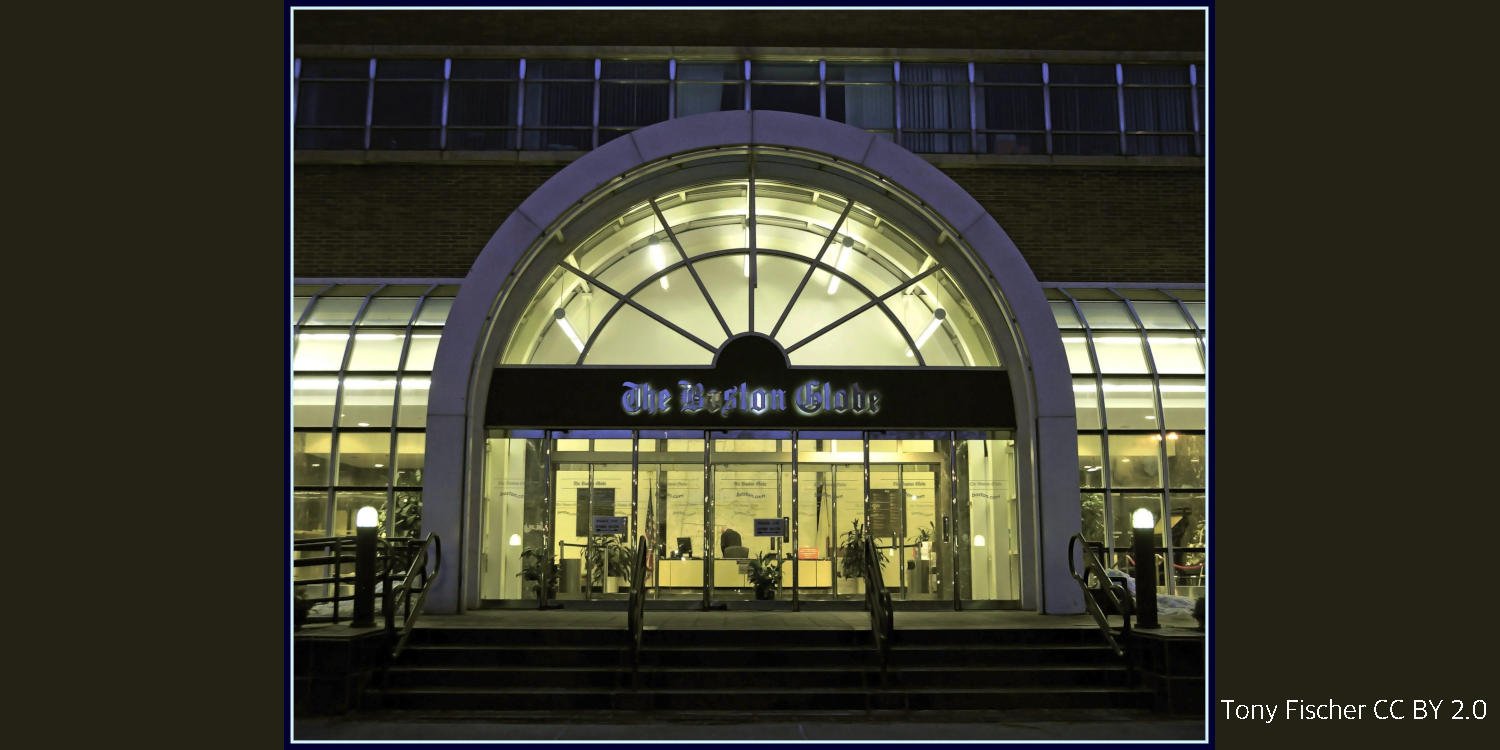
The Boston Globe Spotlight Team accomplished its goal with the creation of a perfect storm of moral panic. The paper’s spin presented every claim and accusation as demonstrably true, reported every settlement as evidence of guilt, spun decades-old claims to make them look as though they occurred yesterday, and never once questioned the financial motives of accusers.
In this arena, the Globe assisted in the continued abuse suffered by real victims by repeatedly giving a platform to personal injury lawyers who stood to pocket forty percent of every settlement wrested from a beleaguered and bludgeoned hierarchy while the millions abused in non-Catholic venues suffered in silence. The Globe’s “public service” was mostly to contingency lawyers.
Not all in the media were onboard with this. Writing for the contentious media platform, CounterPunch, columnist Joanne Wypijewski crowned her long career in journalism as a staff writer for The Nation with her own counter punch entitled “Oscar Hangover Special: Why “Spotlight” Is a Terrible Film.” For full transparency, much of her article was about the case against me. Armed with some healthy skepticism, the most important tool in her journalistic arsenal, she began her article thusly:
“I don’t “believe the victims”.
“I was in Boston in the Spring of 2002 reporting on the priest scandal, and because I know some of what is untrue, I don’t believe the personal injury lawyers or the Boston Globe’s “Spotlight” team or the Catholic “faithful” who became harpies outside Boston churches, carrying signs with images of Satan, hurling invective at congregants who’d just attended Mass, and at least once — this in my presence — spitting in the face of a person who dared dispute them.
“I don’t believe the prosecutors who pursued tainted cases or the therapists who revived junk science or the juries that sided with them or the judges who failed to act justly or the people who made money off any of this.
“And I am astonished (though I suppose I shouldn’t be) that, across the past few months, ever since Spotlight hit theaters, otherwise serious left-of-center people have peppered their party conversation with effusions that the film reflects a heroic journalism, the kind we all need more of.”
The lawyers, the Globe, and the seemingly endless parade of “John Does” all seemed to be on the same page in this, and it was always the front page. None of them reported that Father Dominic Menna, for example, never had any prior accusation, and that the one that destroyed his priesthood was claimed to have happened 53 years earlier and built on a dubious claim of repressed and recovered memory, a fraud that in this arena would go on to transform many lawyers into millionaires.
According to a recent Pew Research Center survey, less than half of Americans said that losing their local newspaper would harm civic life. Less than one third responded that they would miss their local newspaper if it just disappeared. Ken Paulson, President of the Newseum Institute’s First Amendment Center and a member of the USA Today Board of Contributors published an interesting column for USA Today entitled “News Media Lose Trust, Gain Allies.” Mr. Paulson cited a “State of the First Amendment Survey” with dismal results for those in the news media whose careers have been built upon reputable journalism. In the survey results, just 24% of respondents believe that the news media try to report the news without bias. That figure is down from 41% just a year earlier. However, 69% state that journalists in the news media should act in a watchdog role in reporting on government. That figure was down from 80% a year earlier. The first figure — the fact that only 24% of those surveyed believe the news media reports without bias — is alarming, and a record low for this decade-long poll. The second figure — indicating a decline in the sense that the media acts in a watchdog role — was surprising to Mr. Paulson who reported that “This nation’s founding generation insisted on a free press to act as a check on a strong central government … an enduring principle over centuries.” He added, however,
“Social media posts that call out unfairness and injustice don’t diminish this critical watchdog role. It just means a free press has many more allies.”
David F. Pierre, Jr. is one of those allies. His book, Sins of the Press is a David v. Goliath account that takes needed aim at The Boston Globe’s bias, and that is a good thing. The release of Spotlight, Hollywood’s version of this sordid story, felt a lot more like the Globe’s epitaph than any celebration of its dubious public service.
+ + +
+ + +
Note from Father Gordon MacRae: Thank you for reading and sharing this important post. I thank David F. Pierre, Jr. and commend him for his journalistic courage and integrity. You may review his work at TheMediaReport.com.
You may also like these related posts at Beyond These Stone Walls:
Getting Away with Murder on the Island of Guam
The Lying, Scheming Altar Boy on the Cover of Newsweek
Cardinal Bernard Law on the Frontier of Civil Rights
Hidden Evil: The Anti-Catholic Agenda of Bishop Accountability
Illumination From Down Under: Hope Springs Eternal in the Priestly Breast
+ + +

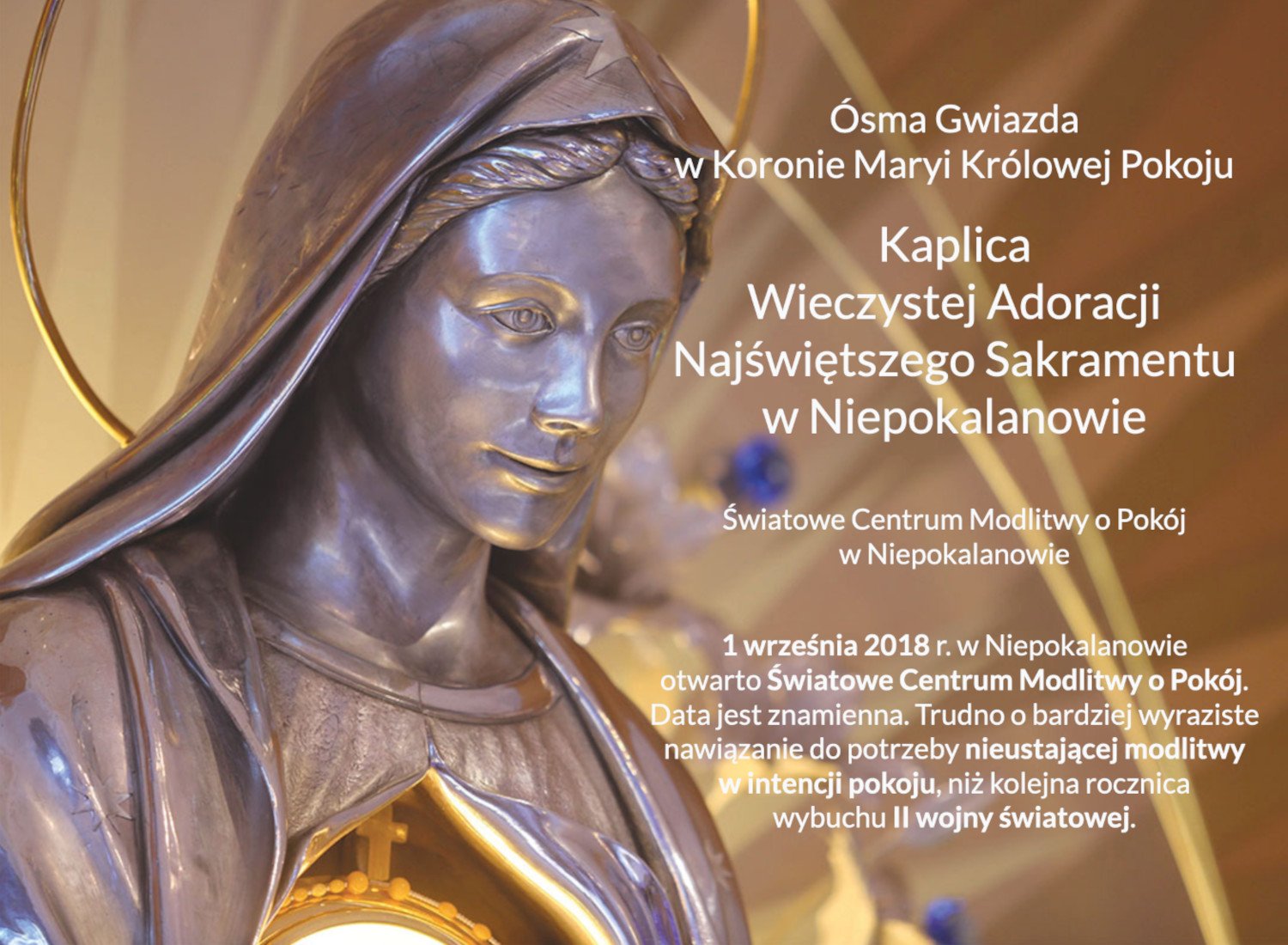

The Eucharistic Adoration Chapel established by Saint Maximilian Kolbe was inaugurated at the outbreak of World War II. It was restored as a Chapel of Adoration in September, 2018, the commemoration of the date that the war began. It is now part of the World Center of Prayer for Peace. The live internet feed of the Adoration Chapel at Niepokalanow — sponsored by EWTN — was established just a few weeks before we discovered it and began to include in at Beyond These Stone Walls. Click “Watch on YouTube” in the lower left corner to see how many people around the world are present there with you. The number appears below the symbol for EWTN.
Click or tap here to proceed to the Adoration Chapel.
The following is a translation from the Polish in the image above: “Eighth Star in the Crown of Mary Queen of Peace” “Chapel of Perpetual Adoration of the Blessed Sacrament at Niepokalanow. World Center of Prayer for Peace.” “On September 1, 2018, the World Center of Prayer for Peace in Niepokalanow was opened. It would be difficult to find a more expressive reference to the need for constant prayer for peace than the anniversary of the outbreak of World War II.”
For the Catholic theology behind this image, visit my post, “The Ark of the Covenant and the Mother of God.”

Hidden Evil: The Anti-Catholic Agenda of Bishop Accountability
David F Pierre, Jr exposes anti-Catholic hostility and bias masked as support for victims. The goal of Bishop Accountability is to bankrupt and empty the Church.
David F Pierre, Jr exposes anti-Catholic hostility and bias masked as support for victims. The goal of Bishop Accountability is to bankrupt and empty the Church.
October 1, 2025 by David F. Pierre, Jr., Editor of The Media Report
Note from Father Gordon MacRae: Late last week Beyond These Stone Walls published at our Voices from Beyond feature an essay by Father Michael P. Orsi, former Research Director at Ave Maria University School of Law. The title of Father Orsi’s brief but brilliant essay, previously published in the Catholic League Journal, Catalyst, is “Bogus Charges Against Priests Abound.”
It is a stunning review of one of the revelatory books by David F. Pierre, Jr. entitled, Catholic Priests Falsely Accused: The Facts, The Fraud, The Stories. Among its content is a bold chapter about the case against me.
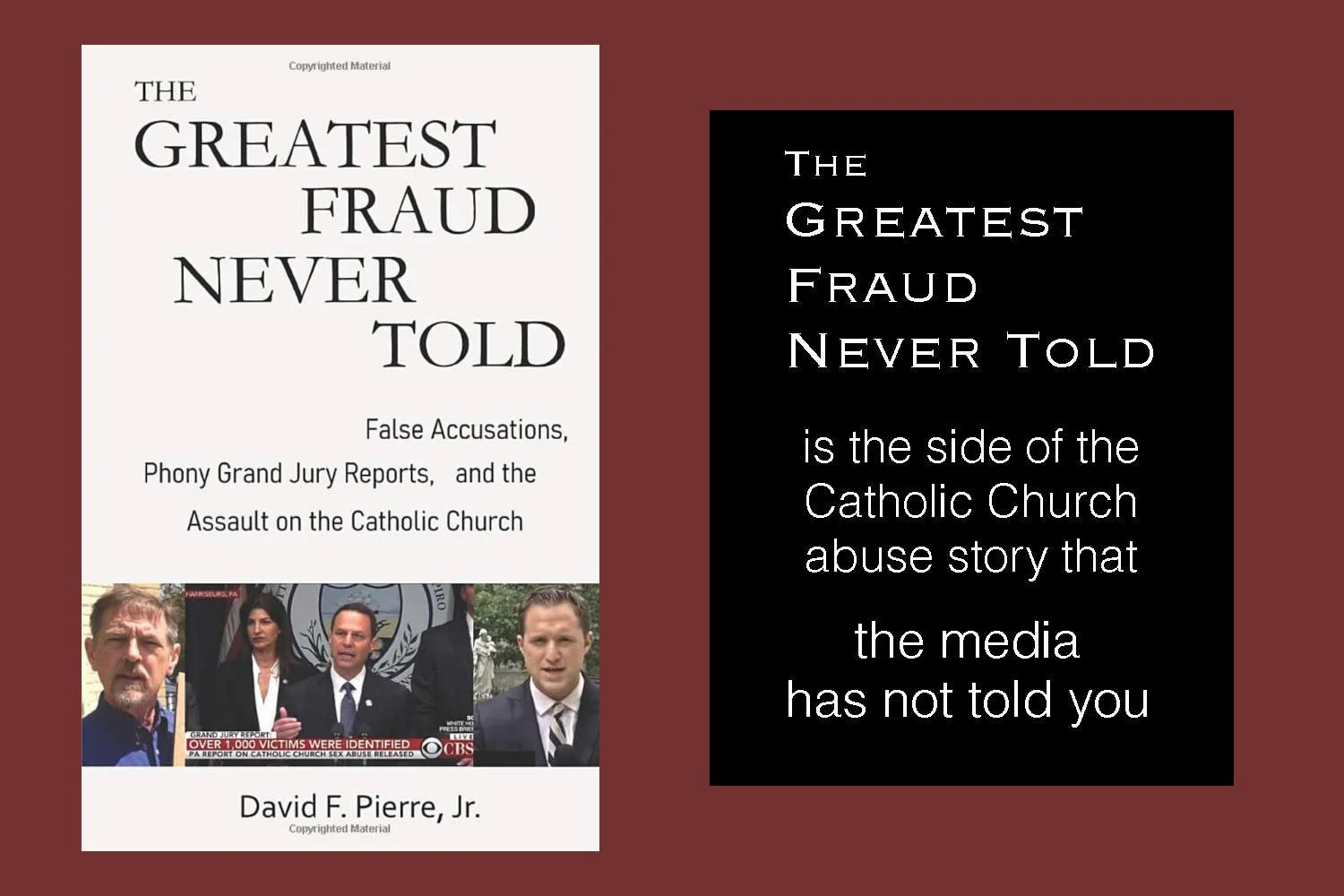
Also at Voices from Beyond this week, we feature another very prominent figure in the American Catholic Church who published an equally stunning review of David F. Pierre, Jr.’s latest book, The Greatest Fraud Never Told. The reviewer is Father Peter M.J. Stravinskas, an accomplished theologian and Editor of The Catholic Response. His excellent review was previously published at The Catholic Thing : “At the Mercy of One False Brother.”
Mr. Pierre has graciously acceded to write about the online continuation of a fraud perpetrated against the Church by BishopAccountability.org.
Now here is David F. Pierre, Jr.
+ + +
The web site BishopAccountability.org likes to fashion itself as merely a “public library of information” that curates a vast “database of accused Roman Catholic priests” as it relates to sexual abuse. The site catalogs literally thousands of priests who have been only accused of sexual abuse whether they are alive or long-dead. For this, Bishop Accountability has naturally become a darling of the legacy media which continues to revel in keeping the embers of the “Catholic Church sex abuse story” alive while browbeating the Church for the sins of a small minority of priests from many decades ago.
But there is an evil that consumes the site. And this evil has absolutely nothing to do with the abuse of children.
For starters, there is little semblance of fairness or due process at Bishop Accountability. A visitor could easily conclude that the thousands of priests profiled on the site must be “guilty of something” for them to even be listed there. Indeed, that is really the whole purpose of the site: to suggest guilt by association. Only after a series of clicks can a visitor find the site’s “posting policy,” which could be paraphrased as such: “If a priest has been publicly accused of abuse at any time, we will plaster his name, photo, and history here for all of the world to see.”
Bishop Accountability’s False Promise
What about the priests who are clearly innocent, you ask? Well, by its very own admission, guilt or innocence plays no role whatsoever on whether or not a priest is profiled on its site. Here is one exception that Bishop Accountability has made:
“If a survivor publicly withdraws an allegation, recants, or states that the alleged perpetrator has been misidentified, and if there are no other allegations of abuse against the accused cleric, that cleric is removed from the database.”
Interesting that Bishop Accountability still identifies a fraudster who has recanted his allegation as a “survivor.” This makes no sense at all, of course. Indeed, if there is any “survivor” in a false accusation, it would be the falsely accused priest himself who has “survived” the ordeal and had his life ruined. But Bishop Accountability does not see it that way. In short, Bishop Accountability will post the identity and photo of any priest accused of anything sex abuse related, no matter how old, wacky, or implausible the accusations are.
Take the case of Diocese of Charleston Bishop Robert Guglielmone from a few years back. In 2019, a man openly admitted to a family member that he made up an abuse claim against Guglielmone in order to extract money from the Church. The man even blithely stated, “It’s worth a try.” The entire accusation was completely bogus and ridiculous, yet Bishop Guglielmone, who swiftly returned to ministry after the truth surfaced, is still listed on Bishop Accountability — along with his photo, of course — as if he were a convicted child molester.
And although Bishop Accountability claims that it will not post the profiles of priests whose accusers have recanted, this itself is not even true. Rev. John M. Costello, a Jesuit priest in the Diocese of Rochester, had his entire life upended in 2003 after a former student claimed that he had abused him some two decades earlier. However, after investigators began to scrutinize the chap’s claim, the accuser recanted and told investigators that “another priest,” not Costello, had abused him. But, defying its very own policy, Bishop Accountability continues to profile Costello on its site for the entire world to see.
Even the Dead Are Fair Game
There is also the legion of cases involving single accusations against long-dead priests. Some readers are old enough to remember a time when one would not dare say anything unproven about a dead person to abide by the truth that “dead people cannot defend themselves.” But when it comes to Catholic priests and Bishop Accountability, they proudly attack the dead and defenseless.
Just a couple of years ago, in 2023, a man contacted the Diocese of Albany to claim that Fr. J. Gregory Mulhall “physically assaulted” him as a “vulnerable adult" many decades earlier. What did Fr. Mulhall have to say about this? Well, not much, as he had died at age 90 over two decades earlier, in 2001. (Mulhall was ordained in 1937, when Franklin Delano Roosevelt was President.) Fr. Mulhall’s surviving friends and family members are naturally none too happy about him being publicly profiled as if he were a convicted child predator.
Another dead priest who would probably want to respond to an accusation against him if he were alive is Fr. Gregory Flohr, who died in 2004. Flohr did not have a single blemish against him in over four decades in ministry. It was not until many years after Flohr died that an anonymous male accuser saw the possibility of a large cash windfall and came forward to lodge a bizarre claim against Flohr that no reasonable person would ever believe. Yet Fr. Flohr is still included in Bishop Accountability’s “database” even though he is obviously unable to defend himself.
The Surprising Truth About Falsely Accused Priests
It is now an undeniable fact that false accusations against Catholic priests are rampant. In recent years as little as 6% of historical abuse claims against priests have even been deemed “substantiated” by the very lenient standards of diocesan review boards, with the majority of accusations deemed either “unsubstantiated” (indeed false), “unable to be proven,” or still under review.
In 2021, in a church of 70 million people in the United States, 44 current minors came forward alleging that a current priest had recently abused them. However, only four of these 44 were ever found to even be “substantiated,” while the remaining 40 (or 91% (!)) were found to be completely bogus.
Why is there a rampancy of false accusations? That answer is easy. Easy money. For the past two-and-a-half decades, the Church has been shoveling out cash to accusers and their tort lawyers like an ATM on tilt, and grifters have long taken notice. As Fr. Gordon MacRae himself chronicled two decades ago, an East-coast attorney confirmed as far back as 2001 that accusing a Catholic priest of sex abuse was a “current and popular scam” among criminals in prison looking for an easy cash payout. And, yes, this hustle still continues to this day.
Meanwhile, states like California and New York have made it easy for flimflammers to get in on the action by repeatedly enacting “window legislation” that temporarily suspends the statute of limitations and allows any fraudster or con artist to sue the Catholic Church for big bucks, no matter how long ago or crazy the abuse claim. Statutes of limitation, due process, and fairness have been discarded in order to line the pockets of tort lawyers and fleece the Catholic Church.
A couple of years ago, Thomas R. Hampson of Illinois, a 40-year veteran investigator with thousands of sex abuse investigations, wrote of what he witnessed in the Archdiocese of Chicago:
“There were priests who were falsely accused of abuse but the archdiocese settled anyway. I know they were false accusations because the stories were outrageous. No details. Implausible circumstances. And a reaction that wasn’t believable. Even in a civil trial these cases could not prove by a preponderance of the evidence that anything actually happened, much less that the accused was the one who did it. In most of those cases the priest was already dead.”
Hampson also added that in the current-day fever swamp in which people must “believe the accusers,” the principle of innocent until proven guilty has been abandoned such that the investigators are looking merely for confirmation of the accused’s guilt.
And what has been the end result of all this? The coffers of the Catholic Church have been drained by literally billions of dollars, robbing it of resources to build the faith and serve the poor.
The Sheer Evil of It All
Bishop Accountability claims that its site is dedicated to “the victims and their families and loved ones.” The reality could not be further from the truth.
There is a kind of underlying spiritual aura to Bishop Accountability that cannot be ignored. And that spirit is evil. Satan, along with his demon partners, hate the Catholic Church and everything it stands for, which is truth. Satan’s rage against Christ and the Catholic Church is eternal and continues today. Writer Thomas J. Nash has recently written about this reality:
“Satan and his demonic minions are irredeemably opposed to the truth. They hate the truth. More to the point, they hate him who is ‘the way, and the truth, and the life,’ our Lord Jesus Christ (John 14:6) … Consequently, Satan and his demonic minions really hate the sacrifice of the Mass and Eucharistic Adoration in general because they are daily reminders of Christ overcoming them and their infernal kingdom through the Cross.”
One of Satan’s great successes in recent years is perpetuating the lie that the priesthood of the Catholic Church is an irredeemable den of sexual immorality and corruption. Much of the recent breakdown in the fabric of Western civilization over the last 25 or 30 years can be directly tied to the nonstop media campaign against the Catholic Church tied to the sex abuse issue and the resulting silence of the hierarchy in opposing the many social initiatives that have brought so much harm to our societies. It has also torn God’s people away from the Eucharist, the Mass, and the Catholic Church itself.
In trampling on the rights of innocent priests, defaming the dead, and trafficking in innuendo, there is little doubt that Bishop Accountability has been a great asset to Satan in his battle against the Catholic Church.
+ + +
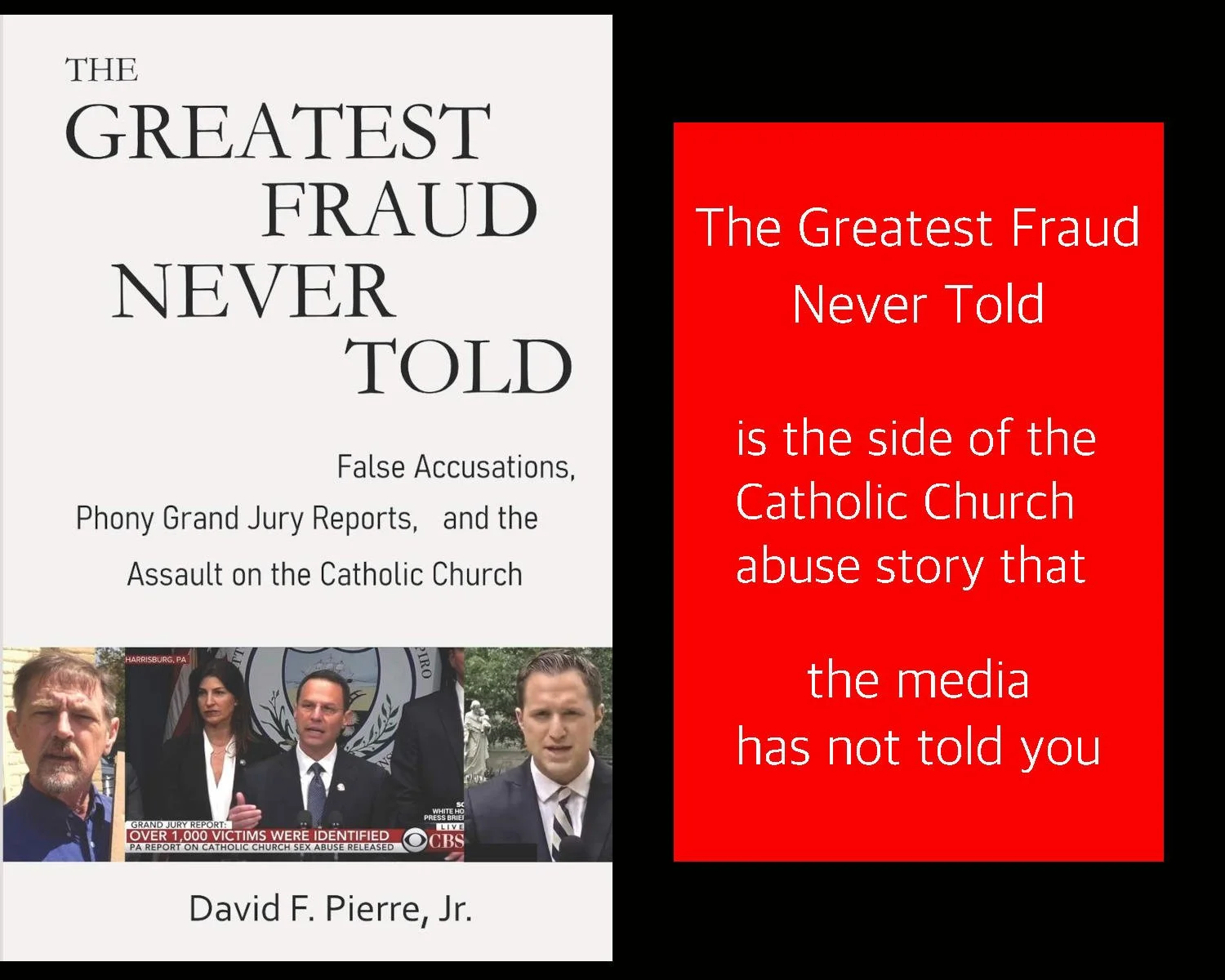
David F. Pierre, Jr. is the country’s leading observer of the media’s coverage of the Catholic Church abuse narrative and is the author of four acclaimed books, the most recent of which is The Greatest Fraud Never Told: False Accusations, Phony Grand Jury Reports, and the Assault on the Catholic Church (Amazon.com).
David is also the creator and author of TheMediaReport.com, an educational cooperative to chronicle and monitor the mainstream media’s coverage of the Catholic Church sex abuse narrative.
Please also check out TheMediaReport.com’s important posts on the case of Fr. MacRae: *EXCLUSIVE REPORT* Alarming New Evidence May Exonerate Imprisoned Priest
The Wall Street Journal Again Profiles Case of Fr Gordon MacRae
The Eucharistic Adoration Chapel established by Saint Maximilian Kolbe was inaugurated at the outbreak of World War II. It was restored as a Chapel of Adoration in September, 2018, the commemoration of the date that the war began. It is now part of the World Center of Prayer for Peace. The live internet feed of the Adoration Chapel at Niepokalanow — sponsored by EWTN — was established just a few weeks before we discovered it and began to include in at Beyond These Stone Walls. Click “Watch on YouTube” in the lower left corner to see how many people around the world are present there with you. The number appears below the symbol for EWTN.
Click or tap here to proceed to the Adoration Chapel.
The following is a translation from the Polish in the image above: “Eighth Star in the Crown of Mary Queen of Peace” “Chapel of Perpetual Adoration of the Blessed Sacrament at Niepokalanow. World Center of Prayer for Peace.” “On September 1, 2018, the World Center of Prayer for Peace in Niepokalanow was opened. It would be difficult to find a more expressive reference to the need for constant prayer for peace than the anniversary of the outbreak of World War II.”
For the Catholic theology behind this image, visit my post, “The Ark of the Covenant and the Mother of God.”
How SNAP Foisted McCarthyism Upon the Catholic Church
Generating fears, shameful to our ears, ruining careers; personal attacks, alternative facts, financial kickbacks: the rap of SNAP for a modern American witch hunt.
Generating fears, shameful to our ears, ruining careers; personal attacks, alternative facts, financial kickbacks: the rap of SNAP for a modern American witch hunt.
September 3, 2025 by Father Gordon MacRae
Ever so slowly awakening across America is a long-suppressed awareness of an ugly part of history that keeps repeating itself. There are prophets arising among us who are finding the courage to speak truth to power — in this case the power of mob justice. One of them is columnist Michelle Malkin whose article, “Fighting for the Falsely Accused” was sent to me some time ago.
Michelle Malkin tells the gruesomely familiar tale of former Fort Worth, Texas police officer, Brian Franklin. Convicted of the sexual assault of a 13-year-old girl in 1995, he spent the next twenty-one years in prison for a crime he had nothing to do with. As Ms. Malkin describes, “There were no witnesses. There was no DNA.” There was just one person’s word against another’s, and the jury — after lots of media hype — was conditioned to bring no skepticism to the heavily coached testimony of a distraught teen.
The sole evidence was a medical report of a physical examination concluding that the girl had in fact been sexually assaulted. That, and a claim that the assault occurred in the backyard of her biological father who was a friend of the police officer-suspect, was enough to satisfy prosecutors and a jury.
It was a prosecutorial perfect storm, and the fact that there was no other evidence, no DNA to test, no witnesses to the peripheral circumstances of the crime, left the defendant-turned-prisoner with nothing to satisfy the court’s demand for proof of actual innocence. So with no one having to “prove” Brian Franklin’s actual guilt, his imprisonment went on and on, passing two decades in the long, slow parade of lost time that struck home hard for me. “It’s the easiest crime to be falsely accused of,” Mr. Franklin says today.
Before reading any further, try to place yourself in Brian Franklin’s shoes for a moment. It’s easy to feel immune from the gravity of such injustice because we have no frame of reference for it happening to ourselves — or to a brother, a father, a son, a close friend, a parish priest — until it does. How would you defend yourself against such a charge when no evidence at all is needed to convict you?
After 21 years in prison — what Michelle Malkin described as “a harrowing 7,700 days of a life sentence” — Mr. Franklin had to fight for freedom even after newly discovered evidence emerged showing that the girl’s stepfather was the actual assailant. In a new trial 21 years after the first, Mr. Franklin was acquitted. He then had to fight again, that time for a declaration of actual innocence from a Texas court that would make him eligible for reparations for the 21 years of life stolen from him.
Over time, laws have been passed that make such exonerations very difficult to obtain. Judges in my own appeals have declined to even review newly discovered evidence because of laws that don’t require them to. Under current New Hampshire law, a convicted defendant has one year from the date of conviction to find and bring forward new evidence that might challenge it, an impossible task from prison.
In a majority opinion of the U.S. Supreme Court, Chief Justice William Rehnquist ruled that “actual innocence is not, in itself, a constitutional claim,” that would support a federal habeas corpus petition for a new trial. Rehnquist wrote for the majority court that innocent defendants in such cases can seek a political solution by asking for a pardon or sentence commutation from their governors. In the entire history of the State of New Hampshire, not a single such petition has ever been granted for a claimed sexual offense. As Brian Franklin said, “it’s the easiest crime to be falsely accused of,” and the most difficult from which to obtain justice once accused.
And as for reparations for the wrongly convicted, two decades ago, the New Hampshire Legislature, passed a law limiting reparations for wrongful imprisonment to a $20,000 cap regardless of how many years or decades a wrongfully convicted person spent in prison. It would cost more than that just to hire a lawyer to pursue such a claim for reparations.
The Catholic Rise of McCarthyism
In the case of Brian Franklin, he reports that he was sustained throughout those 21 lost years by the fact that, as Michelle Malkin wrote, “his family and church stood by him.” On the day this is posted, I awaken to my 11,286th harrowing day of a life sentence in prison for crimes that never took place at all. The things that sustained Brian Franklin have been largely absent from my experience and that of any other American Catholic priest so accused.
When a Catholic priest is accused, the first line of defense for a bishop and diocese is driven by lawyers and insurance companies and it has one goal: to get as much distance as possible from the accused. When I was accused, my bishop and diocese issued a press release that pronounced me guilty before jury selection in my trial. My diocese added to the published pre-trial statement that I also victimized the entire Catholic Church.
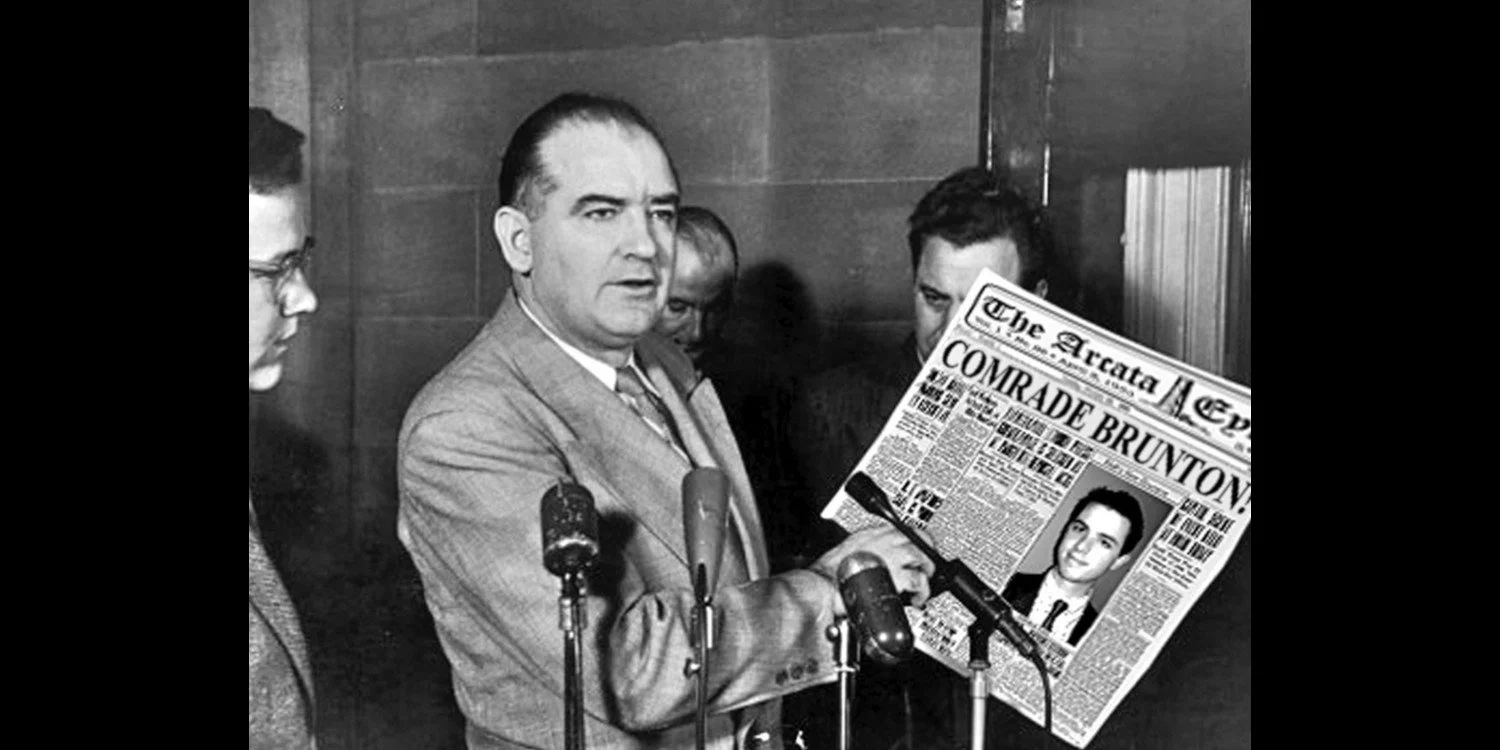
I don’t think anyone in the Diocese of Manchester would stand by that today, but they don’t stand against it either. I think that today they have a hard time explaining it so they just don’t even try, but I know exactly what happened, and it’s time to say it out in the open. In the current climate, few accused Catholic priests could have a fair trial in America. No convicted Catholic priest could be heard justly by an American appellate court or judge. No one in the Church or judicial system wants to admit this, but it is true, and we can learn why from a 1950s moral panic called “McCarthyism”.
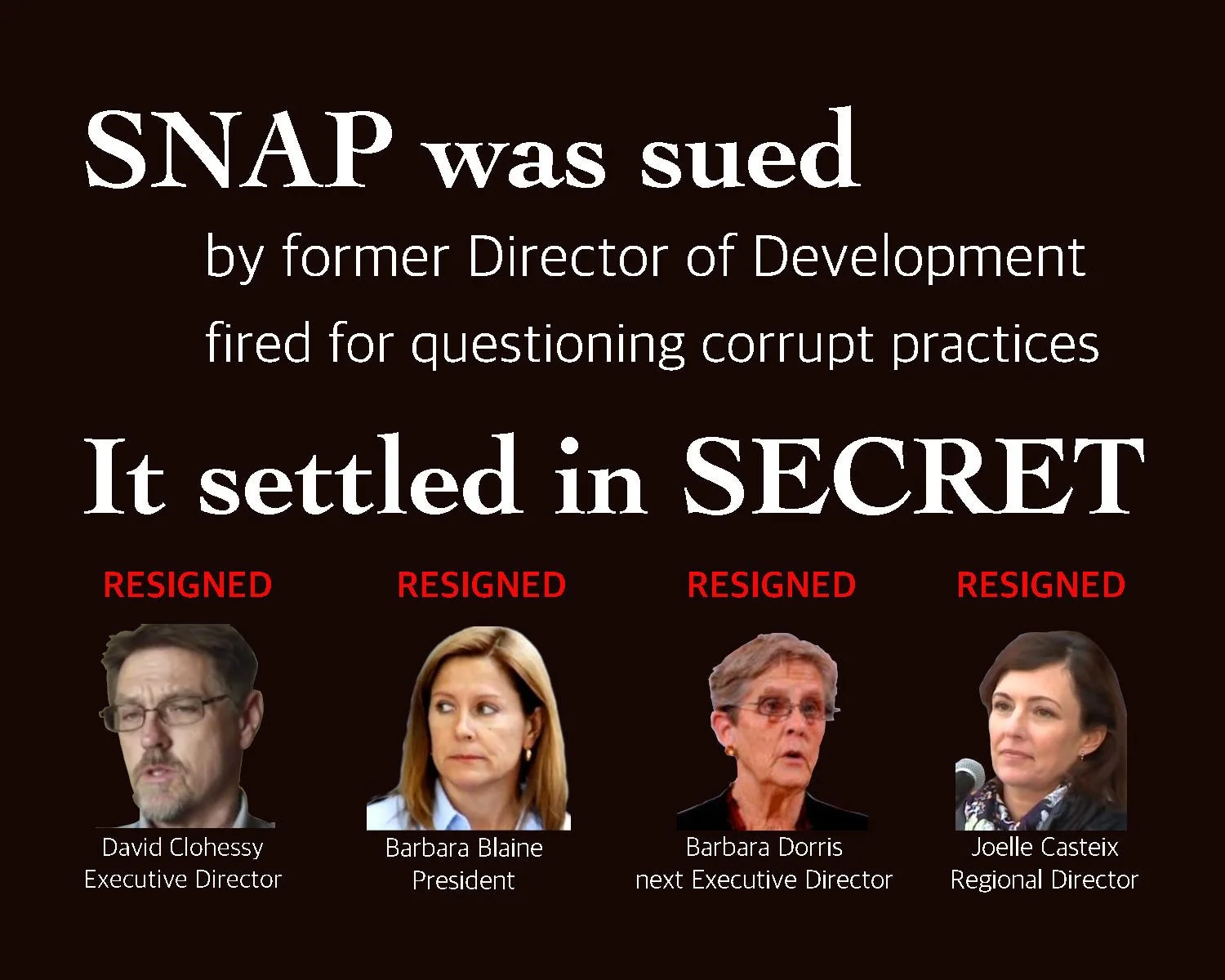
Church officials, after getting their distance from the accused, leave it to the civil courts to sort out guilt or innocence. Maintaining a pretense about the integrity of the outcome, they remain blind or silent, or both, about the role played by money and the practice of mediated settlements in generating accusations. I described how this played out in my own diocese in my post, “David Clohessy Resigned SNAP in Alleged Kickback Scheme.”
From 1990 to the present, activists from SNAP — the Survivors Network of those Abused by Priests — carried out a highly effective campaign modeled after the community activism of Saul Alinsky and the tactics of ACORN, the radical Association for Community Organization for Reform Now. The activist campaign used public demonstrations and the news media to shame anyone who challenged or dissented in any way from the moral panic they promoted. The nature of the forces at work in this were described by The Wall Street Journal’s Daniel Henninger in “McCarthyism at Middlebury” (March 9, 2017):
“America’s campuses have been in the grip of a creeping McCarthyism for years. McCarthyism, the word, stands for the extreme repression of ideas and silencing of speech. In the 1950s, Republican Senator Joseph McCarthy turned his name into a word of generalized disrepute by using the threat of communism, which was real, to ruin innocent individuals’ careers and reputations.”
Just substitute “campuses” with “Catholics,” “Republican Senator Joseph McCarthy” with “SNAP’s David Clohessy,” and “the threat of communism” with “sexual abuse,” and the McCarthyist aura around the abuse narrative in the American Catholic church is clear.
That aura was created by SNAP, and maintained by its director, David Clohessy. Like Communism in the 1950s, sexual abuse is real, a fact harnessed by David Clohessy at SNAP and Terence McKiernan at Bishop Accountability to fuel the moral panic they created. It thus became a weapon for an open assault on the Catholic Church. In every media venue that would have them, SNAP stood ready to pounce on any bishop or Church official who called for even the most basic due process and civil liberties for Catholic priests so accused.
In “SNAP Implodes” in the March 2017 issue of the Catholic League Journal, Catalyst, Bill Donohue described how SNAP manipulated the media with picket signs and feigned “Holy Childhood” photos, and harmed the Church through what he called “the conspiratorial savaging of innocent priests.” I am one of them, and I thank Bill Donohue for this truth, and for having the courage to write it when few others would. Now it’s on you, dear reader. Please share this post. Shout it from the rooftops in the public square of your social media.
SNAP obliterated the lives, reputations, and civil rights of hundreds of merely accused priests by publicly shaming them as “predators” and “pedophiles.” They knew well that these terms carried the same force of shock and moral panic as the political panic that ensued when a charge of “communist” or “communist sympathizer” was leveled in the 1950s. The manipulation of those terms, and of a news media hungry for scandal, characterized and empowered the shaming, blackballing, and ruined lives of the McCarthy Era, the widely accepted model for the modern American witch hunt.
For a stark example of the power of those words to shock even judges and deny priests the basic rights of American citizens, see our recent post, “Judge Joseph Laplante, President Trump, and the Case of Father MacRae.”
Be Wary of Crusaders
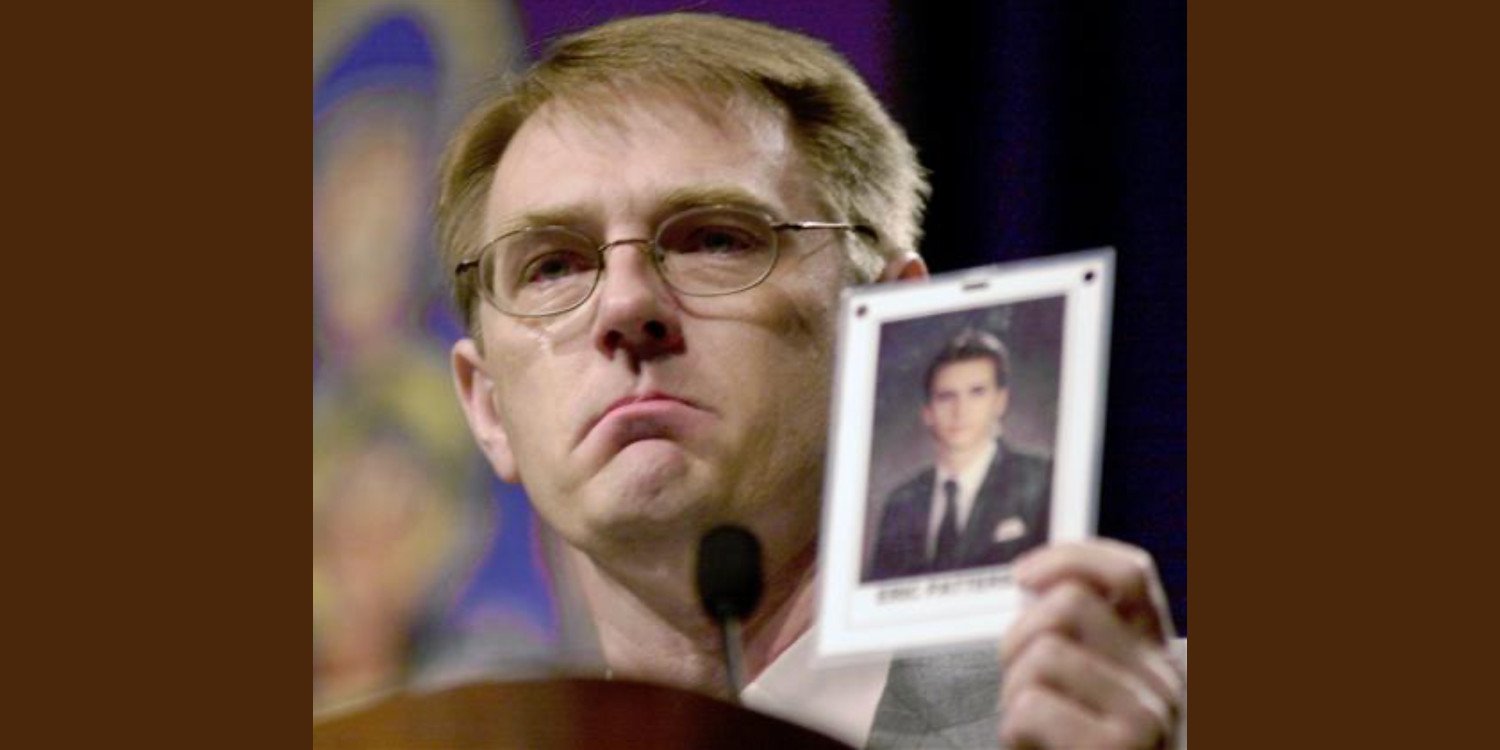
In the later 1980s and 1990s, SNAP had the terminology right. The scandal in the priesthood was first and foremost a story of homosexual predation and blackmail. But to maintain the moral panic, the language had to change to suit political correctness. The terminology did not sit well with the gay rights movement, so SNAP had to change its tactics and its language. Even the bishops went along with the new script, and to this day many Catholic commentators still stick to the “pedophile priest” story. I wrote about this in a 2011 post, “Be Wary of Crusaders The Devil Sigmund Freud Knew Only Too Well.” One sentence has often been quoted from it:
“It is a testament to the power of reaction formation [a classic Freudian defense mechanism] that an entire institution would now prefer the term ‘pedophile scandal’ to ‘homosexual scandal’ even when the facts say otherwise.”
David Clohessy was masterful at abusing the term and using its force of shock to manipulate the news media. SNAP activists labeled as “pedophile enablers” any person of conscience who called for the application of less outrage and more due process when a priest was accused.
Like an accusation of witchcraft in 1692 Massachusetts, or of being a Communist in 1955 Washington, “The P-Word” — pedophile — was fired like a bullet from an automatic weapon by SNAP activists with rancor and an intent to demean and disarm any skeptic asking for due process. The extent to which this one word was misused and manipulated was a key factor behind what writer, Ryan A. MacDonald wrote was “A Grievous Error in Judge Joseph Laplante’s Court,” another post that screams for justice and for both Church and State to take notice.
An example of the tactics of SNAP came from an activist writing under the name, “Neal Allen.” He seemed to stalk cyberspace for any positive comments or articles that called my own case into question, or presented a review of the facts. “Neal Allen” posted the same toxic comment everywhere, fired like a bullet calling me a “convicted pedophile,” and anyone writing in favor of my innocence a “pedophile enabler.”
Then it was discovered and exposed — by the heroic David F Pierre, of TheMediaReport.com — that “Neal Allen” does not even exist. It was a fake screen name used by a member of SNAP to give the impression that a mob was building to gang up on any dissenter from the attacks on me, on other priests, and the Church. Once “Neal Allen” was exposed as a fraud, he simply disappeared, but not before bullying lots of people into silent submission.
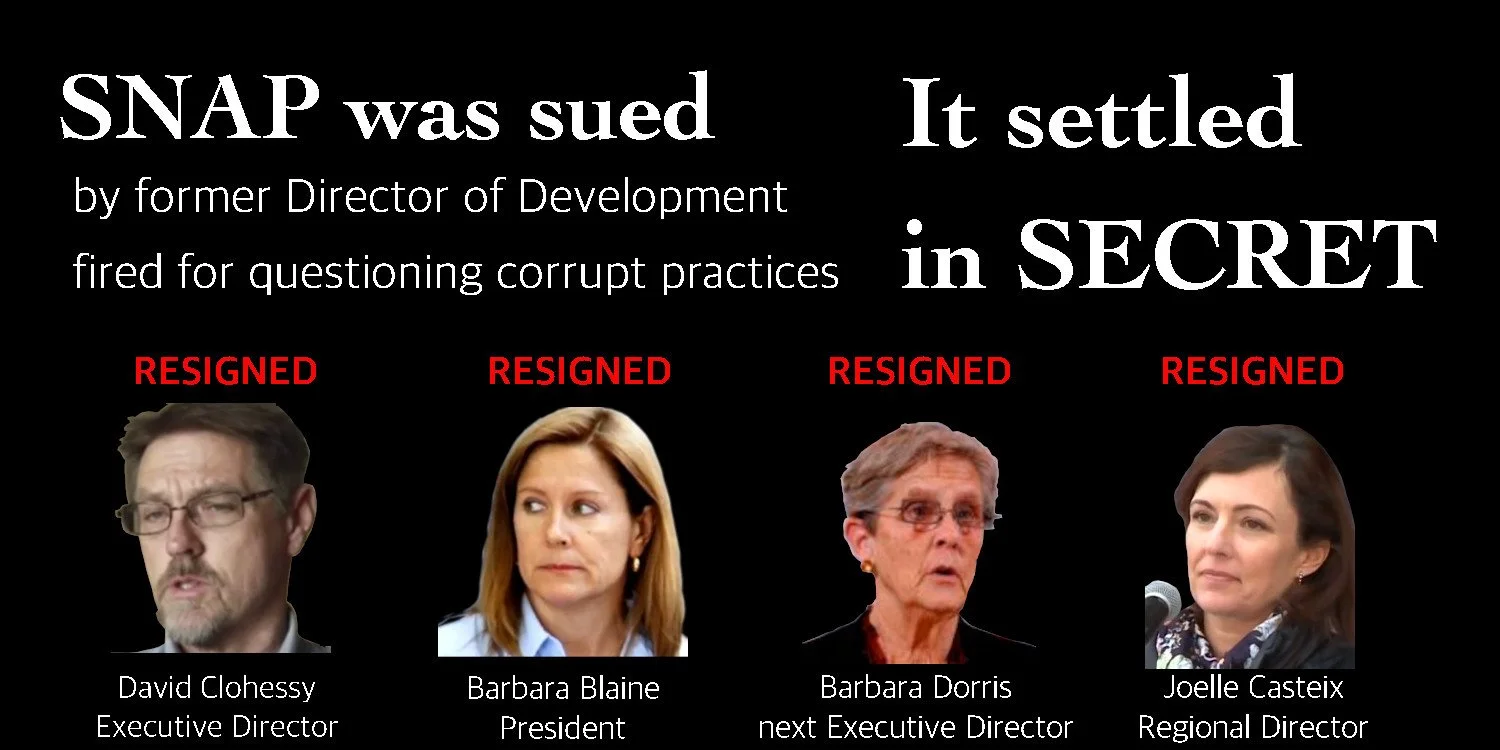
Now, from the recent lawsuits, resignations, and a kickback scandal within SNAP itself, it seems that none of this was ever about helping survivors or protecting children. It was just about money. In the name of nothing more redemptive than money, great, great harm has been brought upon the Church and priesthood.
The United States bishops going into their meeting in Dallas in 2002 were utterly terrified of Clohessy and SNAP, and the mesmerized news media that seemed to hang on their every word. When the USCCB invited David Clohessy and SNAP founder Barbara Blaine to address the 2002 U.S. Bishops Conference in Dallas in full view of the news media, the bishops had settled on a harsh reality that the best way to avoid being targeted by a witch hunt was to join it.
When it was over, and the “Zero Tolerance” language of the Dallas Charter was set in place, the late Father Richard John Neuhaus wrote in his masterful analysis, “Scandal Time,” that the bishops scrambled to the newspapers “to check their score.” Fr. Neuhaus was one of the few Catholic voices to speak out in conscience against this assault on the American priesthood, and in this he gets the posthumous last word from his essay, “Scandal Time”:
“Zero tolerance. One strike and you’re out. Boot them out of ministry. Of course, the victim activists are not satisfied, and, sadly, may never be satisfied. The bishops have succeeded in scandalizing the faithful anew by adopting a thoroughly unbiblical, untraditional, and unCatholic approach to sin and grace. They ended up adopting a policy that was sans repentance, sans conversion, sans forbearance, sans prudential judgment, sans forgiveness, sans almost everything one might have hoped for from the bishops of the Church of Jesus Christ.”
— Source: Richard John Neuhaus: A Life in the Public Square
+ + +
Editor’s Note: Please share this important post for the cause of justice for accused priests and the wrongfully imprisoned. This story needs greater exposure to take it out of the shadows for, sadly, most of our news media has avoided this aspect.
Don’t stop here. There is more to learn on this from Beyond These Stone Walls:
David Clohessy Resigned SNAP in Alleged Kickback Scheme
Be Wary of Crusaders! The Devil Sigmund Freud Knew Only Too Well
Judge Joseph Laplante, President Trump, and the Case of Father MacRae
A Grievous Error in Judge Joseph Laplante’s Court
From the Catholic League: Betrayed by Victims’ Advocates
The Eucharistic Adoration Chapel established by Saint Maximilian Kolbe was inaugurated at the outbreak of World War II. It was restored as a Chapel of Adoration in September, 2018, the commemoration of the date that the war began. It is now part of the World Center of Prayer for Peace. The live internet feed of the Adoration Chapel at Niepokalanow — sponsored by EWTN — was established just a few weeks before we discovered it and began to include in at Beyond These Stone Walls. Click “Watch on YouTube” in the lower left corner to see how many people around the world are present there with you. The number appears below the symbol for EWTN.
Click or tap here to proceed to the Adoration Chapel.
The following is a translation from the Polish in the image above: “Eighth Star in the Crown of Mary Queen of Peace” “Chapel of Perpetual Adoration of the Blessed Sacrament at Niepokalanow. World Center of Prayer for Peace.” “On September 1, 2018, the World Center of Prayer for Peace in Niepokalanow was opened. It would be difficult to find a more expressive reference to the need for constant prayer for peace than the anniversary of the outbreak of World War II.”
For the Catholic theology behind this image, visit my post, “The Ark of the Covenant and the Mother of God.”

Cultural Meltdown: Prophetic Wisdom for a Troubled Age
Cultural Meltdown: The Secular Roots of Our Moral Crisis by Bill Donohue is a tour de force about our culture in decline and what we need to stem the encroaching tide.

Cultural Meltdown: The Secular Roots of Our Moral Crisis by Bill Donohue is a tour de force about our culture in decline and what we need to stem the encroaching tide.
August 21, 2024 by Bill Donohue, Catholic League President
Introduction by Fr Gordon MacRae:
Speaking at the “Essence Festival of Culture” in 2023, Vice President and Democratic presidential nominee Kamala Harris described what culture means to her:
“Culture is — it is a reflection of our moment and our time. Right? And present culture is the way we express how we’re feeling about the moment and we should always find times to express how we feel about the moment. That is a reflection of joy. Because, you know … it comes in the morning. We have to find ways to also express the way we feel about the moment in terms of just having language and a connection to how people are experiencing life. And I think about it in that way, too.”
That quote from the current Vice President at a symposium on culture, was followed by her signature outburst of raucous laughter. I found it cited (without the laughter) in the June, 2024 edition of Catalyst, the Journal of the Catholic League for Religious and Civil Rights, in “Kamala Wins Race to the Bottom.”
Fortunately for America, Catholic League President Bill Donohue has a more nuanced view of culture, what it means for a society to survive, and the price we pay if it fades away. I believe the United States would face even greater cultural decline if not for the brakes applied by honest and vocal prophetic witnesses like Bill Donohue. Among the many accolades of his newest book, Cultural Meltdown: The Secular Roots of Our Moral Crisis (Sophia Institute Press, 2024) Catholic Encyclopedia editor Russell Shaw wrote, “Like the prophets, Donohue skewers bad guys — doers of evil and sowers of confusion — with consistent vigor and style.”
Cultural Meltdown (the book) is riveting, and in equal parts alarming, hopeful, and culturally uplifting. Donohue holds nothing back. His discussion of the roots and fallout of “Transgenderism” spans 58 pages, an education unto itself. It is a deeply troubling exposition of where we are and how we got here. The sheer madness of gender transition treatment for children is distressing. I recall hearing President Joe Biden casually say that “If an eight-year-old boy decides he wants to be a girl, his parents should have no say in it.” Pope Francis, no staunch defender of cultural traditions, called transgender ideology “demonic.”
In June, 2024, the Pew Research Center released results of a nationwide cultural survey. Sixty percent of respondents on the political left reported that being a man or a woman is merely a matter of personal preference and choice. Only nine percent of those on the conservative political right believe that. The lines of demarcation have permeated our politics. A recent Wall Street Journal news report analyzed the evidence of an ideological shift toward the right in young men under the age of thirty. The experience of one man, age 22, is an eye-opener:
“Harrison Wells said Trump’s 2016 campaign initiated his shift to the political right. He recalled being confused by the apoplectic reaction from teachers and students to Trump’s [2016] victory. His high school canceled classes and held listening sessions with students. ‘People were crying, upset,’ he said. ‘Everyone was hysterical.’ The experience crystallized growing skepticism of his private Catholic high school outside Menlo Park CA which organized lectures about the importance of access to contraceptives and abortion and celebrating transgender visibility.”
— “ElectionTriggers Battle of the Sexes, “ WSJ, July 30, 2024
No one involved with the article raised a question about how or why a California Catholic high school sponsored lectures on “the importance of access to abortion and contraceptives and celebrating transgender visibility.”
In the July/August 2024 issue of the Catholic League Journal, Catalyst, Bill Donohue wrote a brief essay entitled, “We Are Badly Divided.” As evidence for his title he wrote, “Those who love Biden hate Trump, and vice versa. The hatred of Trump, often called Trump Derangement Syndrome, is so bad that 86 percent of Democrats reported in a recent survey that the Justice Department should have authorized ‘the use of deadly force’ in its retrieval of documents at Trump’s Mar-a-Lago residence.”
This comes from the same people on the left who have gone on record, as Vice President Kamala Harris has, to advocate for defunding police. Such attitudes lured a hapless 20-year-old at a recent rally in Pennsylvania to the destruction of his own life while trying to end the life of Donald Trump. There is a way out of this cultural madness, and the prophetic Bill Donohue charts its course. What follows is Bill Donohue’s own explanation of why he wrote Cultural Meltdown. I could not improve upon it, so with his permission I am reproducing some of it here:

From Bill Donohue: “Why America Is in Trouble”
“The principal reason I wrote my new book is to address why America is in trouble. We live in a topsy-turvy world and most people, especially older adults, can’t seem to make sense of it. It is my hope that after reading Cultural Meltdown the reader will have a better handle on how this happened. We are a country torn between two conflicting visions of man and society. There are those who accept the religious vision and there are those who accept the secular vision. These perspectives are not only different, they are irreconcilable.
“Right now everything is in flux. As someone who favors the religious vision, I see signs of optimism, but not always. At some point, one side will win. We can’t go on indefinitely living as if we are living in two different worlds. The religious vision acknowledges belief in God, truth, human nature, the natural law, moral absolutes and Original Sin. It recognizes the limitations of the human condition. While it believes in progress it manifestly rejects the idea of human perfectibility.
“The secular vision promotes exactly the opposite view: God does not exist; truth is a mirage; human nature can be changed; there is no such thing as natural law; there are no moral absolutes; and the idea of Original Sin is fanciful. Furthermore, as the secular vision considers the human condition to be infinitely malleable, it champions the idea of the perfectibility of man.
“Left-wing intellectuals epitomize the secular vision. They are the ones who have had the greatest influence on the young, liberals, Democrats, and the well educated. As survey research shows, these are the most secular people in our society.
“The Catholic Church epitomizes the religious vision. We are made in the image and likeness of God. Men and women are biologically different, but possess equal dignity. We are expected to conform our behavior according to the tenets of the natural law. The faculty of reason is important, but it should complement faith, not oppose it.
“Those who ascribe to the religious vision reject the moral relativism that secularists promote. Moral relativism holds that what is moral is a matter of opinion and that there is no such thing as an act which is inherently immoral. Intellectuals very much believe this to be true. So did Hitler.
“I mention Hitler because he rode the waves of moral relativism right into office. There were political and economic reasons why he succeeded, but it was the moral collapse of German culture during the Weimar Republic (between the two world wars) that left the masses without a clear understanding of right and wrong. He capitalized on this cultural meltdown.
“Secularists are fond of saying that as long as two people agree on what constitutes proper moral behavior, that’s all that matters. It all boils down to consent. Those who believe in the religious vision know this to be false. It could justify incest. Without an understanding that God has given us Commandments to live by — and the moral absolutes they entail — all kinds of monstrosities are possible. History has shown exactly that.
“If there is one intellectual strain that is creating mass confusion it is postmodernism. For this we can thank French intellectuals in the 1960s. It is the most extreme expression of the secular vision. At bottom, it regards truth to be a fiction. Once this idea takes hold, look out. Here’s how postmodernism plays out in real life:
“David Detmer is a philosopher who knows how absurd postmodernism is. He interviewed one of its practitioners, fellow philosopher Laurie Calhoun. He asked her a simple question, one that any preschool child could answer: ‘Are giraffes taller than ants?’ ‘No,’ she replied. It is ‘an article of religious faith in our culture.’ In an earlier time, we would house people like her in an asylum. Today they are working in the academy.
“There is a chapter in the book on libertinism, or sexual license. Normal people regard people with perversions as sick and in need of help. Many left-wing intellectuals — who do not want to be regarded as normal, and who indeed reject the idea of normalcy — not only disagree that perverts are abnormal, they want to celebrate them.
“In 2022, Indiana University erected a large bronze sculpture of Alfred Kinsey, the zoologist-turned-sexologist. School officials celebrated his years of work there. There is also a Kinsey Institute on campus. They are proud of his writings and research on sexuality. They shouldn’t be. As I point out [in Cultural Meltdown, p.107] Kinsey was ‘a scientific fraud, a pervert, a voyeur, an exhibitionist, a gay-bar-hopping homosexual (even though he was married) and a child abuser. Oh yes, he also had sex with animals.’ Guess which institution he hated? The Catholic Church.”

More from Bill Donohue: Christianity and Transgenderism
“The secular vision, especially postmodernism, explains the existence of Transgenderism, or gender ideology. If truth does not exist, then it is entirely possible for boys to think they are girls and vice versa. It does not matter what our chromosomes are. All that matters is what we feel is real.
“The tenets of Christianity and Transgenderism are polar opposites and cannot be reconciled. Pope Francis understands this as well as anyone. He calls gender ideology ‘one of the most dangerous ideological colonizations’ of our time. ‘Why is it dangerous? Because it blurs the differences and the value of men and women.’ So upset was [Pope Francis] with this ideological madness that he once called it ‘demonic.’
“Anti-science transgender activists are among the most intolerant people in our society. They believe there are more than two sexes (which they falsely call genders) and anyone who disagrees with them — which is to say most normal people — is dismissed as a bigot.
“The damage being done to young people — 80-percent of those who ‘transition’ to the opposite sex are girls who want to be boys — is incalculable. The long-term physical and psychological problems that they will experience have yet to be determined. We already know that puberty blockers, chemical castration, and genital mutilation have created enormous suffering. Indeed, this is the greatest child abuse issue of our day.
“The last two chapters [of Cultural Meltdown] explain why we are so divided as a nation. To take one example, we are treating racial and ethnic groups as if they were different tribes, pitting one against the other. Robin DiAngelo, the author of the best-selling book, White Fragility likes it that way: ‘People of color need to get away from white people and have some community with each other.’ They teach this racism — in the name of combating it — in many colleges and corporations. No doubt the Klan would agree with her. So does Harvard. That is why it designated ‘an exclusive space for Black-identifying audience members’ when an adaptation of MacBeth was performed in 2021.
“Welcome to the world of the new apartheid. That much-condemned South African practice of separating the races is now very much in vogue in the United States. We have separate dorms on college campuses based on race, as well as separate graduation ceremonies. Part of the problem is the tendency of left-wing intellectuals to compare the tenets of the American Creed — the belief in freedom, equality and rule of law — to existing conditions. Inevitably, we come up short. But the Creed is the ideal; it is not reality. It gives us something to shoot for — holding out the potential that some day we will make good on this promise. Martin Luther King, Jr. understood this. Why can’t intellectuals?”
Back to Father MacRae:
I came of age as a young adult in the middle of the Civil Rights movement of the late 1960s and early 1970s. I was deeply affected by it, and in some ways the roots of my vocation to priesthood were inspired by Reverend Martin Luther King, Jr. We have come a long way since then. It is doubly tragic for those who gave their lives to promote racial equality to see the deterioration of their work today. It is deeply sad that some in the Democratic Party of today choose to foment racial and ethnic divisiveness instead of promoting unity. For me, it feels like a giant step backwards in our culture. Bill Donohue concludes his book with a caveat:
“The Catholic Church — along with evangelical Christians, Orthodox Jews, Mormons, and Muslims — must hold the line and not bow to secular opinion. Secularism is the heart of our moral crisis; it is responsible for our cultural meltdown. We need to proclaim and defend eternal truths about man and society and the moral imperatives that make for the best of all possible worlds on Earth. We don’t need to re-create anything. We need to repair to our religious moorings.”
We are at a crossroads. As we face another presidential election in 2024, we stand at midnight in the garden of good and evil. Even some facets within our Church have quietly ventured over to one side of that garden — the “woke” side. Cultural Meltdown is our wake-up call.
+ + +
Bill Donohue is President of the New York-based Catholic League for Religious and Civil Rights. He holds a Ph.D. in sociology from New York University and served for twenty years on the Board of the National Association of Scholars. The author of ten previous books, he has appeared on thousands of news, television and radio programs including EWTN, Fox News, CNN, NEWSMAX and other national media.
Cultural Meltdown: The Secular Roots of Our Moral Crisis by Bill Donohue is published in 2024 by Sophia Institute Press. His most recent guest post for Beyond These Stone Walls was, “The Ordeal of Father Gordon MacRae.” He was also instrumental in our recent, highly acclaimed post, “A Catholic League White House Plea Set Pornchai Moontri Free.”

Digital billboard just outside the United Center in Chicago, the venue of the Democratic National Convention.
The Eucharistic Adoration Chapel established by Saint Maximilian Kolbe was inaugurated at the outbreak of World War II. It was restored as a Chapel of Adoration in September, 2018, the commemoration of the date that the war began. It is now part of the World Center of Prayer for Peace. The live internet feed of the Adoration Chapel at Niepokalanow — sponsored by EWTN — was established just a few weeks before we discovered it and began to include in at Beyond These Stone Walls. Click “Watch on YouTube” in the lower left corner to see how many people around the world are present there with you. The number appears below the symbol for EWTN.
Click or tap here to proceed to the Adoration Chapel.
The following is a translation from the Polish in the image above: “Eighth Star in the Crown of Mary Queen of Peace” “Chapel of Perpetual Adoration of the Blessed Sacrament at Niepokalanow. World Center of Prayer for Peace.” “On September 1, 2018, the World Center of Prayer for Peace in Niepokalanow was opened. It would be difficult to find a more expressive reference to the need for constant prayer for peace than the anniversary of the outbreak of World War II.”
For the Catholic theology behind this image, visit my post, “The Ark of the Covenant and the Mother of God.”
The United Nations High Commissioner of Hypocrisy
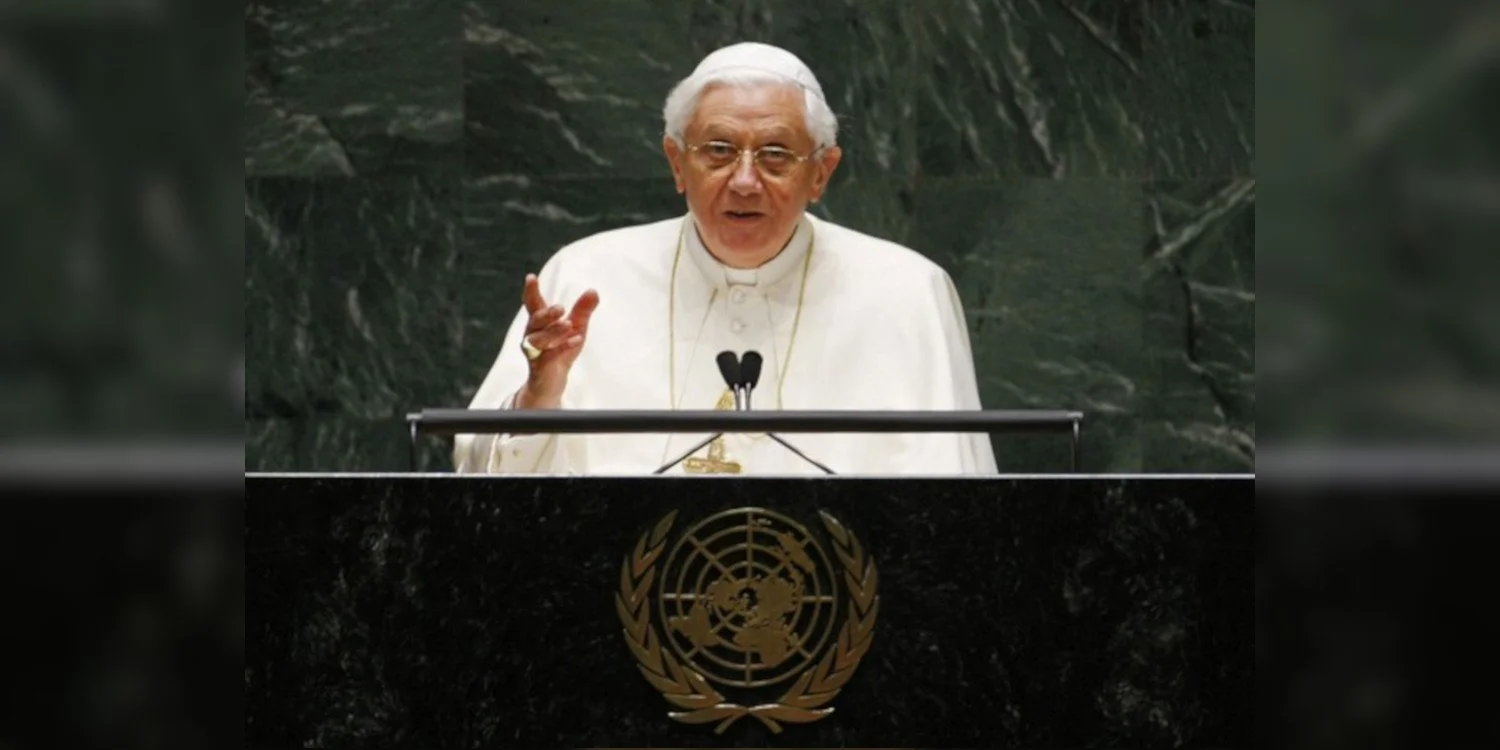
In 2014, a U.N. Commission accused the Vatican under Benedict XVI of a past sex abuse cover-up. Then the U.N. was exposed for a present sex abuse cover-up.

In 2014 a United Nations Commission accused the Vatican under Benedict XVI of a past sex abuse cover-up. Then the U.N. was exposed for a present sex abuse cover-up.
July 12, 2023 by Fr. Gordon MacRae
I sometimes come across an older post I have written about events in the news, and am struck by how much what I wrote ends up coming true. I just re-read a post I wrote on July 7, 2010. I read it anew with far more invested in the topic today than when I originally wrote it. That post is “The Exile of Father Dominic Menna and Transparency at The Boston Globe.”
It raised an important point about an issue that has simmered in the background of this blog since its inception in 2009. That issue is the Catholic clergy sex abuse story, and how much the story has itself been abused in the news media to further certain agendas. On Easter Sunday 2010, for example, The Boston Globe hyped this story about a popular Massachusetts senior priest, Father Dominic Menna, who under the terms of the U.S. Bishops’ “Dallas Charter,” was removed from ministry due to a claim of sexual abuse.
In reporting the story, the Globe neglected to mention that the uncorroborated single claim that destroyed this priest’s life was alleged to have occurred over a half century ago in 1971. And it was no accident that the story was reserved for the Globe’s Easter Sunday edition.
What the Globe omitted from the Easter Sunday 2010 story was the fact that the adult bringing that claim — a man in his late fifties — stood to gain a substantial financial settlement just for making the claim while proving nothing.
The contingency lawyers and their enablers in the media are counting on you to have no frame of reference to put any of the claims of priestly abuse into context. I do have a frame of reference, and I can tell you that the distortion created by lawyers and the news media is deeply unjust — not only to Catholics and their priests, but to millions of adult victims of abuse whose suffering has been trivialized and cheapened by the distortion that only victims of Catholic priests are worth hearing and compensating.
Since I wrote the above post, The Boston Globe was sold by its parent company, The New York Times, for less than ten cents on the dollar, compared to what the Times paid to purchase it. Some like to think that in the end the Globe pretty much reaped what it had sown at the expense of truth and justice.
The eventual result of the symphony created by contingency lawyers and biased news media was an arena in which the Church would become dislodged as a global source of moral truth. I wrote of some of the fallout for other innocent victims in my post, “Benedict Faced the Cruelty of a German Inquisition.”

The U.N. Assault on the Catholic Church
In 2014, an explosive 16-page report issued by the United Nations High Commissioner on the Rights of the Child indicted and convicted the Catholic Church without investigation, without evidence, without a formal defense, and without any trial of the facts. I know the feeling!
This public shaming of the Holy See came as a result of the emergence into public view of hundreds of claims of sexual abuse by priests dating back thirty, forty, fifty years or more. These were claims often brought forward by contingency lawyers who — once the mass settlement process had been established as status quo — flooded Church institutions with demands for “out-of-court” settlements with no effort at corroboration. “I’ve never seen anything like it,” said N.H. contingency lawyer, Peter Hutchins when handed a $5.2 million check from the Diocese of Manchester, New Hampshire.
The various bishops and dioceses caved in to these demands, and then a hapless U.N. committee took that to be proof enough that the claims were all true. In a courageous article in First Things, “Rolling Stone, Alan Dershowitz, and Catholic Priests” (May 21, 2015) Father Thomas Guarino described the cost of this abandonment of rights for the priests accused when bishops got the monkey off their backs by throwing money at it:
“This Episcopal peace comes at a heavy price…. The problem is that, in many cases, no contrary evidence can come forward because an accusation is decades old. What convincing evidence could possibly be adduced to clear a man’s name? Even if a charge could be true, is lifetime suspension a proportionate penalty for a mere possibility? Should bishops be held hostage by forces dividing them from their own priests?”
— Fr Thomas Guarino, First Things
The United Nations had no such interest in basic civil rights like the presumption of innocence. Claudia Rosett, who led the Investigative Reporting Project for the Foundation for the Defense of Democracies, also reacted to the U.N. Commission report on the Vatican with a similarly titled column in The Wall Street Journal (“The U.N. Assault on the Catholic Church,” WSJ, February 10, 2014). Ms. Rosett described the report:
“A Report on the Holy See — released by a U.N. Committee last week to much media fanfare — alleged that tens of thousands of children have been abused by Catholic clerics and that the Vatican has helped cover it up.”
Bill Donohue, President of the Catholic League, described that U.N. report as “one of the most ambitious power grab efforts ever undertaken by a U.N. committee.” The report was, of course, a lie, simply repeating a media mantra. But in the process of describing this in The Wall Street Journal, Claudia Rosett exposed another big lie, one belonging to the United Nations itself.

Now Hiring: A U.N. High Commissioner of Hypocrisy
Between 2007 and 2013, United Nations peacekeeper forces have been repeatedly implicated in the sexual abuse of children they were tasked to protect, and the U.N. has now been implicated in a cover-up of that fact. But the most disturbing part of this story is the extent to which it has been ignored — another form of cover-up — by the American news media. In fact, Ms. Rosett’s above column in the WSJ was likely the first hint of the scandal at the U.N. that appeared in mainstream U.S. news.
Since then, other media outlets have taken this up, but few of them in the United States. Sandra Laville, in The Guardian (U.K.) covered a report leaked to her newspaper alleging that the U.N.’s own investigation revealed “the rape and sodomy of starving and homeless boys” by French U.N. peacekeeper forces operating in the Central African Republic.
As sickening as that charge is, it gets much worse. French president Francois Hollande promised that France would prosecute those soldiers. The story came to light only because of a whistleblower. According to Matheiu Delahouse in the French paper, Le Nouvel Observateur, the U.N. marked its report on this matter “secret” and filed it away.
This is a story worth telling. The French government was not even informed of the claims against its soldiers until a man named Anders Kompass, a Swedish citizen working for the U.N. High Commissioner of Refugees, “broke protocol and gave a copy of the report to the French government,” according to The Week:
“Naturally, the French investigators asked if they could speak to the U.N. investigator who wrote the report, but the U.N…refused to allow that. Meanwhile, Kompass, the whistleblower, has been punished and may lose his job. Saying he leaked a confidential document, the self-interested bureaucrats at the U.N. have suspended this 30-year veteran of humanitarian work for intervening on behalf of children.”
— The Week, “United Nations: Riding sexual abuse by peacekeepers,” May 15, 2015
Rosa Freedman, writing at TheConversation.com from Australia, charged that the U.N. has “a long and sordid history of covering up sexual abuse by peacekeepers.” Simon Allison, writing from South Africa for The Daily Maverick observed about the U.N., “Who can trust an institution that covers up the sexual abuse of minors?”
The very fact that such a question is now asked of the United Nations itself after it dragged the Catholic Church through a round of public mudslinging is symptomatic of an institution in crisis. The situation is more hypocritical than it appears.
I have also written of the hubris and hypocrisy of the U.N.’s finger pointing on this issue. I have described evidence that even while the U.N. was pointing fingers at the Vatican for decades-old and unproven claims of abuse, the U.N. was itself being sued. In 2014, the United Nations employed any and every legal means to fight off a lawsuit from the beleaguered people of Haiti after its unscreened peacekeeper forces caused the deaths of innumerable children by bringing a cholera outbreak to their earthquake stricken country. One of its defenses was to blame the people of Haiti for the cholera, a plague that killed hundreds of Haitian children.
The saddest part of this story is that the Holy See sent emissaries to the U.N. Commission on the Rights of the Child to assure the U.N. that many hundreds of priests have been cast out after being accused in these decades-old claims of abuse. In “The U.N. Assault on the Catholic Church,” (WSJ, February 10, 2014), Claudia Rosett proposed a more fitting response from the Church to the U.N.:
“Pope Francis might want to consider that it is precisely to avoid gross intrusion by U.N. ‘experts’ that the United States signed, but never ratified, the U.N. Convention on the Rights of the Child. This treaty has less to do with children than with political power plays, and a fitting reform of the Vatican would be to walk away from it.”
Would that such advice was followed before hundreds of accused priests were thrown under the bus and out of the priesthood. Would that such advice was followed before the extent of United Nations hypocrisy was bared for all to see. Is reform of the U.N. on the horizon? The evidence does not indicate that it is. The United Nations now needs a High Commissioner of Hypocrisy.
+ + +
Note from Fr. Gordon MacRae: You would serve the cause of justice and truth by sharing this post. You may also like these related posts:
Human Trafficking: Thailand to America and a Cold Case in Guam
Benedict XVI Faced the Cruelty of a German Inquisition
Catholic Scandal and the Third Reich: Rise and Fall of a Moral Panic


The Eucharistic Adoration Chapel established by Saint Maximilian Kolbe was inaugurated at the outbreak of World War II. It was restored as a Chapel of Adoration in September, 2018, the commemoration of the date that the war began. It is now part of the World Center of Prayer for Peace. The live internet feed of the Adoration Chapel at Niepokalanow — sponsored by EWTN — was established just a few weeks before we discovered it and began to include in at Beyond These Stone Walls. Click “Watch on YouTube” in the lower left corner to see how many people around the world are present there with you. The number appears below the symbol for EWTN.
Click or tap the image for live access to the Adoration Chapel.
The following is a translation from the Polish in the image above: “Eighth Star in the Crown of Mary Queen of Peace” “Chapel of Perpetual Adoration of the Blessed Sacrament at Niepokalanow. World Center of Prayer for Peace.” “On September 1, 2018, the World Center of Prayer for Peace in Niepokalanow was opened. It would be difficult to find a more expressive reference to the need for constant prayer for peace than the anniversary of the outbreak of World War II.”
For the Catholic theology behind this image, visit my post, “The Ark of the Covenant and the Mother of God.”

The James Webb Space Telescope and an Encore from Hubble
The James Webb Space Telescope in orbit in a neutral gravity zone one million miles from Earth may provide humanity's first glimpse of dark matter in the universe.

James Webb Space Telescope illustration courtesy of ESA/Hubble (Northrup Grumman).
As the James Webb Space Telescope entered orbit in a neutral gravity zone one million miles from Earth, the waning days of Hubble revealed an astronomical surprise.
June 22, 2022 by Fr. Gordon MacRae
“Where were you when I laid the foundations of the Earth? Can you bind the chains of the Pleiades or lose the chords of Orion?”
— Job 38:4,31
“Astronomy, Cosmology, Physics, Theology, History! Reading this blog is like enrolling in a graduate program at NYU.” That message was sent to me in a letter several years ago from a friend, an official of the Archdiocese of New York. I have written a good deal about the sciences of astronomy and cosmology, but only about a dozen posts over the 13-year lifespan of this blog.
In a recent telephone call from exile to my friend, Father George David Byers, STD, SSL, he chided me that I am way overdue for a science post. I cite his academic credentials here — a Doctorate in Sacred Theology from the Pontifical University Angelicum in Rome and a Licentiate in Sacred Scripture from the Pontifical Biblical Institute in Rome and Jerusalem — to reflect that his suggestion of a mere “science” post might contain just a hint of academic hubris. If so, I can only respond with a quote from the great English poet, Samuel Taylor Coleridge: “And the Devil did grin, for his darling sin is pride that apes humility.”
I actually did write a science post even before Father Byers brought it up. Please don't yawn or click me away just yet. For me, this is a very big deal and it has a “WOW” factor. The Hubble Space Telescope, launched into Earth orbit in 1990, has been operating for 32 years and has far exceeded its intended operational limit. In the waning days of Hubble, it surprised Earthbound scientists with an amazing discovery. I will get to it below, but first ...

Star Trek: The Next Generation
The next generation of space exploration was born with the December 25, 2021 launch of the James Webb Space Telescope (JWST). It has recently arrived at its designated orbit in what is called a “Lagrange point.” Named for the 18th Century French mathematician and physicist, Joseph Louis Lagrange, a “Lagrange point” is a zone of neutral gravity between the Earth and the Sun about one million miles from Earth. That point is now host to the revolutionary James Webb Space Telescope.
Thousands of scientists and engineers took part in this project on the cutting edge of astronomical science. The Space Telescope Science Institute will operate and monitor it from Baltimore. Webb successfully separated from its launch vehicle and unfolded a giant solar array to power the telescope. Armed with huge primary and secondary mirrors and a suite of cameras, spectrometers, and other instruments, the Webb Telescope is the size of a large truck. It is capable of producing spectral images of 100 galaxies at a time. As one scientist described it:
“[Webb] will crack open the treasure chest of the magnificent infrared sky invisible to the human eye. If a bumblebee hovered in space at the distance from Earth to the Moon, Webb will be able to see both the sunlight it reflects and the heat it emits.”
One of the burning questions of both science and faith that Webb may lend itself to solving is the existence of life elsewhere in the Universe. All the latest media craze about evidence of UFOs points only to Earth-bound technology. Distances between stars are like impenetrable barriers. If sentient life exists, we will detect each other long before we ever encounter each other. So far, after decades of searching, no such evidence yet exists.
A general consensus among astronomers is that life does exist “out there,” but complex life is much more rare, and sentient complex life like us, if it exists elsewhere at all, is extremely rare. I once wrote a post laying out a case for our uniqueness in the Cosmos. It was, “Star Trek and the Search for Extraterrestrial Intelligence.”
That post introduced readers to a remarkable contributor to the science that made the Webb Space Telescope possible. Astronomer Vera Rubin defied all the stereotypes of her time to become one of the great icons of cosmology. She discovered that the visible Universe that we see in the night sky is only about 10 to 15 percent of what is actually there. She wrote of this in “Dark Matter in the Universe” (Scientific American, 1998):
“As we have done for centuries, we gaze into the night sky from our planetary platform and wonder where we are in this cavernous cosmos. Flecks of light provide clues about great objects in space. And what we do discern about their motions and apparent shadows tells us that there is much more that we cannot yet see.
“From every photon we collect from the universe’s farthest reaches, we struggle to extract information. Astronomy is the study of light that reaches Earth from the heavens. Our task is not only to collect as much light as possible — from ground and space-based telescopes — but also to use what we can see in the heavens to understand better what we cannot see and yet know must be there.
“Based on 50 years of accumulated observations of the motions of galaxies and the expansion of the universe, most astronomers believe that as much as 90 percent of the stuff constituting the universe may be objects or particles that cannot be seen. In other words, most of the universe’s matter does not radiate. It provides no glow that we can detect in the electromagnetic spectrum. … We call this missing mass ‘dark matter,’ for it is the light, not the matter, that is missing.”
— Vera Rubin, 1998
In coming months, the first images to come from the James Webb Space Telescope now hovering one million miles between Earth and the Sun may provide humanity’s first illumination of dark matter, that 90-percent of the Universe that we have never before seen. The Webb Telescope enormous primary mirror has unfolded perfectly. In coming months Webb’s first images of the ancient cosmos will arrive on Earth. Be prepared to be amazed!

A Pre-retirement Surprise from Hubble
My favorite post of the past year is one that was only half written by me. The other (and far better) half was written by Fr. Andrew Pinsent, a noted particle physicist and Research Director at the Ian Ramsay Center for Science and Religion at Oxford University in the U.K. I was way out of my element in this joint venture, but it was this humble blog’s best foot forward. The jointly written post was, “Fr Georges Lemaître, the Priest Who Discovered the Big Bang.”
It was among our most popular and enduring posts of the last year. Perhaps it was just a nice break from this world’s seemingly never-ending preoccupations with war, pestilence, scandal, and other obsessions of our time.
In that post, I quoted an excerpt from the book, Einstein’s Heroes: Imagining the World Through the Language of Mathematics (Oxford University Press, 2005), a wondrous book by a brilliant mathematician, Robyn Arianrhod:
“In 1931, [Georges] Lemaitre formally sowed the seeds of the Big Bang theory when he suggested the universe had started as an explosion of a ‘primeval atom,’ and that it had continued expanding from that explosive beginning.... Einstein’s equation predicted the universe had expanded not from a tiny piece of matter located in an otherwise empty cosmos, but from a single point in four-dimensional space-time .... Before this point, about thirteen billion years ago, there was no time and no space. No geometry, no matter, nothing. The universe simply appeared out of nowhere. Out of nothing.” ( p. 187)
“The Universe simply appeared out of nowhere. Out of nothing.” And it all happened in an instant 13 billion years ago on “A day without yesterday.” This conclusion of modern cosmology was the work of a brilliant priest, mathematician and physicist, Fr. Georges Lemaitre. If you wonder about the relevance of faith in the scientific world, you may be surprised to learn that science and the Catechism of the Catholic Church are on the same page in describing the origin of a created universe:
“God created the universe out of nothing.” (CCC 290)
“We believe that God needs no pre-existent thing or any help in order to create. God created freely out of nothing.” (CCC 296)
“God said, ‘let there be light,’ and there was light” (Genesis 1:4). Scripture bears witness to faith in creation ‘out of nothing’ as a truth filled with promise and hope.” (CCC 297)
“Since God created everything out of nothing, He can also, through the Holy Spirit, give spiritual life to sinners by creating a pure heart in them, and bodily life to the dead through the Resurrection.” (CCC 298)
The Hubble Space Telescope is destined to soon retire, but not before it gave us some amazing images of the visible Cosmos. Its latest surprise is a photograph of the most distant star ever seen by human eyes or instruments, a star now called “Earendel.” It is 28 billion light years from Earth. A light year is a measure of distance and not of time. It is the distance light travels in a single year at the constant rate of 186,000 miles per second. A light year works out to be 5.6 trillion miles. Multiply that by 28 billion and that is the distance from Earth to Earendel. Please don’t ask me to convert this to kilometers.
The light Hubble captured from Earendel emanated from the star 12.9 billion years ago in the very infancy of creation as calculated by Fr. Georges Lemaitre. The only reason Hubble could spot this star is because of a rare cosmic alignment. A galaxy cluster beyond the Milky Way — our galaxy — was positioned in such a way that its gravity bent light creating a sort of cosmic magnifying lens.
If you did the math, you might have noticed that Earendel is twice the distance of the age of the Universe which is possible only because the Universe has continually expanded over those 13 billion years. This expansion, and the now proven fact that galaxies are defeating gravity by speeding away from one another, was also a discovery of the physics of Fr. Georges Lemaitre which in the end were applauded and embraced by Albert Einstein.
Who says priests are boring?
+ + +
Note: Thank you for reading and sharing this post. Please visit our “Special Events” page and these related links:
Star Trek and the Search for Extraterrestrial Intelligence
Fr Georges Lemaître, the Priest Who Discovered The Big Bang
“A Day Without Yesterday:” Father Georges Lemaitre and The Big Bang
+ + +


Tragedy at Uvalde, Texas: When God and Men Were Missing
Facing the truth about the tragedy in Uvalde, Texas will require courage. Something has gone terribly wrong in our culture and Pornchai Moontri knows it firsthand.

Facing the truth about the tragedy in Uvalde, Texas will require courage. Something has gone terribly wrong in our culture and Pornchai Moontri knows it firsthand.
June 15, 2022 by Fr. Gordon MacRae and Pornchai Moontri
Note to readers: Fr. Gordon MacRae interviewed Pornchai Moontri in Thailand for this post. Pornchai’s most recent post was “A Night in Bangkok, a Year in Freedom.”
+ + +
A dense, dark cloud has been hanging over America since the recent inexplicable and shocking murders of 19 elementary school children and two of their teachers by 18-year-old Salvatore Ramos in Uvalde, Texas. The close knit community will feel the effects of this trauma for decades to come. A lot of soul searching has gone on about what could have triggered such an event, about how it developed, how it might have been prevented, and what could have been done differently by responding police.
The tragedy at Uvalde was devastating, and was preceded just a week earlier by the racially charged rampage of another 18-year-old shooter brandishing the same sort of weapon. He killed 12 people — ten of them targeted for being African American — at a grocery store in Buffalo, New York.
After the shocking but unrelated stories unfolded, half the nation went immediately for the guns and political talking points. President Biden’s loudest and most immediate response was, “When in God’s name are we going to stand up to the gun lobby? Where in God’s name is our backbone?” They were not exactly the words of consolation the nation and the people of Uvalde needed in the moment. The politics should have waited.
Texas Governor Greg Abbott explained rationally that 18-year-olds in Texas have been able to own long guns (not hand guns) since frontier days while only in recent years have these mass shootings occurred in schools. That is true, but it is also true, as Governor Abbott added, that there are currently many reports of a burgeoning mental health crisis among young people that did not exist a hundred years ago. Why does it exist now?
After both stories dominated the news media, I reached out to our friend, Pornchai Moontri in Thailand. I knew that when he learned of these accounts, he might relate them to his own offense at age 18 at a supermarket in Bangor, Maine 30 years ago. During a parking lot struggle with a much larger man, 18-year-old Pornchai killed him. It happened on March 21, 1992. Pornchai never saw freedom again until almost 30 years later.
The major difference between that incident and the two young assailants in Buffalo and Uvalde is that Pornchai never set out to harm anyone that day or on any day. He carried a knife for self-protection. Having been torn from a rural village in Thailand at age 11, Pornchai was abused and tormented in Bangor, Maine until he escaped into homelessness on the streets of a foreign country. As the only Asian in town, he was often the subject of racial hatred, hunted by a Bangor street gang.
Most people who read this blog know Pornchai’s story. It is told in multiple places, but the best source is a widely read article at Linkedin. If you read it, you may wonder, as many already have, how one young man could endure so much and ever trust life again. The article is “Human Trafficking: Thailand to America and a Cold Case in Guam.”

In the Absence of Fathers
When I asked Pornchai for his thoughts about what might have driven 18-year-old Salvatore Ramos to this end, he put his response in the first person:
“I didn’t care about anyone; and then someone cared about me. If I did not find God, and you, and acceptance, and Divine Mercy, I might have stayed on a road to destruction. It was all I knew or expected. Hatred left me when something came along to replace it. Do you remember your Elephants post? It makes total sense. The one thing missing from my life and the lives of those two kids in America was a father. Without one, a decent one, a kid is at the mercy of dark forces and his mind just breaks.”
The “Elephants post” that Pornchai referred to was a Fathers Day post I wrote in this same week in 2012. It was a huge eye-opener for many people and began a serious discussion about the crisis of father absence in our time and the retreat of good men from engagement in the public square. The post was “In the Absence of Fathers: A Story of Elephants and Men.”
It is interesting that, ten years after writing it, that post began appearing in search engines all over the United States just hours after news struck about the horror in Uvalde, Texas. I had also made the same connection and decided that I would share that post anew on Facebook, Linkedin and Twitter. When our editor looked at traffic reports that day, even before we shared it, the post was showing up everywhere.
Despite the story and research covered in that post being suppressed in our agenda-driven mainstream ne ws media, people instinctively know the truth of it. There are two factors, both speaking loudly and clearly, about the burgeoning mental health crisis among the young that is now clearly evident in our culture. Those two factors are the growing and spreading of fathers from the lives of struggling young men and the diminishment of faith and hope as our culture separates itself from God. Along with this, incidents of violence and other criminal behavior among young men have increased 1,000 fold in two decades, and deaths by suicide and accidental opioid overdose are now the number one killers of young men ages 15 to 30.
I live with many who live without hope. For year after year, this prison sees a steady stream of lost, fatherless young men trapped in adolescence and unable to developmentally move on. They are 35 going on 12 emotionally, they suffer from panic attacks and other critical anxiety states, and they are subject to fits of overwhelming emotion. Over ninety percent of them grew up in the care of single mothers with absent fathers. The steady stream of social weapons aimed at men in recent decades — such as the #MeToo movement — has further diminished manhood and, by extension, fatherhood.

In the Name of the Father
Once God and Fatherhood are cast aside, only the feminine remains. That may sound great for the causes of radical feminism, but in the psyches of young men it wreaks havoc and chaos when coupled with the diminishment of fatherhood. The results are all around us: a marked increase in transgender ideology and great political pressure to embrace it, chronic gender confusion, identity confusion, self-medicating drug abuse, and the breakdown of identity and self-awareness. The great psychoanalyst, Erik Erikson predicted that adolescence cannot end until the crisis of identity is resolved. Our culture has extended that crisis to engulf a lifetime.
Before the election of 2020, then nominee Joe Biden said in a news conference “if an eight-year-old boy wakes up one morning and wants to be a girl, he should be given all the tools and medical support necessary and parents should have no say in it.”
That is not verbatim, but it is the context and content of what was said. Media heads were bobbing as they took notes.
Dr. Paul McHugh, Distinguished Professor of Psychiatry at Johns Hopkins University Medical Center and a widely recognized expert in this field, has stated that most transgender people suffer from a mental disorder and the idea of sex reassignment is simply mistaken — and leaves much psychological damage in its wake. Meanwhile, the Biden administration is now finalizing plans to require transgender treatment under healthcare plans. Catholic League President Bill Donohue recently addressed this in “Transgender Mania Grips the White House.”
These developments have all come about as a natural result of removing God from the public square. One of the last bastions of faithful witness has been the Catholic Church, but the sexual abuse crisis, though in too many ways real, was also hyped and manipulated to remove a Catholic voice from public discourse on moral issues. Gone also are the Boys Scouts of America. It is actually a hopeful sign that pro-abortion groups are attacking Catholic churches right now. It’s a sign that the Church is still perceived as being on the front line in the defense of life. Still, the eradication of God has made inroads that deeply affect young people and their ability to hope through hard times.
In a fine commentary by Peggy Noonan in The Wall Street Journal, she added the obvious, that it is one thing for an 18-year-old to have a gun to shoot rattlers in the 18th Century. It is quite another to allow an 18-year-old to buy a military grade assault rifle in the middle of a mental health crisis. Some common sense and compromise are likely to eventually prevail, even in an election year. Ms. Noonan went on, however, to point to a far deeper crisis and contributing factor to such tragedy in a recent column, “Let Not Our Hearts Grow Numb,” (WSJ, May 28, 2022):
“I continue in a kind of puzzled awe at my friends who proceed through life without faith, who get up and go forward without it ... I tell the young, I have been alive for some years and this is the only true thing, that there is a God and he is good and you are here to know him, love him, and show your feeling through your work and how you live. That is the whole mysterious point. And the ridiculous story, the father, the virgin, the husband, the baby — it is all, amazingly, true, and the only true thing ... Consolation is not why you believe, but is a fact of belief and helps all who have it live in the world and withstand it.”
I share with Peggy Noonan the consolation that the good people of Uvalde, Texas at least have that. This is part of our collective crisis. Too many have been robbed of the consolation of faith because of the relentless progressive assault on faith over the last few decades.
And she is also right about the crisis of mental health among the young. Signs of it are reported everywhere, and it is much exacerbated by the government enforced Covid lockdowns of the last two years.
I admire Peggy Noonan also for her unapologetic faith the absence of which is also a crisis among the young. It is the most common prayer request I receive from parents — a hope that their teen and young adult children will return to faith. As mentioned a week ago in these pages, Saint Paul famously wrote that only three gifts have lasting value, Faith, Hope, and Love. To impart Love without also imparting Faith and Hope diminishes love as a shallow and empty affair.

Among the Refugees of Thailand
What happened in Uvalde deeply impacted me. It made me double down on my own commitment as a father to Pornchai Moontri — even as he now lives many thousands of miles from me. When I asked him if he could explain Salvatore Ramos, he said, “I didn't care about anyone either; then someone cared about me.” He talked at length about my post, “In the Absence of Fathers: A Story of Elephants and Men.” Pornchai never knew his biological father, and then ended up in the hands of a sadistic abuser who did great harm to him mentally, spiritually and physically.
He vowed that he would never again be anyone’s victim and would never trust anyone again. When he finally took that chance, life fell back into place. Divine Providence steered the circumstances of our lives until they were on a collision course, and Pornchai courageously let me in.
Some readers have asked me what Pornchai is doing for work to support himself in Thailand. We are simply not there yet. American money goes a long way in Thailand so I manage to support Pornchai for just a small amount of money each month. A few good friends who understand that effort help me with it. I believe it is a necessity and I have dissuaded him from finding a menial job just to support himself right now. This is because I have a fully informed sense of what Pornchai has been through in life, of what others took from him.
So I have asked him to spend his time restoring his life by facing openly the traumas of his past without having to worry about where his next meal is coming from. He spends his days in learning, and when the need arises he spends whatever time is left assisting Father John Hung Le in caring for the Vietnamese refugees in Thailand.
This is of great importance. By caring for others, Pornchai is caring for himself just as the Father in his life taught him. That is why the photo below is so very special to me. In his last sixteen years here with me, at my urging, Pornchai sought the help of a therapist in the prison system to work through a lifetime of trauma and grief and loss. When the therapist saw the photo below, she said, “No one could have accomplished this but Gordon. No one else!”
I had little to do with it. It is God who directed this path. It required only sacrifice from me, and men need to be reminded that sacrifice is at the very heart of fatherhood.

+ + +
Note from Fr. Gordon MacRae: Thank you for reading this post with an open mind and heart, and for sharing it. It can only accomplish some good if others see it.
Please visit our SPECIAL EVENTS page and these related posts from Beyond These Stone Walls:
In the Absence of Fathers: A Story of Elephants and Men
Human Trafficking: Thailand to America and a Cold Case in Guam
The Parable of a Priest and the Parable of a Prisoner
No Child Left Behind — Except in Afghanistan
+ + +

Stones for Pope Benedict and the Rusty Wheels of Justice
Following revelations about possible deliverance after 28 years of wrongful imprisonment, hope is hard to come by, but it was not so for Saint Maximilian Kolbe.

Following revelations about possible deliverance after 28 years of wrongful imprisonment, hope is hard to come by, but it was not so for Saint Maximilian Kolbe.
February 9, 2022
“This prisoner of the State remains, against all probability, staunch in spirit, strong in the faith that the wheels of justice turn, however slowly.”
— Dorothy Rabinowitz, “The Trials of Father MacRae,” The Wall Street Journal, May 13, 2013
When this blog was but a year old back in 2010, my friend and prison roommate, Pornchai Moontri, was received into the Catholic faith. He was 36 years old and it was his 18th year in prison. Everyone who knew him, except me, thought his conversion seemed quite impossible. Pornchai does not have an evil bone in his body, but his traumatic life had a profound effect on his outlook on life and his capacity for hope. There is simply no point in embracing faith without cultivating hope. The two go hand in hand. We cannot have one without the other.
To sow the seeds of hope in Pornchai, I had to first reawaken hope from its long dormant state in my own life as a prisoner. I am not entirely sure that I have completed that task. It seems a work in progress, but Pornchai’s last words to me as he walked through the prison gates toward freedom on September 8, 2020 were, “Thank you for giving me hope.” I wrote of that day in “Padre Pio Witness for the Defense of Wounded Souls.”
A decade earlier, back in April of 2010, Pornchai entered into Communion with the Catholic Church on Divine Mercy Sunday. On the night before, he asked me a haunting question. It was what I call one of his “upside down” questions. As he pondered what was to come, his head popped down from his upper bunk so he appeared upside down as he asked it. “Is it okay for us to hope for a happy ending when Saint Maximilian didn’t have one?” Pornchai had a knack for knocking me off the rails with questions like that.
Before responding, I had to do some pondering of my own. Our Patron Saint lost his earthly life at age 41 in a Nazi concentration camp starvation bunker. His death was followed by his rapid incineration. All that Maximilian Kolbe was in his earthly existence went up in smoke and ash to drift in the skies above Auschwitz, the most hopeless place in modern human history.

Retroactive Guilt and Shame
What I am about to write may seem horribly unpopular with those harboring an agenda against Catholic priests, but popularity has never been an important goal for me. In recent weeks, the news media has trumpeted a charge launched by a commission empowered by some Catholic officials in Germany. The commission’s much-hyped conclusion was that Pope Benedict was negligent when he did not remove four priests quickly enough after suspicions of abuse forty-one years ago in 1981. Some of my friends have cautioned me to stay out of this. Perhaps I should listen.
But I won’t. At what point do we cease judging men of the past for not living up to the ideals and politically correct sensitivities of the present? Merely asking that question puts me in the crosshairs of our victim culture, but it also forces me to ask another. Go back just another forty-one years and you will find yourself amid the hopelessness of 1941 as the children of Yahweh suffered unspeakable crimes in Germany and Poland. Where do we draw the line of historic condemnation? Should the German Church stop with Joseph Ratzinger in 1981?
The condemnation of Pope Benedict called for by some media and German officials today should be seen through the lens of history. It is a part of our hope as Catholics and as human beings that neither Pope Benedict nor the German people would act today as they did — or allowed to be done — forty or eighty years ago. The real target of such pointless inquiry and blame was not Pope Benedict, but rather hope itself.
I think we have to be clear in our response which should include something about the splinters in our eyes and the planks in the eyes of those pointing misplaced fingers of blame. Perhaps the moral authority that chastises Pope Benedict today in Germany doth protesteth too much. A new book by historian Harald Jähner, Aftermath: Life in the Fallout of the Third Reich, 1945-1955 marshals a plethora of facts and critical skills of historical writing to portray the postwar “country’s stubborn inclination toward willful delusion.”
Thank you for indulging my brief tirade. Catholic League President Bill Donohue also came to the defense of Pope Benedict by shedding some light of historical context on the matter.

Hope Is Its Own Fulfillment
But back to Father Maximilian Kolbe. On the day of Pornchai’s Baptism, I responded to his question. I told him, “YOU are Maximilian’s happy ending!” Eighty-one years after his martyrdom at Auschwitz, the world honors him while the names of those who destroyed him have simply faded into oblivion. No one honors them. No one remembers them. God remembers. Their footprint on the Earth left only sorrow.
St. Maximilian Kolbe is the reason why I was compelled to set aside my own quest for freedom — which seemed utterly hopeless the last time I looked — in order to do what Maximilian did: to save another.
In all the anguish of the last two years as deliverance and freedom slowly came to Pornchai Moontri, the clouds of the past that overshadowed him began to lift. My prayer had been constant, and of a consistently singular nature: “I ask for freedom for Pornchai; I ask for nothing for myself.”
I am no saint, but that is what St. Maximilian did, and it seemed to be my only path. But since then that 2013 quote atop this post from The Wall Street Journal's Dorothy Rabinowitz has once again become my reality. As you know if you have been reading these pages in recent weeks, a frenzy of action and high anxiety has surrounded the recent release of the New Hampshire ‘Laurie List,’ known more formally as the Exculpatory Evidence Schedule. If you somehow missed the earthquake that struck from Beyond These Stone Walls in January, I wrote about it in Predator Police: The New Hampshire ‘Laurie List’ Bombshell.
I am most grateful to readers for making the extra effort to share that post. It was emailed by Dr. Bill Donohue to the entire membership of the Catholic League for Religious and Civil Rights. It indeed came as a bombshell to me and to many. Just as the frenzy began to subside, Ryan MacDonald stirred it up again in his brilliant analysis with a very pointed title: “Police Misconduct: A Crusader Cop Destroys a Catholic Priest.”
I am not entirely sure that “destroys” is the right term to use, but I understand where he is coming from. To survive twenty-eight years of wrongful imprisonment means relegating a lot of one’s sense of self to the ash heap of someone else’s oppression. Many of those who spend decades in prison for crimes they did not commit lose their minds. Many also lose their faith, and along with it, all hope.
I have to remind myself multiple times a day that nothing is a sure thing anymore — neither prison nor freedom. I keep asking myself how much I dare to trust hope again. To quote the late Baseball Hall of Famer, Yogi Berra, this all feels “like deja vu all over again.”
Deja vu is a French term which literally means “to have seen before.” It is the strange sensation of having been somewhere before, or having previously experienced a current situation even though you know you have not. It is a phenomenon of neuropsychology that I have experienced all my life. About 15 percent of the population has that experience on occasion.
A possible explanation of deja vu is that aspects of the current situation act as retrieval cues in the psyche that unconsciously evoke an earlier experience long since receded from conscious memory, but resulting in an eerie sense of the familiar. It feels more strange than troublesome. I have a lifelong condition called Temporal Lobe Epilepsy (TLE) which makes me prone to the experience of deja vu, but no one knows exactly why.

When Disappointments of the Past Haunt the Present
This time, my deja vu is connected to real events of the past, and the origin of my caution about current hope is found there. If you have read an important post of mine entitled “Grand Jury, St. Paul’s School, and the Diocese of Manchester,” then you may recall this story. In 2003 and 2004, the New Hampshire Attorney General conducted an intense one-sided investigation of my diocese, the Diocese of Manchester. When it was over, the former Bishop of Manchester signed a blanket release disposing of the privacy rights of priests of his diocese.
In 2021, when I wrote the above post, New Hampshire Judge Richard B. McNamara ruled that the 2003 public release of one-sided documents should have been barred under New Hampshire law because it was an abuse of the grand jury system and it denied basic rights of due process to those involved.
At the time this all happened in 2003, a Tennessee lawyer and law firm cited in a press statement that what happened in this diocese was unconstitutional. I contacted the lawyer who subsequently took a strong interest in my own case. He flew to New Hampshire twice to visit me in prison. I sent him a vast amount of documentation which he found most compelling. After many months of cultivated hope, he sent me a letter indicating that he would soon send a Memorandum of Understanding that I was to sign laying out the parameters under which he would represent me pro bono because I have not had an income for decades.
I waited. I waited a long time, but the Memorandum never came. Without explanation or communication of any kind, the lawyer and the hope he brought simply faded away. Letter after letter remained unanswered. It was inexplicable. It was at this same time that Dorothy Rabinowitz and The Wall Street Journal published a two-part exposé, A Priest’s Story, on the perversion of justice that became apparent in their independent review of this matter. Those articles were actually published a few years after they were first planned. This was because the reams of supporting documents requested and collected by the newspaper were destroyed in the collateral damage of the terrorist attacks in New York of September 11, 2001.
Then in 2012, new lawyers filed an extensive case for Habeas Corpus review of my trial and imprisonment. It is still available at the National Center for Reason and Justice which mercifully still advocates for justice for me. However that effort failed when both State and Federal judges declined to allow any hearing that would give new witnesses a chance to testify under oath.
Now, in 2022 in light of this new ray of hope, some of the people involved in Beyond These Stone Walls have expressed frustration with my caution and apparent pessimism. I have not been as enthused as they have been over the hope arising from the current situation. Hope for me has been like investing in the stock market. Having lost everything twice, I am hesitant to wade too far into the waters of hope again.
I know only too well, however, that hope at times such as these is like that which both Pornchai Moontri and I once found in our Patron Saint. I wrote about it in “Saint Maximilian Kolbe and the Gift of Noble Defiance.”
So in spite of myself, I am now aboard this new train of hope and must go where it takes me. That, for now, is the best that I can do. My prayer has not changed. I ask for nothing for myself, but I will take whatever comes.
I thank you, as I have in the past, for your support and prayers and for being here with me again at this turning of the tide. I will keep you posted, but it won’t be quick. Real hope never is.
+ + +
Note from Fr. Gordon MacRae:
Thank you for reading and sharing this post. Please visit our newest addition to the BTSW menu: The Wall Street Journal. You may also wish to visit these relevant posts cited herein:
Predator Police: The New Hampshire ‘Laurie List’ Bombshell
Police Misconduct: A Crusader Cop Destroys a Catholic Priest


The Last Full Measure of Devotion: Civil Rights and the Right to Life
Racial justice and a dubious idea of critical race theory are now center stage in our culture, but they give no voice to the most urgent Civil Rights issue of all.

Racial justice and a dubious idea of critical race theory are now center stage in our culture, but they give no voice to the most urgent Civil Rights issue of all.
For the entire second term in the presidency of Barack Obama, Ohio Republican congressman John Boehner was Speaker of the House of Representatives. He left that office in 2015. A devout Catholic, he had been honored by the University of Notre Dame with the Laetare Medal, a distinction awarded to Catholics in public life who witness to their faith in extraordinary ways. During Speaker Boehner’s first address to the House of Representatives in 2011, he said that “America is more than a country. It’s an idea.” Like any great idea, it did not begin in its current form. The idea of America evolved with fits and starts in response to both prophets and protests — and wars, and great losses, and immense sacrifices. From my perspective, in the decade from 1963 to 1973 the very idea of America gave birth to a Civil Rights movement that was hard fought and continues to be. Milestones were reached, but the Civil Rights movement never ended. It now just takes another form.
Civil Rights as an idea is not yet a done deal. Just as the idea formed and took shape for some in America, it failed an entire class of others. Just as the idea of Civil Rights embraced our fellow Americans living lives marked by racial divisions and distinctions, it failed millions of others not yet living outside the womb.
In the decade of the 1970s, it sometimes felt like I would be in school forever. After four years studying psychology and philosophy at Saint Anselm College, a Benedictine school just outside Manchester, NH, I commenced another four years at Saint Mary Seminary and University in Baltimore, Maryland from where I was awarded a Master of Divinity and a Pontifical degree in Sacred Theology. Saint Mary’s is the oldest Catholic seminary in the United States and, at that time at least, was the most academically demanding.
Like many seminarians then, I was chronically poor. During the rationing and long gas lines of the late 1970s, I paid $900 for a clunker of a 1969 Chevy Malibu. It had a V-8 engine that could pass everything but gas stations, and when I bought it, it burned almost as much oil as gasoline. A friend and I spent all our spare time in the summer of 1978 rebuilding its engine before I drove it off to Baltimore to begin the great adventure of faith seeking understanding. I was proud of the fact that we got the Malibu’s gas mileage up to a point where I could sit in the long gas lines with a clear conscience, though I don’t think General Motors would have still recognized its engine. I loved that car, not the least for where it took me.
Roaring around Baltimore from 1978 to 1982, I quickly learned that the great city was second only to my native Boston for the lure and lore of its history. Outside the seminary, there was a whole other field of education within 100 miles of Baltimore in any direction. So Saturdays in the seminary were devoted to field trips to the birth and growth of America; to the places where the idea first took shape. That’s when visiting history became my hobby, and an important part of my education. Much more than my loss of freedom, now, I mourn the passing of the world beyond these stone walls.

Upon the Field of Battle
One place stands out strikingly against the background of monuments and memories I visited and studied. I had some friends among the seminarians at Mount Saint Mary Seminary in Emmitsburg, Maryland, a two+ hour drive from Baltimore. On several Saturdays, my speedy Malibu drove north to pick up my friends and head for Gettysburg, just a few miles from Emmitsburg straddling the Maryland and Pennsylvania state line.
It’s hard to describe what I felt the first time I stood surveying the very heart of America’s most terrible war. The Battle of Gettysburg was fought there over the first four days of July in 1863. President Abraham Lincoln’s famous Gettysburg Address was delivered on that field on November 19, 1863, just three months after the horrific four-day battle that took the lives of over 80,000 Americans.
For some reason, standing on that field of battle for the first time in 1979, I thought of John F. Kennedy and his signature cause, the Civil Rights movement which was in turn taken up by President Lyndon Baines Johnson after Kennedy’s untimely death in 1963. It came as a shock to me to realize that the defining battle of the American Civil War — that I once thought to be ancient history — was fought and then immortalized in Lincoln’s great speech just l00 years before the assassination of John F. Kennedy. It was exactly 100 years, barely three generations in the lives of men. The Battle of Gettysburg, and all that led up to it, took place in the lifetime of my grandfather’s grandfather.
Suddenly, with that revelation, I felt linked to all that came before. Michael Shaara’s Pulitzer Prize winning 1974 historical novel, The Killer Angels relived this most decisive battle of the American Civil War, and my first visit came just after this great work of historical storytelling.
It felt strange standing for the first time upon Cemetery Hill where the Civil War pivoted toward victory for the North. But there was really no victory. It was America against itself, and the powerful imprint of death and sacrifice was still upon that battlefield as I stood there 116 years later. It was both eerie and inspiring. My friends went off to tour the museum and stare at row upon row of cannonballs and muskets, but I couldn’t leave that field. I realized standing there for the first time just what an idea can cost, and what hardship and sacrifice it can demand from those who serve it.

The Right to Life and the Cost of Liberty
By the time the Civil War was over, it demanded of America more lives of its citizens than World War I and World War II combined. Some 500,000 lost their lives fighting this nation’s war against itself. I didn’t understand then just how this happened, but standing on that Gettysburg field, I resolved to one day understand. Men and women can sacrifice their lives for an idea, or an ideal, or a principle that is far greater than themselves. They can sacrifice freedom, even, to stand firm on a ground made solid by conscience.
Many historians and legal scholars draw a direct line between the outbreak of the American Civil War in 1861 and a single case decided before the U.S. Supreme Court four years earlier in 1857. As a causal connection, the decision in Dred Scott v. Sanford enraged conscience-driven abolitionists and encouraged slave owners. It broadened the political and ideological abyss between the North and the South, and it led directly to a war of nothing less than the demands of conscience versus the realities of economic necessity and convenience.
Dred Scott was a fugitive slave. In 1848 at the age of 62, having spent decades in secret learning to read and write, he brought suit to claim his freedom on the ground that he resided in a free territory established by the 1820 Missouri Compromise. This is a piece of American history that must not be overlooked or forgotten, though many would prefer not to know. Dred Scott was purchased and lived his life as a slave, but was then taken by his “master”, an Army surgeon, to a free territory rendered free by the Missouri Compromise.
In Dred Scott v. Sanford, Supreme Court Justice Roger Taney wrote for the majority that the Missouri Compromise was unconstitutional and violated the Fifth Amendment because it deprived Southerners of a right to bring their private property — i.e., slaves — wherever they wanted. The decision further ruled that Congress did not have the authority to establish free territory, and in its most alarming language, Justice Taney’s decision established that black men are not citizens of the United States and had “no rights any white man is bound to respect.”
Reflecting upon this now, five generations later, is made all the more painful by the recognition that Supreme Court Chief Justice Roger Taney was a Catholic, though one who surely put the realities of national economics above the tenets of faith or conscience. As I wrote in “The True Story of Thanksgiving,” the Catholic Church had three centuries earlier established slavery as a moral evil, and declared it unacceptable in any Catholic country. It would take another 250 years from the founding of America for this nation to put economic interest aside and catch up with the conscience of the Catholic Church.
Justice Taney’s decision caused some in his day to conclude that there is a higher moral law than the Supreme Court’s interpretation of the Constitution at any given time in history. There is a higher moral law, and it led the nation on a direct path from Dred Scott to Civil War. The war came as a result of the conscience of individuals gradually forming a consensus about slavery, racial justice and the rights of man.

Rev. Martin Luther King and Father John Crowley
One hundred years after that war was fought, its ripples continued throughout this nation. In 1968, Rev. Martin Luther King was assassinated for his unwavering and prophetic public witness in a story that we all know only too well. My friend, the late Father Richard John Neuhaus (who contributed to our “About” page) wrote of the radical grace exemplified by Martin Luther King in American Babylon: Notes of a Christian Exile. He wrote of Dr. King’s notion of “The Beloved Community” and described his movement as a new order . . .
“. . . sought by all who know love’s grief in refusing to settle for a community of less than truth and justice uncompromised.”
Think for a moment, please, about that statement. There are not many of us who escape love’s grief — unless we become so shallow as to so steel ourselves against grief that we can ignore it. What a tragedy! Those of us who know love’s grief and refuse to settle for a community — a nation, a Church — of less than truth and justice uncompromised are in for some prophetic suffering.
Three years before Martin Luther King was assassinated, Father John Crowley, a heroic Catholic priest, was nearly driven from Selma, Alabama when he took out a full-page ad in the Selma Times-Journal on February 7, 1965.
His ad contained a brilliant essay entitled “The Path to Peace in Selma.” It urged the white community to speak out against racial segregation and discrimination not for the good of the black man and woman, but for the good of ALL men and women. Like the famous Lutheran Pastor, Dietrich Bonhoeffer, executed on the personal orders of Adolf Hitler on April 9, 1945, Father John Crowley called upon fellow priests and other Catholics to put aside their fears of loss and stand by the truth uncompromised. I share a date of birth with the date of Dietrich Bonhoeffer’s death, and I share my June 5th date of priesthood ordination with Father John Crowley. These very special men compel me to stand always by the truth uncompromised, and not to fear its cost.

Stand against the Culture of Death
Martin Luther King lost his life just five years before another divisive Supreme Court decision with grave implications for Civil Rights. There are some, and they are many, who see in the 1857 decision in Dred Scott the roots of the 1973’s Supreme Court decision in Roe v. Wade. Justice Antonin Scalia and Justice Anthony Kennedy have both cited this connection. In 1973, after the Supreme Court handed down its divided decision in Roe v. Wade, the State of Texas joined other states in filing a petition for a rehearing before the full Court. The Texas dissent declared that the decision in Roe that an unborn child was not a human being with rights to be protected was not at all unlike the decision in Dred Scott that virtually no just person in this nation would ever stand by today.
And just as Dred Scott inspired dissidents of conscience to hear the Commandments of a Higher Authority, Roe v. Wade has inspired similar heroism, most of it barely noticed in the mainstream media, or, worse, taunted. Have you noticed that much of the loudest ridicule of the Catholic Church in America comes on the heels of legislation that chips away at the right to life and human dignity? Many a media barrage against the Catholic Church has been for the purpose of silencing its pro-life voice in the public square.
Life Site News has carried the stories of two Canadian women whose sacrifices on behalf of civil rights for the unborn had landed them in prison. Linda Gibbons, a grandmother and prisoner of conscience, spent seven years in an Ontario prison because she refused to comply with a court order demanding that she cease and desist from standing on the sidewalk near an Ontario clinic to present alternatives to abortion. In eerie echoes of the Dred Scott decision, the clinic staff and the Ontario court charged her with interfering with fair commerce by suggesting to clients another way. Linda Gibbons first went to prison at the same time I did, in September 1994.
Mary Wagner took leave from a French convent to “witness to life” as Life Site News has called her sacrifice. In Holy Week, 2010, Mary was arrested by Vancouver police and remained in jail for months for refusing to obey court orders to cease talking to abortion clinic clients about Project Rachel.
And you may have heard of the late Norma McCorvey. She’s better known as “Jane Roe,” the plaintiff in the 1973 Roe v. Wade Supreme Court decision. Norma became a Catholic in 1998 and also became a dedicated pro-life activist. She was author of the 1998 book, Won by Love. In 2005, the U.S. Supreme Court rejected a petition by Norma McCorvey to reverse Roe v. Wade. In May 2009, she was among the Catholic pro-life witnesses arrested at the University of Notre Dame during President Obama’s Commencement address.
We can deduce where Martin Luther King would stand on the pressing civil rights issues of this day. There is some annual controversy that his niece, Dr. Alveda King, endeavors to clear up. She staunchly defends Rev. King against claims that he would be a pro-choice or pro-abortion supporter today. She insists that his civil rights agenda would today include a defense of life. It’s no irony that the week that begins in honor of his martyrdom for civil rights ends with the National March for Life in Washington, DC.
Beginning in the fall of 2004, 40 Days for Life has held prayer vigils at 238 locations in the U.S., Canada, England, and Australia. The US Catholic Bishops would do well to heed the courageous voices of those who have sacrificed much for the pro-life cause while the bishops debate the sanctity of the Eucharist and the demeanor necessary to receive the Body of Christ. The great Lutheran pastor, Deitrich Bonhoeffer, went to prison for writing to his fellow Lutherans that they cannot both profess their belief in Christ and support the Third Reich and its culture of death.

Conceived in Liberty
On the Saturday after my first visit to Gettysburg in 1979, I drove an hour south from Baltimore to Washington, DC. I went first to the Lincoln Memorial where the famous Gettysburg Address is etched into the stone behind the immense man’s monumental presence. The great speech immortalized the struggle for civil rights as an ongoing struggle that must never be set aside if the idea of America is to survive.
As I read it, I thought of that awful battlefield where I stood 116 years later, and also of the civil rights battlefields of today where millions are denied the right to life, and the millions more who sacrifice to witness for them. Lincoln’s memorable words apply no less to them.
Fourscore and seven years ago our fathers brought forth upon this continent a new nation, conceived in liberty and dedicated to the proposition that all men are created equal.
Now we are engaged in a great civil war, testing whether that nation or any nation so conceived and so dedicated can long endure. We are met on a great battle field of that war. We have come to dedicate a portion of that field as a final resting place for those who gave their lives that that nation might live. It is altogether fitting and proper that we should do this.
But, in a larger-sense, we can not dedicate — we can not consecrate — we can not hallow — this ground. The brave men, living and dead, who struggled here, have consecrated it far above our power to add or detract. The world will little note, nor long remember, what we say here, but it can never forget what they did here. It is for us the living, rather, to be dedicated here to the unfinished work which they who fought here have thus far so nobly advanced.
It is rather for us to be here dedicated to the great task remaining before us – that from those honored dead we take increased devotion to that cause for which they gave the last full measure of devotion — that we here highly resolve that these dead shall not have died in vain — that this nation, under God, shall have a new birth of freedom — and that government of the people, by the people, for the people, shall not perish from the earth.
+ + +
Note from Father Gordon MacRae: As readers know, we have restored a few older posts in the last three weeks while I have been unable to write. This post was first written in 2011. It has been substantially updated and revised so it is actually a new post. Among the several pro-life posts I have written, many readers thought this one to stand out.
The Supreme Court has announced that it will review limits on abortion which in turn could lead to a review of Roe v Wade. President Biden just announced his new commission to study packing the Court. There is too much at stake to stay on the sidelines. Please share this post.
You might also be interested in this related post:

An Open and Urgent Letter to President Donald Trump
In his 2020 State of the Union Address, President Trump showed mercy on some who had tragically fallen. This is a plea for mercy and justice for Pornchai Moontri.

In his 2020 State of the Union Address, President Trump showed mercy on some who had tragically fallen. This is a plea for mercy and justice for Pornchai Moontri.
December 2, 2020
Dear Mr. President:
I write on behalf of many Catholic followers of Divine Mercy with an urgent but simple appeal. Putting the politics of this nation's polarization aside, I join many American Catholics and people of other faiths who have been moved by your consistent agenda to promote both law and order and much needed reform of the criminal justice system. I wrote for publication about your landmark effort in "President Donald Trump's First Step Act for Prison Reform."
It is a basic tenet of your First Step Act that when a prison term has been fully served, it should not continue in other forms such as joblessness, job discrimination, and society's ongoing pointed finger of shame. Your First Step Act is a second chance for many to rise above the past and embrace a future of hope. This will be a part of your legacy for years to come.
I am writing to request the assistance of your Administration in what should be a simple matter. As a teenager at age eighteen, Pornchai Moontri committed a crime out of desperation. He has served every day of his sentence and was released at age forty-seven on September 11, 2020 to the custody of Immigration and Customs Enforcement for deportation to his native Thailand.
Mr. President, it is important to note that neither Mr. Moontri nor his many advocates and friends who have become his family in America are seeking commutation of his removal order. However, that could also be a just and merciful outcome. In lieu of that, what he and we seek is his rapid repatriation to his native Thailand, a nation from which, as you will read below, he was removed at age eleven as a victim of human trafficking. Since having fully served his prison sentence, Mr. Moontri has experienced an unjust and merciless three-month extension of that sentence with no end in sight.
Taxpayers already have spent far more for Mr. Moontri's detention than would have been spent for his removal. We, his advocates, are more than willing to purchase his airfare to Thailand if permitted. We have built a future for him there with good people who anxiously await his return. This could be remedied easily by your office with a simple phone call.
There is much more to this story which should become part of your discernment on the right course of action. Pornchai Moontri was a child victim of human trafficking. He was abandoned by his mother at age two in Thailand. She fell under the influence and control of an American, Richard Alan Bailey, who brought her to the U.S. After a passage of nine years, Bailey sent her to retrieve Pornchai at age eleven and bring him to this country.
Pornchai was imprisoned by Bailey who repeatedly raped and beat him. At age thirteen he escaped but was returned by local police who did not understand his Thai protests. At age fourteen he escaped again and became a homeless adolescent living on the streets of a foreign country. At age eighteen, intoxicated and broken, he took a man's life during a struggle.
While awaiting trial at age eighteen in 1992, Pornchai was visited by his mother who told him that Richard Bailey would harm her if Pornchai divulged any of what had happened to him. In fear for his mother’s life, Pornchai thus remained silent throughout his trial, refusing to participate in his own defense. In 2000, while attempting to leave Richard Bailey, Pornchai's mother was murdered on the U.S. Territorial Island of Guam while in Bailey's company. She was beaten to death. This matter remains an unsolved “cold case” homicide despite new evidence pointing to an obvious suspect who has never answered for this crime.
In 2018, after becoming fully aware of this story, from articles I had written and published, Pornchai's advocates brought Richard Bailey to justice. On September 12, 2018 Bailey was convicted in Penobscot (Maine) Superior Court on forty felony counts of child sexual abuse against Pornchai Moontri.
A simple Google search of "Pornchai Moontri" will reveal much documentation of the above. It will also reveal the talented, gifted, intelligent man that Pornchai has become. Pornchai became a devout Catholic convert and a celebrated member of the Divine Mercy movement in the Catholic Church. He has been the subject of numerous published articles and a book, Loved, Lost, Found by Marian Press editor and author, Felix Carroll.
As I mentioned above, it would be both justice and mercy if Pornchai's deportation order could be commuted, but he would nonetheless leave the United States for Thailand of his own accord. A life and future have been built for him there as a valued member of Divine Mercy Thailand. Regardless of what you decide in this matter, Mr. President, we implore you to help us get him out of ICE custody to commence rapid repatriation to his native land. Pornchai has suffered more than enough for one lifetime.
Respectfully Yours,
Father Gordon J. MacRaeBeyondTheseStoneWalls.comWe invite you to like and follow Beyond These Stone Walls Facebook.
Please share this post!
Editor’s Note: Please also read and share these related posts from Beyond These Stone Walls:
Human Traffic: The ICE Deportation of Pornchai Moontri
Help Pornchai
Please help us seek the assistance of President Trump by adding your voice to this petition. Please copy and paste the statement below to: https://www.whitehouse.gov/contact/ in the section WHAT WOULD YOU LIKE TO SAY?
Re: Pornchai Moontri ICE detention A-039064244
Pornchai went to prison at age eighteen for a crime of desperation. Having served his prison sentence in full, he was released at age forty-seven to the custody of Immigration and Customs Enforcement (ICE) for deportation to his native Thailand.
Pornchai was taken from Thailand at age eleven as a victim of human trafficking by an American who has recently been convicted of forty felony counts of sexual assault against Pornchai as a child.
With the help from a Catholic priest in prison, Pornchai sought counseling for severe PTSD, became educated graduating with highest honors, completed numerous programs in restorative justice and mental health, and is today a celebrated Catholic convert and member of the Divine Mercy movement in the Catholic Church. He has been the subject of numerous published articles and a book.
Now he is an ICE detainee held far beyond his sentence at an overcrowded for-profit ICE facility in Jena, LA. His ninety day travel documents issued by his embassy were allowed to expire with no action on his removal.
If you Google "Pornchai Moontri" you will be hard pressed to find a "criminal alien" in the results. As a person who has followed the story of Pornchai Moontri, I implore our government to secure the immediate repatriation of this remarkable man and survivor.
For further info, contact: maxmoontri (at) gmail (dot) com
