“There are few authentic prophetic voices among us, guiding truth-seekers along the right path. Among them is Fr. Gordon MacRae, a mighty voice in the prison tradition of John the Baptist, Maximilian Kolbe, Alfred Delp, SJ, and Dietrich Bonhoeffer.”
— Deacon David Jones
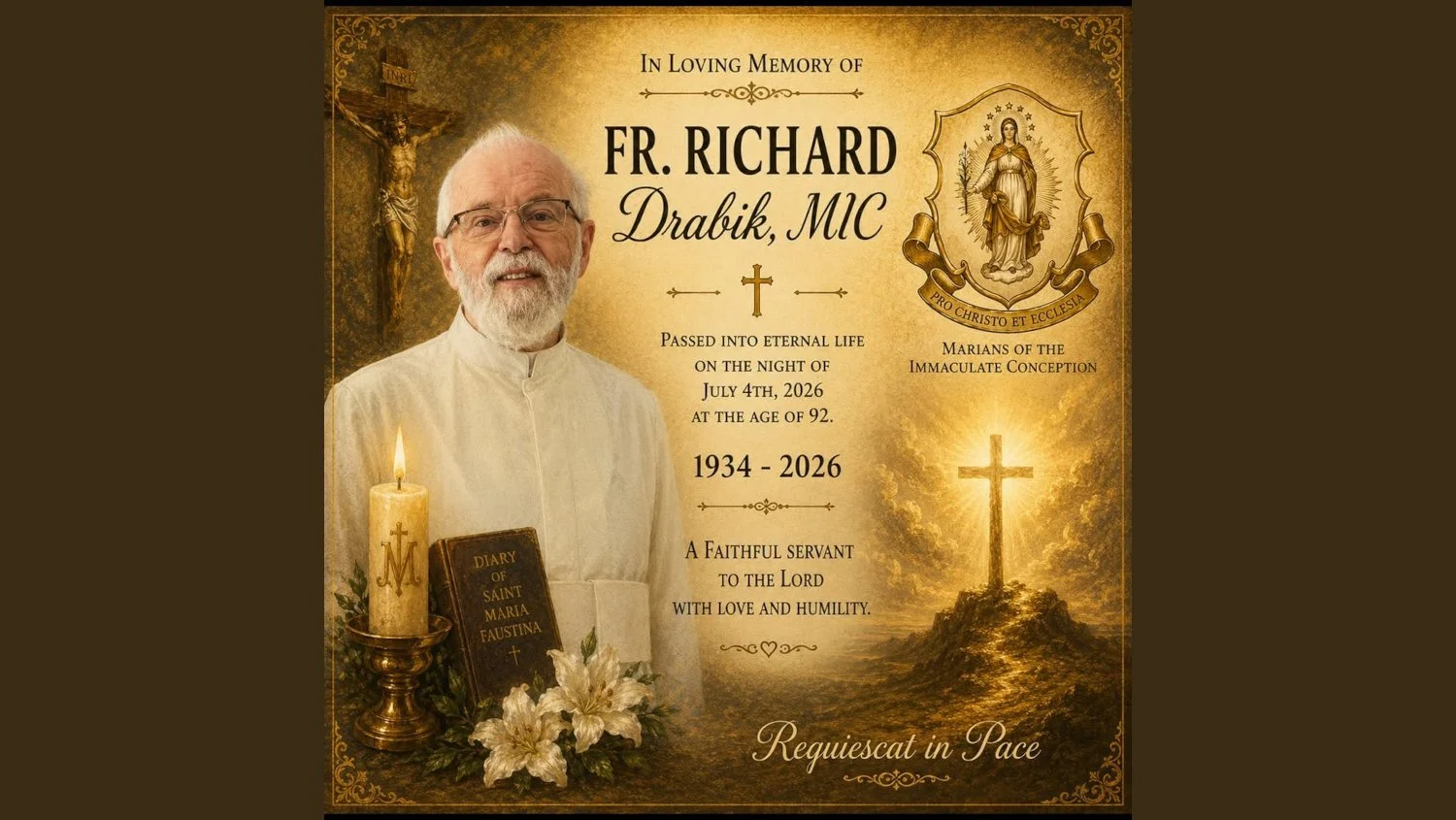
Fr Richard Drabik Introduced Divine Mercy to Saints and Villains
Fr Richard Drabik, MIC, my longtime spiritual director and friend who wrote the Preface to the Diary of Saint Faustina, passed into Divine Mercy on July 4, 2026.
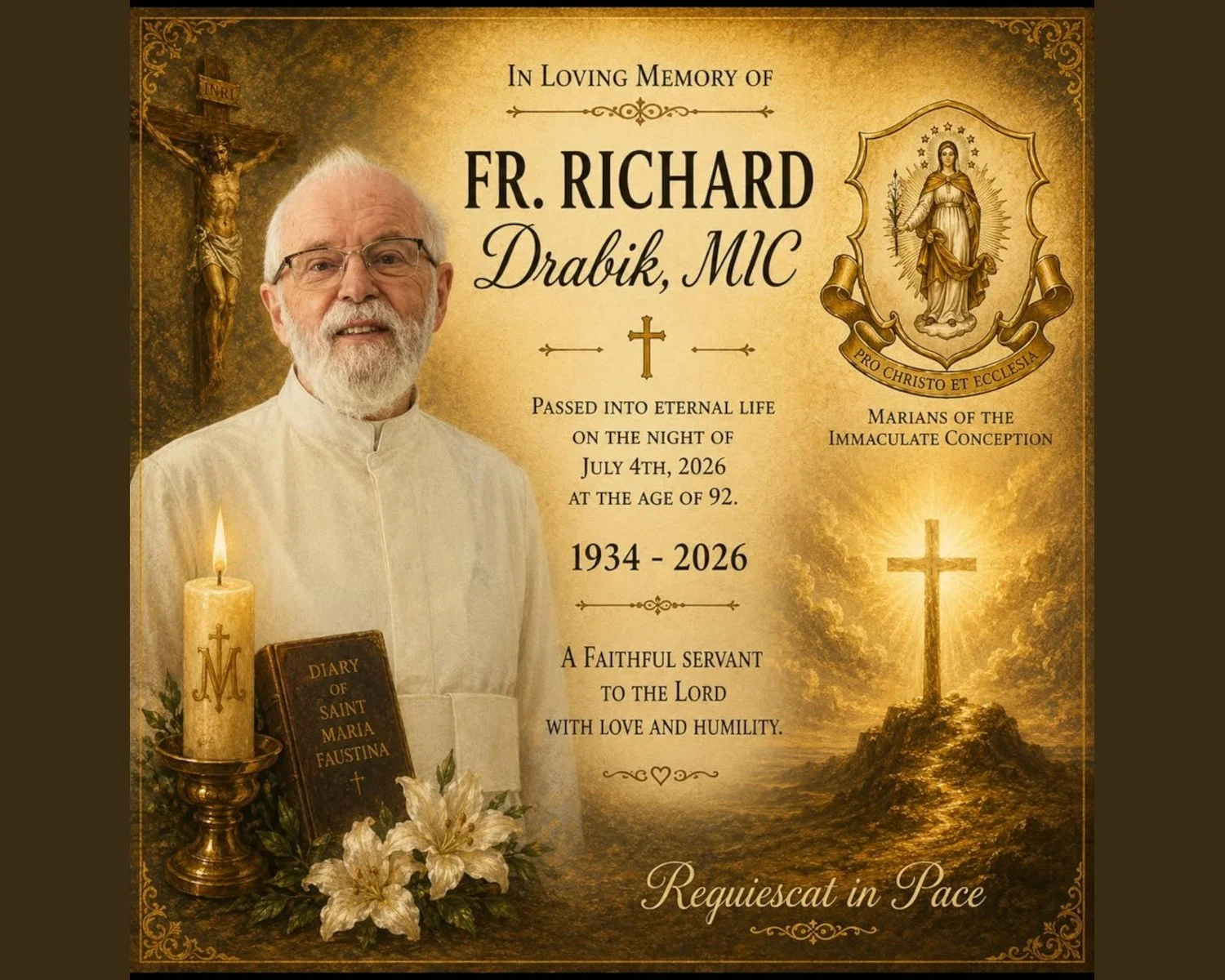
Fr Richard Drabik, MIC, my longtime spiritual director and friend who wrote the Preface to the Diary of Saint Faustina, passed into Divine Mercy on July 4, 2026.
July 8, 2026 by Father Gordon MacRae
“Let the greatest sinners place their trust in My mercy. They have the right before others to trust in the abyss of My mercy . . . To such souls I grant even more graces than they ask. I cannot punish even the greatest sinner if he makes an appeal to My compassion, but on the contrary, I justify him in my unfathomable and inscrutable mercy.”
— Diary of Saint Faustina, 1146
In April of 1993, my friend Father Richard Drabik and I both served on the staff of the Servants of the Paraclete Spiritual and Psychological Renewal Center for priests. Father Drabik was at the time preparing to go to Rome to concelebrate with Pope John Paul II the Mass of Beatification of Sister Maria Faustina Kowalska, now known as Saint Faustina, the Saint of Divine Mercy. Her Beatification took place on the Sunday after Easter that year, and Pope John Paul II decreed that henceforth that Sunday would be universally known in the Roman Calendar as Divine Mercy Sunday.
Father Richard Drabik was formerly Provincial Superior of the Marian Fathers of the Immaculate Conception. He wrote the Preface to the Diary of Saint Maria Faustina Kowalska that has become globally famous. Just before leaving for her Beatification in Rome in 1993, Father Drabik stopped by my office to invite me to write a brief prayer, which would be placed on the altar by Pope John Paul during the Offertory in the Mass for Beatification. I did not know what to write, so on the day of my friend’s departure I handed him a small scrap of paper to place with his intentions for the Mass. I folded it and sealed it in a small envelope that would fit easily in his breast pocket.
No one ever knew what I wrote. The note with my petition was simple: “I ask for the intercession of Blessed Faustina that I may have the courage to be the priest God calls me to be.” It was an odd petition, and today I have no idea what I was thinking about when I wrote it and handed it to Father Drabik on his way out the door.
Exactly two weeks after the Beatification of Sister Faustina, on May 3, 1993, police showed up at my door. They carried with them a secret indictment and a warrant for my arrest for claims alleged to have occurred sometime between 1978 and 1983, ten to fifteen years earlier. They were the claims for which I faced trial and was summarily sent to prison as Ryan A. MacDonald wrote in “Judge Arthur Brennan Sentenced Father Gordon MacRae to Die in Prison.”
Those claims of abuse never took place at all, but I will always remember the words of a police detective as the officers took me away despite my denials: “It doesn’t matter whether you’re guilty. Your Church is!” It was a scene reminiscent of another era I wrote of in “Catholic Scandal and the Third Reich: The Rise and Fall of a Moral Panic.”
The detective’s words could just as easily have been heard in Sister Faustina’s own World War II-era Poland as Father Maximilian Kolbe and many other priests were led off to prison on trumped up charges.
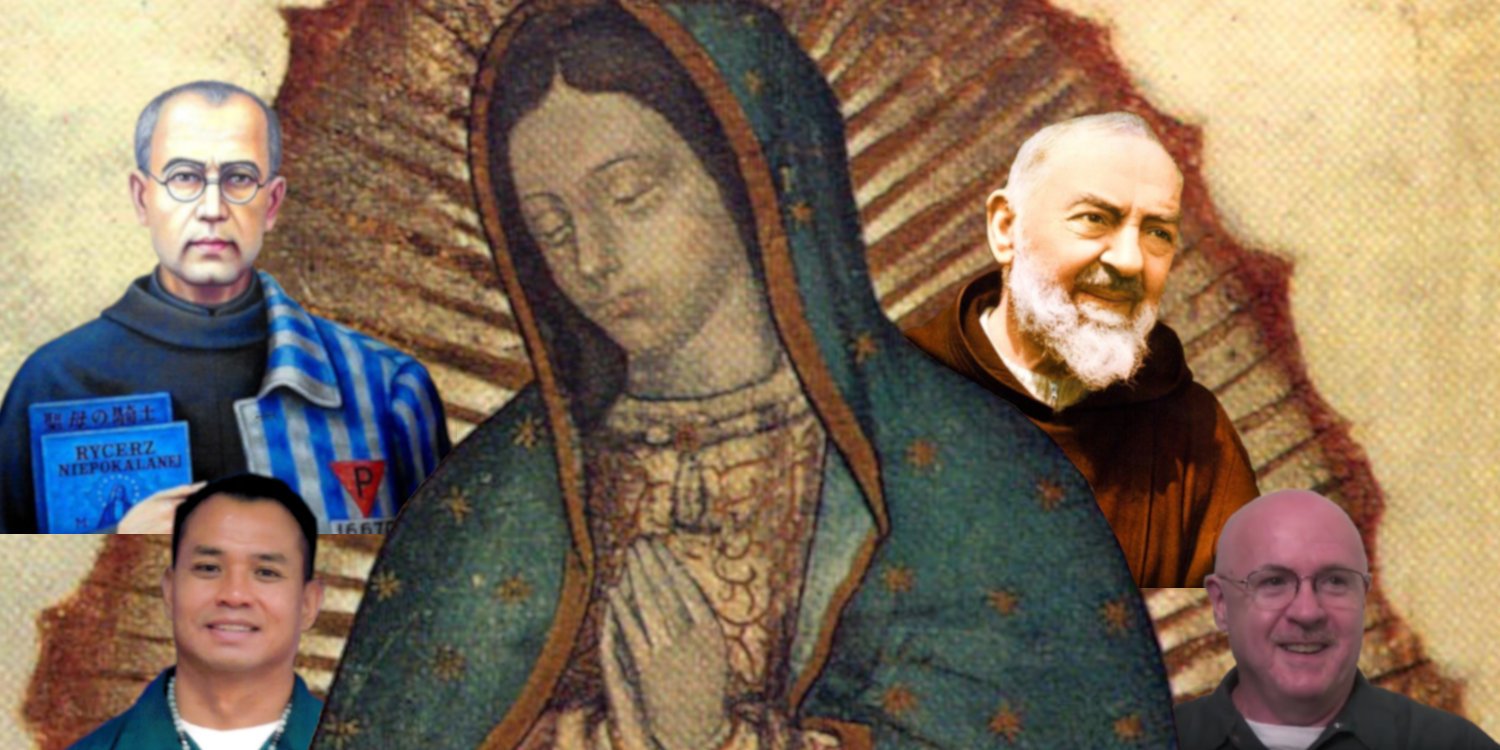
Divine Mercy Behind and Beyond These Stone Walls
Last April 9, I turned 73 years old in prison. I was 41 years old when I was sent to prison, and was in my twenties when my fictitious crimes were alleged to have been committed. I will be age 108 when I next see freedom. The process of reopening a case alleged to have occurred over 30 years ago, and which never contained any evidence to debunk or attack, is a grueling uphill battle. If there is any hope at all for freedom and justice, it is vague hope. It is a hope that exists on the other side of an abyss.
Astute readers remember that I was given several opportunities before my trial to plead guilty and serve only one year in prison. I simply could not fathom doing this. Many years later, Dorothy Rabinowitz, a Pulitzer Prize-winning writer for The Wall Street Journal, took up this case for investigation. She reported that she questioned the detective about the absolute lack of any corroborating evidence. The detective was reported to have said, “Why didn’t he just take the deal?” In a five-minute video interview years later, Ms. Rabinowitz summed up the true nature of this matter.
The readers of Beyond These Stone Walls have helped in so many ways to show us the face of Divine Mercy. Your reading BTSW has given me a global voice when having any voice at all is usually denied to any priest so accused. And having a voice is also often denied to prisoners, as a class of American citizens stripped of rights, including the right to vote. I do not use my access to this voice just to whine about prison conditions. That would be a waste. Instead, I try to employ this voice as an extension of my priesthood, one that is influenced and encapsulated, even defined, by Divine Mercy.
Earlier in my years in prison, my old friend and spiritual director, Father Richard Drabik, visited me. He did so until age and distance made such visits no longer possible. During one of his visits after my publishing began in 2009, I asked him if he had seen the blog that I write from prison, but have never seen. Being a prisoner, I also had no sense of its reach or impact. “It isn’t a blog,” Father Richard said. “It’s a bullhorn!”
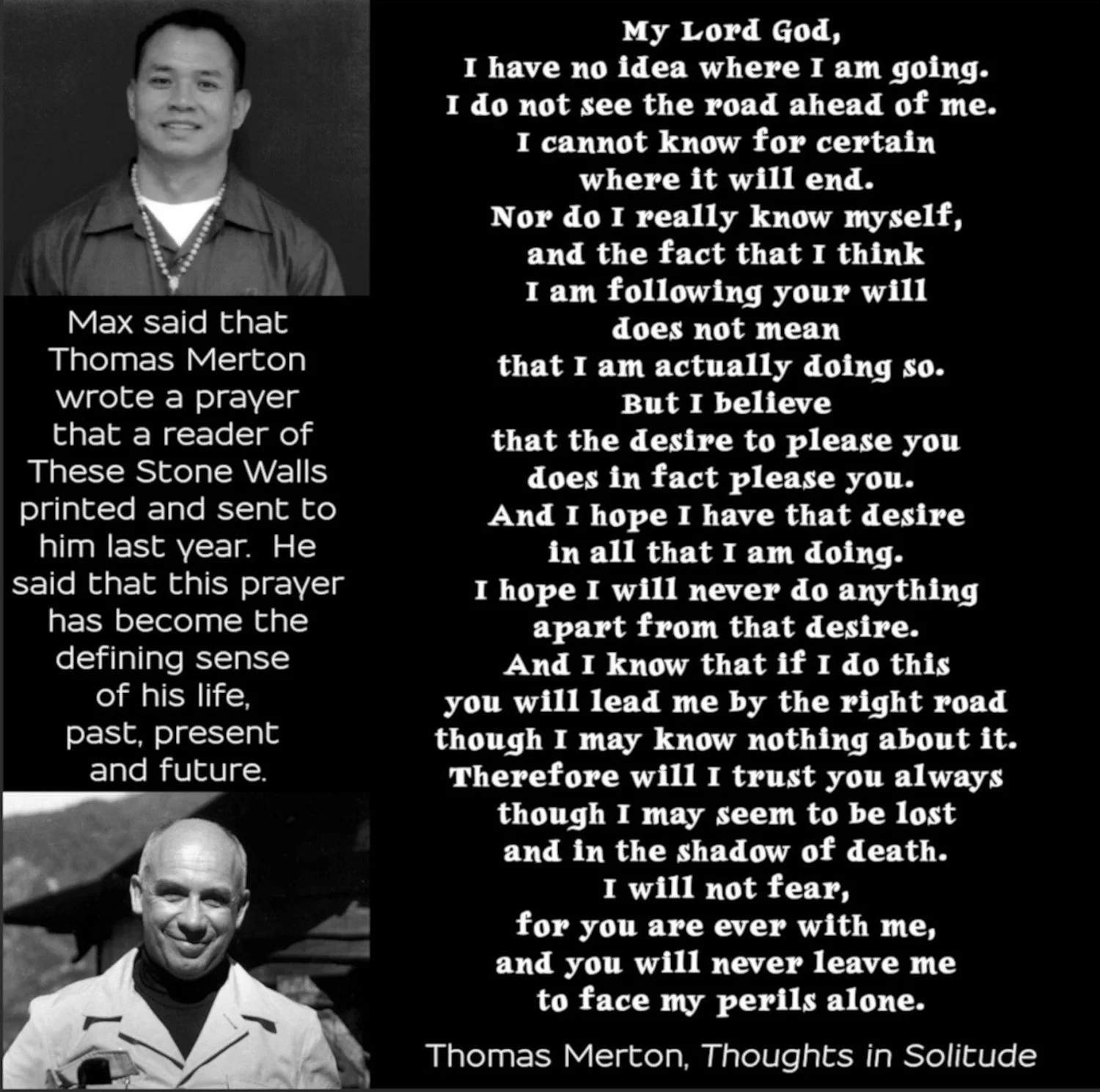
Later, the community of Marians of the Immaculate Conception at the National Shrine of The Divine Mercy took up the slack. They came with an invitation to me and other prisoners to take part in a great Divine Mercy adventure. For some, it became the most important part of our lives here. This was especially so for my friend Pornchai Maximilian Moontri, whose life story was captured by Felix Carroll in the book, Loved, Lost, Found: 17 Divine Mercy Conversions. Pornchai’s story is well known around the world now thanks to the efforts of Catholic League President Bill Donohue. Dr. Donohue invited Pornchai to write his story in his own words. The result was published by the Catholic League as “Pornchai’s Story.” In just four pages, it was powerful and phenomenal. Pornchai was oppressed by the thought that at the end of his own prison sentence he would be deported to Thailand where he no longer knew anyone or had any support at all. Pornchai had been taken from Thailand against his will at age 11, and now would be left there alone at age 47. It was a chilling thought for Pornchai, and also for me. I assured him that we would find a way to build a bridge to Thailand.
Divine Mercy, being what it is, created a roadmap for Pornchai. Father Richard, who was deeply moved by Pornchai’s Story, shared it with others who became links in a chain. One of them was the late Father Seraphim Michalenko, Vice Postulator for the cause of Sainthood for Saint Faustina. He ended up in Thailand meeting with a group called Divine Mercy Thailand. Father Seraphim went there armed with a copy of the Diary of Saint Faustina and a copy of Pornchai’s Story, which he read in English to the assembled group. Suddenly, our bridge to Thailand was built.
Felix Carroll also wrote a wonderful article for Marian Helper Magazine entitled, “Mary Is at Work Here.” The truth of that is today without question.
+ + +
Note from Father Gordon MacRae: Thank you for reading and sharing this post about my great good friend and mentor in the priesthood, Father Richard Drabik, MIC. Don’t misunderstand the opening quote here in this post. Only God knows whether Father Richard is a saint, but he was certainly no villain. He spent a lifetime reaching out to them, however, and reeling them in to show them the Light of Divine Mercy. That was what I liked most about my friend, and what I most try to emulate. You might find his enduring presence in these related posts from Beyond These Stone Walls:
A Priest and Prisoner in the Light of Divine Mercy
Divine Mercy in a Time of Spiritual Warfare
The Parable of a Priest and the Parable of a Prisoner
I greatly treasure the image atop this post. Father Richard’s smile is now engraved upon my heart.

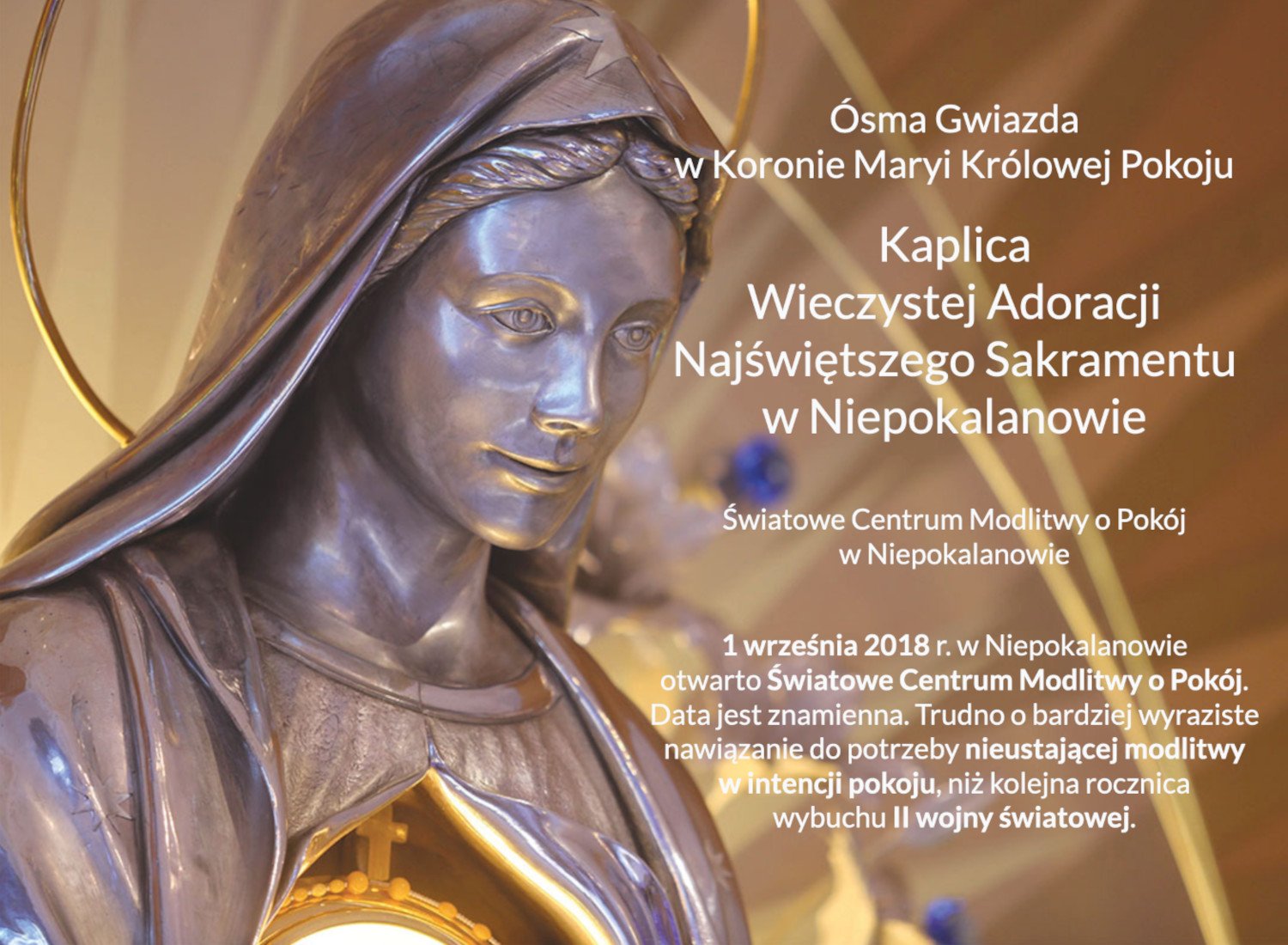

The Eucharistic Adoration Chapel established by Saint Maximilian Kolbe was inaugurated at the outbreak of World War II. It was restored as a Chapel of Adoration in September, 2018, the commemoration of the date that the war began. It is now part of the World Center of Prayer for Peace. The live internet feed of the Adoration Chapel at Niepokalanow — sponsored by EWTN — was established just a few weeks before we discovered it and began to include in at Beyond These Stone Walls. Click “Watch on YouTube” in the lower left corner to see how many people around the world are present there with you. The number appears below the symbol for EWTN.
Click or tap here to proceed to the Adoration Chapel.
The following is a translation from the Polish in the image above: “Eighth Star in the Crown of Mary Queen of Peace” “Chapel of Perpetual Adoration of the Blessed Sacrament at Niepokalanow. World Center of Prayer for Peace.” “On September 1, 2018, the World Center of Prayer for Peace in Niepokalanow was opened. It would be difficult to find a more expressive reference to the need for constant prayer for peace than the anniversary of the outbreak of World War II.”
For the Catholic theology behind this image, visit my post, “The Ark of the Covenant and the Mother of God.”
Pray, Hope and Don’t Worry: This Is Padre Pio’s Key to God’s Heart
Inspired by Padre Pio’s surrender to sacrificial suffering, this unjustly imprisoned priest has had another encounter with Padre Pio, one subtle but profound.
Inspired by Padre Pio’s surrender to sacrificial suffering, this unjustly imprisoned priest has had another encounter with Padre Pio, one subtle but profound.
September 23, 2025 by Fr. Gordon MacRae
I write this week in honor of Saint Pio of Pietrelcina, more popularly known as Padre Pio. He is one of the two Patron Saints of Beyond These Stone Walls and one who has had a living presence in my life behind these walls. The other, of course, is Saint Maximilian Kolbe. Pornchai Moontri and I share a somewhat mystical connection with both. A little time spent at “Our Patron Saints” in the BTSW Public Library might demonstrate how they have come to our spiritual aid in the darkest times of our lives here.
Though they were 20th Century contemporaries, Padre Pio and Maximilian Kolbe did not know each other except by reputation. Among the many letters of Padre Pio to pilgrims who wrote to him are several in which he urged suffering souls to enroll in the Militia Immaculata and Knights at the Foot of the Cross, the two spiritual movements founded by Maximilian Kolbe. I stumbled upon this connection after Pornchai Moontri and I enrolled in both. It is ironic that both saints were canonized by another saint. The lives of St. Padre Pio, St. Maximilian and St. John Paul II were lived with heroic virtue even as they suffered. I wrote of the latter two in another post that touched the hearts of many: “A Tale of Two Priests: Maximilian Kolbe and John Paul II.”
Padre Pio also had a global reputation for doing remarkable things, but he did them in the midst of remarkable suffering. After bearing the wounds of Christ for a half century he passed from this life on September 23, 1968, the date upon which the Church now honors him. On that same date, 26 years later, I was wrongly convicted and sent to prison for life after having tossed aside three chances to save myself and my freedom with a lie.
Since that day, September 23, 1994, Padre Pio has injected himself into my life in profoundly grace-filled ways. I have written of these encounters in multiple posts, but the two that seem to stand out the most are “Padre Pio: Witness for the Defense of Wounded Souls” and one that delves into the deeper mysteries of his life and death, “‘I Am a Mystery to Myself.’ The Last Days of Padre Pio.” We will link to them again at the end of this post and invite you to read them in his honor this week.

Agony in the Garden of Gethsemane
As long as our lives are tied to this world, we will never resolve the mystery of suffering. Like so many of you, I, too, have been confronted with the paradox of suffering. We are trapped in it because, unlike God, we live a linear existence. We see only what has come before and what is now, but we can only imagine what is to come.
But God lives in the '“nunc stans,” the “eternal now” seeing all at once our past, present, and future. Some believers expect God to be the Director of the play that is our lives, but He is more a participant than a director. He allows suffering as a means toward a specific end, but the end is His and not necessarily ours. In my post, “Waking Up in the Garden of Gethsemane,” Jesus discovers that the very first of his suffering is that he is inflicted with a human heart. He asks God to take away the great suffering that is to come, “but Thy will be done.” It is an aspect of the truth of the Resurrection that Jesus brought both His Divinity and the human heart with him when He opened the Kingdom of Heaven to us.
I have encountered this same paradox about suffering, and did so again on the night before writing this post. It comes in the night as a nagging litany of “What-Ifs.” It consists of a series of inflection points, points at which, in my own history, my current state in life could have been avoided had I turned left instead of right. I have identified about five such times and places in my life when a different decision would likely have prevented all the unseen suffering that was to follow.
But “What-Ifs” are spiritually unproductive. They deny the sacrificial nature of at least some of what we suffer and they disregard the plan God has for our souls. During my most recent nighttime Litany of “What-Ifs,” I was reminded of that prayer by St. John Henry Newman that I wrote about in “Divine Mercy in a Time of Spiritual Warfare”:
“God has created me to do Him some definite service. He has committed some work to me which he has not committed to another. I have my mission. I may never know it in this life, but I shall be told it in the next …”
— St. John Henry Newman
I do not have the gift of foresight, but my hindsight is clear. Had I allowed myself to take any of those five alternate steps that I have been reminiscing about, then the work committed to me and no other could not have taken place, and a life and soul may have been lost forever. That life and soul became important to me, but only because it was a work God committed to me and no one else. It was the life and soul of my friend, Pornchai Moontri whom God has clearly called out of darkness. It is my great honor to have been an instrument of the immense grace that transformed Pornchai, but to be such an instrument means never to ask, ”What was in it for me?”
So, if given the chance now, would I trade Pornchai’s life, freedom, and soul to erase the last three decades of my own unjust imprisonment and vilification? Our Lord answered that question with one of his own: “What father among you would give his son a stone if he asks for bread?” (Matthew 7:10). This verse is followed just a few verses further by one that I wrote about in “To the Kingdom of Heaven Through a Narrow Gate”:
“Enter through the narrow gate, for the gate is wide and the road is easy that leads to destruction, and there are many who take it. For the gate is narrow and the road is hard that leads to life, and there are few who find it.”
— Matthew 7:13-14
I could not have foreseen any meaning in what I suffered during my own agony in the garden. Such clarity is only in hindsight. Being sent to prison on false charges seemed to me the worst thing that could ever happen to a person — certainly the worst that could ever happen to a priest because a priest in such a circumstance is almost equally reviled by both Church and State. But today, when recognition of the alternative dawned — recognition that the life and soul of my friend would have been lost forever — I find that I can bear this suffering. I do not choose it. It chose me.

When Padre Pio Stepped In
The story of how Padre Pio stepped into my life as a priest and prisoner came also through Pornchai Moontri. Like Padre Pio himself, I had been shunned and vilified by Catholic activists in groups like SNAP and Voice of the “Faithful.” Out of fear, many other priests and Church officials joined in that shunning during my first decade in prison. The police, the courts, the news media, and the rumor mill in my diocese all amounted to a perfect storm that I was powerless to overcome. In 2002, the storm became a hurricane, first in Boston, then in New Hampshire and from there across the country.
In 2005, The Wall Street Journal’s explosive 2-part publication of “A Priest’s Story” altered the landscape. After it was published, Catholic League President Bill Donohue reached out to me with an invitation to write an article for the Catholic League Journal, Catalyst. My article, “Sex Abuse and Signs of Fraud” was published in the November 2005 issue.
When I received that month’s issue, I was more stricken by its front-page revelation than with my own centerpiece article. It was “Padre Pio Defamed.” I was shocked to learn, for the first time, that Padre Pio suffered more than the visible wounds of the crucified Christ. He also suffered a cascade of slander from both secular and Church officials with wild suspicions and accusations that he sexually abused women in the confessional resulting in multiple Church investigations and even the suspension of his priestly faculties. In 1952, the Congregation of the Holy Office placed in its Index of Forbidden Books all books about Padre Pio.
Heaven can be most forgiving. The bishop who suspended the priestly faculties of Padre Pio based on the rapid spread of false information was Bishop Albino Luciani. Just a few years ago after a miracle attributed to his intercession was confirmed, he was beatified as Blessed Pope John Paul I.
It is ironic — not to mention boldly courageous — that Pope John Paul II canonized Padre Pio in 2002 at the height of media vitriol during the clergy abuse scandal in the United States. One of the last investigations against Padre Pio was a 1960 report lodged by Father Carlo Maccari alleging, with no evidence, that Padre Pio had sexual liaisons with female penitents twice per week.
In the same month my Catalyst article was published, Tylor Cabot joined the slander in the November 2005 issue of Atlantic Monthly with “The Rocky Road to Sainthood.” He wrote, “despite questions raised by two papal emissaries — and despite reported evidence that [Padre Pio] raised money for right-wing religious groups and had sex with penitents — Pio was canonized in 2002.”
Fr. Maccari’s original slander also found its way into The New York Times. Maccari went on to become an archbishop. On his deathbed, Maccari recanted his story as a monstrous lie born of jealousy. He prayed on his deathbed for the intercession of Padre Pio, the victim of his slander.

A Heaven-Sent Blessing from Padre Pio
Also in November of 2005, Pornchai Moontri arrived in this prison after his experience of all the events I described in “Getting Away with Murder on the Island of Guam.” Maximilian Kolbe and Padre Pio teamed up to reverse in him a road to destruction in ways that I was powerless to even imagine. A few years later, in 2009, this blog was born and some of my earliest posts were about what Padre Pio and Maximilian Kolbe suffered in life on the road to becoming the spiritual advocates they have been for us and millions of others. Just after I wrote about Padre Pio for the first time, I received a letter from Pierre Matthews from Ostend, Belgium who had been writing to me since reading of me in The Wall Street Journal.
Learning of my faith despite false charges and imprisonment became for Pierre the occasion for his return to faith and the Church after a long European lapse. When he read my early posts about the plight of Padre Pio, Pierre excitedly told me of a mystical encounter he had with Padre Pio as a young man. A letter from his father to him at his boarding school in Italy instructed him to go to San Giovanni Rotondo to ask for the blessing of the famous stigmatic, Padre Pio.
When 16-year-old Pierre got there, a friar answering the door told him this was impossible. He then gave Pierre a blessed holy card and ushered him toward the door. Just then, while inside the cavernous Capuchin Friary, an old man with bandaged hands came slowly down a flight of stairs and walked directly to the surprised teenager. Padre Pio held Pierre there firmly with his bandaged hands upon his head while he spoke aloud a blessing and prayer. Pierre was stunned, and never forgot it.
Sixty years later, Pierre had a dream that this blessing from Padre Pio was for us, and he wanted to pass it on. He insisted that he must be permitted to become Pornchai Moontri’s Godfather when Pornchai was received into the Church on Divine Mercy Sunday, 2010.
Pierre left this life in 2020 just as Pornchai was undergoing his deportation to Thailand, his emergence from prison and the start of a new life. To this day, we both hold Padre Pio in awe as a mentor and friend. Thanks to the intercession of Pierre Matthews, Pornchai’s Godfather, Padre Pio gave us spiritual hope when there was none in sight. His advice is profoundly simple and characteristically blunt:
“Pray, hope, and don’t worry. Prayer is the key to God’s heart.”
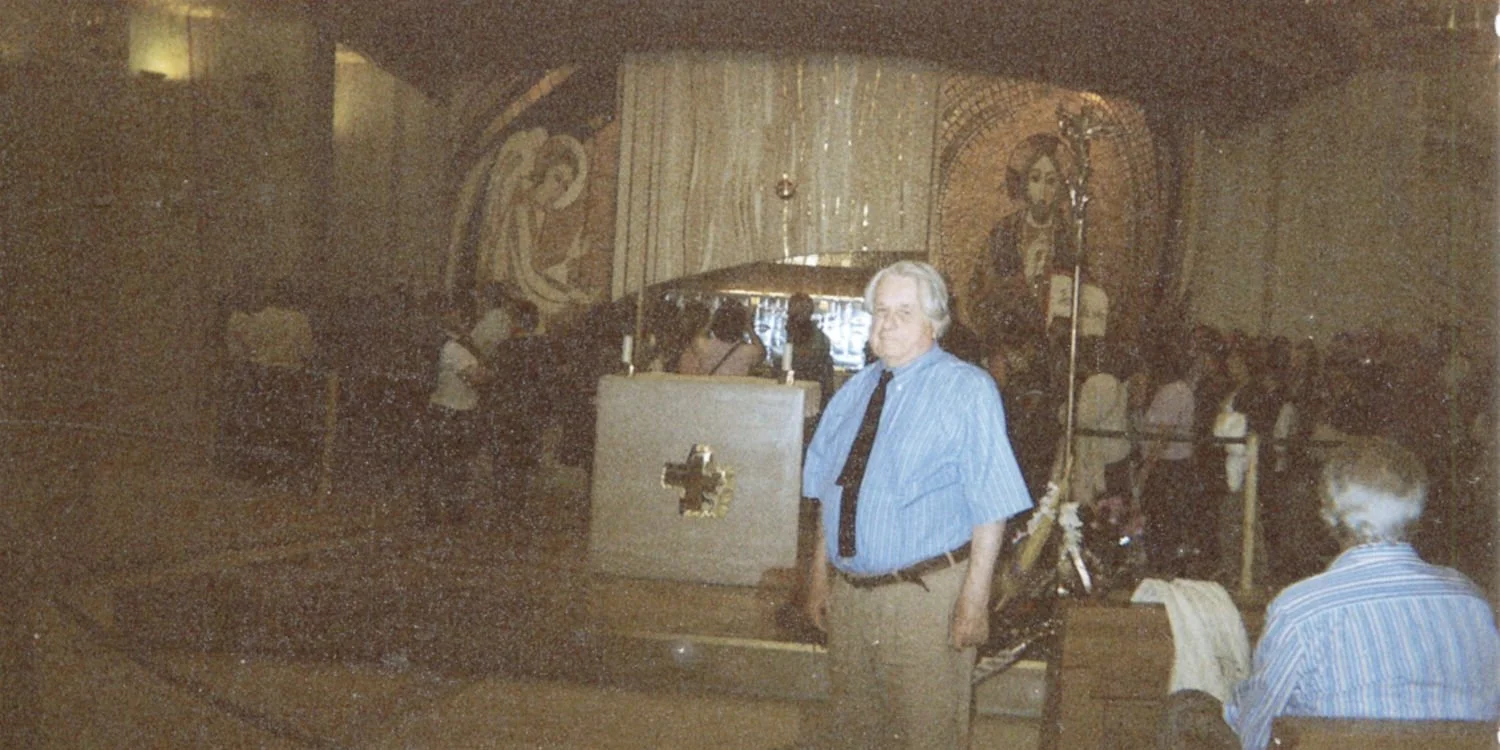
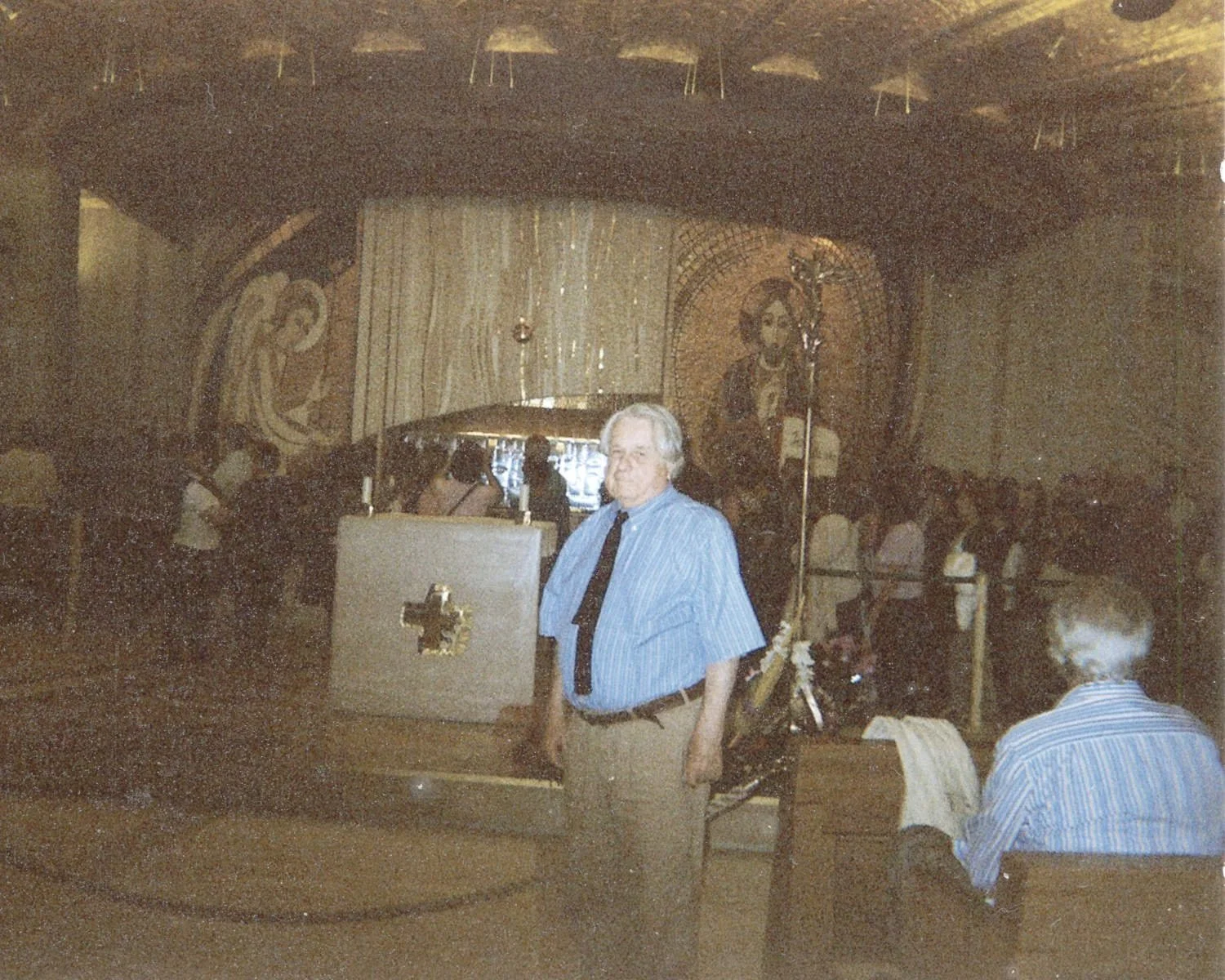
The key to our hearts, Pornchai Moontri’s and my own, was given to us by Pierre Matthews. Just weeks before his own death in 2021, the elderly Pierre ventured on another pilgrimage from his home in Ostend, Belgium to the Shrine of Padre Pio at San Giovanni Rotondo in Italy, the second most visited Catholic shrine in all the world. A photograph was taken of Pierre before the crypt of Saint Padre Pio. Pierre sent the photo to me in prison. It was the last time I heard from him in this life.
As I was preparing this post, I searched for that photo. Over a week’s time I tore my prison cell apart searching more diligently than any of the guards have ever searched. In dismay, I gave up and prepared to send this post to our Editor. Then I reached for a book that caught my eye at the last minute. When I flipped through its pages, the photo was in the book. Now it is atop this post, and I swear that I could hear Pierre and Padre Pio laughing.
+ + +
Note from Fr. Gordon MacRae: Thank you for reading. Please share this post so it may come before someone who needs it. And please Subscribe if you have not done so already. You may also like these related posts from Beyond These Stone Walls.
“I Am a Mystery to Myself.” The Last Days of Padre Pio
Padre Pio: Witness for the Defense of Wounded Souls
A Tale of Two Priests: Maximilian Kolbe and John Paul II
On the Day of Padre Pio, My Best Friend Was Stigmatized

What Do John Wayne and Pornchai Moontri Have in Common?
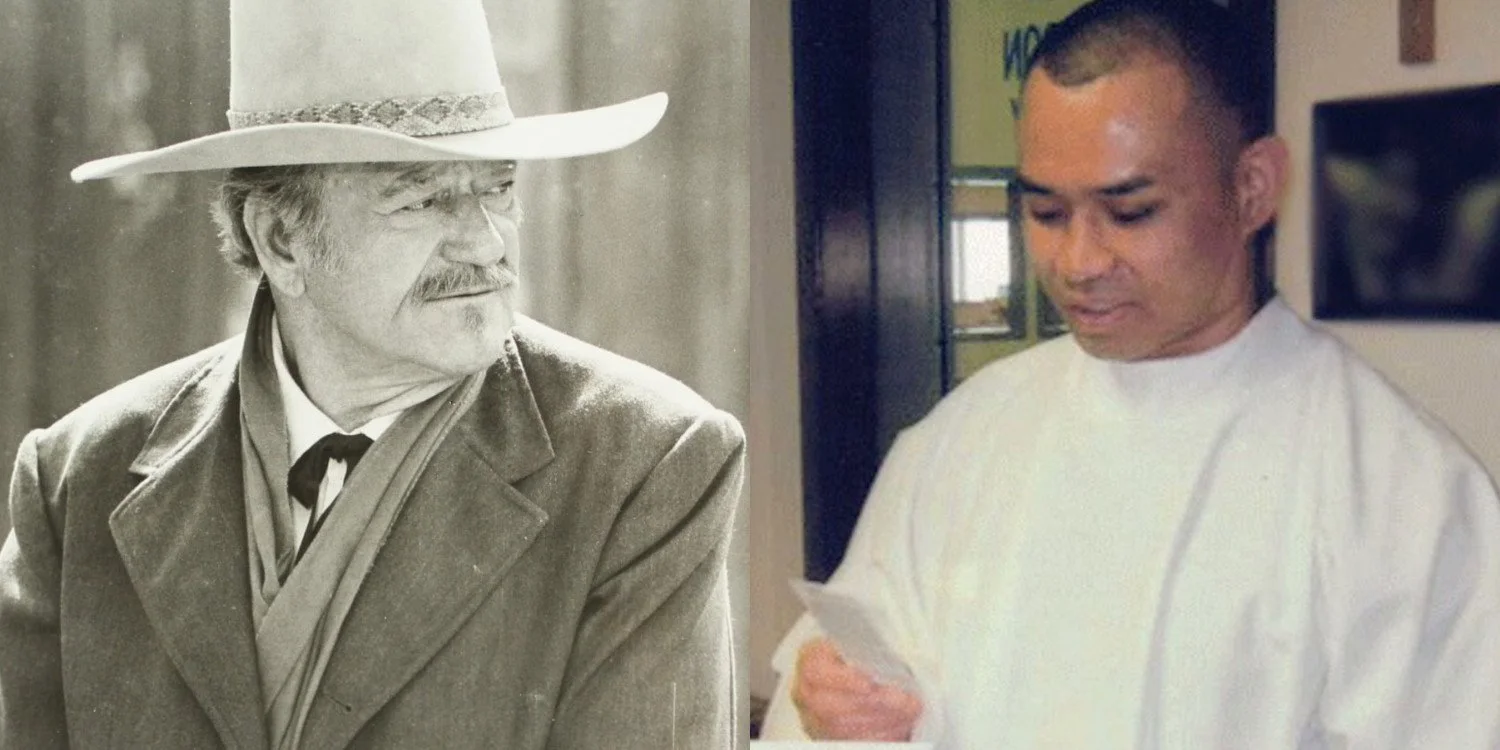
Pornchai Moontri celebrates his 52nd birthday on September 10 this year. It is his 15th birthday as a Catholic, a conversion he shares with the great actor, John Wayne.
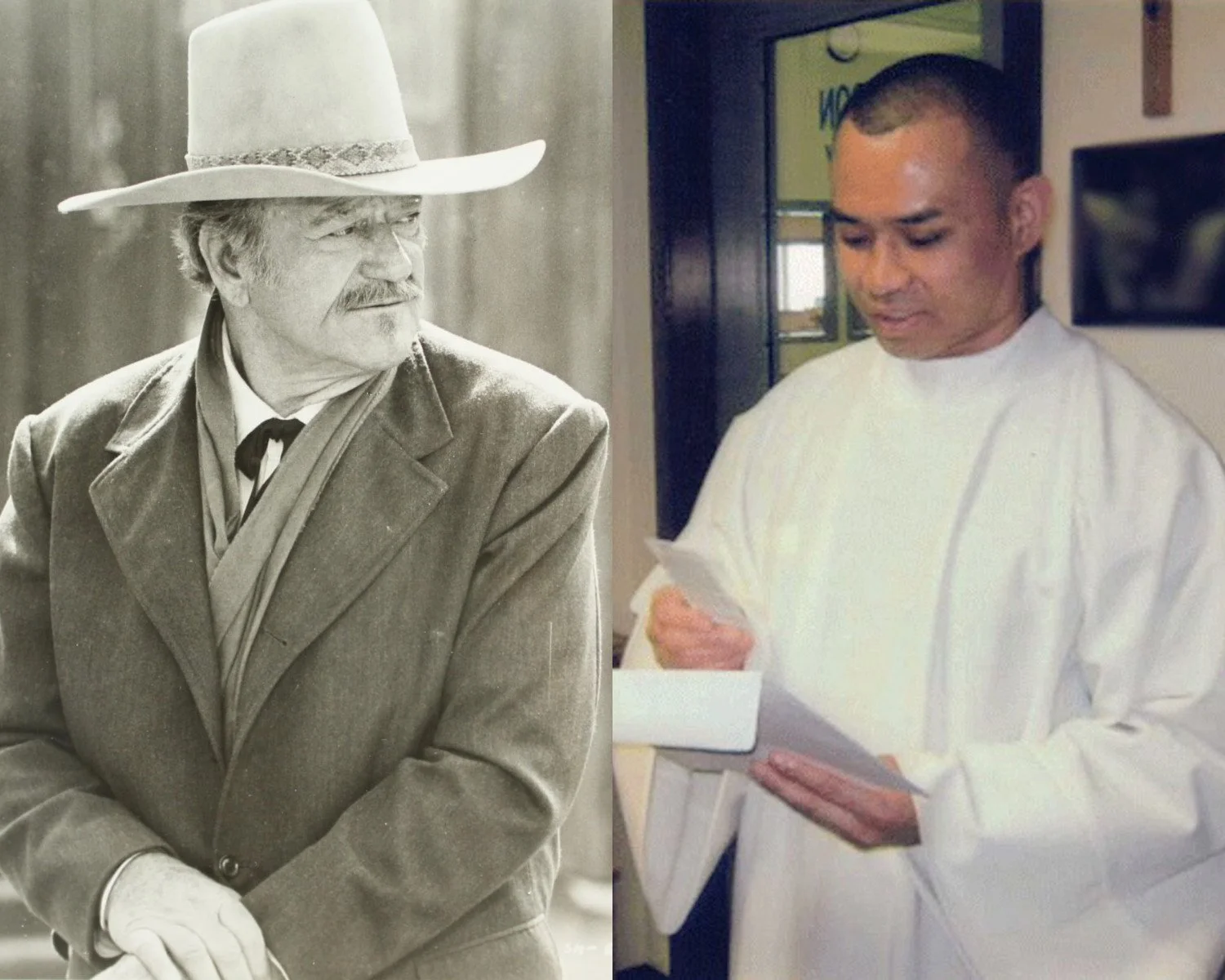
Pornchai Moontri celebrates his 52nd birthday on September 10 this year. It is his 15th birthday as a Catholic, a conversion he shares with the great actor, John Wayne.
September 10, 2025 by Father Gordon MacRae
I last wrote about our friend and my former roommate, Pornchai Max Moontri at a time of tragedy. That post was “A Devastating Earthquake Shook Thailand, Myanmar and Our Friends.” Ironically, I just noticed, it appeared on April 9, 2025, which was my 72nd birthday. I was recently talking with Pornchai in Thailand by telephone, and the subject of birthdays came up. He was absent from Thailand for 36 years, and it was 36 years of loss and tragedy. He spoke of his impression that what constitutes “family” for him is not only those with whom you share blood, but even more so those with whom you share and survive trials and tribulation. This is why those in the military who go through war together and survive form a bond that transcends all other bonds, including family. I readily agreed with that and mentioned the famous series, Band of Brothers as an example.
In an earlier post, “February Tales and a Corporal Work of Mercy in Thailand,” I described growing up on the Massachusetts North Shore — the stretch of seacoast just north of Boston. My family had a long tradition of being “Sacrament Catholics.”
I once heard my father joke that he would enter a church only twice in his lifetime, and would be carried both times. I was seven years old, squirming into a hand-me-down white suit for my First Communion when I first heard that excuse for staying home. I didn’t catch on right away that my father was referring to his Baptism and his funeral. I pictured him, a very large man, slung over my mother’s shoulder on his way into church for Sunday Mass, and I laughed.
We were the most nominal of Catholics. Prior to my First Communion at age seven, I was last in a Catholic church at age five for the priesthood ordination of my uncle, the late Father George W. MacRae, a Jesuit and renowned Scripture scholar. My father and “Uncle Winsor,” as we called him, were brothers — just two years apart in age but light years apart in their experience of faith. I was often bewildered, as a boy, at this vast difference between the two brothers.
But my father’s blustering about his abstention from faith eventually collapsed under the weight of his own cross. It was a cross that was partly borne by me as well, and carried in equal measure by every member of my family. By the time I was ten — at the very start of that decade of social upheaval, life in our home had disintegrated. My father’s alcoholism raged beyond control, nearly destroying him and the very bonds of our family. We became children of the city streets as home and family faded away.
I have no doubt that many readers can relate to the story of a home torn asunder by alcoholism, and some day I hope to write more about this cross. But for now I want to write about conversion, so I’ll skip ahead.
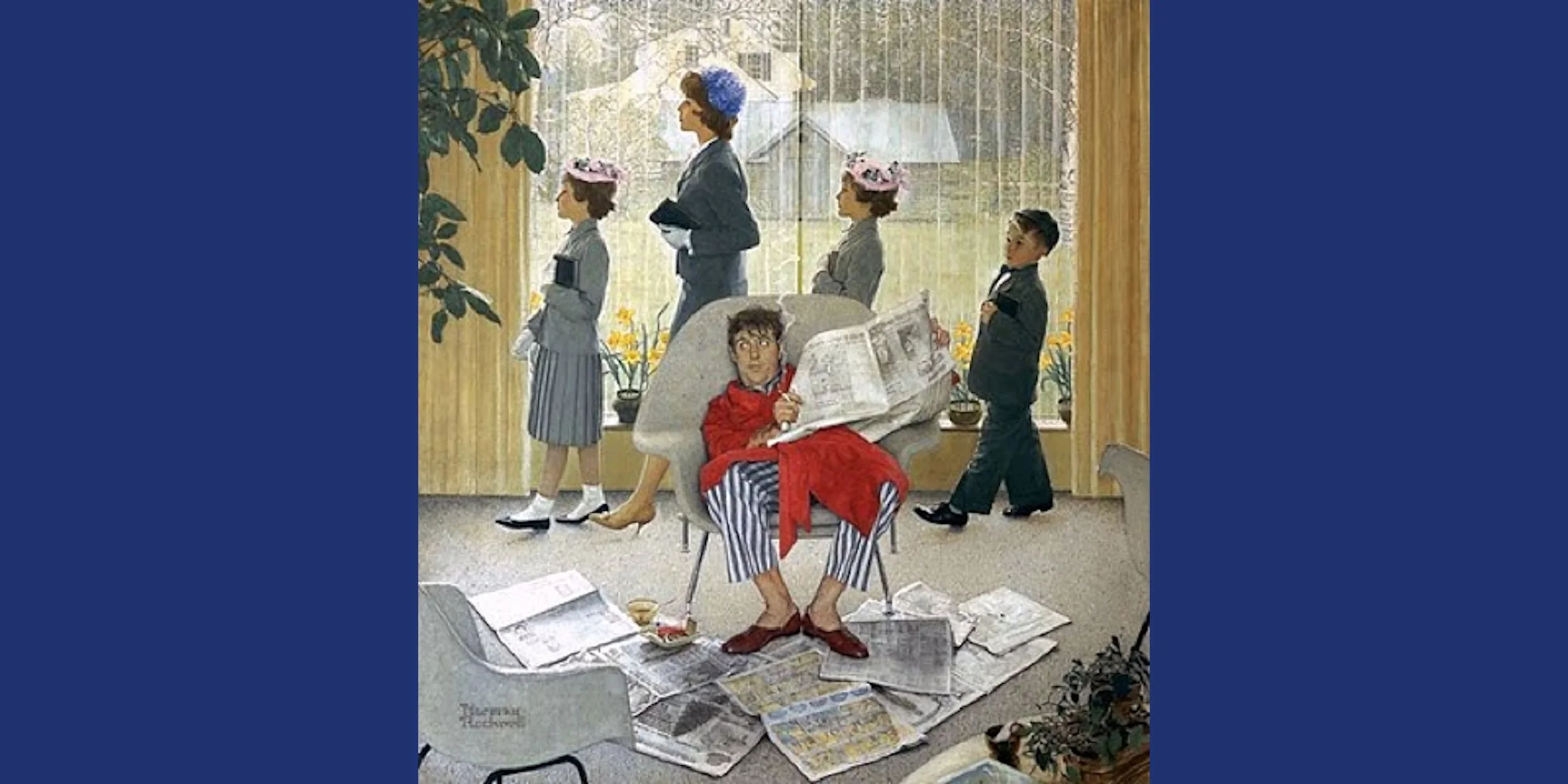
The Long and Winding Road Home
As a young teenager, I had a friend whose family attended a small Methodist church. I stayed with them from time to time. They knew I was estranged from my Catholic faith and Church, so one Sunday morning they invited me to theirs. As I sat through the Methodist service, I just felt empty inside. There was something crucial missing. So a week later, I attended Catholic Mass — secretly and alone — with a sense that I was making up for some vague betrayal. At some point sitting in this Mass alone at age 15 in 1968, I discovered that I was home.
My father wasn’t far behind me. Two years later, when just about everyone we knew had given up any hope for him, my father underwent a radical conversion that changed his very core. He admitted himself to a treatment program, climbed the steep and arduous mountain of recovery, and became our father again after a long, turbulent absence. A high school dropout and machine shop laborer, my father’s transformation was miraculous. He went back to school, completed a college degree, earned a masters degree in social work, and became instrumental in transforming the lives of many other broken men. He also embraced his Catholic faith with love and devotion, and it embraced him in return. That, of course, is all a much longer story for another day.
My father died suddenly at the age of 52 just a few months after my ordination to priesthood in 1982. I remember lying prostrate on the floor before the altar during the Litany of the Saints at my ordination as I described in “The Power and the Glory if the Heart of a Priest Grows Cold.” I was conscious that my father stood on the aisle just a few feet away, and I was struck by the nature of the man whose impact on my life had so miraculously changed. Underneath the millstones of addiction and despair that once plagued him was a singular power that trumped all. It was the sheer courage necessary to be open to the grace of conversion and radical change. The most formative years of my young adulthood and priesthood were spent as a witness to the immensity of that courage. In time, I grew far less scarred by my father’s road to perdition, and far more inspired by his arduous and dogged pursuit of the road back. I have seen other such miracles, and learned long ago to never give up hope for another human being.
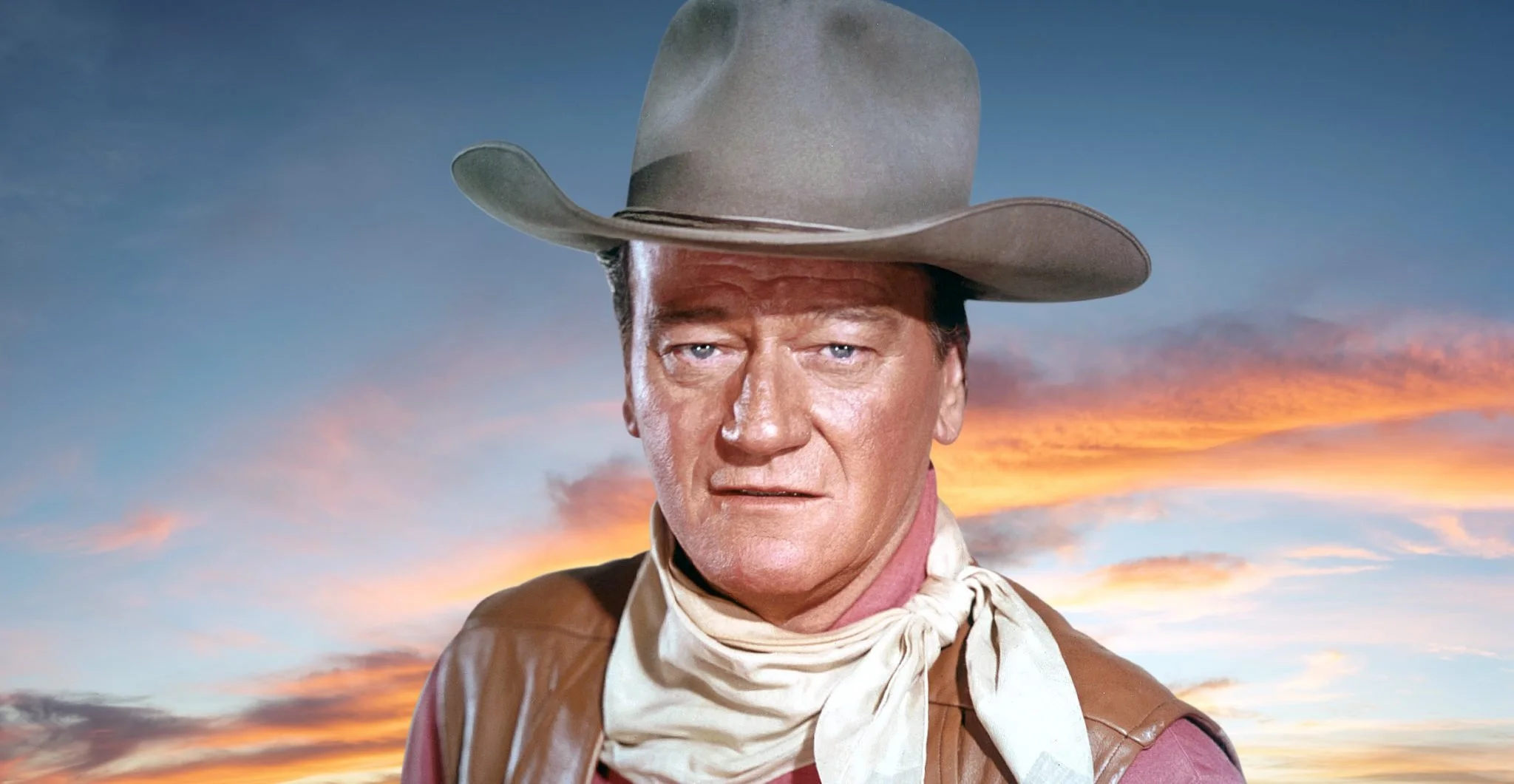
The Conversion of the Duke
I once wrote that John Wayne is one of my life-long movie heroes and a man I have long admired. But all that I really ever knew of him was through the roles he played in great westerns like “The Searchers,” “The Comancheros,” “Rio Bravo,” and my all-time favorite historical war epic, “The Longest Day.”
In his lifetime, John Wayne was awarded three Oscars and the Congressional Gold Medal. After his death from cancer in 1979, he was posthumously awarded the Presidential Medal of Freedom. But, for me, the most monumental and courageous of all of John Wayne’s achievements was his 1978 conversion to the Catholic faith.
Not many in Hollywood escape the life it promotes, and John Wayne was no exception. The best part of this story is that it was first told by Father Matthew Muñoz, a priest of the Diocese of Orange, California, and John Wayne’s grandson.
Early in his film career in 1933, John Wayne married Josephine Saenz, a devout Catholic who had an enormous influence on his life. They gave birth to four children, the youngest of whom, Melinda, was the mother of Father Matthew Muñoz. John Wayne and Josephine Saenz civilly divorced in 1945 as Hollywood absorbed more and more of the life and values of its denizens.
But Josephine never ceased to pray for John Wayne and his conversion, and she never married again until after his death. In 1978, a year before John Wayne died, her prayer was answered and he was received into the Catholic Church. His conversion came late in his life, but John Wayne stood before Hollywood and declared that the secular Hollywood portrayal of the Catholic Church and faith is a lie, and the truth is to be found in conversion.
That conversion had many repercussions. Not least among them was the depth to which it inspired John Wayne’s 14-year old grandson, Matthew, who today presents the story of his grandfather’s conversion as one of the proudest events of his life and the beginning of his vocation as a priest.
If John Wayne had lived to see what his conversion inspired, I imagine that he, too, would have stood on the aisle, a monument to the courage of conversion, as Matthew lay prostrate on the Cathedral floor praying the Litany of the Saints at priesthood ordination. The courage of conversion is John Wayne’s most enduring legacy.
Pornchai Moontri Takes a Road Less Traveled
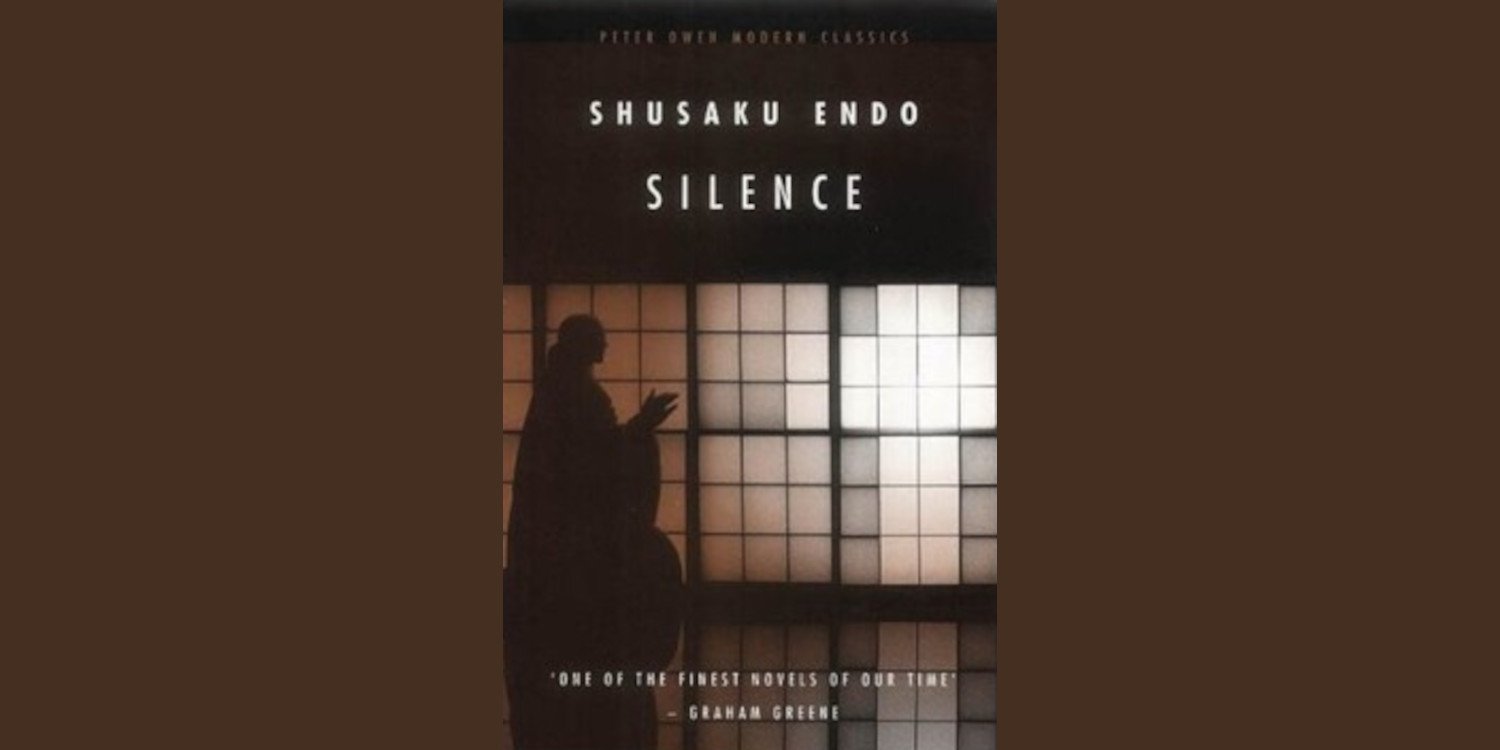
The Japanese Catholic novelist, Shusaku Endo, wrote a novel entitled Silence (Monumenta Nipponica, 1969), a devastating historical account of the cost of discipleship. It is a story of 17th Century Catholic priests who faced torture and torment for spreading the Gospel in Japan. The great Catholic writer, Graham Greene, wrote that Silence is “in my opinion, one of the finest novels of our time.”
Silence is the story of Father Sebastian Rodriguez, one of those priests, and the story is told through a series of his letters. Perhaps the most troubling part of the book was the courage of Father Rodriguez, a courage difficult to relate to in our world. Because of the fear of capture and torture, and the martyrdom of every priest who went before him, Father Rodriguez had to arrive in Japan for the first time by rowing a small boat alone in the pitch blackness of night from the comfort and safety of a Spanish ship to an isolated Japanese beach in 1638 — just 18 years after the Puritan Pilgrims landed the Mayflower at Squanto’s Pawtuxet, half a world away as I describe in “The True Story of Thanksgiving.”
In Japan, however, Father Rodriguez was a pilgrim alone. Choosing to be left on a Japanese beach in the middle of the night, he had no idea where he was, where he would go, or how he would survive. He had only the clothes on his back, and a small traveler’s pouch containing food for a day. I cannot fathom such courage. I don’t know that I could match it if it came down to it.
But I witness it every single day. Most of our readers are very familiar with “Pornchai’s Story,” and with his conversion to Catholicism on Divine Mercy Sunday in 2010. Most know the struggles and special challenges he has faced as I wrote in “Pornchai Moontri, Bangkok to Bangor, Survivor of the Night.”
But the greatest challenge of Pornchai’s life was yet to come. After serving more than half his life in prison in a sentence imposed when he was a teenager, Pornchai faced forced deportation from the United States to his native Thailand. Like Father Sebastian Rodriguez in Silence, Pornchai would be stepping onto the shores of a foreign land in darkness, a land he no longer knew and in which he knew no one.
This was a time of great turmoil for both of us. I have told much of this story before, but it is worth repeating now. I asked Pornchai to write his life story. He was lost for words and did not know how or where to begin. So I asked him to just talk. He sat on the floor of our prison cell and the words came cautiously at first, but then they began to flow as I took notes. Neither of us knew what to expect but in the end I typed the four pages from my notes and titled it simply “Pornchai’s Story.” We had no way to know that this short story would become known all over the world. I sent a copy to Catholic League President Bill Donohue, a Catholic leader with a heart of pure gold. Dr. Donohue published it on the Catholic League website and he wrote that it was “remarkable.” Then the letters came addressed to Pornchai. One was from Ambassador Mary Ann Glendon, who was then U.S. Ambassador to the Holy See. Another was from the late Father Richard John Neuhaus, Editor of First Things magazine, who told Pornchai that his powerful story would turn many souls back to God. Yet another was from Cardinal Kitbunchu, the Archbishop Emeritus of Bangkok. Yet another was from Yela Roongruangchai, Founder and President of Divine Mercy Thailand.
Also in Thailand at the time “Pornchai’s Story” arrived was Father Seraphim Michalenko, MIC, who also happened to be the Vatican’s Postulator for the Cause of Sainthood of Saint Maria Faustina Kowalska, the Saint of Divine Mercy. Father Seraphim read “Pornchai’s Story” aloud during a Divine Mercy Retreat in Bangkok. Ten years before all of this happened, I boldly told Pornchai during a night of near despair, that we would have to build a bridge from a prison in Concord, New Hampshire to Thailand. Pornchai scoffed, but it was the only hope we had to hold onto. Then the bridge was built right before our very eyes. What we once faced with terror in the darkness of a future unseen, we now face with the gift of hope. Happy Birthday, Max!
+ + +
Note from Father Gordon MacRae: Thank you for reading and sharing this post. Don’t stop here. Learn a bit more of this story through the following related posts:
Pornchai Moontri and the Long Road to Freedom
The Shawshank Redemption and Its Grace Rebounding
Thailand’s Once-Lost Son Was Flag Bearer for the Asian Apostolic Congress
A Catholic League White House Plea Set Pornchai Moontri Free
+ + +
A Further Note from Father Gordon MacRae: While writing the above post I received a note from my friend Sheryl Collmer in Tyler, Texas. Along with it was an article Sheryl had written for Crisis Magazine. The article is about the magnificent new film, Triumph of the Heart, telling the story of our Patron Saint Maximilian Kolbe. Sheryl’s article is magnificent in its own right and it casts a light into a very dark place in our world. But her article does not leave us there. There is not much in this world that makes me want to shout from the rooftops, but Sheryl Collmer’s article is one of them. You must not miss “The Tenebrae of Maximilian Kolbe” and I hope you will share it.
The Eucharistic Adoration Chapel established by Saint Maximilian Kolbe was inaugurated at the outbreak of World War II. It was restored as a Chapel of Adoration in September, 2018, the commemoration of the date that the war began. It is now part of the World Center of Prayer for Peace. The live internet feed of the Adoration Chapel at Niepokalanow — sponsored by EWTN — was established just a few weeks before we discovered it and began to include in at Beyond These Stone Walls. Click “Watch on YouTube” in the lower left corner to see how many people around the world are present there with you. The number appears below the symbol for EWTN.
Click or tap here to proceed to the Adoration Chapel.
The following is a translation from the Polish in the image above: “Eighth Star in the Crown of Mary Queen of Peace” “Chapel of Perpetual Adoration of the Blessed Sacrament at Niepokalanow. World Center of Prayer for Peace.” “On September 1, 2018, the World Center of Prayer for Peace in Niepokalanow was opened. It would be difficult to find a more expressive reference to the need for constant prayer for peace than the anniversary of the outbreak of World War II.”
For the Catholic theology behind this image, visit my post, “The Ark of the Covenant and the Mother of God.”

Pope Leo XIV Defamed by the Survivors Network of those Abused by Priests
In 2018 this exposé of SNAP’s shady tactics to increase settlements over accused priests was widely ignored. After the Conclave of 2025 it exploded on the Internet.

In 2018 this exposé of SNAP’s shady tactics to increase settlements over accused priests was widely ignored. After the Conclave of 2025 it exploded on the Internet.
May 21, 2025 by Father Gordon MacRae
It did not take long. In the weeks leading up to the Conclave of 2025, Pope Leo XIV was accused by SNAP — the U.S.-based Survivors Network of those Abused by Priests — of negligently investigating and then covering up a decades-old account of alleged clergy sexual abuse. Lifted out of all context, the story is missing its most important element: the simple truth. To its great credit last week, the Catholic League for Religious and Civil Rights responded to this story by providing the truth and context that the story lacks. I am grateful to the Catholic League for having the Holy Father’s back, not to mention my own.
At about the same time, an article that I wrote in 2018 about SNAP’s deceptions and destructive malfeasance suddenly went viral after the Conclave of 2025. The Catholic League pounced on that as well, and courageously republished it anew under the title, Father Gordon J. Macrae On SNAP’s Deception.
That fact alone conveyed to me the urgency of this account of how and when SNAP activists terrorized the Church and priesthood for two decades.
So here it is again, apparently by popular demand of SNAP itself by raising the same tired old story with a new target: Pope Leo XIV. The papacy of Pope Leo XIV should not be tainted by a repeat of the dishonest rhetoric from this shady and morally compromised anti-Catholic activist network. SNAP can no longer mask the truth revealed in these pages.
Please read and share, as so many in Europe have done:
Abused by the Survivors Network of those abused by Priests

If there exists a Catholic priest still in denial about the agenda of SNAP, it’s because he has lived with his head in the sand blind to the threat lying in wait for him.
In 2009, at the same time I began writing for Beyond These Stone Walls, Catholic League President Bill Donohue invited me to write a feature article for the Catholic League Journal, Catalyst. My article, “Due Process for Accused Priests,” began by describing an important phenomenon.
In 2002, just as the national story of Catholic priests and sexual abuse emerged out of Boston to sweep the country, psychologist Daniel Kahneman was awarded the Nobel Prize in Economics for his work on a phenomenon called “availability bias.” It revealed the power of the media to not just report the news, but to reshape it to fit media bias, to cultivate it, to take a story’s small microphone and turn it into a megaphone.
Activist organizations have trained people to harness this force to sway what others adopt as a bias. It is not new, just newly analyzed. One of the most potent deployments of “availability bias” is one I have quoted before in these pages. It comes from Mein Kampf, the 1926 book by Adolf Hitler that gave rise to the Nazi party in Germany:
“The great mass of people will more easily fall prey to a big lie than to a small one.”
After my 2009 Catalyst article was published, I was subjected to an open assault by David Clohessy, Executive Director of the activist organization, SNAP, the Survivors Network of those Abused by Priests. Matt Abbott at Renew America forwarded my article to Mr. Clohessy and invited a response posted at Renew America entitled, “Imprisoned Priest, Sex Abuse Victim Clash.”
David Clohessy was obviously perturbed by what I exposed about the lawsuit settlement process and how it is advanced and cultivated by “self-serving contingency lawyers and various agenda-driven groups using scandal for their own ends.” Mr. Clohessy had long derided Church officials for entering into secrecy agreements to keep settlement amounts from public view.
On January 17, 2017, former SNAP employee Gretchen Rachel Hammond filed a lawsuit against SNAP in the Circuit Court of Cook County, Illinois. Ms. Hammond had been SNAP’s Director of Development before leaving the organization and filing her lawsuit. The named parties in the suit included David Clohessy, SNAP’s Executive Director, and Barbara Blaine, SNAP’s founder and president, and a member of SNAP’s board of directors.
Ms. Hammond’s lawsuit alleged that she was a victim of retaliatory discharge for questioning the allegedly corrupt practices of this organization. These included claims that SNAP and its leaders received substantial kickbacks in the form of “donations” from attorneys to whom SNAP officials referred clients or potential clients.
The lawsuit exposed that lawyers in California, Chicago, Seattle, and Delaware made major “donations,” some of them in six-figure amounts, and that SNAP leaders “concocted a scheme to have other attorneys make donations to a front foundation” to mask “attorneys’ kickbacks” to the organization.
The lawsuit also alleged a pattern of collusion between SNAP officials and plaintiff lawyers to maximize publicity for the purpose of fueling bigger payouts. It accused SNAP officials of callous disregard for the real interests of real sexual abuse survivors. Among the lawsuit’s other allegations were these:
SNAP engaged in a commercial enterprise motivated by its directors’ and officers’ personal and ideological animus against the Catholic Church.
SNAP conducted business premised on farming out abuse survivors as clients for specific attorneys who file lawsuits and collect settlements from the Catholic Church.
Attorneys routinely gave SNAP confidential plaintiff claims and other privileged information in order for SNAP to maximize payouts with sensational press releases.
SNAP claimed that it existed to provide support for survivors of clergy sexual abuse, however at all relevant times, SNAP did not have a single grief counselor or rape counselor on its payroll. SNAP would ignore survivors who reached out to SNAP for legitimate counseling.
Ms. Hammond alleged that she was told by SNAP official Barbara Dorris to ignore calls from survivors who were seeking only counseling.
Despite accepting funds for counseling and aiding survivors of sexual abuse, SNAP squandered those funds to advance its own interests and those of its leadership.
SNAP set out to deliberately jeopardize the ability of accused priests to receive due process and fair trials.
In 2011, SNAP oversaw fundraising for a charge brought against Pope Benedict XVI at the International Court at The Hague; however SNAP used the funds to pay for lavish hotels and other extravagant travel expenses for its leadership.

The Fallout
When the lawsuit became public, David Clohessy resigned as Executive Director, and SNAP founder and president, Barbara Blaine also resigned. They have since settled the lawsuit by a secrecy clause just like the ones for which Mr. Clohessy had railed against Catholic bishops over the last two decades.
After the settlement, others among SNAP’s more notorious leaders also resigned as reported by David F. Pierre, Jr. at The Media Report in “SNAP R.I.P.” Barbara Dorris, who replaced David Clohessy as Executive Director, and Regional Director Joelle Casteix both resigned. Among the revelations uncovered by David Pierre was that SNAP published the email addresses and personal phone numbers of accused priests to generate harassment.
Ms. Hammond’s lawsuit was only one of several brought against SNAP, but it was the one that appeared to finally expose what had long been suspected of SNAP and its leaders. Simultaneously in 2017, Father Joseph Jiang, a priest of the Archdiocese of St. Louis, filed a defamation lawsuit against SNAP.
Charges brought against Father Jiang were heavily promoted by SNAP leaders who, as they do whenever a priest is accused, issued a public call for anyone else who wants to accuse the priest. When Father Jiang passed a polygraph test [ I did, too, by the way, twice ] the charges were dismissed in 2015.
In 2016 a federal judge ruled that SNAP made false statements against Father Jiang “negligently and with reckless disregard for the truth.” SNAP and the parents of the minor who had falsely accused him settled the lawsuit.
As part of its settlement, SNAP issued a public apology, but the ever complicit news media failed to mention that SNAP was forced to do so in the wake of a false claim and lawsuit. SNAP’s apology, written by its legal counsel, included this statement:
“The SNAP defendants never want to see anyone falsely accused of a crime. Admittedly, false reports of clergy sexual abuse do occur. SNAP apologizes for false or inaccurate statements… its representatives made which in any way disparaged Father Joseph Jiang.”
In reporting this story, some Catholic media outlets continued to refer to SNAP as “a victims’ support group” or “a victim advocacy group.” It’s a bad habit that blindly gives legitimacy of purpose to SNAP which it does not have, and has never had.

Pope Benedict’s “Crimes Against Humanity”
The most important and visible source exposing SNAP’s corruption and reckless disregard for truth is a document by Catholic League President Bill Donohue entitled, “SNAP Implodes.” It provides a comprehensive and compelling account of the path of destruction SNAP and its leaders have left in the Church and priesthood under the false guise of advocating for real victims.
Among the most manipulative of David Clohessy’s “advocacy” was an instruction to accusers to attend SNAP press conferences. To play on the emotions of reporters, Clohessy urged those awaiting settlements to “display holy childhood photos” before the news cameras, and… “If you don’t have compelling holy childhood photos we can provide you with photos of other kids that can be held up for the cameras.”
If that doesn’t infuriate Catholics who have any regard left for truth, then what would? SNAP had a much worse perversion of justice than was first hyped, and then covered up, by the news media. It was the most destructive publicity stunt SNAP and its leaders have devised or condoned to date.
Both Bill Donohue and the Hammond lawsuit cited this one (see the final bullet point in Ms. Hammond’s lawsuit above). What they do not reveal is that SNAP used the false case against me to help bring it about.
David F. Pierre, Jr., moderator of The Media Report exposed this SNAP media stunt in “The Hague Tosses SNAP’s Nutty Lawsuit Against the Vatican, SNAP’s Latest P.R. Stunt Exposed.” That was before I even knew that I was a part of this story. In 2011, SNAP and the Center for Constitutional Rights — located at 666 Broadway in Manhattan — jointly filed a “crimes against humanity” charge against Pope Benedict XVI at the International Criminal Court.
The ICC is an independent judicial institution with the power to hold trials and impose sentences for the most serious crimes of international concern: genocide, crimes against humanity, and war crimes. The ICC was approved by international treaty in 1998 and officially came into being on July 1, 2002, after 60 countries ratified the treaty.
The court is headquartered in The Hague, The Netherlands. Of interest, in May of 2002, President George Bush declined to sign the treaty and refused to allow the ICC to have jurisdiction over United States cases. So SNAP’s target was not U.S. Catholic priests and bishops, but the Pope himself.
SNAP duped the left-leaning Center for Constitutional Rights to compose and file the briefs with information provided by SNAP in collaboration with plaintiff lawyers hoping for a precedent to tap Vatican assets in their never-ending quest for big bucks. I first learned of my involvement in this story from an article by journalist JoAnn Wypijewski, in “Spotlight Oscar Hangover: Why ‘Spotlight’ Is a Terrible Film.” Here is an excerpt:
“The Center for Constitutional Rights [CCR] . . . joined with SNAP to file a grotesque brief to the International Criminal Court demanding ‘investigation and prosecution’ of the Vatican for crimes against humanity… To CCR’s shame, Father [Gordon] MacRae is specifically mentioned in that brief with respect to allegations… which prosecutors threw in at sentencing but for which there is no evidence according to the lead detective in the case [as] cited by [Dorothy] Rabinowitz.”
SNAP, apparently in retaliation for my Catalyst articles calling for independent investigation of dubious claims, fed information to the Center for Constitutional Rights that would fuel a case against the Vatican. They made no attempt to contact me or my defense, nor did they contact Dorothy Rabinowitz at The Wall Street Journal who researched and published extensively on the same story, but with polar opposite conclusions.
And SNAP did this without attempting to contact James Abbott, the former FBI Special Agent who spent three years investigating this case before dismissing it as a fraud. (Agent Abbott’s affidavit is cited at the end of Ryan A. MacDonald’s recent post, “#MeToo and #HimToo: Jonathan Grover and Father Gordon MacRae” which also lays out the fraud behind this story).
In the end, to its great credit, the International Criminal Court declined to accept jurisdiction or the crimes against humanity charge against Pope Benedict XVI, but that was no surprise. Everyone involved knew that this fiasco would go nowhere, and it was never really SNAP’s goal. It was merely a publicity stunt for David Clohessy and SNAP to heighten pressure for quick and lucrative financial settlements.
The people who terrorized American Catholic priests for the last quarter century are gone now. Their fraud is exposed. Their coffers are empty. Their leaders have fled. In “SNAP Implodes,” Catholic League President Bill Donohue summed up what I had come to know at a very personal level in this moral panic that SNAP promoted and extorted for profit over the last 25 years:
“SNAP officials function as borderline gangsters out to destroy innocent persons. It is motivated by hate and exploits the very people it claims to serve. Justice demands that it be shut down by the authorities before it does any more harm.”
+ + +
Note from Father Gordon MacRae: Once again, you would serve the cause of truth and justice if you share this post and ask your contacts to do the same. Eyes may also be opened by these related posts from Beyond These Stone Walls:
The Eucharistic Adoration Chapel established by Saint Maximilian Kolbe was inaugurated at the outbreak of World War II. It was restored as a Chapel of Adoration in September, 2018, the commemoration of the date that the war began. It is now part of the World Center of Prayer for Peace. The live internet feed of the Adoration Chapel at Niepokalanow — sponsored by EWTN — was established just a few weeks before we discovered it and began to include in at Beyond These Stone Walls. Click “Watch on YouTube” in the lower left corner to see how many people around the world are present there with you. The number appears below the symbol for EWTN.
Click or tap here to proceed to the Adoration Chapel.
The following is a translation from the Polish in the image above: “Eighth Star in the Crown of Mary Queen of Peace” “Chapel of Perpetual Adoration of the Blessed Sacrament at Niepokalanow. World Center of Prayer for Peace.” “On September 1, 2018, the World Center of Prayer for Peace in Niepokalanow was opened. It would be difficult to find a more expressive reference to the need for constant prayer for peace than the anniversary of the outbreak of World War II.”
For the Catholic theology behind this image, visit my post, “The Ark of the Covenant and the Mother of God.”

South Park’s Bill Donohue Disgrace Was This Convert’s Amazing Grace
If ever there is an award for a Catholic who heroically goes above and beyond for others, Pornchai Moontri’s Nominee would be Catholic League President Bill Donohue.

If ever there is an award for a Catholic who heroically goes above and beyond for others, Pornchai Moontri’s Nominee would be Catholic League President Bill Donohue.
April 30, 2025 by Fr Gordon MacRae and Pornchai Maximilian Moontri
Earlier in April 2025, the Catholic League for Religious and Civil Rights in New York City sent out the following Media Alert to all Catholic League members:
“April 10, 2025
South Park's “Fantastic Easter Special,” featuring the animated character of Bill Donohue, will air Friday morning, April 11, on Comedy Central at 4:00 a.m. ET. It can also be streamed on HBO’s streaming service for those who have a subscription.”
I had the Alert sent by email to our friend Max Moontri in Pak Chong, Thailand. For those who are newer readers to this blog, Pornchai Max Moontri was my roommate for almost 16 years. His story, amazing in its own right, was told in these pages just a week ago on Relevant Radio in an interview with The Drew Mariani Show.
Upon receipt of Bill Donohue’s Media Alert about South Park, Max wrote to me immediately to tell me that the date of the Catholic League Media Alert was also the anniversary of Max being received into the Catholic Church on Divine Mercy Sunday, 2010. It is difficult to hear this entire story and still cling to any doubt about the truth and power of Divine Mercy. Pornchai Max filled in a lot of blanks so I will now turn this story over to him.
“I was a teenager when I went to prison [in 1992]. Over the next 13 years, I was sent to solitary confinement over and over, for up to three-and-a-half years at a time, because I was so hostile. The longer I was there each time, the more inhuman I felt and became. Living for years on end in solitary confinement joined with the guilt I felt for the life I took during a struggle when I was 18 years old.
“So I just gave up on myself as a human being. I sank to the very bottom of the prison I was in, and stayed there. Then, in the spring of 2005, after almost fourteen years in and out of solitary confinement in Maine’s Supermax Prison, I was told that I was to be shipped to another prison in another state. I sat for months alone in my cell wondering about whatever hell was coming next. Then one day, guards in riot gear came and chained me up….”
[Editor: You can see the solitary confinement unit that held Pornchai in PBSFRONTLINE “Solitary Nation.” If you have not seen this, you cannot begin to know what Pornchai has been through.]
While I was writing the above, I had already lived in a prison cell with Father Gordon MacRae (“Father G”) for almost five years. I shudder when I think of my life before then. It is hard to put together this series of events that seem to be disconnected from each other. It only seems that way. Going from years in brutal solitary confinement to life in a cell with a Catholic priest is something I never imagined.
When I look back, and see all the small steps in which our Blessed Mother inserted herself into my life leading me to Jesus, it seems miraculous to me. If someone else told me this story twenty years ago, I would not believe it. But there is a lot more to my story.
Most people I knew in my earlier prison were afraid of me. Most expected me to erupt in violence any minute. I liked having that reputation then. I could not see it at the time, but it protected me from ever again feeling the terror I felt from the time I was taken from Thailand at age 11 to the time I ended up a homeless teenager living alone on the streets of Bangor, Maine at age 14.

A Black Hole from Which No Light Could Escape
What happened in those three years upon my arrival in America was like a black hole from which no light could escape without Divine assistance. I kept it bottled up within me for many years in a seething rage of trauma and hurt. It became my prison within a prison. But it served a purpose. It kept everyone else away, everyone except Father G.
I have read a little about exorcism since I became a Catholic on Divine Mercy Sunday in 2010. I understand it to be the spiritual casting out of evil. My exorcism at the hands of Jesus through His priest took a long time. It had to begin with my long, slow awakening to the fact that the evil within me was not planted there by me and it was not mine to keep. It was placed in my heart and soul by someone else.
On September 12, 2018, the Feast of the Most Holy Name of Mary, Richard Alan Bailey, the man who violently raped and tortured me more than forty times when I was taken to America, was brought to justice. It was Father G and Beyond These Stone Walls that ultimately accomplished this. Father G wrote some articles about what happened to me. They circled the globe and eventually they found the right persons who would be instrumental in my redemption. One of those persons was Dr. Bill Donohue, President of the Catholic League for Religious and Civil Rights of which I am now a member.
Backing up a little, in Fall, 2005, I was shackled, chained, thrown into a prison van, and driven from solitary confinement in Maine to Concord, New Hampshire. I was handled like a dangerous animal, and thrown into a familiar place: another stint in solitary confinement. But it was brief. It was also in 2005 that The Wall Street Journal wrote its first articles about the injustices that happened to Father G. Not long after I first met him by “chance” one day, I read those articles.
Later in 2006, Father G and I landed in the same place. Our cells were two doors apart. I remember the first time I walked into his cell. I saw a photo on a card attached to a battered mirror on the cell wall, and the man on the card looked sort of like Father G. So I said, “Is this you?” This turned out to be the most important question of my life. Father G then told me about St. Maximilian Kolbe, about what he did in prison at Auschwitz, and about how this card came to be on his mirror. Father G wrote this story in “The Parable of a Priest and the Parable of a Prisoner.”
Then one day came dreaded news. A U.S. Immigration Court ruled that I would be deported to Thailand at the end of my sentence. I never wanted to leave Thailand as a child. I was forcibly brought to America, and all I really knew in America was its prisons. In the meantime, my Mother — my only connection to Thailand — was murdered on the Island of Guam after she was brought there by Richard Alan Bailey. Her death remains classified there as a “cold case unsolved homicide.” It is not “unsolved” in the minds of either me or Father G.
When news of my eventual deportation came, I sank into deep depression. I knew that I had no future in Thailand. I had no future anywhere. Father G helped me appeal the deportation order, but like most such appeals, it was denied. So I just gave up again, and settled in my mind on my own “Plan B,” my eventual self-destruction. Father G confronted this setback with his own optimism that provided no hope or comfort at all. He said, “We are just going to have to build a bridge from here to Thailand.”
Who could take him seriously? I sure didn’t. We were in a prison cell thousands of miles away! All the things Father G tried to instill in me about hope and trust and surrender just felt empty again. But I had nothing else to hang onto. No hope at all. So I hung onto his.

Catholic League President Bill Donohue [l] and Pornchai Moontri at age 12 [r] just as he arrived in America and before the troubling events in this story took place.
Pornchai’s Story
Soon after this rejection from the Immigration Court, Father G came into our cell one day and told me that we have to get a summary of my life story on paper… So we talked for a long time. He asked me lots of questions and took notes. Then he helped me put it together in a four-page document. I could not see the point of it. I tried to type it on his typewriter, but my heart was not in it at all. Father G became impatient with my one-word-per-minute typing speed. So Father G took over and he typed it while I waited. He was not patient with my typing speed, but he was patient with me and my attitude of hopelessness and defeat.
After the story was typed, Father G said that he wanted my permission to send the short life story we typed to a few contacts in the outside world. He said that these were all people who had connections, and that he believed one of them would find connections for me in Thailand.
I thought this was hopeless, of course. No one is going to be interested in me. But I hate arguing so I just told him to go ahead. I believed it would come to nothing.

Dr Bill Donohue on South Park
I wrote that story with Father G’s help in 2007. When Father G said he wanted to send it out to others, I answered with a sarcastic “Whatever!” It was that word for which every parent of every adolescent wants to smack him for saying it. Father G sent my story to several people and he told me that it will come to good. Then I said it again, “Whatever!”
In coming weeks — to my shock and awe — I started receiving letters of support and encouragement. One was from Cardinal Kitbunchu, Archbishop Emeritus of Bangkok, Thailand. I nearly fell over when I saw the envelope with his return address and Thai stamps. Another came from Honorable Mary Ann Glendon, U.S. Ambassador to the Vatican. Another was from Father Richard John Neuhaus, Editor of First Things magazine. They encouraged me to cling to hope even when I saw none. And then finally one came from Dr. Bill Donohue, President of the Catholic League for Religious and Civil Rights. Dr. Donohue shocked me. He asked my permission for the Catholic League to publish my story.
At first, I was excited. Then the inevitable gloom within me crept back in. I did not dare to hope. Hope is not for the beaten down. It is just too painful. I told Father G I did not want others to know that I was victimized in America. I also was consumed with shame. I told Father G that I did not want to publish the story. But this gets really strange from here on.
I used to sometimes come across a horrible cartoon called South Park on the Comedy Central TV channel. South Park spared no one. They would often take famous people and create a cartoon satire to ridicule them. On April 5, 2007, I was watching an episode of South Park. It was their Easter Special. Suddenly, there on my screen was a cartoon version of Dr. Bill Donohue.
I stuck my head down from my top bunk and told Father G to turn it on. The cartoon was very disrespectful, but my first reaction was to shout, “WOW! DR DONOHUE IS REALLY FAMOUS!”
I thought he must be really good because only good people are ridiculed on South Park. Dr. Donohue was ridiculed along with Jesus and Pope Benedict in the same episode. At one point, Jesus punched Dr. Donohue. I was horrified! But this is also what changed my mind. I thought that if Dr. Donohue is brave enough to endure this ridicule, I can be too. So I asked Father G to help me write to Dr. Donohue with permission for the Catholic League to publish my story. It was because of South Park!
Two years later, in 2009, Beyond These Stone Walls began our long adventure in what Father G calls “The Great Tapestry of God.” He told me that in this life, we live only in the back of the tapestry, unable to see what all our tangled threads are producing.
Over the next decade, we together confronted evil. It was not all at once. It was in slow steps because at points along the way whenever I felt overwhelmed, I would retreat and then give up and quit. But Father G never quit. He stayed the course, patiently waiting for a better day to pull me back onto what he called “our road to Emmaus.” And staying the course meant writing about me. What he wrote started to become noticed.
Strange things began to happen. Just weeks after I was received into the Church on Divine Mercy Sunday in 2010, I read that South Park editors cancelled an episode that ridiculed Mohammed after freely ridiculing Jesus, Pope Benedict and Dr. Bill Donohue. I never watched South Park again.
But there are stranger things still. Because of what was being written about me, Clare and Malcolm Farr — husband and wife attorneys in Southwest Australia — offered to assist me pro bono. They are today among my dearest friends, but we have never actually even met in person. They performed miracles with contacts in Thailand, with an attempt to reopen the case of the murder of my Mother in Guam, and with helping Father G to bring my abuser to justice.
Then Father G received a letter from a group called Divine Mercy Thailand. The letter revealed that Marian Father Seraphim Michalenko had been in Thailand and he carried with him a copy of “Pornchai’s Story,” which he read from the Catholic League’s site to the Divine Mercy Thailand group. I learned only later from Father G that Father Seraphim Michalenko was the Vatican’s vicepostulator for the cause of sainthood of Maria Faustina Kowalska. It was Father Seraphim who smuggled Saint Faustina’s diary out of Communist Poland and assisted in its English translation. Father G wrote about this when Father Seraphim came to this prison to interview both of us. Father G’s post was “Divine Mercy in a Time of Spiritual Warfare.”
Father Seraphim’s interest, triggered by Dr. Bill Donohue, then inspired Felix Carroll, who was then Editor of Marian Helper magazine, to contact Father G. Felix Carroll said that he posted my story from the Catholic League’s site and “it lit up our website like never before.” Felix asked that we allow him to include a chapter about me in his book, Loved, Lost, Found: 17 Divine Mercy Conversions.
The miracles continued. I was visited in prison by a representative of the Royal Thai Consulate in New York who offered help in restoring my Thai citizenship and preparing me for repatriation. Then one day I was called to the prison library. The library had received a donated set of Thai language CDs which were set up on a computer for me to study. Then Divine Mercy Thailand wrote again and offered me a home. The bridge to Thailand Father G had once promised was built and I was utterly amazed. Then, in 2020, just before the pandemic took hold, Father G filed a petition on my behalf revealing all that had happened that never made its way into my trial in 1992. I was to be set free within the coming months.
I will never say “Whatever!” to Father G again. He and Bill Donohue, and even the disgraceful South Park, became the keys to the locks that held me bound. If there is ever a book called Divine Mercy Miracles, I expect to find this story in it. I am free!
+ + +
Eternal Father, I offer You the Body and Blood, Soul and Divinity of Your Dearly Beloved Son, Our Lord, Jesus Christ, in atonement for our sins and those of the whole world. For the sake of His sorrowful Passion, have mercy on us and on the whole world.
+ + +
Note from Fr Gordon MacRae: If you are not a member of the Catholic League, please consider lending your voice to this nation’s largest endeavor in protection of Religious Liberty: Catholic League Membership Subscription. Your membership fee also includes a one-year subscription to the Catholic League Journal Catalyst.
We also recommend these related posts:
Pornchai’s Story: The Catholic League Conversion Story for 2008
Divine Mercy in a Time of Spiritual Warfare
A Catholic League White House Plea Set Pornchai Moontri Free
The Parable of a Priest and the Parable of a Prisoner
Thailand’s Once-Lost Son Was Flag Bearer for the Asian Apostolic Congress

The Eucharistic Adoration Chapel established by Saint Maximilian Kolbe was inaugurated at the outbreak of World War II. It was restored as a Chapel of Adoration in September, 2018, the commemoration of the date that the war began. It is now part of the World Center of Prayer for Peace. The live internet feed of the Adoration Chapel at Niepokalanow — sponsored by EWTN — was established just a few weeks before we discovered it and began to include in at Beyond These Stone Walls. Click “Watch on YouTube” in the lower left corner to see how many people around the world are present there with you. The number appears below the symbol for EWTN.
Click or tap here to proceed to the Adoration Chapel.
The following is a translation from the Polish in the image above: “Eighth Star in the Crown of Mary Queen of Peace” “Chapel of Perpetual Adoration of the Blessed Sacrament at Niepokalanow. World Center of Prayer for Peace.” “On September 1, 2018, the World Center of Prayer for Peace in Niepokalanow was opened. It would be difficult to find a more expressive reference to the need for constant prayer for peace than the anniversary of the outbreak of World War II.”
For the Catholic theology behind this image, visit my post, “The Ark of the Covenant and the Mother of God.”

Cultural Meltdown: Prophetic Wisdom for a Troubled Age
Cultural Meltdown: The Secular Roots of Our Moral Crisis by Bill Donohue is a tour de force about our culture in decline and what we need to stem the encroaching tide.

Cultural Meltdown: The Secular Roots of Our Moral Crisis by Bill Donohue is a tour de force about our culture in decline and what we need to stem the encroaching tide.
August 21, 2024 by Bill Donohue, Catholic League President
Introduction by Fr Gordon MacRae:
Speaking at the “Essence Festival of Culture” in 2023, Vice President and Democratic presidential nominee Kamala Harris described what culture means to her:
“Culture is — it is a reflection of our moment and our time. Right? And present culture is the way we express how we’re feeling about the moment and we should always find times to express how we feel about the moment. That is a reflection of joy. Because, you know … it comes in the morning. We have to find ways to also express the way we feel about the moment in terms of just having language and a connection to how people are experiencing life. And I think about it in that way, too.”
That quote from the current Vice President at a symposium on culture, was followed by her signature outburst of raucous laughter. I found it cited (without the laughter) in the June, 2024 edition of Catalyst, the Journal of the Catholic League for Religious and Civil Rights, in “Kamala Wins Race to the Bottom.”
Fortunately for America, Catholic League President Bill Donohue has a more nuanced view of culture, what it means for a society to survive, and the price we pay if it fades away. I believe the United States would face even greater cultural decline if not for the brakes applied by honest and vocal prophetic witnesses like Bill Donohue. Among the many accolades of his newest book, Cultural Meltdown: The Secular Roots of Our Moral Crisis (Sophia Institute Press, 2024) Catholic Encyclopedia editor Russell Shaw wrote, “Like the prophets, Donohue skewers bad guys — doers of evil and sowers of confusion — with consistent vigor and style.”
Cultural Meltdown (the book) is riveting, and in equal parts alarming, hopeful, and culturally uplifting. Donohue holds nothing back. His discussion of the roots and fallout of “Transgenderism” spans 58 pages, an education unto itself. It is a deeply troubling exposition of where we are and how we got here. The sheer madness of gender transition treatment for children is distressing. I recall hearing President Joe Biden casually say that “If an eight-year-old boy decides he wants to be a girl, his parents should have no say in it.” Pope Francis, no staunch defender of cultural traditions, called transgender ideology “demonic.”
In June, 2024, the Pew Research Center released results of a nationwide cultural survey. Sixty percent of respondents on the political left reported that being a man or a woman is merely a matter of personal preference and choice. Only nine percent of those on the conservative political right believe that. The lines of demarcation have permeated our politics. A recent Wall Street Journal news report analyzed the evidence of an ideological shift toward the right in young men under the age of thirty. The experience of one man, age 22, is an eye-opener:
“Harrison Wells said Trump’s 2016 campaign initiated his shift to the political right. He recalled being confused by the apoplectic reaction from teachers and students to Trump’s [2016] victory. His high school canceled classes and held listening sessions with students. ‘People were crying, upset,’ he said. ‘Everyone was hysterical.’ The experience crystallized growing skepticism of his private Catholic high school outside Menlo Park CA which organized lectures about the importance of access to contraceptives and abortion and celebrating transgender visibility.”
— “ElectionTriggers Battle of the Sexes, “ WSJ, July 30, 2024
No one involved with the article raised a question about how or why a California Catholic high school sponsored lectures on “the importance of access to abortion and contraceptives and celebrating transgender visibility.”
In the July/August 2024 issue of the Catholic League Journal, Catalyst, Bill Donohue wrote a brief essay entitled, “We Are Badly Divided.” As evidence for his title he wrote, “Those who love Biden hate Trump, and vice versa. The hatred of Trump, often called Trump Derangement Syndrome, is so bad that 86 percent of Democrats reported in a recent survey that the Justice Department should have authorized ‘the use of deadly force’ in its retrieval of documents at Trump’s Mar-a-Lago residence.”
This comes from the same people on the left who have gone on record, as Vice President Kamala Harris has, to advocate for defunding police. Such attitudes lured a hapless 20-year-old at a recent rally in Pennsylvania to the destruction of his own life while trying to end the life of Donald Trump. There is a way out of this cultural madness, and the prophetic Bill Donohue charts its course. What follows is Bill Donohue’s own explanation of why he wrote Cultural Meltdown. I could not improve upon it, so with his permission I am reproducing some of it here:

From Bill Donohue: “Why America Is in Trouble”
“The principal reason I wrote my new book is to address why America is in trouble. We live in a topsy-turvy world and most people, especially older adults, can’t seem to make sense of it. It is my hope that after reading Cultural Meltdown the reader will have a better handle on how this happened. We are a country torn between two conflicting visions of man and society. There are those who accept the religious vision and there are those who accept the secular vision. These perspectives are not only different, they are irreconcilable.
“Right now everything is in flux. As someone who favors the religious vision, I see signs of optimism, but not always. At some point, one side will win. We can’t go on indefinitely living as if we are living in two different worlds. The religious vision acknowledges belief in God, truth, human nature, the natural law, moral absolutes and Original Sin. It recognizes the limitations of the human condition. While it believes in progress it manifestly rejects the idea of human perfectibility.
“The secular vision promotes exactly the opposite view: God does not exist; truth is a mirage; human nature can be changed; there is no such thing as natural law; there are no moral absolutes; and the idea of Original Sin is fanciful. Furthermore, as the secular vision considers the human condition to be infinitely malleable, it champions the idea of the perfectibility of man.
“Left-wing intellectuals epitomize the secular vision. They are the ones who have had the greatest influence on the young, liberals, Democrats, and the well educated. As survey research shows, these are the most secular people in our society.
“The Catholic Church epitomizes the religious vision. We are made in the image and likeness of God. Men and women are biologically different, but possess equal dignity. We are expected to conform our behavior according to the tenets of the natural law. The faculty of reason is important, but it should complement faith, not oppose it.
“Those who ascribe to the religious vision reject the moral relativism that secularists promote. Moral relativism holds that what is moral is a matter of opinion and that there is no such thing as an act which is inherently immoral. Intellectuals very much believe this to be true. So did Hitler.
“I mention Hitler because he rode the waves of moral relativism right into office. There were political and economic reasons why he succeeded, but it was the moral collapse of German culture during the Weimar Republic (between the two world wars) that left the masses without a clear understanding of right and wrong. He capitalized on this cultural meltdown.
“Secularists are fond of saying that as long as two people agree on what constitutes proper moral behavior, that’s all that matters. It all boils down to consent. Those who believe in the religious vision know this to be false. It could justify incest. Without an understanding that God has given us Commandments to live by — and the moral absolutes they entail — all kinds of monstrosities are possible. History has shown exactly that.
“If there is one intellectual strain that is creating mass confusion it is postmodernism. For this we can thank French intellectuals in the 1960s. It is the most extreme expression of the secular vision. At bottom, it regards truth to be a fiction. Once this idea takes hold, look out. Here’s how postmodernism plays out in real life:
“David Detmer is a philosopher who knows how absurd postmodernism is. He interviewed one of its practitioners, fellow philosopher Laurie Calhoun. He asked her a simple question, one that any preschool child could answer: ‘Are giraffes taller than ants?’ ‘No,’ she replied. It is ‘an article of religious faith in our culture.’ In an earlier time, we would house people like her in an asylum. Today they are working in the academy.
“There is a chapter in the book on libertinism, or sexual license. Normal people regard people with perversions as sick and in need of help. Many left-wing intellectuals — who do not want to be regarded as normal, and who indeed reject the idea of normalcy — not only disagree that perverts are abnormal, they want to celebrate them.
“In 2022, Indiana University erected a large bronze sculpture of Alfred Kinsey, the zoologist-turned-sexologist. School officials celebrated his years of work there. There is also a Kinsey Institute on campus. They are proud of his writings and research on sexuality. They shouldn’t be. As I point out [in Cultural Meltdown, p.107] Kinsey was ‘a scientific fraud, a pervert, a voyeur, an exhibitionist, a gay-bar-hopping homosexual (even though he was married) and a child abuser. Oh yes, he also had sex with animals.’ Guess which institution he hated? The Catholic Church.”

More from Bill Donohue: Christianity and Transgenderism
“The secular vision, especially postmodernism, explains the existence of Transgenderism, or gender ideology. If truth does not exist, then it is entirely possible for boys to think they are girls and vice versa. It does not matter what our chromosomes are. All that matters is what we feel is real.
“The tenets of Christianity and Transgenderism are polar opposites and cannot be reconciled. Pope Francis understands this as well as anyone. He calls gender ideology ‘one of the most dangerous ideological colonizations’ of our time. ‘Why is it dangerous? Because it blurs the differences and the value of men and women.’ So upset was [Pope Francis] with this ideological madness that he once called it ‘demonic.’
“Anti-science transgender activists are among the most intolerant people in our society. They believe there are more than two sexes (which they falsely call genders) and anyone who disagrees with them — which is to say most normal people — is dismissed as a bigot.
“The damage being done to young people — 80-percent of those who ‘transition’ to the opposite sex are girls who want to be boys — is incalculable. The long-term physical and psychological problems that they will experience have yet to be determined. We already know that puberty blockers, chemical castration, and genital mutilation have created enormous suffering. Indeed, this is the greatest child abuse issue of our day.
“The last two chapters [of Cultural Meltdown] explain why we are so divided as a nation. To take one example, we are treating racial and ethnic groups as if they were different tribes, pitting one against the other. Robin DiAngelo, the author of the best-selling book, White Fragility likes it that way: ‘People of color need to get away from white people and have some community with each other.’ They teach this racism — in the name of combating it — in many colleges and corporations. No doubt the Klan would agree with her. So does Harvard. That is why it designated ‘an exclusive space for Black-identifying audience members’ when an adaptation of MacBeth was performed in 2021.
“Welcome to the world of the new apartheid. That much-condemned South African practice of separating the races is now very much in vogue in the United States. We have separate dorms on college campuses based on race, as well as separate graduation ceremonies. Part of the problem is the tendency of left-wing intellectuals to compare the tenets of the American Creed — the belief in freedom, equality and rule of law — to existing conditions. Inevitably, we come up short. But the Creed is the ideal; it is not reality. It gives us something to shoot for — holding out the potential that some day we will make good on this promise. Martin Luther King, Jr. understood this. Why can’t intellectuals?”
Back to Father MacRae:
I came of age as a young adult in the middle of the Civil Rights movement of the late 1960s and early 1970s. I was deeply affected by it, and in some ways the roots of my vocation to priesthood were inspired by Reverend Martin Luther King, Jr. We have come a long way since then. It is doubly tragic for those who gave their lives to promote racial equality to see the deterioration of their work today. It is deeply sad that some in the Democratic Party of today choose to foment racial and ethnic divisiveness instead of promoting unity. For me, it feels like a giant step backwards in our culture. Bill Donohue concludes his book with a caveat:
“The Catholic Church — along with evangelical Christians, Orthodox Jews, Mormons, and Muslims — must hold the line and not bow to secular opinion. Secularism is the heart of our moral crisis; it is responsible for our cultural meltdown. We need to proclaim and defend eternal truths about man and society and the moral imperatives that make for the best of all possible worlds on Earth. We don’t need to re-create anything. We need to repair to our religious moorings.”
We are at a crossroads. As we face another presidential election in 2024, we stand at midnight in the garden of good and evil. Even some facets within our Church have quietly ventured over to one side of that garden — the “woke” side. Cultural Meltdown is our wake-up call.
+ + +
Bill Donohue is President of the New York-based Catholic League for Religious and Civil Rights. He holds a Ph.D. in sociology from New York University and served for twenty years on the Board of the National Association of Scholars. The author of ten previous books, he has appeared on thousands of news, television and radio programs including EWTN, Fox News, CNN, NEWSMAX and other national media.
Cultural Meltdown: The Secular Roots of Our Moral Crisis by Bill Donohue is published in 2024 by Sophia Institute Press. His most recent guest post for Beyond These Stone Walls was, “The Ordeal of Father Gordon MacRae.” He was also instrumental in our recent, highly acclaimed post, “A Catholic League White House Plea Set Pornchai Moontri Free.”

Digital billboard just outside the United Center in Chicago, the venue of the Democratic National Convention.
The Eucharistic Adoration Chapel established by Saint Maximilian Kolbe was inaugurated at the outbreak of World War II. It was restored as a Chapel of Adoration in September, 2018, the commemoration of the date that the war began. It is now part of the World Center of Prayer for Peace. The live internet feed of the Adoration Chapel at Niepokalanow — sponsored by EWTN — was established just a few weeks before we discovered it and began to include in at Beyond These Stone Walls. Click “Watch on YouTube” in the lower left corner to see how many people around the world are present there with you. The number appears below the symbol for EWTN.
Click or tap here to proceed to the Adoration Chapel.
The following is a translation from the Polish in the image above: “Eighth Star in the Crown of Mary Queen of Peace” “Chapel of Perpetual Adoration of the Blessed Sacrament at Niepokalanow. World Center of Prayer for Peace.” “On September 1, 2018, the World Center of Prayer for Peace in Niepokalanow was opened. It would be difficult to find a more expressive reference to the need for constant prayer for peace than the anniversary of the outbreak of World War II.”
For the Catholic theology behind this image, visit my post, “The Ark of the Covenant and the Mother of God.”

A Catholic League White House Plea Set Pornchai Moontri Free
January 2021: In the last days of President Trump’s first term in office, a petition by Catholic League President Bill Donohue led to Pornchai Moontri’s freedom.

January 2021: In the last days of President Trump’s first term in office, a petition by Catholic League President Bill Donohue led to Pornchai Moontri’s freedom.
July 31, 2024 by Fr Gordon MacRae
This post has been a long time in the making. It’s the result of an epiphany, a sudden realization of truth that radically changed my perception of what had previously been to me just a painful memory. Then I stumbled upon something entirely new. To convey this thunderous awakening, I have to first ask you to return with me to a time not long ago that was painful and confusing for us all: the rise of the Covid pandemic of 2020 and 2021. The virus, the masks, the closures, the lies, the “mostly peaceful” protests that were actually riots, the burning cities each night on the news, it was all just awful.
Then there was Covid itself. I had it twice, the first time in the month after my friend, Pornchai “Max” Moontri, was taken away in the custody of ICE, Immigration and Customs Enforcement, after 36 years in America and 15 years as my roommate. Prisons are not known for having empathy about the human side of things. There was not a single concern about what happens to Pornchai or where I go from there. For over 15 years Max lived in the bunk above me where we were engaged in an epic spiritual battle to reconcile his past and secure a future. Then at 0700 on the morning of September 8, 2020, he was gone. By 0900, a stranger was living in his place.
And as I struggled to regain my sense of autonomy and balance, dark forces chose that very moment to bring down this blog. The only means I had to communicate with the outside world. I had to set all this aside to focus my meager resources and attention on the biggest crisis at hand: how to help Max cope with the hellish vortex of being lost in ICE detention with little hope and no means to communicate at all.
I seem to never learn to trust, however. I instinctively lean back on to my own resources and rely on no one else. That was certainly not working and it was not going to work. Then our late friend Claire Dion revealed an ingenious plan. Pornchai Max and I could not call each other, but we both could call Claire. She cared very much for us, and being a retired RN, she put her ingenuity to work. She devised a plan that I described not long after her death from cancer this year. That post was “Claire Dion Has Fallen into the Hands of the Living God.” Here is our treasured photo of how Claire put us back together.

The ICE Follies
As you know, Pornchai Moontri was taken from Thailand at age 11 in 1985 and brought to America. This forced him into a devastating and traumatic life from which there was but one escape. So he fled from it, again and again, the last time leaving him all alone in this world, a homeless teen at age 14 in a foreign country with a language and customs he could not comprehend.
Fleeing the trauma of exploitation, Pornchai fell into life on the streets where he trusted no one. He would steal food to survive, and sleep in doorways, shelters, and sometimes on the floor in the home of a friend. One day he stole a few cans of beer from a store. Fleeing across the store parking lot in 1992, Pornchai was tackled and pinned down by a much larger man. He could not be in that situation again. He could not be someone’s victim. He snapped, and that man died over a few cans of beer.
Ironically, just as I began typing this post I received a message from “Melissa.” Nearly 40 years ago at age 12 she had been a classmate of Pornchai in the seventh grade in middle school in Bangor, Maine when he first arrived in the United States. Melissa’s comment was both caring and brave, and it struck me that the trauma to which Pornchai was subjected has echoes all around him and across the years. Here is an excerpt of Melissa’s comment:
“I met Pornchai in seventh grade. I remember him as a sweet boy who was always smiling. However, a ‘foreigner’ he was not going to be accepted into the ‘in crowd’ though I don’t recall anyone that didn’t like him. How could they not? He had a great disposition … . I was upset to learn of Pornchai’s arrest back in 1992 because I knew the kid never stood a chance. We had all heard about the abusive home in Bangor. Over the years I would check to see if he had yet been released and was infuriated to learn that he had not. He had stolen beer, was chased into the parking lot by a grown man who confronted him. Pornchai reacted as the scared, cornered boy that he was. It was a tragedy for both. However, this boy, barely a legal adult, was locked up and forgotten. His American dream was a living nightmare. He became Bangor’s forgotten son. America, Bangor, Penobscot County Courts, DCF, teachers … . We all failed him.”
Years later, Pornchai emerged from over a decade in solitary confinement. Then our lives converged, clearly by design. I drew the entire story of his life out of Pornchai including all the madness that had been inflicted upon him.
What sparked me to write this post in 2024 was something that I did not know until very recently. I stumbled upon a plea from Catholic League President Bill Donohue addressed to the White House in 2021 in the final days of President Donald Trump’s first term in office. Dr. Donohue published this petition in the January 2021 issue of Catalyst, the Journal of the Catholic League, under title “White House Petitioned on ICE Detainee”:
We took up a very serious case at Christmastime, hoping to bring relief to a man who has paid his dues and has been through enough. We asked Catholics to appeal to President Donald Trump to release Pornchai Moontri from the custody of the Immigration and Customs Enforcement (ICE). He deserves to be repatriated to Thailand.
We were encouraged by news that the embassy in Thailand was contacted by ICE just days after we made our request; Pornchai’s case showed movement for the first time. Right before Christmas we asked our email subscribers to redouble their efforts making one more push.
Bill Donohue has known of the plight of Pornchai for many years. It was Fr. Gordon J. MacRae — he is another victim of injustice — who brought Pornchai’s story to his attention. Pornchai rightly credits Fr. MacRae with mentoring him. More than that, MacRae brought him into the Catholic Church.
We explained why Pornchai deserves to be released.
Pornchai was born in Thailand in 1973 and was abandoned by his mother when he was two-years-old. She intended to sell him, but a young relative came to his rescue and brought him into his home. When he was 11-years-old his mother reemerged with a new husband; they took him to Bangor, Maine, against his will. His stepfather, Richard Bailey, immediately started raping him, and did so for three years. At age 14, Pornchai escaped (it was his second escape) and became homeless. When he was 18, he got into a fight with a much bigger man while he was intoxicated and took the man’s life during the struggle (he was so drunk he does not recall stabbing him).
While awaiting trial, Pornchai’s mother came to visit him in jail, warning him that if he disclosed to the authorities what his stepfather did to him, she would suffer the consequences. Fearing for his mother’s life, he prudently decided not to speak, even to the point of not defending himself in court. He was convicted of murder and sentenced to 45 years in prison. Maine has no parole.
In 2000, his mother attempted to leave her husband; they were living in Guam. That is where she was beaten to death. The only suspect was her husband, but there was no evidence to convict him. Subsequently, many things changed.
In 2005, Pornchai was sent to a New Hampshire State Prison. That is where he met Fr. MacRae. Five years later, Pornchai became a Catholic; he soon became a fan of the Catholic League.
In 2018, after new evidence emerged — advocates for Pornchai pursued Bailey — and justice was finally done. Bailey was convicted on forty felony counts of child sexual abuse against Pornchai.
On September 11, 2020, Pornchai, after serving his full sentence, was released at age 47 to the custody of ICE for deportation to his native Thailand. He is still in custody, with no end in sight.
Pornchai has served his time and has suffered enough. He should now be set free.
— William Donohue, PhD, Catalyst, January 2021

A White House Intervention
When Bill Donohue published the above, and Catholic League members sent it to the White House, Pornchai had already been held by ICE in an ICE detention facility in Gena, Louisiana for five months. It was the peak of Covid contagion and he was living 70 to a room with no protection and lights blazing around the clock. Despite my daily assurances that we were working hard to get him out, he was showing signs of extreme stress and depression. While I was shielding Pornchai from false hopes and promises, I was unaware that others were also shielding me about their own efforts. I thought I was a lone ranger doing my best each day to reach out to anyone who would take a call from a prisoner — and they were few — to plea for relief from Pornchai’s plight. The Covid pandemic had the world locked tightly in its grip and the riots across America were evidence of how tightly wound our world had become. Pornchai believed that he would remain trapped in ICE until the Covid crisis was over and that could take years. So in the meantime, I asked Pornchai to try to reach out to others who were also trapped in ICE, but even less fortunate than himself. He did exactly that, and ended up saving 17-year-old Trepha, a Vietnamese teen who ended up in the same ICE facility as Pornchai, but surrounded mostly by young men from Latin America. Trepha had stowed away on a container ship departing Vietnam and then his unplanned world tour ended in Mexico.
Smugglers took what little money Trepha had saved and then led him across the Rio Grande and locked him in the trunk of an abandoned car. When Border Patrol agents found him, they made no distinction between migrants from Latin American countries and those who had come from abroad. Pornchai protected Trepha by keeping him away from the Central American gangs at Gena and then tasked me with reaching out to the Vietnamese Consulate to try to get Trepha returned home. I still hear from him on occasion. He is back in Vietnam with his grandmother and has promised me that he would not undertake any more world tours. In December 2020 we posted “An Open and Urgent Letter to President Donald Trump” asking for an intervention to move Pornchai’s relocation along despite the Covid pandemic and its international restrictions. What I did not know at the time I wrote that post was that Catholic League President Bill Donohue also reached out to the White House greatly magnifying our voice.
I learned of this only recently, three years later in 2024. I stumbled upon some fascinating paperwork from my friend Fr George David Byers in North Carolina who had been helping me then behind the scenes in this blog. Father George printed a few pages of a BTSW traffic report showing visitors to this site and what they were seeing in December 2020 and January 2021. I did not make much sense of it then, so I just put it aside out of sight and out of mind. Three years passed and I discovered it again just weeks ago. I could see that many of the site views were from ICE Headquarters in New Orleans and then in January 2021 from Homeland Security in Washington and then finally from the White House. This was the culmination of the interest of thousands of Catholic League members who intervened to assist Pornchai Moontri.
Then, upon discovering the above, I went to the prison law library where I work. I keep there a collection of the many issues of Catalyst, the Journal of the Catholic League for Religious and Civil Rights. I began to look through them, and then found one breathlessly in the January 2021 edition entitled “White House Petitioned on ICE Detainee.”
It did not just move the needle, it moved a mountain. Just two weeks after its publication Pornchai was aboard a Korean Airlines flight bound for Seoul along two plainclothes ICE officers who accompanied him. From there they boarded a connecting flight to Bangkok. The flight was 23 hours.
It turned out that the ICE officers read a good deal about Pornchai and as a result treated him very well. In fact, they saved the day. Upon their arrival after midnight in the Customs area at Bangkok International Airport, an exhausted Pornchai found himself surrounded by Thai police who were waiting for him. They demanded to know why he was being deported from the United States. The two ICE officers quickly intervened telling Pornchai not to answer. The ICE officers said that Pornchai had done nothing wrong, that he was being repatriated to his native country in cooperation with the Thai government and was entirely a free man. The Thai police went silent. Pornchai had never seen anything like it. Much later Pornchai wrote of his arrival in “Free at Last Thanks to God and You!”
Pornchai learned from me this week that Catholic League President Bill Donohue, and likely also then-President Donald Trump, were instrumental in a worldwide effort to restore him to freedom. He marveled at this, and so do I. “The Hand of God was on them both,” I told him, “and on you as well.”
“I could not see that then,” said Pornchai, “it took a priest and two presidents, but I see it now.”
+ + +
Note from Fr Gordon MacRae: Catholic League President Bill Donohue has a riveting and timely new book that I hope to soon review in these pages. It is Cultural Meltdown: The Secular Roots of Our Moral Crisis
The Catholic League for Religious and Civil Rights is the nation’s largest Catholic civil rights organization defending individual Catholics and the Church against defamation. No one in the U.S. Catholic Church has done more to assist me and Pornchai Moontri than Catholic League President Bill Donohue. Join forces with us at www.CatholicLeague.org.
You may also like these related posts:
The Parable of a Priest and the Parable of a Prisoner
Untying the Knots of Sin in Prison by Marie Meaney
Free at Last Thanks to God and You! by Pornchai Moontri
On the Day of Padre Pio, My Best Friend Was Stigmatized by Pornchai Moontri
The Eucharistic Adoration Chapel established by Saint Maximilian Kolbe was inaugurated at the outbreak of World War II. It was restored as a Chapel of Adoration in September, 2018, the commemoration of the date that the war began. It is now part of the World Center of Prayer for Peace. The live internet feed of the Adoration Chapel at Niepokalanow — sponsored by EWTN — was established just a few weeks before we discovered it and began to include in at Beyond These Stone Walls. Click “Watch on YouTube” in the lower left corner to see how many people around the world are present there with you. The number appears below the symbol for EWTN.
Click or tap here to proceed to the Adoration Chapel.
The following is a translation from the Polish in the image above: “Eighth Star in the Crown of Mary Queen of Peace” “Chapel of Perpetual Adoration of the Blessed Sacrament at Niepokalanow. World Center of Prayer for Peace.” “On September 1, 2018, the World Center of Prayer for Peace in Niepokalanow was opened. It would be difficult to find a more expressive reference to the need for constant prayer for peace than the anniversary of the outbreak of World War II.”
For the Catholic theology behind this image, visit my post, “The Ark of the Covenant and the Mother of God.”

Cardinal Bernard Law on the Frontier of Civil Rights
Former Boston Archbishop, Cardinal Bernard Law was vilified by The Boston Globe and SNAP, but before that he was a champion of justice in the Civil Rights Movement.

Former Boston Archbishop, Cardinal Bernard Law was vilified by The Boston Globe and SNAP, but before that he was a champion of justice in the Civil Rights Movement.
June 19, 2024 by Fr Gordon MacRae
Note from Fr MacRae: I first wrote this post in November 2015. I wrote it in the midst of a viral character assassination of a man who had become a convenient scapegoat for what was then the latest New England witch hunt. That man was Cardinal Bernard Law, Archbishop of Boston. I have to really tug hard to free this good man’s good name from the media-fueled availability bias that so mercilessly tarnished it back then. A good deal more has come to light, and I get to have the last word.
By coincidence, and it was not planned this way, but the date of this revised reposting is June 19, 2024, the day that the United States commemorates the emancipation of African American slaves on June 19, 1865 in Galveston, Texas. As you will read herein, Cardinal Bernard Law was a national champion in the cause for Civil Rights and racial equality.
+ + +
Four years after The Boston Globe set out to sensationalize the sins of some few members of the Church and priesthood, another news story — one subtly submerged beneath the fold — drifted quietly through a few New England newspapers. After a very short life, the story faded from view. In 2006, Matt McGonagle resigned from his post as assistant principal of Rundlett Middle School in Concord, New Hampshire. Charged with multiple counts of sexually assaulting a 14-year-old high school student six years before, McGonagle ended his criminal case by striking a plea deal with prosecutors. McGonagle pleaded guilty to the charges on July 28, 2006.
He was sentenced to a term of sixteen months in a local county jail. An additional sentence of two-and-a-half to five years in the New Hampshire State Prison was suspended by the presiding judge in Merrimack County Superior Court — the same court that declined to hear evidence or testimony in my habeas corpus appeal in 2013 after having served 20 years in prison for crimes that never took place.
In a statement, Matt McGonagle described the ordeal of being prosecuted. He said it was “extraordinarily difficult,” and thanked his “many advocates” who spoke on his behalf. In the local press, defense attorney James Rosenberg defended the plea deal for a sixteen month county jail sentence:
“The sentence is fair, and accurately reflects contributions that Matt has made to his community as an educator.”
— Melanie Asmar, “Ex-educator pleads guilty in sex assault,” Concord Monitor, July 29, 2006
Four years earlier, attorney James Rosenberg was a prosecutor in the New Hampshire Attorney General’s Office from where he worked to prosecute the Diocese of Manchester for its handling of similar, but far older claims against Catholic priests.
The accommodation called for in the case of teacher/principal Matt McGonagle — an insistence that he is not to be forever defined by the current charges against him — was never even a passing thought in the prosecutions of Catholic priests. Those cases sprang from the pages of The Boston Globe, swept New England, and then went viral across America. The story marked The Boston Globe’s descent into “trophy justice.”

Cardinal Sins
I have always been aware of this inconsistency in the news media and among prosecutors and some judges, but never considered writing specifically about how it applied to Cardinal Bernard Law until I read Sins of the Press, a book by David F. Pierre, Jr. On page after page it cast a floodlight on The Boston Globe’s Pulitzer-endorsed lynching of Cardinal Law, offered up as a scapegoat for The Scandal and driven from Boston by the news media despite having never been accused, tried, or convicted of any real crime.
Does the “lynching of Cardinal Law” seem too strong a term? Historically, the word “lynching” came into the English lexicon from the name of Captain William Lynch of Virginia who acted as prosecutor, judge and executioner. He became notorious for his judgment-sans-trial while leading a band to hunt down Loyalists, Colonists suspected of loyalty to the British Crown in the War for Independence in 1776.
The term applies well to what started in Boston, then swept the country. Most of those suspected or accused in the pages of The Boston Globe, including Cardinal Bernard Law, were never given any trial of facts. As I recently wrote in, “To Fleece the Flock: Meet the Trauma-Informed Consultants,” many of the priests were deceased when accused, and many others faced accusations decades after any supportive evidence could be found, or even looked for. The Massachusetts Attorney General issued an astonishing statement given short shrift in the pages of The Boston Globe:
“The evidence gathered during the course of the Attorney General’s sixteen-month investigation does not provide a basis for bringing criminal charges against the Archdiocese and its senior managers.”
— Commonwealth of Massachusetts Attorney General Thomas Reilly, “Executive Summary and Scope of the Investigation,” July 23, 2003
So I decided to explore the story of Cardinal Bernard Law for Beyond These Stone Walls. When I first endeavored to write about him, he had been virtually chased from the United States by some in the news media and so-called victim advocates deep into lawsuits to fleece the Church. Though not intended originally, my post was to be published on November 4, 2015, which also happened to be Cardinal Law’s 84th birthday.
When I wrote of my intention to revisit the story of Cardinal Bernard Law from a less condemning perspective, it sparked very mixed feelings among some readers. A few wrote to me that they looked forward to reading my take on the once good name of this good priest. A few taunted me that this was yet another “David v Goliath” task. Others wrote more ominously, “Don’t do it, Father! Don’t step on that minefield! What if they target you next?” That reaction is a monument to the power of the news media to spin a phenomenon called “availability bias.”
A while back, I was invited by Catholic League President Bill Donohue to contribute some articles for Catalyst, the Journal of the Catholic League for Religious and Civil Rights. My second of two articles appeared in the July/August 2009 issue just as Beyond These Stone Walls began. It was entitled “Due Process for Accused Priests” and it opened with an important paragraph about the hidden power of the press to shape what we think:
“Psychologist Daniel Kahneman won the Nobel Prize in Economics in 2002 for his work on a phenomenon in psychology and marketing called ‘availability bias.’ Kahneman demonstrated the human tendency to give a proposition validity just by how easily it comes to mind. An uncorroborated statement can be widely seen as true merely because the media has repeated it. Also in 2002, the Catholic clergy sex abuse scandal swept out of Boston to dominate news headlines across the country….”
This is exactly what happened to Cardinal Law. There was a narrative about him, an impression of his nature and character that unfolded over the course of his life. I spent several months studying that narrative and it is most impressive.
Then that narrative was replaced by something else. With a target on his back, the story of Cardinal Law was entirely and unjustly rewritten by The Boston Globe. Then the rewrite was repeated again and again until it took hold, went viral, and replaced in public view the account of who this man really was.
Even some in the Church settled upon this sacrificial offering of a reputation. Perhaps only someone who has known firsthand such media-fueled bias can instinctively recognize it happening. Suffice it to say that I instinctively recognized it. I offer no other defense of my decision to visit anew the first narrative in the story of who Bernard Law was. If you can set aside for a time the availability bias created around the name of Cardinal Bernard Law, then you may find this account to be fascinating, just as I did.

From Harvard to Mississippi
As this account of a courageous life and heroic priesthood unfolded before me, I was eerily reminded of another story, one I came across many years ago. It was the year I began to seek something more than the Easter and Christmas Catholicism I inherited. It was 1968, and I was fifteen years old in my junior year at Lynn English High School just north of Boston. Two champions of the Civil Rights Movement I had come to admire and respect in my youth — Martin Luther King and Bobby Kennedy — had just been assassinated. And just as my mind and spirit were being shaped by that awful time, I stumbled upon something that would refine for me that era: the great 1963 film, The Cardinal.
Based on a book of the same name by Henry Morton Robinson (Simon & Schuster 1950), actor Tom Tryon portrayed the title role of Boston priest, Father Stephen Fermoyle who rose to become a member of the College of Cardinals after a heroic life as an exemplary priest. It was the first time I encountered the notion that priesthood might require courage, and I wondered whether I had any. I was fifteen, sitting alone at Mass for the first time in my life when this movie sparked a scary thought.
Father Fermoyle was asked by the Apostolic Nuncio to tour the southern United States “between the Great Smokies and the Mississippi River” — an area known for anti-Catholic prejudice. He was tasked with writing a report on the state of the Catholic Church there during a time of great racial unrest.
In the script (and in the book which I read later) Mississippi Chancery official, Monsignor Whittle (played in the film by actor, Chill Wills) was fearful of the racist, anti-Catholic Ku Klux Klan. He tried to dissuade Father Fermoyle from making any waves, but his mere presence there would set off a tidal wave of suspicion. In a horrific scene, Father Fermoyle was kidnapped in the night, blindfolded, and driven to the middle of a remote field — a field where many young black men had disappeared.
His blindfold removed, he found himself surrounded by men in sheets and white hoods, illuminated by the light of a burning cross. Father Fermoyle was given a crucifix and ordered to spit on it or face the scourging of Christ. Henry Morton Robinson’s book conveys the scene:
“He held the crucifix between thumb and forefinger, lofting it like a lantern in darkness…. Ancient strength of martyrs flowed into Stephen’s limbs. Eyes on the gilt cross, he neither flinched nor spoke. [The music played] ‘In Dixieland I’ll take my stand.’ Stephen prayed silently that no drop of spittle, no whimpering plea for mercy, would fall from his lips before the end… The sheeted men climbed into their cars. Not until the last taillight had disappeared had Stephen lowered the crucifix.”
— The Cardinal, pp 412-413
This could easily have been a scene from the life of Father Bernard Law. Born on 4 November 1931 in Torreon, Mexico, Bernard Francis Law spent his bilingual childhood between the United States, Latin America, and the Virgin Islands. His father was a U.S. Army Captain in World War II and Bernard was an only child. Very early in life, he learned that acceptance does not depend on race, or color, or creed, and once admonished his classmates in the Virgin Islands that “Never must we let bigotry creep into our beings.”
At age 15, Bernard read Mystici Corporis, a 1943 Encyclical of Pope Pius XII that Bernard later described as “the dominant teaching of my life.” He was especially touched by the language of inclusion of a heroic Pope in a time of great oppression. The encyclical was banned in German-occupied Belgium for “subversive” lines connecting the Mystical Body of Christ with the unity of all Christians, transcending barriers such as race or politics.
As a weird aside, I was in shock and awe as I sat typing this post when I asked out loud, “How could I find a copy of Mystici Corporis while stuck in a New Hampshire prison cell?” Then our convert friend, Pornchai Moontri jumped from his bunk, pulled out his footlocker containing the sum total of his life, and handed me a heavily highlighted copy of the 1943 Encyclical. I haven’t yet wrapped my brain around that, but it’s another post for another time.
While attending Harvard University, Bernard Law found a vocation to the priesthood during his visits to Saint Paul’s Church in Cambridge, Massachusetts. After graduating from Harvard in 1953, the year I was born, a local bishop advised him that Boston had lots of priests and he should give his talents to a part of the Church in need. At age 29, Father Bernard Law was ordained for what was the Diocese of Natchez-Jackson, Mississippi.

Standing before the Mask of Tyranny
The year was 1961. The Second Vatican Council would soon open in Rome, and the Civil Rights Movement was gathering steam (and I do mean steam!) in the United States, Father Law immersed himself in both. A Vicksburg lawyer once remarked that Father Law “went into homes as priests [there] had never done before.” With a growing reputation for erudition and bridge building on issues many others simply avoided, Bernard was summoned by his bishop to the State Capital to become editor of the diocesan weekly newspaper, then called The Mississippi Register.
It was there that the courage to proclaim the Gospel took shape in him, and became, along with his brilliant mind, his most visible gift of the Holy Spirit. Another young priest of that diocese noted that Father Law’s racial attitudes — shaped by his childhood in the Virgin Islands — were different from those of most white Mississipians. “He felt passionately about racial justice from the first moment I knew him,” the priest wrote. “It wasn’t a mere following of teaching, it came from his heart.”
I know many Mississippi Catholics today — including many who read Beyond These Stone Walls — but in the tumultuous 1960s, Catholics were a small minority in Mississippi. They were also a target for persecution by the Ku Klux Klan which was growing in both power and terror as the nation struggled with a burgeoning Civil Rights Movement.
An 1896 U.S. Supreme Court decision in “Plessy v. Ferguson” had defined the doctrine of “separate but equal” as a Constitutional nod to racial segregation, but in 1954 in “Brown v. Board of Education,” the Supreme Court based a landmark desegregation ruling on solid evidence that “separate” was seldom “equal.” Opposition to the ruling grew throughout the South, and so did terrorist Klan activities. In 1955, the murder of a black Mississippi boy, 14-year-old Emmett Till, rocked the state and the nation, as did the acquittal of his accused white killers.
This was the world of Father Bernard Law’s priesthood. Up to that time, the diocesan newspaper, The Mississippi Register, had been visibly timid on racial issues, but this changed with this priest at the helm. In June of 1963 he wrote a lead story on the evils of racial segregation citing the U.S. Bishops’ 1958 “Statement on Racial Discrimination and the Christian Conscience.”
One week later, the respected NAACP leader Medgar Evers was gunned down outside his Jackson, Mississippi home. Both Father Law and (then) Natchez-Jackson Bishop Richard Gerow boldly attended the wake for Medgar Evers under the watchful eyes of the Klan. Father Law’s next issue of The Mississippi Register bore the headline, “Everyone is Guilty,” citing a statement by his Bishop that many believe was written by Bernard Law:
“We need frankly to admit that the guilt for the murder of Mr. Evers and the other instances of violence in our community tragically must be shared by all of us… Rights which have been given to all men by the Creator cannot be the subject of conferral or refusal by men.”
Father Law and Bishop Gerow were thus invited to the White House along with other religious leaders to discuss the growing crisis in Mississippi with President John F. Kennedy and his brother, Attorney General Robert Kennedy. Later that summer, Father Law challenged local politicians in The Mississipi Register for their lack of moral leadership on racial desegregation, stating “Freedom in Mississippi is now at an alarmingly low ebb.” Massachusetts District Judge Gordon Martin, who was a Justice Department attorney in Mississippi at that time, once wrote for The Boston Globe that Father Law…
“…did not pull his punches, and the Register’s editorials and columns were in sharp contrast with the racist diatribes of virtually all of the state’s daily and weekly press.”
Later that year, Father Law won the Catholic Press Association Award for his editorials. In “Freedom Summer” 1964, when three civil rights workers were missing and suspected to have been murdered, Father Bernard Law openly accepted an invitation to join other religious leaders to advise President Lyndon Johnson on the racial issues in Mississippi. When the bodies of the three slain young men were found buried at a remote farm, the priest boldly issued a challenge to stand up to the crisis:
“In Mississippi, the next move is up to the white moderate. If he is in the house, let him now come forward.”
Later that year Father Law founded and became Chairman of the Mississippi Council on Human Relations. Then the home of a member, a rabbi, was bombed. Then another member, a Unitarian minister, was shot and severely wounded. The FBI asked Father Law to keep them apprised of his whereabouts, and Bishop Gerow, fearing for his priest’s safety, ordered him from the outskirts of Jackson to the Cathedral rectory, but Bernard Law feared not.
Cardinal Law’s life and mine crossed paths a few times over the course of my life as a priest. I mentioned above that while attending Harvard University, Bernard Law found his vocation to the priesthood during visits to Saint Paul’s Church in Cambridge. Many years later, in 1985, my uncle, Father George W. MacRae, SJ, the first Roman Catholic Dean of Harvard Divinity School and a renowned scholar of Sacred Scripture, passed away suddenly at the age of 57. I was a concelebrant at his Mass of Christian Burial at Saint Paul’s Church in Cambridge. Concelebrating with me was Cardinal Bernard Law where his life as a priest first took shape.
In 2013, The New York Times sold The Boston Globe for pennies on the dollar.
On December 20, 2017, Cardinal Bernard Law passed from this life in Rome.
Oh, that such priestly courage as his were contagious, for many in our Church could use some now. Thank you, Your Eminence, for the gift of a courageous priesthood. Let us not go gentle into The Boston Globe’s good night.
+ + +
Note from Father Gordon MacRae: I am indebted for this post to the book, Boston’s Cardinal : Bernard Law, the Man and His Witness, edited by Romanus Cessario, O.P. with a Foreword by Mary Ann Glendon (Lexington Books, 2002).
You may also like these related posts from Beyond These Stone Walls:
Saint John Paul the Great: A Light in a World in Crisis
Pell Contra Mundum: Cardinal Truths about the Synod
The Eucharistic Adoration Chapel established by Saint Maximilian Kolbe was inaugurated at the outbreak of World War II. It was restored as a Chapel of Adoration in September, 2018, the commemoration of the date that the war began. It is now part of the World Center of Prayer for Peace. The live internet feed of the Adoration Chapel at Niepokalanow — sponsored by EWTN — was established just a few weeks before we discovered it and began to include in at Beyond These Stone Walls. Click “Watch on YouTube” in the lower left corner to see how many people around the world are present there with you. The number appears below the symbol for EWTN.
Click or tap here to proceed to the Adoration Chapel.
The following is a translation from the Polish in the image above: “Eighth Star in the Crown of Mary Queen of Peace” “Chapel of Perpetual Adoration of the Blessed Sacrament at Niepokalanow. World Center of Prayer for Peace.” “On September 1, 2018, the World Center of Prayer for Peace in Niepokalanow was opened. It would be difficult to find a more expressive reference to the need for constant prayer for peace than the anniversary of the outbreak of World War II.”
For the Catholic theology behind this image, visit my post, “The Ark of the Covenant and the Mother of God.”

Saints Alive! When Padre Pio and the Stigmata Were on Trial
Padre Pio was proclaimed a living saint for the wounds he bore for Christ, but his reputation for sanctity became another wound, this one inflicted from the Church.

Padre Pio was proclaimed a living saint for the wounds he bore for Christ, but his reputation for sanctity became another wound, this one inflicted from the Church.
September 20, 2023 by Fr Gordon MacRae
“Six Degrees of Separation,” a famous play by John Guare, became a 1993 film starring Will Smith, Donald Sutherland, and Stockard Channing. The plot revolved around a theory proposed in 1967 by sociologists Stanley Milgram and Frigyes Karinthy. Wikipedia describes “Six Degrees of Separation” as:
“The idea that everyone is at most six steps away from any other person on Earth, so that a chain of ‘a friend of a friend’ statements can be made to connect any two people in six steps or fewer.”
It’s an intriguing idea, and sometimes the connections are eerie. In “A Day Without Yesterday” I wrote about my long-time hero, Fr. Georges Lemaitre, the priest-physicist who changed the mind of Albert Einstein on the creation of the Universe. A few weeks after my post, a letter arrived from my good friend, Pierre Matthews in Belgium. Pierre sent me a photo of himself as a young man posing with his family and a family friend, the famous Father Lemaitre, in Switzerland in 1956. In a second photo, Pierre had just served Mass with the famous priest who later autographed the photo.
When I wrote of Father Lemaitre, I had no idea there are but two degrees of separation between me and this famous priest-scientist I’ve so long admired. The common connection we share with Pierre Matthews — not to mention the autographed photo — left me awestruck. The mathematical odds against such a connection are staggering. Something very similar happened later and also involving Pierre Matthews. It still jolts my senses when I think of it. The common bond this time was with Saint Padre Pio.
When Pierre visited me in prison in 2010, I told him about this blog which had been launched months earlier. When I told Pierre that I chose Saints Maximilian Kolbe and Padre Pio as the patrons of Beyond These Stone Walls, Pierre quietly and modestly said, “I’ve met Padre Pio.”
Pierre’s casual remark dropped like a bomb on our conversation. What were the odds that I would be sitting at a table in the prison visiting room with a man who traveled from Europe to tell me of how he met Padre Pio. The saint imposed his wounded and bandaged hands in blessing upon Pierre’s head over a half century earlier.
The labyrinthine ways of grace are far beyond my understanding. Pierre told me that as a youth growing up in Europe, his father enrolled him in a boarding school. When he wrote to his father about a planned visit to central Italy, his father instructed him to visit San Giovanni Rotondo and ask for Padre Pio’s blessing. Pierre, a 16-year-old at the time, had zero interest in visiting Padre Pio. But he obediently took a train to San Giovanni Rotondo. He waited there for hours. Padre Pio was nowhere to be seen.
Pierre then approached a friar and asked if he could see Padre Pio. ‘Impossible!’ he was told. Just then, he looked up and saw the famous Stigmatic walking down the stairs toward him. Padre Pio’s hands were bandaged and he wore gloves. The friar, following the young man’s gaze, whispered in Italian, ‘Do not touch his hands.’ Pierre trembled as Padre Pio approached him. He placed his bandaged hands upon Pierre’s head and whispered his blessing.
Fifty-five years later, in the visiting room of the New Hampshire State Prison, Pierre bowed his head and asked for my blessing. It was one of the most humbling experiences of my life. I placed my hand upon Pierre knowing that the spiritual imprint of Padre Pio’s blessing was still in and upon this man, and I was overwhelmed to share in it.
This wasn’t the first time I shared space with Padre Pio. Several years ago, in November 2005, we shared the cover of Catalyst, the Journal of the Catholic League for Religious and Civil Rights. I also share a painful date with Padre Pio. September 23 was the date he died in 1968. On September 23, 1994 I was put into chains and taken to prison to begin a life sentence for crimes that never took place.
That’s why we shared that cover of Catalyst. Catholic League President Bill Donohue wrote of his appearance on NBC’s “Today” show on October 13, 2005 during which he spoke of my trial and imprisonment declaring, “There is no segment of the American population with less civil liberties protection than the average American Catholic priest.” That issue of Catalyst also contained my first major article for The Catholic League, “Sex Abuse and Signs of Fraud” written from prison in 2005.

The Indictment of Heroic Virtue
Padre Pio was on that Catalyst cover because three years after he was canonized in 2002 by Pope John Paul II, Atlantic Monthly magazine carried a brief article by Tyler Cabot entitled “The Rocky Road to Sainthood” (November 2005). Of one of the most revered priests in Church history, Cabot wrote:
“Despite questions raised by two papal emissaries – and despite reported evidence that he raised money for right-wing religious groups and had sex with penitents – [Padre] Pio was canonized in 2002.”
I’m not sure whether the bigger scandal for Tyler Cabot and Atlantic Monthly was the sexual accusation or “raising money for right-wing religious groups.” Bill Donohue expressed surprise that such a “highly regarded magazine would publish such trash.” I was more dismayed than surprised by the irresponsibility. Yes, it’s irresponsible to tell half the story and present it as the truth.
It wasn’t the first time such attacks were launched against Padre Pio. Four years before his canonization, and thirty years after his death, The New York Times (September 24, 1998) carried an article charging that Padre Pio was the subject of no less than twelve Vatican investigations in his lifetime, and one of the investigations alleged that “Padre Pio had sex with female penitents twice a week.” It’s true that this was alleged, but it’s not the whole truth. The New York Times and Atlantic Monthly were simply following an agenda that should come as no surprise to anyone. I’ll describe below why these wild claims fell apart under scrutiny.
But first, I must write the sordid story of why Padre Pio was so accused. That’s the real scandal. It’s the story of how Padre Pio responded with heroic virtue to the experience of being falsely accused repeatedly from within the Church. His heroic virtue in the face of false witness is a trait we simply do not share. It far exceeds any grace ever given to me.

Twice Stigmatized
Early in the morning of September 20, 1918, at the age of 31, Francesco Forgione, known to the world as Padre Pio, received the Stigmata of Christ. He was horrified, and he begged the Lord to reconsider. Each morning in the month to follow, Padre Pio awoke with the hope that the wounds would be gone. He was terrified. After a month with the wounds, Padre Pio wrote a note to Padre Benedetto, his spiritual advisor, describing in simple, matter-of-fact terms what happened to him on that September 20 morning:
“On the morning of the 20th of last month, in the choir, after I had celebrated Mass . . . I saw before me a mysterious person similar to the one I had seen on the evening of 5 August. The only difference was that his hands and feet and side were dripping blood. The sight terrified me and what I felt at that moment is indescribable. I thought I should die and really should have died if the Lord had not intervened and strengthened my heart which was about to burst out of my chest.
“The vision disappeared and I became aware that my hands and feet and side were dripping blood. Imagine the agony I experienced and continue to experience almost every day. The heart wound bleeds continually, especially from Thursday evening until Saturday.
“Dear Father, I am dying of pain because of the wounds and the resulting embarrassment I feel in my soul. I am afraid I shall bleed to death if the Lord does not hear my heartfelt supplication to relieve me of this condition.
“Will Jesus, who is so good, grant me this grace? Will he at least free me from the embarrassment caused by these outward signs? I will raise my voice and will not stop imploring him until in his mercy he takes away . . . these outward signs which cause me such embarrassment and unbearable humiliation.”
— Letters 1, No. 511
And so it began. What Padre Pio faced that September morning set in motion five decades of suspicion, accusation, and denunciation not from the secular world, but from the Catholic one. From within his own Church, Padre Pio’s visible wounds brought about exactly what he feared in his pleading letter to his spiritual director. The wounds signified in Padre Pio exactly what they first signified for the Roman Empire and the Jewish chief priests at the time Christ was crucified. They were the wounds of utter humiliation.
Within a year, as news of the Stigmata spread throughout the region, the people began to protest a rumor that Padre Pio might be moved from San Giovanni Rotondo. This brought increased scrutiny within the Church as the stories of Padre Pio’s special graces spread throughout Europe like a wildfire.
By June of 1922, just four years after the Stigmata, the Vatican’s Holy Office (now the Congregation for the Doctrine of the Faith) began to restrict the public’s access to Padre Pio who was accused of self-inflicting his own wounds and sexually abusing penitents. He was even accused of being a political agitator for a fascist group, and helping to incite a riot. His accusers included fellow friars, and neighboring priests, bishops, and archbishops increasingly threatened by Padre Pio’s growing fame and influence. A physician and founder of Rome’s Catholic university hospital labeled Padre Pio, sight unseen, “an ignorant and self-mutilating psychopath who exploited peoples’ credulity.”
Padre Pio and I have this one thing in common. You would not believe some of the things I’ve been called, sight unseen, by people presenting themselves as the voice of the faithful.
From 1924 to 1931, accusation after accusation was investigated by the Holy See which issued a series of official statements denying the supernatural origin of Pio’s wounds and the legitimacy of his gifts. At one point, the charge that his wounds were self-inflicted was withdrawn. Several legitimate examinations found no evidence for this. It was then charged that Padre Pio’s wounds were psychologically self-induced because of his “persistent concentration on the passion of Christ.”
Finally, in the one instance in which I can personally relate to Padre Pio, he responded with sheer exasperation at his accusers: “Go out to the fields,” he wrote, “and look very closely at a bull. Concentrate on him with all your might. Do this and see if horns grow on your head!”
By June of 1931, Padre Pio was receiving hundreds of letters daily from the faithful asking for prayers. Meanwhile, the Holy See ordered him to desist from public ministry. He was barred from offering Mass in public, barred from hearing confessions, and barred from any public appearance as sexual abuse charges against him were formally investigated — again. Padre Pio was a “cancelled priest” long before it became “a thing” in the Church.
Finally, in 1933, Pope Pius XI ordered the Holy Office to reverse its ban on Padre Pio’s public celebration of Mass. The Holy Father wrote, closing the investigation: “I have not been badly disposed toward Padre Pio, but I have been badly informed.” Over the succeeding year his faculties to function as a priest were progressively restored. He was permitted to hear men’s confessions in March of 1934 and the confessions of women two months later.

Potholes on the Road to Sainthood
The accusations of sexual abuse, insanity, and fraud did not end there. They followed Padre Pio relentlessly for years. In 1960, Rome once again restricted his public ministry citing concerns that his popularity had grown out of control.
An area priest, Father Carlo Maccari, added to the furor by once again accusing the now 73-year-old Padre Pio of engaging in sex with female penitents “twice a week.” Father Maccari went on to become an archbishop, then admitted to his lie and asked for forgiveness in a public recantation on his deathbed.
When Padre Pio’s ministry was again restored, the daily lines at his confessional grew longer, and the clamoring of all of Europe seeking his blessing and his prayers grew louder. It was at this time that my friend, Pierre Matthews encountered the beleaguered and wounded saint on the stairs at San Giovanni.
The immense volume of daily letters from the faithful also continued. In 1962, Padre Pio received a pleading letter from Archbishop Karol Wotyla of Krakow in Poland. The Archbishop’s good friend, psychiatrist Wanda Poltawska, was stricken with terminal cancer and the future pope took a leap of faith to ask for Padre Pio’s prayers. When Dr. Poltawska appeared for surgery weeks later, the mass of cancer had disappeared. News of the miraculous healing reached Archbishop Wotyla on the eve of his leaving for Rome on October 5, 1962 for the convening of the Second Vatican Council.
Former Newsweek Religion Editor Kenneth Woodward wrote a riveting book entitled Making Saints (Simon & Shuster, 1990). In a masterfully written segment on Padre Pio twelve years before his canonization, Kenneth Woodward interviewed Father Paolo Rossi, the Postulator General of the Capuchin Order and the man charged with investigating Padre Pio’s cause for sainthood. Fr. Rossi was asked how he expects to demonstrate Padre Pio’s heroic virtue. The priest responded:
“People would better understand the virtue of the man if they knew the degree of hostility he experienced from the Church . . . The Order itself was told to act in a certain way toward Padre Pio. The hostility went all the way up to the Holy Office, and the Vatican Secretariat of State. Faulty information was given to the Church authorities and they acted on that information.”
— Making Saints, p.188
It is one of the Church’s great ironies that Saint Padre Pio was canonized by Pope John Paul II in 2002 just as the U.S. bishops were implementing a response to the newest media furor about accused U.S. priests. I am one of those priests. The irony is that if the charter the bishops adopted was imposed in Italy forty years earlier, Padre Pio may have been denied any legitimate chance of ever clearing his name. The investigations that eventually exposed those lies simply do not take place in the current milieu.
I’ll live with that irony, and I’m glad Padre Pio didn’t have to. Everything else he wrote to his spiritual director on that fateful morning of September 20, 1918 came to pass. He suffered more than the wounds of Christ. He suffered the betrayal of Christ by Judas, and the humiliation of Christ, and the scourging of Christ, and he suffered them relentlessly for fifty years. As Father Richard John Neuhaus wrote of him in First Things (June/July 2008):
“With Padre Pio, the anguish is not the absence of God, but the unsupportable weight of His presence.”
Fifty years after receiving the Stigmata, Padre Pio’s wounds disappeared. They left no scar — no trace that he ever even had them. Three days later, on September 23, 1968, Padre Pio died. I was fifteen years old — the age at which he began religious life.
In April, 2010, the body of Saint Pio of Pietrelcina was moved from its shrine at San Giovanni Rotondo to a new church dedicated in his honor in 2009 by Pope Benedict XVI. Padre Pio’s tomb is the third most visited Catholic shrine in the world after the Vatican itself and the Basilica of Our Lady of Guadalupe in Mexico City.
The New York Times might still spread another story, but the people of God have spoken. Padre Pio was canonized by the sensus fidelium — by the near universal acclaim of believers long before the Church ratified their belief. Padre Pio is a saint of the people.
Some years ago, a priest in Dallas — who read of Padre Pio’s “Patron Saint” status on our About Page sent me a relic of Saint Pio encased in plastic. He later wrote that he doesn’t know why he sent it, and realized too late that it might not make it passed the prison censors. Indeed, the relic was refused by prison staff because they couldn’t figure out what it was. Instead of being returned to sender as it should have been, it made its way somehow to the prison chaplain who gave it to me.
The relic of Saint Pio is affixed on my typewriter, just inches from my fingers at this moment. It’s a reminder, when I’m writing, of his presence at Beyond These Stone Walls, the ones that imprison me and the one I write for. The relic’s card bears a few lines in Italian by Padre Pio:
“Due cose al mondo non ti abbandonano mai, l’occhio di Dio che sempre ti vede e il cuore della mamma che sempre ti segue.”
“There are two things in the world that will never forsake you: the eye of God that always sees you, and the heart of His Mother that always follows you.”
— Padre Pio
Saints alive! May I never forget it!
+ + +
EPILOGUE
In 2017, Pierre Matthews, my friend and Pornchai Moontri’s Godfather, passed from this life. After his death someone in his family sent me a photograph of him kneeling at the Shrine of Saint Padre Pio where he offered prayers for me and for Pornchai.
+ + +

The Eucharistic Adoration Chapel established by Saint Maximilian Kolbe was inaugurated at the outbreak of World War II. It was restored as a Chapel of Adoration in September, 2018, the commemoration of the date that the war began. It is now part of the World Center of Prayer for Peace. The live internet feed of the Adoration Chapel at Niepokalanow — sponsored by EWTN — was established just a few weeks before we discovered it and began to include in at Beyond These Stone Walls. Click “Watch on YouTube” in the lower left corner to see how many people around the world are present there with you. The number appears below the symbol for EWTN.
Click or tap here to proceed to the Adoration Chapel.
The following is a translation from the Polish in the image above: “Eighth Star in the Crown of Mary Queen of Peace” “Chapel of Perpetual Adoration of the Blessed Sacrament at Niepokalanow. World Center of Prayer for Peace.” “On September 1, 2018, the World Center of Prayer for Peace in Niepokalanow was opened. It would be difficult to find a more expressive reference to the need for constant prayer for peace than the anniversary of the outbreak of World War II.”
For the Catholic theology behind this image, visit my post, “The Ark of the Covenant and the Mother of God.”

For the Soul of a Nation: In Defense of Religious Liberty
The Catholic League for Religious and Civil Rights and the present U.S. Supreme Court are all that stand in the way of the gradual annihilation of religious liberty.

The Catholic League for Religious and Civil Rights and the present U.S. Supreme Court are all that stand in the way of the gradual annihilation of religious liberty.
April 19, 2023 by Fr. Gordon MacRae
Early in 2023, a global Internet tracking service reported that there are more than two billion active websites, 600 million of which are blogs publishing over 2.5 billion posts per year — including this one. Back in 2010 when this blog was in its infancy with a much smaller readership, a site called The Crescat reviewed a variety of blogs it categorized as Catholic blogs.
A moderator divided them into further categories and asked for reader input to sort them out. Somehow, this blog showed up on The Crescat’s radar, but it defied easy description. I wrote about everything. So in the end we were given the dubious distinction of “Best Under-Appreciated Catholic Blog.”
I do not look for recognition in writing, but that may not seem evident when publishing a single weekly post that competes for readers with about 50 million other weekly posts. I also never called this blog a “Catholic blog.” It has no Imprimatur, no Nihil Obstat, and no official recognition from any official Catholic institution, but neither do any other Catholic blogs.
As a writer, I have to earn Catholic “street cred” the hard way. “Street cred” is a term I hear a lot in my present environment. It refers to “street credibility.” In prison it is considered a standard of personal integrity, a sort of consistency of being. Having pulled oneself up from the school of hard knocks translates into a badge of honor for some and a cause for disdain for others. The Catholic Writers Guild invited this blog’s participation while the Catholic Media Association rather bluntly refused it.
“The School of Hard Knocks” is a literary term defined by The American Heritage Dictionary as, “the practical experiences of life, including hardships and disappointments that temper and educate a person.” It isn’t easy for a priest — even one in prison — to claim such a thing, but in recent years some priests could be considered for this distinction. For a Catholic priest, being falsely accused and unjustly in prison is like the postgraduate level of the school of hard knocks.
This blog has always struggled against tidal forces to survive. So you might understand my surprise a few years back when readers of Our Sunday Visitor cited Beyond These Stone Walls as “The Best of the Catholic Web” in the area of Spirituality. Then Catholic Culture gave it highest marks for content, excellence, and fidelity. Then About.com awarded it second place in the category of Best Catholic Blogs. Being where I am, I did not even know about some of this. Do they not know from whence I write?
But for me, the “street cred” with the most impact has come from the Catholic League for Religious and Civil Rights, the largest, most influential, and most visible organization dedicated to the defense and preservation of religious liberty. Catholic League President Bill Donohue has repeatedly recognized this blog as a source of credible Catholic witness in dark times. And Bill Donohue himself has recently been cited by the Catholic Herald in the U.K. as one of the top religious leaders in the U.S.
On a dozen occasions recently, Bill Donohue and the Catholic League have cited and promoted posts from Beyond These Stone Walls sending tens of thousands of readers to this site. Each cited post covered some aspect of religious liberty or controversial currents in the Church that impact religious freedom. These posts are now collected on the page, “Cited by the Catholic League.”

Image Credit: Collection of the Supreme Court of the United States
A Growing Culture of Hostility to Religion
On July 21,2022, Supreme Court Justice Samuel Alito spoke at the University of Notre Dame Religious Liberty Summit in Rome. This excerpt of his address, published in The Wall Street Journal (August 4, 2022) exemplifies the dire importance of our attention to the state of religious freedom. From Justice Samuel Alito:
“I am reminded of an experience I had in a museum in Berlin. One of the exhibits was a rustic wooden cross. A woman and young boy were looking at this exhibit. The young boy turned to the woman, presumably his mother, and said, ‘Who is that man?’ The memory has stuck in my mind as a harbinger of what may lie ahead for our culture. The problem that looms is not just indifference to religion; it is not just ignorance about religion. There is also growing hostility to religion.
“A dominant view among legal academics is that religion does not merit special protection. A liberal society, they say, should be value-neutral, and therefore it should treat religion just like any other passionate personal attachment — like rooting for a favorite sports team, pursuing a hobby, or following a popular artist or group. Now I think we would all agree that in a free society, people should be free to pursue those avocations. But do they really merit the same protection as the exercise of religion?”
— Supreme Court Justice Samuel Alito, July 21, 2022
In a different recent address, Vice President Kamala Harris cited the Declaration of Independence. She emphasized that the document “guarantees all Americans the right to liberty and the pursuit of happiness.” But there was an intentional glaring omission. The Vice President conspicuously left out the most fundamental of inalienable rights, the Right to Life. It is a right rooted in religious liberty, recognizing both life and religious freedom as rights given by God and not simply by the whim of government.
I have strong reason to now believe that the Catholic League for Religious and Civil Rights and the current United States Supreme Court are all that stand in the way of the annihilation of the Right to Life and Religious Liberty in America. A Catholic League annual membership fee is a small price to pay for lending your name in defense of the most basic of our unalienable rights, the right to practice and profess your faith even in a secular world.
I admit to having a vested interest in this. More than any other voice, the Catholic League for Religious and Civil Rights has treated me with open-minded justice and fairness. The Catholic League has also advocated for my friend, Pornchai Moontri as he languished in ICE detention for five grueling months during the pandemic in 2020 and 2021. To great effect, Bill Donohue and the Catholic League petitioned the White House to move Pornchai’s case forward from the bureaucracy in which it was stalled.

A Movement Defending Parental Rights
The Catholic League has also recently distinguished itself as a staunch defender of parental rights. One of my posts cited and recommended this year was “Disney’s Disenchanted Kingdom versus Parental Rights.” That post was about the production of a documentary sponsored by the Catholic League entitled, “Walt’s Disenchanted Kingdom” which has received wide acclaim.
In a recent news release, Catholic League President Bill Donohue described some of its accolades. The film was just one entry among films from 22 nations in the L.A. International Short Film Festival. “Walt’s Disenchanted Kingdom” was nominated for six categories and won in four of them awarding it Best Documentary, Best Editing, Best Sound Design, and an Honorable Mention for Best Trailer. The latter three awards were in a broader field than just the documentaries alone. They were judged the best of all films presented to the International Film Festival. “Walt’s Disenchanted Kingdom” is now also nominated for Best Documentary and Best Poster Design at The Prisma Film Festival in Rome, Italy.
Some on the political left have remained stubbornly tone deaf to the assault on parental rights that the Disney franchise has recently embraced. Parental demands to be heard have upended the political spectrum in Virginia and Florida and are now spreading across the playing field of U.S. politics. To suggest that religion does not belong in that arena may be a fair assessment, but Religious Liberty as an unalienable right certainly does belong in the political sphere, and so does parental rights.
More recent examples of the tone deaf politics arising out of the debate over Parental Rights in Education have come from two prominent New York House Democrats. House Minority Leader Hakeem Jeffries (D-NY) characterized the Parental Rights in Education bill in Congress thusly: “Extreme MAGA Republicans don’t want your child to learn about the LGBTQ+ experience.” He deserves our thanks for making our point so succinctly. Rep. Alexandria Ocasio Cortez (D-NY) described the Parental Bill of Rights as “fascism,” adding, “Our children need urgent and aggressive educational solutions. When we talk about progressive values, I can say what my progressive value is: It is freedom over fascism.”
There is not much left to say after that. They have made our point for us. Please consider lending your voice to the Catholic League efforts to preserve and protect our freedoms. You may become a member or subscribe for free email news releases at: www.catholicleague.org.
Bill Donohue’s new book, War on Virtue: How the Ruling Class Is Killing the American Dream, was published yesterday and is available on Amazon and Sophia Institute Press.
+ + +

A Message to Our Readers from Fr. Gordon MacRae
In recent months, a number of readers have suggested that I compile some of our past posts into a series of published books. I think the popularity of the Prison Journal by George Cardinal Pell raised this idea among some of our readers. I have been moved beyond words that I had a substantial presence in the late Cardinal Pell’s Prison Journal Volume Two.
I am also moved by the Journal itself and the many similarities in our respective prison experiences. The late Cardinal Pell and I responded to prison in much the same way, boldly facing the absence of anything that supports our faith or our priesthood. It is amazing how important something becomes when you can no longer have it. Cardinal Pell's Prison Journal is a legacy for the whole Church. So is his final message which was one of our posts recommended by the Catholic League: “The Vatican Today: Cardinal Pell’s Last Gift to the Church.”
The exoneration of Cardinal Pell was the answer to a prayer. At the time of his exoneration by Australia’s highest court, he had spent just over 400 days in unjust imprisonment. At the time I was storming Heaven for his freedom, I marked 10,000 days and nights in prison. Australia’s justice system is not the same as in the United States. A release based on wrongful conviction here is very hard won. An effort to review my case and restore my freedom is still underway. My faith and my priesthood are also still intact, and they inform and empower my survival.
Compiling past posts into my own version of a Prison Journal like Cardinal Pell’s is not possible, however. I have no access at all to the online world or to income, and that has been so for a much longer period of time. I cannot even see and have never seen this blog. I have no access to almost 14 years of writing published at this site. With severe restrictions on space, I have no access to printed copies of past writings. I have only a list of titles and I reference them only on memory.
But perhaps we have done the next best thing. When These Stone Walls, the prior version of this blog, evolved into Beyond These Stone Walls in 2020, we added the BTSW Public Library with multiple categories. We have slowly been restoring past posts to add them to the respective categories. Some of our categories have considerably more posts than others. This is because I pay more attention to some category subjects than others. Because I have abiding interest in Sacred Scripture, for example, I have written many posts about it.
The BTSW Public Library is set up like an ordinary library’s card catalog except that it is digital. Each category has a title and top image. Once you tap or click on either one, you will enter that category to scroll through a list of images and titles for each post. When you find a post that interests you, just tap or click on the image. When you close it, you will remain in the same category to peruse it further if you wish.

Abuse of the Abuse Crisis
The newest Category in our Library is “Abuse of the Abuse Crisis.” This is an important Category for me because it contains posts about how others have magnified and exploited the abuse crisis in the priesthood for their own ends and agendas. There has been no shortage of people who — out of vindictiveness or greed or just anti-Catholic bias — have used our crisis to tear down the priesthood and your faith. The posts in Abuse of the Abuse Crisis tell a riveting story about the costs of such abuse not only to the Church’s financial future, but to our lives as priests and your lives as Catholics. Real abuse has made us all ashamed, but the amount of fraud and bias is an outrage.
My interest in developing this special Library Category came from an experience with watching CNN a few years ago. A CNN commentator told the world that During a protest at the Vatican, 100,000 victims of sex abuse by priests were refused an audience with the Pope.” I was alerted to this story from several readers so, to the extent I was able, I looked more closely under the hood.
It turned out that SNAP, the Survivor’s Network of Those Abused by Priests, did in fact stage a “victims’ protest” near the Vatican. The number of people present was about 40 — of which more than half were media people invited in advance to the photo op. The actual protesters were very few, and actual victims fewer still. By the time the story reached CNN, 40 became 100,000. I sent this story to Bill Donohue at the Catholic League and he followed it with a protest of his own. CNN apologized and promised to be more vigilant with its facts.
We must not accept such distortions blindly just because they appear in the news media. A post at this new category, second from the top, also addressed this same story. The SNAP-sponsored trip to Rome later became part of an employee lawsuit against SNAP in which the organization was exposed for fraud, a lawyer kickback scheme, and misused donor funds — some of which paid for a high end junket at first class hotels for this protest in Rome. I expect 100,000 people will now visit my Abuse of the Abuse Crisis page. Well ... maybe it will be closer to 40, but you might understand how such numbers are easily confused.
There are other important additions. You may have noticed the “Documents” feature in the menu at Beyond These Stone Walls. You will find there some important documents in the case against me and also a section with documents on the Pornchai Moontri story. Both sets of documents have been equally visited and l consider both to be of great importance to the cause of justice. Over 16 years of listening to the constant tap-tap-tap of my typewriter, Pornchai more than earned an honored place at this blog.
We have recently added a new item atop the documents section in my own case. It was recently prepared for a legal review through a new set of eyes. The document is entitled “Synopsis of the Case.”
Finally, for those who want to help me personally, and/or contribute to maintaining this blog or aiding me in support of Pornchai Moontri and Fr. John Hung Le, we have added access to a Zelle Account in addition to our existing PayPal Account. Zelle is easier and less expensive to use, but presently only available in the United States. Please visit our “Contact and Support” page or “Special Events” for further information.
Thank you for coming here. May the Lord Bless you and keep you.

The Eucharistic Adoration Chapel established by Saint Maximilian Kolbe was inaugurated at the outbreak of World War II. It was restored as a Chapel of Adoration in September, 2018, the commemoration of the date that the war began. It is now part of the World Center of Prayer for Peace. The live internet feed of the Adoration Chapel at Niepokalanow — sponsored by EWTN — was established just a few weeks before we discovered it and began to include in at Beyond These Stone Walls. Click “Watch on YouTube” in the lower left corner to see how many people around the world are present there with you. The number appears below the symbol for EWTN.
Click or tap the image for live access to the Adoration Chapel.
The following is a translation from the Polish in the image above: “Eighth Star in the Crown of Mary Queen of Peace” “Chapel of Perpetual Adoration of the Blessed Sacrament at Niepokalanow. World Center of Prayer for Peace.” “On September 1, 2018, the World Center of Prayer for Peace in Niepokalanow was opened. It would be difficult to find a more expressive reference to the need for constant prayer for peace than the anniversary of the outbreak of World War II.”
For the Catholic theology behind this image, visit my post, “The Ark of the Covenant and the Mother of God.”