“There are few authentic prophetic voices among us, guiding truth-seekers along the right path. Among them is Fr. Gordon MacRae, a mighty voice in the prison tradition of John the Baptist, Maximilian Kolbe, Alfred Delp, SJ, and Dietrich Bonhoeffer.”
— Deacon David Jones
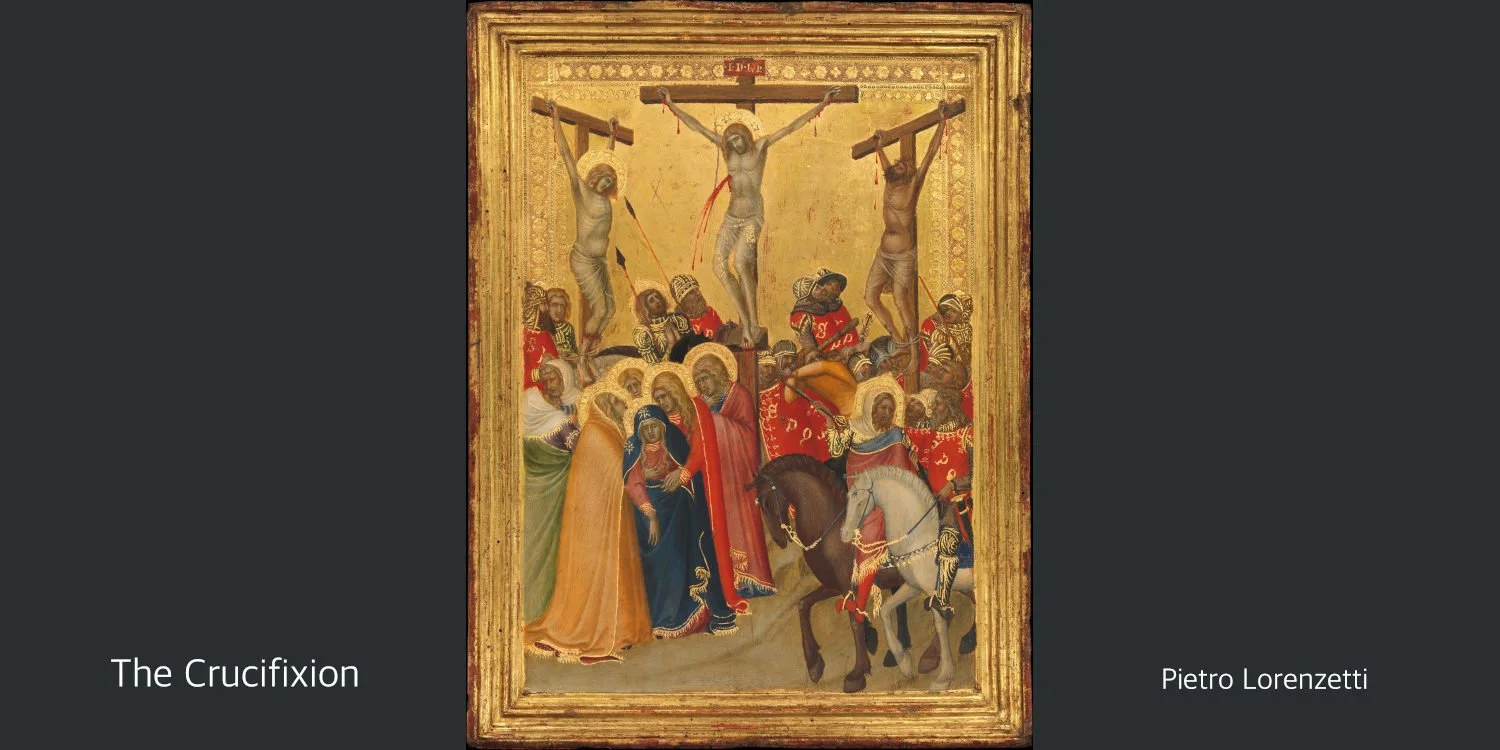
Dismas, the Good Thief Crucified Next to Christ the King
With Jesus before him, Pilate asked the chief priests, ‘Shall I crucify your king?’ They replied ‘We have no king but Caesar.' Only a criminal saw Christ the King.
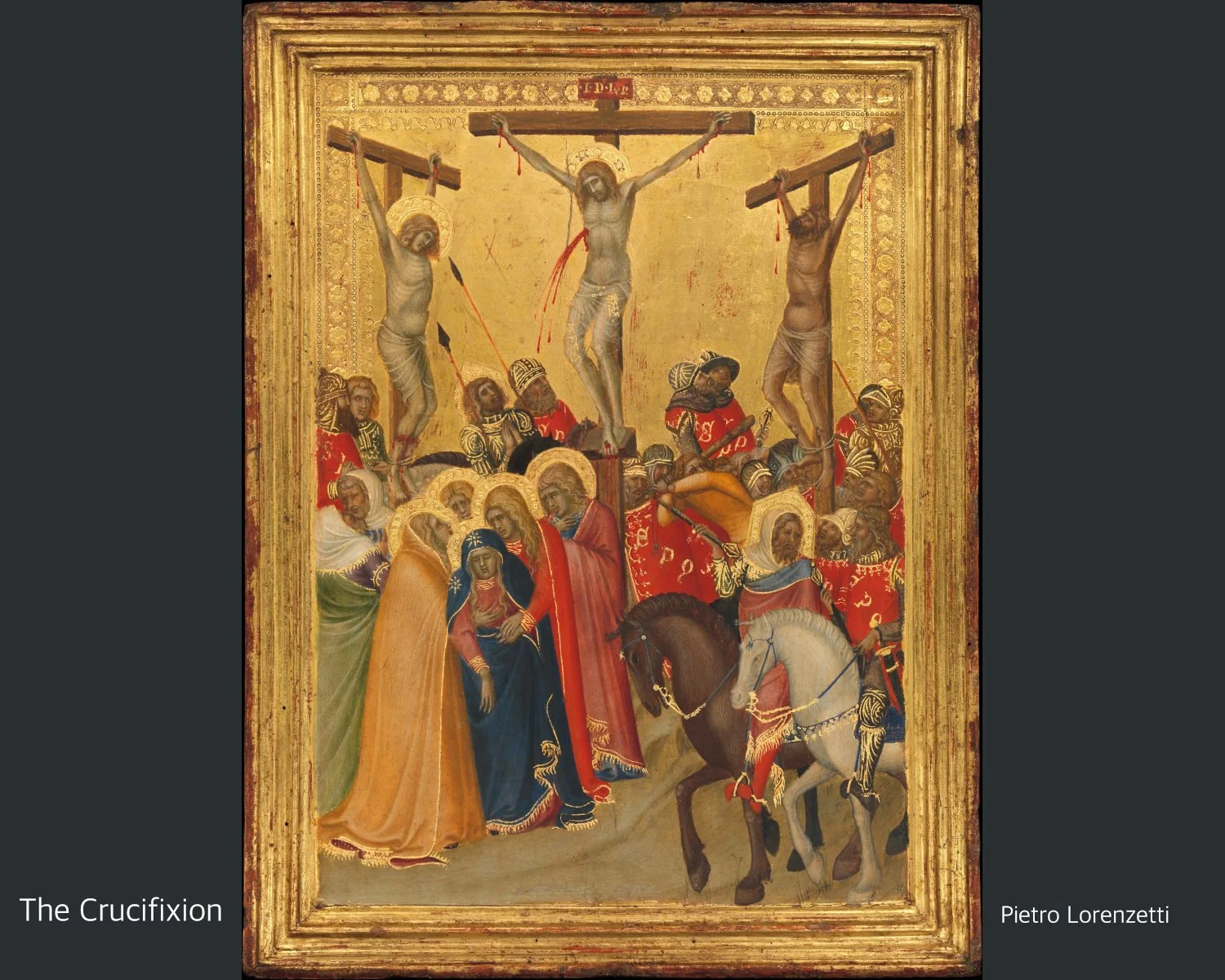
With Jesus before him, Pilate asked the chief priests, ‘Shall I crucify your king?’ They replied ‘We have no king but Caesar.’ Only a criminal saw Christ the King.
November 19, 2025 by Father Gordon MacRae
“Yes, dogs are round about me; a pack of evildoers encircle me; they have pierced my hands and my feet — I can count all my bones — they stare and gloat over me; they divide my garments among them, and for my clothing they cast lots.”
— Psalm 22:16-18
Note from Father Gordon MacRae: This may be a very familiar post to some of our Readers. It was originally written as a Holy Week post some years ago, and for some reason it has remained one of our most popular posts. The Church’s liturgy is on a three-year cycle and so every three years one of three Gospel Readings will appear for the Solemnity of Christ the King. The Gospel passage for this year is the story of Dismas crucified to the right of Christ at Calvary. When I read to a priest-friend the above title and description of this post today, he was stunned. He had never before consciously considered that the denouncement of Christ as King by the religious authorities of Israel, and the identification from the Cross of Christ as King were events separated by only a few hours.
The late Pope Benedict XVI wrote a wonderful reflection about the exchange with Dismas on the Cross next to Jesus. Here is what Pope Benedict wrote in a short meditation entitled “How to Enter Christ’s Kingdom”:
“Then there is the faith of the Good Thief: a faith barely outlined but sufficient to assure him salvation: Today you will be with me in Paradise.” This ‘with me’ is crucial. Yes, it is this that saves him. Of course, Dismas is on the Cross like Jesus, but above all he is on the Cross with Jesus. And unlike the other evildoer and all those who taunted Jesus, Dismas does not ask Jesus to save him or to come down from his Cross. He asked only, from his own cross, ‘Remember me when you come into your kingdom.’”
This is the story of Dismas, crucified to the right, Paradise Lost and Found. It is the story of all of us who come to Him bearing our gifts as we might at Christmas, but also bearing our crosses as we must at Calvary.
+ + +
The only hero at Calvary was Christ. The only person worth following up that hill — up ANY hill — is Christ. I follow Him with the same burdens and trepidation and thorns in my side as you do. So do not follow me. Follow only Him.
This Holy Week, one of many behind these stone walls, has caused me to use a wider angle lens as I examine the events of that day on Mount Calvary as the Evangelists described them. This year, it is Dismas who stands out. Dismas is the name tradition gives to the man crucified to the right of the Lord, and upon whom is bestowed a dubious title: the “Good Thief.”
As I pondered the plight of Dismas at Calvary, my mind rolled some old footage, an instant replay of the day I was sent to prison — the day I felt the least priestly of all the days of my priesthood.
It was the mocking that was the worst. Upon my arrival at prison after trial late in 1994, I was fingerprinted, photographed, stripped naked, showered, and unceremoniously deloused. I did not bother worrying about what the food might be like, or whether I could ever sleep in such a place. I was worried only about being mocked, but there was no escaping it. As I was led from place to place in chains and restraints, my few belongings and bedding stuffed into a plastic trash bag dragged along behind me, I was greeted by a foot-stomping chant of prisoners prepped for my arrival: “Kill the priest! Kill the priest! Kill the priest!” It went on into the night. It was maddening.
It is odd that I also remember being conscious, on that first day, of the plight of the two prisoners who had the misfortune of being sentenced on the same day I was. They are long gone now, sentenced back then to just a few years in prison. But I remember the walk from the courthouse in Keene, New Hampshire to a prison-bound van, being led in chains and restraints on the “perp-walk” past rolling news cameras. A microphone was shoved in my face: “Did you do it, Father? Are you guilty?”
Quickly led toward the van back then, I tripped on the first step and started to fall, but the strong hands of two guards on my chains dragged me to my feet again. I climbed into the van, into an empty middle seat, and felt a pang of sorrow for the other two convicted criminals — one in the seat in front of me, and the other behind.
“Just my %¢$#@*& luck!” the one in front scowled as the cameras snapped a few shots through the van windows. I heard a groan from the one behind as he realized he might vicariously make the evening news. “No talking!” barked a guard as the van rolled off for the 90 minute ride to prison. I never saw those two men again, but as we were led through the prison door, the one behind me muttered something barely audible: “Be strong, Father.”
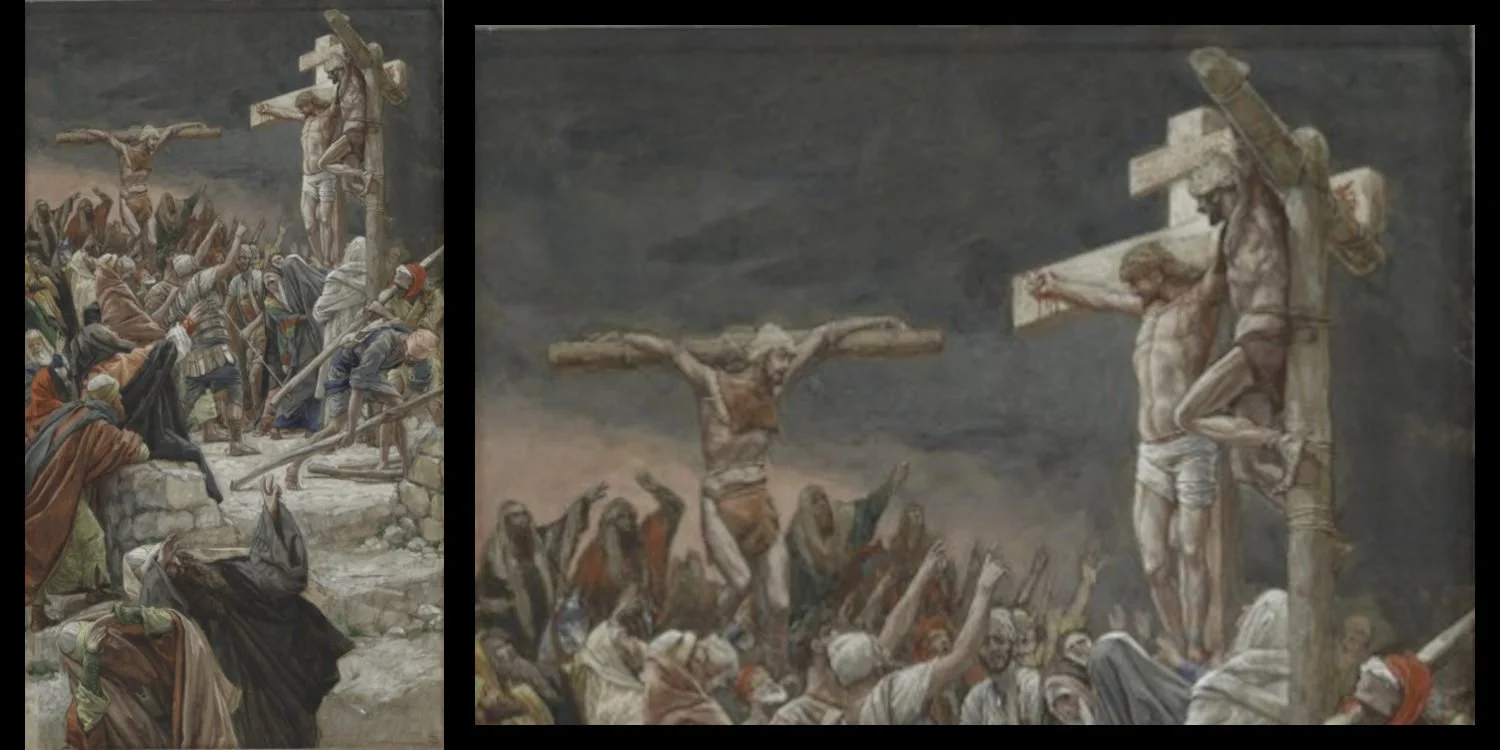
Revolutionary Outlaws
It was the last gesture of consolation I would hear for a long, long time. It was the last time I heard my priesthood referred to with anything but contempt for years to come. Still, to this very day, it is not Christ with whom I identify at Calvary, but Simon of Cyrene. As I wrote in “Simon of Cyrene Compelled to Carry the Cross“:
“That man, Simon, is me . . . I have tried to be an Alter Christus, as priesthood requires, but on our shared road to Calvary, I relate far more to Simon of Cyrene. I pick up my own crosses reluctantly, with resentment at first, and I have to walk behind Christ for a long, long time before anything in me compels me to carry willingly what fate has saddled me with . . . I long ago had to settle for emulating Simon of Cyrene, compelled to bear the Cross in Christ’s shadow.”
So though we never hear from Simon of Cyrene again once his deed is done, I am going to imagine that he remained there at Calvary. He must have, really. How could he have willingly left? I am going to imagine that he remained there and heard the exchange between Christ and the criminals crucified to His left and His right, and took comfort in what he heard. I heard Dismas in the young man who whispered “Be strong, Father.” But I heard him with the ears of Simon of Cyrene.
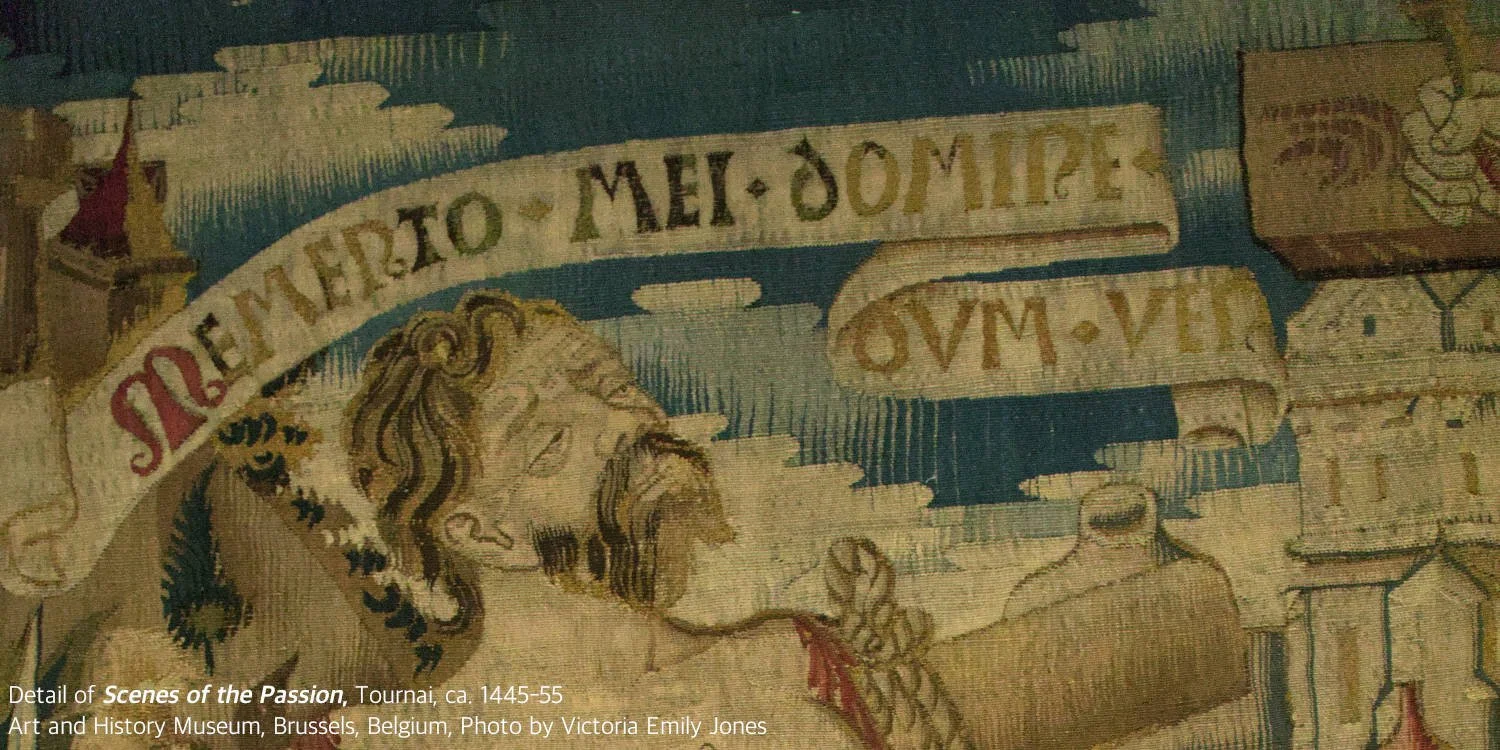
Like a Thief in the Night
Like the names of the Magi I wrote about in “Upon a Midnight Not So Clear,” the name tradition gives to the Penitent Thief appears nowhere in Sacred Scripture. Dismas is named in a Fourth Century apocryphal manuscript called the “Acts of Pilate.” The text is similar to, and likely borrowed from, Saint Luke’s Gospel:
“And one of the robbers who were hanged, by name Gestas, said to him: ‘If you are the Christ, free yourself and us.’ And Dismas rebuked him, saying: ‘Do you not even fear God, who is in this condemnation? For we justly and deservedly received these things we endure, but he has done no evil.’”
What the Evangelists tell us of those crucified with Christ is limited. In Saint Matthew’s Gospel (27:38) the two men are simply “thieves.” In Saint Mark’s Gospel (15:27), they are also thieves, and all four Gospels describe their being crucified “one on the left and one on the right” of Jesus. Saint Mark also links them to Barabbas, guilty of murder and insurrection. The Gospel of Saint John does the same, but also identifies Barabbas as a robber. The Greek word used to identify the two thieves crucified with Jesus is a broader term than just “thief.” Its meaning would be more akin to “plunderer,” part of a roving band caught and given a death penalty under Roman law.
Only Saint Luke’s Gospel infers that the two thieves might have been a part of the Way of the Cross in which Saint Luke includes others: Simon of Cyrene carrying Jesus’ cross, and some women with whom Jesus spoke along the way. We are left to wonder what the two criminals witnessed, what interaction Simon of Cyrene might have had with them, and what they deduced from Simon being drafted to help carry the Cross of a scourged and vilified Christ.
In all of the Gospel presentations of events at Golgotha, Jesus was mocked. It is likely that he was at first mocked by both men to be crucified with him as the Gospel of St. Mark describes. But Saint Luke carefully portrays the change of heart within Dismas in his own final hour. The sense is that Dismas had no quibble with the Roman justice that had befallen him. It seems no more than what he always expected if caught:
“One of the criminals who were hanged railed at him, saying, ‘Are you not the Christ? Save yourself and us!’ But the other rebuked him, saying, ‘Do you not fear God since you are under the same sentence of condemnation? And we indeed justly, for we are receiving the due reward of our deeds; but this man has done nothing wrong.’”
— Luke 23:39-41
The Flight into Egypt
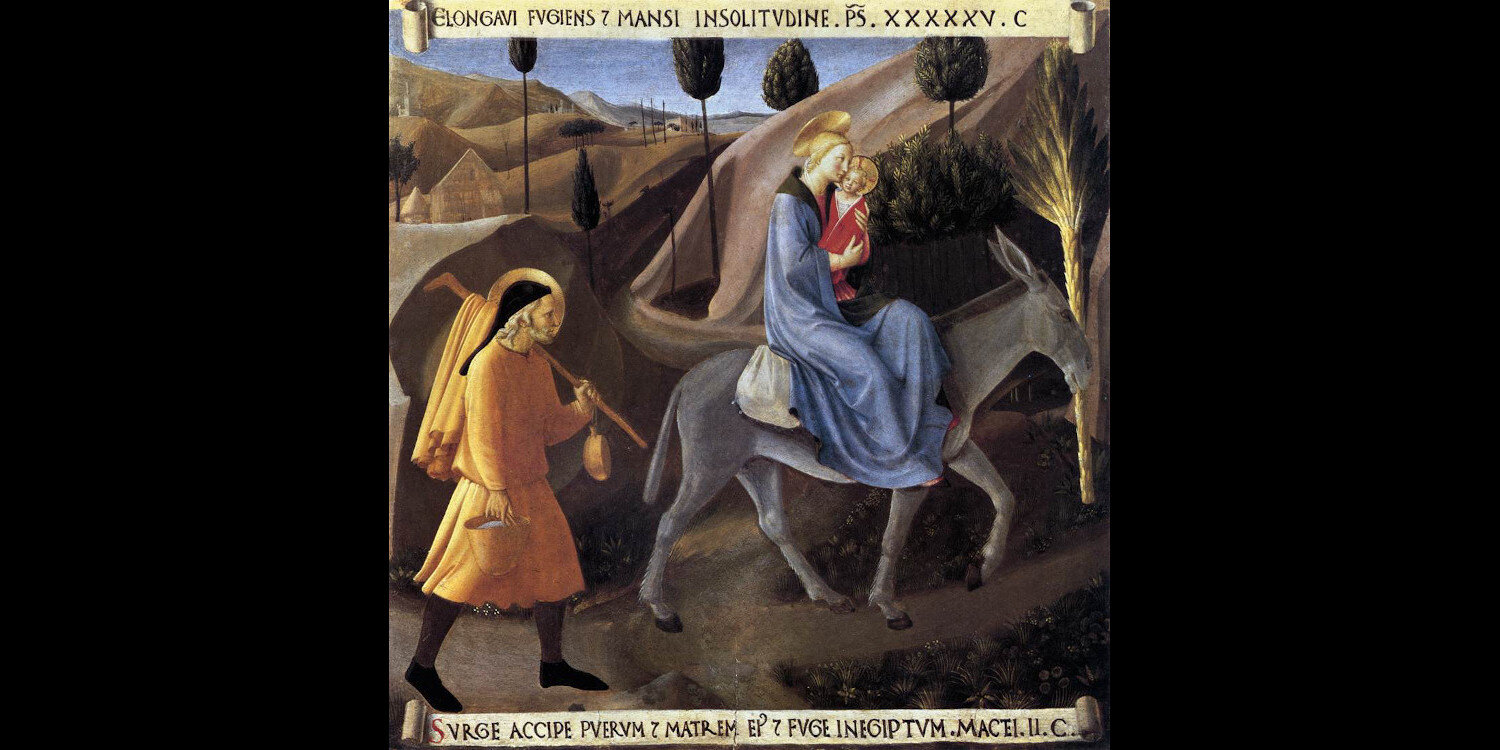
The name, “Dismas” comes from the Greek for either “sunset” or “death.” In an unsubstantiated legend that circulated in the Middle Ages, in a document known as the “Arabic Gospel of the Infancy,” this encounter from atop Calvary was not the first Gestas and Dismas had with Jesus. In the legend, they were a part of a band of robbers who held up the Holy Family during the Flight into Egypt after the Magi departed in Saint Matthews Gospel (Matthew 2:13-15).
This legendary encounter in the Egyptian desert is also mentioned by Saint Augustine and Saint John Chrysostom who, having heard the same legend, described Dismas as a desert nomad, guilty of many crimes including the crime of fratricide, the murder of his own brother. This particular part of the legend, as you will see below, may have great symbolic meaning for salvation history.
In the legend, Saint Joseph, warned away from Herod by an angel (Matthew 2:13-15), opted for the danger posed by brigands over the danger posed by Herod’s pursuit. Fleeing with Mary and the child into the desert toward Egypt, they were confronted by a band of robbers led by Gestas and a young Dismas. The Holy Family looked like an unlikely target having fled in a hurry, and with very few possessions. When the robbers searched them, however, they were astonished to find expensive gifts of gold, frankincense, and myrrh — the Gifts of the Magi. However, in the legend Dismas was deeply affected by the infant, and stopped the robbery by offering a bribe to Gestas. Upon departing, the young Dismas was reported to have said:
“0 most blessed of children, if ever a time should come when I should crave thy mercy, remember me and forget not what has passed this day.”

Paradise Found
The most fascinating part of the exchange between Jesus and Dismas from their respective crosses in Saint Luke’s Gospel is an echo of that legendary exchange in the desert 33 years earlier — or perhaps the other way around:
“‘Jesus, remember me when you come into your kingly power.’ And he said to him, ‘Truly I say to you, today you will be with me in Paradise.’”
— Luke 23:42-43
The word, “Paradise” used by Saint Luke is the Persian word, “Paradeisos” rarely used in Greek. It appears only three times in the New Testament. The first is that statement of Jesus to Dismas from the Cross in Luke 23:43. The second is in Saint Paul’s description of the place he was taken to momentarily in his conversion experience in Second Corinthians 12:3. The third is the Heavenly Paradise that awaits the souls of the just in the Book of Revelation (2:7).
In the Old Testament, the word “Paradeisos” appears only in descriptions of the Garden of Eden in Genesis 2:8, and in the banishment of Cain after the murder of his brother, Abel:
Cain left the presence of the Lord and wandered in the Land of Nod, East of Eden.
— Genesis 4:16
Elsewhere, the word appears only in the prophets (Isaiah 51:3 and Ezekiel 36:35) as they foretold a messianic return one day to the blissful conditions of Eden — to the condition restored when God issues a pardon to man — and he will not be using an autopen.
If the Genesis story of Cain being banished to wander “In the Land of Nod, East of Eden” is the symbolic beginning of our human alienation from God — the banishment from Eden marking an end to the State of Grace and Paradise Lost — then the Dismas profession of faith in Christ’s mercy is symbolic of Eden restored — Paradise Regained.
From the Cross, Jesus promised Dismas both a return to spiritual Eden and a restoration of the condition of spiritual adoption that existed before the Fall of Man. It is easy to see why legends spread by the Church Fathers involved Dismas guilty of the crime of fratricide just as was Cain.
A portion of the cross upon which Dismas is said to have died alongside Christ is preserved at the Church of Santa Croce in Rome. It is one of the Church’s most treasured relics. Catholic apologist, Jim Blackburn has proposed an intriguing twist on the exchange on the Cross between Christ and Saint Dismas. In “Dismissing the Dismas Case,” an article in Catholic Answers Magazine Jim Blackburn reminded me that the Greek in which Saint Luke’s Gospel was written contains no punctuation. Punctuation had to be added in translation. Traditionally, we understand Christ’s statement to Dismas to be:
“Truly I say to you, today you will be with me in Paradise.”
The sentence has been used by some non-Catholics (and a few Catholics) to discount a Scriptural basis for Purgatory. How could Purgatory be as necessary as I described it to be in “The Holy Longing” when even a notorious criminal is given immediate admission to Paradise? Ever the insightful thinker, Jim Blackburn proposed a simple replacement of the comma giving the verse an entirely different meaning:
“Truly I say to you today, you will be with me in Paradise.”
Whatever the timeline, the essential point could not be clearer. The door to Divine Mercy was opened by the events of that day, and the man crucified to the right of the Lord, by a simple act of faith and repentance and reliance on Divine Mercy, was shown a glimpse of Paradise Regained.
The gift of Paradise Regained left the cross of Dismas on Mount Calvary. It leaves all of our crosses there. Just as Cain set in motion our wandering “In the Land of Nod, East of Eden,” Dismas was given a new view from his cross, a view beyond death, away from the East of Eden, across the Undiscovered Country, toward eternal home.
Saint Dismas, pray for us.
+ + +
Note from Father Gordon MacRae: Thank you for reading and sharing this post in honor of Christ the King. You may also wish to read these related posts from Beyond These Stone Walls:
The Chief Priests Answered, ‘We Have No King but Caesar’
To Christ the King through the Immaculate Heart of Mary
Thanksgiving in the Reign of Christ the King
Behold the Lamb of God Upon the Altar of Mount Moriah

Divine Mercy for Doubting Thomas and Other Spiritually Wounded
The Gospel on Divine Mercy Sunday is St John’s account of the spiritually wounded Thomas who would not know peace until surrendering his wounds to the Risen Christ.

The Gospel on Divine Mercy Sunday is St John’s account of the spiritually wounded Thomas who would not know peace until surrendering his wounds to the Risen Christ.
April 23, 2025 by Fr Gordon MacRae
There is a scene in the great World War II prisoner of war film, Stalag 17, in which an American Air Force officer (played by actor William Holden) negotiates with the German Commandant over the treatment of a fellow prisoner. I was dragged into a similar role here several years ago when I protested an injustice aimed at a friend.
For a long time I had managed to avoid efforts to recruit me for an Inmate Communications Committee (ICC), a group of eight chosen from 1,500 prisoners here. The ICC advocated for better prison conditions and due process. After protesting over another prisoner, I no longer had a valid excuse, so I reluctantly accepted.
From the start, I was saddled with doing all the writing, which included detailed minutes of every meeting for distribution to prison officials, a monthly summary of progress, and a quarterly newsletter.
The job — which payed nothing — was in addition to my Law Library job which payed next to nothing. It also meant writing endless memos, proposals, clarifications, and requests that I fielded each week. We succeeded in only about ten percent of the concessions we set out to obtain, and that is more or less on par with William Holden’s success rate in Stalag 17.
About the only high point is that I was also required to be present at a Jobs and Education Fair in the prison gymnasium twice a year. It was an effort to get the other 1,500 prisoners here into jobs, educational classes and programs, and typically about 500 showed up. Among the dozens of display tables set up, the Law Library and ICC were side by side, so I manned both.
The Veterans Affairs table was set up next to the ICC table. It was a nice display with information on veteran groups here, an annual POW/MIA Remembrance, and other programs. The table was staffed by my friend, John, whom I did not get to see as often as I would like. John was a Navy veteran in his mid to later thirties. He lost his leg during active duty in the Middle East before coming to prison. John told me that when he arrived here, his prosthetic leg was taken from him because of an infection at the amputation site with the result of consigning him to a wheelchair. John was very anxious to get the prosthetic leg back and get back on his feet again, but because of the fear of infection, the prison medical officials were withholding it. It was John, by the way, who told me of the release of my friend Martin, the U.S. Marine veteran I wrote about in “A U.S. Marine Who Showed Me What to Give Up for Lent.”
I told John that I would do some research to see if there was a precedent here that John might use to restore his prosthetic leg. Then, without thinking, I thanked him for “stepping up” to take charge of the Veteran’s table. I quickly apologized for my faux pas, but John had a good laugh.
Then he told me that he spent half his day thanking people for all sorts of small things: an assist out of the chair, a push up a steep ramp, picking up a dropped item. He said that my thanks was the first time in a long time anyone had thanked him for his service to others. That small, awkward gesture had a profound effect on John. As I left, he was beaming. I made a decision that I would find a way to help restore what he lost and get him out of that dreaded wheelchair.
I can sometimes become so aware of the spiritual warfare that engulfs me here that it diminishes my awareness of the wounds of others. We are all, in one way or another, wounded by life physically, emotionally, spiritually, and it dulls our senses.
It drives us onto self-centered islands of emotional distance and spiritual isolation. The wounds we carry foster pessimism and doubt, erode faith, and turn the joy of living into a crucible of mere existence. Peace evades wounded warriors, even in spiritual warfare.

Doubting Thomas
This is the great plague of our age. I receive lots of mail from readers asking me to pray for a husband or wife, a son or daughter, who has lost their faith in response to the wounds of life and the sheer weight of living. In a war with one’s self, faith is often the first to go and the last to come back. If this describes you or someone in your life, then pay special attention to the Apostle Thomas in the Gospel from Saint John on Divine Mercy Sunday.
There are some remarkable elements in Saint John’s account of the death of Jesus and all that came after the Cross. The first witness to the “Seventh Sign,” the Resurrection of Jesus, was a woman whose own demons Jesus had once cast out. I wrote of her and the evidence for her first-hand witness in “Mary Magdalene: Faith, Courage, and an Empty Tomb.” I would like to reproduce a scene from that post that never took place, but it is one that I have long imagined.
“Mary came to the disciples, Peter and the others, hidden by fear behind locked doors, and said, ‘I have good news and not-so-good news.’ Peter asked, ‘What’s the good news?’ Mary replied, ‘The Lord has risen and I have seen him.’ Peter then asked, ‘What’s the not-so-good news?’ Mary said, ‘He’s on his way here, and He wants a word with you about last Friday.”
The focus is so intensely on Jesus in the Resurrection accounts that it is easy to forget the wounds of everyone else in this story. They are all living with the deeply felt trauma of loss, and not only loss, but with an overwhelming sense of utter discouragement. They are devastated and stripped of hope.
John, the Beloved Disciple, stood with the mother of Jesus at the foot of the Cross and watched Him die a most gruesome death at the hands of the Roman Empire, but at the behest of his own people, the Chief Priests who answered Pilate, “We have no king but Caesar.”
Mary Magdalene stood there as well, and watched. The others fled. Peter, their leader, denied three times that he even knew Jesus. All that had been promised and hoped for had been misunderstood, and now gone forever. The Chief Priests — emboldened when Pilate caved to their “We Have No King but Caesar” — sought only to round up the rest.
It was in this state of fear that Mary Magdalene showed up in the Upper Room where the Apostles were in hiding for fear of the mobs. She had news that defied belief. And when Jesus first appeared to them behind that locked door, His demeanor was the opposite of what I imagined above to be a human response to their abandonment of Him. “Peace be with you,” He said. It is not a reference to a state of peace between disputing parties or someone subject to Earthly powers. The word the Gospel used in Greek – Eiréné – has more to do with spiritual welfare than spiritual warfare.
It refers to a state of mind, heart and soul, the equivalent of the Hebrew “Shalom”, and its usage means harmony with God within one’s self. It is the same sense that the Prophet Isaiah used in his Messianic expectation of the Prince of Peace:
“For us a child is born, to us a son is given; and the government will be upon his shoulder and his name will be called ‘Wonder Counselor, Mighty God, Everlasting Father, Prince of Peace.’”
— Isaiah 9:6
It is what Saint Paul refers to in his letter to the Colossians, “Let the peace of Christ reign in your hearts” (Col. 3:15). Once you have it, it is far more contagious than any pandemic. This peace is the foundation and gift of Divine Mercy.
But Thomas missed the whole thing. When he arrived and found them stunned and exuberant, he retreated into his own deep wounds. Thomas did not stay to see Jesus crucified. Like the others, he could not bear it. He and they fled when Jesus appeared before Pilate mocked, beaten, broken, as the accusing mob grew beyond control to threaten even Pilate himself, “Crucify him! Crucify him!” But Thomas saw enough to know that it was over, that all was lost, and all hope had gone out of the world. So when faced with the great risk of trusting and hoping again, he said,
“Unless I see the mark of the nails in his hands, and put my finger into the nail marks, and place my hand in his side, I will not believe.”
— John 20:25

Trusting Divine Mercy
For this, the Apostle is forever called, “Doubting Thomas,” but I see something more painful than his doubt. I see him also as hurting, defeated, robbed of hope. He had to touch the wounds of the Risen Christ because the wounds of the Crucified Christ had already touched him, had broken his heart, and devastated his faith, and destroyed all hope. As so many of you know only all too well, coming to trust again after such hurt is a very risky business.
I find it fascinating that the story of Thomas and his struggle with trust and hope after the events of Holy Week is the Gospel for Divine Mercy Sunday. When Jesus presented Himself to Thomas, and invited him to probe the wounds in his living hands and side, Thomas did not oblige. Instead, he surrendered his own wounds, and responded in a leap of faith, “My Lord and my God.” Pope Benedict XVI wrote of this in his magisterial book, Jesus of Nazareth: Holy Week:
“In His two appearances to the Apostles gathered in the Upper Room, Jesus repeats several times the greeting, ‘Peace be with you’… It becomes the gift of peace that Jesus alone can give because it is the fruit of his radical victory over evil… For this reason Saint John Paul II chose to call this Sunday after Easter ‘Divine Mercy,’ with a very specific image: that of Jesus’ pierced side from which blood and water flowed.”
This image, revealed to Saint Maria Faustina Kowalska as the image of Divine Mercy, is that of the same wounds transfigured:
“I saw the Lord Jesus dying on the Cross amidst great suffering, and out of the Heart of Jesus came the two rays as are in the image.”
— Diary of Saint Faustina, 414
“The two rays denote blood and water. The pale ray stands for the Water which makes souls righteous. The red ray stands for the Blood which is the life of souls… Happy is the one who will dwell in their shelter…”
— Diary of Saint Faustina, 299
I recently wrote a post entitled “Thailand’s Once-Lost Son Was Flag Bearer for the Asian Apostolic Congress.” Most of our readers know the story of what led to Pornchai Maximilian Moontri’s Divine Mercy conversion. Starting at the age of two in rural Thailand, he knew only abandonment by the very people who should have taught him trust. Forced to forage in the streets for food, he was hospitalized for malnutrition. Then at age eleven he was taken from Thailand and forced into a life marked by violence, exploitation and abuse. At age 18, after several years of adolescent homelessness, he killed a man after being pinned to the ground in a struggle. Pornchai was sent to prison for life. While there, his mother, his only contact in the free world was murdered by the man who exploited him. After many years of solitary confinement, Pornchai was moved to another prison and spent the next 15 years as my roommate.
How does anyone emerge from such wounds? How does anyone ever trust again when all prior trust was broken? On Divine Mercy Sunday in 2010, Pornchai took on a new name, “Maximilian,” after Saint Maximilian Kolbe who walked this path with him and led him to Jesus through the Immaculate Heart of Mary.
In the course of this remarkable journey, Pornchai’s wounds never healed. They are with him for life, but they have been transformed. He is a powerful figure today in the realm of Divine Mercy because he has placed his wounds in the service of the Risen Lord. Back in October of 2024, Pornchai was invited to carry the flag of the Kingdom of Thailand in procession at the Fifth Asian Apostolic Congress on Divine Mercy held in the Philippines. In the scene atop this section, Pornchai Max proudly carries the flag of Thailand before a crowd of 5,000 pilgrims in honor of Divine Mercy.
If a picture speaks a thousand words, this one below speaks volumes. This is the Face of Divine Mercy.

+ + +


And to honor our late Holy Father: “Pope Francis Had a Challenge for the Prodigal Son’s Older Brother.”

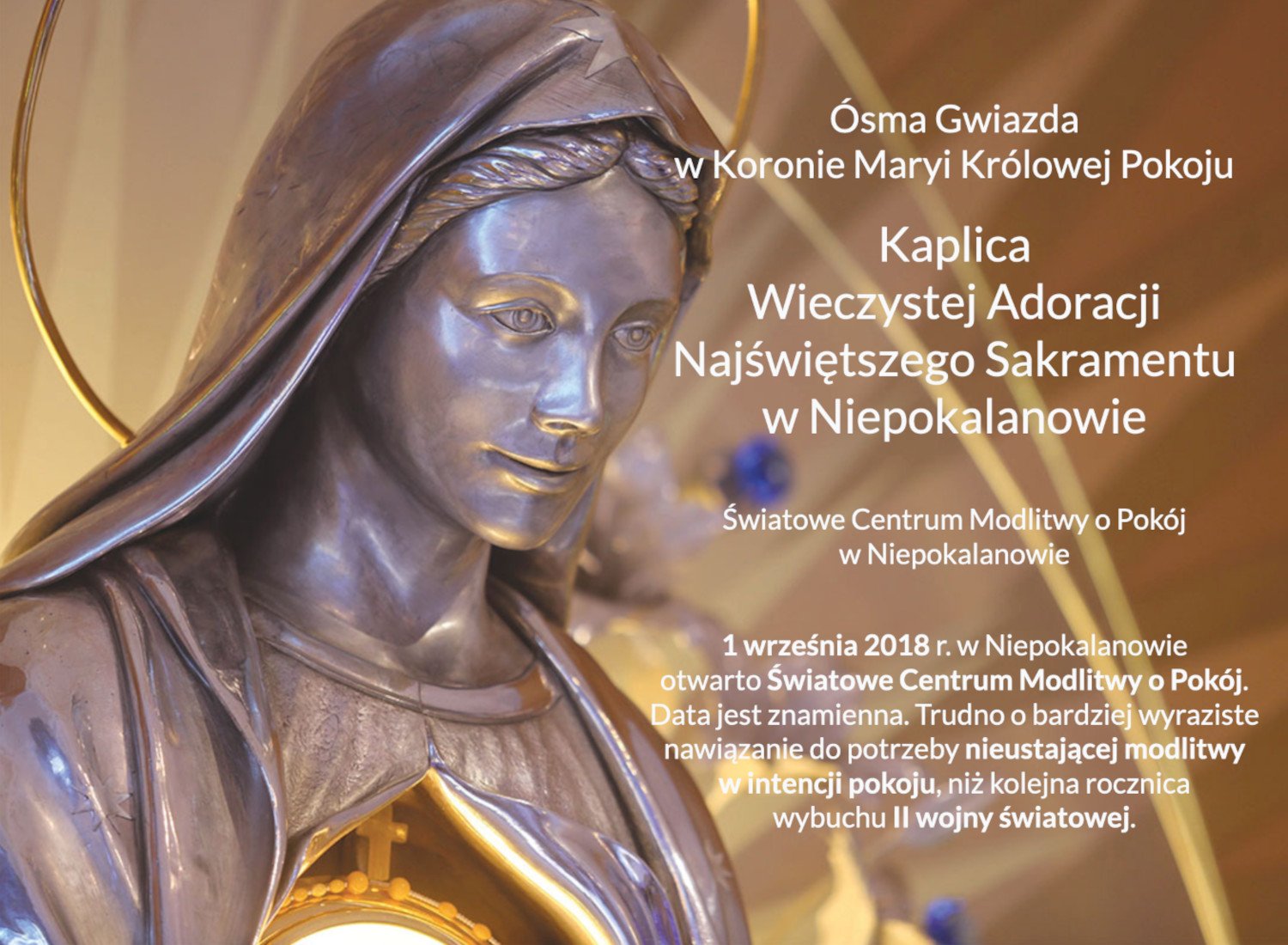

The Eucharistic Adoration Chapel established by Saint Maximilian Kolbe was inaugurated at the outbreak of World War II. It was restored as a Chapel of Adoration in September, 2018, the commemoration of the date that the war began. It is now part of the World Center of Prayer for Peace. The live internet feed of the Adoration Chapel at Niepokalanow — sponsored by EWTN — was established just a few weeks before we discovered it and began to include in at Beyond These Stone Walls. Click “Watch on YouTube” in the lower left corner to see how many people around the world are present there with you. The number appears below the symbol for EWTN.
Click or tap here to proceed to the Adoration Chapel.
The following is a translation from the Polish in the image above: “Eighth Star in the Crown of Mary Queen of Peace” “Chapel of Perpetual Adoration of the Blessed Sacrament at Niepokalanow. World Center of Prayer for Peace.” “On September 1, 2018, the World Center of Prayer for Peace in Niepokalanow was opened. It would be difficult to find a more expressive reference to the need for constant prayer for peace than the anniversary of the outbreak of World War II.”
For the Catholic theology behind this image, visit my post, “The Ark of the Covenant and the Mother of God.”

The Chief Priests Answered, ‘We Have No King but Caesar’
The Passion of the Christ has historical meaning on its face, but a far deeper story lies beneath where the threads of faith and history connect to awaken the soul.
The Passion of the Christ has historical meaning on its face, but a far deeper story lies beneath where the threads of faith and history connect to awaken the soul.
There are few things in life that a priest could hear with greater impact than what was revealed to me in a recent letter from a reader of These Stone Walls. After stumbling upon TSW several months ago, the writer began to read these pages with growing interest. Since then, she has joined many to begin the great adventure of the two most powerful spiritual movements of our time: Marian Consecration and Divine Mercy. In a recent letter she wrote, “I have been a lazy Catholic, just going through the motions, but your writing has awakened me to a greater understanding of the depths of our faith.”
I don’t think I actually have much to do with such awakenings. My writing doesn’t really awaken anyone. In fact, after typing last week’s post, I asked my friend, Pornchai Moontri to read it. He was snoring by the end of page two. I think it is more likely the subject matter that enlightens. The reader’s letter reminded me of the reading from Saint Paul’s Letter to the Ephesians read by Pornchai a few weeks ago, quoted in “De Profundis: Pornchai Moontri and the Raising of Lazarus”:
“Awake, O sleeper, and rise from the dead, and Christ will give you light.”
I may never understand exactly what These Stone Walls means to readers and how they respond. That post generated fewer comments than most, but within just hours of being posted, it was shared more than 1,000 times on Facebook and other social media.
Of 380 posts published thus far on These Stone Walls, only about ten have generated such a response in a single day. Five of them were written in just the last few months in a crucible described in “Hebrews 13:3 Writing Just This Side of the Gates of Hell.” I write in the dark. Only Christ brings light.
Saint Paul and I have only two things in common — we have both been shipwrecked, and we both wrote from prison. And it seems neither of us had any clue that what we wrote from prison would ever see the light of day, let alone the light of Christ. There is beneath every story another story that brings more light to what is on the surface. There is another story beneath my post, “De Profundis.” That title is Latin for “Out of the Depths,” the first words of Psalm 130. When I wrote it, I had no idea that Psalm 130 was the Responsorial Psalm for Mass before the Gospel account of the raising of Lazarus:
“Out of the depths I cry to you, O Lord!
Lord hear my voice!
Let your ears be attentive
to my voice in supplication…
”I wait for the Lord, my soul waits,
and I hope in his word;
my soul waits for the Lord
more than sentinels wait for the dawn,
more than sentinels wait for the dawn.”
Notice that the psalmist repeats that last line. Anyone who has ever spent a night lying awake in the oppression of fear or dark depression knows the high anxiety that accompanies a long lonely wait for the first glimmer of dawn. I keep praying that Psalm — I have prayed it for years — and yet Jesus has not seen fit to fix my problems the way I want them fixed. Like Saint Paul, in the dawn’s early light I still find myself falsely accused, shipwrecked, and unjustly in prison.
Jesus also prayed the Psalms. In a mix of Hebrew and Aramaic, he cries out from the Cross, “Eli, Eli làma sabach-thàni?” It is not an accusation about the abandonment of God. It is Psalm 22, a prayer against misery and mockery, against those who view the cross we bear as evidence of God’s abandonment. It is a prayer against the use of our own suffering to mock God. It’s a Psalm of David, of whom Jesus is a descendant by adoption through Joseph:
“Eli, Eli làma sabach-thàni?
My God, my God, why have you forsaken me?
Why are You so far from my plea,
from the words of my cry? …
… All who see me mock at me;
they curse me with parted lips,
they wag their heads …
Indeed many dogs surround me,
a pack of evildoers closes in upon me;
they have pierced my hands and my feet.
I can count all my bones …
They divide my garments among them;
for my clothes they cast lots.”
So maybe, like so many in this world who suffer unjustly, we have to wait in hope simply for Christ to be our light. And what comes with the light? Suffering does not always change, but its meaning does. Take it from someone who has suffered unjustly. What suffering longs for most is meaning. People of faith have to trust that there is meaning to suffering even when we cannot detect it, even as we sit and wait to hear, “Upon the Dung Heap of Job: God’s Answer to Suffering.”

The Passion of the Christ
Last year during Holy Week, two Catholic prisoners had been arguing about why the date of Easter changes from year to year. They both came up with bizarre theories, so one of them came to ask me. I explained that in the Roman Church, Easter falls on the first Sunday after the first full moon after the vernal equinox (equinox is from the Latin, “equi noctis,” for “equal night”). The prisoner was astonished by my ignorance and said, “What BS! Easter is forty days after Ash Wednesday!”
Getting to the story beneath the one on the surface is important to understand something as profound as the events of the Passion of the Christ. You may remember from my post, “De Profundis,” that Jesus said something perplexing when he learned of the illness of Lazarus:
“This illness is not unto death; it is for the glory of God, so that the Son of God may be glorified by means of it”
The irony of this is clearer when you see that it was the raising of Lazarus that condemned Jesus to death. The High Priests were deeply offended, and the insult was an irony of Biblical proportions (no pun intended). Immediately following upon the raising of Lazarus, “the chief priests and the Pharisees gathered the council” (the Sanhedrin). They were in a panic over the signs performed by Jesus. “If he goes on like this,” they complained, “the Romans will come and destroy both our holy place (the Jerusalem Temple) and our nation” (John 11 47-48).
The two major religious schools of thought in Judaism in the time of Jesus were the Pharisees and the Sadducees. Both arose in Judaism in the Second Century B.C. and faded from history in the First Century A.D. At the time of Jesus, there were about 6,000 Pharisees. The name, “Pharisees” — Hebrew for “Separated Ones” — came as a result of their strict observance of ritual piety, and their determination to keep Judaism from being contaminated by foreign religious practices. Their hostile reaction to the raising of Lazarus had nothing to do with the raising of Lazarus, but rather with the fact that it occurred on the Sabbath which was considered a crime.
Jesus actually had some common ground with the Pharisees. They believed in angels and demons. They believed in the human soul and upheld the doctrine of resurrection from the dead and future life. Theologically, they were hostile to the Sadducees, an aristocratic priestly class that denied resurrection, the soul, angels, and any authority beyond the Torah.
Both groups appear to have their origin in a leadership vacuum that occurred in Jerusalem between the time of the Maccabees and their revolt against the Greek king Antiochus Epiphanies who desecrated the Temple in 167 B.C. It’s a story that began Lent on These Stone Walls in “Semper Fi! Forty Days of Lent Giving Up Giving Up.”
The Pharisees and Sadducees had no common ground at all except a fear that the Roman Empire would swallow up their faith and their nation. And so they came together in the Sanhedrin, the religious high court that formed in the same time period the Pharisees and Sadducees themselves had formed, in the vacuum left by the revolt that expelled Greek invaders and their desecration of the Temple in 165 B.C.
The Sanhedrin was originally composed of Sadducees, the priestly class, but as common enemies grew, the body came to include Scribes (lawyers) and Pharisees. The Pharisees and Sadducees also found common ground in their disdain for the signs and wonders of Jesus and the growth in numbers of those who came to believe in him and see him as Messiah.
The high profile raising of Lazarus became a crisis for both, but not for the same reasons. The Pharisees feared drawing the attention of Rome, but the Sadducees felt personally threatened. They denied any resurrection from the dead, and could not maintain religious influence if Jesus was going around doing just that. So Caiaphas, the High Priest, took charge at the post-Lazarus meeting of the Sanhedrin, and he challenged the Pharisees whose sole concern was for any imperial interference from the Roman Empire. Caiaphas said,
“You know nothing at all. You do not understand that it is expedient for you that one man should die for the people, so that the whole nation should not perish”
The Gospel of John went on to explain that Caiaphas, being High Priest, “did not say this of his own accord, but to prophesy” that Jesus was to die for the nation, “and not for the nation only, but, to gather into one the children of God” (John 11: 41-52). From that moment on, with Caiaphas being the first to raise it, the Sanhedrin sought a means to put Jesus to death.
Caiaphas presided over the Sanhedrin at the time of the arrest of Jesus. In the Sanhedrin’s legal system, as in our’s today, the benefit of doubt was supposed to rest with the accused, but … well … you know how that goes. The decision was made to find a reason to put Jesus to death before any legal means were devised to actually bring that about.
Behold the Man!
The case found its way before Pontius Pilate, the Roman Prefect of Judea from 25 to 36 A.D. Pilate had a reputation for both cruelty and indecision in legal cases before him. He had previously antagonized Jewish leaders by setting up Roman standards bearing the image of Caesar in Jerusalem, a clear violation of the Mosaic law barring graven images.
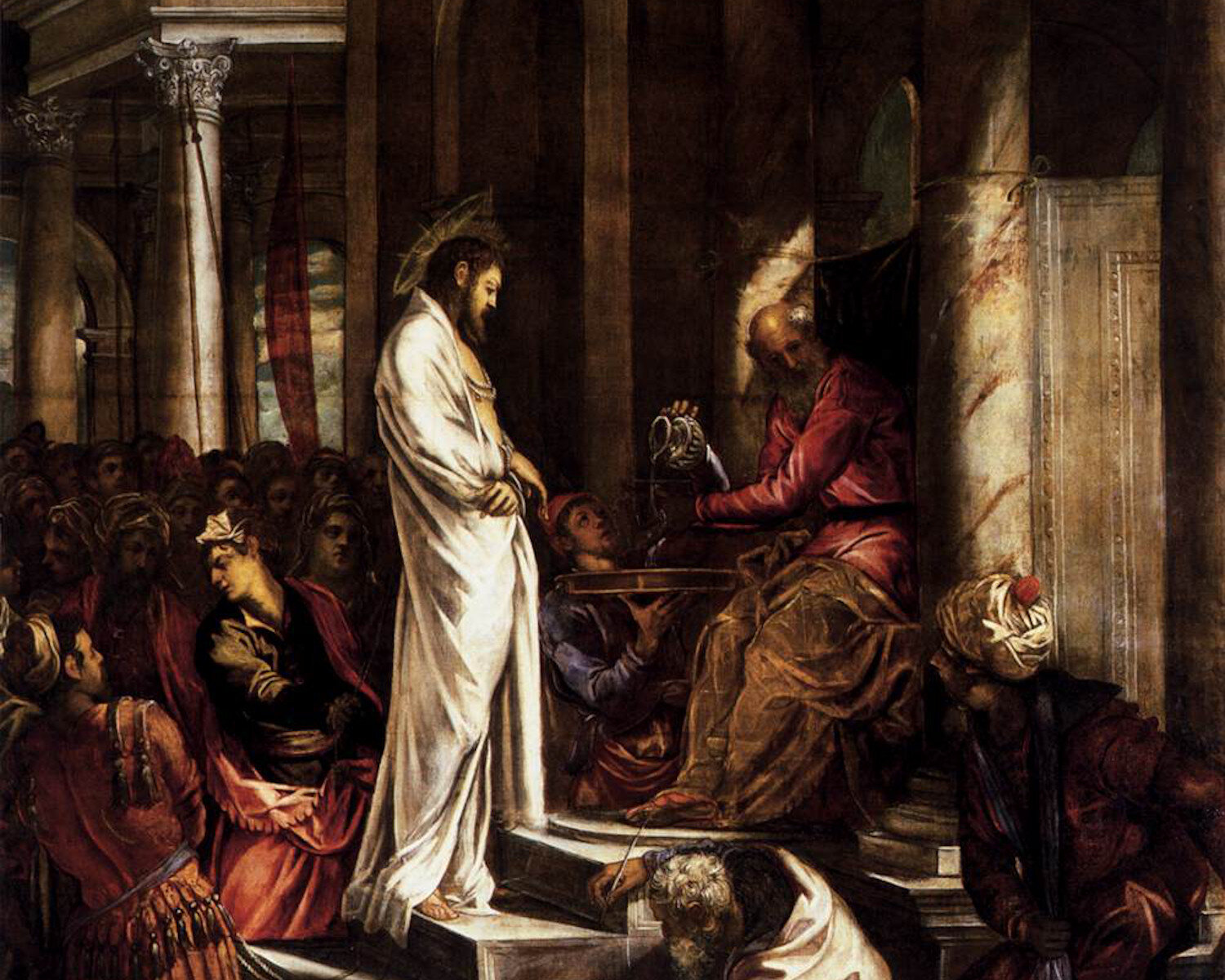
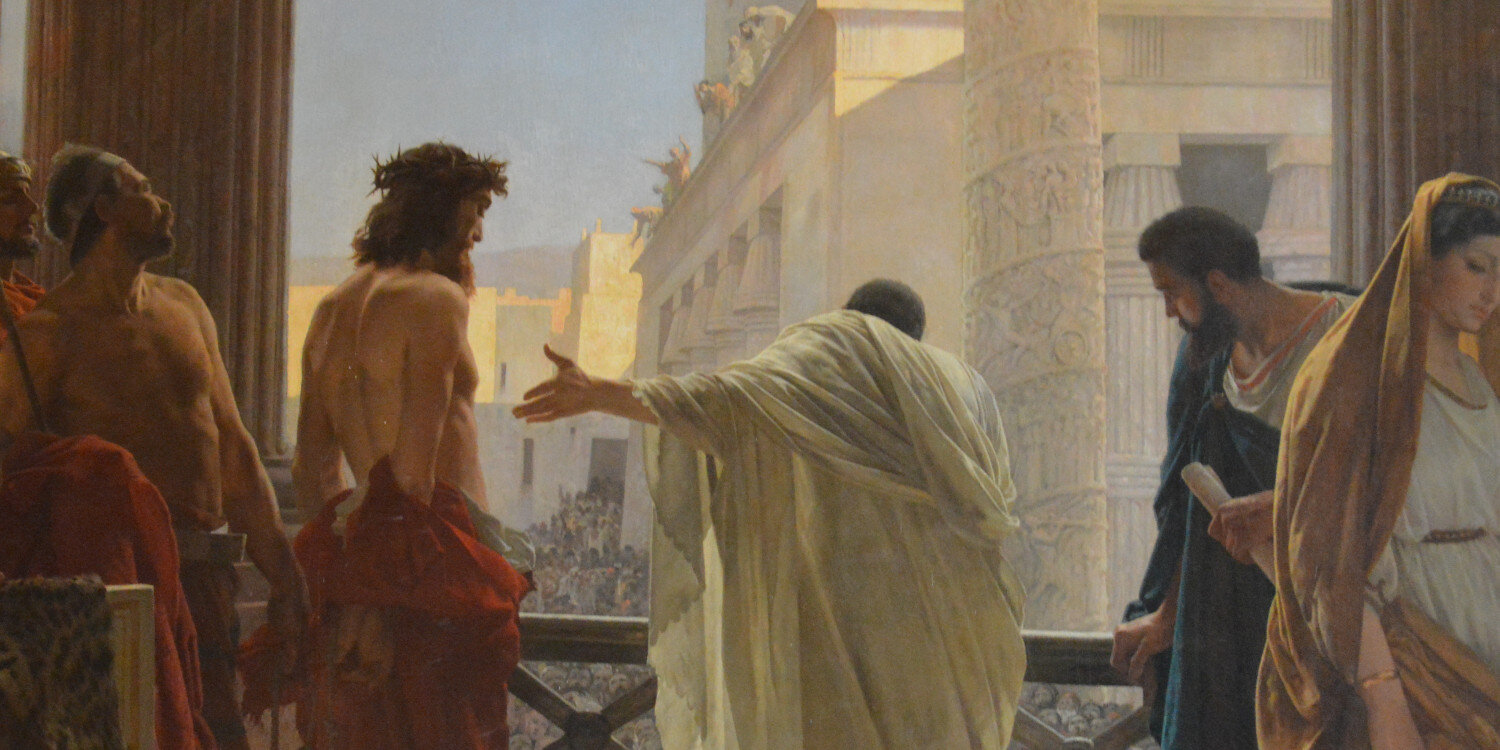
All four Evangelists emphasize that, despite his indecision about the case of Jesus, Pilate considered Jesus to be innocent. This is a scene I have written about in a prior Holy Week post, “Behold the Man as Pilate washes His Hands.”
On the pretext that Jesus was from Galilee, thus technically a subject of Herod Antipas, Pilate sent Jesus to Herod in an effort to free himself from having to handle the trial. When Jesus did not answer Herod’s questions (Luke 23: 7-15) Herod sent him back to Pilate. Herod and Pilate had previously been indifferent, at best, and sometimes even antagonistic to each other, but over the trial of Jesus, they became friends. It was one of history’s most dangerous liaisons.
The trial before Pilate in the Gospel of John is described in seven distinct scenes, but the most unexpected twist occurs in the seventh. Unable to get around Pilate’s indecision about the guilt of Jesus in the crime of blasphemy, Jewish leaders of the Sanhedrin resorted to another tactic. Their charge against Jesus evolved into a charge against Pilate himself: “If you release him, you are no friend of Caesar” (John 19:12).
This stopped Pilate in his tracks. “Friend of Caesar” was a political honorific title bestowed by the Roman Empire. Equivalent examples today would be the Presidential Medal of Freedom bestowed upon a philanthropist, or a bishop bestowing the Saint Thomas More Medal upon a judge. Coins of the realm depicting Herod the Great bore the Greek insignia “Philokaisar” meaning “Friend of Caesar.” The title was politically a very big deal.
In order to bring about the execution of Jesus, the religious authorities had to shift away from presenting Jesus as guilty of blasphemy to a political charge that he is a self-described king and therefore a threat to the authority of Caesar. The charge implied that Pilate, if he lets Jesus go free, will also suffer a political fallout.
So then the unthinkable happens. Pilate gives clemency a final effort, and the shift of the Sadducees from blasphemy to blackmail becomes the final word, and in pronouncing it, the Chief Priests commit a far greater blasphemy than the one they accuse Jesus of:
“Shall I crucify your king? The Chief Priests answered, ‘We have no king but Caesar.”
Then Pilate handed him over to be crucified.