“There are few authentic prophetic voices among us, guiding truth-seekers along the right path. Among them is Fr. Gordon MacRae, a mighty voice in the prison tradition of John the Baptist, Maximilian Kolbe, Alfred Delp, SJ, and Dietrich Bonhoeffer.”
— Deacon David Jones
My Father’s House Has Many Rooms. Is There a Room for Latin Mass?
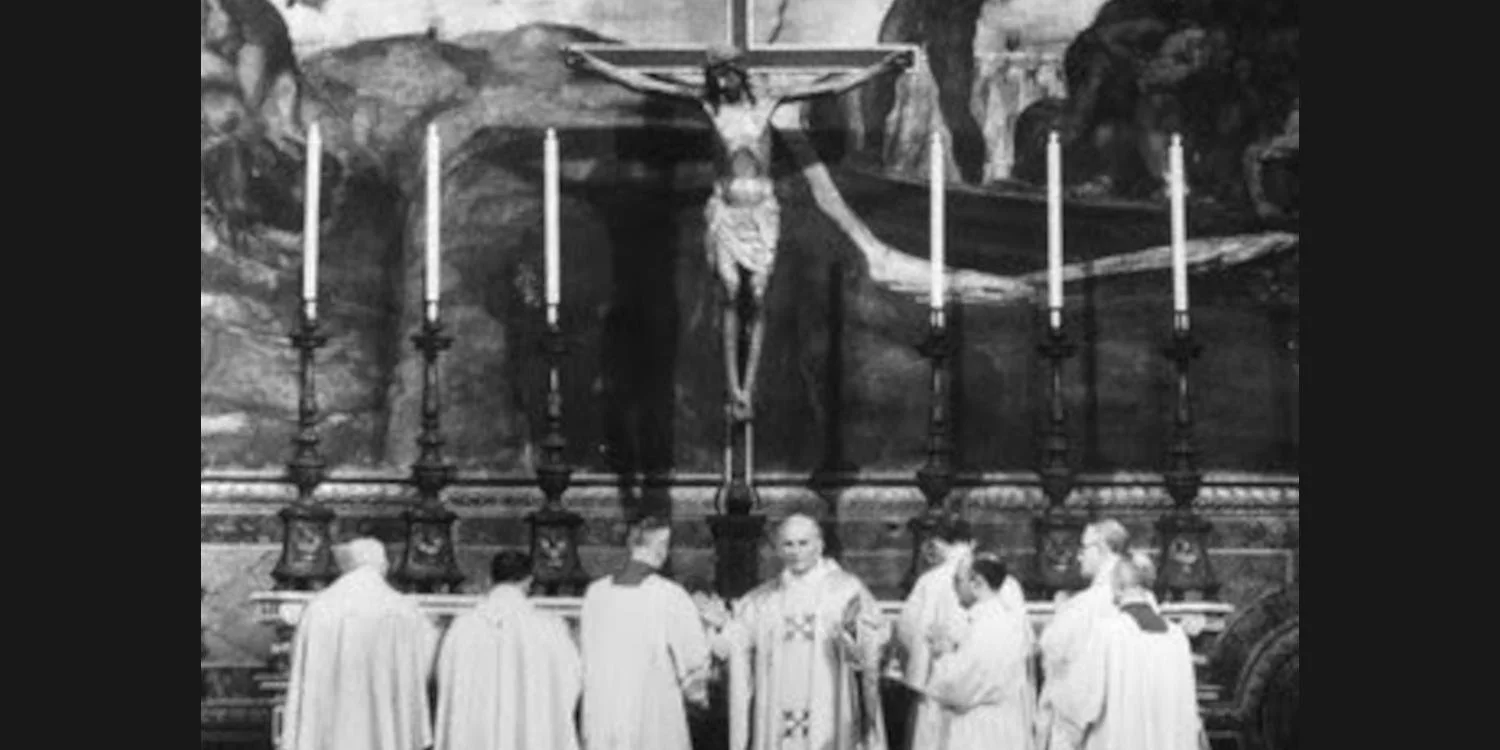
In Traditionis Custodes, Pope Francis dealt a sharp but not fatal blow to Catholics who treasure the TLM. I hear from many who hope and pray for reconsideration.
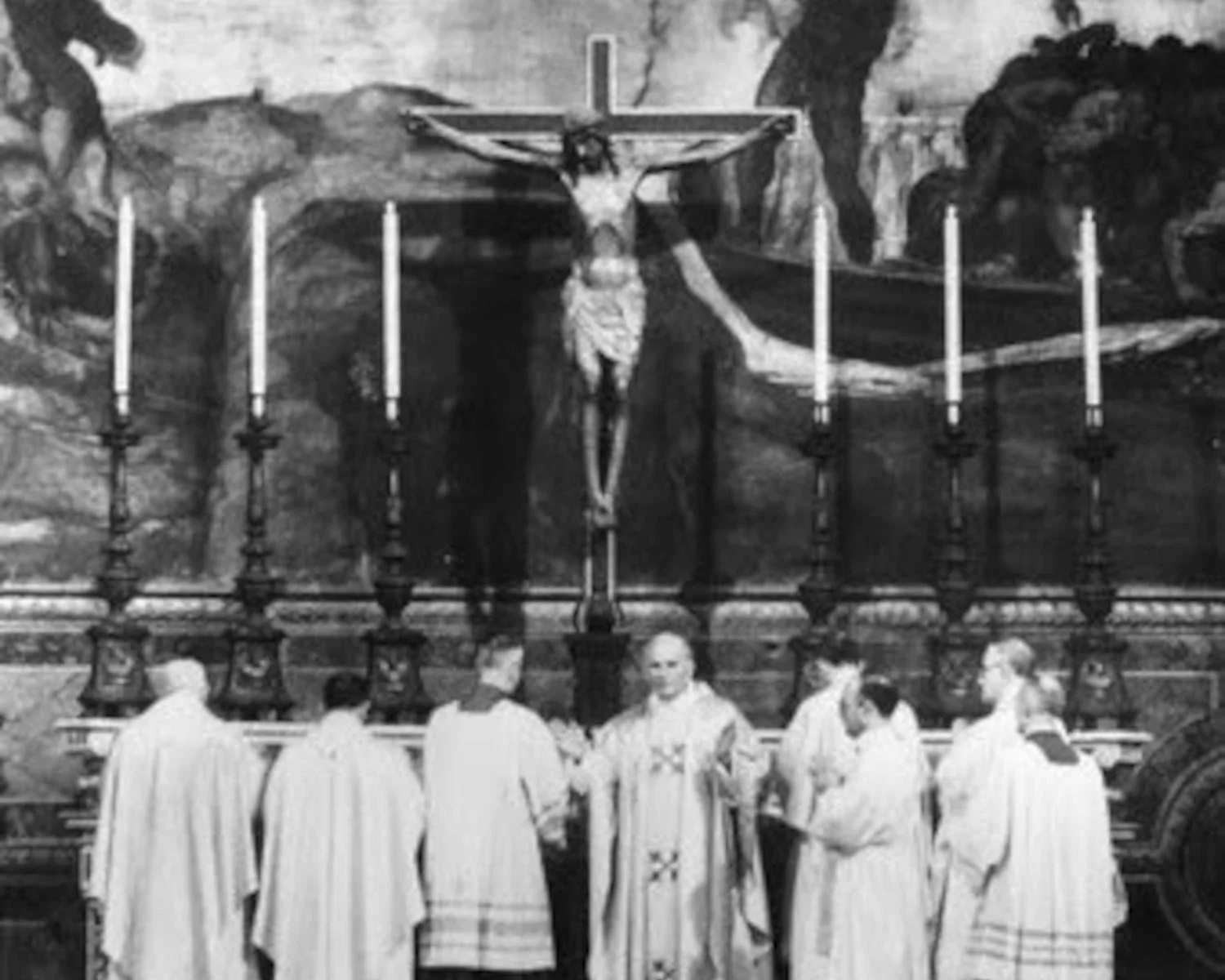
In Traditionis Custodes, Pope Francis dealt a sharp but not fatal blow to Catholics who treasure the TLM. I hear from many who hope and pray for reconsideration.
In the photo above His Holiness Pope John Paul II offers Mass in Latin, ad orientem, from the Sistine Chapel.
August 20, 2025 by Father Gordon MacRae
My title for this post is from the Gospel of John, Chapter 14, verse 2, “My Father’s House Has Many Rooms.” It is seen by scholars as a reference to the Jerusalem Temple, hinting of its heavenly sanctuary, the dwelling place of angels and saints who worship in eternal liturgy. The Letter to the Hebrews describes it:
“You have come to Mount Zion, to the City of the Living God in the heavenly Jerusalem, to choirs of angels in festal gathering and the assembly of the firstborn enrolled in heaven, to a judge who is God of all, and to the spirits of the just made perfect, and to Jesus, mediator of a new covenant, and to the sprinkled blood that speaks more graciously than the blood of Abel.”
— Hebrews 12:22-24
The Gospel passage from John 14:2 speaks of God’s House having many chambers. Could one of them accommodate the Latin Mass? In 1947, Pope Pius XII wrote in Mediator Dei, his encyclical on the liturgy, that “the mystery of the most Holy Eucharist which Christ, the High Priest, instituted and commands to be continually renewed, is the culmination and center of the Christian religion.” In the Mass the redemptive action of the death and Resurrection of Jesus is made actually present to the faithful across the centuries. This mystery of faith, the Mysterium Fidei, is found in the liturgy of the entire Church, both East and West.
The Catechism of the Catholic Church (CCC 889) tells us that “By a supernatural sense of faith” the whole People of God, under the guidance of the Church’s Magisterium, “unfailingly adheres to this faith.” To comprehend how the whole people of God is infallible in its sense of the faith — its sensus fidelium — it must be understood that the body of the faithful goes far beyond limits of space and time. The People of God always includes those of all past generations as well as those in the present. Those of the past are in fact the vast majority and it is easier to ascertain what they believed and practiced. It is that belief that marks the sensus fidelium pointing infallibly to truth.
I have never been a devotee of the Traditional Latin Mass. Growing up, I had nothing but the barest and most minimal exposure to our Catholic faith until my later adolescence. Then, in the 1960s, Latin in the Mass had receded and all manner of confusing experimentation took its place. I attended an inner city public high school then, and had begun to attend Mass just as Latin was disappearing. I wondered what all the agony in the garden of faith was about so I registered for Latin among my high school courses.
I took three successive years of Basic, Intermediate, and Advanced Classical Latin then. I developed a fascination with both the ancient language and the Roman Empire that flourished because of it. More than a half century later, I still recall my exposure to Latin. Endless declensions and conjugations still stream through my mind. My friend, Pornchai Moontri once suggested that I know Latin because it was my first language.
A House Divided Cannot Stand
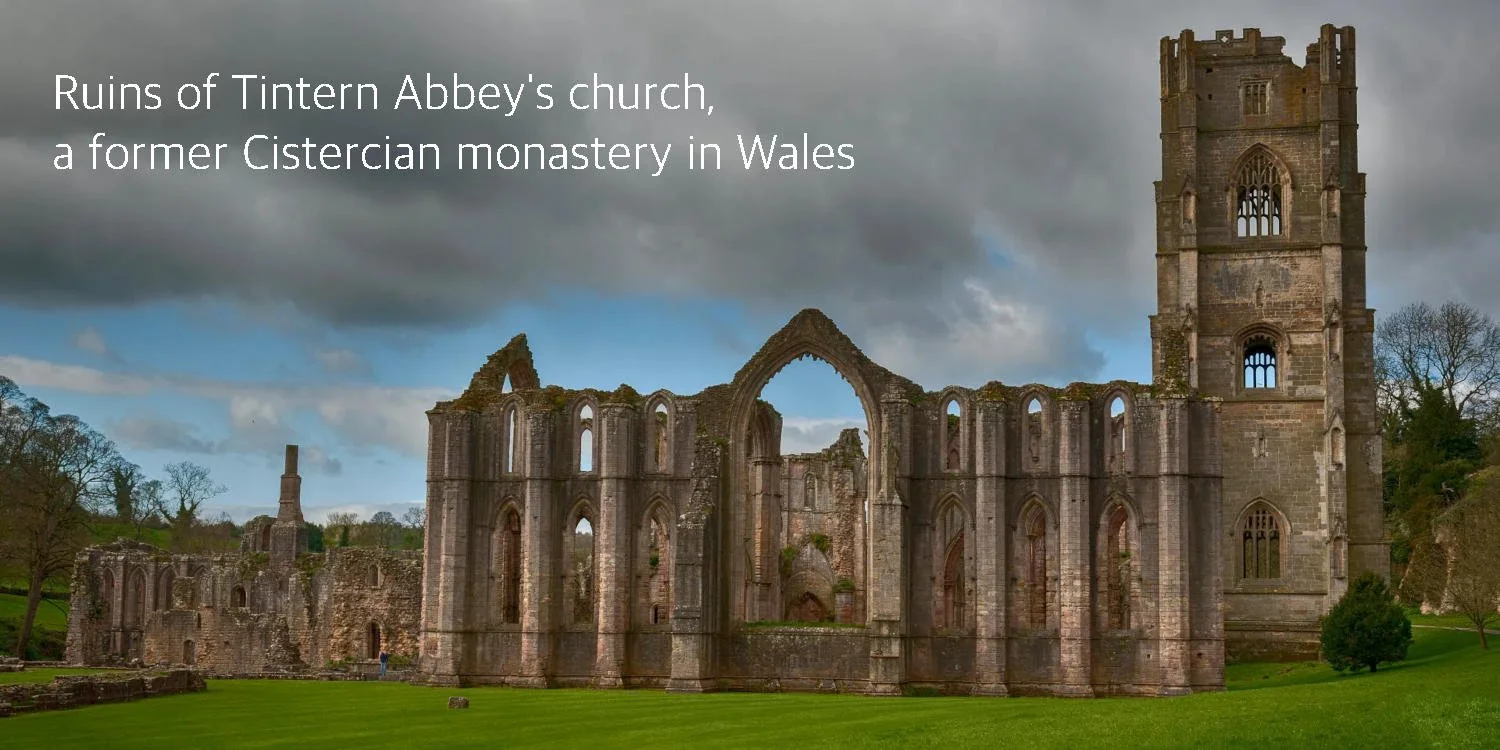
On July 16, 2021, the Feast of Our Lady of Mount Carmel, the late Pope Francis published Traditionis Custodes, a Pastoral Letter that placed immediate and severe restrictions on a Catholic celebration of the Traditional Latin Mass. The wound this inflicted on the spirit of Traditional Catholics, some of the most faithful among us, was also severe. Despite my own lack of experience with the Latin Mass, I wrote, not so much in protest, but in support of those who felt cast adrift. My post was “A House Divided: Cancel Culture and the Latin Mass.”
The restrictions became effective immediately, including a mandate barring newly ordained priests from celebration of the TLM and barring its celebration in any parish church. Bishops were suddenly required to first consult the Holy See before granting any exceptions to the Traditional (Extraordinary) Form of the Mass.
For expressed reasons of “unity,” Pope Francis imposed these restrictions without explanation in open contradiction of a 2014 Motu Proprio of his predecessor, Benedict XVI, who permitted celebration of the Traditional Latin Mass without preconditions and without consent from any bishop. Some of the best early reaction to this new and draconian development came from Father John Zuhlsdorf (Father Z’s Blog) in “First Reactions to Traditionis Custodes.”
His reactions inspired me and many. Father Z’s bottom line was that Catholics with devotion to the TLM should pause, take a deep breath, and adopt a wait-and-see attitude. He wrote,
“Fathers... change nothing, do nothing differently for now. It is not rational to leap around without mapping the mine field we are entering. Keep calm and carry on.
“Lay people... be temperate. Set your faces like flint. When you are on fire, it avails you nothing to run around flapping your arms. Drop and roll and be calm.
“To those of you who have put your heart and goods and hopes into supporting and building the Traditional Latin Mass, thank you. Do not for a moment despair or wonder if what you did was worth the effort, time, cost and suffering. It was worth it. It still is.”
— Father John Zuhlsdorf, July 16, 2021
I found myself cheering inside for Father Z. I am not a rebel priest and neither is he, but I would have been a rebel without a clue had I taken this on. I have never even experienced the TLM. But human nature being what it is, this edict of Pope Francis had the opposite effect from unity. Telling people that they cannot have something drew worldwide attention to it.
So I wrote back then, not so much in defense of the TLM, but in defense of the many people who told me of their grief in having it taken summarily away and without apparent just cause or dialogue. I cannot help but wonder what Pope Francis might have been thinking at Mass just days later as he listened to the First Reading on the Sixteenth Sunday in Ordinary Time on July 18, 2021. Was he at all conscious that Catholics all over the world were hearing the same rebuke from the Prophet Jeremiah that we heard that Sunday?
“Woe to the shepherds who mislead and scatter the flock of my pasture, says the Lord. Therefore, thus says the Lord, the God of Israel, against the shepherds who shepherd my people: You have scattered my sheep and driven them away. You have not cared for them, but... I myself will gather the remnant of my flock from all the lands and bring them back to their meadow... I will appoint shepherds for them who will shepherd them so that they need no longer fear and tremble, and none shall be missing, says the Lord.”
— Jeremiah 23:1-6
A Catholic Unraveling in Germany
I have been searching for a more panoramic map of the minefield Father Zuhlsdorf suggested that we were entering then, and I think I found some of its rumblings. While reading from Volume Two of the Prison Journal of George Cardinal Pell (which, for full disclosure, included five pages quoting this blog) I came upon his entry for 9 August 2019, the feast of Edith Stein, Saint Teresa Benedicta of the Cross, that we observed this month. I wrote about her once in “Saints and Sacrifices: Maximilian Kolbe and Edith Stein at Auschwitz.”
Edith Stein was German by birth. In his book, Cardinal Pell advised readers to seek her intercession for the Church in Germany. Cardinal Pell quoted Cardinal Gerhard Muller, former Prefect of the Congregation for the Doctrine of the Faith:
“The Catholic Church [in Germany] is going down. Leaders there are not aware of the real problems. [They are] self-centered and concerned primarily with sexual morality, celibacy, and women priests. They don’t speak about God, Jesus Christ, grace, the sacraments, and faith, hope, and love.”
— Prison Journal, Volume 2, p.75
It gets worse. Later in Prison Journal, Volume 2, in an entry dated 16 October 2019, Cardinal Pell wrote candidly about German Catholic fears of the possibility of schism that had been raised there. If allowed to happen, such a break would sweep much of Europe. Cardinal Pell quoted from a Catholic Culture article by Philip Lawler entitled, “Who Benefits from All This Talk of Schism?” (September 19, 2019):
“Lawler argues that Pope Francis has spoken calmly about such a prospect, saying he is not frightened by it, something Lawler believes is frightening in itself.”
— Prison Journal, Volume 2, p. 214
Cardinal Pell wrote of earlier confidence about the unlikelihood of a schism, but acknowledged that “the odds against it have shortened.” He added,
“Not surprisingly, the New York Times has been writing about the prospect of a schism by the John Paul and Benedict followers in the United States, the Gospel Catholics... . I believe Lawler’s diagnosis is correct when he points out that the topic of schism has been raised by the busiest and most aggressive defenders of Pope Francis who recognize that they cannot engineer the radical changes they want without precipitating a split in the Church. So they want orthodox Catholics to break away first, leaving [progressives] free to enact their own revolutionary agenda.”
— Prison Journal, Volume 2, pp. 214-215
It was that final sentence that I vividly recalled and revisited after hearing these new restrictions imposed by Pope Francis on the Traditional Latin Mass. Were we then witnessing the opening salvo of such a manipulated schism? Was there a move under way to antagonize conservative and traditional Catholics into breaking away?
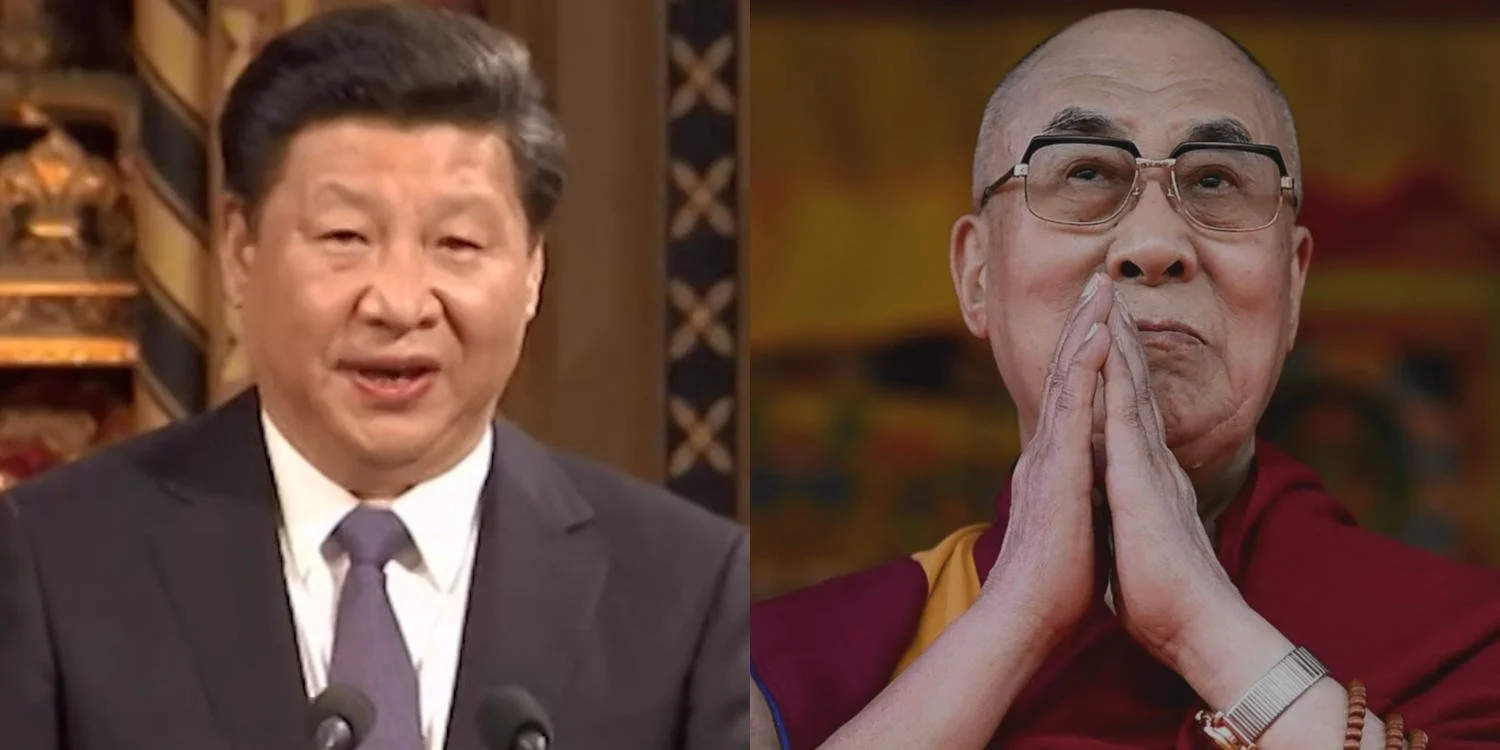
China, Catholics, and the Dalai Lama
I am certain this was not by design, but on the day after this announcement by Pope Francis, the weekend edition of The Wall Street Journal carried a stunning pair of articles. I will summarize their major points:
The first was entitled, “Beijing Targets Tibet for Assimilation” by Liza Lin, Eva Xaio, and Jonathan Cheng. The assimilation referred to is better described as suppression, and it needs a little historical background.
Twelve centuries had passed between the establishment of Tibetan Buddhism in AD 747 and the Chinese Communist Party (CCP) gaining control of China in 1949. By 1950, the CCP came into increasing conflict with Tenzin Gyatso, the 14th Dalai Lama. The Dalai Lama is believed by Buddhists to be a reincarnation of the Buddha. When he dies, his soul is thought to enter the body of a newborn boy, who, after being identified by traditional tests, becomes the new Dalai Lama.
As such, the Dalai Lama is spiritual leader of Tibetan Buddhism and the ex officio ruler of Tibet since the Eighth Century. In 1959, during the Chinese Communist absorption of Tibet (resistance was futile!) the Dalai Lama was forced into exile in India where he has remained since. He received the Nobel Peace Prize in 1989 for leading nonviolent opposition to continued Chinese claims to rule Tibet.
Xi Jinping, President of China and General Secretary of the Chinese Communist Party (CCP), has as his national priority the forging of a single Chinese identity centered on unity and Party loyalty. His agenda placed new restrictions on Tibetan Buddhism and launched an effort to replace traditional Tibetan language with Mandarin Chinese while insisting on courses designed for indoctrination in socialism and the CCP.
The Dalai Lama, in exile in India, will soon turn 90 years of age. His eventual death is expected to trigger a clash with the Chinese government over control of Tibetan Buddhism. One of the major points of Chinese suppression is a CCP claim that it has the right to choose the Dalai Lama’s “reincarnation,” and thus establish full control over the heart of Tibetan religion and identity. In late 2020, President Xi Jinping commanded an effort to make Tibetan Buddhism “compatible with a socialist identity.”
This affront to Tibet’s religious freedom actually had a strange sort of precedent. In 2019, Pope Francis signed a concordat — the tenets of which are still secret — in which he agreed to a Chinese Communist Party demand to select Catholic bishops in the State-approved Chinese Catholic church. This has translated into increased harassment and suppression of the underground Catholic Church for which many have suffered for their loyalty to Rome.
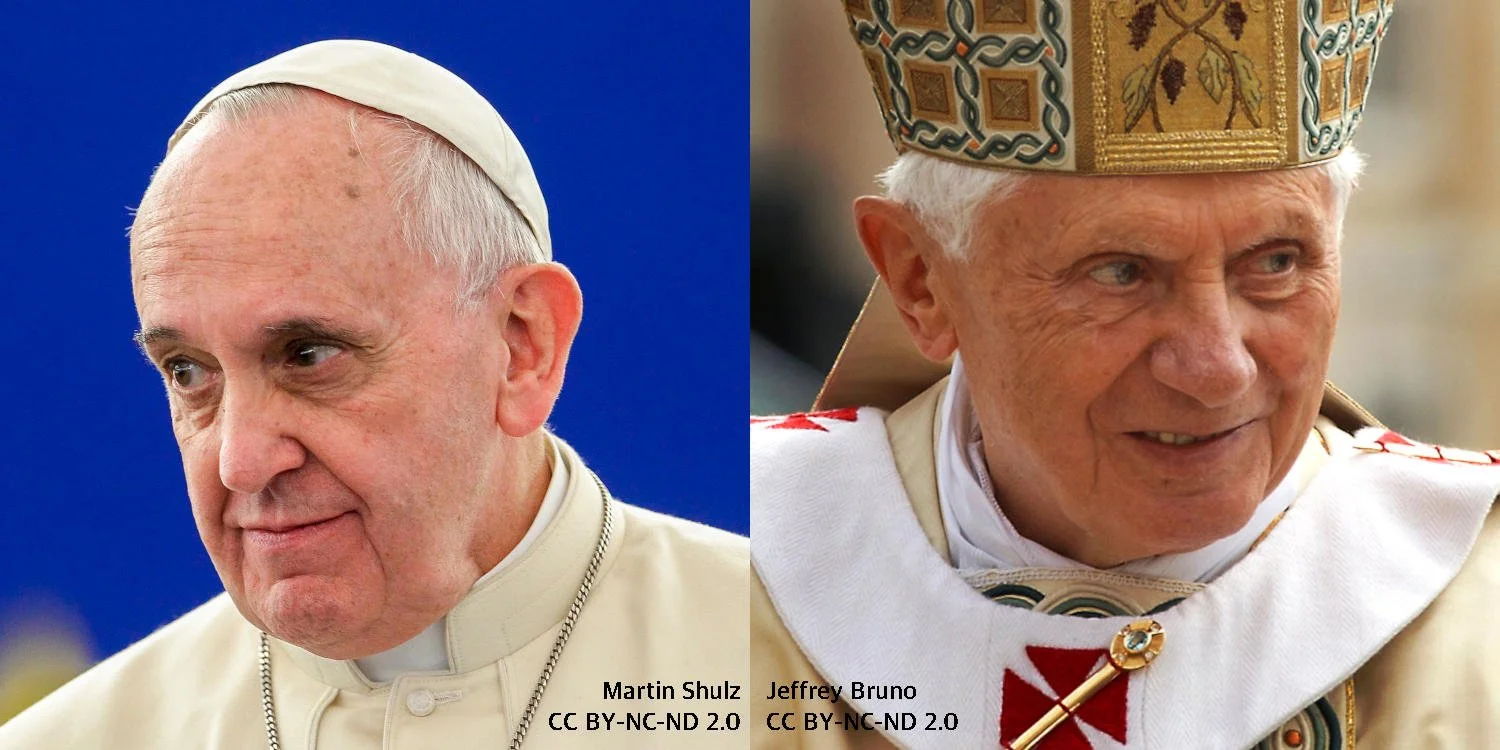
The Threat of Schism
A second major article, this one by Vatican correspondent Francis X. Rocca, appeared on the same day in The Wall Street Journal, again just two days after the announced suppression of the Latin Mass. Its title asked an ominous question: “Is Pope Francis Leading the Church to a Schism?” Pope Francis had used some of the same reasoning and language in restricting the TLM that Xi Jinping used while suppressing Tibetan Buddhism. Pope Francis cited “unity” as his principal reason and goal, but its effect seemed to invite just the opposite.
Two years after Cardinal Pell wrote from his prison cell with dismal foreboding about the state of the Church in Germany, Francis X. Rocca quoted Cardinal Rainer Woelki, Archbishop of Cologne and leader of the conservative minority of German bishops. He warned that the current wave of dissent sweeping Germany could lead to schism and the formation of a German national church. Rocca reported that similar warnings have been echoed by cardinals and bishops of other European countries.
Subsequently, San Francisco Archbishop Salvatore Cordileone asked for prayers for the universal Church and the bishops of Germany “that they step back from this radical rupture.” Schism is more a threat to the Catholic Church than any other because, as Rocca points out, its “core identity is inextricably tied to its global unity under the pope.”
Francis X. Rocca wrote that Pope Francis has played down the concerns of more traditional African bishops who, in the view of many represent the future of the Church’s moral integrity. For a glimpse of the mindset at work in the German church, consider this statement by Joachim Frank, a German journalist who took part in the synod there, and described its work:
“There was this sense of movement, of change, another spirit, another type of church after these boring and very painful years of John Paul II and Benedict XVI.”
In his 26-year papacy, Saint John Paul II is widely considered to have almost single-handedly brought down the Soviet Union and ended European communism. To dismiss his papacy and that of Benedict XVI as "boring and painful" is to break, not just with Catholic tradition, but with reality.
The trending Catholic mindset of Germany and much of Europe should not steer the Barque of Peter and the moral authority and praxis of the Church. In Germany, before the 2019-2021 pandemic, only about nine-percent of Catholics attended Mass on a regular basis. Post-Covid, that is now down to two or three percent. Among African Catholics, regular Mass participation is the world’s highest. By 2050, there will be twice as many practicing Catholics in Africa than in all of Europe.
Throughout Asia, Catholicism is relatively small, but growing. In Thailand, Catholics account for less than one-percent of the population but they leave a large footprint on the culture because of an orthodox commitment to living their faith, often heroically. I was recently informed by an active Catholic in Thailand that many people in his village attend the Buddhist Temple to observe local tradition, and then attend Sunday Mass to observe faith.
Our friend, Pornchai Moontri, told me that in the years he has lived in Thailand, he has heard Masses in Thai, Vietnamese, Lao, Issan, and English, all of them filled to capacity. Few of the Thai, Vietnamese, or Lao converts understand each other, nor can they understand the Mass in any language but their own. “If the Church had kept Latin,” Pornchai recently offered, “this might not happen.” He pointed out rather wisely that in the mobile culture this world has become, an ancient but universal language in the Mass promotes unity instead of detracting from it. It overlooks national identity to establish a Catholic one.
This is not meant to be a critique of Pope Francis. He had his reasons for imposing Traditionis Custodes, but new information suggests that one of them may have been based on erroneous information conveyed to him. Newly emerging information paints another picture, and I hope to present that soon. Meanwhile, please keep the faith. The Body and Blood of Christ become manifest in every Mass. That Communion is the source and summit of all grace.
“Ad Altare Dei”
+ + +
Note from Fr Gordon MacRae: Thank you for reading and sharing this post. Sharing it helps to reach others who might benefit from these pages. You may also like these related posts:
Fr Gordon MacRae in the Prison Journal of George Cardinal Pell
A House Divided: Cancel Culture and the Latin Mass
Behold the Lamb of God Upon the Altar of Mount Moriah
The Vatican Today: Cardinal George Pell’s Last Gift to the Church

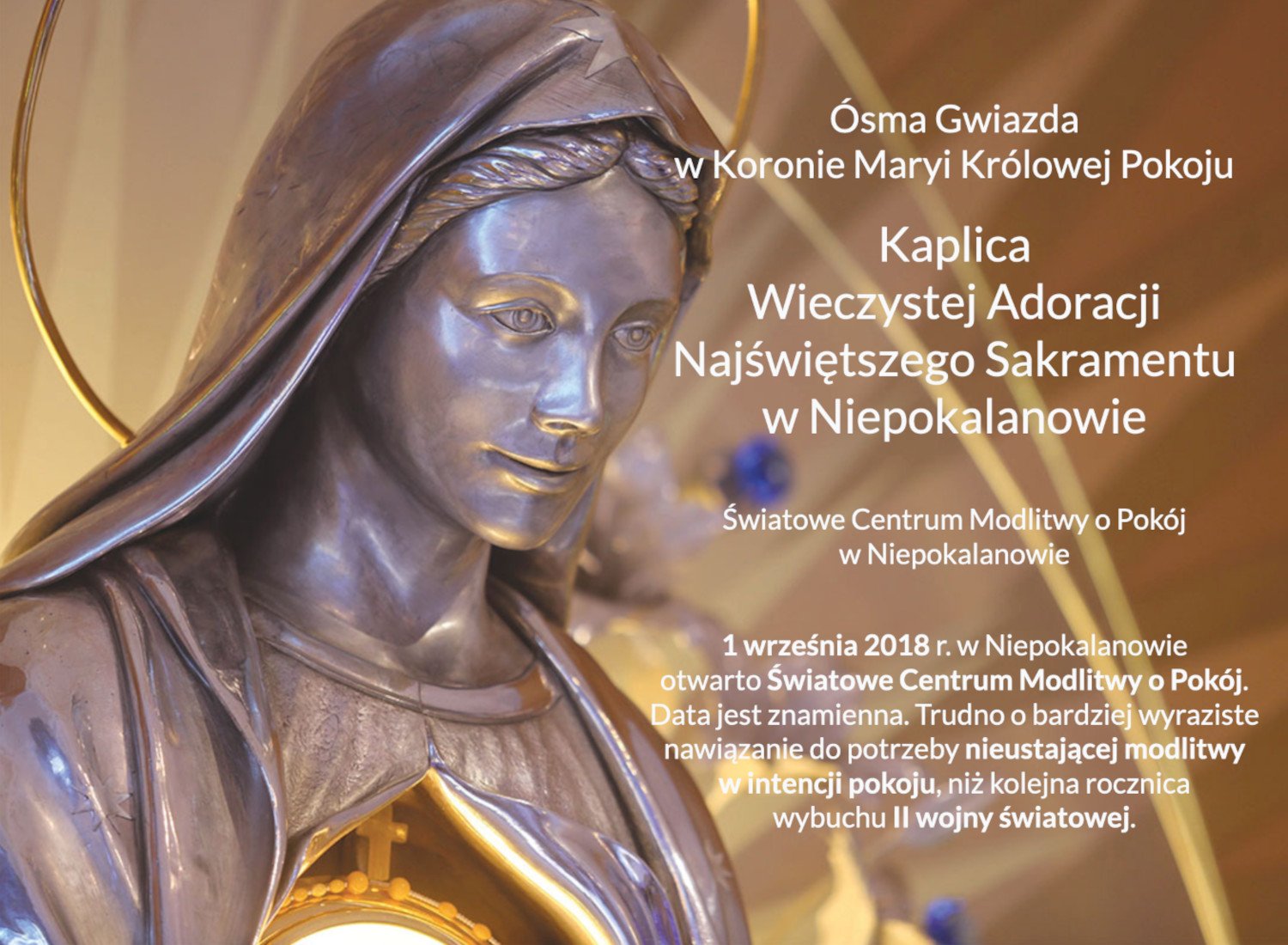

The Eucharistic Adoration Chapel established by Saint Maximilian Kolbe was inaugurated at the outbreak of World War II. It was restored as a Chapel of Adoration in September, 2018, the commemoration of the date that the war began. It is now part of the World Center of Prayer for Peace. The live internet feed of the Adoration Chapel at Niepokalanow — sponsored by EWTN — was established just a few weeks before we discovered it and began to include in at Beyond These Stone Walls. Click “Watch on YouTube” in the lower left corner to see how many people around the world are present there with you. The number appears below the symbol for EWTN.
Click or tap here to proceed to the Adoration Chapel.
The following is a translation from the Polish in the image above: “Eighth Star in the Crown of Mary Queen of Peace” “Chapel of Perpetual Adoration of the Blessed Sacrament at Niepokalanow. World Center of Prayer for Peace.” “On September 1, 2018, the World Center of Prayer for Peace in Niepokalanow was opened. It would be difficult to find a more expressive reference to the need for constant prayer for peace than the anniversary of the outbreak of World War II.”
For the Catholic theology behind this image, visit my post, “The Ark of the Covenant and the Mother of God.”

What Belongs to Caesar and What Belongs to God
Pharisees set a trap for Jesus with a query about paying tax to Caesar. Like much in the Gospel, this has a story on its surface and a far greater one in its depths.

Pharisees set a trap for Jesus with a query about paying tax to Caesar. Like much in the Gospel, this has a story on its surface and a far greater one in its depths.
Note from Father Gordon MacRae: One of the most frequent religious questions in the Google database of searches is also the Gospel at Mass for the 29th Sunday in Ordinary Time. With that question, the Pharisees laid out a trap for Jesus.
+ + +
Prisoners often come to my door with questions. Sometimes they simply don’t have the ability to search through the library for answers and sometimes they just assume that a guy my age must know at least something about almost everything. My friend, Pornchai Moontri, when he was here with me, used to sometimes chime in with answers of his own.
One day a prisoner asked me, “Do you know any Latin? Pornchai shot back, “Of course he does. Latin was his first language!” The implied meaning was that I am old enough to remember when Latin was spoken on the streets of the Roman Empire. The prisoner didn’t get the joke so he didn’t laugh. I got it, and I still look forward to my quid pro quo moment.
But Pornchai may not have been entirely wrong. I went to a public high school as a teen growing up on the North Shore of Massachusetts in the 1960s. (Yes, locals still call it the “Noath Shoah”). I graduated from Lynn English High School when I was only one month seventeen in 1970, and what I most remember about those years is Latin. At Lynn English I studied basic, intermediate, and advanced Classical Latin with Miss Ruggiero who also moderated the “Latin Club” of which I was a charter member.
Latin was not my first language, but I became proficient in my first language, English, only because I studied Latin. I owe a great debt to Miss Ruggiero because she was never satisfied with our merely learning the discipline of Latin declinations and conjugations. We also had to study in depth the setting in which it was spoken: the vast Roman Empire that had spread throughout the known world.

The Roman Empire
The Roman Empire lasted for only five centuries. One of them, the one we now call the First Century A.D. (Anno Domini, Latin for “the Year of the Lord”) includes the Roman occupation of Judea during the birth, life, death, and resurrection of Jesus, and the life of the Early Church.
The Empire began to spread from the city of Rome to the rest of Italy and neighboring regions to become the Roman Republic about 500 years before the birth of Jesus. In 49 B.C., Gaius Julius Caesar, a Roman military strategist and politician, prevailed in a civil war and became dictator of the Republic. He ruled for only five years when he was assassinated on the Ides of March (March 15). The month of July was named in his honor. Caesar’s longtime military deputy, Mark Antony, and Caesar’s grandnephew, Gaius Octavius, defeated Caesar’s assassins and rivals. Then they turned on each other. At the battle of Actium in 31 B.C., Octavius prevailed over a plot by Roman governor Mark Antony and the Egyptian princess, Cleopatra, Caesar’s former mistress who took up with Mark Antony. It’s one of the great soap operas of history.
In 27 B.C. the Roman Senate proclaimed Octavius to be the Roman Republic’s supreme leader giving him the title, “Augustus,” meaning “exalted or holy one.” Most historians cite 27 B.C. as the date the Roman Empire was born. Its first Emperor took his title and added “Caesar” in honor of his great-uncle, Julius.
Caesar Augustus thus meant, “Caesar the Exalted Holy Roman Emperor.” It was a title and not a name. Augustus was also given the titles, “Pontifex Maximus,” supreme head of the state religion, and “Pater Patriae,” Father of the Fatherland.
The month of August was named in the ancient Roman Calendar in honor of Caesar Augustus. It’s easy to see the Roman influence not only in the Latin language of the Church but in the religious titles later assigned by tradition to the papacy. It’s a crime against history to allow Latin to fade from Catholic Tradition, for Christianity transformed it from the language of Earthly powers to the language of the Church. I once wrote of the meaning of this loss in the life of the Church in “A House Divided: Cancel Culture and the Latin Mass.”
From 27 B.C. forward, “Caesar” became the title for a string of Roman rulers. Three are mentioned by name in our New Testament: Augustus, who reigned at the time of the birth of Jesus (see Luke 2:1); Tiberius, in whose fifteenth year as Emperor Jesus was baptized by John at the Jordan (Luke 3:1); and Claudius (Acts 18:2), who commanded that all Jews leave the city of Rome. Others, such as Caligula and Nero, are not mentioned by name but had a profound effect on early Christianity.
By the birth of Jesus, Augustus centralized power by turning to the Equestrian Order, Roman citizens with wealth, power, and property, and sustained their loyalty by appointing them governors over the various regions of Roman occupation. When Jesus was about 14 years of age, Tiberius succeeded Augustus as Emperor, and later appointed one of the Equestrian Order, Pontius Pilate, as governor of Judea.
In some ways in the early years of the advance of Rome into Palestine, the Jews saw it to their advantage. It was a chance to free themselves from the oppression of the Seleucids, the Greek dynasty under Antiochus IV Epiphanies who overtook the Jerusalem Temple in 167 B.C. and replaced the Torah in the Sanctuary with the cult of Zeus.
This is a story of great imperial oppression and Jewish resistance that is laid out in the First Book of Maccabees (1 Macc 8:1-6) which spoke positively of the advancing Romans and an alliance with the Jews to expel the Greek oppressors. It is the story of the Jewish Festival of Hanukkah. A century before the birth of Jesus, Rome became the dominant force in the Mediterranean region, having replaced the Hellenistic Greek influence that sought to destroy the Hebrew language and expression of faith.

Caesar and Christ
So when I came to the Gospel reading for the Twenty-ninth Sunday in Ordinary Time, I was struck by the answer Jesus gave to the religious scholars of his day, the Pharisees, who had set out to entrap him. Armed with a thorough knowledge of Hebrew Law, they asked Jesus if it is permissible for Jews to pay the census tax to Caesar.
The brief story that the Gospel tells in Matthew 22: 15-22 is a good story on its face, but if you are willing to venture a little deeper under into its depths, the result is fascinating. So sometime before or after you hear the Gospel for the 29th Sunday in Ordinary Time, invest a little of your own ordinary time for a careful reading of the rest of this post.
It is impossible to fully understand the dynamic in this account between Jesus and a group of Pharisees without some exploration of its setting. First, the story on the surface:
“The Pharisees went off and plotted how they might entrap Jesus in speech. They sent their disciples to him, with the Herodians, saying, ‘Teacher, we know that you are a truthful man and that you teach the way of God in accordance with the truth. And you are not concerned with anyone’s opinion, for you do not regard a person’s status. Tell us, then, what is your opinion: Is it lawful to pay the census tax to Caesar or not?’” The trap is set.
“Knowing their malice, Jesus said, ‘Why are you testing me, you hypocrites? Show me the coin that pays the census tax.’ Then they gave him the Roman coin. He said to them, ‘Whose image is this and whose inscription?’ They replied, ‘Caesar’s.’ At that he said to them, ‘Then repay to Caesar what belongs to Caesar, and to God what belongs to God.’ When they heard it, they marveled; and then they left him and went away.”
— Matthew 22: 15-22
Why were the Pharisees plotting against Jesus at all? It began in an earlier chapter of the Gospel, Matthew 12. The Pharisees challenged Jesus over his disciples plucking grain on the Sabbath because they were hungry. The chapter then culminates in his Sabbath Day healing of a man with a withered hand. Using the Pharisees’ own expertise in Hebrew Law and the Prophets, Jesus challenged them to consider the prophetic meaning of “I desire mercy, and not sacrifice” (quoting from the Prophet Hosea 6:6). Stymied by the challenge, “the Pharisees went out and took counsel against him on how to destroy him.” (Matthew 12:14).
The next encounter between Jesus and the Pharisees is the account of their question about whether the Hebrew Law permits Jews to pay a census tax to Caesar. When Jesus asked to see the coin that would be used, and then asks whose image is on this coin, he cut to the heart of their trap with one of his own.
The coin was a denarius stamped with the profile of the Emperor, Tiberius Caesar. The tax was deeply offensive to the Pharisees because of a law set forth in the Book of Exodus:
“You shall not make for yourself a graven image whether in the form of anything that is in heaven above, or that is on the earth beneath… You shall not bow down to them, or worship them.”
— Exodus 20:4-5
To pay a tax to Caesar using the coin of the realm, one engraved with Caesar’s image, was considered a direct affront to the Hebrew Law, and yet the Roman occupation required it and it was the price Jews paid for freedom from the oppression of the Greeks who committed a far more serious abomination: total desecration of their Temple. So paying it was an accommodation that the Jews begrudgingly obliged despite the Mosaic Law.
But what these Pharisees wanted to know from Jesus was not whether or not to pay the tax, but his opinion on whether it was in accord with the Law of Moses. The trap was set no matter how he answered. If his opinion was that it was lawful to pay, then it would be a public insult against the Law of Moses which could be used to discredit him. If he said it was not lawful to pay, then it would have been a public insult against Rome which could be used to accuse him of insurrection.
But in the end, Jesus trapped the entrappers by saying something that caused them first to marvel, and then to simply go away in silence. His trap had multiple tiers. The first was to play upon the word, “image.” The coin bore the image and likeness of Tiberius Caesar. Therefore, for Jesus, it belonged to him.
To pay the tax is simply to render to Caesar what belongs to Caesar. It would be a clearer violation of the law against graven images for a Jew to keep the coin. But the Pharisees would also see in this a subtle reference to a passage in Genesis with great authority:
“So God created man in his image; in the image of God he created him.”
— Genesis 1:27
Hence the second part of Jesus’ challenge: “Render to Caesar the things that are Caesar’s and to God the things that are God’s.”
This meant not just their obedience to the Law, but their very selves. The gist of the implication is even stronger. This higher duty, for Jesus, is incumbent not only upon these Pharisees, but even upon Caesar himself, and that was a revolutionary thought that put the Pharisee’s in a stupor.
For the Pharisees to challenge him in any way after this would have required their affirmation that Caesar is an ultimate authority that surpasses even the will of God. So they were left to marvel, and then they just left. This places an entirely new meaning on the accommodations to Caesar made by religious authorities of Jesus’ time — and perhaps even our own.
Somehow, between this scene in the Gospel of Matthew that is proclaimed at a Sunday Mass, and the Gospel of John that we will hear in Holy Week, came the final descent of faith and the cost of believing culminating in the scene before Pilate that became one of my most read Holy Week posts, “The Chief Priests Answered, ‘We Have No King but Caesar.’”
It was the ultimate accommodation to Caesar from which there is no return. As for the vast Roman Empire that tried to make its Emperor god, the successor of Peter remains in Rome to this day. The successor of Caesar is but a footnote on history.
+ + +
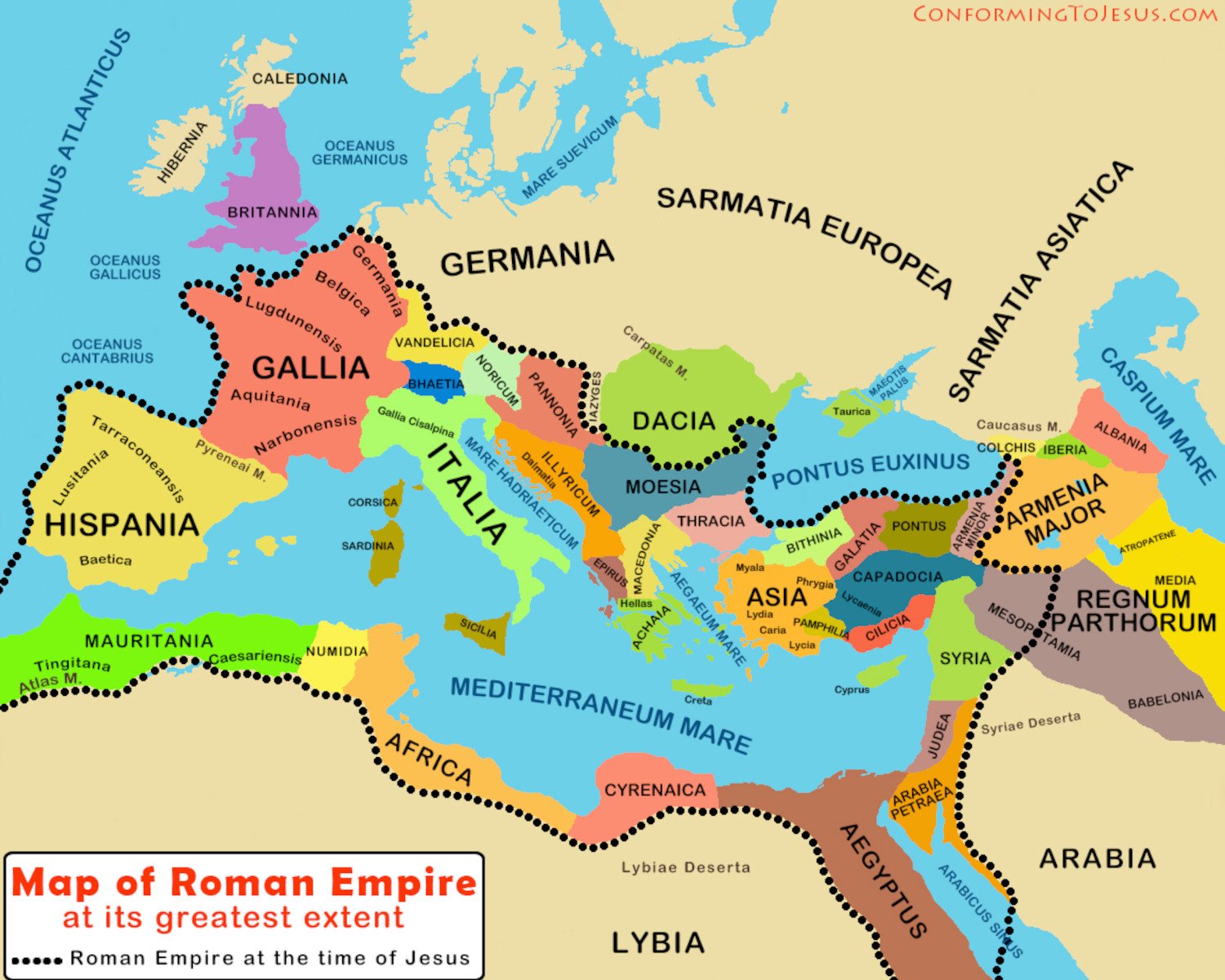
The dotted line in the map above marks the perimeter of the Roman Empire at the time of Jesus.
Note from Father Gordon MacRae: For more forays into the deeper wells of Scripture visit our collection of biblical posts, The Bible Speaks.
The Eucharistic Adoration Chapel established by Saint Maximilian Kolbe was inaugurated at the outbreak of World War II. It was restored as a Chapel of Adoration in September, 2018, the commemoration of the date that the war began. It is now part of the World Center of Prayer for Peace. The live internet feed of the Adoration Chapel at Niepokalanow — sponsored by EWTN — was established just a few weeks before we discovered it and began to include in at Beyond These Stone Walls. Click “Watch on YouTube” in the lower left corner to see how many people around the world are present there with you. The number appears below the symbol for EWTN.
Click or tap here to proceed to the Adoration Chapel.
The following is a translation from the Polish in the image above: “Eighth Star in the Crown of Mary Queen of Peace” “Chapel of Perpetual Adoration of the Blessed Sacrament at Niepokalanow. World Center of Prayer for Peace.” “On September 1, 2018, the World Center of Prayer for Peace in Niepokalanow was opened. It would be difficult to find a more expressive reference to the need for constant prayer for peace than the anniversary of the outbreak of World War II.”
For the Catholic theology behind this image, visit my post, “The Ark of the Covenant and the Mother of God.”