“There are few authentic prophetic voices among us, guiding truth-seekers along the right path. Among them is Fr. Gordon MacRae, a mighty voice in the prison tradition of John the Baptist, Maximilian Kolbe, Alfred Delp, SJ, and Dietrich Bonhoeffer.”
— Deacon David Jones
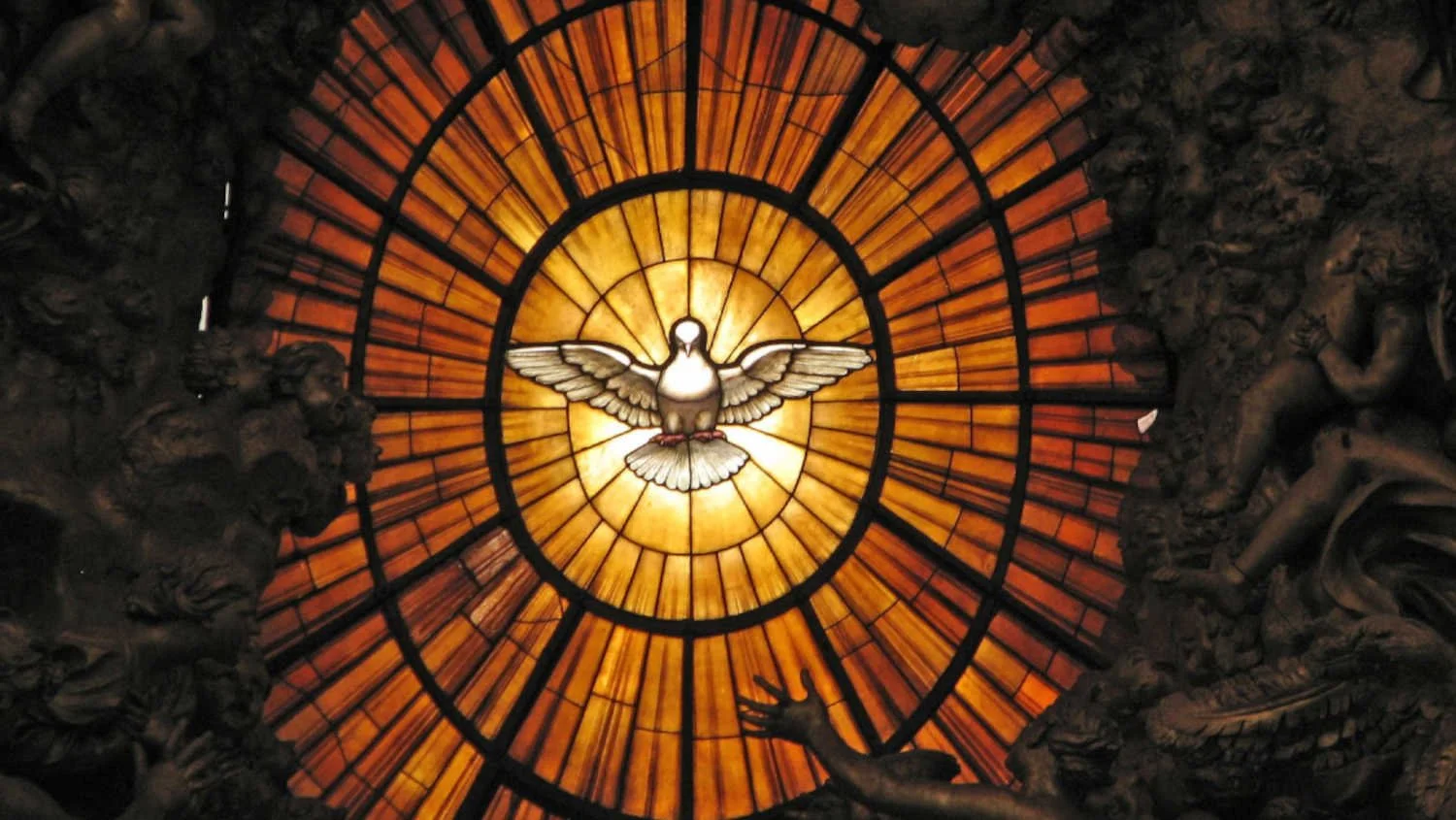
Inherit the Wind: Pentecost and the Breath of God
From Creation onward, Scripture often depicts the Holy Spirit as the wind or breath of God. When it swept through Jerusalem at Pentecost, all divisions ceased.
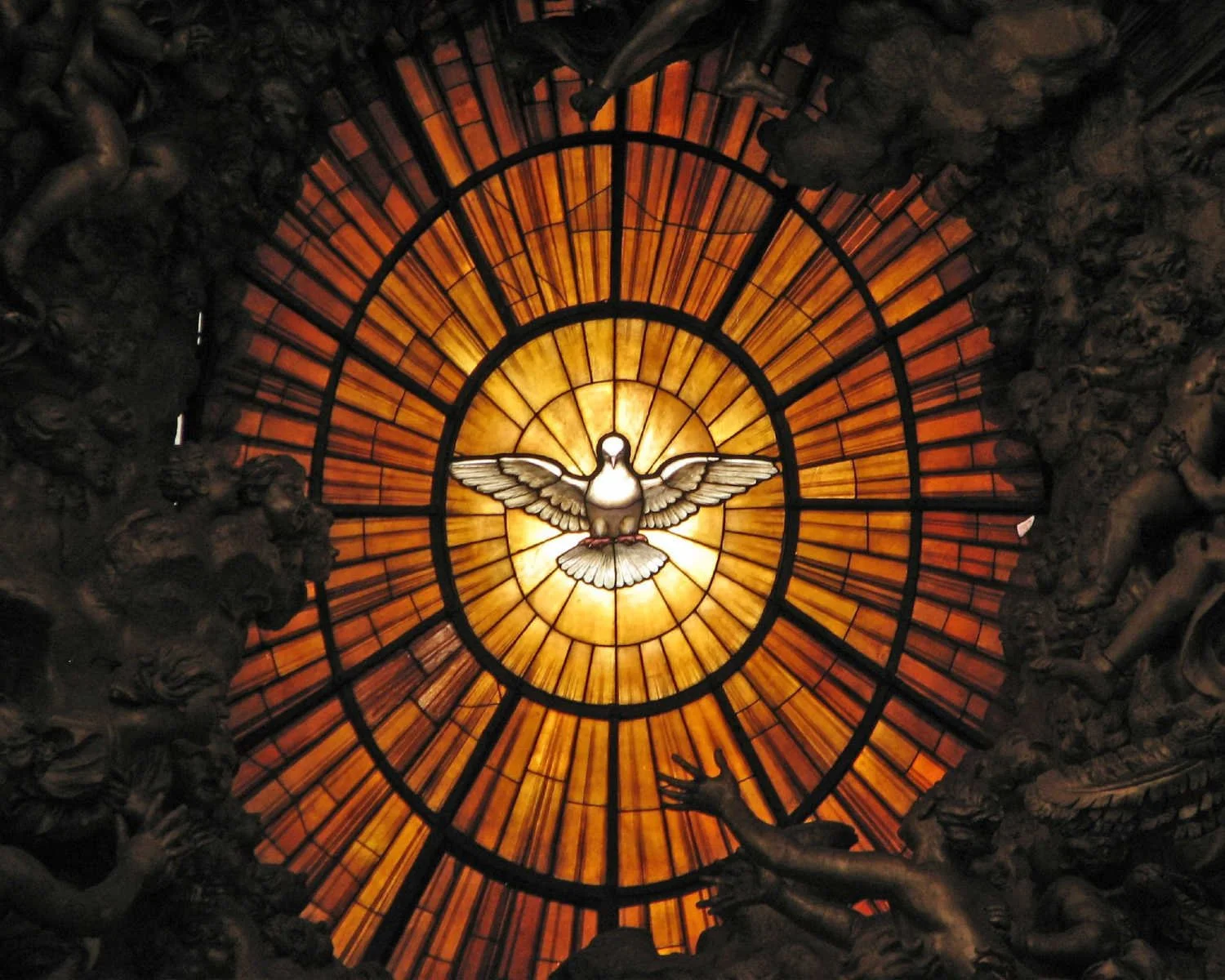
From Creation onward, Scripture often depicts the Holy Spirit as the wind or breath of God. When it swept through Jerusalem at Pentecost, all divisions ceased.
May 20, 2026 by Father Gordon MacRae
For a hot summer post years ago, I wrote “Hot Town: Summer in the Slammer.” My title was a spoof of “Summer in the City,” the famous 1969 hit single by “The Lovin’ Spoonful.” I was sixteen years old when that song hit the charts, but my post about it decades later was sparked by more current heat in my life: the long, hot summer days in prison.
The sealed and barred window in my prison cell then faced due west, so on the hottest summer days there was a build-up of heat in a sort of greenhouse effect within these stone walls, and it could feel very oppresive at times. The windows let in heat, but no air. There are no curtains or shades in prison, and covering cell windows is forbidden. By late in a typical summer day, that cell could feel like a crucible from which there is no escape. There is no air conditioning in prison, but I bought a little nine-inch fan, which was great at circulating the heat.
Underneath each cell window was a small security grate, a five-inch high double-grated steel slot venting through the stone wall to the outside world. By summer each year, the grates are so clogged with dust that not even a hint of moving air passed through them. Prisoners were always trying to devise new ways to clean the small vent.
On one of the hottest days that summer, I watched with great hope out my cell window as towering thunderclouds built in the west late in a stifling afternoon. They grew denser and darker, and then the rarest of things happened. A blast of cool wind flowed out of the west, through the security grate, and filled this cell with cool air. Then came thunder and a torrential rain that released all the day’s heat built up in these stone walls. Blast after blast, the cool wind kept coming. It felt like the very Breath of God.
This post is about the wind, but first I owe thanks to playwrights Jerome Lawrence and Robert E. Lee for my use of the title of their great 1955 American play, “Inherit the Wind.” The play was based on the so-called “Scopes Monkey Trial” of 1925 in which the famous defense lawyer, Clarence Darrow defended John Scopes in a Tennessee court. A high school biology teacher, John Scopes, was charged with violating state law by teaching Darwin’s theory of evolution in science class. In 1925 Tennessee, this violated a state-sanctioned fundamentalist view of the biblical account of Creation. I wrote about our culture’s conflict between science and religion in “Did Stephen Hawking Sacrifice God on the Altar of Science?” Religion is not a topic for scientific inquiry, and science should not be refuted in the name of religion. Those are human conflicts, not God’s.
Most people do not know that “Inherit the Wind,” — both the play and the classic 1960 Spencer Tracy film — first borrowed the title from the Book of Proverbs: “He who troubles his household will inherit the wind, and the fool will be a servant to the wise.” (Proverbs 11:29). It is just possible that the Book of Proverbs itself borrowed the phrase from an even more ancient source: the followers of Pazuzu, the Assyrian god of wind and pestilence. In some ancient Mesopotamian religions, “an ill wind” carried the spirits of demons, and so to inherit the wind could mean generations of suffering for one person’s sin.
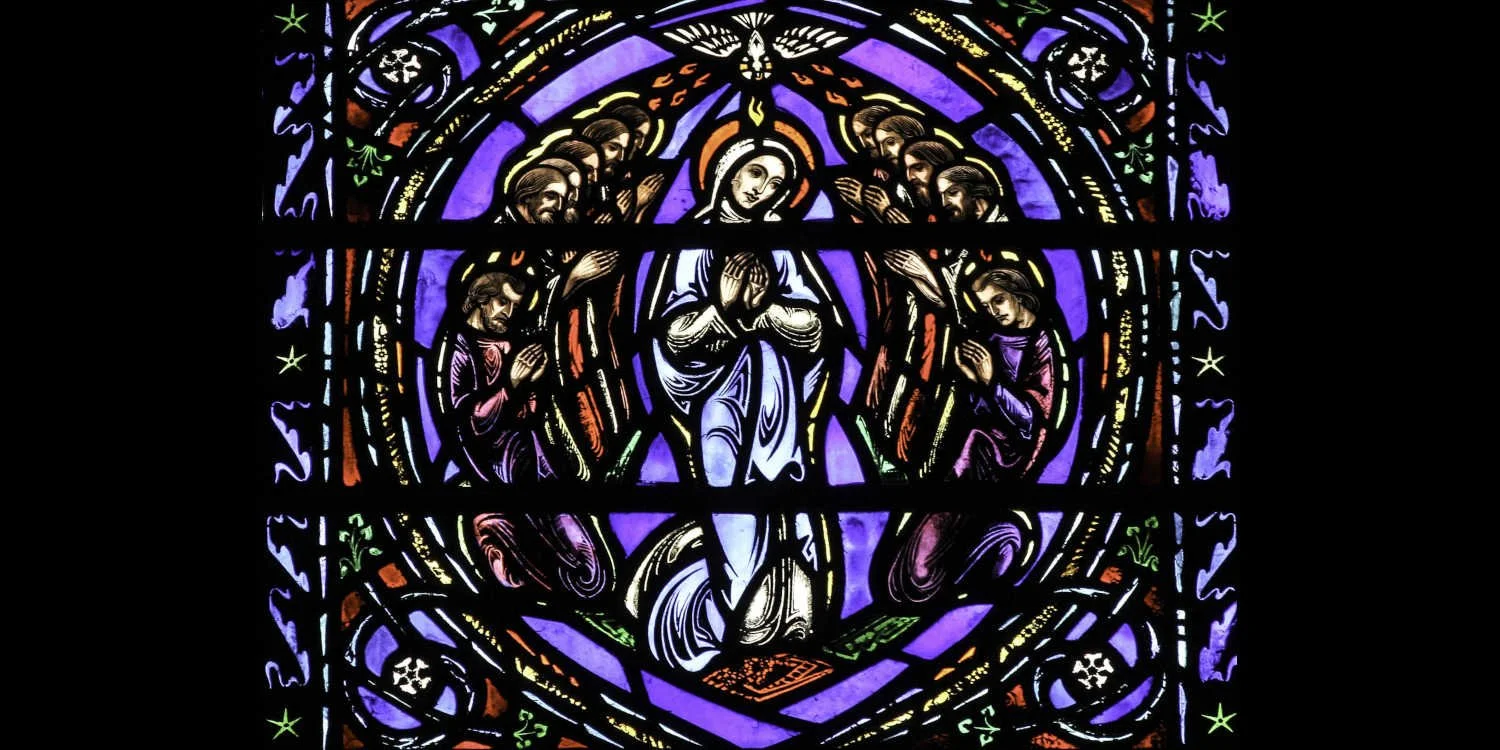
On the Day of Pentecost
I borrowed the title, Inherit the Wind, with a very different connotation. There are 181 references to wind in the Judeo-Christian Scriptures, and many of them are equated with a sacred wind or with the Breath of God. The Hebrew word for both “breath” and “wind” is “ruah,” and the Hebrew name for the Holy Spirit is “ruah ha-Qodesh,” simultaneously meaning the Spirit of God, the Wind of God, and the Breath of God.
The image of the Spirit of God rendered as a mightly wind is ancient. The very first time I picked up a Bible as a child, I was enthralled by a single image that begins the story of our existence in a created Universe with God. It was told in a few simple sentences that taught nothing about the science of cosmology except the most basic fact that I described in a science post, “A Day Without Yesterday.” It had to do with the fact of Creation, not the mechanics of it, and as a child it filled me with wonder:
“In the beginning, God created the heavens and the earth. The earth was without form and void, and darkness was upon the face of the deep; and the Spirit of God was moving over the face of the waters.”
— Genesis 1:1-2 RSV
Some biblical translations render that phrase, “a mighty wind from God was moving over the surface of the waters.” The image this raises is striking. If you have ever seen a film depicting raging winds at sea, the result is chaos.
The New Revised Standard Version of the Bible (NRSV Catholic Edition) translated this more literally: “A Wind of God swept over the face of the waters.” The only thing in existence in the Universe that God did not create is darkness. Darkness is the one reality that was already there at the moment of Creation. The darkness is not a description of something evil, but rather of something absent. The Wind of God moved above its unfathomable depth, and then, with a spoken word, “Let there be light,” there was light, and light overcame the darkness.
The Breath of God has stirred throughout human history ever since, and each time it does, we change dramatically. In the moment man became man, God “breathed into his nostrils the breath of life, and man became a living soul” (Genesis 2:7) in the image and likeness of God. That same image is reflected in the account of the Resurrection appearances of Jesus in the Gospel of John before Pentecost:
“He breathed on them and said, ‘Receive the Holy Spirit.’ ”
— John 20:22
I will forever think of that blast of cool wind through my cell as I read the story of Pentecost in the Acts of the Apostles:
“When the day of Pentecost had come, they were all together in one place. And suddenly a sound came from heaven like the rush of a mighty wind, and it filled the house where they were sitting. There appeared to them tongues as of fire, distributed and resting on each of them, and they were filled with the Holy Spirit.”
— Acts 2:2-4
Saint Luke was a great writer. In three matter-of-fact sentences, with no flourish whatsoever, he conveyed a meeting between God and humankind that would be told for thousands of years. Understanding its setting explains a lot about its meaning, and what happened next.
Some people mistakenly assume that the “Day of Pentecost” referred to is the coming of the Holy Spirit that Saint Luke goes on to describe, but it does not. The “Day of Pentecost” was the reason the Apostles were in Jerusalem in the first place, and “all together in one place,” and it is the reason why “devout men from every nation under heaven” (Acts 2:5) were there. They had all come because Shavuot required a pilgrimage to Jerusalem.
Shavuot is the second of three “pilgrimage festivals” in Jewish tradition. The other two are Passover itself, and “Sukkot,” the Feast of Booths (or “Tents”), which was the Jewish autumn festival marking the harvest of wheat. The Sukkot pilgrimage to Jerusalem was set down in the Book of Leviticus (23:42) and recalls the forty years of wandering and encampment in the desert after the Exodus (hence the “booths” or tents). Sukkot was the setting for the Gospel account of the Transfiguration of Jesus (eg., Mark 9:2-13). Each of the three pilgrimage festivals — as described in the Book of Deuteronomy (16:16) — required adult men of Israel to travel to Jerusalem to mark the feast.
The Shavuot festival, known in Greek as Pentecost (meaning “fifty days”), is also called the “Festival of Weeks” because it is celebrated on the day after the passage of seven full weeks from Passover. Shavuot originally marked the end of the barley season and the beginning of the wheat season. The pilgrimage required that the first fruits of wheat be brought to Jerusalem as an offering, as described in the Book of Leviticus (23:15-17). The feast fell on the Sixth day of the Hebrew month, Sivan. In Rabbinic legend, that was also the date marking the giving of the Torah to Moses on Mount Sinai described in Exodus 8, and that became the main reason for the pilgrimage feast. At Shavuot, specially baked twin loaves made from newly cut wheat were presented in the Jerusalem Temple with great ceremony to commemorate the Tablets of the Law given to Moses on Mount Sinai. In our Gregorian calendar, the Sixth day of Sivan falls on our Feast of Pentecost.
This is the setting for Pentecost in the Book of Acts, Chapter Two. As that driving wind filled the room where the Apostles were gathered, “men of every race and tongue, of every people and nation” emptied into the street at the strange and powerful noise. The mighty wind and tongues of fire described by Saint Luke were reminiscent of the loud wind and fiery descent of the Spirit of God on Mount Sinai at the time of the Exodus:
“On the morning of the third day there were thunders and lightning and a thick cloud upon the mountain, and a very loud trumpet blast, so that all the people who were in the camp trembled. Then Moses brought the people out of the camp to meet God, and they took their stand at the foot of the mountain. And Mount Sinai was wrapped in smoke, because the Lord descended upon it in a fire.”
— Exodus 19:16-19
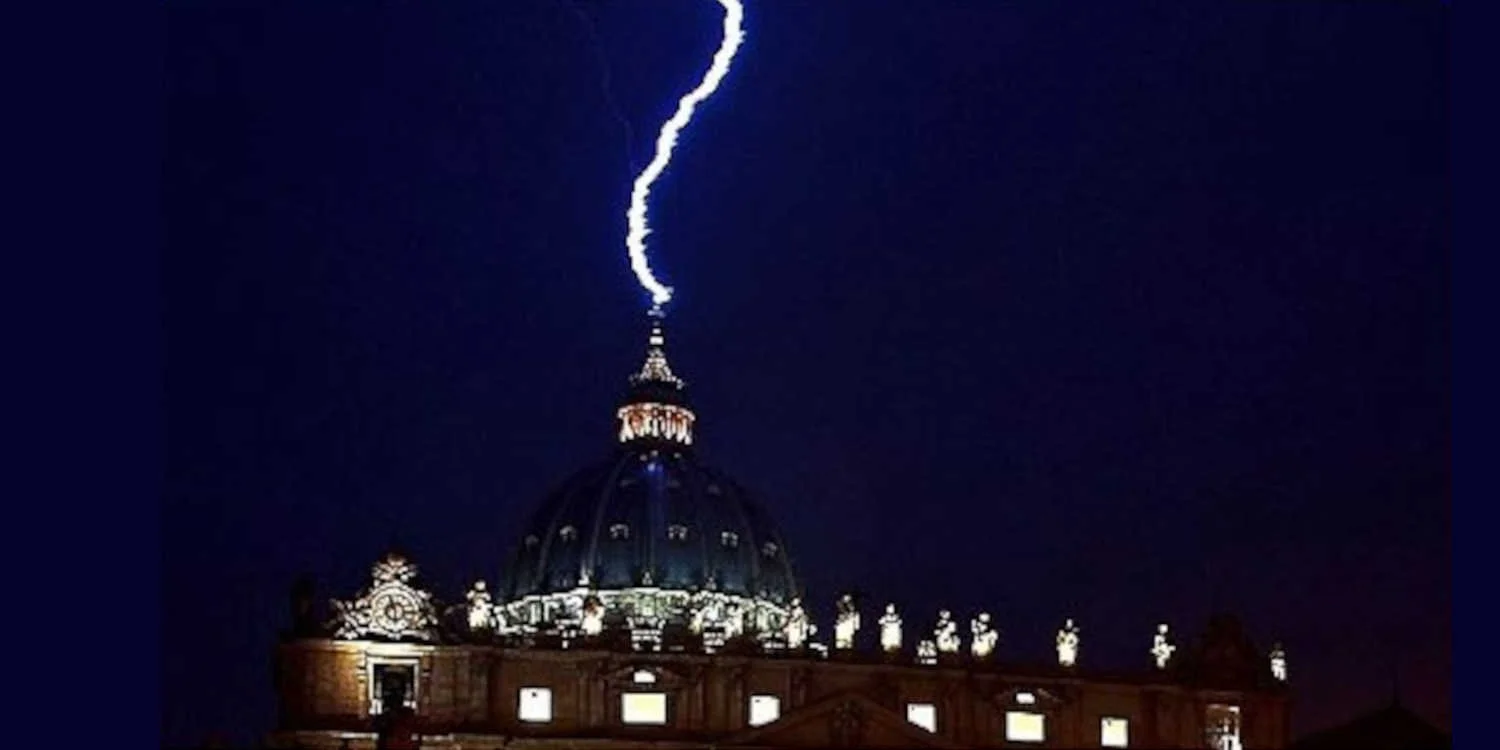
The First Catholic Scandal!
Filled with the Holy Spirit, the Apostles began to address the bewildered crowd gathered in Acts Chapter Two. Each person heard them speaking in his own native tongue, an event that in effect reversed the “tragedy of Babel” described in the Book of Genesis (11:1-9), in which men became divided by foreign languages. In Acts, the Holy Spirit filled not only the Apostles, but many of the crowd as well, “and there were added that day about three thousand souls.” (Acts 2:41).
It was on that day that the Church was born, and before it was even ten minutes old, scandal broke out. Those in the crowd who did not “inherit the wind” immediately accused the Apostles of being drunk at 9:00 in the morning on a major holy day that required a morning fast. Their claims forced Saint Peter into the first Papal defense of the Church:
“Men of Judea and all who dwell in Jerusalem, let this be known to you, and give ear to my words. For these men are not drunk, as you suppose, since it is only the third hour of the day.”
— Acts 2:14-15
Saint Peter went on to preach the Church’s first homily, relying on the Prophet Joel (2:28-32) to explain that God poured out His Spirit because the Messianic Age had begun. The meaning of The Passion of the Christ was revealed, and the Apostolic Succession that first preached Christ continues even today in Salvation History as expressed in Catholic Tradition. There is no human institution on earth that has endured for so long in human history. For me, this is the real evidence that the Church inherits the wind. There is no human language, culture, or government that has existed in linear succession for so long. It is safe to say that no human conflict can put asunder what God Himself has joined. To suggest that a 21st Century tabloid sex scandal can destroy the Church is pure folly.
The point is brought home often in the news headlines, and a great example was in a May 10, 2011 column by Mary Kissel in The Wall Street Journal (“A Cardinal’s Warning on China“). Mary Kissel wrote of China’s Communist regime and its interference in the selection and ordination of Catholic bishops. She summed up the state of affairs quite well:
“The Holy See is thousands of years old; the Chinese Communist Party has ruled for little over six decades, and it faces all kinds of internal instability and challenges to its illegitimate rule. When the regime eventually falls, China will be the holy grail of Catholic missions.”
— WSJ Editorial Page, May 10, 2011
I have a particular challenge as I mark this 32nd Pentecost in prison. As I wrote in “The Last Full Measure of Devotion,” more than the loss of freedom itself, I mourn the passing of the world beyond these stone walls. Sometimes my faith strains under the weight of an unjust imprisonment, but when something as simple as a blast of cool wind through my cell on a blistering summer day can remind me of Pentecost, I have hope. We who have inherited the wind do not measure the weight of our crosses, but rather the strength of our conversion and our identity as True Believers.
In the last words of the Resurrected Christ to the Apostles as they gathered in fear of his Crucifixion and the torment of pursuit, Christ never promised them a rose garden instead, “He breathed on them and said to them, ‘Receive the Holy Spirit.’ ” (John 20:22)
+ + +
Note from Father Gordon MacRae: “Receive the Holy Spirit.” Join us a three-minute meditation on the event of Pentecost as the Benedictine Monks of the Abbey of Santo Domingo de Silos chant the Pentecostal hymn “Veni Creator Spiritus.”
This post will be added to our Sacred Scripture collection, The Bible Speaks. You may also like these related links from Beyond These Stone Walls:
The Holy Spirit and the Book of Ruth at Pentecost
For Mother Teresa of Calcutta, Pentecost Illumined the Night
Forty Years of Priesthood in the Mighty Wind of Pentecost
+ + +
Veni Creator Spiritus

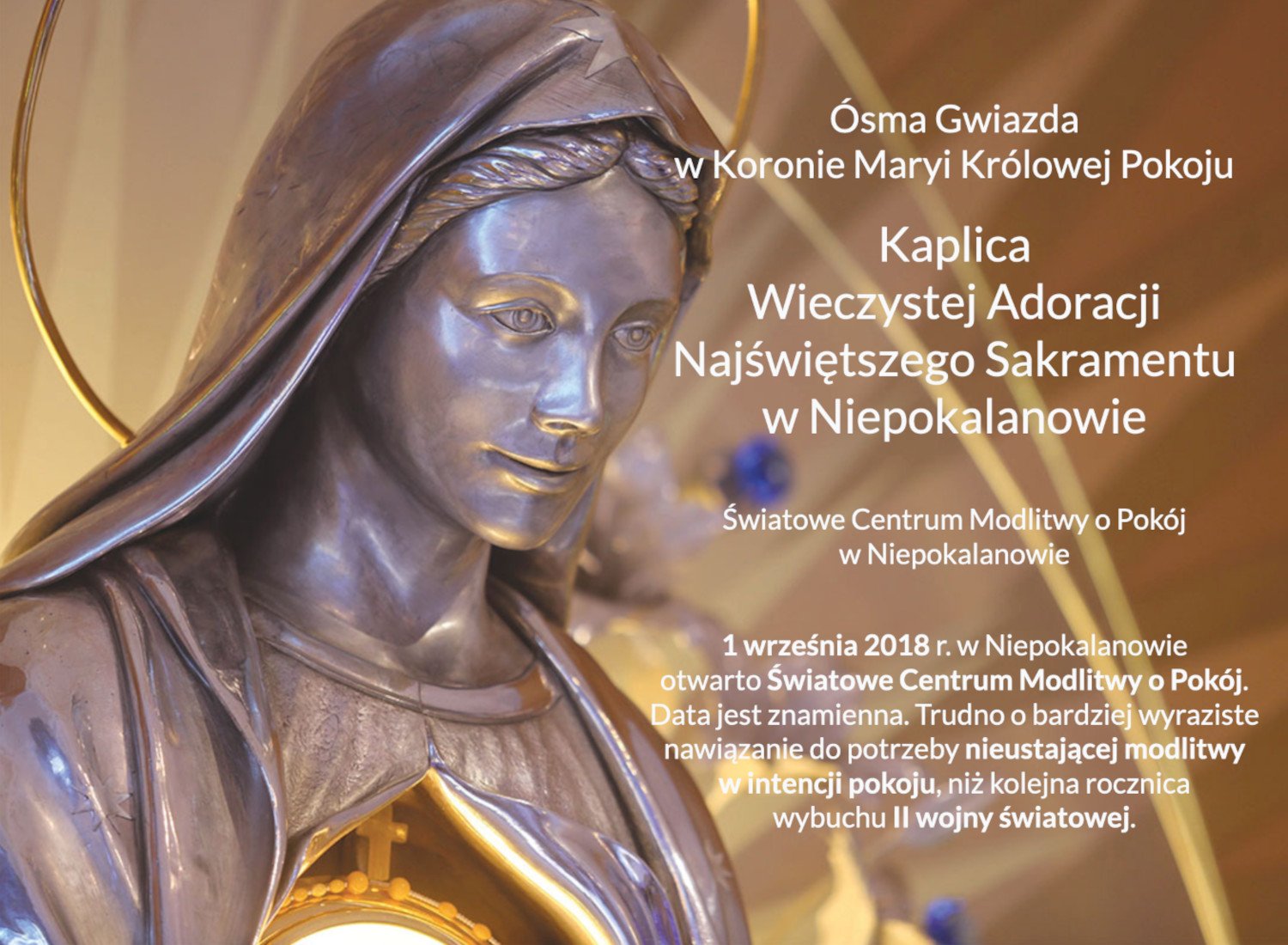

The Eucharistic Adoration Chapel established by Saint Maximilian Kolbe was inaugurated at the outbreak of World War II. It was restored as a Chapel of Adoration in September, 2018, the commemoration of the date that the war began. It is now part of the World Center of Prayer for Peace. The live internet feed of the Adoration Chapel at Niepokalanow — sponsored by EWTN — was established just a few weeks before we discovered it and began to include in at Beyond These Stone Walls. Click “Watch on YouTube” in the lower left corner to see how many people around the world are present there with you. The number appears below the symbol for EWTN.
Click or tap here to proceed to the Adoration Chapel.
The following is a translation from the Polish in the image above: “Eighth Star in the Crown of Mary Queen of Peace” “Chapel of Perpetual Adoration of the Blessed Sacrament at Niepokalanow. World Center of Prayer for Peace.” “On September 1, 2018, the World Center of Prayer for Peace in Niepokalanow was opened. It would be difficult to find a more expressive reference to the need for constant prayer for peace than the anniversary of the outbreak of World War II.”
For the Catholic theology behind this image, visit my post, “The Ark of the Covenant and the Mother of God.”
Science and Faith Are Not Mutually Incompatible
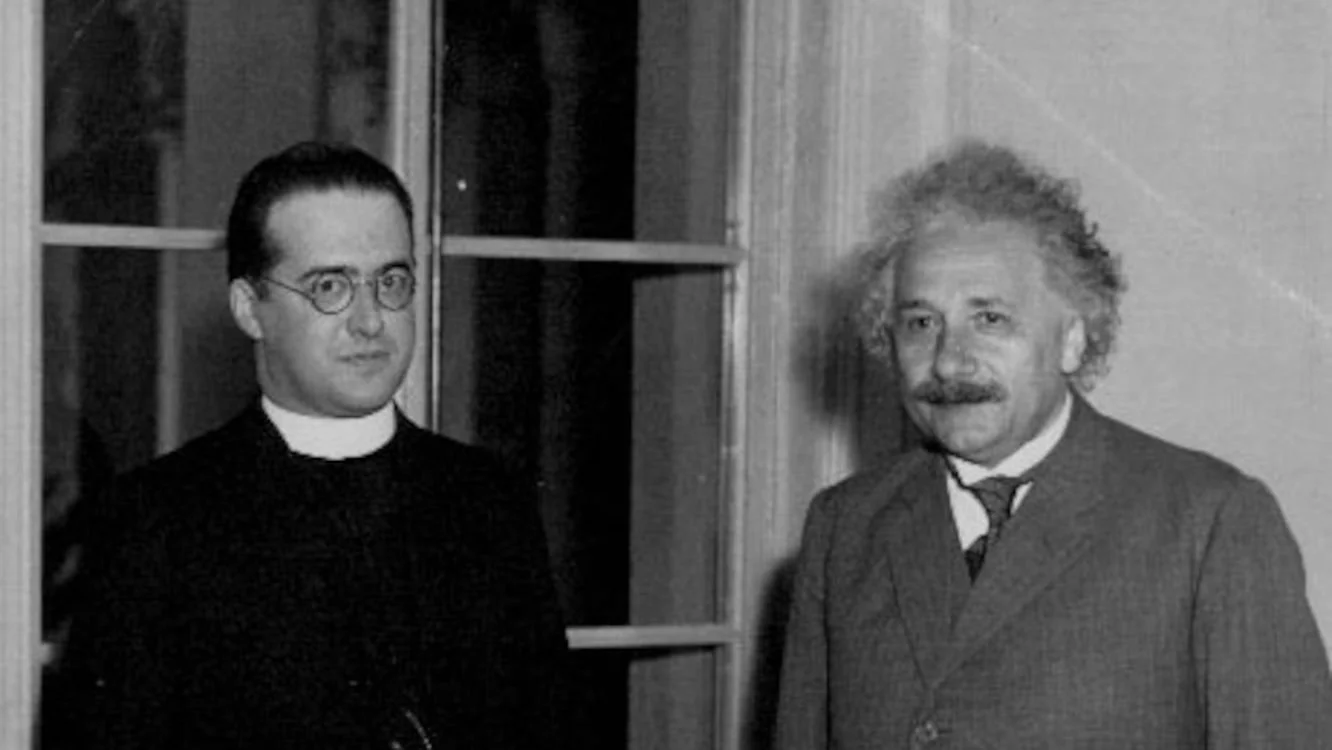
Albert Einstein honored Georges Lemaitre, the priest, physicist and mathematician whose Big Bang Theory is now the scientifically accepted origin of the universe.
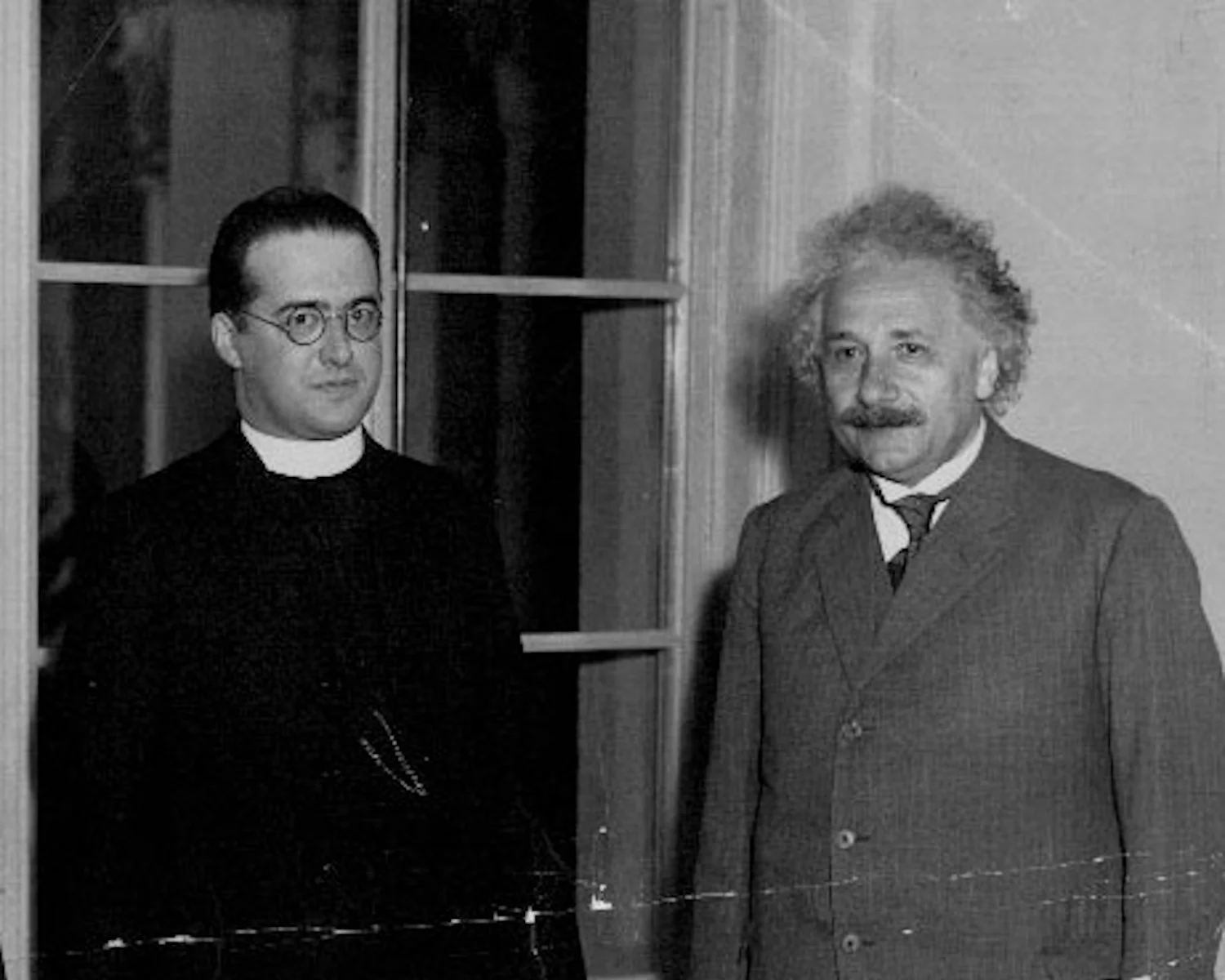
Albert Einstein honored Georges Lemaitre, the priest, physicist and mathematician whose Big Bang Theory is now the scientifically accepted origin of the universe.
March 11, 2026 by Father Gordon MacRae
In 2016, an issue of the former Catholic newspaper Our Sunday Visitor profiled some eye-opening research in an article entitled “Young People Are Leaving the Faith: Here’s Why” (August 27, 2016). It was an analysis of two national studies conducted by The Center for Applied Research in the Apostolate (CARA) to provide insight into the reasons why a third of “millennials” who were raised Catholic reject the faith of their parents as young adults.
In the CARA studies, “Millennials” are defined as those born in 1982 or later. The majority of the young adults who responded with comments on the research indicated that they left their faith for science, concluding that Catholicism cannot be reconciled with science at the high school and university level. They report finding little in the Catholic presentation of faith that challenges that view. The OSV summary included a sampling of the responses behind their decisions:
“As I learn more about the world around me and understand things that I once did not, I find the thought of an all-powerful being to be less and less believable.”
“Catholic beliefs aren’t based on fact… nothing can be disproved, but it certainly shouldn’t be taken seriously.”
“I realized that religion is in complete contradiction with the rational and scientific world, and to continue to subscribe to a religion would be hypocritical.”
“As I started to enjoy math and science more, I realized the discrepancy between religion and science… Catholicism especially did seem to clash fairly well.”
“[Faith] no longer fits into what I understand of the universe.”
These responses reflect a pattern of thought familiar to many parents of young adult Catholics and others concerned about the dismal conclusions of the CARA research. This is also one of the most common pleas I hear on a global scale from parents and grandparents and other readers of this blog.
I must seem to be an enigma to those who have left our faith or are pondering doing so. Judging from my posts of the last ten years, though it was never intended to be so, I seem to devote almost equal time to both faith and science. For example, we have recently collected in one place a number of posts dedicated to the understanding of Sacred Scripture. We called this collection, “The Bible Speaks.” Apparently it speaks quite loudly. There are presently some 43 titles in that collection, and some have broken records among the readership of this blog.
But there is a similar phenomenon that has been taking place in more recent years. I have also written several posts about science and especially the sciences of cosmology, astronomy and particle physics. One of my friends here who comes to the library where I work has asked me for copies of posts over the last few years. He recently complained of feeling a sense of whiplash, bouncing between science and religion, but he said he finds both to be fascinating. To demonstrate this phenomenon one recent post has broken all records in numbers of readers and especially in numbers of readers who come to it again and again, and who share it. That post is “Did Stephen Hawking Sacrifice God on the Altar of Science?” It seems that many people believed that he did, but I have made a case for the opposite. What strikes me most about that post is the unfathomable number of educational institutions of higher learning that are also sharing it and recommending it.
The same has held true for another recent post that blends principles of both science and faith entitled “The Higgs Boson God Particle: All Things Visible and Invisible.” Our Editor has observed and commented on the high number of academic institutions that have also been visiting religious titles on this blog. Some of these institutions are dedicated to scientific research, and yet here they are suddenly delving into the mysteries of Catholic faith. And yet no one is denouncing anything. They seem to come here to observe and to learn, not to refute.
True Believers
I have some firsthand experience with the challenging questions posed by science for the faith of younger Catholics. A decade ago at one university, the son of a reader of this blog, a science major, sent me a letter filled with questions. The previous summer, his mother had emailed him with a link to one of my forays into the science of cosmology entitled, “Science and Faith and the Big Bang Theory of Creation.” In his letter to me the student wrote that he pretty much just dismissed the post as irrelevant without having read it. He read his mother’s email, but didn’t bother clicking on the link until two months later. The student wrote that he grew up in a devout family that accepted Catholic teachings about the world and universe without question. He attended Catholic schools until switching to a public high school, then abandoned his faith in adolescence because his interest in science made faith seem irrelevant.
He believed, or rather was led to believe, that science and religion are mutually incompatible, unable to coexist in a person of science. “The bias fed to me in academia,” he wrote in a much later letter, “was that science is the new source of all faith, and to be taken seriously as a scientist requires setting aside the faith of my parents in this new world order.” And thus ended his identity as a Catholic. It is a troubling story given that for every convert entering the Catholic faith in America in recent years, more than six others left.
The exit of millennials is not at all for the reasons typically put forward by older Catholics who become disenchanted with their Church. In the CARA study, Catholic scandal and the Latin Mass are barely touched upon as influential reasons. And the millennials are not leaving to embrace some other faith. They now constitute the fastest growing expression of religious belief in America — the “Nones,” who self-identify with no religious affiliation at all. A decade ago in “A Crisis of Faith, Not of Worship,” a soul-stirring post at The Catholic Thing, (Aug. 24, 2016) Father Mark A. Pilon made this point well:
“The real underlying problem is simple: it’s a massive loss of faith… About thirty years ago, a reliable survey revealed that only about 30 percent of Catholics believed in the Real Presence of Christ in the Eucharist any longer. Why didn’t the bishops call an emergency meeting to reflect on this loss of faith, as they did in 2002 to deal with sexual abuse? … The highest priority has to be this basic question: What caused this massive loss of faith, and how do we work to resurrect that lost faith?”
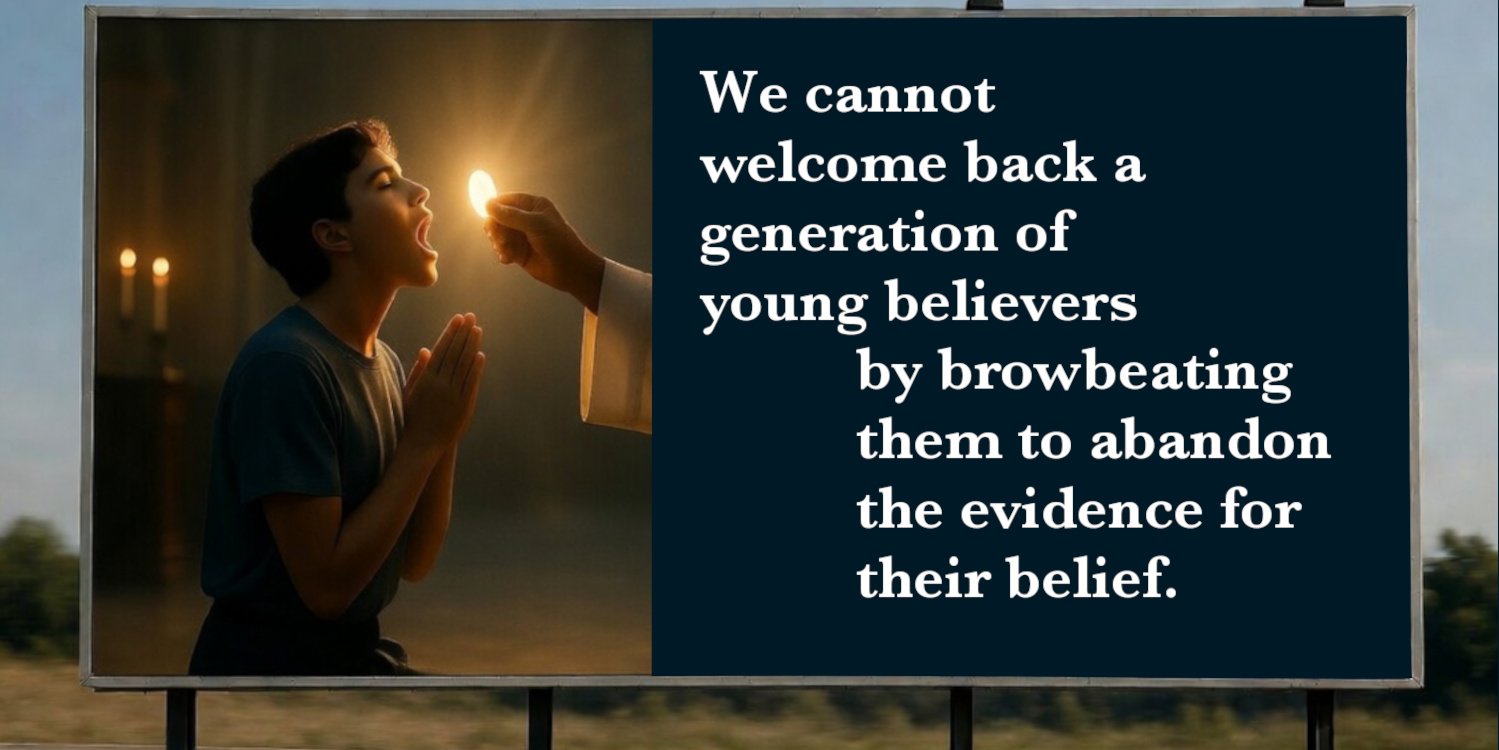
These are very relevant questions, but some have already begun to change. In early 2025 I wrote a post entitled “On the Great Biblical Adventure, the Truth Will Make You Free.” Something happened over the preceding year that signaled a great cultural change toward openness to religion and especially biblical studies. Book publishers have observed that Bible sales greatly increased by double digits toward the end of 2024. A lot of factors were proposed as contributing to this, including the election of 2024, the assassination attempts on the leading U.S. presidential candidate at that time, and later the assassination of Charlie Kirk, founder of Turning Point USA. These were inflection points causing broad swaths of America and elsewhere in the free world to pause and reassess where we are and where we are going. The biblical interest and its resulting growth of interest in faith also has continued to this day. For those who have suggested that Catholic leaders need to take advantage of this trend, a good start would be to moderate “climate change” as an example of our highest priority while abandoning other priorities, such as respect for life. Our hierarchy might also want to reconsider its revulsion for the Traditional Latin Mass and for those who find spiritual comfort in it, many of whom are younger Catholics. And a prohibition against kneeling to receive the True Presence of Christ is simply mind-boggling for true believers. We cannot welcome back a generation of young believers by browbeating them to abandon the evidence for their belief.
The Folly of Leaving Faith Behind for Science
The answer to the suspected disconnect between science and faith is not as simple as seeking relevancy by replacing faith with science. True believers in both find not only “common ground” but windows to the universe that will leave the believer in awe. The student who had been writing to me, for example, is now on his way back. As time wore on, his mother asked him what he thought about the post she sent him. He scurried to find “Science and Faith and the Big Bang Theory of Creation” buried in his inbox, and then he actually read it.
He later wrote that he was “bowled over” by it, and that it turned on its head the entire scientific orthodoxy that had been fed to him claiming that only freedom from religion could legitimately engage him with the world of science. Science with a bias against faith experience prevented him from seeing the bigger picture.
This student had many questions. First and foremost among them was this: “How is it that you, a person obviously well versed in science, could endure such injustice and still also believe in God?” It was a good question, but the answer requires something other than science’s doubts about faith. A better beginning question was the one I posed in return: “How is it that you, a science major in an American university, never before heard or read that the scientist now considered to be the Father of The Big Bang and Modern Cosmology was a Belgian astrophysicist who was also a Catholic priest?”
That question generated several letters over the last two years, suggesting BTSW posts that he has read and reread and shown to other science majors at his school. Before I get into that, however, I want to describe another development that I read some years ago by Beckie Strum in The Wall Street Journal: “U.S. Loses Top School Ranking to U.K.’s Oxford” (WSJ, Sept. 22, 2016).
For the first time, a university outside the United States was ranked the best university in the world, unseating the California Institute of Technology (Caltech) as number one. The U.K.’s Oxford University, the oldest college in the English speaking world, founded in the year 1096, took the top spot in the World University Rankings. Oxford knocked CalTech down to second place, MIT to fifth, and Harvard to sixth bin 2016. At this writing, Oxford has retained that place of primacy for a decade.
Oxford is also host to something missing from more narrowly focused American universities. Oxford is home to a research center called the Ian Ramsey Center for Science & Religion. Its Research Director at the time was Father Andrew Pinsent, a Catholic priest and particle physicist who was formerly on the science team at CERN, the European Council for Nuclear Research.
Father Andrew Pinsent holds a Ph.D. in particle physics from Oxford, a Ph.D. in philosophy from St. Louis University, and advanced degrees in theology from the Pontifical Gregorian University in Rome. He is a member of the United Kingdom Institute of Physics and the Vatican Conference for Scientists, and presently serves on the faculty and formation staff of a major U.S. seminary.
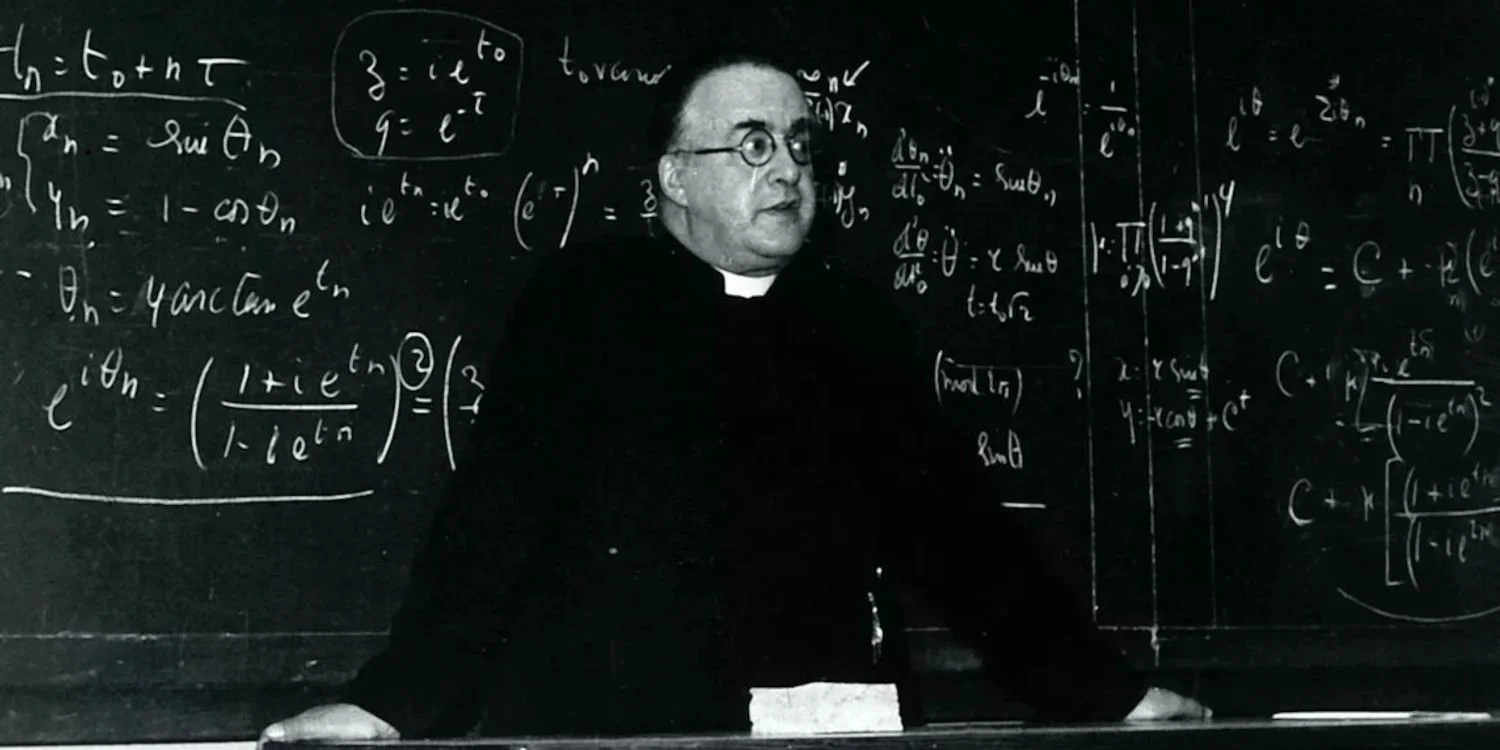
Father Pinsent has also been a guest writer at this blog. His post, “Fr Georges Lemaître, the Priest Who Discovered the Big Bang” was the final leverage that my university friend and correspondent needed to accept the fact that something essential has been missing from his education and exposure in both science and religion. The fact that his science education did not include the story of Georges Lemaitre — the astronomer, mathematician, physicist, and Catholic priest who changed the mind of Albert Einstein on the nature and origin of the universe — told him that it was science, and not faith, that deprived him of a wider world view.
This is a story that has been covered and uncovered at Beyond These Stone Walls in a series of science posts that has run parallel to our collection on Sacred Scripture. Reading these, and especially exploring Father Pinsent’s work, has opened my friend’s eyes as a young Catholic scientist, but it was a part of Father Andrew Pinsent’s guest post that more fully opened my own eyes when he wrote:
“What is to be done to help raise the profile of people like Fr Georges Lemaitre? Among Catholics with some kind of popular outreach, Fr Gordon MacRae, through his widely-read blog Beyond These Stone Walls, has done more than almost anyone I know in recent years to draw attention to Fr Lemaitre. Inspired in part by Fr Gordon’s work, my colleagues and I in England have put together a series of posters called the “Catholic Knowledge Network.”
— Fr Andrew Pinsent, “Fr Georges Lemaître, the Priest Who Discovered the Big Bang”
I think I have come to understand Father Georges Lemaitre’s science whose footprint in the history of modern cosmology is parallel to that of Albert Einstein. They were colleagues who became friends, primarily through Einstein’s great respect for Fr Lemaitre’s gifted mathematical and scientific mind. After a lecture about his theory of relativity at a European university in the 1930s, Einstein was approached by a science writer who asked him whether he thought anyone in the audience really comprehended his work. Einstein’s simple answer was “Lemaitre, certainly. As for the rest…”
The scientific dogma of the age was that the universe was static, eternal, and unchanging. Einstein also embraced this view, but it dismissed the beliefs of established religion that the universe was created from nothing.
However, Georges Lemaitre and Russian mathematician Aleksander Friedmann had more faith in Einstein’s mathematics than other scientists of their time. At first, Einstein payed little attention when they used his own equations to conclude that the universe is not static but expanding, and its rate of expansion is increasing when all established science said the opposite.
It was the American astronomer, Edwin Hubble (in whose honor the Hubble Space Telescope is named) who in 1929 discovered physical evidence that Lemaitre is right, that the universe is in fact expanding. Two years later in 1931, Father Georges Lemaitre concluded that the universe began “On a day without yesterday,” 13.8 billion years ago, with the explosion of a primordial atom from which space, time, and matter were created.
The idea was ridiculed, and “The Big Bang” was a pejorative term some scientists used to taunt the physicist priest. But he was right, and he turned science on its head with this revelation that has since been demonstrated with the discovery of cosmic background radiation emanating from The Big Bang.
Einstein, who first disagreed, ended up applauding the idea as “The most beautiful explanation of creation I have ever heard.” It was a bigger bang for science than even Einstein realized. It took the language of mathematics to comprehend that it points to what faith always told us: a universe arising out of nothing.
I think I finally came to some rudimentary understanding of the science behind this through the language of mathematics. For this I owe thanks to Robyn Arianrhod, and her book, Einstein’s Heroes: Imagining the World Through the Language of Mathematics (Oxford University Press 2005):
“In 1932, Lemaitre sowed the seeds of the Big Bang theory when he suggested that the universe had started as an explosion of a ‘primeval atom’ that… continued expanding from that explosive beginning. Some of the world’s most ancient creation myths have also imagined the world exploding from some sort of cosmic seed…”
“In 1970, English physicists Stephen Hawking and Roger Penrose showed that Einstein’s equations predicted the universe had expanded not from a tiny piece of matter located in an otherwise empty cosmos, but from a single point in four-dimensional spacetime. This meant that the Big Bang was not an ordinary explosion which took place at a specific three-dimensional location at a given time on the cosmic stage, but that Space and time themselves were actually created in the explosion, along with all matter and energy. Before this point … there was no time and no space. No geometry, no matter, nothing. The universe simply appeared out of nowhere. Out of nothing.”
— Einstein’s Heroes, p. 187
“The universe simply appeared out of nowhere. Out of nothing.” Take a moment to ponder that conclusion of science and it will sound a lot like a tenet of faith. Science, mathematics, and faith all open a window to the universe onto the same panoramic vista. And the awe this truth evokes is at one and the same time the comprehension of science and the inspiration of faith.
And as for my student-friend’s first question about the mystery of suffering in the light of faith, I can only gather up some prescientific humility to echo God against the protest of Job:
“Where were you when I laid the foundations of the earth?… Can you bind the chains of the Pleiades, or loose the cords of Orion?”
— Job 38: 4, 31

+ + +
Note from Father Gordon MacRae: Thank you for reading and sharing this post.
You might also like these other posts from Beyond These Stone Walls about the great adventure of science and faith:
On the Great Biblical Adventure, the Truth Will Make You Free
Science and Faith and the Big Bang Theory of Creation
The Higgs Boson God Particle: All Things Visible and Invisible
The Eucharistic Adoration Chapel established by Saint Maximilian Kolbe was inaugurated at the outbreak of World War II. It was restored as a Chapel of Adoration in September, 2018, the commemoration of the date that the war began. It is now part of the World Center of Prayer for Peace. The live internet feed of the Adoration Chapel at Niepokalanow — sponsored by EWTN — was established just a few weeks before we discovered it and began to include in at Beyond These Stone Walls. Click “Watch on YouTube” in the lower left corner to see how many people around the world are present there with you. The number appears below the symbol for EWTN.
Click or tap here to proceed to the Adoration Chapel.
The following is a translation from the Polish in the image above: “Eighth Star in the Crown of Mary Queen of Peace” “Chapel of Perpetual Adoration of the Blessed Sacrament at Niepokalanow. World Center of Prayer for Peace.” “On September 1, 2018, the World Center of Prayer for Peace in Niepokalanow was opened. It would be difficult to find a more expressive reference to the need for constant prayer for peace than the anniversary of the outbreak of World War II.”
For the Catholic theology behind this image, visit my post, “The Ark of the Covenant and the Mother of God.”

“A Day Without Yesterday:” Father Georges Lemaitre and The Big Bang
The Catholic Church in Belgium can take pride in the story of Georges Lemaitre, the priest and mathematician who changed the mind of Einstein on the creation of The Universe.

The Catholic Church in Belgium can take pride in the story of Georges Lemaitre, the priest and mathematician who changed the mind of Einstein on the creation of The Universe.
(This post needs a disclaimer, so here it is. It’s a post about science and one of its heroes. It’s a story I can’t tell without a heavy dose of science, so please bear with me. I read the post to my friends Pornchai, Joseph, and Skooter. Pornchai loved the math parts. Joseph said it was “very interesting,” and Skooter yawned and said, “You CAN’T print this.” When I told Charlene about the post, she said, “Well, people may never read your blog again.” Well, I sure hope that’s not the case. I happen to think this is a really cool story, so please indulge me these few minutes of science and history.)
The late Carl Sagan was a professor of astronomy at Cornell University when he wrote his 1980 book, Cosmos. It spent 77 weeks on the New York Times Best Seller List. Later in the 1980s, Dr. Sagan narrated a popular PBS series also called “Cosmos,” based on his book. Sagan was much imitated for his monotone intonation of “BILLions and BILLions of stars.” I taped all the installments of “Cosmos,” and watched each at least twice.

More than once, I fell asleep listening to Sagan’s monotone “BILLions and BILLions of stars.” I hope you’re not doing the same right now. Science was my first love as a geeky young man. Religion and faith eventually overtook it, but science never left me. Astronomy has been a lifelong fascination, and Carl Sagan was one of its icons. That’s why I was enthralled 25 years ago to walk out of a bookstore with my reserve copy of Sagan’s first and only novel, Contact (Simon & Shuster, 1985).
Contact was about radio astronomy and the SETI project — the Search for Extraterrestrial Intelligence. It wasn’t science fiction in the way “Star Trek” was science fiction. Contact was science AND fiction, a novel crafted with real science, and no one but Carl Sagan could have pulled it off. The sheer vastness of the Cosmos unfolded with crystal clarity in Sagan’s prose, a vastness the human mind can have difficulty fathoming. Anyone who thinks we are visited by aliens from other planets doesn’t understand the vastness of it all.
The central theme of Contact was the challenge astronomy poses to religion. In the story, SETI scientist Eleanor Arroway — a wonderful character portrayed in the film version by actress Jodie Foster — becomes the first radio astronomer to detect a signal emitting from another civilization. The signal came from a planet orbiting Vega, a star, not unlike our own, about 26 light years from Earth. The message of the book (and film) is clear: if another species like us exists, and we are ever to have contact, it will be in just this way — via radio waves moving through space at light speed.

Here comes the geeky part. For those who never caught the science bug, a “light year” is a unit of distance, not time. Light moves through space at a known rate of speed — about 186,000 miles per second. At that rate, light travels through space about 5.86 trillion miles in one year. That’s a “light year,” and in numbers it represents 5,860,000,000,000 miles. In the vacuum of space, radio waves also travel at the speed of light.
The galaxy in which we live — the one we call “The Milky Way” — is a more or less flat spiral disk comprised of about 100 billion stars. The Milky Way measures about 100,000 light years across. That’s a span of about 6,000,000,000,000,000,000 miles, give or take a few. Please don’t ask me to convert this to kilometers!
This means that light — or radio waves — from across our galaxy can take up to 100,000 years to reach Earth. One of The Milky Way Galaxy’s approximately 100 billion stars is shining in my cell window at this moment. Our galaxy is one of about fifty billion galaxies now known to comprise The Universe. The largest known to us is thirteen times larger than The Milky Way. You get the picture. The Universe is immense.

If E.T. Phones Home, Make Sure It’s Collect!
In a recent post I made a cynical comment about UFOs. I wrote, “The real proof of intelligent life in The Universe is that they don’t come here.” It was an attempt at humor, but the problem with searching for extraterrestrial intelligence is one of practical physics. The limit of our ability to “listen” is a mere few hundred light years from Earth, a tiny fraction of the galaxy — a mere survey of our own backyard. If there is another civilization out there, we may never know it.
Even if we hear from them some day, it will be a one-sided conversation. The signal we may one day receive might have been broadcast hundreds — perhaps thousands — of years earlier. If we respond, it will take hundreds or thousands of years for our response to be detected. We sure won’t be trading recipes, or asking, “What’s new?” If there’s anyone out there — and so far we know of no one else — we can forget about any exchange of ideas, let alone ambassadors.
Still, I devoured Contact twice in 1985, then I wrote Carl Sagan a letter at Cornell. I understood that Sagan was an atheist, but the central story line of Contact was the effect the discovery of life elsewhere might have on religion, especially on fundamentalist Protestant sects who seemed the most threatened by the discovery.
I thought Carl Sagan handled the controversy quite well, without judgments, and even with some respect for the religious figures among his characters. In my letter, I pointed out to Dr. Sagan that Catholicism, the largest denomination of Christians in America, would not necessarily share in the anxiety such a discovery would bring to some other faiths. I wrote that if our galactic neighbors were embodied souls, like us, then they would be in need of redemption in the same manner in which we have been redeemed.
Weeks later, when an envelope from Cornell University’s Department of Astronomy and Space Sciences arrived, I was so excited my heart was beating BILLions and BILLions of times! Carl Sagan was most gracious. He wrote that my comments were very meaningful to him, and he added, “You write in the spirit of Georges Lemaitre!”
I framed that letter and put it on my rectory office wall. I wanted everyone I knew to see that Carl Sagan compared me with Georges Lemaitre! I was profoundly moved. But no one I knew had a clue who Georges Lemaitre was. I must remedy that. He was one of the enduring heroes of my life and priesthood. He still is!

Father of the Big Bang
Georges Lemaitre died on June 20, 1966 when I was 13 years old. It was the year “Star Trek” debuted on network television and I was mesmerized by space and the prospect of space travel. Georges Lemaitre was a Belgian scientist and mathematician, a pioneer in astrophysics, and the originator of what became known in science as “The Big Bang” theory — which, by the way, is no longer considered in cosmology to be a theory.
But first and foremost, Father Lemaitre was a Catholic priest. He was ordained in 1923 after earning doctorates in mathematics and science. Father Lemaitre studied Einstein’s celebrated general theory of relativity at Cambridge University, but was troubled by Einstein’s model of an always-existing, never changing universe. It was that model, widely accepted in science, that developed a wide chasm between science and the Judeo-Christian understanding of Creation. Einstein and others came to hold that The Universe had no beginning and no end, and therefore the word “Creation” could not apply.
Father Lemaitre saw problems with Einstein’s “Steady State” theory, and what Einstein called “The Cosmological Constant” in which he maintained that The Universe was relatively unchanging over time. From his chair in science at Catholic University of Louvain in Belgium from 1925 to 1931, Father Lemaitre put his formidable mind to work.
He developed both a mathematical equation and a scientific basis for what he termed the “primeval atom,” a sort of cosmic egg from which The Universe was created. He also concluded that The Universe is not static, as Einstein believed, but expanding at an ever increasing rate, and he put forward a mathematical model to prove it. In 1998, Father Lemaitre was proven to be correct.
Einstein publicly disagreed with Lemaitre’s conclusions, and the priest was not taken seriously by mainstream science largely because of that. In his book, The Universe in a Nutshell (Bantam Books, 2001), mathematician and physicist Stephen Hawking addressed the controversy:
“If galaxies are moving apart now, it means they must have been closer together in the past. About fifteen billion years ago, they would have been on top of each other, and the density would have been very large. This state was called the “primeval atom” by the Catholic priest Georges Lemaitre, who was the first to investigate the origin of the universe that we call the big bang. Einstein seems never to have taken the big bang seriously”
Stephen Hawking actually calculated the density of Father Lemaitre’s “Primeval Atom” just prior to The Big Bang. It was 1,000,000,000,000,000,000,000,000,000,000,000,000,000,000,000,000,000,000,000,000,000,000,000,000, tons per square inch. I haven’t checked this math myself, so we’ll take Professor Hawking’s word for it.
Though Einstein disagreed with Father Lemaitre at first, he respected his brilliant mathematical mind. When Einstein presented his theories to a packed audience of scientists in Brussels in 1933, he was asked if he thought his ideas were understood by everyone present. “By Professor D, perhaps,” Einstein replied, “And certainly by Lemaitre, as for the rest, I don’t think so.”
When Father Lemaitre presented his concepts of the “primeval atom” and an expanding universe, Einstein told him, “Your mathematics is perfect, but your grasp of physics is abominable.”
They were words Einstein would one day have to take back. When Edwin Hubble and other astronomers read Father Lemaitre’s paper, they became convinced that it was Einstein’s physics that was flawed. They could only conclude that the priest and scientist was correct about the creation and expansion of The Universe from the “primeval atom,” and the fact that time, space and matter actually did begin at a moment of creation, and that The Universe will end.
It’s an ironic twist that science often accuses religion of holding back the truth about science. In the case of Father Lemaitre and The Big Bang, it was science that refused to believe the evident truth that a Catholic priest proposed to a mathematical certainty: that the true origin of The Universe, and of time and space, is its creation on “a day without yesterday.”

For his work, Father Lemaitre was inducted into the Royal Academy of Belgium, and was awarded the Franqui prize by an international commission of scientists. Pope Pius XI applauded Father Lemaitre’s view of the creation of the universe and appointed him to the Pontifical Academy of Science. Later, Pope Pius XII declared that Father Lemaitre’s work was a vindication of the Biblical account of creation.
The Pope saw in Father Lemaitre’s brilliance a scientific model of a created Universe that bridged science and faith and halted the growing sense that each must entirely reject the other.
Einstein finally came around to endorse, if not openly embrace Father Lemaitre’s conclusions. He admitted that his concept of an eternal, unchanging universe was an error. “The Cosmological Constant was my greatest mistake,” he said.
In January, 1933, Father Georges Lemaitre traveled to California to present a series of seminars. When Father Lemaitre finished his lecture on the nature and origin of The Universe, a man in the back stood and applauded, and said, “This is the most beautiful and satisfying explanation of creation to which I have ever listened.” Everyone present knew that voice. It was Albert Einstein, and he actually said the “C” word so disdained by the science of his time: “Creation!”
“I want to know how God created this world. I am not interested in this or that phenomenon, in the spectrum of this or that element. I want to know God’s thoughts; the rest are details.”
“The more we know of the universe, the more profoundly we are struck by a Reason whose ways we can only contemplate with astonishment” … Albert Einstein once said that in the laws of nature, ‘there is revealed such a superior Reason that everything significant which has arisen out of human thought and arrangement is, in comparison with it, the merest empty reflection.’ In what is most vast, in the world of heavenly bodies, we see revealed a powerful Reason that holds the world together.”
“In the Beginning, God created the heavens and the earth. The earth was without form and void, and darkness was upon the face of the deep; and the spirit of God was moving over the face of the waters.”
“Live long and prosper.”
For Further Reading:
