“There are few authentic prophetic voices among us, guiding truth-seekers along the right path. Among them is Fr. Gordon MacRae, a mighty voice in the prison tradition of John the Baptist, Maximilian Kolbe, Alfred Delp, SJ, and Dietrich Bonhoeffer.”
— Deacon David Jones
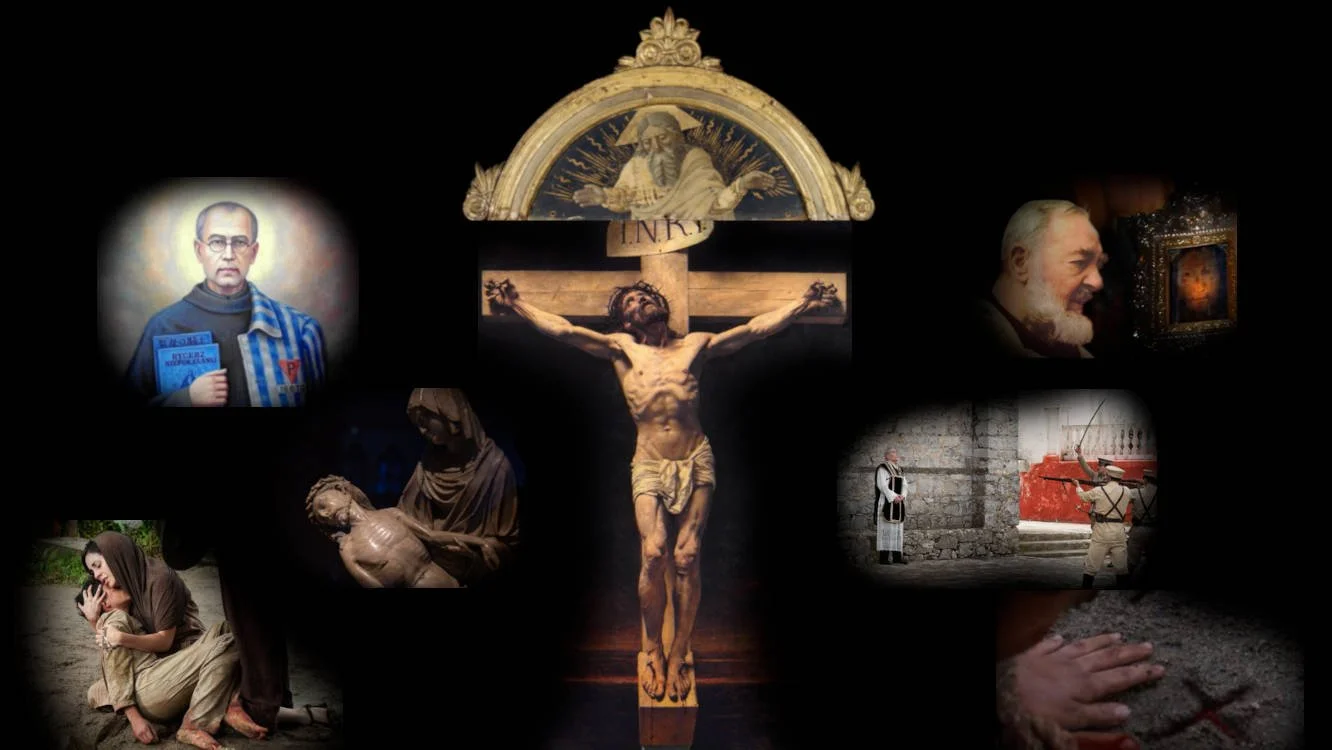
The Darkness of the Cross Enlightened on the Road to Emmaus
At Gethsemane Jesus of Nazareth agreed to bear the Cross to his own Crucifixion so that following him to Heaven’s Gate would not be a burden of impossibility for us.
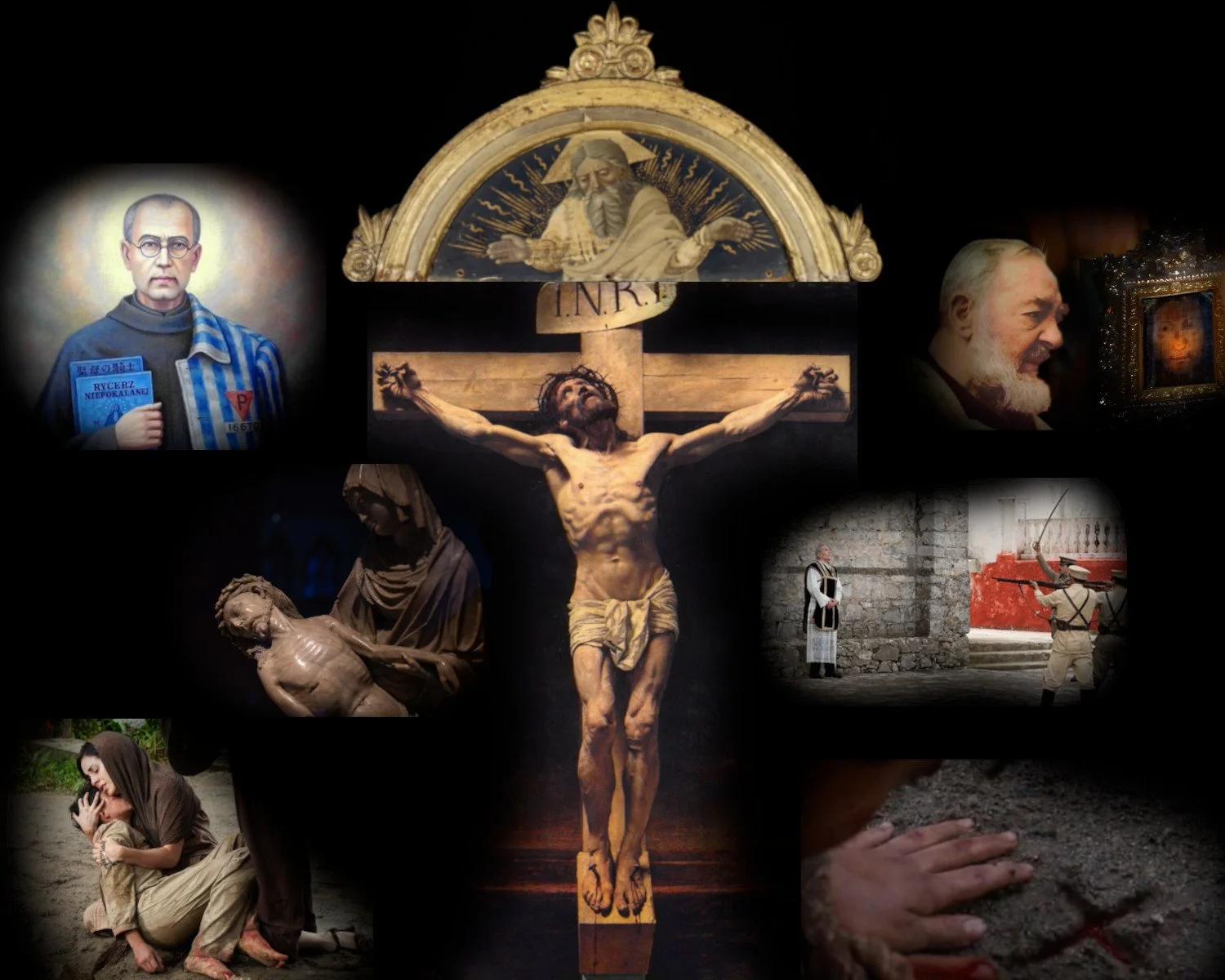
At Gethsemane Jesus of Nazareth agreed to bear the Cross to his own Crucifixion so that following him to Heaven’s Gate would not be a burden of impossibility for us.
Holy Week 2026 by Father Gordon MacRae
In all of human history, no method of execution has been devised more heinously, or delivered with more cruelty than crucifixion. In the Old Testament — no stranger to the cruel acts of men — crucifixion did not exist. It was first introduced to human history in the Sixth Century BC by the Persians, the ancestral empire of present-day Iran. I recently wrote of Iran and its place in history in “Iran, by Another Name, Was Once the Savior of Israel.”
My visual introduction to crucifixion was not so much biblical, but cinematic. Over many years I had pondered in depth its biblical presentation, but it was only when I watched the 2004 film, The Passion of the Christ directed by Mel Gibson, that I experienced and absorbed its visual impact. The brutality of the film was criticized for its excessive violence, but there was no such thing as a “gentle” crucifixion.
The Passion of the Christ contains all the elements ascribed to the event in the four Gospel accounts of the Crucifixion of Jesus in Sacred Scripture. I have read and studied those accounts many times, but I could watch that film only once and never again. It left me in a state of profound sorrow. That sorrow caused me to rethink some of the peripheral, but mysterious events that Sacred Scripture lends to the Crucifixion scene. One of them is the following excerpt from Psalm 22 attributed to King David. He never experienced crucifixion, but in Psalm 22 he wrote of it in the first person and in vivid prose 1,000 years before Jesus of Nazareth experienced it:
“My God, my God, why have you forsaken me? Why are you so far from helping me, from the words of my cry?
“O my God, I cry out by day, but you answer not, and by night, but I find no rest.
“Yet you are holy, enthroned upon the praises of Israel. In you our fathers trusted; they trusted and you delivered them. To you they cried and they were saved. In you they trusted, and were not disappointed.
“But I am worm and no man; scorned by men and despised by the people. All who see me scoff at me. They mock me with parted lips; they wag their heads. ‘He trusted in the Lord, let him deliver him. Let him rescue him if he delights in him.’
“I am poured out like water, and all my bones are wracked; my heart is like wax, it is melted within my breast. My strength is dried up like a potsherd, and my tongue cleaves to my jaws. You have laid me in the dust of death.
“Indeed, many dogs surround me; a pack of evildoers closes in upon me. They have pierced my hands and my feet. I can count all my bones; they stare and gloat over me. They divide my garments amongst them. For my clothing they cast lots.”
— Excerpted from Psalm 22, a Psalm of King David, circa 1000 BC
Most observant Jews would likely have recognized “My God, my God, why have you forsaken me?” as the opening line of Psalm 22. Mysteriously, those present for the Crucifixion of Jesus failed to do so. The Gospel quotes them as saying, “He is calling upon Elijah.” It was a distortion of the mixed Hebrew and Aramaic in the plea of Jesus from the Cross: “Eloi, Eloi, lema sabachthani.” In a magisterial treatise, Jesus of Nazareth: Part 2 Holy Week, Pope Benedict XVI wrote “Psalm 22 is Israel’s great cry of anguish, in the midst of its sufferings, addressed to the apparently silent God …. Now we hear the great anguish of the one suffering on account of God’s seeming absence.” Many of us have been here when simply calling out or pleading with God is not enough. In extreme anguish, prayer inevitably becomes a loud cry. Jesus prays this loud cry on behalf of all of us: “My God, my God, why have you forsaken me?”
What is remarkable about the four Gospel accounts of the Crucifixion is the multitude of Old Testament allusions and quotations they contain. In them, the Word of God and the events of the Gospel are deeply interwoven into the Passion Narrative. Two of these allusions, Psalm 22 and Isaiah 53, the “Suffering Servant” motif, shed light on the entire Passion event.
Isaiah begins with a direct reference to this saving act of God in a prophesy written hundreds of years before its fulfillment: “Behold, a virgin shall conceive and bear a son, and shall call his name ‘Emmanuel’” — a name which means “God with us.”
All of Sacred Scripture makes clear one consistent truth. If God is with us, we are not always with God. This becomes especially evident in the Passion Narrative of the Gospels, the arrest, interrogation, trial, scourging, and Crucifixion of Jesus. No one who followed him to this end, and who came to believe that he is the Messiah, the Christ of God, could ever have imagined that he would face humiliation, torture, Crucifixion and death. When it came, despite all promises to the contrary, most of his disciples shrank from their own promises and fled. None of us can stand in judgment of them. I wrote of one of history’s most vivid examples in “The Apostle Falls: Simon Peter Denies Christ.”
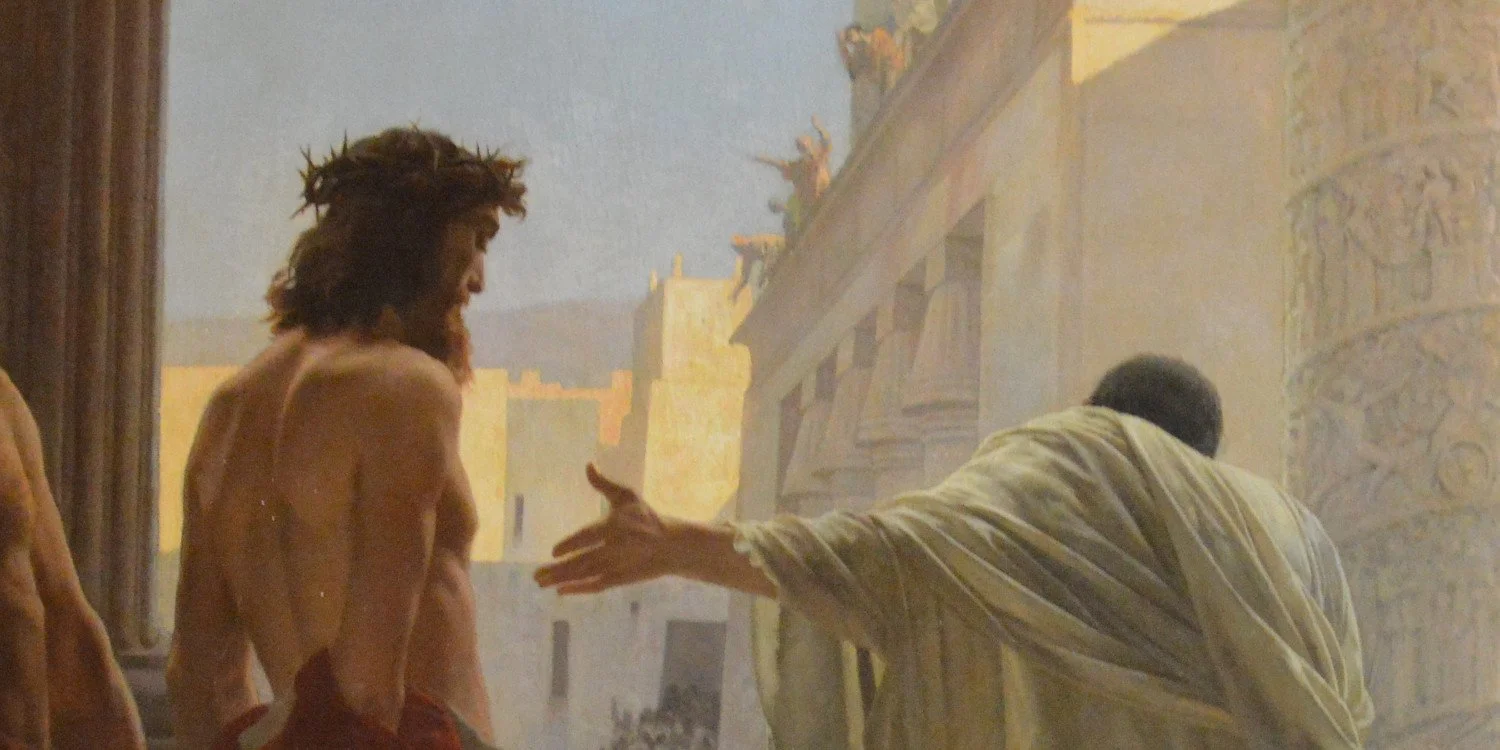
He Suffered under Pontius Pilate
But prior to all that, Jesus was interrogated by Pontius Pilate, the Roman military governor or procurator of the imperial province of Judea from 26 to 36 AD. The Jewish historian, Flavius Josephus, portrayed Pilate as a harsh administrator who failed to understand the religious convictions and national pride of the Jews. Pilate is known mainly for his connection with the trial and execution of Jesus. His culpability in the outcome has been the subject of debate ever since, and this conflicting view was implied even by Pope Benedict XVI, who wrote:
“After the interrogation, Pilate knew for certain what in principle he had already known beforehand: this Jesus was no political rebel; his message and his activity posed no threat for the Roman rulers. Whether Jesus had offended against the Torah was of no concern to Pilate as a Roman.”
— Jesus of Nazareth: Holy Week, p195
The Gospels of John and Mark present the custom of choosing a prisoner to be released on the Passover. The Gospels present a juxtaposition of the theological significance of choosing Jesus or Barabbas for release. John refers to Barabbas simply as a robber (18:40). In the political context of the time the Greek word that John used has also acquired the meaning of “terrorist,” or “rebel.” This is clear from Mark’s account: “And among the rebels in prison who had committed murder in the insurrection, there was a man called Barabbas” (Mark 15:7). It was clear that Pilate preferred to release Jesus, yet the crowd had different categories. Pilate came to understand their strong preference to release Barabbas, who had acquired the personna of a swashbuckling rebel.
The governor of Judea had complete judicial authority over all who were not Roman citizens, but many cases, especially those relating to religious matters, were decided by the Sanhedrin, the Jewish supreme council. According to the Gospel accounts, after the Sanhedrin found Jesus guilty of blasphemy it committed him to the Roman court because it lacked the authority to impose a death sentence. Pilate refused to approve their judgment without further investigation but the Sanhedrin threatened Pilate. When Pilate asked them, “Shall I crucify your king?” “The Chief Priests Answered, ‘We Have No King but Caesar’”
The Jewish priests then made other charges against Jesus, accusing him of blasphemy by calling himself a king (which he never actually did) and a son of God. Pilate appears to have been impressed with the dignity and honesty of Jesus, and tried to save him (John 18:38-39, 19:12-15). But fear of an uprising in Jerusalem and a resulting report to Roman authorities forced Pilate to accede to the Sanhedrin’s demand after the chief priests declared that freeing Jesus would mean that Pilate “is no friend of Caesar.” The false claim that Jesus was “King of the Jews,” was perceived as a threat to the Roman empire. It ended up on the inscription bearing the official nature of his offense to be affixed to his Cross.
Jesus was thus to be crucified and was handed over by Pilate for scourging, a brutal aspect of the punishment that often left the accused dead even before being crucified. Some have suggested that the scourging was intensified by Pilate to sway Jewish leaders away from crucifixion if the scourging was brutal enough. The guards saw to it that it was, but to no avail. It is very likely that Jesus carried only the crossbeam to which his hands were affixed first by ropes and then nails were added upon the height of Mount Calvary. His scourging had left his skin shredded so Simon of Cyrene was recruited to help carry the crossbeam. Only a few faithful women, including his Mother, his Mother’s sister, and Mary Magdalene remained with the beloved disciple John.
Each of the four Gospels presents a parallax view, the same scene but from a different perspective. In the Gospel according to John, the dying Jesus addressed his Mother: “Woman, behold your son” and to John, “Behold your Mother” (John 19:27). The Gospel instructs us that “from that hour the disciple took her into his own home.” Faithful Catholics have done the same ever since. Mary occupies a very special place in this scene and in our hearts.
As for Pontius Pilate, he was recalled to Rome in AD 36. According to the Roman historian, Eusebius, Pilate later committed suicide. Other traditions, however, report that Pilate secretly became a Christian and was condemned to death by the Roman Senate. Perhaps for this reason, Pilate is strangely revered by Coptic Christians as a martyr. They observe his feastday on June 25.
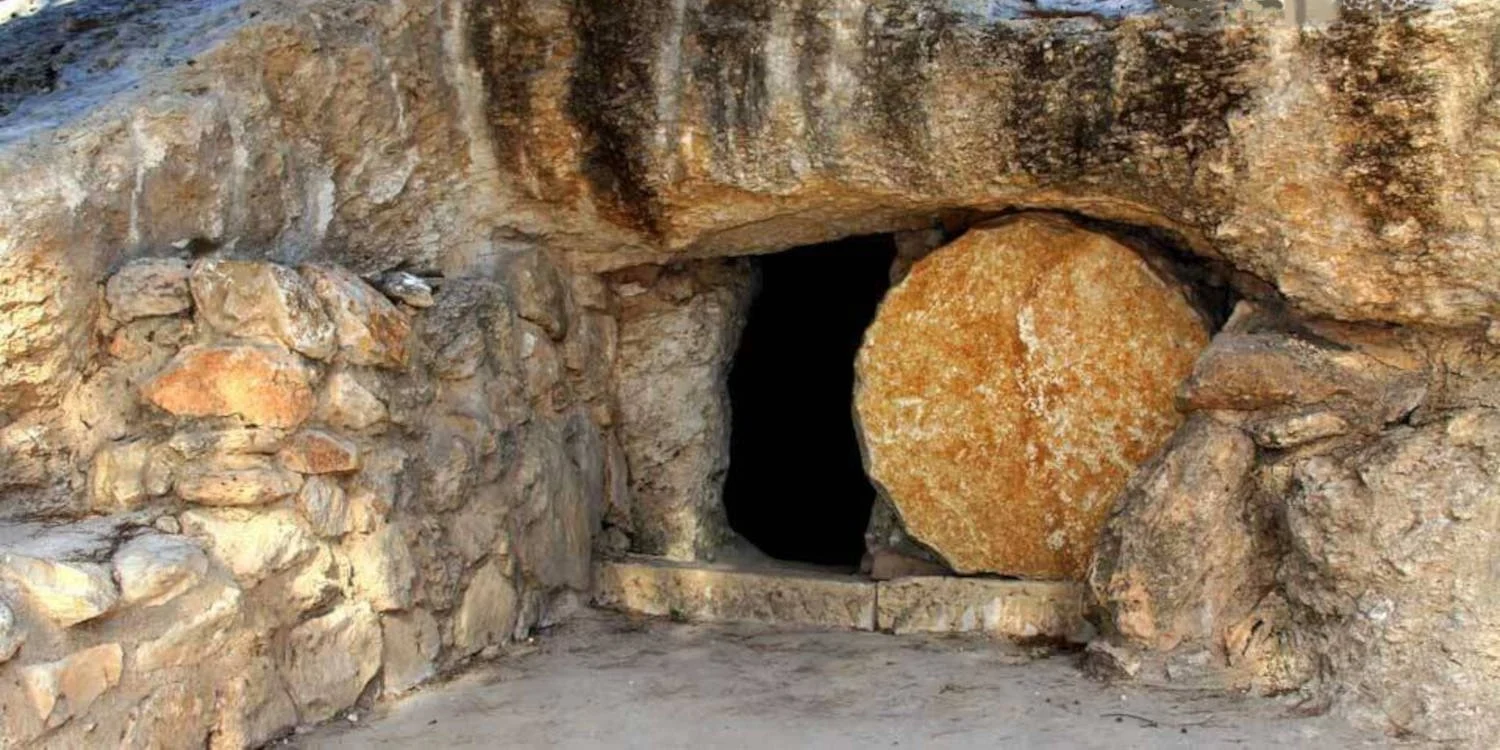
“Why Do You Seek the Living among the Dead?” (Luke 24:5)
The Resurrection of Jesus is the crowning event of the Passion Narratives of all four Gospels. Joseph of Arimathea, a member of the Sanhedrin who “was looking for the Kingdom of God” risked his standing in the Sanhedrin by asking Pilate for the body of Jesus, which was granted. Joseph interred the body in his own tomb hewn from rock (Luke 24:51). Some women went to the tomb as the Sabath was beginning. They saw the body of Jesus there then left to observe the Sabath.
On the next day, the first day of the week, these same women, now identified as Mary Magdalene, Joanna and Mary, mother of James, returned with spices to prepare the body according to the ritual law. They found the stone sealing the tomb to have been rolled away and two men in dazzling apparel frightened them asking,”Why do you seek the living among the dead?” When they told this to the disciples, they were not believed, but Peter ran to the tomb and found it just as they had said.
Later that same day, two of his disciples — one identified as Cleopas — were venturing about seven miles from Jerusalem along the road to Emmaus. They were speaking with great sorrow and trauma about the events of this and previous days. I have been where they were on that day. I do not mean that I have been on the road to Emmaus, except perhaps figuratively. I have been at a place at which all that I had ever worked for and hoped for just collapsed in irreparable ruin, and there was no justice in it. Reading about this encounter on the road to Emmaus, their deep sorrow and loss resonates with me on a personal level.
Then they encounter the Risen Christ along that road, but “Their eyes were kept from recognizing him.” (Luke 24:16) The visitor asked what their animated conversation was all about. The one named Cleopas was incredulous: “Are you the only visitor to Jerusalem who does not know the things that have happened there in these days?” “What things?” asked the stranger. Then came the outpouring of their grief:
“The things concerning Jesus of Nazareth who was a prophet might in word and deed before God and all the people, and how our chief priests and rulers delivered him up to be condemned to death, and crucified him. We had hoped that he was the one to redeem Israel. And besides all this, it is now the third day since this has happened. Now some women of our company have just amazed us. They were at the tomb early in the morning, but they did not find his body. They came back saying that they had even seen a vision of angels who said that he is alive. Some of those who were with us went to the tomb and found it just as the women said, but him they did not see.”
(To be continued.)
+ + +
Note from Father Gordon MacRae: Thank you for reading and sharing this post, which will now be added to both Our Holy Week Retreat and to our Collection called The Bible Speaks. You may also like these related posts leading up to the top of Mount Calvary:
Satan at the Last Supper: Hours of Darkness and Light
Waking Up in the Garden of Gethsemane

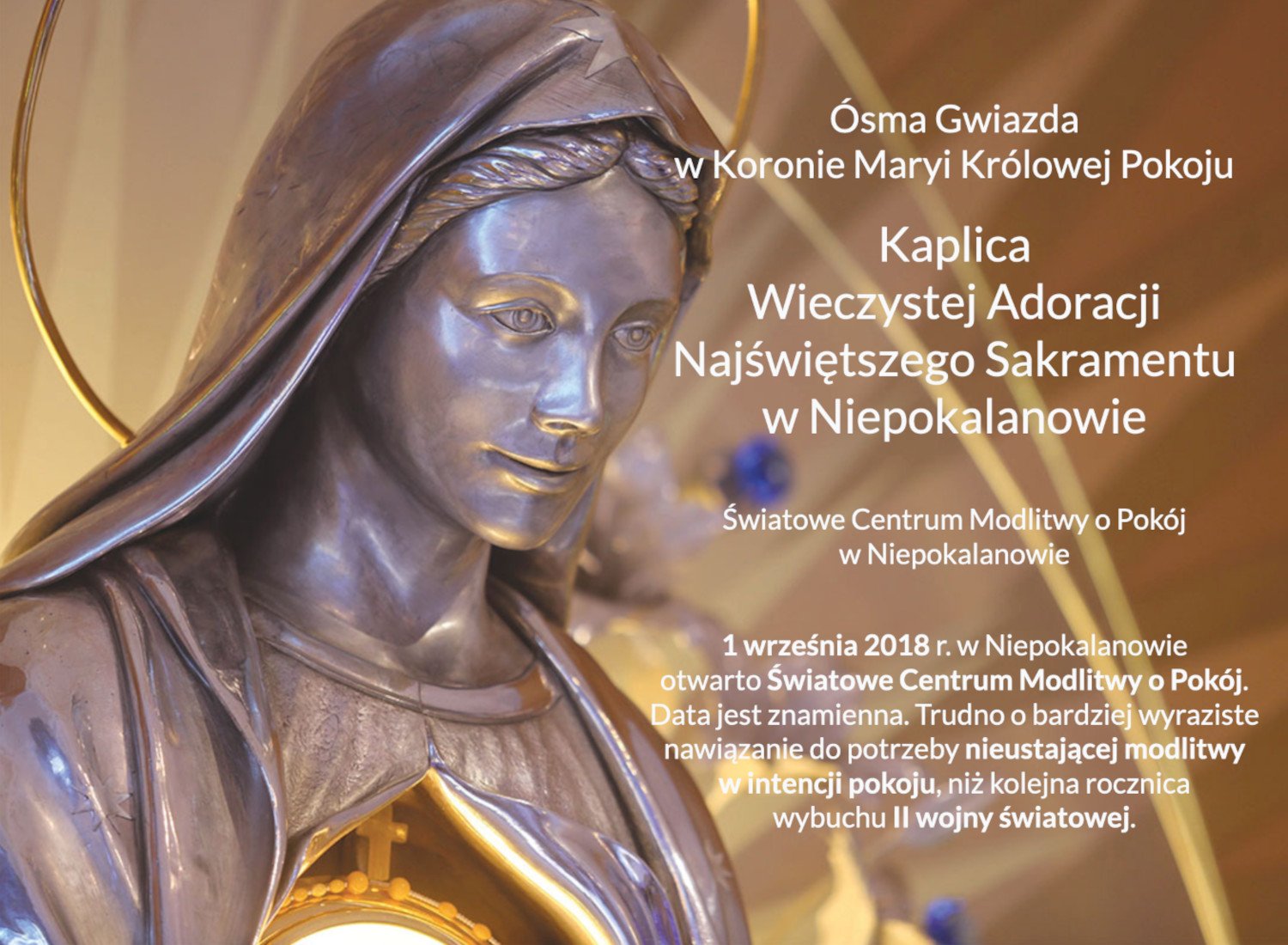

The Eucharistic Adoration Chapel established by Saint Maximilian Kolbe was inaugurated at the outbreak of World War II. It was restored as a Chapel of Adoration in September, 2018, the commemoration of the date that the war began. It is now part of the World Center of Prayer for Peace. The live internet feed of the Adoration Chapel at Niepokalanow — sponsored by EWTN — was established just a few weeks before we discovered it and began to include in at Beyond These Stone Walls. Click “Watch on YouTube” in the lower left corner to see how many people around the world are present there with you. The number appears below the symbol for EWTN.
Click or tap here to proceed to the Adoration Chapel.
The following is a translation from the Polish in the image above: “Eighth Star in the Crown of Mary Queen of Peace” “Chapel of Perpetual Adoration of the Blessed Sacrament at Niepokalanow. World Center of Prayer for Peace.” “On September 1, 2018, the World Center of Prayer for Peace in Niepokalanow was opened. It would be difficult to find a more expressive reference to the need for constant prayer for peace than the anniversary of the outbreak of World War II.”
For the Catholic theology behind this image, visit my post, “The Ark of the Covenant and the Mother of God.”

Behold the Lamb of God Upon the Altar of Mount Moriah
“This is the night when Christ broke the prison-bars of death and rose victorious from the underworld. Our birth would have been no gain had we not been redeemed.”

“This is the night when Christ broke the prison-bars of death and rose victorious from the underworld. Our birth would have been no gain had we not been redeemed.”
Holy Week 2025 by Fr Gordon MacRae
You might readily see the irony of my invoking the haunting passage above. It is from the Exultet, that wondrous proclamation of Salvation History as the Paschal Candle is blessed at the doors of the church in the liturgy for the Easter Vigil. The imagery of Christ breaking the prison bars of death may understandably have deep meaning for me. The excerpt recalls a scene from Holy Week that I once wrote about in “To the Spirits in Prison: When Jesus Descended into Hell.”
That post tells the story referenced in the Second Letter of Saint Peter, about what happened to Jesus on what we now call Holy Saturday, that period of darkness between the Cross and the Resurrection. And I just now realized, looking back at that post from several years ago, that I cited that same passage from the Exultet in its opening.
Back in February 2025, I wrote a post entitled “On the Great Biblical Adventure, the Truth Will Make You Free.” It mentioned my recent acquisition of the much anticipated Ignatius Catholic Study Bible: Old and New Testament edited by Dr. Scott Hahn. That post also referred to a recent and surprising resurgence of biblical interest throughout the free world. I learned of that explosion of interest when Ignatius Press placed me on a waiting list for that particular bible which is now in its fourth or fifth printing. I have been lugging the weighty hardcover tome, consisting of 2,314 pages, around with me for two months at this writing. I don’t seem to be able to part with it for long. It is a treasure trove of biblical insight and truth, filled not only with readable and scholarly translations of Sacred Scripture, but also with scholars’ notes on the biblical texts. From a historical perspective it draws clear connections between the Old and New Testaments. From a spiritual perspective it is as though a lamp has been relit opening for me, and hopefully also for you, a world of deeper meaning embedded within the texts. As I mentioned in a previous post, my goal has been two-fold: to educate, or rather reeducate myself on the story of God and us, and to avoid dropping the very heavy book on my foot in the process.
The interpretation of a religious text is a study called exegesis. It seeks to convey and understand both the literal and spiritual sense of biblical truths. Neither should be sacrificed in pursuit of the other. I have often described it this way: There is a story on its surface, which is true, and a far greater story in its depths which points to even greater truths. One way in which the spiritual truth of Scripture is expressed is in allegory. Jesus told many allegorical accounts in parables. Most readers are clear that the truth in these precious accounts is in the lesson they convey. Two of the most famous examples are the “Parable of the Good Samaritan” and the “Parable of the Prodigal Son.” You know these stories well, and they need no explanation.
Most of Sacred Scripture is not conveyed in parable form, but as a historical narrative. Allegory is still very much a part of that narrative, and we are cheating our understanding of a text when we suppress its allegorical content. We should start by accepting both truths: the truth of the historical content of Scripture and the equal and sometimes even greater truth in its allegorical content. In this sense allegory refers to a story, poem, or picture that can be interpreted to reveal a hidden meaning, typically a moral or religious one. In the 19th and 20th centuries, fundamentalist Scripture scholars stripped allegory from their interpretations of the text, but at great cost. More modern scholars have restored it. One of them has been Dr. Scott Hahn.
When I cited an excerpt from the Exultet Proclamation from the Easter Vigil liturgy as I opened this post, I later realized that the Second Reading for the Easter Vigil Mass is one that I have pondered for a very long time. It is from Genesis 22:1-19, the story of God calling upon Abraham to sacrifice Isaac, his beloved son. “So momentous is this event in its outcome,” wrote Scott Hahn, “that it stands as one of the defining moments of Salvation History.” I have set out to study the great depths of this account and they are astonishing.

Abraham and Isaac
Isaac is a Hebrew name, of course, and it means “He laughs.” It has its origin in Genesis 17:16-17: “ ‘I will bless (Sarah) and moreover I will give you a son by her; I will bless her and she shall be the mother of nations; kings of peoples shall come from her.’ Then Abraham fell on his face and laughed, and said to himself, ‘Shall a child be born to a man who is a hundred years old? Shall Sarah, who is ninety years old, bear a child?’ ”
Abraham apparently gave little thought to the wisdom of falling to the ground and laughing at God. The fact that he “said it to himself” is no guarantee that God would not have heard it loud and clear. And so it was that the Word of God came to give the son of Abraham and Sarah the name “Isaac,” which means “He laughs.”
Abraham was apparently not the only one laughing. God seemed to get a chuckle out of it as well.
As the story progressed, the significance of Isaac’s birth was immediate. He was to be the fulfillment of God’s promise to Abraham. Isaac was to be the bearer of the covenant into future generations: “I will establish my covenant with him as an everlasting covenant for him and his descendants after him” (Genesis 17:19). Then the drama of the Book of Genesis reaches its greatest intensity with the heart-wrenching story of God’s call to Abraham to sacrifice as a burnt offering his beloved son upon the heights of Mount Moriah. Had Abraham shown anything less than heroic faith and obedience the grand narrative of the Bible would have developed very differently thereafter. Here is the Genesis account which became the Second Reading of our Easter Vigil liturgy.
From the Book of Genesis 22:1-18:
After these things, God tested Abraham and said to him, “Take your son, your only begotten son Isaac, whom you love, and go to the land of Moriah, and offer him there as a burnt offering upon one of the mountains of which I shall tell you.” So Abraham rose early in the morning, saddled his donkey, and he cut the wood for the burnt offering, and went to the place of which God had told him. … Abraham took the wood for the burnt offering and laid it on the shoulders of his son to carry, and he took in his own hands the fire and the knife. So they went both of them together. Isaac said to his father, “Behold the fire and the wood, but where is the lamb for a burnt offering?” Abraham said, “God will provide himself the lamb for a burnt offering, my son.”
When they came to the place of which God had told him, Abraham built an altar there and laid the wood in order, and he bound Isaac his son and laid him on the altar upon the wood. Then Abraham put forth his hand and took the knife to slay his son. But the angel of the Lord called to him from heaven and said, ‘Abraham, Abraham! Do not lay your hand on your son or do anything to him for now I know that you have not withheld your only begotten son from me.” Abraham then lifted up his eyes and looked, and behold, behind him was a ram caught in a thicket by his horns. So Abraham went and took the lamb and offered it up as a burnt offering instead of his son. So Abraham called the name of that place YHWH YIR’EH, in Hebrew, “The Lord will see.”
It is from this very account that, twenty one centuries later, the Gospel of John (1:29) proclaims “Behold the lamb of God who takes away the sin of the world.”
I have always felt that this account in Genesis was a presage, a looking far ahead, to the sacrifice of Jesus upon Golgotha. It is allegorical in that sense. The account is true on its literal face but it is also true that it echoes the Greatest Story Ever Told which will come many centuries later. All the elements are there. The Second Book of Chronicles (3:1) identifies Moriah as the site upon which, nearly one thousand years later, Solomon would build the Jerusalem Temple, and Calvary, where the only begotten Son of God was crucified, is a hillock in the Moriah range. So for the Hebrew reader of the story of the Crucifixion, there is a powerful sense of déjà vu: the place, the mount, Abraham placing the wood for sacrifice upon the back of Isaac, and is not the ram caught by its horns in the thicket highly reminiscent of the Crown of Thorns? But we cannot reminisce backwards. This amazing account from Genesis is a mysterious example of the power of biblical inspiration. Only in the mind of God, in the time of Genesis, was the story of Christ evident.

From Sheol to the Kingdom of Heaven
In the Old Testament, “to die” meant to descend to Sheol. It was our final destination. To rise from the dead, therefore, meant to rise from Sheol, but no one ever did. The concept of Sheol being the “underworld” is a simple employment of the cosmology of ancient Judaism which understood the abode of God and the heavens as being above the Earth, and Sheol, the place of the dead, as below it. This is the source of our common understanding of Heaven and hell, but it omits a vast theological comprehension of the death, Resurrection and Ascension of Jesus and the human need to understand our own death in terms of faith.
If, up to the time of Jesus, “to die” meant to descend into Sheol, then Jesus introduced an entirely new understanding of death in his statement from the Cross to the penitent criminal, Dismas, who pleaded from his own cross, “Jesus remember me when you come into your kingdom.” Jesus responded, “Today you will be with me in Paradise” (Luke 23:43). This is an account that I once told entitled, “Dismas, Crucified to the Right: Paradise Lost and Found.”
It is by far the most widely read of our Holy Week posts, and not just at Holy Week. On the Cross, where the penitent criminal comes to faith while being crucified along with Jesus, God dissolves the bonds of death because death can have no power over Jesus. It is highly relevant for us that the conditions in which the penitent Dismas entered Paradise were to bear his cross and to come to faith.
It was at the moment Jesus declared, in His final word from the Cross, “It is finished,” that Heaven, the abode of God, opened for human souls for the first time in human history. The Gospels do not treat this moment lightly:
“It was now about the sixth hour [3:00 PM], and there was darkness over the whole land until the ninth hour while the sun’s light failed; and the curtain of the Temple was torn in two. Then Jesus, crying with a loud voice, said, ‘Father, into your hands I commend my spirit.’ Saying this he breathed his last.”
— Luke 23:44-46
“And behold, the curtain of the Temple was torn in two from top to bottom, and the Earth shook, and the rocks were split. The tombs also were opened, and many bodies of the saints who had fallen asleep were raised ... When the centurion, and those who were with him keeping watch over Jesus, saw the earthquake, and what took place, they were filled with awe, and said, ‘Clearly, this was the Son of God.’”
— Matthew 27:51-54
The veil of the Temple being torn in two appears also in Mark’s Gospel (15:38) and is highly significant. Two veils hung in the Jerusalem Temple. One was visible, separating the outer courts from the sanctuary. The other was visible only to the priests as it hung inside the sanctuary before its most sacred chamber in which the Holy of Holies dwelled (see Exodus 26:31-34). At the death of Jesus, the curtain of the Temple being torn from top to bottom is symbolic of salvation itself. Upon the death of Jesus, the barrier between the Face of God and His people was removed.
According to the works of the ancient Jewish historian, Josephus, the curtain barrier before the inner sanctuary that was torn in two was heavily embroidered with images of the Creation and the Cosmos. Its destruction symbolized the opening of Heaven, God’s dwelling place and the Angelic Realm, to human souls.
In ancient Israel in the time of Abraham and Isaac the concept of Sheol after death was closely connected with the grave and pictured only as a gloomy underworld hidden deep in the bowels of the Earth. There human souls descended after death (Genesis 37:35) to a joyless existence where the Lord is neither seen nor worshipped. Both the righteous and the wicked sank into the nether world (Genesis 44:31). Despite the apparent finality of death, Scripture displays great confidence in the power of God to deliver his people from its clutches. That confidence was made manifest in the deliverance of Jesus from his tomb after he displayed the power of God to the one place where he had always been absent, the realm of the dead. “For Christ also died for sins once and for all, the righteous for the unrighteous, that he might bring us to God, being put to death in the flesh but made alive in the spirit, in which he went and declared to the spirits in prison who did not formerly obey when God’s patience waited in the days of Noah.” (1 Peter 3:18-20)
The essential point for us could not be clearer or more hopeful. Besides Jesus himself, the first to be sanctioned with a promise of paradise was a condemned prisoner who, even in the intense suffering of his own cross, refused to mock Jesus but rather came to believe and then place all his final hope in that belief. As I ended “Dismas, Crucified to the Right” Dismas was given a new view from his cross, a view beyond death away from the East of Eden, across the Undiscovered Country of Death, toward his sunrise and eternal home.
I have written many times that we live in a most important time. The story of Abraham told above took place twenty one centuries before the Birth of the Messiah. We now live in the twenty first century after. Christ is now at the very center of Salvation History.
+ + +

+ + +
Note from Father Gordon MacRae: Thank you for reading and sharing this post. Here are some recommended posts along a similar theme.
The God of the Living and the Life of the Dead
To the Kingdom of Heaven through a Narrow Gate
Dismas, Crucified to the Right: Paradise Lost and Found
A Devil in the Desert for the Last Temptation of Christ
+ + +
Our “From Ashes to Easter” feature will be retitled after the Easter Season to become “Salvation History.” We will adding other Scripture-based posts at that time.
News Alert: When we tried to share some of these Holy Week posts in several Facebook Catholic groups, Facebook characterized them as “SPAM” and then disabled our account. There is no easy way to communicate with Facebook about this. We have opened an “X” account (formerly Twitter) and find it a much more accepting platform for Catholic or traditional viewpoints. Please follow us there at BeyondTheseStoneWalls.
With many thanks and Easter Blessings,
Father Gordon MacRae

The Eucharistic Adoration Chapel established by Saint Maximilian Kolbe was inaugurated at the outbreak of World War II. It was restored as a Chapel of Adoration in September, 2018, the commemoration of the date that the war began. It is now part of the World Center of Prayer for Peace. The live internet feed of the Adoration Chapel at Niepokalanow — sponsored by EWTN — was established just a few weeks before we discovered it and began to include in at Beyond These Stone Walls. Click “Watch on YouTube” in the lower left corner to see how many people around the world are present there with you. The number appears below the symbol for EWTN.
Click or tap here to proceed to the Adoration Chapel.
The following is a translation from the Polish in the image above: “Eighth Star in the Crown of Mary Queen of Peace” “Chapel of Perpetual Adoration of the Blessed Sacrament at Niepokalanow. World Center of Prayer for Peace.” “On September 1, 2018, the World Center of Prayer for Peace in Niepokalanow was opened. It would be difficult to find a more expressive reference to the need for constant prayer for peace than the anniversary of the outbreak of World War II.”
For the Catholic theology behind this image, visit my post, “The Ark of the Covenant and the Mother of God.”