“There are few authentic prophetic voices among us, guiding truth-seekers along the right path. Among them is Fr. Gordon MacRae, a mighty voice in the prison tradition of John the Baptist, Maximilian Kolbe, Alfred Delp, SJ, and Dietrich Bonhoeffer.”
— Deacon David Jones

Pope Leo XIV Defamed by the Survivors Network of those Abused by Priests
In 2018 this exposé of SNAP’s shady tactics to increase settlements over accused priests was widely ignored. After the Conclave of 2025 it exploded on the Internet.

In 2018 this exposé of SNAP’s shady tactics to increase settlements over accused priests was widely ignored. After the Conclave of 2025 it exploded on the Internet.
May 21, 2025 by Father Gordon MacRae
It did not take long. In the weeks leading up to the Conclave of 2025, Pope Leo XIV was accused by SNAP — the U.S.-based Survivors Network of those Abused by Priests — of negligently investigating and then covering up a decades-old account of alleged clergy sexual abuse. Lifted out of all context, the story is missing its most important element: the simple truth. To its great credit last week, the Catholic League for Religious and Civil Rights responded to this story by providing the truth and context that the story lacks. I am grateful to the Catholic League for having the Holy Father’s back, not to mention my own.
At about the same time, an article that I wrote in 2018 about SNAP’s deceptions and destructive malfeasance suddenly went viral after the Conclave of 2025. The Catholic League pounced on that as well, and courageously republished it anew under the title, Father Gordon J. Macrae On SNAP’s Deception.
That fact alone conveyed to me the urgency of this account of how and when SNAP activists terrorized the Church and priesthood for two decades.
So here it is again, apparently by popular demand of SNAP itself by raising the same tired old story with a new target: Pope Leo XIV. The papacy of Pope Leo XIV should not be tainted by a repeat of the dishonest rhetoric from this shady and morally compromised anti-Catholic activist network. SNAP can no longer mask the truth revealed in these pages.
Please read and share, as so many in Europe have done:
Abused by the Survivors Network of those abused by Priests

If there exists a Catholic priest still in denial about the agenda of SNAP, it’s because he has lived with his head in the sand blind to the threat lying in wait for him.
In 2009, at the same time I began writing for Beyond These Stone Walls, Catholic League President Bill Donohue invited me to write a feature article for the Catholic League Journal, Catalyst. My article, “Due Process for Accused Priests,” began by describing an important phenomenon.
In 2002, just as the national story of Catholic priests and sexual abuse emerged out of Boston to sweep the country, psychologist Daniel Kahneman was awarded the Nobel Prize in Economics for his work on a phenomenon called “availability bias.” It revealed the power of the media to not just report the news, but to reshape it to fit media bias, to cultivate it, to take a story’s small microphone and turn it into a megaphone.
Activist organizations have trained people to harness this force to sway what others adopt as a bias. It is not new, just newly analyzed. One of the most potent deployments of “availability bias” is one I have quoted before in these pages. It comes from Mein Kampf, the 1926 book by Adolf Hitler that gave rise to the Nazi party in Germany:
“The great mass of people will more easily fall prey to a big lie than to a small one.”
After my 2009 Catalyst article was published, I was subjected to an open assault by David Clohessy, Executive Director of the activist organization, SNAP, the Survivors Network of those Abused by Priests. Matt Abbott at Renew America forwarded my article to Mr. Clohessy and invited a response posted at Renew America entitled, “Imprisoned Priest, Sex Abuse Victim Clash.”
David Clohessy was obviously perturbed by what I exposed about the lawsuit settlement process and how it is advanced and cultivated by “self-serving contingency lawyers and various agenda-driven groups using scandal for their own ends.” Mr. Clohessy had long derided Church officials for entering into secrecy agreements to keep settlement amounts from public view.
On January 17, 2017, former SNAP employee Gretchen Rachel Hammond filed a lawsuit against SNAP in the Circuit Court of Cook County, Illinois. Ms. Hammond had been SNAP’s Director of Development before leaving the organization and filing her lawsuit. The named parties in the suit included David Clohessy, SNAP’s Executive Director, and Barbara Blaine, SNAP’s founder and president, and a member of SNAP’s board of directors.
Ms. Hammond’s lawsuit alleged that she was a victim of retaliatory discharge for questioning the allegedly corrupt practices of this organization. These included claims that SNAP and its leaders received substantial kickbacks in the form of “donations” from attorneys to whom SNAP officials referred clients or potential clients.
The lawsuit exposed that lawyers in California, Chicago, Seattle, and Delaware made major “donations,” some of them in six-figure amounts, and that SNAP leaders “concocted a scheme to have other attorneys make donations to a front foundation” to mask “attorneys’ kickbacks” to the organization.
The lawsuit also alleged a pattern of collusion between SNAP officials and plaintiff lawyers to maximize publicity for the purpose of fueling bigger payouts. It accused SNAP officials of callous disregard for the real interests of real sexual abuse survivors. Among the lawsuit’s other allegations were these:
SNAP engaged in a commercial enterprise motivated by its directors’ and officers’ personal and ideological animus against the Catholic Church.
SNAP conducted business premised on farming out abuse survivors as clients for specific attorneys who file lawsuits and collect settlements from the Catholic Church.
Attorneys routinely gave SNAP confidential plaintiff claims and other privileged information in order for SNAP to maximize payouts with sensational press releases.
SNAP claimed that it existed to provide support for survivors of clergy sexual abuse, however at all relevant times, SNAP did not have a single grief counselor or rape counselor on its payroll. SNAP would ignore survivors who reached out to SNAP for legitimate counseling.
Ms. Hammond alleged that she was told by SNAP official Barbara Dorris to ignore calls from survivors who were seeking only counseling.
Despite accepting funds for counseling and aiding survivors of sexual abuse, SNAP squandered those funds to advance its own interests and those of its leadership.
SNAP set out to deliberately jeopardize the ability of accused priests to receive due process and fair trials.
In 2011, SNAP oversaw fundraising for a charge brought against Pope Benedict XVI at the International Court at The Hague; however SNAP used the funds to pay for lavish hotels and other extravagant travel expenses for its leadership.

The Fallout
When the lawsuit became public, David Clohessy resigned as Executive Director, and SNAP founder and president, Barbara Blaine also resigned. They have since settled the lawsuit by a secrecy clause just like the ones for which Mr. Clohessy had railed against Catholic bishops over the last two decades.
After the settlement, others among SNAP’s more notorious leaders also resigned as reported by David F. Pierre, Jr. at The Media Report in “SNAP R.I.P.” Barbara Dorris, who replaced David Clohessy as Executive Director, and Regional Director Joelle Casteix both resigned. Among the revelations uncovered by David Pierre was that SNAP published the email addresses and personal phone numbers of accused priests to generate harassment.
Ms. Hammond’s lawsuit was only one of several brought against SNAP, but it was the one that appeared to finally expose what had long been suspected of SNAP and its leaders. Simultaneously in 2017, Father Joseph Jiang, a priest of the Archdiocese of St. Louis, filed a defamation lawsuit against SNAP.
Charges brought against Father Jiang were heavily promoted by SNAP leaders who, as they do whenever a priest is accused, issued a public call for anyone else who wants to accuse the priest. When Father Jiang passed a polygraph test [ I did, too, by the way, twice ] the charges were dismissed in 2015.
In 2016 a federal judge ruled that SNAP made false statements against Father Jiang “negligently and with reckless disregard for the truth.” SNAP and the parents of the minor who had falsely accused him settled the lawsuit.
As part of its settlement, SNAP issued a public apology, but the ever complicit news media failed to mention that SNAP was forced to do so in the wake of a false claim and lawsuit. SNAP’s apology, written by its legal counsel, included this statement:
“The SNAP defendants never want to see anyone falsely accused of a crime. Admittedly, false reports of clergy sexual abuse do occur. SNAP apologizes for false or inaccurate statements… its representatives made which in any way disparaged Father Joseph Jiang.”
In reporting this story, some Catholic media outlets continued to refer to SNAP as “a victims’ support group” or “a victim advocacy group.” It’s a bad habit that blindly gives legitimacy of purpose to SNAP which it does not have, and has never had.

Pope Benedict’s “Crimes Against Humanity”
The most important and visible source exposing SNAP’s corruption and reckless disregard for truth is a document by Catholic League President Bill Donohue entitled, “SNAP Implodes.” It provides a comprehensive and compelling account of the path of destruction SNAP and its leaders have left in the Church and priesthood under the false guise of advocating for real victims.
Among the most manipulative of David Clohessy’s “advocacy” was an instruction to accusers to attend SNAP press conferences. To play on the emotions of reporters, Clohessy urged those awaiting settlements to “display holy childhood photos” before the news cameras, and… “If you don’t have compelling holy childhood photos we can provide you with photos of other kids that can be held up for the cameras.”
If that doesn’t infuriate Catholics who have any regard left for truth, then what would? SNAP had a much worse perversion of justice than was first hyped, and then covered up, by the news media. It was the most destructive publicity stunt SNAP and its leaders have devised or condoned to date.
Both Bill Donohue and the Hammond lawsuit cited this one (see the final bullet point in Ms. Hammond’s lawsuit above). What they do not reveal is that SNAP used the false case against me to help bring it about.
David F. Pierre, Jr., moderator of The Media Report exposed this SNAP media stunt in “The Hague Tosses SNAP’s Nutty Lawsuit Against the Vatican, SNAP’s Latest P.R. Stunt Exposed.” That was before I even knew that I was a part of this story. In 2011, SNAP and the Center for Constitutional Rights — located at 666 Broadway in Manhattan — jointly filed a “crimes against humanity” charge against Pope Benedict XVI at the International Criminal Court.
The ICC is an independent judicial institution with the power to hold trials and impose sentences for the most serious crimes of international concern: genocide, crimes against humanity, and war crimes. The ICC was approved by international treaty in 1998 and officially came into being on July 1, 2002, after 60 countries ratified the treaty.
The court is headquartered in The Hague, The Netherlands. Of interest, in May of 2002, President George Bush declined to sign the treaty and refused to allow the ICC to have jurisdiction over United States cases. So SNAP’s target was not U.S. Catholic priests and bishops, but the Pope himself.
SNAP duped the left-leaning Center for Constitutional Rights to compose and file the briefs with information provided by SNAP in collaboration with plaintiff lawyers hoping for a precedent to tap Vatican assets in their never-ending quest for big bucks. I first learned of my involvement in this story from an article by journalist JoAnn Wypijewski, in “Spotlight Oscar Hangover: Why ‘Spotlight’ Is a Terrible Film.” Here is an excerpt:
“The Center for Constitutional Rights [CCR] . . . joined with SNAP to file a grotesque brief to the International Criminal Court demanding ‘investigation and prosecution’ of the Vatican for crimes against humanity… To CCR’s shame, Father [Gordon] MacRae is specifically mentioned in that brief with respect to allegations… which prosecutors threw in at sentencing but for which there is no evidence according to the lead detective in the case [as] cited by [Dorothy] Rabinowitz.”
SNAP, apparently in retaliation for my Catalyst articles calling for independent investigation of dubious claims, fed information to the Center for Constitutional Rights that would fuel a case against the Vatican. They made no attempt to contact me or my defense, nor did they contact Dorothy Rabinowitz at The Wall Street Journal who researched and published extensively on the same story, but with polar opposite conclusions.
And SNAP did this without attempting to contact James Abbott, the former FBI Special Agent who spent three years investigating this case before dismissing it as a fraud. (Agent Abbott’s affidavit is cited at the end of Ryan A. MacDonald’s recent post, “#MeToo and #HimToo: Jonathan Grover and Father Gordon MacRae” which also lays out the fraud behind this story).
In the end, to its great credit, the International Criminal Court declined to accept jurisdiction or the crimes against humanity charge against Pope Benedict XVI, but that was no surprise. Everyone involved knew that this fiasco would go nowhere, and it was never really SNAP’s goal. It was merely a publicity stunt for David Clohessy and SNAP to heighten pressure for quick and lucrative financial settlements.
The people who terrorized American Catholic priests for the last quarter century are gone now. Their fraud is exposed. Their coffers are empty. Their leaders have fled. In “SNAP Implodes,” Catholic League President Bill Donohue summed up what I had come to know at a very personal level in this moral panic that SNAP promoted and extorted for profit over the last 25 years:
“SNAP officials function as borderline gangsters out to destroy innocent persons. It is motivated by hate and exploits the very people it claims to serve. Justice demands that it be shut down by the authorities before it does any more harm.”
+ + +
Note from Father Gordon MacRae: Once again, you would serve the cause of truth and justice if you share this post and ask your contacts to do the same. Eyes may also be opened by these related posts from Beyond These Stone Walls:



The Eucharistic Adoration Chapel established by Saint Maximilian Kolbe was inaugurated at the outbreak of World War II. It was restored as a Chapel of Adoration in September, 2018, the commemoration of the date that the war began. It is now part of the World Center of Prayer for Peace. The live internet feed of the Adoration Chapel at Niepokalanow — sponsored by EWTN — was established just a few weeks before we discovered it and began to include in at Beyond These Stone Walls. Click “Watch on YouTube” in the lower left corner to see how many people around the world are present there with you. The number appears below the symbol for EWTN.
Click or tap here to proceed to the Adoration Chapel.
The following is a translation from the Polish in the image above: “Eighth Star in the Crown of Mary Queen of Peace” “Chapel of Perpetual Adoration of the Blessed Sacrament at Niepokalanow. World Center of Prayer for Peace.” “On September 1, 2018, the World Center of Prayer for Peace in Niepokalanow was opened. It would be difficult to find a more expressive reference to the need for constant prayer for peace than the anniversary of the outbreak of World War II.”
For the Catholic theology behind this image, visit my post, “The Ark of the Covenant and the Mother of God.”

Pop Stars and Priests: Michael Jackson and the Credible Standard
The late Michael Jackson settled one abuse claim for $20 million but supporters maintain his innocence. A Catholic priest is ruined for life just for being accused.

The late Michael Jackson settled one abuse claim for $20 million but supporters maintain his innocence. A Catholic priest is ruined for life just for being accused.
April 24, 2024 by Fr Gordon MacRae
Daniel Kahneman died last month on March 27, 2024. Just as Beyond These Stone Walls was beginning, I was asked by Catholic League President Bill Donohue, to write an article for the Catholic League Journal, Catalyst. Published in July 2009, my article was “Due Process for Accused Priests.” It began with a revelation about the work of Daniel Kahneman, a noted psychologist who was awarded the Nobel Prize in Economics for his work in a phenomenon known as “availability bias.”
As a result of availability bias, humans tend to replace their beliefs with the crowd’s beliefs simply because a proposition has been repeated in the media and presented as widely believed. We are subjected to subtle cues of social pressure every day in marketing that convince many people to purchase things they don’t really need. We also face subtle cues and social pressure in the daily bombardment of news stories that cause many people to believe something based solely on its prevalence in the media. It is indeed possible that Michael Jackson and many Catholic priests became the subjects of classic, media-fueled availability bias.
In his 2011 bookThinking, Fast and Slow Daniel Kahneman laid out the foundations of what a stream of availability bias might look like:
“An availability cascade is a self-sustaining chain of events, which may lead up to public panic and large-scale government action. On some occasions, a media story about a risk catches the attention of a segment of the public, which becomes aroused and worried. This emotional reaction becomes a story in itself, prompting additional coverage in the media, which in turn produces greater concern and involvement. The cycle is sometimes sped along deliberately by ‘availability entrepreneurs,’ individuals or organizations who seek to ensure a continuous flow of worrying news. The danger is increasingly exaggerated as the media compete for attention-grabbing headlines. Anyone who claims that the danger is overstated is suspected of association with a ‘heinous cover-up’”
— Kahneman, Thinking, Fast and Slow, p.142
Does this not sound like exactly what has taken place in the early days of the priesthood crisis? In that arena, the “availability entrepreneurs” were composed largely of contingency lawyers and groups like SNAP, which I once exposed in “David Clohessy Resigned SNAP in Alleged Kickback Scheme.”
One of the conclusions of “availability bias” widely touted in the media is that statutes of limitation for lawsuits should be extended or discarded because it takes victims of sexual abuse many years or decades to come forward. The prison system in which I have spent the last 30 years houses nearly 3,000 prisoners. Estimates of those convicted of sexual offenses account for about 40 percent of them. This translates into a population of approximately 1,200 offenders in this one prison who stand convicted of sexual crimes, most true but some not. In addition to these 1,200 men, thousands more are currently on parole in New Hampshire as “registered” sexual offenders.
Only one among these thousands is a convicted Catholic priest, and if you have been paying attention at all, then you know that his conviction has been widely called into serious doubt. The thousands of other men convicted of sexual abuse are accused parents, grandparents, step-parents, foster parents, uncles, teachers, ministers, scout leaders, and so on, and for them the typical time lapse between abuse and the victim reporting it has been measured in weeks or months, not years — and certainly not decades.
My own diocese, the Diocese of Manchester, New Hampshire, in just the last month has provided a six-figure settlement to the accuser of a long deceased priest accused in a claim from 52 years ago. Even the lawyer involved admitted in a press report that “No lawsuit was filed because the alleged abuse happened outside the statute of limitations, but … it is important for survivors to come forward as part of the healing process,” which in this case involves a whole lot of money, forty percent of which goes to that attorney. In their own statement, Church officials said, “The Diocese of Manchester provides financial assistance to those who have been harmed, regardless of when the abuse occurred.” I live in a place with men some of whom have taken lives for far less money than that provided by my diocese to those who falsely took my reputation and freedom.
A simultaneous press release came under the title “Diocese of Manchester Adds to List of Clergy Accused of Sexual Abuse of a Minor.” Accuracy in language is important here. The press release continued, “The Diocese of Manchester added three priests to its list of clergy accused of sexual abuse.” Note that the usual term “credibly accused” is missing from these reports. Even that weakest of standards seems to have been discarded in favor of discarding priests who are merely “accused.” Ryan A. MacDonald wrote of the risks that such published lists pose to priests. His eye-opening article was, “In the Diocese of Manchester, Transparency and a Hit List.”

Pop Stars and Priests
I kicked a hornets’ nest some years ago when I wrote an article in response to a quote from actress Marlo Thomas who suggested in some published forum that the best American role model for middle school age boys might be singer Michael Jackson. I scoffed in my own response why the suggestion was ridiculous for many reasons, not least being the taint of sexual abuse claims against him.
Despite being acquitted in a criminal trial, Michael Jackson settled a single claim of sexual abuse for a reported $20 million, and untold millions settled other claims against him. When Michael Jackson died, he was celebrated as a cultural icon of the entertainment industry. In contrast, an American bishop, under pressure from a victims’ group, reportedly ordered the remains of a posthumously accused priest exhumed from a diocesan cemetery and reinterred elsewhere.
My point was not that I thought Michael Jackson was guilty. It was that for many fans the claims and sett1ements did not destroy his name. He was acquitted at trial, so if there was any evidence at all a jury did not find it persuasive. Some people conclude that, despite acquittal in a criminal trial, Michael Jackson’s multi-million dollar settlement of civil lawsuits was itself evidence of guilt. I’ll get back to that point.
Catherine Coy, a fan and advocate of Michael Jackson, sent a shot across my bow back then for suggesting any connection between settlements and credible accusations. I knew I was in for it when Ms. Coy began her message with “You, of all people …!” Actually, when Catherine Coy and I listened to each other, we came to a sort of detente if not agreement. In a 2005 article, “Sex Abuse and Signs of Fraud” (Catalyst, Nov. 2005), I detailed the relationship between mediated settlements and claims against Catholic priests. Did Michael Jackson become vulnerable to the same media-generated shroud under which claims against priests were seen as “credible?”
Catherine Coy insisted that in spite of monetary settlements, Jackson had never had a “credible” claim of sexual abuse lodged against him. That statement might evoke a dismissive “Yeah, right!” in some corners, but not in mine.
Why did so many people presume the worst of Mr. Jackson? It certainly wasn’t evidence. It is more of a spontaneous response, and one that is very similar to what happens when priests are accused and maintain their innocence. This is the point predicted by Nobel laureate Daniel Kahneman. The mere news media repetition of sordid stories about Michael Jackson and Catholic priests took on such prevalence in the news media that they became an unconscious bias against both. When the Catholic bishops of the United States refer to a 20-, or 30- or 40-year-old claim against a priest as “credible” they mean only that they have determined that both the priest and the accuser lived in the same community in the time period alleged.
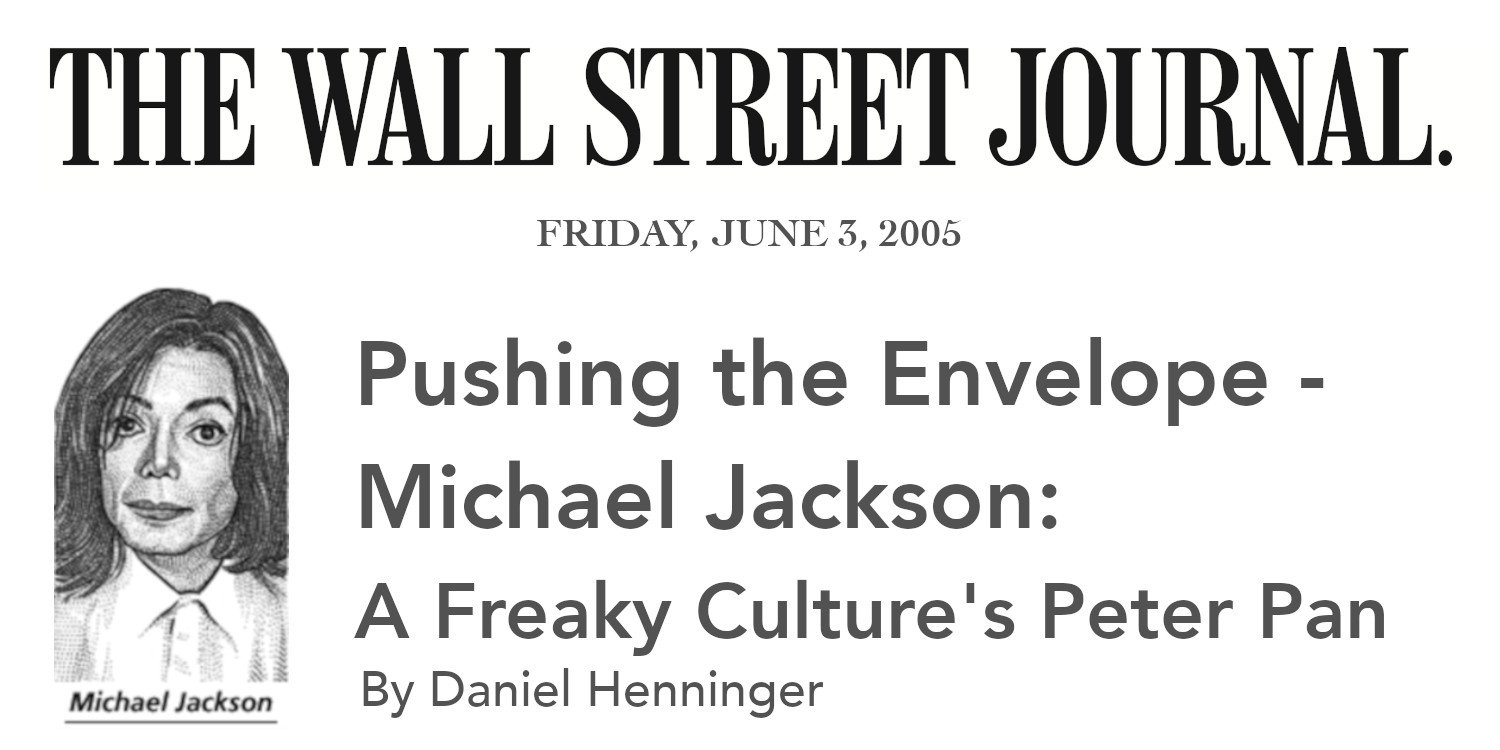
Michael and I in The Wall Street Journal
Catherine Coy was right. I, of all people, should have seen the analogy instantly. Ms. Coy wrote “There isn’t a person alive who could have withstood the onslaught of lies, innuendo and slander that was heaped on Jackson for well over 20 years.” On that score, I beg to differ, but I see her point.
The very association of Michael Jackson’s name with the bizarre proclivity attributed to him may in fact be the result of media-fueled availability bias and not evidence. There is no doubt in my mind that I and many other priests have faced this same phenomenon. With no personal experience of the behaviors attributed to some accused priests, many Catholics simply adopted the point of view given them by the news media.
This does not mean that all the claims of sexual abuse by priests are false. The U.S. Bishops commissioned a formal study of the matter conducted by the John Jay College of Criminal Justice. There were really two waves in the scandal. The first was the revelations that priests were accused at the time alleged abuse happened in the 1960’s to the 1980’s, and then were quietly moved around to other parishes to avoid a public scandal. This was scandalous enough, and tragic.
The John Jay Report also revealed that a full seventy percent of the claims faced by bishops and dioceses in 2002 and following also alleged claims from the 1960’s to 1980’s, but those claims were not brought forward until 2002 when it became clear that Church institutions would settle because of the bludgeoning they took in the media. Those claims were propelled by the widely held belief that it takes victims decades to realize they were abused and report it. Lots of people now believe that, and entire states have passed legislation to accommodate that belief. However, as demonstrated in “Due Process for Accused Priests,” the “delayed reporting” principle is classic availability bias.
In June, 2005, just three months after Dorothy Rabinowitz published an explosive two-part analysis of the case against me in The Wall Street Journal, Deputy Editorial Page Editor, Daniel Henninger wrote a most interesting commentary as Michael Jackson’s criminal trial got underway (“Pushing the Envelope – Michael Jackson: A Freaky Culture’s Peter Pan,” June 3, 2005).
It was Daniel Henninger who first put into print what I hoped someone out there might grasp:
“[Prosecutor] Tom Sneddon may lose this case. If so, it will be because Mr. Jackson, like Kobe Bryant [and O.J. Simpson], was able to mount a defense equal to the accusatory powers of the state. Not everyone can do that. If Michael walks, I’ll wonder if any of the many convicted Catholic priests similarly charged were in fact innocent but found guilty because they couldn’t push back against the state’s relentless steamroller.”
I do not at all begrudge Michael Jackson’s having had the means to mount a defense equal to the state’s prosecution of him. Whatever he spent defending himself, it was less than the state spent trying to put him in prison. At the same time, I thought Daniel Henninger’s comment about convicted priests was just and fair, but he missed an important point. I no longer have the letter, but I wrote to Mr. Henninger shortly after his 2005 editorial. This is the gist of what I wrote:
“As a priest without the means to push back in equal measure to Michael Jackson, I must point out some factors you overlooked:
“Imagine how steeply uphill Michael Jackson’s battle would have been if twenty years passed between the alleged crime and the state’s prosecutorial steamroller rumbling into action for a trial. Imagine the state having to prove nothing while Michael Jackson’s defense tried in vain to prove that something alleged to have happened two decades earlier never happened at all.
“Then imagine Michael Jackson struggling to proclaim his innocence while the institution he served denounced him and his attempts to defend himself, seeking only the path of least resistance to settle with his accusers and rid themselves of liability at the expense of due process.
“Imagine all of this, and you will have captured the scene faced by most similarly accused Catholic priests.”

The Wall Street Journal
The aftermath of those articles in April, 2005 was most interesting. The accusers in the case against me — anxious to talk to the news media before receiving settlements — suddenly had nothing to say. one of my prosecutors had nothing to say. The other took his own life. The judge was quoted in a local news article saying, vaguely, “Review is a positive thing.” Then he took early retirement from the bench. The police detective who choreographed the case, reportedly offering bribes to potential accusers, had nothing to say and has since been exposed on a previously secret list of ethically challenged police.
After those WSJ articles about me, I expected an onslaught of defensive rhetoric from victims’ groups, prosecutors, and contingency lawyers, but it never came. The sole protest came from the most unexpected source. Father Edward Arsenault, my Bishop’s delegate and the man most involved in settlement negotiations in these cases, declared that I was found guilty in a court of law by a jury of my peers, and nothing else needed to be said. Father Arsenault denounced The Wall Street Journal and its writer as biased. Incredible!
A few years later, Msgr. Edward Arsenault was convicted of multiple counts of embezzlement, including charges of forgery and fraud, and sentenced to prison. He was subsequently dismissed from the clerical state by Pope Francis but now inexplicably has a new life and a new name: Edward J. Bolognini.
In 2005 just as the Catholic scandal was building up steam to rumble full speed ahead for a national contingency lawyer windfall, I did not expect that the world’s largest secular newspaper would publish so openly against the tide — or tidal wave — of typical media coverage of claims against priests while most in the Catholic media remained silent. With the exception of Father Richard John Neuhaus in First Things and The Catholic League in Catalyst, and the Catholic World Report, the Catholic media — on both the left and the right — continued to remain silent about false claims against priests brought for money, or, worse, they have used the clergy scandal for some agenda of their own.
And of Michael Jackson, writing in The Nation, (“The Love We Lost”), JoAnn Wypijewski wrote that
“Ordinary rules of judgment have been suspended” in this sound-bite culture of news that shapes most peoples’ views on sex and the accused:
“[I]t cannot matter that Michael Jackson was acquitted of child molestation, since he was frequently remembered in death as a pedophile… just as it cannot matter whether others who plead guilty to a sex charge really did it, or whether evidence to convict was nonsense, or whether the guilty served their time. They can never ‘pay their debt to society.’ Guilt is the presumption, forever.”
JoAnn Wypijewski went on to describe the case of the priest convicted in a trial in which the sole “credible” evidence presented to the jury was the mere fact that he is a priest — that, and a claim of repressed and recovered memory, the legitimacy of which is always questioned when the accused is not a priest. In an all-too familiar twist, that priest’s bishop added his own sound bite by administratively dismissing the priest from the priesthood just before the sham of a trial.
JoAnn Wypijewski also bravely wrote about me just as the fiasco film, “Spotlight” was receiving its Academy Award for Public Service. Her ground-shaking article was “Oscar Hangover Special: Why "Spotlight" Is a Terrible Film.”
After what has now exceeded $4 billion in total mediated settlements nationwide, the matter of false claims is the elephant in the sacristy that no one wants to talk about. At the same time, our beleaguered Catholic bishops present case after case as “credible” despite knowing exactly what that term means and does not mean.
The “credible” standard Catherine Coy applied to Michael Jackson is admirable and hopeful. Ms. Coy’s fair-minded attitude about Michael Jackson is the polar opposite of what is now applied to Catholic priests.
There is no mechanism whatsoever beyond preserved DNA or an admission of guilt that would serve as evidence that a priest accused from decades ago is guilty. There is no investigation technique that could determine the credibility of such claims. What makes most claims against priests “credible” is the fact that someone — not them — has paid money to an accuser. Nothing else. Catholics should take note of the efforts by Michael Jackson fans to revisit credibility despite financial settlements which, in the secular world, are merely designed to make the claim go away with no statement of culpability.
For my part, I can only remember the famous scene early in Michael’s trial during which he danced on the hood of an SUV outside the court to the wild cheers of fans. Michael sure was a strange guy, but the dance gave me pause. Having been through such a trial, I know its oppression. That dance was surely the act of a delusional man …
… or perhaps an innocent one.

Note from Fr Gordon MacRae: Thank you for reading and sharing this post. Your comments are most welcome, but they are moderated, so they may not appear instantly. You may also like these related posts from Beyond These Stone Walls.
Due Process for Accused Priests, Catalyst, July 2009
In the Diocese of Manchester, Transparency and a Hit List
The Eucharistic Adoration Chapel established by Saint Maximilian Kolbe was inaugurated at the outbreak of World War II. It was restored as a Chapel of Adoration in September, 2018, the commemoration of the date that the war began. It is now part of the World Center of Prayer for Peace. The live internet feed of the Adoration Chapel at Niepokalanow — sponsored by EWTN — was established just a few weeks before we discovered it and began to include in at Beyond These Stone Walls. Click “Watch on YouTube” in the lower left corner to see how many people around the world are present there with you. The number appears below the symbol for EWTN.
Click or tap here to proceed to the Adoration Chapel.
The following is a translation from the Polish in the image above: “Eighth Star in the Crown of Mary Queen of Peace” “Chapel of Perpetual Adoration of the Blessed Sacrament at Niepokalanow. World Center of Prayer for Peace.” “On September 1, 2018, the World Center of Prayer for Peace in Niepokalanow was opened. It would be difficult to find a more expressive reference to the need for constant prayer for peace than the anniversary of the outbreak of World War II.”
For the Catholic theology behind this image, visit my post, “The Ark of the Covenant and the Mother of God.”