“There are few authentic prophetic voices among us, guiding truth-seekers along the right path. Among them is Fr. Gordon MacRae, a mighty voice in the prison tradition of John the Baptist, Maximilian Kolbe, Alfred Delp, SJ, and Dietrich Bonhoeffer.”
— Deacon David Jones

The Annunciation: When the Dawn from On High Broke Upon Us
The Gospel of Saint Luke opens with a news flash from the Archangel Gabriel for Zechariah the priest, and Mary — Theotokos — the new Ark of the Covenant.
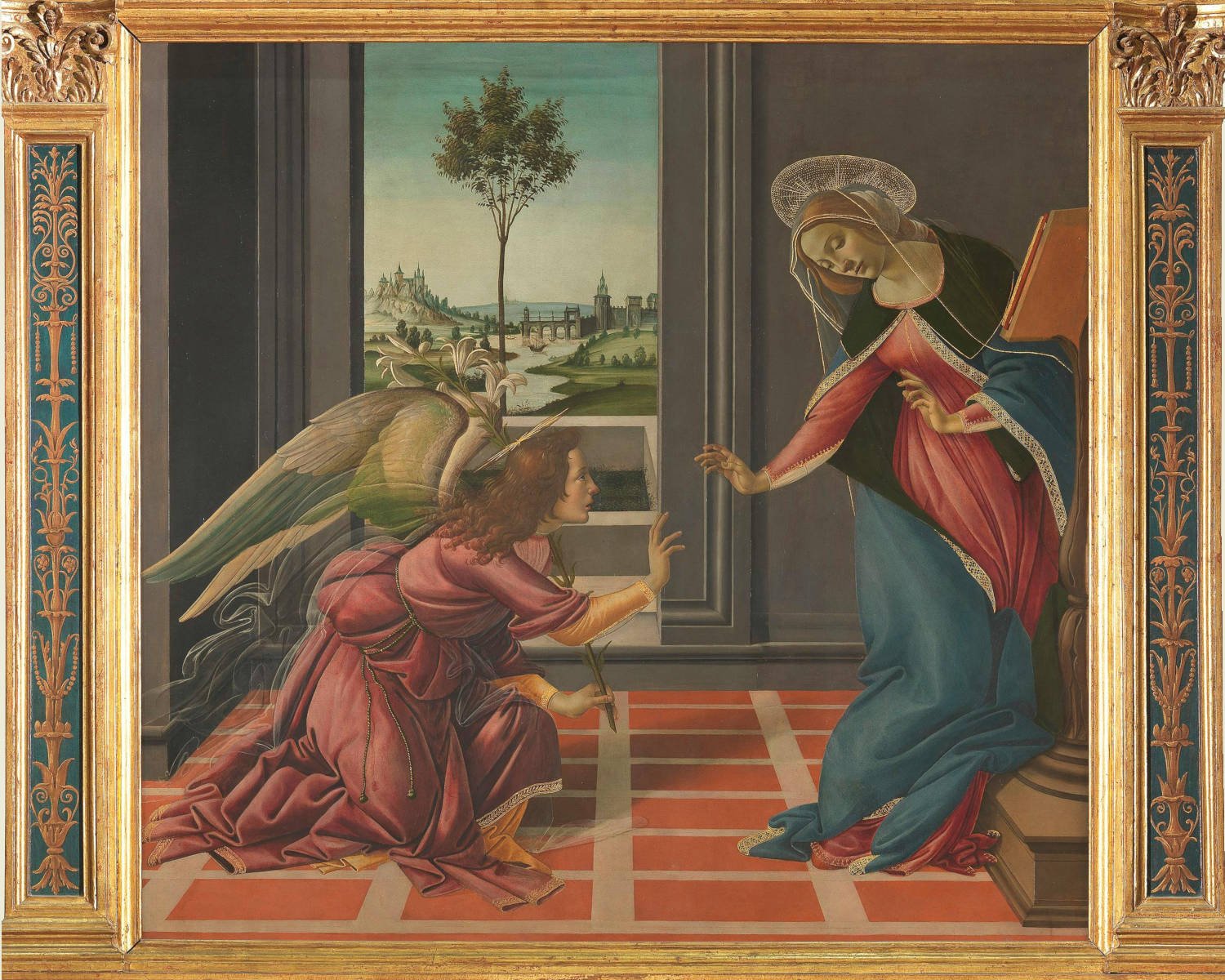
The Gospel of Saint Luke opens with a news flash from the Archangel Gabriel for Zechariah the priest, and Mary — Theotokos — the new Ark of the Covenant.
March 25, Solemnity of the Annunciation
On the 25th day of March, the Church remembers the Annunciation of the Angel Gabriel to Mary marking a pivotal event in Salvation History. The account is conveyed to us in the first chapter of the Gospel According to Saint Luke, a Gentile physician and a companion of the Apostle Paul. Several of the Fathers of the Early Church attribute the Third Gospel to Saint Luke and affirm his authorship of it. I once wrote of this unique Gospel in “Saint Luke the Evangelist, Dear and Glorious Physician.”
This Gospel reveals many facets of the life and mission of Jesus, but foremost among them is its universal message of Salvation. Luke, despite being a Gentile, anchors his Gospel in the traditions of the earlier Covenant, the Old Testament, portraying Jesus as the Savior and Redeemer of God’s Old Covenant people. He thus presents Jesus in history as one foretold by the Prophets (Isaiah 11:10-12, 49:6, and Ezekiel 39:25-29). Luke thus depicts Jesus as the Royal Messiah in the line and legacy of King David to reunite the scattered tribes of Israel and gather them into one nation. Given that he is the only Gentile Evangelist, that is an amazing feat through which Luke has prepared an artistic and spiritual masterpiece.
Saint Luke alone among the Evangelists recounts for us the Parable of the Good Samaritan (10:25-37), the Parable of the Prodigal Son (15:11-32), the Magnificat of Mary (1:46-55), the Benedictus of Zechariah (1:68-79), the Nunc Dimittis of Simeon (2:29-35), the Angelic Gloria (2:14) sung by the Angels on Christmas Night and in our liturgy to this day. And Luke is the sole source of the account that begins our story of Salvation: the Archangel Gabriel’s Annunciation to Mary.
No one really knows when or why tradition first places the Birth of Christ on December 25th, but the custom is ancient and it has a lot to do with the Annunciation, which also ties it into the events of Holy Week.
The first recorded mention of December 25 as the date of observance of the Feast of the Nativity was in a Roman document called the Philocalian Calendar dated as early as 336 A.D. Popular observance of the December 25 date of the Nativity, however, was at least a century older.
One obscure theory points to an early Roman Empire legend that great men are fated to die on the same date they were conceived. One tradition traced the date of Passover at or near March 25 in the year Jesus of Nazareth was crucified. If thus among some Romans it became popular belief that he was conceived on that date, then nine months to the day later would be December 25. However, it is impossible today to discern which came first, our belief in the December 25 date for the Birth of Jesus, or our belief in the March 25 date of his Crucifixion and therefore the Annunciation.

Spiritual Battle on a Cosmic Scale
The angels of TV-land usually worked out solutions to the drama of being human within each episode’s allotted sixty minutes. That’s not so with the angels of Scripture. Most came not with a quick fix to human madness, but with a message for coping, for giving hope, for assuring a believer, or, in the case of the Angel of the Annunciation, for announcing some really big news on a cosmic scale — like Salvation! What the angels of Scripture do and say has deep theological symbolism and significance, and in trying times interest in angels seems to thrive. The Archangel Gabriel dominates the Nativity Story of Saint Luke’s Gospel, but who is he and what is the meaning of his message?
We first meet Gabriel five centuries before the Birth of Christ in the Book of Daniel. The Hebrew name, “Gabri’El” has two meanings: “God is my strength,” and “God is my warrior.” As revealed in “Angelic Justice: Saint Michael the Archangel and the Scales of Hesed,” the Hebrew name Micha-El means “Who is like God?” The symbolic meaning of these names is portrayed vividly as Gabriel relates to Daniel the cosmic struggle in which he and Michael are engaged:
“Fear not, Daniel, for from the first day that you set your mind to understand, and humbled yourself before God, your words have been heard, and I have come because of your words. The prince of the kingdom of Persia withstood me twenty-one days, but Michael, one of the chief princes, came to help me. So I left him there with the prince of the kingdom of Persia, and came to make you understand what is to befall your people in the latter days . . . But I will tell you what is inscribed in the Book of Truth: there is none who contends at my side against these except Michael.”
— Daniel 10:12-14, 21
In the Talmud, the body of rabbinic teaching, Gabriel is understood to be one of the three angels who appeared to Abraham to begin Salvation History, and later led Abraham out of the fire into which Nimrod cast him. The Talmud also attributes to Gabriel the rescue of Lot from Sodom. In Christian apocalyptic tradition, Gabriel is the “Prince of Fire,” who will prevail in battle over Leviathan at the end of days. Centuries after the Canon of Old and New Testament Scripture was defined, Gabriel appears also in the Qu’ran as a noble messenger.
In Jewish folklore, Gabriel was in the role of best man at the marriage of Adam and Eve in the Garden of Eden. I found that a strange idea at first, but then it dawned on me: Who else were they going to ask? In later rabbinic Judaism, Gabriel watches over man at night during sleep, so he is invoked in the bedside “Shema” which observant Jews must recite at bedtime in a benediction called the Keri’at Shema al ha_Mitah:
“In the name of the God of Israel, may Michael be on my right hand, Gabriel on my left hand, Uriel before me, behind me Raphael, and above my head, the Divine Presence. Blessed is he who places webs of sleep upon my eyes and brings slumber to my eyelids. May it be your will to lay me down and awaken me in peace. Blessed are You, God, who illuminates the entire world with his glory.”
In an older issue of Word Among Us, Louise Perrotta described Gabriel’s central message to Daniel:
“History is not a haphazard series of events. Whatever the dark headlines — terrorist attacks, natural disasters, economic upheavals — we’re in the hands of a loving and all-powerful God. Earthly regimes will rise and fall, and good people will suffer. But . . . at an hour no one knows, God will bring evil to an end and establish His eternal kingdom.”
The way He accomplishes that is personified in the unusual graphic atop this section portraying Mary bearing the Christ Child in cosmic harmony with the Angelic realm.
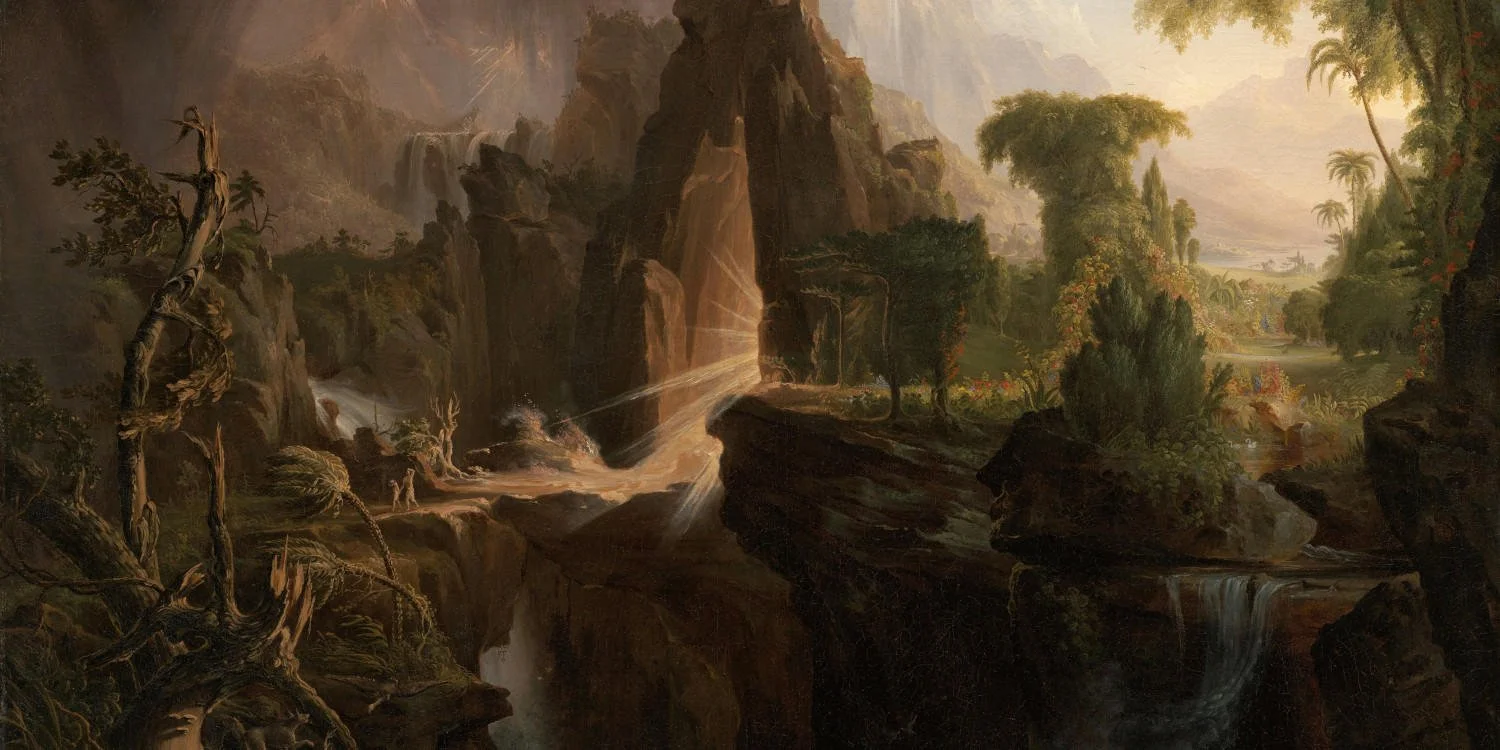
East of Eden; East of God
The Book of Tobit identifies the Archangel Raphael as one of seven angels who stand in the Presence of God. Scripture and the Hebrew Apocryphal books identify four by name: Michael, Gabriel, Raphael, and Uriel. The other three are not named for us. In rabbinic tradition, these four named angels stand at the Celestial Throne of God at the four compass points, and Gabriel stands to God’s left. From our perspective, this places Gabriel to the East of God, a position of great theological significance for the fall and redemption of man.
In a previous post I described the symbolism of “East of Eden,” a title made famous by the great American writer, John Steinbeck, who was awarded the Nobel Prize in Literature for it in 1962. I don’t mean to brag (well, maybe a little!) but a now-retired English professor at a very prestigious U.S. academy who knew Steinbeck left a comment on my post comparing it to Steinbeck’s work. This has absolutely nothing to do with the Archangel Gabriel, but I’ve been waiting for a subtle chance to mention it again! (ahem!) But seriously, in the Genesis account of the fall of man, Adam and Eve were cast out of Eden to the East (Genesis 3:24). It was both a punishment and a deterrent when they disobeyed God by eating from the Tree of Knowledge of Good and Evil:
“Behold, the man has become like one of us, knowing good from evil; and now, lest he put out his hand and take also from the Tree of Life, and eat, and live forever,’ therefore the Lord God sent him forth from the Garden of Eden to till the ground from which he was taken. He drove the man out, and to the east of the Garden of Eden he placed a Cherubim, and a flaming sword which turned every which way, to guard the way to the Tree of Life.”
— Genesis 3: 22-24
A generation later, after the murder of his brother Abel, Cain too “went away from the presence of the Lord and dwelt in the land of Nod, East of Eden.” (Genesis 4:16). The land of Nod seems to take its name from the Hebrew “nad” which means “to wander,” and Cain described his fate in just that way: “from thy face I shall be hidden; I shall be a fugitive and a wanderer on the earth” (Genesis 4:14). The entire subsequent history of Israel is the history of that wandering East of Eden. I wonder if it is also just coincidence that the Gospel of Saint Matthew, the only source of the story of the Magi, has the Magi seeing the Star of Bethlehem “in the east” and following it out of the east.
In rabbinic lore, Gabriel stands in the Presence of God to the left of God’s throne, a position of great significance for his role in the Annunciation to Mary. Gabriel thus stands in God’s Presence to the East, and from that perspective in St. Luke’s Nativity Story, Gabriel brings tidings of comfort and joy to a waiting world in spiritual exile East of Eden.
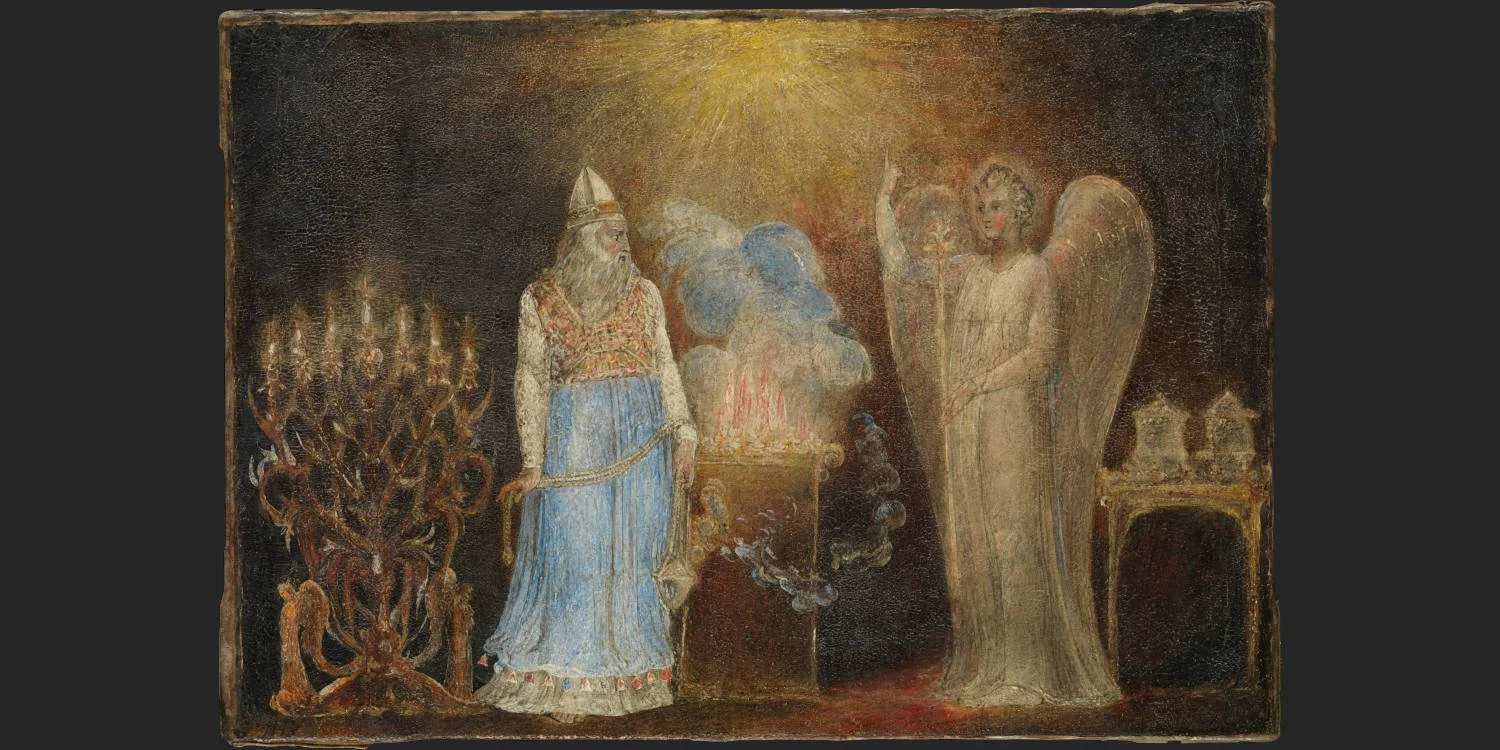
Gabriel Appears to Zechariah
The Archangel’s first appearance is to Zechariah, the husband of Mary’s cousin, Elizabeth. Zechariah is told that he and his wife are about to become the parents of the one who would become John the Baptist. The announcement does not sink in easily because, like Abraham and Sarah at the beginning of Salvation History, Zechariah and Elizabeth were rather on in years. Zechariah is about to burn incense in the Temple of Sacrifice, as close to the Holy of Holies as a human being can get, when the Archangel Gabriel appears with news:
“Fear fell upon him. But the angel said to him, ‘Do not be afraid, Zechariah, for your prayer is heard, and your wife, Elizabeth will bear you a son, and you shall call his name John . . . and he will be filled with the Holy Spirit even from his mother’s womb, and he will turn many of the sons of Israel to the Lord their God and will go before him in the spirit and power of Elijah . . .’”
— Luke 1:12-15
This news isn’t easily accepted by Zechariah, a man of deep spiritual awareness revered for his access to the Holy of Holies and his connection to God. Zechariah doubts the message, and questions the messenger. It would be a mistake to read the Archangel Gabriel’s response in a casual tone. Hear it with thunder in the background and the Temple’s stone floor trembling slightly under Zechariah’s feet:
“I am Gabriel who stand in the Presence of God . . . and behold, you will be silent and unable to speak until the day that these things come to pass.”
I’ve always felt great sympathy for Zechariah. I imagined him having to make an urgent visit to the Temple men’s room after this, followed by the shock of being unable to intone the Temple prayers.
Zechariah was accustomed to great deference from people of faith, and now he is scared speechless. I, too, would have asked for proof. For a cynic, and especially a sometimes arrogant one, good news is not easily taken at face value.
Then six months later “Gabriel was sent from God to a city of Galilee named Nazareth, to a virgin betrothed to a man whose name was Joseph, of the House of David, and the virgin’s name was Mary.” (Luke 1: 26-27). This encounter was far different from the previous one, and it opens with what has become one of the most common prayers of popular devotion.
Gabriel said, “Hail Mary, full of grace, the Lord is with thee.” His words became the Scriptural basis for the doctrine of the Immaculate Conception, that and centuries of “sensus fidelium,” the consensus of the faithful who revere her as “Theotokos,” the God-Bearer. Mary, like Zechariah, also questions Gabriel about the astonishing news. “How can this be since I have not known man?” There is none of the thunderous rebuke given to Zechariah, however. Saint Luke intends to place Gabriel in the presence of his greater, a position from which even the Archangel demonstrates great reverence and deference.
It has been a point of contention with non-Catholics and dissenters for centuries, but the matter seems so clear. There’s a difference between worship and reverence, and what the Church bears for Mary is the deepest form of reverence. It’s a reverence that came naturally even to the Archangel Gabriel who sees himself as being in her presence rather than the other way around. God and God alone is worshiped, but the reverence bestowed upon Mary was found in only one other place on Earth. That place was the Ark of the Covenant, in Hebrew, the “Aron Al-Berith,” the Holy of Holies which housed the Tablets of the Old Covenant. I wrote of Mary’s identification with the most sacred artifact in all of Israel in “The Ark of the Covenant and the Mother of God.”
But the story of Gabriel’s Annunciation to Mary draws on elements from the Second Book of Samuel. These elements are drawn by Saint Luke as he describes Mary’s haste to visit her cousin Elizabeth in the hill country of Judea. In 2 Samuel 6:2, David visits this very same place to retrieve the Ark of the Covenant. Upon Mary’s entry into Elizabeth’s room in Saint Luke’s account, the unborn John the Baptist leaps in Elizabeth’s womb. This is reminiscent of David leaping before the Ark of the Covenant in 2 Samuel 6:16.
For readers “with eyes to see and ears to hear,” Saint Luke presents an account of God entering into human history in terms quite familiar to the old friends of God. God himself expressed in the Genesis account of the fall of man that man has attempted to “become like one of us” through disobedience. Now the reverse has occurred. God has become one of us to lead us out of the East, and off the path to eternal darkness and death.
The Church honors with the deepest reverence Mary, Theotokos, the Bearer of God and the new Ark of the Covenant. Mary, whose response to the Archangel Gabriel was simple assent:
“Let it be done to me according to your word.”
“Then the Dawn from On High broke upon us, to shine on those who dwell in darkness and the shadow of death, and to guide our feet on the way to peace.”
— Luke 1:78-79
+ + +
Note from Father Gordon MacRae: Thank you for reading and sharing this post. It is also added to our collection of Scripture posts, The Bible Speaks.
You may also like these related posts:
Saint Luke the Evangelist, Dear and Glorious Physician
The Ark of the Covenant and the Mother of God
Holy Week begins this year on Palm Sunday, March 29. We have collected a list of seven Holy Week posts from Beyond These Stone Walls. Together, they form a sort of personal Holy Week Retreat. We invite you to take part in it by visiting or revisiting each of its linked posts throughout the course of this coming week. You may access here Our Beyond These Stone Walls Holy Week Retreat.

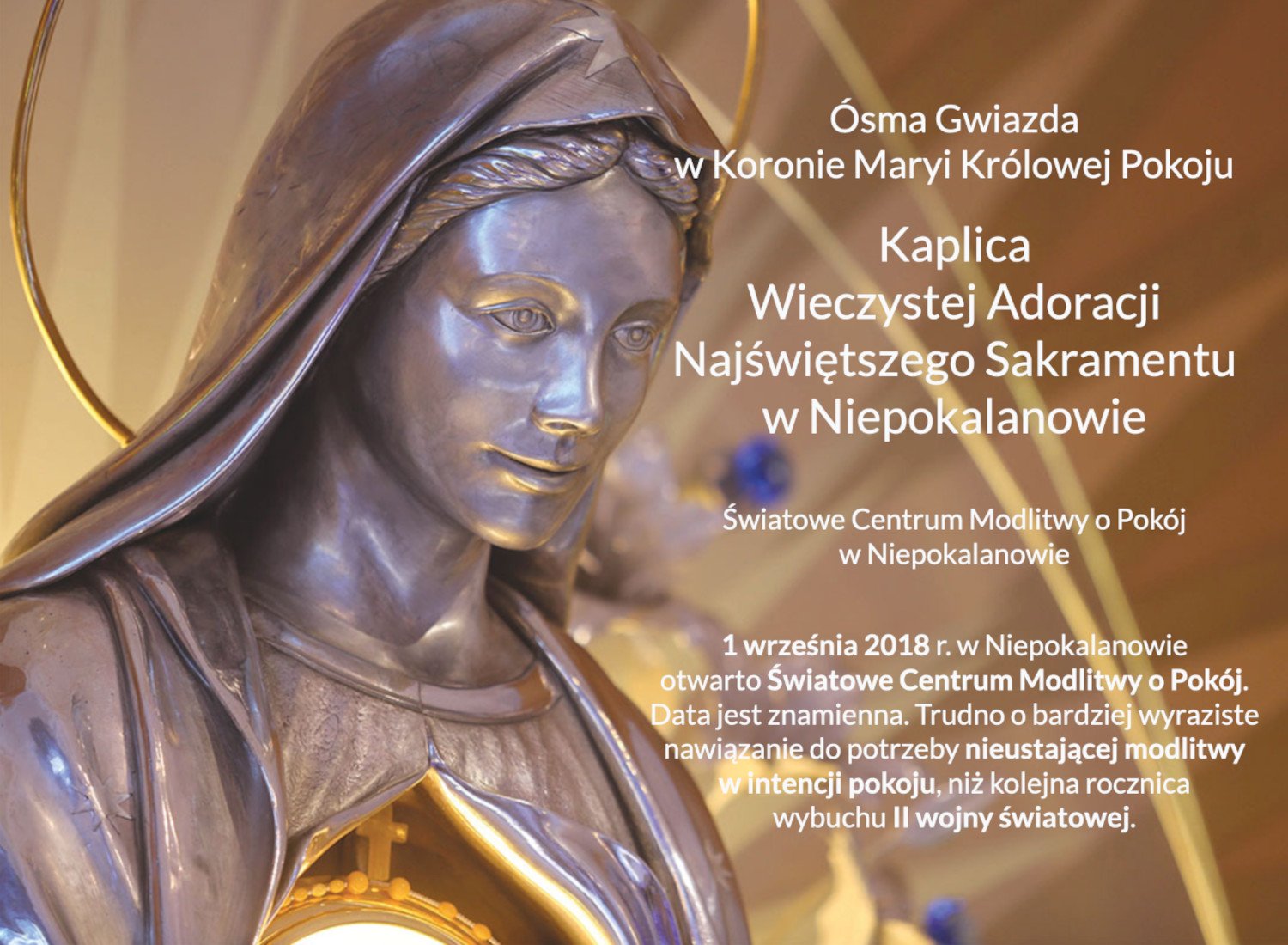

The Eucharistic Adoration Chapel established by Saint Maximilian Kolbe was inaugurated at the outbreak of World War II. It was restored as a Chapel of Adoration in September, 2018, the commemoration of the date that the war began. It is now part of the World Center of Prayer for Peace. The live internet feed of the Adoration Chapel at Niepokalanow — sponsored by EWTN — was established just a few weeks before we discovered it and began to include in at Beyond These Stone Walls. Click “Watch on YouTube” in the lower left corner to see how many people around the world are present there with you. The number appears below the symbol for EWTN.
Click or tap here to proceed to the Adoration Chapel.
The following is a translation from the Polish in the image above: “Eighth Star in the Crown of Mary Queen of Peace” “Chapel of Perpetual Adoration of the Blessed Sacrament at Niepokalanow. World Center of Prayer for Peace.” “On September 1, 2018, the World Center of Prayer for Peace in Niepokalanow was opened. It would be difficult to find a more expressive reference to the need for constant prayer for peace than the anniversary of the outbreak of World War II.”
For the Catholic theology behind this image, visit my post, “The Ark of the Covenant and the Mother of God.”

The Ark of the Covenant and the Mother of God
A theological expedition into Salvation History reveals a startling truth about the Ark of the Covenant in the Old Testament and the identity of Mary, Mother of God.

A theological expedition into Salvation History reveals a startling truth about the Ark of the Covenant in the Old Testament and the identity of Mary, Mother of God.
December 21, 2021
Most long time readers of these pages might guess my favorite among the canonical Gospels. Back in 2019, I wrote a post entitled “St. Luke the Evangelist, Dear and Glorious Physician.” In part, it profiled a 1959 book by Taylor Caldwell that I read at age 21 during my novitiate year as a Capuchin. Several years later, life took me in another direction to diocesan priesthood, and then down darker roads that seemed to have a will of their own. These were roads of betrayal and false witness that sent me ever further from the dream of my vocation to priesthood as I first envisioned how it would be.
That story is told in small snippets in multiple places. One day, I will compose the whole story. For this post, suffice it to say today that one book always stood out in the back of my mind as a story of Divine Providence that very much influenced my life. It was Dear and Glorious Physician, the 1959 novel by Taylor Caldwell on the life of Saint Luke. It was Taylor Caldwell's Magnum Opus, forty years in the making, and a masterpiece of Catholic literature.
Two years after I first wrote about the book, I saw it in a library catalog from Ignatius Press. I was looking for a copy of Prison Journal Volume 2 by George Cardinal Pell when I spotted a reprint of Dear and Glorious Physician and decided that I could afford another $22.00. Forty-seven years after my first reading of it, I am reading it again for Advent in honor of St. Luke. Dear and Glorious Physician is indeed a masterpiece.
Among the four New Testament evangelists, Saint Luke provides the most theologically nuanced information about the identity of Mary and her role in Salvation History. The Gospel of Luke is unique. He is the only Gentile author to compose a New Testament book and the only evangelist to write a sequel — the Acts of the Apostles which begins where Luke’s Gospel narrative ends.
Luke’s intended audience on the surface included Gentile Christians throughout the Mediterranean world. I write “on the surface” because Luke writes a fascinating narrative beneath the obvious one. A deeper reading reveals a secondary audience, the Diaspora, the dispersion of Jews living outside of Palestine since the Babylonian exile of the sixth century BC.
In subtle echoes of the Old Testament, Luke reaches into ancient times recalling the most sacred imagery for the people of Israel. Nowhere is this more evident in Luke’s Gospel than in his Infancy Narratives about the Annunciation to Mary and her Visitation to Elizabeth which is the Gospel for the Fourth Sunday of Advent.

The Ark of the Covenant
That narrative requires some understanding of the most treasured and sacred object for Israel in the Old Testament, the Ark of the Covenant. First, I need to clarify what is meant by a “Testament.” In relation to Scripture, the word is a Latin translation by St. Jerome of the Hebrew “berit” and the Greek, “diathēkē.” Both words refer to a kinship bond with obligations between connected parties. It is the master theme of Sacred Scripture, and in that sense, the word “Covenant” captures better than “Testament” the meaning and intent of what we call the Old and New Testament.
I recently read in a secular commentary that Christianity is the only religion that includes the entire Sacred Scriptures of another religion, Judaism. That is not accurate. Christianity is not a replacement of Judaism, but rather a continuation of it. The Gospel According to St. Luke makes this most clear in Luke’s treatment of the Ark of the Covenant.
The Ark was a chest constructed in the time of Moses as described in the Book of Exodus (25:10-26). It was constructed of acacia wood, a tree that grows nowhere but in the southern district of Palestine in the Jordan Valley. Acacia appears in Scripture in three places: the Books of Exodus (Ch 25-27, 30) and Deuteronomy (10:3) in reference to the construction of the Ark, and in a prophecy of Isaiah (41:19) who states that in the messianic restoration of Israel, Yahweh will make acacia grow in the desert. This is significant.
The desert in Scripture is highly symbolic of exile and wandering. It is a place of demons, a place where mankind becomes lost. To make acacia grow there is symbolic of God bringing the Ark of the Covenant even there. This is why the Gospel gave John the Baptist the title of “A Voice in the Wilderness” in fulfillment of a prophecy of Isaiah (40:2-5):
“A voice cries in the wilderness ‘Prepare the way of the Lord, make straight in the desert a highway for our God ... and the glory of the Lord shall be revealed.’”
Inside the Ark of the Covenant — also called the “Ark of Testimony” and the “Ark of the Presence” — was placed the stone tablets of the Decalogue, the Ten Commandments inscribed by Yahweh and given to Moses on Mt. Sinai after the Exodus from slavery in Egypt. As such, the Ark was believed by all of Israel to be the Tabernacle of the Presence of Yahweh.
The Ark was elaborately designed according to specifications issued to Moses by Yahweh. The acacia was covered inside and out by gold plating. At the four corners of the Ark were rings of solid gold to permit gilded acacia poles to carry the Ark so human hands would not touch it. Its lid was a solid gold slab that formed the “kapporet,” the seat of atonement along with two cherubim of beaten gold facing each other (Exodus 25: 17-22). The two golden cherubim formed a footstool for the Hidden Lord.
The Ark was the place of the Lord’s intimate presence among his people, and it became the most cherished object in Israel. It was secured in the Holy of Holies, the Tabernacle where Moses conversed with the Lord (Numbers 7:89). The Ark was carried into the Promised Land of Canaan appearing in the Books of Joshua (3:3; 3:11), Judges (20: 27), and First Samuel (4: 3,11). During a struggle with the Philistines, it was captured and carried off (1 Samuel 4: 11).
The Philistines suffered seven months of earthquakes and plague before returning the Ark to the Israelites. Out of fear of human contact with it, the Ark was kept in Kiriath-Jearim for 20 years in the home of Abinadab and his son, Eleazar, both consecrated with responsibility for the Ark. Then, about 1,000 years before the Birth of the Messiah, it was returned to David who placed it prominently in a Tabernacle in his established capital, Jerusalem (2 Samuel 6:2ff).
Later, David’s son, Solomon, enshrined the Ark in the Jerusalem Temple where it remained for 400 years until the Fall of Jerusalem to the Babylonians in 586 BC. The Second Book of Maccabees (2:5-7) refers to the Ark saved from destruction by the Prophet Jeremiah and hidden on Mount Nebo “until God gathers His people together again, and shows His mercy.”

Mary, the New Ark of the Covenant
In the Book of Revelation (11:19) the Ark of the Covenant appears again, this time in the Celestial Temple in fulfillment of the prophecy of Jeremiah. This vision of the Ark leads immediately in Revelation to the vision of the Woman Clothed with the Sun who was with child (Rev. 12:1). The image is that of Mary, presented as Mother of the Messiah and spiritual Mother of Israel, the New Ark of the Covenant.
I alluded to this earlier in an Advent post, “To Christ the King through the Immaculate Heart of Mary.” In the first two chapters of his Gospel, Saint Luke strings together some of the most beautiful traditions from both Testaments (Covenants) about the nature of the Ark of the Covenant. In subtle language, he leads the careful reader to a conclusion about Mary herself: that she, as “Theotokos,” the Bearer of the Presence of God, is thus the Ark of God’s New Covenant while the Ark of the Old Covenant prefigures a more wonderful Ark to come, the Mother of the Messiah.
Luke draws upon a tradition from the Old Covenant setting up a subtle but significant parallel between Mary’s Visitation to Elizabeth (Luke 1:30-45) and David's encounter with the Ark of the Covenant (2 Samuel 6:2) about 1000 years earlier. Consider these passages:
In Luke 1:39: “In those days, Mary arose and went with haste into the hill country to a city of Judah.” In Second Samuel 6, David arose and went in haste to the same place to receive the Ark of the Covenant.
In Luke 1:41: “When Elizabeth heard Mary’s greeting, the child leaped in her womb.” In Second Samuel 6:16, David danced with joy in the presence of the Ark. In the Gospel of Luke, Elizabeth asks of Mary, “Who am I that the Mother of my Lord should come to me?” (Luke 1:43). In Second Samuel (9:8), David, who prefigures the coming Messiah, is then asked by the son of Jonathan, “Who am I that you should look upon someone such as me?” In Luke, Mary stays at the house of Zechariah and Elizabeth for three months. In Second Samuel (6:11), David stays in the house of Obed-edom three months.
These opening narratives from Luke have a multitude of such parallels with which Luke draws faithful Jews of the Diaspora who were familiar with the Old Covenant into the New. Finally, in Luke’s sequel, the Acts of the Apostles, Mary is present with the Apostles at Pentecost as the Holy Spirit calls forth the newborn Church. This provides a fulfillment of the declaration of Jesus from the Cross establishing Mary in the unique role of Motherhood over the whole Church:
“When Jesus saw his mother and the disciple whom he loved, he said, ‘Woman, behold your son.’ Then he said to the disciple, ‘Behold your Mother.’ From that hour, the disciple took her into his home.”
— John 19:26-27
+ + +
From the vision of Saint John:
“Then God’s temple in Heaven was opened and the Ark of his covenant was seen within his temple; and there were flashes of lightning, loud noises, peals of thunder, heavy hail, and the Earth quaked. And a great sign appeared in Heaven, a woman clothed with the sun, with the moon under her feet, and on her head a crown of twelve stars. She was with child.”
— Rev. 11:19 - 12:2
+ + +
O come, O come, Thou Lord of might,
Who to Thy tribes on Sinai's height
In ancient times did give the Law
In cloud and majesty and awe
O come, Thou rod of Jesse's stem,
From every foe deliver them
That trust Thy mighty power to save
And give them victory over the grave
Rejoice! rejoice! O Israel
To Thee shall come Emmanuel!
+ + +
Special Announcements:
If you like this excursion into Sacred Scripture, please visit our collection of BTSW Sacred Scripture posts, From Abraham to Easter for other titles that make Scripture come alive.
Our Voices from Beyond feature has an article by Father Gordon MacRae and Felix Carroll on the work of Mary behind those stone walls. Father G says, “Don’t let the top graphic on that post scare you away.”
You may also wish to visit these related posts:
St. Gabriel the Archangel When the Dawn from On High Broke Upon Us


Saint Luke the Evangelist, Dear and Glorious Physician
The Church honors St. Luke the Evangelist on October 18. Author of a unique Gospel and Acts of the Apostles, Luke is the source of the most cited parables of Jesus.

The Church honors St. Luke the Evangelist on October 18. Author of a unique Gospel and Acts of the Apostles, Luke is the source of the most cited parables of Jesus.
In “February Tales,” an early post on Beyond These Stone Walls, I wrote of some of the books that captivated my imagination in childhood. Working today in a library, I have come across some of them decades later in adulthood and gave them a second look. It’s a testimony to growing up that most of the books I thought were masterpieces of Western literature in my youth are only laughable today. But a rare few have stood the test of time.
One of them is a book I stumbled upon at age 16. It was 1969 and I was in my senior year of high school. I wrote a short biography of what my life was like then against the backdrop of a culture in the early days of its long moral and social decline. You could find those biographical paragraphs early on in my recent post, “Where Were You When Neil Armstrong Walked on the Moon?”
Somehow in 1969, I discovered among the tattered paperbacks of the Lynn English High School Library a historical novel that would leave its mark on my mind and soul for decades to come. Though first published in 1959, it is a testament to its literary stature that its most recent hardcover edition was published over a half century later in 2012, twenty-seven years after the author’s death. The book is Dear and Glorious Physician by Taylor Caldwell who described its long path:
“This book has been forty-six years in the writing. The first version was written when I was twelve years old, the second when I was twenty-two, the third when I was twenty-six, and all through those years work did not cease on this book. It was impossible to complete, as the other versions were impossible to complete, until my husband and I visited the Holy Land in 1956.”
Taylor Caldwell published forty-three novels to much acclaim in her literary career. Among them were some stand-out historical novels. Her most famous was Captains and the Kings (1972) about the wave of Irish immigrations to America. It became an equally acclaimed television mini-series later in the 1970s.
Caldwell’s first novel was published in 1939. Her last, Unto All Men, was posthumously found and published by her grandchildren in 2012. At that time, they also republished Dear and Glorious Physician, Ms Caldwell’s labor of love that spanned decades in its writing. No other book of my youth has withstood the test of time with such power and majesty.
The author imagined the life of Saint Luke the Evangelist with such realism that it seemed as though she had followed him through it taking notes. It is impossible to know of the birth and upbringing of any of the Gospel characters. But where their life stories were absent, Ms Caldwell spent years, with the assistance of a Catholic priest and historian, researching life and culture in early First Century Antioch — which today is Southern Turkey, the world from which Saint Luke emerged.

She was also aided in this adventure by a wealth of legends about Saint Luke that surfaced in the first few centuries, some of them known to the early Church Fathers, from Antioch, Greece, and Egypt. Like many stories surrounding Biblical legends, some were built upon grains of truth. She was aided in this effort by a collection of these extra-Biblical legends surrounding Saint Luke in the possession of a Catholic nun living in Antioch during the years of her research. The end result is a remarkable volume described by Taylor Caldwell with shades of the pilgrimage of her own life:
“This book is only indirectly about Our Lord. No novel, no historical book, can convey the story of His life so well as our Sacred Scripture. The story of Lucanus, St Luke, is the story of every man’s pilgrimage through despair and life’s darkness, through suffering and anguish, through bitterness and sorrow, doubt and cynicism, rebellion and hopelessness, to the Feet and the understanding of God. The search for God and the final revelation are the only meaning in life for men.”

The Spiritual Legacy of Saint Luke
In the Roman Rite, the Church honors and remembers Saint Luke the Evangelist on October 18. At least some of the readers of Beyond These Stone Walls may have gleaned from my posts that among the four Gospel writers, I have long been especially drawn to the work of Saint Luke. Many of my posts have been built upon Gospel passages that are unique to Luke alone. We will link to a few of the more important ones at the end of this post.
There are several factors that make Luke unique among the four Evangelists. He was the only Gentile author to compose a book in the Canon of Sacred Scripture. All others were of Israelite descent. Saint Paul hints at Luke’s Gentile identity and profession when he refers to him as “Luke the beloved physician” (Colossians 4:14).
Luke is also the only Evangelist to have composed a sequel to his Gospel. The Acts of the Apostles is the second of a two-volume work that picks up immediately where Luke’s Gospel ends. It continues the Gospel narrative with a revelation of how, after the Ascension of Jesus, the Holy Spirit continued to work in the living community of Christ’s mystical body, the Church.
The early manuscripts of the third Gospel, all of which were composed in highly sophisticated Greek, had the title, “Kata Loukan,” meaning “According to Luke.” Though Luke was not an Apostle (nor was Saint Mark) this title serves as a signpost of apostolic tradition in the Gospel. There was no debate whatsoever among the early Christian Church that the author of this work was indeed Luke, the companion of Saint Paul.
Like Paul, Luke had never known Jesus directly, but rather experienced Him in His post-Resurrection presence to the apostolic community and its birth at Pentecost. The Church Fathers were unanimous as far back as A.D. 170 that Luke is indeed the author of both the third Gospel and the Acts of the Apostles.
The only professional disagreement among scholars is the time period in which the Gospel transformed from oral tradition to written form. Luke himself possessed highly refined Greek linguistic ability, and his Gospel clearly reflects it. So there is no reason to believe that Luke relied on anyone else to put his Gospel in written form.
Estimates of the date of authorship vary from about A.D. 60 to A.D. 80. There is much evidence, however, to hold to the earlier date because of the close connection between this Gospel and Acts of the Apostles. The latter, which was the second to be written, concludes with Saint Paul in prison in Rome in A.D. 62. There is no hint at all of the outcome of Paul’s trial or any subsequent activity.
In Acts of the Apostles, much attention is given by Luke to the interactions between the earliest Christians and imperial Rome. However Luke presents no apparent awareness of the open persecution of Christians later in the 60s, nor does he ever mention the late 60s martyrdom of his two central characters in Acts: Saints Peter and Paul. Luke’s writings also seem unaware of the events of A.D. 70 when Jerusalem was utterly destroyed by the Romans.
The Gospel According to Luke is also unique in its near complete absence of Hebrew terms. His one theme that towers above all others is his proclamation of universal salvation for all who embrace Christ. As a writer from Antioch steeped in Greek language and culture, Luke writes for Gentile believers.
This explains his lack of Hebrew terminology. However, he also displays a profound knowledge of the Hebrew Scriptures, and an ability to incorporate them into his Gospel narrative by way of inference. There are a multitude of examples, but here is one from my post “Waking up in the Garden of Gethsemane.”
In the Gospel of Luke (22:31ff ) Jesus is alone and apart from the others as He prays in agony in the face of death. “Father, if you are willing, remove this chalice from me, but Thy will, and not mine, be done.” For Hebrew ears, Luke’s account of Jesus at Gethsemane (referred to only as the Mount of Olives in Luke) is a mirror image in reverse of a scene that occurred at that very same site 1,000 years earlier.
It was a story of a son not obedient unto death, but of a son who betrayed his father. It was the agony of King David and his flight from his son, Absalom, who betrayed him:
“David went up the ascent of the Mount of Olives, weeping as he went, with his head covered and walking barefoot.”
— 2 Samuel 15:30

The Magnificat and Two Powerful Parables
It seems clear that Luke had an awareness of the Gospel of Mark which he incorporates as a source, but he also had sources that none of the other Evangelists had. Luke’s Gospel is the sole source of the glorious Magnificat, the proclamation of Mary in her pre-Christmas visit to her cousin, Elizabeth. Many believe that Luke was given this by Mary herself (Luke 1:46-56):
“My soul magnifies the Lord, and my spirit rejoices in God my Savior, for he has regarded the low estate of his handmaiden. For behold, henceforth all generations will call me blessed, for he who is mighty has done great things for me, and holy is his name. His mercy is on those who fear him in every generation. He has shown strength with his arm, and has scattered the proud in their conceit. He has cast down the mighty from their thrones and has lifted up the lowly. He has filled the hungry with good things and the rich he has sent empty away. He has come to the help of his servant, Israel remembering his promise of mercy as he spoke to our fathers, to Abraham and his children forever.”
Women are especially honored throughout the Gospel of Luke. His portrayal of Mary the Mother of God is unparalleled in the New Testament. He is the sole source of the Archangel Gabriel’s declaration of Annunciation — “Hail, Full of Grace” (Luke 1:28), another example of the belief of many that Mary or someone close to her was one of his sources. Luke also pays close attention to the presence of Elizabeth (1:39-45), Anna (2:36-38), the widow of Nain (7:11-17), Mary Magdalene (8:2), Mary and Martha of Bethany (10:38-42), Joanna and Susanna (8:3) and others.
Saint Luke’s Gospel presents the sole account of the Parable of the Prodigal Son and the Parable of the Good Samaritan, two of the most important stories and most reflected-upon moral lessons in the life of the Church. At the end of this post, I will link to some of the BTSW posts that highlight popular parables unique to Luke’s Gospel. Those parables are held to be masterpieces of Catholic spirituality.
Saint Luke composed a two-part spiritual masterpiece for the ages. Taylor Caldwell would make no such claim, but by having brought Saint Luke to life some 2000 years later with such clarity, beauty and majesty, she deserves at least one not-so-coveted award to honor her accomplishment. Beyond These Stone Walls’ Stuck-Inside Literary Award is presented posthumously to Taylor Caldwell for Dear and Glorious Physician.
+ + +
Note from Father Gordon MacRae: Please share this post on social media. It would also help the cause of justice if you Subscribe to Beyond These Stone Walls.
You may also like these other tributes to the Gospel According to St. Luke:
To Christ the King Through the Immaculate Heart of Mary
The Ark of the Covenant and the Mother of God
St. Gabriel the Archangel: When the Dawn from On High Broke Upon Us
We invite you to visit our Sacred Scripture series called From Abraham to Easter category at the BTSW Library.
