“There are few authentic prophetic voices among us, guiding truth-seekers along the right path. Among them is Fr. Gordon MacRae, a mighty voice in the prison tradition of John the Baptist, Maximilian Kolbe, Alfred Delp, SJ, and Dietrich Bonhoeffer.”
— Deacon David Jones
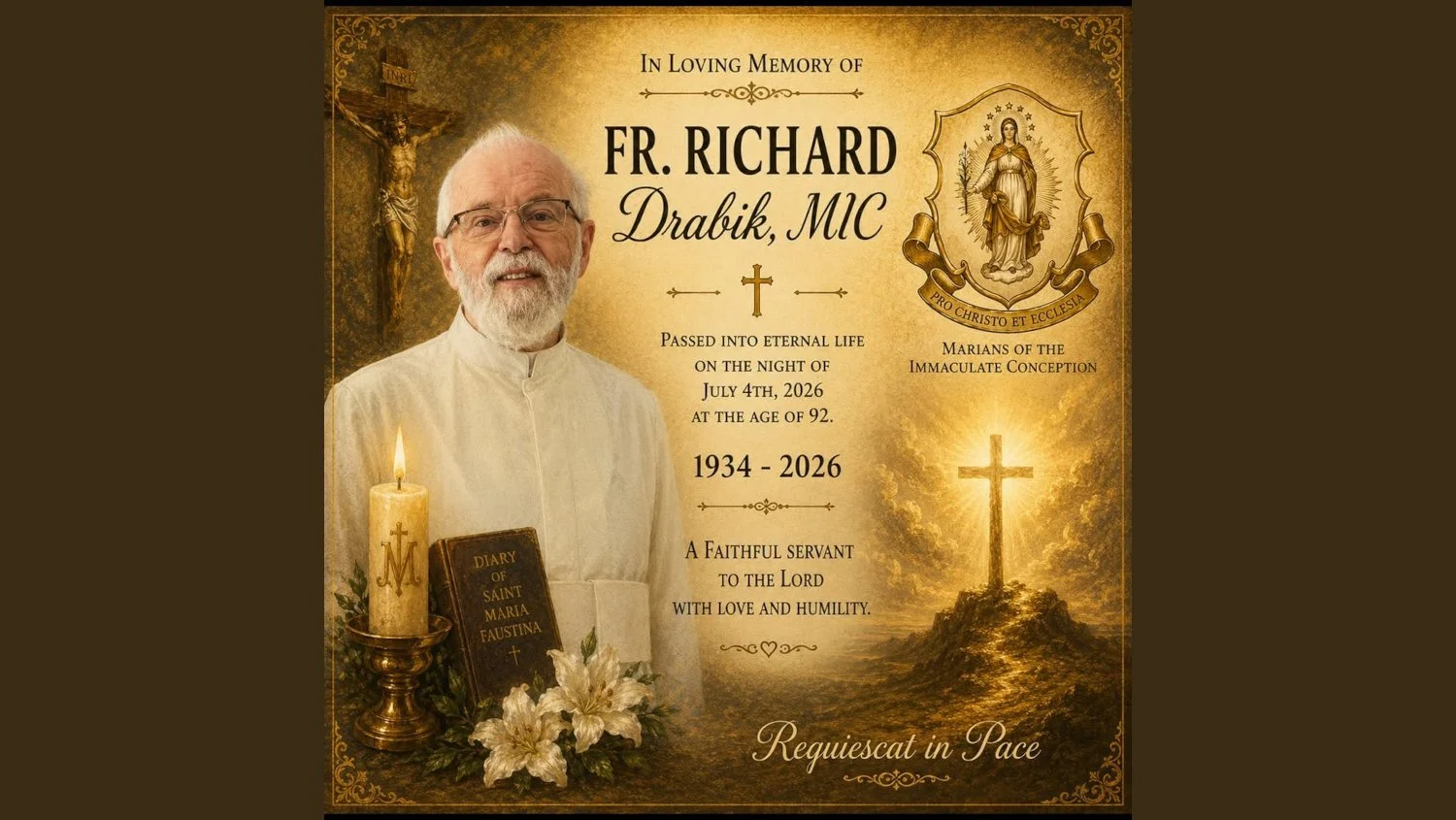
Fr Richard Drabik Introduced Divine Mercy to Saints and Villains
Fr Richard Drabik, MIC, my longtime spiritual director and friend who wrote the Preface to the Diary of Saint Faustina, passed into Divine Mercy on July 4, 2026.
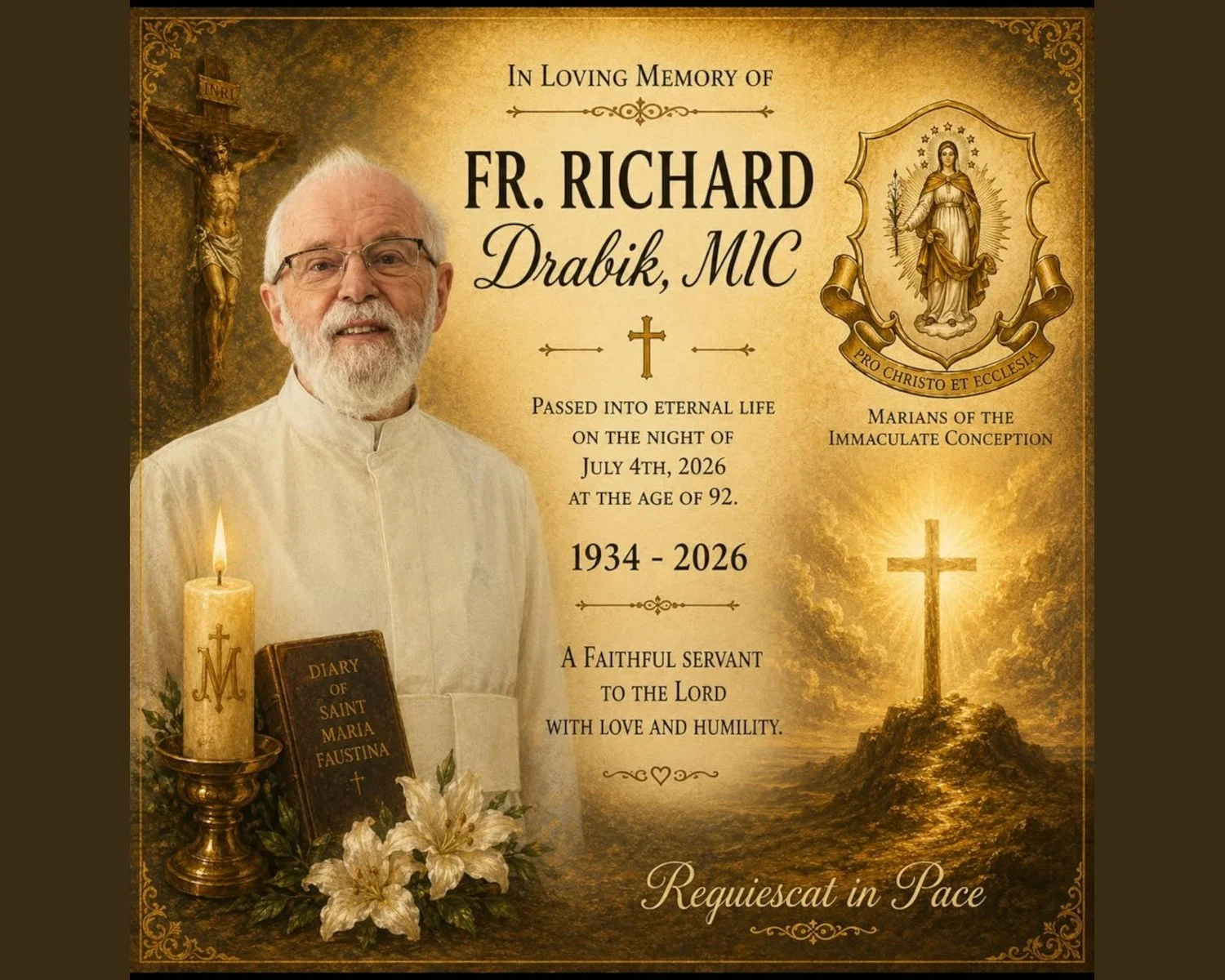
Fr Richard Drabik, MIC, my longtime spiritual director and friend who wrote the Preface to the Diary of Saint Faustina, passed into Divine Mercy on July 4, 2026.
July 8, 2026 by Father Gordon MacRae
“Let the greatest sinners place their trust in My mercy. They have the right before others to trust in the abyss of My mercy . . . To such souls I grant even more graces than they ask. I cannot punish even the greatest sinner if he makes an appeal to My compassion, but on the contrary, I justify him in my unfathomable and inscrutable mercy.”
— Diary of Saint Faustina, 1146
In April of 1993, my friend Father Richard Drabik and I both served on the staff of the Servants of the Paraclete Spiritual and Psychological Renewal Center for priests. Father Drabik was at the time preparing to go to Rome to concelebrate with Pope John Paul II the Mass of Beatification of Sister Maria Faustina Kowalska, now known as Saint Faustina, the Saint of Divine Mercy. Her Beatification took place on the Sunday after Easter that year, and Pope John Paul II decreed that henceforth that Sunday would be universally known in the Roman Calendar as Divine Mercy Sunday.
Father Richard Drabik was formerly Provincial Superior of the Marian Fathers of the Immaculate Conception. He wrote the Preface to the Diary of Saint Maria Faustina Kowalska that has become globally famous. Just before leaving for her Beatification in Rome in 1993, Father Drabik stopped by my office to invite me to write a brief prayer, which would be placed on the altar by Pope John Paul during the Offertory in the Mass for Beatification. I did not know what to write, so on the day of my friend’s departure I handed him a small scrap of paper to place with his intentions for the Mass. I folded it and sealed it in a small envelope that would fit easily in his breast pocket.
No one ever knew what I wrote. The note with my petition was simple: “I ask for the intercession of Blessed Faustina that I may have the courage to be the priest God calls me to be.” It was an odd petition, and today I have no idea what I was thinking about when I wrote it and handed it to Father Drabik on his way out the door.
Exactly two weeks after the Beatification of Sister Faustina, on May 3, 1993, police showed up at my door. They carried with them a secret indictment and a warrant for my arrest for claims alleged to have occurred sometime between 1978 and 1983, ten to fifteen years earlier. They were the claims for which I faced trial and was summarily sent to prison as Ryan A. MacDonald wrote in “Judge Arthur Brennan Sentenced Father Gordon MacRae to Die in Prison.”
Those claims of abuse never took place at all, but I will always remember the words of a police detective as the officers took me away despite my denials: “It doesn’t matter whether you’re guilty. Your Church is!” It was a scene reminiscent of another era I wrote of in “Catholic Scandal and the Third Reich: The Rise and Fall of a Moral Panic.”
The detective’s words could just as easily have been heard in Sister Faustina’s own World War II-era Poland as Father Maximilian Kolbe and many other priests were led off to prison on trumped up charges.
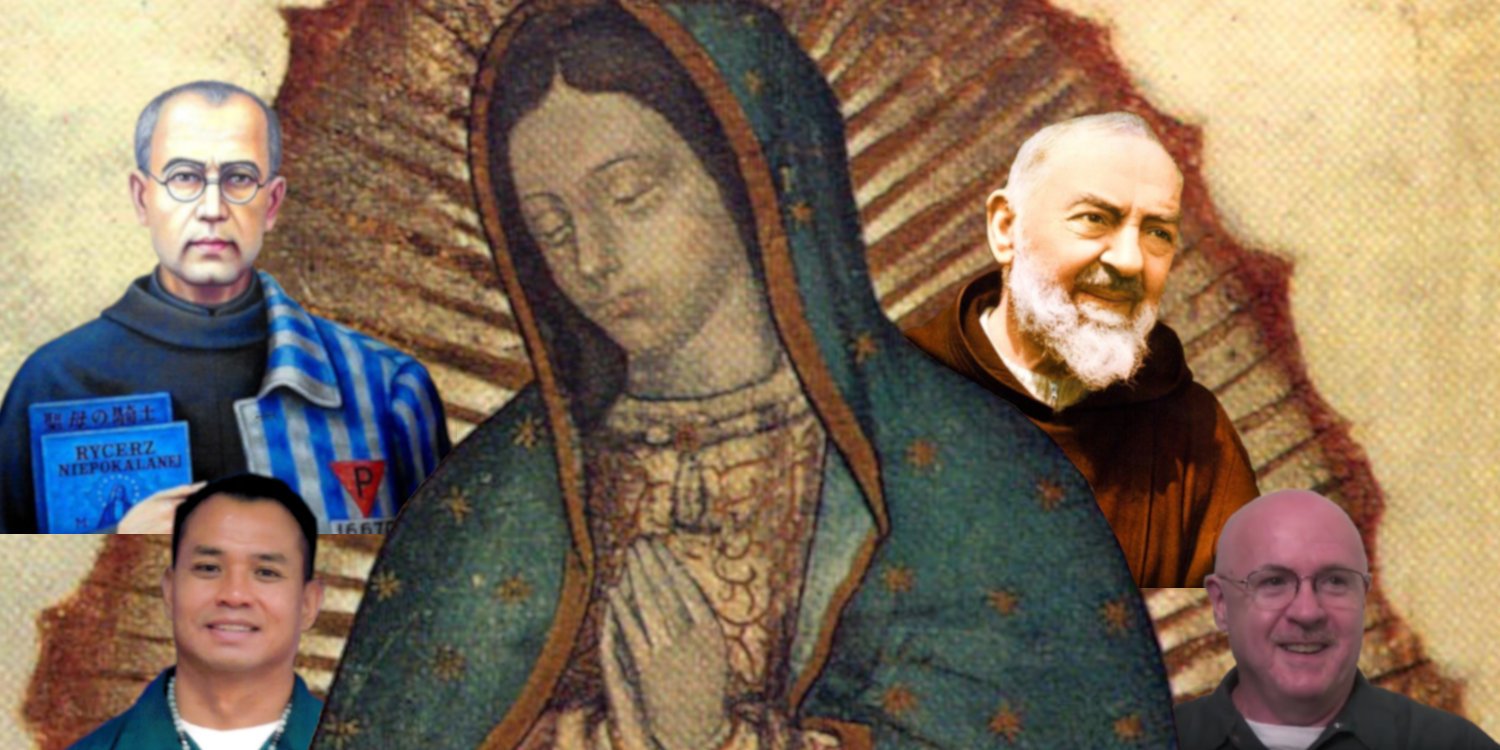
Divine Mercy Behind and Beyond These Stone Walls
Last April 9, I turned 73 years old in prison. I was 41 years old when I was sent to prison, and was in my twenties when my fictitious crimes were alleged to have been committed. I will be age 108 when I next see freedom. The process of reopening a case alleged to have occurred over 30 years ago, and which never contained any evidence to debunk or attack, is a grueling uphill battle. If there is any hope at all for freedom and justice, it is vague hope. It is a hope that exists on the other side of an abyss.
Astute readers remember that I was given several opportunities before my trial to plead guilty and serve only one year in prison. I simply could not fathom doing this. Many years later, Dorothy Rabinowitz, a Pulitzer Prize-winning writer for The Wall Street Journal, took up this case for investigation. She reported that she questioned the detective about the absolute lack of any corroborating evidence. The detective was reported to have said, “Why didn’t he just take the deal?” In a five-minute video interview years later, Ms. Rabinowitz summed up the true nature of this matter.
The readers of Beyond These Stone Walls have helped in so many ways to show us the face of Divine Mercy. Your reading BTSW has given me a global voice when having any voice at all is usually denied to any priest so accused. And having a voice is also often denied to prisoners, as a class of American citizens stripped of rights, including the right to vote. I do not use my access to this voice just to whine about prison conditions. That would be a waste. Instead, I try to employ this voice as an extension of my priesthood, one that is influenced and encapsulated, even defined, by Divine Mercy.
Earlier in my years in prison, my old friend and spiritual director, Father Richard Drabik, visited me. He did so until age and distance made such visits no longer possible. During one of his visits after my publishing began in 2009, I asked him if he had seen the blog that I write from prison, but have never seen. Being a prisoner, I also had no sense of its reach or impact. “It isn’t a blog,” Father Richard said. “It’s a bullhorn!”
Later, the community of Marians of the Immaculate Conception at the National Shrine of The Divine Mercy took up the slack. They came with an invitation to me and other prisoners to take part in a great Divine Mercy adventure. For some, it became the most important part of our lives here. This was especially so for my friend Pornchai Maximilian Moontri, whose life story was captured by Felix Carroll in the book, Loved, Lost, Found: 17 Divine Mercy Conversions. Pornchai’s story is well known around the world now thanks to the efforts of Catholic League President Bill Donohue. Dr. Donohue invited Pornchai to write his story in his own words. The result was published by the Catholic League as “Pornchai’s Story.” In just four pages, it was powerful and phenomenal. Pornchai was oppressed by the thought that at the end of his own prison sentence he would be deported to Thailand where he no longer knew anyone or had any support at all. Pornchai had been taken from Thailand against his will at age 11, and now would be left there alone at age 47. It was a chilling thought for Pornchai, and also for me. I assured him that we would find a way to build a bridge to Thailand.
Divine Mercy, being what it is, created a roadmap for Pornchai. Father Richard, who was deeply moved by Pornchai’s Story, shared it with others who became links in a chain. One of them was the late Father Seraphim Michalenko, Vice Postulator for the cause of Sainthood for Saint Faustina. He ended up in Thailand meeting with a group called Divine Mercy Thailand. Father Seraphim went there armed with a copy of the Diary of Saint Faustina and a copy of Pornchai’s Story, which he read in English to the assembled group. Suddenly, our bridge to Thailand was built.
Felix Carroll also wrote a wonderful article for Marian Helper Magazine entitled, “Mary Is at Work Here.” The truth of that is today without question.
+ + +
Note from Father Gordon MacRae: Thank you for reading and sharing this post about my great good friend and mentor in the priesthood, Father Richard Drabik, MIC. Don’t misunderstand the opening quote here in this post. Only God knows whether Father Richard is a saint, but he was certainly no villain. He spent a lifetime reaching out to them, however, and reeling them in to show them the Light of Divine Mercy. That was what I liked most about my friend, and what I most try to emulate. You might find his enduring presence in these related posts from Beyond These Stone Walls:
A Priest and Prisoner in the Light of Divine Mercy
Divine Mercy in a Time of Spiritual Warfare
The Parable of a Priest and the Parable of a Prisoner
I greatly treasure the image atop this post. Father Richard’s smile is now engraved upon my heart.

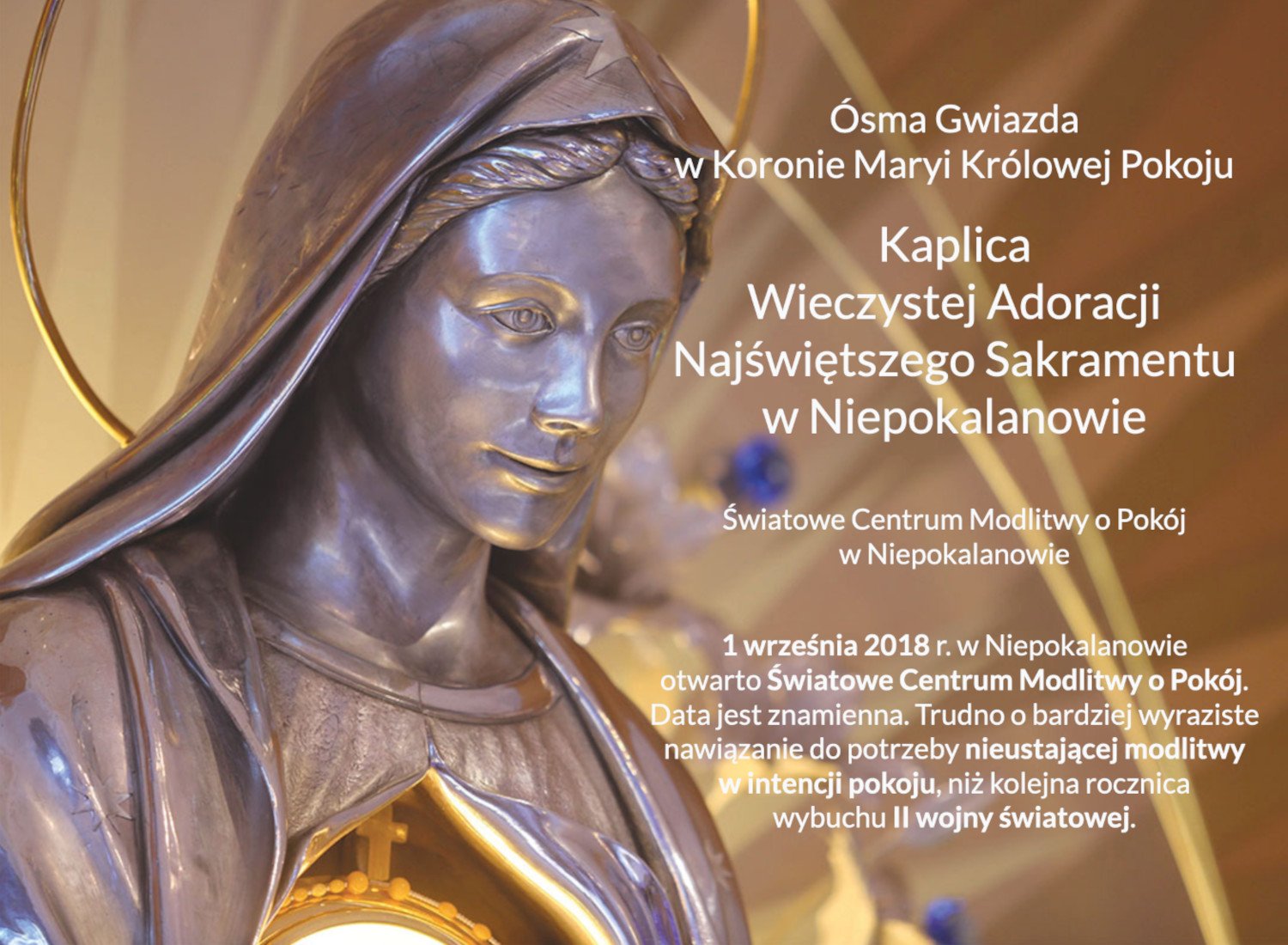

The Eucharistic Adoration Chapel established by Saint Maximilian Kolbe was inaugurated at the outbreak of World War II. It was restored as a Chapel of Adoration in September, 2018, the commemoration of the date that the war began. It is now part of the World Center of Prayer for Peace. The live internet feed of the Adoration Chapel at Niepokalanow — sponsored by EWTN — was established just a few weeks before we discovered it and began to include in at Beyond These Stone Walls. Click “Watch on YouTube” in the lower left corner to see how many people around the world are present there with you. The number appears below the symbol for EWTN.
Click or tap here to proceed to the Adoration Chapel.
The following is a translation from the Polish in the image above: “Eighth Star in the Crown of Mary Queen of Peace” “Chapel of Perpetual Adoration of the Blessed Sacrament at Niepokalanow. World Center of Prayer for Peace.” “On September 1, 2018, the World Center of Prayer for Peace in Niepokalanow was opened. It would be difficult to find a more expressive reference to the need for constant prayer for peace than the anniversary of the outbreak of World War II.”
For the Catholic theology behind this image, visit my post, “The Ark of the Covenant and the Mother of God.”

A Priest and Prisoner in the Light of Divine Mercy
Fr Seraphim Michalenko, Fr Michael Gaitley, Fr Gordon MacRae, Marian Helper Editor Felix Carroll and Pornchai Moontri share the stage in a wondrous Divine Mercy drama.

Fr Seraphim Michalenko, Fr Michael Gaitley, Fr Richard Drabik, Fr Gordon MacRae, Marian Helper Editor Felix Carroll and Pornchai Moontri in a wondrous Divine Mercy drama.
As a young man, I depended far too much on my own resources. I recognize today in the humility of hindsight that they were never quite up to the task. But back then, I knew everything. What a dumbass I have since become! I now know nothing, and cannot write a single word except in the light of Divine Mercy. My life’s path recalls the words of Dante Alighieri as he opened his epic literary masterpiece, The Divine Comedy. His story begins in a dark forest on Good Friday in the year 1300:
“When I had journeyed midway upon our life’s path, I found myself within a shadowed forest, for I had lost the way that does not stray. How can I say what wood that was, that savage forest which even now in recall renews my fear? So bitter death is hardly more severe! But to tell the good I found there, I will also tell of the other things I saw.”
In my post two weeks ago, “Wrongful Convictions: The Other Police Misconduct,” I told of some of the other things I saw — a forest of dark things like corruption and deep injustice surrounded me once. Like Dante, I cannot tell of these — though they must be told — without the light of a profoundly wonderful grace I discovered amid all that suffering.
In many posts over time, I have told snippets of the story of Divine Mercy, of how it entered midway upon my life’s journey, and of how it dramatically transcended my prison walls. I have never before put it all together in a post, and I cannot pretend to do so now because it would fill a book. Perhaps one day, if I have the tools to do so, this story will become a book. For now, however, all I have is this humble blog.
What prompted this retelling of my Divine Mercy journey is the death of Father Seraphim Michalenko, MIC, who on this Earth became a driving force in the beatification and canonization of St. Maria Faustina and the promotion of her famous Diary. My friend, Marian Helper Editor Felix Carroll, published a moving eulogy which included this paragraph:
“Father Seraphim Michalenko, MIC, the world-renowned expert on the life and spirituality of St. Faustina — the man who smuggled photographic images of the pages of St. Faustina’s Diary out of Communist-occupied Poland in the 1970s and later documented her beatification and canonization miracles — died Thursday, February 11, 2021, from illness related to Covid 19. ... Side by side with Blessed Michael Sopocko, Pope St. John Paul II, and St. Faustina herself, Fr. Seraphim stands as a central figure who helped make the Divine Mercy message and devotion the greatest grassroots movement in the history of the Church.”
A few years ago, well into his eighties, Father Seraphim ventured from his home at the National Shrine of The Divine Mercy in Stockbridge, Massachusetts for a drive of several hours to Concord, New Hampshire. He came to offer Mass in prison, and to interview Pornchai Moontri and me about the substance and source of our Divine Mercy journeys as we passed through the dark wood of prison.
My story, which I have told before, begins in 1988. Father Richard Drabik, MIC was Provincial Superior of the Marians of the Immaculate Conception, a post from which he wrote the Preface for Divine Mercy in My Soul, also known as the Diary of Saint Faustina. You will find his Preface at the beginning of every copy of this mysterious book.
A few years later when he concluded his term as Provincial, Father Drabik was recruited to be a spiritual director for the Servants of the Paraclete Renewal Center for priests in New Mexico where I once served as Director of Admissions. Father Richard became my spiritual director for several years, and the finest one I ever had as a priest.

Grace Follows Even the Darkest Night
I will never forget the moment Father Richard stopped by my office one night early in April, 1993 to tell me that he would be leaving that week for Rome to take part in the Beatification of Sister Maria Faustina by Pope John Paul II on Divine Mercy Sunday. Father Richard invited me to write a private intention to be placed on the altar for the Mass of Beatification. Then I promptly forgot all about it.
Saint Faustina was later canonized by Pope John Paul II on Divine Mercy Sunday in 2000, a saint canonized by a saint. Now that I think of it, the saints who have had the most influence on my life as a priest and as a prisoner, and ultimately also on Pornchai Moontri’s life, were canonized by Pope John Paul II. Besides Saint Faustina they include Saint Maximilian Kolbe, Saint Padre Pio, and the Beatification of Mother Teresa.
I know the latter two do not retain their Earthly titles, but I cannot imagine calling them anything else. These influencers now also include Saint John Paul II himself who left a giant footprint on both the Church and my life as a priest.
I knew nothing of Saint Faustina when Father Richard made his request, and if he ever spoke of Divine Mercy in our sessions, I retained none of it. If memory serves, I did most of the talking in spiritual direction. I hope I have since learned to listen as well. Father Richard, like many at the National Shrine of The Divine Mercy, is still in contact with me. I hope he might be reading this.
A week or so after inviting me to write my intention for the Mass of Beatification in Rome, I had forgotten all about it. Father Richard stopped by my office again on the night before his departure and reminded me of it. I was especially busy with God only knows what. I told him I would bring it to him in ten minutes. I then grabbed a piece of note paper and quickly wrote this spontaneous prayer:
“I ask Blessed Faustina’s intercession that I may have the strength and courage to be the priest God wants me to be.”
I sealed my intention in a small envelope and brought it to Father Richard. I watched him tuck it into a pocket of his jacket, and thought no more of it. The Beatification of Saint Faustina was presided over by Pope John Paul II on Divine Mercy Sunday, the Sunday after Easter, but it was not yet called that. It was on the day of St. Faustina's Mass of Canonization, on April 30, 2000 during the Great Jubilee Year that Pope John Paul II declared in his homily that from hereon the Second Sunday of Easter will be the day of Divine Mercy.
But none of this meant anything to me. Today, it means everything to me. By the time Father Richard returned from Rome after the Mass of Beatification in 1993, I had been arrested on false charges from the distant past, and taken away. In 1994, after refusing multiple “plea deal” offers to plead guilty and serve one year in prison, I was sentenced to a term of sixty-seven years. That story is conveyed in the post cited above.
I spent the next twelve years in the dark forest of Dante’s Inferno. I heard from no one. I communicated with few. In all that time, I somehow retained an identity as a priest. Because I maintained my innocence, I spent all that time in punitive prison housing with eight men sharing each cell. An officer in that unit saw that I had a typewriter so he asked me to volunteer to type some inventory forms for him each week. After a few weeks he asked me if I wanted something in return. He meant extra food. I asked for the use of an empty storage room for one hour on Sunday nights to offer private Mass.

A Summons to Divine Mercy
It was not what this Sergeant expected to hear. He said he would have to present the unusual request to his own supervisor. Holy Week was coming up, and I hoped I might have an approval by Easter. It came a week too late. My first Mass in prison was offered in a storage closet on April 30, 2000, which I only later learned was the first official Divine Mercy Sunday and the day Saint Faustina was canonized.
That was year six, midway in my twelve years in darkness. Six years later, I was visited in prison by Father James McCurry, who is today the Minister Provincial of the Franciscan Friars Conventual of the Our Lady of the Angels Province. Unbeknownst to me at the time, he had also been a vice-postulator for the cause of sainthood for Saint Maximilian Kolbe who was canonized by Pope John Paul II in 1982, the year I was ordained. Father McCurry learned of me from some other priest. He was in the area and thought he would arrange a visit.
His first words in the visiting room, after introducing himself, were, “What do you know about St. Maximilian Kolbe?” I knew little beyond the fact that he offered his life to save that of another prisoner in the horror of Auschwitz. We talked about that but our visit was brief. He had to catch a plane. He said he would be sending me something. A week later, a small biography of Saint Maximilian arrived along with a card depicting him in both his Franciscan habit and his Auschwitz uniform.
By that time, I had been moved to slightly better prison quarters, perhaps thanks to the Sergeant who was impressed that I asked for a place to offer Mass instead of extra food. I put the image of Saint Maximilian on the battered steel mirror in my cell. Through tears, I realized that on that same day I was a priest in prison a day longer than I had been a priest in freedom. The darkness I felt was overwhelming. I would eventually write multiple posts about the impact this Saint has had on our lives, most notably “Saint Maximilian Kolbe and the Gift of Noble Defiance.”
Shortly after Saint Maximilian arrived on the mirror in my cell, Pornchai Moontri was sent here after fourteen grueling years lost in and out of solitary confinement in a Maine prison. I was bitter and he was broken. All hope had virtually died in our lives. Providence moved Pornchai from one place to another here, and then he ended up living with me. In his moving recent guest post, “Free at Last Thanks to God and You,” he recounted the day he first walked into my cell and saw the image of Saint Maximilian on the mirror. “Is this you?” he asked.
From that moment on, we were caught up in the grasp of Divine Mercy. As you know, Pornchai became a devout Catholic and was received into the Church on Divine Mercy Sunday, 2010. Knowing the importance of this conversion for him, I was compelled to set aside all the bitterness of false witness and wrongful imprisonment that I carried like a crushing cross in my own Calvary. Confronting the brokeness of Pornchai meant also confronting my own in the light of Divine Mercy, and it salvaged my life as a priest.
Pornchai Moontri was featured, as you know, in a profoundly wonderful book, Loved, Lost, Found: 17 Divine Mercy Conversions, by Marian Helper Editor Felix Carroll. Father Seraphim Michalenko brought the book to Thailand where he presented a retreat to Divine Mercy Thailand. He read them the chapter about Pornchai, and a future, long since thought to be hopeless, was born for him.
We were also invited to take part in a series of 33-Day retreats in Father Michael Gaitley’s “Hearts Afire” program beginning with “33 Days to Morning Glory.” As a result, dozens of other prisoners followed us on this path and many were converted. I will link to the most moving of their stories at the end of this post.
And Divine Mercy has not let up — not even for a moment. I just learned that in 1994, the year I was sent to prison, Relevant Radio host, Drew Mariani, produced a film along with the Marians entitled, “Time for Mercy.” Late last month, some 26 years later, Drew Mariani interviewed me in prison. The interview is available here.
+ + +
Note from Father Gordon MacRae: Please continue to celebrate Divine Mercy this year through these additional posts with inspiring true accounts of how Divine Mercy has impacted our lives:
Coming Home to the Catholic Faith I Left Behind by Michael Ciresi
I Come to the Catholic Church for Healing and Hope by Pornchai Moontri
