“There are few authentic prophetic voices among us, guiding truth-seekers along the right path. Among them is Fr. Gordon MacRae, a mighty voice in the prison tradition of John the Baptist, Maximilian Kolbe, Alfred Delp, SJ, and Dietrich Bonhoeffer.”
— Deacon David Jones
Saint Maximilian Kolbe: A Knight at My Own Armageddon
An empty vessel reduced to a cloud of smoke and ash above Auschwitz, this Patron Saint of Prisoners, Priests, and Writers remains a Knight at the Foot of the Cross.
An empty vessel reduced to a cloud of smoke and ash above Auschwitz, this Patron Saint of Prisoners, Priests, and Writers remains a Knight at the Foot of the Cross.
August 13, 2025 by Father Gordon MacRae
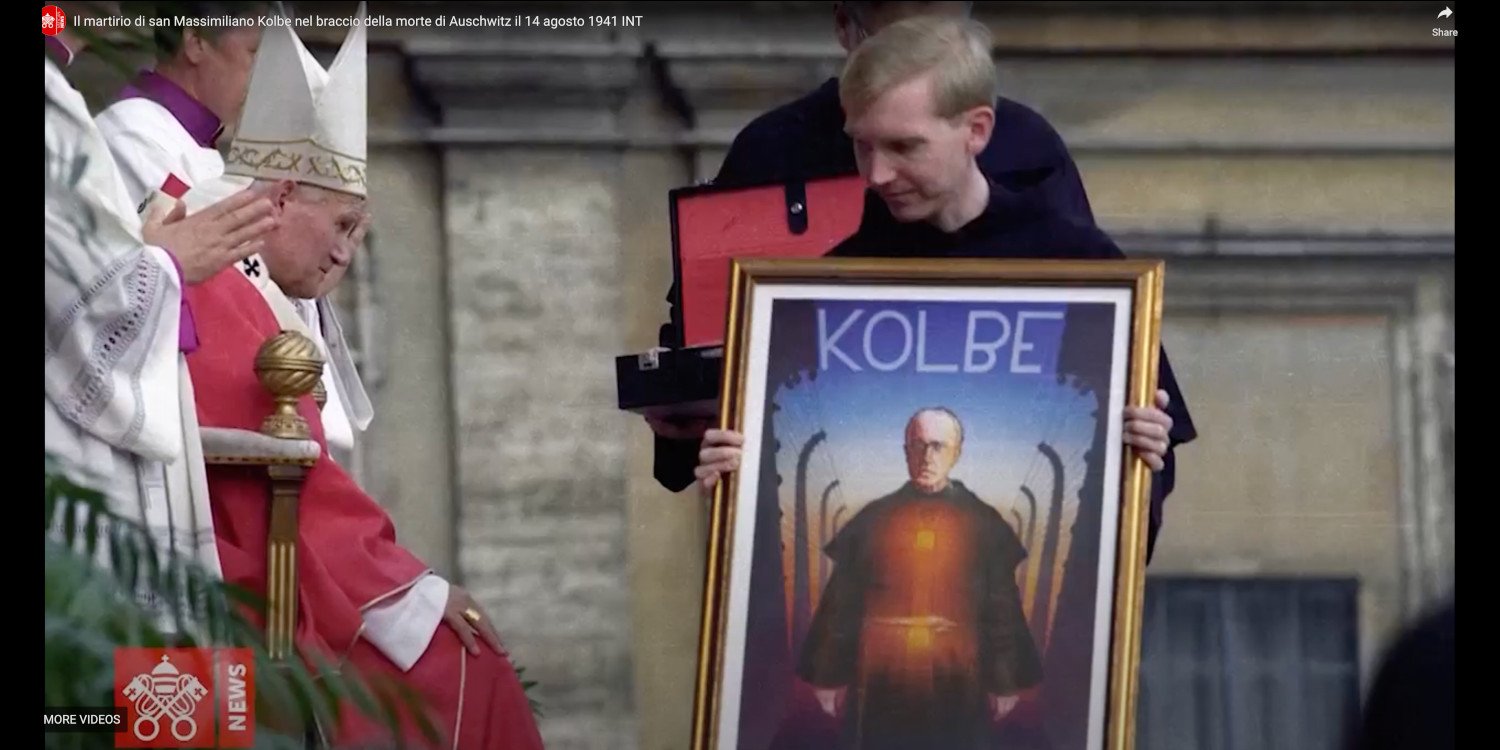
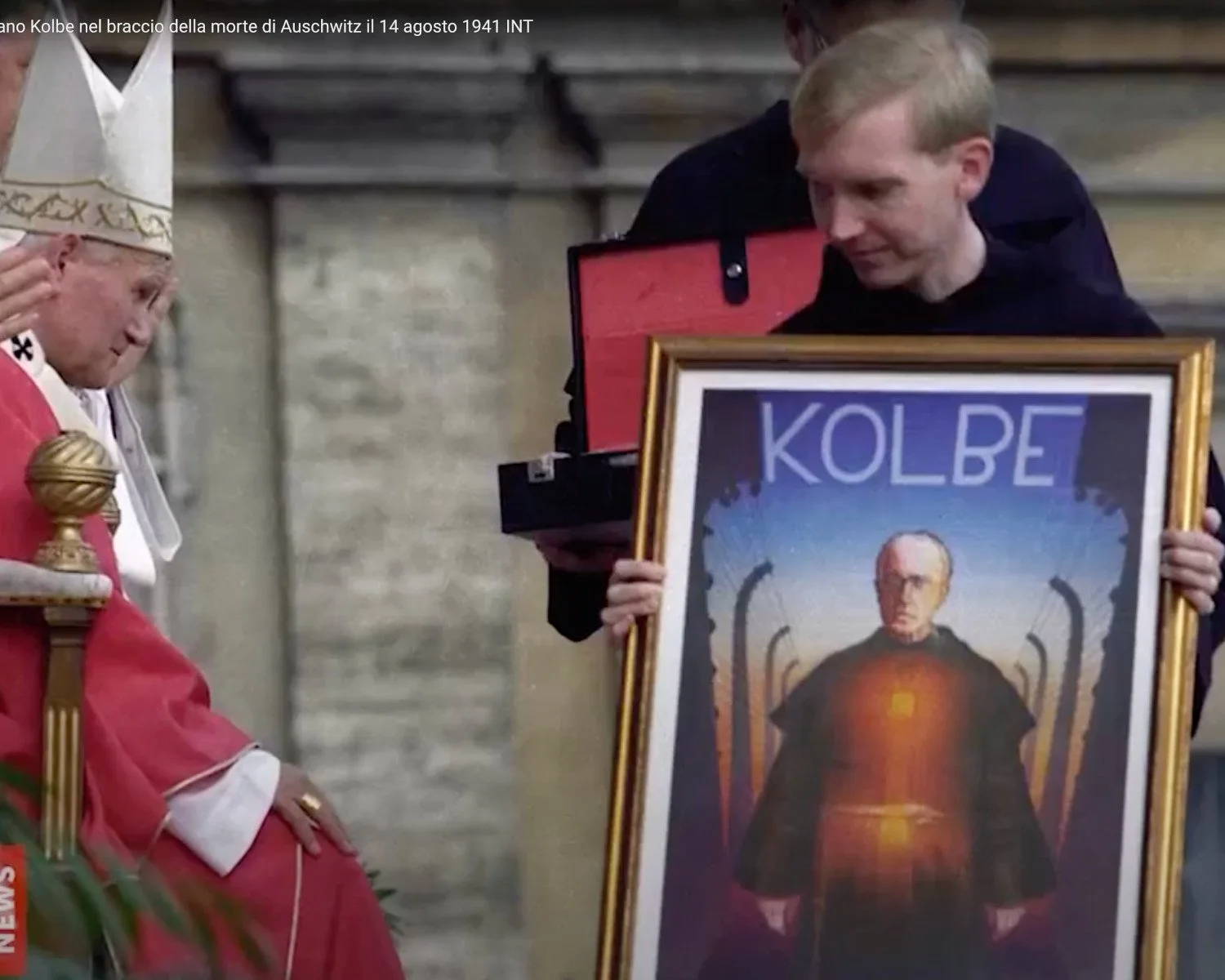
This post started out as Part 2 of another post from back in 2016. It was “How Father Benedict Groeschel Entered My Darkest Night.” That post describes my own Dark Night of the Soul when all light and hope went out of the world for me. I somehow survived it mentally and spiritually. The scene above would much later come to have a lot to do with my survival of that Dark Night. The scene took place in 1982, the year of my priesthood ordination. It depicts Pope John Paul II at the Mass of Canonization of Saint Maximilian Kolbe. The person in front of him is Father James McCurry, OFM Conv, who was the Vice Postulator for the Cause of Sainthood of Father Maximilian. The scene is taking place 41 years after Maximilian was martyred at Auschwitz. Another 24 years after this scene, in 2006, Father McCurry rather mysteriously, through a series of unknown connections came to visit me in prison. Our visit began with a question: “What do you know about Saint Maximilian Kolbe?”
At that time, I knew very little. I knew that he had been canonized at the time of my ordination. I was somewhat preoccupied then, and never gave him a second thought. I had no idea at the time of the amazing graces to come through this great saint, and not only for me. He appeared among the wreckage of my own Armageddon.
On its face, “Armageddon” seems an exaggerated word to define any battle you can personally endure — until you actually endure it. For some who have lived through the torment of an inner battle, there is no word that captures it better. The word, “armageddon” calls forth images of the End Time, the apocalyptic battle between Good and Evil and the Final Coming of Christ. It is a mysterious word that appears in only one place in all of Sacred Scripture, a single word in a single line in The Book of Revelation, also called, “The Apocalypse”:
“And I saw, issuing from the mouth of the dragon, and from the mouth of the beast and from the mouth of the false prophet, three foul spirits … for they are demonic spirits, performing signs, who go abroad to the kings of the whole world, to assemble them for battle on the great day of God the Almighty. (‘Lo, I am coming like a thief! Blessed is he who is awake keeping his garments, that he may not go naked and be seen exposed!’) And they assembled them at the place which is called in Hebrew, ‘Armageddon’.”
— Revelation 16:13-16
The word, “Armageddon” comes from the Hebrew, “har Megiddôn, which means the “hill of Megiddo.” It was the site of several decisive battles in Israel’s Biblical history (see Judges 5:19; 2 Kings 9:27; and 2 Chronicles 35:22). In common usage from that one source, “Armegeddon” has also come to refer to any epic or pivotal battle or struggle between good and evil, even one within ourselves.
For me, the battle for hope, for truth, for justice that brought about the shattering of my life and priesthood, the battle in which I fell, leaving behind an empty vessel, has been the source of a sort of personal Armageddon. That account was told in these pages in my post, “How Father Benedict Groeschel Entered My Darkest Night.”
I know that among our readers there are many whose lives, at some point or other, have been shattered in similar ways. Through illness, great loss, alienation, even betrayal, they know what I mean when I write as I did in that post that the collapse of hope and faith leaves us as an empty vessel. In such a state, the struggle between Good and Evil is at a crossroad. Like many of you, I have stood empty and lost at that crossroad, and often the road less traveled, the one to redemption, seems at that time to be the more arduous one. It seems easier to just give up.
I receive many letters from people who have been where I was then, some who are there even now, and all are seeking one thing: a guide to traverse the inner darkness, to fill the emptiness that sickness, loss, abandonment, betrayal, and injustice leave behind. I have known some, including some good priests, who have utterly lost their faith in the midst of such a personal Armageddon. In this struggle, our Patron Saints are not just here to intercede for us. They are here to be our guides and shield bearers in the midst of battle.
We have a tendency to see the earthly lives of our saints as somehow enraptured in some inner beatific vision just waiting for release from this life, but they were as vulnerable to this world as the rest of us. I once wrote of one of my spiritual heroes, the great Doctor of the Church, Saint Thérèse of Lisieux, in “A Shower of Roses.” Saint Thérèse knew suffering that would have drawn her to despair if not for faith. In the days between August 22 and 27, 1897, her tuberculosis reached the peak of suffering. In an entry in her diary at that time, she wrote that her faith was all that stood between her and an act of suicide:
“What would become of me if God did not give me courage? A person does not know what this is unless he experiences it. No, it has to be experienced! What a grace it is to have faith. If I had no faith, I would have inflicted death upon myself without hesitating a moment.”
— Story of a Soul, Third Edition, ICS Publications, p. 264
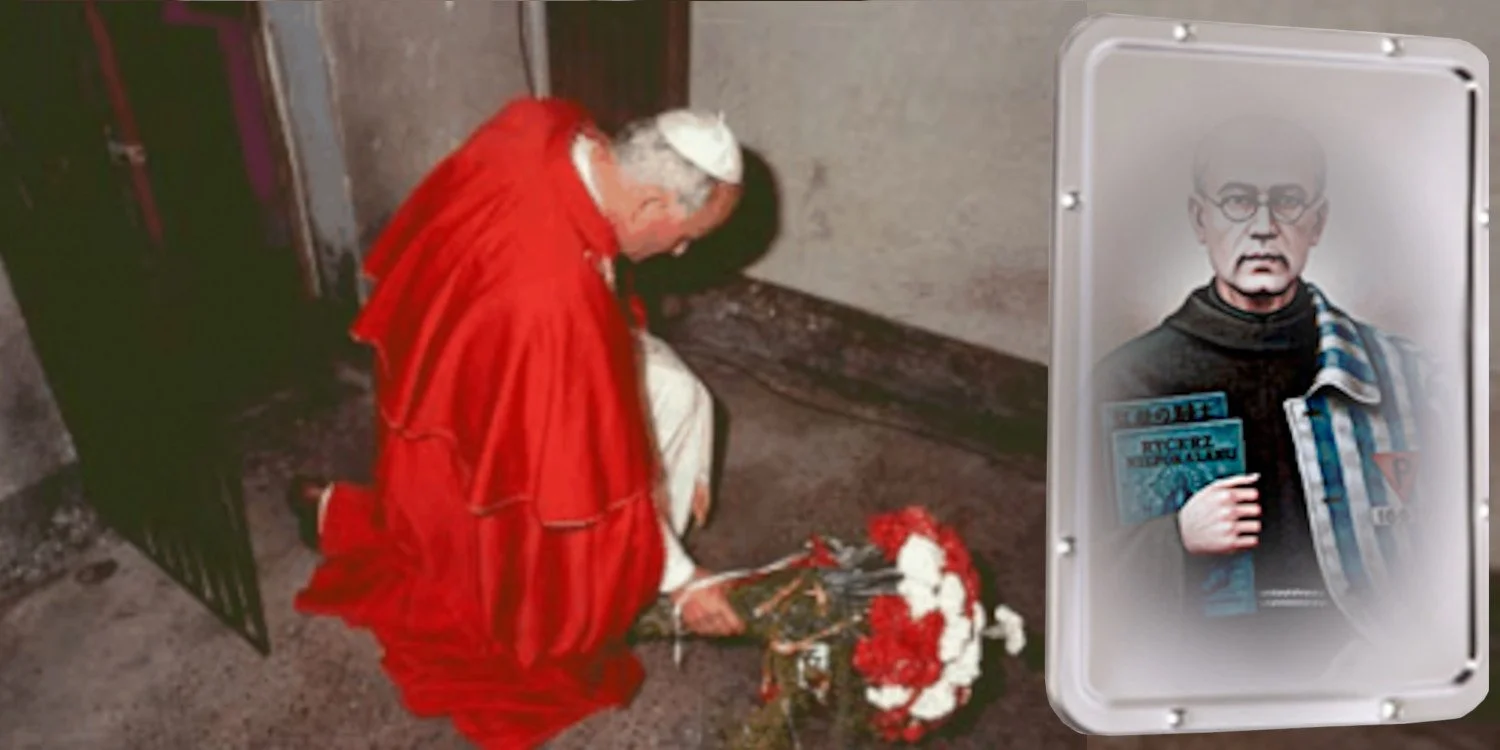
Thanks to that unexpected visit in 2006, when I was on the verge of spiritual collapse, Maximilian Kolbe came to become my Patron Saint. Several days after that visit with Father McCurry, I received from him in the mail, a note with a laminated card depicting Saint Maximilian half in his Auschwitz prison uniform and half in his Franciscan habit. I should not have received that image at all. Such inspiring and hopeful things are considered contraband here. Marveling over how it made its way to my cell, I taped it onto the battered mirror on my cell wall. After that day, I learned everything I could about Maximilian Kolbe including a biography of his life by Father James McCurry OFM Conventual.
Maximilian Kolbe and His Noble Resistance
Back in 2016, at the time I wrote about Father Benedict Groeschel and my Darkest Night, The Wall Street Journal carried a story by Vatican correspondent Francis X. Rocca entitled, “Pope Honors Victims of Auschwitz” (WSJ, July 30-31, 2016). I was surprised to see within it a reference to our Patron Saint:
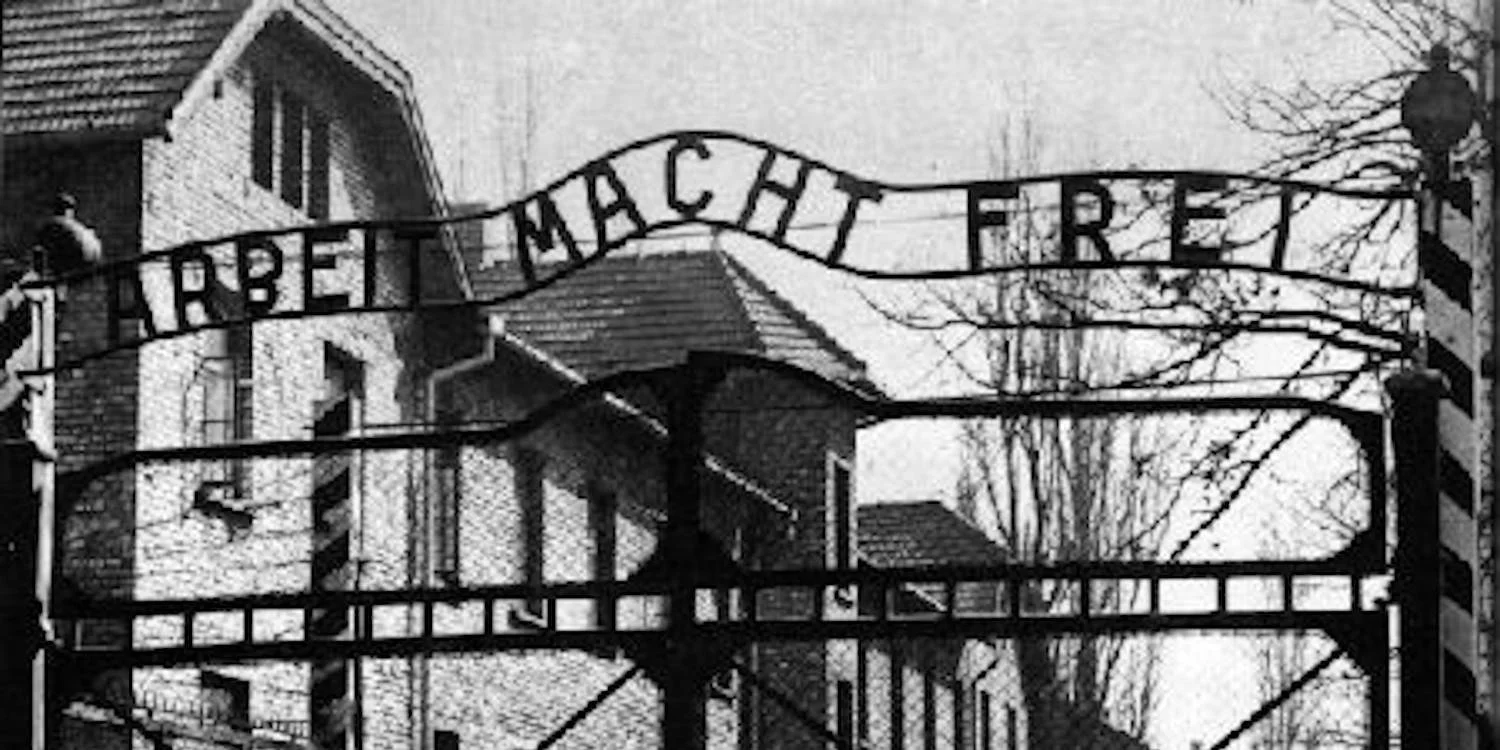
“The pope walked unaccompanied through the camp’s entrance gate, passing under the arch bearing the infamous phrase, ‘Arbeit macht frei,’ German for ‘Work will set you free.’ He then went to the spot in the camp where St. Maximilian Kolbe, a Franciscan priest, volunteered on July 29, 1941, to die in the place of a condemned prisoner. In Cell 18 of Block 11, the ‘starvation cell’ where Kolbe subsequently died on August 14, 1941, Pope Francis sat alone in semidarkness to pray before an image of the saint.”
The imagery here struck me very hard. I wrote back then of the crushing injustice of false witness, of the greed enabled by the now broken trust between priests and their bishops, and of the sense of utter hopelessness found in the prospect of unjust imprisonment, possibly for the rest of my life. The events I described in “How Father Benedict Groeschel Entered My Darkest Night” took place a year before my trial. During that year came the multiple attempts to entice me into lenient “plea deals” — first an offer to serve one-to-three years in prison, then reduced to one-to-two. If you have read The Grok Chronicle Chapter 1 then you already know of my refusal to “just go along.”
My refusal of these deals was met not just with condemnation from the State, but also from the Church, or at least from those charged with the administration of my diocese. After I refused these convenient deals, my bishop and diocese released unbidden a statement to the news media pronouncing me guilty before jury selection in my trial. It was that betrayal that led inexorably to the events of my Darkest Night.
There is no way to cushion what I faced after emerging from Intensive Care as an empty and discarded vessel. As I described in that post, I, too, sat in semidarkness, but by that point I knew nothing of either the sacrifice or the resistance of Saint Maximilian Kolbe. Long time readers of these pages also know the story of how he injected himself not only into my prison, but also into that of Pornchai Maximilian Moontri. This account has appeared in a number of posts, but most importantly in “The Parable of a Priest and the Parable of a Prisoner.”
Whatever I endure pales next to what happened in the prison of Maximilian Kolbe. His “crime” against the Third Reich was his insistence on writing openly about hope and truth when all of Europe was descending into darkness. There is a very important element of the story of Maximilian Kolbe’s sacrifice in prison, and it was to become the first sign of hope for me and others behind these prison walls. Like the Gospel itself, there is an historical truth within the story, but then there is another level of meaning in how the story was interpreted, how it inspired those whose lives were changed by it. The story of what Maximilian did in that prison was not just an act of sacrifice that saved the life of one man. It was an act of resistance that spread through all of Auschwitz and the other death camps, and emboldened many with hope to survive. This aspect of the story is told best in an unusual place.
Hermann Langbein (1912 – 1995) was a survivor of the horrors of both Dachau and Auschwitz. After the liberation of the camps, he became general secretary of the International Auschwitz Committee during which he wrote two important books published in association with the United States Holocaust Memorial Museum. The first was Against All Hope: Resistance in the Nazi Concentration Camps. The second was People of Auschwitz (University of North Carolina Press, 2004).
In the latter, as a member of the Auschwitz resistance, he profiled those among his fellow prisoners whose acts of resistance empowered others to hope. There were other
courageous acts of resistance at Auschwitz. Prisoner Albert Benaviste, a Jew from Saloniki, learned that none of the camp guards understood Greek. While working at the entrance ramp to Auschwitz, he called to Jewish mothers in Greek, mothers who had been deported from his homeland. He called in Greek, “You young mothers, give your children to an older woman near you. Elderly women and children are under the protection of the Red Cross!” This act of resistance saved many lives, for elderly women alone, and young children alone were destined to die in the gas chambers. But the best known act of resistance, Hermann Langbein wrote,
“was that of Maximilian Rajmund Kolbe who deprived the camp administration of the power to make arbitrary decisions about life and death.”
— People of Auschwitz, p. 241
“Where Was God in Auschwitz?”
Seeing the meaning of this story through the eyes of a fellow prisoner, a Jewish prisoner, brings an important element of resistance to the story that Langbein tells in his own words:
“Kolbe, a Catholic clergyman, arrived in Auschwitz on May 29, 1941. When an inmate made a successful escape in July of that year, the administration ordered the reprisal that was usual at that time. The inmates of the escapee’s block had to remain standing after the evening roll call. Karl Fritzsch, the SS camp leader, picked out fifteen men, and everyone knew that they would be locked up in a dark cell in the bunker where they would have to remain without food and water until the escapee was caught or they died.”
— People of Auschwitz, p. 241
One of the young men lined up that day was Franz Gajowniczek, who was one of the last selected for death by the SS officer. The young man cried, “My wife and children! What will happen to my family?” What happened next is described by an eyewitness, Dr. Franz Wiodarski, a Polish physician who also stood in that line:
“After the fifteen prisoners had been selected, Maximilian Kolbe broke ranks, took his cap off, and stood at attention before the SS camp leader, who turned to him in surprise: ‘What does this Polish swine want?’ Kolbe pointed at Gajowniczek, who was destined for death, and replied: ‘I am a Catholic priest from Poland. He has a wife and children, and therefore I want to take his place.’ The SS camp leader was so astonished that he could not speak. After a moment he gave a hand signal and spoke only one word: ‘Weg!’ (Away!). This is how Kolbe took the place of the doomed man, and Gajowniczek was ordered to rejoin the lineup.”
— People of Auschwitz, p. 241
“Resistance in an extermination camp meant the protection of life,” wrote Hermann Langbein in his interpretation of this story. With the eyes of faith, we see Saint Maximilian Kolbe as a martyr of charity, but for those imprisoned at Auschwitz his act was an act of resistance that diminished the SS leader in the eyes of other prisoners as a man spiritually bankrupt.
Father Dwight Longenecker wrote an article back then for Aleteia entitled “Maximilian Kolbe and the Redemption of Auschwitz.” It describes a pilgrimage to the site of Saint Maximilian’s martyrdom. “It is impossible to take it in,” he wrote, “and quickly process the truths you are learning. Like most, I had to ask where God was in the midst of such horror.” Father Longenecker found the answer:
“Where was God in Auschwitz? He was there in the prison cell, just as he was at the crucifixion of Christ, not defeating the evil with violence or force… Whenever and wherever possible we must do all we can to oppose evil by passive resistance, civil disobedience, protest, boycott, and even armed force, but when the evil is so overwhelming, when the stench of hell is so great and the hatred of Satan so violent as that of Auschwitz, one can only stand back, aghast and horrified by the hurricane of sheer unadulterate cruelty, torture, and premeditated murder. Then all resistance is futile.”
— Father Longenecker
Ah, but is it futile? Not in the bigger picture it isn’t. Saint Maximilian’s sacrifice — his act of resistance — has played out in my prison bringing hope and inspiring faith where otherwise they simply could not be. Spend some time in his honor with the links at the end of this post, and learn with us behind walls about the possibilities for the lives of others when evil is resisted.
There is a story from the early life of Rajmund Kolbe that is included in each of several biographies of his life, including the one by Father James McCurry. At age ten, his mother once asked him in exasperation, “Whatever will become of you?” It troubled Rajmund enough to send him to church to pray before a statue of the Mother of God. While there, he had a dream, or a vision. It was never really clear which. Mary presented him with two crowns, one red, and the other white. He chose them both. The symbolism of the two colors was a pivotal event in the life of the person who was to become Saint Maximilian Kolbe.
After writing of my wrongful imprisonment in The Wall Street Journal in 2005, Dorothy Rabinowitz challenged me in a telephone call to “emulate that Saint you have come to regard so highly. Find someone whose suffering is heavier than yours and then seek his freedom.” It was shortly after that this daughter of a Holocaust survivor sent me another challenge that would result in a post of my own. It was “Say Not the Struggle Naught Availeth.” It was also at just this time that Pornchai Moontri emerged from another concentration camp, thirteen years of hellish existence in solitary confinement in a Maine prison. He was transferred to this one and by some mysterious circumstance he became my cellmate. His first words to me while staring at the battered mirror on our cell wall with the image of our Patron Saint were, “Is this you?”
I had my first hint that Saint Maximilian was deeply at work in my prison when Pornchai Moontri made a decision to become Catholic on Divine Mercy Sunday, 2010, and to take the name, Maximilian, as his Christian name. This was brought about by a series of events described in a chapter of a book by Felix Carroll, Loved, Lost, Found: 17 Divine Mercy Conversions.”
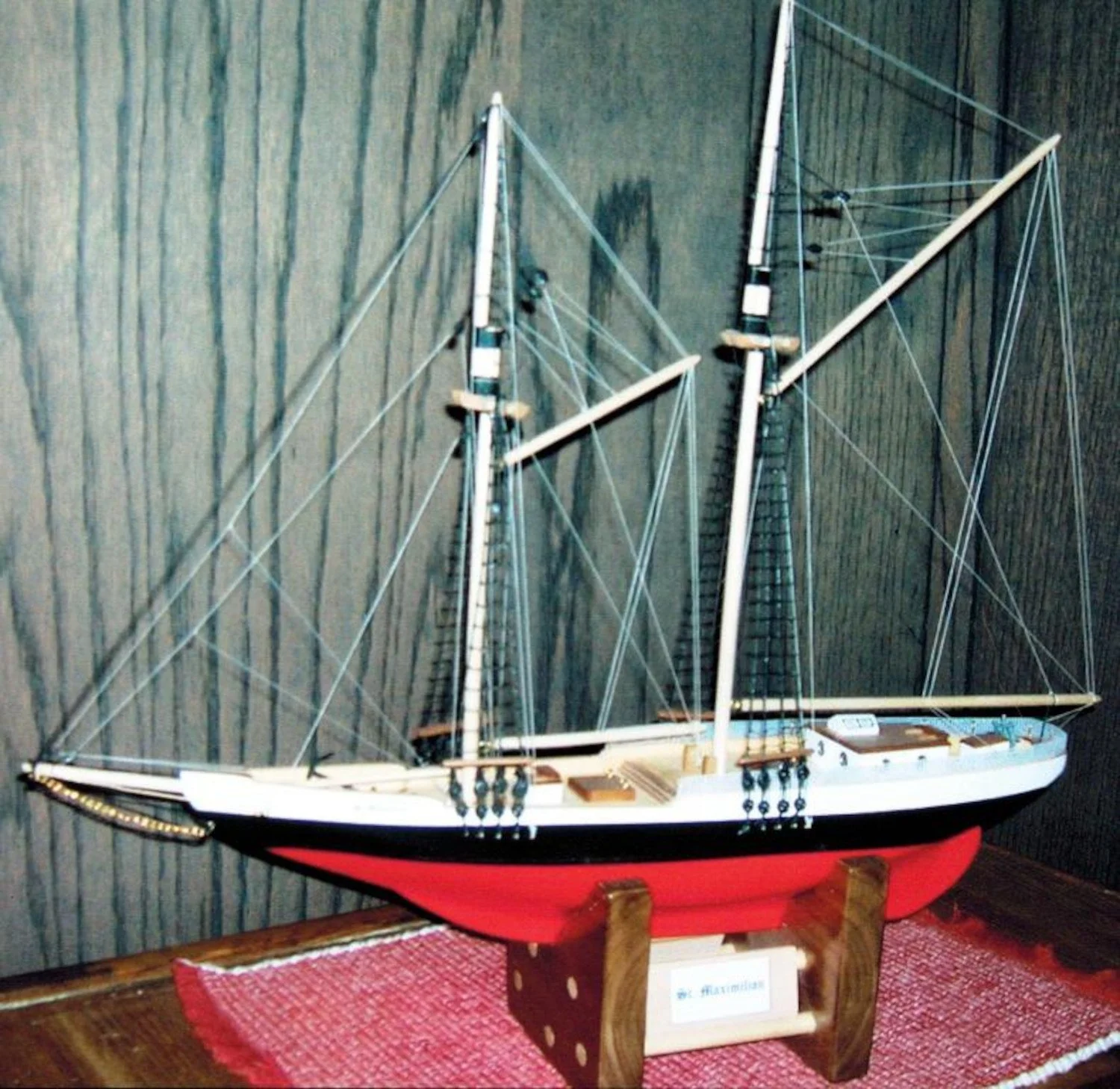
At the time, Pornchai decided to honor his new Patron Saint with an art form in which he had become a master craftsman, the art of model shipbuilding. So he meticulously designed a vessel that he would name the “St. Maximilian.” He proceeded in his work area in the prison woodworking shop to hand carve the bow, masts, and every tiny fitting, and to tie all the intricate rigging. Pornchai painted the hull black to symbolize the horror of where he died.
But then a few days later, while knowing nothing about the early life experiences of his new Patron Saint, Pornchai told me one morning that he had changed his mind, and had decided that the black hull will be crowned in red and white. This seemed to have come out of nowhere but inside Pornchai’s own soul where Maximilian was hard at work again saving a life.
I was startled by this choice of colors and asked him why he chose them. He said, “I don’t know. They just seem right.” So here below is the St. Maximilian, created by Pornchai Maximilian Moontri to honor his Patron Saint and to inform us all that resistance is not futile. Not ever!
+ + +
Note from Father Gordon MacRae: Thank you for reading and sharing this post. Don’t stop here. Learn more about how Saint Maximilian Kolbe led us to Christ through the Immaculate Heart of Mary:
How Father Benedict Groeschel Entered My Darkest Night
The Parable of a Priest and the Parable of a Prisoner

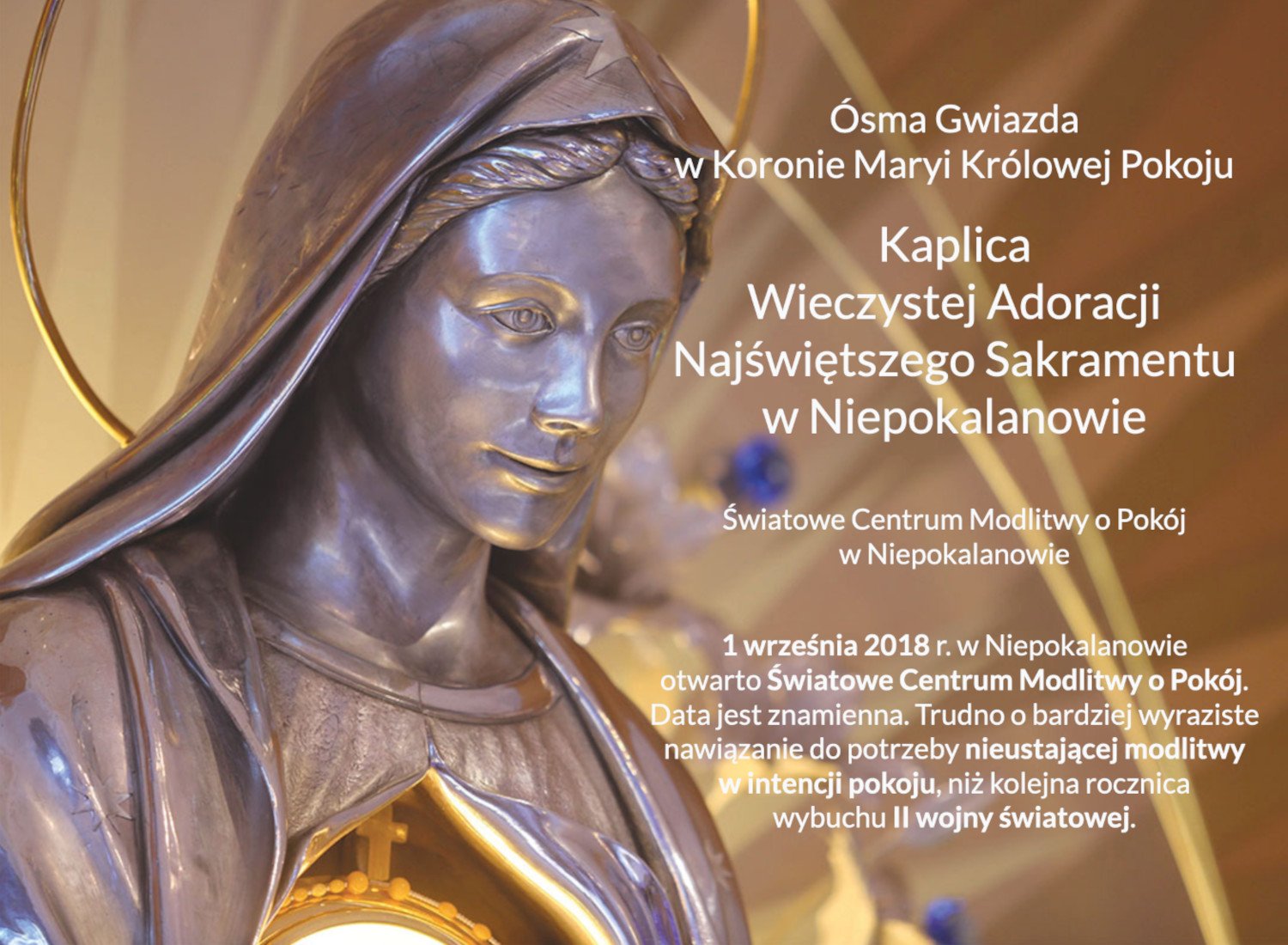

The Eucharistic Adoration Chapel established by Saint Maximilian Kolbe was inaugurated at the outbreak of World War II. It was restored as a Chapel of Adoration in September, 2018, the commemoration of the date that the war began. It is now part of the World Center of Prayer for Peace. The live internet feed of the Adoration Chapel at Niepokalanow — sponsored by EWTN — was established just a few weeks before we discovered it and began to include in at Beyond These Stone Walls. Click “Watch on YouTube” in the lower left corner to see how many people around the world are present there with you. The number appears below the symbol for EWTN.
Click or tap here to proceed to the Adoration Chapel.
The following is a translation from the Polish in the image above: “Eighth Star in the Crown of Mary Queen of Peace” “Chapel of Perpetual Adoration of the Blessed Sacrament at Niepokalanow. World Center of Prayer for Peace.” “On September 1, 2018, the World Center of Prayer for Peace in Niepokalanow was opened. It would be difficult to find a more expressive reference to the need for constant prayer for peace than the anniversary of the outbreak of World War II.”
For the Catholic theology behind this image, visit my post, “The Ark of the Covenant and the Mother of God.”

Thailand’s Once-Lost Son Was Flag Bearer for the Asian Apostolic Congress
In Cebu, Philippines Pornchai Max Moontri was flag bearer for the Kingdom of Thailand at the 5th Asian Apostolic Congress Pilgrimage of Hope in Divine Mercy.

In Cebu, Philippines Pornchai Max Moontri was flag bearer for the Kingdom of Thailand at the 5th Asian Apostolic Congress Pilgrimage of Hope in Divine Mercy.
November 13, 2024 by Fr Gordon MacRae
Many readers know that I earn $2.00 per day as the legal clerk in a prison law library. Among other tasks, I assist prisoners, many of whom are my friends, who faced deportation from the United States. Their destinations have so far included Brazil, Cambodia, China, Guatemala, Honduras, India, Indonesia, Japan, Laos, Mexico, Myanmar, Nepal, Thailand, and Vietnam. Despite the advice of Saint Padre Pio to “Pray, Hope, and Don’t Worry,” I have worried the most about my friend, Pornchai Max Moontri. He faced a nearly impossible assimilation to a country and culture he had neither seen nor been exposed to since he was taken from Thailand at age 11 in 1985.
Pornchai faced assimilation to Thailand after an absence of 36 years, 30 of them in a U.S. prison. I worried about his language barrier, about the absence of any family or material support, about the mountains of crushing discouragement that awaited him along this path. Readers of this blog may have seen a recent “Voices from Beyond” feature describing a project from an Arizona State University student who chose Beyond These Stone Walls as her thesis project in Ethnology, also known as Cultural Anthropology. Her project was motivated in part by interest, not so much in my story, but in Pornchai’s. It included an interview with Dilia E. Rodriguez, Ph.D., our editor who submitted her own perspective on Pornchai’s presence at this blog:
“Initially, I was struck by how many posts are about or mention Pornchai Moontri. After a while I came to think that their profound bond was like that of friends who endure the horrors of war together and survive. But now I think it is much more profound than that.
“God has inspired many truth seekers to investigate the case of Father MacRae, … but God wanted to reveal this with more than facts. He would reveal it with the powerful transformation of lives and souls. Pornchai had been viciously sexually and physically abused for years by a man who trafficked him from Thailand at the age of eleven and murdered his mother. Pornchai escaped and lived on the streets for all of his teen years. Then at age 18 he killed a man who tackled him and pinned him to the ground. After years of enduring violent sexual abuse this sent Pornchai into a rage.
“Having learned that Father Gordon MacRae had been convicted of sexual abuse, Pornchai should have wanted to stay as far away from him as possible. But Pornchai’s instinct told him otherwise. They became friends and Pornchai asked Father Gordon to be his cellmate for the next fifteen years until the time of his deportation to his native Thailand in 2020. In “Pornchai’s Story,” an article published by Catholic League President Bill Donohue, Pornchai described that Father Gordon ‘is my best friend and the person I trust most in this world.’
“While living with Father Gordon, Pornchai earned his high school diploma with honors and also pursued studies at Stratford Career Institute and in theology at Catholic Distance University. He was received into the Church on Divine Mercy Sunday in 2010, taking the name, ‘Maximilian’ as his Christian name in honor of Saint Maximilian Kolbe, a Patron Saint of Prisoners, Writers, Refugees, and Beyond These Stone Walls.” Back to Father Gordon ...

The 5th Asian Apostolic Congress on Mercy
From October 10 to 19, 2024, I was inspired to receive a steady stream of photos and videos sent to the tablet in the prison cell I once shared with Pornchai Max Moontri. From the far side of the world in Cagayan de Oro and Cebu City, Philippines the photos were sent to me by Max (he mostly goes by Max now) who was among the delegates from Divine Mercy Thailand at the 5th Asian Apostolic Congress on Mercy: Pilgrimage of Hope. The event drew some 5,000 pilgrims from ten Southeast Asian nations and others from around the world. As the photos came in, I was stunned at the sheer magnitude of this international event.
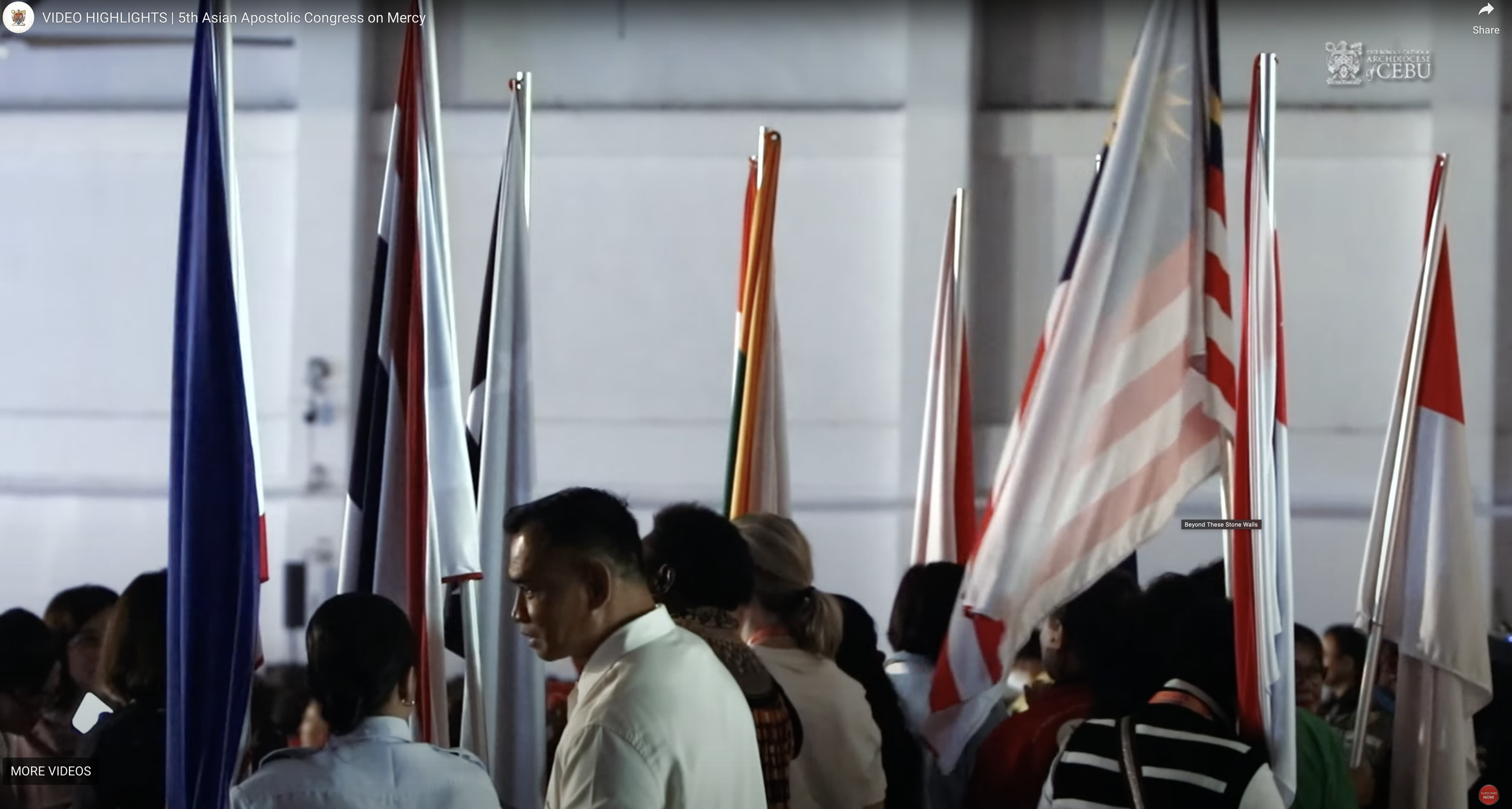
The first photos I received now form the collage above this section. They were taken when Max was chosen to present the flag of Thailand in procession at the opening ceremony of the Congress. Khun Yela Smit, Outreach Director of Divine Mercy Thailand, and Nithat Nawachartkosit its President asked Max to carry and present the flag of his homeland. The honor spoke volumes to my heart about how Divine Mercy can enter even the most wounded souls to connect with the mercy of God in hope for redemption and restorative justice.
The sight of Max standing before that immense crowd proudly holding the flag of his country brought tears to my eyes. In a photo from the AACOM website at the end of this post, you can see the face of Pornchai Max among delegates from other nations as he prepares for the procession to present his country’s flag.
Longtime readers of these pages already know the back story of Max’s life that our editor, Dilia E. Rodriguez summarized above. You can deduce from her words how steep a climb Pornchai’s path to Divine Mercy had been. Max says he was on this path because of me. I see signs that it was always the other way around. I have been on this path because God saw our lives long before we were even born. That is a difficult concept, but one magnified and embraced by Saint Maximilian Kolbe himself.
Just weeks before writing this, Jim Reilly, a reader from the Chicago area, sent me a series of newsletters from the National Shrine of St. Maximilian Kolbe. Among them was a profound message from our Patron Saint whose name Pornchai-Max chose as his own. St. Maximilian’s message quelled any lingering doubt I might have had about the Divine Mercy that binds us even from a world apart:
“For every human being on Earth, God has destined the fulfillment of a determined mission. Even from when He created the Universe, He directed causes so that the chain of effects would be unbroken, and conditions and circumstances for fulfillment of this mission would be most appropriate and fitting. Every individual is born with particular gifts and talents that are applicable to, and in keeping with, the assigned task. Throughout life the environment and circumstances so arrange themselves as to make possible the achievement of the goal and to facilitate its unfolding.”
— St. Maximilian Kolbe, “Prophet of the Civilization of Love”
I had to several times read that profound description of Actual Grace at work in our lives, across generations and even across millennia, before I could settle on the absolute truth of it. What Saint Maximilian wrote is mind-boggling, but now I live by it. Like Maximilian himself, I may even die by it.
I have been a priest for over 42 years, thirty of them in a Purgatory of unjust exile like Saint Maximilian himself. I call it “unjust” because, well, from every human standard it is. And yet I can see that it has not been without purpose — without God’s purpose, and I submit to it now with no further doubts. A few years ago, I was present at one of several Divine Mercy retreat programs offered in this prison by the Marian Fathers of the Immaculate Conception from the National Shrine of The Divine Mercy in Stockbridge, Massachusetts. I wrote several posts about these spiritual experiences, but one that stands out was in memory of the late Fr. Seraphim Michalenko. That post was “Divine Mercy in a Time of Spiritual Warfare.” What follows is an excerpt:
“In the 1970s, Fr. Seraphim Michalenko smuggled the Diary of St. Faustina out of Communist-occupied Poland. Over forty years later he smuggled Divine Mercy into a prison. Divine Mercy would one day become for me the framework of my very existence as a man, as a priest, as a prisoner.
“Fr Seraphim was appointed by the Vatican to be Vice-Postulator for the cause of canonization of Saint Faustina. Internationally known as an expert on her life and famous Diary, Father Seraphim was a catalyst for publishing it and documenting the miracles that became a basis for Faustina’s place among the Communion of Saints.
“Three years before his death in 2021, Father Seraphim was brought to this prison for a Mass. After Mass in the prison chapel, Max Moontri and I were both asked to remain because Father Seraphim wanted to speak with us. We both knew about him but had no idea that he knew about us. Max was nervous! ‘I don’t know what to say,’ he whispered to me. When Father Seraphim approached, he asked to speak with Max first. Fifteen minutes later, Max emerged smiling from a chapel office to tell me that I am next.
“As Father Seraphim and I spoke, he asked about our connection with St. Maximilian Kolbe, how he entered our lives, and how we came to Divine Mercy. In the telling, I mentioned my lifelong regard for a famous passage from St. John Henry Newman about how we are ‘links in a chain, bonds of connection between persons.’ I spoke of how this has guided me. I remember asking Father Seraphim how I could ever be certain of the 'definite service' God has committed to me that He has not committed to another. Father Seraphim leaned a little closer to me and whispered with quiet certainty as he pointed, ‘He is standing right over there.’ He was pointing to Pornchai-Max.”
— from “Divine Mercy in a Time of Spiritual Warfare”

In Cebu City : The Pilgrimage of Hope
On an Autumn evening back in 2014, my roommate, Max and I were summoned to the office of this prison’s chaplain, Catholic Deacon Jim Daly. He presented each of us with a book signed by its author, Felix Carroll from the National Shrine of The Divine Mercy. The book was a now well known Marian Press title, Loved , Lost, Found: 17 Divine Mercy Conversions. In Chapter 11, it contains the story of Max’s conversion. It being “Chapter 11” is itself highly symbolic.
Max suffered much in life, and he had to eventually come to terms with a hard truth. He had to accept his past life as bankrupt in order to start over on a path to seek and find God. Both our faces lit up as we turned that night to Chapter 11 in the book to see Max smiling while standing in the prison Chapel with Bishop John McCormack after having just been received into the Church. Bishop McCormack later told me that he had never before appeared in a photograph in any published book and was proud to now be so immortalized next to Max Moontri “whose sacred quest to learn trust stands as a monument to hope.” As we walked in the dark through the prison complex that night, Max turned to me holding up his book and asked, “How did this happen?”
When invited by Divine Mercy Thailand to the Philippines in October, Max arrived two days before the Asian Apostolic Congress on Mercy was scheduled to begin. The delegates from Divine Mercy Thailand who traveled together went first to the Diocese of Cagayan de Oro. There, in the city of El Salvador, Max was surprised to see in the sanctuary of the Basilica a mosaic of famous Divine Mercy saints. Some in the group asked Max to stand before the mosaic of Saint Maximilian Kolbe while others snapped his picture. If a picture speaks a thousand words, the one above speaks entire volumes.
Father Seraphim Michalenko once confirmed for me what I had already begun to suspect. Shortly after, the truth of it appeared in a 2014 issue of Marian Helper magazine in an article by Felix Carroll, “Mary Is at Work Here.” This is an excerpt:
“The Marians believe Mary chose this particular group of inmates to be the first [for Marian Consecration]. The reason eventually was revealed. It turns out that one of the participating inmates was Pornchai Moontri who was featured in last year’s Marian Press title, “Loved, Lost, Found:17 Divine Mercy Conversions.” Pornchai experienced a dramatic conversion in no small part due to a friendship he formed with fellow inmate — and now cellmate — Fr. Gordon MacRae who chronicles their lives in a celebrated website, BeyondTheseStoneWalls.com.”
That was when I began to pray. I do not just mean the recitation of the words of prayers. I mean “to pray,” from a heart opening to God its shades of darkness as well as its light. And it was for the first time in my life and priesthood. When (then) Blessed Faustina was to be beatified in 1993, one of the Marian priests who worked toward her canonization was Father Richard Drabik who was also my spiritual director in a spiritual renewal center for priests in which I worked in ministry. Fr. Richard’s Introduction to the Diary of Saint Faustina now graces its opening pages.
In my office one night, Father Drabik told me that he was leaving for Rome the next day for the Beatification of Saint Faustina. He asked me to write a personal petition that he would place on the altar at the Beatification Mass. I hastily wrote something spontaneous. I am told that the most efficacious prayer is that which wells up spontaneously from the heart and soul without forethought or rehearsal. My prayer, which I scribbled before sealing it in an envelope was, “I ask for the intercession of Saint Faustina that I may have the courage to be the priest God calls me to be.”
Be careful what you ask for! St. Faustina is now on the left of the Divine Mercy mosaic where Max Moontri stood, pictured above. Two weeks after writing that petition, I was arrested by the Gestapo and charged with the false claims that sent me to prison. Lawfare is outrageous, and it is also contagious. Wrongful imprisonment is the most arduous path I have ever been on. Over the next fifteen years, having been moved from one Purgatory to another, Pornchai Moontri showed up, a story we captured in “The Parable of a Priest and the Parable of a Prisoner.”
Four years before I began writing this, Pornchai-Max was deported to his native Thailand. In October 2024, he was invited by the group, Divine Mercy Thailand, to join them at the 5th Asian Apostolic Congress: Pilgrimage of Hope held in Cebu City, Philippines. Upon return from the Pilgrimage, Pornchai was also asked to take an active role in the group’s Thai apostolate beginning with the telling of his own powerful life story and conversion.
When I received the Pilgrimage brochure, I was surprised to see that among the presenters would be Father Joel de los Reyes from Barrigada in the Archdiocese of Agana, Guam, the very place where Pornchai’s mother was murdered, the most painful chapter in his life. Father Reyes’ address was entitled, “Mercy Shines in the Darkness of Our Life.” It was time for the healing of these memories. Other presenters from our more immediate past included Very Reverend Chris Alar, MIC, Provincial Superior of the Marians, and Fr Patrice Chocholski. Both are from the National Shrine of The Divine Mercy which played a major role in my priesthood, in Max’s conversion. Divine Mercy also became our summons to Consecration to Jesus through the Immaculate Heart of Mary which beats in our lives still.
+ + +
I invite you to visit a photo album from Pornchai’s pilgrimage by scrolling through the short videos and images below:



The Eucharistic Adoration Chapel established by Saint Maximilian Kolbe was inaugurated at the outbreak of World War II. It was restored as a Chapel of Adoration in September, 2018, the commemoration of the date that the war began. It is now part of the World Center of Prayer for Peace. The live internet feed of the Adoration Chapel at Niepokalanow — sponsored by EWTN — was established just a few weeks before we discovered it and began to include in at Beyond These Stone Walls. Click “Watch on YouTube” in the lower left corner to see how many people around the world are present there with you. The number appears below the symbol for EWTN.
Click or tap here to proceed to the Adoration Chapel.
The following is a translation from the Polish in the image above: “Eighth Star in the Crown of Mary Queen of Peace” “Chapel of Perpetual Adoration of the Blessed Sacrament at Niepokalanow. World Center of Prayer for Peace.” “On September 1, 2018, the World Center of Prayer for Peace in Niepokalanow was opened. It would be difficult to find a more expressive reference to the need for constant prayer for peace than the anniversary of the outbreak of World War II.”
For the Catholic theology behind this image, visit my post, “The Ark of the Covenant and the Mother of God.”