“There are few authentic prophetic voices among us, guiding truth-seekers along the right path. Among them is Fr. Gordon MacRae, a mighty voice in the prison tradition of John the Baptist, Maximilian Kolbe, Alfred Delp, SJ, and Dietrich Bonhoeffer.”
— Deacon David Jones
#MeToo and #HimToo: Addiction and #NHCorruption
Jonathan Grover died from opiate addiction before his 49th birthday. His role in the case against Fr Gordon MacRae left unanswered questions, but now gains clarity.
Jonathan Grover died from opiate addiction before his 49th birthday. His role in the case against Fr Gordon MacRae left unanswered questions, but now gains clarity.
April 18, 2018, Updated June 26, 2026 by Ryan A. MacDonald
Editor’s Note:
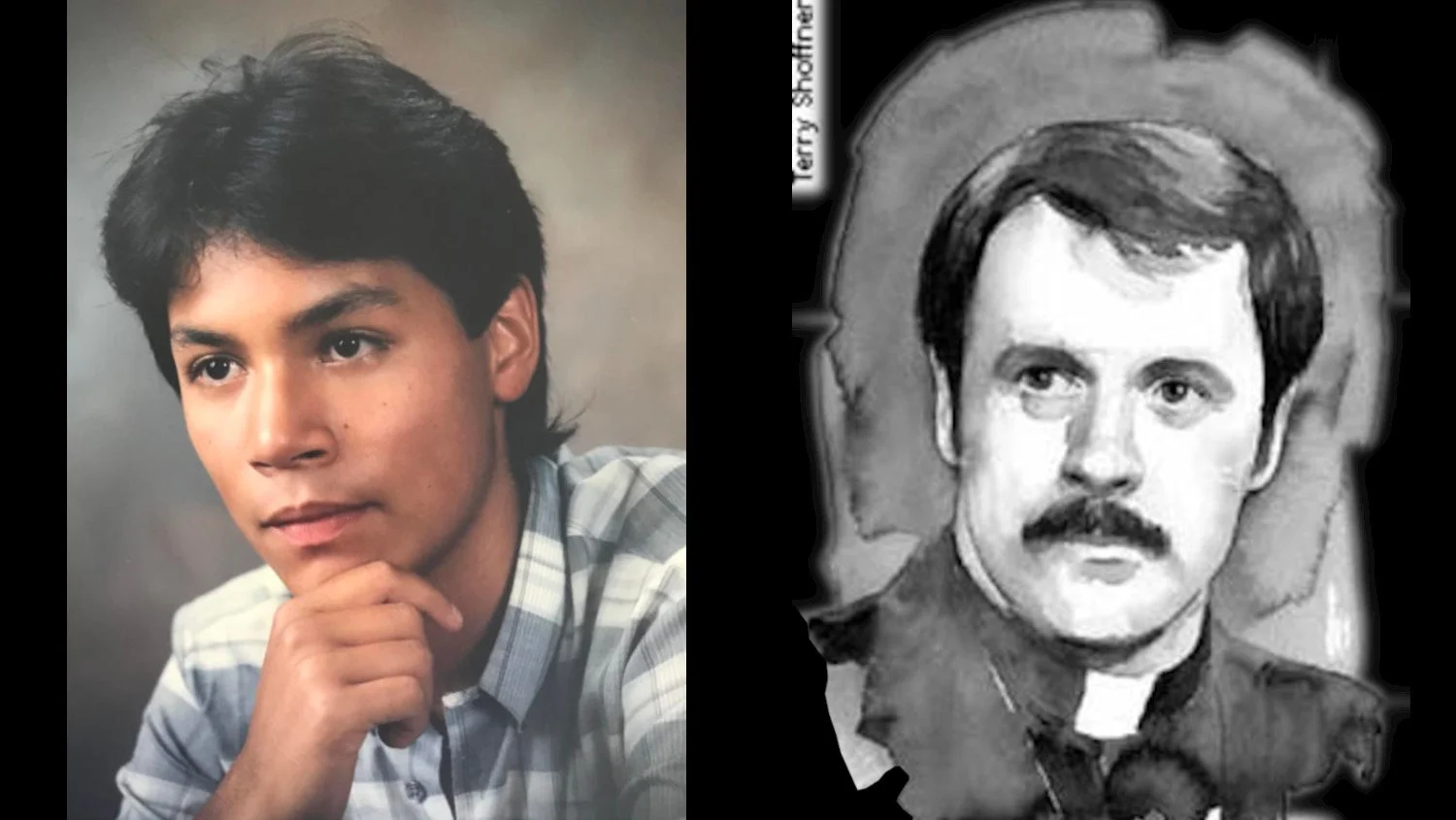
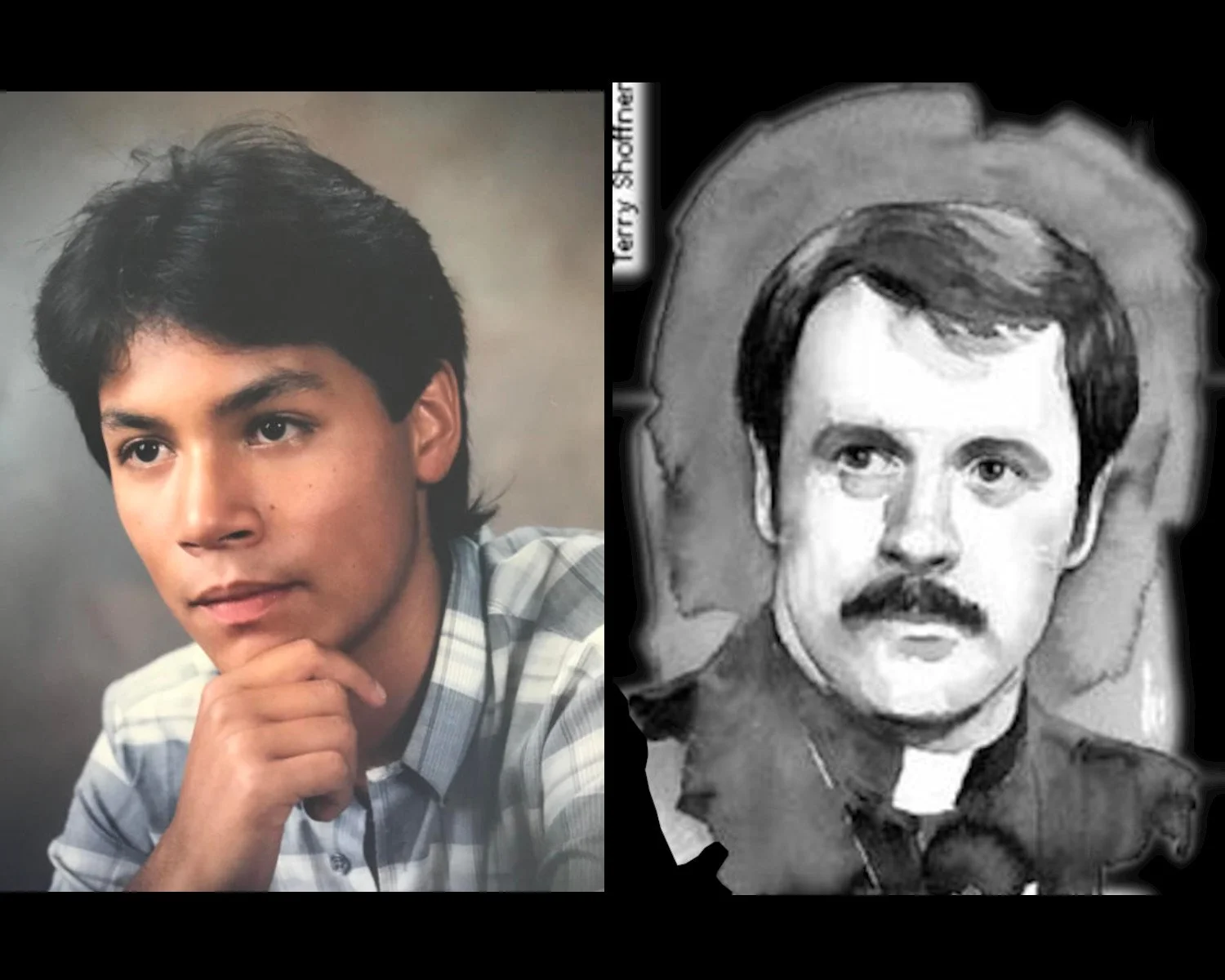
The image atop this post is a composite featuring the high school graduation photograph of Jonathan Grover at age 18. To the right is an artist’s rendering of a photo of Father Gordon MacRae circa 1983. The photo was composed for The Wall Street Journal and depicts Father MacRae in the time period in which the story told here was alleged to have taken place. This post by Ryan A. MacDonald is a necessary Part 2 of last week’s post, “Justice and Due Process Support the Rights of Priests — But Not This One.”
When I read Father Gordon MacRae’s Holy Week post in 2018, I was struck by a revelation that he offered Mass in his prison cell for the soul of a man who helped put him there by falsely accusing him. I do not know that I could have done the same in his shoes, and even if I could, I am not so certain that I would. His post took a high road that most only strive for.
The unnamed subject of that post about Judas Iscariot was Jonathan Grover, who died in Arizona from opiate addiction two weeks before his 49th birthday. An obituary indicated that he died “peacefully,” and cited ‘a “long career in the financial industry.” Police determined the cause of death to be an accidental overdose of self-injected opiates weeks after leaving his most recent attempt at rehab. In Arizona, he had charges for theft, criminal trespass, and multiple arrests for driving under the influence of drugs. A police report described him as “homeless.”
In the early 1990s, Jonathan Grover was one of Father MacRae’s accusers. MacRae first learned of Mr. Grover’s death from a letter written by a woman who had been a young adult friend of Grover at the time of MacRae’s trial in 1994. She wrote that she is now a social worker with “expertise in PTSD” (Post Traumatic Stress Disorder). The letter accused MacRae of having “murdered” 48-year-old Grover. This requires a rational and factual response.
Of interest, Mr. Grover’s obituary — despite his being 48 years old at the time of death — featured his 1987 Keene High School (NH) graduation photograph when Grover was 18 years old. I had seen this photo before. The photograph was among the discovery materials in MacRae’s defense files in preparation for his 1994 trial. Because Jonathan was the first of his brothers to falsely accuse MacRae, it was presumed that the case he brought would be the first to go to trial. Perhaps because it was full of obvious holes and factual discrepancies, prosecutors opted to postpone it and prosecute the case brought by his older brother, Thomas Grover, first.
The photograph of Jonathan raised the first of many doubts about the truth of his claims. At age 18 in 1987, Grover gave Father Gordon MacRae, his parish priest and friend at the time, a nicely framed copy of that photo with a letter written on the back. It thanked MacRae for his “friendship and support,” and “for always being there for me.” It was a typically touching letter from a young man to someone he obviously admired. It was written before addiction and the inevitable justification of enablers took hold in his life.
Five years later, apparently forgetting that he ever wrote that letter, Jonathan Grover became the first of four adult brothers to accuse MacRae of a series of sexual assaults alleged to have occurred more than a decade earlier. So what happened between writing that letter in 1987 and accusing MacRae five years later in 1992? It is one of the burning questions left behind in this story.
The framed high school photograph and its accompanying letter never found their way into MacRae’s 1994 trial, or into the public record, because the trial dealt only with the claims of Jonathan’s brother, Thomas Grover. Jonathan was the first to accuse MacRae, but a trial on his claims was deferred. His story had many holes that did not reconcile with the facts. Investigators have since uncovered a different story from the one Grover and his brothers first told.
Bombshells and Black Ops
The two common denominators in the case against Father Gordon MacRae were expectations of money and James F. McLaughlin. In the 1980s, the city of Keene, New Hampshire, with a population then of about 26,000, employed a full-time sex crimes detective on its small police force. In 1988, McLaughlin launched investigations of at least three, and possibly more, Catholic priests in the area including Father Gordon MacRae.
His targeting of MacRae seems to have begun with a bizarre and explosive letter. In September 1988, Detective McLaughlin received a letter from Sylvia Gale, a social worker with the Division of Children, Youth and Families, the New Hampshire agency tasked with investigating child abuse. Ms. Gale’s letter to McLaughlin revealed that she had uncovered information about “a Catholic priest in your area, named Gordon MacRae.”
The letter described explosive information from an unnamed employee of Catholic Social Services in the Diocese of Manchester, who developed a slanderous tale that MacRae had been “a priest in Florida where he molested two boys, one of whom was murdered and his body mutilated.” The letter went on to claim that the case was still unsolved, and that MacRae was moved from Florida by Catholic Church officials to avoid that investigation.
The libelous letter also named a Church official, Monsignor John Quinn, as the source of this information reportedly told by him to an unnamed Catholic Charities employee on the condition that she would be fired if she ever divulged it. The 1988 letter generated a secret 70-page report developed by Detective James McLaughlin. He launched a dogged pursuit of MacRae, who was unaware at the time that any of this was taking place.
This all began to unfold one year after Jonathan Grover graduated from Keene High School and presented Father MacRae with that framed photograph and letter of thanks. Armed with Sylvia Gale’s letter, Detective McLaughlin proceeded to question 26 Keene area adolescents and their parents who had known MacRae including members of the Grover family. Up to that point, not one person had ever actually contacted McLaughlin with a complaint against MacRae, but rather it was McLaughlin who initiated these contacts. As reported below, some of them today claim to have been solicited by McLaughlin to accuse MacRae, some with the enticement of money.
I had to read up to page 54 of McLaughlin’s 1988 report before I came across any effort to corroborate the Florida “murder and mutilation” story with Florida law enforcement officials. By the time McLaughlin learned that MacRae had never served as a priest in Florida and that no such crime had been committed there, the damage to MacRae’s reputation was already done, and the seeds were sown for the Grover brothers to ponder claims yet to come.
Among those approached by McLaughlin armed with Sylvia Gale’s slanderous letter was Mrs. Patricia Grover, Jonathan’s adoptive mother. A parishioner of Saint Bernard Parish in Keene where MacRae had served from 1983 to 1987, Mrs. Grover was also a DCYF social worker who was supervised by Sylvia Gale. She had previously worked with McLaughlin in the handling of other cases.
Mrs. Grover also knew Father MacRae. According to McLaughlin’s 1988 report, she was alarmed by the Sylvia Gale letter but doubted that MacRae had ever served as a priest in Florida. She nonetheless vowed to talk with her young adult sons about their relationship with MacRae. Four more years passed before the first of them, Jonathan Grover, accused him.
After graduating from high school at age 18, Jonathan joined the U.S. Navy and was sent to submarine school in San Diego. It did not go well. There were early signs that Grover was experimenting with drugs. He slowly developed an opioid addiction. After an arrest for driving under the influence, Grover was discharged from the Navy while refusing its intervention program for alcohol and drug abuse. Jonathan returned to Keene, New Hampshire with an opiate addiction.
Grover had been approaching Father MacRae with increasingly anxious requests for financial loans, none of which were ever paid back or explained. MacRae was at first resistant to the idea that Grover may be abusing drugs, but eventually the signs became clear and the priest refused to continue the loans.
The “fake news” in the 1988 Sylvia Gale Florida letter set this community abuzz with anxiety and gossip about the potentially lecherous and murderous priest in its midst. Later, Monsignor John Quinn and other Diocese of Manchester officials denied having any involvement in the untrue information about MacRae. They also denied that there was ever any priest who relocated from Florida to New Hampshire under the circumstances described in the libelous letter.
Four years later in late 1992, Jonathan Grover became the first of four members of the Grover family to accuse Father Gordon MacRae of sexual abuse dating back to approximately the early 1980s. I use the word “approximately” because Grover and his brothers each presented highly conflicting and multiple versions of their stories and the relevant time frames. Detective James F. McLaughlin was acting more as a coach than as an investigator. According to his own police reports, he gave the Grover brothers copies of MacRae’s resume “to help them with their dates.”
As is clearer below, Jonathan Grover’s claims became problematic for the prosecution of MacRae, but instead of questioning Grover’s veracity, the police detective engaged a contingency lawyer on Grover’s behalf. In a September 30, 1992 letter from McLaughlin to Jonathan Grover, the detective detailed his conversations with Keene attorney William Cleary, who ultimately obtained a nearly $200,000 settlement for Grover from the Diocese of Manchester. From McLaughlin’s letter to Grover:
“As agreed, I contacted William Cleary about your case. Bill believes the statute of limitations has lapsed for a civil action, but this does not rule out the church being financially responsible. Bill [Cleary] states he would like to meet with you for a conference. You would not be charged for this. Your options could then be outlined and discussed.”
There is reason to question Detective McLaughlin’s police reports in this case. In most of McLaughlin’s prior cases, he practiced a protocol of audio-recording every interview with complainants. In many of his other reports that I have read, he made a point of explaining that he records interviews to protect the integrity of the investigation.
Two years prior to the Grover claims, for example, McLaughlin investigated a complaint against another former Keene area priest, Father Stephen Scruton. From the outset, his reports took pains to document his practice of securing both video and audio recordings of his interviews. He even administered a polygraph test on the accuser. All were standard protocol, but McLaughlin did not create a single recording of any type with any accuser in the case of Father Gordon MacRae. This is suspect, at best, and it has never been explained.
It is made more suspicious by the emergence of other information that has been developed by former FBI Special Agent Supervisor James Abbott, who spent three years investigating the MacRae case. One of MacRae’s accusers, a high school classmate of Jonathan Grover, recanted his own developing story of abuse by MacRae when questioned by Mr. Abbott in 2008. An excerpt of Steven Wollschlager’s statement may shed light on why Detective McLaughlin chose not to record these interviews.
“In 1994 I was contacted by Keene Police Detective McLaughlin … I was aware at the time of Father MacRae’s trial knowing full well that it was bogus and having heard of the lawsuits and money involved and also the reputations of those who were making accusations … The lawsuits and money were of greatest discussion, and I was left feeling that if I would go along with the story I could reap the rewards as well. McLaughlin had me believing that all I had to do was make up a story about this priest and I could receive a large sum of money as others already had.
“McLaughlin reminded me of the young child and girlfriend I had and referenced that life could go easier for us with a large amount of money … I was at the time using drugs and could have been influenced to say anything they wanted for money.”
In “The Trials of Father MacRae,” a 2013 article by Dorothy Rabinowitz in The Wall Street Journal, Detective McLaughlin described the above account simply as “a fabrication.” What struck me about Mr. Wollschlager’s statement, besides the fact that he had nothing whatsoever to gain by lying, is that he never went to Detective McLaughlin with an accusation. Instead, he alleges that it was McLaughlin who approached him, and the approach alleges the enticement of money.
Steven Wollschlager was not the first person to report such an overture. Given the nature of his account and others, it is unclear today whether Jonathan Grover and his brothers initiated their first contacts with this detective. This suspicion was a contentious issue in MacRae’s 1994 trial. Thomas Grover, the brother of Jonathan Grover, was asked under oath to reveal to whom he went first with his claims, the police or a personal injury lawyer, but he refused to answer. To this very day, that question has never been answered.
What became clear, however, is hard evidence that placed Detective James McLaughlin investigating at least some of this case, not from his office in the Keene Police Department, but from the Concord, NH office of Thomas Grover’s contingency lawyer, Robert Upton, before MacRae was even charged in the case.
A Conspiracy of Fraud
In a Police Report labeled Case No. 93010850, Detective McLaughlin produced the first of several conflicting accounts of untaped interviews with Jonathan Grover. Note that the first two digits of McLaughlin’s report, “93,” seem to indicate the year it was typed, but the date on the report is August 27, 1992. The content of this report is sexually explicit so I will paraphrase. The report has Grover claiming that when he was 12 or 13 years old he “would spend nights in the St. Bernard rectory in Keene.” During those nights, he alleged, he was sexually assaulted by both Father Gordon MacRae and Father Stephen Scruton.
But there was an immediate problem. MacRae was never at St. Bernard’s Parish in Keene until being assigned there on June 15, 1983, when Grover was 14 years old. Father Stephen Scruton was never there before June of 1985 when Grover was 16 years old. These dates were easily determined from diocesan files, but McLaughlin never investigated this. The report continued with claims alleged to have taken place in the Keene YMCA hot tub:
“It was during these times that Grover would be seated in the whirlpool and both Father MacRae and Father Scruton would be joined in conversation and they would alternate in rubbing their foot against his genitals. Grover was unsure if the priests were acting in concert or if they were unaware of each other’s actions.”
This report is highly suspicious. Just months earlier, Detective McLaughlin had previously investigated Father Stephen Scruton for an identical claim brought by another person alleged to have occurred in 1985 after Scruton’s arrival at this parish. Tod F. X. Biltcliffe, the person who brought that claim against Scruton, was also a high school classmate of Jonathan Grover.
After McLaughlin’s investigation, Mr. Biltcliffe obtained an undisclosed sum of money in settlement from the Diocese of Manchester. That interview with Biltcliffe was labeled Case No. 90035705 dated just 18 months before Jonathan Grover’s identical claims emerged. Unlike the Grover interviews, the interview with Tod Biltcliffe was tape-recorded by McLaughlin. Here is an excerpt from the report:
“Father Scruton was a regular at the YMCA. Tod went to the YMCA with Father Scruton. They decided to use the hot tub … At one point, Father Scruton took one of his feet and placed it between Tod’s legs and rubbed his genitals … The touching was intentional and not a mistake. A rubbing motion was used by Father Scruton … I asked Tod where he stood on civil lawsuits.”
It defies belief that a small town police detective could write a report about a Catholic priest (Scruton) fondling a teenager’s genitals in a YMCA hot tub, then 18 months later write virtually the same report with the same claims of doing the same things in the same place, only this time adding a second priest (MacRae), but nothing in the second report seemed to even vaguely remind the detective of the first report.
After Tod F. X. Biltcliffe’s YMCA hot tub complaint in 1990 — 18 months before Jon Grover’s own YMCA hot tub story — Father Stephen Scruton was charged by McLaughlin with misdemeanor sexual assault. He pled guilty and received a suspended sentence and probation. One year later, McLaughlin has someone else repeat the same story, only now involving both Scruton and MacRae, but two to four years before either of them was present in Keene.
What is most suspect about this claim of Jonathan Grover involving both priests is that in 1994, one year after writing the report, McLaughlin responded to a question under oath:
“On occasion, I have had conversations with Reverend Stephen Scruton, however I have no recollection of ever discussing any actions of Gordon MacRae with the Reverend Scruton.”
(Cited in USDC-NM 1504-JB)
The above was also cited in an AI analysis entitled “The Grok Chronicle Chapter 2: The Perjury of Detective James F. McLaughlin.”
But this all becomes more suspicious still. In the investigation file on these claims was found a transcript of a November 1988 Geraldo Rivera Show entitled “The Church’s Sexual Watergate.” It was faxed by the Geraldo Show in New York to Detective McLaughlin at the Keene Police Department two months after his 1988 receipt of the Sylvia Gale “Florida letter.” It was two years before Tod F. X. Biltcliffe’s YMCA hot tub claim about Father Scruton and four years before Jonathan Grover’s identical claims involving both priests. Here is an excerpt:
Geraldo Rivera:What did the priest do to you Greg?
Greg Ridel: Around the age of 12 or so, he and I went to a YMCA. And I was an altar boy at the time. And the first time I was ever touched … he began stroking my penis in a hot tub, I believe it was, at a YMCA. From there it went to what you might call role playing in the rectory where the priests stay.
— “The Church’s Sexual Watergate,” Geraldo Show, Nov. 14, 1988
Detective McLaughlin’s 1993 police report also had Jonathan Grover claiming that Father MacRae paid him money in the form of checks from his own and parish checking accounts in even amounts of $50 to $100 in order to maintain his silence about the abuse. McLaughlin never investigated this, but Father MacRae’s lawyer did investigate. MacRae’s personal checking account was researched from between 1979 to 1988. It revealed no checks issued to Jonathan or Thomas Grover.
However, the attorney uncovered several checks written from parish accounts to both Jonathan Grover and Thomas Grover. All were in even amounts between $40 and $100 and dated between 1985 and 1987 when these two brothers were 16 to 20 years of age respectively. The checks were filled out and signed by Rev. Stephen Scruton.
Days before Father Gordon MacRae’s 1994 trial commenced, his attorney sought Father Scruton for questioning. He declined to respond. When the lawyer sought a subpoena to force his deposition, Scruton fled the state. During trial, the jury heard none of this. Because the trial involved the shady claims of Thomas Grover alone, the defense could not introduce anything involving his brother, Jonathan.
In April, 2005, The Wall Street Journal published an extensive two-part investigation report of the Father MacRae case (“A Priest’s Story”), but it omitted Father Stephen Scruton’s role in the story — perhaps because he could not be located. Diocese of Manchester officials reported for years that they had no awareness of Scruton’s whereabouts.
In November 2008, former FBI Special Agent Supervisor James Abbott was retained to investigate this case. He located Father Scruton at an address in Newburyport, Massachusetts, just over the New Hampshire state line. First reached by telephone, Scruton was reportedly agitated and nervous when he learned the reason for the call. The investigator heard a clear male voice in the background saying, “Steve, if this is something that might help Gordon I think you should do it.” Scruton reluctantly agreed to meet.
The former FBI agent drove from his New York office to Newburyport, MA, on the agreed-upon date and time, but Scruton refused to open the door. He said only that he had “consulted with someone” and now declines to answer any questions. The investigator then sent Scruton a summary of his involvement in this case and requested his cooperation by telling the simple truth. Days after receiving it, Father Stephen Scruton suffered a mysterious fall down a flight of stairs and never regained consciousness. Scruton died a month later in January of 2009. He took the truth with him, and now Jonathan Grover has done the same. But facts speak a truth of their own. Readers can today form their own conclusions about this story.
I have formed mine, and I remain more than ever convinced that an innocent man is in prison in New Hampshire, a blight on the American justice system. Having thus far served 32 years of wrongful imprisonment for crimes that never took place, Father Gordon MacRae still prays for the dead.
“After three years of investigation of this case, I have found no evidence that Father MacRae committed these crimes, or any crimes.”
— Affidavit of former FBI Special Agent Supervisor James Abbott
ADDENDUM: IN THE EARLY DAYS OF THE GROVER FAMILY GRIFT
Thomas Grover’s former wife, Trina Ghedoni, in an interview with investigator James Abbott, told the former FBI official that around 1988 Thomas Grover was interviewed by Detective McLaughlin, but Grover made no allegation that resulted in a charge. She stated that Grover was 22 or 23 years old then and living in the City of Manchester. She said that he met a man named Dominic Martin and they became close friends and “drinking buddies.” Dominic Martin had a girlfriend, whose name Ghedoni could not recall. It was then that Dominic Martin began to introduce Grover to the idea of setting up priests for money.
Investigator Abbott noted in his report that Dominic Martin was later arrested and convicted for extortion against a priest in neighboring Massachusetts in 2003. This was reported in a January 25, 2003 Boston Globe article, “Couple Facing Extortion Charges” by Matt Carroll. Dominic Martin and his wife, Brianna Martin were arrested in early January, 2003. They were charged and convicted of extortion after they falsified claims of sexual misconduct and then demanded $1,500 from an elderly Lowell, Massachusetts, priest who never had a prior accusation against him.
Using a threat of publicity, the Martins convinced the priest that he would be ruined if Martin’s claimed information ever became public. Compounding his poor judgment, the elderly priest borrowed $1,500 and paid a courier to deliver it to a newspaper kiosk at a local restaurant. Father MacRae first wrote of this account in “Ten Years After The Boston Globe Spotlight Prostituted Journalism.”
Predictably, with the $1,500 in hand, Dominic Martin then made a second demand after which the frightened priest called the police, who set up a sting of their own. They staked out the restaurant and arrested the Martins as they drove away. Oddly, the Globe article reported that Dominic Martin is a self-described bishop in The Traditional Western Rite Archdiocese, an “independent” Christian denomination.
A final bombshell for our purposes exploded in the last line of the Globe article reporting, that Dominic Martin had legally changed his name about two years earlier in 2000 or 2001. He identified his birth name as Tod F. X. Biltcliffe, the same person who previously sued the Diocese of Manchester alleging that Father Stephen Scruton molested him in a hot tub at the Keene YMCA. His financial settlement was obtained at about the same time Jonathan Grover, his former high school classmate, concocted an identical account. I previously wrote of this story in “Police Investigative Misconduct Railroaded an Innocent Catholic Priest.”
COUPLE FACING EXTORTION CHARGES
By Matt Carroll, Globe Staff, 1/25/2003
Dominic Martin is listed on a website of independent churches as a bishop in the Traditional Western Rite Archdiocese, an independent Christian denomination, and pastor of Holy Family Old Catholic Mission in Springfield. He also lists his birth name as Tod F.X. Biltcliffe, but legally changed it about two years ago, said his attorney, Lynda Dantas.
+ + +

Note from Father Gordon MacRae: For the second week in a row, I am indebted to Ryan A. MacDonald for his clear writing and equally clear sense of justice. You may also like these related links from Beyond These Stone Walls:
Justice and Due Process Support the Rights of Priests — But Not This One
Ten Years After The Boston Globe Spotlight Prostituted Journalism
Oprah, Geraldo, and a Psycho-Therapist: A Perfect Storm
Police Investigative Misconduct Railroaded an Innocent Catholic Priest

Weapons of Mass Destruction
At the behest of paid, unnamed ‘trauma-informed consultants,’ my diocese provided a six-figure settlement of a claim far too old to be filed in any court of law.

At the behest of paid, unnamed ‘trauma-informed consultants,’ my diocese provided a six-figure settlement for a claim far too old to be filed in any court of law.
May 22, 2024 by Fr Gordon MacRae
And they keep on coming. A year before the 2002 wave of clergy sex abuse claims rippled out of Boston across the country, Sean Murphy, age 37, and his mother, Sylvia, demanded $850,000 from the Archdiocese of Boston. Sean claimed that three decades earlier, he and his brother were repeatedly molested by their parish priest. In support of the claim, Mrs. Murphy produced old school records placing her sons in a community where the priest was once assigned. No other corroboration was needed. Shortly thereafter, Byron Worth, age 41, recounted molestation by the same priest and demanded his own six-figure settlement. The men were following an established practice of “mediated settlements,” a precedent set in the early 1990s when a multitude of molestation claims from the 1960s and 1970s emerged against Father James Porter and a few other priests. In 1993, the Diocese of Fall River settled some 80 such claims in a single negotiated deal. Other Church institutions followed that lead on the advice of insurers and attorneys.
Before the Murphys’ $850,000 demand was paid, however, Sean, his mother, and Byron Worth were indicted by a Massachusetts grand jury for conspiracy, attempted larceny, and soliciting others to commit larceny. It turned out that Sean and Byron were once inmates together at the Massachusetts Correctional Institute at Shirley where they concocted their fraudulent plan to score a windfall from their beleaguered Church.
On November 16, 2001, Sean Murphy and Byron Worth pleaded guilty to fraud charges and were sentenced to less than two years in prison for the scam. The younger Murphy brother was never charged, and Mrs. Murphy died before facing court proceedings. Local newspapers relegated the Murphy scam to the far back pages while headlines screamed about the emerging multitude of decades-old claims of abuse by priests. When two other inmates at MCI-Shirley accused another priest in 2001, a Boston lawyer wrote that it is no coincidence these men shared the same prison. “They also shared the same contingency lawyer,” he wrote. “I have some contacts in the prison system, having been an attorney for some time, and it has been made known to me that this is a current and popular scam.”
It is not difficult to understand the roots of such fraud. Prison inmates, like others, read newspapers. Just months before the onslaught of claims against priests, the Archdiocese of Boston landed on the litigation radar screen with the notorious arrest of Mr. Christopher Reardon, a young, married, Catholic layman, model citizen, and youth counselor at a local YMCA who was also employed part-time at a small, remote parish outpost north of Boston. As Mr. Reardon’s extensive serial child molestation case came to light—with substantial and graphic DNA, videotape, and photographic evidence of assaults that occurred over previous months—the YMCA quickly entered into settlements consistent with the State’s charitable immunity laws.
In a search for deeper pockets, however, a local contingency lawyer pondered for the news media about whether the rural part-time parish worker’s activities were personally known—and covered up—by the Cardinal Archbishop of Boston. It was a ludicrous suggestion, but it was a springboard to announce in the Boston Globe (July 14, 2001) that “the hearsay and speculation” among lawyers and clients, is that “the Catholic Church settled their cases [of suspected abuse by priests] for an average of $500,000 each since the 1990s.”
It was a dangled lure that would soon have many takers, some of whom have been to the Church’s ATM more than once. In January of 2003, at the height of the clergy scandal, a 68-year-old Massachusetts priest had the poor judgment to be drawn into a series of suggestive Internet exchanges with a total stranger, a 32-year-old man named Dominic Martin. Using a threat of media exposure of the printed exchanges, Mr. Martin demanded that the priest leave an envelope containing $3,000 in a local restaurant lobby.
The frightened priest, who never had a prior accusation, compounded his poor judgment by paying the demand. Soon after, another cash demand was made, but the priest finally called the police who set up a sting of their own. On January 24, 2003, Dominic Martin and his wife, Brianna, were arrested at the drop point, and charged with extortion.
The police report revealed that Mr. Martin had changed his name. His birth name was identified as Tod Biltcliffe, a man who, a decade earlier, obtained a settlement when he accused a New Hampshire priest of molesting him in the 1980s. At the time the priest protested that Mr. Biltcliffe was committing fraud and larceny. The Church settled anyway. Biltcliffe’s claim was that when he was 15 years old, the priest fondled his genitals while the two were in a hot tub at a local YMCA. Curiously, the investigation file contained a transcript of a 1988 “Geraldo Rivera” show entitled “The Church’s Sexual Watergate.” One of the cases profiled was that of a young man who claimed that a priest fondled his genitals while the two were in a hot tub at a local YMCA.
The 1988 “Geraldo” transcript was a sensationalized account of clergy sex abuse cases from the 1970s and 1980s. The transcript is notable because it contains many of the same claims of exposing secret Church documents, archives, and episcopal cover-ups in 1988 that lawyers and reporters claim to have exposed for the first time in 2003.
Writer Jason Berry, and contingency lawyers Jeffrey Anderson and Roland Lewis all appeared live on “Geraldo” on November 14, 1988 to announce the existence of secret Church archives, cover-ups by bishops, and out-of-court settlements of Catholic clergy sex abuse claims across the country. Jason Berry, who excoriates the Church and priesthood at every turn, actually defended, in 1988, the existence of so-called “secret” Church archives: “Canon law says that you have to have a secret archive in every diocese…. That’s funny because I’ve been attacking the Church for three years on this… I want to express my own irony of [now] being in a position of defending the Church.”

Enter Shamont Lyle Sapp
When Shamont Lyle Sapp first detected the smell of money, he found it too enticing to pass up. Convicted for a series of bank robberies, Mr. Sapp, then age 51, was serving a lengthy sentence in the dark peripheries of the U.S. Penitentiary in Allenwood, Pennsylvania when the scent first drifted by his cell in 2008. That was when Sapp filed a lawsuit against the Archdiocese of Portland, Oregon. Detailing his tragic past, Sapp’s lawsuit claimed that he was a stranded teenage runaway from his Pennsylvania home en route to stay with relatives in Oregon. Then Archdiocese of Portland priest, Father Thomas Laughlin took advantage of his plight to repeatedly sexually abuse him.
Sapp claimed in his highly detailed lawsuit that the priest offered the young runaway a job cutting grass, then sexually abused him at a Portland Catholic church. Then Father Laughlin sodomized him during a five-day motel stay paid for by the priest who then funded the youth’s return trip to Pennsylvania. It was the latest horror story in the Catholic abuse narrative, and one that dismayed Catholics coast to coast.
Mr. Sapp’s story rang true, so it flew. Further inquiry was deemed unnecessary. The detailed claims were reported to civil legal authorities for whom the story also rang true, but Father Tom Laughlin had already been accused and convicted by others with similar tales. Mr. Sapp’s disturbing story added to the weight of a growing millstone around the priest’s neck.
In all public documents in the case, Mr. Sapp found refuge among an ever-expanding list of “John Does” accusing priests from the Archdiocese of Portland to cash in on its bankruptcy proceedings. Sapp’s story was accepted at face value resulting in a cash settlement of $70,000. Inmate Sapp accepted the offer while lawyers, the Archdiocese, and victim advocates all pontificated about how no amount of money could compensate him for the trauma he endured. As for Father Laughlin, the “credible” (aka “settled”) accusations drove another nail into the coffin containing the remains of his priesthood as the Archdiocese sought his dismissal.
There was only one problem with Shamont Lyle Sapp’s story: “It was entirely fabricated,” said Assistant U.S. Attorney Stephen Peifer who in 2014 prosecuted Sapp for mail fraud and other federal charges for this and three similar frauds carried out against Catholic priests and dioceses in four jurisdictions. While serving another sentence in a medium security state prison in Minersville, PA, Mr. Sapp filed a second lawsuit claiming that a priest of the Diocese of Tucson, Arizona sexually abused him.
Later still, Sapp was serving a sentence in a South Carolina prison from where he sought compensation for claimed sexual abuse by another priest. And before all the above, Sapp filed a 2006 lawsuit claiming that a Spokane, Washington priest had sexually abused him in a similar account.
In all these other claims, Sapp picked from diocesan records the names of senior priests who had never before been accused, destroying not only their good names, but their vocations. Each was removed from ministry under the terms of the U.S. Bishops’ Dallas Charter. They became “Priests in Limbo,” as the National Catholic Register’s Joan Frawley Desmond described priests living, sometimes for years, under a cloud of shame and suspicion for events that could not be disproven after the passage of time. In each of his claims, Shamont Lyle Sapp simply did a little research on publicly available bankruptcy proceedings entered into by each of the four beleaguered dioceses he sued. He then attached his name and claims to each case — one by one over several years — aided and abetted by an assurance of anonymity as “John Doe” at every level in the settlement process.
He was also “John Doe” in the news media, and in the fired-up rhetoric of the activists of SNAP, the Survivors Network of those Abused by Priests who are ready to dismiss any hard questions as “revictimizing the victims.” It was ultimately his own greed that unfolded Mr. Sapp’s hand. In 2011, Sapp gained some notoriety when he filed a lawsuit seeking $1 million in damages against comedians Jamie Fox and Tyler Perry, falsely claiming that they stole from him an idea for a film project called “Skank Robbers.” Finally, someone took a hard look at Shamont Lyle Sapp, and it was his undoing.

“Like the Anti-Communist Witch Hunt of the 1950s”
In a 2004 article in the Boston Phoenix, “Fleecing the Shepherds,” legal expert and author Harvey Silverglate cautioned against capitulating to significant numbers of questionable claims brought after the Church entered into huge blanket settlements. In some cases, such claims were deemed “credible” — the standard established for permanent removal of accused priests — with no other basis than their having been settled.
As accusations swept over the U.S. Church, few in the media dared write anything contrary to the tidal wave gaining indiscriminate momentum against the Church. A notable exception was the left-leaning Catholic magazine Commonweal, which editorialized: “Admittedly, perspective is hard to come by in the midst of a media barrage that is reminiscent of the day care sex abuse stories, now largely disproved, of the early nineties… All analogies limp, but it is hard not to be reminded of the din of accusation and conspiracy-mongering that characterized the anti-Communist witch hunts of the early 1950s.”
With media coverage of the unprecedented $4 billion invested in mediated settlements, the trolling for claims and litigation continues unabated. In 2007, a Boston area high school history teacher and coach of twenty years, a husband and father with no prior record or accusation, was caught up in an Internet sting by New Hampshire Detective James F. McLaughlin posing on-line as a teenage boy cruising Internet chat rooms for sexual encounters. The practice has netted the detective some 600 arrests, including — by his own estimation — one Catholic priest, six police officers, and 18 public school teachers.
The Keene, New Hampshire police detective was also known to have fielded cases for local contingency lawyers. The ex-teacher, now prison inmate, related that as the handcuffs were set upon him, before he was even led out of the YMCA to which he had been lured and arrested, Detective James F. McLaughlin reportedly asked some enticing questions: “Are you a Catholic?” “Yes,” said the suspect. “Were you ever an altar boy?” Another “Yes.” “Were you ever molested by a priest?”
+ + +
Note from Fr Gordon MacRae: The mainstream media, and sometimes even the Catholic media as well, too often shrinks from reporting on the story of fraudulent claims of victimhood. So please share this post on social media and elsewhere. You may also like these related posts from Beyond These Stone Walls:
The Lying, Scheming Altar Boy on the Cover of Newsweek
Follow the Money: Another Sinister Sex Abuse Grand Jury Report



The Eucharistic Adoration Chapel established by Saint Maximilian Kolbe was inaugurated at the outbreak of World War II. It was restored as a Chapel of Adoration in September, 2018, the commemoration of the date that the war began. It is now part of the World Center of Prayer for Peace. The live internet feed of the Adoration Chapel at Niepokalanow — sponsored by EWTN — was established just a few weeks before we discovered it and began to include in at Beyond These Stone Walls. Click “Watch on YouTube” in the lower left corner to see how many people around the world are present there with you. The number appears below the symbol for EWTN.
Click or tap here to proceed to the Adoration Chapel.
The following is a translation from the Polish in the image above: “Eighth Star in the Crown of Mary Queen of Peace” “Chapel of Perpetual Adoration of the Blessed Sacrament at Niepokalanow. World Center of Prayer for Peace.” “On September 1, 2018, the World Center of Prayer for Peace in Niepokalanow was opened. It would be difficult to find a more expressive reference to the need for constant prayer for peace than the anniversary of the outbreak of World War II.”
For the Catholic theology behind this image, visit my post, “The Ark of the Covenant and the Mother of God.”