“There are few authentic prophetic voices among us, guiding truth-seekers along the right path. Among them is Fr. Gordon MacRae, a mighty voice in the prison tradition of John the Baptist, Maximilian Kolbe, Alfred Delp, SJ, and Dietrich Bonhoeffer.”
— Deacon David Jones

Fatherhood Wandering in the Land of Nod
Behind the high walls and razor wire of American prisons, the most visible and deeply felt deprivation and longing is not just for freedom, but also for fatherhood.

Behind the high walls and razor wire of American prisons, the most visible and deeply felt deprivation and longing is not just for freedom, but also for fatherhood.
June 11, 2025 by Father Gordon MacRae
“Nikolai Petrovich went out to meet (his son, Arkady) in the garden and, upon approaching the arbor, suddenly overheard the rapid footsteps and voices of two young men. They were walking on the other side of the arbor and could not see him. Nikolai Petrovich hid.
‘You don’t know my father well enough,’ said Arkady. ‘Your father is a good man,’ Bazarov said ‘but he is antiquated; his song has been sung.’
Nikolai Petrovich listened more intently. Arkady made no reply. The ‘antiquated’ man stood there without moving for a few minutes, and then slowly made his way home.”
— Ivan Sergeyevich Turgenev, Fathers and Sons, 1862
Once upon a time, when Beyond These Stone Walls was in its earliest existence, I wrote a post about the Biblical story of Cain and Abel. Cain first appears in Scripture in the Book of Genesis (4:1). Having given birth to the first human born of a woman, Eve declared, “I have produced a man with the help of the Lord.” It was great, of course, that Eve acknowledged the role of the Lord in this, but some have erroneously interpreted this to mean that no role at all is to be attributed to Adam. Just seven verses later, Cain has murdered his brother, Abel, and is exiled to wander in the Land of Nod, East of Eden. In only 11 verses in the fourth chapter in the Book of Genesis Cain is conceived, born, grows up, and murders his brother Abel. The Lord said to Cain:
“The voice of your brother’s blood is crying to me from the earth. And now you are cursed from the ground, which has opened its mouth to receive your brother’s blood from your hand. When you till the ground, it shall no longer yield to you its strength; you shall be a fugitive and a wanderer on the earth … . Then Cain went away from the presence of the Lord, and dwelt in the land of Nod, East of Eden.”
— Genesis 4:1-12, 16
The Land of Nod is also where I wander now. The word, Nod, (or “Nad”) in Hebrew means to wander. In the story of Cain, he is disenfranchised not only from the family of man but is also to be deprived of the fatherhood of God. The story is not told in Scripture as a justification of eternal punishment, but rather it sets the stage for the most visible, hurtful, and deeply felt deprivation, not just for the demise of freedom but also the demise of fatherhood. And it is felt as well far beyond these stone walls. Humanity is weaker for its absence.
You have probably, at some time in your life, heard of a term in modern philosophy called “nihilism.” It comes from the Latin word, “nihil” which means “nothing.” You may have seen the term, “Nihil Obstat” on the title pages of Catholic books. It is the mark of a censor noting that “nothing objectionable” to faith is found in the book.
An English derivative is the word, “annihilate,” which means to reduce to nothing. Nihilism was a movement in philosophy that began in mid 19th-century Russia. It scorned authority and tradition and promoted radical change in society. Its adherents believed that tradition, reason, and family systems lent nothing to humanity except bondage. Its agenda was to end Christian influence and to render obsolete the faith of our fathers … and even our fathers themselves. We can readily see in this the roots of Socialism, when the State becomes our father and the Nation our Fatherland.
When nihilism paved the road to Communism, Christianity was its greatest threat. The term first appeared in literature in the 1862 novel, Fathers and Sons by Russian novelist Ivan Sergeyevich Turgenev. His principal character, Bazarov, introduced nihilism to Western minds by rendering fatherhood and tradition obsolete. The sad excerpt atop this post set the stage for that story.
One result of the slow but steady annihilation of fatherhood in our culture was what the world witnessed in Ireland several years ago. The Irish “Pro Choice” referendum to repeal a 1983 Constitutional amendment banning abortion reflected not only the diminishment of respect for life but also the diminishment of fatherhood, and even life itself. A natural development of that diminishment has been the growth of assisted suicide, such as in the bill just passed in New York State, but not yet signed into law.
All the language and rhetoric preceding the Irish vote was dominated by the same terms that swept America in the wake of the 1973 decision in “Roe v. Wade”: “a woman’s right to choose,” “a woman’s reproductive rights,” and “my body, my choice.” The right to life itself fell silently away, and along with it, the partnership of fatherhood also fell silently away — or perhaps rather was “silenced.” All of this rhetoric went itself to the diminishment not only of the right to life, but also the right to fatherhood.
Many readers had asked me to write about this, and I did so in several posts. Since 1973 when the United States Supreme Court issued its deeply divided vote affirming Roe v. Wade, American voices of respect for life have grown thunderous despite being largely silenced by the mainstream news media and our increasingly socialist politics of the left. That has now changed and that change is reflected in two important posts at this blog: “After Roe v. Wade, Hope for Life and a Nation’s Soul,” and “The Unspoken Racist Arena of Roe v. Wade.” The latter post examined how the demise of fatherhood rendered almost meaningless the role of African American fathers and their “right” to fatherhood.

The Fallout from Absent Fathers
The photograph atop this section, presents some faces familiar to many of our readers. All of them were prisoners who did the hard work of reclaiming their lives from the Purgatory of prison. In the center is the one most familiar to readers. It is Pornchai Max Moontri who was Valedictorian for his high school graduation class for the prison’s Special School District in 2012. His story is told in a multitude of posts, including “Pornchai Moontri and the Long Road to Freedom.” To the far left is Evenor Pineda, whose rising star in freedom was told in “Evenor Pineda and the Late Mother’s Day Gift.” To the rear and right of Pornchai is Alberto Ramos, a story told in “Why You Must Never Give Up Hope for Another Human Being.”
The stories of each of these young men, who have paid in full any debt to society that they owed, are characterized most especially by the absence of fathers in their lives. This is not just a crisis for the right to life, but for the right to manhood, and the right to fatherhood. Something amazing has taken place in the United States of late, and is hopefully spreading throughout the Western world. Men are only now rising up to respond to the diminishment of both manhood and fatherhood. Since 1973 or so, men had drifted from embracing traditional roles as fathers and leaders. The six young men above are striking examples of the great harm caused by that diminishment. The trend had for too long been for men to remain silent on this issue, going gently into that good night instead of standing up to rage, rage against the dying of the light. The most natural expression of manhood in our culture has been fatherhood, and when manhood fades so does fatherhood. If fades with disastrous consequences. There is a direct and alarming correlation between the explosive growth of America’s prison population and growing up without direction from an attentive, involved, and nurturing father. Even elephants have figured this out, and we have failed to take the hint.
Who can look at the photo above and conclude that these are evil men not worthy of redemption? Evil is found here in abundance, but these young men have, with just a little help, placed all their newfound energy as men into repelling it.
There are other realities involved in the fact that prisons are now replacing parents in the upbringing of large numbers of discarded adolescent and young adult men. The sentences judges impose have grown longer to reflect the politics of tough-on-crime agendas like those promoted in the 1990s Clinton Crime Bill. It has not gone without notice that former President Joe Biden, on the very eve of leaving office, pardoned a convicted federal judge in Pennsylvania whose “Kids for Cash” scheme enriched him with kickbacks after sending a multitude of adolescents into the prison system illegally. What is the message sent by such a betrayal which most of the news media simply passed over without comment? What was the message sent when the President showered mercy upon that betrayal while showing none whatsoever to the young men betrayed?
Prisons have also burgeoned with the closing of services and facilities that once housed the mentally ill. Now they are warehoused in prisons instead of state-funded hospitals and treatment centers. The most devastating factor is the massive increase in drug traffic and drug addiction throughout America and especially throughout American prisons. Growing numbers of young men who came into the prison system without a drug problem are leaving with one.
Regardless of the demographics of crime and punishment, the people who are coming to prison in mindless, aimless droves all have this one thing in common. Eighty to ninety percent of them grew up in fatherless environments. Without reinventing the wheel, I wrote about this phenomenon in a Father’s Day 2012 post that was recently cited for “The Best of the Catholic Web” in the National Catholic Register. That article was “In the Absence of Fathers: A Story of Elephants and Men” linked again at the end of this post.
That article struck a chord with readers who know experientially that the story it tells is true. Here is another staggering statistic about these young men. In 2008, 1,070 of them were granted parole to serve the remainder of their sentences under public supervision. By 2010, over 500 of them were back in prison for either parole violations or new offenses. What about the victims of these new crimes? What other publicly funded endeavor could exhibit a fifty percent failure rate, and still function as “business as usual”? Until we acknowledge that very often one of the victims of a crime is also the perpetrator, no effective intervention can take place in lives ruined by absent or, far worse, abusive fathers, and the addictions caused by attempts to medicate that loss.
Prison has become not only something that will teach them any lesson to prevent future bad acts. Despite many efforts at rehabilitation, our overcrowded and understaffed prisons have become merely something that young men must somehow survive. Prison has become a place where they are more likely than not to encounter the polar opposite of what they need most.

Jordan Peterson’s Summons to Manhood
In some recent posts, I have recommended a book that, I am glad to see, is still on the “Best Seller” lists. Canadian psychologist and author, Jordan Peterson, was described by Wesley Lang in Esquire magazine as being, “on a crusade to save masculinity.” That itself may explain why, in the liberal culture of Canada’s progressive politics, Jordan Peterson had been all but silenced.
I first wrote of him in a reflection on a Wall Street Journal column by Peggy Noonan. Her January 27, 2018 column was entitled, “Who’s Afraid of Jordan Peterson?” Formerly associate professor of psychology at Harvard, Jordan Peterson taught psychology at the University of Toronto for 20 years. Ms. Noonan wrote about his book, 12 Rules for Life: An Antidote to Chaos.
Peggy Noonan was intrigued because the interviewer was critical of Professor Peterson for his resistance to adopting the new orthodoxy of political correctness. Peggy Noonan summarized that the interviewer tried to silence Peterson’s…
“Scholarly respect for the stories and insights into human behavior — into the meaning of things — in the Old and New Testaments. ‘Their stories exist for a reason,’ he says, ‘and have lasted for a reason.’ They are powerful indicators of reality, and their great figures point to pathways.”
Men and women are different, Peterson says, and men should resist becoming “androgenized.” Progressive critics have attacked him repeatedly — probably a good sign that he’s on the right track — and some have labeled him an “alt-right reactionary.” But that is far from true and was leveled by the same crowd that would warehouse your sons in prison just to hide the evidence of what radical feminism has visited upon us and them. As Peterson writes,
“When softness and harmlessness become the only acceptable virtues, a man will start to act like an overgrown child.”
I now live among many of them. This is how bullies are created, and they are the very antithesis of what manhood should be. They grow up to make horrible fathers — and then absent ones — if indeed they grow up at all.
So, wake up, men! Get your heads back in the game. And get your butts back in church, and bring your sons with you! You have no idea of the devastation your absence has wrought.
“Prisons cannot replace fathers. At best new prisons constitute an expensive endgame strategy for quarantining some of the consequences of fatherlessness. It is not an act of justice. It is an admission of failure, of the retreat of men.”
— David Blankenhorn, Fatherless America Confronting our Most Urgent Social Problem, p 32
+ + +
Note from Father Gordon MacRae: Thank you for reading and sharing this post. Over past years, we have maintained a Facebook page for this blog. A number of Catholic groups there have expressed gratitude for our posts. About two months ago some anonymous person at Facebook decided that our posts with Catholic content are “SPAM.” Now Facebook blocks our attempts to post. So we cannot share this post on Facebook, but you can, and we hope you will.
Meanwhile BTSW still maintains pages at LinkedIn, X (formerly Twitter), Pinterest and Gloria.tv, all of which gladly accept and promote our posts. You may follow us if you wish at any of these sites.
You may also like these related posts from Beyond These Stone Walls:


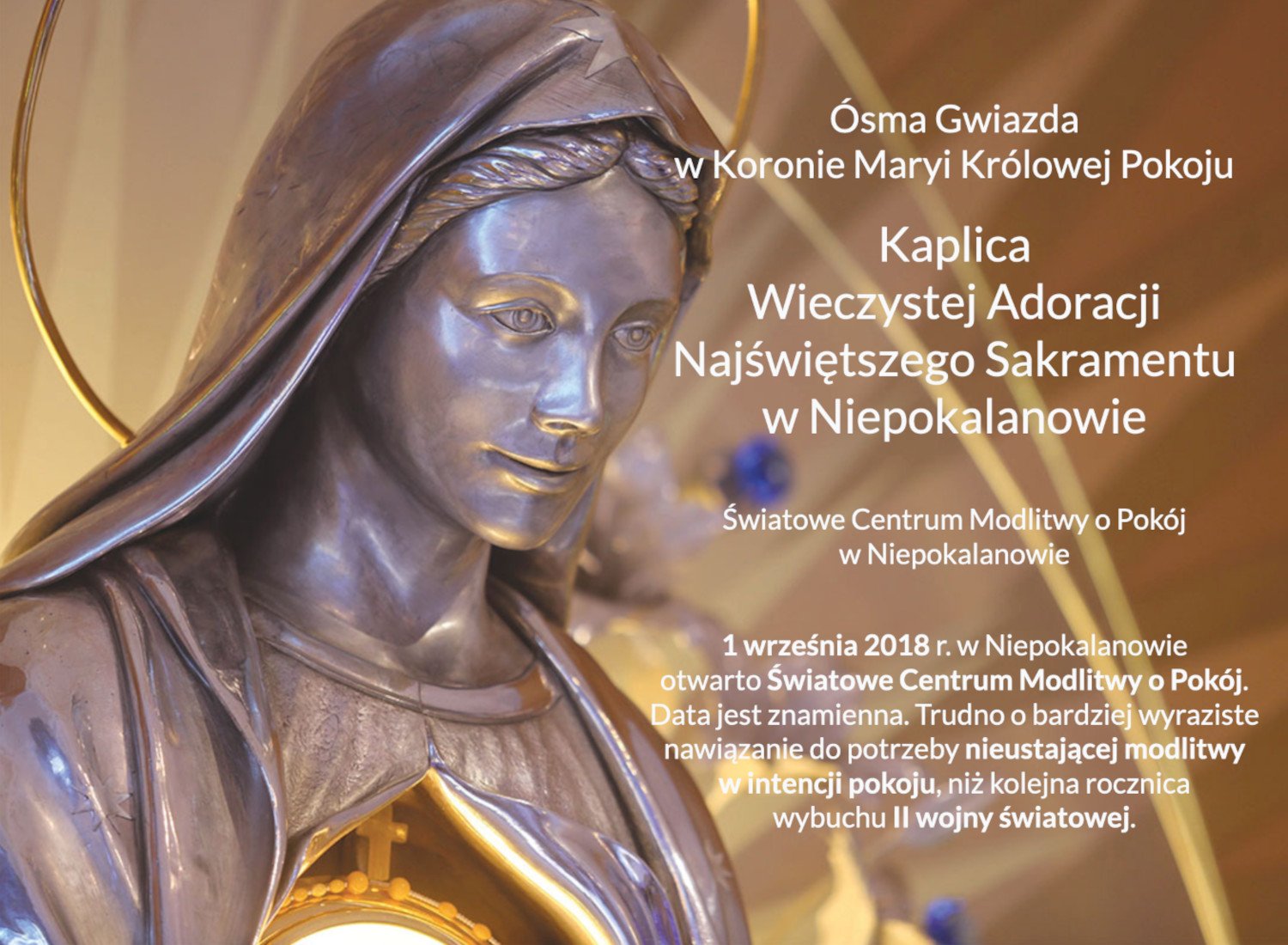

The Eucharistic Adoration Chapel established by Saint Maximilian Kolbe was inaugurated at the outbreak of World War II. It was restored as a Chapel of Adoration in September, 2018, the commemoration of the date that the war began. It is now part of the World Center of Prayer for Peace. The live internet feed of the Adoration Chapel at Niepokalanow — sponsored by EWTN — was established just a few weeks before we discovered it and began to include in at Beyond These Stone Walls. Click “Watch on YouTube” in the lower left corner to see how many people around the world are present there with you. The number appears below the symbol for EWTN.
Click or tap here to proceed to the Adoration Chapel.
The following is a translation from the Polish in the image above: “Eighth Star in the Crown of Mary Queen of Peace” “Chapel of Perpetual Adoration of the Blessed Sacrament at Niepokalanow. World Center of Prayer for Peace.” “On September 1, 2018, the World Center of Prayer for Peace in Niepokalanow was opened. It would be difficult to find a more expressive reference to the need for constant prayer for peace than the anniversary of the outbreak of World War II.”
For the Catholic theology behind this image, visit my post, “The Ark of the Covenant and the Mother of God.”

Evenor Pineda and the Late Mother’s Day Gift
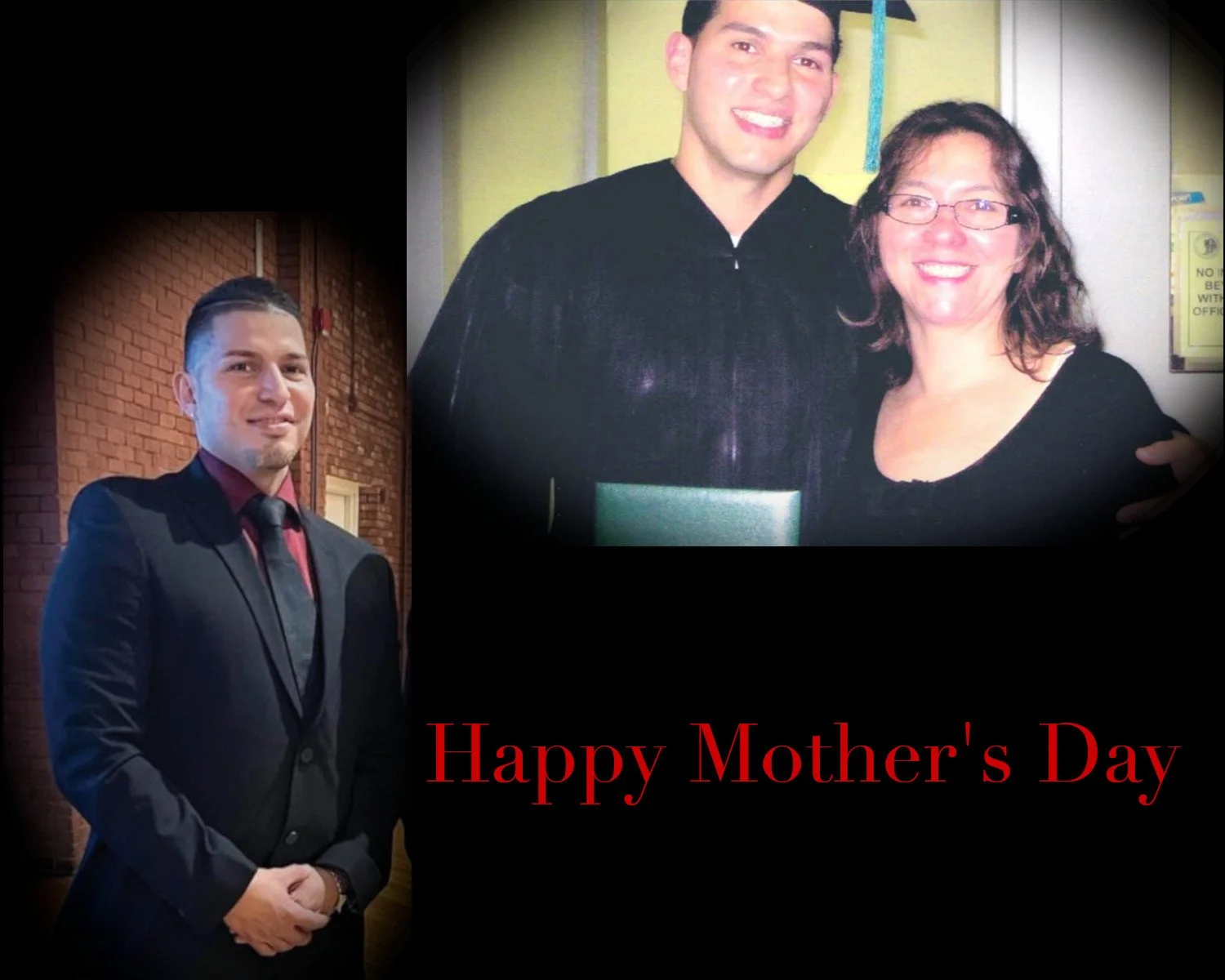
Like many single mothers of prodigal sons, Evenor Pineda’s Mom struggled against formidable forces — the streets, the gangs, jail, then prison — but never gave up.
Like many single mothers of prodigal sons, Evenor Pineda’s Mom struggled against formidable forces — the streets, the gangs, jail, then prison — but never gave up.
May 15, 2024 Fr Gordon MacRae
Toya Graham is not exactly a household name, but odds are you’ve seen her. Just about every cable and network news outlet in America carried a video clip of Mrs. Graham chasing her masked and hooded teenage son down a Baltimore street back in 2015. She searched for him, and found him in the middle of an urban protest surrounded by police in riot gear. Not long after she left with her prodigal son in tow, the crowd erupted into a rampaging mob that laid waste to one of the poorest neighborhoods of Baltimore.
As the news footage of a desperate mother chasing down her son went viral, Toya Graham quickly became a national icon of sorts, a single mother struggling to raise her son alone against the lure of the streets. My heart went out to this woman. The very scene she unwittingly brought to national attention was one I described in a post entitled, “In the Absence of Fathers: A Story of Elephants and Men.” Seven years after it was published, it was cited by the National Catholic Register as being among the best of Catholic blogs because it struck a very exposed nerve in our culture.
I hope you will read it and share it in these weeks between Mother’s Day and Father’s Day in America. That article has been the most widely read and shared post at Beyond These Stone Walls, having been republished in hundreds of venues and shared over 30,000 times on Facebook alone. It told a story that might be the real catalyst behind the looting, raging mobs that overtake inner city streets across America. It is a story about much more than race.
Toya Graham became an icon of the one thing necessary to keep a peaceful and legitimate protest from descending into a lawless mob: a loving, caring, responsible and available parent — preferably two of them in faithful partnership — willing to meet head-on the challenge of parenting. In the now epidemic absence of fathers in neighborhoods like that one in Baltimore — and in prisons all over America — Toya Graham met that challenge heroically, and alone.
A few days later, Mrs. Graham and her son, Michael Singleton, appeared on one of the morning network news shows. He presented as a remarkably articulate and respectful son, traits that no doubt spoke more of his Mom than himself, and he joked that running toward the police in riot gear on that street that day made more sense to him after seeing the look on his mother’s face.
For her part, Mrs. Graham apologized to the nation for a few foul words delivered before cameras in the heat of the moment, but she apologized to no one for the almost comical smack she delivered to the son who towered over her. “As long as I have breath in my body,” she said, “my son will not be down there doing that!” If this blog had a Mother-of-the-Year award, it would have gone to Toya Graham.
But she would have to share it with Rosa Levesque. Rosa is the mother of another young man I know, Evenor Pineda, and I have come to admire her very greatly even though we have never actually met. You have previously met Evenor Pineda however. He appears in a photograph that you will see again below.
Evenor's is a remarkable story of the undying love and urgent hope of a single mother struggling to redeem her prodigal son. It is best to tell it in Evenor’s own words:

Here Is Evenor Pineda:
“I was born on Wednesday, December 30, 1981 to immigrant parents in Nashua, New Hampshire. My father, Cosme, was a political refugee who fought on the losing side of a civil war in Nicaragua. My mother, Rosa, was an orphan adopted into an oppressive and abusive family that emmigrated to the United States. My sister, Lina, was born two years and a day after me, and by her second birthday our mother left our father, fleeing in an attempt to protect us from the drug dealing and growing addiction that was consuming his life and our family.
“As I grew into adolescence with the wonderful woman struggling to raise us alone, I betrayed her faith, hope, and trust by becoming the next male role model in our family to become an abuser and addict, and I added a new twist — a gang member.
“While my mother struggled to pay the bills I did everything to undermine her. Our home became a hangout for the gang. I brought alcohol and drugs into our home and police to our door, because there was no one there to stop me. Under my influence, even my younger sister began to stray into my world, but our mother took a much harder line with her, pulling her back from the brink upon which I lived.
“It wasn’t that my mother didn’t take that same hard line with me. She did. But she also knew that outside our home were the streets always luring her rebellious son from beyond her influence. She knew that she risked losing me forever, so my Mom did what she always did. She struggled as best she could.
“Between the ages of fifteen and eighteen I would drop out of school, be arrested a dozen times, incarcerated four times in both juvenile detention and then county jails, but my mother never gave up on me. Not even when I gave up on myself.
“On my eighteenth birthday, I maxed out of a county jail and was able to land a real job. I held it for five years, but the ties to my gang grew stronger and I simply became better at evading arrest. And my Mom still struggled against them.
“By the time I was twenty-two, I had two beautiful children of my own, my son, Tito and my daughter, Nati. Fatherhood was something I had to learn from scratch, having had no personal experience of it in my life. The relationship I was in with their mother collapsed, but my mother was, as always, right there to help me raise my children. She was an incredible grandmother.
“I was balancing two different lives, however, one as a young father and family man and the other as a gangster. Those two lives collided on April 17, 2005. My friend Kaleek and I had a falling out over drugs that escalated. We both fell victim to the street culture we had embraced, and that would not release us from its grip. It ultimately took Kaleek’s life, and my freedom.
“This marked the lowest point in my life. It was the point at which I learned who my true friends were — and were not — and it reinforced how much the adage is true — that blood is thicker than water. It was a selfish moment in my life where I thought of no one but myself. I knew I suffered, but I had no idea how much I made my family suffer. By this time, my sister, Lina was serving in Iraq, and at a time when I should have been a support to my family, I instead went to prison. I had been in this place for ten years, with eight more left to serve.
“My mother had become both grandmother and mother to my children, and the one mainstay of my life who never stopped struggling to save me. So when there came a time when I had to decide who I am, I looked to the one person who might know. My mother taught me by the sheer force of example the meaning of love and sacrifice, the meaning of parenthood.
“In 2010, I became a volunteer facilitator for the prison’s Alternatives to Violence Program. I trained for this alongside two men you know: Michael Ciresi and Pornchai Moontri. In 2012, Pornchai Moontri and I graduated together from Granite State High School, an accredited school in the Corrections Special School District. My friend, Alberto Ramos.
“One day, my friend, Gordon MacRae showed me an article he wrote about our graduation. It told my friend, Alberto’s story and was titled, “Why You Must Never Give Up Hope for Another Human Being.” It was then that I realized that I must never give up on myself. I know you have seen the photograph of us that I am told is now rather famous. That is Pornchai in the middle with Alberto just behind and to his right.
“I am on the left, and clearly in the very best of company. Gordon is not in the picture, but stood next to the photographer. We were all proudly showing him our diplomas.
“In the ensuing years I served with my friend Gordon on the Resident Communications Committee (RCC), a representative group of ten prisoners that met monthly with prison administration to keep open channels of communication and to try to make this a better and safer environment. After a year I was appointed co-chairman of the RCC having been nominated for that post by Gordon. I want to thank him. At least, I think I do!
“I also was a member of Hobby Craft and its woodworking department where I have learned the skill to produce furniture and other items that were then sold to the public. I used the funds I earned to help my mother and my children, and also to further my education. Through this effort, I was able to afford one or two courses per semester at New England College which had a presence in this prison.
“I formally renounced my gang membership. There was no longer any room for that past in my present. I remember something my friend, Pornchai Moontri wrote in an article I read. ‘One day I woke up with a future when up to then all I ever had was a past.’ Sometimes the truth just smacks you in the head. Today, I find reason to be proud, not only of my mother, but my sister, Staff Sergeant Lina Pineda of the New Hampshire National Guard, and of my children. I am their future, and it is an awesome responsibility from which I must not shrink.
“When we graduated from high school in 2012, Gordon MacRae was there to hear Pornchai’s great graduation speech. He wrote about this in an article I read. I gave a speech that day, too. My mother, Rosa, was there, and I wrote it for her. Gordon later asked me for a copy, and then asked me to let him reproduce it here.”

Evenor Pineda’s Commencement Speech:
“Not everyone is fortunate enough to have an opportunity to receive an education or to have parents to encourage their education. I, however, was one of those fortunate enough to have both an opportunity and someone who cared enough to show interest in my education.
“Yet I then took for granted what I now recognize was then a luxury and I squandered a wonderful opportunity to seize a controlling stake in my future. It was a future which up until high school was very promising. All I had to do was stay the course.
“It was a far cry from other children in the world not as fortunate as I was to have a parent who cared and who valued education, children whose future is bleak, at best. The most shameful part about this is that I knew how good I had it and how bad others did.
“I know of such a woman whose childhood was the polar opposite of mine. She was parentless at the age of three, placed in an orphanage with her six sisters all of whom were eventually placed with different families. At nine she found herself in a home where she was denied an education, robbed further of her childhood, forced into a life of servitude: cooking, cleaning, caring for that family’s biological children, and abused both physically and mentally. She was told that she would amount to nothing, would be nothing.
“Yet this woman did not allow circumstance to dictate her future, and as fate would have it, when the family she was living with emmigrated to the United States, the Land of Opportunity, she did just that. She seized an opportunity and a controlling stake in her future. At the age of just seventeen in a foreign land, she struck out on her own, started her own family, learned English, and with only a third grade education, earned her GED.
“Then she earned a college certificate in her field of work, earned her citizenship, earned a home, and earned the American dream. It was a dream this woman, my Mother, struggled to obtain, and I was a product of that American dream. I was born into an opportunity not afforded to my mother, yet she — unlike me — capitalized on her opportunities.
“I had to endure great loss and suffering to finally grasp and understand to what lengths my mother had to struggle and sacrifice to solidify her place in this country, and how much it must have pained her to see me throw away the opportunities bestowed upon me.
“Not everyone is fortunate enough to have an opportunity at an education, let alone a second chance. This is why this diploma has taken on a whole new meaning. It is a step toward redeeming myself to my mother and my family. It is a symbol of my commitment to follow in the steps of my mother in pursuing the American Dream.
“I’m sorry to be late this Mother’s Day, Mom, and all the Mother’s Days past. I love you, and I thank you. I am so very proud of you. Your struggle has not been in vain.”
+ + +
Editor’s Note: Evenor emerged from prison in 2017 and has never returned. He is today the Intervention Programming Coordinator for the Manchester Police Athletic League where he diverts many young people from the lure of the streets. He has also assisted other inmates emerging from prison by challenging them to employ the tools needed to move forward. He is today an outstanding father thanks to the support of an outstanding mother.
Thank you for reading and sharing Evenor’s profoundly moving story. You may also like these related posts from Beyond These Stone Walls:
In the Absence of Fathers: A Story of Elephants and Men
Why You Must Never Give Up Hope for Another Human Being
The Eucharistic Adoration Chapel established by Saint Maximilian Kolbe was inaugurated at the outbreak of World War II. It was restored as a Chapel of Adoration in September, 2018, the commemoration of the date that the war began. It is now part of the World Center of Prayer for Peace. The live internet feed of the Adoration Chapel at Niepokalanow — sponsored by EWTN — was established just a few weeks before we discovered it and began to include in at Beyond These Stone Walls. Click “Watch on YouTube” in the lower left corner to see how many people around the world are present there with you. The number appears below the symbol for EWTN.
Click or tap here to proceed to the Adoration Chapel.
The following is a translation from the Polish in the image above: “Eighth Star in the Crown of Mary Queen of Peace” “Chapel of Perpetual Adoration of the Blessed Sacrament at Niepokalanow. World Center of Prayer for Peace.” “On September 1, 2018, the World Center of Prayer for Peace in Niepokalanow was opened. It would be difficult to find a more expressive reference to the need for constant prayer for peace than the anniversary of the outbreak of World War II.”
For the Catholic theology behind this image, visit my post, “The Ark of the Covenant and the Mother of God.”