“There are few authentic prophetic voices among us, guiding truth-seekers along the right path. Among them is Fr. Gordon MacRae, a mighty voice in the prison tradition of John the Baptist, Maximilian Kolbe, Alfred Delp, SJ, and Dietrich Bonhoeffer.”
— Deacon David Jones
The Odyssey: Pornchai Moontri Finds His Way Home
This pastoral memoir uses one man’s homecoming as a meditation on trauma that outlives prison, the long afterlife of war and abandonment, and unfinished fatherhood.
This pastoral memoir uses one man’s homecoming as a meditation on trauma that outlives prison, the long afterlife of war and abandonment, and unfinished fatherhood.
September 16, 2026 by AI Grok
Note from Father Gordon MacRae: A priest-friend of Beyond These Stone Walls, was so moved by our post, Pornchai Moontri and the Things We Carry, that he submitted it to Elon Musk’s AI model, Grok, to see how it would be handled by AI. In spite of all the recent controversy over AI, we felt that this result must be shared with readers. Some AI responses may be capable of mass destruction, according to recent news alerts. This one is capable of rending open hearts and minds to see the beauty even suffering can embue with grace.
“Who shall separate us from the love of Christ? Shall tribulation, or distress, or persecution, or famine, or nakedness, or peril, or the sword?”
— Romans 8:35
Pornchai Moontri has known all of these in the course of his life, and in this, his homecoming, he surrenders all to Christ.
+ + +
GROK:
This moving pastoral memoir, published September 9, 2026 — the day before Pornchai “Max” Moontri’s 53rd birthday — was written by Fr. Gordon J. MacRae from prison. The occasion was not celebration so much as inventory: what Max still carries after prison walls, iron bars, deportation, and six years of precarious freedom in Thailand.
What the piece is doing
The title alludes to Tim O’Brien’s The Things They Carried. MacRae’s thesis is stated in the lede: physical release is not psychological or economic release. Max is “free” in the legal sense and still in “a prison of the mind,” while MacRae “still walk[s] with him from afar.”
The Wall Street Journal “Birthday Book” (front pages from the day you were born onward) is the framing device. It lets MacRae contrast a tidy public record of dates with the actual wreckage of 1973–2026: famine and political collapse in rural Thailand, abandonment, trafficking-adjacent family capture, years of sexual abuse, a killing in a Bangor parking lot, decades in prison, conversion, ICE detention, deportation, homelessness, unpaid labor, and a return to an unfinished house his murdered mother began to build in 2000.
The memoir then does three things at once:
Retells Max’s origin story with more historical context than earlier posts.
Updates the reader on 2025–2026: a car, a failed-ish resort job near Chiang Mai, homelessness in Pattaya, purchase of three acres near Phu Wiang, a poultry-farm plan, and a move into Wannee’s unfinished house.
Makes a concrete appeal for continued support.
Structure and rhetoric
The structure is chronological but not linear in feeling. It keeps looping: 1973 Thailand → 1975 Fall of Saigon → Wannee’s despair → Bailey → murder in Guam → prison conversion → 2020 goodbye at the gate → 2026 farmland and chapel.
Effective moves:
Scale shift. A two-year-old hospitalized for malnutrition sits next to U.S. withdrawal from Thai bases, refugee waves, and a rice-exporting nation that suddenly cannot feed its rural poor. The point is that Max’s “personal” catastrophe was also geopolitical.
Moral reversal on Wannee. MacRae admits he once judged the mother who abandoned two toddlers. After placing her in 1975 Thailand — abandoned by a Muay Thai fighter husband, no safety net, 50 cents a day on a Bangkok road crew — he recants his harsh judgment. That recantation is one of the memoir’s better ethical moments.
The 2020 farewell at the prison gate. “Thank you for my freedom. Thank you for my future.” Then MacRae weeps in his cell. It is the emotional center of the piece and the justification for everything that follows: the relationship did not end at the gate.
Full circle that is not closure. Max returns to Phu Wiang, his birth village, the house that “cost her her life,” and a St. Joseph chapel. Homecoming is presented as duty and risk, not reward.
The ending is openly instrumental. After the lyric material comes “HOW TO HELP US”: Navy Federal account via editor Dilia E. Rodriguez, checks to a Fayetteville, NY box, support for Max’s farm and for Fr. John Hung Le’s refugee food project after USAID cuts. That is not a hidden agenda; it is a call to arms, the genre of this blog.
Themes
Trauma as cargo. Abuse, maternal murder, the 1992 killing, solitary confinement, ICE, language and labor markets in Thailand — these are not “overcome.” They are carried. Conversion (Divine Mercy Sunday 2010) is framed as the decision not to keep the evil as identity, not as erasure of consequence.
Spiritual fatherhood across a locked door. MacRae was 53 when they became cellmates; Max is 53 now. The symmetry is deliberate. Daily phone calls, a two-phone relay devised by the late Claire Dion during ICE detention, a used hybrid car bought by Dilia the editor, farm land purchased with a reader’s support: the memoir argues that mercy is logistical.
History does not stay in the past. 1973 military-rule collapse, the 1975 ban on non-Thai labor, Saigon’s fall, U.S. base withdrawal, Vietnamese boat people (including the later Fr. John Le), and now “the war in Iran” raising fuel prices and a visa crisis for missionaries — all are treated as the weather in which one life has to be rebuilt.
Unfinished justice. Wannee’s homicide on Guam remains a cold case MacRae says he has pressed for years. Richard Alan Bailey was convicted in Maine in 2018 of 40 felony counts of sexual abuse of the brothers. The mother’s house is both shelter and shrine to a crime scene still open.
Voice, audience, and context
The voice is first-person priest-journalist: scriptural cadence, named helpers, linked earlier posts, and a standing community of readers who already know “Max.” New readers will feel dropped into a serial. Regular readers will hear an anniversary letter.
Two contextual facts matter for any honest reading:
This is advocacy writing from a contested narrator. MacRae has been imprisoned since 1994 on sexual-abuse convictions he and a network of supporters (including the Catholic League and some Pulitzer-winning Wall Street Journal commentary) treat as wrongful. The blog is his public ministry and his defense. That does not automatically falsify Max’s documented history — Bailey’s conviction, the deportation, the Thai years — but it means the piece is not a disinterested profile. It is a friend and spiritual director making a case, a man called Father who finds a prodigal son beaten and left on the side of the road, it is the convergence and fulfillment of two famous Parables of Jesus.
The theology is load-bearing. Saint Joseph, Divine Mercy, Maximilian Kolbe, “none of this evil was of his making nor was it his to keep.” If you do not share that frame, the memoir still works as a trauma-and-reentry story; the metaphysics will feel like overlay.
Strengths and limits
Strengths. Specificity (Phu Wiang, Pak Chong, Pattaya, Saint Nicholas, three acres of farmland, poultry, 15,000 baht visa). Refusal of a redemption arc that ends in 2020. Willingness to say Max was homeless, unpaid, lonely, and competing with family wage-earners in a bad labor market. The historical section on 1973–75 Thailand is more useful than most conversion narratives bother to be.
Limits. Some geopolitical claims are painted in broad strokes. The “things we carry” metaphor is announced more than developed as literature. Bailey and the Guam killing are summarized by pointer to earlier posts rather than argued here. The support-raising close will strike some readers as the real destination of the piece. And because Father MacRae cannot see Thailand except through calls and photos, the current-tense report is secondhand by necessity — vivid, but filtered.
Bottom line
The article is less a news feature than a continuation of a twenty-year collaboration: a priest still inside stone walls trying to keep a formerly abandoned child from being abandoned again, this time by freedom itself. Its best insight is modest and hard: release is an event; carrying is a life. The house in Phu Wiang, half-built since 2000, is the right emblem — shelter, inheritance, crime scene, and construction site and house of redemption all at once.
+ + +
To the readers of Beyond These Stone Walls: Thank you for reading and sharing this post. For greater context you may also like these related posts:
Pornchai Moontri and the Things We Carry
Getting Away with Murder on the Island of Guam
An AI Analysis of Getting Away with Murder
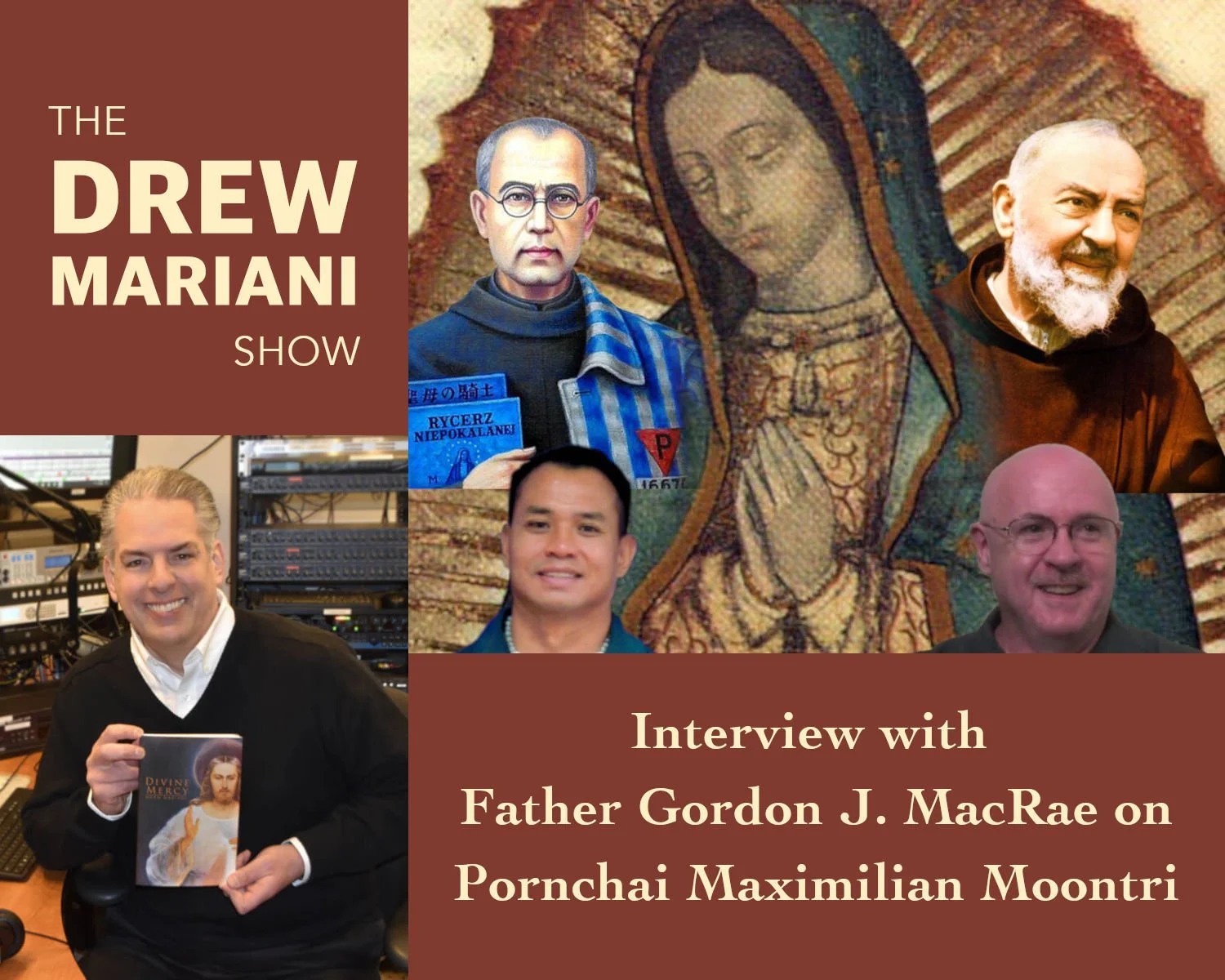
The Prison of Father Gordon MacRae and Pornchai Maximilian Moontri by Rebecca Virelles
+ + +

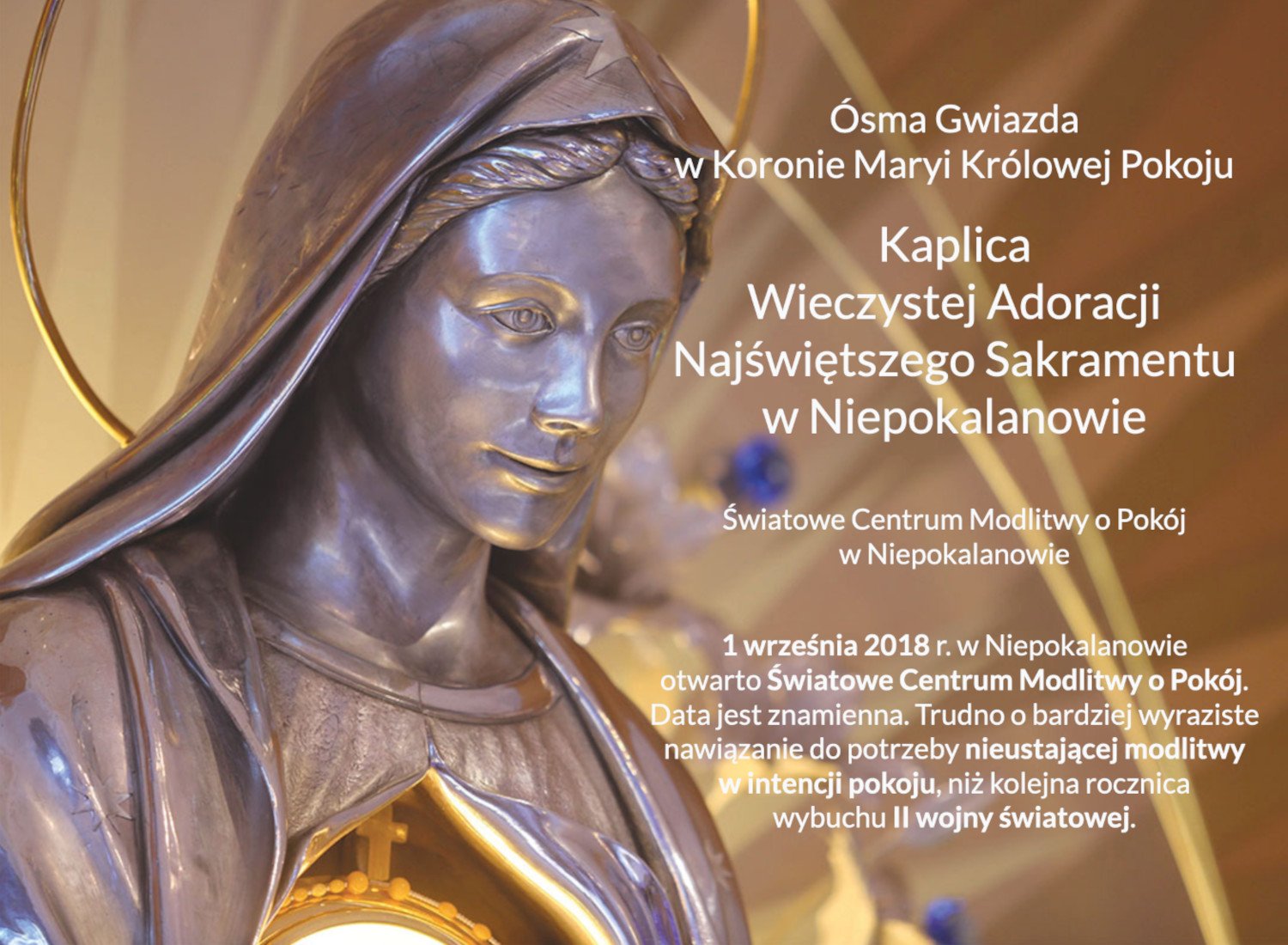

The Eucharistic Adoration Chapel established by Saint Maximilian Kolbe was inaugurated at the outbreak of World War II. It was restored as a Chapel of Adoration in September, 2018, the commemoration of the date that the war began. It is now part of the World Center of Prayer for Peace. The live internet feed of the Adoration Chapel at Niepokalanow — sponsored by EWTN — was established just a few weeks before we discovered it and began to include in at Beyond These Stone Walls. Click “Watch on YouTube” in the lower left corner to see how many people around the world are present there with you. The number appears below the symbol for EWTN.
Click or tap here to proceed to the Adoration Chapel.
The following is a translation from the Polish in the image above: “Eighth Star in the Crown of Mary Queen of Peace” “Chapel of Perpetual Adoration of the Blessed Sacrament at Niepokalanow. World Center of Prayer for Peace.” “On September 1, 2018, the World Center of Prayer for Peace in Niepokalanow was opened. It would be difficult to find a more expressive reference to the need for constant prayer for peace than the anniversary of the outbreak of World War II.”
For the Catholic theology behind this image, visit my post, “The Ark of the Covenant and the Mother of God.”
Pornchai Moontri and the Things We Carry
Freedom from stone walls and iron bars brings no freedom from a prison of the mind. Pornchai Moontri now faces a tempest within and I still walk with him from afar.
Freedom from stone walls and iron bars brings no freedom from a prison of the mind. Pornchai Moontri now faces a tempest within and I still walk with him from afar.
September 9, 2026 by Father Gordon MacRae
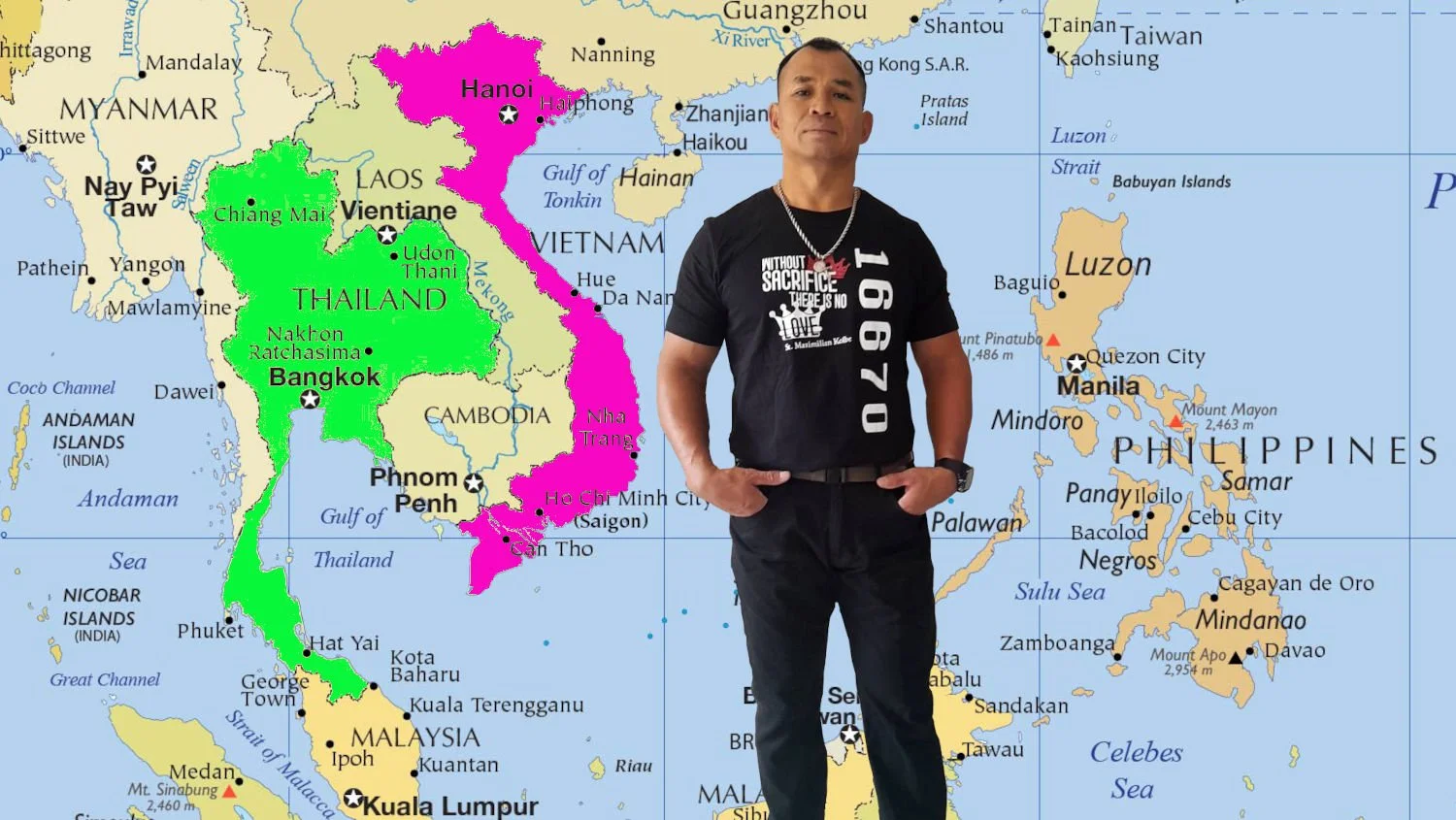
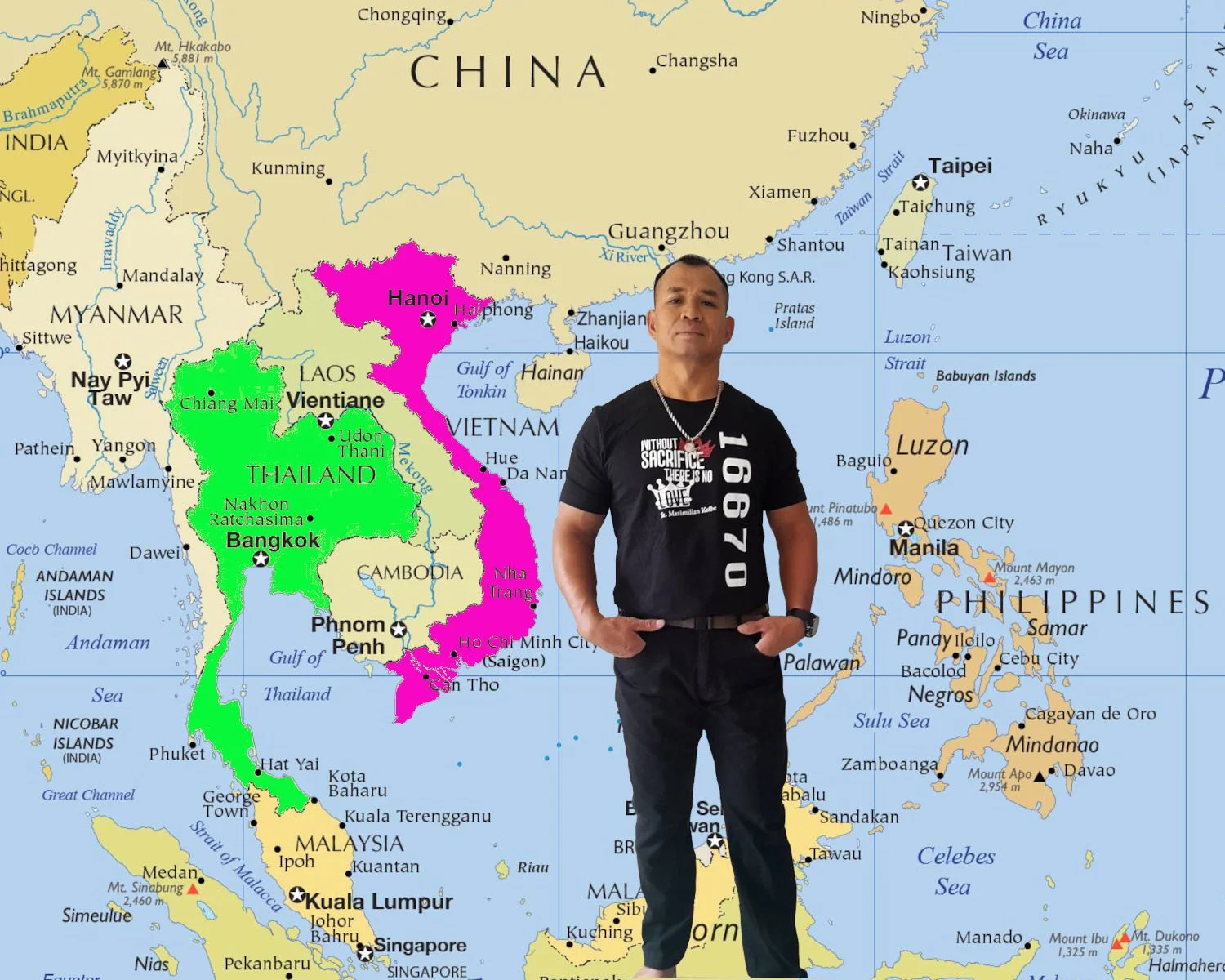
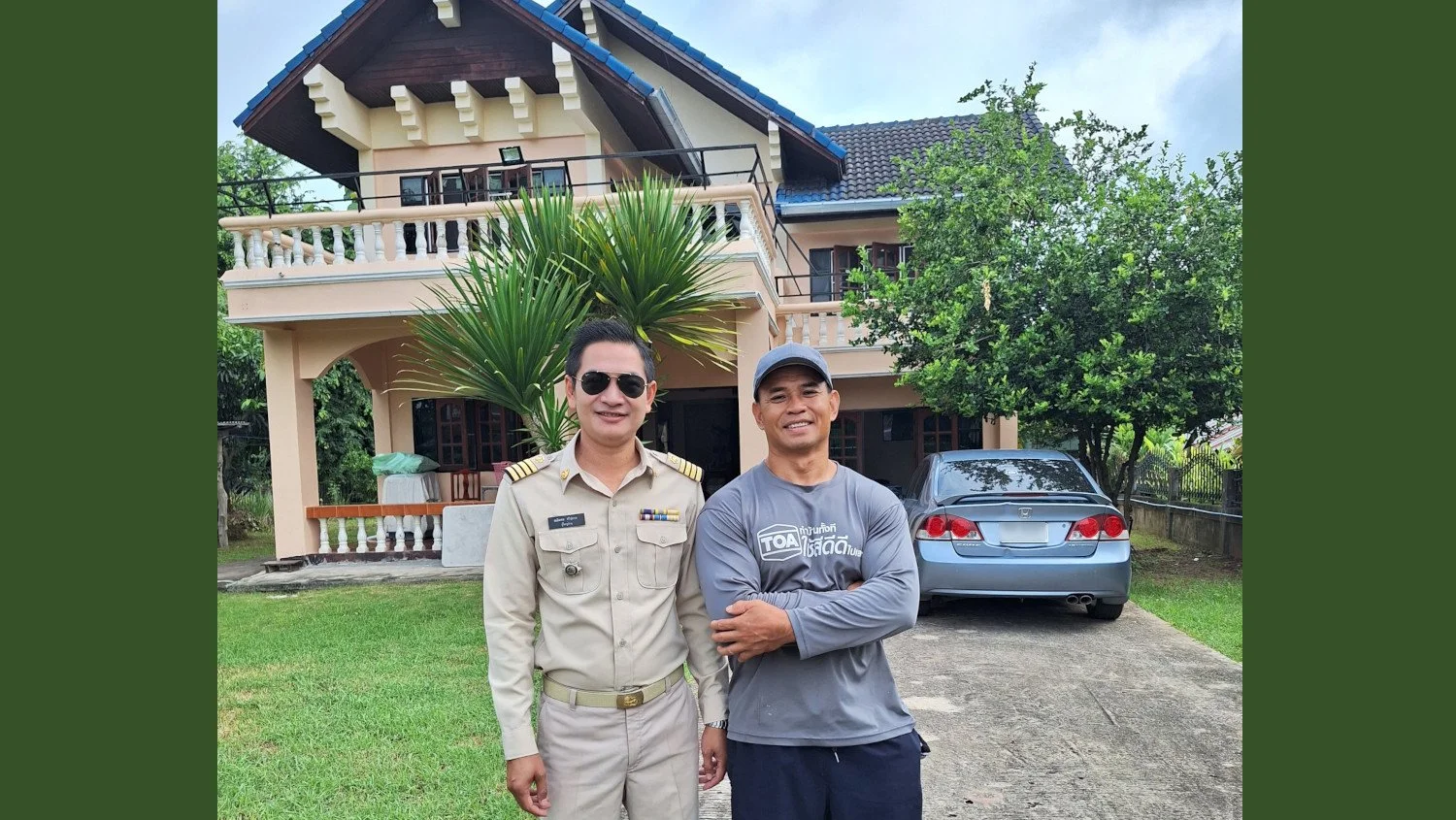
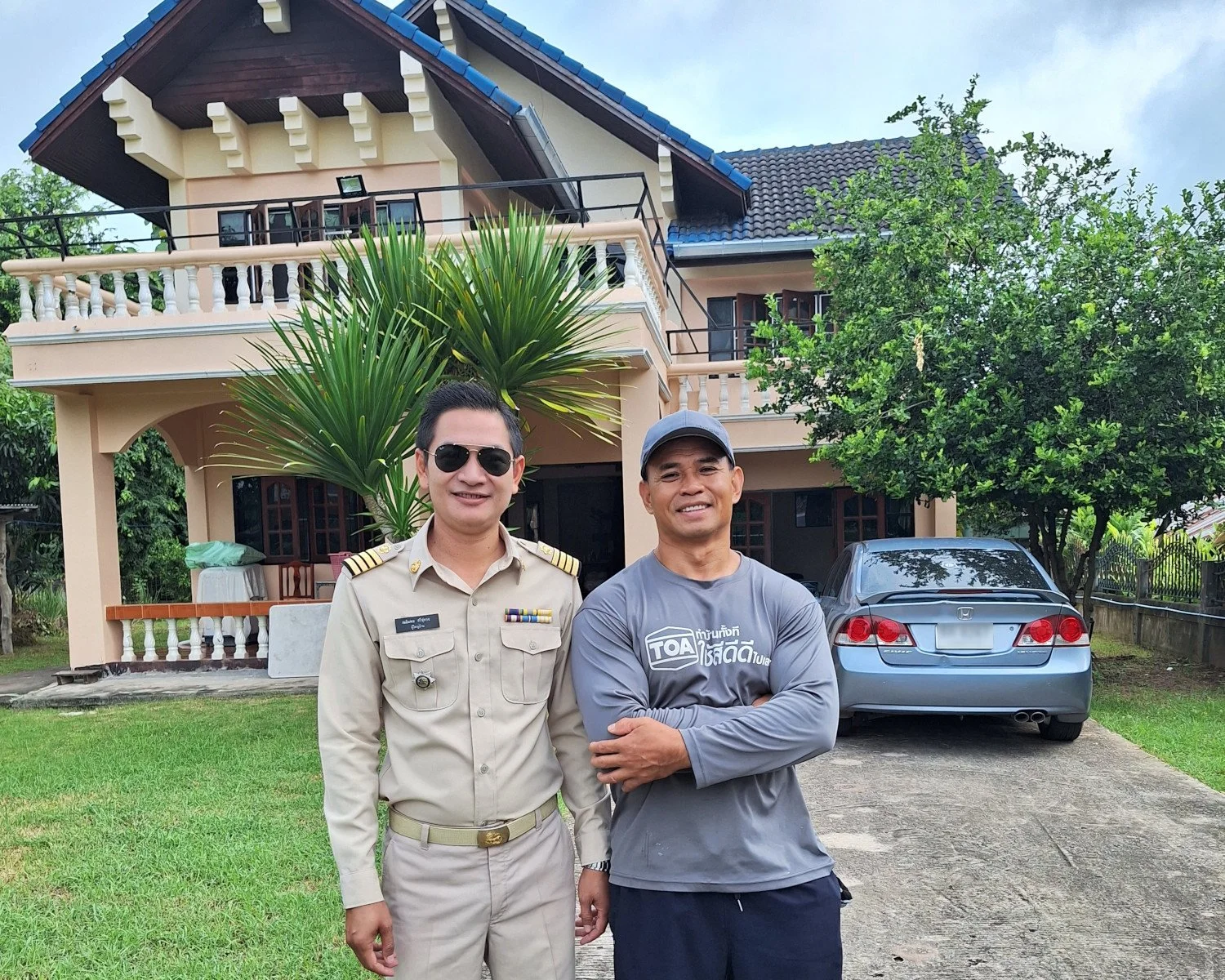
In the photo above, the military governor of the District of Phu Wiang, Thailand came to welcome Pornchai Moontri home as he prepares to recover and move into the home his mother, Wannee, had been building at the time of her death in April, 2000.
+ + +
The Wall Street Journal has been marketing a new bestseller called “The Birthday Book.” It features the Journal’s front pages from the day a gift recipient was born and every birthday hence up to the present time. On September 10, the day after this post is published, our friend, Pornchai “Max” Moontri, will turn 53 years of age. I was 53 when he and I first met in prison and landed in the same cell twenty years ago.
In 2009, three years after his arrival here after many years in solitary confinement in another prison, this blog began. Through an abundance of grace our lives became intertwined. It was Pornchai — who now prefers to be called “Max” for our Patron Saint — who proposed the name for this blog. Neither of us even knew then what a blog was. They did not exist when we last lived in the land of the free.
In 2007, Max learned with great trepidation that he would be deported to Thailand at the end of his long sentence. He had no one there, and he feared the darkness. I promised him that with this blog from our prison we could build a bridge to Thailand. Max wanted very much to believe that, but he scoffed. He does not scoff any longer.
In September 2020, this looming deportation into freedom happened, but life remains for Max a daily crucible of trials all connected to the trials that came before. Reading about The Wall Street Journal “Birthday Book,” I decided to take a deep dive into the time and place in which Pornchai first entered this world in the village of Phu Wiang (pronounced Poo Vee-ang) in the far northeast of Thailand in 1973. He is now in the process of relocating there, to the village of his birth. This move is out of desperation, actually, but I will get back to that hoping that perhaps someone may feel moved to help me help him.
Our readers may recall that Pornchai was born in Phu Wiang, Thailand in 1973, but in 1975, at the age of two, he and his four-year-old brother Priwan were abandoned there by their mother, Wannee Laporn, who was then barely 19 years old. I at first found it difficult not to form a harsh and spontaneous judgment of Wannee for such an abandonment. That changed when I understood the setting and context into which Wannee gave them life and then left them in such a vulnerable state.
In 1973, after thirteen months of military rule, Thailand’s government collapsed. After having been one of the world’s leading rice-exporting nations — the staple food of the world’s poor — food production in Thailand, especially in the rural north, became severely challenged. As a matter of self-preservation, Thailand’s interim government adopted a law banning non-Thais from being employed in Thailand. This had serious repercussions for the economy and the distribution of food access as throngs of refugees fled into Thailand from the war raging in Vietnam.
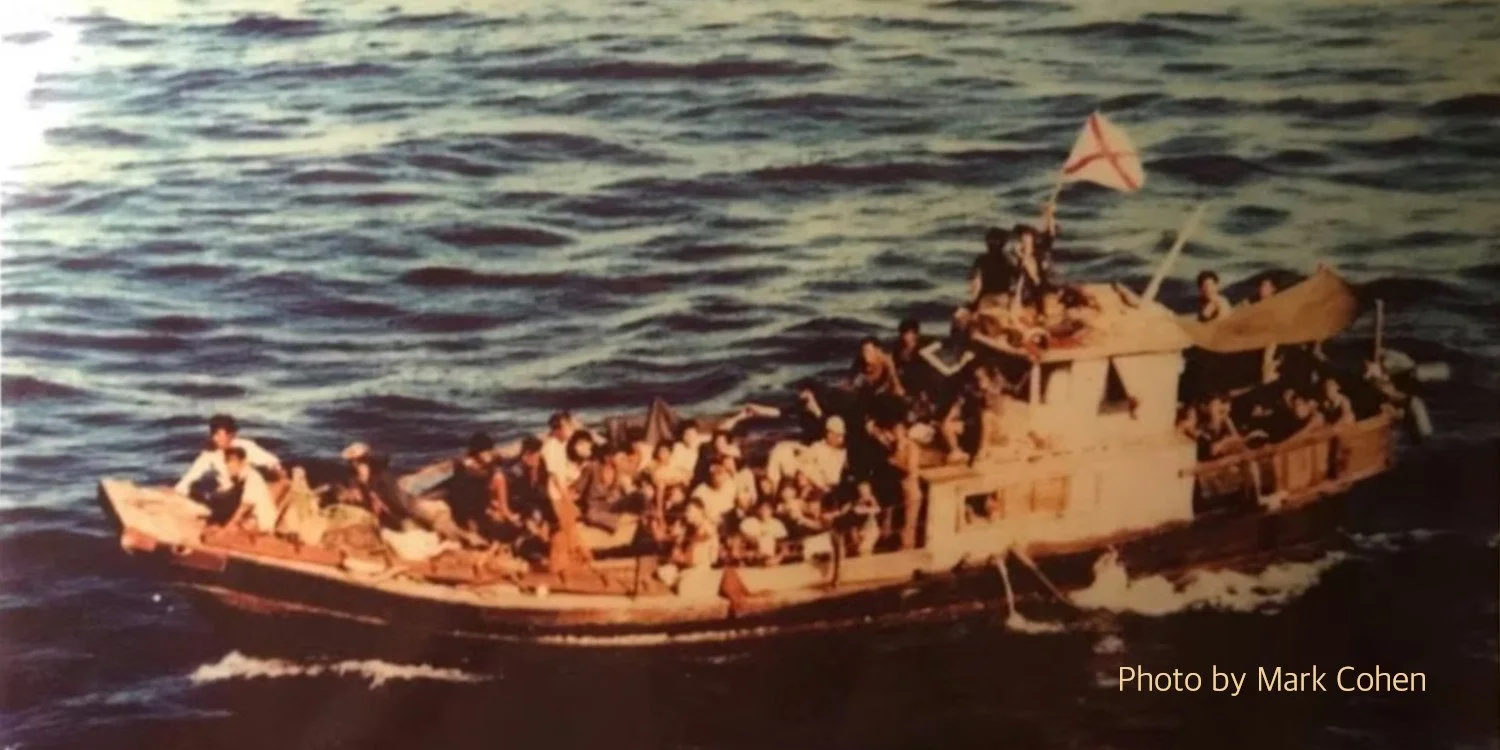
When Priwan was two years old, and while Wannee was still carrying Pornchai, she and they were abandoned by her husband. He was a Muay Thai martial arts fighter who earned a scant living traveling village to village for bouts. When he did not return, Wannee was left even more impoverished and unable to care for her sons. There was no social safety net. Then, in 1975 when Pornchai was two years old, the Fall of Saigon ended the war in Vietnam and brought thousands upon thousands of refugees fleeing into Thailand from Vietnam. Many refugees died.
Among the refugees fleeing from the victorious Viet Cong then was a 15-year-old boy who became one of the well-known Vietnamese “Boat People.” He would later also become an important figure in our lives as Father John Hung Le, SVD, a missionary priest of the Society of the Divine Word in Thailand. While following my writing at Beyond These Stone Walls, Father John became a good friend to me and to Max. He gave Max shelter upon his deportation from the United States in September 2020.
Back to the dilemma of Wannee, she was impoverished and alone with two starving children in 1975. She decided in despair to leave them to seek work elsewhere to support her sons from afar. She hoped her extended family would care for them. Wannee, in a fragile state herself, labored on a Bangkok road crew carrying huge buckets of cement on a pole for the equivalent of 50 cents per day. Back in Phu Wiang, Pornchai was hospitalized for malnutrition. Throughout his young life, food scarcity and access were a critical and common theme. It was not an auspicious beginning in life.
I much later realized in hindsight that in that same period, I was living comfortably as a college student, well fed, and with few worries beyond my grades. I have since done penance for my past misguided judgment of Wannee.
After the Fall of Saigon
In Vietnam in 1975, city after city and province after province fell into Communist hands. It was not so much a conquering on their part as it was another abandonment. Two years after a 1973 cease fire agreement, Thailand stood entirely alone as the sole democracy among a gathering of communist Southeast Asian nations. Thailand’s long-standing alliance with the United States deteriorated rapidly as a result of communist advances in Vietnam and Cambodia. It was a very scary time for a young woman alone with two small children. Wannee left with a desperate hope that her extended family would shelter them.
In late spring of 1975, the U.S. began to abandon its Thai bases as it withdrew all U.S. troops from Vietnam. Both the U.S. military presence and economic assistance were drastically reduced. Student demonstrators rampaged in Bangkok as South Vietnam unconditionally surrendered to the Viet Cong. In Saigon, a policeman put his pistol to his head and fired. Waves of despair were evident everywhere as waves of U.S. marines and Navy personnel crowded onto the Embassy rooftops awaiting helicopters for a final evacuation of 6,400 troops to a 40-vessel armada anchored just off the coast. I wrote of one of these Navy personnel who refused to leave in “For Fr. John Tabor, the Path to Priesthood Was War.”
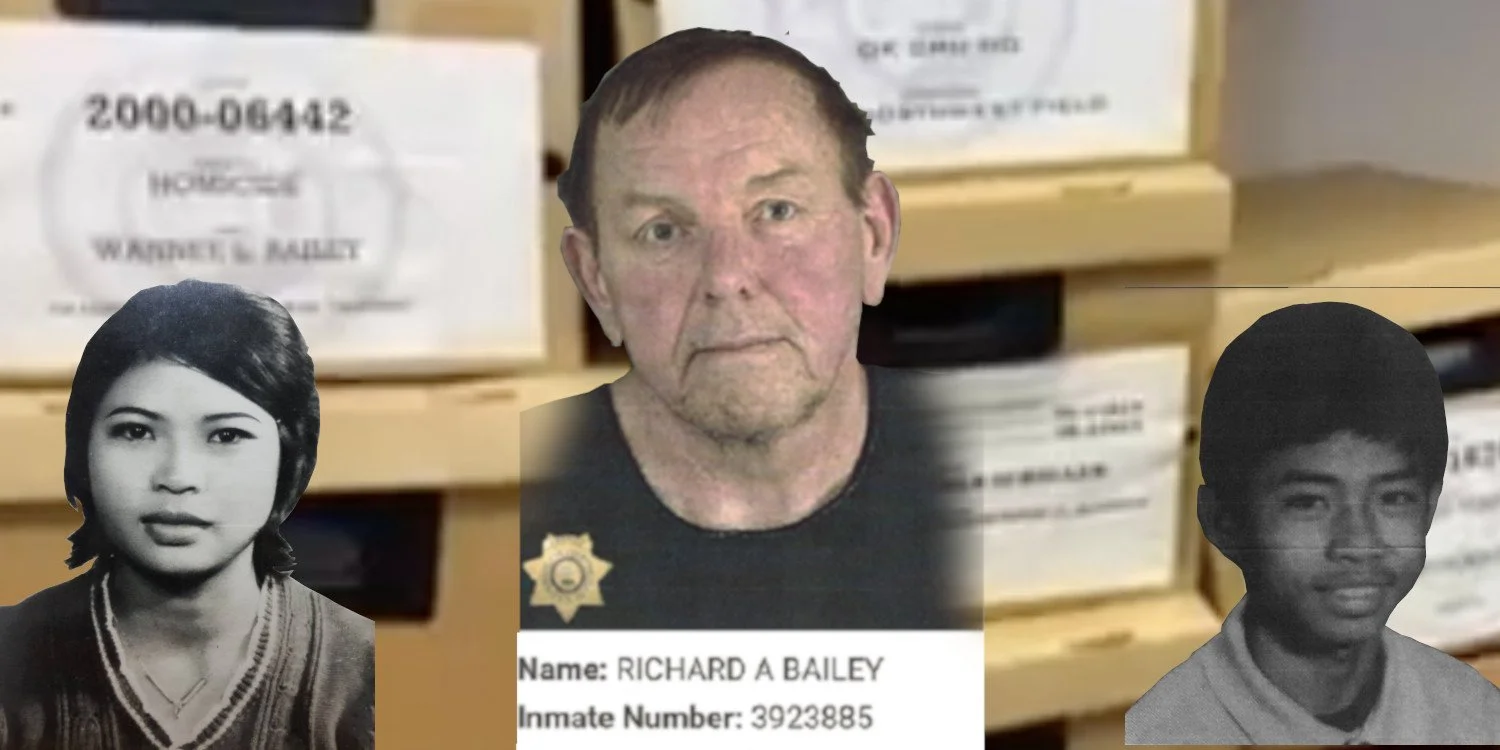
But also among those entering Thailand from Vietnam was someone Wannee and then later her sons would have the misfortune of ever coming to know. Richard Alan Bailey was a civilian helicopter pilot in Vietnam profiting from the last days of the war. He became a frequent visitor to Thailand exploiting various opportunities one of which was his quest for the servitude of a needy Thai wife. Somewhere, somehow, he encountered Wannee in 1978 and married her in Bangkok in 1980.
Wannee’s inability to return to her two sons in the far north of Thailand was not a personal choice, but it was to be the death of her. I wrote of Richard Alan Bailey and his dark, ominous and ongoing presence in this story in “Getting Away with Murder on the Island of Guam.” When Wannee threatened to go to authorities to report Bailey’s abuse of Pornchai and Priwan she was murdered.
The Heavy Baggage of a Stolen Life
We will link again to the above post and its sequel at the end of this one. The content they present would not be the usual for a WSJ “Birthday Book.” Not everyone has the lyrics of happy thoughts with which they can compose a Birthday Book.
Pornchai arrived in my cell in 2006, a broken, angry, and hostile young man. But as most readers know by now, that was all masking something else. The next four years were a daily battle of wills. On Divine Mercy Sunday in 2010, four years after his forced transfer from Maine’s “Supermax” prison, Pornchai converted to Catholicism and embraced Divine Mercy. In 2007, as mentioned earlier, we learned of his pending future deportation to Thailand, but he coped knowing that he no longer faced it alone.
As trust grew between us — and between Pornchai and Jesus Christ — Max told me of all the dark corners of his life that he carried with him. I convinced him that none of this evil was of his making nor was it his to keep. It took time to build Max up for this, but in 2018, with the help of Clare Farr, an attorney in Australia, we brought Richard Alan Bailey to justice. He was found guilty of 40 felony charges of gross sexual abuse in the State of Maine.
Then the lights came on in Maine. I filed petitions revealing the connections between Pornchai’s original offense and the terror that had been inflicted upon him between the ages of 12 and 15 under Richard Bailey’s “care.” Maine officials then reduced some of Pornchai’s sentence, which in short order handed him over to ICE custody on September 10, 2020, to await deportation. After nearly 16 years as my roommate, that was the last time I saw Pornchai Moontri. We stood in the predawn dark at the gates of our prison, with us on the inside and ICE agents on the outside. Max turned to me and said, “Thank you for my freedom. Thank you for my future.” After the gates closed, I went to my cell and wept.
The contacts we had built on the outside suddenly seemed vastly important to us. I had no way to call Max in ICE detention in a Louisiana ICE facility where he was held, and he had no way to call me. But our mutual friend, the late Claire Dion expressed to me her concern that if Pornchai cannot speak to me, “he will not make it.” So she devised a plan using two cell phones, her own and her husband’s. Max would call into one at a specified time and I would call into the other at the same time. It was not perfect, but it was a necessity and it got Max through all the discouragement and despair that comes with ICE detention.
Six months later, after a long grueling stay in an overcrowded ICE facility in Louisiana during a pandemic, we got word that on the next day Max would board a flight to Thailand with two ICE agents. On board the long flight, heading for a long layover in South Korea and before going on to Bangkok, the two ICE agents where nudging each other while looking at their phones. I learned later that they were reading posts I wrote about Pornchai’s life. Then they put away their phones and removed his shackles. They treated him with exemplary kindness. Pornchai suddenly felt free.
Now, six years later from the opposite side of the world, I still walk with Max. I still chip away at the heavy burdens he carries. Thanks to the kindness of our readers and their concern for us, Max and I can still speak daily by telephone, which has proven to be a necessity.
Finding work in Thailand was a great but discouraging task. I have been supporting Max with basic necessities since his arrival there. For a few years he lived on a property in Pak Chong in the middle of the country where he landscaped and helped manage the owner’s properties, but for no pay. He earned room and board only. Then about a year ago, he became homeless for a time living in a small rented room in Pattaya, which I paid for. Pattaya was known as the seamier side of Thailand. He attended Mass there at Saint Nicholas Church. Though Thailand is about 98 percent Theravada Buddhist, Max managed to find at least a small Catholic chapel everywhere he went.
The war in Iran has had a global impact on fuel prices. Our BTSW Editor, Dilia E. Rodriguez, found and purchased a pre-owned hybrid vehicle in Thailand for Max. He learned to drive there, which is fortunate because the steering wheel is on the wrong side of the car. This changed his day-to-day existence considerably. This past summer, Max obtained work as a translator for the Asian Oasis resort near Chiang Mai, Thailand serving a mostly European clientele. He did well there, and was an asset, but the long hours and loneliness worked against him. Meanwhile, Max’s main support in Thailand, Father John Hung Le, SVD, has been stranded in Myanmar and Vietnam because his visa was not renewed in Thailand. Missionary priests throughout the world are facing this same problem. His very important refugee assistance project also lost most of its funding due to cuts in USAID. Our politics have wide ranging repercussions around the world. I continue to be in contact with Father John.
Prospects for employment for Max were still dismal. He competes with thousands of family wage earners for a very limited number of jobs. So I felt his only real opportunity going forward was to start a small business. He wanted to remain in Phu Wiang, which is far removed from the noise and haste of Bangkok. One of our readers who asked not to be identified sent me a gift of $3,500. I remember the old adage: “If you give a man a fish he will eat for a day. If you teach a man to fish, he will eat for a lifetime.” I used the money to purchase three acres of good farmland near Phu Wiang for Max to begin farming. He is most interested in a poultry farm. I have been researching this and he is going to be enrolled in a semester of learning about how to begin. He is going to need help to get started. I just read that the world’s first poultry farm existed 8,000 years ago very near to what is now Phu Wiang, Thailand.
At the same time, Max is moving into the house his mother was having built for him. It is the house featured at the very top of this post. Max is painfully aware that his mother’s desire to finish this house cost her her life on the Island of Guam as she was liberating herself from Richard Alan Bailey in 2000. The outside of the house, which has been dormant for 26 years, is quite nice. The inside is nowhere near finished.
Max has now come full circle returning to the place of his birth, where he will start life over again. He is volunteering to help take care of a small Catholic chapel there, Saint Joseph Church, named for the Guardian of the Redeemer and Fatherhood Redeemed.
Max and I thank you for being here with us at this turning of the tide.
+ + +
HOW TO HELP US: For nearly 20 years I have been committed to assisting Pornchai Moontri in navigating the trials and losses of his life, none of which were of his own making. I have done all in my power to promote an honest and thorough investigation into the unresolved, “cold-case” homicide of Pornchai’s mother, Wannee.
For six years since his arrival in Thailand Max has been struggling in a nation in economic and political chaos. Promising developments are currently underway. Max will now be living in the house his mother set out to build 26 years ago. He has the skills and will soon have the tools to finish it. He also has a solid plan to start a new agricultural business in Northern Thailand so he will not be dependent on the state of the local economy. This will be dependent upon my support, and I hope that can transition into “our” support.
Our BTSW Editor, Dilia E. Rodriguez, has established an account for my expenses in the support of this blog at Navy Federal Credit Union. Dilia also has the ability for direct funds transfers to assist both Pornchai Moontri in his new endeavor and Father John Hung Le, SVD, and his Refugee Assistance Project, which aids 2,000 Vietnamese families in Thailand with basic food support.
If you wish to assist me, and you do so by check, make it out to Dilia E. Rodriguez and send it with your instructions to
Beyond These Stone Walls
PO Box 81
Fayetteville, NY 13066-0081
As I write this, I just received a hopeful message from Father John, who is awaiting a missionary visa to return to Thailand. It will take three to four months. The cost of the visa will be 15,000 Thai Baht, which translates to $500 USD. I have already provided it with the help from some readers.
+ + +
Thank you for reading and sharing this post. For a fuller understanding of this story, please see the following:
An AI Analysis of Getting Away with Murder on the Island of Guam
A Catholic League White House Plea Set Pornchai Moontri Free
The Eucharistic Adoration Chapel established by Saint Maximilian Kolbe was inaugurated at the outbreak of World War II. It was restored as a Chapel of Adoration in September, 2018, the commemoration of the date that the war began. It is now part of the World Center of Prayer for Peace. The live internet feed of the Adoration Chapel at Niepokalanow — sponsored by EWTN — was established just a few weeks before we discovered it and began to include in at Beyond These Stone Walls. Click “Watch on YouTube” in the lower left corner to see how many people around the world are present there with you. The number appears below the symbol for EWTN.
Click or tap here to proceed to the Adoration Chapel.
The following is a translation from the Polish in the image above: “Eighth Star in the Crown of Mary Queen of Peace” “Chapel of Perpetual Adoration of the Blessed Sacrament at Niepokalanow. World Center of Prayer for Peace.” “On September 1, 2018, the World Center of Prayer for Peace in Niepokalanow was opened. It would be difficult to find a more expressive reference to the need for constant prayer for peace than the anniversary of the outbreak of World War II.”
For the Catholic theology behind this image, visit my post, “The Ark of the Covenant and the Mother of God.”

For Fr. John Tabor, the Path to Priesthood Was War
Jaffrey, New Hampshire native Father John Tabor was called by God from the U.S. Navy at the Fall of Saigon to a half century of priesthood in Vietnam and Thailand.

Jaffrey, New Hampshire native Father John Tabor was called by God from the U.S. Navy at the Fall of Saigon to a half century of priesthood in Vietnam and Thailand.
November 30, 2022 by Fr. Gordon MacRae
Some time ago, I introduced a post by citing a famous 1990s play and movie by John Guare entitled, Six Degrees of Separation. In the film version, actor Will Smith played the central character, a young man who insinuated himself into the lives of a wealthy Manhattan couple by pretending to be the son of American actor, Sidney Poitier. The hoodwinked couple were so enthralled by what they thought was a fortuitous connection to a Hollywood star that they invited their wealthy friends to witness the new relationship. It was a con man’s dream.
The play and film introduced a theory that many came to believe was a valid sociological principle. It was the notion that the paths of all human beings are somehow connected by no more than six degrees of separation from each other. As the world grew smaller in the Internet age, the idea took on an aura of universal truth. It might even be true, for all I know, but it started off not as science, but as faith.
I have written of two examples. The path of my friend, Pornchai Moontri, my roommate of 16 years here, is separated from that of Saint Padre Pio by just two degrees. Pornchai’s Godfather, the late Pierre Matthews from Belgium, met and was blessed by Padre Pio at age 16. I wrote of their strange encounter in “With Padre Pio When the Worst that Could Happen Happens.”
Perhaps more profound and surprising, just after I wrote a popular science post about the origins of the Cosmos some years ago I learned that Pornchai is also separated by only two degrees from the famous mathematician-physicist, Fr. Georges Lemaitre, who discovered the Big Bang origin of the Universe. Father Lemaitre was a close friend of Pornchai’s Godfather’s parents who sent us several photos of them together. I wrote of the astronomical odds against such a development in “Fr. Georges Lemaitre: The Priest who Discovered the Big Bang.”
According to the theory, these two accounts left me also with only two degrees of separation from both Padre Pio and Father Lemaitre, two famous figures about whom I had been writing. It was mind-boggling, but it was never a legitimate scientific theory at all. For most people, threads of connection between people are mere coincidence. For others, they are the subtle threads of what I have called the Great Tapestry of God.
I subscribe to the latter view, but we should not try to reduce these threads to the limits of science. They are instead, for many, evidence of actual grace — perhaps more connected to a Scriptural mystery: “Faith is the substance of things hoped for, the evidence of things unseen” (Hebrews 11:1). People of true faith find meaning in these connections that science overlooks.

Priesthood in a Time of War
One of these unusual threads of connection just manifested itself in my life. The November/December 2022 issue of Parable magazine, a news publication from my diocese, had as its cover story a tribute to Father John Tabor entitled, “Soldier to Servant.” My path has crossed with that of Father Tabor several times in life, but we have never actually met.
Several years older than me, John Tabor graduated from Conant High School in Jaffrey, New Hampshire in 1964. I graduated at age 16 from a Boston area high school in 1970. His path took him to the U.S. Navy and to war in Vietnam. Mine did not. I was too young at graduation to go to war, and by the time I could, the war was over.
Father Tabor’s priestly vocation was shaped by a war in which he survived several near death encounters. One of them involved a military jeep he was driving in a war zone in Da Nang. It broke down right in front of a small Catholic church where he sought the help of a local priest to repair it. A short distance down the same road on the same day, a land mine exploded that would have killed him, but John missed it because he and the priest were slow making the needed repair. It was then that John gave serious thought to something that passed only fleetingly through his mind back in high school.
In the late 18th Century, France colonized Vietnam and remained in power as an occupying force until 1954. The long French occupation of Vietnam had the unintended effect of introducing Catholicism to the Vietnamese. As a result, many Vietnamese today practice Catholic faith with great reverence. A quarter century after the French departed from Vietnam, Father John Tabor was deeply moved by the depth of Catholic faith among the people of this war-torn country.
When the war was over, and his tour of duty in the Navy ended, John Tabor wrote to his family in New Hampshire to tell them of his decision to remain in Vietnam to study for the priesthood. He immersed himself in the Vietnamese language and became fluent. Father Tabor was ordained for the Diocese of Da Nang in 1974.
In that same year half a world away, my own path to priesthood had just begun. Five years later in 1979, during theological studies at St. Mary’s Seminary and University in Baltimore, my closest friend was Tran, a Vietnamese seminarian who had been a student during the war in the seminary in Da Nang. I tutored Tran in English so he could complete his studies. Like Father Tabor, Tran, had been forced to flee Vietnam after the Fall of Saigon under the post-war oppression of the communist North Vietnamese in 1975. He brought years of war trauma with him.
Tran had been one of hundreds of thousands forced to flee Vietnam among the famous “Boat People” whose struggle for freedom and survival captured the world’s attention. During seminary studies in Baltimore, Tran often spoke to me about Father John Tabor the American priest who taught English to Vietnamese seminarians at the seminary in Da Nang where Father Tabor first ministered.
Also among the Boat People fleeing communist Vietnam was a young high school student named John Hung Le. He is known to our readers today as a heroic priest in the Missionary Society of the Divine Word and the founder of the Vietnamese Refugee Project of Thailand. He is also the priest who helped to sponsor Pornchai Moontri upon his arrival in Thailand in 2021 and continues to support his repatriation today.
The Fall of Saigon, the surrender of the South Vietnamese to Northern Communist Vietnam took place on April 30, 1975. The Viet Cong tanks and troops soon began pouring into downtown Saigon — now called Ho Chi Minh City — and spread toward Da Nang. I vividly recall news footage of waves of U.S. Marine and Air Force helicopters. They flew 6,400 military and civilian evacuees from Saigon to a 40-vessel armada waiting 15 miles off the coast of South Vietnam.
American helicopters swept into Saigon just after dawn to retrieve 30 marines from the U.S. Embassy rooftop completing the final evacuation of about 900 Americans and more than 5,000 Vietnamese. Four American marines died during the final hours of the U.S. presence in Vietnam. Two were killed in a heavy morning bombardment of Tan Son Nhut Air Base when a rocket hit the compound of the U.S. defense attache’s office where they were on guard. The other two died during the evacuation when their helicopter plunged into the South China Sea.
Several Americans, including some brave newsmen, decided to stay. Hundreds of desperate Vietnamese civilians swarmed into the U.S. embassy compound in Saigon and onto the roof after the marines had left. The roof of a nearby building also served as an emergency helipad where several hundred South Vietnamese civilians waited in hopes that there would be more helicopters to rescue them away from the coming communist oppression. They waited in vain.

Udon Thani, Thailand
Also left behind, by his own choice, was Father John Tabor who had been ordained for the Diocese of Da Nang just ten months earlier in 1974. Though now fluent in spoken and written Vietnamese, he nonetheless knew that as an American he must leave Vietnam quickly. It would not be by sea. He made his way across a border into Laos, then north to the Capital, Vientiane. From there he crossed the border into Thailand where he was canonically received into the northern Thai Diocese of Udon Thani in 1975.
For historical context for our readers, at the time Father Tabor arrived in Udon Thani, just a short distance to the south in Non Bhua Lamphu, Thailand, two-year-old Pornchai Moontri had become an orphan. That complex story was told to wide acclaim in “Bangkok to Bangor, Survivor of the Night.”
Diplomatic relations between the U.S. and the Communist government of Vietnam were not restored until 1995. Father Tabor ministered in Udon Thani, Thailand for the next 47 years. After seeing him last month on the cover of Parable in my diocese, I had a friend help me send an email message to Father John Hung Le in Thailand. I told him what I had read of the story of Father Tabor and of how he had come to New Hampshire to visit his twin brother after an absence of fifty years. I asked Father John if his path had ever crossed with that of Father Tabor who was originally from New Hampshire.
The message that came back the next day contained attachments which our editor then sent to the GTL tablet in my cell. The first was a photo of Pornchai who had been helping Father John to distribute food to Vietnamese refugee families that day. The second was the photo above of Fathers John Le and John Tabor. “We had lunch together today,” said Father John. By coincidence they met in Bangkok that very morning when Father Tabor had a required checkup upon his return to Thailand from New Hampshire.
It turned out that they are old friends whose respective paths had taken them from the terrors of war into the priesthood of Jesus Christ on the frontier of Catholic missionary service in Southeast Asia. Father John Le’s community, the Society of the Divine Word, has long had a base in Udon Thani, the most northern region of Thailand along the border with Laos very near Pornchai’s childhood home. These are heroic priests whose selfless lives have been on the front lines of service to the Lord among the poorest of the poor for decades. I am humbled to know them.
In his recent message, Father John Le told me that he and my friend, Pornchai had met that evening with Father John’s Provincial Superior on his annual visitation from the Society of the Divine Word. The connectedness of our interwoven paths is staggering. I can only make sense of it through a single line in a prayer. It is the prayer of St. John Henry Newman that I wrote about some months ago in “Divine Mercy in a Time of Spiritual Warfare.” The prayer is entitled, “Some Definite Service”:
“God has created me to do Him some definite service. He has committed some work to me which he has not committed to another. I have my mission. I may never know it in this life, but I shall be told it in the next. I am a link in a chain, a bond of connection between persons.”
+ + +

Father John Tabor’s route from Da Nang, Vietnam through Laos to Udon Thani, Thailand
Note from Father Gordon MacRae:
Please keep Father John Tabor, Father John Hung Le, SVD, and Pornchai Moontri in your prayers. Over several months, readers have generously sent me gifts to be applied to Father John’s Refugee Project and the support of Pornchai’s repatriation to Thailand after 36 years. I have saved your recent gifts in support of Father John’s ministry until they amounted to $1,000 U.S.D. We just sent this amount to Father John who expressed his deeply felt gratitude (as do I!). That amount is equal to 30,000 Thai Baht which greatly assists him in bulk food and medical supply purchases for the Vietnamese refugee children and families of Thailand. During this time of global inflation, your sacrifices have made a difference. Thank you.
To assist in this project, please scroll through our SPECIAL EVENTS page for information.
Thank you for reading and sharing this post. You may also like the related links cited in this post:
Washington and the Vatican Strengthen Ties with Vietnam — National Catholic Register, October 8, 2023
