“There are few authentic prophetic voices among us, guiding truth-seekers along the right path. Among them is Fr. Gordon MacRae, a mighty voice in the prison tradition of John the Baptist, Maximilian Kolbe, Alfred Delp, SJ, and Dietrich Bonhoeffer.”
— Deacon David Jones
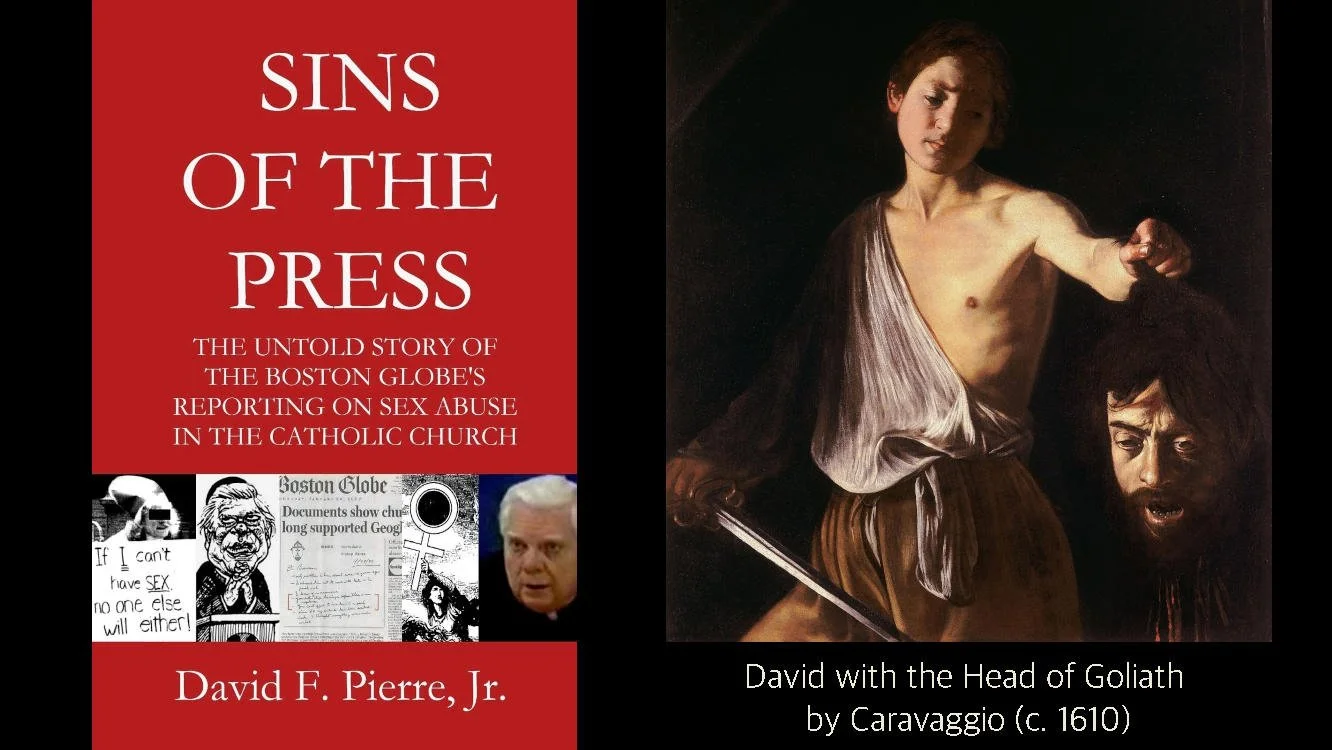
Sins of the Press: David and the Truth About Goliath
In his book, Sins of the Press, Catholic writer and media equalizer David F Pierre Jr, takes aim at a news Goliath: The Boston Globe’s Pulitzer-endorsed Prejudice.
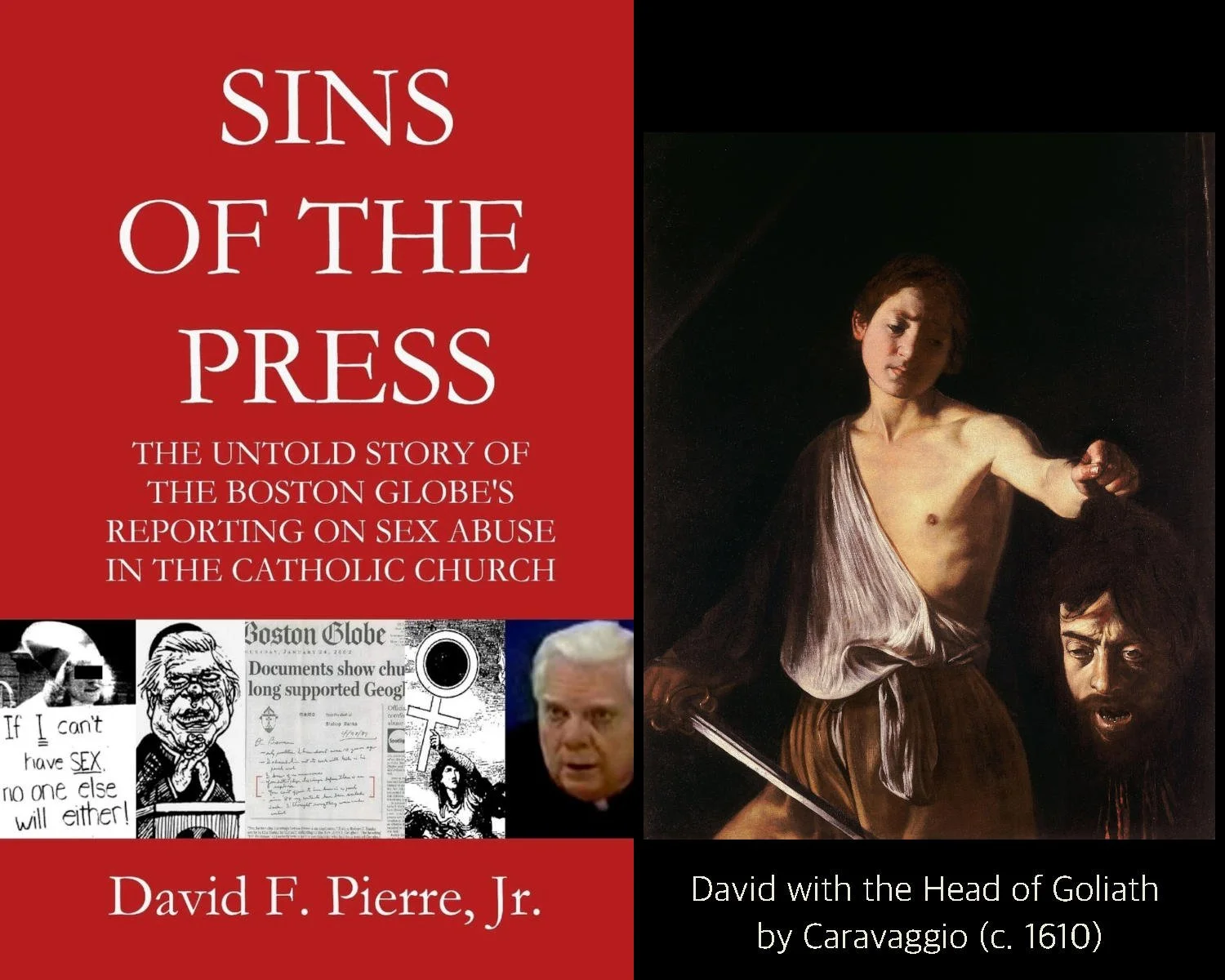
In his book, Sins of the Press, Catholic writer and media equalizer David F Pierre Jr, takes aim at a news Goliath: The Boston Globe’s Pulitzer-endorsed Prejudice.
October 15, 2025 by Father Gordon MacRae
Do you remember Robert McCall? He was The Equalizer, a retired espionage operative in a popular 1980s TV series. It was never clear whether he was CIA or MI6, but each week he placed his formidable skills in the service of some underdog up against powerful oppressors. With British actor Edward Woodward in the role of Robert McCall, The Equalizer managed to even the odds against a perfect storm of tyranny. He appeared rather benign, and at times he seemed a bit in over his head, but he was patient and bided his time. When he struck, the powerful and powerfully corrupt were unmasked and undone.
In a world of media atrocities, David F. Pierre, Jr. aims to be an equalizer. With the patience of Job, he waited a dozen years before loading his small stone of an expository book into a sling to take aim at a media Goliath, in this case The Boston Globe and its 2003 Pulitzer Prize for — don’t miss the irony in this — “Public Service.” Here’s how the Pulitzer Committee described its 2003 award to The Boston Globe…
“… for its courageous, comprehensive coverage of sexual abuse by priests, an effort that pierced secrecy, stirred local, national, and international reaction, and produced changes in the Roman Catholic Church.”
I found that description by the 2003 Pulitzer Committee to be incredibly tragic and sad. The recipients of that Pulitzer, The Boston Globe and its Spotlight Team, had an opportunity to pierce entrenched secrecy, to stir long dormant local, national and international reaction, and to produce substantive changes in the epidemic of sexual abuse from which millions in this culture have suffered. Indeed, that would have been a public service.
But the Globe let that opportunity pass for the creation of a moral panic aimed exclusively at the Catholic Church, and the Pulitzer Prize Committee chose to underwrite that fraud. It was an adventure in media narcissism, and David F. Pierre, Jr. struck the eye of that self-serving Goliath in Sins of the Press: The Untold Story of The Boston Globe's Reporting on Sex Abuse in the Catholic Church.
His publication of this book was timely. In the same year of the book’s release, Hollywood released its own version of The Boston Globe’s Pulitzer-endorsed prejudice with the film, “Spotlight” written by Thomas McCarthy, who also directed, and Josh Singer. Some have suggested that the film was on a par with the great 1976 Oscar winner, All the President’s Men that explored The Washington Post’s dogged pursuit of President Richard Nixon and the Watergate scandal. The claim was ludicrous.
David Pierre posted an exclusive here two weeks ago in “Hidden Evil: The Anti-Catholic Agenda of Bishop Accountability.” It exposed another venomous venue, Bishop Accountability, which was far more interested in exploiting Catholic scandal than covering the truth about child abuse. Sins of the Press, in contrast, was focused on The Boston Globe’s coverage of Catholic scandal which was aimed solely for the purpose of destroying one of the most important pillars of Boston, Massachusetts, its Catholicism.
On page after page of Sins of the Press, Pierre presents clear and compelling evidence of the Globe’s reckless disservice to humanity in its shameless pursuit of Catholic priests. Like David Pierre’s previous books, Catholic Priests Falsely Accused, and Double Standard, Sins of the Press is right on point without its author telling us what to think about the sordid revelations it contains. He lets the facts speak for themselves, and they do, quite loudly, sometimes with echoes that resounded in my soul and psyche for days.
Mr. Pierre was not the first to take on the Globe’s reckless and destructive pursuit of Catholic priests and their due process rights. Several years before Sins of the Press was written, we published at Beyond These Stone Walls, “The Exile of Father Dominic Menna and Transparency at The Boston Globe.” Father Menna was an 81-year-old priest in the Archdiocese of Boston living out his senior years in a rectory with other priests while he served, as best he could, a parish that loved him dearly. Then out of the blue in 2007 came a single, vague allegation against him — there had never been another before or since — that The Boston Globe exploited mercilessly while allowing its readers to believe that the allegation was something that had just taken place. In truth, it was claimed to have happened 53 years earlier and like all such claims it was settled with no regard for Father Menna’s due process rights or well-being. Thanks to the Globe’s one-sided account, Father Menna was driven out of the priesthood at age 83 and died from a broken heart. Where was the Spotlight on that?

A Spotlight When We Needed a Floodlight
What The Boston Globe did, and what the Pulitzer Prize Committee honored for the Globe’s Spotlight coverage, was patently reckless, unjust, and dishonest, not only about the Catholic Church and priests, but also about the tragic and silenced majority of victims of sexual abuse. Dave Pierre’s book exposes one media tenet clearly: “If a priest didn’t do it, we’re not interested!”
The reader is left with no doubt that the harsh glare of a spotlight brought to bear by The Boston Globe was meant for a singular purpose, to isolate the Catholic Church and priesthood as a sort of special locus of sexual abuse. At the same time, the Globe accommodated by omission the prevalence of sexual abuse in other institutions throughout not only Boston, but the nation. A spotlight leaves a lot in the dark, whereas a floodlight is all-inclusive.
A case in point, one very familiar to our readers, is the story of what happened to Pornchai Moontri. The worst of it took place in New England, and the State of Maine, well within The Boston Globe’s coverage area. Pornchai Moontri was taken from his home in rural Thailand at age 11 and brought to Bangor, Maine, where he suffered years of horrific sexual abuse and violence. At one point he escaped only to be handed back over to his abuser by police. Having never been exposed to English, Pornchai could not articulate what had been happening to him. Then his mother was murdered, from all appearances by the same man who exploited Pornchai. He escaped into the streets as a teen where he lived under a bridge and homeless. During a struggle with a much larger man, Pornchai killed him in desperation, and was sent to life in prison with no defense. He ended up in a cell with me, and on April 10, 2010 he became a Catholic on Divine Mercy Sunday. As Pornchai much later wrote, “I could not believe all the stories of repressed memory and demands for huge amounts of money, by those who were accusing Catholic priests. I came to the Catholic Church for healing and hope, and found both. The grace of my recovery came from a priest who was falsely accused and I came to know that with every fiber of my being. He led me out of darkness into a wonderful light.”
With help from Clare Farr, an Australia attorney who read of Pornchai’s story and took an interest, we scoured cyberspace to find Pornchai’s abuser and bring him to justice. After reading what I wrote (linked at the end of this post), detectives from Maine came to interview Pornchai. On a second interview they brought the District Attorney. Pornchai’s abuser was found in Oregon and he was charged with 40 felony counts of child sexual abuse in Penobscot County Superior Court in Maine. On September 18, 2018 Richard Alan Bailey entered a plea of no contest on all counts. He was found guilty on all of them, but sentenced only to 18 years probation. There was no outrage, not even a sign that anyone noticed. The Boston Globe had zero interest in this story. There was just no cash to be had or Roman collar to be destroyed.
In September 2020, Pornchai was taken into custody by ICE and deported to his native Thailand. Hollywood called the Globe’s Oscar-winning film Spotlight. In a perverted sort of way, that was appropriate because it left in darkness, under shrouds of ignorance the real damage that had been done.
Losing the News
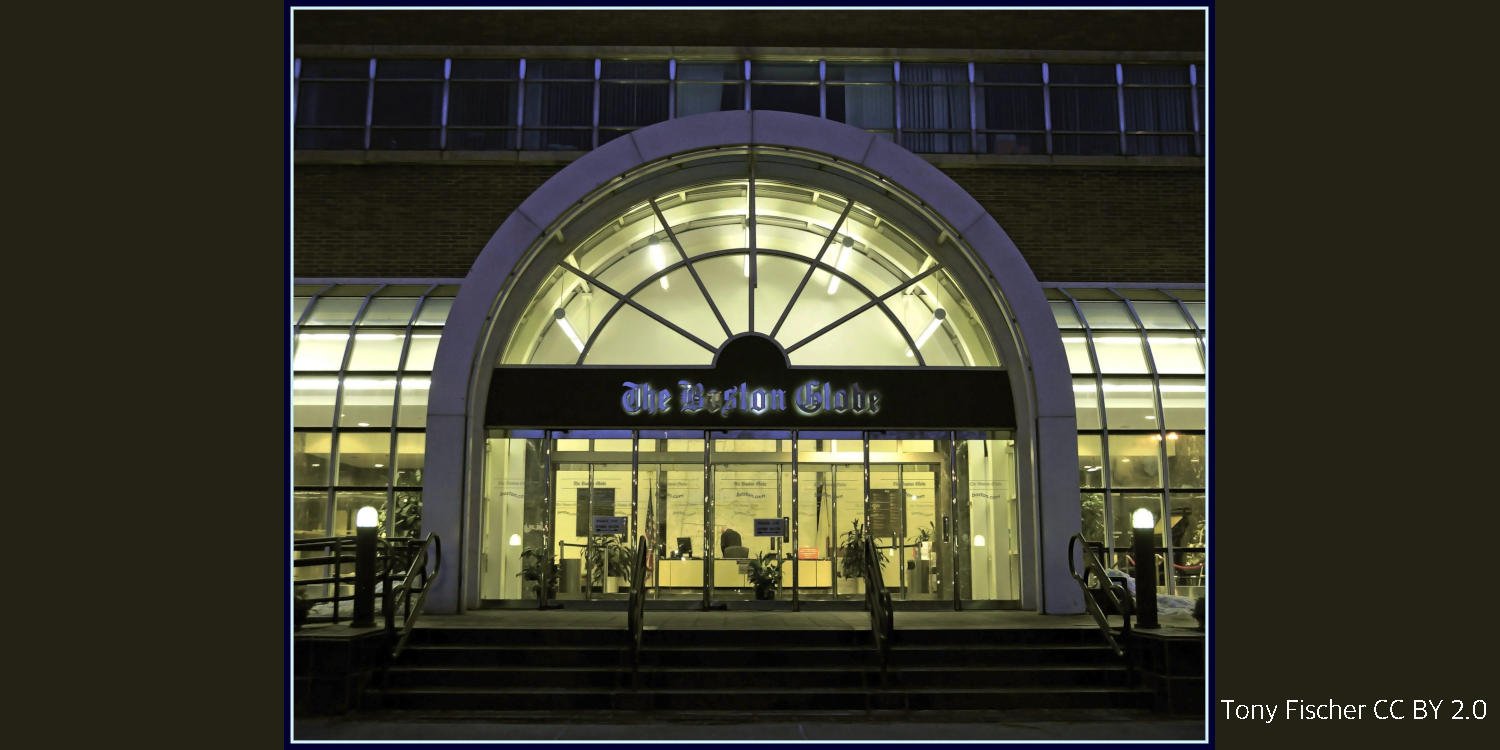
The Boston Globe Spotlight Team accomplished its goal with the creation of a perfect storm of moral panic. The paper’s spin presented every claim and accusation as demonstrably true, reported every settlement as evidence of guilt, spun decades-old claims to make them look as though they occurred yesterday, and never once questioned the financial motives of accusers.
In this arena, the Globe assisted in the continued abuse suffered by real victims by repeatedly giving a platform to personal injury lawyers who stood to pocket forty percent of every settlement wrested from a beleaguered and bludgeoned hierarchy while the millions abused in non-Catholic venues suffered in silence. The Globe’s “public service” was mostly to contingency lawyers.
Not all in the media were onboard with this. Writing for the contentious media platform, CounterPunch, columnist Joanne Wypijewski crowned her long career in journalism as a staff writer for The Nation with her own counter punch entitled “Oscar Hangover Special: Why “Spotlight” Is a Terrible Film.” For full transparency, much of her article was about the case against me. Armed with some healthy skepticism, the most important tool in her journalistic arsenal, she began her article thusly:
“I don’t “believe the victims”.
“I was in Boston in the Spring of 2002 reporting on the priest scandal, and because I know some of what is untrue, I don’t believe the personal injury lawyers or the Boston Globe’s “Spotlight” team or the Catholic “faithful” who became harpies outside Boston churches, carrying signs with images of Satan, hurling invective at congregants who’d just attended Mass, and at least once — this in my presence — spitting in the face of a person who dared dispute them.
“I don’t believe the prosecutors who pursued tainted cases or the therapists who revived junk science or the juries that sided with them or the judges who failed to act justly or the people who made money off any of this.
“And I am astonished (though I suppose I shouldn’t be) that, across the past few months, ever since Spotlight hit theaters, otherwise serious left-of-center people have peppered their party conversation with effusions that the film reflects a heroic journalism, the kind we all need more of.”
The lawyers, the Globe, and the seemingly endless parade of “John Does” all seemed to be on the same page in this, and it was always the front page. None of them reported that Father Dominic Menna, for example, never had any prior accusation, and that the one that destroyed his priesthood was claimed to have happened 53 years earlier and built on a dubious claim of repressed and recovered memory, a fraud that in this arena would go on to transform many lawyers into millionaires.
According to a recent Pew Research Center survey, less than half of Americans said that losing their local newspaper would harm civic life. Less than one third responded that they would miss their local newspaper if it just disappeared. Ken Paulson, President of the Newseum Institute’s First Amendment Center and a member of the USA Today Board of Contributors published an interesting column for USA Today entitled “News Media Lose Trust, Gain Allies.” Mr. Paulson cited a “State of the First Amendment Survey” with dismal results for those in the news media whose careers have been built upon reputable journalism. In the survey results, just 24% of respondents believe that the news media try to report the news without bias. That figure is down from 41% just a year earlier. However, 69% state that journalists in the news media should act in a watchdog role in reporting on government. That figure was down from 80% a year earlier. The first figure — the fact that only 24% of those surveyed believe the news media reports without bias — is alarming, and a record low for this decade-long poll. The second figure — indicating a decline in the sense that the media acts in a watchdog role — was surprising to Mr. Paulson who reported that “This nation’s founding generation insisted on a free press to act as a check on a strong central government … an enduring principle over centuries.” He added, however,
“Social media posts that call out unfairness and injustice don’t diminish this critical watchdog role. It just means a free press has many more allies.”
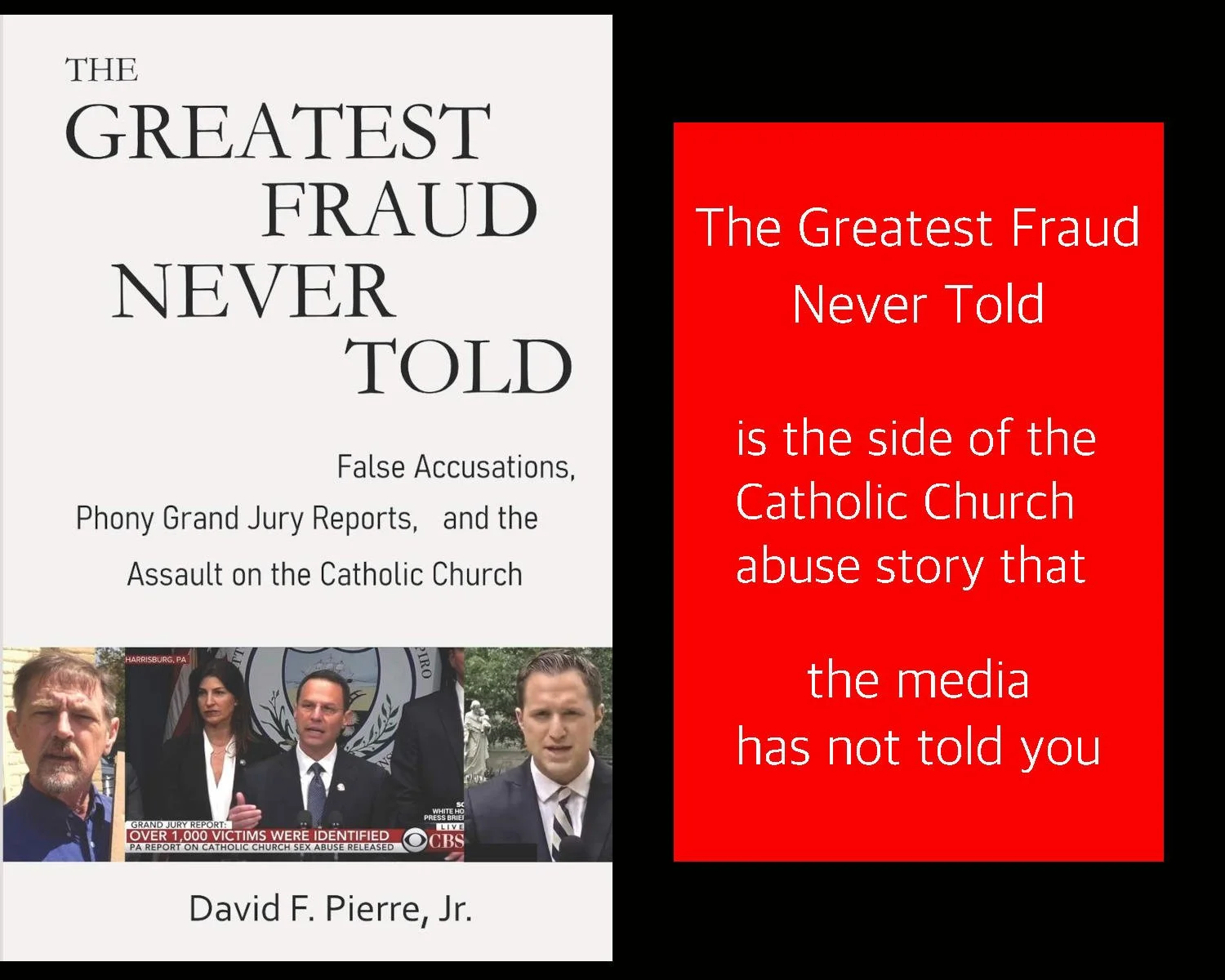
David F. Pierre, Jr. is one of those allies. His book, Sins of the Press is a David v. Goliath account that takes needed aim at The Boston Globe’s bias, and that is a good thing. The release of Spotlight, Hollywood’s version of this sordid story, felt a lot more like the Globe’s epitaph than any celebration of its dubious public service.
+ + +
+ + +
Note from Father Gordon MacRae: Thank you for reading and sharing this important post. I thank David F. Pierre, Jr. and commend him for his journalistic courage and integrity. You may review his work at TheMediaReport.com.
You may also like these related posts at Beyond These Stone Walls:
Getting Away with Murder on the Island of Guam
The Lying, Scheming Altar Boy on the Cover of Newsweek
Cardinal Bernard Law on the Frontier of Civil Rights
Hidden Evil: The Anti-Catholic Agenda of Bishop Accountability
Illumination From Down Under: Hope Springs Eternal in the Priestly Breast
+ + +



The Eucharistic Adoration Chapel established by Saint Maximilian Kolbe was inaugurated at the outbreak of World War II. It was restored as a Chapel of Adoration in September, 2018, the commemoration of the date that the war began. It is now part of the World Center of Prayer for Peace. The live internet feed of the Adoration Chapel at Niepokalanow — sponsored by EWTN — was established just a few weeks before we discovered it and began to include in at Beyond These Stone Walls. Click “Watch on YouTube” in the lower left corner to see how many people around the world are present there with you. The number appears below the symbol for EWTN.
Click or tap here to proceed to the Adoration Chapel.
The following is a translation from the Polish in the image above: “Eighth Star in the Crown of Mary Queen of Peace” “Chapel of Perpetual Adoration of the Blessed Sacrament at Niepokalanow. World Center of Prayer for Peace.” “On September 1, 2018, the World Center of Prayer for Peace in Niepokalanow was opened. It would be difficult to find a more expressive reference to the need for constant prayer for peace than the anniversary of the outbreak of World War II.”
For the Catholic theology behind this image, visit my post, “The Ark of the Covenant and the Mother of God.”

A Sex Abuse Cover-up in Boston Haunts the White House
With The Boston Globe Spotlight focused only on Catholic priests, sex abuse by a top Boston police union official was covered up all the way to the 2021 White House.

When The Boston Globe Spotlight focused only on Catholic priests, sex abuse by a top Boston police union official was covered up all the way to the 2021 White House.
Our Canadian guest writer, Father Stuart MacDonald, posted a thoughtful comment on my recent post, “Cardinal Sins in the Summer of Media Madness.” He pointed out a sobering fact. Former police officer Derek Chauvin, who now stands convicted in the murder of George Floyd, was sentenced to exactly one-third of the sentence I am serving for crimes that never took place. Father Stuart’s insightful comment was followed by one from another frequent guest writer, Ryan A. MacDonald, no relation to Father Stuart.
Their comments are very much worth a return visit to that post. The tragic death of George Floyd at the hands of Derek Chauvin in sight of three other officers launched a movement across America to defunct police. It also led to all of the events described in the post cited above.
You might think that in my current location, a movement like #DefundPolice would find lots of sympathy and even some vocal support. The truth is just the opposite. No one understands the need for police in our society more than a prisoner. As one friend here, an African American, put it: “Knowing the truth about some of the guys around me, the last thing I want to see is them and my family living in the same place without police.”
I reflected that same sentiment, and others like it, in my own response to the #DefundPolice movement that was spawned by the death of George Floyd. It was a post written in the heat of that awful riotous summer of 2020. It was “Don’t Defund Police! Defund Unions that Cover Up Corruption.”
As that post revealed, former Minneapolis officer Derek Chauvin had multiple excessive force complaints in his personnel file. Thanks to the so-called “Blue Wall” and the misguided advocacy of the local public sector police union, none of the prior complaints ever became public. Had they been known, George Floyd may be alive today and Derek Chauvin may not be facing prison.
Others among my friends have advised me not to overlook the fact that Mr. Floyd was alleged to have committed a crime that day — an attempt to pass a counterfeit $20 bill. Even if true, this is not relevant. Americans do not face death over a fake $20 bill. The George Floyd story unmasked racial prejudice in the way policing is sometimes done on the streets of America. We will be a stronger and better people for the hard soul-searching and policy building needed to address this.
I write all of the above to stress that I am not in any way against police. Like my friend mentioned above, knowing some of the men with whom I now live deepens my appreciation for the many dedicated police officers who serve and protect our communities.
The account I am about to present should not be understood as just another “dirty cop” story. It is better seen as a cautionary tale of public corruption that extends beyond police to infiltrate and compromise many of the once-respected institutions on which our culture is built. The corruption you will read about here is as much that of partisan politics and the news media as it is about police. It is a Boston story. It took place in my own home town.

While the Spotlight Was on Catholic Scandal
This account is unrelated to the sordid stories of Catholic scandal in which we have been immersed for two decades, but it must begin there with a July, 2010 post, “The Exile of Fr. Dominic Menna and Transparency at The Boston Globe.”
I highly recommend that post for the back story of what was happening to many Catholic priests as the age of cancel culture was just taking shape. The story might infuriate you. It should. In 2010, Father Dominic Menna was a much beloved 80-year-old Boston priest who was suddenly accused of molesting a minor 51 years earlier when he was 29 years old in 1959. Like every accused priest since The Scandal first gripped Boston and spread from there across the land, the elderly Father Menna was put out into the street.
You could not tell from reading The Boston Globe accounts of the case that none of this story took place in the present. The Globe had a subtle way of presenting every decades-old claim as though it happened in the here and now. Father Menna just disappeared into the night with no recourse to protect himself or his priesthood. There were no groups forming such as “Stand with Father James Parker” or “Stand with Canceled Priests” when the stench of injustice was in any way related to suspicions of sexual abuse.
Even some Catholic entities have thanked The Boston Globe and its pernicious Spotlight Team for doggedly pursuing the files of priests accused and for publishing every lurid detail, true or not. The Globe helped create a mantra that impacted the civil rights of all priests who, since the Bishops’ Dallas Charter of 2002, have been considered “guilty for being accused.” The trajectory lent itself in 2010 to “The Exile of Fr. Dominic Menna” with few questions asked. The details in that post are staggering for any Catholic who still cares about justice. One of the truths exposed in that post is about all that is left in darkness when a spotlight is used on a topic that requires a floodlight. It is about something that was happening off-the-radar in Boston while The Boston Globe and its Spotlight Team celebrated an Academy Award for Best Picture in the category of Public Service.
If not for the Globe’s hammering away at priests, the people of Boston might have been shocked in the summer of 2020 when Patrick Rose, a Boston police officer and former president of the Boston police union, was charged with 33 counts of molesting children. Bostonians might have been further shocked to learn that the behaviors which led to his arrest extended all the way back to 1995 and were known by officials in the Boston police, their public sector union, and others who helped to keep it all secret.
In 1995, just months after I was on trial in nearby New Hampshire, Patrick Rose was arrested and charged with child sexual abuse. He was placed on administrative leave by the Boston Police Department. The Boston Globe today reports that the charges were dropped in 1996 when the accuser recanted her account under pressure from Rose. Later in 1996, however, a Boston Police Internal Affairs investigation reported that the charge “was sustained” and relayed to supervisors.
Despite this, Patrick Rose remained on the police force. In 1997, an attorney for the police union wrote a letter to the police commissioner complaining that Rose had been kept on administrative duty for two years and demanding his full reinstatement. Rose was then reinstated. Prosecutors today allege that he went on to molest five additional child victims, including some after Rose himself became union president from 2014 to 2017.
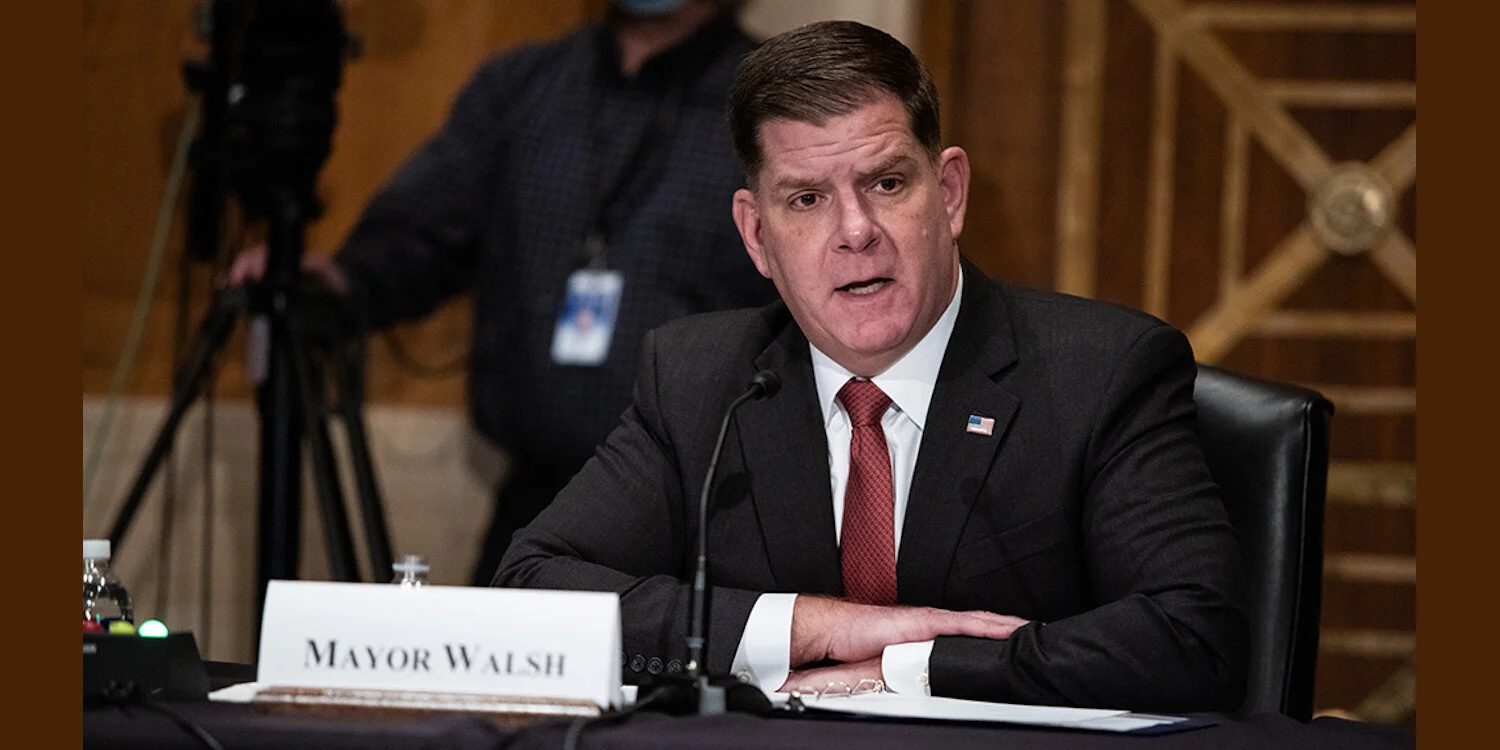
White House Labor Secretary Marty Walsh
In the May 14, 2021 print edition of The Wall Street Journal, the Editorial Board published “A Police Union Coverup in Boston.” The WSJ reported that The Boston Globe filed requests for the Internal Affairs file on Patrick Rose. The administration of then Boston Mayor Marty Walsh denied the request citing that the record could not be released in a way that would satisfy privacy concerns.
Imagine the outcry if the late Cardinal Bernard Law said this when The Boston Globe demanded a file on any foreknowledge of sexual abuse by Father Dominic Menna. It turned out in that case that there was no such file because the 80-year-old priest had never previously been accused. The Boston Globe repeatedly dragged the Archdiocese of Boston into court in 2002 to demand public release of scores of files on Catholic priests and never rested until every detail — corroborated or not — ended up in newsprint.
It is hard to imagine today that The Globe would simply settle for the excuse Mayor Marty Walsh provided. It is hard to imagine that the “Blue Wall of Silence” was any real obstacle for The Boston Globe which, perhaps to cover for its own inaction, reported that it was “astonishing [the] lengths to which the [Boston Police] Department and the now departed Walsh administration went to keep those files under wraps.”
The file remained “under wraps” until after Senate confirmation hearings that vetted Mayor Walsh and confirmed him (68 to 29) for a Biden Administration cabinet position as Secretary of Labor in 2021. Walsh signed a contract with the Boston Police Union in 2017 while Patrick Rose was still union president. It remains unclear what Marty Walsh knew and when he knew it.
A Massachusetts state supervisor of public records refuted the Mayor’s reasoning for keeping the file secret. He called upon (then) Mayor Walsh to provide a better reason for denying the Internal Affairs file on Patrick Rose. Walsh ignored this for two months until his mayoral successor, Kim Janey, released a redacted version of the file after the Senate confirmation hearing approved Mr. Walsh as Secretary of Labor. The Wall Street Journal reported:
“Mr. Biden picked Mr. Walsh because he is a union man. He was president of a Laborers’ Union local, as well as head of the Boston Building Trades, until he ran for mayor in 2013. As mayor, he showered unions with taxpayer money, including a contract with Mr. Rose’s police union in 2017 that resulted in a pay increase of 16-percent over four years. City employees in unions donated hundreds of thousands of dollars to his campaign. The Rose Coverup is relevant to Mr. Walsh’s duties at the Labor department.”

An Epilogue
Just as I was preparing to print and mail this post, someone sent me the July 2021 copy of Newsmax magazine containing an article by journalist Merisa Herman on this same story entitled, "Police Union Cover-Up Haunts Top Biden Official." [I chose my title long before seeing this]. Ms. Herman concluded:
“Rose had been given a pass from the media for what could be construed as a cover-up ... Someone in Congress might ask Mr. Walsh why Americans should believe he’ll fight union corruption when his city may have helped protect a union chief with a history of alleged predation against children.”
It is difficult to measure this story against what happened in 2010 to 80-year-old Father Dominic Menna whose life and priesthood were utterly obliterated by The Boston Globe spotlight for a half century-old claim that could never be corroborated.
It is difficult to measure this story against what happened to George Floyd in Minneapolis when a history of previous excessive force complaints in a police file were kept under wraps until someone paid with his life.
+ + +
Notes from Father Gordon MacRae:
Many thousands of readers have been circulating last week’s post, “Biden and the Bishops: Communion and the Care of a Soul.” Thousands in Washington, Chicago, New York and Boston have read that post. If you wish to send a printed copy to your bishop or anyone else, we have created a five-page pdf version that is printable.
We have also created a pdf with the name and address of every U.S. Catholic Bishop.
Learn more about The Boston Globe’ s Spotlight coverage of the Catholic Church and the Best Picture Academy Award for the film, Spotlight. You may never watch the Oscars again after reading “Oscar Hangover Special: Why ‘Spotlight’ Is a Terrible Film” by a courageous journalist, Joann Wypijewski, former Editor of The Nation. (It also sheds some much needed media light on my own travesty of justice.)

The Exile of Father Dominic Menna and Transparency at The Boston Globe

As Father Dominic Menna, a senior priest at Saint Mary’s in Quincy, MA, was sent into exile, The Boston Globe’s role in the story of Catholic Scandal grew more transparent.
“I’m a true Catholic, and I think what these priests are doing is disgusting!” One day a few weeks ago, that piece of wisdom repeated every thirty minutes or so on New England Cable News, an around-the-clock news channel broadcast from Boston. I wonder how many people the reporter approached in front of Saint Mary’s Church in Quincy, Massachusetts before someone provided just the right sound bite to lead the rabid spectacle that keeps 24-hour news channels afloat.
The priest this hapless “true Catholic” deemed so disgusting is Father F. Dominic Menna, an exemplary priest who has been devoting his senior years in service to the people of God at Saint Mary’s. At the age of 80, Father Menna has been accused of sexual abuse of a minor.
There is indeed something disgusting in this account, but it likely is not Father Menna himself. He has never been accused before. Some of the news stories have not even bothered to mention that the claim just surfacing now for the first time is alleged to have occurred in 1959. No, I did not transpose any numbers. The sole accusation that just destroyed this 80-year-old priest’s good name is that he abused someone fifty-one years ago when he was 29 years old.
Kelly Lynch, a spokesperson for the Archdiocese of Boston, announced that Father Menna was placed on administrative leave, barred from offering the Sacraments, and ordered to pack up and leave the rectory where he had been spending his senior years in the company of other priests. These steps, we are told, are designed to protect children lest this 80-year-old priest — if indeed guilty — suddenly decides to repeat his misconduct every half century or so.
Ms. Lynch declined to reveal any further details citing, “the privacy of those involved.” That assurance of privacy is for everyone except Father Menna, of course, whose now tainted name was blasted throughout the New England news media last month. Among the details Kelly Lynch declines to reveal is the amount of any settlement demand for the claim.
Some of the fair-minded people who see through stories like this one often compare them with the 1692 Salem witch trials which took place just across Massachusetts Bay from Father Menna’s Quincy parish. The comparison falls short, however. No one in 1692 Salem ever had to defend against a claim of having bewitched a child fifty-one years earlier.
Archdiocesan spokesperson Kelly Lynch cited “the integrity of the investigation” as a reason not to comment further to The Boston Globe. Does some magical means exist in Boston to fairly and definitively investigate a fifty-one year old claim of child abuse? Is there truly some means by which the Archdiocese could deem such a claim credible or not?
Ms. Lynch should have chosen a word other than “integrity” to describe the “investigation” of Father Menna. Integrity is the one thing no one will find anywhere in this account — except perhaps in Father Menna himself if, by some special grace, he has not utterly lost all trust in the people of God he has served for over fifty years.

Transparency at The Boston Globe
The June 3rd edition of The Boston Globe buried a story on page A12 about the results of an eight-year investigation into the Archdiocese of Los Angeles. Eight years ago, it was front page news all over the U.S. that the Los Angeles Archdiocese was being investigated for a conspiracy to cover-up sexual abuse claims against priests.
After eight years of investigation at taxpayer expense, California prosecutors reluctantly announced last month that they have found insufficient evidence to support the charges. That news story was so obviously buried in the back pages of The Boston Globe that the agenda could not be more transparent. The story of sexual abuse in the Catholic Church is front page news only when it accommodates the newspaper’s editorial bias. That much, at least, is clear.
But all transparency ends right there. The Globe article attributed the lack of evidence of a conspiracy by Catholic bishops to the investigation being “stymied by reluctant victims.” Now, that’s an interesting piece of news!
The obvious question it raises is whether these claimants were reluctant to speak BEFORE obtaining financial settlements in their claims against the Archdiocese. If they are reluctant witnesses now, then, at best, it may be because the true goal of some has long since been realized and there is nothing in it for them to keep talking. At worst, the silence of claimants in the conspiracy investigation could be interpreted as an effort to fend off pointed questions about their claims. Perhaps prosecutors were investigating the wrong people.
I have seen this sort of thing play out before. Last year, a New Hampshire contingency lawyer brought forward his fifth round of mediated settlement demands against the Diocese of Manchester. During that lawyer’s first round of mediated settlements in 2002 — in which 28 priests of the Diocese of Manchester were accused in claims dating from the 1950s to the 1980s — the news media announced a $5.5 million settlement. The claimants’ lawyer was astonished that $5.5 million was handed over with no real effort at proof or corroboration sought by Diocesan representatives before they paid up and deemed the claims “credible.” The lawyer was quoted in the news media:
“During settlement negotiations, diocesan officials did not press for details such as dates and allegations for every claim. I’ve never seen anything like it.”
“He and his clients did not encounter resistance from the Diocese of Manchester in their six months of negotiations. Some victims made claims in the last month, and because of the timing of negotiations, gained closure in just a matter of days.”
That lawyer’s contingency fee for the first of many rounds of mediated settlements was estimated to be in excess of $1.8 million. When the mediation concluded, the news media reported that at the attorney’s and his clients’ request, the diocese agreed not to disclose the claimants’ names or any details of their claims or the amounts they received in settlement. “No confidentiality was sought by the Diocese,” the lawyer declared.
In contrast, the names of the accused priests — many of whom were deceased and none of whom faced criminal charges — were repeatedly released and publicized throughout the news media. This process served one purpose: to invite new claimants against those same priests with assurances that their names would remain private and no real corroborating details would ever be elicited. It was clear that non-disclosure clauses were demanded by the contingency lawyer and his clients, though the diocese and its lawyers were eager to oblige as part of the settlement.
It is fascinating that the news media now blames “reluctant victims” for stifling an investigation into cover-ups in the Catholic Church. That is a scandal worthy of the front page, but we won’t ever see it there. If the news media now has concerns about the very people whose cause it championed in 2002, we won’t be reading about it in the news media. Transparency in the news media, after all, is a murky affair.

Transparency and the U.S. Bishops
Writer Ryan A. MacDonald has a number of contributions published on These Stone Walls. His most recent is, “Should the Case Against Father Gordon MacRae Be Reviewed?” I am told that Mr. MacDonald has an essay published in the June/July, 2010 issue of Homiletic & Pastoral Review entitled, ”Anti-Catholicism and Sex Abuse.” In the essay, the writer also recommends These Stone Walls to H&PR readers. Though I subscribe to the well respected H&PR, I have not at this writing seen the current issue.
Ryan MacDonald also has a letter published in a recent issue of Our Sunday Visitor (“Raising the Alarm,” June 13, 2010). Ryan makes a point very similar to one I made last month in “As the Year of the Priest Ends, Are Civil Liberties for Priests Intact?” Here is an excerpt from Ryan’s OSV letter:
“A number of courageous bishops have argued in opposition to retroactive application of revised civil statutes of limitations. Such revised statutes typically expose the Catholic Church to special liability while exempting public institutions.
“But I must raise the alarm here. As a body, American bishops lobbied the Holy See for retroactive extension of the time limits of prescription, the period of time in which a delict (a crime) exists and can be prosecuted under Church law …
“… Many accused priests now face the possibility of forced laicization with no opportunity for defense or appeal because our bishops have embraced routine dispensation from the Church’s own statute of limitations. The bishops cannot argue this point from two directions. Some have defended this duplicity citing that the delicts involve criminal and not civil matters. This is so, but these men are also American citizens, and the U.S. Constitution prohibits retroactive application of criminal laws as unconstitutional.
“Statutes of limitations exist in legal systems to promote justice, not hinder it. Our bishops cannot have it both ways on this issue.”
Ryan MacDonald made this point far better than I ever could. The issue for me is not just the obvious double standard applied when the spirit of Church law is set aside. The issue is one of fundamental justice and fairness, and what Cardinal Dulles called “The great scandal of the Church’s failure to support Her priests in their time of need.” Pope John Paul II said that the Church must be a mirror of justice. Let’s hope our bishops can respond to the public scandal of sexual abuse without perpetrating a private scandal of their own.
There are people in groups like S.N.A.P. and Voice of the Faithful who clamor for the Church to ignore the rights of priests in favor of an open embrace of “survivors.” It is always easy to deny someone else’s rights and restrict someone else’s civil liberties, and that, historically, is how witch hunts begin.
