“There are few authentic prophetic voices among us, guiding truth-seekers along the right path. Among them is Fr. Gordon MacRae, a mighty voice in the prison tradition of John the Baptist, Maximilian Kolbe, Alfred Delp, SJ, and Dietrich Bonhoeffer.”
— Deacon David Jones
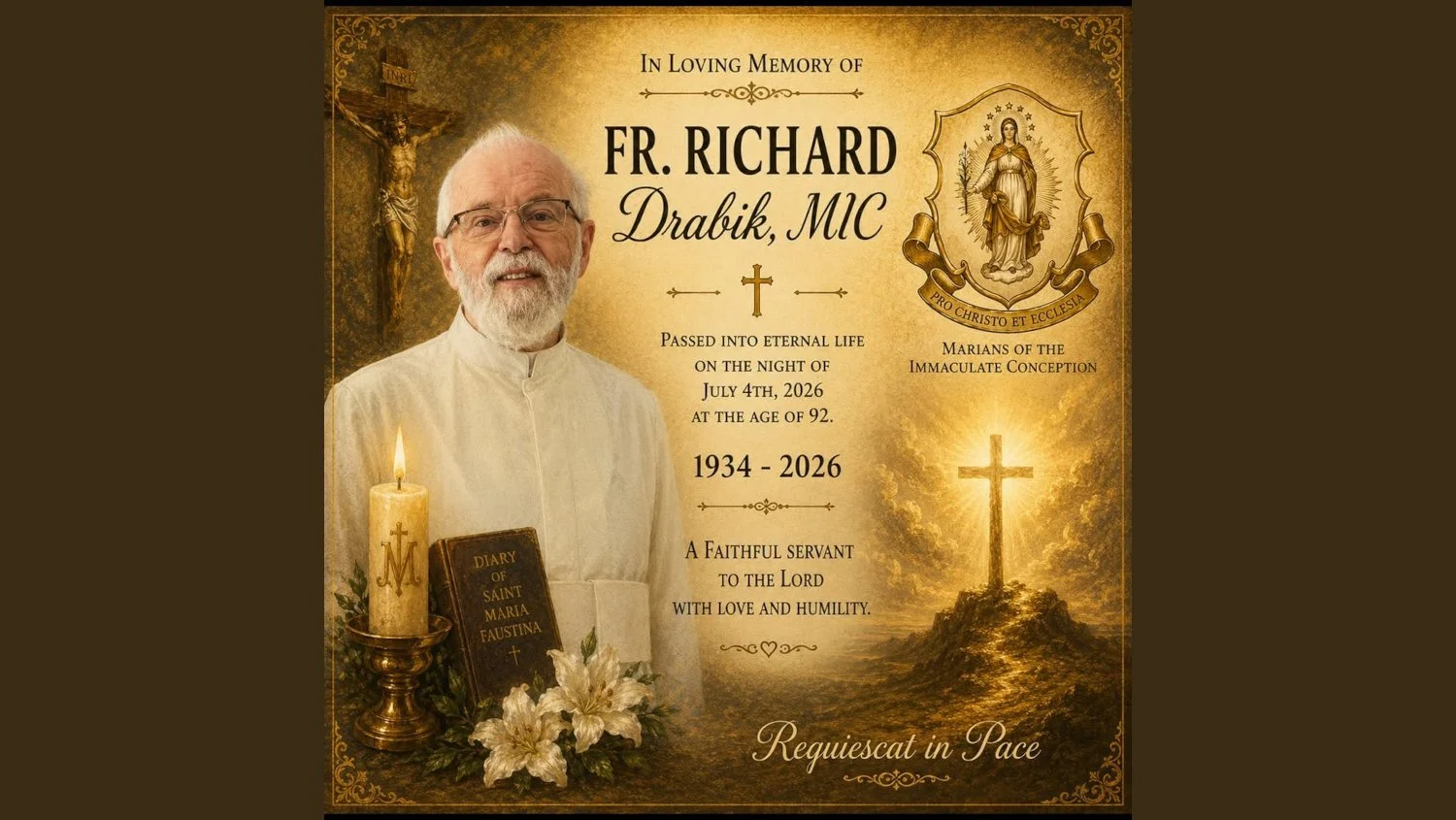
Fr Richard Drabik Introduced Divine Mercy to Saints and Villains
Fr Richard Drabik, MIC, my longtime spiritual director and friend who wrote the Preface to the Diary of Saint Faustina, passed into Divine Mercy on July 4, 2026.
Fr Richard Drabik, MIC, my longtime spiritual director and friend who wrote the Preface to the Diary of Saint Faustina, passed into Divine Mercy on July 4, 2026.
July 8, 2026 by Father Gordon MacRae
“Let the greatest sinners place their trust in My mercy. They have the right before others to trust in the abyss of My mercy . . . To such souls I grant even more graces than they ask. I cannot punish even the greatest sinner if he makes an appeal to My compassion, but on the contrary, I justify him in my unfathomable and inscrutable mercy.”
— Diary of Saint Faustina, 1146
In April of 1993, my friend Father Richard Drabik and I both served on the staff of the Servants of the Paraclete Spiritual and Psychological Renewal Center for priests. Father Drabik was at the time preparing to go to Rome to concelebrate with Pope John Paul II the Mass of Beatification of Sister Maria Faustina Kowalska, now known as Saint Faustina, the Saint of Divine Mercy. Her Beatification took place on the Sunday after Easter that year, and Pope John Paul II decreed that henceforth that Sunday would be universally known in the Roman Calendar as Divine Mercy Sunday.
Father Richard Drabik was formerly Provincial Superior of the Marian Fathers of the Immaculate Conception. He wrote the Preface to the Diary of Saint Maria Faustina Kowalska that has become globally famous. Just before leaving for her Beatification in Rome in 1993, Father Drabik stopped by my office to invite me to write a brief prayer, which would be placed on the altar by Pope John Paul during the Offertory in the Mass for Beatification. I did not know what to write, so on the day of my friend’s departure I handed him a small scrap of paper to place with his intentions for the Mass. I folded it and sealed it in a small envelope that would fit easily in his breast pocket.
No one ever knew what I wrote. The note with my petition was simple: “I ask for the intercession of Blessed Faustina that I may have the courage to be the priest God calls me to be.” It was an odd petition, and today I have no idea what I was thinking about when I wrote it and handed it to Father Drabik on his way out the door.
Exactly two weeks after the Beatification of Sister Faustina, on May 3, 1993, police showed up at my door. They carried with them a secret indictment and a warrant for my arrest for claims alleged to have occurred sometime between 1978 and 1983, ten to fifteen years earlier. They were the claims for which I faced trial and was summarily sent to prison as Ryan A. MacDonald wrote in “Judge Arthur Brennan Sentenced Father Gordon MacRae to Die in Prison.”
Those claims of abuse never took place at all, but I will always remember the words of a police detective as the officers took me away despite my denials: “It doesn’t matter whether you’re guilty. Your Church is!” It was a scene reminiscent of another era I wrote of in “Catholic Scandal and the Third Reich: The Rise and Fall of a Moral Panic.”
The detective’s words could just as easily have been heard in Sister Faustina’s own World War II-era Poland as Father Maximilian Kolbe and many other priests were led off to prison on trumped up charges.
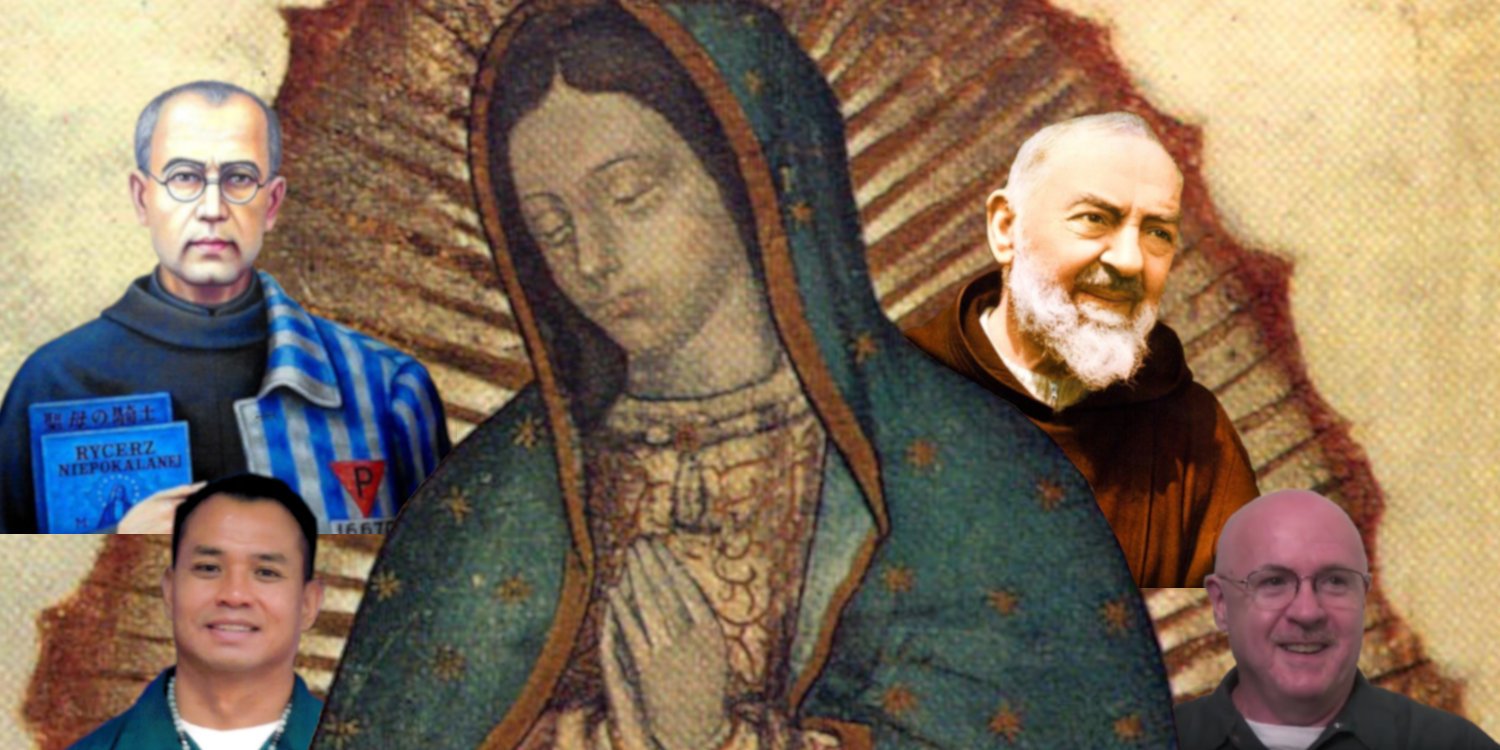
Divine Mercy Behind and Beyond These Stone Walls
Last April 9, I turned 73 years old in prison. I was 41 years old when I was sent to prison, and was in my twenties when my fictitious crimes were alleged to have been committed. I will be age 108 when I next see freedom. The process of reopening a case alleged to have occurred over 30 years ago, and which never contained any evidence to debunk or attack, is a grueling uphill battle. If there is any hope at all for freedom and justice, it is vague hope. It is a hope that exists on the other side of an abyss.
Astute readers remember that I was given several opportunities before my trial to plead guilty and serve only one year in prison. I simply could not fathom doing this. Many years later, Dorothy Rabinowitz, a Pulitzer Prize-winning writer for The Wall Street Journal, took up this case for investigation. She reported that she questioned the detective about the absolute lack of any corroborating evidence. The detective was reported to have said, “Why didn’t he just take the deal?” In a five-minute video interview years later, Ms. Rabinowitz summed up the true nature of this matter.
The readers of Beyond These Stone Walls have helped in so many ways to show us the face of Divine Mercy. Your reading BTSW has given me a global voice when having any voice at all is usually denied to any priest so accused. And having a voice is also often denied to prisoners, as a class of American citizens stripped of rights, including the right to vote. I do not use my access to this voice just to whine about prison conditions. That would be a waste. Instead, I try to employ this voice as an extension of my priesthood, one that is influenced and encapsulated, even defined, by Divine Mercy.
Earlier in my years in prison, my old friend and spiritual director, Father Richard Drabik, visited me. He did so until age and distance made such visits no longer possible. During one of his visits after my publishing began in 2009, I asked him if he had seen the blog that I write from prison, but have never seen. Being a prisoner, I also had no sense of its reach or impact. “It isn’t a blog,” Father Richard said. “It’s a bullhorn!”
Later, the community of Marians of the Immaculate Conception at the National Shrine of The Divine Mercy took up the slack. They came with an invitation to me and other prisoners to take part in a great Divine Mercy adventure. For some, it became the most important part of our lives here. This was especially so for my friend Pornchai Maximilian Moontri, whose life story was captured by Felix Carroll in the book, Loved, Lost, Found: 17 Divine Mercy Conversions. Pornchai’s story is well known around the world now thanks to the efforts of Catholic League President Bill Donohue. Dr. Donohue invited Pornchai to write his story in his own words. The result was published by the Catholic League as “Pornchai’s Story.” In just four pages, it was powerful and phenomenal. Pornchai was oppressed by the thought that at the end of his own prison sentence he would be deported to Thailand where he no longer knew anyone or had any support at all. Pornchai had been taken from Thailand against his will at age 11, and now would be left there alone at age 47. It was a chilling thought for Pornchai, and also for me. I assured him that we would find a way to build a bridge to Thailand.
Divine Mercy, being what it is, created a roadmap for Pornchai. Father Richard, who was deeply moved by Pornchai’s Story, shared it with others who became links in a chain. One of them was the late Father Seraphim Michalenko, Vice Postulator for the cause of Sainthood for Saint Faustina. He ended up in Thailand meeting with a group called Divine Mercy Thailand. Father Seraphim went there armed with a copy of the Diary of Saint Faustina and a copy of Pornchai’s Story, which he read in English to the assembled group. Suddenly, our bridge to Thailand was built.
Felix Carroll also wrote a wonderful article for Marian Helper Magazine entitled, “Mary Is at Work Here.” The truth of that is today without question.
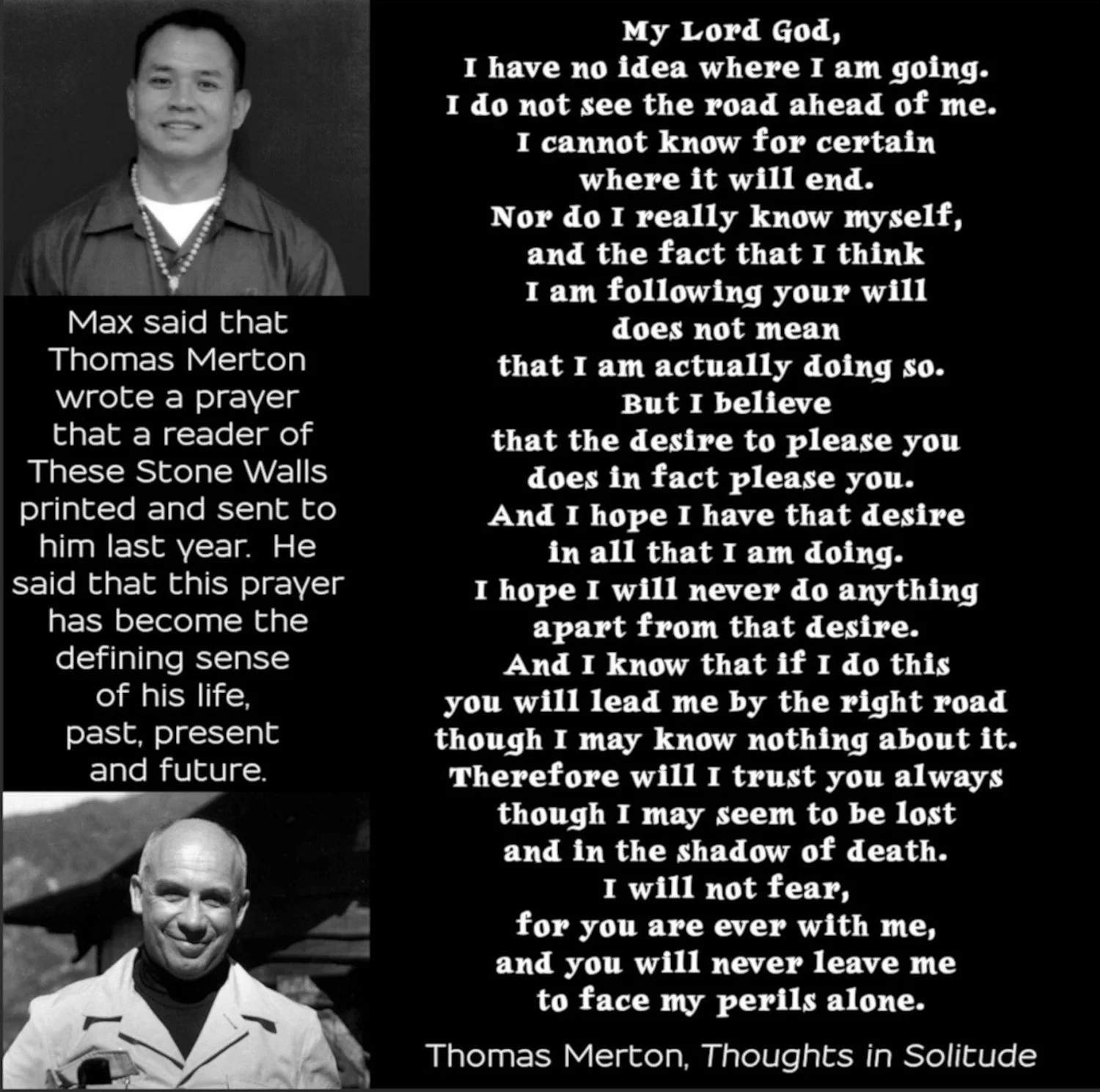
+ + +
Note from Father Gordon MacRae: Thank you for reading and sharing this post about my great good friend and mentor in the priesthood, Father Richard Drabik, MIC. Don’t misunderstand the opening quote here in this post. Only God knows whether Father Richard is a saint, but he was certainly no villain. He spent a lifetime reaching out to them, however, and reeling them in to show them the Light of Divine Mercy. That was what I liked most about my friend, and what I most try to emulate. You might find his enduring presence in these related posts from Beyond These Stone Walls:
A Priest and Prisoner in the Light of Divine Mercy
Divine Mercy in a Time of Spiritual Warfare
The Parable of a Priest and the Parable of a Prisoner
I greatly treasure the image atop this post. Father Richard’s smile is now engraved upon my heart.

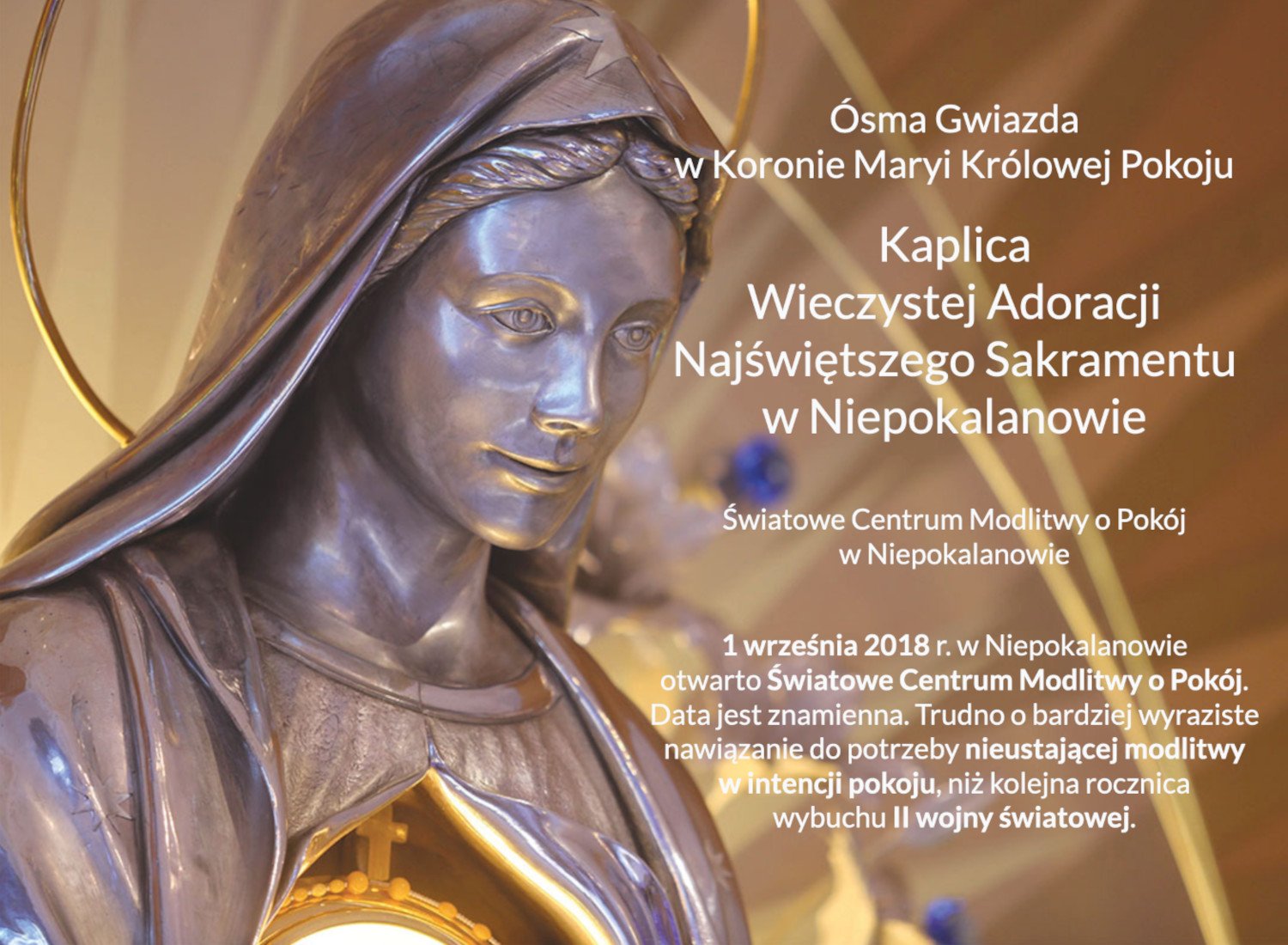

The Eucharistic Adoration Chapel established by Saint Maximilian Kolbe was inaugurated at the outbreak of World War II. It was restored as a Chapel of Adoration in September, 2018, the commemoration of the date that the war began. It is now part of the World Center of Prayer for Peace. The live internet feed of the Adoration Chapel at Niepokalanow — sponsored by EWTN — was established just a few weeks before we discovered it and began to include in at Beyond These Stone Walls. Click “Watch on YouTube” in the lower left corner to see how many people around the world are present there with you. The number appears below the symbol for EWTN.
Click or tap here to proceed to the Adoration Chapel.
The following is a translation from the Polish in the image above: “Eighth Star in the Crown of Mary Queen of Peace” “Chapel of Perpetual Adoration of the Blessed Sacrament at Niepokalanow. World Center of Prayer for Peace.” “On September 1, 2018, the World Center of Prayer for Peace in Niepokalanow was opened. It would be difficult to find a more expressive reference to the need for constant prayer for peace than the anniversary of the outbreak of World War II.”
For the Catholic theology behind this image, visit my post, “The Ark of the Covenant and the Mother of God.”

How Father Benedict Groeschel Entered My Darkest Night
Prayers for justice, for the fall of prison walls, are prayers for hope. On the night hope fell, Fr Benedict Groeschel served upon me a summons from the Highest Court.

Prayers for justice, for the fall of prison walls, are prayers for hope. On the night hope fell, Fr Benedict Groeschel served upon me a summons from the Highest Court.
I don’t think I have ever struggled with a post as I struggle now with this one. It is painful to write, and, in part at least, I know it will be painful to read. What I am about to describe is an earlier scene in the story of my own passion narrative that you do not know about, and now it is time to put it openly before you. I only ask you to withhold judgment for the judgment on this story is not yours to have. And I ask that you bear with me to the end for, as you will read, that is exactly what I am doing.
This confession of sorts was prompted by the 54-day Rosary Novena in which so many readers of Beyond These Stone Walls are engaged on my behalf. Many others who could not commit to that effort are offering prayers and sacrifices for those who are. Some include our friend, Pornchai Maximilian Moontri in these prayers, and I am most grateful for that. I mentioned in a post two weeks ago that I have been simply lost for words by this outpouring of faith and hope, and I will have something to say about it in my post this week.
But that was not entirely true. I have not been as “lost for words” as I claimed. It’s just that the words that come, the words that I must convey to you now, are from a time when my own faith and hope fell into the darkest of nights, and I fear you may think less of me for it. That is what I risk for total candor, but I risk far more if I do not speak up.
When my post, “Seven Years Behind These Stone Walls” appeared on BTSW on June 29, some readers surprised me with an overture to begin a 54-Day Rosary Novena for the cause of justice. It was to begin on the following day, June 30, the Commemoration of the First Martyrs of the Church of Rome.
Your prayer for me is much more a prayer for hope, and you may have no idea how much that prayer is needed. Most have no idea how fragile hope can be for the falsely accused. BTSW reader, Helen, sent me a note asking if I am conscious of the prayer support of so many. What I have been most conscious of is what happened on the morning this Rosary Novena began.
At 3:00 AM that Thursday morning, June 30th, I was awakened in my cell from a very vivid and troubling dream. You know that in February I underwent surgery and now have a seven-inch scar extending under my ribcage from the front to my side. In the dream, I woke up with a strange sensation. I lifted my shirt to discover with horror that my scar had opened and blood and water were pouring out from it drenching everything. It was not water mixed with blood. Both were streaming out of the open wound, blood on one side and water on the other. I tried to put my hand over it to stop it, but the flow continued right through my hand. It went on for a long time, and in my subconscious mind this was somehow connected with your prayers.
When I finally awoke for real, I quickly sat up and lifted my shirt. I grabbed my book light and a mirror, but all was dry and the scar was sealed and intact. It was a little after 3:00 AM and I was filled with anxiety and had trouble breathing.
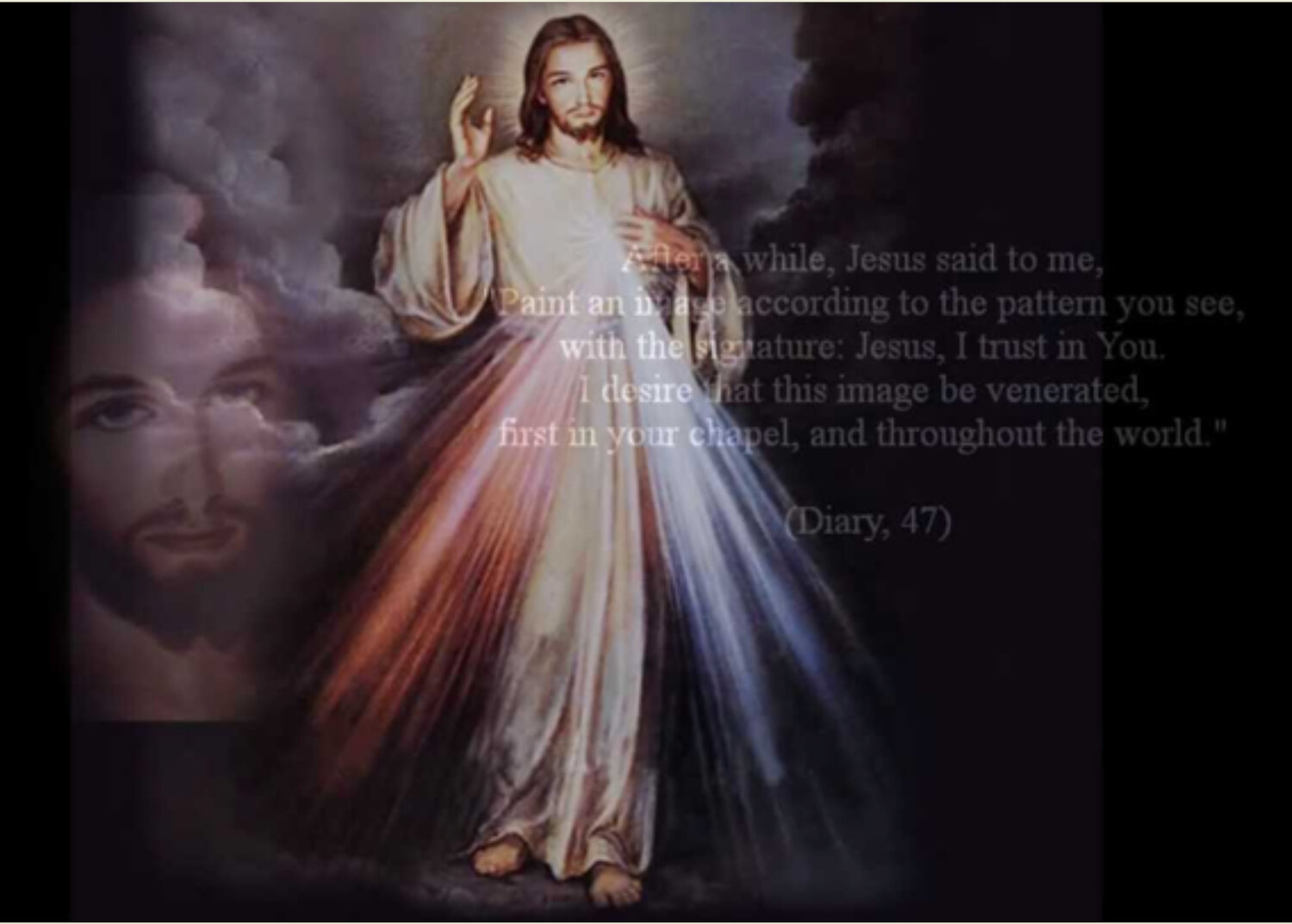
So I got up and paced around this cell. Soon after, Pornchai was awakened in the bunk above me. He asked me what was wrong. I was shaken, but I told him about the dream. As I spoke, he glanced over my shoulder at the Divine Mercy image on our cell wall. Pornchai got it immediately, but I am a little slow in such matters. Saint Faustina wrote:
“During prayer I heard these words within me: The two rays denote Blood and Water. The pale ray stands for the Water which makes souls righteous. The red ray stands for the Blood which is the life of souls... These two rays issued forth from the very depth of my tender mercy when my agonized heart was pierced by a lance on the Cross.… Happy is the one who will dwell in their shelter for the just hand of God shall not lay hold of him.”
— Diary of Saint Faustina, 299
Later that morning, I called Father George David Byers and told him about this dream. It was only then that I connected it with an event in the Gospel of John (19:34), “But one of the soldiers pierced his side with a spear, and at once there came out blood and water.” Please do not misunderstand me. I have no messianic delusions whatsoever. Christ asked, and I merely fled. The first stunning lines of Francis Thompson’s haunting, “The Hound of Heaven” capture best what happened when I was first issued a summons to Divine Mercy:
“I fled him, down the night and down the days; I fled him, down the arches of the years; I fled him, down the labyrinthine ways of my own mind; and in the midst of tears, I hid from him.”
Christ at the Crossroads
A note on John 19:34 describes the flow of blood and water as evidence of Christ’s humanity, that place where His life and that of fallen humanity intersects. The dream has stayed with me through the days of your prayers, and I find it to be both scary and hopeful. The hardest, most unrepentant criminal here fears only one thing: dying in prison. You can imagine then the toll that such a prospect takes on someone wrongfully imprisoned.
So of course I want your prayers to have real meaning, and to succeed despite the fact that I am not worthy of them. I am not worthy of them because there was a time in my life when, on the night of my own Gethsemane, faith and hope utterly failed me and I fell. In my hopelessness, I attempted to take my own life, and was hospitalized for it.
I have to try to convey the context. It was May of 1993, weeks after I had been accused. At the time, ironically, I served in ministry as Director of Admissions of the New Mexico Servants of the Paraclete residential center for priests.
There is no point in the details, but what I did was serious, and deadly, and I should not have survived it. But I did survive. It is one thing for someone justly accused to face such charges, but to be falsely accused, summarily declared guilty by my own bishop and diocese, disposed for the sake of thirty pieces of silver, is devastating for a priest.
Complicating this picture was the fact that I have epilepsy — specifically, complex-partial seizure disorder with a focus bilaterally in the temporal lobes. That, combined with the crushing experience of being falsely accused and discarded, swept away in a moment of despair all frame of reference for my life as a priest, and left me drained of all resources.
This was a time when the U.S. church was reeling over the sudden emergence of many such claims from decades past, and many in the Church pretended to believe them all just to ease the path to quick, quiet financial settlement. It was the dawn of what Father George David Byers described as “The Judas Crisis.” As my broken spirit descended into chaos, I believed that a sacrifice was required, the sacrifice of the life of a priest, and I believed I was to be that sacrifice. It was a moment when all hope went out of my world, and my faith and sanity fell along with it.
By some miracle of actual grace, I survived. On that night late in May of 1993 I regained consciousness in the Intensive Care Unit of Albuquerque Presbyterian Hospital. I did not, for a time, know where, or even who I was, but within a day my mind came back on line as though rebooted. I felt the deepest darkest shame and despair over this shattering of all hope as my life and priesthood lay before me in utter ruins.
My friend, Father Clyde Landry, was there with me. He told me that I had written a letter to the Servant General, Father Liam Hoare, asserting my innocence of these charges, but asking his forgiveness for the sacrifice of my life because of the harm these false claims brought upon priesthood and Church. I do not know what became of that letter.
That night in my hospital room, my friend Father Clyde brought me something that he knew I treasured and might want. It was a portable shortwave radio. Later, when I was alone, still deeply shattered, I turned it on and placed the earpiece in my ear. I randomly turned the dial, then stopped suddenly.
I had used that radio on many nights as I surfed the shortwave band for broadcasts from around the world, but I had never before come across what I heard that night in Gethsemane. I distinctly heard intoned the “Salve Regina,” and then an announcer’s voice that I was listening to EWTN broadcasting on a shortwave band from Irondale, Alabama. Then I heard a clear and very familiar voice. It was the voice of someone I had known well many years earlier, but lost touch with. The lilting voice and Yonkers accent were unmistakable. It was Father Benedict Groeschel.
My Gift to the Lord: An Empty Vessel
Some time ago, I wrote a post in defense of Father Groeschel entitled, “Father Benedict Groeschel at EWTN: Time for a Moment of Truth.” What happened on the night I am now describing is why I wrote that post. He was accused of calling into question a claim of victimhood in the Catholic scandal, and the Gospel of Political Correctness that American bishops had cowardly agreed to was not going to spare him. The wolves began to circle Father Groeschel and several Catholic institutions he so generously served all began to get some distance from him. In my challenging post, I drew a line in the sand that many stood behind. “Not this time! Not this priest!” I wrote.
I wrote that post because twenty years earlier, Father Benedict Groeschel entered my darkest night with a message of hope, and a plan for redemption when all was lost. In that hospital bed that night, it was as though he was addressing me directly. I can only paraphrase it here, and hope that I am doing it justice:
“When life seems as though it has fallen apart, and you face an immeasurable sense of loss, whether the cause is tragic illness, or loss of a loved one, or financial ruin, or public shame, or grave injustice, the loss of all hope seems to be the final loss. It leaves you as though an empty vessel which you feel can never be filled again. This is a crucial and vulnerable time. It is also a moment when God is nearest to you.”
Father Groeschel went on that night to speak of the only response left for an empty vessel: a spirit of abandonment and surrender to God’s Providence. God alone can fill what has been torn asunder by the forces of this world. “Surrender control, for control of your life is an illusion,” he said. “Embrace surrender to God’s Providence so that your empty vessel may serve Him in the salvation not just of your soul, but of many souls.” I was, for perhaps the first time in my life, ready to hear these words and absorb them. Nothing made sense up to then, but Father Groeschel made total sense.
You may remember a post of mine about the suicide of another priest from my diocese, Father Richard Lower. I wrote of this tragedy in “The Dark Night of a Priestly Soul.” After being informed by Monsignor Edward Arsenault of the emergence of a decades-old sexual abuse claim, Father Lower was given the usual 24 hours to vacate his parish and residence without a word to his parishioners whom he had served for a dozen years. He was to be just another priest who disappears in the night. In his darkest night, he walked out to a deserted mountain path and took his own life. In “The Dark Night of a Priestly Soul” I wrote that I would have given anything to have been on that path with him. It’s because I HAVE been on that path, and I survived.
Some twenty-six accused U.S. Catholic priests have taken their own lives since the U.S. Bishops entered into The Judas Crisis by presuming every money-driven claim against a priest to be true. Whatever cynic presumes from this their guilt knows nothing of the identity of priesthood and its permanent bond with the notion of sacrifice. No priest should be required to sacrifice his life to satisfy the demands of contingency lawyers, insurance companies, and the agendas of those who despise the Church.
The Summons of Divine Mercy
The summons served upon me by Father Benedict Groeschel that night came from the Highest Court of justice, a Court in which Divine Mercy is its mirror image. It was actually the second time that summons was served. The first time was exactly one month earlier. A friend and coworker in the Servants of the Paraclete ministry to priests was Father Richard Drabik, MIC. He was also my spiritual director. You may recognize him as the former Provincial Superior of the Marian Fathers of the Immaculate Conception, and the author of the Preface to the Diary of Saint Maria Faustina.
In early April, 1993, Father Drabik came to my office with a request. He was leaving for Rome a week later to concelebrate Mass at the Beatification of (then) Blessed Faustina on Divine Mercy Sunday, April 18, 1993. Father Drabik invited me to draft a petition that he would place on the altar at the Beatification. The petition I wrote was this simple note sealed in a small envelope:
“I ask for the intercession of Blessed Faustina that I may have the courage to be the priest God intends for me to be.”
Fifteen days after the Beatification, I was charged with crimes alleged to have taken place over a decade earlier, crimes that never took place at all, and the violent emptying of the vessel of my life and priesthood began. Two weeks later, the courage I asked for gave way to hopelessness as I lay in ICU hearing this summons repeated by Father Benedict Groesechel.
So on that awful night, I solemnly vowed to go the distance, to remain an empty vessel with hope and trust as my only choices in life while discerning God’s Providence. Since then, as you know if you have been an attentive reader of Beyond These Stone Walls, that summons to Divine Mercy has become woven into every fiber of my life, and not only my life, but many others.
The stunning evidence for this is found in many places, but one of the more striking is the medical miracle confirmed as attributed to Saint Faustina by the Vatican Congregation for the Cause of Saints. The recipient of that miracle was Mrs. Maureen Digan who shares a chapter along with Pornchai Moontri in Felix Carroll’s wondrous book, Loved, Lost, Found: 17 Divine Mercy Conversions. Seeing Pornchai’s and Maureen’s stories together in that volume is to see Divine Mercy come full circle in my life and priesthood, and this empty vessel filled with hope beyond imagining. I thank you for your heroic prayers for justice on my behalf. The most fundamental aspect of justice is the preservation of hope.
“O Blood and Water which gushed forth from the Heart of Jesus as Fount of Mercy for us, I trust in You.”
— Diary of Saint Faustina, 309
“To priests who proclaim and extol My mercy, I will give wondrous power; I will anoint their words and touch the hearts of those to whom they will speak.”
— Diary of Saint Faustina, 1521
+ + +
Editor’s Note: This post continues next week on Beyond These Stone Walls with “Saint Maximilian Kolbe: A Knight at My Own Armageddon.”
And with joy and thanksgiving, Father Gordon MacRae wants you to know about the publication of an inspiring biography, A Friar’s Tale: Remembering Father Benedict J.Groeschel, C.F.R. by John Collins available from Our Sunday Visitor.

A Friar’s Tale — Remembering Fr. Benedict J. Groeschel by John Collins (Our Sunday Visitor)