“There are few authentic prophetic voices among us, guiding truth-seekers along the right path. Among them is Fr. Gordon MacRae, a mighty voice in the prison tradition of John the Baptist, Maximilian Kolbe, Alfred Delp, SJ, and Dietrich Bonhoeffer.”
— Deacon David Jones
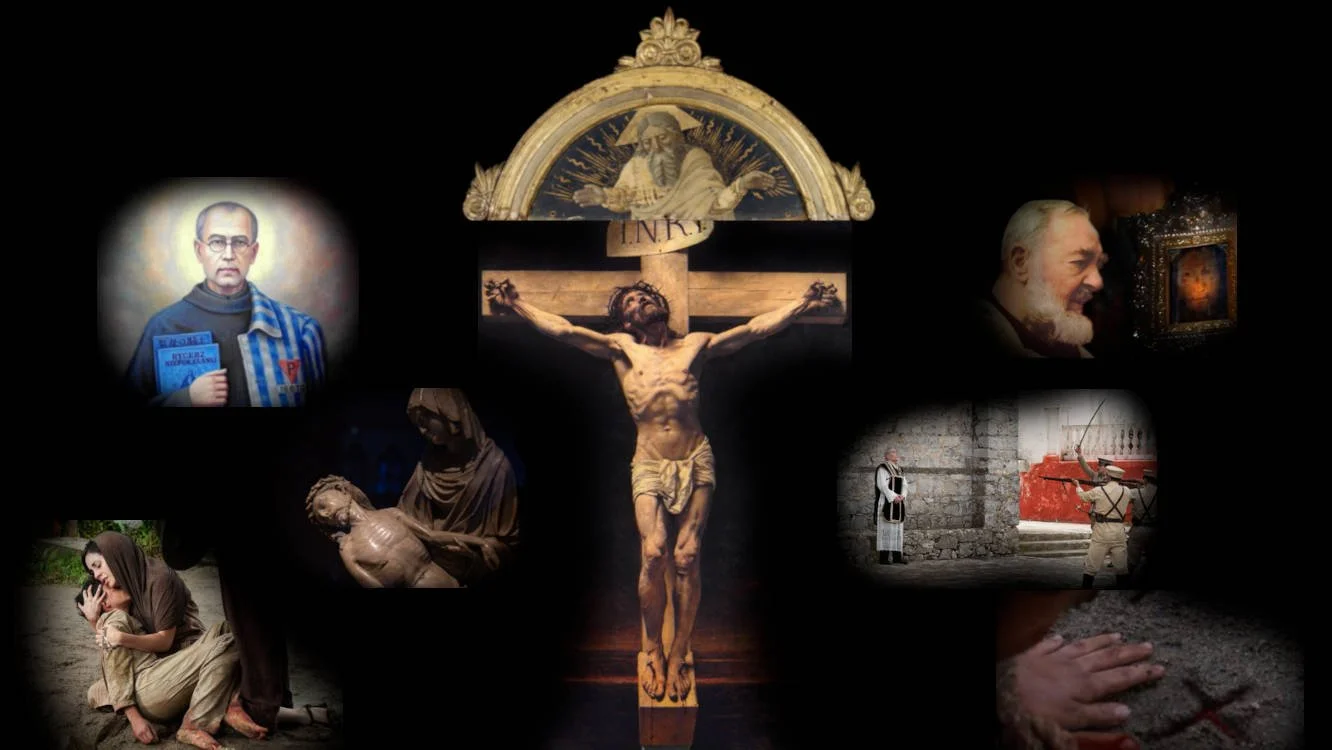
The Darkness of the Cross Enlightened on the Road to Emmaus
At Gethsemane Jesus of Nazareth agreed to bear the Cross to his own Crucifixion so that following him to Heaven’s Gate would not be a burden of impossibility for us.
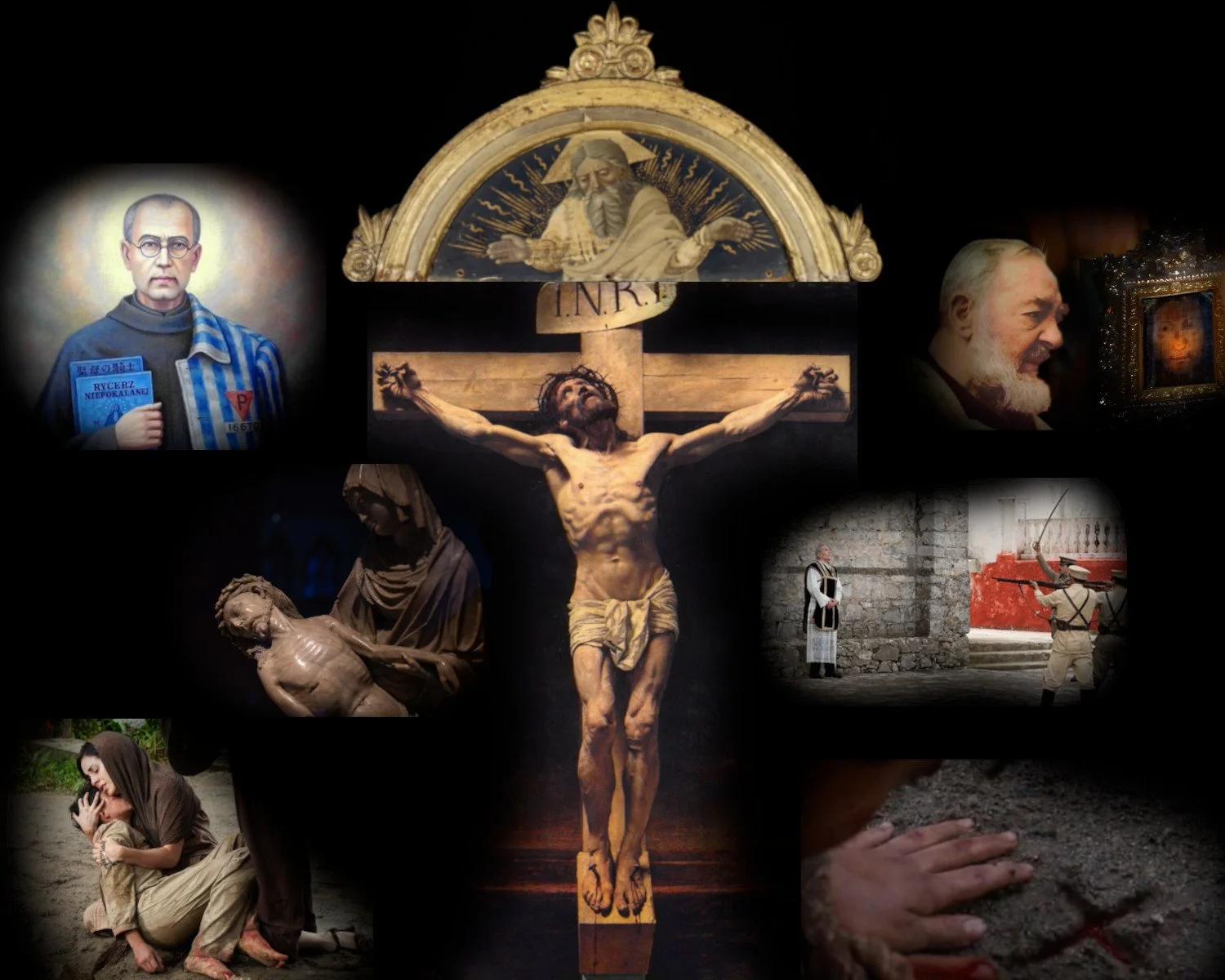
At Gethsemane Jesus of Nazareth agreed to bear the Cross to his own Crucifixion so that following him to Heaven’s Gate would not be a burden of impossibility for us.
Holy Week 2026 by Father Gordon MacRae
In all of human history, no method of execution has been devised more heinously, or delivered with more cruelty than crucifixion. In the Old Testament — no stranger to the cruel acts of men — crucifixion did not exist. It was first introduced to human history in the Sixth Century BC by the Persians, the ancestral empire of present-day Iran. I recently wrote of Iran and its place in history in “Iran, by Another Name, Was Once the Savior of Israel.”
My visual introduction to crucifixion was not so much biblical, but cinematic. Over many years I had pondered in depth its biblical presentation, but it was only when I watched the 2004 film, The Passion of the Christ directed by Mel Gibson, that I experienced and absorbed its visual impact. The brutality of the film was criticized for its excessive violence, but there was no such thing as a “gentle” crucifixion.
The Passion of the Christ contains all the elements ascribed to the event in the four Gospel accounts of the Crucifixion of Jesus in Sacred Scripture. I have read and studied those accounts many times, but I could watch that film only once and never again. It left me in a state of profound sorrow. That sorrow caused me to rethink some of the peripheral, but mysterious events that Sacred Scripture lends to the Crucifixion scene. One of them is the following excerpt from Psalm 22 attributed to King David. He never experienced crucifixion, but in Psalm 22 he wrote of it in the first person and in vivid prose 1,000 years before Jesus of Nazareth experienced it:
“My God, my God, why have you forsaken me? Why are you so far from helping me, from the words of my cry?
“O my God, I cry out by day, but you answer not, and by night, but I find no rest.
“Yet you are holy, enthroned upon the praises of Israel. In you our fathers trusted; they trusted and you delivered them. To you they cried and they were saved. In you they trusted, and were not disappointed.
“But I am worm and no man; scorned by men and despised by the people. All who see me scoff at me. They mock me with parted lips; they wag their heads. ‘He trusted in the Lord, let him deliver him. Let him rescue him if he delights in him.’
“I am poured out like water, and all my bones are wracked; my heart is like wax, it is melted within my breast. My strength is dried up like a potsherd, and my tongue cleaves to my jaws. You have laid me in the dust of death.
“Indeed, many dogs surround me; a pack of evildoers closes in upon me. They have pierced my hands and my feet. I can count all my bones; they stare and gloat over me. They divide my garments amongst them. For my clothing they cast lots.”
— Excerpted from Psalm 22, a Psalm of King David, circa 1000 BC
Most observant Jews would likely have recognized “My God, my God, why have you forsaken me?” as the opening line of Psalm 22. Mysteriously, those present for the Crucifixion of Jesus failed to do so. The Gospel quotes them as saying, “He is calling upon Elijah.” It was a distortion of the mixed Hebrew and Aramaic in the plea of Jesus from the Cross: “Eloi, Eloi, lema sabachthani.” In a magisterial treatise, Jesus of Nazareth: Part 2 Holy Week, Pope Benedict XVI wrote “Psalm 22 is Israel’s great cry of anguish, in the midst of its sufferings, addressed to the apparently silent God …. Now we hear the great anguish of the one suffering on account of God’s seeming absence.” Many of us have been here when simply calling out or pleading with God is not enough. In extreme anguish, prayer inevitably becomes a loud cry. Jesus prays this loud cry on behalf of all of us: “My God, my God, why have you forsaken me?”
What is remarkable about the four Gospel accounts of the Crucifixion is the multitude of Old Testament allusions and quotations they contain. In them, the Word of God and the events of the Gospel are deeply interwoven into the Passion Narrative. Two of these allusions, Psalm 22 and Isaiah 53, the “Suffering Servant” motif, shed light on the entire Passion event.
Isaiah begins with a direct reference to this saving act of God in a prophesy written hundreds of years before its fulfillment: “Behold, a virgin shall conceive and bear a son, and shall call his name ‘Emmanuel’” — a name which means “God with us.”
All of Sacred Scripture makes clear one consistent truth. If God is with us, we are not always with God. This becomes especially evident in the Passion Narrative of the Gospels, the arrest, interrogation, trial, scourging, and Crucifixion of Jesus. No one who followed him to this end, and who came to believe that he is the Messiah, the Christ of God, could ever have imagined that he would face humiliation, torture, Crucifixion and death. When it came, despite all promises to the contrary, most of his disciples shrank from their own promises and fled. None of us can stand in judgment of them. I wrote of one of history’s most vivid examples in “The Apostle Falls: Simon Peter Denies Christ.”
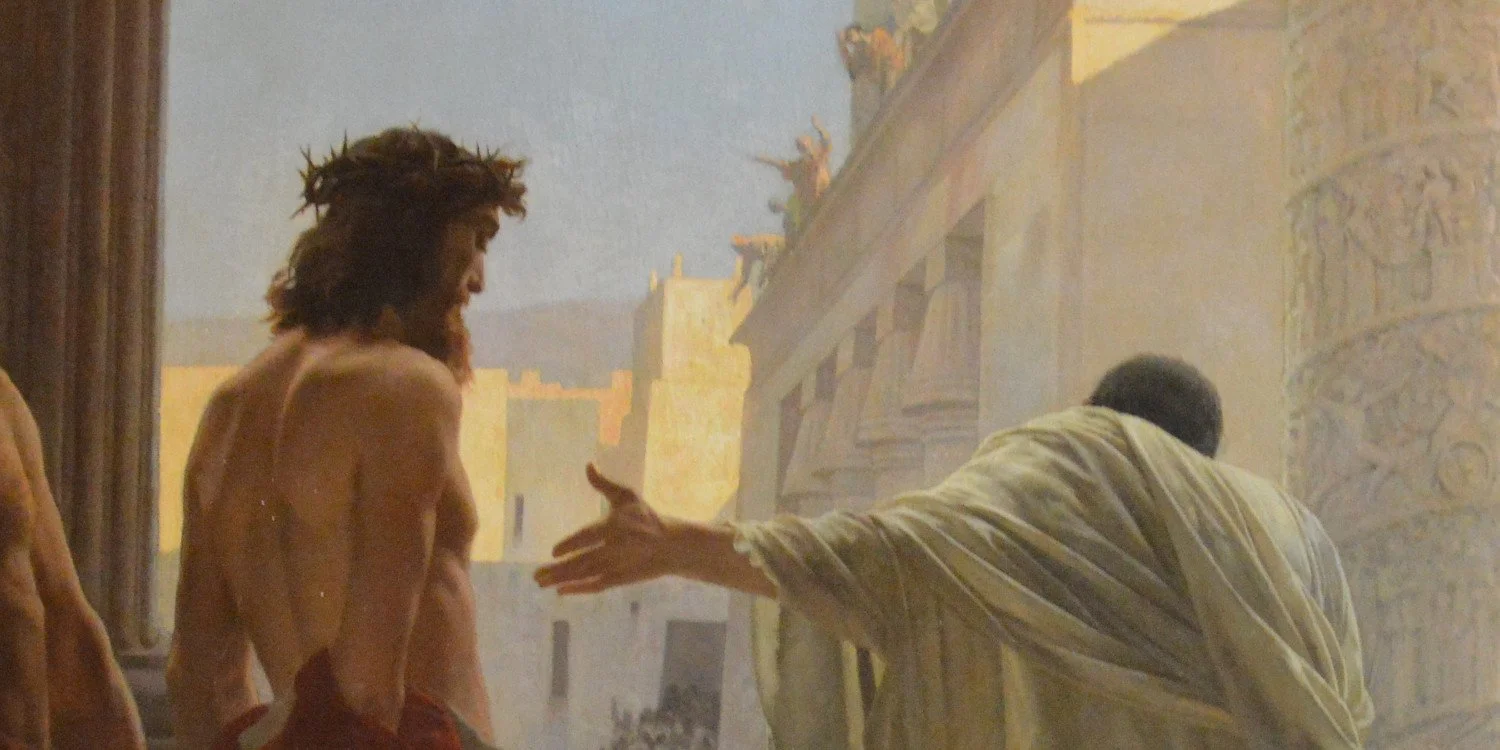
He Suffered under Pontius Pilate
But prior to all that, Jesus was interrogated by Pontius Pilate, the Roman military governor or procurator of the imperial province of Judea from 26 to 36 AD. The Jewish historian, Flavius Josephus, portrayed Pilate as a harsh administrator who failed to understand the religious convictions and national pride of the Jews. Pilate is known mainly for his connection with the trial and execution of Jesus. His culpability in the outcome has been the subject of debate ever since, and this conflicting view was implied even by Pope Benedict XVI, who wrote:
“After the interrogation, Pilate knew for certain what in principle he had already known beforehand: this Jesus was no political rebel; his message and his activity posed no threat for the Roman rulers. Whether Jesus had offended against the Torah was of no concern to Pilate as a Roman.”
— Jesus of Nazareth: Holy Week, p195
The Gospels of John and Mark present the custom of choosing a prisoner to be released on the Passover. The Gospels present a juxtaposition of the theological significance of choosing Jesus or Barabbas for release. John refers to Barabbas simply as a robber (18:40). In the political context of the time the Greek word that John used has also acquired the meaning of “terrorist,” or “rebel.” This is clear from Mark’s account: “And among the rebels in prison who had committed murder in the insurrection, there was a man called Barabbas” (Mark 15:7). It was clear that Pilate preferred to release Jesus, yet the crowd had different categories. Pilate came to understand their strong preference to release Barabbas, who had acquired the personna of a swashbuckling rebel.
The governor of Judea had complete judicial authority over all who were not Roman citizens, but many cases, especially those relating to religious matters, were decided by the Sanhedrin, the Jewish supreme council. According to the Gospel accounts, after the Sanhedrin found Jesus guilty of blasphemy it committed him to the Roman court because it lacked the authority to impose a death sentence. Pilate refused to approve their judgment without further investigation but the Sanhedrin threatened Pilate. When Pilate asked them, “Shall I crucify your king?” “The Chief Priests Answered, ‘We Have No King but Caesar’”
The Jewish priests then made other charges against Jesus, accusing him of blasphemy by calling himself a king (which he never actually did) and a son of God. Pilate appears to have been impressed with the dignity and honesty of Jesus, and tried to save him (John 18:38-39, 19:12-15). But fear of an uprising in Jerusalem and a resulting report to Roman authorities forced Pilate to accede to the Sanhedrin’s demand after the chief priests declared that freeing Jesus would mean that Pilate “is no friend of Caesar.” The false claim that Jesus was “King of the Jews,” was perceived as a threat to the Roman empire. It ended up on the inscription bearing the official nature of his offense to be affixed to his Cross.
Jesus was thus to be crucified and was handed over by Pilate for scourging, a brutal aspect of the punishment that often left the accused dead even before being crucified. Some have suggested that the scourging was intensified by Pilate to sway Jewish leaders away from crucifixion if the scourging was brutal enough. The guards saw to it that it was, but to no avail. It is very likely that Jesus carried only the crossbeam to which his hands were affixed first by ropes and then nails were added upon the height of Mount Calvary. His scourging had left his skin shredded so Simon of Cyrene was recruited to help carry the crossbeam. Only a few faithful women, including his Mother, his Mother’s sister, and Mary Magdalene remained with the beloved disciple John.
Each of the four Gospels presents a parallax view, the same scene but from a different perspective. In the Gospel according to John, the dying Jesus addressed his Mother: “Woman, behold your son” and to John, “Behold your Mother” (John 19:27). The Gospel instructs us that “from that hour the disciple took her into his own home.” Faithful Catholics have done the same ever since. Mary occupies a very special place in this scene and in our hearts.
As for Pontius Pilate, he was recalled to Rome in AD 36. According to the Roman historian, Eusebius, Pilate later committed suicide. Other traditions, however, report that Pilate secretly became a Christian and was condemned to death by the Roman Senate. Perhaps for this reason, Pilate is strangely revered by Coptic Christians as a martyr. They observe his feastday on June 25.
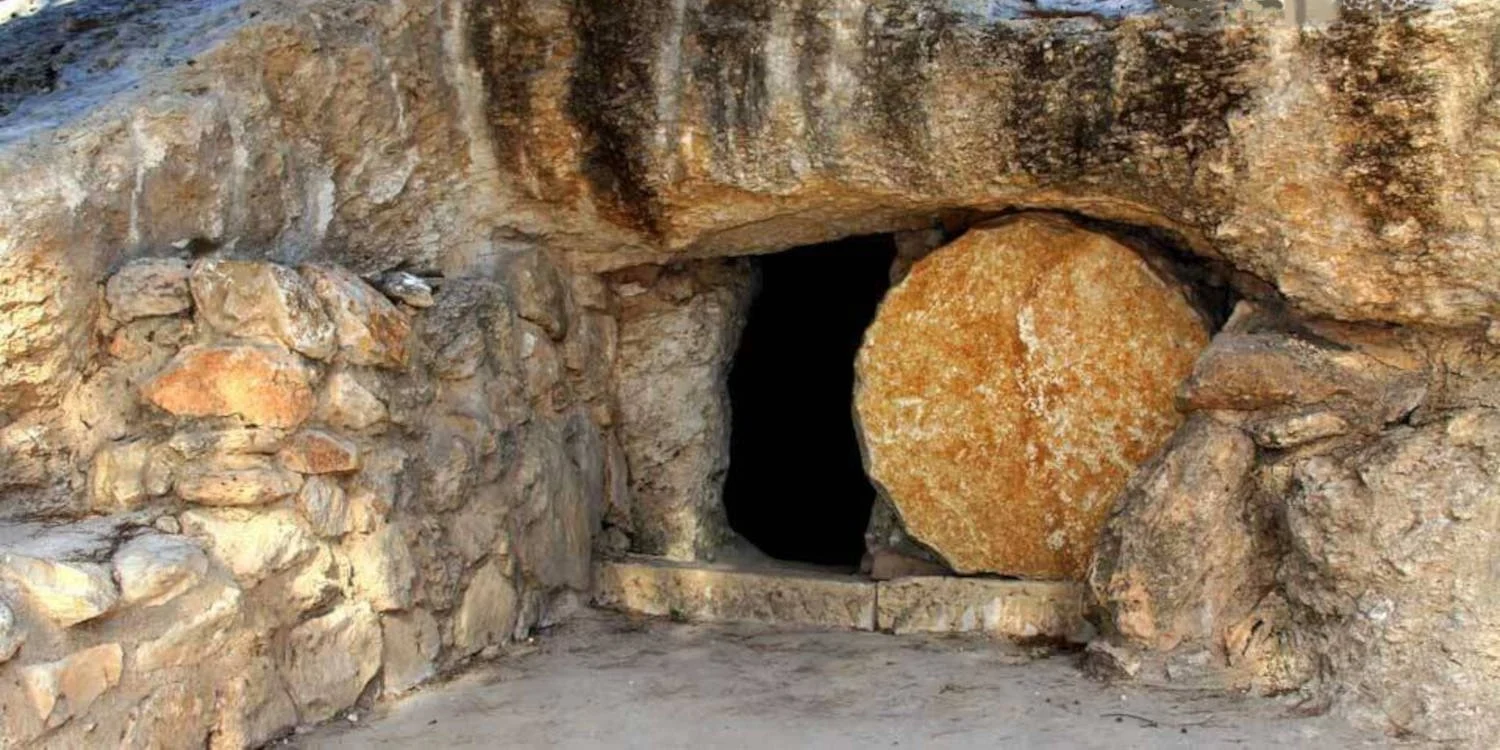
“Why Do You Seek the Living among the Dead?” (Luke 24:5)
The Resurrection of Jesus is the crowning event of the Passion Narratives of all four Gospels. Joseph of Arimathea, a member of the Sanhedrin who “was looking for the Kingdom of God” risked his standing in the Sanhedrin by asking Pilate for the body of Jesus, which was granted. Joseph interred the body in his own tomb hewn from rock (Luke 24:51). Some women went to the tomb as the Sabath was beginning. They saw the body of Jesus there then left to observe the Sabath.
On the next day, the first day of the week, these same women, now identified as Mary Magdalene, Joanna and Mary, mother of James, returned with spices to prepare the body according to the ritual law. They found the stone sealing the tomb to have been rolled away and two men in dazzling apparel frightened them asking,”Why do you seek the living among the dead?” When they told this to the disciples, they were not believed, but Peter ran to the tomb and found it just as they had said.
Later that same day, two of his disciples — one identified as Cleopas — were venturing about seven miles from Jerusalem along the road to Emmaus. They were speaking with great sorrow and trauma about the events of this and previous days. I have been where they were on that day. I do not mean that I have been on the road to Emmaus, except perhaps figuratively. I have been at a place at which all that I had ever worked for and hoped for just collapsed in irreparable ruin, and there was no justice in it. Reading about this encounter on the road to Emmaus, their deep sorrow and loss resonates with me on a personal level.
Then they encounter the Risen Christ along that road, but “Their eyes were kept from recognizing him.” (Luke 24:16) The visitor asked what their animated conversation was all about. The one named Cleopas was incredulous: “Are you the only visitor to Jerusalem who does not know the things that have happened there in these days?” “What things?” asked the stranger. Then came the outpouring of their grief:
“The things concerning Jesus of Nazareth who was a prophet might in word and deed before God and all the people, and how our chief priests and rulers delivered him up to be condemned to death, and crucified him. We had hoped that he was the one to redeem Israel. And besides all this, it is now the third day since this has happened. Now some women of our company have just amazed us. They were at the tomb early in the morning, but they did not find his body. They came back saying that they had even seen a vision of angels who said that he is alive. Some of those who were with us went to the tomb and found it just as the women said, but him they did not see.”
(To be continued.)
+ + +
Note from Father Gordon MacRae: Thank you for reading and sharing this post, which will now be added to both Our Holy Week Retreat and to our Collection called The Bible Speaks. You may also like these related posts leading up to the top of Mount Calvary:
Satan at the Last Supper: Hours of Darkness and Light
Waking Up in the Garden of Gethsemane

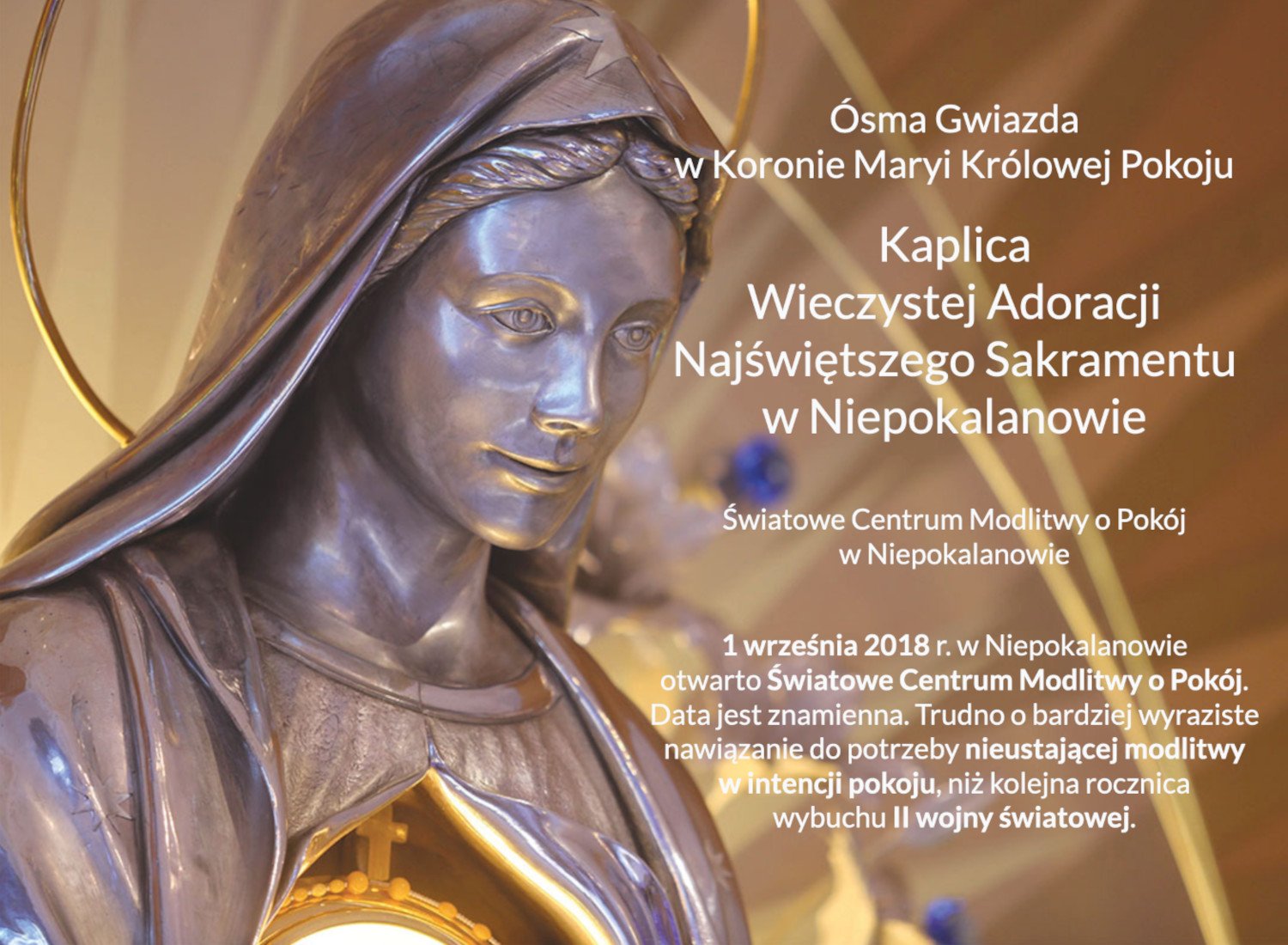

The Eucharistic Adoration Chapel established by Saint Maximilian Kolbe was inaugurated at the outbreak of World War II. It was restored as a Chapel of Adoration in September, 2018, the commemoration of the date that the war began. It is now part of the World Center of Prayer for Peace. The live internet feed of the Adoration Chapel at Niepokalanow — sponsored by EWTN — was established just a few weeks before we discovered it and began to include in at Beyond These Stone Walls. Click “Watch on YouTube” in the lower left corner to see how many people around the world are present there with you. The number appears below the symbol for EWTN.
Click or tap here to proceed to the Adoration Chapel.
The following is a translation from the Polish in the image above: “Eighth Star in the Crown of Mary Queen of Peace” “Chapel of Perpetual Adoration of the Blessed Sacrament at Niepokalanow. World Center of Prayer for Peace.” “On September 1, 2018, the World Center of Prayer for Peace in Niepokalanow was opened. It would be difficult to find a more expressive reference to the need for constant prayer for peace than the anniversary of the outbreak of World War II.”
For the Catholic theology behind this image, visit my post, “The Ark of the Covenant and the Mother of God.”
Our Holy Week Retreat for Beyond These Stone Walls
Each Holy Week since 2010 Fr Gordon MacRae has composed a special post based on the Scriptural events of the Way of the Cross. They now comprise a Holy Week retreat.
Each Holy Week since 2010 Fr Gordon MacRae has composed a special post based on the Scriptural events of the Way of the Cross. They now comprise a Holy Week retreat.
Holy Week for Beyond These Stone Walls
As many of our readers know, this blog began in controversy in 2009. Born out of a challenge from the late Cardinal Avery Dulles to rise above suffering and consider instead its legacy. Many posts in my long Prison Journal since 2010 have been about the injustices that I and other priests have faced. But in the weeks before his death in December 2008, Cardinal Dulles sent a series of letters to me in prison. He challenged me to dig deeper into my own passion narrative. Cardinal Dulles wrote:
“Someone might want to add a new chapter to the volume of Christian literature from those unjustly in prison. In the tradition of Dietrich Bonhoeffer, Fr Alfred Delp, Fr Walter Ciszek, and Saint Paul, your writing, which is clear, eloquent and spiritually sound, will be a monument to your trials.”
And so in preparation for Holy Week in 2010, I began to make a concerted effort to set aside my own unjust plight to write a post about the Passion of the Christ. I compose a new Holy Week post every year since to present a different scene in the Way of the Cross. For me, this has become a sacred obligation as a priest to take part in my own unique way in the events that led to Calvary and beyond. And, yes, there IS a beyond.
Many readers, especially those who have also suffered in ways large or small, have found these posts to be inspiring. No one has been more surprised by this than me. So we have collected our Holy Week posts in the order in which they appear in the Gospel narrative to become an invitation for a personal retreat. We invite you to make these posts a part of your Holy Week and Easter observance.
If any of them touches your heart and soul in some way, or gives you a deeper understanding of the Scriptures, then please also share a link to them with others. I hear from many newer readers who first came to this blog in just that way, and then found in these pages spiritual consolation and a path to peace.
We will add a new post on Wednesday of Holy Week this year and will make the title linked here, active at that time.
The Passion of the Christ in an Age of Outrage (2020)
Overshadowing Holy Week with forced pandemic restrictions and political outrage recalls the Bar Kochba revolt of AD 132 against the Roman occupation of Jerusalem.
Satan at the Last Supper: Hours of Darkness and Light (2020)
The central figures present before the Sacrament for the Life of the World are Jesus on the eve of sacrifice and Satan on the eve of battle to restore the darkness.
Waking Up in the Garden of Gethsemane (2019)
The Agony in the Garden, the First Sorrowful Mystery, is a painful scene in the Passion of the Christ, but in each of the Synoptic Gospels the Apostles slept through it.
The Apostle Falls: Simon Peter Denies Christ (2024)
The fall of Simon Peter was a scandal of biblical proportions. His three-time denial of Jesus is recounted in every Gospel, but all is not as it first seems to be.
Behold the Man, as Pilate Washes His Hands (2014)
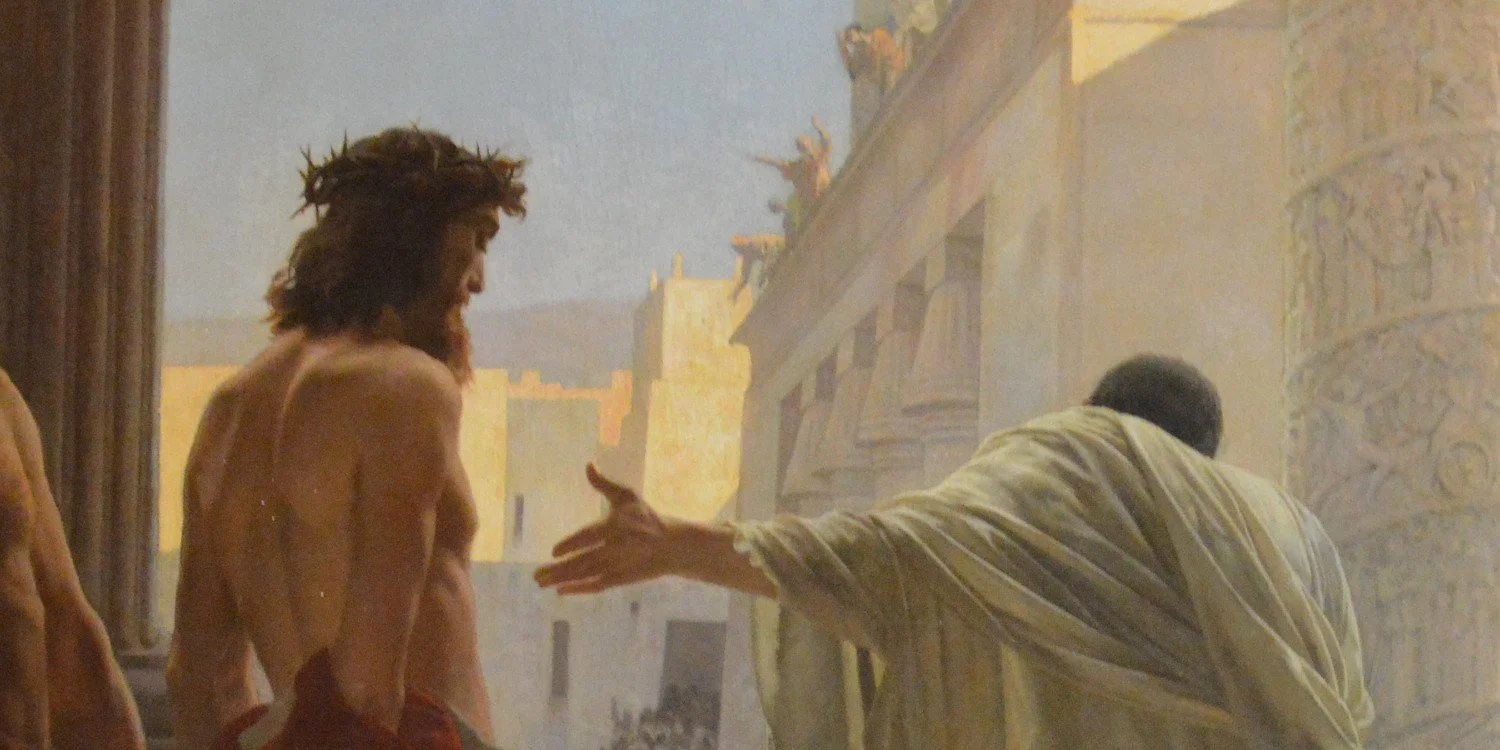
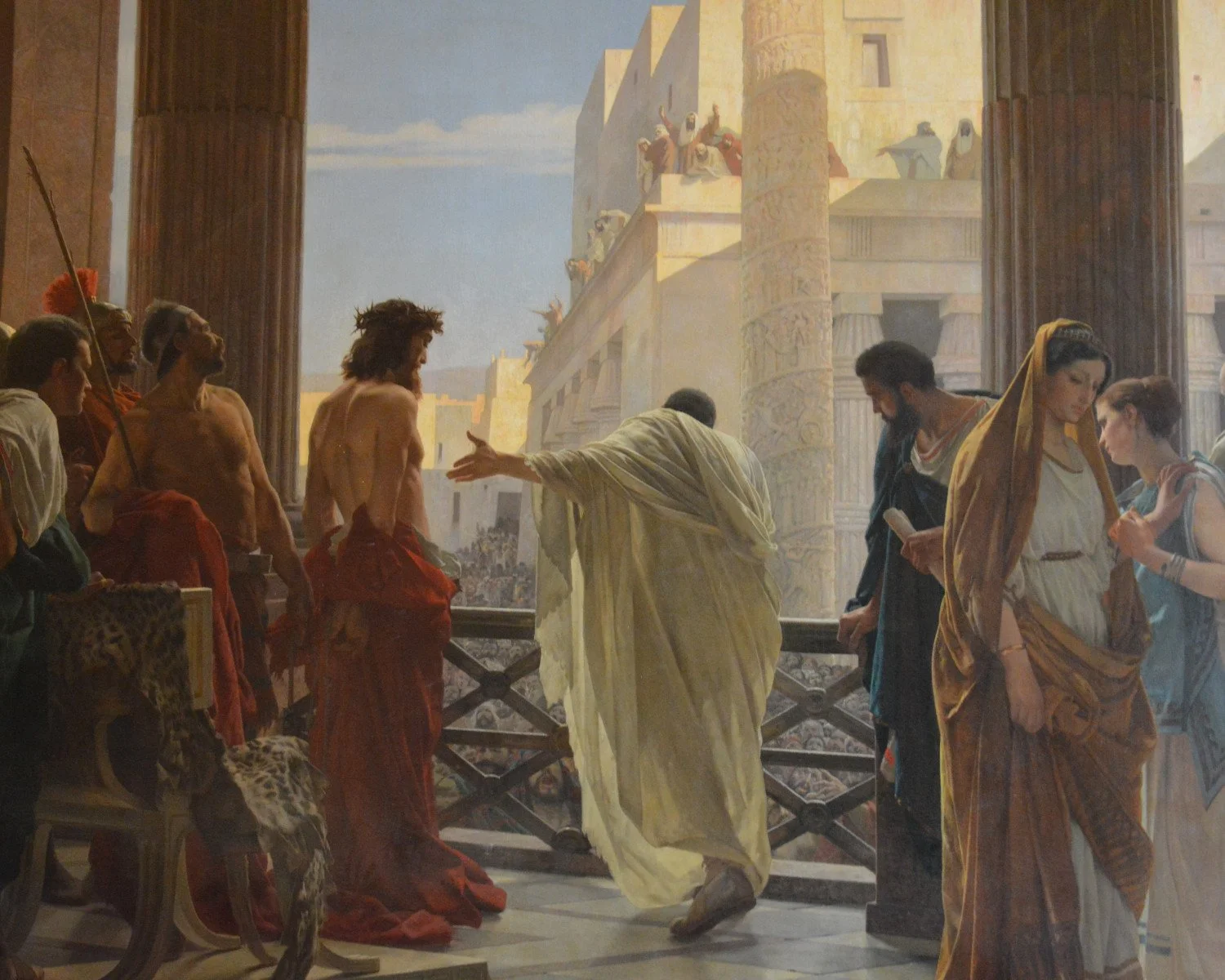
‘Ecce Homo,’ an 1871 painting of Christ before Pilate by Antonio Ciseri, depicts a moment woven into Salvation History and into our very souls. ‘Shall I crucify your king?’
The Chief Priests Answered, ‘We Have No King but Caesar’ (2017)
The Passion of the Christ has historical meaning on its face, but a far deeper story lies beneath where the threads of faith and history connect to awaken the soul.
Simon of Cyrene Compelled to Carry the Cross (2023)
Simon of Cyrene was just a man on his way to Jerusalem but the scourging of Jesus was so severe that Roman soldiers feared he may not live to carry his cross alone.
Dismas, the Good Thief Crucified Next to Christ the King (2025)
With Jesus before him, Pilate asked the chief priests, ‘Shall I crucify your king?’ They replied ‘We have no king but Caesar.’ Only a criminal saw Christ the King.
To the Spirits in Prison: When Jesus Descended into Hell (2022)
The Apostles Creed is the oldest statement of Catholic belief and apostolic witness. Its Fifth Article, what happened to Jesus between the Cross and the Resurrection, is a mystery to be unveiled.
Mary Magdalene: Faith, Courage, and an Empty Tomb (2015)
History unjustly sullied her name without evidence, but Mary Magdalene emerges from the Gospel a faithful, courageous, and noble woman, an Apostle to the Apostles.
The Darkness of the Cross Enlightened on the Road to Emmaus (2026)
At Gethsemane Jesus of Nazareth agreed to bear the Cross to his own Crucifixion so that following him to Heaven’s Gate would not be a burden of impossibility for us.
The Resurrection of Christ: Further Along the Road to Emmaus
What are we to understand when we speak of the Resurrection of Jesus? Ancient Scriptures and interpretations from a brilliant theologian-pope provide amazing clues.

Before the gates there sat, On either side a formidable Shape
One of Gustave Dore’s illustrations of the epic poem Paradise Lost by John Milton (Courtesy of University at Buffalo)

The Eucharistic Adoration Chapel established by Saint Maximilian Kolbe was inaugurated at the outbreak of World War II. It was restored as a Chapel of Adoration in September, 2018, the commemoration of the date that the war began. It is now part of the World Center of Prayer for Peace. The live internet feed of the Adoration Chapel at Niepokalanow — sponsored by EWTN — was established just a few weeks before we discovered it and began to include in at Beyond These Stone Walls. Click “Watch on YouTube” in the lower left corner to see how many people around the world are present there with you. The number appears below the symbol for EWTN.
Click or tap here to proceed to the Adoration Chapel.
The following is a translation from the Polish in the image above: “Eighth Star in the Crown of Mary Queen of Peace” “Chapel of Perpetual Adoration of the Blessed Sacrament at Niepokalanow. World Center of Prayer for Peace.” “On September 1, 2018, the World Center of Prayer for Peace in Niepokalanow was opened. It would be difficult to find a more expressive reference to the need for constant prayer for peace than the anniversary of the outbreak of World War II.”
For the Catholic theology behind this image, visit my post, “The Ark of the Covenant and the Mother of God.”

Waking Up in the Garden of Gethsemane
The Agony in the Garden, the First Sorrowful Mystery, is a painful scene in the Passion of Christ, but in each of the Synoptic Gospels the Apostles slept through it.

The Agony in the Garden, the First Sorrowful Mystery, is a painful scene in the Passion of Christ, but in each of the Synoptic Gospels the Apostles slept through it.
It seems so long ago now, but a few years back I wrote a post that stunned some TSW readers out of the doldrums of a long nap in the Garden of Gethsemane where, sooner or later, we will all spend some time. That post was “Pentecost, Priesthood, and Death in the Afternoon.”
It was about one of our friends, a middle-aged prisoner named Anthony, and his discovery of having terminal cancer. Anthony was one of the most irritating and obnoxious individuals I had ever met. He was the only prisoner I have ever thrown out of my cell with a demand that he never return. Very few people have had that kind of effect on me, but Anthony was masterful at it.
But then Anthony discovered that he was dying. As an unintended result of our “falling out” he believed that he could not come to me. He was Pornchai Moontri’s friend but the story of his impending doom was my comeuppance. I cannot forget the day that Pornchai told me, “You have to help Anthony. He is going to die and he doesn’t know how.” After a long sleep when the priest in me had succumbed too much to the prisoner, that was my awakening in the Garden of Gethsemane.
Over the next 18 months, Pornchai and I took care of Anthony for as long as we possibly could before handing him over to the prison version of hospice from where we would never see him again. But before that happened, Anthony became a Catholic, was received into the Church, and had a transformation of spirit that, in the midst of death, proclaimed an incomparable stress on life.
Pornchai and I were eyewitnesses to how all the things that once took priority in Anthony’s life just fell away. He became, in the end, like “Dismas, Crucified to the Right” of the Lamb of God. It seemed so ironic that it was his impending death that opened up for Anthony a world of faith, hope and trust that overcame all other forces at work in his life. In the end, I no longer, recognized the man I had once so disdained.
Not long after leaving us, Anthony died in the prison’s medical center where a small group of hospice volunteers took turns being with him around the clock. I once wrote of Anthony’s death, and of an event that shook our world back then, but it’s a story worth telling again. I told it at a brief memorial service for Anthony that was attended by about sixty prisoners, twice the normal for such things.
At the service in the prison chapel, those attending were invited to speak. So Pornchai nudged me and said, “Tell them about the book.” I told those in attendance that Anthony left this world having committed a second crime against the State of New Hampshire: an unreturned library book. The rest of the story generated a collective gasp.
The Library where I work has a computer system that tracks the 22,000 volumes from which prisoners can select and check out books. When a prisoner is released from prison without returning a book, an alert would come across the screen a week later to give us a last chance to find and retrieve a book left behind.
I had no knowledge that Anthony ever checked a book out of the Library. I never saw him there, and he never asked me for a book. But a week after he died, this appeared on my screen:
“Anthony Begin #76810 — Gone/Released — Heaven Is for Real”

The Agony in the Garden
Heaven is for real, but for it to be a reality for us required an Exodus from the slavery of sin and death. That second Exodus commenced in the Garden of Gethsemane, and in the course of it, God exacted from Himself the same price — the death of His Son — that he imposed upon Pharaoh to bring about the first Exodus.
The Biblical account of Jesus and His Agony in the Garden of Gethsemane opens the Passion Narrative of the Synoptic Gospels of Matthew, Mark, and Luke. In the Gospel of John (18:1), the place is simply referred to as “across the Kidron Valley where there is a garden.” John, writing from a different tradition, cites only the betrayal by Judas there whereas the other Gospels precede that betrayal with the agony of Jesus at prayer.
Almost immediately preceding this in each of the Synoptic Gospels was the Institution of the Eucharist at what has been famously depicted by Leonardo Da Vinci as The Last Supper. This was the decisive turning point in Salvation History:
“Drink of it, all of you, for this is the blood of the covenant, which is poured out for many for the forgiveness of sins. I tell you I shall not drink again of this fruit of the vine until that day when I drink of it anew with you in my Father’s Kingdom.”
— Matthew 26: 28-29
Following this in the account of Saint Luke, Jesus addresses Peter about the spiritual warfare that is to come:
“‘Simon, Simon, behold, Satan demanded to have you that he might sift you like wheat, but I have prayed for you that your faith may not fail; and when you have turned again, strengthen your brethren.’ And [Peter] said to him, ‘Lord, I am ready to go with you to prison and to death.’”
— Luke 22:31-34
Peter’s “readiness” for prison and for death will soon become an issue. From here the scene moves to the Mount of Olives where Jesus went to pray “as was His custom” (Luke 22:39).
Only the Gospels of Matthew and Mark name the place “Gethsemane.” Once there, Jesus withdrew from His disciples to pray. As you already know, the suffering and death he now faced would be set in motion by the betrayal of Judas who provided “the more opportune time” that Satan awaited when the Temptation of Christ in the desert failed (Luke 4:13), a scene depicted in “To Azazel: The Fate of a Church That Wanders in the Desert.”
Jesus, fully human in his suffering by God’s design, recoils not only from the image of suffering he knows to be upon Him, but also by the weight of the Apostolic betrayal just moments away. The betrayal by Judas is intensified by the dreadful weight of humanity’s sin for which Jesus is offered up as the Scapegoat — the Sacrificial Lamb of God — for the sins of all humanity.
For Hebrew ears, the account of Jesus at Gethsemane is a mirror image in reverse of a scene that occurred at this very same site 1,000 years earlier. It was a story not of a son obedient unto death, but of a son who betrayed his father. It was the agony of King David and his flight from his son, Absolom, and his traitorous revolt. As David learned that his trusted counselor, Ahithophel, had betrayed him in league with Absolom…
“David went up the ascent of the Mount of Olives, weeping as he went, with his head covered and walking barefoot, and all the people who were with him covered their heads and went up, weeping as they went. David was told that Ahithophel was one of the conspirators with Absolom.”
— 2 Samuel 15:30-31
And, as with Judas 1,000 years later, Ahithophel hanged himself when the consequences of his betrayal weighed upon him.
In Saint Matthew’s account of the Gethsemane scene (26:37), Jesus left His disciples and brought Peter, James and John with Him to the place of prayer. Note that Peter, James and John witnessed Jesus raise the daughter of Jairus from death (Mark 5:37) and they were also witnesses to His Transfiguration in the presence of Moses and Elijah that I wrote of during this Lent in “Turmoil in Rome and the Transfiguration of Christ.”
In the Gospel of Luke (22:31ff) Jesus is alone and apart from the others as He prays in agony in the face of death: “Father if you are willing, remove this chalice from me; nevertheless not my will but yours be done.” I cannot tell you how often I have prayed that same prayer in the last 25 years. I pray it still.
In the Gospel, God answers the prayer of Jesus, not by removing the suffering, for His suffering is to be our Exodus, but by strengthening Him to endure it. And He will endure it unto death:
“There appeared to him an angel from heaven to strengthen him. And being in agony, he prayed more earnestly; and his sweat became like great drops of blood falling down upon the ground.”
— Luke 22:43
In each of the Gospel accounts, Jesus returned to His disciples to discover that they have all slept through His agony. None were there to console Him except the angel sent from heaven while humanity slept.

Consoling the Heart of Jesus
The Gospel of Saint Mark presents a more vivid account of the inner suffering that betrayal and death brought to the heart of Jesus. Mark describes that Jesus “began to be greatly distressed and troubled” (Mark 14:33). The Greek of Mark’s Gospel used the terms έκθαμβεῖσθαι and άδημονεῖν which vividly express in Greek the depth of distress and anxiety that came upon Him. The comfort the angel brings is reminiscent of Psalm 42:
“Why are you cast down O my soul, and why are you disquieted within me? Hope in God; for I shall again praise him, my help and my God.”
— Psalm 42:12
The coming betrayal by Judas marks the climax of the ministry of Jesus who has left hints throughout the Gospel of Mark:
“And he began to teach them that the Son of man must suffer many things and be rejected by the elders and the chief priests and the scribes, and be killed, and after three days rise again. And he said this plainly.”
— Mark 8:31
“The Son of man will be delivered into the hands of men, and they will kill him, and when he is killed, after three days he will rise.”
— Mark 9:31
“Behold, we are going up to Jerusalem, and the Son of man will be delivered to the chief priests and the scribes, and they will condemn him to death, and deliver him to the Gentiles, and they will mock him, and spit on him, and scourge him, and kill him, and after three days he will rise.”
— Mark 10:33-34
So how do we, His disciples by Baptism and by the fidelity we claim, how do we console the heart of Jesus at Gethsemane? For the answer, I am indebted to Father Michael Gaitley, M.I.C. for his profound book, Consoling the Heart of Jesus which was the text for a six-week course offered here by the Marians of the National Shrine of The Divine Mercy.
Like many, I believe I learn the most from Sacred Scripture when the circumstances of my life force me to live it. So picking up this book for the first time, I asked myself, “How can I console Jesus, who is happy in Heaven, while I am stuck in this hellhole called prison?” That’s what Pornchai Moontri called it in these pages in his post, “Imprisoned by Walls, Set Free by Wood.”
Father Gaitley has an answer called “Retroactive Consolation” that comes from the theology of Pope Pius XI and the Dominican theologian, Réginald Marie Garrigou-Lagrange, O.P. whom Father Gaitley quotes:
“During his earthly life and particularly while in Gethsemane, Jesus suffered from all future acts of profanation and ingratitude. He knew them in detail with a superior intuition that governed all times… Thus his suffering encompassed the present instant and extended to future centuries. ‘This drop of blood I shed for you.’ So in the Garden of Olives, Jesus suffered for all, and for each of us in particular.”
— Consoling the Heart of Jesus, P. 394
So, if His suffering is projected into the future, how can our consolation of Him at Gethsemane become retroactive into the past? What will awaken us from our sleep in the Garden of Gethsemane? Jesus Himself provides that answer, and it has something to do with our story about Anthony that began this post. It is laid out powerfully in the Gospel of Matthew:
“Then the righteous will answer him, ‘Lord, when did we see you hungry and feed you, or thirsty and give you drink? And when did we see you a stranger and welcome you, or naked and clothe you? And when did we see you sick or in prison and care for you?’ And the King will answer them, ‘Truly I say to you, as you did it to one of the least of these, you did it to me.’”
— Matthew 25:37-40
Now
“Arise. Let us be going. See, my betrayer is at hand.”
— Matthew 26:46
+ + +
Editor’s Note: Please share this Holy Week post with your contacts on Facebook and other social media. To prepare for a meaningful Holy Week and Easter, you may also like these other posts from along the Way of the Cross at Beyond These Stone Walls :
A Personal Holy Week Retreat at Beyond These Stone Walls
The Chief Priests Answered, ‘We Have No King but Caesar’
Behold the Man, as Pilate Washes His Hands
Simon of Cyrene at Calvary: Compelled to Carry the Cross
