“There are few authentic prophetic voices among us, guiding truth-seekers along the right path. Among them is Fr. Gordon MacRae, a mighty voice in the prison tradition of John the Baptist, Maximilian Kolbe, Alfred Delp, SJ, and Dietrich Bonhoeffer.”
— Deacon David Jones
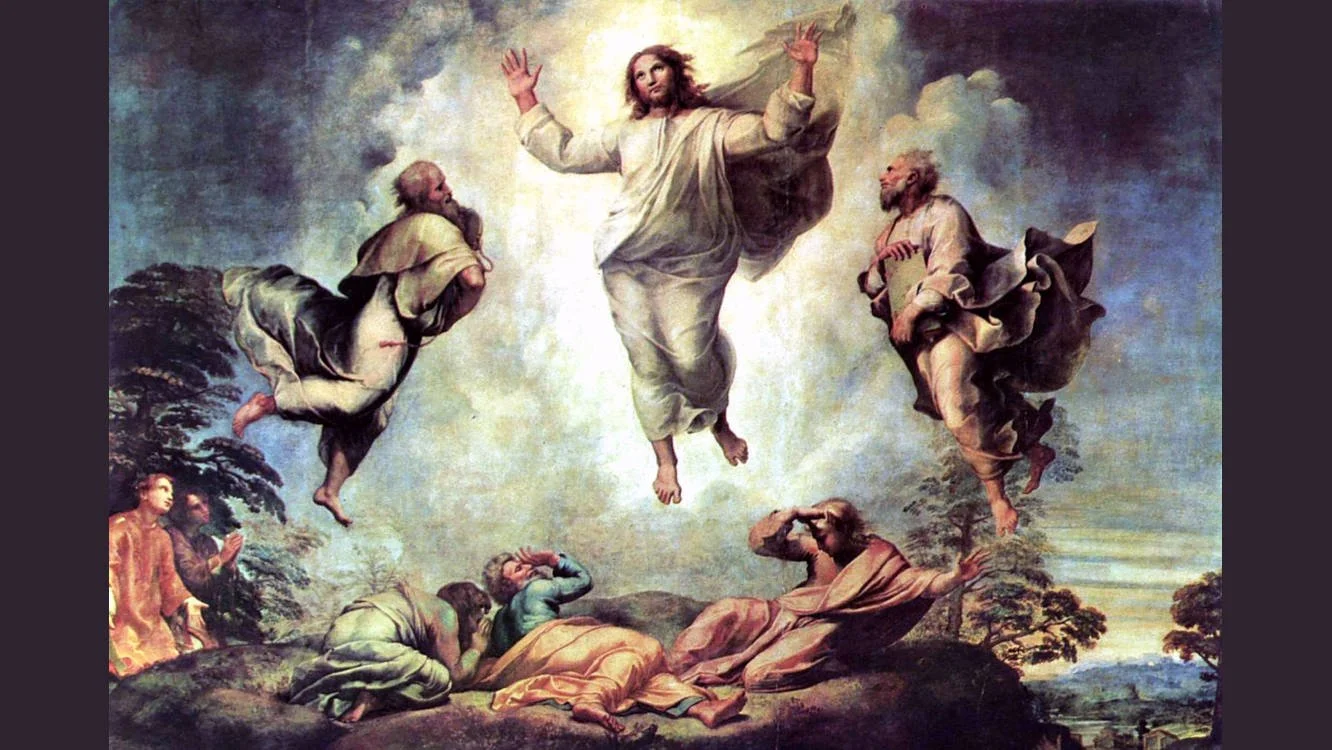
The Law and the Prophets and the Transfiguration of Christ
Moses and the Prophet Elijah are present for the Transfiguration of Christ. They represent the Law and the Prophets, the two pillars of Israel's faith and ours.
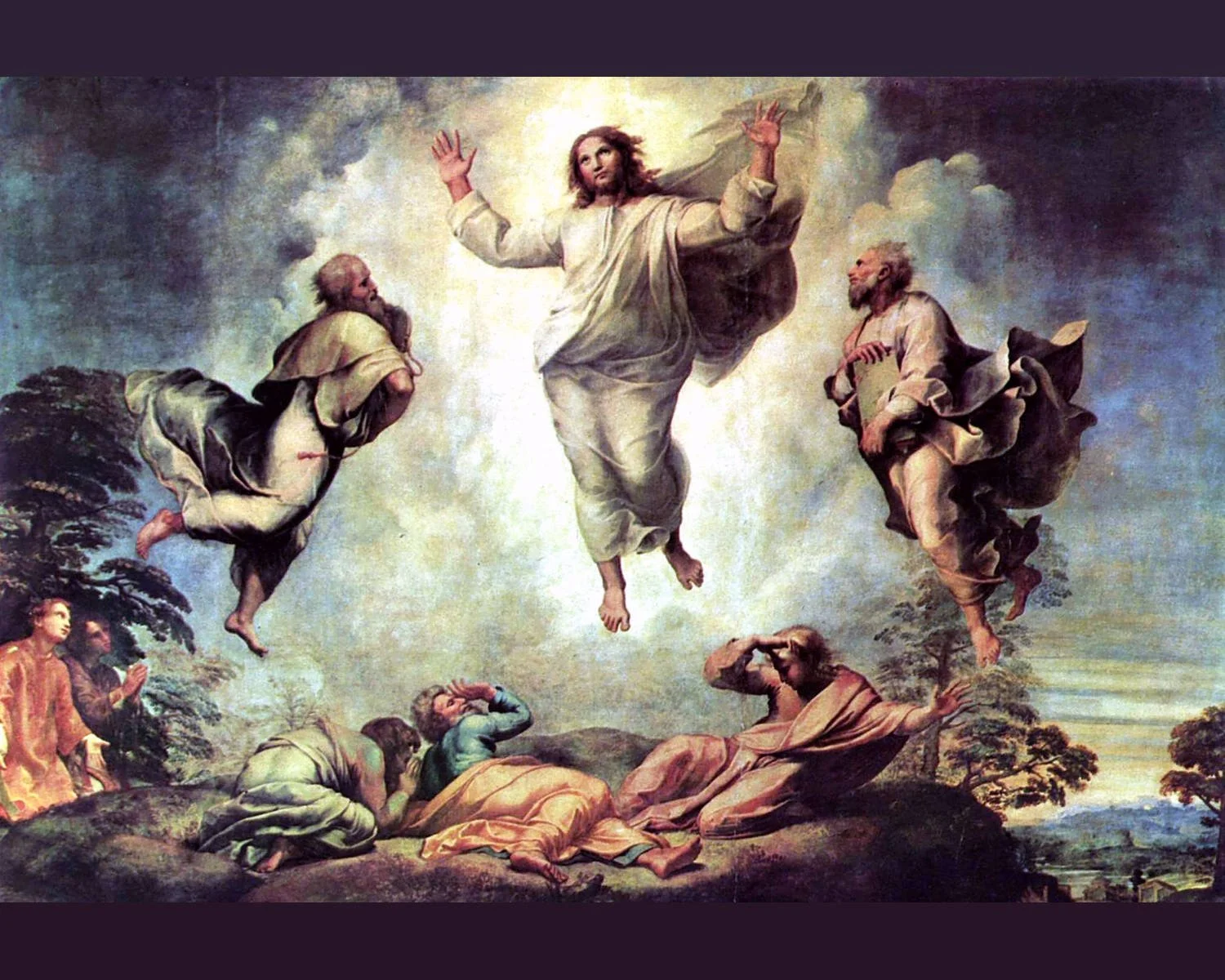
Moses and the Prophet Elijah are present for the Transfiguration of Christ. They represent the Law and the Prophets, the two pillars of Israel's faith and ours.
February 25, 2026 by Father Gordon MacRae
“Nothing new in the Holy See.” I hear these words from our Editor every week as she reviews with me a global traffic report for this blog. Being blind behind these stone walls to everything going on with a post after it leaves my archaic typewriter, this opportunity to know that someone out there is actually reading is vaguely comforting to me. We cannot know who is reading any particular post, but we can see where they are, and how many they are.
Our call always ends with “Nothing new in the Holy See.” It means that no one there has stopped to look from Beyond These Stone Walls. There is a sadness in that. There is a lot of controversy in Rome these days, and because I have a stake in it, I am both anxious about it and anxious to have a voice in it. I look intently at the affairs of Rome even if no one there is ever looking back. Current events there are sometimes manipulated by those with an agenda to reshape the Church in their own image, or to filter the Way, the Truth, and the Light through the age of relativism.
But all this has more to do with our politics than the far more important opportunities to explore, and allow to be shaped within us, the profoundness of our faith. Unlike other Catholic bloggers, I can write only one post per week so the affairs of Rome will have to wait. It is Lent, after all, and the Transfiguration of Christ in the Gospel this week shakes the Earth under my feet while the affairs of Rome only make me tremble a bit.
So no offense to my fellow Catholics embroiled over the dramas of Rome, and the tug-of-war closer to home as struggles over altar rails and Latin in the Mass threaten to replace our struggle to live the Gospel. I am painfully aware that in 2013 Pope Benedict XVI left the Chair of Peter. My entire life as a priest had been overshadowed by the light of two great men who became giants not only in faith but in the world. I will never forget that 1978 knock on my seminary room door and the voice that followed: “The Pope has died!” I shouted back, “That happened a month ago!” The face of the Church in the modern world changed as the first non-Italian in centuries became pontiff in the person of Saint John Paul II. Twenty-six years later in 2005 he was followed in the papacy by the brilliant Joseph Ratzinger, a theologian par excellence who became Benedict XVI. I have always been aware that the two popes who followed them had to fill the shoes of giants, so I have to always remind myself to cut them a little slack. I fend off any tendency to judge or compare them with their predecessors.
These are dark days for priests, and often dark for faithful Catholics as well. But darkness preceded the Transfiguration of Christ at the center of the Gospel for the Second Sunday of Lent, and as usual there is a story on its surface and a far greater one in its depths. Lord, be our Light.
Who Do You Say That I Am?
All three Synoptic Gospels have an account of the Transfiguration of Jesus, and the accounts are remarkably uniform. This week for the Second Sunday of Lent, it is Matthew’s turn, but all the elements he presents in his presentation of the Transfiguration of Christ are also presented by Luke who adds a component. Luke alone presents a reason for the Lord to bring three of His Apostles to the top of Mount Tabor:
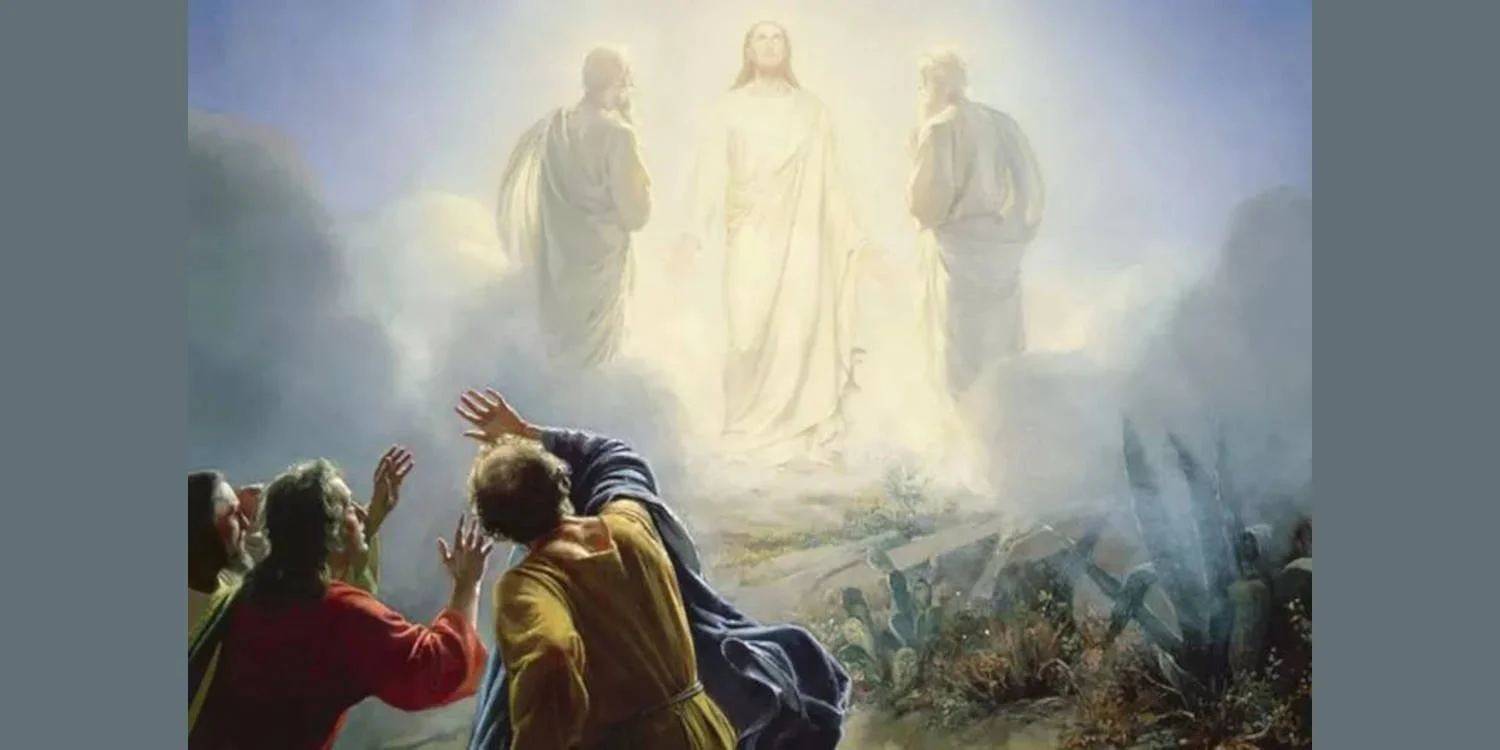
“Jesus took Peter, James and John and went up the mountain to pray. While he was praying his face changed in appearance and his clothing became dazzling white. And behold, two men were conversing with him, Moses and Elijah, who appeared in glory and spoke of his exodus that he was going to accomplish in Jerusalem.”
— Luke 9:28-30
I wrote of this same event and its place in Salvation History in my recent post, “Covenants of God.”
Some immediate understanding of this event would have dawned upon any faithful Jew and certainly registered with Peter, James and John. The account is highly reminiscent of an event in the Book of Exodus that took place some 13 centuries earlier:
“When Moses came down from Mount Sinai with the two tablets of the Law in his hands, as he came down from the mountain Moses did not know that the skin of his face shone because he had been talking with God. And when Aaron and all the people of Israel saw Moses, because the skin of his face shown, they were afraid to come near him.”
— Exodus 34:29-30
Though the event of the Transfiguration of Jesus would vividly bring to the Jewish mind that passage from Exodus, it was also very different. It was like the difference between the Sun and the Moon. The Moon only reflects light radiated from the Sun. As brilliant as a full moon can appear in the darkness of night, it produces no light of its own. The face of Moses only reflected the light of grace radiated from God.
The Sun, on the other hand, radiates its own dazzling light, and to look too long would cause blindness. The light of the Transfiguration of Christ was “dazzling,” and it came from within. In those few moments — for Peter, James and John could have stood no more than a few — God lifted a corner of the veil to reveal the nature of the person Peter declared to be the Christ:
“The only begotten Son of God, born of the Father before all ages, God from God, Light from Light, true God from true God, begotten, not made, consubstantial with the Father, through him all things were made. For our salvation he came down from heaven.”
— The Nicene Creed
I wrote of this account a few years ago in “A Transfiguration Before Our Very Eyes.” That post was more about the conversion that this episode can bring within a person who comes to some understanding of its spiritual dimensions. Canadian Catholic blogger Michael Brandon at “Free Through Truth” actually wrote a post about that post — and his was far better than mine — which he entitled, “Transfiguration, You and Me.”
The conversion that Michael Brandon and I both highlighted was that of Pornchai Moontri, and it is a most important story, not just for him, or for me, but for a Church embroiled in scandal. If you think I may beat this drum of Pornchai’s conversion too much, I challenge you to delve into it for I cannot emphasize it enough. Given the story told in “Pornchai Moontri and the Long Road to Freedom,” his conversion — a change not just of heart but of substance — should have been impossible. And he found no light in me, for I radiate none.
In the Gospel, the Transfiguration of Jesus was preceded by two pivotal events. On the command of Jesus, the Apostles fed 5,000 people with a mere five loaves of bread and two fish. When it was over, he asked the Apostles, “Who do the people say that I am?” They answered, “Some say John the Baptist” (for he had already been beheaded by Herod) “while some say Elijah or that one of the prophets of old has arisen.”
But what about you, asked Jesus. “Who do you say that I am?” Peter answered for all: “You are the Christ of God”. Jesus then told them a startling revelation bringing them to an inner darkness:
“You are to tell this to no one. The Son of Man, must suffer many things, be rejected by the elders and chief priests and scribes, and be killed, and on the third day be raised. If any man would come after me, let him deny himself and take up his cross daily and follow me. For whoever would save his life will lose it; and whoever will lose his life for my sake, will save it.”
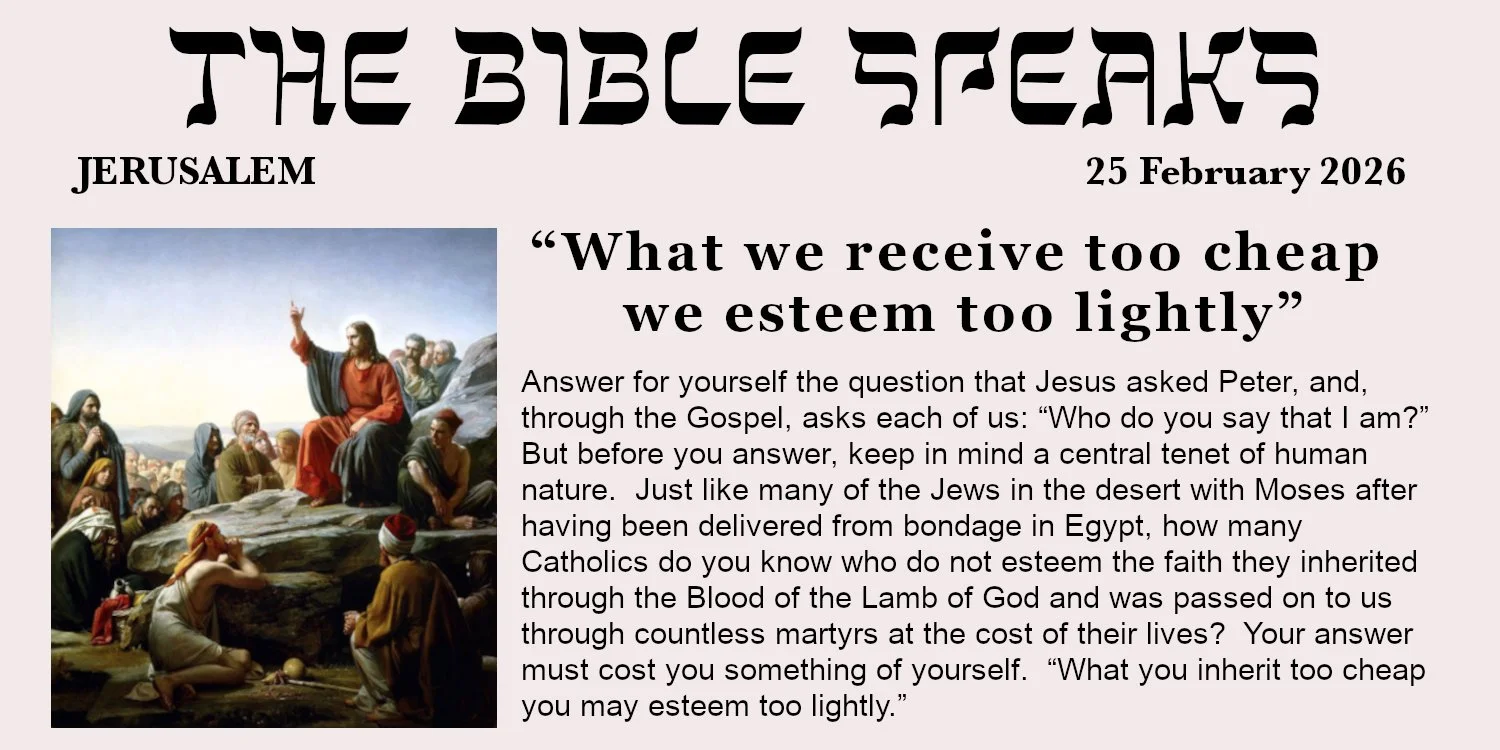
So answer for yourself the question that Jesus asked Peter, and, through the Gospel, asks each of us: “Who do you say that I am?” But before you answer, keep in mind a central tenet of human nature. Just like many of the Jews in the desert with Moses after having been delivered from bondage in Egypt, how many Catholics do you know who do not esteem the faith they inherited through the Blood of the Lamb of God and was passed on to us through countless martyrs at the cost of their lives? Your answer must cost you something of yourself. “What you inherit too cheap you may esteem too lightly.”
A Conversation with Moses and Elijah
I would like to delve deeper into the theological significance of the Transfiguration account and into its spiritual resonance. First, the very important story behind the story. The account is filled with great spiritual meaning. First, why do Moses and Elijah appear?
A lot in Sacred Scripture happens on mountaintops. In the Book of Exodus, Moses received the Covenant from God on Mount Sinai. In the First Book of Kings, the Prophet Elijah encountered God on Mount Horeb. On Mount Tabor — the place where long-held tradition places the Transfiguration — Moses and Elijah represent the Law and the Prophets, the two central pillars of faith in Judaism, and the foundations of God’s Covenant with Israel.
But how can they be present in heaven before the Resurrection of Jesus and the Exodus from sin and death? The greatness of Elijah is attested to by the sheer number of allusions to him in both the Old and New Testaments. In the Hebrew mind, it was Elijah who affirmed the supremacy of Yahweh over nature and human history, and was seen as the principal defender of traditional Hebrew morality.
Elijah can be present at the Transfiguration because he was taken on a chariot into heaven (2 Kings 2:1-18). It was an ingrained belief of Hebrew tradition that God would return Elijah to Israel even before this prophecy was set forth by the Prophet Malachi: “Behold, I will send you Elijah the prophet before the great and terrible Day of the Lord comes” (Malachi 4:5). Knowing the Scriptures, the presence of Elijah must have struck both hope and terror into the hearts of Peter, James and John.
But how is it that Moses was there with Jesus on Mount Tabor? This is where the Hebrew Scriptures and the legends of faith intersect. The Canon of Sacred Scripture reveals the story of Salvation History from Abraham to Jesus, but Israel also had a collection of oral and written traditions accepted by Rabbinical teaching as “Deuterocanonical” meaning, “Secondary Canon.” Some of these are also called “Apocryphal” texts from the Greek, “apokryphos” which means “hidden.” Some of what is in these texts intersects with the Bible, but remains a matter of pious traditional belief instead of historical verification. I once wrote of these discoveries in “Qumran: The Dead Sea Scrolls and the Coming Apocalypse.” There are others perhaps not yet discovered. The Book of Daniel (12:9) speaks of “words that are shut up until the end of time.”
An example of how one such text contributed to popular belief is the “Protoevangelium of James.” It circulated in the Early Church and was cited by one of the Church Fathers. It is the only source for a tradition that the parents of Mary were Joachim and Anna.
There were several texts outside of Scripture from which legends and traditions circulated regarding Moses. These include the Books of Enoch, the Book of Jubilees, and the Assumption of Moses. They influenced early Rabbinic beliefs and teachings about angels, for example, and the lives of Moses and other Biblical figures.
The Assumption of Moses reveals a tradition, now lost from the fragments of the text that have survived, about the death of Moses in the Sinai desert. In that legend, Satan tried to claim the body of Moses, but Michael the Archangel contended with Satan and won. Michael then escorted Moses into heaven, like Elijah, body and soul. That this legend became engraved into the beliefs of Israel, and passed to the Early Christian Church, is evident in the New Testament Letter of Jude who is writing to an audience that obviously already knows of the account:
“But when the Archangel Michael, contending with the devil, disputed about the body of Moses, he did not presume to pronounce a reviling judgment upon him, but said, ‘The Lord Rebuke you.’ ”
— Jude 1:9
It may be from this legendary story that, from the earliest time in the Christian Church, Saint Michael the Archangel has the role of escorting the souls of the dead to salvation. This is how Moses could thus be present with Elijah at the Transfiguration where they are reported to have discussed with Jesus the Cross, the Second Exodus. The road upon which Jesus is embarked is connected to the Law and the Prophets. It is to be an Exodus from the bondage of sin and death in which God will Himself pay the price for release that he once exacted from Pharaoh: The sacrificial death of his own Son.
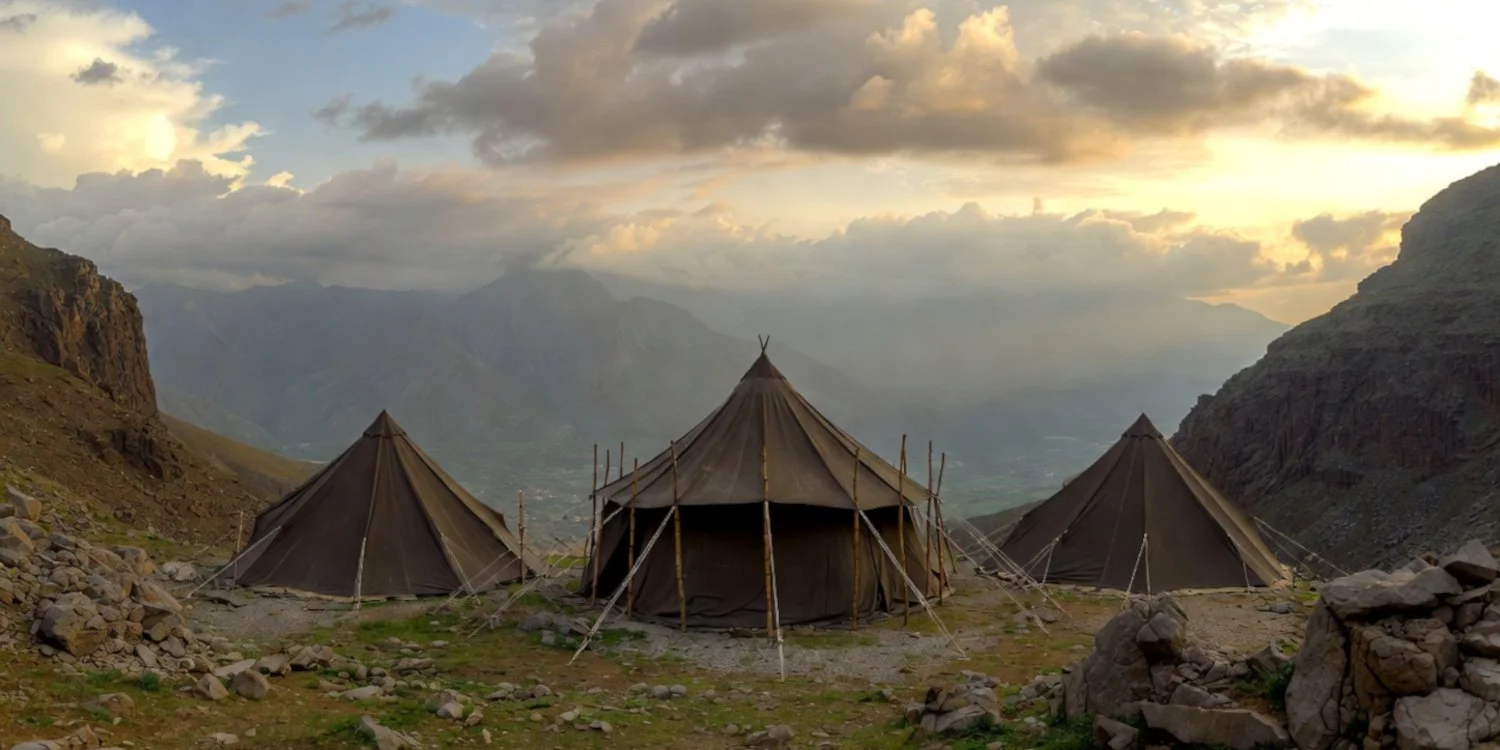
The Feast of Tabernacles
The entire Gospel account of Transfiguration takes place against the backdrop of the Feast of Tabernacles. This is why, in his dreamlike ecstatic state, Peter wants to delay the parting of Moses and Elijah from Jesus by saying,
“Master, it is good that we are here. Let us make three tents, one for you, one for Moses, and one for Elijah.”
Peter misinterprets the reason why they are all present in that place as being the annual Harvest Feast of Tabernacles (or tents), called in Hebrew, “Sukkot.” It is one of three Pilgrimage Feasts in the Hebrew calendar. It was originally a harvest feast, something like the American Thanksgiving, and called the “Feast of Ingathering” in the earliest Hebrew traditions. It lasts for seven days.
As I researched the connection between the Feast of Tabernacles, with its origin in Exodus 23:16, and the Transfiguration of Christ some thirteen centuries later, I came upon a long and detailed article about its history. As I studied the article, I was shocked to see at the end that it was written by my uncle, the late Father George W. MacRae, a renowned Scripture scholar who became rector of the École biblique et archéologique française de Jérusalem and Stillman Professor of Catholic Studies at Harvard University. It was an article he wrote for Catholic Biblical Quarterly in 1960, much of which became included in the New Jerome Biblical Commentary.
The Feast of Sukkot — variously interpreted as Tabernacles, Tents, Huts or Booths — had its roots in early Palestine as little huts were built in the fields, orchards and vineyards during the harvest. Much later, the Pilgrimage Feast was given a deeper religious meaning when it became connected to the events of the Exodus as a memorial to how the Israelites lived during their forty years of wandering in the desert after following Moses through the Red Sea.
It is an irony of Biblical proportions that this formed the scene for the revelation of Jesus as the Son of God about to enter Jerusalem for the New Exodus, the Exodus through the Red Sea of sin and death. It is the Exodus of the Cross through which Jesus will lead us to the New Jerusalem, the Promised Land, if we pick up our Cross and follow Him.
“This is my Son, my Chosen. Listen to him.”
— Luke 9:35
+ + +
Note from Father Gordon MacRae: Thank you for reading and sharing this post. You may also like these related posts from Beyond These Stone Walls:
Qumran: The Dead Sea Scrolls and the Coming Apocalypse
He Has His Mother’s Eyes: The Vision of Our Lady of Guadalupe
“What Shall I Do to Inherit Eternal Life?” (Luke 10:25)
On Good Authority, “Salvation Is from the Jews”
Readers have told us that our Sacred Scripture collection, The Bible Speaks, is a treasure trove of meaningful biblical literature and fine reading for Lent.
Don’t be a stranger. Follow Father Gordon MacRae on X.

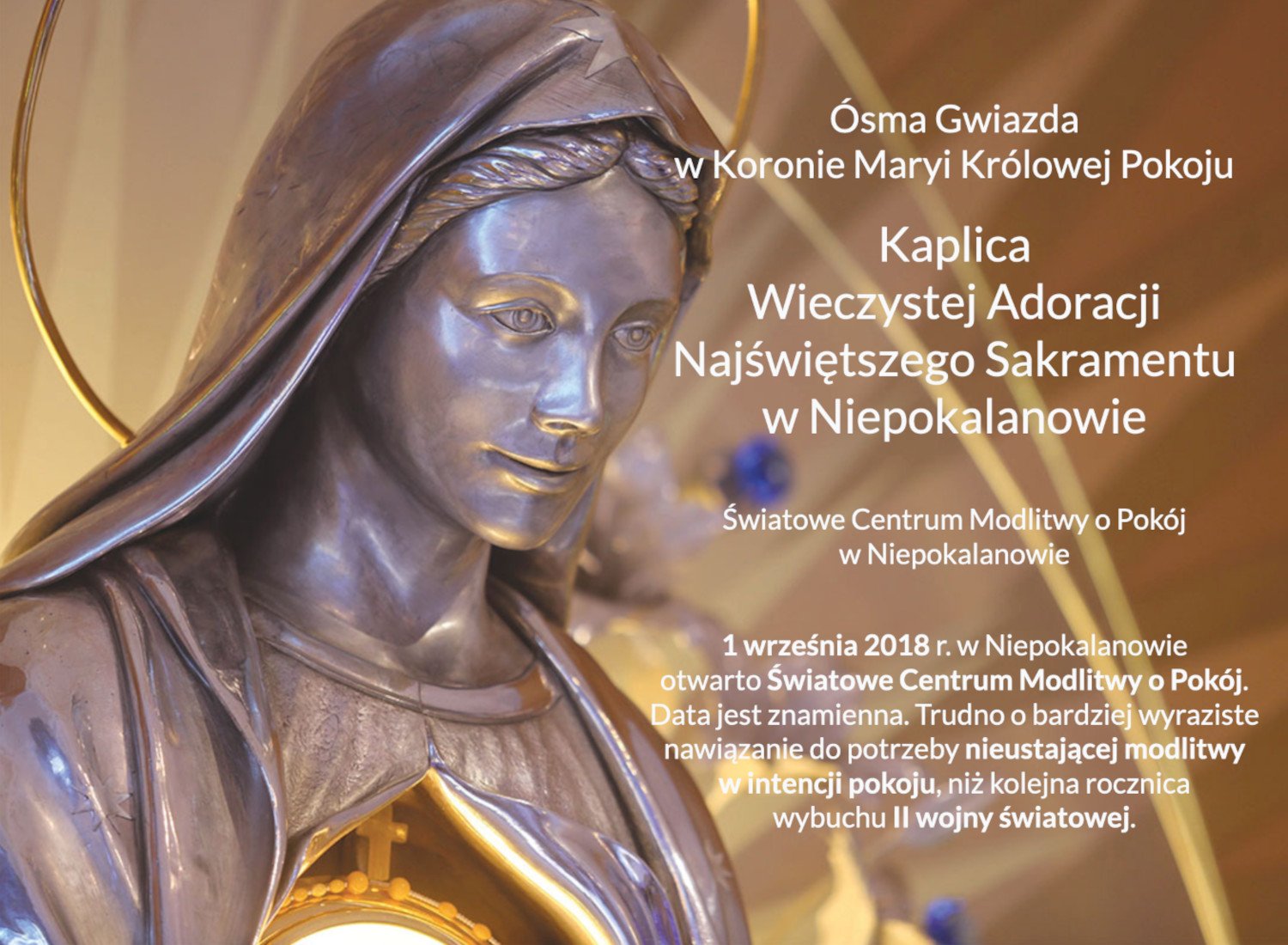

The Eucharistic Adoration Chapel established by Saint Maximilian Kolbe was inaugurated at the outbreak of World War II. It was restored as a Chapel of Adoration in September, 2018, the commemoration of the date that the war began. It is now part of the World Center of Prayer for Peace. The live internet feed of the Adoration Chapel at Niepokalanow — sponsored by EWTN — was established just a few weeks before we discovered it and began to include in at Beyond These Stone Walls. Click “Watch on YouTube” in the lower left corner to see how many people around the world are present there with you. The number appears below the symbol for EWTN.
Click or tap here to proceed to the Adoration Chapel.
The following is a translation from the Polish in the image above: “Eighth Star in the Crown of Mary Queen of Peace” “Chapel of Perpetual Adoration of the Blessed Sacrament at Niepokalanow. World Center of Prayer for Peace.” “On September 1, 2018, the World Center of Prayer for Peace in Niepokalanow was opened. It would be difficult to find a more expressive reference to the need for constant prayer for peace than the anniversary of the outbreak of World War II.”
For the Catholic theology behind this image, visit my post, “The Ark of the Covenant and the Mother of God.”

Qumran: The Dead Sea Scrolls and the Coming Apocalypse
The community of believers that left behind the Dead Sea Scrolls at Qumran awaited an apocalyptic battle between the Children of Light and the Children of Darkness.

The Angel Michael Binding Satan (“He Cast him into the Bottomless Pit, and Shut him up”), 1805 drawing by William Blake.
The community of believers that left behind the Dead Sea Scrolls at Qumran awaited an apocalyptic battle between the Children of Light and the Children of Darkness.
My annual Holy Week post this year was somewhat unusual. It profiled an announcement from the government of Israel about a new archeological discovery in the general region of Qumran in modern day Jordan. The discovery includes 2,000 year-old remains of the Bar Kochba rebellion against the Roman occupation of Jerusalem about 100 years after the Crucifixion of Jesus. My post was, “The Passion of the Christ in an Age of Outrage.”
It told the story of Bar Kochba and a revolt by residents of Jerusalem against the secular suppression of their religious beliefs by Roman Emperor Hadrian in the Second Century AD. The story has many parallels with current events and especially with the growing “cancel culture” disdain for Catholics, our faith, and our public witness of that faith.
Several readers have since asked me to write about the Dead Sea Scrolls, their place in Salvation History, and their connection to Sacred Scripture. Understanding the mindset of those who created and left behind the Dead Sea Scrolls can inspire and empower our own struggle against forces in our own time seeking to eradicate and silence our religious convictions.
First, a little geography. It’s ironic that I am typing this post on my 68th birthday. In the 16 years Pornchai Moontri was here with me, he organized an annual birthday acknowledgment among prisoners I knew. Part of its ritual was the unveiling of a birthday card by a local inmate-artist. The cards were always insulting, but hilarious. One of them declared, “When Father G was born, the Dead Sea was only sick!” One of the other cards was about Latin being my first language. Hmmph!
Anyway, regarding the Dead Sea, Pornchai was not so far off the mark, but its geography is very interesting. It is the lowest inland body of water on Earth. Its surface is 1,290 feet below sea level, and it reaches a depth of 1,300 feet. It is fed by the Jordan River and several smaller streams. The Biblical cities of Sodom and Gomorrah (Genesis 18) have long been thought to lie under the waters of the Dead Sea’s southern end.
The term, “Dead Sea” is mentioned nowhere in Scripture. It was known as the Salt Sea in Genesis (14:3) and Deuteronomy (3:37). The Prophet Ezekiel called it the Eastern Sea. The Roman historian Josephus called it the Asphalt Sea. Owing to evaporation, its salt concentration is the highest of any body of water on Earth. Neither animal nor plant life can live in it or around it. But in Biblical times in the valley created by the Dead Sea, there were several settlements such as Qumran and Masada.
In 1947, quite by accident, scrolls were discovered in ancient jars in a cave near the Dead Sea by two nomadic Bedouin shepherds who sold them to antiquities dealers. The writings made their way to the Hebrew University of Jerusalem. To the amazement of the Judeo-Christian world, the scrolls contained intact Hebrew and Aramaic books of the Bible composed between 250 BC and 70 AD, the latter being the date of the destruction of Jerusalem and the Temple mentioned in my post linked above.
In 1956, multiple excavations in multiple caves at the site yielded some 800 manuscripts containing complete scrolls and thousands of fragments of virtually every book of the Hebrew Bible. Some ancient apocryphal and Deuterocanonical texts were also discovered and I will write more about these below. A decades-long scholarly translation of the discoveries was set in motion. One of the translators was my late uncle, Jesuit Father George W. MacRae, a renowned Biblical scholar and expert in ancient Semitic languages and texts at Harvard University and the Institute Biblique in Jerusalem.

The Essenes: The Community behind the Scrolls
After decades of excavation and historical analysis, scholars have settled on the identity and origin of the group that created and preserved the scrolls. They arose in the years after the Maccabean Revolt in 167 BC. Hellenism — Greek civilization — spread throughout the Eastern Mediterranean region after the conquests of Alexander the Great. Jerusalem, the center of Jewish thought, culture and religion, experienced a wave similar to the progressive “cancel culture” movement of today. The elite among the aristocracy of Jerusalem fostered a strong movement toward Hellenism, and the replacement of Judaism with Greek traditions.
The majority of the Jews in Jerusalem were conservative and resisted this movement. Most, however, did not have the voice and the influence of the left-leaning liberal elite. Signs of rebellion and civil unrest gave the newly installed king of Syria, Antiochus Epiphanes, the excuse he needed to suppress conservative thought and practices among the Jews. He did this by demoralizing them. In 168 BC, his army plundered the Temple and its treasury. They suppressed Jewish worship and the sacred Books of the Law, the Torah.
The final straw came with the “Abomination of Desolation” as described in the Book of Daniel (9:27). Antiochus took the Temple, removed the Torah, and replaced it with an altar to the mythological Greek god, Zeus. This triggered a revolution by Judas Maccabeas and his family which became the central story of the First Book of Maccabees. In 165 BC, the Maccabees led by Judas forcefully retook the Temple, deposed the statue of Zeus, and restored the sanctuary. They held it for eight days while awaiting reinforcements. This is the origin of the Jewish Festival of Hanukkah.
The two predominant religious sects in Jerusalem at that time, the Pharisees and Sadducees, were both tolerant at best, and at worst accommodating, to the Hellenist conquerors just as they would be to Caesar nearly two centuries later. I wrote of their plot in “The Chief Priests Answered, ‘We Have No King but Caesar’ .”
To those who have been paying attention to recent trends in our own time and culture, this should all have a ring of the familiar. Just as with the revolt of the Maccabees, resistance is not at all futile. So resist — with fidelity as your sword and Divine Mercy as your shield — the Abomination of Desolation that is being handed to us by the “woke” elite around us. Many have the spiritual depth of mud puddles.
Sorry for the editorial. By 150 BC, the accommodations of the Pharisees and Sadducees toward the wave of Hellenistic culture resulted in the emergence of a third religious identity in Israel, that of the mysterious Essenes. Jews returning from exile in Babylon heard of the successful revolt of the Maccabees and were inspired by it. Their communal reaction was to focus on fidelity to the Covenant. They came to be known by history as Essenes — Hebrew for “Pious Ones.”
The Essenes are not mentioned by name in Sacred Scripture. This was possibly due to the quiet and secret nature of their rebellion. The historian, Pliny the Elder, mentions them as having emerged as a community on the Western shore of the Dead Sea at a place that, by his description, could be none other than Khirbet Qumran. Philo and Josephus, two other historians of the period, describe the Essenes in more detail and their descriptions correspond seamlessly to what is now known of the record they left behind: the Dead Sea Scrolls.

The Dead Sea Hosts a Living Faith
The Essenes lived as a structured community believing that over Israel’s entire history, God had prepared for this Community of the New Covenant. The Prophet Habakkuk wrote in this same period that for all those who observe the Law among the Jews, God will deliver from judgment because of their suffering and because of their faith in a Holy One. Habukkuk identifies their time as the final time, but now prolonged according to the mysterious plan of God. This was also a time when expectations of a Messiah and life beyond death became prominent themes in Israel.
In the decades after the Maccabean revolt that restored the Jerusalem Temple after its desecration by Antiochus Epiphanes, the concept of an apocalypse spread widely throughout Judaism. The prophetic witness of the Book of Daniel, composed at about the same time the Essenes formed, was highly influential. This influence continued well into the early Christian era.
The discovery of the Dead Sea Scrolls brought to light the existence of the Essene sect whose way of life was heavily influenced by apocalyptic ideas as a reaction to what they saw as the secular infringement upon their Jewish, and later Jewish-Christian, faith. These ideas included an emphasis on exploration of the heavenly mysteries and a sense of participation in the angelic realm. Their commitment to fidelity and a community of faith was to prepare them for an epic final battle between the Children of Light and the Children of Darkness — a battle that raged in both the spiritual realm and the Earthly one.
The Essenes had an influence that reflected far beyond their separatist community hidden for twenty centuries in Qumran on the Western shore of the Dead Sea. Their emphasis on apocalyptic ideas came to be widely accepted. This included a belief in resurrection from the dead and eternal life, a belief that was embraced by the Pharisees and gradually entered the mainstream of Jewish faith by the time of Jesus. The argument could be made that this development was in preparation for the time of Jesus.
It is now widely believed among scholars that the Essenes had a connection with John the Baptist. In the Dead Sea Scrolls about their own community, they described themselves in words identical to those ascribed to John the Baptist in each of the Gospels (see Luke 4:18-19). Both were citing Isaiah 40:3, “The voice of one crying in the wilderness, prepare the way of the Lord, make straight in the desert a highway for our God.”
It also appears that the Essenes had an influence on the Gospel of John, the last of the four to come into written form around 90 AD. It was once believed that this Gospel was heavily influenced by Hellenistic philosophical ideas. The Dead Sea Scrolls made clear that John’s Gospel is solidly rooted in Jewish thought and traditions faithful to the Covenant, the Law and the Prophets.
The apocalyptic traditions of the Essenes were also influenced by the Book of Enoch, a Second Century BC work considered by Jewish scholars as a Deuterocanonical text. “Deuterocanonical” is a Scriptural term derived from Greek meaning “Secondary Canon.” Enoch and some other books considered to be deuterocanonical were accepted in the Jewish Canon of Scripture well into the time of Jesus until about 90 AD. After the destruction of the Jerusalem Temple — a cataclysmic event for Judaism and one predicted by Jesus — the apocalyptic ideas of Enoch diminished.

Michael Contends With the Devil
Other books considered to be outside the Canon of Hebrew Scripture but later accepted in the Catholic Canon were Judith, the Wisdom of Solomon, Sirach (also called Ecclesiasticus), Baruch, First and Second Maccabees, and the Book of Tobit which was analyzed here recently in “Archangel Raphael on the Road with Pornchai Moontri.”
The Book of Enoch is especially interesting because it had a wide influence on the Essenes — and therefore is also prominent among the Dead Sea Scrolls. Enoch also had an influence on some early Christian writings of Jude, Barnabas, and Irenaeus. Among the Christian Patriarchs, Tertullian regarded it as Scripture while Augustine and Jerome saw it as apocryphal, but influential. In the New Testament Letter of Jude (Jude 9) the Apostle refers to a story that appeared nowhere else but the apocryphal book, The Assumption of Moses, and in references in the Book of Enoch. He wrote as though this account was highly familiar to both Jews and Jewish Christians:
“When the Archangel Michael, contending with the devil, disputed about the body of Moses, he did not presume to pronounce a reviling judgment upon him [which would have been the purview only of God] but said, ‘The Lord rebuke you.’”
The Letter of Jude included a reference to this story from an apocryphal book without explanation. This implies that the story was well known among the Jews of this period. In the story, Moses died in the desert without ever entering the Promised Land. Satan tried to take the body of Moses but the Archangel Michael fought him and won. Michael then escorted the physical body of Moses to Heaven. In the Hebrew Scriptures, only one other human being was taken into Heaven for eternity. It was Elijah. It is for this very reason that Moses and Elijah could appear with Jesus in the Gospel account of the Transfiguration (see Luke 9:28ff) where they represent the Law and the Prophets, the two pillars of Jewish tradition.
It is possible that the Essenes latched upon the Book of Enoch to preserve it. Though composed in their time (the Second Century BC) it is named for the Enoch of Genesis, father of Methuselah. Here is the Genesis account of Enoch: At the age of 65,
“Enoch walked with God after the birth of Methuselah three hundred years ... thus all the days of Enoch were three hundred and sixty-five years. Enoch walked with God and he was not, for God took him.”
Enoch appears, by adoption through the line of Joseph, in the genealogy of Jesus in the Gospel of Luke (Luke 3:37).
It was not lost on the writers of the Book of Enoch — or on the Essenes — that the number of his years was also the number of days in a single year. The Book of Enoch explores the Genesis reference to Enoch being taken bodily into heaven for 300 years, and is filled with visions of the cosmos, of angelic tours of the heavenly realm, of the abode of the dead awaiting redemption, and of a pre-existent Son of Man. It is likely that the Essenes sought to preserve it because it was Israel’s first example of a developed apocalyptic faith and the expectation of resurrection.
All of this apocalyptic tradition — and its call to arm for battle in spiritual warfare between light and a growing darkness — entered both Judaism and Christianity as a result of elitist secular values and their infringement upon our lives of faith. The Essenes were short lived. They died out along with the Jerusalem Temple destroyed by the Romans in 70 AD. That their legacy emerged into our world by “accident” 2,000 years later is a gift to our time.
And perhaps there is more of this gift to come. The apocalyptic message of Daniel, also influential to the Essenes, hints at books that are shut up until the end of time:
“At that time shall arise Michael, the great prince who has charge of your people. And there shall be a time of trouble, such as never has been since there was a nation ... but at that time your people shall be delivered, every one whose name shall be found written in the book. And many of those who sleep in the dust of the Earth shall awake, some to everlasting life and some to everlasting contempt ... But you, Daniel, shut up the words and seal the book until the time of the end.”
+ + +
Note from Father Gordon MacRae: Writing from prison is difficult, and has become even more so in this time of pandemic. I rely on the postal service to mail my weekly post for scanning, and I am unable to make a photocopy so I mail the only copy I have. If there is a delay (there have been two late arrivals in the last four weeks) I have no way to inform readers.
It would help much if you would subscribe. This way, you receive a notice of a new post in your inbox even if we are a bit late in posting. We will invade your email only once per week. If you have not already done so, please click “SUBSCRIBE.”
Please also share this post, and these related posts that appear herein:
The Passion of the Christ in an Age of Outrage
The Chief Priests Answered, ‘We Have No King but Caesar’
Archangel Raphael on the Road with Pornchai Moontri
and one I didn’t mention, but should have:
