“There are few authentic prophetic voices among us, guiding truth-seekers along the right path. Among them is Fr. Gordon MacRae, a mighty voice in the prison tradition of John the Baptist, Maximilian Kolbe, Alfred Delp, SJ, and Dietrich Bonhoeffer.”
— Deacon David Jones
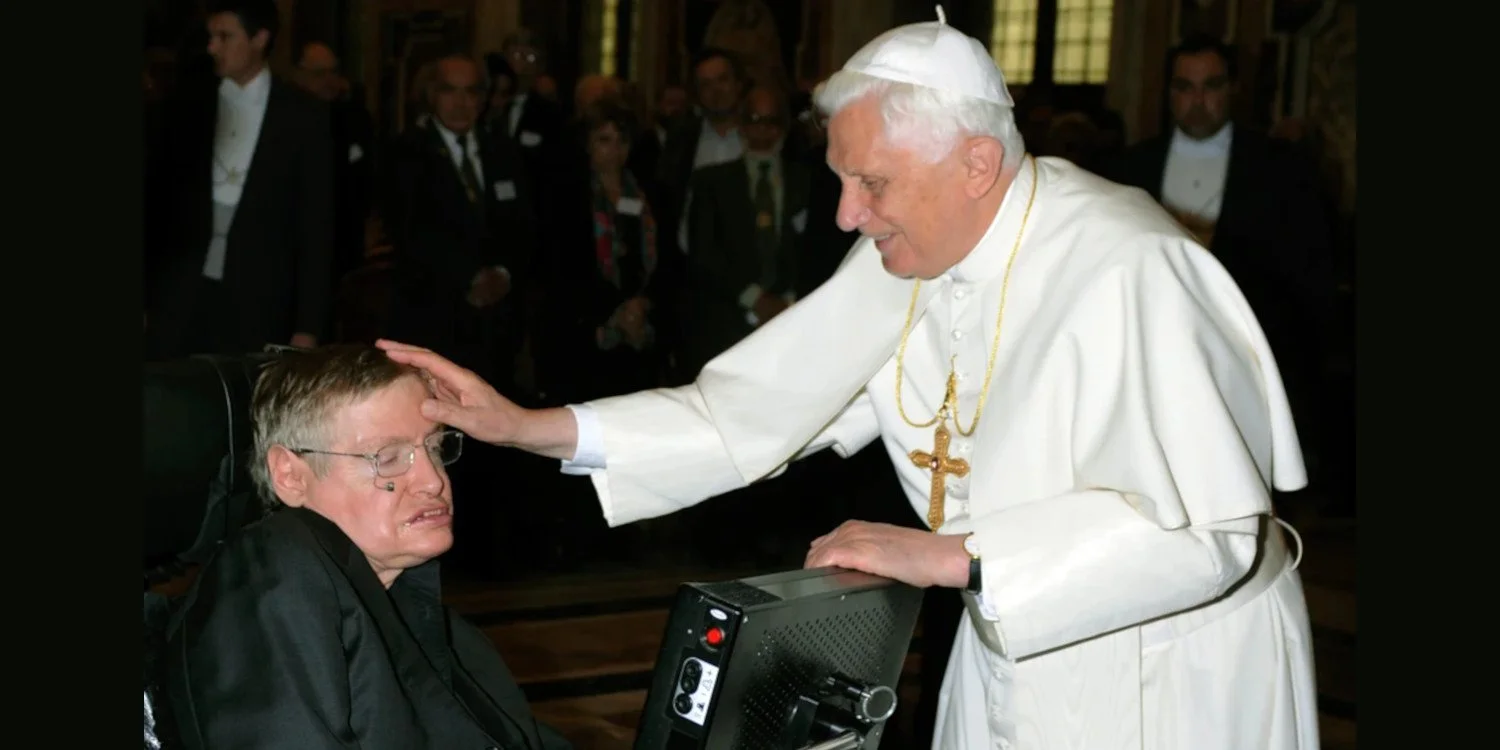
Did Stephen Hawking Sacrifice God on the Altar of Science?
Physicist, Stephen Hawking, died on March 14, 2018. His book, The Grand Design, caused many to believe that he widened the chasm between science and faith.
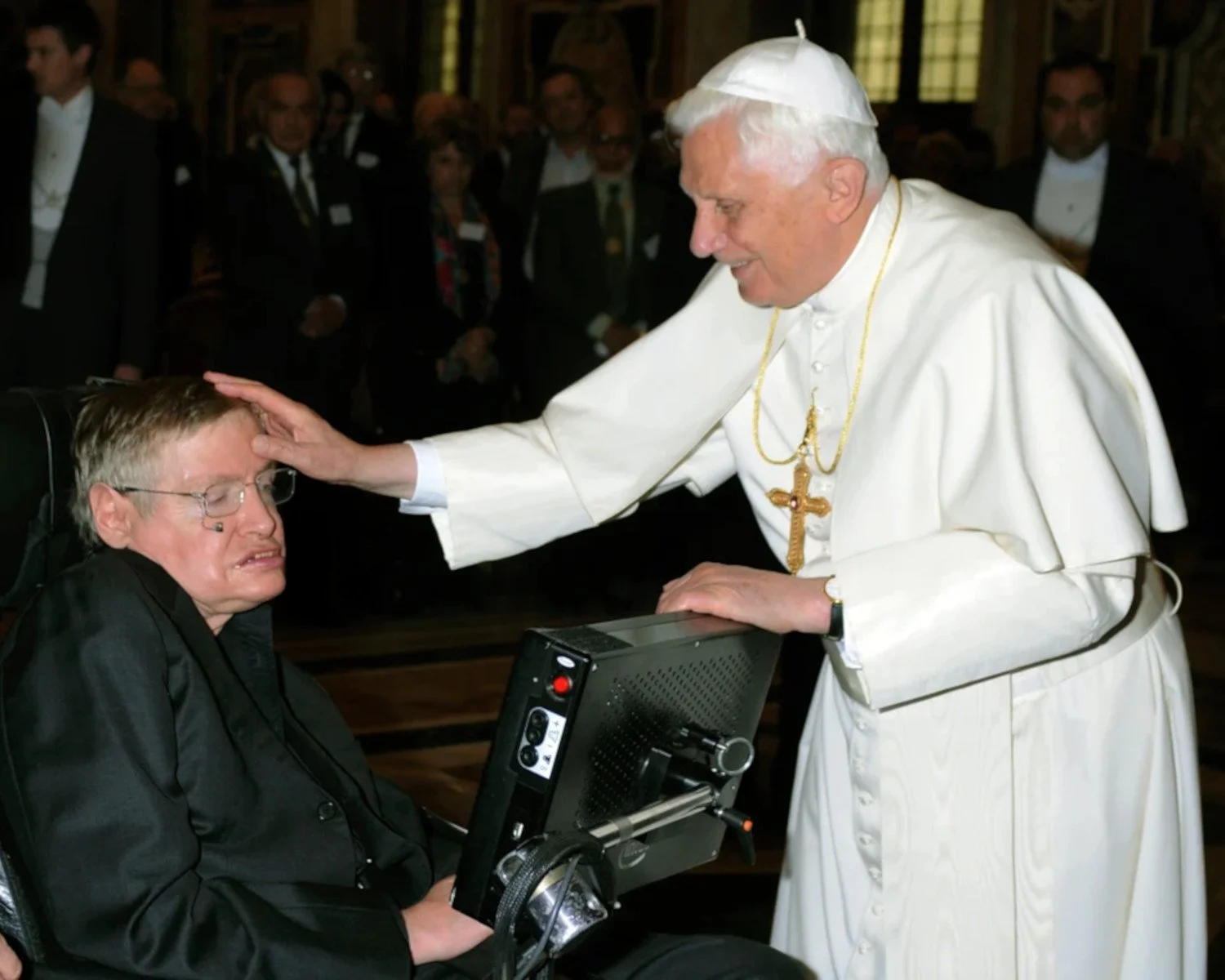
Physicist, Stephen Hawking, died on March 14, 2018. His book, The Grand Design, caused many to believe that he widened the chasm between science and faith.
July 30, 2025 by Father Gordon MacRae
Back in 2010, in the earliest days of this blog, I wrote a post about the late, great physicist, Stephen Hawking. It was among my first posts about the dichotomy between science and faith. A controversial book, The Grand Design, published not long before I wrote about Professor Hawking, caused many to believe that he was an atheist who concluded that there is no reason to believe that God created the Universe or anything else. He attributed all of creation to one overpowering force, gravity. At the time I was pondering a response, I imagined that if I had been on an archeological dig among 15th Century ruins in Rome and found a worn chisel that was known to have belonged to Michelangelo, and used to create the Pieta, what sort of controversy would that entail? Would naysayers suggest that Michelangelo did not thus create the Pieta, his chisel did. That is the simplest response to anyone who used gravity to demonstrate that Stephen Hawking did not believe in God. God created not only the material Universe, but also all the material tools that brought the Universe into being.
Also a few weeks before I first wrote about Hawking, Pope Benedict XVI beatified John Henry Cardinal Newman in Birmingham, England. The Holy Father emphasized Cardinal Newman’s “insights into the relationship between faith and reason,” and commended him for applying “his pen to many of the most pressing subjects of the day.” Without doubt, Cardinal Newman also might have had a pointed response to the media tremors after physicist and author, Stephen Hawking declared that science can explain the creation of the Universe without God.
I mentioned Stephen Hawking in another 2010 post, “A Day Without Yesterday: Father Georges Lemaitre, and The Big Bang.” His declaration about creation came in The Grand Design. Many in the media called it a definitive statement about the existence of God. It was no such thing, but the news media cannot be accused of a lack of trying to diminish the faith of billions.
I cannot claim to have even a fraction of the gifts of faith and reason that Saint John Henry Newman would call upon to respond, but as a priest who respects science, I feel driven to weigh in. First, I have to confess that I had not by then read The Grand Design, but I eventually did. However, in a full-page article in The Wall Street Journal in 2010, Stephen Hawking and Leonard Mlodinow laid out the cosmology behind the book and their conclusions (“Why God Did Not Create the Universe,” September 4-5, 2010).
It is to that article that I here respond. If you have a concern for the implications of Professor Hawking’s pronouncement that God had nothing to do with bringing you and your world into being, please read on. There is a lot at stake here. I will address this from two points of view.
My Response as a Priest
Like Father Georges Lemaitre and Saint John Henry Newman, my response is first and foremost that of a Catholic priest. I have known many priests who have struggled with faith and some who have lost their faith. I correspond regularly with a priest who lost his faith years ago. Now this declaration by Stephen Hawking feels like a nail in faith’s coffin for him. I have lived 72 years of struggle over the question of God. I have arrived — in spite of toil, trial and tribulation, and more than my share of each — at what I think is a more than tepid faith in God’s existence and in His Grand Design. I believe in His creation of our existence. I believe in His enduring and caring Presence in this life and the promised life to come. I believe that our relationship with Him can survive this life if we walk the path He has shown to us. I wrote about that path in a recent post, “What Shall I Do to Inherit Eternal Life?”
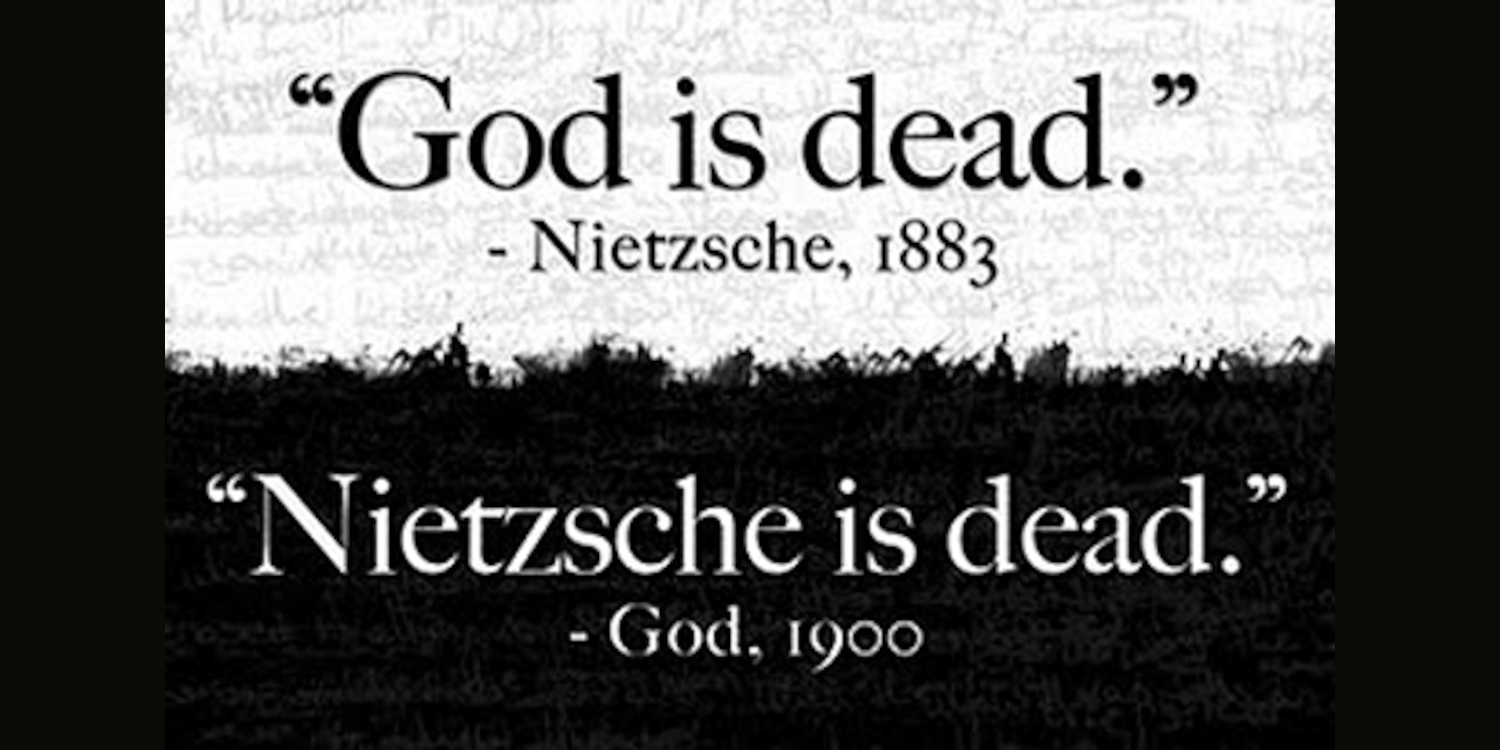
I have read nothing in any of Stephen Hawking’s writings that causes me to wonder whether my faith conclusions are valid. I write as a priest and believer. My faith and my priesthood both came into being in a time of great social upheaval. The existential philosopher, Frederick Nietzsche (1844-1900) seemed to rule the reasoning — or lack thereof — of the 1960s. His contempt for Judaism and Christianity, and his cynical view that mankind is but a herd at the mercy of the ruling and gifted intellectual elite, marked the dawn of the “God is Dead” movement. The bumper stickers were everywhere:
“GOD IS DEAD!” Nietzsche
In the 1970s, that sorry and narcissistic wave began to dissipate, but not before destroying the faith of many who bought into it. I remember buying a bumper sticker for my seminary room door in 1978:
“NIETZSCHE IS DEAD!” God
The three masters of deceit — Freud, Marx, and Nietzsche — are all dead and not only their persons but their ideologies as well. Each reduced man to his basest, soul-less drives, and each in his own way was an enemy of faith. I do not count Stephen Hawking among them. Contrary to what the news media was lifting out of his latest book — and out of context — Stephen Hawking did not denounce God, nor does he claim to have proven that God does not exist. The exact quote that so many in the media now read into from his WSJ article cited above, and from his book is this:
“The discovery recently of extreme fine-tuning of so many laws of nature could lead some back to the idea that the grand design is the work of some grand Designer. Yet the latest advances in cosmology explain why the laws of the universe seem tailor-made for humans, without the need for a benevolent creator.”
But who would then explain the identity of the Tailor? This comes as no great revelation. One might expect that I, as a priest, would proclaim that the Universe was brought into being and maintained, at least in part for our benefit, by a Divine Creator whose title is also His name: God. But did anyone really expect Stephen Hawking, or any cosmologist to make the same declaration? What Professor Hawking has written is neither new nor surprising in cosmology. I do not, and will never have a faith that depends on science to finally and definitively weigh in on God’s existence and creation of the Universe. Science should never be able to do this to the satisfaction of any person of faith. To say that science can explain creation without God is not to say that God did not create everything — including the science and scientists trying to nudge Him from center stage. Faith is far more than the dictates of reason and the pronouncements of science. Our tradition of faith does not reduce God to His quantum mechanics, and does not promise to teach all there is to know about the created Universe or the laws of physics.
Our faith promises that we can know God through Christ in a personal relationship without fully explaining God. Who in this world can claim to fully comprehend God? Certainly not I. Faith is not an event, and science does not make or break it. Faith is a pilgrimage, and like any pilgrimage, most of us will have times of wandering, and wondering whether we will ever arrive, whether we will ever get to the point at which there are no doubts. That is the point of faith. It is its own evidence.
“Faith is the assurance of things hoped for; the conviction of things unseen”
— Hebrews 11:1
Faith at some point involves an assent of the intellect (Catechism of the Catholic Church, 155) to the revealed truth about God Himself. Central to that truth is the redemption offered to us through Christ who not only reveals God to man, but “fully reveals man to himself” (Gaudium et Spes, 22). None of us looks to Stephen Hawking, or to science, to reveal the truth about God. Faith in God and His creation can no more be subjected to the scientific method than science can legitimately be subjected and defined in the light of faith. Who among us, when faced with life’s inevitable crises, ever cried out to Stephen Hawking for mercy or for redemption?
The greatest physicist of the 20th Century, Albert Einstein, never pondered God until his discussions with fellow physicist Father Georges Lemaitre. When those discussions proved to Einstein that the Universe came into being at a specific point some 13.2 Billion years earlier, Einstein responded, “I want to know God’s thoughts. The rest are just details.”
My Response as a Student of Science
I write secondly with a lifelong respect for science as a tool, not for understanding God, but for understanding the mechanics of the Universe in which we exist. This has been not so much a journey of the mind, but of the heart and soul. I at one time thought quantum mechanics referred to guys who worked on Volkswagen Beetles. To my great fortune, my mind has expanded a bit since then.
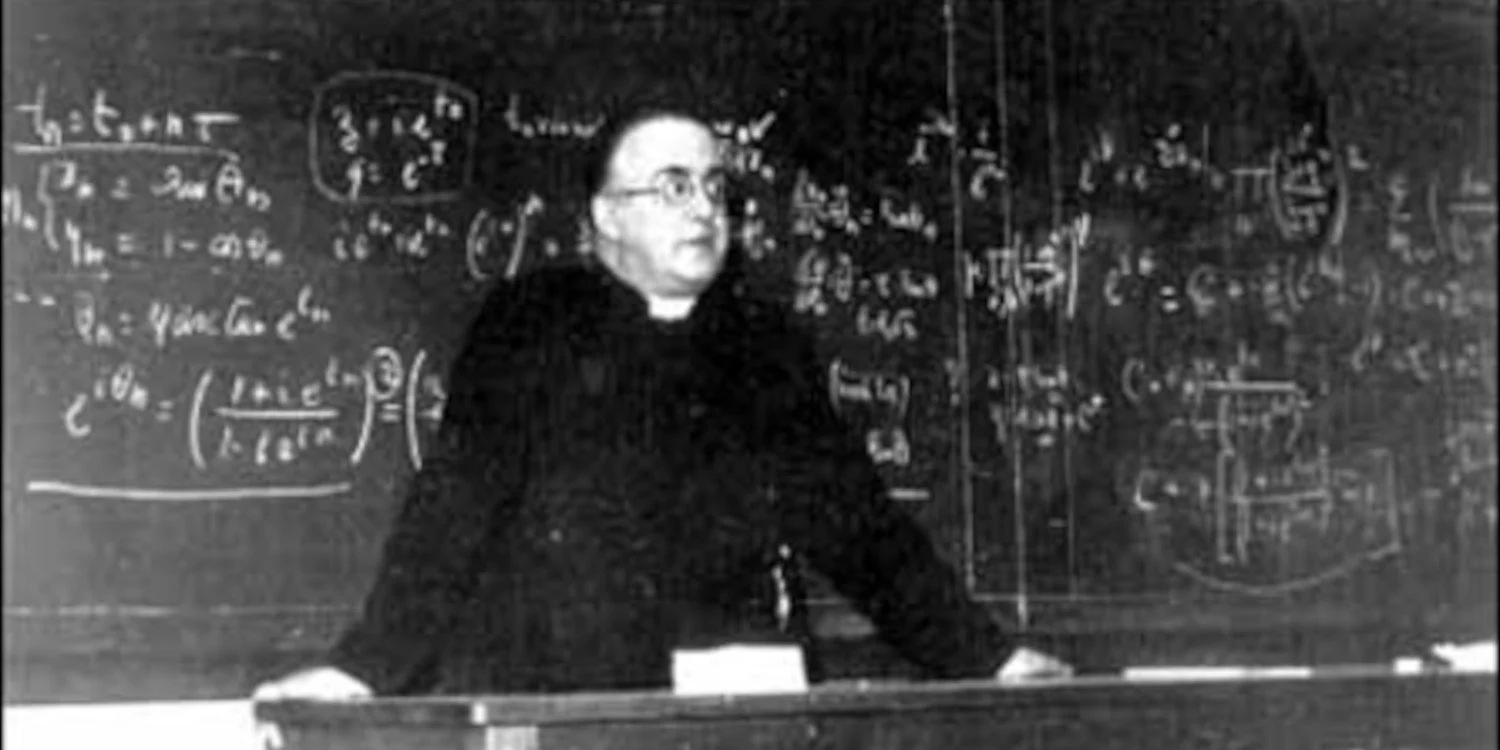
I have several times written of one of my heroes on the parallel journeys of both science and faith. One of these posts, “A Day Without Yesterday” is the story of priest, mathematician and physicist, Father Georges Lemaitre, the originator of the Big Bang explanation of cosmology and the man who changed the mind of Albert Einstein on the origin of this created Universe.
A French publication, Les Dossiers De La Recherche (No. 35, May 2009) had an interesting article entitled “Le Big Bang Histoire: De La Science A La Religion” (“The History of the Big Bang: From Science to Religion”). I am grateful to my Belgian friend, Pierre Matthews (who is also the Godfather of Pornchai Moontri). Pierre and his family knew Father Georges Lemaitre well and they translated into English this portion of the article cited above in French:
“Pope Pius XII, an enthusiastic amateur astronomer, addressed the Pontifical Academy of Sciences in 1951. His talk dealt with recent findings in cosmology stating: ‘It appears truly that today’s science going back millions of centuries has succeeded to witness the initial ‘fiat lux’ [Let there be light], coming out of nothing, that very moment of matter and ocean of light and rays, while the chemical components of particles split and assembled into millions of galaxies.’
“Pope Pius XII referred openly to Fr. Georges Lemaitre’s scenario. But this ‘concordism’ assumed to exist between revealed truth and science is counter-publicity for those, among them Fr. Georges Lemaitre, wanting a total and independent separation of the history of the Universe, evolution, and religious truth.
“Following a meeting with Fr. Lemaitre, Pope Pius XII a year later rejected, before the General Council of the International Astronomical Federation, any concordance between the two fields: science and faith. For Father Lemaitre, this was a double victory: cosmology can develop in total freedom and religion should no longer fear contrary positions based on new scientific discoveries.”
Why was Father Georges Lemaitre so insistent that the Pope should declare no concordance between faith and science? The obvious reason is that, for Father Lemaitre — a man of deep faith and a brilliant physicist and cosmologist — faith and science are parallel fields and should never limit each other. The Church suffered a black eye for its condemnation of Galileo’s views about science four centuries ago, but science has often seemed utterly ridiculous for holding the Church in contempt for not responding to science in 1660 as it would in 2025.
In 2005, noted science writer, Chet Raymo wrote a blog post entitled “The Future of Catholicism” on his Science Musings blog (April 10, 2005). Raymo wrote:
“In spite of the pope’s outreach to the scientific community, the Church has been slow to understand the theological implications of the scientific world view. The Church’s truce with modern cosmology and biology is uneasy at best, although certainly more enlightened than the outright rejection by fundamentalist faiths.”
Chet Raymo was right, but in a limited way. He very much understated the appreciation for scientific achievement demonstrated by the Church in the last century. We can expect this to improve greatly during the pontificate of Pope Leo XIV whose own education includes a degree in Mathematics, which leaves him well disposed to the work of Fr. George Lemaitre.
I had a brief discussion about this some years ago with a fundamentalist Evangelical pastor I know. He is an educated man, a university graduate, and well read but only very narrowly so. I asked for his opinion of what I have written above about Stephen Hawking’s views.
His response came as no surprise, and it was little different from what we might have heard from one of the Calvinist Puritan founders of New England in 1620. His view was an utter rejection of science. “The Universe was created by God in six days about 6,000 years ago. There is no such thing as poetic and metaphorical language in Scripture.” I asked him how he would explain the discoveries of bones that are many tens of millions of years old, or the fact that we can see galaxies that are millions of light years away. His answer was to simply ignore the questions. Of course, this man also believes that the Catholic Church is the anti-Christ, the “Whore of Babylon.” He believes it is not only science that is condemned, but the Catholic Church as well, and he would cite the Church’s nod to science as evidence for that view.
Science is the empirical examination of the physical Universe. Gone are the dark days in which science and religious dogma demanded conformity one with the other. There are legitimate forums for dialogue, however. It is more than ironic that Stephen Hawking was a lifetime member of the Pontifical Academy of Science. There were calls for him to resign after he wrote The Grand Design, but I believed then that he should retain his position. Dialog should not require conformity, and the Church should not be daunted by diverse scientific views.
Using Father Georges Lemaitre’s model, Stephen Hawking should no more publicly weigh the legitimacy of Judeo-Christian belief in Creation as a design plan of God than the Pope should affirm or deny black holes. My concern for the controversy surrounding Stephen Hawking’s 2010 book is not that it encourages masses of believers to set aside their Catholic faith, as Chet Raymo declared to have done, but that it may have the effect of encouraging some Christians, Catholics among them, to set aside science. Either approach would be tragic.
Professor Hawking’s foray into the realm of faith does not change the way I perceive God. The very fact that I perceive God at all is its own evidence, “the conviction of things unseen,” (Hebrews 11:1). What it does change is my respect for the strides taken by science to speak also to the masses of people who are not scientists, but are people of faith open to science. There is a danger that science is gradually placing itself outside the experience of the great majority of people while claiming to enlighten its own elite. In this, there is a growing rift between science and the reality experienced by billions of people of faith.
The late Stephen Hawking’s view was in danger of sparking a return to the bad old days of Nietzsche, this time by the establishment of the “uber-scientist” for whom masses of faithful believers are but an ignorant herd. It is science, and not faith, that faces the greatest harm. Stephen Hawking presented that the laws of gravity, and not God, created the Universe we live in. I am not prepared to rewrite Scripture. It is not the experience of thousands of years of belief that “In the beginning, Gravity created the heavens and the earth.”
I have a response as a prisoner, too. I certainly believe in gravity, but there’s precious little solace in it, and it speaks nothing to the reality of my soul. Sorry, Professor. I respect your cosmology greatly, but I think you should not have thrown in with the wrong “G!”
I still like you, though, and I believe God does, too. He has inspired me to pray for you.
+ + +
Note from Father Gordon MacRae: Thank you for reading and sharing this post. Sharing is important to place these pages before believers who may benefit from them. For 15 years we shared posts at various Catholic groups on Facebook. A few months ago Facebook called my posts “spam” and froze our account. I can no longer share there, but you can, and I thank you if you do so.
You may also like these related posts from Beyond These Stone Walls:
“A Day Without Yesterday:” Father Georges Lemaitre and The Big Bang
Science and Faith and the Big Bang Theory of Creation
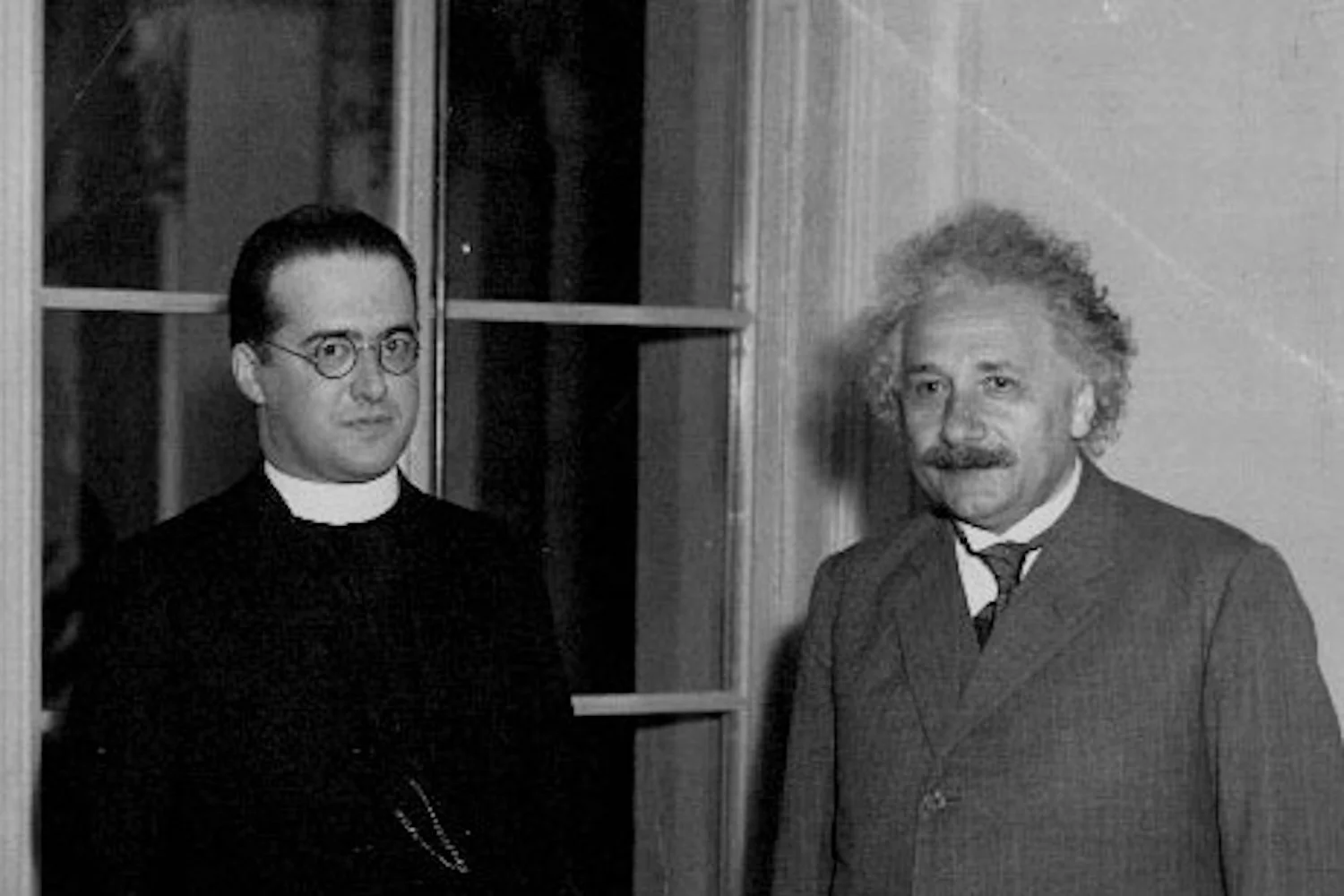
Albert Einstein and Fr. George Lemaitre at the California Institute of Technology in 1930.
"I want to know God' thoughts. The rest are just details." -- Albert Einstein

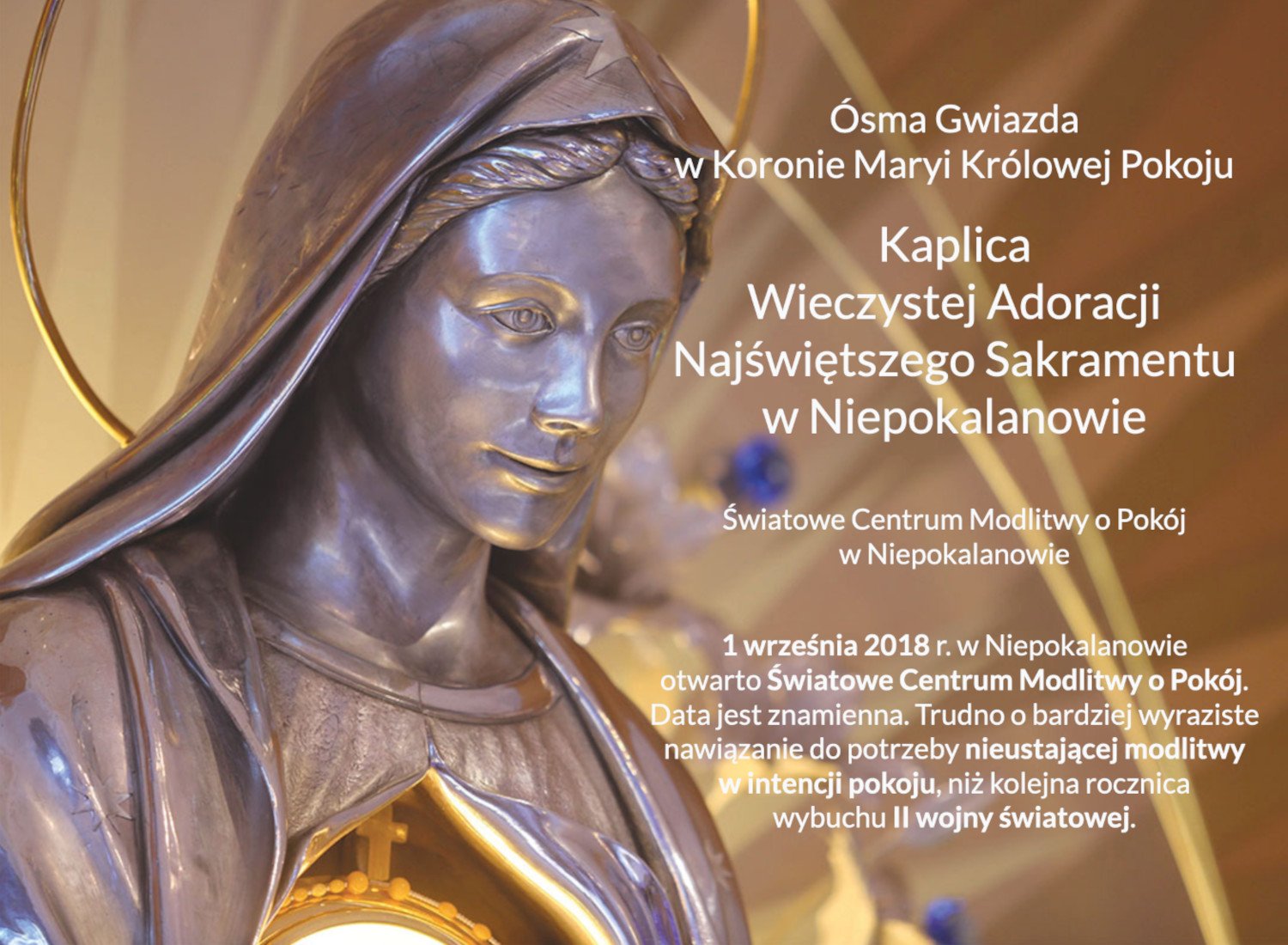

The Eucharistic Adoration Chapel established by Saint Maximilian Kolbe was inaugurated at the outbreak of World War II. It was restored as a Chapel of Adoration in September, 2018, the commemoration of the date that the war began. It is now part of the World Center of Prayer for Peace. The live internet feed of the Adoration Chapel at Niepokalanow — sponsored by EWTN — was established just a few weeks before we discovered it and began to include in at Beyond These Stone Walls. Click “Watch on YouTube” in the lower left corner to see how many people around the world are present there with you. The number appears below the symbol for EWTN.
Click or tap here to proceed to the Adoration Chapel.
The following is a translation from the Polish in the image above: “Eighth Star in the Crown of Mary Queen of Peace” “Chapel of Perpetual Adoration of the Blessed Sacrament at Niepokalanow. World Center of Prayer for Peace.” “On September 1, 2018, the World Center of Prayer for Peace in Niepokalanow was opened. It would be difficult to find a more expressive reference to the need for constant prayer for peace than the anniversary of the outbreak of World War II.”
For the Catholic theology behind this image, visit my post, “The Ark of the Covenant and the Mother of God.”

For Darryll Bifano, the Currency of Debt Is Mercy
Men facing death in this prison at one time died alone. Darryll Bifano is a prisoner and hospice volunteer who helped change that. In the process, he changed himself.

Men facing death in this prison at one time died alone. Darryll Bifano is a prisoner and hospice volunteer who helped change that. In the process, he changed himself.
Some time ago, I wrote a Scripture post that ended up being about death and thus scared some people off from reading it. Everyone has to face it, but few want to, and many spend their lives in denial of it. That post was, “The God of the Living and the Life of the Dead.” Despite its heavy dose of theology, it drew an unusual audience for Beyond These Stone Walls and was shared some 5,000 times on Facebook and other social media. Death touches everyone.
There was a pall over this prison as summer commenced this year. One of our friends, John, age 39, died of pancreatic cancer in the prison medical unit on June 10. It was a long and grueling death that saw him drift from the vibrancy of a healthy man in his thirties to an emaciated frame of his former self. Through it all, his alert mind grasped for meaning and connection.
There was a time when prisoners here died in empty isolation. Several years ago, one of my own roommates, 52-year-old Harvey, developed stomach cancer that slowly consumed his life. When he could no longer live among us, he died alone locked in a cold, bare room with four concrete walls and little human contact.
I pleaded at the time to visit Harvey and help take care of him but overwhelmed prison medical staff responded that there was just no process in place that allows for that. But in the last three years here, this has dramatically changed. A group of men — prisoners all — have come together to form a training protocol for a hospice team. Now in three-hour shifts around the clock, they sit, talk, walk and care for fellow prisoners who are dying.
My first deeply-felt gratitude to this hospice team came when our friend, Anthony Begin, died from cancer. I wrote of that journey in a post that shocked some readers. It was “Pentecost, Priesthood, and Death in the Afternoon.” I wrote about how Anthony was such a caustic personality, that I literally threw him out of my room one day. We did not speak for over a year until Pornchai Moontri told me one day that Anthony is dying.
Pornchai and I took over the care of Anthony, and in the process, he changed. So did we. Anthony was allowed to live in a bunk just outside our cell for his final months. When his condition came to the point of no return, we had to leave him in the medical unit where we would never see him again.
This was my first experience of the immense value of hospice. The newly formed prisoner hospice team was with Anthony around the clock for the final steps of his journey which I documented in “The First of the Four Last Things.” Thanks mostly to the influence of Pornchai Moontri, Anthony experienced a religious conversion and was received into the Catholic faith just before we handed him over to hospice.
I will never forget what happened a week after he died. It turned out that Anthony left this life having committed a second crime against the State of New Hampshire: an unreturned library book. When a prisoner leaves without returning a book, an alert comes across a computer screen at my desk in the prison library. Here is what the computer told me a week after Anthony died:
“Anthony Begin — Released with book #3015: Heaven is for Real.”

A Down Payment on a Debt
The recent, untimely death of John at age 39 unsettled many prisoners and sent a shockwave throughout this prison. John was a young man in good shape until he began having symptoms of discomfort. Once the diagnosis of pancreatic cancer came, the end loomed shockingly fast. His final weeks were not easy, but he was never alone thanks to the dedication and perseverance of a few good men.
One of these men is Darryll Bifano. If his name sounds a bit familiar, it’s because you have met him before in these pages. Darryll was a pitcher on Pornchai Moontri’s intramural softball team, the Legion of Angels when it won the league pennant for the third year in a row in 2016. At 6’3” and 270 pounds, Darryll Bifano was an imposing presence both on the team and in my post, “A Legion of Angels Victorious.”
A big guy with a wide wingspan not much got past Darryll on the pitcher’s mound. He proved himself to be a team player who contributed much to our victories. Today, Darryll lives on the pod Pornchai Moontri and I moved to last summer. He was among those who spoke up for us and helped us to get there.
During the long ordeal of Darryll’s ministering to John in hospice, I was much aware of the schedule he had to keep. He has a full-time job working in the prison Recreation Department — the same place where Pornchai works. Darryll also volunteers for multiple other programs offering support to prisoners in need. He is a trained volunteer for a newly formed Peer Support program that assists with monitoring and moral support for prisoners on suicide watch, a critical and important need here.
Darryll’s presence in that endeavor seemed to naturally grow out of his commitment to hospice. Having witnessed the physical and emotional toll that hospice can exact from these men, I sat down with Darryll after the death of John. We spent time processing not only the experience but also the journey that brought Darryll to this point in his life.
We began with the most natural question of all. What brought Darryll Bifano to care for the dying through hospice? I have to let him answer this in his own words:
“I am 47 years old and in the 11th year of a 27-year-to-life sentence for second degree homicide. I grew up in the ideal American family: a loving mother and father, a brother and a sister. I am the oldest. I excelled in school and in multiple sports, graduated from two universities, and followed my passion for music, and traveled that road everywhere and anywhere it would take me.
“Through trial and error and experience, I was becoming the man I always wanted to be. I was on a path of my choosing, and as a musician I developed some talent. Then everything changed in a single foggy moment. After a night of drinking and drugs, my best friend and I argued. Then we fought. I threw a single punch that killed my dear friend, Stephen, and, in the aftermath of our drunken state, he died alone.
“I work with hospice today because I have a debt to life that I cannot fully pay, but I must try. I cannot bring back my friend, but I can honor him, and be responsible, and give this tragedy meaning.”
Darryll is one of 20 prisoners, each working in 3-hour shifts, who sit with terminally ill prisoners and accompany them to the end of life. After working all day, he often takes a shift that no one else really wants — from 1:00 to 4:00 AM. A quick two hours sleep and then Darryll is up again to get ready for his work at 7:00 AM.
I have seen this schedule take its toll on Darryll, but like the few prisoners who stand out dramatically here, he seems driven by service, and the sure knowledge that mercy was shown to others is the path to peace within himself:
“I remember, as a child, the experience of my grandfather dying of cancer in his home. This drove home fore me the importance of not dying alone.
“In hospice, you’re sitting with this guy and he is dying, and it’s treated as taboo — on one else really wants to talk about it. It’s the final stage of life.
“In prison, I often hear people say, ‘I came in alone and I’ll go out alone.’ It’s their excuse for disengagement with the world around them, but I no longer believe in this. For a life that has meaning, no one can make it alone in this world.”

Is God Dead?
In the last week of John’s life, Darryll spent about eight shifts with him, mostly in the pre-dawn hours which often seemed the toughest for John. Darryll described this time as “the ideal of what hospice is supposed to be.” He walked with John from resentment and denial to acceptance. They talked of John’s life, his family, nieces, and nephews. Darryll sat and wrote letters to them dictated by John. Along the way, Darryll was witness to a transition from torment to peace.
I am not certain that Darryll phrased this as such in his own mind, but his presence to John fulfilled a basic tenet of Viktor Frankl’s famous book, Man’s Search for Meaning. Darryll was helping John to give meaning to suffering, perhaps the greatest gift one human being can impart to another in the face of death.
For much of his life, John had reportedly described himself first as an atheist, and then, in more recent years, an agnostic. In its simplest form, agnosticism is to render the question of God moot because, for the agnostic, it is impossible to know Him or whether He even exists so there is no point trying.
As I sit here typing this post, the last book John read in this life has just landed on my desk to be checked back into the library. It’s a collection of essays by the Nineteenth Century German philosopher, Friedrich Nietzsche.
I cannot imagine what prompted John to request this book, but the reality was that in his dying state he was unable to read at all. He handed the book to his hospice volunteers. Caring for him in their 3-hour shifts, he tasked them to read aloud portions of Also Sprach Zarathustra (Thus Spake Zarathustra) Nietzsche’s treatise about the death of God.
Nietzsche developed the essay between 1883 and 1885 to explain his theory of the Übermensche (meaning superman or overman). Stating that “God is dead,” Nietzsche rejected Christian beliefs and traditional values as the source of our “collective slave morality.” Instead, Nietzsche believed in the power of superman: a person of extraordinary imagination and will who can break the destructive grip of traditional Christian values.
Only a superman, Nietzsche theorized, can institute a “master morality” to save society from the slavery of Christianity. This became the foundation for Adolf Hitler’s concept of a Master Race. It was also the foundation of the effort to dissolve Christian influence in Western Civilization that I recently described in these pages in “Fathers Day in the Land of Nod.”
This was the last book John requested of me, and it was perhaps the very last book I might have sent him in the week of his death had I been given a choice. But alas, such choices are not mine to make. Nor are they Darryll Bifano’s who dutifully read aloud Nietzsche’s words to John.
I remember once writing in these pages about the resurgence of Nietzsche’s “God is Dead” movement in the 1960s. The bumper stickers were everywhere in that radical, “question everything” age of my adolescence in 1968: “GOD IS DEAD! Signed, Nietzsche.” Then one day I saw one that presented a sobering thought: “NIETZSCHE IS DEAD! Signed, God.”
Even Nietzsche, an atheist, in the end, came to regret the impact of his own atheistic thought. He wrote that the destruction of the belief in God in the 20th Century was the greatest cataclysm humanity has ever faced: “What were we doing when we unchained this Earth from its Sun? ” he asked. “Are we not now straying as though through an infinite nothing?”
But while Darryll was reading to John, he also took questions, and these were perhaps more revealing of what was taking place in the heart and soul of a man facing death while his mind struggled with its apparent emptiness. John stopped Darryll in his reading and asked, “Do you think there is a heaven? Do you think I could go there?”
Perhaps John wasn’t buying the emptiness of Nietzsche’s ode to the dying. Perhaps Darryll wasn’t buying it either, and this post is actually more about him. He is not a man who should forever be defined by his one big mistake. He is a good man, a talented and dedicated asset to the race we call “human.”
Darryll’s footprints here leave this a better place. God knows, prison very much needs natural leaders like Darryll Bifano who draw others along a path to righteousness having long since parted ways with his own personal road to ruin.
Last summer in my post, “The Days of Our Lives,” I wrote about a concert that Darryll helped organize among the musicians here. It was worthy of Carnegie Hall, and its most unforgettable moment was Darryll’s brilliant performance of Led Zeppelin’s “Stairway to Heaven.”
Darryll didn’t offer me his answers to John’s last questions: “Do you think there is a heaven? Do you think I could go there?” “I grew up a Catholic,” Darryll told me, “and like so many of the wannabe rebels of my time, I left my faith back there.”
“Is the door to it closed or cracked?” I asked. “Well…” he pondered with a distant gaze, “I always really do enjoy talking to you, G.”
+ + +
Note: On February 17, 2023 Darryll Bifano was profiled on the television news and cultural magazine, New Hampshire Chronicle.