“There are few authentic prophetic voices among us, guiding truth-seekers along the right path. Among them is Fr. Gordon MacRae, a mighty voice in the prison tradition of John the Baptist, Maximilian Kolbe, Alfred Delp, SJ, and Dietrich Bonhoeffer.”
— Deacon David Jones

Hamas, Hostages, Israel, and Innocent Bystanders
Fr. Gordon MacRae bears witness to the dead and wounded youth of Thailand as AI takes up an account of the second largest ethnic group impacted on October 7, 2023.
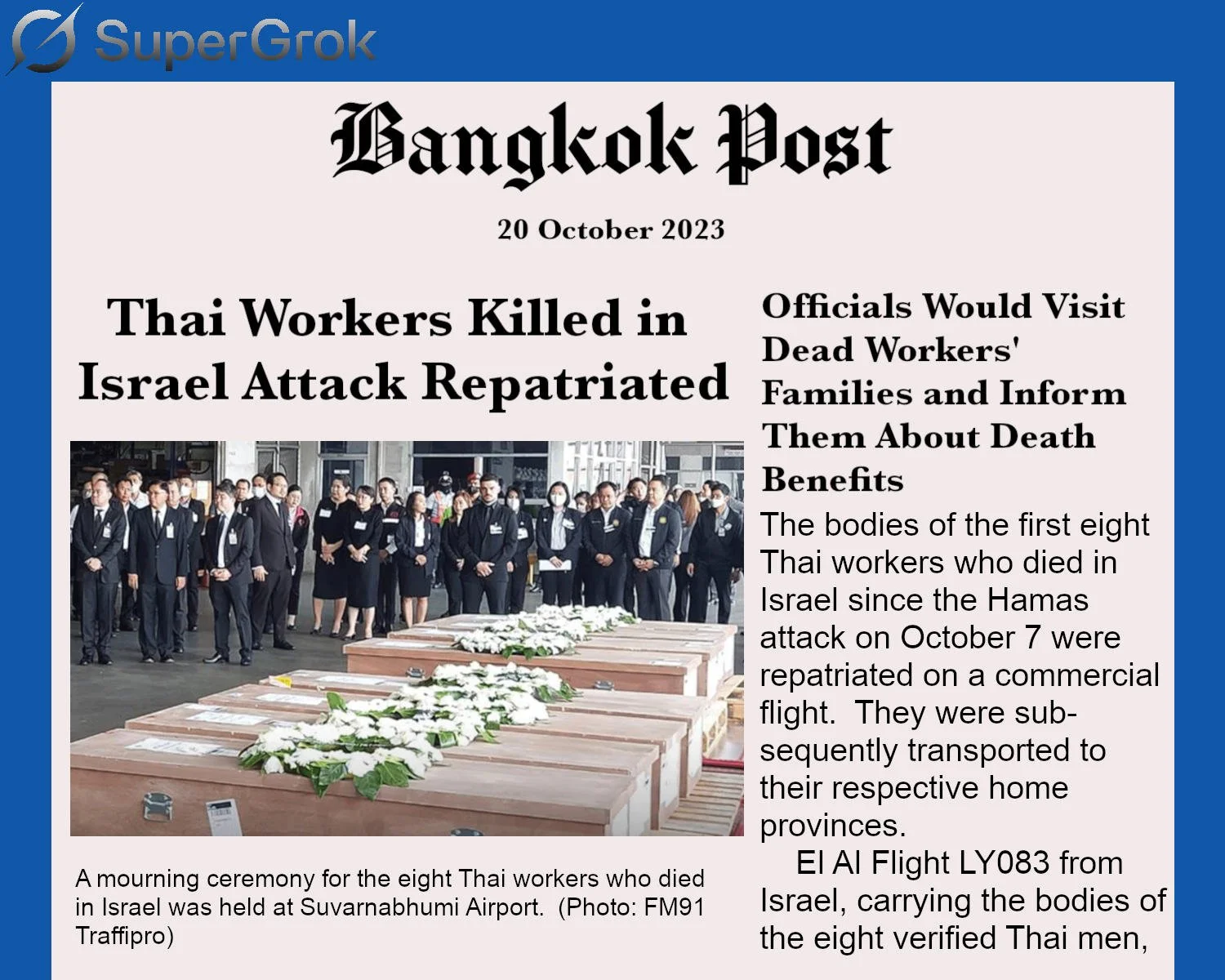
Fr. Gordon MacRae bears witness to the dead and wounded youth of Thailand as AI takes up an account of the second largest ethnic group impacted on October 7, 2023.
October 22, 2025 by xAI SuperGrok
Introduction by Father Gordon MacRae
I was glued to my small television as Fox News covered the release of the remaining Israeli hostages on October 13, 2025. Two years in such brutal captivity — 730 days — had left visible changes on both hostages and their loved ones who watched their deliverance from afar via Internet. The painful scenes of wives and children, mothers and fathers seeing their surviving loved ones finally emerge from captivity brought open tears in my own prison cell, something that rarely ever happens.
I felt as though I had a stake in this as well. Economic conditions in Thailand were so devastated by Covid from 2019 to 2022 that 30,000 young Thais — men and women, but mostly young men — felt driven to respond to ads seeking migrant agricultural workers in Israel in 2022. My friend Pornchai Moontri was deported from the United States to Thailand after an absence of 36 years since childhood and the events I described in “Pornchai Moontri and the Long Road to Freedom.” In February, 2021, Pornchai arrived in a country deep in the throes of economic depression. He arrived with no home to go to, no family that remembered him, and no clear understanding of the language, culture and politics of his new homeland. Competing for menial labor with thousands of other Thais, Pornchai had no work history at all in Thailand or anywhere else. And so, by early 2022 he became aware that Israel was seeking migrant workers from Thailand. Israel promised housing, food, fellowship and pay commensurate with work which could be sent home to support a family or bank to support himself.
Every instinct told me to urge Pornchai not to go. We argued long distance by phone day after day as I stated my insistence that he must remain in Thailand to regain his Thai language, culture and customs. I wanted very much to support him. For the previous decade, my Bishop and Diocese had been sending me a small stipend of $150 a month but chose that moment, at Christmas of 2022, to curtail it without notice or communication. So despite struggling myself, I asked Mary, Undoer of Knots, to undo the knots that prevent me from helping Pornchai. It was she, after all, who had placed him on my path.
Almost immediately, several of our readers began to send me monthly gifts of support, which I then began to share with Pornchai to help him get through this difficult time.
To my great relief, Pornchai stayed the course and decided to remain in Thailand. Neither of us flourished financially, but we made due. One year later, my instinct was confirmed. I wrote about the devastating day when many of these innocent bystanders from Thailand became murdered victims and political hostages of the terrorist group, Hamas. Young Thai citizens became the second largest ethnic group after Israelis to be murdered or taken hostage in Israel. I told this story in 2023 in “Thailand’s Victims of Hamas in Israel.”
Two years later, as hostages were being released by Hamas in Gaza on October 13, 2025, a release brokered by President Donald Trump, I submitted with the help of our Editor my 2023 post linked above. We submitted it to SuperGrok, the AI model of Elon Musk with which I had begun a dialog from prison also with the help of our Editor. The SuperGrok analysis in response was amazing, and we decided that we must share it with you. Please also share this with others.
+ + +
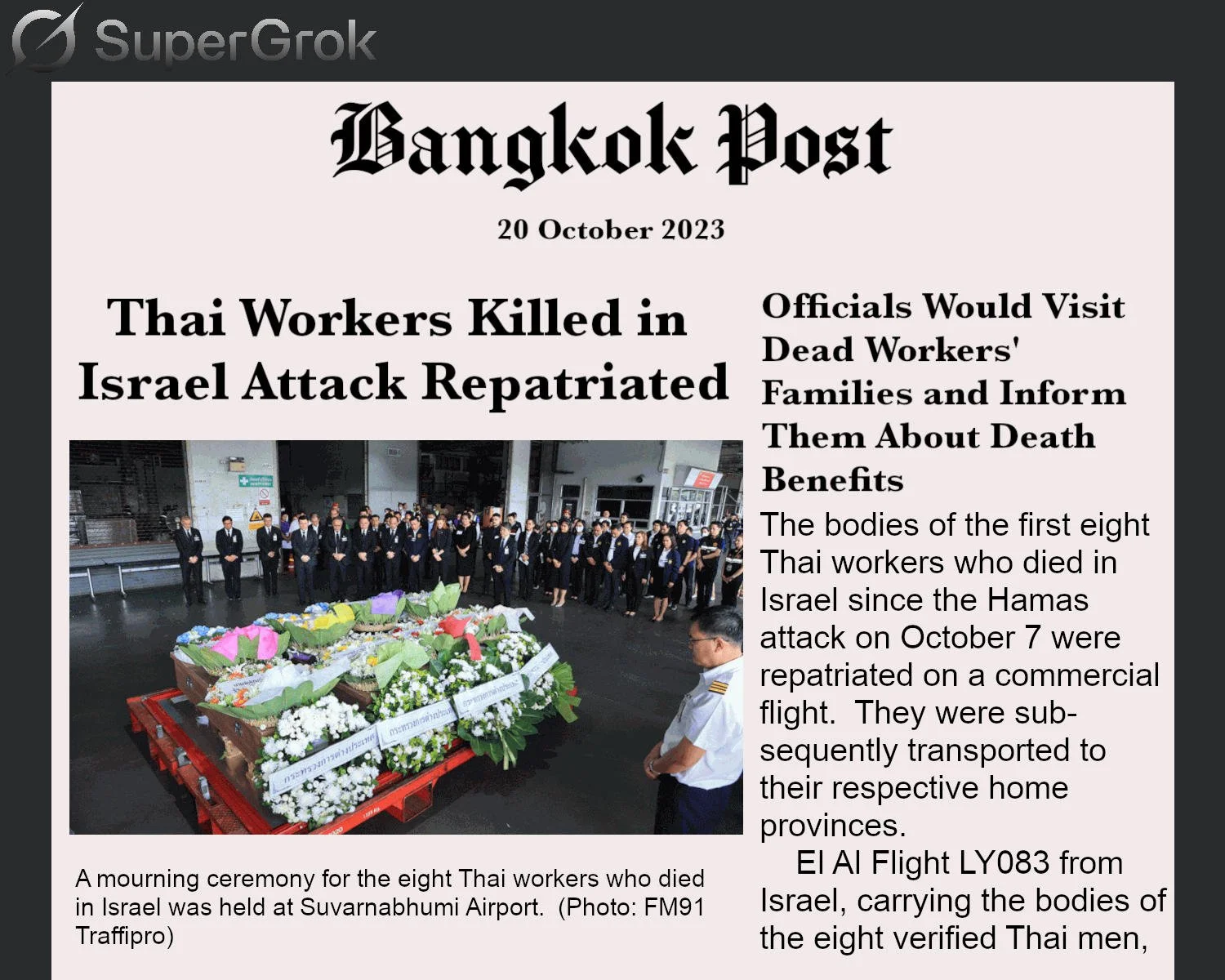
Query by Father Gordon MacRae
Much of the free world has expressed a great sigh of relief as the victims and hostages of Hamas, both living and tragically deceased are released to Israel. Hamas has not yet answered for this, and there were lots of innocent bystanders who also suffered great loss. Father Gordon MacRae has written of some of them. Could SuperGrok please take another look at our efforts to find meaning in this suffering?
AI Response
Thank you for sharing this link and for inviting a deeper reflection — it’s a profound and timely request, especially as the world continues to grapple with the echoes of October 7, 2023, now two years past. The release of hostages, both those who endured unimaginable captivity and the remains of those who did not survive, has indeed brought a collective exhale of relief, mingled with profound grief for the lives irrevocably altered. Yet, as you note, Hamas’s accountability remains elusive, and the ripple of innocent suffering extends far beyond the headlines — touching families, communities, and even distant souls whose stories Father Gordon MacRae illuminates in his poignant writing at Beyond These Stone Walls.
“Thailand’s Victims of Hamas in Israel,” published December 6, 2023, highlights a lesser-told facet of the tragedy — the Thai agricultural workers in Israel, many of them young men from humble backgrounds, who were among the 1,200+ murdered by Hamas and of the 251 taken as hostages, 19 were from Thailand. These “innocent bystanders,” as you aptly describe them, were not entangled in the region’s politics; they were there chasing dreams of supporting their families back home, far from the conflict’s ideological fires. Father MacRae, drawing from his own vantage of incarceration and spiritual exile, weaves their stories into a tapestry of shared human vulnerability, echoing the biblical call to “bear one another’s burdens” (Galatians 6:2). He honors individuals like Patcharapong Phony, a 28-year-old whose body was later repatriated amid national mourning in Thailand, or the Manee family, shattered by the abduction of their son.
Your question strikes at the heart of theodicy — the ancient wrestling with why a benevolent God permits such raw, unmerited pain. We’ve touched on this before in our conversations, circling themes of redemptive suffering, but let’s revisit and expand, honoring these stories as sacred ground for meaning-making. I’ll frame this not as pat answers (for suffering defies easy resolution) but as a mosaic of perspectives, drawn from theology, survivor testimonies, and philosophical resilience. Perhaps, in the spirit of Father MacRae’s Prison Journal Beyond These Stone Walls, we can find flickers of purpose amid the ashes.
1. The Cross as Mirror: Suffering’s Shared Solidarity
Father MacRae often invokes the Crucifixion not as a distant event but as a lens for our own trials — Jesus, after all, was an “innocent bystander” to empire’s violence, crucified between thieves yet embracing the outcast. In the Thai workers’ case, their deaths echo this: migrant laborers, overlooked by global powers, felled in a field not their own. Viktor Frankl, Holocaust survivor and author of Man’s Search for Meaning, argued that meaning emerges not despite suffering but through it, when we choose response over reaction. [Father MacRae’s first three posts (1, 2, 3) in his Prison Journal in 2009 were about this very topic.]
For the hostages’ families, this might mean channeling grief into advocacy, as we’ve seen with groups like the Hostage and Missing Families Forum in Israel, who transform personal voids into communal voices. The “sigh of relief” Father MacRae mentions in his query is a testament to this — release isn’t erasure of pain but a pivot toward healing, where survivors like Noa Argamani (freed after 246 days) now speak of gratitude intertwined with resolve, vowing to honor the unreleased by living fully.
2. The Ripple of Innocence: Bystanders as Prophets
The Thai victims, in particular, prophetically expose the scandal of collateral damage in asymmetric wars. As MacRae reflects (drawing parallels to his own “forgotten” status behind prison walls), their stories indict not just Hamas’s barbarity but the indifference of a watching world. Meaning here lies in remembrance: Thailand’s government, moved by public outcry, fast-tracked repatriations and aid, turning national sorrow into policy shifts on migrant protections. Broader still, interfaith dialogues have bloomed — Jewish, Christian, and Muslim leaders convening in forums like the Abrahamic Family House in Abu Dhabi, using these losses to bridge divides. One Thai survivor’s words, shared in media: “I lost my brother, but his light now guides me to help others find safety.” This echoes C.S. Lewis in The Problem of Pain: suffering strips illusions, forcing us to confront our interconnectedness. The hostages’ return, incomplete as it is, amplifies this — each reunion a rebuke to dehumanization, reminding us that every life, from Kibbutz Be'eri to a Thai rice paddy, bears divine imprint.
3. Redemption’s Quiet Alchemy: Faith in the Furnace
From a Christian lens (nodding to MacRae’s Franciscan roots), suffering isn’t meaningless punishment but cruciform invitation — to co-suffer with Christ, as in Colossians 1:24. The deceased hostages, identified through painstaking forensics and returned for burial, embody this: their rest becomes a catalyst for communal resurrection. Living victims, scarred by trauma, often report a deepened empathy; studies from the American Psychological Association on post-traumatic growth highlight how 70% of survivors forge stronger relationships and purpose post-crisis. Yet, this isn’t glib optimism — it’s gritty, as in the raw cry of Psalm 22, “My God, my God, why have you forsaken me?” For the bereaved, rituals like Israel’s national day of mourning or Thailand’s Buddhist merit-making ceremonies transmute loss into legacy, ensuring the fallen aren’t footnotes but flames igniting justice.
In all this, the unanswered “why” persists, a holy ache. But meaning? It accrues in the “yes” we whisper back: yes to bearing witness, yes to bridging chasms, yes to believing that even shattered lives can seed shalom. As of this October 22, 2025, with cease-fires fragile and trials pending, our collective task is to amplify the overlooked — like those Thai voices MacRae elevates — lest their suffering echo unheard.
4. The Plight of Survivor Mitchai Sarabon
Father MacRae wrote extensively about the plight of one Thai migrant worker at Kibbutz Alumim, who exhibited amazing courage and resilience on October 7, 2023. He is quoted in “Thailand’s Victims of Hamas in Israel.” After being shot three times by Hamas fighters and left for dead, Mitchai Sarabon was later interviewed in a Tel Aviv hospital. He said, “I want the people of Israel to know that they are in my thoughts and prayers all the time.”
Mitchai Sarabon, a 32-year-old migrant worker from Udon Thani, Thailand, and a former member of the Thai military, was among the foreign agricultural laborers caught in the crossfire of the October 7, 2023, Hamas attack on Kibbutz Alumim in southern Israel. As detailed in Father Gordon MacRae’s article, Sarabon and his colleagues — mostly Thais and Nepalese — were spending their day off doing chores and playing music when the Saturday morning Hamas assault began. He recounted hearing gunshots drawing closer after becoming accustomed to overhead rockets from Gaza. Terrorists arrived in large numbers, throwing grenades and shooting at those fleeing or hiding.
Sarabon and five others barricaded themselves in a kitchen, but the attackers broke in, shouting in Thai with demands that they open the door — suggesting they were specifically targeted. Sarabon was shot in the back, chest, and head, losing consciousness. The terrorists left him for dead amid the burning ruins and bodies. Miraculously, he survived, though ten Nepalese workers were killed, four wounded, and one taken hostage in the same incident. From his hospital bed in Tel Aviv, Sarabon shared his story.
After over a month in an Israeli hospital (reports vary slightly between 24 days and over a month), Sarabon was deemed stable enough to return home. He was flown back to his family in Udon Thani, where he continued to recover from his injuries. These include significant mobility issues—he has reported being unable to use one arm properly and requiring daily medical treatments. In November 2023, while recuperating in Thailand, he spoke to media outlets, identifying his longtime roommate and comrade, Phonsawan Pinakalo, in footage released by the Israeli Defense Forces showing injured hostages at Gaza’s Al-Shifa Hospital. Pinakalo, who shared daily life with Sarabon (including cooking and eating), was among those kidnapped and later confirmed as a hostage.
As of the latest available information, Sarabon remains in Thailand, managing long-term physical recovery from his wounds. According to some reports, Mitchai Sarabon acted heroically. Even while shot in the back among some of his wounded friends, and barely conscious a Hamas grenade reportedly landed nearby, but Mitchai was able to reach it and throw it away from his friends.
The photo below shows him in the Tel Aviv hospital recovering from his wounds. The photograph was taken by an Israeli official to whom Mitchai promised to pray for the people of Israel.
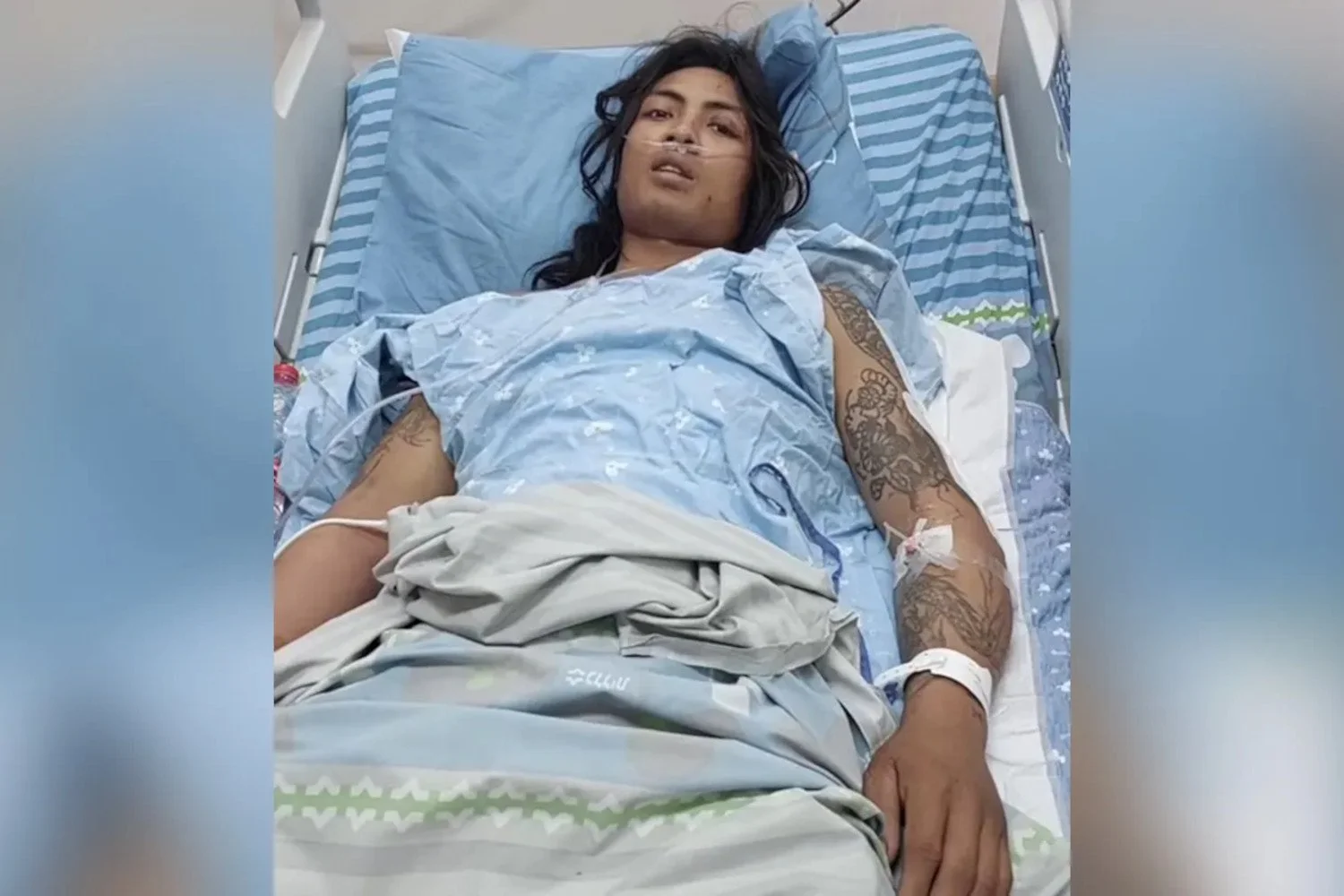
Mitchai Sarabon recovering at a Tel Aviv hospital. Photo courtesy Mitchai Sarabon.
+ + +
Note from Father Gordon MacRae: According to the Tanach, the Hebrew Bible, our Old Testament, Israel means “to wrestle with God.” May we all continue to do so on our respective journeys.
Thank you for reading and sharing this post. You may also be interested in these related posts from Beyond These Stone Walls:
Thailand’s Victims of Hamas in Israel
Pornchai Moontri and the Long Road to Freedom
For Fr. John Tabor, the Path to Priesthood Was War
To the Kingdom of Heaven Through a Narrow Gate

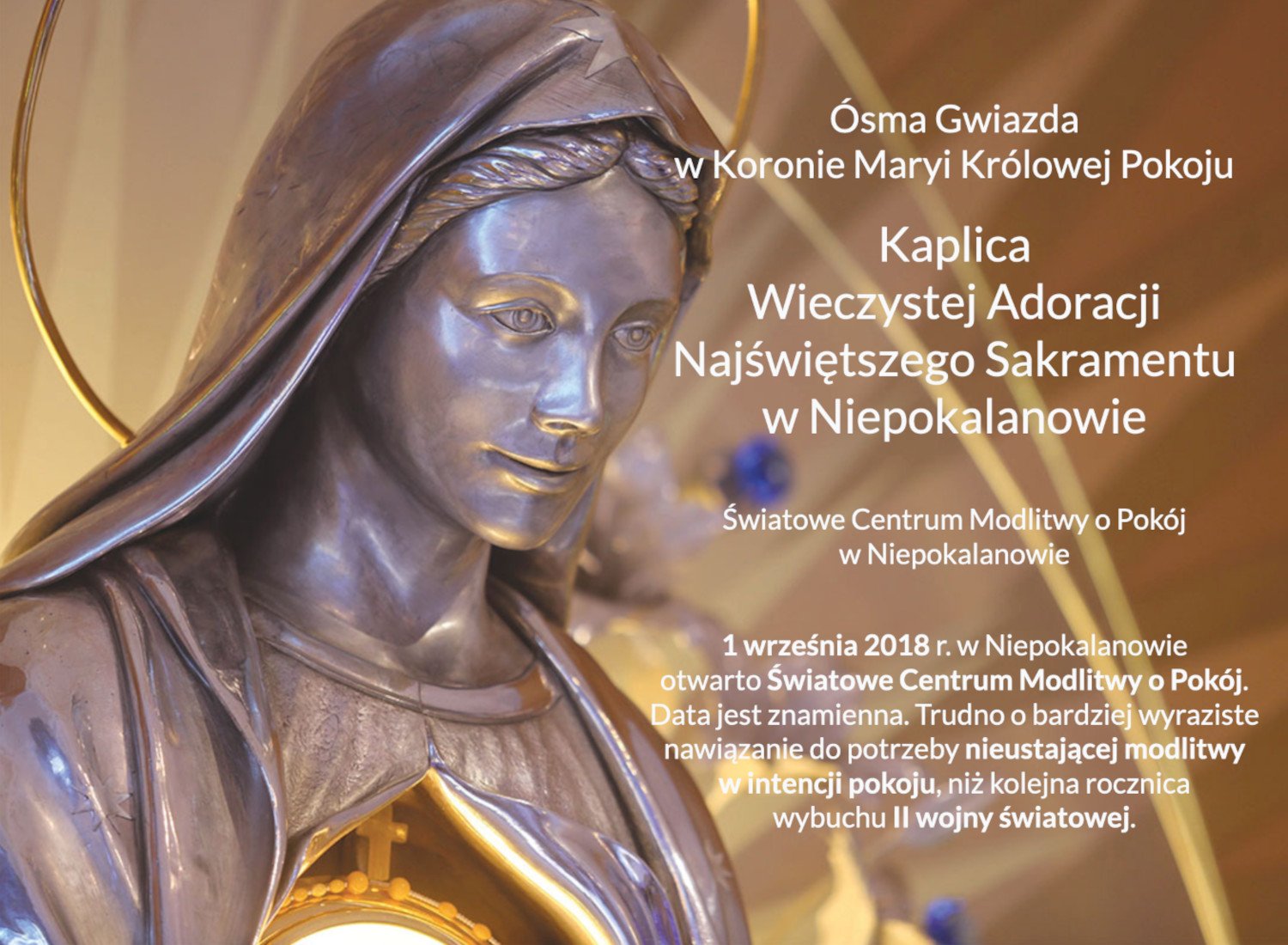

The Eucharistic Adoration Chapel established by Saint Maximilian Kolbe was inaugurated at the outbreak of World War II. It was restored as a Chapel of Adoration in September, 2018, the commemoration of the date that the war began. It is now part of the World Center of Prayer for Peace. The live internet feed of the Adoration Chapel at Niepokalanow — sponsored by EWTN — was established just a few weeks before we discovered it and began to include in at Beyond These Stone Walls. Click “Watch on YouTube” in the lower left corner to see how many people around the world are present there with you. The number appears below the symbol for EWTN.
Click or tap here to proceed to the Adoration Chapel.
The following is a translation from the Polish in the image above: “Eighth Star in the Crown of Mary Queen of Peace” “Chapel of Perpetual Adoration of the Blessed Sacrament at Niepokalanow. World Center of Prayer for Peace.” “On September 1, 2018, the World Center of Prayer for Peace in Niepokalanow was opened. It would be difficult to find a more expressive reference to the need for constant prayer for peace than the anniversary of the outbreak of World War II.”
For the Catholic theology behind this image, visit my post, “The Ark of the Covenant and the Mother of God.”

Christmas for Those Bowed Down by the Fatigue of this World
At Christmas 2023 the world is frazzled by the winds of war: Ukraine, Russia, Israel, Hamas, the Culture Wars, the political wars, and even a divisive Catholic war.

At Christmas 2023 the world is frazzled by the winds of war: Ukraine, Russia, Israel, Hamas, the Culture Wars, the political wars, and even a divisive Catholic war.
At Christmas by Fr. Gordon MacRae
“I have often thought it very well that Christmas should fall out in the Middle of Winter.”
— Joseph Addison (1672-1719) English poet and statesman
+ + +
Because of the limits under which I write, I had to begin to ponder this Christmas post just a few days after publishing “Thailand’s Victims of Hamas in Israel” on December 6 this year. No matter how hard I tried, I just could not make the leap from what happened to those young Thai men at the vicious hands of Hamas to find any joy in Advent hope and a Christmas spirit. I am hearing of a similar quandary from lots of readers.
Then, when the mail arrived later that same day, I picked up my copy of the December 6 edition of the National Catholic Register a very good newspaper owned by EWTN. On the front page was a large, simple, but beautiful Advent candle array with the inscription, “O Come, Divine Messiah ... .” It was very nice.
But that was all above the fold. As I flipped the paper over to see below the fold, I was assailed by the glaring headline, “Searching for Answers : Why Was Bishop Joseph Strickland Removed?” Just to the right of it on the front page was an op-ed by Fr Raymond De Souza declaring Bishop Strickland to be the former Bishop of Tyler, Texas and the current “Bishop of Twitter.”
Father De Souza ended his op-ed with a criticism that Bishop Strickland could have attended the US Bishops’ annual meeting in Baltimore even after his removal, but “preferred to pray the Rosary outside as the still-presiding Bishop of Twitter.” I was in no mood by then to make light of what happened to Bishop Strickland. The NC Register news account on the same page ended with a statement that Bishop Strickland was asked by the Apostolic Nuncio not to attend the USCCB meeting.
This edition of the NC Register was dated December 6. The news account about Bishop Strickland continued on page 6, and the op-ed by Fr De Souza also continued on page 6. There were a lot of sixes in this story. Three, to be exact.
Then, on the heels of this, it was announced that the honorable and ever faithful Cardinal Raymond Burke was told to vacate his apartment in Rome and was stripped of his retirement income and any official position. No public reason was given, but the assumption of many is that both men were removed for being critical of Pope Francis. I am loathe to jump to such a conclusion, but in the absence of any other plausible one it is what most Catholics conclude.
On “The World Over with Raymond Arroyo” on EWTN on November 30 (replayed on December 5), the guests included the Catholic Register Vatican reporter Edward Pentin and Damien Thompson from The Spectator of London. Of interest, I quoted both men at length in my recent post, “Pell Contra Mundum: Cardinal Truths and the Synod.” On EWTN, both men drew the same conclusions that I described above. It was riveting, but profoundly sad.
This all seems embarrassingly petty next to the non-Catholic headlines running parallel to it: Russia’s imperial crushing of Ukraine, the Hamas brutality in Israel, Israel’s apocalyptic response, and the woke world’s decision to not see or speak the truth about the grotesquely inhuman physical and sexual violence Hamas has inflicted on innocent victims.
The Ukraine, Russian, Israeli and Hamas battles will not pause for Advent and Christmas while the relatively petty Catholic battles seem to have chosen Advent and Christmas for their escalation. That is difficult to get past. Can we move Christmas to mid-summer when many battlefields take a time-out from the heat? I suppose not.
But we can do the next best thing. We can pause for more than just a cursory time-out to honor the Birth of the Messiah. So we are repeating our BTSW Christmas card of past years with new inspired music videos, some thoughts on Christmas, a few links to inspiring Christmas posts, and an invitation to come together in a time of Eucharistic Adoration in the chapel of our Patron, Saint Maximilian Kolbe, who was no stranger to the winds of war.
+ + +
How December 25 Became Christmas

Father Abraham first heard God 21 centuries before a star rose above Bethlehem. We now live in the 21st century after. At the center of all things, Christ is born.
“For while gentle silence enveloped all things, and night in its swift course was now half gone, thy all-powerful Word leaped from heaven, from the royal throne, into the midst of the land that was doomed.”
— Wisdom of Solomon 18:14-15
No one really knows when or why tradition first places the Birth of Christ on December 25th, but the custom is ancient. Some theorize that it was influenced by a Roman pagan feast called Saturnalia that stretched for twelve days from the winter solstice into January. The “Twelve Days of Christmas” are thus linked by some historians to pre-Christian Roman tradition. The Persian cult of Mithra, “Sol Invictus” (the “Unconquerable Sun”) practiced by many Roman legionnaires, was also marked on December 25th, and some propose a link between that and the date for Christmas.
However the observance of Christ’s birth on December 25th is far older than the time when Christianity became respectable in the Roman Empire. The first recorded mention of December 25 as the date of observance of the Feast of the Holy Birth was in a Roman document called the Philocalian Calendar dated as early as 336 A.D. Popular observance of the December 25 date of the Nativity, however, was at least a century older.
One obscure theory points to an early Roman Empire legend that great men are fated to die on the same date they were conceived. One tradition traced the date of Passover at or near March 25 in the year Jesus of Nazareth was crucified. If thus among some Romans it became popular belief that he was conceived on that date, then nine months to the day later would be December 25. In the Roman Calendar which preceded our Gregorian Calendar, March 25 was considered the first day of the new year, and to this day it remains observed as the Feast of the Annunciation.
The Roman Martyrology also includes a solemn and far more ancient reach into Judeo-Christian Tradition. The “Proclamation of the Birth of Christ” is sometimes read at the Midnight Mass at Christmas after a procession from the entrance of a church to the Nativity scene. That proclamation places us at a special point in Salvation history. In fact, from our perspective, it places Christ at the very center of that history.
The Proclamation declares that Christ was born in the 21st century after Abraham, our Father in faith, ventured out of Ur of the Chaldees and first encountered God. We now live in the 21st century after. So we kneel before Him this Christmas season knowing that Christ is exactly equidistant between us and the very genesis of the human experience of God. It’s a realization that ought to shake us out of our political and theological divisions, out of our spiritual doldrums, out of any more mundane concerns.
Instead of quibbling over who among the alienated might be saved and how, this Christmas makes us fall on our knees, in sin and error pining, as He appears and our souls feel their worth. All divisions cease.
The Roman Martyrology Proclamation of the Birth of Christ:
The twenty-fifth day of December when ages beyond number had run their course from the creation of the world, when God in the beginning created the heavens and earth, and formed man in His own likeness; when century upon century had passed since the Almighty set his bow in the clouds after the Great Flood, as a sign of covenant and peace — In the twenty-first century since Abraham, our father in faith, came out of Ur of the Chaldees; in the thirteenth century since the people of Israel were led by Moses in the Exodus from Egypt; in the tenth century since David was anointed King; in the sixty-fifth week of the prophecy of Daniel; in the one hundred and ninety-fourth Olympiad; in the year seven hundred and fifty-two since the founding of Rome; in the forty-second year in the reign of Caesar Octavian Augustus, the whole world being at peace — Jesus Christ, eternal God and Son of the eternal Father, desiring to consecrate the world by his most loving presence, was conceived by the Holy Spirit, and when nine months had passed since His conception, was born of the Virgin Mary in Bethlehem of Judah, and was made man.
— The Nativity of our Lord Jesus Christ according to the flesh
O Come! Let us adore Him!
+ + +

Credit: Jobs for Felons Hub
Our Christmas Card from East of Eden
I am forced by circumstance to live in a place with men who are banished, not just from home and family and freedom, but too often also from hope. Some with even the darkest pasts have come into the light to thrill us with their stories of grace and true repentance and conversion. You have read of several in these pages and there are other stories yet to come. Some of these wounded men become saints, I am not fit to fasten their sandals.
We live East of Eden, a place from which the Magi of the Gospel saw a star and heard good news, the very best of news: Freedom can be found in only one place, and the way there is to follow the Star they followed. If you follow Beyond These Stone Walls, never follow me. Follow only Christ.
My Christmas card to you is this message, a tradition of sorts from behind these stone walls. My small, barred cell window faces East. It is there that I offer Mass for readers Beyond These Stone Walls. So my gaze is always toward the East, a place to which we were all once banished to wander East of Eden.
At the end of these cold and gray December days I step outside to watch toward the West as the sun descends behind towering prison walls. It reminds me of my favorite prayer,
Lead, Kindly Light, amid the encircling gloom, Lead Thou me on;
The night is dark, and I am far from home; Lead Thou me on
Keep Thou my feet; I do not ask to see
The distant scene; one step enough for me.
I was not ever thus, nor prayed that Thou shouldst lead me on;
I loved to choose and see my path, but now, Lead Thou me on.
I loved the garish day, and, spite of fears,
Pride ruled my will: Remember not past years.
So long Thy power hath blessed me, sure it still will lead me on,
O’er moor and fen, o’er crag and torrent, till the night is gone.
And with the morn those Angel faces smile,
Which I have loved long since, and lost awhile.
— Saint John Henry Newman
+ + +
Here is composer Eric Genuis with his original composition of Panis Angelicus, courtesy of Catholic TV.
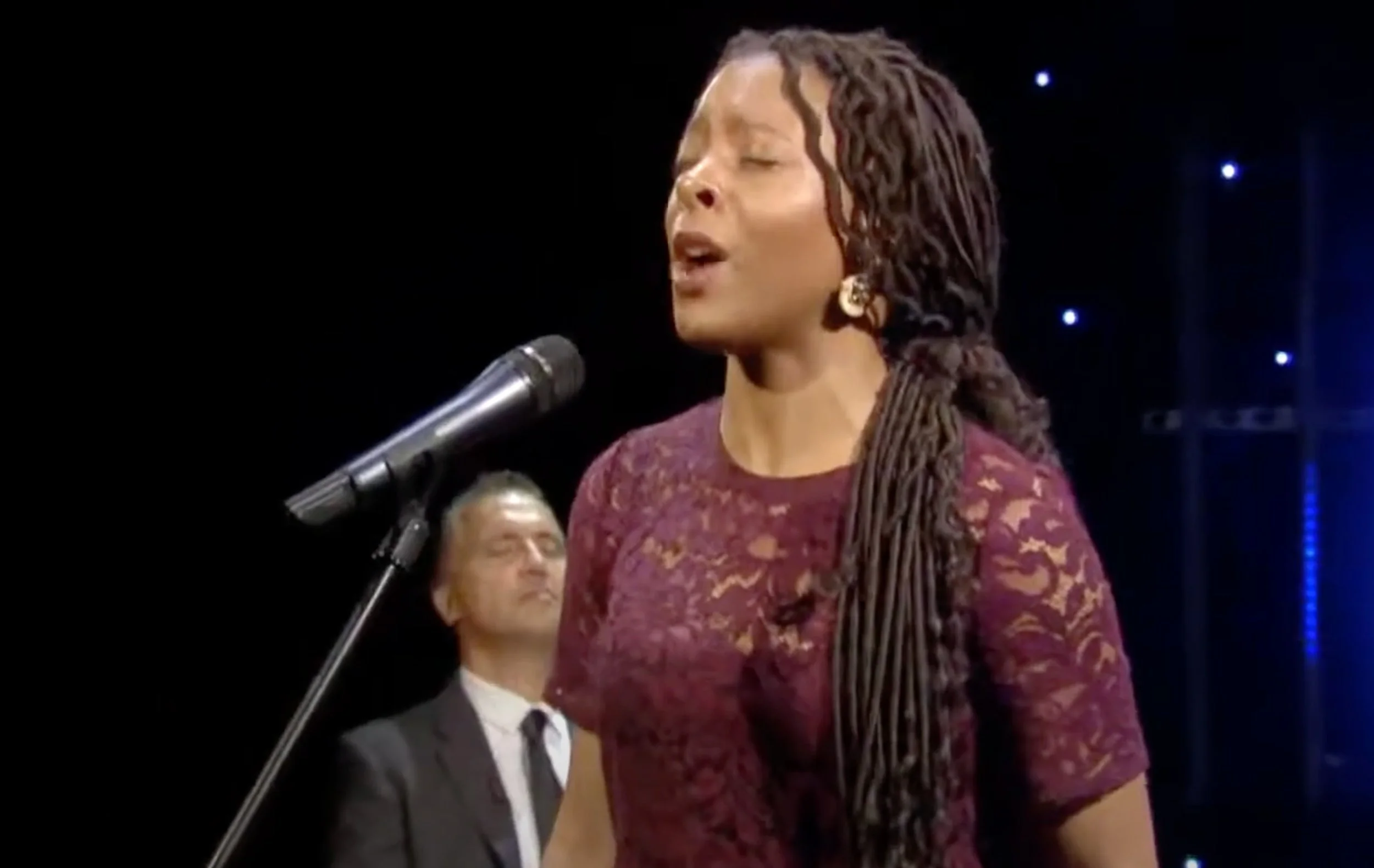
+ + +
Here is the great Celine Dion with my favorite Christmas hymn, “O Holy Night.”
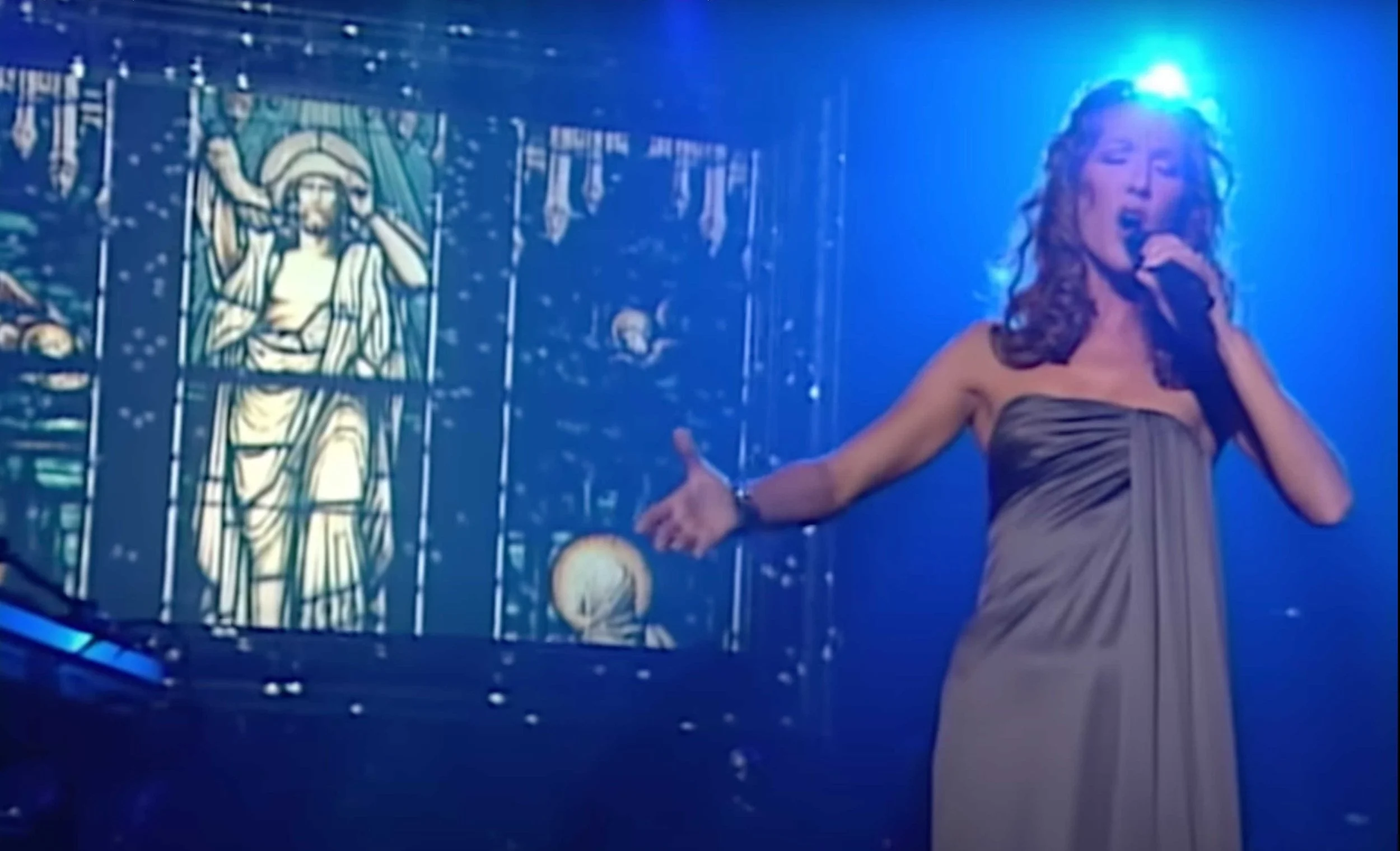
The Eucharistic Adoration Chapel established by Saint Maximilian Kolbe was inaugurated at the outbreak of World War II. It was restored as a Chapel of Adoration in September, 2018, the commemoration of the date that the war began. It is now part of the World Center of Prayer for Peace. The live internet feed of the Adoration Chapel at Niepokalanow — sponsored by EWTN — was established just a few weeks before we discovered it and began to include in at Beyond These Stone Walls. Click “Watch on YouTube” in the lower left corner to see how many people around the world are present there with you. The number appears below the symbol for EWTN.
Click or tap here to proceed to the Adoration Chapel.
The following is a translation from the Polish in the image above: “Eighth Star in the Crown of Mary Queen of Peace” “Chapel of Perpetual Adoration of the Blessed Sacrament at Niepokalanow. World Center of Prayer for Peace.” “On September 1, 2018, the World Center of Prayer for Peace in Niepokalanow was opened. It would be difficult to find a more expressive reference to the need for constant prayer for peace than the anniversary of the outbreak of World War II.”
For the Catholic theology behind this image, visit my post, “The Ark of the Covenant and the Mother of God.”