“There are few authentic prophetic voices among us, guiding truth-seekers along the right path. Among them is Fr. Gordon MacRae, a mighty voice in the prison tradition of John the Baptist, Maximilian Kolbe, Alfred Delp, SJ, and Dietrich Bonhoeffer.”
— Deacon David Jones

New Hampshire Dark Justice Is Illuminated Down Under
In early 2024, several Civil Rights venues hosted new, hopeful developments in a 30-year-old lingering injustice: the once hopeless 1994 trial of a Catholic priest.

In early 2024, several Civil Rights venues hosted new, hopeful developments in a 30-year-old lingering injustice: the once hopeless 1994 trial of a Catholic priest.
February 7, 2024 by Fr Gordon MacRae
“Fr MacRae was convicted on 23 September 1994 and sentenced to 67 years in a New Hampshire prison. The allegations had no supporting evidence and no corroboration. ... We enter another world with a life sentence. Australia is not New Hampshire, and I don’t believe Australia would blackball the discussion of a case such as Fr MacRae’s.”
— Cardinal George Pell, Prison Journal Volume 2, p.58
+ + +
It’s hard to know when to give up on justice. It’s even harder to know when to give up on hope. I have been at the brink of both several times over the last three decades, but I have not yet taken the plunge. I am not sure what that would feel like. Prison is bad enough without adding hopelessness to the mix. Other prisoners watch me for signs of hopelessness. If I descend into it, it will only justify their caving into it as well.
As my 30th year of unjust imprisonment began on September 23, 2023, my friend Pornchai Moontri wrote a post for this blog from Thailand. It is emotionally staggering to read, but it is also filled with hope — the sort of hope for which “the bigger picture” provides much-needed context. Only someone who has suffered and survived a great deal in life, as Pornchai has, could give both suffering and hope equal measure. l was not able to see his post, but our editor read it to me while preparing it for publication. She paused four times to cry.
Not all tears are tears of sorrow. Pornchai’s article deserves an award, but there isn’t one that measures what he and I, and Maximilian Kolbe, and Padre Pio have all been through together and triumphantly. Let that last word sink in. None of us appears on the surface to be triumphant in anything by any measure of this world, but in the Kingdom of Heaven, our enduring hope is radiant.
Its triumph is not just in our endurance, or in any obvious outcome. It is in the grace-filled ability to suffer with faith, hope, and love intact — the greatest of gifts as defined by Saint Paul (1 Corinthians 13:13). If you missed Pornchai’s post, you shouldn’t, but bring a tissue. Bring four of them. Nothing in my experience of the last thirty years makes any sense without the context provided by Pornchai’s heart rending message from our New Evangelization. His post is, “On the Day of Padre Pio, My Best Friend Was Stigmatized.” We will add a link to it at the end of this post.
In the early dawn of this 30th year in prison, there are some recent developments that I now need to write about, but first I must ask for your forgiveness. During the months between September 2023 and now, several of our readers extended kindness and generosity to me and this humble blog by helping with a number of expenses. I have been unable to respond with gratitude in a timely manner. I am sorry. My excuse is just more suffering. Like many in this overcrowded place I came down with a respiratory virus that lasted two months. A weekly post was all the writing that I could handle.
By December, the virus morphed into vertigo so even walking upright from point A to point B became a challenge. Then it became a month-long migraine with chronic double vision. It may even have been a minor stroke. I hope my posts of the last few months did not mirror the struggle I was in to write them. I now await an “outside” consult with an ophthalmologist.
I have begun to feel a little better but the vision problem remains a challenge, though with more recent minor improvements. So besides my BTSW posts, I have managed only a few letters in the last few months. Forgive me, please. We need your help but I am sorrowful to accept it in silence. A family member who had for the last 30 years been managing a small expense account for me with power of attorney has also had some health issues and I have had to relieve him of that burden. Please note at both our “Contact and Support” and “Special Events” pages, that we now have a new address for assistance to me and this blog. The address is: “Fr. Gordon MacRae, P.O. Box 81, Fayetteville, NY 13066-0081.”
You are raised up in thanksgiving before the Lord at every Sunday Mass in my prison cell. If you ever decide to help again in the wake of my only silent gratitude, it would help further if you always include an email address so I may properly acknowledge your assistance.

The Bill of Rights Obliterated
I owe a debt of gratitude to Ryan A. MacDonald, an accomplished columnist who has taken up my cause repeatedly over these many years. His latest articles appeared here over the last few weeks. In “Detective James McLaughlin and the Police Misconduct List” Ryan accomplished something that no other writer has taken on. He exposed concrete examples of how judicial secrecy in New Hampshire has further eroded the rights of citizens to seek justice.
Former Keene, New Hampshire Detective James McLaughlin is now retired, but at this writing he continues in retirement to investigate cases for the local Cheshire County (NH) prosecutor. As many readers now know, he has been exposed for a pattern of corruption and misconduct in his investigations when his name appeared on a once-secret list of officers with credibility issues. He also choreographed a fraudulent case against me that rode the waves to capitalize on Catholic scandal over the last thirty years.
Detective McLaughlin’s name appeared on that secret list for an unspecific 1985 incident of “Falsification of Records.” In some reports it has been described as “Falsification of Evidence,” something that I have accused him of since my own charges first arose over 30 years ago. Getting to the bottom of this is a test of endurance in a legal system that shelters police misconduct through secret and anonymous hearings.
Under a U.S. Supreme Court precedent (“Brady v. Maryland”), prosecutors are required to inform defendants and their defense counsel when an investigating detective is on the list for misconduct. In my case and many others, they did not do so. This discovery constitutes new evidence that can reopen a case. Famed civil rights attorney Harvey Silverglate addressed this in a 2022 Wall Street Journal op-ed, “Justice Delayed for Father MacRae.”
As pointed out in these pages in recent weeks, however, judges hearing former Detective McLaughlin’s petition to remove his name from that list have allowed these hearings to be presented in secret proceedings that are rendered anonymous through the use of “John Doe” in place of an offending officer’s name. Citizens are prevented from offering any further evidence because of this judicial secrecy. On January 24, Ryan MacDonald published another bombshell: “In New Hampshire Courts, Police Corruption Is Judged in Secret.”
His article lays out additional evidence under New Hampshire law for a multitude of other alleged incidents of official misconduct on the part of this officer. They include perjury, witness tampering, attempted bribery, tampering with evidence, and additional incidents of falsification of records. All of this has been shielded under color of law by the practice of sealing police personnel files and hearing challenges to the police misconduct list in secret. Ryan has also cited articles published at InDepthNH.org:
“The records obtained by InDepthNH.org indicate there are more internal affairs reports dealing with McLaughlin which the city has not so far provided. The city has also not provided an explanation for the omission of the other reports.”
The reporter cites a 1988 letter in McLaughlin’s file from then Keene, NH Police Chief Thomas Powers:
“I reviewed your personnel file and several internal affairs investigations. While you have accumulated a number of praises in your career, a disproportionate number of serious accusations and violations have significantly detracted from your record, including a one-week suspension.”

First in the Nation
By coincidence (or probably not) I am writing this post on January 23, 2024, the day that the State of New Hampshire hosts its much-celebrated, but now endangered, First-in-the-Nation presidential primary election. In anticipation of this event, Kentucky attorney Frank Friday penned a superb and provocative article for American Thinker entitled “Our Corrupt FBI : New Hampshire Edition.” It begins ...
“This Tuesday, New Hampshire will hold its quadrennial first-in-the-nation primary. I am sorry to say, I have come to know something of the seamier side of this small state, writing these past years about a great legal injustice that has occurred up there. This is something most Granite Staters don’t like to think about: the Fr. Gordon MacRae frame-up.
“Thanks to the state’s tiny, inbred legal and law enforcement community, the matter was kept quiet for years. But the truth is inevitably coming out especially regarding the ‘hero-detective’ who doesn’t look so good now.
“One of my New Hampshire friends who writes about this has even found a small army of New Hampshire lawyers, police and politicos making a nice living off spurious sex abuse allegations. The local FBI office, no surprise, may even be connected. It’s worth reading the whole thing. You will be appalled.”
— “Our Corrupt FBI : New Hampshire Edition,” AmericanThinker, January 20, 2024
To my great admiration, the Catholic League for Religious and Civil Rights emailed the above article to its entire global network of members. It links in the final paragraph to a previous post here at Beyond These Stone Walls by Los Angeles documentary researcher Claire Best. Mr. Friday is right. You will be appalled! The link goes to, “New Hampshire Corruption Drove the Fr. Gordon MacRae Case.”
And because of the American Thinker article, and the decision of the Catholic League to promote it, that link above surpassed almost all other posts in traffic so far this year. It is just the sort of thing that needs to happen. History has shown that nothing stifles Civil Rights more than a silent Coverup.

Wrongful Convictions Report — Down Under
While all the above was going on in recent weeks, I wrote a painfully difficult article about new developments in the case of the late Cardinal George Pell for whom I also have great respect and admiration. I do not think there has been a Church figure in modern times so unjustly maligned. My December 10, 2023 post was, “The Trial of Cardinal Becciu, the Betrayal of Cardinal Pell.”
An unintended effect was that it caught the attention of a site in Australia that I did not even know existed. Within a week of posting the above link, the site editor, Australian writer Andrew L. Urban, did a deep dive into my own situation and published two outstanding articles there:
“Sexual Abuse or Justice Abused?”
“False allegations, a corrupt detective, flawed judicial decisions ... no wonder Father Gordon MacRae’s life has been ruined, sentenced to a 67-year jail term, after refusing a one-year plea deal wishing to maintain his innocence.”
And...
“The Back Alley of Justice: Fr Gordon MacRae’s Wrongful Conviction”
“Malevolent shenanigans behind the scenes in the Fr Gordon MacRae case, from withholding evidence to witness tampering ... It seems justice took a holiday — and hasn’t returned. Fr Gordon, now 70, has been in prison for men in Concord, USA since he was 41.”
The above two articles are the result of exceptional investigative reporting by Andrew Urban who also published an extended excerpt from one of my own recent posts on Australia’s own Cardinal Pell marking the first anniversary of his death on January 10. Andrew Urban entitled it, the “Week of Pell’s Resurrection.”
+ + +
Note from Fr Gordon MacRae: Thank you for reading and sharing this post which casts some needed light on a story otherwise kept in darkness. You will demonstrate to the above writers the importance of this story by sharing it. You may also like these related posts cited herein:
On the Day of Padre Pio, My Best Friend Was Stigmatized by Pornchai Moontri
Our Corrupt FBI : New Hampshire Edition by Frank Friday, Esq.
New Hampshire Corruption Drove the Fr. Gordon MacRae Case by Claire Best
Detective James McLaughlin and the Police Misconduct List by Ryan A. MacDonald
In New Hampshire Courts, Police Corruption Is Judged in Secret by Ryan A. MacDonald

Former Judge Arthur Brennan arrested at a Washington, DC protest in 2011.

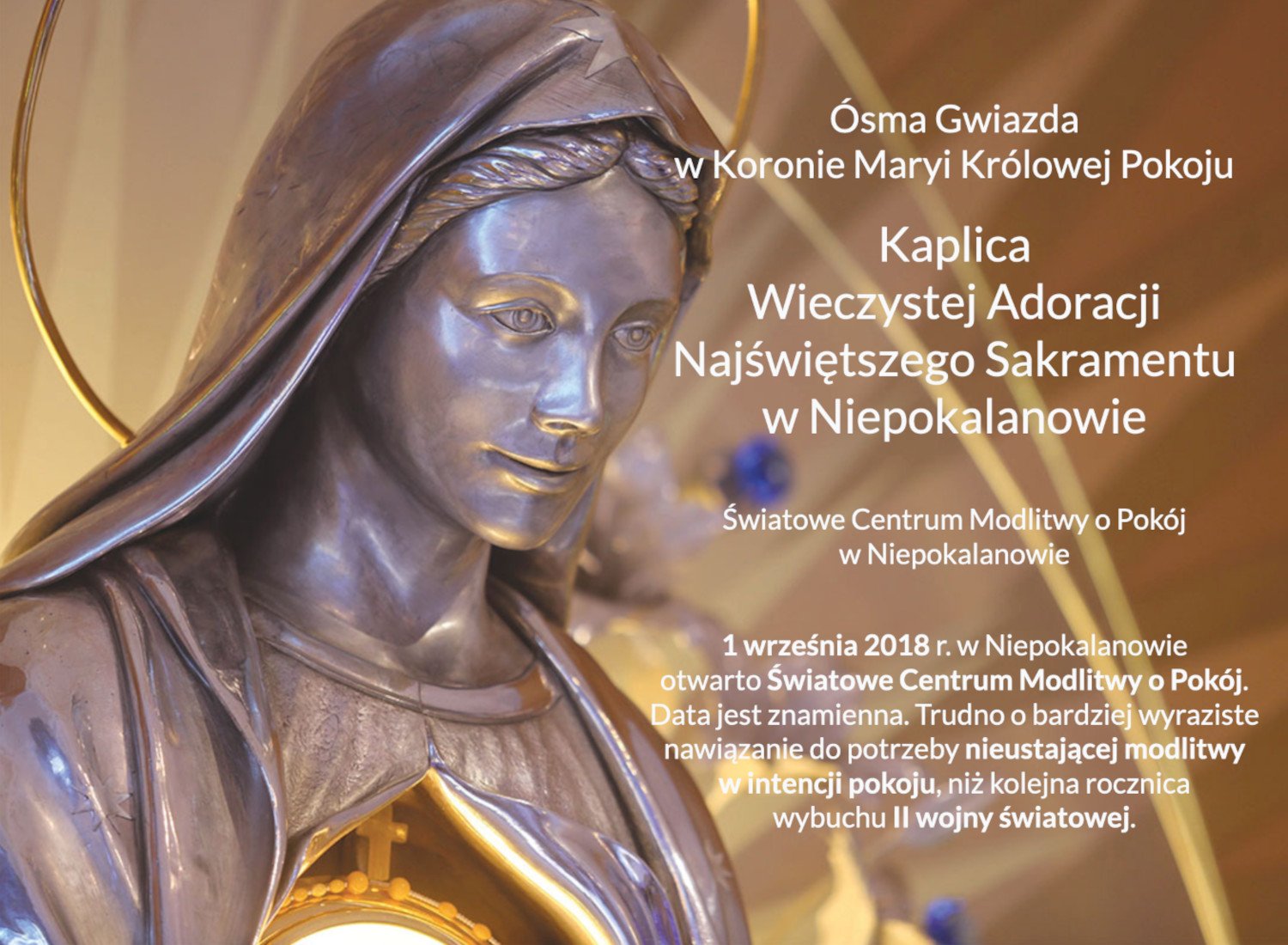

The Eucharistic Adoration Chapel established by Saint Maximilian Kolbe was inaugurated at the outbreak of World War II. It was restored as a Chapel of Adoration in September, 2018, the commemoration of the date that the war began. It is now part of the World Center of Prayer for Peace. The live internet feed of the Adoration Chapel at Niepokalanow — sponsored by EWTN — was established just a few weeks before we discovered it and began to include in at Beyond These Stone Walls. Click “Watch on YouTube” in the lower left corner to see how many people around the world are present there with you. The number appears below the symbol for EWTN.
Click or tap here to proceed to the Adoration Chapel.
The following is a translation from the Polish in the image above: “Eighth Star in the Crown of Mary Queen of Peace” “Chapel of Perpetual Adoration of the Blessed Sacrament at Niepokalanow. World Center of Prayer for Peace.” “On September 1, 2018, the World Center of Prayer for Peace in Niepokalanow was opened. It would be difficult to find a more expressive reference to the need for constant prayer for peace than the anniversary of the outbreak of World War II.”
For the Catholic theology behind this image, visit my post, “The Ark of the Covenant and the Mother of God.”

New Hampshire Corruption Drove the Fr. Gordon MacRae Case
A researcher unravels a trail of financial corruption behind the cases of Father Gordon MacRae in the Diocese of Manchester and Owen Labrie at St. Paul’s School.

A researcher unravels a trail of financial corruption behind the cases of Father Gordon MacRae in the Diocese of Manchester and Owen Labrie at St. Paul’s School.
September 6, 2023: An Op-Ed by Claire Best
For the last 29 years, Father Gordon MacRae has been denied justice, relegated to Concord Men’s Prison in New Hampshire. Despite an ex-FBI agent’s 3-year investigation, a Pulitzer prize-winning Wall Street Journalist’s multi-part exposé, even a current investigation into the police officer who framed him, nothing has thus far moved the needle — except perhaps in the court of public opinion.
Finally in 2023, the pieces of this puzzle have come together to explain why this might be: The New Hampshire Department for Children, Youth and Families (DCYF), some New Hampshire Police, local attorneys, the “compliance officer” for the Diocese of Manchester, and the Attorney General’s office have been involved in a racket. For Father Gordon MacRae to get justice, they would all risk being exposed in an organized crime to frame him in order to extort the insurance for the Diocese and trigger an expansion of business that spreads to the Catholic Medical Center, schools, nursing homes, day care centers, clinics, addiction recovery centers, banks, insurance companies and media. This is an enterprise worth billions that stretches far beyond the borders of New Hampshire across the US and internationally.
While Father Gordon MacRae has been incarcerated, New Hampshire has covered up horrific child sex abuse by its very own employees at the State’s Youth Detention Center. The NH DCYF has failed multiple audits by the US Department of Health and Human Services Office of the Inspector General (DHHS OIG). It has downplayed Medicaid fraud. Opioids and fentanyl overdoses have skyrocketed. Children and young adults have died or disappeared, drugs have been trafficked, arms have been trafficked, money has been laundered, billions have been made and a monopoly without accountability has blossomed. That monopoly is tied to the interests of the US Government and its three letter agencies. Framing Father Gordon MacRae to get inside the Diocese of Manchester looks like it was a strategic plan that has had catastrophic consequences not just for MacRae but for anyone who has become a tool for, or victim of, the Government infiltration of Catholic organizations.
Father Gordon MacRae was prosecuted, convicted and imprisoned in 1994, the year the Clinton Crime Bill (authored by Joe Biden) was enacted. It is also the year that the Violence Against Women Act was passed enabling $9 billion in grants from the Department of Justice to police, prosecutors and Non-Government Organizations (NGOs). Creating crimes that didn’t exist (while hiding those of state employees or friends of law enforcement and the courts) in order to access grants has undermined the integrity of the justice system in the State of New Hampshire and across the land.
“Justice for the Victim” has been a rallying cry in New Hampshire which has deliberately and consistently failed to ascertain the validity of claims of domestic and sexual assault, while pre-determining victims and predators without doing anything that could remotely be called due process.
Lots of people are denied justice each year and decades later a few of them go free after prosecutorial and police misconduct, or other flaws in the original investigations and trials, are exposed. Some years ago in Pennsylvania, a “Kids for Cash” scheme was unravelled. It involved police, prosecutors, judges and private attorneys. In California, a local journalist came across a series of gatherings in which judges, prosecutors, private attorneys and the media conspired to rig cases in civil, family and criminal courts. What has transpired in New Hampshire bears all the same markings as these. A few breadcrumbs here and there have provided clues to an epic scandal that has been carefully hidden from the public for decades — in large part due to a small “club” who are vested in the profits from it. That club comprises law enforcement, non-profits, local councils, attorneys general, elected representatives, justices, other members of the New Hampshire Bar and certain media outlets. They figured out that by controlling the news, they could control the narrative. And by controlling the narrative they could leverage the outcomes of criminal trials and civil lawsuits. Father Gordon MacRae is a victim of this corruption which even includes local “investigative” reporters who have no critical thinking skills but are determined to reinforce the court corruption in their coverage — presumably due to the sponsorship of their media outlets.
In 1995, a prosecutor in New Hampshire failed to let the defense know that a police officer who arrested a man on trial for murder had a dishonest track record. The state dropped the case. The defendant’s name was Carl Laurie, for whom the “Laurie List” is named. A 1963 US Supreme Court case, Brady v Maryland, requires the prosecution to provide any and all exculpatory evidence to the defense in a timely manner before any criminal trial. Somehow New Hampshire ignored this rule, and for decades judges and prosecutors have been OK with that. This is most likely because there isn’t really a division between police, prosecutors, judges and media in New Hampshire. So a lie that works for one finds its way up the ladder to work for all. Elected DAs who have challenged the ethics of this have been voted out of office (Robin Davis, DA of Merrimack County) or have been undermined by the Attorney General taking over their prosecutions (Michael Conley, DA of Hillsborough County). It is easier in New Hampshire to promote a lie than it is to defend the truth because there is a waterfall of money to be made in the lie — federal grants, civil settlements, contracts, promotions, rewards.

Detective James F. McLaughlin
In June 2018 the police detective who began investigating Father Gordon MacRae in the late 1980s was added to the Attorney General’s secret list of corrupt police officers — the “Laurie List” — also known as the Exculpatory Evidence Schedule for a charge of “Falsification of Records.” James F. McLaughlin, New Hampshire’s top child sex crimes detective, was brought out of retirement in 2017 to work on a Grand Jury Criminal Investigation of St Paul’s School following the framing of scholarship student, 18-year-old Owen Labrie, by Concord Police Detective Julie Curtin. Attorney General Gordon MacDonald brought McLaughlin into the investigation to supervise Detective Julie Curtin and Lieutenant Sean Ford. The report into the school and alleged cover-ups of sex abuse from 2009 to 2017 was completed in August 2018 and a settlement agreement was reached between the Attorney General and the school administration in September 2018. The agreement required a “compliance officer” and a contract with victims advocacy organization the New Hampshire Coalition Against Domestic and Sexual Violence (NHCADSV).
The agreement mirrored one that had been entered into in 2002 after James F. McLaughlin’s investigation into Father Gordon MacRae triggered the circumstances for a Grand Jury criminal investigation, a “compliance officer” and settlement with the Diocese of Manchester. The NHCADSV had brought on board Brian Harlow of SNAP (the Survivors Network of those Abused by Priests) in 2012. Though Harlow had no connection to the MacRae case, he had been one of the original “victims” to come forward for the Diocese of Manchester investigation in 2002. NHCADSV wanted him to help them expand their business and they had a contract with the Department of Defense as well as with the University of New Hampshire which had a strategic agreement with the (Obama) White House 2014 “Not Alone” task force to combat sexual assault on campuses. The Chair of the University System in New Hampshire is Alex Walker. He just so happens to also now be the CEO of Catholic Medical Center in the Diocese of Manchester. As published in a Catholic Medical Center statement:
“Alex has been actively involved in the community for many years. He currently serves on the Board of Trustees of the University System of New Hampshire and on the New Hampshire Business Committee for the Arts. In 2019 and 2020 he co-chaired the Bishop’s Charitable Assistance Fund with his wife, Lisa. He was Chairman of the Board of Trustees of the Palace Theatre, and past Chairman of the Board of Directors of Granite United Way. He has also served on the New Hampshire Bar Association’s Board of Governors, the New Hampshire Supreme Court’s Access to Justice Commission, the Board of Directors of City Year New Hampshire, the Board of Directors for the Business and Industry Association of New Hampshire, and the Greater Manchester Chamber of Commerce Board of Directors where he served as Chairman of the Board in 2011.”
Alex Walker provided counsel to the Diocese alongside the Nixon Peabody law firm which was formed in 1999 in Boston and Manchester. Gordon MacDonald, an attorney at Nixon Peabody became Attorney General and is the current New Hampshire Supreme Court Chief Justice. Before he took office as AG, he successfully managed to block an audit of his client Purdue Pharma. New Hampshire’s opioid crisis has been one of the worst in the country. Catholic Medical Center was fined $3.8 million recently for a kick back scheme. The Boston Globe has exposed cover-ups of medical malpractice by CMC’s administrators headed by Alex Walker. Curiously however, the Boston Globe Spotlight team which covered the Catholic priest sex abuse scandal in 2002-2003 is only interested in exposing a portion of the story that benefits ambulance chasing civil attorneys. The Globe is guilty of removing comments under articles which smacks of the newspaper’s own compromised position preventing its journalists from seeking the real truth as opposed to the monied subjective “his/her/their truth”.
With the addition of Detective James F. McLaughlin on the police misconduct “Laurie List,” AG Gordon MacDonald was suddenly compromised. He had hired McLaughlin because of his history with the Diocese and now he had to hide the fact that he knew McLaughlin was dishonest in the middle of the investigation into St Paul’s School which he had ordered. Instead of coming clean, Gordon MacDonald kept McLaughlin’s dishonesty secret because he was part of the club that had profiteered from McLaughlin’s misconduct. His success as an attorney is deeply tied to his representation of the Diocese of Manchester.
The “compliance officer” in the Diocese was Father Edward Arsenault who became a Monsignor before being defrocked by the Pope after he pled guilty to defrauding the diocese, a dead priest’s estate, and Catholic Medical Center in 2014. Among the expenses Edward Arsenault had clocked up using church funds were the purchase of cell phones, computer equipment, trips to Boston, meals out and work with journalists as well as travel expenditures for himself and his young adult lover.
Recent articles in the last few weeks have revealed that the FBI had planned to infiltrate and undermine the Catholic Church. Christopher Wray, head of the FBI, has tried to toss this off. But the case of Father Gordon MacRae and those of police officer, James F. McLaughlin and Monsignor Edward Arsenault should force a wider inquiry into the Government’s involvement in Catholic institutions going back to the 1980s when Sylvia Gale made up a false rumor about MacRae and shared it with McLaughlin launching his investigation of MacRae.
I have long suspected that Edward Arsenault was never really a priest but actually an FBI operative who got inside the Diocese of Manchester to increase the business of The National Catholic Risk Retention Group and Catholic Charities in such a way that they would become intertwined with Maximus Inc — a for-profit enterprise acting on behalf of the Government. His background is in accounting and finance and he also seems to be heavily involved in big pharma-adjacent enterprises: health/mental health non-profits.
Around the same time (1975) that the US Senate “Church Committee” Inquiry revealed the CIA’s work with 186 educational institutions and non-profits for MK Ultra experiments, Maximus Inc was founded by David Mastran, a Vietnam vet involved with DARPA. Since then Maximus has grown to become the most enormous outsource company for the Governments of the US, Canada, Australia, UK, Israel and Saudi Arabia. Its tentacles have reached into pretty much any Government program you can think of from the IRS to Medicaid, from student loans to Title IV funds, from Department of Defense contracts to Covid vaccination tracking. For all intents and purposes, Maximus has taken over where the CIA and FBI left off when their clandestine and abhorrent human experiments were exposed by the US Senate Church Committee. It would be hard to imagine that the CIA just stopped its experiments in its tracks with so many organizations involved.
In the 1980s in Keene New Hampshire, Sylvia Gale, an employee with State Child Protective Services and DCYF, created a false rumor about Father Gordon MacRae. In an official DCYF letter in 1988, she told Keene Police Detective James F. McLaughlin that MacRae had been involved in a serious crime: the sexual abuse and murder of a child in Florida. Sylvia Gale cited that the source of the fake Florida murder molestation that became McLaughlin’s “probable cause” was Msgr. John Quinn who was at the time Director of Catholic Charities in the Diocese of Manchester.
The crime did not exist and Father Gordon MacRae had never even been in Florida. McLaughlin was known in 1985 for dishonesty but for some reason it took until June 2018 for his name to appear on a State list kept in secret by the Attorney General. In December 2021 Detective McLaughlin’s name appeared publicly on the “Laurie List” of corrupt police for just a few hours before it was removed by Attorney General Gordon MacDonald. Whether Sylvia Gale knew of McLaughlin’s dishonesty when she spread her rumor will forever be an unanswered question but since there were rewards being bandied about by McLaughlin, I believe she probably did know and that money was involved as a reward to her as a “witness” for creating the rumor. Sylvia Gale was a DCYF supervisor of Patricia Grover, the mother of Father MacRae’s accuser at his 1994 trial.
In the time frame from 1985-2018, James F. McLaughlin rose to be New Hampshire’s most celebrated child and internet sex crimes investigator who instructed others in his tactics which included making false statements, procuring and coercion of “victims,” deleting exculpatory evidence, working with media to “shape the message,” federal entrapment (sending unsolicited images of minors), working with civil attorneys and non-profits/victims rights advocates in kick-back schemes. He was given a lifetime achievement award in 2016. At the same ceremony, Concord Police Detective Julie Curtin, was given an award for her work in investigating St. Paul’s school, singling out and framing 18-year-old Owen Labrie. She worked with domestic and international agencies to censor social media for the “victim” who had been recruited in June 2014 for the latest sick experiment. She was carrying the McLaughlin torch forward while he was supposed to retire.
James F. McLaughlin’s crooked enterprise yielded millions in grants, increases in police budgets, non-profit budgets and grants for DCYF, the University of New Hampshire and other affiliated agencies. Why did it matter if a few people had to be framed when so much money could be extorted and former federal prosecutors working at Nixon Peabody are on their side? The law firm’s business grew, turning it into a giant in representation for the health care industry. Particularly that tied to Catholic healthcare institutions — where Monsignor Edward Arsenault was tasked with increasing profits — and the opioid industry. Nixon Peabody represented Purdue Pharma when it was sued by the State of New Hampshire. Creating sex offenders, extorting Catholic establishments, creating drug addicts and claiming Medicaid for medical treatments and facilities has been a sustainable business in New Hampshire for over two decades.
James F. McLaughlin’s enterprise is reminiscent of that of Tom Coleman, aka “T.J. Dawson,” a police officer in Tulia, Arizona who built a business, with accolades all along the way, framing members of the black community for drug offenses they did not commit. Drugs would be planted on unsuspecting targets. Instead of drugs, for Keene Detective James F. McLaughlin, it was sex crimes that were planted. He would fabricate whatever story he could pull off to get plea deals and convictions. In New Hampshire it was easy because the statutes for sex crimes require no corroborating witnesses or evidence. Add qualified immunity for police officers to that, and sovereign immunity for prosecutors, judges and non-profits tied to the courts such as CASA, NHCADSV and agencies like DCYF. They had the perfect racket: collect the federal grants, fabricate the crimes, hide the exculpatory evidence, train the witnesses, use media to garner public outrage to leverage civil settlements with attorneys at the ready to profiteer, and non-profits to train victims and write impact statements. Wash, rinse, repeat.

The National Catholic Risk Retention Group
Attorney General Gordon MacDonald went on to become New Hampshire’s Supreme Court Chief Justice without ever having served as a judge in any capacity. He has a lot to thank James McLaughlin for. MacDonald joined the Nixon Peabody law firm to represent the Diocese of Manchester in the early 2000s. Together with his partner David Vicinanzo, a former federal prosecutor for Massachusetts who had spent time working in the New Hampshire Attorney General’s office, they settled dozens, if not hundreds, of claims against the Diocese of Manchester. Monsignor Edward Arsenault was the appointed compliance officer — nominally. Actually he was in charge of all financial affairs of the Diocese and increasing its reach. He had a business to run; a business to grow. In Monsignor Arsenault’s once-published resume, since removed from view, he boasted of having personally negotiated multi-million dollars settlements in 250 sexual abuse claims against the Diocese of Manchester with a select few personal injury lawyers.
Meanwhile, James F. McLaughlin’s father had been a member of the Concord City Council for 25 years. The Council approves the budget for police investigations including the payments of witnesses for Grand Juries. Although Concord only has 43,000 residents, it is the capital of New Hampshire and is home to the 2nd largest legislative body in the United States after the US Congress in Washington, DC, and the 4th largest in the world. There are 400 elected representatives in New Hampshire. It is an important first stop for any presidential candidate making it a magnet for dark money and a perfect place for three letter agencies involved in clandestine operations to experiment.
The Concord Police Department is not accredited. The current police chief, Bradley Osgood, stated that his department did not have the time or resources to get accredited. The cost is under $20,000. Bradley Osgood was trained in Virginia by the FBI. His predecessor, Timothy O’Malley, left the job to join Vanguard Securities in the fraud department. Dartmouth College and other institutions have accounts with Vanguard Securities. These institutions also have accounts tied to the “Pandora Papers” as does Maximus.
In 1996 Maximus went public. It was the same year that Father Gordon MacRae was denied his first appeals. Bill Clinton was President. He and Hillary were friends with Jeanne and Bill Shaheen. Attorney General Philip McLaughlin, who ordered the investigation into the Diocese in 2002, had been appointed by Governor Jeanne Shaheen who achieved her position with the help of the Clintons. John Sununu, the father of current Governor Chris Sununu, was close to George Bush senior and worked in his administration as White House Chief of Staff. The State of New Hampshire renamed its “Youth Development Center” the “Sununu Youth Development Center” after Governor John Sununu. It is now exposed that youths in the detention center were subjected to sexual, physical, and mental abuse, a scandal that exploded in secret in the early 2000s while the State was investigating the Catholic Church. There are currently over 1,330 pending lawsuits alleging sexual and physical abuse by State employees. The State has hidden millions of documents pertaining to this abuse. Curiously, unlike in the cases of the Diocese of Manchester and St. Paul’s School, no grand jury has been convened to investigate the State and create a report. Maximus and DCYF are front and center in this, but local news organizations have not scrutinized this relationship or that of Catholic Charities and New Hampshire’s police.
In 1999, Nixon Peabody formed in Boston and Manchester, New Hampshire, bringing together a law firm comprising 450 lawyers across New England. The Diocese of Manchester was their client and Maximus was a generous donor to Catholic Charities while starting to get contracts with Catholic institutions. But Maximus was a for-profit wing of the federal government that was effectively now wheedling its way into the vast array of businesses that fall under Catholic Charities. Disgraced Monsignor Edward Arsenault was Chairman of the Board of the Catholic insurance wing for these, The National Catholic Risk Retention Group. David Vicinanzo had been a federal prosecutor who joined Nixon Peabody. Vicinanzo and Nixon Peabody were thus connected to the FBI and so, by association at least, was Edward Arsenault and the Diocese of Manchester, Catholic Charities and their insurance.
The Diocese today refers children to the Children’s Trust Fund for claims of child sex abuse. Children’s Trust Fund shares the same address (10 Ferry Street) as Maximus and Virtus LLC founded in 1999 by Edward Arsenault. Virtus is owned by The National Catholic Risk Retention Group. Also located at 10 Ferry Street is Policy Studies Inc which Kathleen Kerr (on the board of Maximus) joined after she received a letter from US Department of Health and Human Services (DHHS) regarding failures of NH DCYF in 1999. She was legal counsel for DCYF and was there 12 years before she segued into Policy Studies Inc and Maximus which bought it after it was taken over by Veritas. She would have been working with DCYF when the MacRae case took place involving staff members of the DCYF and their families.
Coincidentally, Sylvia Gale, who created the first untrue rumor about Father Gordon MacRae back in 1988, successfully appealed a complaint against her for conflicts of interests that arose between her work for the Nashua DCYF and other non-profits. Sylvia Gale died in 2020 and left behind a legacy for her work in children’s advocacy, but judging by reports on New Hampshire’s Youth Detention Center scandal, the State’s Foster Care System, failures of the DCYF, and the drugging of children in State care, I am not sure it is a legacy to be proud of. It was Sylvia Gale’s colleague, Patricia Grover whose son Thomas Grover became a drug addict before he was convinced by James F. McLaughlin that he could make substantial money by being a witness/victim of Father Gordon MacRae. The Diocese of Manchester coughed up $200,000. Years later, Grover admitted to family members that he was bribed and that the case was a fraud. A therapist sat at the back of the courtroom motioning for him to cry during his testimony against the priest, a story exposed in “Psychotherapists Helped Send an Innocent Priest to Prison.”

The Diocese of Manchester and St. Paul’s School
The Catholic links of Maximus go all the way to the Vatican. Disgraced Monsignor Edward Arsenault appears to have been a conduit between the Diocese, the FBI and the Vatican. When Arsenault went to jail for multiple felony counts of embezzlement in 2014, Assistant Attorney General Jane Young (now the US Attorney for New Hampshire) shook his hand. She even allowed him to continue consulting from behind bars. He was sentenced to prison for four to twenty years, but released on home confinement. Ultimately he had the remainder of his sentence vacated and his restitution of nearly $300,000 was paid in full by unknown third parties during his confinement. Then he appeared with a new name: Edward Bolognini. This time, he claimed he was married — to Francesco Bolognini-Arsenault. They own a Sicilian ceramics import shop together, a luxury condo and Edward Bolognini works for ReServe a non-profit with a $10 million contract from the City of New York despite his financial crimes. Edward Bolognini’s current boss does not seem remotely bothered that he had been convicted of defrauding another non-profit before joining ReServe. Is he just FBI infiltrating/controlling another business related to the Government? Does his sales pitch include promises to increase profits and provide access to Catholic Charities databases in return for immunity for his own crimes?
In September 2018, Laura L. Dunn, an advisor to the White House “Not Alone” Task Force which was partnered with the University of New Hampshire and the NHCADSV, tweeted a congratulations on the settlement agreement reached by Attorney General Gordon MacDonald (David Vicinanzo’s ex-partner from Nixon Peabody) with St Paul’s School following a grand jury criminal investigation. She had actually been introduced to the trial of NH v Owen Labrie by James F. McLaughlin’s protegé, Concord Police Detective Julie Curtin sometime between June 2014 and March 2015, five months before the high profile high school sexual assault trial. Laura Dunn had lied about her own case on NHPR in 2010 but the White House, (then) Vice President Joe Biden, the DOJ and DOE do not mind. She was a useful tool. She helped plant the Rolling Stone UVA “A Rape on Campus” fake story by Sabrina Rubin Erdeley who previously wrote a story about a Catholic priest’s sexual abuse — which also turned out to be untrue. Ironically, Father Gordon MacRae exposed that story from prison in an article entitled, “The Lying, Scheming Altar Boy on the Cover of Newsweek.”
The Attorney General’s settlement agreement with St. Paul’s School was identical to the one arranged for the Diocese of Manchester in 2002. In the case of St. Paul’s School, however, Nixon Peabody Attorney David Vicinanzo commended the Judge for keeping the St. Paul’s School Grand Jury Report private. Vicinanzo’s client, the NHCADSV, got a contract out of it and Attorney General Gordon MacDonald, Vicinanzo’s former partner at Nixon Peabody, got to install a “compliance officer” (an ex-police officer) at the school’s expense. News about this arrangement was lauded by the NHCADSV and others. Allowing the Government to get inside a private Episcopal School was praiseworthy and novel. It would set the example for other private schools around the nation. The compliance officer implemented a behavior reporting software called maxient.com which has been criticized by many as being something the Stasi would have approved of. AG Gordon MacDonald knew that James F. McLaughlin was on the dishonest police officer list when he was carrying out the grand jury criminal investigation into the school but he never revealed that knowledge to the public. Instead he released the settlement agreement just hours after Owen Labrie’s first NH Supreme Court appeal was argued and then later denied. In September 2019, the same month Judge Richard McNamara ruled that the St. Paul’s School Grand Jury Report should remain private, the NHCADSV published a report which asserted that Gordon MacDonald wanted to increase the number of prosecutions for sexual assault.
Before becoming Attorney General, Gordon MacDonald also knew about a thriving false accusations industry for lawyers in New Hampshire because, according to Father Gordon MacRae and a 2005 article in The Wall Street Journal, MacDonald asked the priest to admit to the sexual assault of males he had never met nor even heard of just so Nixon Peabody could reach a quick settlement.
In November 2019, I ran into S. Daniel Carter who had been a partner with Laura L. Dunn in her non-profit SurvJustice tied to the White House “Not Alone” Task Force. He admitted to me that the real interest in NH v Owen Labrie was in St. Paul’s School as opposed to the framed scholarship student himself. The real interest was in the Diocese of Manchester, not Father Gordon MacRae. Both cases were about power, money, control and politics. This explains why Father MacRae was originally offered a lenient plea deal to serve one to three years. Because he would not go along with the lie, he was sentenced by Judge Arthur Brennan to up to 67 years.
On reflection, with recent news regarding the FBI’s memo about its plans within the Catholic Church, I believe that the real goal behind NH v Gordon MacRae and NH v Owen Labrie was a Government goal to get inside Catholic and Episcopal institutions to undermine their religious principles and force them to be subjected to corrupt and greedy Government operatives hiding behind NGOs or Maximus, for-profit enterprises. In contrast, police did not bother going after State employees at the Youth Detention Center leaving it covered up even as they went after the Catholic Church. They also did not bother going after sex abusers in local public schools. There was no money in those and they were already under Government control whereas the private institutions were not. But Government-tied extortionists wanted a piece of those pies.
The FBI in Bedford, New Hampshire and Boston, Massachusetts seem none too bothered by the extortion rackets of these institutions. Why would they be? Their members might even be complicit in them. Robert Mueller was head of the FBI in 2014 when St. Paul’s School was targeted and Owen Labrie framed. He had expanded the definition of rape in 2011. He also happened to be an alum of St Paul’s School in the same class as Senator John Kerry.
Neither the Diocese of Manchester nor St. Paul’s School seem to have benefitted from the fake “independent” compliance officers who are actually spies. Donald Sullivan, the current compliance officer at St. Paul’s School, wrote in a recent report that the information from maxient.com on student conduct is now entering the “analysis phase.” The information is shared with RAINN which has a contract with the Department of Defense as does the NHCADSV. It is also shared with the Attorney General’s office. Data on kids in private religious schools — not exactly what anybody might be interested in except the FBI, the DOD and the DOJ.
Are the Government’s MK Ultra programs still alive and thriving behind Maximus, Virtus, maxient.com and “compliance officer” police state spies? Thomas Grover was offered financial rewards to accuse Father Gordon MacRae. He was a drug addict and he was the son of a DCYF social worker supervisor. Chessy Prout was offered financial rewards to accuse Owen Labrie. She had taken “health” leave for downing nail polish remover in an attempt at self-harm. Like Thomas Grover, she was coached in the courtroom. Useful and malleable tools to frame disposable assets to get at the money and control of Catholic and Episcopal institutions.
+ + +
Claire Best is the founder and CEO of Claire Best & Associates — an international film and television agency based in Los Angeles. Her clients include Oscar and Emmy Award winners. Her background is in documentaries.
Suspicious of the over-sensationalism surrounding the high-profile criminal sexual assault trial of St. Paul’s School (Concord, New Hampshire) scholarship student Owen Labrie in August 2015 she started to investigate. In the fall of 2019 she came across Beyond These Stone Walls and Father Gordon’s post comparing the settlement agreement and players involved in the St. Paul’s School and Diocese of Manchester cases. This led her to follow the money to find out what was really going on and why there was such a desire to quash inquiry. Although New Hampshire is the 5th smallest state in the US, it is “First In the Nation” for primary presidential elections. It has a global significance in the financial affairs of Catholic Charities, Maximus and three letter agencies.
+ + +
SOURCES
DCYF:
Joe Biden and the Crime Bill
Violence Against Women Act
VAWA $9 billion in grants
Kids for Cash Scandal
California Bench, Bar, Media Scandal
Article mentioning the “club” in New Hampshire’s Bar/judiciary from 1999
Controlling the Narrative: “Pretrial Publicity Friend or Foe: Advice from the Experts Amanda Grady Sexton (NHCADSV, City of Concord Council member) and Steve Kelly Esq (lead attorney in multiple Does v St. Paul’s School suits, and Rappuano and Does v Dartmouth which yielded $14 million of which the NHCADSV was a financial beneficiary to the tune of $2.865 million)
Laurie List
Father Gordon MacRae
Brady v Maryland / Brady Rule
Robin Davis
Michael Conley
James McLaughlin caught in lies
Diocese of Manchester and St. Paul’s School Agreement mirror each other
White House strategic partnership with UNH for “Not Alone” task force
Alex Walker tapped as Chair of New Hampshire University System
Gordon MacDonald defended Purdue Pharma
Catholic Medical Center Kick-back scheme $3.8 million fine
Boston Globe exposes Catholic Medical Center cover-ups for medical malpractice
FBI targeted Catholic Church and Christopher Wray lied about it
Maximus, Inc
Edward Arsenault — defrocked former priest
Senate Church Committee
MKUltra
James F. McLaughlin
Concord Police Detective Julie Curtin receives award
Tulia Drug Bust Revisited
Diocese of Manchester pays for dozens of claims
Dark Money in NH Politics
AG Phil McLaughlin, mentor to Jeanne Shaheen
YDC Abuse Lawsuits survive State’s attempt to dismiss
Attorney who represented church abuse victims (Chuck Douglas) defends State’s YDC settlement plan
10 Ferry Street
Pandora Papers
US DHHS OIG complaint sent in 1999 to Kathleen Kerr at NH DCYF
Maximus links to the Catholic Church
Laura L. Dunn
NH v Owen Labrie
maxient.com Stasi like
https://www.washingtontimes.com/news/2023/feb/20/as-colleges-become-more-stasi-like-students-live-i/
Virtus LLC
David Vicinanzo: WASHINGTON (June 5) — Attorney General Janet Reno announced Friday career federal prosecutor David Vicinanzo of New Hampshire will head the Justice Department’s campaign finance task force.
“Who is David Vicinanzo?”
The Eucharistic Adoration Chapel established by Saint Maximilian Kolbe was inaugurated at the outbreak of World War II. It was restored as a Chapel of Adoration in September, 2018, the commemoration of the date that the war began. It is now part of the World Center of Prayer for Peace. The live internet feed of the Adoration Chapel at Niepokalanow — sponsored by EWTN — was established just a few weeks before we discovered it and began to include in at Beyond These Stone Walls. Click “Watch on YouTube” in the lower left corner to see how many people around the world are present there with you. The number appears below the symbol for EWTN.
Click or tap here to proceed to the Adoration Chapel.
The following is a translation from the Polish in the image above: “Eighth Star in the Crown of Mary Queen of Peace” “Chapel of Perpetual Adoration of the Blessed Sacrament at Niepokalanow. World Center of Prayer for Peace.” “On September 1, 2018, the World Center of Prayer for Peace in Niepokalanow was opened. It would be difficult to find a more expressive reference to the need for constant prayer for peace than the anniversary of the outbreak of World War II.”
For the Catholic theology behind this image, visit my post, “The Ark of the Covenant and the Mother of God.”

Psychotherapists Helped Send an Innocent Priest to Prison
Psychotherapists who capitalize on moral panic and enlist junk science to help send innocent people to prison should be held personally and professionally liable.

Psychotherapists who capitalize on moral panic and enlist junk science to help send innocent people to prison should be held personally and professionally liable.
August 23, 2023 by Ryan A. MacDonald
From the Editor: Ryan A. MacDonald is a frequently cited columnist, and an occasional contributor at Beyond These Stone Walls. Among his standout articles is “Police Misconduct: A Crusader Cop Destroys a Catholic Priest.”
On September 23, 1994, Rev. Gordon MacRae, a New Hampshire Catholic priest, was convicted of raping a male counseling client more than a decade earlier. At the time of Fr. MacRae’s trial, accuser Thomas Grover was 27 years old. His core testimony was simple. Grover stated that, in 1983, he sought MacRae out for counseling for his drug addiction in the months preceding his 16th birthday. He claimed that during each session he was berated, made to cry, and then forced to submit to oral sex in a Church rectory office. His claim that these events occurred during counseling sessions enhanced the charges to five counts of aggravated felonious sexual assault. When asked by defense counsel why Grover, at almost age 16 — being 5’ 11” and weighing in excess of 180 pounds — would return from week to week after having been raped, Grover answered, “I don’t know — I repressed it.” When the defense pressed for an explanation, Grover said, “I had out of body experiences; I don’t remember how I got there.”
During this remarkable testimony, a woman in the spectator section of the court was taking copious notes. She wasn’t with reporters in the press section. When defense counsel approached her during a break, she identified herself as “a student interested in the trial.”
Following Thomas Grover’s testimony, the prosecution was permitted to call to the stand an expert witness, Leonard Fleischer, Ed.D., whose role was purportedly to “educate” the jury about Child Abuse Accommodation Syndrome, Post Traumatic Stress Disorder, and “delayed reporting.” His description of PTSD included a reference to “out of body experiences” even though, as a witness, Leonard Fleischer was not allowed to be present during Thomas Grover’s testimony. During the trial, however, Fleischer was seen in a restaurant with the “student” who had been taking notes during Grover’s testimony. From all appearances, he had planted a surrogate in the courtroom to hear what he was not allowed to hear. Thomas Grover also testified that between ages 15 and 27, he was treated in six drug abuse treatment centers, the first being Beech Hill Hospital in New Hampshire. Leonard Fleischer then testified that he had once been a therapist at Beech Hill Hospital, and “in my experience 70% to 80% of the males who had been treated at Beech Hill Hospital were sexually abused.”
On appeal, the State conceded that this uncorroborated statistical testimony by this “expert” witness should not have been allowed. The state appellate court agreed, but determined that it was “harmless error beyond a reasonable doubt.” In the book, Actual Innocence, Innocence Project founder Attorney Barry Scheck described “harmless error” as “the process by which judges excuse the misconduct of police and prosecutors.” In post-trial interviews with jurors, several stated that their verdict was swayed solely by the expert witness testimony.
One juror said she voted for guilty because she watched the defendant carefully during the trial, “and he did not appear to be remorseful.” The jury never heard that this trial came after MacRae’s rejection of the State’s plea offer of a sentence of one to three years. He rejected this offer twice before trial and again following Thomas Grover’s testimony. After the trial, he was sentenced by Judge Arthur Brennan to a term of up to 67 years — more than 20 times the maximum of the State’s proffered deal.
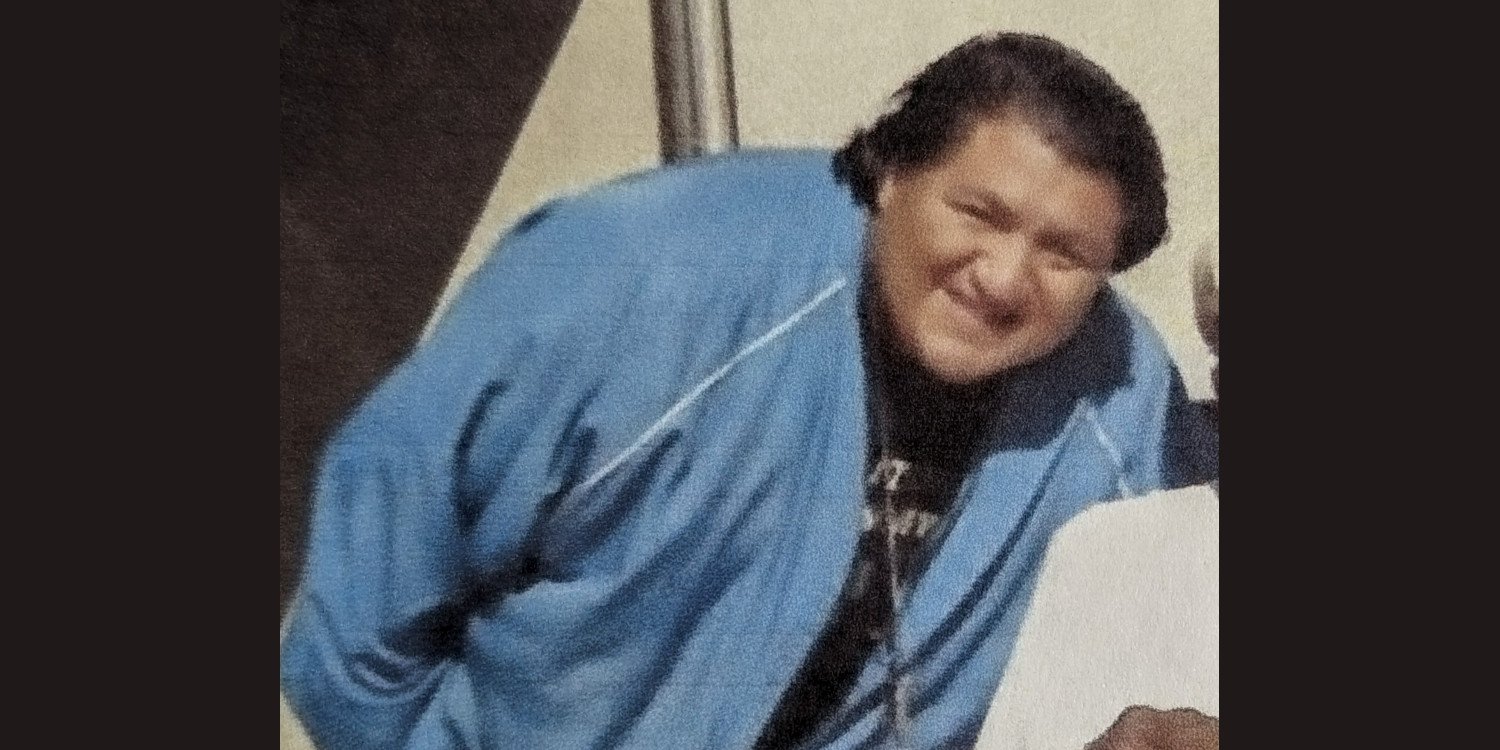
After receiving $200,000 settlement from the Diocese of Manchester in 1996, Thomas Grover relocated to Arizona. He is pictured here about three years after the MacRae trial.
Now Pauline Goupil, M.A.
Far more troubling was the role played in this trial and its aftermath by psychotherapist Pauline Goupil, M.A. (now Pauline Goupil Vachon). As defense counsel Ron Koch (pronounced “Coke”) stood at the defense table to cross-examine Thomas Grover, Mr. Grover turned in protest to the judge. This 27-year-old, 220 lb. man, no stranger to the criminal justice system, complained that he did not want to look at the defendant during the trial and therefore could not answer Mr. Koch’s questions if he stood in the middle aisle by the defense table. In apparent disregard of the Constitutional right of defendants to confront an accuser at trial, Judge Brennan ordered defense counsel to cross-examine Thomas Grover from a position in the court as far from the defendant as possible.
Later, during a break in the trial, PBS-TV official Leo Demers and his wife Penny approached the defense attorney. The issue, they said, had nothing to do with the lawyer standing near the defendant. They pointed out the presence of a woman seated with spectators on the center aisle. They reported seeing that woman influence Thomas Grover’s testimony using hand signals. They pointed out that defense counsel had been blocking Grover’s view of her when he was standing near Father MacRae during cross examination.
Mr. and Mrs. Demers claimed that when defense counsel asked Mr. Grover to explain to whom he first brought his sexual abuse claims, the police or a contingency lawyer, Thomas Grover looked directly at the woman seated at the center aisle at which point she gestured with her index finger over her eye and down her cheek. Grover then began to sob uncontrollably on the stand, causing the judge to declare a recess. Leo Demers pointed the woman out, and defense counsel approached her.
The woman identified herself as Pauline Goupil, M.A., Thomas Grover’s therapist. The defense approached the bench, the jury was dismissed for the day, and Pauline Goupil was ordered to the stand. Ms. Goupil testified that she had been retained by Thomas Grover at the behest of contingency lawyer, Robert Upton, to counsel Grover throughout the trial and keep him “clean and sober.” Ms. Goupil stated that she had a practice specialization in treating victims of sexual abuse and assault.
For an entire afternoon, Pauline Goupil, M.A. testified about her role, and vehemently protested defense attempts to obtain her file. Pre-trial, the defense moved for copies of all Thomas Grover’s treatment records, but received none of them despite Grover's claim that he had been treated for his drug addiction six times. The defense was never told of Grover’s on-going treatment with Pauline Goupil.
In the end, the judge ruled that he would conduct an in-camera review of Ms. Goupil’s treatment file which she was ordered to produce the next day. She was then barred from the court for the remainder of trial. The presence of Ms. Goupil, and the matter of her giving Grover hand signals during his testimony, was never heard by the jury and the defense counsel did not move for a mistrial.
Pauline Goupil’s file was submitted the next day for in-camera review by Judge Brennan. In it was a letter from Ms. Goupil to Thomas Grover in which she chastised him for not showing up for her sessions, and assured him:
“I have good news. Jim [Keene, NH sex crimes detective James F. McLaughlin] told me that MacRae is being offered a plea deal he will have to accept. So there will be no trial. We can just move on with the settlement phase.”
Neither the letter, nor Pauline Goupil’s coaching of Thomas Grover’s testimony ever became known to the jury.
Several years after this trial, but before his retirement from PBS and WGBH Television in Boston, Leo Demers wrote a personal letter to retired Judge Arthur Brennan:
“My wife and I were present in the courtroom throughout most of the trial of Fr. Gordon MacRae in 1994. For all these years, I have had many questions about this trial and much that I have wanted to clarify for my own peace of mind ... . We saw something in your courtroom during the MacRae trial that I don’t think you ever saw. My wife nudged me and pointed to a woman, Ms. Pauline Goupil, who was engaged in what appeared to be clear witness tampering. During questioning by the defense attorney, Thomas Grover seemed to feel trapped a few times. On some of those occasions, we witnessed Pauline Goupil make a distinct sad expression with a down-turned mouth and gesturing her finger from the corner of her eye down her cheek at which point Mr. Grover would begin to cry and sob on the stand. The lawyer’s questions were never answered.
“I have been troubled about this for all these years. I know what I saw, and what I saw was clearly an attempt to dupe the court and the jury. If the sobbing and crying was not truthful, then I cannot help but wonder what else was not truthful on the part of Mr. Grover. If he was really a victim who wanted to tell the simple truth, then why was it necessary for him and Ms. Goupil to have what clearly appeared to be a set of prearranged signals to alter his testimony?”
Back at the 1994 trial, once Pauline Goupil’s role in the case was known, Thomas Grover was put back on the stand. He testified that Ms. Goupil arranged for him to be drugged before his testimony, and that was why he could not remember specifics. Thomas Grover claimed that part of the residual effect of the abuse he suffered was chronic unemployment due to his emotional state. He was asked by defense counsel how — since he could not hold a job — could he afford weekly therapy with Ms. Goupil. Grover stated, “She worked something out with my lawyer. She’ll be paid after the settlement.” Earlier in his testimony, Grover denied having any awareness of plans to sue the Catholic Church.
The next morning in the court, Judge Brennan cited a local Keene Sentinel news article reporting that Thomas Grover appeared confused and inconsistent on the witness stand. Judge Brennan came up with a shocking remedy for this. When he summoned the jurors back into the Court, he instructed them to “disregard inconsistencies in Mr. Grover's testimony.”
Pauline Goupil had just three years earlier obtained a B.A. in psychology from “The School of Lifelong Learning.” She then received an M.A. in counseling from Antioch College in Keene, NH where the state’s expert witness in this trial, Leonard Fleischer, Ed.D., was a faculty member and Ms. Goupil’s mentor.
Shortly after Father MacRae was sent to prison, some of the witnesses in this trial spotted Ms. Goupil in the prison’s visiting area. She was visiting her son who in 1989 was convicted at age 19 of multiple charges of serial rape for which he is serving a lengthy sentence. Her son’s convictions came just a few years before Pauline Goupil began a practice specialization in treating victims of sexual assault.
Two years after Gordon MacRae’s criminal trial, Pauline Goupil offered extensive testimony in a lawsuit against the Catholic Church brought by Thomas Grover and his brothers. Her testimony was in support of Grover’s attempt to defeat the state’s three-year statute of limitations on tort actions by claiming, successfully, that the statute of limitations should begin to toll only when a victim becomes aware he was injured and makes a causal connection with abuse.
Toward that end, Pauline Goupil testified with a whole lot of information and documentation that was not part of the treatment file that she was ordered by Judge Brennan to hand over in 1994 for in-camera review.
In her renewed testimony for the lawsuit in 1996, she testified that Thomas Grover’s particular version of Post Traumatic Stress Disorder caused him to “suppress” all emotional awareness of the abuse he suffered, and caused him to forget many crucial details of that abuse until his pre-trial treatment sessions with her. From the 1996 testimony of Pauline Goupil, M.A.:
Q: Now, one of the ways that a person avoids trauma is inability to recall important aspects of the trauma?
Ms. Goupil: Yes.
Q: That’s not true in Tom’s case is it?
Ms. Goupil: Yes, it is true.
Q: Didn’t he tell you all about this trauma?
Ms. Goupil: He told me some incidences of trauma, but there were some details that were very relevant that I heard when I was sitting in court that he had never spoken with me about that he could remember. One of the symptoms of [PTSD] is that the person forgets information that is really quite relevant to the trauma.
Q: How do you know that he forgot these things?
Ms. Goupil: The point [is] that a person who suffers from Post Traumatic Stress Disorder will forget relevant information, meaning that it’s relevant to the trauma that they experienced, but they will remember irrelevant information.
Q: Tom remembered this trauma, isn’t that right?
Ms. Goupil: Parts of the trauma.
Q: Is it fair to say that, as you understand it...that he did not forget any aspect of what happened to him that he had reported to you?
Ms. Goupil: He did forget some aspects of what happened to him.
Q: No. That he had reported to you.
Ms. Goupil: Your questions are very complicated.
Q: All right. Let me start again... . It was apparent that he had always remembered the things that he told you?
Ms. Goupil: No, that is not apparent.
Q: Okay. Tell me. Did he say, “I just remembered these.”?
Ms. Goupil: Yes.
Q: And what did he say that he just remembered?
Ms. Goupil: I can’t tell you any specific memory because all the memories are just sort of there, but he would come into a — I can’t name a particular session — I would have to consult the file — where he would say...you know, something happened and I just remembered it.
Elsewhere in the 1996 lawsuit transcript, Pauline Goupil testified about her diagnosis of Tom Grover:
Q: ... Now did you review your records in the time that you were away about the number of visits that you had with Tom?
Ms. Goupil: Yes.
Q: ... And what’s the total number?
Ms. Goupil: Twenty-eight.
Q: And those sessions each lasted about an hour in the usual course?
Ms. Goupil: Fifteen minutes.
Q: And the diagnosis you made was when? At the end of the line? At the beginning
Ms. Goupil: At the beginning. It usually takes two or three sessions to make an assessment.
Q: You said you gave him a dual diagnosis?
Ms. Goupil: Yes.
Q: One thing I heard was Post Traumatic Stress Disorder?
Ms. Goupil: Uh-huh.
Q: The other problem?
Ms. Goupil: Substance abuse. In remission.
Q: ... So, now we’re talking about PTSD, and you’re diagnosing it with regard to someone who has had a sexual experience.
Ms. Goupil: That’s correct... . In 1980 PTSD was taken out of the battlefields and brought into the battlefields of persons who have been abused because the symptomatology was very obviously similar to people who were returning from war.
Q: ... Would you say psychotherapy is an art, science, or both?
Ms. Goupil: My degree is a Master of Arts so I guess it’s probably an art.
Author’s note: During an ongoing investigation of this matter by former FBI Special Agent Supervisor James Abbott, both Thomas Grover and Pauline Goupil declined to be interviewed or to answer any questions regarding this matter.
+ + +
Editor’s Note: Thank you for reading and sharing this post. You may also be interested in these related posts by Ryan A. MacDonald.
The Trial of Father MacRae: A Conspiracy of Fraud
The Eucharistic Adoration Chapel established by Saint Maximilian Kolbe was inaugurated at the outbreak of World War II. It was restored as a Chapel of Adoration in September, 2018, the commemoration of the date that the war began. It is now part of the World Center of Prayer for Peace. The live internet feed of the Adoration Chapel at Niepokalanow — sponsored by EWTN — was established just a few weeks before we discovered it and began to include in at Beyond These Stone Walls. Click “Watch on YouTube” in the lower left corner to see how many people around the world are present there with you. The number appears below the symbol for EWTN.
Click or tap the image for live access to the Adoration Chapel.
The following is a translation from the Polish in the image above: “Eighth Star in the Crown of Mary Queen of Peace” “Chapel of Perpetual Adoration of the Blessed Sacrament at Niepokalanow. World Center of Prayer for Peace.” “On September 1, 2018, the World Center of Prayer for Peace in Niepokalanow was opened. It would be difficult to find a more expressive reference to the need for constant prayer for peace than the anniversary of the outbreak of World War II.”
For the Catholic theology behind this image, visit my post, “The Ark of the Covenant and the Mother of God.”
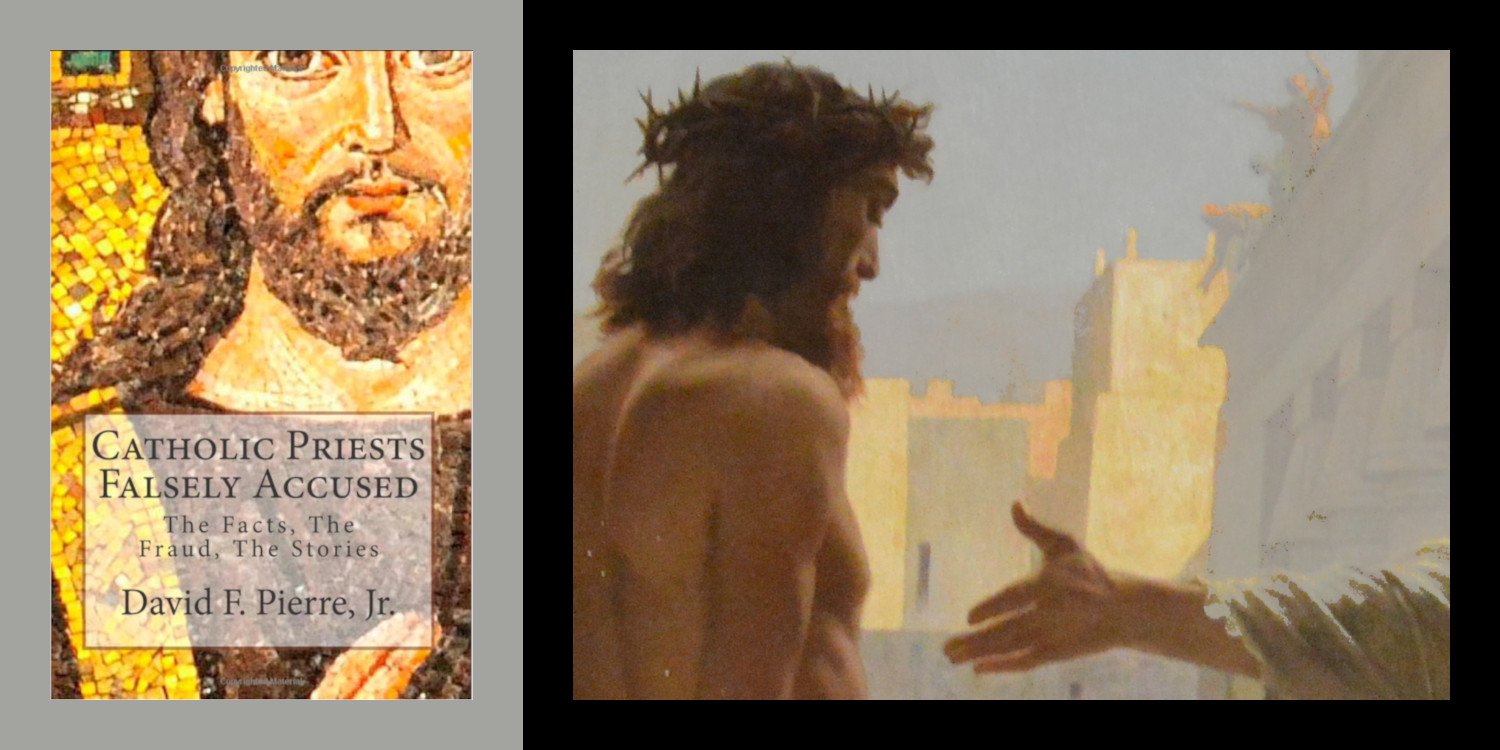
The Media Report: Catholic Priests Falsely Accused
David F. Pierre, Jr. is a widely acclaimed author on the Catholic abuse story. One of the cases presented in his book, entitled above, is that of Fr. Gordon MacRae.

David F. Pierre, Jr. is a widely acclaimed author on the Catholic abuse story. One of the cases presented in his book, entitled above, is that of Fr. Gordon MacRae.
October 19, 2022 by David F. Pierre, Jr.
A Message from David F. Pierre, Jr.:
“When I published my book Catholic Priests Falsely Accused over a decade ago, I never thought that the contents would still reverberate today and that the chapter on the case of Fr. MacRae would especially impact its readers. Since the book was released, there have been numerous additional revelations further vindicating Fr. MacRae — as Beyond These Stone Walls has compiled — and I consider the chapter just one piece of many chronicling the many important aspects of the case.”
The case of Father Gordon J. MacRae — from the Diocese of Manchester (New Hampshire) — falls into a category all its own. No single case in the Catholic Church abuse narrative has been more feverishly debated. The case has bitterly polarized observers for several years. There are those who maintain the priest’s guilt and those who forcefully assert his innocence.
Since 1994, Fr. MacRae has been incarcerated in the New Hampshire State Prison for Men. On September 23, 1994, a jury convicted the priest of repeatedly molesting a teenage boy during counseling sessions and elsewhere. A judge later sentenced the cleric to 67 years in prison.
Fr. Gordon vehemently asserts his innocence and claims that he is falsely accused. With the help of outside supporters, an old typewriter, and the use of traditional postal mail, Fr. MacRae authors BeyondTheseStoneWalls.com from his small prison cell. Fr. MacRae utilizes the blog not just as a forum to assert his innocence. He also posts thoughtful spiritual and theological commentary. BeyondTheseStoneWalls.com is truly a compelling venue on the Internet.
What are the facts in this controversial case? Those who believe Fr. Gordon’s guilt is demonstrable gesture to reams of court documents and articles available at an anti-Church watchdog site. However, as with so many other cases, there is an alarming opposite side to Fr. MacRae’s narrative that has not been widely told.
The criminal conviction of Fr. Gordon in 1994, which would catapult him to his sentence of 67 years in prison, rested on the uncorroborated testimony of one individual. The man’s name is Thomas Grover [who at this writing is 55 years of age]. Amazingly, two of Thomas’ brothers and two other men — known to the Grover boys — also accused Fr. Gordon of molesting them. Yet only the claims of Thomas Grover would be the subject of an actual criminal trial.
It is certainly a matter of debate whether the justice system yielded a fair trial for Fr. Gordon. Although the accuser Grover had a lengthy juvenile and adult criminal history of “theft, assault, forgery and drug offenses,” the presiding judge, the Hon. Arthur D. Brennan, did not allow the priest’s defense to present this as evidence. Had the judge allowed this important information, the jury may have examined Grover’s claims a bit more critically.
Indeed, Thomas Grover’s accusations were quite untenable. According to the court testimony of Grover, Fr. Gordon repeatedly sexually assaulted him about a decade earlier during four different counseling sessions in 1983, when he was fifteen years old. Asked at trial why he would repeatedly return week after week to counseling sessions at which he had been previously attacked, Grover testified that he had “repressed” the memory of the experience after each assault. He claimed that he had an “out-of-body experience” which resulted in him completely forgetting the fact that he had been victimized during the previous visit.
In addition, according to trial testimony, when Grover attended a drug treatment center in 1987, he told a counselor that his father had abused him. Grover did not cite the priest as an abuser. In fact, the accuser identified the priest by name to his counselor in only one instance. Grover wrote Fr. MacRae’s name on his discharge contract indicating that the priest would be his sponsor in sobriety. She reported that Grover went on in therapy to accuse so many people of sexually abusing him that the staff thought “he was going for some kind of sexual abuse victim world record.” But he never accused Fr. MacRae.
In a previous deposition under oath, Grover made more bizarre claims about Fr. Gordon, one of which was that the priest had chased him with a car. “And he had a gun,” the accuser added, “and he was threatening me and telling me over and over that he would hurt me, kill me, if I tried to tell anybody, that no one would believe me. He chased me through the cemetery and tried to corner me.” However, at Fr. MacRae’s trial, the prosecution did not call a single witness to corroborate the public spectacle of a priest with a gun in a car chasing a boy through a cemetery.
As the trial progressed, even the prosecution could see that Thomas Grover had serious credibility problems. In the middle of the trial, after Grover’s flimsy appearance, the prosecution offered Fr. Gordon a plea bargain in which the priest would agree to serve only a maximum of two years in jail in exchange for an admission of guilt. It was not the first time the prosecution extended such a generous deal. On two other occasions before the court case — six months before trial and again a week before trial — the state offered plea deals to Fr. Gordon, both of which would ask that he serve no longer than three years in prison. The prosecution would have loved to have seen the priest take the offers.
But Fr. Gordon was adamant. He would not plead guilty to charges that he maintained were false. “I am not going to say I am guilty of crimes I never committed so that the Grovers and other extortionists can walk away with hundreds of thousands of dollars for their lies,” the priest asserted.
The trial progressed, and although Thomas Grover’s testimony may have seemed hard to believe on the surface, the accuser was effectively theatrical during his appearance. He railed against the priest for “forcing” him to withstand the agony of a trial. In addition, during Grover’s testimony, the accuser’s therapist — retained by the man’s contingency lawyer — reportedly coached her former patient while sitting in open view inside the courtroom. Apparently directed by the therapist, Grover became emotional at strategic moments during his testimony. Courtroom witnesses have reported that when Grover was confronted with difficult questions, the therapist would gesture to her patient that he should cry. Grover would then become emotional and dramatic, often leading the judge to call a recess.
Meanwhile, Judge Brennan purposefully ordered the jury to “disregard inconsistencies in Mr. Grover’s testimony.” To the shock of Fr. Gordon, the jury returned with a guilty verdict in less than 90 minutes.
At Fr. Gordon’s sentencing, the prosecution efficiently utilized accusations of abuse charges by other men. Stomach-turning stories of child pornography also impacted the jury. An angry Judge Brennan railed against the convicted priest. He berated the cleric for his “lack of remorse” over his crimes. (Lost on the judge was the fact that the priest forcefully maintained his innocence and had rejected three different plea offers.) Building upon his rage, the judge added, “The evidence of your possession of child pornography is clear and convincing.”
There was one problem, however. “There was never any evidence of child pornography,” the lead detective on the case later admitted to The Wall Street Journal.
Under New Hampshire prison guidelines, Fr. Gordon will never be eligible for parole unless he admits guilt. As with the case of Msgr. McCarthy (Chapter 6), Father Gordon’s narrative highlights the zeal with which some detectives will seek a prosecution, despite the claims presented to them.
The criminal case against Fr. Gordon actually began when one of Thomas Grover’s brothers, Jonathan, approached Keene, New Hampshire, Detective James McLaughlin with the claim that Fr. Gordon had abused him years earlier. However, Jonathan did not just accuse Fr. Gordon of abuse; he accused a second priest as well — Fr. Stephen Scruton. However, as Detective McLaughlin further examined Jonathan’s claims, he realized that Fr. Scruton did not even serve at the parish of the alleged abuse until years after Jonathan claimed that the acts took place.
With this startling discovery of fact, many detectives would have concluded that Jonathan was not being truthful. There would even be more reason to doubt Jonathan when two of his brothers came forward to claim similar abuse by the two priests. But rather than dropping the investigation altogether and issuing charges against Jonathan for filing a false report, McLaughlin continued his crusade by simply scrubbing the existence of Fr. Scruton from future investigations altogether. [It was at this point in police reports that Detective McLaughlin gave the Grover brothers a copy of Fr. MacRae’s resume “to help them with their dates.”]
In the course of trying to nab Fr. MacRae, McLaughlin initiated a couple of attempted “stings” to get the priest to admit to the alleged abuse. One was a letter claiming to be from Jonathan Grover that “recalled” several sexual escapades and declared that the “sex between us was very special.” Fr. Gordon replied to the letter by saying that the letter writer must be an imposter, because no such acts ever took place. McLaughlin also attempted a number of secretly recorded phone calls to try to bust the priest, but none of them yielded anything incriminating. The calls were an utter failure, by all investigative measures.
Fr. Gordon would have been out of prison long ago if he had accepted the plea deals and admitted guilt. Instead, in staunchly maintaining his innocence, he will likely live in a prison cell for the remainder of his life.
In recent years, even more evidence has surfaced to support the claim that Fr. Gordon was falsely accused. One of the priest’s accusers (not Thomas Grover) has reportedly recanted his claims. In early 2011, a document surfaced in which the accuser plainly acknowledges that fraud was committed against Fr. Gordon and the Catholic Church. According to a New York investigative writer, the document says:
“I was aware at the time of the trial, knowing full well that it was bogus and having heard of the lawsuits and money involved, and also the reputations of those making accusations … whom I went to school with. It seemed as though it would be easy money if I would also accuse Fr. Gordon of some wrongdoing. … I believed easy money would come from lawsuits against MacRae. I was at the time using drugs and could have been influenced to say anything they wanted for money.” [Signed statement of Steven Wollschlager]
So despite the tempting opportunity of a high-stakes payout, the man refused to go along with what he saw was a gross money-grubbing scam.
In 2005 and 2013, Pulitzer Prize-winning writer Dorothy Rabinowitz profiled the case of Fr. Gordon for a trio of eye-opening articles for The Wall Street Journal. After months of studying court documents and combing through testimonies, Rabinowitz concluded that Fr. MacRae was clearly a victim of fraud and was wrongly convicted.
Sadly, under intense public pressure from events of the past decade, Church officials have essentially abandoned Fr. Gordon. Despite the fact that evidence possibly indicating innocence continues to surface, Church officials have kept their distance from the incarcerated cleric. While Church officials have publicly supported the prosecution of Fr. Gordon, there are reports that privately they admit that the cleric may have been falsely accused. For example, in 2011, two signed statements surfaced which claim that Bishop John McCormack, the longtime head of the Diocese of Manchester, has privately stated that he believes Fr. Gordon is innocent.
One such statement comes from a man who once worked at a television station that was to profile Fr. Gordon’s case. It quotes Bishop McCormack as saying to the man, “Understand, none of this is to leave this office. I believe Father MacRae is not guilty and his accusers likely lied. There’s nothing I can do to change the verdict,” Bishop McCormack said, according to the statement. [See Fr. George David Byers, “Omertà in a Catholic Chancery: Affidavits Expanded”]
The man submitted his statement about Bishop McCormack’s remarks because he believed there was a glaring injustice in the inconsistency between the Bishop’s public actions and his private statements.
Should the case against Father Gordon MacRae be reviewed? Considering the totality of the evidence, especially that which has surfaced in recent years, the answer is, “Yes.” Justice demands it.
In addition, recent developments and emerging information will likely result in appeals of Fr. MacRae’s case. Stay tuned.
David F. Pierre, Jr. is the country’s leading observer of the media’s coverage of the Catholic Church abuse narrative and is the author of four books. His most recent is The Greatest Fraud Never Told: False Accusations, Phony Grand Jury Reports, and the Assault on the Catholic Church. David has been heard on National Public Radio (NPR) and cited in the New York Times, the Chicago Tribune, USA Today, and many other media outlets. He is the creator and author of TheMediaReport.com, an educational cooperative to chronicle and monitor the mainstream media’s coverage of the Catholic Church sex abuse narrative. He lives with his wife and family in Massachusetts.

Bogus Charges Against Priests Abound
Editor’s Note: In a 2012 article for Catalyst, the Journal of the Catholic League for Religious and Civil Rights, Rev. Michael P. Orsi, research fellow in Law and Religion at Ave Maria School of Law, wrote an extended review of David F. Pierre’s book cited above. His review is titled “Bogus Charges Against Priests Abound.”
The following is an excerpt from that review:
Catholic Priests Falsely Accused: The Facts, The Fraud, The Stories by David F. Pierre, Jr., Mattapoisett, Massachusetts: www.TheMediaReport.com
“David Pierre is one of the country’s leading observers of the Catholic Church abuse narrative. In Catholic Priests Falsely Accused: The Facts, the Fraud, the Stories, he presents case studies backed by hard data which clearly demonstrates some of the injustices foisted on Catholic priests and the Church. ...
“A sure way to ameliorate the injustices perpetrated against priests and to rehabilitate the reputation of the Church would be to re-examine the cases of those priests found guilty due to false or dubious abuse claims filed against them. The widely reported case of Fr. Gordon MacRae, of the Diocese of Manchester, New Hampshire, would be a good place to start. Pierre outlines it in his book. It is quite obvious that Fr. MacRae did not receive a fair trial according to the facts cited in a piece published in The Wall Street Journal.
“MacRae’s accuser, a fifteen year old boy, had a lengthy juvenile record and presented doubtful evidence in trial testimony. The judge even went so far as to order the jury to ‘disregard inconsistencies in Mr. Grover’s (his accuser) testimony.’ Father MacRae, protesting his innocence, refused a plea bargain deal of two years in prison. Now he is serving a 67 year sentence. His own, now retired, bishop believes him to be innocent. What a moral boost this would be for the nation’s priests and for the Catholic laity ... to have this case reopened!”
+ + +
BREAKING NEWS: Just as this post went to print, David F. Pierre, Jr. and The Media Report published “Twice Is a Charm? Wall St. Journal Again Profiles Stunning Case of Wrongfully Convicted Priest Fr. Gordon MacRae.”
To learn more about the rampant fraud, dishonest grand jury investigations, and career-building prosecutorial misconduct behind the Catholic Church abuse story, please consult these additional books by David F. Pierre, Jr. and The Media Report. Father Gordon MacRae also urges readers to subscribe to The Media Report.
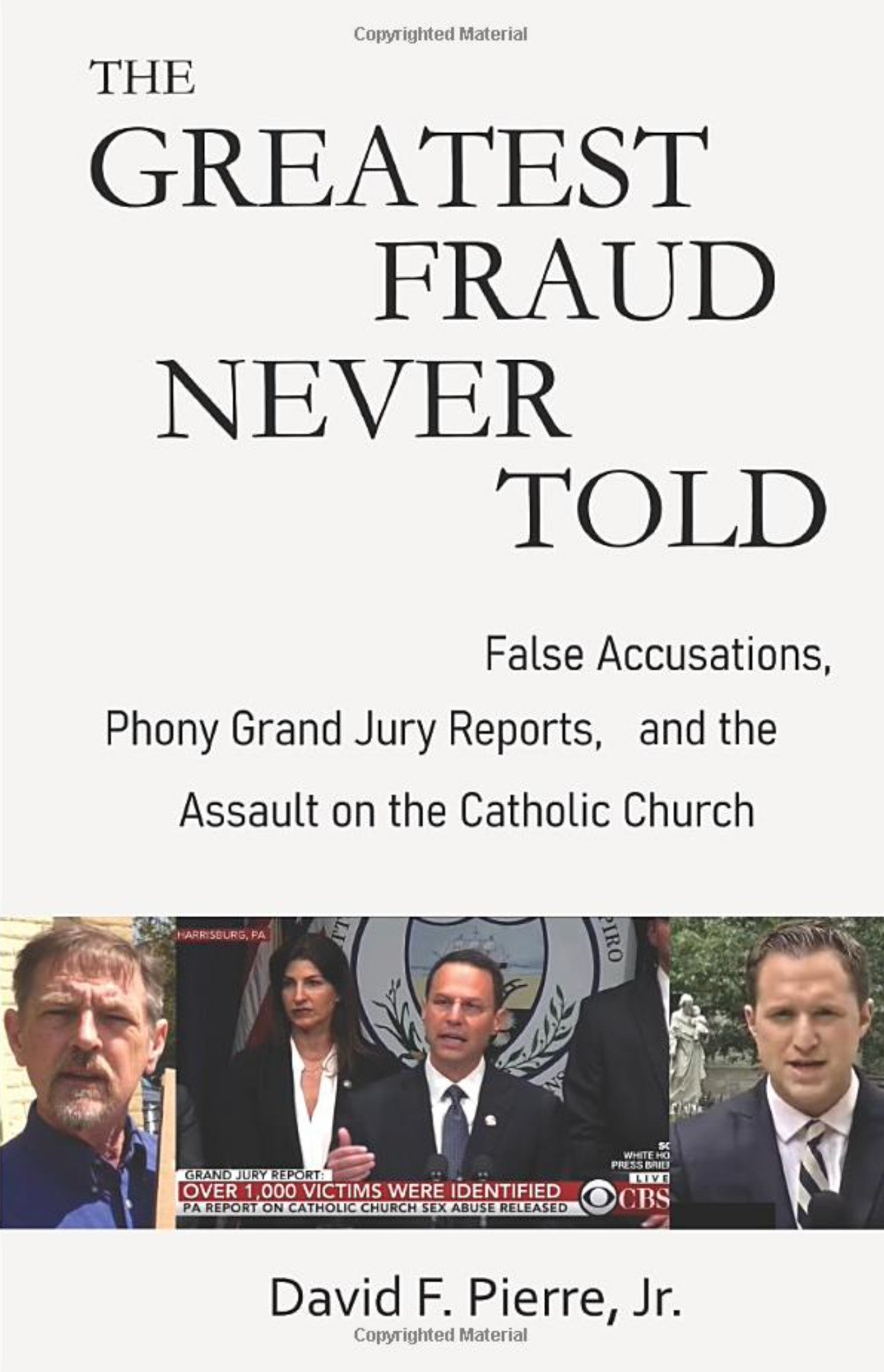


Police Misconduct: A Crusader Cop Destroys a Catholic Priest
Keene New Hampshire sex crimes detective James McLaughlin developed claims against a Catholic priest while suppressing exculpatory evidence and coercing witnesses.

Keene New Hampshire sex crimes Detective James McLaughlin developed claims against a Catholic priest while suppressing exculpatory evidence and coercing witnesses.
Editor’s Note: The following guest post by Ryan A. MacDonald is a response to Fr. Gordon MacRae’s recent, “Predator Police: The New Hampshire Laurie List Bombshell.”
January 26, 2022 by Ryan A. MacDonald
Last week, Fr. Gordon MacRae wrote here about the manipulation of facts and witnesses in his 1994 trial on charges brought forward by former Keene, NH Detective James McLaughlin. This manipulation included allegations that he coerced and threatened a witness, Debra Collett, to alter her first-hand testimony because it did not agree with his bias. Another witness, a former accuser of Father MacRae who recanted, alleged that McLaughlin presented him with a proffered bribe to concoct a false claim against MacRae and conspired to attempt perjured testimony before a grand jury.
These are very serious allegations. They were uncovered years after the trial by former FBI Special Agent James Abbott who conducted a three year investigation of this case. Mr. Abbott obtained signed statements from these witnesses and others that became part of a habeas corpus petition seeking to free Father MacRae from an unjust imprisonment.
As MacRae’s post linked above points out, New Hampshire judges at both state and federal levels overlooked these allegations, and declined to allow an evidentiary hearing to permit these witnesses to testify under oath. From a political standpoint, this may be business as usual in New Hampshire. From a justice standpoint, it is most disturbing.
At the start of 2022, advocates for Father MacRae learned that former Detective James McLaughlin appears on a newly published list of police officers with professional misconduct or credibility issues previously held in secret personnel files. The list had been held in secret for years by the NH Attorney General, but a recent legal decision required its public release. Formally called the “Exculpatory Evidence Schedule,” the list is also known as the “Laurie List” for the NH Supreme Court case that initiated it.
It came as no surprise to discover Detective McLaughlin on this list for a 1985 incident of “Falsification of Records.” That was nine years before MacRae’s trial. Over fifty years ago, the U.S. Supreme Court ruled in Brady v. Maryland that state and federal prosecutors are required under the Due Process Clause of the U.S. Constitution to reveal to defendants and legal counsel all exculpatory evidence uncovered in the investigation of a case.
The failure of prosecutors to reveal the “falsification of records” charge against Detective McLaughlin was a violation of what is known as the “Brady Rule” that can and should overturn a conviction. As a minimum, it constitutes new evidence that can reopen a case for judicial review of the entire case.
Advocates first learned of this Brady violation from an article published at InDepthNH.org by Damien Fisher entitled, “AG Hides Some ‘Laurie List’ Names Hours After Release.” The article, though largely accurate, contained some misinformation. It described MacRae as a “former” Catholic priest which is not accurate. It also cited that MacRae “claimed that McLaughlin offered to pay cash to one of his accusers.” That claim was not made by MacRae, but by the accuser himself who recanted in a signed statement obtained by former FBI Agent James Abbott.

Politics and Prosecution
The New Hampshire Center for Public Interest Journalism, which publishes InDepthNH.org, is continuing its lawsuit seeking full and unredacted disclosure of the “Laurie List” in its entirety. A more recent article by Damien Fisher, “Famed Keene Cop Called Out for Federal Entrapment” (January 11, 2022) detailed a clear case of entrapment by McLaughlin. The article describes the original “Laurie List” charge of “Falsification of Records” by McLaughlin as “Falsification of Evidence.”
Noted Boston lawyers Harvey Silverglate and Alan Dershowitz are long-time associates in the cause of preservation of our civil rights and civil liberties. Mr. Dershowitz wrote the Forward for Silverglate’s acclaimed 2009 book, Three Felonies a Day: How the Feds Target the Innocent. The following is an excerpt:
“Our system of investigation and prosecution is unique in the world. We [in America] have politicized the role of prosecutor, not only at the federal level but in all of our states and counties as well. Nowhere else are prosecutors (or judges) elected. Indeed, it is unthinkable in most parts of the world to have prosecutors run for office, make campaign promises and solicit contributions. In the United States, prosecutors are not only elected but the job is a stepping stone to higher office as evidenced by the fact that nearly every congressman or senator who ever practiced law once served as a prosecutor. Winning becomes more important than doing justice.” (p. xxv)
There were two prosecutors at Father Gordon MacRae’s 1994 trial. One inexplicably took his own life several years later after the first articles challenging this case appeared in The Wall Street Journal and were published along with the items in our Documents page at a site that preceded MacRae’s blog. The lead prosecutor was Bruce Elliot Reynolds. At the time of the high profile trial, he used its notoriety to campaign for another Assistant County Attorney in his office who was running to unseat the incumbent. In New Hampshire, a County Attorney is equivalent to a District Attorney in other states.
There was a lot that went on behind the scenes of this trial. The lead prosecutor was reined in by the judge for sensational media statements about the trial which could (and did) taint the jury pool. The trial drew lots of local news coverage. As it got under way, Mr. Reynolds was chastised by Judge Arthur Brennan for wearing his campaign button before news cameras.
On the day after the trial, for reasons unknown, Reynolds was fired by the winner of the election, the incumbent against whom he was campaigning. Sometime later, Reynolds decided to run for County Attorney himself. His campaign cited his “vigorous” prosecution of Father Gordon MacRae as his most significant “tough on crime” career achievement. Mr. Reynolds was then exposed for some sort of tax matter, dropped out of the race, and left the state. He relocated to the State of Wisconsin.
Prior to the trial, Reynolds sent a letter to MacRae’s defense counsel which laid out terms for a strikingly lenient plea deal for a sentence of one to three years in prison if MacRae would simply plead guilty. He refused this offer because he is not guilty. He refused a similar offer in the middle of trial when the offer was reduced to one-to-two years. The prosecutor asked what it would take to get MacRae to take the deal. His lawyer’s answer: “The dismissal of charges because he is innocent.”
It seemed clear throughout pretrial motion hearings and the trial itself that the real prosecution of this case was carried out by Detective James McLaughlin, the sole sex crimes detective among the 25 or so officers in the Keene, NH Police Department. An account of how Detective McLaughlin investigated this matter is laid out in “Wrongful Convictions: the Other Police Misconduct.”

A Conspiracy of Fraud
This trial was a classic example of why the blending of politics and the justice system often defeats justice. The trial was not about arriving at the truth. It was all about winning, at any cost, because political aspirations and careers were at stake. In no other arena but the political could a prosecution accept without question testimony from a grown man who claimed that he was sexually assaulted five times by a Catholic priest a dozen years earlier at age 15, but returned to be assaulted again and again for a total of five times because he repressed all memory of the vicious assaults from week to week.
Only political blindness could deny and obfuscate the fact that a $200,000 settlement from a Catholic diocese is a possible enticement for perjury and fraud. As Alan Dershowitz observed above, “Winning becomes more important than doing justice.” Such an arena requires the work of an unethical crusader to mold and shape a case toward that end. In Detective James McLaughlin, the State had just such a crusader.
At the “Documents” section on this site is a three-part case history which was the result of substantial research. It includes a most telling document entitled, “United States District Court: Gordon J. MacRae v. James F. McLaughlin, et al.” It requires a little background. Prior to the 1994 MacRae trial, the suppression of evidence and one-sided media coverage was so great that Father MacRae felt his only recourse was to file a lawsuit of his own. It lays out the bold but simple truth of this matter. No one refuted even one of its many claims.
The lawsuit was upheld and survived several attempts to have it thrown out, but in the end it had to be dismissed without prejudice — meaning without a judicial ruling — when MacRae was convicted at trial. He could only bring the lawsuit again if the underlying convictions were resolved. This document lays out perhaps the most chilling factual abuse of police power in this or virtually any other case. It is well worth a review.
Prior to this trial MacRae voluntarily took, and conclusively passed, two polygraph examinations with a noted expert. Some of Detective McLaughlin police reports made allusions to the possible creation of child pornography by MacRae. At the time of his sentencing, Judge Arthur Brennan cited this, claiming that “This Court has heard clear and compelling evidence that you created pornography of your victims.” This never surfaced at all during the trial, but the ugly accusation at sentencing was later used for a purely evil endeavor. It was used by SNAP, the Survivors Network of those Abused by Priests, to bolster a crimes against humanity charge targetting Pope Benedict XVI at the International Criminal Court at The Hague.
Mercifully the effort failed. Eleven years later in 2005 Dorothy Rabinowitz at The Wall Street Journal questioned Detective McLaughlin about the nature and substance of that evidence. “There was never any evidence of child pornography,” he admitted. In this entire matter, that was the only time McLaughlin told the truth.
During the trial, two court observers reported spotting a woman in the gallery giving hand signals to Thomas Grover to begin crying during his testimony. It came after he testified that he was unaware of any plan to sue the Catholic Church. He was asked by MacRae’s counsel to reveal to whom he went first with his accusations: the police or a lawyer. At this point, Ms. Pauline Goupil (now Pauline Goupil Vachon) was observed from the gallery signalling Grover to cry. He was riveted upon her for his entire testimony. At that point she was seen placing her fingers below her eye and then down her cheek in a pantomime of crying. In response, 27-year-old Grover wept loudly and at length. The two witnesses who observed it reported it to the defense counsel who then approached the bench. Judge Brennan cleared the jury from the court and called Ms. Goupil to the stand. She identified herself as a therapist retained by Thomas Grover at the behest of his attorney. All treatment records of Mr. Grover were to be reviewed by the defense pretrial, but neither Pauline Goupil’s records nor the fact of her treatment of Grover were revealed.
Hard evidence surfaced pretrial that Detective McLaughlin conducted some of his one-sided investigation, not from his Keene police office, but from 60 miles away in the law office of Robert Upton, the personal injury lawyer who brought a lawsuit on behalf of Thomas Grover and obtained a $200,000 settlement from the Diocese of Manchester. Family members of Grover revealed years later that Grover was coached to “act crazy” before the jury, to appear vulnerable, and to commit perjury in regard to some of his testimony. When asked who did this coaching, their answer was Pauline Goupil and Detective McLaughlin. These family members, the former wife and stepson of Thomas Grover, were also barred from giving testimony under oath. The two people who observed Pauline Goupil’s courtroom witness tampering were also barred from testifying.

A public debt is owed to the NH Center for Public Interest Journalism which publishes InDepthNH.org. The Center continues an open lawsuit contending that the new law that only partially released the “Laurie List” does not protect the public right to know its extent.
In a 2003 Concord Monitor article — now apparently removed from the Internet — fellow Keene, NH officer Sgt. Hal Brown defended McLaughlin’s shady tactics and actions:
“It’s our job to ferret the criminal element out of society.”
I believe Father MacRae would today agree with me that those are very scary words!
Be Wary of Crusaders! The Devil Sigmund Freud Knew Only Too Well
+ + +
Editor’s Note: Please share this important post on your social media.
You may also be interested in these related articles:
Predator Police: The New Hampshire ‘Laurie List’ Bombshell
Police Investigative Misconduct Railroaded an Innocent Catholic Priest

Several years after sentencing Father Gordon MacRae to life in prison, Judge Arthur Brennan was arrested in Washington, DC in 2011 during a protest in which he tried to occupy the US Capitol Building.

#MeToo and #HimToo: Jonathan Grover and Father Gordon MacRae

Jonathan Edward Grover died in Scottsdale Arizona just before his 49th birthday. His role in the case against Father Gordon MacRae leaves many unanswered questions.
Editor’s Note: The following is a guest post by independent writer Ryan A. MacDonald whose previous articles include “The Post-Trial Extortion of Father Gordon MacRae” and “A Grievous Error in Judge Joseph Laplante’s Court.”
When I read Father Gordon MacRae’s Holy Week post on These Stone Walls this year, I was struck by a revelation that he offered Mass in his prison cell for the soul of a man who helped put him there by falsely accusing him. I do not know that I could have done the same in his shoes, and even if I could, I am not so certain that I would. His post took a high road that most only strive for.
The unnamed subject of that post about Judas Iscariot was Jonathan Edward Grover who died in Arizona in February two weeks before his 49th birthday. An obituary indicated that he died “peacefully,” and cited ‘a “long career in the financial industry.” Police determined the cause of death to be an accidental overdose of self-injected opiates weeks after leaving rehab. In Arizona, he had charges for theft, criminal trespass, and multiple arrests for driving under the influence of drugs. A police report described him as “homeless.”
In the early 1990s, Jonathan Grover was one of Father MacRae’s accusers. MacRae first learned of Mr. Grover’s death from a letter written by a woman who had been a young adult friend of Grover at the time of MacRae’s trial in 1994. She wrote that she is now a social worker with “expertise in PTSD” (Post Traumatic Stress Disorder). The letter accused MacRae of having “murdered” 48-year-old Grover. This requires a rational and factual response.
Of interest, Mr. Grover’s obituary – despite his being 48 years old at the time of death – featured his 1987 Keene High School (NH) graduation photograph when Grover was 18 years old. I had seen this photo before. It was among the discovery materials in MacRae’s defense files in preparation for his 1994 trial. The photograph raised the first of many doubts about Grover’s claims.
At age 18 in 1987, Grover gave Father Gordon MacRae, his parish priest and friend at the time, a nicely framed copy of that photo with a letter written on the back. It thanked MacRae for his “friendship and support,” and “for always being there for me.” It was a typically touching letter from a young man to someone he obviously admired. It was written before addiction and the inevitable justification of enablers took hold in his life.
Five years later, apparently forgetting that he ever wrote that letter, Jonathan Grover became the first of four adult brothers to accuse MacRae of a series of sexual assaults alleged to have occurred more than a decade earlier. So what happened between writing that letter in 1987 and accusing MacRae five years later in 1992? It is one of the burning questions left behind in this story.
The framed high school photograph and its accompanying letter never found their way into MacRae’s 1994 trial, or into the public record, because the trial dealt only with the claims of Jonathan’s brother, Thomas Grover. Jonathan was the first to accuse MacRae, but a trial on his claims was deferred. His story had many holes that did not reconcile with the facts. Investigators have since uncovered a different story from the one Grover and his brothers first told.

Bombshells and Black Ops
The two common denominators in the case against Father Gordon MacRae were expectations of money and James F. McLaughlin. In the 1980s, the city of Keene, New Hampshire, with a population then of about 26,000, employed a full-time sex crimes detective on its small police force. In 1988, McLaughlin launched investigations of at least three, and possibly more, Catholic priests in the area including Father Gordon MacRae.
His targeting of MacRae seems to have begun with a bizarre and explosive letter. In September 1988, Detective McLaughlin received a letter from Sylvia Gale, a social worker with the Division of Children, Youth and Families, the New Hampshire agency tasked with investigating child abuse. Ms. Gale’s letter to McLaughlin revealed that she had uncovered information about “a man in your area, a Catholic priest named Gordon MacRae.”
The letter described explosive information from an unnamed employee of Catholic Social Services in the Diocese of Manchester, who developed a slanderous tale that MacRae had been “a priest in Florida where he molested two boys, one of whom was murdered and his body mutilated.” The letter went on to claim that the case was still unsolved, and that MacRae was removed from Florida by Catholic Church officials to avoid that investigation.
The libelous letter also named a Church official, Monsignor John Quinn, as the source of this information reportedly told to an unnamed Church employee on the condition that she would be fired if she ever divulged it. The 1988 letter generated a secret 70-page report developed by Detective James McLaughlin. He launched a dogged pursuit of MacRae who was unaware at the time that any of this was going on.
This all began to unfold one year after Jonathan Grover graduated from Keene High School and presented Father MacRae with that framed photograph and letter of thanks. Armed with Sylvia Gale’s letter, Detective McLaughlin proceeded to question 26 Keene area adolescents and their parents who had known MacRae including members of the Grover family.
Up to that point, not one person had ever actually contacted McLaughlin with a complaint against MacRae, but rather it was McLaughlin who initiated these contacts. As reported below, some of them today claim to have been solicited by McLaughlin to accuse MacRae, some with the enticement of money.
I had to read up to page 54 of McLaughlin’s 1988 report before I came across any effort to corroborate the Florida “murder and mutilation” story with Florida law enforcement officials. By the time he learned that MacRae had never served as a priest in Florida and that no such crime had been committed there, the damage to MacRae’s reputation was already done, and the seeds were sown for the Grover brothers to ponder claims yet to come.
Among those approached by McLaughlin armed with Sylvia Gale’s slanderous letter was Mrs. Patricia Grover, Jonathan’s mother. A parishioner of Saint Bernard Parish in Keene where MacRae had served from 1983 to 1987, Mrs. Grover was also a DCYF social worker and an acquaintance of Sylvia Gale. She had previously worked with McLaughlin in the handling of other cases.
Mrs. Grover also knew Father MacRae. According to McLaughlin’s 1988 report, she was alarmed by the Sylvia Gale letter but doubted that MacRae had ever served as a priest in Florida. She nonetheless vowed to talk with her young adult sons about their relationship with MacRae. Four more years passed before the first of them, Jonathan Grover, accused him.
The “fake news” in the 1988 Sylvia Gale letter set this community abuzz with anxiety and gossip about the potentially lecherous and murderous priest in its midst. Later, Monsignor John Quinn and other Diocese of Manchester officials denied having any involvement in the untrue information about MacRae. They also denied that there was ever any priest who relocated from Florida to New Hampshire under the circumstances described.
Four years later in late 1992, Jonathan Grover became the first of four members of the Grover family to accuse Father Gordon MacRae of sexual abuse dating back to approximately the early 1980s. I use the word “approximately” because Grover and his brothers each presented highly conflicting and multiple versions of their stories and the relevant time frames.
As becomes clear below, Jonathan Grover’s claims became problematic for the prosecution of MacRae, but instead of questioning Grover’s veracity, the police detective engaged a contingency lawyer on Grover’s behalf. In a September 30, 1992 letter from McLaughlin to Jonathan Grover, the detective detailed his conversations with Keene attorney William Cleary who ultimately obtained a nearly $200,000 settlement for Grover from the Diocese of Manchester. From McLaughlin’s letter to Grover:
“As agreed, I contacted William Cleary about your case. Bill believes the statute of limitations has lapsed for a civil action, but this does not rule out the church being financially responsible Bill [Cleary] states he would like to meet with you for a conference. You would not be charged for this. Your options could then be outlined and discussed.”
There is reason to question Detective McLaughlin’s police reports in this case. In most of McLaughlin’s prior cases, he practiced a protocol of audio recording every interview with complainants. In many of his other reports that I have read, he made a point of explaining that he records interviews to protect the integrity of the investigation.
Two years prior to the Grover claims, for example, McLaughlin investigated a complaint against another former Keene area priest, Father Stephen Scruton. From the outset, his reports took pains to document his practice of securing both video and audio recordings of his interviews. He even administered a polygraph test on the accuser. All were standard protocol, but McLaughlin did not create a single recording of any type with any accuser in the case of Father Gordon MacRae. This is suspect, at best, and it has never been explained.
It is made more suspicious by the emergence of other information that has been developed by former FBI Special Agent Supervisor James Abbott who spent three years investigating the MacRae case. One of MacRae’s accusers, a high school classmate of Jonathan Grover, recanted his story when questioned by Mr. Abbott in 2008. An excerpt of Steven Wollschlager’s statement may shed light on why Detective McLaughlin chose not to record these interviews.
“In 1994 I was contacted by Keene Police Detective McLaughlin… I was aware at the time of Father MacRae’s trial knowing full well that it was bogus and having heard of the lawsuits and money involved and also the reputations of those who were making accusations… The lawsuits and money were of greatest discussion, and I was left feeling that if I would go along with the story I could reap the rewards as well. McLaughlin had me believing that all I had to do was make up a story about this priest and I could receive a large sum of money as others already had.
McLaughlin reminded me of the young child and girlfriend I had and referenced that life could go easier for us with a large amount of money… I was at the time using drugs and would have been influenced to say anything they wanted for money.”
In “The Trials of Father MacRae,” a 2013 article by Dorothy Rabinowitz in The Wall Street Journal, Detective McLaughlin described the above account simply as “a fabrication.” What struck me about Mr. Wollschlager’s statement, besides the fact that he had nothing whatsoever to gain by lying, is that he never went to Detective McLaughlin with an accusation. Instead, he alleges that it was McLaughlin who approached him, and the approach alleges the enticement of money.
Steven Wollschlager was not the first person to report such an overture. Given the nature of his account and others, it is unclear today whether Jonathan Grover and his brothers initiated their first contacts with this detective. This suspicion was a contentious issue in MacRae’s 1994 trial. Thomas Grover, the brother of Jonathan Grover, was asked under oath to reveal to whom he went first with his claims, the police or a personal injury lawyer, but he refused to answer. To this very day, that question has never been answered.
What became clear, however, is hard evidence that placed Detective James McLaughlin investigating at least some of this case, not from his office in the Keene Police Department, but from the Concord, NH office of Thomas Grover’s contingency lawyer, Robert Upton, before MacRae was even charged in the case.

A Conspiracy of Fraud
In a report labeled Case No. 93010850, Detective McLaughlin produced the first of several conflicting accounts of untaped interviews with Jonathan Grover. Note that the first two digits of McLaughlin’s report, “93,” seem to indicate the year it was typed, but the date on the report is August 27, 1992. The content of this report is sexually explicit so I will paraphrase. The report has Grover claiming that when he was 12 or 13 years old he “would spend nights in the St. Bernard rectory in Keene.” During those nights, he alleged, he was sexually assaulted by both Father Gordon MacRae and Father Stephen Scruton.
But there was an immediate problem. MacRae was never at St. Bernard’s Parish in Keene until being assigned there on June 15, 1983, when Grover was 14 years old. Father Stephen Scruton was never there before June of 1985 when Grover was 16 years old. These dates were easily determined from diocesan files, but McLaughlin never investigated this. The report continued with claims alleged to have taken place in the Keene YMCA hot tub:
“It was during these times that Grover would be seated in the whirlpool and both Father MacRae and Father Scruton would be joined in conversation and they would alternate in rubbing their foot against his genitals. Grover was unsure if the priests were acting in concert or if they were unaware of each other’s actions.”
This report is highly suspicious. Just months earlier, Detective McLaughlin had previously investigated Father Stephen Scruton for an identical claim brought by another person alleged to have occurred in 1985 after Scruton’s arrival at this parish. “Todd,” the person who brought that claim against Scruton, was also a high school classmate of Jonathan Grover.
After McLaughlin’s investigation, “Todd” obtained an undisclosed sum of money in settlement from the Diocese of Manchester. That interview with “Todd” was labeled Case No. 90035705 dated just 18 months before Jonathan Grover’s identical claims emerged. Unlike the Grover interviews, the interview with Todd was tape recorded by McLaughlin. Here is an excerpt from the report:
“Father Scruton was a regular at the YMCA. Todd went to the YMCA with Father Scruton. They decided to use the hot tub… At one point, Father Scruton took one of his feet and placed it between Todd’s legs and rubbed his genitals… The touching was intentional and not a mistake. A rubbing motion was used by Father Scruton… I asked Todd where he stood on civil lawsuits.”
It defies belief that a small town police detective could write a report about a Catholic priest (Scruton) fondling a teenager’s genitals in a YMCA hot tub, then 18 months later write virtually the same report with the same claims of doing the same things in the same place, only this time adding a second priest, but nothing in the second report seemed to even vaguely remind the detective of the first report.
After “Todd’s” YMCA hot tub complaint in 1990 — 18 months before Jon Grover’s own YMCA hot tub story — Father Stephen Scruton was charged by McLaughlin with misdemeanor sexual assault. He pled guilty and received a suspended sentence and probation. One year later, McLaughlin has someone else repeat the same story, only now involving both Scruton and MacRae, but two to four years before either of them was present in Keene.
What is most suspect about this claim of Jonathan Grover involving both priests is that in 1994, one year after writing the report, McLaughlin responded to a question under oath:
On occasion, I have had conversations with Reverend Stephen Scruton, however I have no recollection of ever discussing any actions of Gordon MacRae with the Reverend Scruton.
(Cited in USDC-NM 1504-JB)
But this all becomes more suspicious still. In the investigation file on these claims was found a transcript of a November 1988 Geraldo Rivera Show entitled “The Church’s Sexual Watergate.” It was faxed by the Geraldo Show in New York to Detective McLaughlin at the Keene Police Department two months after his 1988 receipt of the Sylvia Gale “Florida letter.” It was two years before “Todd’s” YMCA hot tub claim about Father Scruton and four years before Jonathan Grover’s claims. Here is an excerpt:
“Geraldo Rivera: What did the priest do to you Greg?
Greg Ridel: Around the age of 12 or so, he and I went to a YMCA. And I was an altar boy at the time. And the first time I was ever touched… he began stroking my penis in a hot tub, I believe it was, at a YMCA. From there it went to what you might call role playing in the rectory where the priests stay.”
Detective McLaughlin’s 1993 police report also had Jonathan Grover claiming that Father MacRae paid him money in the form of checks from his own and parish checking accounts in even amounts of $50 to $100 in order to maintain his silence about the abuse. McLaughlin never investigated this, but Father MacRae’s lawyer did investigate. Father MacRae’s personal checking account was researched from between 1979 to 1988. It revealed no checks issued to Jonathan or Thomas Grover.
However, the attorney uncovered several checks written from parish accounts to both Jonathan Grover and Thomas Grover. All were in even amounts between $40 and $100 and dated between 1985 and 1987 when these two brothers were 16 to 20 years of age respectively. The checks were filled out and signed by Rev. Stephen Scruton.
Days before Father Gordon MacRae’s 1994 trial commenced, his attorney sought Father Scruton for questioning. He declined to respond. When the lawyer sought a subpoena to force his deposition, Scruton fled the state. During trial, the jury heard none of this. Because the trial involved the shady claims of Thomas Grover alone, the defense could not introduce anything involving his brother, Jonathan.
In April, 2005, The Wall Street Journal published an extensive two-part investigation report of the Father MacRae case (“A Priest’s Story” Parts One and Two), but it omitted Father Stephen Scruton’s role in the story — perhaps because he could not be located. Diocese of Manchester officials reported for years that they had no awareness of Scruton’s whereabouts.
In November 2008, former FBI Special Agent Supervisor James Abbott was retained to investigate this case. He located Father Scruton at an address in Newburyport, Massachusetts just over the New Hampshire State Line. First reached by telephone, Scruton was reportedly agitated and nervous when he learned the reason for the call. The investigator heard a clear male voice in the background saying, “Steve if this is something that might help Gordon I think you should do it.” Scruton reluctantly agreed to meet.
The former FBI agent drove from his New York office to Newburyport, MA on the agreed-upon date and time, but Scruton refused to open the door. He said only that he had “consulted with someone” and now declines to answer any questions. The investigator then sent Scruton a summary of his involvement in this case and requested his cooperation by telling the simple truth.
Days after receiving it, Stephen Scruton suffered a mysterious fall down a flight of stairs and never regained consciousness. Father Stephen Scruton died a month later in January of 2009. He took the truth with him, and now Jonathan Grover has done the same. But facts speak a truth of their own. Readers can today form their own conclusions about this story.
I have formed mine, and I remain more than ever convinced that an innocent man is in prison in New Hampshire, a blight on the American justice system. Having thus far served 24 years of wrongful imprisonment for crimes that never took place, Father Gordon MacRae still prays for the dead.
“After three years of investigation of this case, I have found no evidence that Father MacRae committed these crimes, or any crimes.”

Editor’s Note: Please share this post which could be of great importance to Father MacRae for justice in both Church and State.
Ryan A. MacDonald has published extensively in both print and online media. Ryan’s articles include:
The Trial of Father MacRae: A Conspiracy of Fraud
How Psychotherapists Helped Send an Innocent Priest to Prison
In the Fr Gordon MacRae Case, Whack-a-Mole Justice Holds Court
Justice and a Priest’s Right of Defense in the Diocese of Manchester

The Trial of Father MacRae: A Conspiracy of Fraud
For Catholic priests, merely being accused is now evidence of guilt. A closer look at the prosecution of Fr Gordon MacRae opens a window onto a grave injustice.

Former Judge Arthur Brennan
Arrested at a Washington, DC protest in 2011
For Catholic priests, merely being accused is now evidence of guilt. A closer look at the prosecution of Fr. Gordon MacRae opens a window onto a grave injustice.
Editor’s Note: This is Part 1 of a two-part guest post by Ryan A. MacDonald.
“Those aware of the facts of this case find it hard to imagine that any court today would ignore the perversion of justice it represents.”
The above quote says it all. I wrote for These Stone Walls two weeks ago to announce a new federal appeal filed in the Father Gordon MacRae case. I mentioned my hope to write in more detail about the perversion of justice cited by Dorothy Rabinowitz in “The Trials of Father MacRae,” her third major article on the MacRae case in The Wall Street Journal.
The details of how such injustice is perpetrated are especially important in cases like Father MacRae’s because there was no evidence of guilt — not one scintilla of evidence — presented to the jury in his 1994 trial. I recently wrote “Justice and a Priest’s Right of Defense in the Diocese of Manchester,” an article with photographs of the exact location where the charges against this priest were claimed to have occurred. If you read it, you can judge for yourself whether those charges were even plausible.
The sexual assaults for which Father Gordon MacRae has served two decades in prison were to have taken place five times in as many weeks, all in the light of day in one of the busiest places in downtown Keene, New Hampshire. Yet no one saw anything. No one heard anything. Accuser Thomas Grover — almost age 16 when he says it happened, and age 26 when he first accused the priest — testified that he returned from week to week after each assault because he repressed the memory of it all while having a weekly “out-of-body experience.”
The complete absence of evidence in the case might have posed a challenge for the prosecution if not for a pervasive climate of accusation, suspicion, and greed. It was the climate alone that convicted this priest, that and a press release from the Diocese of Manchester that declared him guilty before his trial commenced. As Dorothy Rabinowitz wrote,
“Diocesan officials had evidently found it inconvenient to dally while due process took its course.”
It was 1994, the onset of fear and loathing when many New England priests were accused, when the news media focused its sights on Catholic scandal, when lawyers and insurance companies for bishops and dioceses urged as much distance as possible from the accused while quiet settlements mediated from behind closed doors doled out millions to accusers and their lawyers. Accusation alone became all the evidence needed to convict a priest, and in Keene, New Hampshire — according to some who were in their teens and twenties then — word got out that accusing a priest was like winning the lottery.
The fact that little Keene, NH — a town of about 22,000 in 1994 — had a full time sex crimes detective on its police force of 30 brought an eager ace crusader into the deck stacking against Gordon MacRae. By the time of the 1994 trial, Detective James F. McLaughlin boasted of having found more than 1,000 victims of sexual abuse in 750 cases in Keene. The concept that someone might be falsely accused escaped him completely. He reportedly once told Father MacRae, “I have to believe my victims.” This priest WAS one of his victims.
The only “hard evidence” placed before the MacRae jury was a document proving that he is in fact an ordained Catholic priest. The prosecution was aided much by an outrageous statement from Judge Arthur Brennan instructing jurors to disregard inconsistencies in Thomas Grover’s testimony. This is no exaggeration. As Dorothy Rabinowitz wrote, those jurors “had much to disregard.”
It is important to unravel the facts of this prosecution, not all of which could appear in the current appeal briefs. I have done some of this unraveling in an article entitled, “In the Fr Gordon MacRae Case, Whack-A-Mole Justice Holds Court.” I consider it an important article because it addresses head-on many of the distortions put forth by those committed to keeping the momentum against priests and the Church going. This is a lucrative business, after all. Most importantly, that article exposes the “serial victims” behind MacRae’s prosecution.

Seduced and Betrayed
Had I been a member of the jury that convicted Father MacRae, I would no doubt feel betrayed today to learn that Thomas Grover, a sole accuser at trial, accused so many men of sexual abuse “that he appeared to be going for some sort of sexual abuse victim world record” according to Grover’s counselor, Ms. Debbie Collett. That fact was kept from the jury, and if any one was seduced in this case, it was the jurors themselves.
Ms. Collett reports today that Grover accused many — including his adoptive father — during therapy sessions with her in the late 1980s, but never accused MacRae. Ms. Collett also reports today that she was herself “badgered, coerced, and threatened” by Detective McLaughlin and another Keene police officer into altering her testimony and withholding the truth about Thomas Grover’s other past abuse claims from the jury. If the justice system does not take seriously her statement about pre-trial coercion, it undermines the very foundations of due process.
I subscribe to The Wall Street Journal’s weekly “Law Blog” entries in its online edition. A recent posting was by a high-profile corporate lawyer who occasionally undertakes appeals for wrongfully convicted criminal defendants. After winning the freedom of one unjustly imprisoned man who served 15 years in prison for a crime he did not commit, the lawyer wrote that justice has a greater hope of prevailing in such a case when a layman with no training in the law can read the legal briefs in an appeal and conclude beyond a doubt that an injustice has indeed taken place.
This was exactly my reaction after reading Attorney Robert Rosenthal’s federal appeal brief filed on behalf of Father MacRae. I have heard of similar reactions from others. One reader recently wrote, “I just read the appeal brief and I’m stunned! How was this man ever convicted in a US court of law?” Another reader wrote, “Taken as a whole, the MacRae trial was a serious breach of American justice and decency. Had I been a juror, I would today feel betrayed and angry by what I have just learned.”
A few weeks ago in his post on These Stone Walls, Father MacRae wrote of how justice itself was a victim in the prosecution of Monsignor William Lynn in a Philadelphia courtroom. That conviction was recently reversed by an appeals court in a ruling that described that trial and conviction as “fundamentally flawed.” In his appeal of Father MacRae’s trial, Attorney Robert Rosenthal has masterfully demonstrated the fundamental flaws that brought about the prosecution of MacRae and the verdict that sent him to prison. Taken as a whole, no competent person could conclude from those pleadings that the conviction against this priest should stand.

Psychotherapist for the Prosecution
I would like to seize upon a few of the details, and magnify them to demonstrate just how very flawed this trial was. I’ll begin with some excerpts from a document I recently obtained in this case. It is a letter written by an observer at Father MacRae’s 1994 trial.
The letter, dated October 30, 2013, was addressed to retired judge Arthur Brennan who presided over the trial of Father MacRae and who sentenced him to a prison term of 67 years. The letter was written by a man whose career was in the news media, a fact that very much influenced his attention to detail throughout the trial of Father MacRae. The letter writer expressed to the retired judge that he held his pen for so many years, but now that state courts are no longer involved in this appeal, he felt more free to write. Here is a portion of that letter:
“We saw something in your courtroom during the MacRae trial that I don’t think you ever saw. My wife nudged me and pointed to a woman, Ms. Pauline Goupil, who was engaged in what appeared to be clear witness tampering. During questioning by the defense attorney, Thomas Grover seemed to feel trapped a few times. On some of those occasions, we witnessed Pauline Goupil make a distinct sad expression with a downturned mouth and gesturing her finger from the corner of her eye down her cheek at which point Mr. Grover would begin to cry and sob.”
Pauline Goupil was called under oath to the witness stand in the 1994 trial where she produced a bare bones treatment file of Thomas Grover that contained little, if any, information about claims against Father MacRae. She stated under oath that this was her entire file.
Two years later, Ms. Goupil testified in an evidentiary hearing about the lawsuits brought by Thomas Grover and three of his brothers against Father MacRae and the Diocese of Manchester. Under oath in that hearing, Pauline Goupil referenced an extensive file with many notations about claims against Father MacRae and about how she helped Thomas Grover to “remember” the details of his claims. In one of these two testimonies under oath — or perhaps in both — Pauline Goupil appears to have committed perjury.
In a brief, defensive hand-written reply to the above letter from the unnamed trial observer, retired Judge Brennan referred to the testimony of “young Thomas Grover” at the MacRae trial. This spoke volumes about that judge’s view of this case. The “young Thomas Grover” on the witness stand in Judge Brennan’s court was a 5’ 11” 220-lb., 27-year-old man with a criminal record of assault, forgery, drug, burglary, and theft charges. Prior to the trial, he was charged with beating his ex-wife. “He broke my nose,” she says today. The charge was dropped after MacRae’s trial. Once again, from the observer’s letter to the retired judge:
“Secondly, I was struck by the difference in Thomas Grover’s demeanor on the witness stand in your court and his demeanor just moments before and after outside the courtroom. On the stand he wept and appeared to be a vulnerable victim. Moments later, during court recess, in the parking lot he was loud, boisterous and aggressive. One time he even confronted me in a threatening attempt to alter my own testimony during sentencing.”
And lest we forget, the sentence of 67 years was imposed by Judge Arthur Brennan after Father MacRae three times refused a prosecution plea deal to serve only one to three years in exchange for an admission of guilt. It is one of the ironic challenges to justice in this case that had Father MacRae been actually guilty, he would have been released from prison 17 years ago.
Like others involved in this trial, Ms. Pauline Goupil was contacted by retired FBI Special Agent James Abbott who conducted an investigation of the case over the last few years. Ms. Goupil refused to be interviewed or to answer any questions.
Thomas Grover, today taking refuge on a Native American reservation in Arizona, also refused to answer questions when found by Investigator James Abbott. He reportedly did not present as someone victimized by a parish priest, but rather as someone caught in a monumental lie. “I want a lawyer!” was all he would say. We all watch TV’s “Law and Order.” We all know what “I want a lawyer” means.
