“There are few authentic prophetic voices among us, guiding truth-seekers along the right path. Among them is Fr. Gordon MacRae, a mighty voice in the prison tradition of John the Baptist, Maximilian Kolbe, Alfred Delp, SJ, and Dietrich Bonhoeffer.”
— Deacon David Jones

Knock and the Door Will Open: The Long Road to Bangkok Thailand
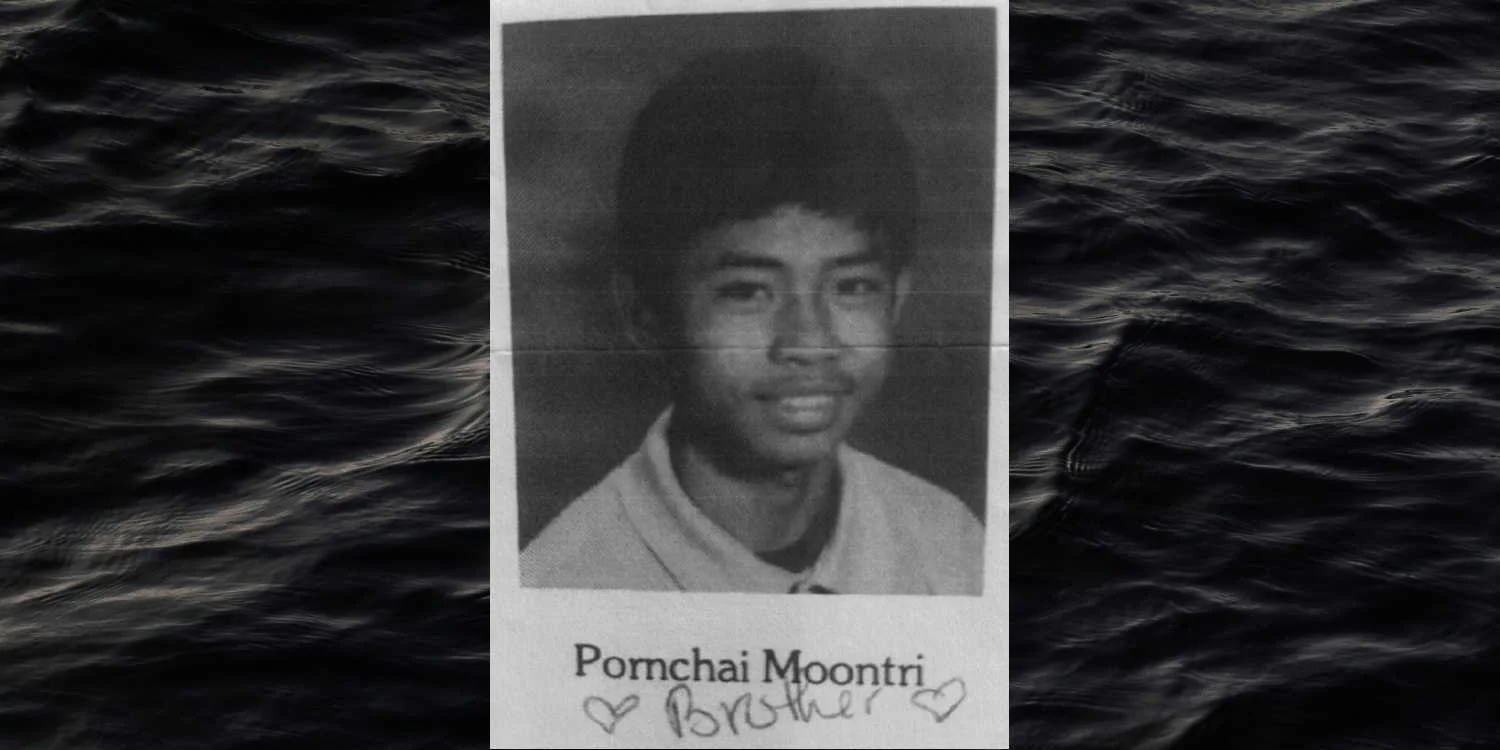
Thanks to Bill Donohue, “Pornchai’s Story” made its way around the world and was read to Catholics in Thailand. Pornchai’s Divine Mercy bridge to Thailand was built.

Thanks to Bill Donohue, “Pornchai’s Story” made its way around the world and was read to Catholics in Thailand. Pornchai’s Divine Mercy bridge to Thailand was built.
May 6, 2026 by Father Gordon MacRae
I wrote a post recently entitled “Book of Tobit: The Angel Raphael on the Road with Pornchai Moontri.” It was an allegory, like the Book of Tobit itself. An allegory is a sort of genre of Sacred Scripture in which a story is told more for its meaning than for its historical value. Every parable of Jesus falls into this same genre. A part of the story of Tobit, and his son Tobias and their interactions with the Archangel Raphael in disguise were all part of the allegory. That does not mean the allegory did not happen. It means only that the truth of the story does not depend upon someone believing it. There was one aspect of the Book of Tobit story that became a centerpiece of my blog linked above. At the beginning and the end of the Book of Tobit there is a mysterious dog whose presence, meaning and purpose remain a mystery.
My friend Pornchai Max and his grueling assimilation to his native Thailand after a forced absence of 36 years and all the torment he endured in that time, also included the presence of a mysterious dog named Hill. When that post was published on April 29 this year, a number of our readers wanted to know what became of Hill. So I went back this week and added an important addendum, which you can read for yourselves by clicking on it at the end of this post.
Now I want to back up about 19 years, in 2007 when Max learned that he would be deported to Thailand at the end of his sentence. He would be taken to Bangkok and left there. ICE would have no further responsibility for him.
Bangkok, the Capitol of the Kingdom of Thailand, is a massive city of about 9.5 million people. In Thai, the great city’s name is almost unpronounceable to the Western World, and the longest name of any city on Earth at 156 characters. I don’t expect you to memorize it, but in the Thai language Bangkok’s name is: Krungthepmahanakorn Amornrattanakosin Mahintrayuthaya Mahadilokpob Noparat Rajataniburirom Udomrajanivej Mahasatharn Amornpimarn Awatarnsat Sakatadtiya Wisanukamprasit. For daily use in Thai, the name is simply abbreviated to “Bangkok Krung Thep” which in English means “City of Angels.” When Max first told me of this in a phone call, he said, “I’m not kidding. They called it that even before I got here!”
This is a complicated but amazing story that meanders down a long and winding road. Our presentation of it begins in 2006 in a New Hampshire prison cell and threads its mysterious connections all the way around the globe. I n the end you may find any lingering doubts about Divine Mercy falling away. Divine Mercy has opened impenetrable doors for Pornchai Moontri, many of them in otherwise unreachable places.
If you have read my post, “The Parable of a Priest and the Parable of a Prisoner” then you know that Max had been in prison for 29 years, more than half his life, for a crime committed as a teenager, a crime that was set in motion by someone else. You also know that Max was moved from a maximum security solitary confinement unit in Maine to the New Hampshire Prison where we met and became friends late in 2006. That story is told powerfully at the link above.
I had another friend in this prison from Cambodia whom I had helped with the deportation process. He was brought to this country as a child of two, and committed a petty crime at age 18. After a long failed process of appeals, he was deported at age 25 to Cambodia, but spoke not a word of Khmer. One year after his deportation, I received a note from his sister telling me that he disappeared in the capital city of Phenom Penh. He had never been seen or heard from again.
We learned an important but scary lesson from what happened to my Cambodian friend. Since Max was brought to the U.S. as a young child, and has no known family or contacts in Thailand other than distance cousins, the experience of our friend in Cambodia chilled me to the core. I became determined that Max would be ready to live and cope somehow in the immense City of Bangkok when the time came. We had a few years to prepare, but I did not even know where to begin.
How could two men living in a prison cell in New Hampshire with no resources, no online access, and a severely limited budget find and connect with people on the other side of the world? How could I interest anyone in Thailand with the plight of a young man taken from there at age 11, his mother murdered, only to come to the United States to end up homeless and in prison as a teenager? This was not a good place from which to start.
THE SILENCE
“I don’t even know where to begin,” Max told me dismally. “I don’t even know how to learn about Thailand.” I knew I had to start writing, but this was two years before even the idea of this blog was conceived. A day in the prison library produced some addresses. First, I wrote of Max’s situation to Catholic Charities in the Diocese of Manchester (NH). They are, after all, a global network. No response, but no real surprise there. Then I wrote to the national office of Catholic Charities. No response. Then I wrote to the Office of Immigration and Refugee Assistance sponsored by my Diocese. No response. Then I wrote to the Catholic Legal Immigration Network at Boston College. No response. I knocked at the door of every official Catholic agency I could find. No one answered. I knocked, and I waited, and I knocked some more.
I cannot convey in words the utter frustration of writing repeatedly only to have my overtures met with silence. I decided that the problem was not Pornchai’s plight, but rather mine. I told Max that we will have to write all these letters again, but coming directly from him. So we redrafted all the letters under his name. More knocking; more waiting. More silence.
When all of our letters from prison were relegated to the netherworld without responses, I took it personally. I knew we needed a different approach. I asked Max to candidly write his life story — which is an amazing story in and of itself — in as few pages as possible, and let me send it to the few Catholic contacts I had who did not ignore our plight. One of them was Bill Donohue, President of the Catholic League for Religious and Civil Rights. Once he read “Pornchai’s Story,” he wrote back immediately asking if he could publish it on the Catholic League website. From there, it slowly made its way around the world. We knocked and knocked, and waited some more.
The late Father Richard John Neuhaus — a courageous Catholic writer and editor of First Things magazine — sent Max a personal letter to tell him how very important his story is, not only for Max, but for the Church. Father Neuhaus promised to pass the story along to others. This was a year before Father Neuhaus faced his own untimely death from cancer in January, 2009. More knocking, and more waiting.
Max started receiving letters from other important figures in the Church. One came from His Eminence Cardinal Kitbunchu, Archbishop Emeritus of Bangkok. Max was bowled over by that letter. Another came from the Rome Office of Ambassador Mary Ann Glendon, who had been appointed by President George W. Bush as U.S. Ambassador to the Holy See.
Bill Donohue extending to Max honorary membership in the Catholic League and promised to promised to promote his story. My article for Catalyst appeared at the same time, in the July/August 2009 issue. It was “Due Process for Accused Priests.” As an unintended consequence, Pornchai’s story and mine became linked together.
Pornchai’s Story
Here is Pornchai’s Story:
[From Dr. Bill Donohue: ] As we begin the New Year, we’d like to share with you this moving account of one young man’s conversion story.
My name is Pornchai Moontri, and as I write this I am prisoner #77948 in the New Hampshire State Prison. I come to the Catholic faith after a painful journey in darkness that my friend, Father Gordon MacRae, has asked me to write candidly. This is not something I do easily, but I trust my friend.
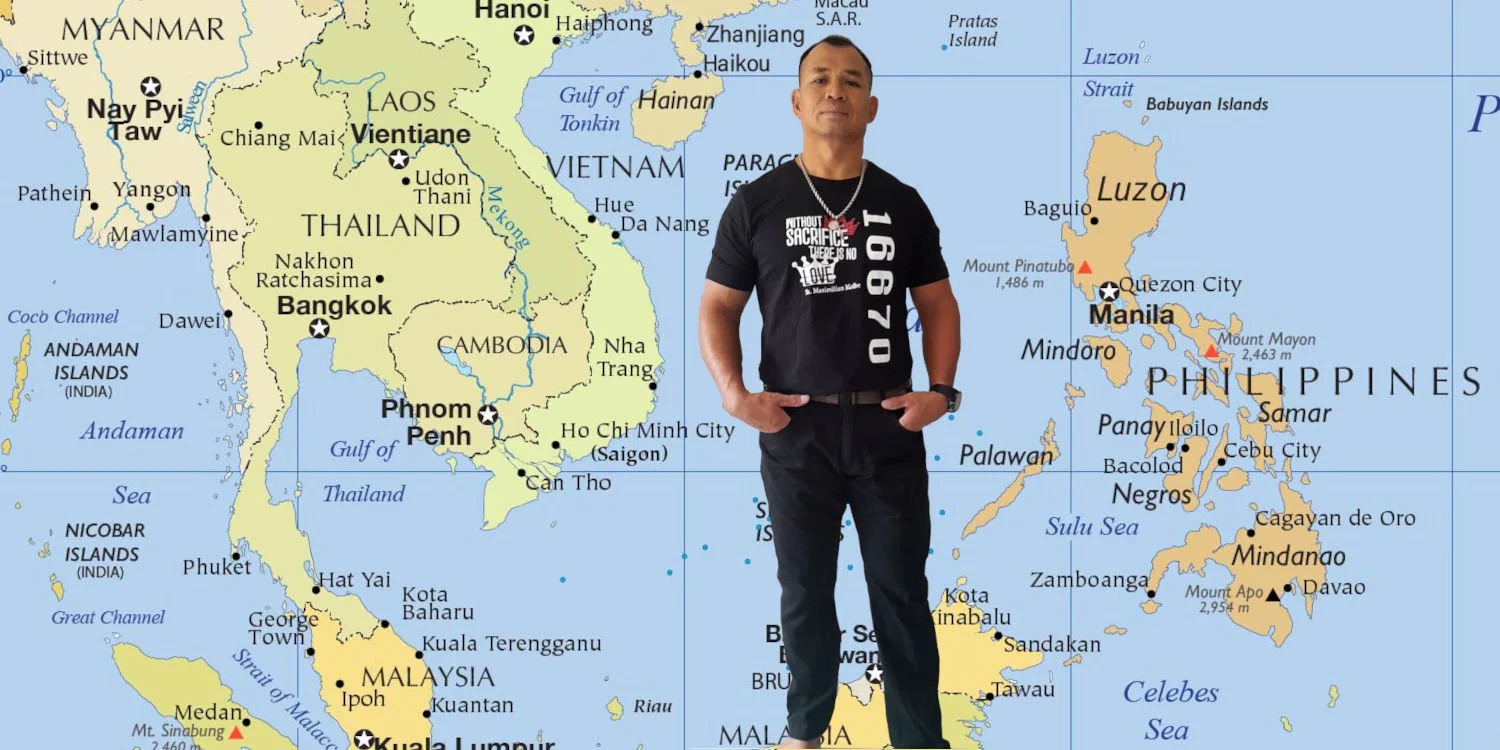
I was born in Bua Nong Lamphu, in a small village in the north of Thailand near Khon Kaen on September 10, 1973. At the age of two, I was abandoned by my mother and a stranger tried to sell me. A distant teenaged relative rescued me. He walked many miles to carry me away to his family farm where I worked throughout my childhood raising water buffalo, rice, and sugar cane. I never attended school, however, and never learned to read and write in Thai. Though my childhood involved hard work, I was safe and happy.
When I was 11 years old, my mother re-emerged in Thailand with a new husband — an American air traffic controller from Bangor, Maine. I was taken from Thailand by them against my will, and brought to the United States. This transition was a trauma to be endured. A month after my arrival in Bangor, my new stepfather’s motive for importing a ready-made Thai family became clear. I was forcibly raped by him at age 11, an event that was to be repeated with regularity over the next three years. I was a prisoner in his house, and resistance was only met with violence against me and against my mother. I was all of 100 pounds. I cannot describe this further. Welcome to America!
Being one of only three Asians in 1985 Bangor, and speaking little English, I did not readily comprehend my new names. “Gook,” “V.C.” and “Charlie” meant nothing to me, but I could sense the scorn with which such names were delivered. Because my English was poor, I was treated as though I was stupid. Part of my humiliation was that I had to get a paper route at age 12, and my earnings were taken from me to pay for the “privilege” of living in my captor’s house. Stephen King’s home was on my paper route. Mr. King once gave me a Christmas bonus of 25¢ for delivering his newspaper all year. The horror stories he wrote about Maine are all true. Remember the one with the evil clown? It’s true.
When I was 14, my English was better. I was a little bigger, and a lot stronger — and nothing but angry. Anger was all I had. So with it I fled that house and became a homeless teenager in and around Bangor. One day the Bangor police actually picked me up and forced me to go “home.” I would rather have gone to one of the ones Stephen King wrote about. I just fled again and again, and ended up at the Good Will Hinckley School for people like me. I was there for a year and got kicked out for fighting. I was always fighting. I fought everyone.
Back on the streets of Bangor, I began to carry a knife. At 17 and 18, a lot of people were after me. I lived under a bridge for a while and sometimes my mother would bring me things. I tried to climb out of the deep hole I was in by signing up for night classes at age 18 to finish my high school diploma. I was kicked out of Bangor High School for punching the principal.
One night, at age 18, something that lived in me got out. I got very drunk with friends, and we walked into a Bangor Shop & Save supermarket to buy cigarettes. I barely remember this. In my drunken state, I opened a bottle of beer from a case and started to drink it. The manager confronted me and ordered me to leave. I tried to flee the store, but the manager and other employees then tried to keep me there. I tried to fight them off to flee. When I got outside, a manager from another Shop & Save had witnessed the incident and pounced on me. I was 130 pounds and was pinned to the ground by this 190-pound man. I think something snapped in my mind. IT was happening again. I fought, but his dead weight was suffocating me. The newspapers would later tell a different story, but this was the truth, and it is all I remember.
In jail that night, I was questioned for three hours. I was told that I had stabbed a man and was charged with attempted murder. I have no memory, to this day, of stabbing the man. The next morning, I awoke in a jail cell and was told that I was charged with Class A murder. The man had died during the night. I was told that I blew a .25 on the Breathalyzer, but the result was so high it was discarded as an error.
My stepfather could have hired expert counsel, but it was clearly not in his best interest that my life be evaluated, so I was left in the care of a public defender who wanted this high profile case off his desk. There was talk about the Breathalyzer, and “level of culpability,” and things like “defensive vs. offensive wounds,” but in the end there were no theories, no experts and no defense. I was terrified of being abandoned. My mother came to me in jail and pleaded with me to protect her and “the family” by not revealing what happened in my life. So I remained silent. I offered no defense at all. My co-defendant told the truth of my being pinned down, but he was not believed. I was convicted of “Class A murder with deliberate indifference” and sentenced, at age 18, to 45 years in a Maine Prison. Maine has no parole.
I was also sentenced with the soul of the innocent man whose life I took — despite my being unable to remember taking it. The mix of remorse and anger was toxic in prison, and I gave up. Prison became just an extension of where I had already been. My anger raged on and on, and I spent 13 of my 15 years in prison in Maine’s “supermax” facility for those who can’t be trusted in the light of day.
Five years into my imprisonment, I learned one night in my supermax cell that my mother and stepfather had relocated to the Island of Guam where my mother was murdered. She was pushed from a cliff. [The story that was told to Pornchai, but it was false.] The only suspect was her husband but there was no evidence. I was now alone in my rage.
After 14 years of this, the Maine prison decided to send me to an out-of-state prison. I had no idea where I was to be sent. I arrived in the New Hampshire State Prison on October 18, 2005 dragging behind me the Titanic in which I stored all my anger and hurt and loss and loss and loss — and guilt.
I started my time in a new prison by getting into a fight and ended up in the same old place — the hole. When some months went by, I was given another chance. I was sent to H-Building where I met my friend JJ, an Indonesian who was waiting to be deported. JJ introduced me one day to Gordon, who he said was helping him and some others with appealing their INS removal orders or with preparing themselves to be deported. He seemed to be the only person who even cared. JJ trusted Gordon, so I had several conversations with him. A few months later, I was moved to the same unit in which he lives in this prison. We became friends.
By patience and especially by example, Gordon helped me change the course of my life. He is my best friend, and the person I trust most in this world. It is the strangest irony that he has been in prison for 13 years accused fictionally of the same behaviors visited upon me in the real world by the man who took me from Thailand. I read the articles about Gordon in The Wall Street Journal last year. I know him better, I think, than just about anyone. I know only too well the person who does what Gordon is wrongly accused of. Gordon is not that person. Far from it. It is hard for me to accept that laws and public sentiment allow men to demand and receive huge financial settlements from the Catholic Church years or decades after claimed abuse while all that happened to me has gone without even casual notice by anyone — except, ironically, Gordon MacRae.
On September 10, I will be 34 years old. I have been in prison now for nearly half of my life, but in the last year I have begun to know what freedom is. My anger is still with me and it always lurks just below the surface, but my friend is also with me. We both recently signed up for an intense 15-week course in personal violence. He is doing this for me. I spend my days in school instead of in lock-up now, and I will soon complete my High School diploma. Gordon helped me obtain a scholarship for a series of non-credit courses in Catholic studies at Catholic Distance University. In the last year, with help and understanding, I have completed programs offered in the New Hampshire prison. One day I felt strangely light so I looked behind me, and the Titanic was not there. I parked it somewhere along the way. I have put my childhood aside. Now I am a man.
In March of this year, after 15 years in prison, I was ordered by an INS court to be removed from the United States and deported to Thailand at the end of my sentence in 17 to 20 years or so. Gordon hopes that I can seek a sentence reduction so that I can return to Thailand at an age at which I may still build a life. There are many obstacles. The largest is that I do not speak Thai any longer and I never had an opportunity to learn and to read and write in Thai. We are working hard to prepare me for this. Though years away, it is a very frightening thing to go to a country only vaguely familiar. I have not heard Thai spoken since age 11, 23 years ago. There is no one I know there and no place for me to go. I have no home anywhere.
Along this steep path, I have made a decision to become Catholic. The priest in my friend has not been extinguished by 13 years in prison. It is still the part of him that shines the brightest. Gordon never asked me to become Catholic. He never even brought it up. I t is the path he is on and I was pulled to it by the force of grace, and the hope that one day I could do good for others. Gordon showed me a book, Jesus of Nazareth, in which Pope Benedict wrote: “The true ‘exodus’…consists in this: Among all the paths of history, the path to God is the true direction that we must seek and find.”
I am taking a correspondence course in Catholic studies through the Knights of Columbus and I look forward to the studies through Catholic Distance University. I go to Mass with Gordon when it is offered in the prison, and our faith is always a part of every day. When I return to the place I haven’t seen since age 11, I want to go there as a committed Catholic open to God’s call to live a life in service to others. It is what someone very special to me has done for me, and I must do the same.
My friend asked me to sit down today and type the story of my life and where I am now. He asked me to let him send this to a few friends who he says may play some role — directly or indirectly — in my life some day. The account is my own. What Father Gordon added was hope, and somehow faith has also taken root. In prison, hope and faith are everything. Everything!
[Written by Pornchai Moontri in 2008 and published by the Catholic League.]
Thanks to Bill Donohue and the Catholic League, “Pornchai’s Story” made its way around the world and was read to Catholics in Thailand. Pornchai Moontri’s Divine Mercy Bridge to Thailand was built despite many obstacles.
Note from Father Gordon MacRae: Pornchai’s story does not end here. There were other miracles yet to be told, but they are told in other posts here:
Book of Tobit: The Angel Raphael on the Road with Pornchai Moontri
The Parable of a Priest and the Parable of a Prisoner
Getting Away with Murder on the Island of Guam
A Catholic League White House Plea Set Pornchai Moontri Free

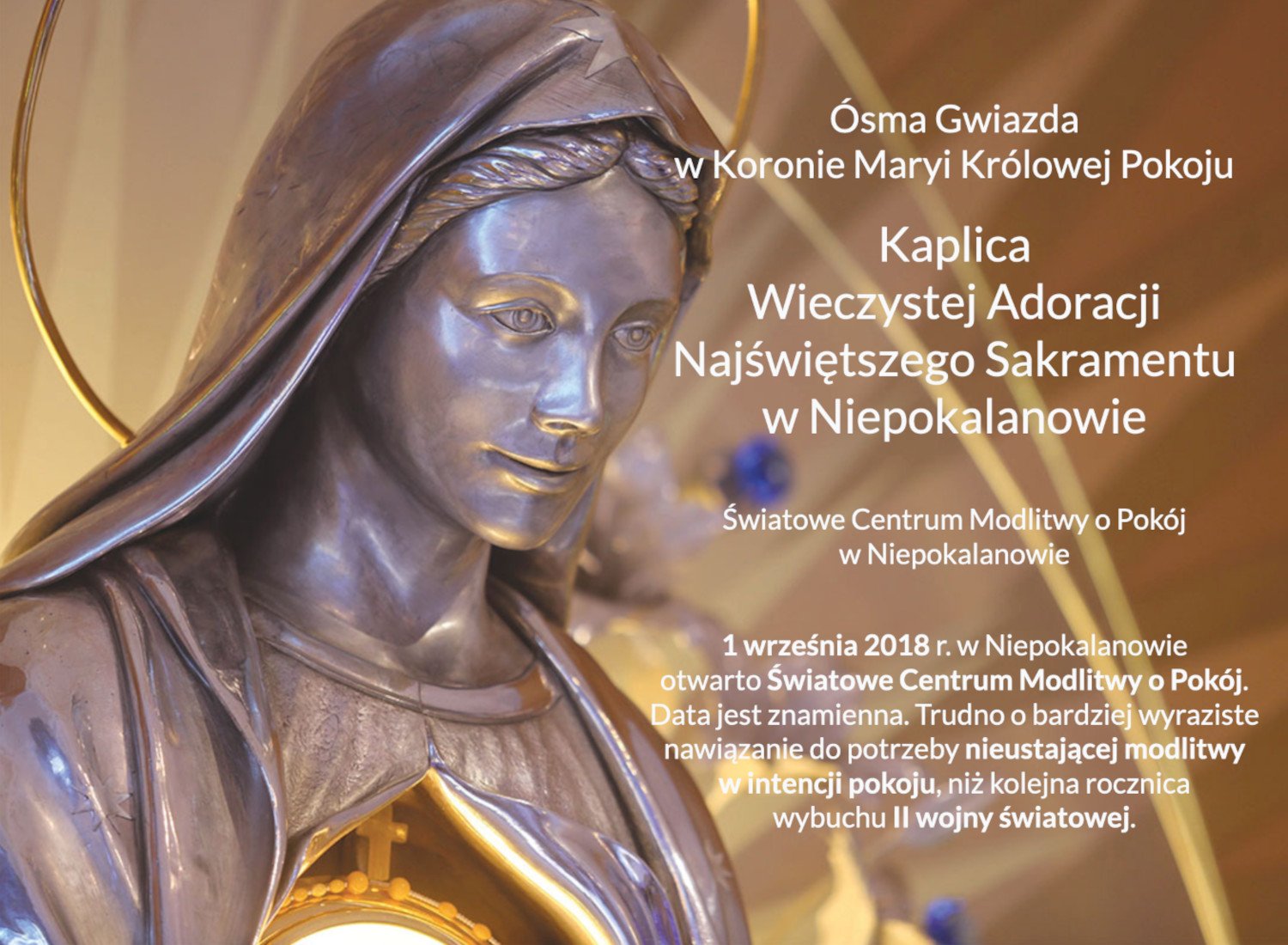

The Eucharistic Adoration Chapel established by Saint Maximilian Kolbe was inaugurated at the outbreak of World War II. It was restored as a Chapel of Adoration in September, 2018, the commemoration of the date that the war began. It is now part of the World Center of Prayer for Peace. The live internet feed of the Adoration Chapel at Niepokalanow — sponsored by EWTN — was established just a few weeks before we discovered it and began to include in at Beyond These Stone Walls. Click “Watch on YouTube” in the lower left corner to see how many people around the world are present there with you. The number appears below the symbol for EWTN.
Click or tap here to proceed to the Adoration Chapel.
The following is a translation from the Polish in the image above: “Eighth Star in the Crown of Mary Queen of Peace” “Chapel of Perpetual Adoration of the Blessed Sacrament at Niepokalanow. World Center of Prayer for Peace.” “On September 1, 2018, the World Center of Prayer for Peace in Niepokalanow was opened. It would be difficult to find a more expressive reference to the need for constant prayer for peace than the anniversary of the outbreak of World War II.”
For the Catholic theology behind this image, visit my post, “The Ark of the Covenant and the Mother of God.”

Richard John Neuhaus: A Life in the Public Square
Six years after the death of Richard John Neuhaus, a new biography by Randy Boyagoda echoes his bold, timely, vibrant voice on religion in the public square.

Six years after the death of Richard John Neuhaus, a new biography by Randy Boyagoda echoes his bold, timely, vibrant voice on religion in the public square.
January 29, 2025 by Fr Gordon MacRae
[Editor’s Note: The following post first appeared in 2015 at an earlier version of this blog. It has been heavily updated with new material by Father Gordon MacRae.]
When I was cast into the exile of unjust imprisonment in 1994, a friend concerned for what he imagined was a dearth of intellectual stimulation here gifted me with a subscription to First Things magazine. It was a gift that expanded a mind trapped in a world of concrete and steel, but it also created a serious problem for me. I simply could not part with the monthly issues that piled up on my cell floor drawing frowns from prison guards. “Why would you keep these?” asked one. “There aren’t even any pictures in them!”
I live in a micromanaged world in which every precious square inch of space must be accounted for, leaving little room for a collection of First Things. So I took a job in the prison library, found an empty shelf, and began what is likely the only collection of First Things spanning fifteen years in a prison library. You might be surprised by how often they are checked out, the lack of pictures notwithstanding.
But there is one issue that has never left my cell. I keep it in a safe place, and return to it twice a year in January and May. It is the April 2009 issue, Number 192, bearing the cover, “Richard John Neuhaus In Memoriam.”
I was simply amazed that, just three months after RJN’s untimely death from the ravages of cancer on January 9, 2009, this collection of essays could be gathered from the friends and colleagues for whom he was the hub in the arena of religion and public life in America. I should say, “in the Americas,” for Richard was Canadian by birth and his voice was as influential to our north as it was here in the U.S.
I keep this issue close because when Father Richard left this world, I could partake of none of the usual rituals with which we say goodbye. So I never said goodbye. Through the words of those who loved and cherished his company, he is still very much here, and I am grateful for that.
I have written of this before, so forgive my repetition, but my first inkling that something was amiss with Richard’s health came in a handwritten note from Steve Oslica in October of 2008. He had been in New York and attended a Mass offered by Father Richard. “Keep Father Neuhaus in your prayers,” Steve wrote. “I think he is dealing with some health issues.” Two months later, he was gone. Father Richard John Neuhaus left this world in the Lord’s friendship on January 9, 2009.
He also left dangling the friendship of countless others, including mine, though it was a friendship formed almost entirely through mutual friends, and in a dynamic exchange of letters to and from prison that spanned the last decade of his life. His influence upon me within these prison walls is directly proportional to the void that he left here.
A month after his death, I received the kindest of notes, dated February 17, 2009, from the Honorable Mary Ann Glendon, just returned from her post as United States Ambassador to the Holy See:
“Greetings from Boston — It’s good to be home again. I have just returned from a meeting in NYC to discuss the continuation of First Things and other aspects of Father Neuhaus’ work. I know you must be feeling his loss as keenly as the rest of us who depended on his leadership in so many ways.”
I was so deeply grateful to Ambassador Glendon. The brief letter filled in for me what had been lacking in the absence of ritual and sacrament to acknowledge death. Then, that April when First Things published its truly wonderful “In Memoriam” issue, I stored that letter within it, and marveled at the wit and wisdom and deeply felt love and respect that issue contains.
Of the dozens of profound and moving remembrances paying tribute to RJN, my favorite was, and still is, one entitled “Canadian Summers” by Father Tim Moyle of the Diocese of Pembroke, Ontario, who today reads Beyond These Stone Walls on occasion. Father Tim wrote of a long friendship with Richard and of the impact of one of his lesser known works, Freedom for Ministry (1979):
“Richard offered a powerful vision of pastoral service. Here he spoke of the importance of finding ways to present the awesome challenge of Jesus Christ to those under one’s pastoral care. By accepting the wonderful ‘challenge of orthodoxy’ that is the placing of Christ at the center of their lives, clergy of all stripes would find the inspiration to minister God’s love to all the baptized as they labored to promote the Kingdom of God. His fraternal care and concern for those who took up the pastoral yoke of Jesus Christ was where his compassion, faith, and profound humility in the face of the paschal mystery shone through the brightest for me.”
For me as well, Father Tim. I revisit this and other essays each May because that is the month of Richard’s birth. It is an irony that Father Richard John Neuhaus was born on May 14, the Feast of Saint Matthias, chosen by lot to complete the Twelve Apostles by filling the vacancy left by Judas Iscariot (Acts 1:21-26). The significance of that for me may be more evident below.

The Biography
Now, six years after RJN’s untimely death, biographer Randy Boyagoda has written a stellar biography of this great good friend and his prodigious voice in the arena of religion in American — and, yes Father Tim, Canadian — public life. Richard John Neuhaus: A Life in the Public Square (Image Books, 2015) is a timely tribute and a most welcomed addition to the national discussion of the role of religion and faith with which we in the Americas now struggle. In 459 pages, Randy Boyagoda captured well the strength of courage and depth of faith, coupled with a most formidable intellect, that produced the prophetic voice of Richard John Neuhaus. I received it and devoured it with that same old familiar sense of feeling both elated and deflated.
Elated first: A biography about a friend must naturally be approached with some trepidation, and I am not the first to express that thought. In a brief review, former First Things interim editor, Russell E. Saltzman wrote,
“I have never read a biography of someone I knew well. It was with apprehension, then, that I read the galleys of Randy Boyagoda’s biography of Neuhaus … I was having trouble figuring out how anyone could capture Neuhaus whole.”
— Russell E. Saltzman, “New Biography Captures Spirit of One of the Great Catholic Intellectuals,” Feb. 18, 2015
Randy Boyagoda did just that, however. He captured well the man I knew and still know through the pens of the many whose esteem for him ran deep. Boyagoda summarized him as “a bold Christian and a bold intellectual and a bold cosmopolitan and a bold operator, all at once, all as one.”

First Things and Last Things
Few people know the extent of that boldness, professed, at times, at great personal cost to himself. I have a first hand account of it, and to this day Neuhaus is subjected, even in death, to the ridicule he expected — but never feared — on account of his own exercise of justice.
Among the many tributes to RJN, published anew as reviews by Mr. Boyagoda’s wondrous biography, was one I admired greatly. It appeared in the The Wall Street Journal (“From Anti-War Pastor to Pro-Life Priest,” March 27, 2015) by University of Oklahoma History Professor and former First Things Editorial Board member, Wilfred M. McClay. I disagree however, with one point emphasized in both the book and Mr. McClay’s review.
“Mr. Boyagoda does not refrain from faulting some of Neuhaus’ more questionable judgments, such as his playing down of the clergy sex-abuse scandal, which led him to undertake a fierce and misguided defense of Father Marcial Maciel, the founder of the Legion of Christ, who would eventually be exposed as a prodigious sexual abuser and disciplined by Pope Benedict XVI.”
— Wilfred M. McClay, “From Anti-War Pastor to Pro-Life priest,” WSJ, March 27, 2015
Some of the comments on that McClay review at WSJ.com dusted off old prejudices about Catholics, charging that Neuhaus “abandoned the word of God” in his transformation from Lutheran pastor to Catholic priest. Others highlighted what Wilfred McClay termed his “fierce and misguided defense of Father Marcial Maciel.” So I posted two comments of my own, and this is one of them:
“It is a distortion and an injustice to characterize Father Richard John Neuhaus’ concerns for justice in the Church as “playing down the sex-abuse scandals.” He did no such thing. His collection of essays under the title, ‘Scandal Time’ comprised the sanest, most just, and most critical analysis of that crisis in print. Father Neuhaus rightly called upon the U.S. Bishops not to simply replace one injustice with another to appease a scandal hungry media, and the ravenous tort bar.”
The “Scandal Time” essays are compiled and posted in pdf format here at Beyond These Stone Walls. Even a cursory read of them will tell you that Boyagoda’s characterization of this great priest as “bold” is immensely understated. In the face of a modern day witch hunt in the secular media, and, sadly, even the Catholic press as clergy sex abuse scandals unfolded in 2002, the voice of Father Neuhaus was more than bold. It was revolutionary. This one man held back the tide of “availability bias” to give accused priests a singular voice calling for justice, due process, and fairness. And this was after his defense of Marcial Maciel was shown to be flawed and misdirected.
I cannot convey in mere words what this meant to me, personally. Even while being bludgeoned for his misjudgment on Maciel, Father Neuhaus published “A Kafkaesque Tale,” demonstrating to the Catholic Christian community the inconsistency of its application of justice in the wake of the U S Bishops’ “Final Solution,” the 2002 Dallas Charter that blatantly equated accusation with guilt. In this, Richard John Neuhaus stood almost entirely alone in Catholic media in the religious public square.
Father Neuhaus refused to use the apparent guilt of Maciel to undermine justice and due process for other accused Catholic priests even when many other writers were doing just that. To fault Father Neuhaus for this today is to add insult to injustice. Even after his defense of Father Maciel was undermined and criticized, Father Neuhaus published “A Kafkaesque Tale” in the January 2008 edition of First Things:
“Among the many sad consequences of the sex abuse crisis are the injustices visited on priests falsely accused. A particularly egregious case is that of Father Gordon MacRae of the Diocese of Manchester, New Hampshire. He was sentenced to sixty-seven years and has been imprisoned more than twelve years with no chance of parole because he insists he is innocent. I have followed the case for several years. Lawyer friends have closely examined the case and believe he was railroaded. The Wall Street Journal ’s Pulitzer Prize-winning journalist Dorothy Rabinowitz published, on April 27 and 28, 2005, an account of the travesty of justice by which he was convicted. Now the friends of Father MacRae have created a website, BeyondTheseStoneWalls.com, which provides a comprehensive narrative of the case, along with pertinent documentation. Bishop John McCormack, a former aide of Boston’s Cardinal Law, and the Diocese of Manchester do not come off as friends of justice or, for that matter, of elementary decency. You may want to visit the website and read this Kafkaesque tale. And then you may want to pray for Father MacRae, and for a Church and a justice system that seem indifferent to justice.”

Among His Last Things
Beyond These Stone Walls came into being exactly six months after Father Neuhaus left this world. In part, at least, this blog was his idea, an idea shared and generated by his friend of long standing, Cardinal Avery Dulles. As our “About” page describes, they together wrote, “Your article is an important one, and will hopefully be followed by many others. Your writing, which is clear, eloquent and spiritually sound, will be a monument to your trials.”
In this call for fairness in the face of a witch hunt, Father Neuhaus came full circle. Born on the Feast of Saint Matthias who resolved the first Judas Crisis in the Church, Father Neuhaus sought to also resolve its newest form as the 21st Century commenced. He and Cardinal Dulles were lone voices in the media glare of 2002, but truth and justice accommodating the acceptable media view is an old practice that history always exposes eventually as deeply flawed.
This boldness extended into First Things as Father Neuhaus published several letters of mine including “Crime and Punishment,” (First Things, November 2008), and “Sin and Risk Aversion” (November 1996). In his last letter to me two months before his death, Father Neuhaus asked, “How does one go about arranging to visit with you?” Upon hearing of his illness I quickly wrote back, assuring him that he had been living the Corporal Works of Mercy for the last decade of our fraternal correspondence — an exchange in which I never once felt like the outcast so many other corners of the Church fashioned for me. This adviser to popes and presidents found room to also quietly live the exhortation of Hebrews 13:3.
+ + +
“Zero tolerance, one strike and you’re out, boot them out of ministry. Of course the victim activists are not satisfied and, sadly, may never be satisfied. The bishops have succeeded in scandalizing the faithful anew by adopting [in the Dallas Charter] a thoroughly unbiblical, untraditional, and un-Catholic approach to sin and grace.… They ended up adopting a policy that was sans repentance, sans conversion, sans forbearance, sans prudential judgment, sans forgiveness, sans almost everything one might have hoped for from the bishops of the Church of Jesus Christ.”
— Richard John Neuhaus, “Scandal Time”, 2008, First Things
+ + +
Note from Father Gordon MacRae: Thank you for reading and sharing this post about my great good friend, Father Richard John Neuhaus. You may also like these related posts:
Pell Contra Mundum: Cardinal Truth on the Synod
Canon Law Conundrum: When Moral Certainty Is Neither Moral Nor Certain
Cultural Meltdown: Prophetic Wisdom for a Troubled Age
How I Became the Catholic I Was by Richard John Neuhaus
The Eucharistic Adoration Chapel established by Saint Maximilian Kolbe was inaugurated at the outbreak of World War II. It was restored as a Chapel of Adoration in September, 2018, the commemoration of the date that the war began. It is now part of the World Center of Prayer for Peace. The live internet feed of the Adoration Chapel at Niepokalanow — sponsored by EWTN — was established just a few weeks before we discovered it and began to include in at Beyond These Stone Walls. Click “Watch on YouTube” in the lower left corner to see how many people around the world are present there with you. The number appears below the symbol for EWTN.
Click or tap here to proceed to the Adoration Chapel.
The following is a translation from the Polish in the image above: “Eighth Star in the Crown of Mary Queen of Peace” “Chapel of Perpetual Adoration of the Blessed Sacrament at Niepokalanow. World Center of Prayer for Peace.” “On September 1, 2018, the World Center of Prayer for Peace in Niepokalanow was opened. It would be difficult to find a more expressive reference to the need for constant prayer for peace than the anniversary of the outbreak of World War II.”
For the Catholic theology behind this image, visit my post, “The Ark of the Covenant and the Mother of God.”

Cardinal Bernard Law on the Frontier of Civil Rights
Former Boston Archbishop, Cardinal Bernard Law was vilified by The Boston Globe and SNAP, but before that he was a champion of justice in the Civil Rights Movement.

Former Boston Archbishop, Cardinal Bernard Law was vilified by The Boston Globe and SNAP, but before that he was a champion of justice in the Civil Rights Movement.
June 19, 2024 by Fr Gordon MacRae
Note from Fr MacRae: I first wrote this post in November 2015. I wrote it in the midst of a viral character assassination of a man who had become a convenient scapegoat for what was then the latest New England witch hunt. That man was Cardinal Bernard Law, Archbishop of Boston. I have to really tug hard to free this good man’s good name from the media-fueled availability bias that so mercilessly tarnished it back then. A good deal more has come to light, and I get to have the last word.
By coincidence, and it was not planned this way, but the date of this revised reposting is June 19, 2024, the day that the United States commemorates the emancipation of African American slaves on June 19, 1865 in Galveston, Texas. As you will read herein, Cardinal Bernard Law was a national champion in the cause for Civil Rights and racial equality.
+ + +
Four years after The Boston Globe set out to sensationalize the sins of some few members of the Church and priesthood, another news story — one subtly submerged beneath the fold — drifted quietly through a few New England newspapers. After a very short life, the story faded from view. In 2006, Matt McGonagle resigned from his post as assistant principal of Rundlett Middle School in Concord, New Hampshire. Charged with multiple counts of sexually assaulting a 14-year-old high school student six years before, McGonagle ended his criminal case by striking a plea deal with prosecutors. McGonagle pleaded guilty to the charges on July 28, 2006.
He was sentenced to a term of sixteen months in a local county jail. An additional sentence of two-and-a-half to five years in the New Hampshire State Prison was suspended by the presiding judge in Merrimack County Superior Court — the same court that declined to hear evidence or testimony in my habeas corpus appeal in 2013 after having served 20 years in prison for crimes that never took place.
In a statement, Matt McGonagle described the ordeal of being prosecuted. He said it was “extraordinarily difficult,” and thanked his “many advocates” who spoke on his behalf. In the local press, defense attorney James Rosenberg defended the plea deal for a sixteen month county jail sentence:
“The sentence is fair, and accurately reflects contributions that Matt has made to his community as an educator.”
— Melanie Asmar, “Ex-educator pleads guilty in sex assault,” Concord Monitor, July 29, 2006
Four years earlier, attorney James Rosenberg was a prosecutor in the New Hampshire Attorney General’s Office from where he worked to prosecute the Diocese of Manchester for its handling of similar, but far older claims against Catholic priests.
The accommodation called for in the case of teacher/principal Matt McGonagle — an insistence that he is not to be forever defined by the current charges against him — was never even a passing thought in the prosecutions of Catholic priests. Those cases sprang from the pages of The Boston Globe, swept New England, and then went viral across America. The story marked The Boston Globe’s descent into “trophy justice.”

Cardinal Sins
I have always been aware of this inconsistency in the news media and among prosecutors and some judges, but never considered writing specifically about how it applied to Cardinal Bernard Law until I read Sins of the Press, a book by David F. Pierre, Jr. On page after page it cast a floodlight on The Boston Globe’s Pulitzer-endorsed lynching of Cardinal Law, offered up as a scapegoat for The Scandal and driven from Boston by the news media despite having never been accused, tried, or convicted of any real crime.
Does the “lynching of Cardinal Law” seem too strong a term? Historically, the word “lynching” came into the English lexicon from the name of Captain William Lynch of Virginia who acted as prosecutor, judge and executioner. He became notorious for his judgment-sans-trial while leading a band to hunt down Loyalists, Colonists suspected of loyalty to the British Crown in the War for Independence in 1776.
The term applies well to what started in Boston, then swept the country. Most of those suspected or accused in the pages of The Boston Globe, including Cardinal Bernard Law, were never given any trial of facts. As I recently wrote in, “To Fleece the Flock: Meet the Trauma-Informed Consultants,” many of the priests were deceased when accused, and many others faced accusations decades after any supportive evidence could be found, or even looked for. The Massachusetts Attorney General issued an astonishing statement given short shrift in the pages of The Boston Globe:
“The evidence gathered during the course of the Attorney General’s sixteen-month investigation does not provide a basis for bringing criminal charges against the Archdiocese and its senior managers.”
— Commonwealth of Massachusetts Attorney General Thomas Reilly, “Executive Summary and Scope of the Investigation,” July 23, 2003
So I decided to explore the story of Cardinal Bernard Law for Beyond These Stone Walls. When I first endeavored to write about him, he had been virtually chased from the United States by some in the news media and so-called victim advocates deep into lawsuits to fleece the Church. Though not intended originally, my post was to be published on November 4, 2015, which also happened to be Cardinal Law’s 84th birthday.
When I wrote of my intention to revisit the story of Cardinal Bernard Law from a less condemning perspective, it sparked very mixed feelings among some readers. A few wrote to me that they looked forward to reading my take on the once good name of this good priest. A few taunted me that this was yet another “David v Goliath” task. Others wrote more ominously, “Don’t do it, Father! Don’t step on that minefield! What if they target you next?” That reaction is a monument to the power of the news media to spin a phenomenon called “availability bias.”
A while back, I was invited by Catholic League President Bill Donohue to contribute some articles for Catalyst, the Journal of the Catholic League for Religious and Civil Rights. My second of two articles appeared in the July/August 2009 issue just as Beyond These Stone Walls began. It was entitled “Due Process for Accused Priests” and it opened with an important paragraph about the hidden power of the press to shape what we think:
“Psychologist Daniel Kahneman won the Nobel Prize in Economics in 2002 for his work on a phenomenon in psychology and marketing called ‘availability bias.’ Kahneman demonstrated the human tendency to give a proposition validity just by how easily it comes to mind. An uncorroborated statement can be widely seen as true merely because the media has repeated it. Also in 2002, the Catholic clergy sex abuse scandal swept out of Boston to dominate news headlines across the country….”
This is exactly what happened to Cardinal Law. There was a narrative about him, an impression of his nature and character that unfolded over the course of his life. I spent several months studying that narrative and it is most impressive.
Then that narrative was replaced by something else. With a target on his back, the story of Cardinal Law was entirely and unjustly rewritten by The Boston Globe. Then the rewrite was repeated again and again until it took hold, went viral, and replaced in public view the account of who this man really was.
Even some in the Church settled upon this sacrificial offering of a reputation. Perhaps only someone who has known firsthand such media-fueled bias can instinctively recognize it happening. Suffice it to say that I instinctively recognized it. I offer no other defense of my decision to visit anew the first narrative in the story of who Bernard Law was. If you can set aside for a time the availability bias created around the name of Cardinal Bernard Law, then you may find this account to be fascinating, just as I did.

From Harvard to Mississippi
As this account of a courageous life and heroic priesthood unfolded before me, I was eerily reminded of another story, one I came across many years ago. It was the year I began to seek something more than the Easter and Christmas Catholicism I inherited. It was 1968, and I was fifteen years old in my junior year at Lynn English High School just north of Boston. Two champions of the Civil Rights Movement I had come to admire and respect in my youth — Martin Luther King and Bobby Kennedy — had just been assassinated. And just as my mind and spirit were being shaped by that awful time, I stumbled upon something that would refine for me that era: the great 1963 film, The Cardinal.
Based on a book of the same name by Henry Morton Robinson (Simon & Schuster 1950), actor Tom Tryon portrayed the title role of Boston priest, Father Stephen Fermoyle who rose to become a member of the College of Cardinals after a heroic life as an exemplary priest. It was the first time I encountered the notion that priesthood might require courage, and I wondered whether I had any. I was fifteen, sitting alone at Mass for the first time in my life when this movie sparked a scary thought.
Father Fermoyle was asked by the Apostolic Nuncio to tour the southern United States “between the Great Smokies and the Mississippi River” — an area known for anti-Catholic prejudice. He was tasked with writing a report on the state of the Catholic Church there during a time of great racial unrest.
In the script (and in the book which I read later) Mississippi Chancery official, Monsignor Whittle (played in the film by actor, Chill Wills) was fearful of the racist, anti-Catholic Ku Klux Klan. He tried to dissuade Father Fermoyle from making any waves, but his mere presence there would set off a tidal wave of suspicion. In a horrific scene, Father Fermoyle was kidnapped in the night, blindfolded, and driven to the middle of a remote field — a field where many young black men had disappeared.
His blindfold removed, he found himself surrounded by men in sheets and white hoods, illuminated by the light of a burning cross. Father Fermoyle was given a crucifix and ordered to spit on it or face the scourging of Christ. Henry Morton Robinson’s book conveys the scene:
“He held the crucifix between thumb and forefinger, lofting it like a lantern in darkness…. Ancient strength of martyrs flowed into Stephen’s limbs. Eyes on the gilt cross, he neither flinched nor spoke. [The music played] ‘In Dixieland I’ll take my stand.’ Stephen prayed silently that no drop of spittle, no whimpering plea for mercy, would fall from his lips before the end… The sheeted men climbed into their cars. Not until the last taillight had disappeared had Stephen lowered the crucifix.”
— The Cardinal, pp 412-413
This could easily have been a scene from the life of Father Bernard Law. Born on 4 November 1931 in Torreon, Mexico, Bernard Francis Law spent his bilingual childhood between the United States, Latin America, and the Virgin Islands. His father was a U.S. Army Captain in World War II and Bernard was an only child. Very early in life, he learned that acceptance does not depend on race, or color, or creed, and once admonished his classmates in the Virgin Islands that “Never must we let bigotry creep into our beings.”
At age 15, Bernard read Mystici Corporis, a 1943 Encyclical of Pope Pius XII that Bernard later described as “the dominant teaching of my life.” He was especially touched by the language of inclusion of a heroic Pope in a time of great oppression. The encyclical was banned in German-occupied Belgium for “subversive” lines connecting the Mystical Body of Christ with the unity of all Christians, transcending barriers such as race or politics.
As a weird aside, I was in shock and awe as I sat typing this post when I asked out loud, “How could I find a copy of Mystici Corporis while stuck in a New Hampshire prison cell?” Then our convert friend, Pornchai Moontri jumped from his bunk, pulled out his footlocker containing the sum total of his life, and handed me a heavily highlighted copy of the 1943 Encyclical. I haven’t yet wrapped my brain around that, but it’s another post for another time.
While attending Harvard University, Bernard Law found a vocation to the priesthood during his visits to Saint Paul’s Church in Cambridge, Massachusetts. After graduating from Harvard in 1953, the year I was born, a local bishop advised him that Boston had lots of priests and he should give his talents to a part of the Church in need. At age 29, Father Bernard Law was ordained for what was the Diocese of Natchez-Jackson, Mississippi.

Standing before the Mask of Tyranny
The year was 1961. The Second Vatican Council would soon open in Rome, and the Civil Rights Movement was gathering steam (and I do mean steam!) in the United States, Father Law immersed himself in both. A Vicksburg lawyer once remarked that Father Law “went into homes as priests [there] had never done before.” With a growing reputation for erudition and bridge building on issues many others simply avoided, Bernard was summoned by his bishop to the State Capital to become editor of the diocesan weekly newspaper, then called The Mississippi Register.
It was there that the courage to proclaim the Gospel took shape in him, and became, along with his brilliant mind, his most visible gift of the Holy Spirit. Another young priest of that diocese noted that Father Law’s racial attitudes — shaped by his childhood in the Virgin Islands — were different from those of most white Mississipians. “He felt passionately about racial justice from the first moment I knew him,” the priest wrote. “It wasn’t a mere following of teaching, it came from his heart.”
I know many Mississippi Catholics today — including many who read Beyond These Stone Walls — but in the tumultuous 1960s, Catholics were a small minority in Mississippi. They were also a target for persecution by the Ku Klux Klan which was growing in both power and terror as the nation struggled with a burgeoning Civil Rights Movement.
An 1896 U.S. Supreme Court decision in “Plessy v. Ferguson” had defined the doctrine of “separate but equal” as a Constitutional nod to racial segregation, but in 1954 in “Brown v. Board of Education,” the Supreme Court based a landmark desegregation ruling on solid evidence that “separate” was seldom “equal.” Opposition to the ruling grew throughout the South, and so did terrorist Klan activities. In 1955, the murder of a black Mississippi boy, 14-year-old Emmett Till, rocked the state and the nation, as did the acquittal of his accused white killers.
This was the world of Father Bernard Law’s priesthood. Up to that time, the diocesan newspaper, The Mississippi Register, had been visibly timid on racial issues, but this changed with this priest at the helm. In June of 1963 he wrote a lead story on the evils of racial segregation citing the U.S. Bishops’ 1958 “Statement on Racial Discrimination and the Christian Conscience.”
One week later, the respected NAACP leader Medgar Evers was gunned down outside his Jackson, Mississippi home. Both Father Law and (then) Natchez-Jackson Bishop Richard Gerow boldly attended the wake for Medgar Evers under the watchful eyes of the Klan. Father Law’s next issue of The Mississippi Register bore the headline, “Everyone is Guilty,” citing a statement by his Bishop that many believe was written by Bernard Law:
“We need frankly to admit that the guilt for the murder of Mr. Evers and the other instances of violence in our community tragically must be shared by all of us… Rights which have been given to all men by the Creator cannot be the subject of conferral or refusal by men.”
Father Law and Bishop Gerow were thus invited to the White House along with other religious leaders to discuss the growing crisis in Mississippi with President John F. Kennedy and his brother, Attorney General Robert Kennedy. Later that summer, Father Law challenged local politicians in The Mississipi Register for their lack of moral leadership on racial desegregation, stating “Freedom in Mississippi is now at an alarmingly low ebb.” Massachusetts District Judge Gordon Martin, who was a Justice Department attorney in Mississippi at that time, once wrote for The Boston Globe that Father Law…
“…did not pull his punches, and the Register’s editorials and columns were in sharp contrast with the racist diatribes of virtually all of the state’s daily and weekly press.”
Later that year, Father Law won the Catholic Press Association Award for his editorials. In “Freedom Summer” 1964, when three civil rights workers were missing and suspected to have been murdered, Father Bernard Law openly accepted an invitation to join other religious leaders to advise President Lyndon Johnson on the racial issues in Mississippi. When the bodies of the three slain young men were found buried at a remote farm, the priest boldly issued a challenge to stand up to the crisis:
“In Mississippi, the next move is up to the white moderate. If he is in the house, let him now come forward.”
Later that year Father Law founded and became Chairman of the Mississippi Council on Human Relations. Then the home of a member, a rabbi, was bombed. Then another member, a Unitarian minister, was shot and severely wounded. The FBI asked Father Law to keep them apprised of his whereabouts, and Bishop Gerow, fearing for his priest’s safety, ordered him from the outskirts of Jackson to the Cathedral rectory, but Bernard Law feared not.
Cardinal Law’s life and mine crossed paths a few times over the course of my life as a priest. I mentioned above that while attending Harvard University, Bernard Law found his vocation to the priesthood during visits to Saint Paul’s Church in Cambridge. Many years later, in 1985, my uncle, Father George W. MacRae, SJ, the first Roman Catholic Dean of Harvard Divinity School and a renowned scholar of Sacred Scripture, passed away suddenly at the age of 57. I was a concelebrant at his Mass of Christian Burial at Saint Paul’s Church in Cambridge. Concelebrating with me was Cardinal Bernard Law where his life as a priest first took shape.
In 2013, The New York Times sold The Boston Globe for pennies on the dollar.
On December 20, 2017, Cardinal Bernard Law passed from this life in Rome.
Oh, that such priestly courage as his were contagious, for many in our Church could use some now. Thank you, Your Eminence, for the gift of a courageous priesthood. Let us not go gentle into The Boston Globe’s good night.
+ + +
Note from Father Gordon MacRae: I am indebted for this post to the book, Boston’s Cardinal : Bernard Law, the Man and His Witness, edited by Romanus Cessario, O.P. with a Foreword by Mary Ann Glendon (Lexington Books, 2002).
You may also like these related posts from Beyond These Stone Walls:
Saint John Paul the Great: A Light in a World in Crisis
Pell Contra Mundum: Cardinal Truths about the Synod
The Eucharistic Adoration Chapel established by Saint Maximilian Kolbe was inaugurated at the outbreak of World War II. It was restored as a Chapel of Adoration in September, 2018, the commemoration of the date that the war began. It is now part of the World Center of Prayer for Peace. The live internet feed of the Adoration Chapel at Niepokalanow — sponsored by EWTN — was established just a few weeks before we discovered it and began to include in at Beyond These Stone Walls. Click “Watch on YouTube” in the lower left corner to see how many people around the world are present there with you. The number appears below the symbol for EWTN.
Click or tap here to proceed to the Adoration Chapel.
The following is a translation from the Polish in the image above: “Eighth Star in the Crown of Mary Queen of Peace” “Chapel of Perpetual Adoration of the Blessed Sacrament at Niepokalanow. World Center of Prayer for Peace.” “On September 1, 2018, the World Center of Prayer for Peace in Niepokalanow was opened. It would be difficult to find a more expressive reference to the need for constant prayer for peace than the anniversary of the outbreak of World War II.”
For the Catholic theology behind this image, visit my post, “The Ark of the Covenant and the Mother of God.”