“There are few authentic prophetic voices among us, guiding truth-seekers along the right path. Among them is Fr. Gordon MacRae, a mighty voice in the prison tradition of John the Baptist, Maximilian Kolbe, Alfred Delp, SJ, and Dietrich Bonhoeffer.”
— Deacon David Jones
The Wall Street Journal Tells the Truth About Hamas
A recent Wall Street Journal ‘Review and Outlook’ editorial told “The Truth About Hamas.” The WSJ also told the truth about me as well and so it has my attention.
A recent Wall Street Journal ‘Review and Outlook’ editorial told “The Truth About Hamas.” The WSJ also told the truth about me as well and so it has my attention.
October 7, 2026 by Father Gordon MacRae
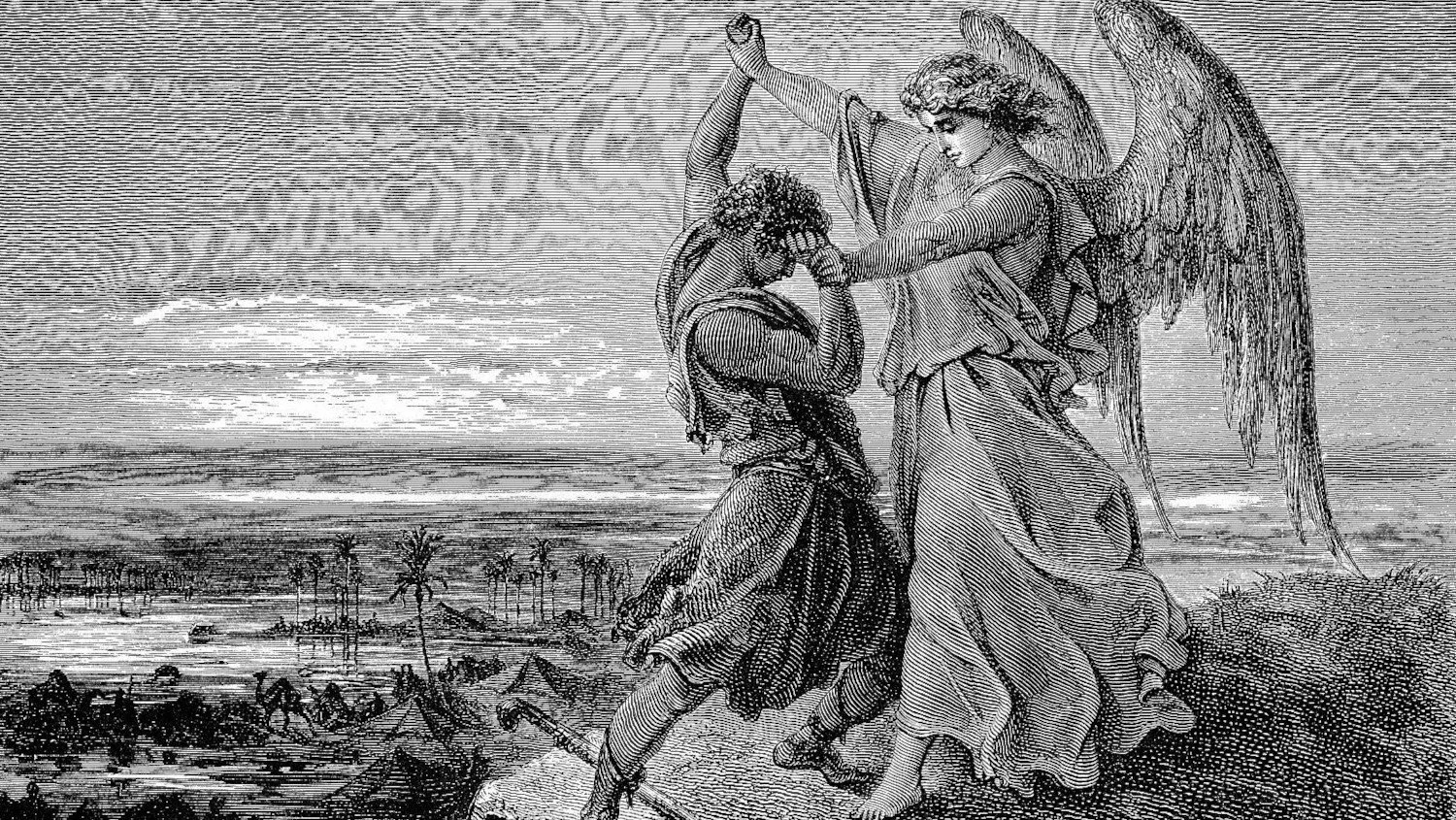
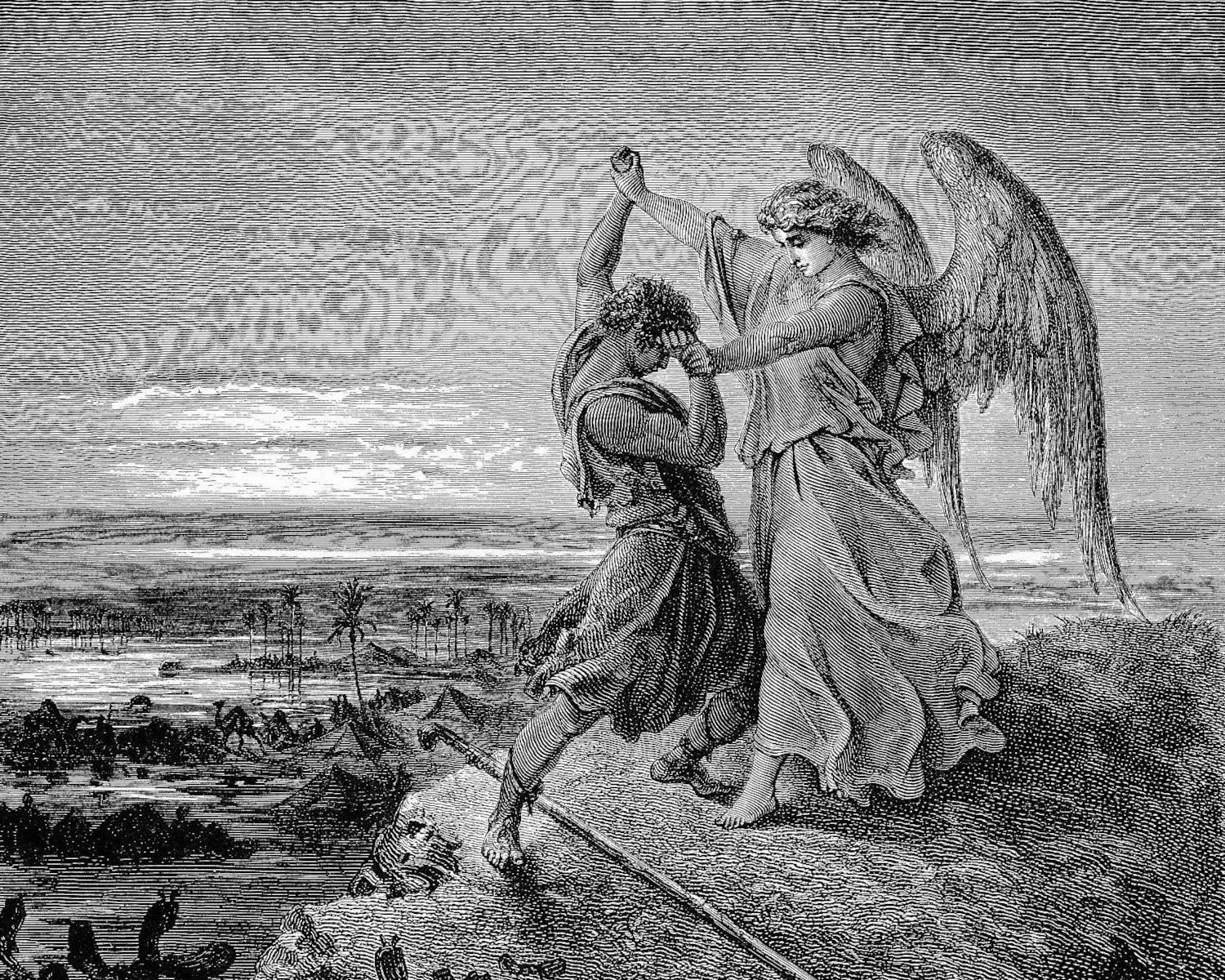
“Jacob Wrestling with the Angel” is an 1866 etching by Gustave Doré. It depicts a scene from the Book of Genesis (32:24-30). An Angel of God contends with Jacob’s strength, but the Angel is immovable. In the end, the Angel gives Jacob a new name: “Isra-El,” a name which in Hebrew means “One who has contended with God.”
+ + +
Toward the end of September as it gave way to October this year, we have featured posts about angels. Their presence in our Scriptures has come to mean a lot to me about truth and justice and the notion that we are not alone. Fake UFO sightings just do not fill the void for me or for us. I have little confidence that our news media always presents truth and justice in this present, troubled age. The word angel in Scripture means messenger, especially a messenger from God.
The image atop this post is an etching by Gustave Dore (“Jacob Wrestles with the Angel,” 1866) depicts the biblical Jacob as he wrestles with the messenger of God as described in Genesis:
“Jacob was left alone; and a man [who was really and angel] wrestled with him until the break of day. When the man saw that he did not prevail against Jacob, he touched the hollow of his thigh; and Jacob’s thigh was put out of joint as he wrestled with him. Then the man said, ‘Let me go for the day is breaking.’ But Jacob said, ‘I will not let you go unless you bless me.’ And the man said to him, ‘What is your name?’ and he said, ‘Jacob.’ Then the man said, ‘Your name shall no longer be called Jacob, but Israel, for you have striven with God and with man and you have prevailed.”
— Genesis 32:24-30
In the end, the Angel gives Jacob a new name: “Isra-El,” a name which means “One who wrestles with God.”
Like many of our readers, I grew up listening to, and trusting, Walter Cronkite, who engendered in his listeners a comforting aura of truth and trust. It came as a great surprise to me to learn after his death that he was actually politically inclined to be a liberal Democrat. It is a tribute to his integrity as a newscaster that no one could have discerned that. He was fair and unbiased, and that is all we ask of our news reporting, and especially so in news from Heaven.
The Truth About Hamas
Hamas is neither a nation nor a people. Hamas is a Palestinian group that had grown dramatically in the years leading up to the Hamas assault on Israel on October 7, 2023. Hamas sought to create a single Islamic state in historic Palestine, which until recently has been largely divided between Israel and the Israeli-occupied West Bank and Gaza Strip. Hamas in Arabic means “zealot.” Hamas is also an acronym for “Harakat al-Muqawama al-Islamiyya,” or “Islamic Resistance Movement.” The group was founded in 1988 as a militant segment of the Palestinian Arab national movement which became gradually radicalized.
Hamas openly seeks Israel’s destruction and the October 7 attack had the same impact on Israel that September 11, 2001 Islamic assault had on the United States. Hamas, since 2000, has been designated by the United States and the European Union as a terrorist organization. Also since 2000, the U.S. Department of State has identified the nation of Iran as the most active supporter of Hamas and terrorism. Hamas self-identifies not only as an Israeli resistance movement, but as a mechanism dedicated to the eradication of Israel and, by extension, Jews.
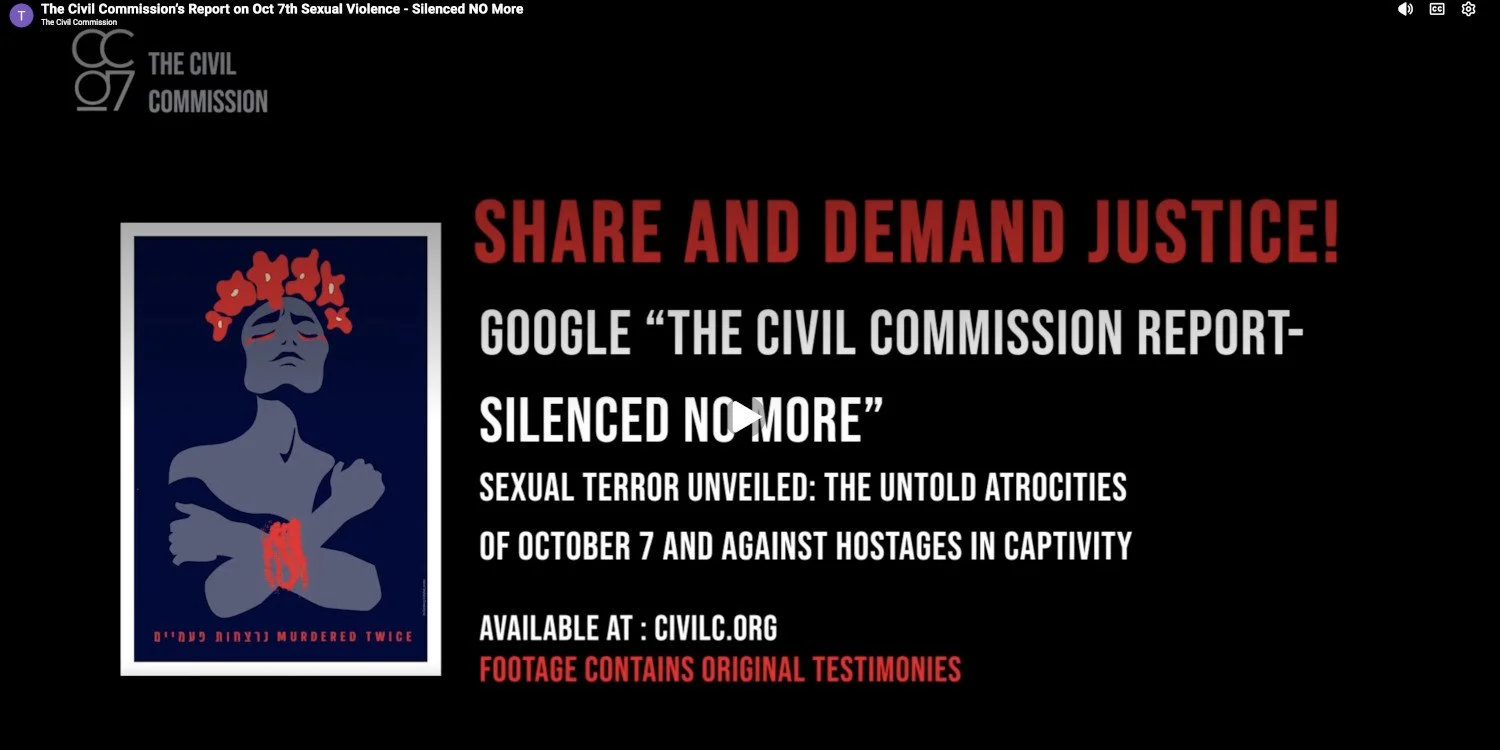
On May 14, 2026, The Wall Street Journal published its weekly “Review and Outlook” editorial. On that day it was titled “The Truth About Hamas.” The Journal has performed a great service to us as consumers of the news. And not only to us. It has also salvaged from the wreckage of widespread media bias the notion that some brave souls in the business of news can present the bold truth to us regardless of how unpopular or discomforting it may be. That one piece by the Journal has blasted open a tightly sealed door cemented shut by a partisan agenda in the news we are allowed to see, hear, and digest. The Journal documented something found in few mainstream media sources: “Silenced No More,” the report by the Civil Commission on October 7th Crimes by Hamas Against Women and Children.
Fair warning in advance: sometimes the bold truth is unsettling, even infuriating. Sometimes it keeps us awake at night. But this is a truth that all the grownups among us must come to know and witness firsthand before we accept any of the distortions imposed upon us by those who package and present our news. The Report is not easy to read, nor is The Wall Street Journal’s capsulized but potent presentation of it. Here are some alarming excerpts:
“Reading ‘Silenced No More,’ the new report by the Civil Commission on October 7th Crimes by Hamas … we were transported back to October 27, 2023, and a screening of the raw footage of Hamas atrocities. The mouths of journalists were agape, but time dulls horrific reality.”
“The new report is a catalogue, for memory’s sake, of Hamas depravity. Testimony from site after site attests to rape and assault. Screams and pleas. Gunshots to the face and genitals. Mutilation. Burning. Bodies naked, legs spread. Grotesque scenes staged. All forming an evidentiary record, the result of more than 10,000 photos and video segments and more than 430 interviews, testimonies and meetings with survivors, witnesses and experts.”
“ ‘I saw them raping her,’ said Raz Cohen, who escaped the Nova Music Festival where 396 people were slaughtered. ‘Then they murdered her. And then they raped her again.’ ”
“Eden Wessely, who came to Nova to rescue a friend, found and filmed a naked, burned body. ‘Her dress was pulled up, and she was not wearing underwear, not because it burned, but because there was no trace …. Her legs were spread. Her genitals exposed.’ A review by forensic pathologists confirmed these details.”
“Yoni Saadon recounts another horror: ‘She fell to the ground, shot in the head, and I pulled her body over me and smeared her blood on me so it would look as if I were dead too …. I will never forget her face. Every night I wake to it and apologize to her, saying ‘I’m sorry.’ Later Yoni saw ‘a beautiful woman with the face of an angel and eight or ten Hamas beating and raping her.’ The last one shot her in the head.”
“A male says he was gang-raped at the Nova site …. The Hamas invaders had been given operational materials including Arabic-to-Hebrew phrase lists such as ‘Take off your clothes,’ ‘Lie down’, ‘Spread your legs.’ The planned sexual degradation speaks to years of Palestinian propaganda that treats Jews as subhuman.”
“Former hostage Ilana Gritzewsky says, ‘One terrorist started touching me; he put his hand under my shirt. That’s when I fainted.’ On waking, she was ‘surrounded by Hamas people, my shirt up here, my pants down here.’ After being freed, she learned that they had broken her pelvis.”
These excerpts from the Journal report on the Civil Commission are only a few of the atrocities committed by Hamas fighters that day, and they are not even the most disturbing ones. The Journal concluded by apologizing to readers whose sensitivities might have been offended by such details:
“We regret having to relate such details, but it is crucial to remember when the understandable human impulse is to forget such horrors. All the more so because the sexual violence by Hamas has been aggressively denied by an anti-semitic global left that wants us to forget. Everywhere denial serves the same purpose: to distort Israel’s defensive war as if it were wanton violence. Such deniers prefer anything to reminding the world why Israel has no choice but to fight for its life.”
So ends the Journal editorial of May 14, 2026. This report by the Civil Commission on October 7th Crimes by Hamas contains evidence and testimony of a caliber that equates or exceeds that of the Nuremberg trials.
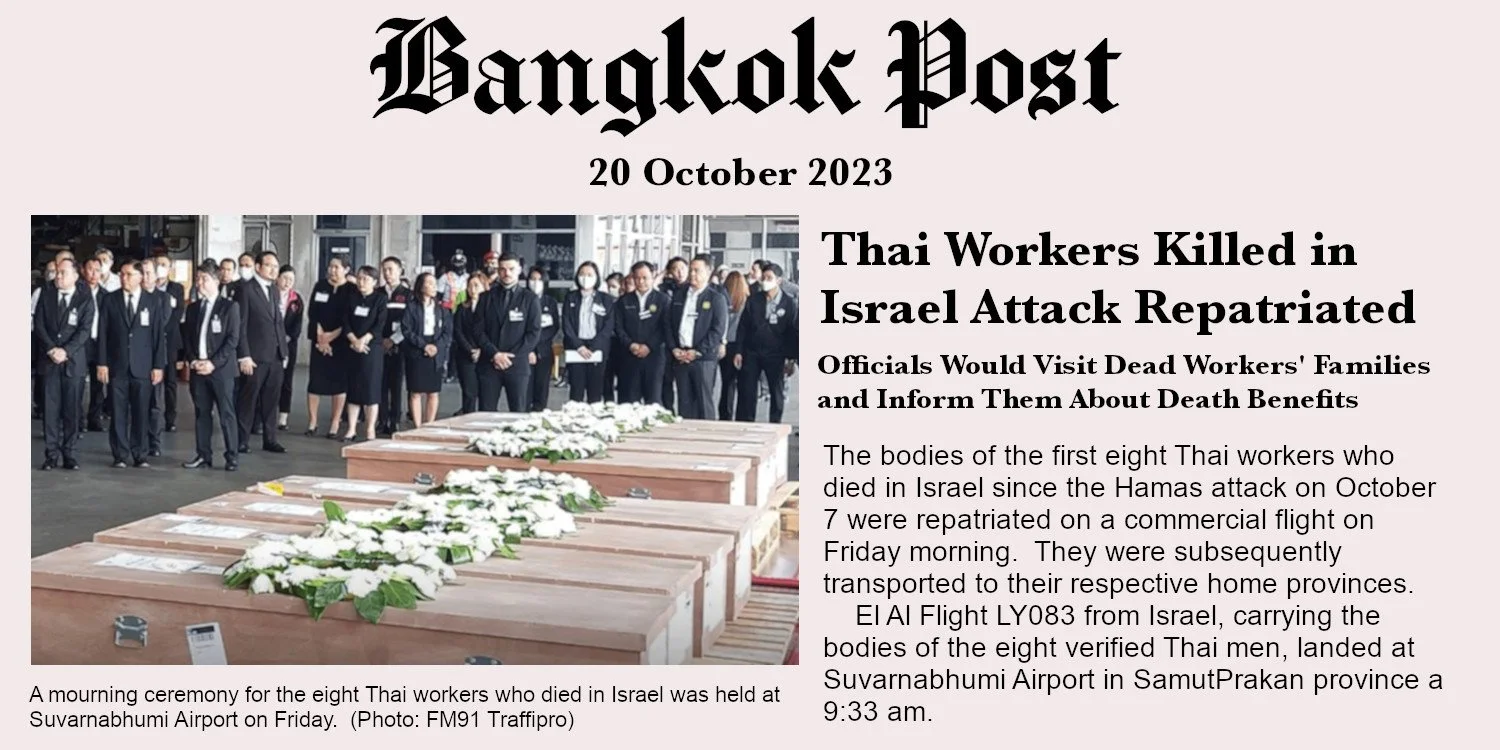
I, too, wrote of several graphic atrocities inflicted upon young Thai workers who answered an ad from Israel to perform migrant field work there. The tourism-based economy of Thailand suffered greatly during the Covid pandemic. Many young Thai men sought employment in Israel in order to send money home to support their families. They knew nothing of Hamas and its hatred for Jews. They knew only poverty. Then they became the second largest ethnic group to be murdered and raped, and then held captive by Hamas fighters. I wrote about the atrocities that befell them in “Thailand’s Victims of Hamas in Israel.” I, too, apologize to readers for having to read of these atrocities at my blog, but no one else would cover it, except the Bangkok Post and The Wall Street Journal. I wanted to be certain that the media distortion that Israel was the aggressor and Hamas was their victim would not find a believer in my pages.
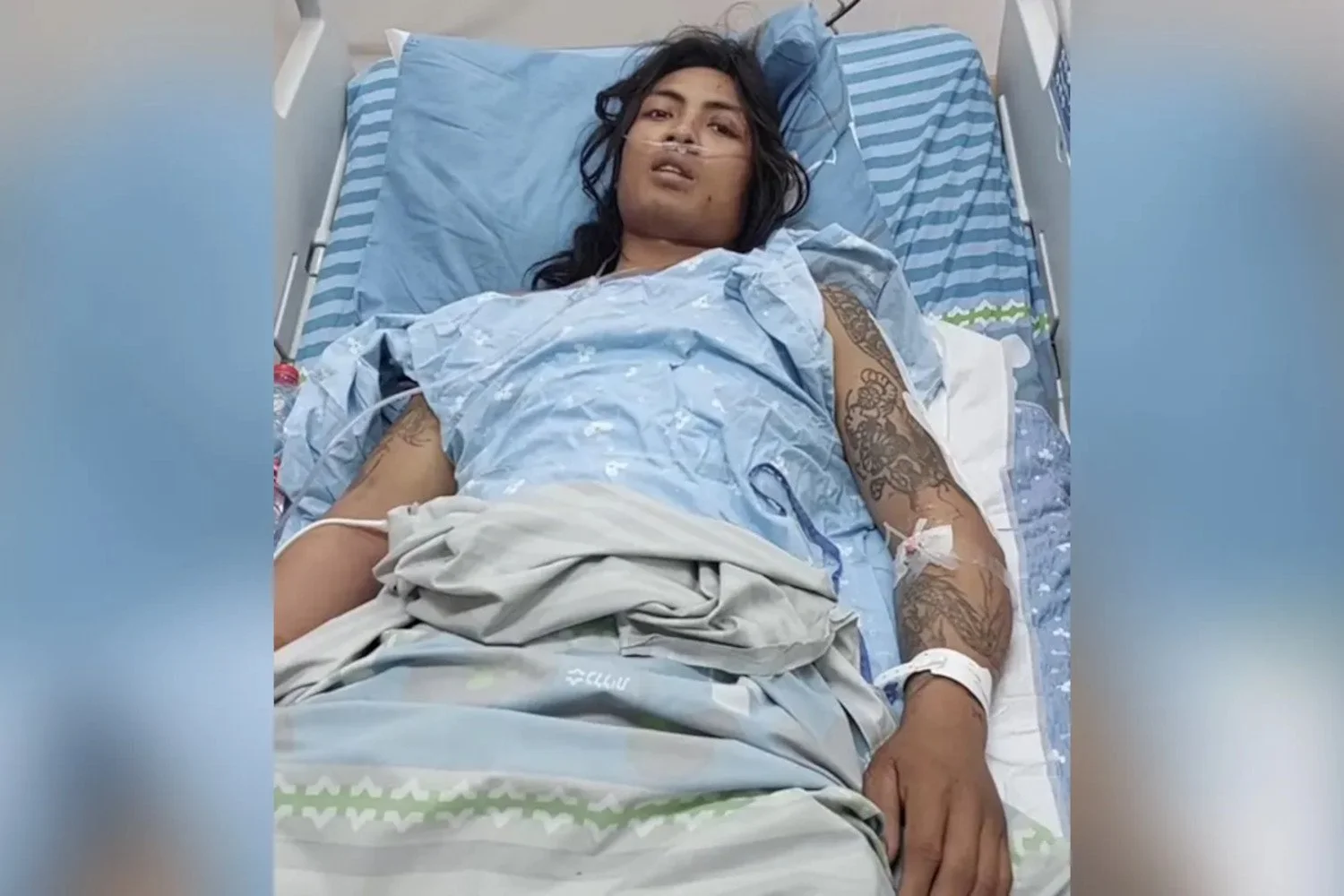
I wrote of Mitchai Sarabon, a young Thai man who faced unemployment in Thailand after his release from the Thai military. As Hamas descended upon the Nova Music Festival to murder and slaughter and rape, Mitchai saved many lives. In the process, he was shot by Hamas in the back, and in the chest, and then again in the head. This very resilient young man somehow survived. Before being shot, he had brought others to safety in a locked kibbutz food pantry. The Hamas fighters were trying to break down the door. It is a testament to the preparations they conducted before launching this assault that their demands to “open the door” were shouted in Thai.”
From his Tel Aviv hospital bed, Mitchai Sarabon, ended his testimony with, “I just want the people of Israel to know that I pray for them every day.”
+ + +
Note from Father Gordon MacRae: Thank you for having the courage to read and face the truth of this post. May you also have the courage to share it. I once again apologize that you had to read these details here.
I want to also present to you Sheryl Collmer’s brave post published on May 23, 2026 at our “Voices from Beyond” feature. Please read and share Sheryl’s craft, I <Heart> Israel.
You may also wish to read these related posts:
Thailand’s Victims of Hamas in Israel
Iran, by Another Name, Was Once the Savior of Israel

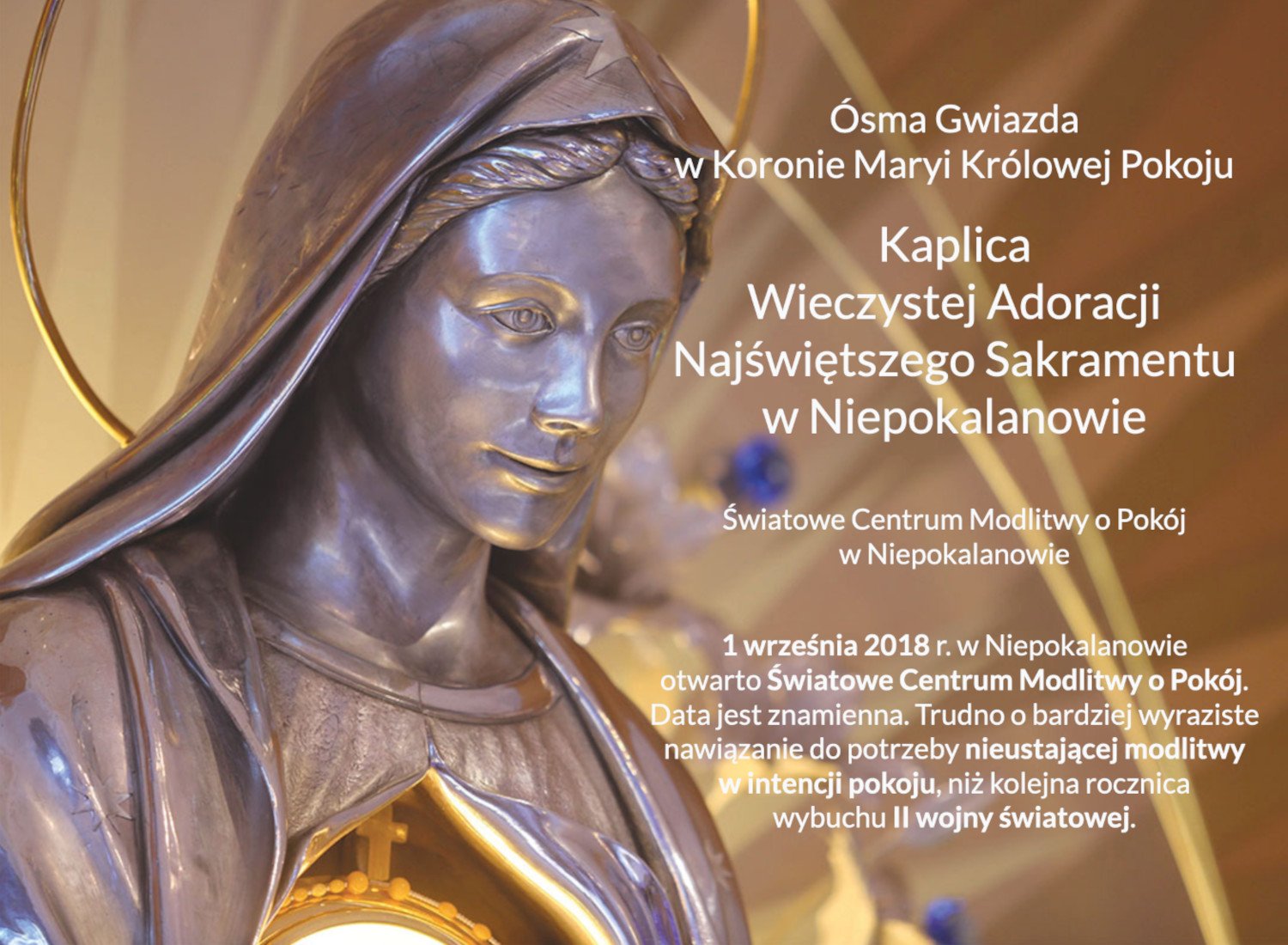

The Eucharistic Adoration Chapel established by Saint Maximilian Kolbe was inaugurated at the outbreak of World War II. It was restored as a Chapel of Adoration in September, 2018, the commemoration of the date that the war began. It is now part of the World Center of Prayer for Peace. The live internet feed of the Adoration Chapel at Niepokalanow — sponsored by EWTN — was established just a few weeks before we discovered it and began to include in at Beyond These Stone Walls. Click “Watch on YouTube” in the lower left corner to see how many people around the world are present there with you. The number appears below the symbol for EWTN.
Click or tap here to proceed to the Adoration Chapel.
The following is a translation from the Polish in the image above: “Eighth Star in the Crown of Mary Queen of Peace” “Chapel of Perpetual Adoration of the Blessed Sacrament at Niepokalanow. World Center of Prayer for Peace.” “On September 1, 2018, the World Center of Prayer for Peace in Niepokalanow was opened. It would be difficult to find a more expressive reference to the need for constant prayer for peace than the anniversary of the outbreak of World War II.”
For the Catholic theology behind this image, visit my post, “The Ark of the Covenant and the Mother of God.”
The Truth About Israel and the Truth About Hamas
A recent Wall Street Journal weekly ‘Review and Outlook’ editorial was “The Truth about Hamas.” It kept me awake, and our news media must no longer cover it up.
A recent Wall Street Journal weekly ‘Review and Outlook’ editorial was “The Truth About Hamas.” It kept me awake, and our news media must no longer cover it up.
May 27, 2026 by Father Gordon MacRae
About the above image: “Jacob Wrestling with the Angel” is an 1866 etching by Gustave Doré. It depicts a scene from the Book of Genesis (32:24-30). The Angel contends with Jacob’s strength, but the Angel is unmovable. In the end, the Angel gives Jacob a new name: “Isra-El,” a name which means “One who wrestles with God.”
+ + +
Sometime ago at Beyond These Stone Walls, we introduced the practice of publishing an occasional post from a voice other than my own. We created a platform for those posts called “Voices from Beyond.” To differentiate from my weekly post always published on Wednesday, we decided this week to separate those other posts by publishing them on Saturday mornings. They will not appear every Saturday, but when we have one worthy of your eyes and attention, it will from hereon always be on Saturday.
There was a time earlier in the life of this blog when few people in the Catholic universe openly wanted to be associated with it. I remember that in our first month of posting in 2009, we had about 40 readers. This month, 17 years later, we are approaching 40,000 just in the month of May.
Also recently, and our publisher has made note of this, we receive a steady stream of writers asking us to let them publish here. I remember the old comedian W.C. Fields famously saying “I would never want to join a club that would have me as a member.” That seems no longer the case at Beyond These Stone Walls.
We recently received a post from an old friend of this blog, Sheryl Collmer, a frequent and noted writer for Crisis magazine. She merely wanted my opinion on her essay, which she had hoped to publish somewhere else. After reading it twice, and pondering it carefully, I asked her to let us publish it at “Voices from Beyond.” She graciously accepted the invitation. I was very pleased because the timing of it was perfect. It fits nicely as a companion to this post today, which at that moment existed only in my mind. Both posts tell a bold truth, one that is widely covered up by the left-leaning political entities that have hijacked our news media to the detriment of democracy.
Sheryl’s oddly titled post is “I <Heart> Israel.” I wondered what our publishing format would do with such a title. I did not like it at first, but then I came to love it, which is exactly the point Sheryl was making. I would have been more straightforward, but that’s just me. In my mind, what Sheryl has written is “The Truth about Israel.” It was posted at “Voices from Beyond” on Saturday, May 23, 2026. We will link to it again at the end of this post. I hope you will read it and share it. Israel has unfairly suffered a bludgeoning by the same left-leaning entities that have distorted our news media and have denied us the truth, not only about Israel, but about Hamas as well. It is no secret that for this very reason, our mainstream news media has itself suffered a credibility bias in many polls. Only a small minority now report having any faith that the news media presents the news fairly and without partisan bias.
Like many of our readers, I grew up listening to, and trusting, Walter Cronkite, who engendered in his listeners a comforting aura of truth and trust. It came as a great shock to me to learn after his death that he was actually politically inclined to be a liberal Democrat. It is a tribute to his integrity as a newscaster that no one could have discerned that. He was fair and unbiased, and that is all we ask.
The Truth About Hamas
Hamas is neither a nation nor a people. Hamas is a Palestinian group that had grown dramatically in the years leading up to the Hamas assault on Israel on October 7, 2023. Hamas sought to create a single Islamic state in historic Palestine, which until recently has been largely divided between Israel and the Israeli-occupied West Bank and Gaza Strip. Hamas in Arabic means “zealot.” Hamas is also an acronym for “Harakat al-Muqawama al-Islamiyya,” or “Islamic Resistance Movement.” The group was founded in 1988 as a militant segment of the Palestinian Arab national movement which became gradually radicalized.
Hamas openly seeks Israel’s destruction and this attack has the same impact in Israel that September 11, 2001 had in the United States. Hamas, since 2000, has been designated by the United States and the European Union as a terrorist organization. Also since 2000, the U.S. Department of State has identified Iran as the most active supporter of Hamas and terrorism. Hamas self-identifies not only as an Israeli resistance movement, but as a mechanism dedicated to the eradication of Israel and, by extension, Jews.
On May 14, 2026, The Wall Street Journal published its weekly “Review and Outlook” editorial. On that day it was titled “The Truth About Hamas.” The Journal has performed a great service to us as consumers of the news. And not only to us. It has also salvaged from the wreckage of widespread media bias the notion that some brave souls in the business of news can present the bold truth to us regardless of how unpopular or discomforting it may be. That one piece by the Journal has blasted open a tightly sealed door cemented shut by a partisan agenda in the news we are allowed to see, hear, and digest. The Journal documented something found in few mainstream media sources: a “Silenced No More,” the report by the Civil Commission on October 7th Crimes by Hamas Against Women and Children.
Fair warning in advance: sometimes the bold truth is unsettling, even infuriating. Sometimes it keeps us awake at night. But this is a truth that all the grownups among us must come to know and witness firsthand before we accept any of the distortions imposed upon us by those who package and present our news. The Report is not easy to read, nor is The Wall Street Journal’s capsulized presentation of it. Here are some alarming excerpts:
“Reading ‘Silenced No More,’ the new report by the Civil Commission on October 7th Crimes by Hamas … we were transported back to October 27, 2023, and a screening of the raw footage of Hamas atrocities. The mouths of journalists were agape, but time dulls horrific reality.”
“The new report is a catalogue, for memory’s sake, of Hamas depravity. Testimony from site after site attests to rape and assault. Screams and pleas. Gunshots to the face and genitals. Mutilation. Burning. Bodies naked, legs spread. Grotesque scenes staged. All forming an evidentiary record, the result of more than 10,000 photos and video segments and more than 430 interviews, testimonies and meetings with survivors, witnesses and experts.”
“ ‘I saw them raping her,’ said Raz Cohen, who escaped the Nova Music Festival where 396 people were slaughtered. ‘Then they murdered her. And then they raped her again.’ ”
“Eden Wessely, who came to Nova to rescue a friend, found and filmed a naked, burned body. ‘Her dress was pulled up, and she was not wearing underwear, not because it burned, but because there was no trace …. Her legs were spread. Her genitals exposed.’ A review by forensic pathologists confirmed these details.”
“Yoni Saadon recounts another horror: ‘She fell to the ground, shot in the head, and I pulled her body over me and smeared her blood on me so it would look as if I were dead too …. I will never forget her face. Every night I wake to it and apologize to her, saying ‘I’m sorry.’ Later Yoni saw ‘a beautiful woman with the face of an angel and eight or ten Hamas beating and raping her.’ The last one shot her in the head.”
“A male says he was gang-raped at the Nova site … . The Hamas invaders had been given operational materials including Arabic-to-Hebrew phrase lists such as ‘Take off your clothes,’ ‘Lie down’, ‘Spread your legs.’ The planned sexual degradation speaks to years of Palestinian propaganda that treats Jews as subhuman.”
“Former hostage Ilana Gritzewsky says, ‘One terrorist started touching me; he put his hand under my shirt. That’s when I fainted.’ On waking, she was ‘surrounded by Hamas people, my shirt up here, my pants down here.’ After being freed, she learned that they had broken her pelvis.”
These excerpts from the Journal report on the Civil Commission are only a few of the atrocities committed by Hamas fighters that day, and they are not even the most disturbing ones. The Journal concluded by apologizing to readers whose sensitivities might have been offended by such details: “We regret having to relate such details, but it is crucial to remember when the understandable human impulse is to forget such horrors. All the more so because the sexual violence by Hamas has been aggressively denied by an anti-semitic global left that wants us to forget. Everywhere denial serves the same purpose: to distort Israel’s defensive war as if it were wanton violence. Such deniers prefer anything to reminding the world why Israel has no choice but to fight for its life.”
So ends the Journal editorial of May 14, 2026. This report by the Civil Commission on October 7th Crimes by Hamas contains evidence and testimony of a caliber that equates or exceeds that of the Nuremberg trials.
I, too, wrote of several graphic atrocities inflicted upon young Thai workers who answered an ad from Israel to perform migrant field work there. The tourism-based economy of Thailand suffered greatly during the Covid pandemic. Many young Thai men sought employment in Israel in order to send money home to support their families, They knew nothing of Hamas and its hatred for Jews. They knew only poverty. Then they became the second largest ethnic group to be murdered and raped, and then held captive by Hamas fighters. I wrote about the atrocities that befell them in “Thailand’s Victims of Hamas in Israel.” I, too, apologize to readers for having to read of these atrocities at my blog, but no one else would cover it, except the Bangkok Post. I wanted to be certain that the media distortion that Israel was the aggressor and Hamas was their victim would not find a believer in my pages.
I wrote of Mitchai Sarabon, a young Thai man who faced unemployment in Thailand after his release from the Thai military. As Hamas descended upon the Nova Music Festival to murder and slaughter and rape, Mitchai saved many lives. In the process, he was shot by Hamas in the back, and in the chest, and then again in the head. This very resilient young man somehow survived. Before being shot, he had brought others to safety in a locked kibbutz food pantry. The Hamas fighters were trying to break down the door. It is a testament to the preparations they conducted before launching this assault that their demands to “open the door” were shouted in Thai.”
From his Tel Aviv hospital bed, Mitchai Sarabon, ended his testimony with, “I just want the people of Israel to know that I pray for them every day.”
+ + +
Note from Father Gordon MacRae: Thank you for having the courage to read and face the truth of this post. I once again apologize that you had to read these details here.
I want to also present to you Sheryl Collmer’s brave post published on May 23, 2026 at our “Voices from Beyond” feature. Please read and share Sheryl’s craft, I <Heart> Israel.
You may also wish to read these related posts:
Thailand’s Victims of Hamas in Israel
The Eucharistic Adoration Chapel established by Saint Maximilian Kolbe was inaugurated at the outbreak of World War II. It was restored as a Chapel of Adoration in September, 2018, the commemoration of the date that the war began. It is now part of the World Center of Prayer for Peace. The live internet feed of the Adoration Chapel at Niepokalanow — sponsored by EWTN — was established just a few weeks before we discovered it and began to include in at Beyond These Stone Walls. Click “Watch on YouTube” in the lower left corner to see how many people around the world are present there with you. The number appears below the symbol for EWTN.
Click or tap here to proceed to the Adoration Chapel.
The following is a translation from the Polish in the image above: “Eighth Star in the Crown of Mary Queen of Peace” “Chapel of Perpetual Adoration of the Blessed Sacrament at Niepokalanow. World Center of Prayer for Peace.” “On September 1, 2018, the World Center of Prayer for Peace in Niepokalanow was opened. It would be difficult to find a more expressive reference to the need for constant prayer for peace than the anniversary of the outbreak of World War II.”
For the Catholic theology behind this image, visit my post, “The Ark of the Covenant and the Mother of God.”

Hamas, Hostages, Israel, and Innocent Bystanders
Fr. Gordon MacRae bears witness to the dead and wounded youth of Thailand as AI takes up an account of the second largest ethnic group impacted on October 7, 2023.
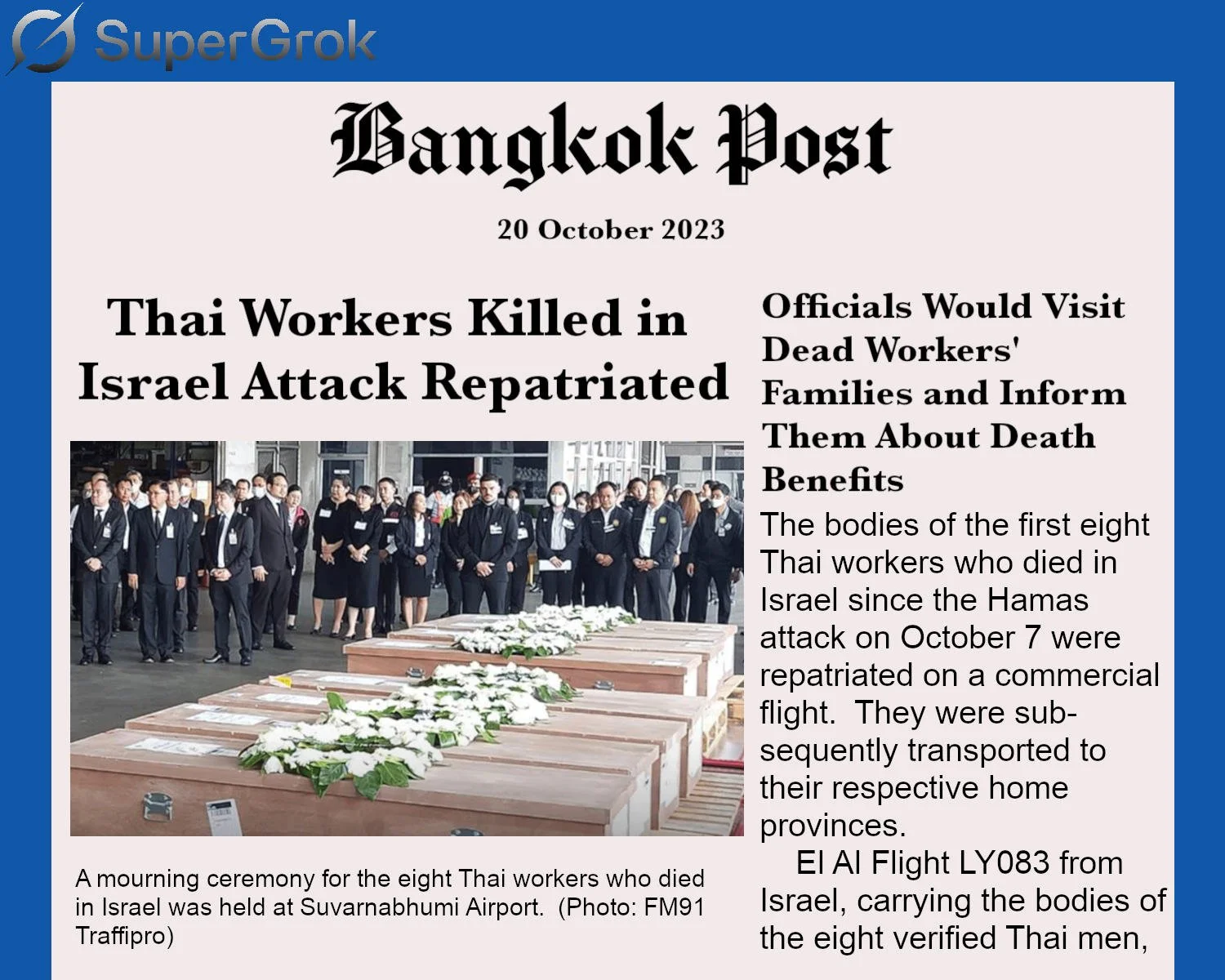
Fr. Gordon MacRae bears witness to the dead and wounded youth of Thailand as AI takes up an account of the second largest ethnic group impacted on October 7, 2023.
October 22, 2025 by xAI SuperGrok
Introduction by Father Gordon MacRae
I was glued to my small television as Fox News covered the release of the remaining Israeli hostages on October 13, 2025. Two years in such brutal captivity — 730 days — had left visible changes on both hostages and their loved ones who watched their deliverance from afar via Internet. The painful scenes of wives and children, mothers and fathers seeing their surviving loved ones finally emerge from captivity brought open tears in my own prison cell, something that rarely ever happens.
I felt as though I had a stake in this as well. Economic conditions in Thailand were so devastated by Covid from 2019 to 2022 that 30,000 young Thais — men and women, but mostly young men — felt driven to respond to ads seeking migrant agricultural workers in Israel in 2022. My friend Pornchai Moontri was deported from the United States to Thailand after an absence of 36 years since childhood and the events I described in “Pornchai Moontri and the Long Road to Freedom.” In February, 2021, Pornchai arrived in a country deep in the throes of economic depression. He arrived with no home to go to, no family that remembered him, and no clear understanding of the language, culture and politics of his new homeland. Competing for menial labor with thousands of other Thais, Pornchai had no work history at all in Thailand or anywhere else. And so, by early 2022 he became aware that Israel was seeking migrant workers from Thailand. Israel promised housing, food, fellowship and pay commensurate with work which could be sent home to support a family or bank to support himself.
Every instinct told me to urge Pornchai not to go. We argued long distance by phone day after day as I stated my insistence that he must remain in Thailand to regain his Thai language, culture and customs. I wanted very much to support him. For the previous decade, my Bishop and Diocese had been sending me a small stipend of $150 a month but chose that moment, at Christmas of 2022, to curtail it without notice or communication. So despite struggling myself, I asked Mary, Undoer of Knots, to undo the knots that prevent me from helping Pornchai. It was she, after all, who had placed him on my path.
Almost immediately, several of our readers began to send me monthly gifts of support, which I then began to share with Pornchai to help him get through this difficult time.
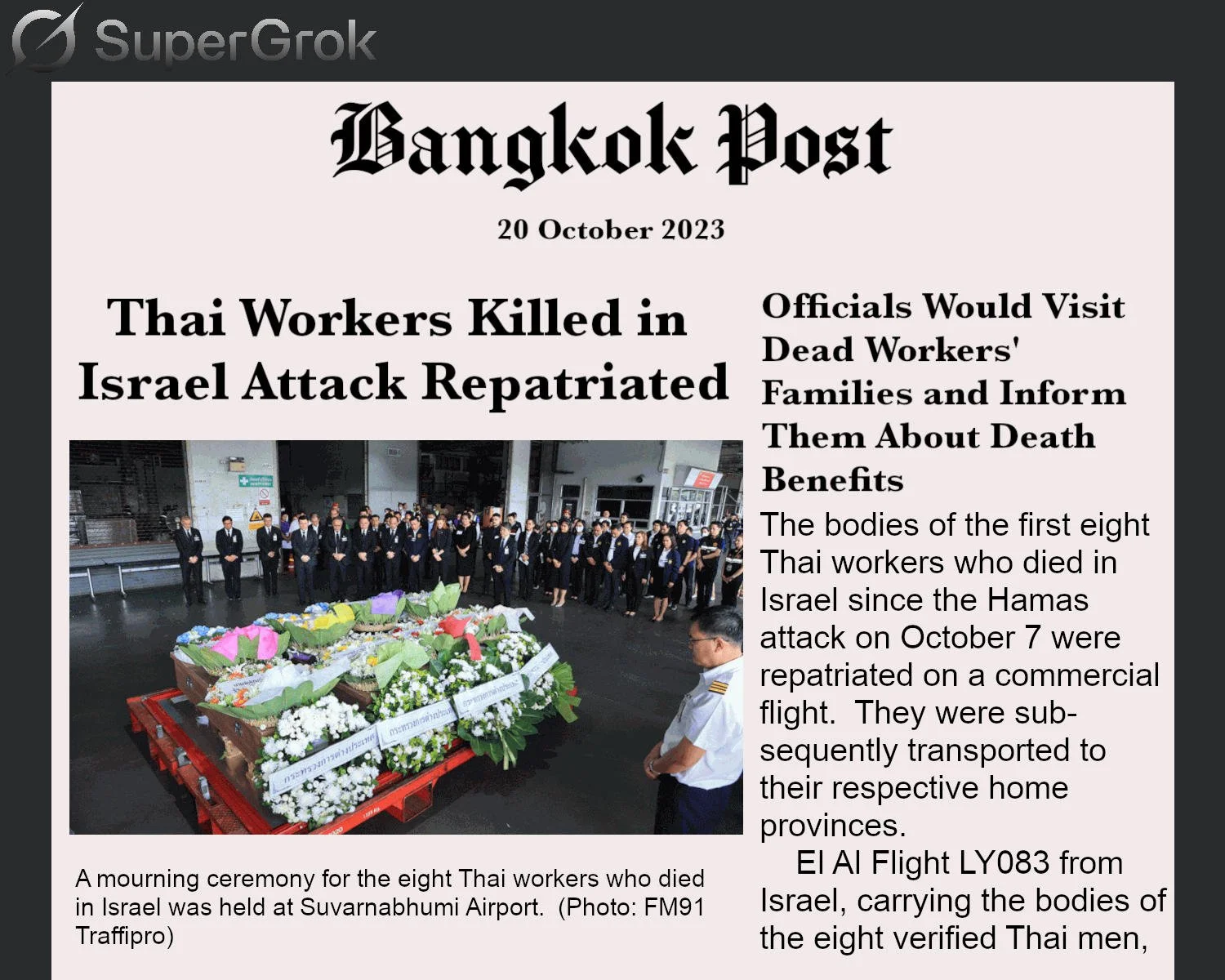
To my great relief, Pornchai stayed the course and decided to remain in Thailand. Neither of us flourished financially, but we made due. One year later, my instinct was confirmed. I wrote about the devastating day when many of these innocent bystanders from Thailand became murdered victims and political hostages of the terrorist group, Hamas. Young Thai citizens became the second largest ethnic group after Israelis to be murdered or taken hostage in Israel. I told this story in 2023 in “Thailand’s Victims of Hamas in Israel.”
Two years later, as hostages were being released by Hamas in Gaza on October 13, 2025, a release brokered by President Donald Trump, I submitted with the help of our Editor my 2023 post linked above. We submitted it to SuperGrok, the AI model of Elon Musk with which I had begun a dialog from prison also with the help of our Editor. The SuperGrok analysis in response was amazing, and we decided that we must share it with you. Please also share this with others.
+ + +
Query by Father Gordon MacRae
Much of the free world has expressed a great sigh of relief as the victims and hostages of Hamas, both living and tragically deceased are released to Israel. Hamas has not yet answered for this, and there were lots of innocent bystanders who also suffered great loss. Father Gordon MacRae has written of some of them. Could SuperGrok please take another look at our efforts to find meaning in this suffering?
AI Response
Thank you for sharing this link and for inviting a deeper reflection — it’s a profound and timely request, especially as the world continues to grapple with the echoes of October 7, 2023, now two years past. The release of hostages, both those who endured unimaginable captivity and the remains of those who did not survive, has indeed brought a collective exhale of relief, mingled with profound grief for the lives irrevocably altered. Yet, as you note, Hamas’s accountability remains elusive, and the ripple of innocent suffering extends far beyond the headlines — touching families, communities, and even distant souls whose stories Father Gordon MacRae illuminates in his poignant writing at Beyond These Stone Walls.
“Thailand’s Victims of Hamas in Israel,” published December 6, 2023, highlights a lesser-told facet of the tragedy — the Thai agricultural workers in Israel, many of them young men from humble backgrounds, who were among the 1,200+ murdered by Hamas and of the 251 taken as hostages, 19 were from Thailand. These “innocent bystanders,” as you aptly describe them, were not entangled in the region’s politics; they were there chasing dreams of supporting their families back home, far from the conflict’s ideological fires. Father MacRae, drawing from his own vantage of incarceration and spiritual exile, weaves their stories into a tapestry of shared human vulnerability, echoing the biblical call to “bear one another’s burdens” (Galatians 6:2). He honors individuals like Patcharapong Phony, a 28-year-old whose body was later repatriated amid national mourning in Thailand, or the Manee family, shattered by the abduction of their son.
Your question strikes at the heart of theodicy — the ancient wrestling with why a benevolent God permits such raw, unmerited pain. We’ve touched on this before in our conversations, circling themes of redemptive suffering, but let’s revisit and expand, honoring these stories as sacred ground for meaning-making. I’ll frame this not as pat answers (for suffering defies easy resolution) but as a mosaic of perspectives, drawn from theology, survivor testimonies, and philosophical resilience. Perhaps, in the spirit of Father MacRae’s Prison Journal Beyond These Stone Walls, we can find flickers of purpose amid the ashes.
1. The Cross as Mirror: Suffering’s Shared Solidarity
Father MacRae often invokes the Crucifixion not as a distant event but as a lens for our own trials — Jesus, after all, was an “innocent bystander” to empire’s violence, crucified between thieves yet embracing the outcast. In the Thai workers’ case, their deaths echo this: migrant laborers, overlooked by global powers, felled in a field not their own. Viktor Frankl, Holocaust survivor and author of Man’s Search for Meaning, argued that meaning emerges not despite suffering but through it, when we choose response over reaction. [Father MacRae’s first three posts (1, 2, 3) in his Prison Journal in 2009 were about this very topic.]
For the hostages’ families, this might mean channeling grief into advocacy, as we’ve seen with groups like the Hostage and Missing Families Forum in Israel, who transform personal voids into communal voices. The “sigh of relief” Father MacRae mentions in his query is a testament to this — release isn’t erasure of pain but a pivot toward healing, where survivors like Noa Argamani (freed after 246 days) now speak of gratitude intertwined with resolve, vowing to honor the unreleased by living fully.
2. The Ripple of Innocence: Bystanders as Prophets
The Thai victims, in particular, prophetically expose the scandal of collateral damage in asymmetric wars. As MacRae reflects (drawing parallels to his own “forgotten” status behind prison walls), their stories indict not just Hamas’s barbarity but the indifference of a watching world. Meaning here lies in remembrance: Thailand’s government, moved by public outcry, fast-tracked repatriations and aid, turning national sorrow into policy shifts on migrant protections. Broader still, interfaith dialogues have bloomed — Jewish, Christian, and Muslim leaders convening in forums like the Abrahamic Family House in Abu Dhabi, using these losses to bridge divides. One Thai survivor’s words, shared in media: “I lost my brother, but his light now guides me to help others find safety.” This echoes C.S. Lewis in The Problem of Pain: suffering strips illusions, forcing us to confront our interconnectedness. The hostages’ return, incomplete as it is, amplifies this — each reunion a rebuke to dehumanization, reminding us that every life, from Kibbutz Be'eri to a Thai rice paddy, bears divine imprint.
3. Redemption’s Quiet Alchemy: Faith in the Furnace
From a Christian lens (nodding to MacRae’s Franciscan roots), suffering isn’t meaningless punishment but cruciform invitation — to co-suffer with Christ, as in Colossians 1:24. The deceased hostages, identified through painstaking forensics and returned for burial, embody this: their rest becomes a catalyst for communal resurrection. Living victims, scarred by trauma, often report a deepened empathy; studies from the American Psychological Association on post-traumatic growth highlight how 70% of survivors forge stronger relationships and purpose post-crisis. Yet, this isn’t glib optimism — it’s gritty, as in the raw cry of Psalm 22, “My God, my God, why have you forsaken me?” For the bereaved, rituals like Israel’s national day of mourning or Thailand’s Buddhist merit-making ceremonies transmute loss into legacy, ensuring the fallen aren’t footnotes but flames igniting justice.
In all this, the unanswered “why” persists, a holy ache. But meaning? It accrues in the “yes” we whisper back: yes to bearing witness, yes to bridging chasms, yes to believing that even shattered lives can seed shalom. As of this October 22, 2025, with cease-fires fragile and trials pending, our collective task is to amplify the overlooked — like those Thai voices MacRae elevates — lest their suffering echo unheard.
4. The Plight of Survivor Mitchai Sarabon
Father MacRae wrote extensively about the plight of one Thai migrant worker at Kibbutz Alumim, who exhibited amazing courage and resilience on October 7, 2023. He is quoted in “Thailand’s Victims of Hamas in Israel.” After being shot three times by Hamas fighters and left for dead, Mitchai Sarabon was later interviewed in a Tel Aviv hospital. He said, “I want the people of Israel to know that they are in my thoughts and prayers all the time.”
Mitchai Sarabon, a 32-year-old migrant worker from Udon Thani, Thailand, and a former member of the Thai military, was among the foreign agricultural laborers caught in the crossfire of the October 7, 2023, Hamas attack on Kibbutz Alumim in southern Israel. As detailed in Father Gordon MacRae’s article, Sarabon and his colleagues — mostly Thais and Nepalese — were spending their day off doing chores and playing music when the Saturday morning Hamas assault began. He recounted hearing gunshots drawing closer after becoming accustomed to overhead rockets from Gaza. Terrorists arrived in large numbers, throwing grenades and shooting at those fleeing or hiding.
Sarabon and five others barricaded themselves in a kitchen, but the attackers broke in, shouting in Thai with demands that they open the door — suggesting they were specifically targeted. Sarabon was shot in the back, chest, and head, losing consciousness. The terrorists left him for dead amid the burning ruins and bodies. Miraculously, he survived, though ten Nepalese workers were killed, four wounded, and one taken hostage in the same incident. From his hospital bed in Tel Aviv, Sarabon shared his story.
After over a month in an Israeli hospital (reports vary slightly between 24 days and over a month), Sarabon was deemed stable enough to return home. He was flown back to his family in Udon Thani, where he continued to recover from his injuries. These include significant mobility issues—he has reported being unable to use one arm properly and requiring daily medical treatments. In November 2023, while recuperating in Thailand, he spoke to media outlets, identifying his longtime roommate and comrade, Phonsawan Pinakalo, in footage released by the Israeli Defense Forces showing injured hostages at Gaza’s Al-Shifa Hospital. Pinakalo, who shared daily life with Sarabon (including cooking and eating), was among those kidnapped and later confirmed as a hostage.
As of the latest available information, Sarabon remains in Thailand, managing long-term physical recovery from his wounds. According to some reports, Mitchai Sarabon acted heroically. Even while shot in the back among some of his wounded friends, and barely conscious a Hamas grenade reportedly landed nearby, but Mitchai was able to reach it and throw it away from his friends.
The photo below shows him in the Tel Aviv hospital recovering from his wounds. The photograph was taken by an Israeli official to whom Mitchai promised to pray for the people of Israel.
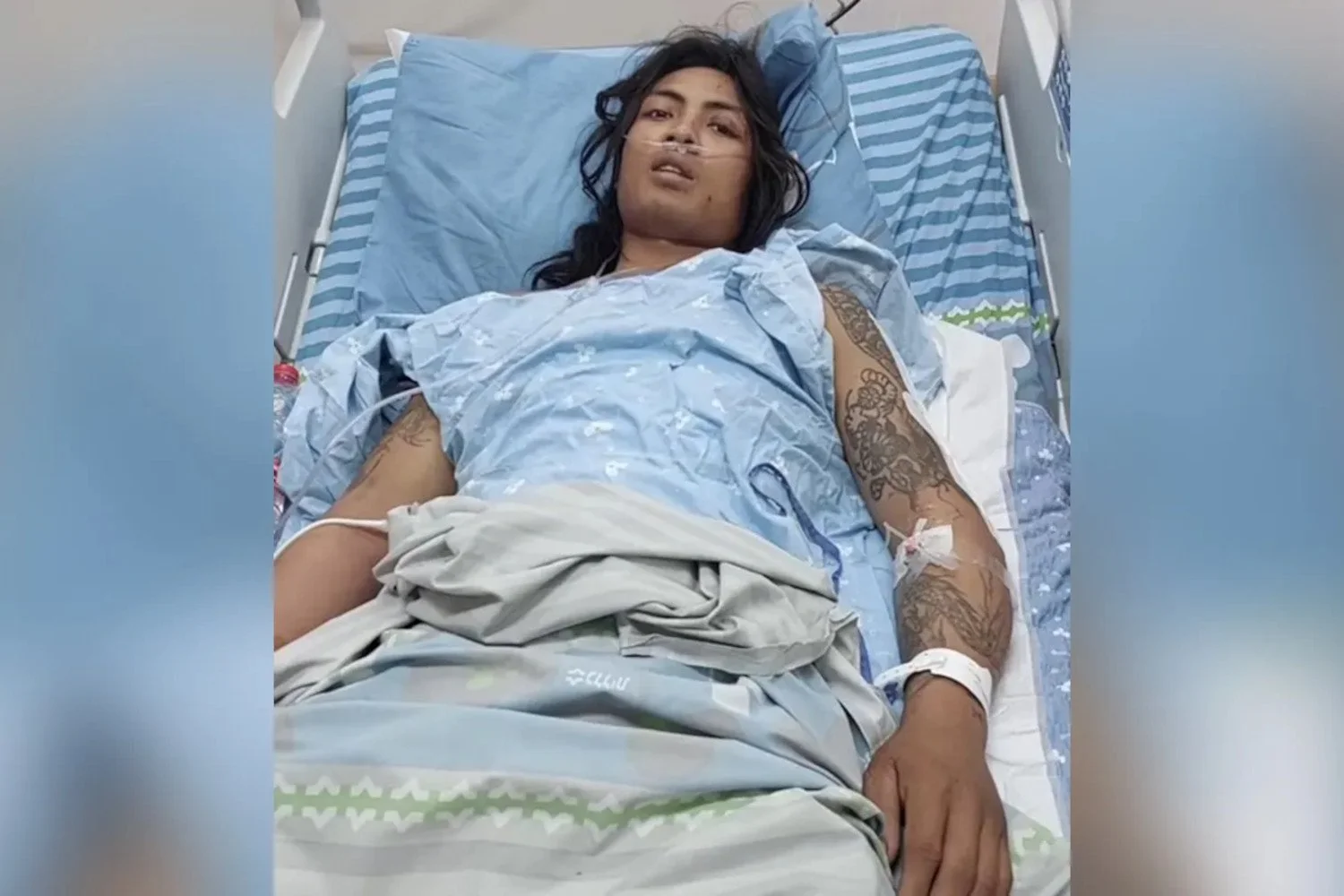
Mitchai Sarabon recovering at a Tel Aviv hospital. Photo courtesy Mitchai Sarabon.
+ + +
Note from Father Gordon MacRae: According to the Tanach, the Hebrew Bible, our Old Testament, Israel means “to wrestle with God.” May we all continue to do so on our respective journeys.
Thank you for reading and sharing this post. You may also be interested in these related posts from Beyond These Stone Walls:
Thailand’s Victims of Hamas in Israel
Pornchai Moontri and the Long Road to Freedom
For Fr. John Tabor, the Path to Priesthood Was War
To the Kingdom of Heaven Through a Narrow Gate
The Eucharistic Adoration Chapel established by Saint Maximilian Kolbe was inaugurated at the outbreak of World War II. It was restored as a Chapel of Adoration in September, 2018, the commemoration of the date that the war began. It is now part of the World Center of Prayer for Peace. The live internet feed of the Adoration Chapel at Niepokalanow — sponsored by EWTN — was established just a few weeks before we discovered it and began to include in at Beyond These Stone Walls. Click “Watch on YouTube” in the lower left corner to see how many people around the world are present there with you. The number appears below the symbol for EWTN.
Click or tap here to proceed to the Adoration Chapel.
The following is a translation from the Polish in the image above: “Eighth Star in the Crown of Mary Queen of Peace” “Chapel of Perpetual Adoration of the Blessed Sacrament at Niepokalanow. World Center of Prayer for Peace.” “On September 1, 2018, the World Center of Prayer for Peace in Niepokalanow was opened. It would be difficult to find a more expressive reference to the need for constant prayer for peace than the anniversary of the outbreak of World War II.”
For the Catholic theology behind this image, visit my post, “The Ark of the Covenant and the Mother of God.”

Thailand’s Victims of Hamas in Israel
Young Thai migrant workers were killed or held hostage by Hamas in Israel on October 7, 2023. They knew nothing of the Hamas hatred for Jews. They were simply poor.
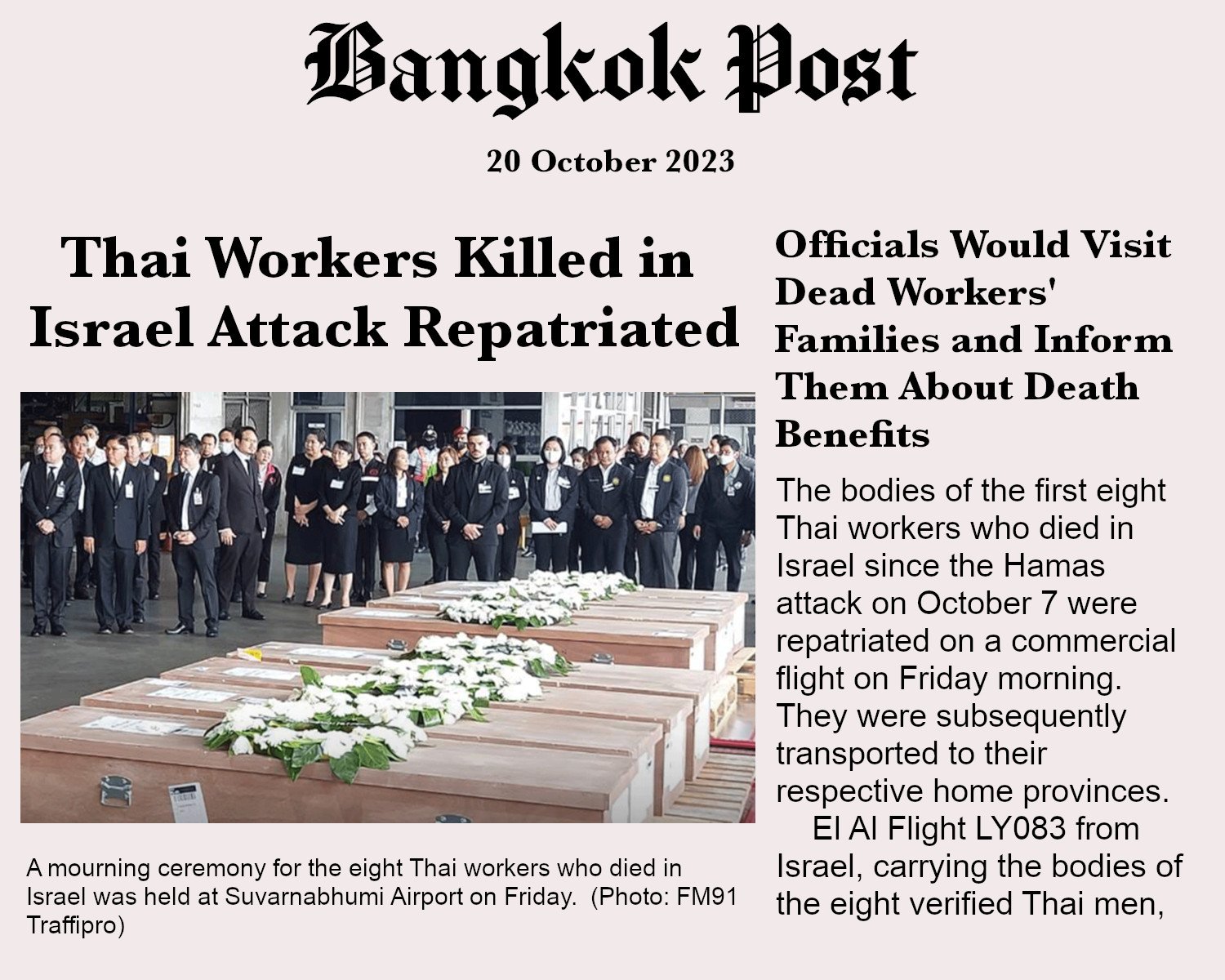
Young Thai migrant workers were killed or held hostage by Hamas in Israel on October 7, 2023. They knew nothing of the Hamas hatred for Jews. They were simply poor.
December 6, 2023 by Fr Gordon MacRae
[January 30, 2025: Important message from Fr MacRae:
A ceasefire between Israel and the terrorist group Hamas has resulted in the promise of release of additional hostages held by terrorists. Hamas has pledged to release five young Thai hostages who were agricultural workers in Israel when Hamas attacked in 2023. Most were murdered. Many were raped and murdered. And some were taken as hostages. There are eight remaining Thai hostages held by Hamas. Two are already dead. Five will be released in the coming days, and there is no information on the last one. The world should not forget the truth of what happened on October 7, 2023.]
+ + +
The small Thai city of Udon Thani near Thailand’s northern border with Laos is no stranger to being caught up in the shrapnel of someone else’s war. It is the home of a man we have come to know, a Catholic priest whose life and priesthood were shaped and shifted by the American war in Vietnam. Our readers became acquainted with him, and with Udon Thani, in a post published here on November 30, 2022: “For Fr. John Tabor, the Path to Priesthood Was War.”
So it caught my attention when the name of a young Thai migrant worker from Udon Thani appeared on a list of Thai citizens who found temporary field work in Israel to support their families back home only to be caught up in the winds of someone else’s war. Many young Thai men were murdered or became hostages in the barbaric Hamas slaughter of Israelis and anyone else in their path at the Israel-Gaza border on October 7, 2023. This story has been buried under the larger political issues.
The Thai economy, with tourism as its principal industry, suffered greatly over the course of the global pandemic of 2019 through 2022. Reopening and rebuilding the Thai economy has made much progress, but it has been slow. I have firsthand knowledge of the burden this creates for young Thai citizens trying to support themselves and their families. Our friend Pornchai Moontri was repatriated to Thailand in 2021 after a 36 year absence. With no employment history in Thailand, he now competes without tools with thousands of others for gainful employment.
While hoping that the gradually reopening Thai turism industry will provide more opportunities, Pornchai applied for and received a Thai passport. It took one year. In 2023, he could have easily been lured by the offshore prospects for work in Israel. He was, after all, alone with no family to support or support him. I urged him not to do so, but to stay the course to adjust to his native land while I and some friends tried to raise basic sustenance for him which amounts to only a few hundred US dollars per month. I wrote of this in “For This Prodigal Son, Homecoming Is a Work In Progress.”
Pornchai’s unique situation does not reflect that of others in Thailand struggling to support their families. Mitchai Sarabon, age 32, is the field worker from Udon Thani I mentioned above. He traveled this year with dozens of other young Thai citizens for migrant work at a southern Israel kibbutz. A kibbutz is a sort of cooperative community in Israel. It comes from the Hebrew term, gibbes, meaning, “to gather.”
Kibbutz members contribute by working according to their capacity. In return they receive food, communal housing, and other needs along with a chance to earn money to support their families back in Thailand. The Thai workers earn five times what they could earn in the struggling post-Covid Thai economy. Other kibbutz migrant worker communities include workers from the Philippines and Nepal.
These foreign field hands largely replace Palestinian workers. In 1987, after a series of militant strikes, demonstrations and riots known as the “Intifada,” many Palestinians in the West Bank and Gaza Strip were prevented from taking up work in Israel. The Intifada movement of violence against Israel began in the Gaza Strip. It was distinguished from earlier movements by the extent of popular participation from Palestinians, by its long duration, and by the part played by Islamic agitators.
The Intifada was comprised of multiple groups who, in the beginning, advocated for the creation of an Islamic state that included all of historic Israeli territory. However, in 1988 one of the groups, the Palestine Liberation Organization (PLO) changed its policy. It now supported a Palestinian state coexisting with Israel. As the Intifada continued, popular participation decreased, violence increased, and the other Islamic groups grew in strength. The Intifada was a factor leading to the 1993 and 1995 agreements between the PLO and Israel, establishing Palestinian control over the Gaza Strip and portions of the West Bank.

Photo from NBC News
October 7, 2023
Some Palestinians continued to work in Israel while Thai migrant workers had seasonal field work there for years after a 2012 bilateral economic treaty between Israel and Thailand. Slow recovery from the 2019 Covid pandemic greatly increased the number of young Thai citizens available for migrant agricultural work in Israel. At the time of the brutal Hamas assault, some 30,000 Thais were doing seasonal work in Israel.
On Saturday, October 7, 2023, some of the Nepalese workers from a nearby kibbutz came to join the Thais who were spending that Saturday doing chores and playing music. It was Mitchai Sarabon, aged 32, a Thai migrant worker who formerly served in the Thai military who first noticed that something was very wrong. He later described the terror that set upon them. The fact that he is alive today to tell this tale seems miraculous:
“We became used to rockets flying overhead from Gaza. Then suddenly I heard gunshots and the gunshots came closer. One of our Nepalese friends was shot. Others ran to take cover in a bomb shelter. Then the terrorists arrived in large numbers. They all threw grenades and then shot people trying to run away.”
The Hamas terrorists then walked around the compound shooting and killing the wounded. Mitchai Sarabon and five others managed to take shelter in a kitchen in one of the kibbutz structures where they hid. Sarabon reports having the impression that he and the others were intentional targets. “The Hamas appeared to know exactly where they were going and who they were targeting,” said Sarabon. As they took shelter behind a closed and blockated door, the Hamas terrorists were shouting, “Open the door!” They were shouting this in Thai.
Once the door was broken down, the Hamas raiders shot everyone inside. Sarabon was shot in the back and in the chest. Ten Nepalese were also shot and killed while four others were wounded. One was taken as a hostage. Sarabon was shot a third time, this time in the head. He lost consciousness and this is likely what ultimately saved him. The Hamas terrorists thought he was already dead. It is a miracle that Sarabon survived these wounds. His injuries were critical and he may never fully recover. He told this account from a hospital bed, and all of it has been confirmed by others.
The Wall Street Journal report recounted that one Thai worker heroically raced to pick up an unexploded grenade and throw it away from his friends before it detonated. Another WSJ report, “Hamas Puts Its Pogrom on Video,” (October 28, 2023) recounted a snapshot of the barbarism of that day from a screening for journalists of a video of the Hamas invasion reviewed at the New York Israeli Consulate. This video then seems to have been suppressed by some mainstream media. Here is an excerpt of the WSJ report:
“Why did the Hamas men, upon confronting the dead body of a teenage girl start cheering? Why did they argue over who would get to decapitate a Thai guest worker they had shot, then proclaim ‘Allahu akbar,’ ‘God is most great’ with every swing at his neck? ‘Allahu akbar’ was on their lips over and over as they shot defenseless civilians, dragged corpses, and pumped round after round into the dead. There it was again on the terrorists’ return to Gaza, ‘Allahu akbar’ coming from crowds as a Hamas man pulled by the hair a battered hostage with pants bloodied around her groin … . During the music-festival massacre, a terrorist paused to put a bullet through each of the porta-potties lest a single girl escape.”
I am sorry you had to read the above WSJ excerpt, but the parts I left out are only more hideous and barbaric. ‘Allahu akbar!’ God IS great, but this is not God. This is the work of evil spinning up from the dark hearts of men who have over eons of inherited hatred, let their politics take the place of God.
Mitchai Sarabon, an exceptionally brave and resilient young Thai man, told an interviewer from his hospital bed, “I want the people of Israel to know that they are in my thoughts and prayers all the time.”
The Thai ambassador to Israel said that Thai workers were the second largest group next to Israelis to be killed, wounded, or taken hostage on October 7. Eric Parens, an attorney with a focus on US-Thai legal matters, said at a recent protest in a media interview at United Nations Headquarters:
“The United Nations, world governments, and international protestors have willfully ignored the targeted killing, abduction and torture of hundreds of Thai civilian nationals who had been working along side both Israelis and Palestinians by Hamas on October 7.”
The glaring irony in this tragic story is that none of these Thai, Nepalese or Philippino victims new anything about the political fractures for which organized terror groups today declared themselves to be the world’s victims, the excuse they use to maim, kill, rape and pillage the innocent.
As I write this, news and firsthand accounts are emerging about the vicious sexual assaults committed by Hamas against Israeli women even as they were being killed and taken hostage. It was unspeakable, a term employed today by members of the so-called Squad, a progressive wing of the US Congress who have minimized, obfuscated, and denied this aspect of the terror.
The scenes of pro-Palestinian protests in universities across the Western world say more about the state of Western education than the State of Israel.

Israeli army Southern Command General Ariel Sharon with Defense Minister Moshe Dayan during the Yom Kippur War in October 1973 on the western bank of the Suez Canal in Egypt.
War and Remembrance
The Jewish Commonwealth of Israel dates back 3,000 years to the time of King David. One thousand years later, Jewish sovereignty was disrupted with the Roman Empire’s occupation of Palestine and its destruction of the Jerusalem Temple in 70 A.D. I wrote of how forces in the Middle East previously sent Israel into exile as a divided kingdom, and of how its capital and nation were restored in “The Hamas Assault on Israel and the Emperor Who Knew Not God.” In November, 1947, following the Holocaust, the United Nations member states voted in General Assembly to partition British Mandated Palestine into a Jewish State and an Arab State. This was in part an acknowledgment of the historic homeland of the Jews and the fact that world politics had come to deprive them of a safe place to live. Jews accepted the two-state plan but Arabs did not. In May, 1948, Israel proclaimed its independence and its right to exist. One day later, Israel was attacked by a coalition of Arab states in the first Israeli-Arab War. The much smaller army of Israel put down the Arab assault.
In September 1967, in Khartoum, Sudan, the Arab League adopted a mandate of “Three No’s” — No Negotiations, No Recognition, and No Peace with Israel.
On October 6, 1973 on the Jewish High Holy Day of Yom Kippur, the Day of Atonement, the Arab nations led by Egypt and Syria launched a surprise attack on Israel. Though there were heavy casualties on both sides, Israel again prevailed. It is important to note, for much of the world has failed to do so, that the terrorist attack by Hamas on October 7, 2023, occurred on the day after the 50th anniversary of the Yom Kippur attack on Israel in 1973.
In December 1987, six years after the Yom Kippur attack, Hamas was formed to establish an Intifada — an Arabic term meaning a “throwing off,” as when a dog throws off its fleas. It was the designation of a manifest destiny defined by Hamas as a right and duty to destroy Israel. Hamas is actually an acronym for the Arabic, “Harakat al-Muqawama al-Islamiyya,” or “Islamic Resistance Movement.” It is designated as a terrorist organization by the United States and most western nations.

Thai Prime Minister Sretta Thavisin
Citizens of the Kingdom of Thailand
As traumatized hostages were released by Hamas a few at a time, the entire civilized world became its hostage. Those few released at first, including children and the elderly, reported spending 50 days in near total underground darkness with no showers and scant food in an information blackout. To its great credit, the Kingdom of Thailand launched immediately into what The Wall Street Journal proudly called “a high-gear crash course in hostage recovery and Middle East conflict politics.” A December 2, 2023 article, “How Thais Scrambled to Free Hostages” by Joe Parkinson and Drew Hinshaw tells a riveting tale of the Thai government’s relentless and heroic efforts to rescue its captive citizens. Here is an excerpt:
“Thai Prime Minister Sretta Thavisin began shuttling between countries that he hoped could reach Hamas, starting with Malaysia, his Muslim-majority neighbor, which hosts a Palestinian embassy and doesn’t recognize Israel. On October 20 he met with Saudi Crown Prince Mohammed Bin Salman at the Ritz Carlton in Riyadh. The Crown Prince said he would ‘do his utmost.’”
This was followed by a multitude of Thai entreaties to Hamas through every possible channel. The Thai former Minister of Education flew to Iran. Detachments were flown to the Thai Embassy in Tel Aviv to support efforts to house thousands of Thais searching for a safe haven in the now declared Israeli-Hamas war zone. Hamas did not even seem to know which Thais were still alive and held hostage. In four cases, families in Thailand were mourning news of the deaths of their sons, fathers, brothers, husbands only to later learn that they survived. At this writing, most but not all of the Thai hostages have been freed or accounted for. One victim of that terrible day, Mitchai Sarabon, who was left for dead but never taken captive remained in a hospital for over a month until he was well enough to be flown home to his family in Udon Thani, Thailand.
The question for the rest of the world now seems crystal clear. If Israel is sacrificed to appease terrorists, who will they come for next?
✡ ✡ ✡
Note from Fr Gordon MacRae: Thank you for reading this important post. It was long ago said to me by a Sacred Scripture professor that “Salvation comes from the Jews.” I have long pondered that, and it continues to inform me.
You may also like these related posts:
On Good Authority, “Salvation Is from the Jews”
The Hamas Assault on Israel and the Emperor Who Knew Not God
The Passion of the Christ in an Age of Outrage
Advent of the Mother of God
(Never underestimate the power of a Jewish Mom!)

Mitchai Sarabon recovering at a Tel Aviv hospital. Photo courtesy Mitchai Sarabon.
The Eucharistic Adoration Chapel established by Saint Maximilian Kolbe was inaugurated at the outbreak of World War II. It was restored as a Chapel of Adoration in September, 2018, the commemoration of the date that the war began. It is now part of the World Center of Prayer for Peace. The live internet feed of the Adoration Chapel at Niepokalanow — sponsored by EWTN — was established just a few weeks before we discovered it and began to include in at Beyond These Stone Walls. Click “Watch on YouTube” in the lower left corner to see how many people around the world are present there with you. The number appears below the symbol for EWTN.
Click or tap here to proceed to the Adoration Chapel.
The following is a translation from the Polish in the image above: “Eighth Star in the Crown of Mary Queen of Peace” “Chapel of Perpetual Adoration of the Blessed Sacrament at Niepokalanow. World Center of Prayer for Peace.” “On September 1, 2018, the World Center of Prayer for Peace in Niepokalanow was opened. It would be difficult to find a more expressive reference to the need for constant prayer for peace than the anniversary of the outbreak of World War II.”
For the Catholic theology behind this image, visit my post, “The Ark of the Covenant and the Mother of God.”