“There are few authentic prophetic voices among us, guiding truth-seekers along the right path. Among them is Fr. Gordon MacRae, a mighty voice in the prison tradition of John the Baptist, Maximilian Kolbe, Alfred Delp, SJ, and Dietrich Bonhoeffer.”
— Deacon David Jones
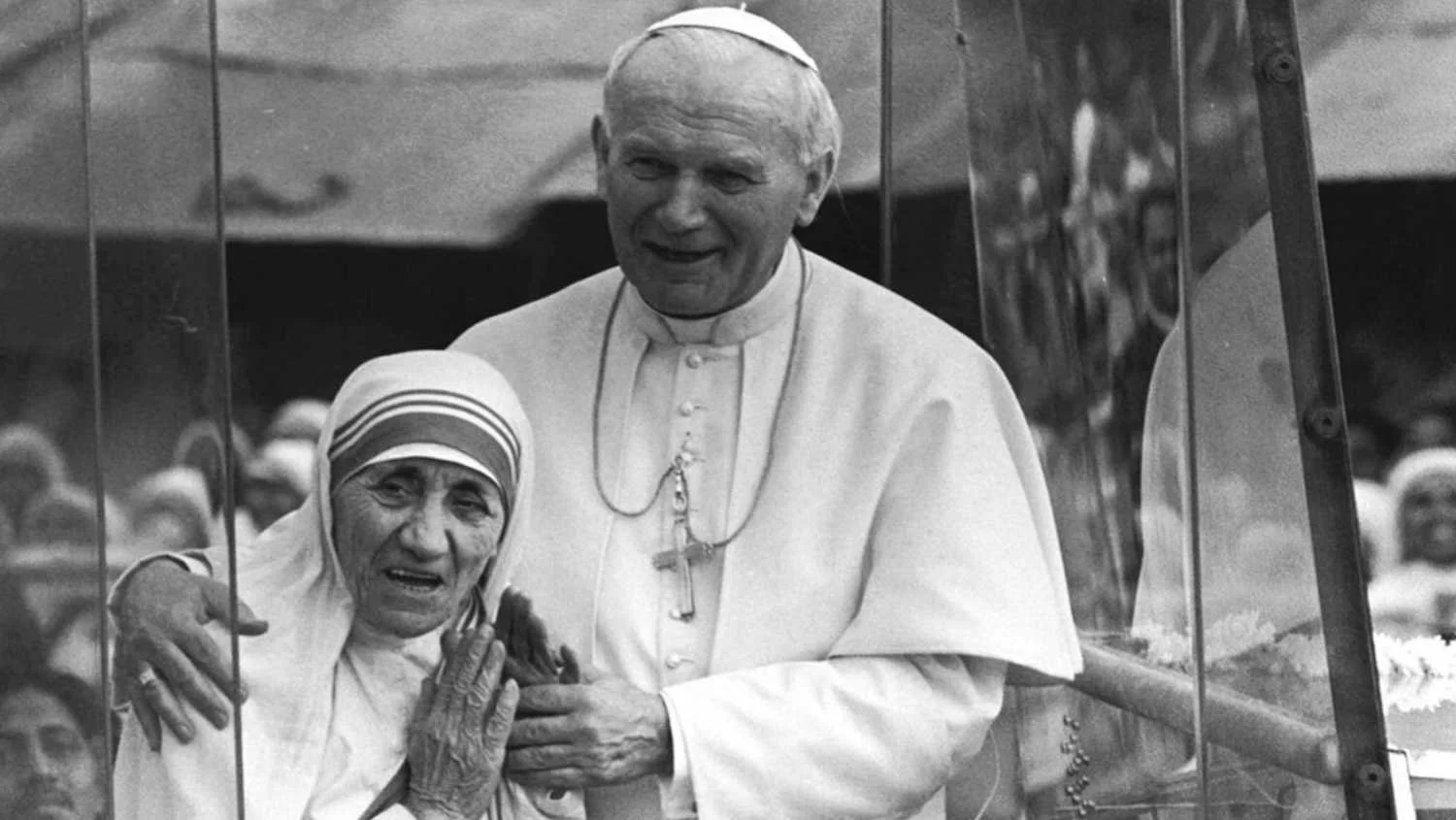
For Mother Teresa of Calcutta, Pentecost Illumined the Night
Discouragement is the deep spiritual valley of our age. For Mother Teresa of Calcutta, the Holy Spirit’s light came only at dawn in a long dark night of the soul.
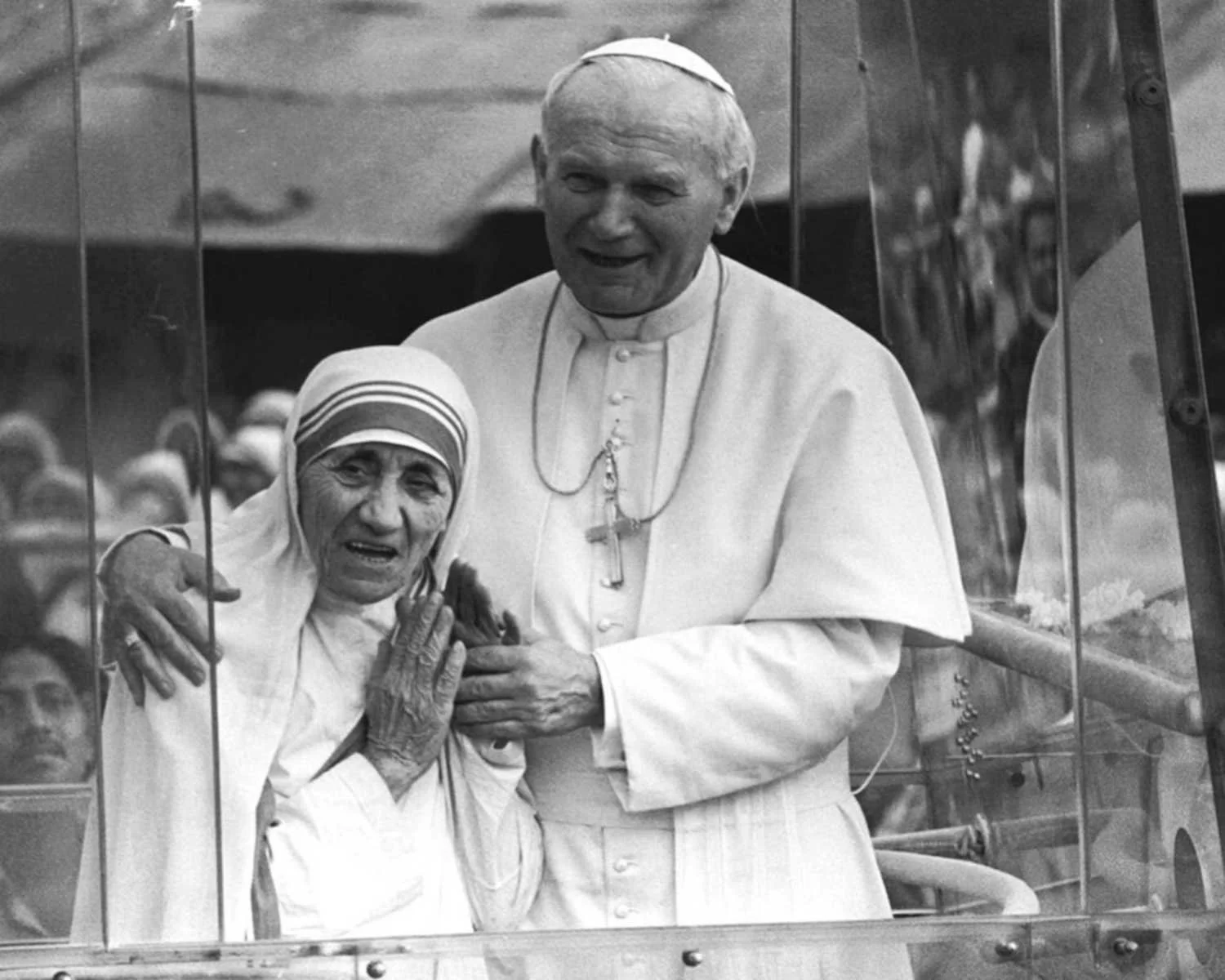
Discouragement is the deep spiritual valley of our age. For Mother Teresa of Calcutta, the Holy Spirit’s light came only at dawn in a long dark night of the soul.
May 13, 2026 by Father Gordon MacRae
I grew up a few miles north of Boston in an area known locally as the North Shore. Well, it is called that in print anyway. In conversation, it comes out something like, “the Noath Shoah.” I never knew that until I moved to another part of the country where people inexplicably pronounce the letter “R.” Anyway, I have lived in so many places since then that I have lost much of my Boston accent, but I can still translate it when I hear it.
There is an old North Shore saying, “Light finally dawns upon Marblehead.” I am not sure of its origin, but it makes logical sense. The seaside town of Marblehead is at the head of a deep harbor north of Boston, so the dawn’s early light is seen there a few seconds later than in other North Shore coastal towns. Its figurative meaning is that some reality that has been eluding us is now finally made clear.
Light finally dawned upon Marblehead today when I set out to write about Pentecost and ended up writing about Saint Mother Teresa of Calcutta. There is a connection that I had to spend some time ferreting out, and that is when the light finally dawned. I learned something important about her, and in the process, about myself.
But first, I know I am going to have a hard time dropping “Mother” from her name. “Saint” Teresa seems incomplete and already taken. So I guess that like Saint Padre Pio, she will be forever endowed with a title that has become a necessary part of her name. I am going to have to call her Saint Mother Teresa of Calcutta, and it has slowly caught on.
She was canonized on September 4, 2016, the eve of the date of her death in 1997. In life the person she was, the spirit she is, was eclipsed by the sorrowful mysteries of the poor to whom she devoted her life. The images of her presence among the poor, the disfigured, the utterly broken and rejected — even the despised — have always been part of the background landscape of my life as a priest, but to be honest I could never bring myself to linger on those scenes. They were just too painful. They always left me with a sense of inadequacy as a priest, afraid to look upon the broken too long lest I feel compelled to follow her lead.
I admired Mother Teresa’s presence at the peripheries of human suffering, but as a priest I admired it from too much of a safe distance. That troubles me today. I had to be compelled in priesthood to carry the cross of the outcast, a cross that brought me unwillingly to the scene of that post-resurrection appearance to Simon Peter in the Gospel of John.
“Truly, truly I say to you, when you were young, you fastened your own belt and walked where you would; but when you are old, you will stretch out your hands, and another will fasten your belt for you and carry you where you do not wish to go.”
— John 21:18
I have experienced those ominous words of John’s Gospel in a literal and terrifying way, but I found companions and some inner peace along the way as well. I wrote of one recently in “A Lesson From Saint Damien of Molokai, Leper Priest.” It was about how disappointment and discouragement have been part of my own dark night of the soul for thirty-two long years, and how Saint Damien of Molokai — whose feast day was observed on May 10 — taught me what my priorities must be in a life among prisoners.
And you know from many posts that I found other companions and mentors in Saint Maximilian Kolbe and Saint Padre Pio who have shown me by example that my life bound over by earthly powers must be lived out at the foot of Cross. In prison, others have joined me there, many others, but I remain in the dark.
Come Be My Light
Now I present this new friend at the foot of the Cross in the life of Mother Teresa of Calcutta, but I had to first shed all my assumptions about her. It is a little intimidating that she was awarded the Nobel Peace Prize in 1979 for her witness to the world’s broken, abandoned and poor. In life Mother Teresa was revered as a living saint. I just assumed that for her to be that person, to do the work that she did, Mother Teresa must have been given a gift of daily awareness of the light of supernatural grace that flowed within her and shined through her. Otherwise, I thought, she would just sink into dark desolation just as I have been known to do with far less in the way of grace to count on.
And when I do sink into that desolation, I sometimes stay for days, weeks, months, at one point in my imprisonment before Beyond These Stone Walls began, even years. And if my mail is any indication, many of you have had that same experience. Please, do not come to Beyond These Stone Walls because misery loves company. It really does not. Come here because together we can manage crosses of discouragement that alone might only elude us and crush our spirits. You cannot just go to Home Depot to buy a weed whacker to wipe out desolation. It is best to have someone show you how to use it.
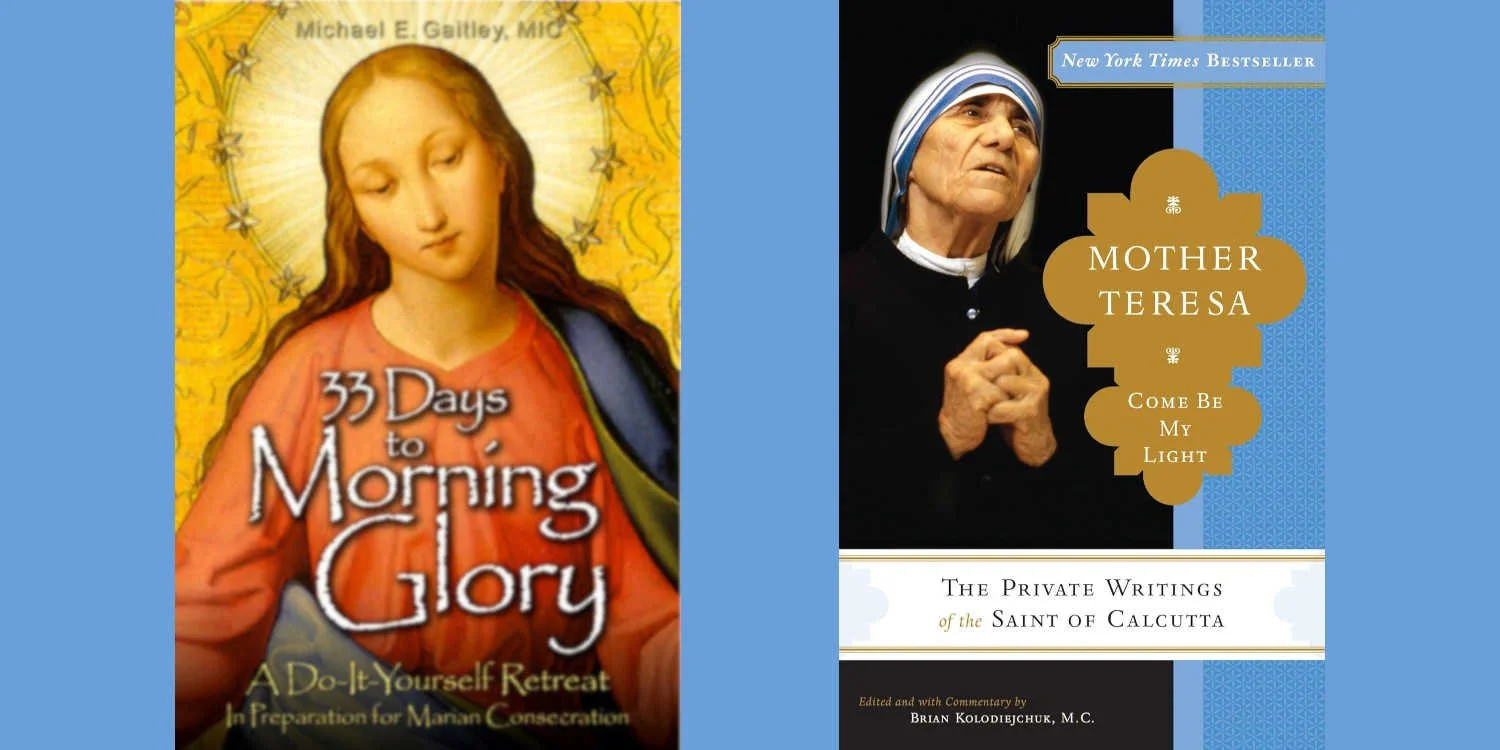
I was wrong about Mother Teresa, about my image of her basking in the reflected glow of the Holy Spirit. About a year after I started writing for this blog, I was given a copy of Mother Teresa’s Come Be My Light (Doubleday 2007) and my presumptions about her life in grace were quickly dispelled.
Some of the shallow secular media made a big deal of this book, presenting it as the latest Catholic scandal that the great Living Saint among us had long bouts of doubt and desolation. But for me she became human again, and an icon not so much of living grace, but of grace hard won through great spiritual struggle. Like Saint Maximilian Kolbe, she became someone I could let in, and learn from.
Centuries of Catholic art tend to depict the saints among us with halos, in a state of ecstatic pose before the True Presence. Mother Teresa’s own writings convey her struggle to survive spiritually in the present absence. In that, I can relate. In that, I find much hope. That sense of absence is something I have taken up in other posts (see “Priesthood in the Real Presence and the Present Absence”).
Through letters to her spiritual director, Come Be My Light is a guided tour of the interior life of this courageous woman whose heart “burned with the fire of charity” while at the same time experienced doubt and spiritual darkness in “a true dark night of the soul.” I began to do what she did, to pray not so much to be free of spiritual desolation, but to be free to serve even in the midst of it. Mother Teresa did that well. I get, at best, a C-minus, but I am still reading the book!
A part of it reminds me so much of something Canadian Catholic writer Michael Brandon wrote some time back in “All Things Turn to Good” at his Freedom Through Truth blog. While writing of the news of the failure of the justice system to pursue justice for me, Michael quoted another Saint Teresa, Saint Teresa of Avila, who once wrote, “God, if this is how You treat Your friends, it’s no wonder that you have so few.” When our friend, Pornchai Moontri, read that quote, it made him laugh. He had been having a hard time with discouragement over my plight, but the quote put it into perspective for him.
Do not read Come Be My Light in one sitting. Keep it on your night stand and read it prayerfully, a letter a day perhaps, or even reserved for moments in your own dark night. It has gotten me through many of my own. She is fast becoming the Patron Saint of “Get-off-your-priestly-arse-and-do-something-for-someone-instead-of-moping-about!”
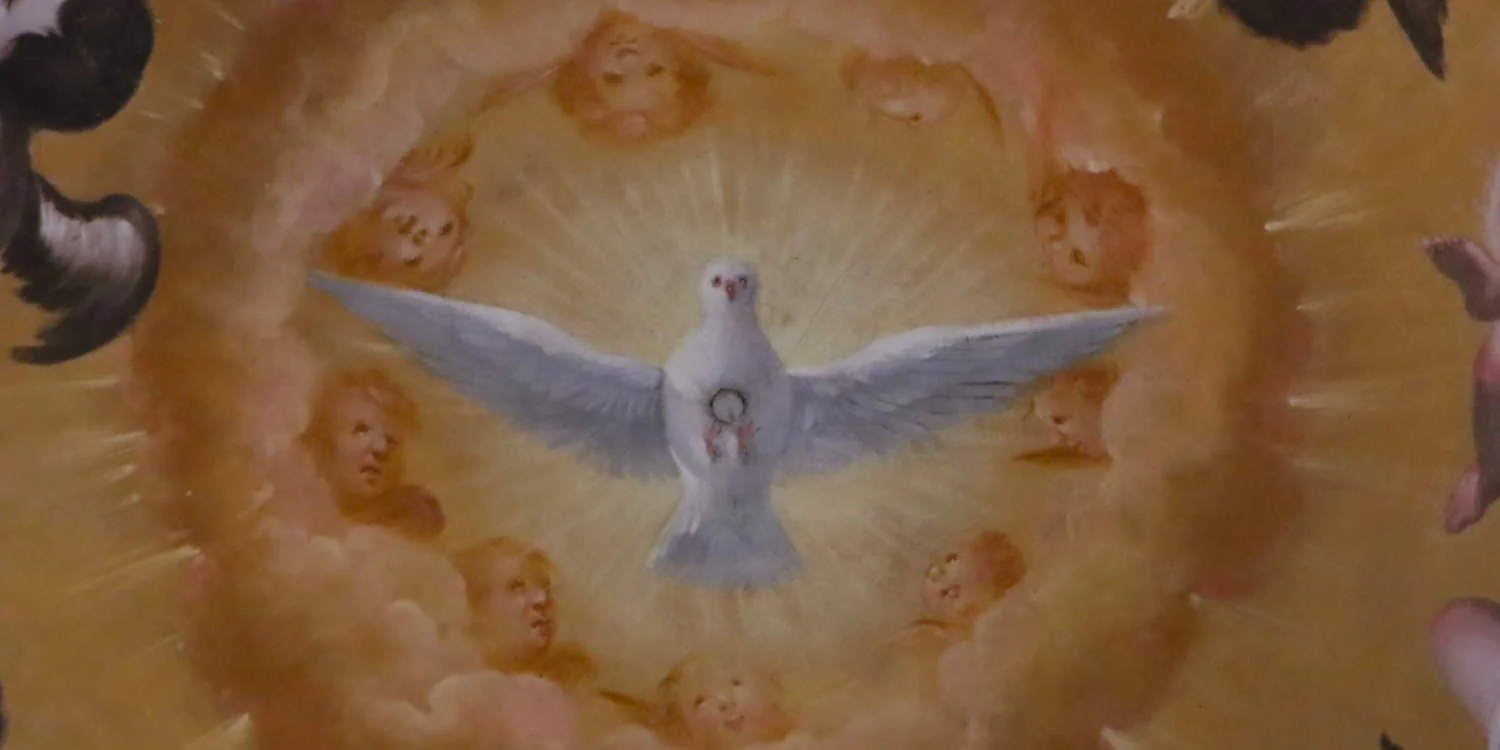
The Advocate
There is a little side story to tell. While composing this post, I had left my copy of Come Be My Light in the prison library where I work, but I had only a Saturday afternoon to finish this post and get it into the mail. The library is closed on weekends so I had no way to retrieve the book. On Saturday morning, I remembered that Father Michael Gaitley had an entire section about the Marian consecration of Mother Teresa in his book, 33 Days to Morning Glory.
But I had left that book in the library as well! When I mentioned that to Pornchai, who was still here with me then, he said, “Well, there’s at least ten of them right here in this unit.” Then it struck me. How is it even possible that out of sixty prisoners in this one prison cell block, ten of them have completed 33 Days to Morning Glory and entered into Marian Consecration? That is one out of every six prisoners in our field of view. So all I had to do was walk to the cell next to mine and borrow the book. Duh!
When I did, I opened to the Table of Contents and was instantly reminded that three of my favorite saints comprise weeks two, three, and four of Father Gaitley’s 33 Days to Morning Glory, retreat. They are Saints Maximilian Kolbe, Mother Teresa, and John Paul II, and all are saints of the Twentieth Century.
I thought I had read this book cover to cover, but while looking at the Table of Contents to find the section on Mother Teresa, I unconsciously thumbed back two pages, and stopped on a name that jumped off the page at me. It was a short review of 33 Days by Father James McCurry, formerly Minister Provincial of the Conventual Franciscans, the order to which Saint Maximilian Kolbe belonged and the Vice Postulator for his cause for sainthood. How could I not have seen this before?
Many years ago, Father James McCurry came to visit me in prison. I had never previously met him, and today I cannot really explain what brought him here except a vague memory that he was passing through and heard of me through a friend of a friend. In the prison visiting room, Father McCurry asked, “What do you know of Saint Maximilian Kolbe?” It was a question that would change my life, and then change the life of Pornchai Moontri, and then others as well. I wrote of this first encounter with a Patron Saint in “The Parable of a Priest and the Parable of a Prisoner.”
So in searching for a section on Mother Teresa, she pointed me back to an old friend. The interconnections between everyone in this story are mind-boggling. Father McCurry wrote that the essence of Marian consecration is …
“St. Maximilian Kolbe’s mystical intuition about the interior life of Mary and the Holy Spirit in the life of a consecrant; Blessed Mother Teresa’s experience of Mary drawing us into her heart, where Jesus keeps repeating, ‘I thirst’; and St. John Paul’s understanding that consecration to Mary brings us to the source of merciful love — the Divine Mercy poised to transform the world.”
That is when the light finally dawned upon Marblehead! I realized that the world I am thrown into is in fact being transformed in spite of my protests about being here in the first place. Some around me — the poor, the outcasts, the discarded, the lepers, the criminals — are being transformed. How could it possibly have happened that one out of every six of these men around me in prison now lives a life consecrated to Jesus through Mary? How is it that the saints whose intercession I keep pursuing are already engaged in a work that has eluded me? Then I read in the Gospel:
“I have told you this while I am with you. The Advocate, the Holy Spirit, whom the Father will send in my name, will teach you everything and remind you of all that I told you. Peace I leave with you; my peace I give you. Not as the world gives do I give it to you. Do not let your hearts be troubled or afraid.”
— John 14:25-28
This brings to light what Saint Mother Teresa of Calcutta learned in the dark. The Holy Spirit was her Advocate not in any obvious glory, but in desolation, and it was from there on the very edges of suffering humanity that she led countless souls to Christ, and witnessed to the world that the Lord hears the cry of the poor.
“It is beautiful to see the humility of Christ. This humility can be seen in the crib, in the exile in Egypt, in the hidden life, in the inability to make people understand him, in the desertion of his apostles, in the hatred of the Jews, and all the terrible suffering and death of his passion, and now in his permanent state of humility in the tabernacle, where he has rendered himself to such a small particle of bread that the priest can hold him with two fingers.”
— Mother Teresa of Calcutta
+ + +
Note from Father Gordon MacRae: We could extend the same invitation to Saint Mother Teresa that she extended to the Holy Spirit: Come Be My Light.
Thank you for reading and sharing this post about a great saint of our age. You may also like these related posts at Beyond These Stone Walls:
Lesson From Saint Damien of Molokai, Leper Priest
The Parable of a Priest and the Parable of a Prisoner

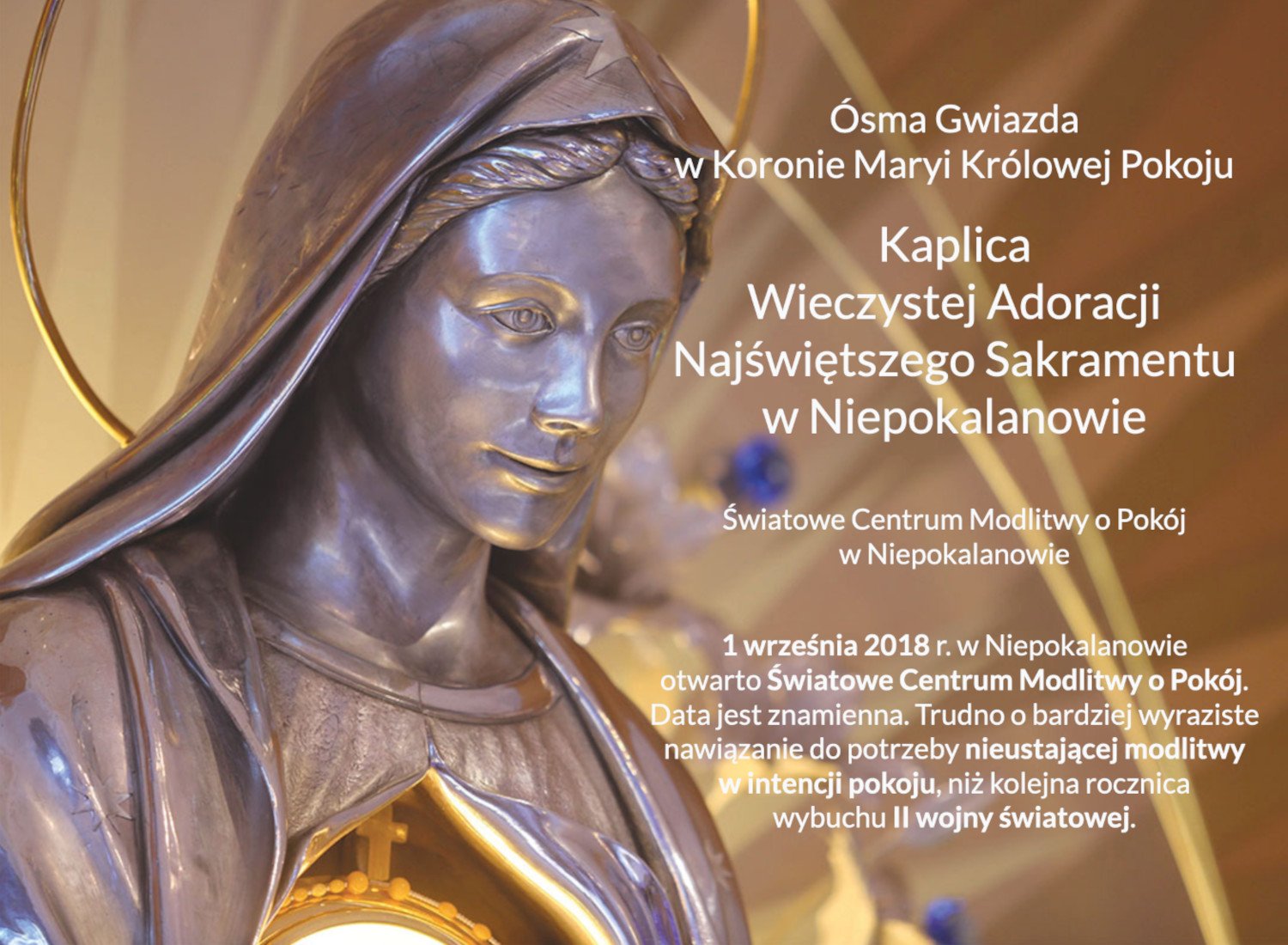

The Eucharistic Adoration Chapel established by Saint Maximilian Kolbe was inaugurated at the outbreak of World War II. It was restored as a Chapel of Adoration in September, 2018, the commemoration of the date that the war began. It is now part of the World Center of Prayer for Peace. The live internet feed of the Adoration Chapel at Niepokalanow — sponsored by EWTN — was established just a few weeks before we discovered it and began to include in at Beyond These Stone Walls. Click “Watch on YouTube” in the lower left corner to see how many people around the world are present there with you. The number appears below the symbol for EWTN.
Click or tap here to proceed to the Adoration Chapel.
The following is a translation from the Polish in the image above: “Eighth Star in the Crown of Mary Queen of Peace” “Chapel of Perpetual Adoration of the Blessed Sacrament at Niepokalanow. World Center of Prayer for Peace.” “On September 1, 2018, the World Center of Prayer for Peace in Niepokalanow was opened. It would be difficult to find a more expressive reference to the need for constant prayer for peace than the anniversary of the outbreak of World War II.”
For the Catholic theology behind this image, visit my post, “The Ark of the Covenant and the Mother of God.”

Priesthood in the Real Presence and the Present Absence
A new Manual for Eucharistic Adoration from the Poor Clares and Saint Benedict Press has found a captive audience in Fr Gordon MacRae as he marks 34 years of priesthood.

A new Manual for Eucharistic Adoration from the Poor Clares and Saint Benedict Press has found a captive audience in Fr Gordon MacRae as he marks 34 years of priesthood.
June 1, 2016 by Fr. Gordon MacRae
“You have GOT to be joking!” That was my first reaction. In early April this year, I was summoned to a prison office to sign for “personal property.” I had no idea what it could be. I hadn’t ordered anything recently from the place where we in prison must purchase shoes, clothing, toiletries. So it had to be a book, but receiving books here also requires that I know in advance that the book is coming. I knew of nothing.
I signed for the mysterious item and returned to my cell where I sat down on a concrete stump — the same one I am typing upon at this moment. “You have GOT to be joking’” I said to myself as I perused the book in my hand and its cover letter. It was from Christian Tappe, Director of Marketing at Saint Benedict Press in Charlotte, North Carolina. The letter began:
“I am pleased to enclose this review copy of TAN Books’ Manual for Eucharistic Adoration… written by the Poor Clares of Perpetual Adoration. If you would like more information, or to schedule an interview…”
I was more bewildered than ever. It was the fourth time in the last year that a Catholic publisher has sent me a book to review on These Stone Walls. Are people actually reading TSW? But this particular book was a complete mystery. First off, I should not have received it at all. The shipment and cover letter were addressed to “Father” Gordon MacRae with no prison number (67546) as required on anything sent to me. In the ordinary course, either the use of a title or the absence of a number would cause the book to be rejected and returned to sender without my even knowing about it. But here it was, in my hand nonetheless.
My first impulse was to toss the book aside as useless, at least for me. My apologies to the Poor Clares who so lovingly wrote it, and to the publisher who so kindly sent it to me. I am a slow learner, so the nicely adorned book sat unopened in a corner of my cell for a month. I was simply too caught up in the glaring irony of it. There is no True Presence here to adore. There is only the present absence.
To make matters worse, and more mysterious, on the same day I received the Manual for Eucharistic Adoration I learned from lawyers that we had lost yet another effort at appeal of my wrongful conviction and imprisonment. It took one full year for the First Circuit Court of Appeals to notify us that they will not review an earlier decision to dismiss my appeal with no hearing on its merits or evidence. This has made the road to justice ever steeper and more treacherous. I am told that others will be taking this up to write about it.

In the Nighttime
So it was in the dim and murky light of continued injustice that I tossed aside the good sisters’ book about Eucharistic Adoration, and shrugged it off. But appearances can be deceiving, and you never know what apparently “useless” thing might have a profound influence on your view of the world — not only the world you live in, but the world that lives in you. Who you are is in large part a collision of these two worlds, and a person of faith risks great loss if the interior life is forfeited to live only in that other, more calamitous world. We have to live in and with both worlds, and we have to keep them in balance.
One day recently, I saw a vocation ad in Our Sunday Visitor for a community of sisters. The ad described them as a “monastic, cloistered and contemplative community,” and then added, “Find us on Facebook!” That, to me, seemed a collision of two worlds, but it works if the sisters can reflect in the latter world the light that shines in the former.
On June 5th I mark thirty-four years of priesthood. Twenty-two of them have been in a place where presence before the Blessed Sacrament is unavailable and simply impossible. It can only be imagined. It has been a long time since I wrote of the power of the True Presence in a place where it seems absent. In 2010 I wrote a post entitled “The Sacrifice of the Mass” (Part I and Part II), and it seemed a pivotal point not only for These Stone Walls, but for my life as a priest in extraordinary circumstances.
The two-part post described the utter deprivation of something many readers simply took for granted in their world. For my first seven years in this prison, Mass was unavailable to me, and without it I found myself growing ever more distant from my life as a priest. That post described the extreme efforts it took to gain the ability to offer Mass, beginning with what I today call a “spiritual offering.”
It wasn’t what you might think. It was along the lines of a “Spiritual Communion,” and I got the idea from reading Father Walter Ciszek’s book, He Leadeth Me. During twenty years in a Siberian prison accused of being a Vatican spy, Father Ciszek could only imagine the Mass. Sitting in the pitch dark at night on his bunk, he began to recite The Roman Canon in his mind, and to imagine himself present before the Blessed Sacrament. After reading this, I began to do the same, and my post, “The Sacrifice of the Mass” evolved from that. After I wrote that two-part post, a TSW reader sent me a letter, an excerpt of which follows:
“I cannot imagine what sustains your identity as a priest in that prison. There is nothing in that environment that in any way supports your priesthood. You are not ever in the company of other priests. Your diocese and fellow priests have cast you off. You see yourself each day in the mirror wearing the uniform of a prisoner, and you know in your mind, heart and soul that there has been no justice in your being forced to wear this role.
“And yet when I read your writings, your priesthood is always at the forefront, the part of you that shines the brightest, that speaks the loudest, that sustains not only you but apparently many of those around you in that place. Can you explain, Father MacRae, what exactly allows you to retain a priestly identity?”

Come Be My Light
I do not have an answer for this. After I wrote my recent post, “Mother Teresa of Calcutta: Pentecost Illumines the Night,” some readers wrote in comments that they are moved by my faith. It is not so obvious. At least, it is not obvious to me. I struggle with faith on a daily basis, and I found a kindred spirit in Saint Mother Teresa when I learned that she struggled as well. The truth is that it was the Poor Clares’ Manual of Eucharistic Adoration that caused me to look more deeply into the faith life of soon-to-be Saint Mother Teresa. The Manual includes an admonition from her, and it was this quote that prompted me to write “Mother Teresa of Calcutta: Pentecost Illumines the Night.”
“The time you spend with Jesus in the Blessed Sacrament is the best time you will spend on earth. Each moment that you spend with Jesus will deepen your union with Him and make your soul everlastingly more glorious and beautiful in heaven, and will help bring about everlasting peace on earth.”
Manual, p. 111
It was from writing that post that I fathomed the necessity of Eucharistic Adoration. It is not for us to be present to Him. It is for Him to be present to us in a way that “will deepen your union with Him.” That is the very purpose of the interior life, that other world that we must balance with our other foot in this world.
While writing my Pentecost post, I learned of the spiritual deprivation often experienced by Mother Teresa, but that deprivation never seemed able to diminish her commitment to serve the poor. Rather, the opposite happened. It was her service to the poor that brought her to the Paschal Mystery and kept her there, ever providing the beckoning of Christ that compelled her spiritual life. Mother Teresa sought union with Christ in the Blessed Sacrament, and brought Christ from there to the poor. It was never the other way around.

Eucharistic Adoration
So how could I, as a priest wrongly imprisoned for decades, possibly bring my interior life into this world where the True Presence is so overshadowed by the present absence? No matter what the source of the sense of emptiness is in your life, if you are reading this you know what I mean by “the present absence.” That is why God allowed Mother Teresa and others among our patron saints to suffer spiritual deprivation, and to endure it. It was so that we might emulate them as they serve as beacons in spiritual darkness. Their witness inspires hope in the dark, not just our rescue from it.
As has happened on so many nights in prison, I awoke one night recently, filled with an anxiety that has no name. It’s not related to anything I can identify. It’s just there, a natural side effect of the stifling nature of an American prison. I have a little battery-powered book light purchased from the same prison vendor from which we purchase clothing and other needs. Waking often in the night, I have gotten hundreds of times my money’s worth from that small light.
I switched on the light in that anxious night, and reached for my glasses and a book on a small shelf at the end of my iron bunk. I thought I had grabbed another book, but my hand landed on the previously untouched Manual for Eucharistic Adoration by the Poor Clares. It has a ribbon page marker so I opened to the ribbon and was struck by this admonition from Saint John Vianney, the Curé of Ars and the patron saint of priests:
“When you awake in the night, transport yourself quickly in spirit before the tabernacle, saying, ‘Behold, my God, I come to adore you, to praise, thank, and love you, and to keep you company with the angels.’”
Manual, p. 116
So that night I tried to imagine a time and a place in which being before the Blessed Sacrament was most meaningful to me. Sadly, it was long ago. It wasn’t during my years as a parish priest when time and again I passed by the sanctuary and tabernacle barely noticing, blindly going from one pastoral task to another, not even genuflecting, not even knowing that I failed to bring Christ with me because I failed to stop and enter into His Presence. At some point in my life as a priest, this world collided with that one, and demolished it. This has been the real priesthood scandal. Action somehow overshadowed contemplation to our priestly peril.
It was only years later, after year upon year of absence, that I became aware of this deprivation of the Presence of God. So in that night of prison anxiety my mind fled down the nights and down the days, past the parishes where I served, and the seminary I attended, to a Benedictine Abbey just twenty miles from this prison. The journey in my mind took me to 1977. I was a Capuchin then, attending school at Saint Anselm College, and my most special place on campus was a tiny alcove built into the Abbey Church.
There, before a magnificent granite tabernacle, I spent many hours in the Presence of the Lord. Last year, a reader found a photograph of the interior of the Saint Anselm Abbey Church and printed it for me. It is the opening graphic for this post. Then our Missionary of Mercy Friend, Father George David Byers, found a photo of the Blessed Sacrament alcove to the right of the main sanctuary. This is where I went back then, before the world shook lose the Holy Longing to be in His Presence. This is where I go now when I awaken in the night. Sometimes, now, I don’t think I awaken with anxiety and then go there. I think I now awaken just to go there.
In just a few months, These Stone Walls will mark seven years in publication, just one third the time that I have been in this prison. During that seven years, many readers have sent me letters and comments informing me that they have devoted an hour before the Blessed Sacrament to be in His Presence in my stead. You have bestowed upon me a most priceless gift, and for this I have much gratitude.
Now the Poor Clares of Perpetual Adoration, along with author Paul Thigpen and Saint Benedict Press, have provided a road map to the interior life, and a tool to converse with the Living Christ among us. I most highly recommend the Manual for Eucharistic Adoration and, if you are not there already, the restoration of the Lord’s Presence in your interior life.
I humbly thank you for thirty-four years of priesthood, even out here on the dark peripheries from which I write. Without you, I might have forgotten how to be a priest, and might today be just a prisoner. There are two kneelers before the Blessed Sacrament at Saint Anselm Abbey Church in Manchester, New Hampshire. Some night when anxiety awakens you in the dark, join me there. I’ll have the Manual for Eucharistic Adoration in my hands.