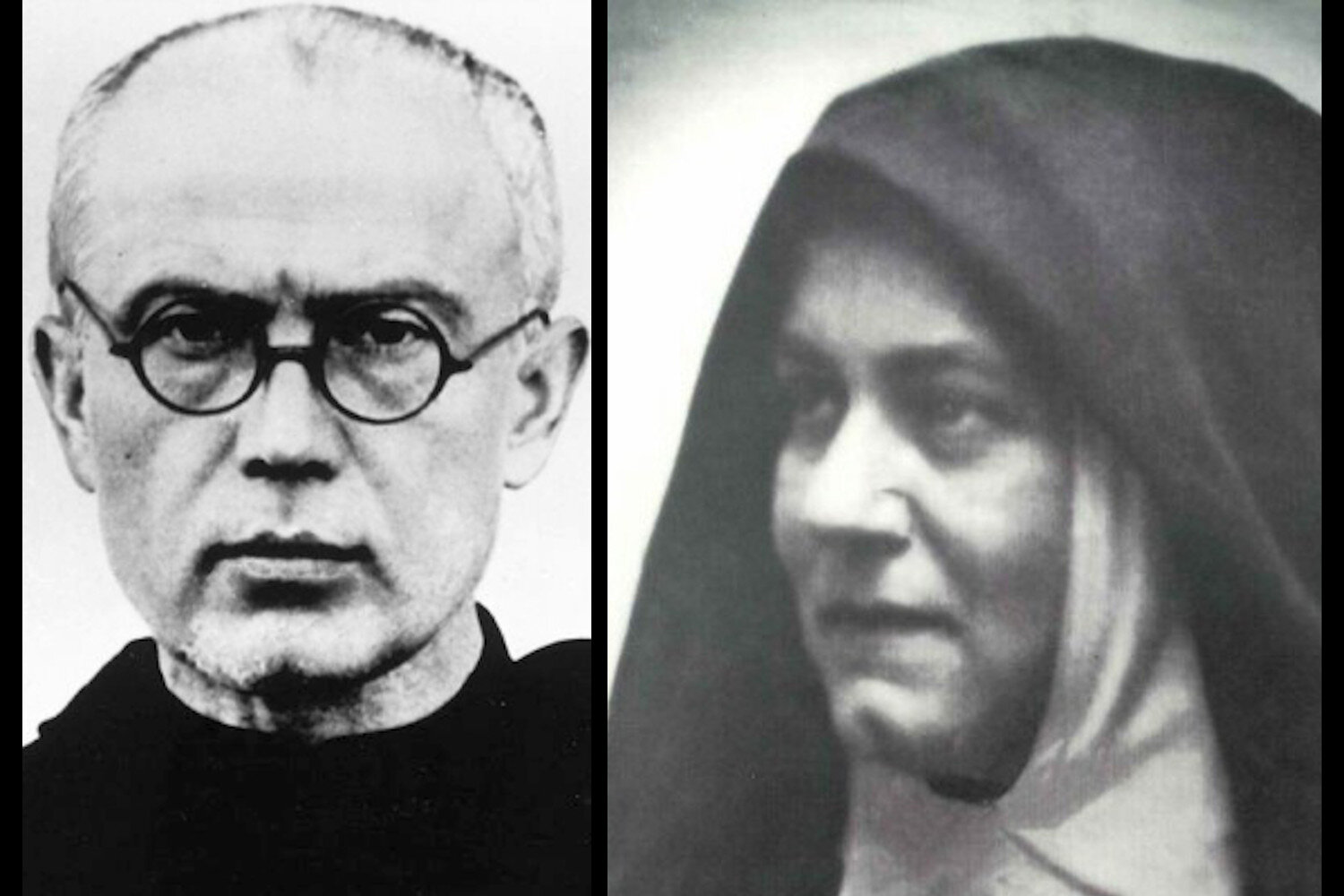
“There are few authentic prophetic voices among us, guiding truth-seekers along the right path. Among them is Fr. Gordon MacRae, a mighty voice in the prison tradition of John the Baptist, Maximilian Kolbe, Alfred Delp, SJ, and Dietrich Bonhoeffer.”
— Deacon David Jones
The Higgs Boson God Particle: All Things Visible and Invisible
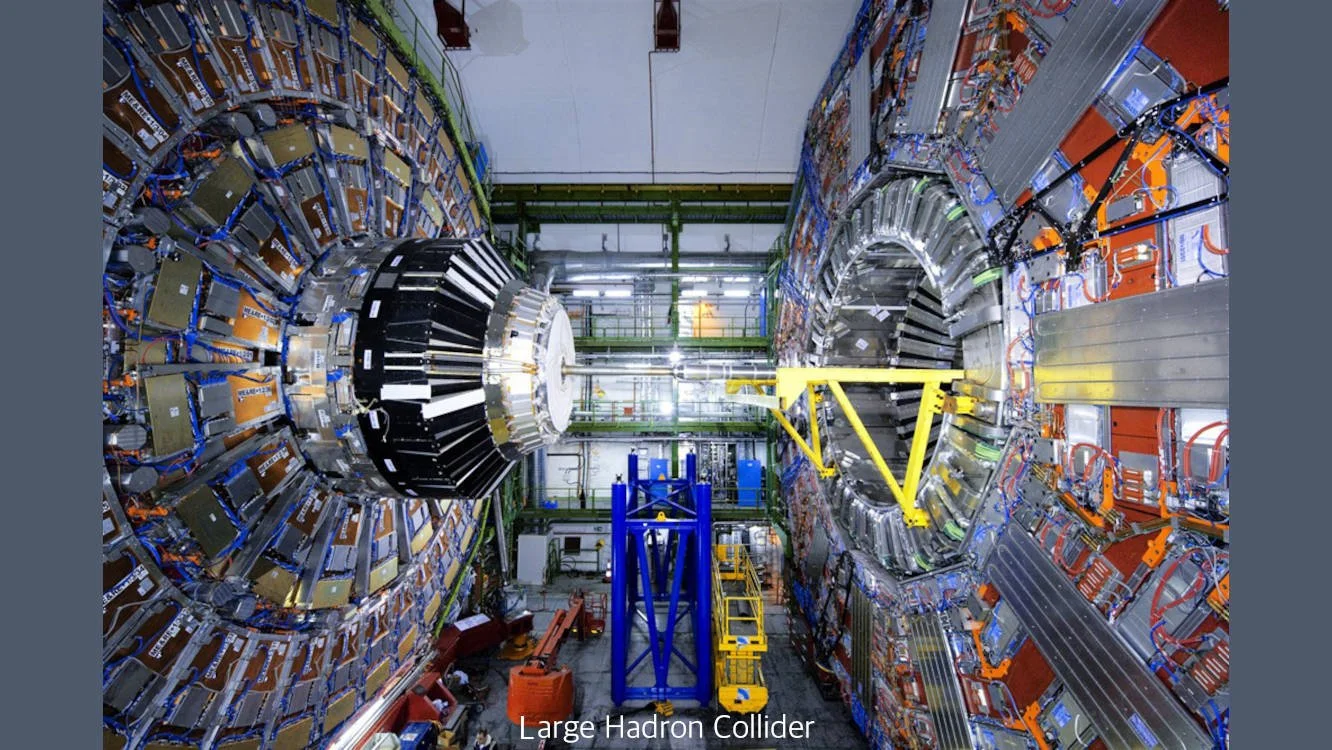
In 2012, scientists at the Large Hadron Collider detected the elusive Higgs boson, a subatomic particle dubbed the “God Particle” explaining the origin of matter.
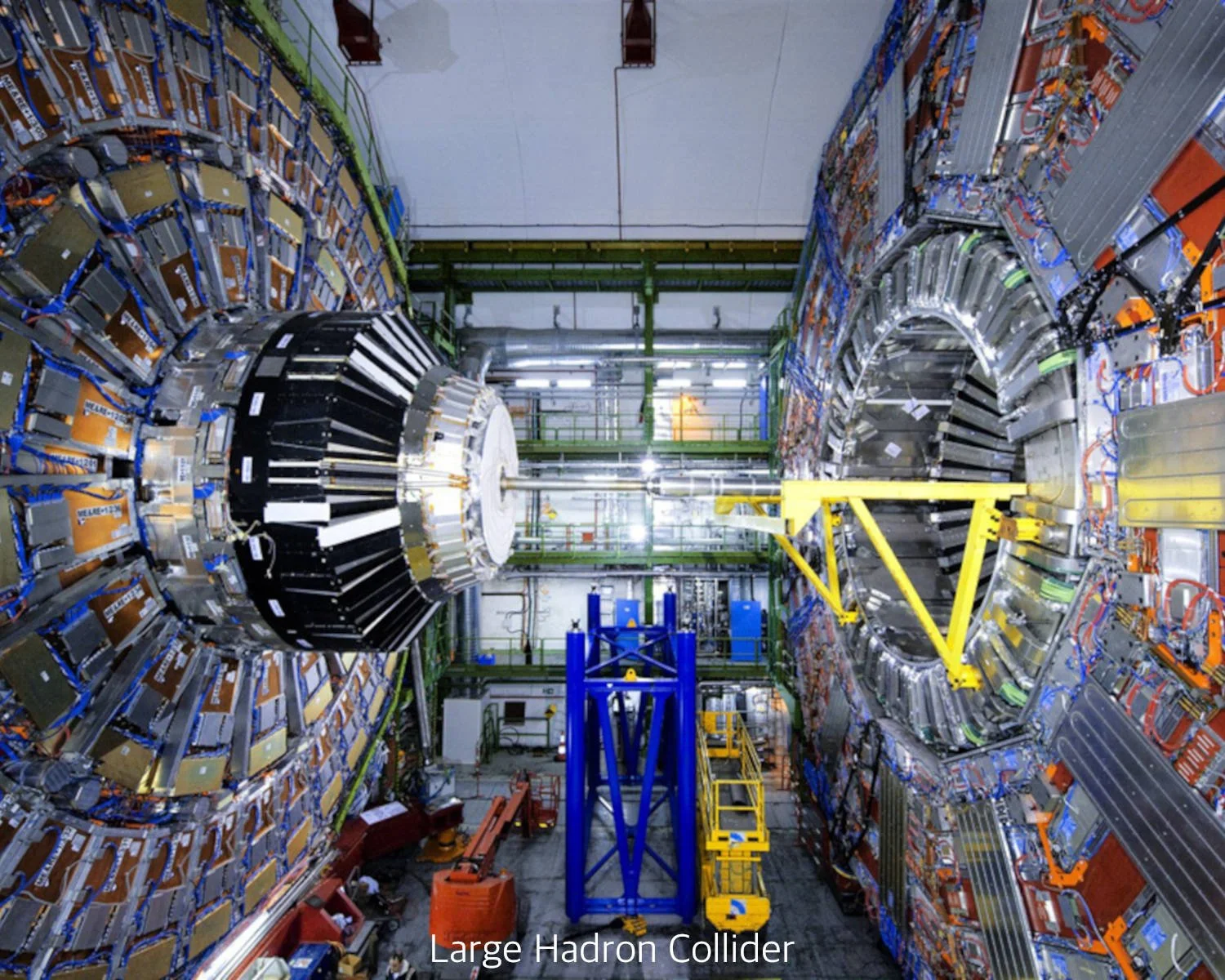
In 2012, scientists at the Large Hadron Collider detected the elusive Higgs boson, a subatomic particle dubbed the “God Particle” explaining the origin of matter.
February 4, 2026 by Father Gordon MacRae
“Two Higgs boson particles walked into a bar. Over drinks one said, ‘I hear Stephen Hawking bet $100 that we don’t exist. What if he’s right?’ The other replied, ‘No matter!’ ”
Get it? No matter? Get it? Well, hopefully you will in a few minutes. I didn’t get it either until I did some heavy-duty reading.
If this post is creating a touch of déjà vu, a sense that you have seen it before, it’s because you probably have. Something quite unusual happened here at this blog in recent weeks. In the earliest days of this blog in 2010, I was contacted by a reader in Australia about a new book by physicists Stephen Hawking and Leonard Mlodinow entitled The Grand Design (Bantam Books, 2010). The letter writer was concerned that media outlets in Australia and around the world were citing aspects of the book out of context in an attempt to demonstrate that Stephen Hawking declared that God does not exist. That was a faulty interpretation and the reader wanted me to set the record straight. It was a tall order, but I had time on my side to ponder and present a contrary point of view. So on October 6, 2010, we published “Did Stephen Hawking Sacrifice God on the Altar of Science?”
A lot of work went into that post, but to my chagrin it was met by most of our readers with a yawn the size of a giant black hole. Fifteen years later, someone (not me) submitted that post to an advanced artificial intelligence model requesting an analysis of it. The results were then read to me by our Editor. AI scoured the Internet and then referred to me as “a Catholic priest with a background in science” while singling out that post as “a significant example of bridging the gap between science and faith.”
So of course, I thought that was the nicest thing any AI had ever said about me (There was very little to compare it to.). Given this new interest in a bridge between science and faith, I decided to haul out this 15-year-old post and rehabilitate it for a new audience. On July 30, 2025, we republished “Did Stephen Hawking Sacrifice God on the Altar of Science?” The result was mind boggling, but it was not immediate. A few months later that post started showing up in our stats and then it began a viral spread. By January it was outpacing my regular weekly posts in popularity. And then by mid-January it spread all over the world in unprecedented numbers for this blog.
I cannot pretend to know why this happened. I do not understand the global attention to this one post on the space-time continuum. Perhaps my only conclusion is that when I post a bomb, just wait 15 years and post it again.
The Discovery
There is another post of mine that also bridges the gap between science and faith. I do not have an explanation for why or how, but another of my posts, this one from 2012, also began to show up in unusually large numbers with that other post. I have long wanted to repost this one with some updated information so that those who are currently reading and spreading it can see the updated version. It is “The Higgs Boson God Particle: All Things Visible and Invisible.”
I first wrote it in September 2012. It, too, was met with a rather extended yawn, but today it shows up often and everywhere. It profiles the work of the late physicist Peter Higgs who rose to prominence in the scientific community in 1964 when he theorized that the Higgs boson exists as a necessary subatomic particle which explains the existence of matter. After my post was first published, the Higgs boson was experimentally demonstrated again and Peter Higgs was awarded the Nobel Prize in Physics. He died on April 8, 2024 at the age of 94 knowing that his life’s work was a major addition to the scientific understanding of the Universe.
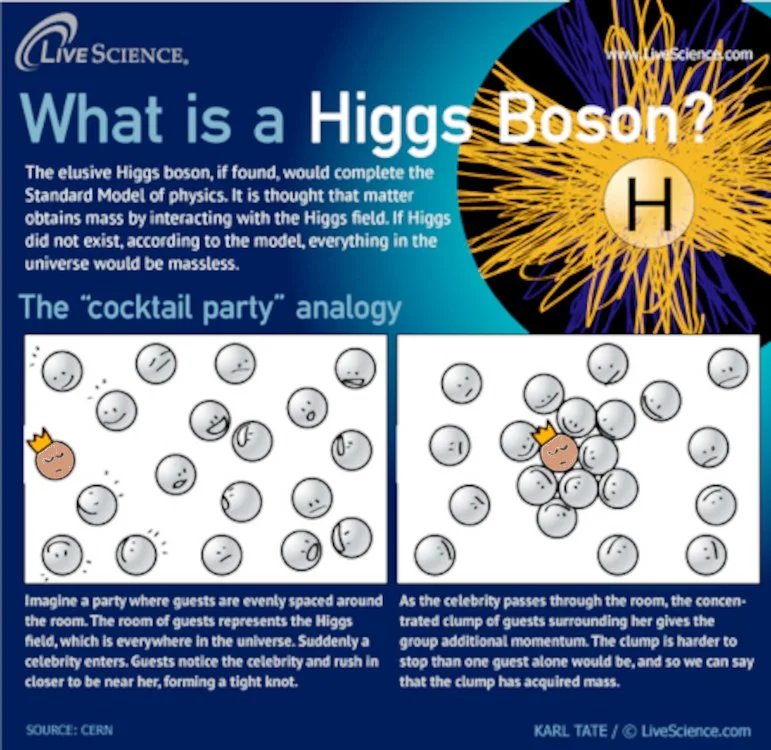
A boson in physics is a component of subatomic particles such as protons and photons, which exist in every atom of matter. As a class of particle, a boson is so-called in honor of Indian physicist, Satyenda Nath Bose, who collaborated with Albert Einstein. The existence of a then-theoretical Higgs boson resolved a puzzle in the Standard Model of physics, a widely accepted model for how particles interact. The thinking in the Standard Model was that particles such as photons — particles of light — have no mass. They should move throughout the Universe unhindered. The mathematics of the Standard Model explained successfully the existence of particles, but not mass or matter. The Higgs boson proposed by Peter Higgs in 1964 was an explanation for how particles could attain mass, and thus bring into being a Universe filled with matter that we can see or otherwise detect.
CERN, the European agency for nuclear research, operates and oversees the Large Hadron Collider. It is a donut-shaped laboratory 27-miles in circumference on the French-Swiss border. Two beams of protons were set on a collision course moving at close to the speed of light. Their collision resulted in an explosion that recreated the conditions of The Big Bang, the scientifically accepted origin of our Universe. During the collision, a supercomputer detected the presence of the Higgs boson particle and a Higgs field for a trillionth of a second. It was the first time its existence had ever been established in a laboratory
On July fourth in 2012, physicists announced that they had a momentary glimpse of the elusive Higgs boson, the subatomic particle long theorized to exist, and without which matter itself would not exist. The physicists who reported that they only found “evidence” of the Higgs boson were just being careful scientists. The discovery had a 99.9999% rate of certainty. There is no doubt left. The Higgs boson does indeed exist and that experiment has since been ratified.
So what exactly does this mean? Many scientists grimaced every time someone in the news media referred to this discovery as “the God particle.” Using science out of context to debunk religious faith is a favorite pastime of some in the media, but the reverse should also not happen.
I took a hard look at the interaction between faith and science in “Did Stephen Hawking Sacrifice God on the Altar of Science?” After publication of The Grand Design, some in the news media speculated that Hawking’s book demonstrated that gravity — and not God — is responsible for the creation of the Universe. My conclusion was simply that Stephen Hawking has thrown in with the wrong “G,” and the pundits misreading his book have confused the tools of God with God. I cited in that post a vivid example. If you were an archeologist digging in ruins in Florence, Italy and you discovered a worn chisel that was used by Michelangelo to create the Pietà, one of the most celebrated examples of sculptured marble in art history, would you then conclude that Michelangelo did not create the Pietà, his chisel did?
What I find most interesting about the recent discovery is that the Higgs boson appears nowhere in Stephen Hawking’s The Grand Design. His analysis of the science of cosmology omitted it entirely. In fact, two decades ago Stephen Hawking wagered $100 that the Higgs boson would never be detected. He lost the bet.
The discovery of the Higgs boson is a big deal in science because it presents a purely scientific explanation for how matter exists, but not why. The model for creation it implies is that a primordial atom exploded in what we call The Big Bang 13.7 billion years ago. As the explosion cooled, a force known as a “Higgs field” — which contained the Higgs boson — was formed and permeates the Universe. As other particles interacted with this field, they acquired mass allowing gravity to bring particles together. It acted sort of like a dam slowing particles so that they would mass together. The result was matter as we know and see it — everything from stars to us. It’s sort of the yeast with which God bakes bread.
A Day Without Yesterday
The Higgs boson was detected by the Large Hadron Collider’s super computers in July 2012 for a fraction of a trillionth of a second. The tiny collision sent particles in every direction producing the energy equivalent to 14 trillion electron volts and blistering temperatures. The collision recreated a tiny model of the instance of The Big Bang. Some theorize that it was the presence of the Higgs boson particle within the primordial atom that caused The Big Bang itself, and the explosion of all matter in the Universe.
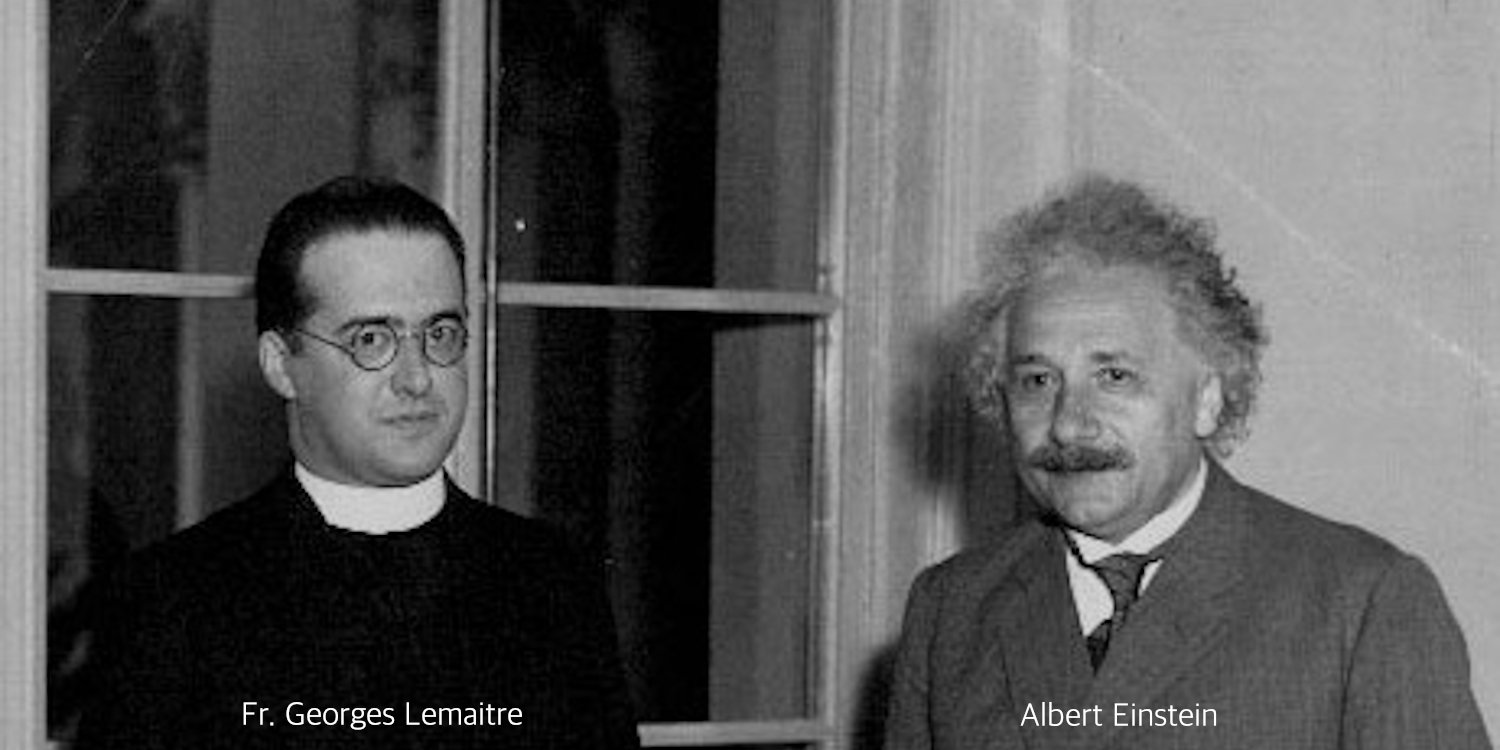
I find this all fascinating, but what is most fascinating is that the entire model was first mathematically predicted, and then demonstrated to even Albert Einstein’s satisfaction, by a Catholic priest. I wrote of the Belgian priest and physicist, Father Georges Lemaitre, in “A Day Without Yesterday:” Father Georges Lemaitre and the Big Bang. As a result of that post and others related to it, I began a correspondence with Father Andrew Pinsent, who prior to priesthood had been a physicist at CERN. We collaborated on a very special post, “Fr Georges Lemaître, the Priest Who Discovered the Big Bang.”
If ever you bristle about the typical anti-Catholic mythology that religion attempts to hold back science, remember that the originator of all the science behind this model of creation was a Catholic priest, and many of the great scientists of his time did everything they could to suppress his ideas. They failed because they could not successfully refute either his faith or his science. In the end, even Einstein bowed to Father Lemaitre, declaring that his model was “the most satisfactory explanation of creation I have ever heard.”
Pope Pius XII applauded Father Lemaitre’s discovery of The Big Bang because it challenged the acceptable science of the time which claimed that the Universe was not created, but always existed and is eternal. Einstein later acknowledged that his “Cosmological Constant” was his greatest error.
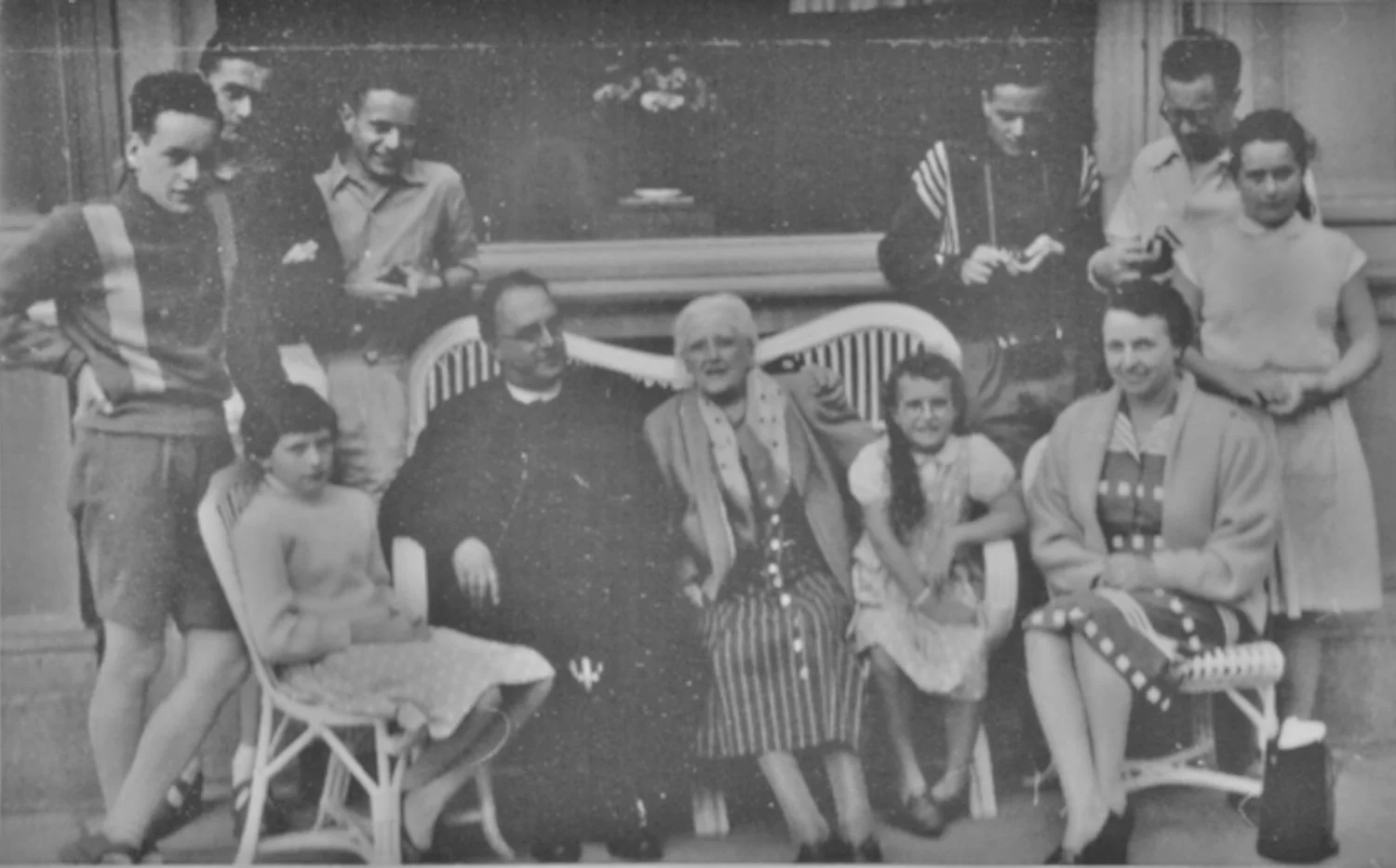
Perhaps the greatest miracle of all for me was receiving the photo below of Pornchai Moontri’s Godfather, the late Pierre Matthews, whose mother was a close friend of Father Lemaitre, who became Pierre’s Godfather. The odds that my roommate in Concord, New Hampshire would turn out to be the Godson of a man whose own Godfather discovered the Big Bang are as great as the odds of the Big Bang itself.
Michio Kaku, a professor of theoretical physics at City University of New York, wrote a brilliant and (unlike this post) brief commentary about the Higgs boson for The Wall Street Journal (“The Spark That Caused the Big Bang,” July 6, 2012). Professor Kaku wrote:
“The press has dubbed the Higgs boson the ‘God particle,’ a nickname that makes many physicists cringe. But there is some logic to it. According to the Bible, God set the Universe in motion as He proclaimed ‘Let there be light.’”
“So why did the Higgs boson particles hurry to church?
Because Mass could not start without them.”
+ + +
Note from Fr. Gordon MacRae: For open minds and enlightened souls bridges are taking shape between the realms of science and faith. You may also like these related posts from Beyond These Stone Walls:
Did Stephen Hawking Sacrifice God on the Altar of Science?
Fr Georges Lemaître, the Priest Who Discovered the Big Bang (a must-read by Father Andrew Pinsent)
The James Webb Space Telescope and an Encore from Hubble
For Those Who Look at the Stars and See Only Stars
+ + +
And then there was this: xAI Grok on Higgs Boson, God Particle, Science and Faith.

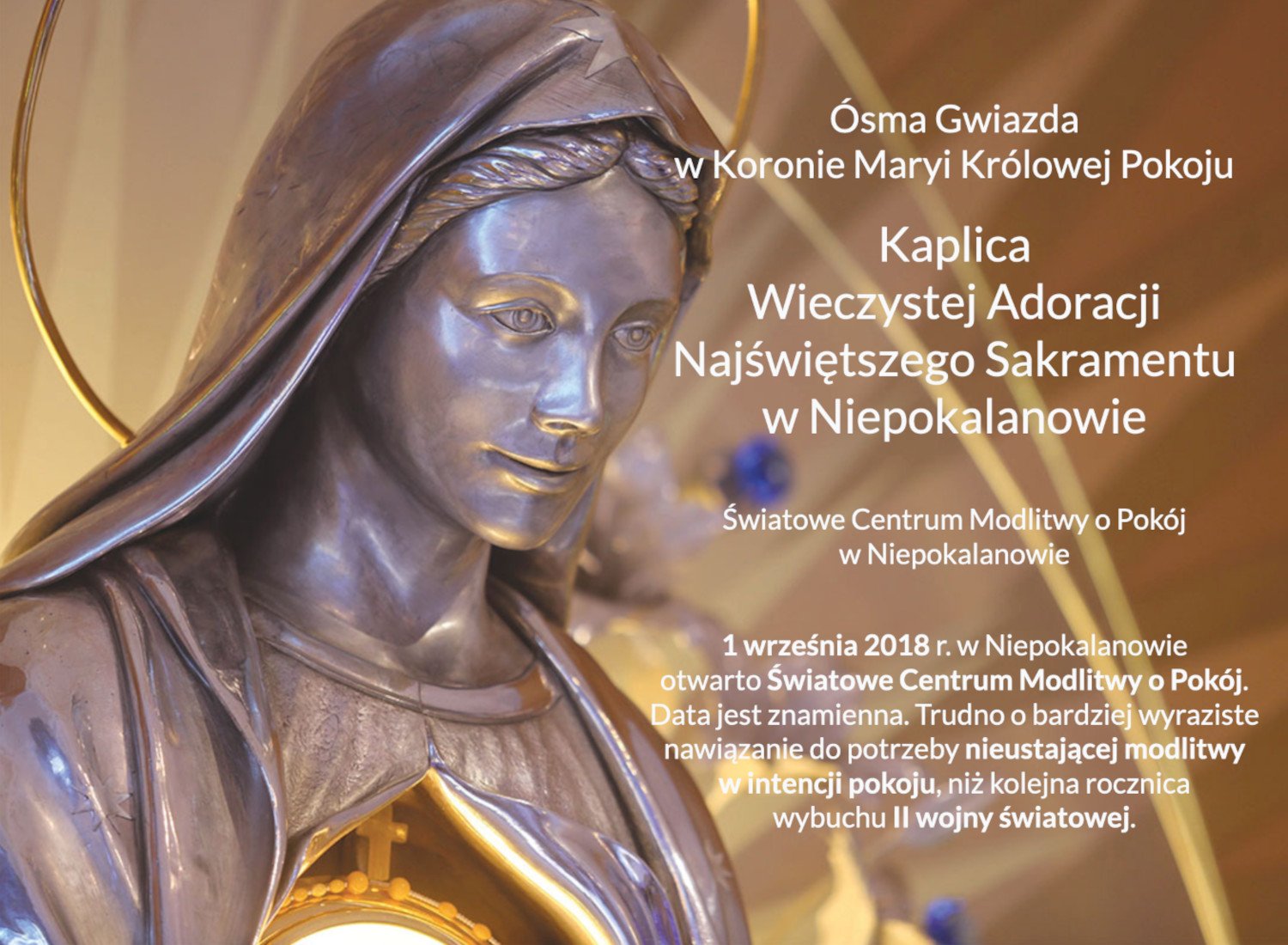

The Eucharistic Adoration Chapel established by Saint Maximilian Kolbe was inaugurated at the outbreak of World War II. It was restored as a Chapel of Adoration in September, 2018, the commemoration of the date that the war began. It is now part of the World Center of Prayer for Peace. The live internet feed of the Adoration Chapel at Niepokalanow — sponsored by EWTN — was established just a few weeks before we discovered it and began to include in at Beyond These Stone Walls. Click “Watch on YouTube” in the lower left corner to see how many people around the world are present there with you. The number appears below the symbol for EWTN.
Click or tap here to proceed to the Adoration Chapel.
The following is a translation from the Polish in the image above: “Eighth Star in the Crown of Mary Queen of Peace” “Chapel of Perpetual Adoration of the Blessed Sacrament at Niepokalanow. World Center of Prayer for Peace.” “On September 1, 2018, the World Center of Prayer for Peace in Niepokalanow was opened. It would be difficult to find a more expressive reference to the need for constant prayer for peace than the anniversary of the outbreak of World War II.”
For the Catholic theology behind this image, visit my post, “The Ark of the Covenant and the Mother of God.”

Saints and Sacrifices: Maximilian Kolbe and Edith Stein at Auschwitz
Saint Maximilian Kolbe and Saint Teresa Benedicta of the Cross — Edith Stein — are honored this week as martyrs of charity and sacrifice.

Saint Maximilian Kolbe and Saint Teresa Benedicta of the Cross — Edith Stein — are honored this week as martyrs of charity and sacrifice.
In a post some years ago I invited our readers to join my friend Pornchai Moontri and me in a personal Consecration to Saint Maximilian Kolbe’s dual movements: the Militia of the Immaculata and the Knights at the Foot of the Cross. Our Consecration took place at Mass on the night of August 15, the Solemnity of the Assumption, and the day after Saint Maximilian’s Feast Day. Visit the website of the Militia of the Immaculata for instructions for enrolling in the Militia Immaculata and the Knights at the Foot of the Cross.
We’re very moved by the number of people who have pledged to join us in this Consecration. The invitation remains always open.
Consecration as members of Saint Maximilian’s M.I. or Knights at the Foot of the Cross does not mean I plan to take on any more suffering or that I will never again complain. It does not even mean that I accept with open arms whatever crosses I bear and embrace them.
A person who is unjustly imprisoned must do all in his power to reverse that plight just as a person with cancer must do everything possible to be restored to health. Consecration does not mean we will simply acquiesce to suffering and look for more. It means we embrace the suffering of Christ, and offer our own as a share in it. In the end, I know I cannot empty myself, as Christ did, but I can perhaps attain the attitude of “Simon of Cyrene: Compelled to Carry the Cross,” of which my own is but a splinter.
I have written in the past that history has a tendency to treat its events lightly. The centuries have made Saint Patrick, for example, a sort of whimsical figure. History has distorted the fact that he became the saint he is after great personal suffering. Patrick was kidnapped by Irish raiders at the age of 16, forced from his home and family, taken across the Irish Sea and forced into slavery.
The life and death of Saint Maximilian are still too recent to be subjected to the colored glasses through which we often view history and sainthood. As with nearly all the saints — and with some of us who simply struggle to believe — great suffering was imposed on Maximilian Kolbe and he responded in a way that revealed a Christ-centered rather than self-centered life. What happened to Father Maximilian Kolbe must not be removed from what the Germans would call his “sitz im leben,” the “setting in life” of Auschwitz and the Holocaust. As evil as they were, they were the forges in which Maximilian cast off self and took on the person of Christ.

Scene from the 1978 mini-series “Holocaust”
“And the Winner Is . . .”
Do you remember the television “mini-series” productions of the 1970s and 1980s? After the great success of bringing Alex Haley’s “Roots” to the screen, several other forays into history were aired in our living rooms. One of them was a superb and compelling series entitled “Holocaust” that debuted on NBC on April 16, 1978. It was a brilliant and powerful example of television’s potential.
“Holocaust” won several Emmy Awards for NBC in 1978 for outstanding Limited Series, Best Director (Marvin Chomsky), Best Screenplay (Gerald Green), Best Actor (Michael Moriarty), Best Actress (Meryl Streep) and a number of Supporting Actor and other awards. As a historical narrative, however, “Holocaust” was deeply disturbing and shook an otherwise comfortable generation all too inclined to want to forget and move on. That was a complaint during the famous Nuremberg Trials of 1945 and 1946.
Just two years after the Allied Invasion of Germany and Poland ended the war and exposed the Death Camps, writers complained that Americans had lost interest and were not reading about the Nuremberg Trials. The aftermath of war revealed the sheer evil of the Nazi Final Solution, and it was more than most of us could bear to look at — so many did not look.
As I wrote in “Catholic Scandal and the Third Reich,” there are some who would have you believe that the Catholic Church is to be the moral scapegoat of the 20th Century. Viewing “Holocaust” (the miniseries) would quickly shatter any such revisionist history. Its first episode was so graphic in its depiction of Nazi oppression, and caused me so much anguish, that I struggled with whether to watch the rest.
I was 25 years old when it first aired, and finishing senior year at Saint Anselm College, a Benedictine school in New Hampshire. I was a double major in philosophy and psychology, and was in the middle of writing my psychology thesis on the relationship between trauma and depression when “Holocaust” kept me awake all night.
The morning after that first episode, I sought out a friend, an elderly Benedictine monk on campus who recommended the series to me. I thought he might tell me to turn my television off, but I was wrong. “This happened in my lifetime,” he said. “We cannot run from it. So don’t look away. Stare straight into its heart of darkness, and never forget what you see.”
He was right, and his words were eerily similar to those of biographer, George Weigel, who wrote of Pope John Paul II and his interest in Saint Maximilian Kolbe in Witness to Hope (HarperCollins, 1999):
Maximilian Kolbe . . . was the ‘saint of the abyss’ — the man who looked into the modern heart of darkness and remained faithful to Christ by sacrificing his life for another in the Auschwitz starvation bunker while helping his cellmates die with dignity and hope.
— Witness to Hope, p. 447
That was what the Holocaust was: “the modern heart of darkness.” I have been a student of the Holocaust since, but I am no closer to understanding it than I was on that sleepless night in 1978. As I asked in “Catholic Scandal and the Third Reich”:
“How did a society come to stand behind the hateful rhetoric of one man and his political machine? How did masses of people become convinced that any ideology of the state was worth the horror unfolding before their eyes?”
We have all been reading about the breakdown of faith in Europe, and about how decades-old scandals are now being used to justify the abandonment of Catholicism in European culture. This is not a new phenomenon. This madness engulfed Europe just eighty years ago, and before it was over, six million of our spiritual ancestors were deprived of liberty, and then life, for being Jews.
Hitler’s “Final Solution” exterminated fully two-thirds of the Jewish men, women, and children of Europe — and millions of others who either stood in his way or spoke the truth. Among those imprisoned and murdered were close to 12,000 Catholic priests and thousands more women religious and other Catholics. The determination to rid Europe of the Judeo-Christian faith did not begin with claims of sexual abuse, and this is not the first time such claims were used to further that agenda.

The Great Lie and Revealed Truth
This of all weeks keeps me riveted on the Holocaust. It was in this week that two of my dearest spiritual friends were murdered a year apart at Auschwitz by that madman, Hitler, and his monstrous Third Reich. Father Maximilian Kolbe traded his life for that of a fellow prisoner on August 14, 1941, and Edith Stein — who became Carmelite Sister Teresa Benedicta of the Cross — was dragged from a cattle train and murdered along with her sister, Rosa, immediately upon arrival at Auschwitz on August 9, 1942.
We must not forget this line from Adolf Hitler’s Mein Kampf (Vol. 1, Ch.10, 1925): “The great mass of people … will more easily fall victim to a big lie than to a small one.” In order for a lie to disseminate and prevail, the truth must be controlled. In 1933, the Third Reich imposed the “Editor’s Law” in Germany requiring that editors and publishers join the Third Reich’s Literary Chamber or cease publishing. In 1933 there were over 400 Catholic newspapers and magazines published in Germany. By 1935 there were none.
The Nazi law was imposed in each country invaded by the Reich. In Poland, Father Maximilian was one of many priests sent to prison for his continued writings, but time in prison did not teach him the lesson intended by the Nazis. He was imprisoned again, and he would not emerge alive from his second sentence at Auschwitz. He was not alone in this. Nearly 12,000 priests were sent to their deaths in concentration camps.

“Come, Let Us Go For Our People.”
Edith Stein was the youngest of eleven children in a devout Jewish family in Germany. She was born on Yom Kippur, the Day of Atonement, on October 12, l891. As a young woman, Edith broke her mother’s heart by abandoning her Jewish faith in adolescent rebellion. She was also brilliant, and it was difficult to win an argument with her using reason and logic. She was a master of both.
Edith received her doctorate in philosophy under the noted phenomenologist, Edmund Husserl, and taught at a German university when the Nazis came to power in 1933. During this time of upheaval, Edith converted to Catholicism after stumbling across the autobiography of Saint Teresa of Avila. “This is the truth,” Edith declared after reading it through in one sleepless night. A few years after her conversion, Edith Stein entered a Carmelite convent in Germany taking the name Sister Teresa Benedicta of the Cross (Blessed by the Cross).
March 27, 1939 was Passion Sunday, the beginning of Holy Week. In response to a declaration of Adolf Hitler that the Jews would bring about their own extinction, Sister Teresa Benedicta of the Cross wrote a private note to her Carmelite superior. She offered herself in prayer as expiation against the Anti-Christ who had cast all of Europe into a spiritual stranglehold. In her letter to her superior, Sister Teresa offered herself as expiation for the Church, for the Jews, for her native Germany, and for world peace.
As the Nazi horror overtook Europe, Sister Teresa grew fearful that she was placing her entire convent at risk because of her Jewish roots. Edith was then assigned to a Carmelite Convent in Holland. Her sister, Rosa, who also converted to Catholicism, joined her there as a postulant.
Catholics in France, Belgium, Holland and throughout Europe organized to rescue tens of thousands of Jewish children from deportation to the Death Camps. Philip Friedman, in Roads to Extinction: Essays on the Holocaust (The Jewish Publication Society, 1980) commended the Catholic bishops of the Netherlands for their public protest about the Nazi deportation of Jews from Holland. In retaliation for those bishops’ actions, however, even Jews who had converted to Catholicism were rounded up for deportation to Auschwitz.
A 2010 book by Paul Hamans — Edith Stein and Companions: On the Way to Auschwitz — details the horror of that day. Hundreds of Catholic Jews were arrested in Holland in retaliation for the bishops’ open rebellion, and most were never seen again. This information stands in stark contrast to the often heard revisionist history that Pope Pius XII “collaborated” with the Nazis through his “silence.” He was credited by the chief rabbi of Rome, Eugenio Zolli, with having personally saved over 860,000 Jews and preventing untold numbers of deaths.
The last words heard from Sister Teresa as she was forced aboard a cattle car packed with victims were spoken to her sister, Rosa, “Come, let us go for our people.” On August 9, 1942, Sister Teresa emerged from the cramped human horror of that cattle train into the Auschwitz Death Camp to face The Sorting.
Nobel Prize winner and Holocaust survivor Elie Wiesel described The Sorting:
“How do you describe the sorting out on arriving at Auschwitz, the separation of children who see a father or mother going away, never to be seen again? How do you express the dumb grief of a little girl and the endless lines of women, children and rabbis being driven across the Polish or Ukranian landscapes to their deaths? No, I can’t do it. And because I’m a writer and teacher, I don’t understand how Europe’s most cultured nation could have done that.”
That August 9th, Edith Stein went no further into the depths of Auschwitz than The Sorting. Some SS officer glared at this brilliant 50-year-old nun in the tattered remains of her Carmelite habit, and declared that she was not fit for work. This woman who had worked every day of her life, who taught philosophy to Germany’s graduate students, who scrubbed convent floors each night, was determined to be “unfit for work” by a Nazi officer who knew it was a death sentence.
Edith and Rosa were taken directly to a cottage along with 113 others, packed in, the doors sealed, and they were gassed to death. Their remains, like those of Maximilian Kolbe a year earlier, went unceremoniously up in smoke to drift through the sky above Auschwitz. And Europe thinks it would be better off now without faith!
“Thus the way from Bethlehem leads inevitably to Golgotha, from the crib to the Cross. (Simeon’s) prophecy announced the Passion, the fight between light and darkness that already showed itself before the crib … The star of Bethlehem shines in the night of sin. The shadow of the Cross falls on the light that shines from the crib. This light is extinguished in the darkness that is Good Friday, but it rises all the more brilliantly in the sun of grace on the morning of the Resurrection.
“The way of the incarnate Son of God leads through the Cross and Passion to the glory of the Resurrection. In His company the way of everyone of us, indeed of all humanity, leads through suffering and death to this same glorious goal.”
— Edith Stein/Sister Teresa Benedicta of the Cross