“There are few authentic prophetic voices among us, guiding truth-seekers along the right path. Among them is Fr. Gordon MacRae, a mighty voice in the prison tradition of John the Baptist, Maximilian Kolbe, Alfred Delp, SJ, and Dietrich Bonhoeffer.”
— Deacon David Jones
Behold, the Lamb of God
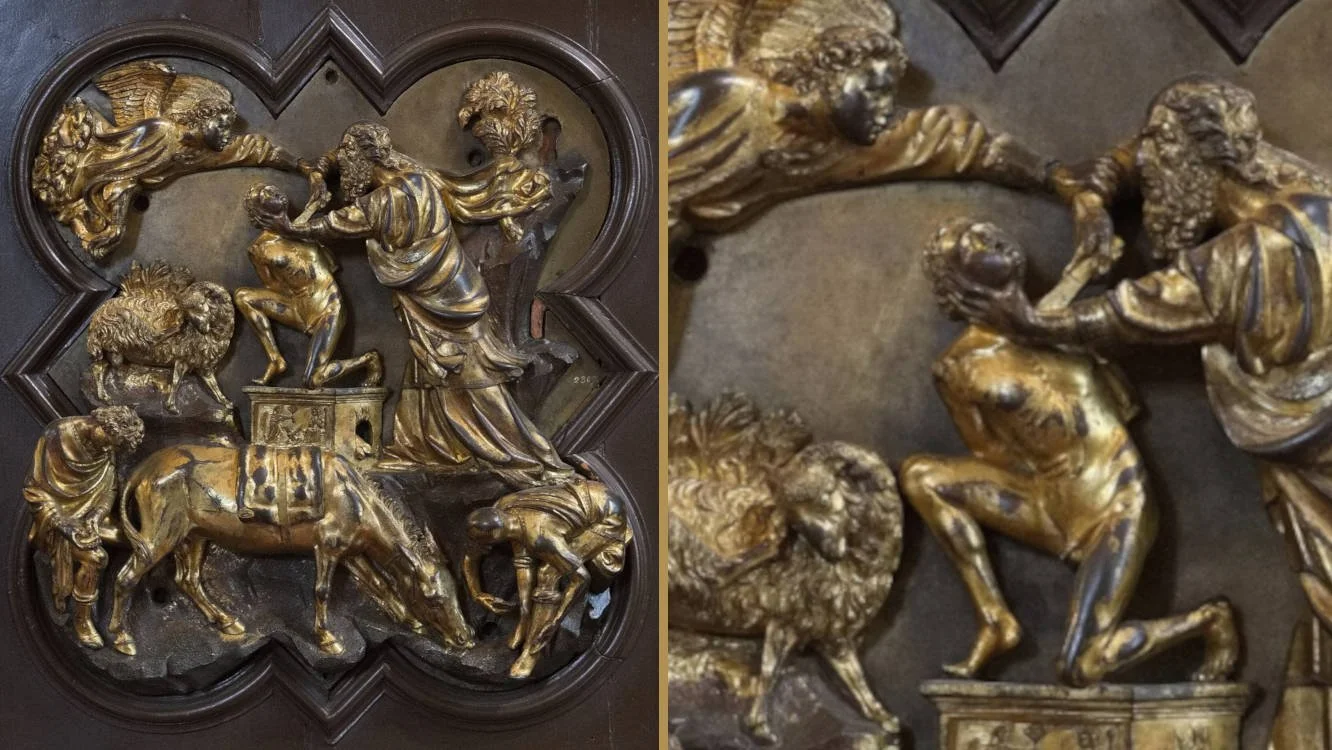
As Christmastide gives way to Ordinary Time in the Sunday Mass Gospel, John the Baptist connects the Lamb of God to the time of Abraham 2000 years before Christ.
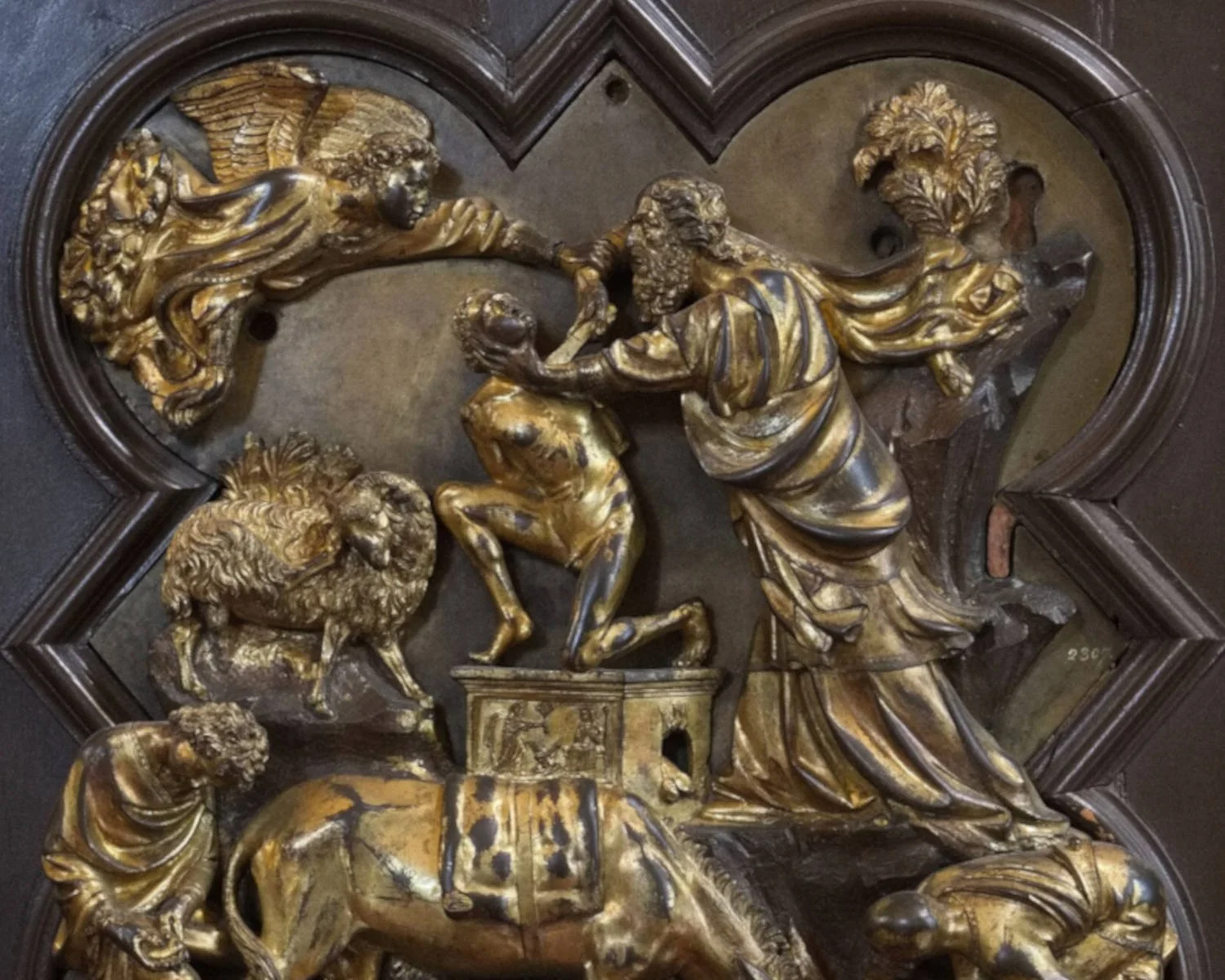
As Christmastide gives way to Ordinary Time in the Sunday Mass Gospel, John the Baptist connects the Lamb of God to the time of Abraham 2000 years before Christ.
January 14, 2026, Ordinary Time
Note from Father Gordon MacRae: In 17 years writing for this blog I have produced about 850 posts from inside a prison cell with access only to an old typewriter. After I type them, I mail them to be scanned by an editor and then published at Beyond These Stone Walls. Once I mail a post, I have no means to ever see it again except on the rare occasion when I can make a photocopy. Once published, readers can see it but I cannot. So these 850 posts, at least for me, exist only in my mind. It seems inevitable that I would eventually write content that is familiar to readers.
After the Gospel passage about the Baptism of Jesus, the Church’s liturgy enters Ordinary Time. The Sunday Gospel this week, According to Saint John (1:29-34), begins with a declaration of John the Baptist as he saw Jesus coming toward him at the River Jordan: “Behold, the Lamb of God, who takes away the sin of the world.” This is the source of the Agnus Dei, the declaration we recite three times before the reception of the Eucharist at every Mass. The declaration has its origin in this Gospel passage.
It has another origin story as well, deep in the chasms of Salvation History. I set out to write about that this week, and then realized that I already had. So this post should sound familiar. I thank you for reading and sharing it.
+ + +
“This is the night when Christ broke the prison-bars of death and rose victorious from the underworld. Our birth would have been no gain had we not been redeemed.”
— from the Easter Vigil Exultet
You might readily see the irony of my invoking the subject of this post in the haunting passage above. It is from the Exultet, that wondrous proclamation of Salvation History as the Paschal Candle is blessed at the doors of the church in the liturgy for the Easter Vigil. The imagery of Christ breaking the prison bars of death may understandably have deep meaning for me. The excerpt recalls a scene from Holy Week that I once wrote about in “To the Spirits in Prison: When Jesus Descended into Hell.”
That post conveys the story referenced in the Second Letter of Saint Peter, about what happened to Jesus on what we now call Holy Saturday, that period of darkness between the Cross and the Resurrection.
Back in February 2025, I wrote a post entitled “On the Great Biblical Adventure, the Truth Will Make You Free.” It mentioned my recent acquisition of the much anticipated Ignatius Catholic Study Bible: Old and New Testament edited by Dr. Scott Hahn. That post also referred to a recent and surprising resurgence of biblical interest throughout the free world. I learned of that explosion of interest when Ignatius Press placed me on a waiting list for that particular bible, and I had to wait for its fourth or fifth printing. I have been lugging the weighty hardcover tome, consisting of 2,314 pages, around with me for months at this writing. I don’t seem to be able to part with it for long. It is a treasure trove of biblical insight and truth, filled not only with readable and scholarly translations of Sacred Scripture, but also with scholars’ notes on the biblical texts. From a historical perspective it draws clear connections between the Old and New Testaments. From a spiritual perspective it is as though a lamp has been relit opening for me, and hopefully also for you, a world of deeper meaning embedded within the texts. As I mentioned in a previous post, my goal has been two-fold: to educate, or rather reeducate myself on the story of God and us, and to avoid dropping the very heavy book on my foot in the process.
The interpretation of a religious text is a study called exegesis. It seeks to convey and understand both the literal and spiritual sense of biblical truths. Neither should be sacrificed in pursuit of the other. I have often described it this way: There is a story on its surface, which is true, and a far greater story in its depths which points to even greater truths. One way in which the spiritual truth of Scripture is expressed is in allegory. Jesus told many allegorical accounts in parables. Most readers are clear that the truth in these precious accounts is in the lesson they convey. Two of the most famous examples are the “Parable of the Good Samaritan” and the “Parable of the Prodigal Son,” both found in the Gospel of Luke. You know these stories well, and they need no explanation.
Most of Sacred Scripture is not conveyed in parable form, but as a historical narrative. Allegory is still very much a part of that narrative, and we are cheating our understanding of a text when we suppress its allegorical content. We should start by accepting both truths: the truth of the historical content of Scripture and the equal and sometimes even greater truth in its allegorical content. In this sense allegory refers to a story, poem, or picture that can be interpreted to reveal a hidden meaning, typically a moral or religious one. In the 19th and 20th centuries, fundamentalist Scripture scholars stripped allegory from their interpretations of the text, but at great cost. More modern scholars have restored it. One of them has been Dr. Scott Hahn.
When I cited an excerpt from the Exultet Proclamation from the Easter Vigil liturgy as I opened this post, I later realized that the Second Reading for the Easter Vigil Mass is one that I have pondered for a very long time. It is from Genesis 22:1-19, the story of God calling upon Abraham to sacrifice Isaac, his beloved son. “So momentous is this event in its outcome,” wrote Scott Hahn, “that it stands as one of the defining moments of Salvation History.” I have set out to study the great depths of this account and they are astonishing.

Abraham and Isaac
Isaac is a Hebrew name, of course, and it means “He laughs.” It has its origin in Genesis 17:16-17: “ ‘I will bless (Sarah) and moreover I will give you a son by her; I will bless her and she shall be the mother of nations; kings of peoples shall come from her.’ Then Abraham fell on his face and laughed, and said to himself, ‘Shall a child be born to a man who is a hundred years old? Shall Sarah, who is ninety years old, bear a child?’ ”
Abraham apparently gave little thought to the wisdom of falling to the ground and laughing at God. The fact that he “said it to himself” is no guarantee that God would not have heard it loud and clear. And so it was that the Word of God came to give the son of Abraham and Sarah the name “Isaac,” which means “He laughs.”
Abraham was apparently not the only one laughing. God seemed to get a chuckle out of it as well.
As the story progressed, the significance of Isaac’s birth was immediate. He was to be the fulfillment of God’s promise to Abraham. Isaac was to be the bearer of the covenant into future generations: “I will establish my covenant with him as an everlasting covenant for him and his descendants after him” (Genesis 17:19). Then the drama of the Book of Genesis reaches its greatest intensity with the heart-wrenching story of God’s call to Abraham to sacrifice as a burnt offering his beloved son upon the heights of Mount Moriah. Had Abraham shown anything less than heroic faith and obedience the grand narrative of the Bible would have developed very differently thereafter. Here is the Genesis account which became the Second Reading of our Easter Vigil liturgy.
From the Book of Genesis 22:1-18:
After these things, God tested Abraham and said to him, “Take your son, your only begotten son Isaac, whom you love, and go to the land of Moriah, and offer him there as a burnt offering upon one of the mountains of which I shall tell you.” So Abraham rose early in the morning, saddled his donkey, and he cut the wood for the burnt offering, and went to the place of which God had told him. … Abraham took the wood for the burnt offering and laid it on the shoulders of his son to carry, and he took in his own hands the fire and the knife. So they went both of them together. Isaac said to his father, “Behold the fire and the wood, but where is the lamb for a burnt offering?” Abraham said, “God will provide himself the lamb for a burnt offering, my son.”
When they came to the place of which God had told him, Abraham built an altar there and laid the wood in order, and he bound Isaac his son and laid him on the altar upon the wood. Then Abraham put forth his hand and took the knife to slay his son. But the angel of the Lord called to him from heaven and said, ‘Abraham, Abraham! Do not lay your hand on your son or do anything to him for now I know that you have not withheld your only begotten son from me.” Abraham then lifted up his eyes and looked, and behold, behind him was a ram caught by his horns in a thicket. So Abraham went and took the lamb and offered it up as a burnt offering instead of his son. So Abraham called the name of that place YHWH YIR’EH, in Hebrew, “The Lord will see.”
It is from this very account that, twenty one centuries later, the Gospel of John (1:29) proclaims “Behold the lamb of God who takes away the sin of the world.”
I have always felt that this account in Genesis was a presage, a looking far ahead, to the sacrifice of Jesus upon Golgotha. It is allegorical in that sense. The account is true on its literal face but it is also true that it echoes the Greatest Story Ever Told which will come many centuries later. All the elements are there. The Second Book of Chronicles (3:1) identifies Moriah as the site upon which, nearly one thousand years later, Solomon would build the Jerusalem Temple, and Calvary, where the only begotten Son of God was crucified, is a hillock in the Moriah range. So for the Hebrew reader of the story of the Crucifixion, there is a powerful sense of déjà vu: the place, the mount, Abraham placing the wood for sacrifice upon the back of Isaac, and is not the ram caught by its horns in the thicket highly reminiscent of the Crown of Thorns? But we cannot reminisce backwards. This amazing account from Genesis is a mysterious example of the power of biblical inspiration. Only in the mind of God, in the time of Genesis, was the story of Christ evident.

From Sheol to the Kingdom of Heaven
In the Old Testament, “to die” meant to descend to Sheol. It was our final destination. To rise from the dead, therefore, meant to rise from Sheol, but no one ever did. The concept of Sheol being the “underworld” is a simple employment of the cosmology of ancient Judaism which understood the abode of God and the heavens as being above the Earth, and Sheol, the place of the dead, as below it. This is the source of our common understanding of Heaven and hell, but it omits a vast theological comprehension of the death, Resurrection and Ascension of Jesus and the human need to understand our own death in terms of faith.
If, up to the time of Jesus, “to die” meant to descend into Sheol, then Jesus introduced an entirely new understanding of death in his statement from the Cross to the penitent criminal, Dismas, who pleaded from his own cross, “Jesus remember me when you come into your kingdom.” Jesus responded, “Today you will be with me in Paradise” (Luke 23:43). This is an account that I once told entitled, “Dismas, Crucified to the Right: Paradise Lost and Found.”
It is by far the most widely read of our Holy Week posts, and not just at Holy Week. On the Cross, where the penitent criminal comes to faith while being crucified along with Jesus, God dissolves the bonds of death because death can have no power over Jesus. It is highly relevant for us that the conditions in which the penitent Dismas entered Paradise were to bear his cross and to come to faith.
It was at the moment Jesus declared, in His final word from the Cross, “It is finished,” that Heaven, the abode of God, opened for human souls for the first time in human history. The Gospels do not treat this moment lightly:
“It was now about the sixth hour [3:00 PM], and there was darkness over the whole land until the ninth hour while the sun’s light failed; and the curtain of the Temple was torn in two. Then Jesus, crying with a loud voice, said, ‘Father, into your hands I commend my spirit.’ Saying this he breathed his last.”
— Luke 23:44-46
“And behold, the curtain of the Temple was torn in two from top to bottom, and the Earth shook, and the rocks were split. The tombs also were opened, and many bodies of the saints who had fallen asleep were raised ... When the centurion, and those who were with him keeping watch over Jesus, saw the earthquake, and what took place, they were filled with awe, and said, ‘Clearly, this was the Son of God.’”
— Matthew 27:51-54
The veil of the Temple being torn in two appears also in Mark’s Gospel (15:38) and is highly significant. Two veils hung in the Jerusalem Temple. One was visible, separating the outer courts from the sanctuary. The other was visible only to the priests as it hung inside the sanctuary before its most sacred chamber in which the Holy of Holies dwelled (see Exodus 26:31-34). At the death of Jesus, the curtain of the Temple being torn from top to bottom is symbolic of salvation itself. Upon the death of Jesus, the barrier between the Face of God and His people was removed.
According to the works of the ancient Jewish historian, Josephus, the curtain barrier before the inner sanctuary that was torn in two was heavily embroidered with images of the Creation and the Cosmos. Its destruction symbolized the opening of Heaven, God’s dwelling place and the Angelic Realm, to human souls.
In ancient Israel in the time of Abraham and Isaac the concept of Sheol after death was closely connected with the grave and pictured only as a gloomy underworld hidden deep in the bowels of the Earth. There human souls descended after death (Genesis 37:35) to a joyless existence where the Lord is neither seen nor worshipped. Both the righteous and the wicked sank into the nether world (Genesis 44:31). Despite the apparent finality of death, Scripture displays great confidence in the power of God to deliver his people from its clutches. That confidence was made manifest in the deliverance of Jesus from his tomb after he displayed the power of God to the one place where he had always been absent, the realm of the dead. “For Christ also died for sins once and for all, the righteous for the unrighteous, that he might bring us to God, being put to death in the flesh but made alive in the spirit, in which he went and declared to the spirits in prison who did not formerly obey when God’s patience waited in the days of Noah.” (1 Peter 3:18-20)
The essential point for us could not be clearer or more hopeful. Besides Jesus himself, the first to be sanctioned with a promise of paradise was a condemned prisoner who, even in the intense suffering of his own cross, refused to mock Jesus but rather came to believe and then place all his final hope in that belief. As I ended “Dismas, Crucified to the Right” Dismas was given a new view from his cross, a view beyond death away from the East of Eden, across the Undiscovered Country of Death, toward his sunrise and eternal home.
I have written many times that we live in a most important time. The story of Abraham told above took place twenty one centuries before the Birth of the Messiah. We now live in the twenty first century after. Christ is now at the very center of Salvation History.
+ + +

+ + +
Note from Father Gordon MacRae: Please visit our new page: Abraham to Easter: The Bible Speaks, our collection of Scriptural exegesis for Beyond These Stone Walls.
+ + +


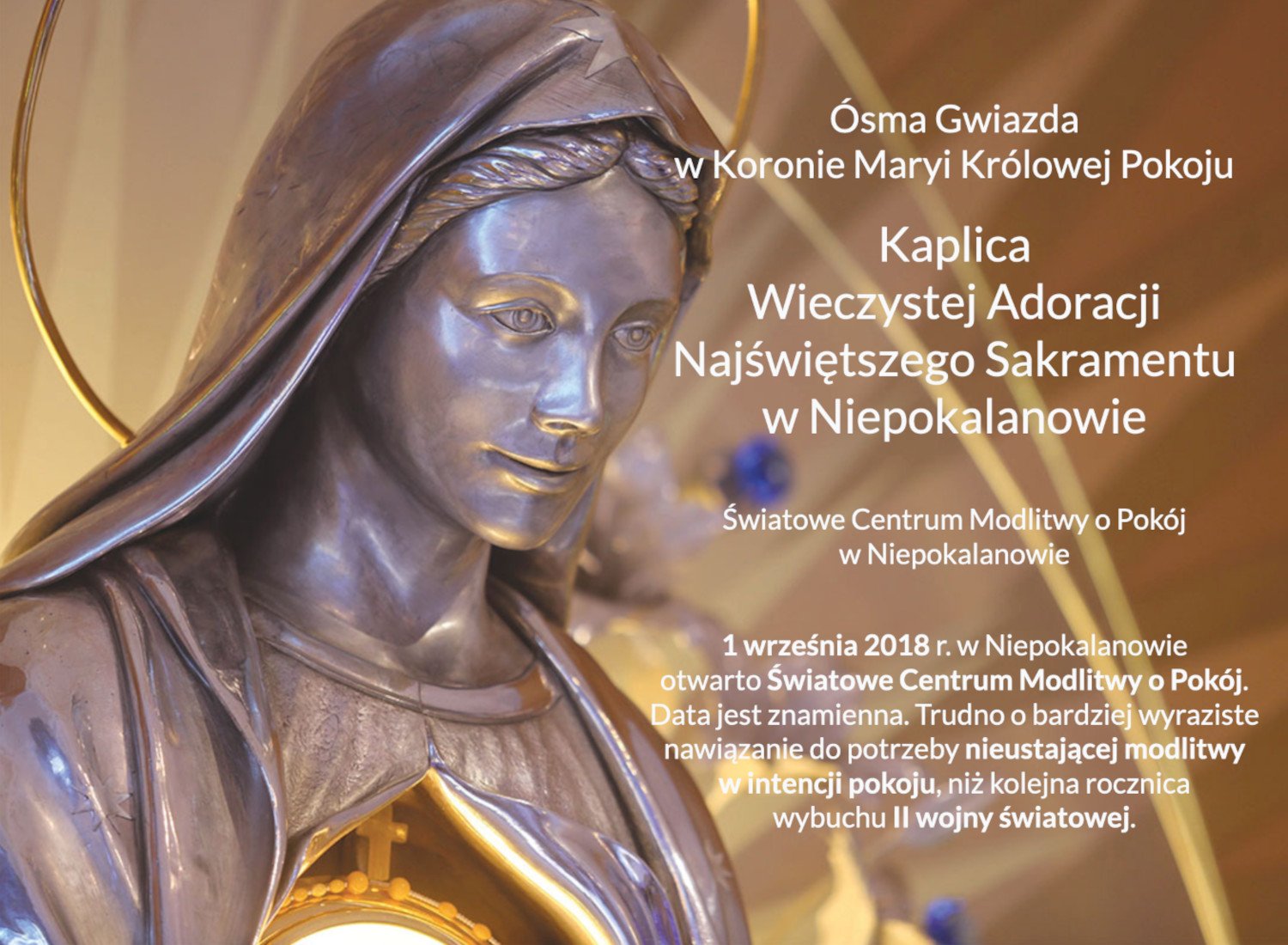

The Eucharistic Adoration Chapel established by Saint Maximilian Kolbe was inaugurated at the outbreak of World War II. It was restored as a Chapel of Adoration in September, 2018, the commemoration of the date that the war began. It is now part of the World Center of Prayer for Peace. The live internet feed of the Adoration Chapel at Niepokalanow — sponsored by EWTN — was established just a few weeks before we discovered it and began to include in at Beyond These Stone Walls. Click “Watch on YouTube” in the lower left corner to see how many people around the world are present there with you. The number appears below the symbol for EWTN.
Click or tap here to proceed to the Adoration Chapel.
The following is a translation from the Polish in the image above: “Eighth Star in the Crown of Mary Queen of Peace” “Chapel of Perpetual Adoration of the Blessed Sacrament at Niepokalanow. World Center of Prayer for Peace.” “On September 1, 2018, the World Center of Prayer for Peace in Niepokalanow was opened. It would be difficult to find a more expressive reference to the need for constant prayer for peace than the anniversary of the outbreak of World War II.”
For the Catholic theology behind this image, visit my post, “The Ark of the Covenant and the Mother of God.”

The Measure By Which You Measure: Prisoners of a Captive Past
The Gospel of Luke issues a difficult challenge before Lent. The mother of a murdered young man heeded it and rose to become an advocate for her son's former enemy.

The Gospel of Luke issues a difficult challenge before Lent. The mother of a murdered young man heeded it and rose to become an advocate for her son’s former enemy.
February 16, 2022
Like most human beings, and entirely unlike Jesus, I have enemies. This needs some clarification. There were some who made themselves enemies of Jesus, but never did Jesus perceive them as such. I have as of yet been unable to rise to that Gospel challenge. That much became clear in our recent posts, “Predator Police: The New Hampshire ‘Laurie List’ Bombshell,” and its sequel, “Police Misconduct: A Crusader Cop Destroys a Catholic Priest.” That latter post, by Ryan MacDonald, took a surprising turn. Several days after it was posted, it had been shared only about 200 times on social media. Then, on Monday, January 31st, it suddenly exploded, gathering 2,300 shares on Facebook, thus placing that post before hundreds of thousands.
In recent weeks and months, there have been many assaults and other attacks on police officers. The vast majority of police are couragous and honest men and women who do their jobs heroically. The posts linked above are not at all about them. They are about a deceitful and self-righteous crusader who used sleazy and dishonest tactics to frame and entrap people, including me. Now, just weeks after those posts were published, I am confronted with a Gospel passage two weeks before Lent that I would rather not hear. But I did hear it.
Should a priest have enemies? It is not exactly a good look, but priests are human beings and most humans do not respond well to being hated or hunted, or falsely accused. The words “enemy” and “enemies” (for those who sadly have amassed more than one) occur in Sacred Scripture 526 times. What would the opposite word be to contrast it in Scripture? It isn’t “friend.” I know many people who are neither friends nor enemies to me. I even have some ex-friends who are certainly not my enemies. There is no word for an ex-enemy. But as I pondered all this, the Gospel for the Seventh Sunday in Ordinary Time smacked me:
“Jesus said to his disciples, ‘To you who hear, love your enemies, do good to those who hate you, bless those who curse you, pray for those who mistreat you.’”
— Luke 6:27
I started splitting hairs upon reading this. Jesus said “To you who hear,” so what if I simply pretend I didn’t hear it? I could not handle the dishonesty that would entail, but I just don’t know what to do with what I heard. I tried praying for my enemy, but my prayer became corrupted: “I pray that my enemy will one day stand in the Presence of the Lord. Sooner rather than later might be nice!”
It isn’t a good prayer. I will have to try harder. The whole passage for this coming Sunday’s Mass ends, however, on a more reachable note. It is a statement that now haunts me with a call to arms. In this case, however, I am taking up arms not against my enemy, but against myself. It seems on first reading to be a lot easier than deciding to love my enemy and pray for him. Maybe that will come some day. Not today. But this final statement of Jesus concludes the Gospel for the Seventh Sunday of Ordinary Time. Let it sink in. It's not for my enemy. It is for me:
“The measure with which you measure will in turn be measured out to you.”
— Luke 6:38
Way to go, Jesus! Please pass the Tylenol.

Divine Mercy Calls Forth Unexpected Role Models
I wrote a post back in 2012 that was one of a few that contained the photograph above. That post was “Why You Must Never Give Up Hope for Another Human Being.” It has been on our list of posts from the older version of this blog that had to be restored for you to read them anew. I asked that it be moved to the top of the list so you could read it for this post. No need to do so now. I will add a link to it at the end. It’s very important.
The young men in the photo above all graduated from high school in this prison after putting in years of hard work and even more years of struggle with themselves. The obstacles against learning the right things in this environment are very great. With the right kind of support, each one of them overcame these obstacles. The result was this triumphant photograph above. I am very proud of it, and the men who are in it — all gawking at me on the other side of the camera. With their diplomas in hand, they are victorious.
In the photo, my friend Alberto is hunched down just behind and to the right of Pornchai Moontri. For the previous two years, he had been a student of mine in a pilot program for exceptional prisoners to enroll in courses for college credit even while working on their high school diplomas. I was recruited for the program by a local community college to teach two courses in which I had earned degrees before prison in Philosophy and Behavioral Science.
Alberto was my student for four semesters, taking one course at a time. He failed both courses in the first two semesters. Alberto hinted that, with the stroke of a pen, I could rescue him with a “C.” But I did not. So he re-registered to take both courses again. He passed both the second time around with a respectable “B+.” I was very proud of him both when he failed, because he made an effort, and when he came back and excelled because he would not accept yet another defeat in life.
Alberto became a good friend to me and to Pornchai. When he wasn’t in trouble and hauled off for a stint in the hole, he lived where we lived. I mentioned him long ago in a 2010 post, “Angelic Justice: St. Michael the Archangel and the Scales of Hesed.” Alberto read a hard copy of it because he was in it, and it became a turning point in his life. I cannot take credit for that because credit is rightly owed in equal measure to Pornchai Moontri and St. Michael.

In the Absence of Fathers
Alberto was 14 years old when the gun in his hand fired severing the artery of an 19-year-old with whom he struggled. It was a vicious end to a late night drug deal gone very bad in a dark Manchester, New Hampshire alley. It happened in 1994, the same year that I was sent to prison. It seemed a flip of a coin which combatant would die that night and which would survive only to wake up in prison. At 14, Alberto had lost himself. Sentenced to a prison term of 30 years to life, he spent his first years in solitary confinement. The experience extracted from him, as it also did from Pornchai, any light in his heart, any spark of optimism or hope in his eyes.
Then, when finally age 18, Alberto was allowed to live in the prison’s general population where the art of war is honed in daily spiritual and sometimes physical battle. It is a rare week that a City of Concord Fire Department ambulance doesn’t enter these prison walls shutting down all activity while some young man is taken to a local hospital after a beating or a stabbing or a headlong flight down some concrete stairs. The catalyst for such events is the same here as it was in the alley that sent Alberto here. There is no honor in any of it. It is just about drugs and gangs and money.
Alberto’s path to prison seemed inevitable. Abandoned by a father he never met, he was raised by a single mother who lost all control over him by age 12. Drugs and money and avoiding the law were the dominant themes of his childhood. By age 14, he was a child of the streets and nowhere else, but the streets make for the worst possible parents. Alberto became a textbook example of a phenomenon that I once wrote about to much public fanfare, but little public action: “In the Absence of Fathers: A Story of Elephants and Men.”
In “Big Prison” it was discovered that there is more to Alberto than the violence of his past. He was 32 when he earned his high school diploma here. He will one day soon be released after having spent more than two-thirds of his life behind bars.
I wrote about Alberto’s life in “Why You Must Never Give Up Hope for Another Human Being.” Now I want to challenge you to go read it because at the end of it at the very top of its many comments is one by the mother of the young man Alberto killed. She read it too. In just a few short sentences, Mrs. Rose Emerson became a role model for pondering what Jesus says in the Gospel on the Seventh Sunday of Ordinary Time:
“The measure with which you measure will in turn be measured out to you.”
Luke 6:38
+ + +
Note from Father Gordon MacRae: The post that I suggested above — “Why You Must Never Give Up Hope for Another Human Being” — is now posted under the “Prison Journal” category of our BTSW Library. I would like to leave Mrs. Emerson’s comment as the final word on that post. If you wish to comment further, and I hope you will, please return here to place your comment on this post. In coming weeks or months we hope to present other powerful stories of hope and Divine Mercy encountered in prison.
Please share this post.
+ + +

Jesus calls forth Lazarus from his tomb.

Cry Freedom! Saint Paul and a Prisoner of the Apocalypse
Two prior posts from Beyond These Stone Wa11s revisit the idea1 of freedom, what it means to find it, what it costs to keep it, what it takes to give it to another.
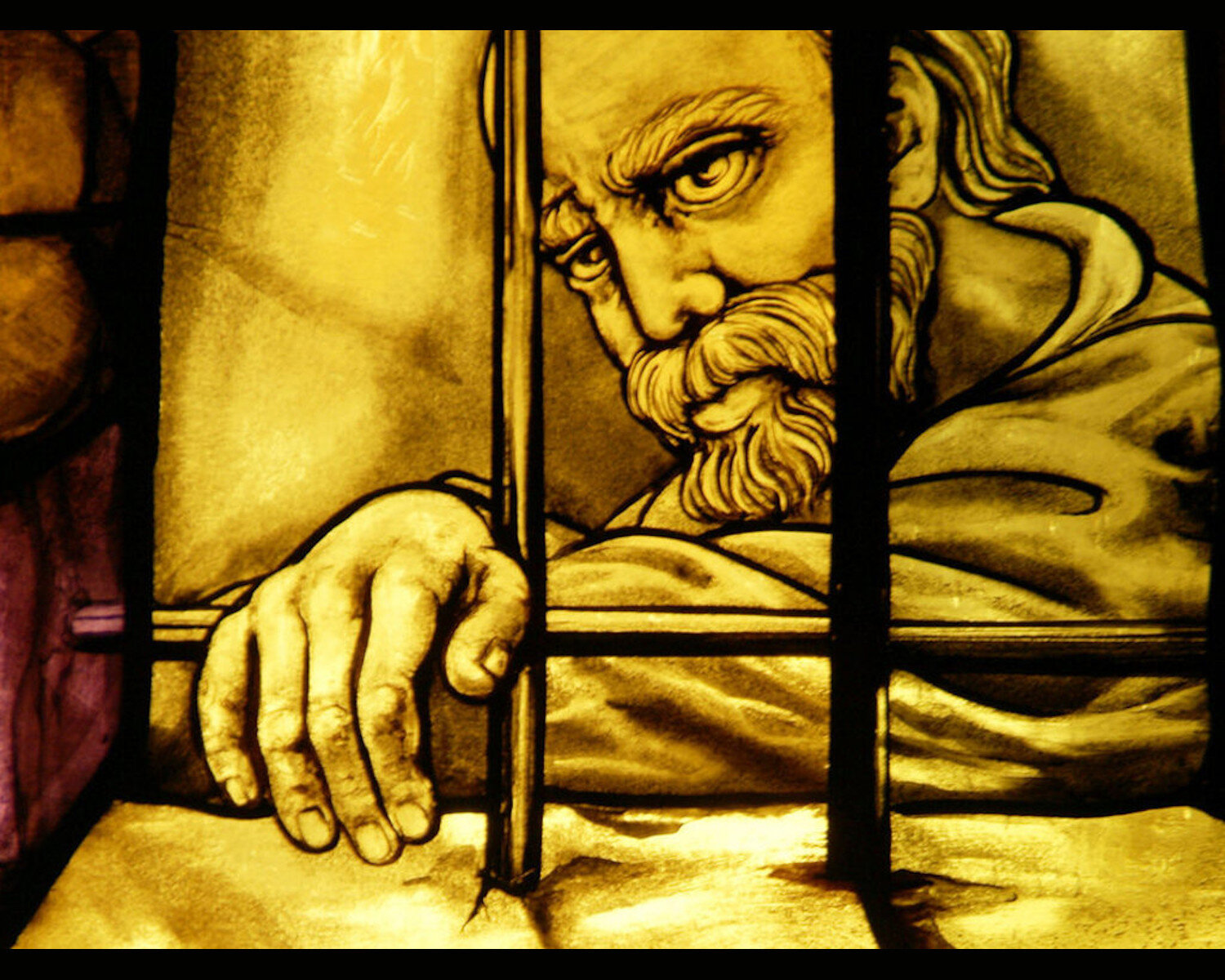
Two prior posts from Beyond These Stone Walls revisit the ideal of freedom, what it means to find it, what it costs to keep it, what it takes to give it to another.
Some readers who are aware of my day to day life as a guest of the state have heard that I was held in a high security quarantine dormitory setting for the entire month of May and part of June in 2021. I did write briefly of this just before it happened, but it seems that what I wrote was too cryptic. I just received a letter from a reader who wanted to launch a petition over my continued heightened confinement. Please don’t show up here with picket signs. I am now liberated from my dungeon.
I was not technically in quarantine. Due to a planned construction project where I was living, I and 23 others were moved to an unused dormitory space that had been previously set up as a Covid-19 triage and quarantine area. It commenced on May 1 and was supposed to last for just ten days at which time, it was promised, we would all move back to our housing assignments.
The construction ran into obstacles, however, and the predicted ten days ultimately turned into forty. During that time, I was pretty much locked into a crowded, noisy room with 23 other disgruntled prisoners. I had no access to my typewriter while there so writing was extremely difficult. Somehow, I still managed to write three posts, but with great difficulty. One of them was for my 39th anniversary of priesthood entitled, “It Is the Duty of a Priest to Never Lose Sight of Heaven.”
I wrote that post “by fits and starts,” a term meaning “haphazardly” that has gone out of style in writing. I wrote that post only in my mind. I was still able to work, as needed but with greatly reduced hours, in the prison law library where I am the sole legal clerk. There is an old manual typewriter there, so I managed to type that post over two hours one afternoon. I mailed it just at the final deadline to have it posted on time. I hope its troubled creation was not so evident.
I could not bring myself to complain about the forty-day confinement. I was constantly aware that our friend, Pornchai Moontri, spent five full months in ICE detention awaiting deportation in a room of the same size, but housing 60 to 70 detainees at any one time. That story should become another BTSW classic post on freedom. The gripping story is told in “ICE Finally Cracks: Pornchai Moontri Arrives in Thailand.”
More importantly, it was also impossible for me to offer Mass during my stay in what I can only describe as “a FEMA shelter without the disaster.” I had hoped to offer Mass on June 6, the Solemnity of Corpus Christi this year and the anniversary of my First Mass on the day after my priesthood ordination on June 5, 1982. But it was not meant to be. After forty days, we were all finally liberated and returned to the place in which I have lived since July of 2017.
It is difficult for me to believe that it was four years ago this month that Pornchai and I were finally moved to that better housing. For the previous 23 years — 12 for Pornchai — we were prisoners in a building housing 504 prisoners but built for half that number. There was little to no access to the outside. It contained all the trouble and chaos that such constant confinement brings.
But we are now free from that. Even in a state of unjust imprisonment, I can thank God for the freedoms I have. I am free to write to the world beyond these stone walls which means more to me than you may know.
As I pondered Independence Day in America this year, I realized that it falls on the Fourteenth Sunday in Ordinary Time. This time is anything but ordinary for me and Pornchai. When I looked at the Mass readings for that day, I noted that I wrote of those same readings for Independence Day six years ago. So I want to invite you to visit that post anew. It is the story of Saint Paul and his plea to be free of his famous but cryptic “thorn in the flesh.”
The second post I want to present anew is a memorable one you also may have previously read. It is brief, but you should not miss it.
+ + +
Independence Day: St Paul and His Thorn in the Flesh

A Mass Reading from Second Corinthians on the 14th Sunday in Ordinary Time conveys Saint Paul’s thorny lesson about freedom and power. Our world has it all wrong.
It is not by design, but the Fourteenth Sunday in Ordinary Time falls on Independence Day in the United States in 2021. The Mass readings assigned to that day (Lectionary 101 – Year B) have an important lesson about the nature of freedom and the source of true power. The lesson’s focal point, as in every Mass, is the Gospel (Mark 6:1-6). Jesus concludes that the people in his own “native place” would not hear Him, but “only took offense at Him.” I certainly know the feeling.
These were his own people. The Gospel mentions that they knew Joseph. They knew Mary. They knew some of the Apostles, but Jesus “was amazed by their lack of faith.” He concluded famously that “A prophet is not without honor except in his native place, and among his own kin, and in his own house” (Mark 6:4). It is having confronted that reality that the Mission of Christ Universal begins to unfold.
As I read this Gospel passage, I thought of a letter sent to me two years ago by Cardinal Raymond Burke. In it, he expressed his concern for my plight and asked for my prayers for him and for the Church. His words suggesting that I offer some of what I endure for a greater good — “pro bono Ecclesiae,” a phrase taught to us recently in Father Stuart MacDonald’s provocative post, “Last Rights: Canon Law in a Mirror of Justice Cracked.”
Cardinal Burke’s request that I suffer for something greater than suffering was an honor without measure. I wrote of this in a Christmas post last year. Here is an excerpt from my post, “Silent Night and the Dawn of Redeeming Grace.”
This letter is among the best Christmas gifts I have received out here among the Church’s debris, and it came as a source of grace, a sort of awakening. What follows may be the most important sentence in this post: There is no greater service to those who suffer than to give meaning to what they suffer.
A few months after my receipt of Cardinal Burke’s letter, a bishop came to this prison to offer Mass on Divine Mercy Sunday. Our friend, Pornchai Moontri and I were among the fifty Catholic prisoners gathered in the prison chapel for Mass. You know Divine Mercy Sunday is a special day for us.
After the Mass, as we filed out, the Bishop grasped my hand and said something very strange to me. He had obviously been reading These Stone Walls. As he took my hand, he bent forward a bit and said quietly but forcefully, “You are a prophet! YOU are a prophet.” There was no further exchange.
As we descended down the long flights of stairs outside, my friend, Pornchai said, “Wow! That was weird. What do you think it means?” I responded sarcastically, “If the Church is consistent, it means my head is about to be lopped off!”
Our prophets do not fare very well. In Scripture, some were thrown into prison. The Prophet Jeremiah was stoned to death. According to legend, the Prophet Isaiah was sawed in half. The Prophet Jonah was thrown overboard. John the Baptist was beheaded. Saint Paul was shipwrecked, beaten, imprisoned, and finally martyred.
As the great Saint Teresa of Avila once said to God in prayer, “Lord, if this is how you treat your friends, it is no wonder that you have so few!”
The Gospel is, of course, the centerpiece of the Liturgy of the Word, but on the 14th Sunday in Ordinary Time it is the Second Reading that really leaps off the page in my quest for my own Independence Day. It is Saint Paul’s famous account from the Second Letter to the Corinthians (12:7-10) about his thorn in the flesh:
“… A thorn in the flesh was given to me, an angel of Satan, to beat me, to keep me from being too elated. Three times I begged the Lord about this, that it might leave me, but he said to me, ‘My grace is sufficient for you, for my power is made perfect in weakness.’ ”
Scripture scholars — both real and imagined — have pondered for centuries to decipher what this cryptic thorn in the flesh could mean. Some have interpreted it to mean a physical ailment or disability of some sort that rendered Paul weak and challenged. His phrase, “my power is made perfect in weakness” lends itself to that theory when you consider the vast influence he has had on the growth of Christianity.
THE AGENT OF SATAN

Others have suggested that his thorn in the flesh was the manifestation of some mental illness which, in Saint Paul’s time, was often described in Jewish tradition as a manifestation of Satan or some other demonic attack. His words, “to beat me, to keep me from being too elated” suggest a sense of personal diminishment that could support a theory about some mental condition such as bouts of chronic depression or anxiety.
In more modern times, some have suggested with a straight face that the thorn in the flesh could be an allusion to some morally compromising sexual proclivity over which Paul experienced little self-control. I believe that all three of these theories are incorrect, and the third one is far more descriptive of the preoccupations of our own time than Saint Paul’s.
I have formed my own conclusions about Paul’s mysterious “thorn in the flesh,” and they come from a more panoramic understanding not just of what he wrote, but also of who he was — and is. I believe his “thorn in the flesh” is a person, someone who stood in hostile opposition to Paul and his missionary activities.
Saint Paul, formerly Saul, was a Jew born in the town of Tarsus in the Roman Province of Celicia. In his Letter to the Romans (11:1) he revealed that he was from the Tribe of Benjamin. He was also a Roman citizen which gave him certain rights and privileges. In Acts of the Apostles (22:25-29) Paul was about to be scourged by a Roman tribune. When it was learned that he was a Roman citizen by birth, the punishment was halted.
Paul was also a zealous member of the Pharisees (Acts 26:5). This meant that in Jewish circles, he was highly educated in the law and Jewish Scripture and traditions. His writing has to be seen in this context, and the phrases he used have to be weighed against the Hebrew Scriptures with which he was thoroughly familiar.
In those Scriptures, the word, “thorns” is often symbolically used to refer to enemies. The context for its use by Paul in the excerpt from Second Corinthians cited above was not that the “thorn in my flesh” was placed there by Satan, but rather is described as “an agent of Satan.” This presents an impression that this thorn is a person in hostile opposition to Paul.
As a Pharisee, Paul would have been thoroughly familiar with the Torah, the Books of Moses held to be especially sacred. The Book of Numbers, which is a re-telling of the Exodus story and the arrival of the Israelites in the Promised Land, contains an allusion with which Paul would have been very familiar:
“But if you do not drive out the inhabitants of the land from before you, then those whom you let remain shall be as barbs in your eyes and thorns in your side.”
Saint Paul’s description of this “thorn” as a “servant” or “angel” (messenger) of Satan suggests that Paul was faced with a growing personal hostility and oppression from someone within his own community. By “his own community,” I mean his Jewish community and not the community of believers in “The Way.” It was more likely someone in the Jewish community who oppressed Paul because his allusion to the thorn as depicting an enemy is a purely Old Testament Jewish symbolism.
So the only remaining mystery is not “what” the thorn in his flesh was but rather who. It was during Paul’s Second Missionary Journey commencing in 50 A.D. that he established the Church in Corinth, a city in Greece on the Isthmus of Corinth. Paul remained there for over a year, but before departing he was viciously attacked by an unnamed enemy (2 Corinthians 11:13).
The unnamed enemy may well be the thorn in Saint Paul’s flesh. Paul was a Pharisee who had previously persecuted Christians, capturing them and handing them over for stoning. He was deeply committed to the Pharisaic tradition of maintaining legal and ritual purity for the Jews. Now Paul was promoting this new faith, and not only promoting it, but actively welcoming gentiles to its ranks.
It was during his Third Missionary Journey to Macedonia that he wrote the Second Letter to the Corinthians in 53 A.D. He wrote it from Philippi in Macedonia. Then, proceeding to Corinth, he wrote his Letter to the Romans. At the time he wrote both Second Corinthians and Romans, he began to speak of his impending imprisonment and martyrdom.
Saint Paul’s allusion that “Three times I begged the Lord” about the thorn in his flesh, i.e., the hostility he encountered — likely refers to a leader in the Jewish community. Using the past tense, “begged,” infers that he has stopped begging, and has accepted the answer that came to him:
“My grace is sufficient for you, for my power [the power of God] is made perfect in [your] weakness.”
The power Paul encounters is manifested in his acceptance of weakness, meaning his acceptance that it is not his own gifts and talents that are driving the bus on this mission:
“I will rather boast: most gladly of my weaknesses, in order that the power of Christ may dwell with me. Therefore I am content with weaknesses, insults, hardships, persecutions, and constraints for the sake of Christ; for when I am weak, then I am strong.”
Independence Day thus dawned for the Apostle Paul.
+ + +
Left Behind: In Prison for the Apocalypse

This medium security prison has a library where I have been a prisoner-clerk for the last ten years. Its shelves are stocked with 21,000 volumes. With an average of 1,000 visits, and some 3,000 books checked out each month, the library is a literary hub intersecting virtually every facet of prison life. But there is a lot more going on than books flying off the shelves.
There are few proud moments in prison, but one of mine came in the form of a second-hand message from my friend Skooter, now free. Two months after Skooter ascended through the corrections system to finally hit the streets, another friend of his was sent back to prison for a parole violation.
That friend came to the library one day, and standing at my desk, said, “You’re the guy who broke Skooter out of prison!” The man explained that he lived near Skooter in a seedy urban rooming house while both were unemployed and barely surviving in their first few months on parole. He said that Skooter had been unable to land a job, working in temp jobs for minimum wage and at times faced with a choice between food and rent.
It is an all-too-familiar account for young men struggling to emerge not just from a prison, but from a past. Skooter came very close to giving up, the friend said, but often spoke of his “wanting very much not to disappoint you” by coming back to prison. “So he stayed the course,” said the friend, “and now he’s gotten his life together.”
I first met Skooter several years earlier, one of the scores of aimless, rootless, fatherless, uneducated young men for whom prison can become a warehouse, a place in which thousands of “Skooters” store their aimless, hopeless futures. One day as we slowly ascended the multiple flights of stairs to be checked in at the Education Floor where the prison library is located, Skooter told me with a sense of shame that, at age 24, he had never learned to read or write.
Having resisted all the concerted efforts to recruit him into any number of prison gangs that would only foster his ignorance and exploit it, Skooter became a regular fixture in the prison library. For an hour a day there, I and other prisoners worked with Skooter to teach him to read and write.
My friend, Pornchai Moontri tutored him in math, Skooter’s most feared academic nemesis. We made sure he didn’t starve, and in return, he struggled relentlessly toward earning his high school diploma in prison, a steep ascent in a place that by its very nature fosters humiliation and shuns personal empowerment.
One day, shortly before his high school graduation in May 2011, Skooter came charging into the library looking defeated. He plopped before me the previous day’s copy of USA Today, opened to a full-page ad by some self-proclaimed Prophet-of-the-End-Time announcing that the world is to end on May 21, 2011, a week before Graduation Day.
“It’s just my luck’” lamented Skooter. “I do all this work and the world’s gonna end just before I graduate.” “It’s not true,” I said calmly. “It MUST be true,” Skooter shot back. “They wouldn’t put it in the paper if it wasn’t true!” Like many prisoners, and far too many others, Skooter believed that all truth was carefully vetted before ending up in newsprint.
Apocalyptic predictions sometimes play out strangely in prison. I told Skooter that back in 1999, a prisoner I knew became convinced of dire consequences from a looming technological Armageddon called “Y2K.” ‘That prisoner deduced somehow that prison officials would release toxic gas at the turn of the millennium so he spent the night of December 31 sewing his lips and eyes shut. Skooter wanted to know how the guy managed to sew that second eyelid, a small tribute to his deductive reasoning.
I pointed out to Skooter in the USA Today ad’s smaller print that this newest End-Time prediction was actually a revision of the author’s previous one set in 1994. I strongly urged Skooter not to put off studying for final exams because of this. Skooter stayed the course.
Since then, a subsequent prison policy barred all prisoners from teaching and tutoring other prisoners, a decision that effectively eliminated all of the positive influence, and none of the negative influence, that takes place in prison, driving the former underground.
Still, that graduation was Skooter’s finest moment, and one of my own as well. It was a direct result of a prison library subculture that grants every prisoner a few hours a week out of prison into an arena of books, a world of ideas, a release of huddled neurons yearning to be free.
A week after graduation, Skooter showed up in the library with a copy of The Wall Street Journal opened to an article by science writer, Matt Ridley. The article explored evidence that the Earth’s magnetic core shifts polarity every few hundred thousand years, and pointed out with dismal foreboding that it is 780,000 years overdue. Mr. Ridley stressed that no one knows its potential impact on our global technological infrastructure.
“It’s just my luck!” lamented Skooter as he plopped the article on my desk. “Just when I was thinkin’ about college!”
+ + +
Note from Father Gordon MacRae: Please visit our “Special Events” page.
