“There are few authentic prophetic voices among us, guiding truth-seekers along the right path. Among them is Fr. Gordon MacRae, a mighty voice in the prison tradition of John the Baptist, Maximilian Kolbe, Alfred Delp, SJ, and Dietrich Bonhoeffer.”
— Deacon David Jones
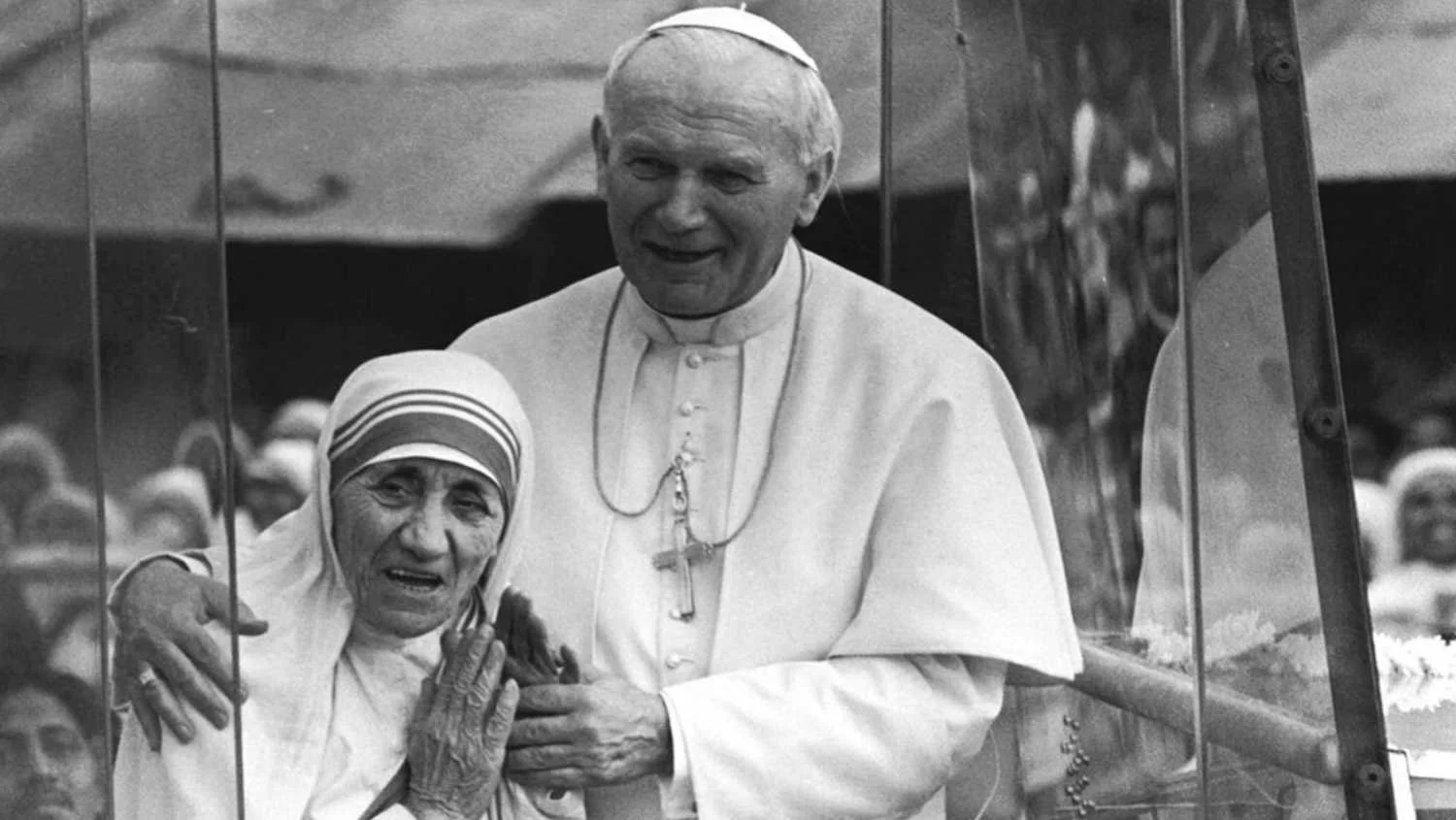
For Mother Teresa of Calcutta, Pentecost Illumined the Night
Discouragement is the deep spiritual valley of our age. For Mother Teresa of Calcutta, the Holy Spirit’s light came only at dawn in a long dark night of the soul.
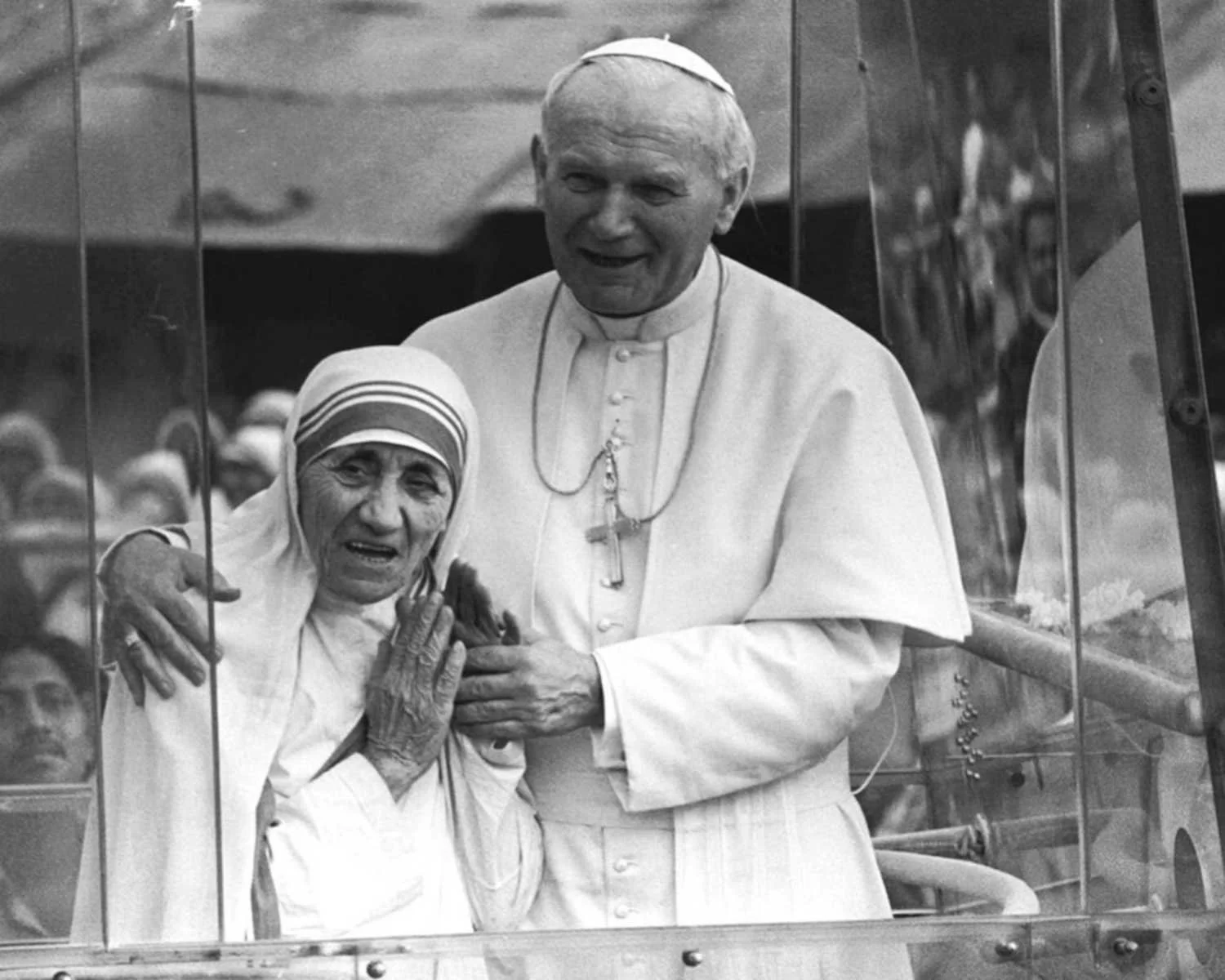
Discouragement is the deep spiritual valley of our age. For Mother Teresa of Calcutta, the Holy Spirit’s light came only at dawn in a long dark night of the soul.
May 13, 2026 by Father Gordon MacRae
I grew up a few miles north of Boston in an area known locally as the North Shore. Well, it is called that in print anyway. In conversation, it comes out something like, “the Noath Shoah.” I never knew that until I moved to another part of the country where people inexplicably pronounce the letter “R.” Anyway, I have lived in so many places since then that I have lost much of my Boston accent, but I can still translate it when I hear it.
There is an old North Shore saying, “Light finally dawns upon Marblehead.” I am not sure of its origin, but it makes logical sense. The seaside town of Marblehead is at the head of a deep harbor north of Boston, so the dawn’s early light is seen there a few seconds later than in other North Shore coastal towns. Its figurative meaning is that some reality that has been eluding us is now finally made clear.
Light finally dawned upon Marblehead today when I set out to write about Pentecost and ended up writing about Saint Mother Teresa of Calcutta. There is a connection that I had to spend some time ferreting out, and that is when the light finally dawned. I learned something important about her, and in the process, about myself.
But first, I know I am going to have a hard time dropping “Mother” from her name. “Saint” Teresa seems incomplete and already taken. So I guess that like Saint Padre Pio, she will be forever endowed with a title that has become a necessary part of her name. I am going to have to call her Saint Mother Teresa of Calcutta, and it has slowly caught on.
She was canonized on September 4, 2016, the eve of the date of her death in 1997. In life the person she was, the spirit she is, was eclipsed by the sorrowful mysteries of the poor to whom she devoted her life. The images of her presence among the poor, the disfigured, the utterly broken and rejected — even the despised — have always been part of the background landscape of my life as a priest, but to be honest I could never bring myself to linger on those scenes. They were just too painful. They always left me with a sense of inadequacy as a priest, afraid to look upon the broken too long lest I feel compelled to follow her lead.
I admired Mother Teresa’s presence at the peripheries of human suffering, but as a priest I admired it from too much of a safe distance. That troubles me today. I had to be compelled in priesthood to carry the cross of the outcast, a cross that brought me unwillingly to the scene of that post-resurrection appearance to Simon Peter in the Gospel of John.
“Truly, truly I say to you, when you were young, you fastened your own belt and walked where you would; but when you are old, you will stretch out your hands, and another will fasten your belt for you and carry you where you do not wish to go.”
— John 21:18
I have experienced those ominous words of John’s Gospel in a literal and terrifying way, but I found companions and some inner peace along the way as well. I wrote of one recently in “A Lesson From Saint Damien of Molokai, Leper Priest.” It was about how disappointment and discouragement have been part of my own dark night of the soul for thirty-two long years, and how Saint Damien of Molokai — whose feast day was observed on May 10 — taught me what my priorities must be in a life among prisoners.
And you know from many posts that I found other companions and mentors in Saint Maximilian Kolbe and Saint Padre Pio who have shown me by example that my life bound over by earthly powers must be lived out at the foot of Cross. In prison, others have joined me there, many others, but I remain in the dark.
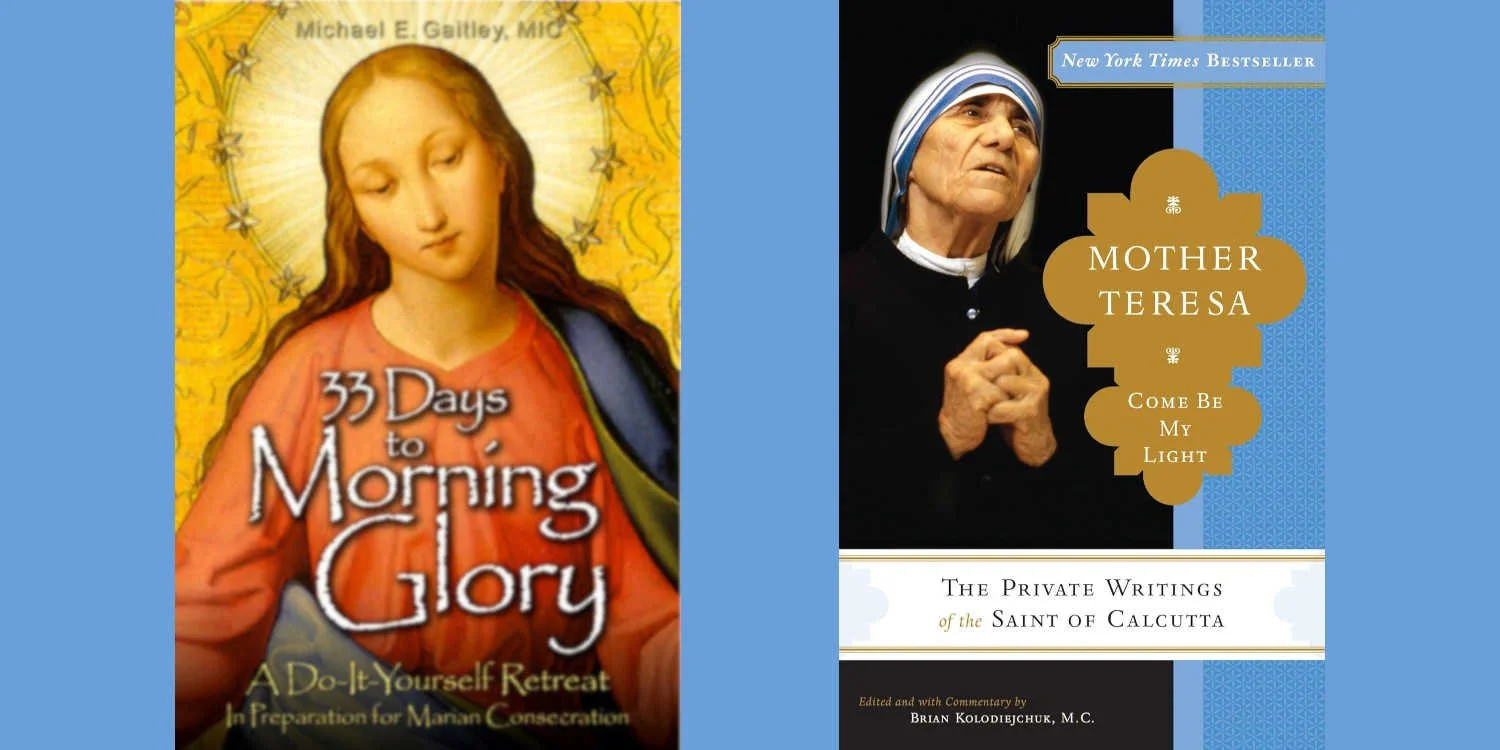
Come Be My Light
Now I present this new friend at the foot of the Cross in the life of Mother Teresa of Calcutta, but I had to first shed all my assumptions about her. It is a little intimidating that she was awarded the Nobel Peace Prize in 1979 for her witness to the world’s broken, abandoned and poor. In life Mother Teresa was revered as a living saint. I just assumed that for her to be that person, to do the work that she did, Mother Teresa must have been given a gift of daily awareness of the light of supernatural grace that flowed within her and shined through her. Otherwise, I thought, she would just sink into dark desolation just as I have been known to do with far less in the way of grace to count on.
And when I do sink into that desolation, I sometimes stay for days, weeks, months, at one point in my imprisonment before Beyond These Stone Walls began, even years. And if my mail is any indication, many of you have had that same experience. Please, do not come to Beyond These Stone Walls because misery loves company. It really does not. Come here because together we can manage crosses of discouragement that alone might only elude us and crush our spirits. You cannot just go to Home Depot to buy a weed whacker to wipe out desolation. It is best to have someone show you how to use it.
I was wrong about Mother Teresa, about my image of her basking in the reflected glow of the Holy Spirit. About a year after I started writing for this blog, I was given a copy of Mother Teresa’s Come Be My Light (Doubleday 2007) and my presumptions about her life in grace were quickly dispelled.
Some of the shallow secular media made a big deal of this book, presenting it as the latest Catholic scandal that the great Living Saint among us had long bouts of doubt and desolation. But for me she became human again, and an icon not so much of living grace, but of grace hard won through great spiritual struggle. Like Saint Maximilian Kolbe, she became someone I could let in, and learn from.
Centuries of Catholic art tend to depict the saints among us with halos, in a state of ecstatic pose before the True Presence. Mother Teresa’s own writings convey her struggle to survive spiritually in the present absence. In that, I can relate. In that, I find much hope. That sense of absence is something I have taken up in other posts (see “Priesthood in the Real Presence and the Present Absence”).
Through letters to her spiritual director, Come Be My Light is a guided tour of the interior life of this courageous woman whose heart “burned with the fire of charity” while at the same time experienced doubt and spiritual darkness in “a true dark night of the soul.” I began to do what she did, to pray not so much to be free of spiritual desolation, but to be free to serve even in the midst of it. Mother Teresa did that well. I get, at best, a C-minus, but I am still reading the book!
A part of it reminds me so much of something Canadian Catholic writer Michael Brandon wrote some time back in “All Things Turn to Good” at his Freedom Through Truth blog. While writing of the news of the failure of the justice system to pursue justice for me, Michael quoted another Saint Teresa, Saint Teresa of Avila, who once wrote, “God, if this is how You treat Your friends, it’s no wonder that you have so few.” When our friend, Pornchai Moontri, read that quote, it made him laugh. He had been having a hard time with discouragement over my plight, but the quote put it into perspective for him.
Do not read Come Be My Light in one sitting. Keep it on your night stand and read it prayerfully, a letter a day perhaps, or even reserved for moments in your own dark night. It has gotten me through many of my own. She is fast becoming the Patron Saint of “Get-off-your-priestly-arse-and-do-something-for-someone-instead-of-moping-about!”
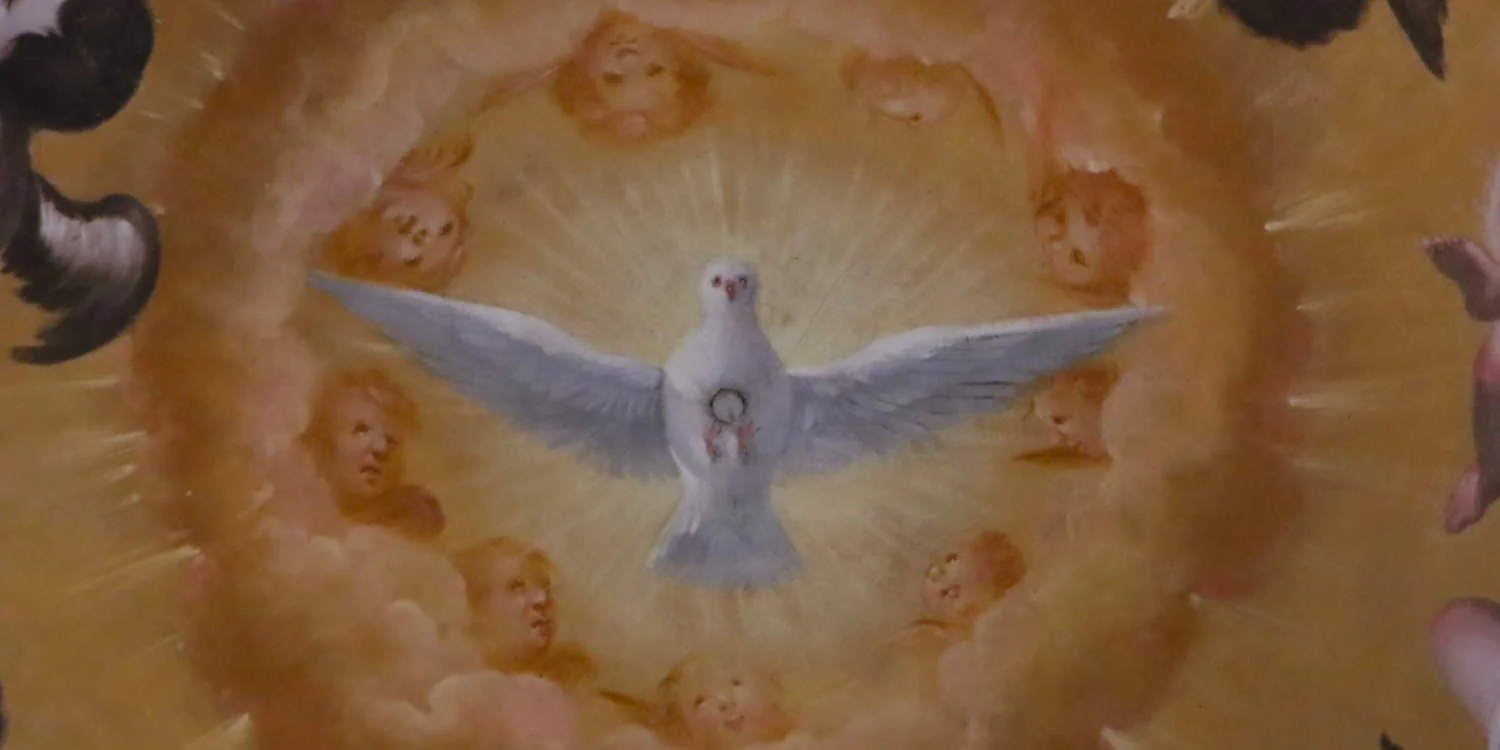
The Advocate
There is a little side story to tell. While composing this post, I had left my copy of Come Be My Light in the prison library where I work, but I had only a Saturday afternoon to finish this post and get it into the mail. The library is closed on weekends so I had no way to retrieve the book. On Saturday morning, I remembered that Father Michael Gaitley had an entire section about the Marian consecration of Mother Teresa in his book, 33 Days to Morning Glory.
But I had left that book in the library as well! When I mentioned that to Pornchai, who was still here with me then, he said, “Well, there’s at least ten of them right here in this unit.” Then it struck me. How is it even possible that out of sixty prisoners in this one prison cell block, ten of them have completed 33 Days to Morning Glory and entered into Marian Consecration? That is one out of every six prisoners in our field of view. So all I had to do was walk to the cell next to mine and borrow the book. Duh!
When I did, I opened to the Table of Contents and was instantly reminded that three of my favorite saints comprise weeks two, three, and four of Father Gaitley’s 33 Days to Morning Glory, retreat. They are Saints Maximilian Kolbe, Mother Teresa, and John Paul II, and all are saints of the Twentieth Century.
I thought I had read this book cover to cover, but while looking at the Table of Contents to find the section on Mother Teresa, I unconsciously thumbed back two pages, and stopped on a name that jumped off the page at me. It was a short review of 33 Days by Father James McCurry, formerly Minister Provincial of the Conventual Franciscans, the order to which Saint Maximilian Kolbe belonged and the Vice Postulator for his cause for sainthood. How could I not have seen this before?
Many years ago, Father James McCurry came to visit me in prison. I had never previously met him, and today I cannot really explain what brought him here except a vague memory that he was passing through and heard of me through a friend of a friend. In the prison visiting room, Father McCurry asked, “What do you know of Saint Maximilian Kolbe?” It was a question that would change my life, and then change the life of Pornchai Moontri, and then others as well. I wrote of this first encounter with a Patron Saint in “The Parable of a Priest and the Parable of a Prisoner.”
So in searching for a section on Mother Teresa, she pointed me back to an old friend. The interconnections between everyone in this story are mind-boggling. Father McCurry wrote that the essence of Marian consecration is …
“St. Maximilian Kolbe’s mystical intuition about the interior life of Mary and the Holy Spirit in the life of a consecrant; Blessed Mother Teresa’s experience of Mary drawing us into her heart, where Jesus keeps repeating, ‘I thirst’; and St. John Paul’s understanding that consecration to Mary brings us to the source of merciful love — the Divine Mercy poised to transform the world.”
That is when the light finally dawned upon Marblehead! I realized that the world I am thrown into is in fact being transformed in spite of my protests about being here in the first place. Some around me — the poor, the outcasts, the discarded, the lepers, the criminals — are being transformed. How could it possibly have happened that one out of every six of these men around me in prison now lives a life consecrated to Jesus through Mary? How is it that the saints whose intercession I keep pursuing are already engaged in a work that has eluded me? Then I read in the Gospel:
“I have told you this while I am with you. The Advocate, the Holy Spirit, whom the Father will send in my name, will teach you everything and remind you of all that I told you. Peace I leave with you; my peace I give you. Not as the world gives do I give it to you. Do not let your hearts be troubled or afraid.”
— John 14:25-28
This brings to light what Saint Mother Teresa of Calcutta learned in the dark. The Holy Spirit was her Advocate not in any obvious glory, but in desolation, and it was from there on the very edges of suffering humanity that she led countless souls to Christ, and witnessed to the world that the Lord hears the cry of the poor.
“It is beautiful to see the humility of Christ. This humility can be seen in the crib, in the exile in Egypt, in the hidden life, in the inability to make people understand him, in the desertion of his apostles, in the hatred of the Jews, and all the terrible suffering and death of his passion, and now in his permanent state of humility in the tabernacle, where he has rendered himself to such a small particle of bread that the priest can hold him with two fingers.”
— Mother Teresa of Calcutta
+ + +
Note from Father Gordon MacRae: We could extend the same invitation to Saint Mother Teresa that she extended to the Holy Spirit: Come Be My Light.
Thank you for reading and sharing this post about a great saint of our age. You may also like these related posts at Beyond These Stone Walls:
Lesson From Saint Damien of Molokai, Leper Priest
The Parable of a Priest and the Parable of a Prisoner

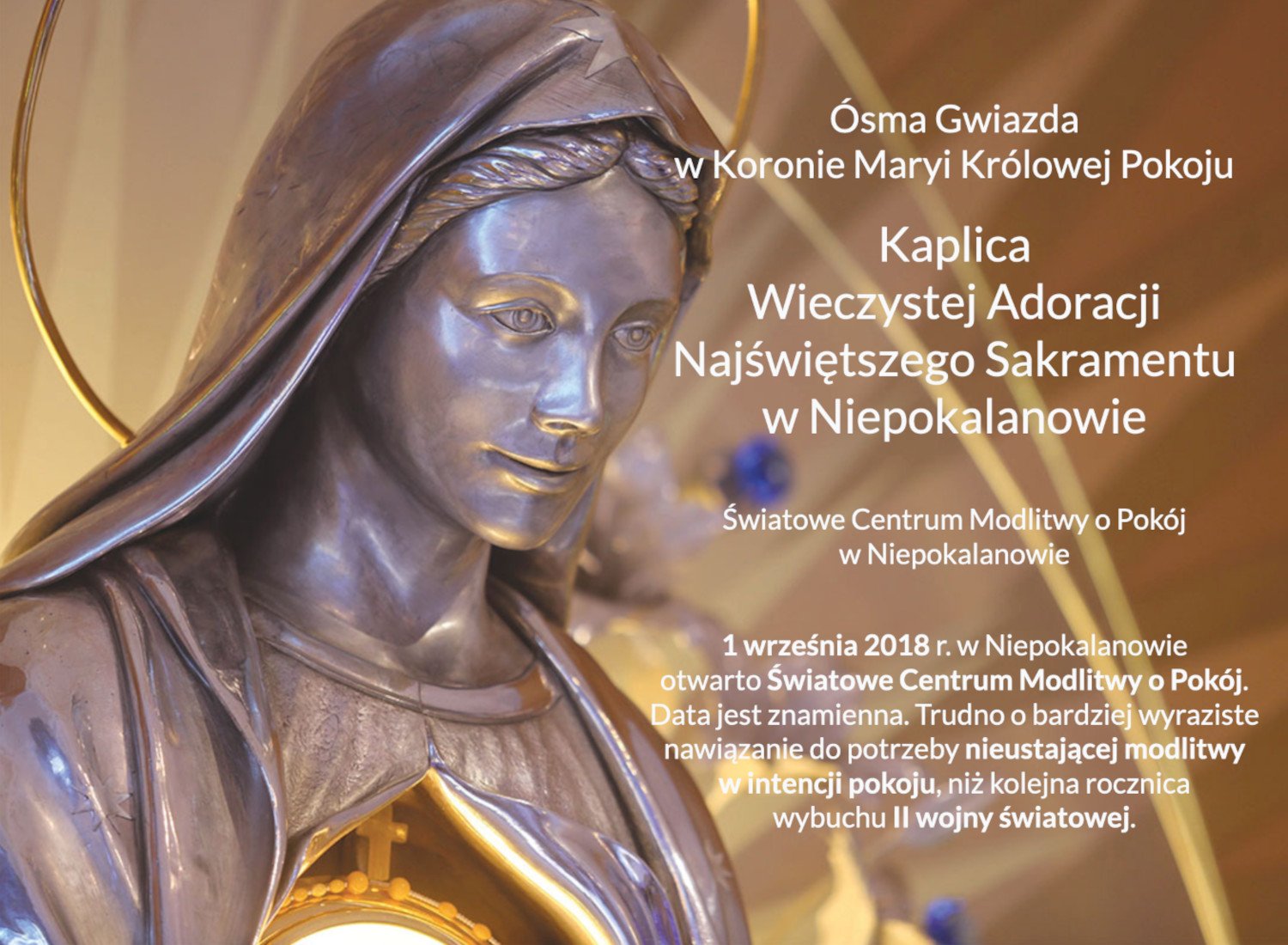

The Eucharistic Adoration Chapel established by Saint Maximilian Kolbe was inaugurated at the outbreak of World War II. It was restored as a Chapel of Adoration in September, 2018, the commemoration of the date that the war began. It is now part of the World Center of Prayer for Peace. The live internet feed of the Adoration Chapel at Niepokalanow — sponsored by EWTN — was established just a few weeks before we discovered it and began to include in at Beyond These Stone Walls. Click “Watch on YouTube” in the lower left corner to see how many people around the world are present there with you. The number appears below the symbol for EWTN.
Click or tap here to proceed to the Adoration Chapel.
The following is a translation from the Polish in the image above: “Eighth Star in the Crown of Mary Queen of Peace” “Chapel of Perpetual Adoration of the Blessed Sacrament at Niepokalanow. World Center of Prayer for Peace.” “On September 1, 2018, the World Center of Prayer for Peace in Niepokalanow was opened. It would be difficult to find a more expressive reference to the need for constant prayer for peace than the anniversary of the outbreak of World War II.”
For the Catholic theology behind this image, visit my post, “The Ark of the Covenant and the Mother of God.”

Of Saints and Souls and Earthly Woes
For Catholics, the month of November honors our beloved dead, and is a time to reenforce our civil liberties especially the one most endangered: Religious Freedom.

For Catholics, the month of November honors our beloved dead, and is a time to reinforce our civil liberties especially the one most endangered: Religious Freedom.
The Commemoration of All Saints and All Souls by Fr. Gordon MacRae
A lot of attention has been paid to a recent post by Pornchai Moontri. Writing in my stead from Thailand, his post was “Elephants and Men and Tragedy in Thailand.” Many readers were able to put a terrible tragedy into spiritual perspective. Writer Dorothy R. Stein commented on it: “The Kingdom of Thailand weeps for its children. Only a wounded healer like Mr. Pornchai Moontri could tell such a devastating story and yet leave readers feeling inspired and hopeful. This is indeed a gift. I have read many accounts of this tragedy, but none told with such elegant grace.”
A few years ago I wrote of the sting of death, and the story of how one particular friend’s tragic death stung very deeply. But there is far more to the death of loved ones than its sting. A decade ago at this time I wrote a post that helped some readers explore a dimension of death they had not considered. It focused not only on the sense of loss that accompanies the deaths of those we love, but also on the link we still share with them. It gave meaning to that “Holy Longing” that extends beyond death — for them and for us — and suggested a way to live in a continuity of relationship with those who have died. The All Souls Day Commemoration in the Roman Missal also describes this relationship:
“The Church, after celebrating the Feast of All Saints, prays for all who in the purifying suffering of purgatory await the day when they will join in their company. The celebration of the Mass, which re-enacts the sacrifice of Calvary, has always been the principal means by which the Church fulfills the great commandment of charity toward the dead. Even after death, our relationship with our beloved dead is not broken.”
That waiting, and our sometimes excruciatingly painful experience of loss, is “The Holy Longing.” The people we have loved and lost are not really lost. They are still our family, our friends, and our fellow travelers, and we shouldn’t travel with them in silence. The month of November is a time to restore our spiritual connection with departed loved ones. If you know others who have suffered the deaths of family and friends, please share with them a link to “The Holy Longing: An All Souls Day Spark for Broken Hearts.”

The Communion of Saints
I have written many times about the saints who inspire us on this arduous path. The posts that come most immediately to mind are “A Tale of Two Priests: Maximilian Kolbe and John Paul II,” and more recently, “With Padre Pio When the Worst that Could Happen Happens.” Saint Maximilian Kolbe and Saint Padre Pio inspire me not because I have so much in common with them, but because I have so little. I am not at all like them, but I came to know them because I was drawn to the ways they faced and coped with adversity in their lives on Earth.
Patron saints really are advocates in Heaven, but the story is bigger than that. To have patron saints means something deeper than just hoping to share in the graces for which they suffered. It means to be in a relationship with them as role models for our inevitable encounter with human trials and suffering. They can advocate not only for us, but for the souls of those we entrust to their intercession. In the Presence of God, they are more like a lens for us, and not dispensers of grace in their own right. The Protestant critique that Catholics “pray to saints” has it all wrong.
To be in a relationship with patron saints means much more than just waiting for their help in times of need. I have learned a few humbling things this year about the dynamics of a relationship with Saints Maximilian Kolbe and Padre Pio. I have tried to consciously cope with painful things the way they did, and over time they opened my eyes about what it means to have their advocacy. It is an advocacy I would not need if I were even remotely like them. It is an advocacy I need very much, and can no longer live without.
I don’t think we choose the saints who will be our patrons and advocates in Heaven. I think they choose us. In ways both subtle and profound, they interject their presence in our lives. I came into my unjust imprisonment decades ago knowing little to nothing of Saints Maximilian Kolbe and Padre Pio. But in multiple posts at Beyond These Stone Walls I have written of how they made their presence here known. And in that process, I have learned a lot about why they’re now in my life. It is not because they look upon me and see their own paths. It is because they look upon me and see how much and how easily I stray from their paths.
I recently discovered something about the intervention of these saints that is at the same time humbling and deeply consoling. It is consoling because it affirms for me that these modern saints have made themselves a part of what I must bear each day. It is humbling because that fact requires shedding all my notions that their intercession means a rescue from the crosses I would just as soon not carry.
Over the last few years, I have had to live with something that is very painful — physically very painful — and sometimes so intensely so that I could focus on little else. In prison, there are not many ways to escape from pain. I can purchase some over-the-counter ibuprophen in the prison commissary, but that’ is sort of like fighting a raging forest fire with bottled water. It is not very effective. At times, the relentless pain flared up and got the better of me, and I became depressed. There are not many ways to escape depression in prison either. The combination of nagging pain and depression began to interfere with everything I was doing, and others started to notice. The daily barrage of foul language and constantly loud prison noise that I have heard non-stop for decades suddenly had the effect of a rough rasp being dragged across the surface of my brain. Many of you know exactly what I mean.
So one night, I asked Saint Padre Pio to intercede that I might be delivered from this awful nagging pain. I fell off to sleep actually feeling a little hopeful, but it was not to be. The next morning I awoke to discover my cross of pain even heavier than the night before. Then suddenly I became aware that I had just asked Padre Pio — a soul who in life bore the penetrating pain of the wounds of Christ without relief for fifty years — to nudge the Lord to free me from my pain. What was I thinking?! That awareness was a spiritually more humbling moment than any physical pain I have ever had to bear.
So for now, at least, I will live with this pain, and even embrace it, but I am no longer depressed about it. Situational depression, I have learned, comes when you expect an outcome other than the one you have. I no longer expect Padre Pio to rescue me from my pain, so I am no longer depressed. I now see that my relationship with him is not going to be based upon being pain-free. It is going to be what it was initially, and what I had allowed to lapse. It is the example of how he coped with suffering by turning himself over to grace, and by making an offering of what he suffered.
A rescue would sure be nice, but his example is, in the long run, a lot more effective. I know myself. If I awake tomorrow and this pain is gone forever, I will thank Saint Padre Pio. Then just as soon as my next cross comes my way — as I once described in “A Shower of Roses” — I will begin to doubt that the saint had anything to do with my release.
His example, on the other hand, is something I can learn from, and emulate. The truth is that few, if any, of the saints we revere were themselves rescued from what they suffered and endured in this life. We do not seek their intercession because they were rescued. We seek their intercession because they bore all for Christ. They bore their own suffering as though it were a shield of honor and they are going to show us how we can bear our own.

For Greater Glory
Back in 2010 when my friend Pornchai Moontri was preparing to be received into the Church, he asked one of his “upside down” questions. I called them “upside down” questions because as I lay in the bunk in our prison cell reading late at night, his head would pop down from the upper bunk so he appeared upside down to me as he asked a question. “When people pray to saints do they really expect a miracle?” I asked for an example, and he said, “Should you or I ask Saint Maximilian Kolbe for a happy ending when he didn’t have one himself?”
I wonder if Pornchai knew how incredibly irritating it was when he stumbled spontaneously upon a spiritual truth that I had spent months working out in my own soul. Pornchai’s insight was true, but an inconvenient truth — inconvenient by Earthly hopes, anyway. The truth about Auschwitz, and even a very long prison sentence, was that all hope for rescue was the first hope to die among any of its occupants. As Maximilian Kolbe lay in that Auschwitz bunker chained to, but outliving, his fellow prisoners being slowly starved to death, did he expect to be rescued?
All available evidence says otherwise. Father Maximilian Kolbe led his fellow sufferers into and through a death that robbed their Nazi persecutors of the power and meaning they intended for that obscene gesture. How ironic would it be for me to now place my hope for rescue from an unjust and uncomfortable imprisonment at the feet of Saint Maximilian Kolbe? Just having such an expectation is more humiliating than prison itself. Devotion to Saint Maximilian Kolbe helped us face prison bravely. It does not deliver us from prison walls, but rather from their power to stifle our souls.
I know exactly what brought about Pornchai’s question. Each weekend when there were no programs and few activities in prison, DVD films were broadcast on a closed circuit in-house television channel. Thanks to a reader, a DVD of the soul-stirring film, “For Greater Glory” was donated to the prison. That evening we were able to watch the great film. It was an hour or two after viewing this film that Pornchai asked his “upside-down” question.
“For Greater Glory” is one of the most stunning and compelling films of recent decades. You must not miss it. It is the historically accurate story of the Cristero War in Mexico in 1926. Academy Award nominee Andy Garcia portrays General Enrique Gorostieta Delarde in a riveting performance as the leader of Mexico’s citizen rebellion against the efforts of a socialist regime to diminish and then eradicate religious liberty and public expressions of Christianity, especially Catholic faith.
If you have not seen “For Greater Glory,” I urge you to do so. Its message is especially important before drawing any conclusions about the importance of the issue of religious liberty now facing Americans and all of Western Culture. As readers in the United States know well, in 2026 we face a most important election for the future direction of Congress and the Senate.
“For Greater Glory” is an entirely true account, and portrays well the slippery slope from a government that tramples upon religious freedom to the actual persecution, suppression and cancelation of priests and expressions of Catholic faith and witness. If you think it could not happen here, think again. It could not happen in Mexico either, but it did. We may not see our priests publicly executed, but we are already seeing them in prison without due process, and even silenced by their own bishops, sometimes just for boldly speaking the truth of the Gospel. You have seen the practice of your faith diminished as “non-essential” by government dictate during a pandemic.
The real star of this film — and I warn you, it will break your heart — is the heroic soul of young José Luis Sánchez del Río, a teen whose commitment to Christ and his faith resulted in horrible torment and torture. If this film were solely the creation of Hollywood, there would have been a happy ending. José would have been rescued to live happily ever after. It is not Hollywood, however; it is real. José’s final tortured scream of “Viva Cristo Rey!” is something I will remember forever.
I cried, finally, at the end as I read in the film’s postscript that José Luis Sánchez del Río was beatified as a martyr by Pope Benedict XVI after his elevation to the papacy in 2005. Saint José was canonized October 16, 2016 by Pope Francis, a new Patron Saint of Religious Liberty. His Feast Day is February 10. José’s final “Viva Cristo Rey!” echoes across the century, across all of North America, across the globe, to empower a quest for freedom that can be found only where young José found it.
“Viva Cristo Rey!”
+ + +
Note from Fr. Gordon MacRae: Our Faith is a matter of life and death, and it diminishes to our spiritual peril. Please share this post. You may also like these related posts to honor our beloved dead in the month of November.
Elephants and Men and Tragedy in Thailand
The Holy Longing: An All Souls Day Spark for Broken Hearts


Thanksgiving in the Reign of Christ the King
While American tradition offers thanks in the land of the free and the home of the brave, some still await the promise of freedom with a bravery found in defiant hope.

While American tradition offers thanks in the land of the free and the home of the brave, some still await the promise of freedom with a bravery found in defiant hope.
November 20, 2024 by Father Gordon MacRae
Before celebrating Thanksgiving in America — even if you’re not in America — I will be asking the readers of Beyond These Stone Walls to ponder my post for next week. It has become a Thanksgiving tradition at this blog so I will post it anew on the day before Thanksgiving in America. Some readers have said that it has become a part of their own Thanksgiving observance. Its point is clear. Not everyone lives a privileged life. Not everyone even lives a life in freedom. But in the land of the free and the home of the brave, everyone can find reason to give thanks in the Reign of Christ the King.
The story next week’s post will tell is a true account of history that most other sources left in the footnotes. It is also a story that has deep meaning for us who have endured painful losses in this odyssey called life, the loss of loved ones, the loss of health, of happiness, of hope, the unjust loss of freedom. For some, the litany of loss can be long and painful, and it could drive us all into an annual major holiday depression.
It has helped me and those around me to consider the story of Squanto. History is too often passed down by victors alone. The story of the Mayflower Pilgrims who fled religious persecution (though they didn’t really) to endure the wilds of a brave new world (though they didn’t endure it without help) is well known. But it has been stripped of a far more accurate and inspiring story under its surface.
It is the story of Tisquantum, known to history as Squanto, the sole survivor of a place the indigenous called “The Dawn Land,” now known as Plymouth, Massachusetts. Having been chained up and taken on an odyssey of my own, I found very special meaning in the story of Squanto’s quiet but powerful impact on American history. So will you.
If you have followed our posts, then you know that a spirit of Thanksgiving has been elusive for us behind these stone walls. But with a little time and perspective, my friends here and I find that our list of all for which we give thanks has actually grown in size, scope, and clarity.
From the earliest days of BTSW since its inception in 2009, we have tried to live within a single core principle. I first discovered it in the classic book by Viktor Frankl, Man’s Search for Meaning (Beacon Press 1992). It promotes a fundamental truth about coping with life’s litany of loss with a central liberating theme: “The one freedom that can never be taken from us is the freedom to choose the person we will be in any circumstance.”
In Frankl’s own words, his story of survival in Auschwitz, the darkest of prisons, was in part inspired by the same person who inspires us. Saint Maximilian Kolbe was a prisoner, but he was first and foremost a Catholic priest who survived heroically by giving his life to save another. “Survived” might seem a strange word to use. Father Maximilian Kolbe was murdered, his earthly remains reduced to smoke and ash to drift in the skies above Auschwitz.
But he survives still. I am certain of this. The Nazi commandant whose power over others extinguished countless lives is now just a footnote on history. I don’t even know his name. But Saint Maximilian lives forever among the communion of saints. He lives in mysterious communion with us behind these stone walls with the same truth that inspired Victor Frankl to survive Auschwitz and write his own story of survival:
“We must never forget that we also find meaning in life even when confronted by a hopeless situation. For what then matters is to bear witness to the uniquely human potential to turn a personal tragedy into a triumph. When we are no longer able to change a situation … we are challenged to change ourselves.”
— Man’s Search for Meaning, p. 116
A friend recently sent me a revision of the famous “Serenity Prayer.” It struck me as an awesome truth and I reposted it a while back in another post, God, Grant Me Serenity. I’ll be Waiting. I find myself sharing this revised version often now with prisoners who come to me with a litany of grief and sorrow:
“God grant me Serenity to accept
the people I cannot change,
The Courage to change
the only one I can,
And the Wisdom to know
that it’s me.”

The Folly of Living with Resentment
One of the two patron saints who empower this blog is Saint Maximilian Kolbe. I have been very much informed by the course of his life in light of his sacrifices. Today my priesthood feels meaningless unless I don the glasses that Father Maximilian wore in prison. If I cannot see what he saw, then what I suffer is meaningless and empty.
But I have seen it. You may recall our post just a week ago, “Thailand’s Once-Lost Son Was Flag Bearer for the Asian Apostolic Congress.” You may have noticed the top graphic on that post. My friend, Pornchai Maximilian Moontri, was wearing a very special shirt sent to him in Thailand by one of our readers. It says “Without sacrifice there is no love.” The quote is attributed to Saint Maximilian Kolbe, and the shirt is emblazoned with his Auschwitz prison number, 16670. I told Max that if he puts this T-shirt on, he will never see his life and suffering the same way again. So I marvel at the fact that he not only put it on, but he wore it for all the world to see.
Sometimes readers write to ask me how it is that I am still (relatively?) sane after 30 years of unjust imprisonment with continually rising and then falling hope. They ask how it is that I still have faith, and why I do not seem to be bitter or resentful when I write. But I HAVE been bitter and resentful about the losses and sorrows life has tossed at me. It is just that I came to recognize that living in anger and resentment is like mixing a toxic brew for our enemies and then drinking it ourselves. It is to live in a self-imposed prison, a relentless assault upon your very soul.
Once you become ready to let go of bitterness and cease to be governed by resentment, faith and hope are what grow in its place. It is like a plant that springs up from a tiny crack in the urban concrete. You simply cannot hold onto your bitterness and your faith at the same time. One of them always gives way to the other.
I find lots of inspiration for this from the readers of this blog. Consider Fr William Graham of the Diocese of Duluth, Minnesota who spent eight years in exile, publicly shamed and his priestly ministry suspended. I wrote of his plight and its most recent development in “After Eight Years in Exile Fr William Graham Is Credibly Innocent.”
He had been falsely accused and cast out in 2016 after his bishop deemed a nearly 40-year-old claim against him to be “credible.” “Credible” is a vague and much abused term used in no other setting but American Catholic priesthood in the age of suspicion. As a legal standard, it means no more than the fact that a priest and an accuser lived in the same geographic area 30, 40, or 50 years ago. If an accusation “could have happened,” then it is seen by our bishops and their lawyers and insurers as “credible.”
After eight years in exile with a dark cloud of accusation hanging over his head, Father Graham was fully exonerated. He returned to ministry in the parish from which he was banished. He returned just in time to file his request for retirement and he moved on to a safer, quieter life with his priesthood intact. In spite of all that befell him, Father Graham believes that he has much to be thankful for. Throughout, Father Graham reported that he found both solace and hope in Beyond These Stone Walls, and it was a lantern during his darker times. Now he is free.

My Thanksgiving for Irony
And I am also thankful for the inspiration of irony. If you have been reading our posts all along, our stories are filled with it. Here’s a very moving example sent to me from a dear reader, the late Kathleen Riney. Kathleen was a retired nurse living in Texas. Her beloved husband, Tom, died from cancer, and Kathleen wrote that she found spiritual refuge in Beyond These Stone Walls.
Before her own death Kathleen wrote to me near the September 23 feast day of Saint Padre Pio, which is also the anniversary of my false imprisonment. I had written a post then that included the “Prayer after Communion” composed by Saint Padre Pio. I sent the post and prayer to Kathleen Riney who was caring for her dying husband at home.
Kathleen wrote that while her husband, Tom, was in the last weeks of his life, she gave him a copy of that prayer printed from that older post. The downloaded page had her name and email address at the top. She had rented a reclining hospital chair to help keep her husband comfortable. Many months after Tom died, Kathleen received this message in her email:
“Kathleen, my name is Kristine. I rented a hospital recliner. I found a paper with the “Stay With Me, Lord” prayer in the chair. I wanted to let you know that the prayer has helped me. I’m scheduled for surgery on November 1st and the surgery is the reason I rented the chair. Somehow that prayer found me and has strengthened me. I wanted to let you know that you touched a stranger in a great way!!! I will read it often. I hope all is well in your life. Thank you, Kristine.”
Accounts such as this are easy to dismiss as mere coincidence, but only if you really struggle to live life only on the surface without ever delving into what I recently called “the deep unseen” in the great Tapestry of God where our lives, through grace, become entangled with the Will of God. Padre Pio had many spiritual gifts in this life that I do not fully comprehend. I wonder if he ever thought that his “Prayer after Communion” would become like a message in a bottle cast into the sea where it would drift into the hands of someone known only to God. Here is that prayer in its entirety:
Padre Pio’s Prayer after Communion
Stay with me, Lord, for it is necessary to have You present so that I do not forget You. You know how easily I abandon You.
Stay with me, Lord, because I am weak and I need Your strength, that I may not fall so often.
Stay with me, Lord, for You are my life, and without You, I am without fervor.
Stay with me, Lord, for You are my light, and without You, I am in darkness.
Stay with me, Lord, to show me Your will.
Stay with me, Lord, so that I hear Your voice and follow You.
Stay with me, Lord, for I desire to love You very much, and always be in Your company.
Stay with me, Lord, if You wish me to be faithful to You.
Stay with me, Lord, for as poor as my soul is, I want it to be a place of consolation for You, a nest of love.
Stay with me, Jesus, for it is getting late and the day is coming to a close, and life passes; death, judgment, eternity approaches. It is necessary to renew my strength, so that I will not stop along the way and for that, I need You. It is getting late and death approaches. I fear the darkness, the temptations, the dryness, the cross, the sorrows. O how I need You, my Jesus, in this night of exile!
Stay with me tonight, Jesus, in life with all its dangers. I need You.
Let me recognize You as Your disciples did at the breaking of the bread, so that the Eucharistic Communion be the Light which disperses the darkness, the force which sustains me, the unique joy of my heart.
Stay with me, Lord, because at the hour of my death, I want to remain united to You, if not by communion, at least by grace and love.
Stay with me, Jesus, I do not ask for divine consolation, because I do not merit it, but the gift of Your Presence, oh yes, I ask this of You!
Stay with me, Lord, for it is You alone I look for, Your Love, Your Grace, Your Will, Your Heart, Your Spirit, because I love You and ask no other reward but to love You more and more.
With a firm love, I will love You with all my heart while on earth and continue to love You perfectly during all eternity.
Amen
This coming Sunday, the Sunday before Thanksgiving, the Church celebrates a most important Solemnity. Our politics consume all the press right now, and it is unavoidable. Only one truth is necessary this Thanksgiving. No matter who we elected president, Christ is our King!
+ + +
Note from Father Gordon MacRae: Whether we face the aftermath of our political struggles with sorrow or joy, our coming Thanksgiving requires a heart open to grace. Here are a few posts that I hope might light that lantern:
Four Hundred Years Since That First Thanksgiving
To Christ the King Through the Immaculate Heart of Mary
The Eucharistic Adoration Chapel established by Saint Maximilian Kolbe was inaugurated at the outbreak of World War II. It was restored as a Chapel of Adoration in September, 2018, the commemoration of the date that the war began. It is now part of the World Center of Prayer for Peace. The live internet feed of the Adoration Chapel at Niepokalanow — sponsored by EWTN — was established just a few weeks before we discovered it and began to include in at Beyond These Stone Walls. Click “Watch on YouTube” in the lower left corner to see how many people around the world are present there with you. The number appears below the symbol for EWTN.
Click or tap here to proceed to the Adoration Chapel.
The following is a translation from the Polish in the image above: “Eighth Star in the Crown of Mary Queen of Peace” “Chapel of Perpetual Adoration of the Blessed Sacrament at Niepokalanow. World Center of Prayer for Peace.” “On September 1, 2018, the World Center of Prayer for Peace in Niepokalanow was opened. It would be difficult to find a more expressive reference to the need for constant prayer for peace than the anniversary of the outbreak of World War II.”
For the Catholic theology behind this image, visit my post, “The Ark of the Covenant and the Mother of God.”

Saint Thérèse of Lisieux and the Gift of Life
There was once a Little Flower who became a spiritual giant. The Story of a Soul by Saint Thérèse of Lisieux inspired many souls. This is the story of just a few.

There was once a Little Flower who became a spiritual giant. The Story of a Soul by Saint Thérèse of Lisieux inspired many souls. This is the story of just a few.
Back in September, 2013, I happened upon a FOX News interview of Megan Kelly with Miriam Ibrahim. You may remember her as the young Sudanese woman who was cast into a Sudan prison with a death sentence. Miriam’s “crime” was two-fold. She married a Catholic, and then refused to renounce her Christian faith and convert to Islam. In chilling words, she spoke of having to give birth to her second child with her ankles chained in that prison cell. Her story received worldwide attention.
The courage of Miriam Ibrahim is inspiring. Her being a Christian and marrying a Catholic were both crimes punishable by death in her Islamic country, and she was given three days to recant. The world responded, and many intervened, including Pope Francis. Miriam Ibrahim is an extraordinary woman of immense courage and faith. My heart leapt at this exchange:
Megan Kelly: “But why not just say what they wanted to hear to save your life?”
Miriam: “If I did that it would mean I gave up. It’s not possible because it’s not true. I have committed no crime.”
I wonder today about the story that will be told to her child whose life began with a death sentence in that Sudanese prison. The story makes me wonder about the gift of life, about how Miriam’s Islamic captors would so casually extinguish it in the name of Sharia law and justice. It makes me wonder about what Western Culture could learn from such courage rooted in the sanctity of life and freedom. It makes me wonder about the raw courage of Miriam’s “fiat” to suffer not for its own sake, but for the sake of a message to the world.
I did have an ironic laugh, however, at the conclusion of the interview. Miriam Ibrahim now lives about twenty miles away from the prison in which I write. Megan Kelly asked her what her life is like now living in New Hampshire. Miriam paused thoughtfully and said, “Well, it’s better than a Sudanese prison!”
On that note, I sometimes wonder what draws so many people to visit me in prison from beyond these stone walls week after week. I have never once dropped a completed post in the prison mailbox and walked away thinking it might inspire anyone. I don’t think it’s a result of false humility, or the power of prisons everywhere to stifle any evidence of self-respect. I just don’t think that what I write is particularly noteworthy. I guess a part of that comes from reading a lot. I read so much from writers I admire that I never feel that anything I write could ever measure up to them.
All of which makes me wonder why it is that so many others write about what I write. Father James Valladares, PhD in Australia wrote a book a decade ago entitled Hope Springs Eternal in the Priestly Breast, about a third of the book references my writing at Beyond These Stone Walls. Then Dr. Bill Donohue of the Catholic League did the same in “Travesty of Justice: The Ordeal of Father Gordon MacRae” at the same time. Both of them generated lots of responses from around the globe.
One of the memorable responses appeared at Freedom Through Truth, the blog of Michael Brandon writing from Canada. His post “From Fear and Humility to Hope and Love” is a reflection on Bill Donohue’s guest post that rivals anything I write in depth and understanding. Then a few days later Mr. Brandon posted “The Parable of the Prisoner,” a post about Pornchai Maximilian and me. I had to wait for that one to arrive by mail because the person who tried to read it to me by telephone sobbed all the way through it.
I was so inspired by what Michael Brandon wrote that I forgot it was about me! I am always struck by the number of people, like the talented Catholic writer behind Freedom Through Truth who read Beyond These Stone Walls and tell me they felt as though I were writing directly to them. I am also struck by the many letters, comments, and posts by other writers all expressing the thought that, had I not been in such straits in prison, they would not have been drawn to what I write.

Thorns Before a Rose
As I try to wrap my mind around that, don’t think for a moment that I actually know what I’m doing when I write. I do not. I just plod along casting outposts like messages in a bottle cast into the sea. I am not gifted with the insight into the meaning of suffering that God has given to those I admire, those whose writings I write about, such as Saint Padre Pio, Saint Maximilian Kolbe, and this week, Saint Thérèse of Lisieux.
In “From Arizona State University: An Interview with Our Editor”, Dilia E. Rodríguez, PhD described the nuts and bolts of this blog (Pornchai Max might say “more nuts than bolts”) and how she became its editor. When this blog first began in 2009, my first posts were brief, and handwritten because at the time I had nothing more in this prison cell to write with than a Bic pen and some lined paper. There are few posts from back then that are still read today. But one that is, and that remains one of my most read and most shared posts today, is about an ordinary encounter with an extraordinary young woman. That post is “A Shower of Roses,” and since this post appears on BTSW on the day after the Feast Day of Saint Thérèse of Lisieux, I want to mention it again.
Readers may recall that back in 2013 my friend Pornchai Moontri and I took part in an “in-house” retreat based on the book 33 Days to Morning Glory by Marian Father Michael Gaitley. We recently featured an article about this from Felix Carroll in Marian Helper magazine, “‘Mary Is at Work Here’.” One evening during that retreat, our esteemed coordinator, Nate Chapman, mentioned that he had been awaiting a wonderful new book, Angels and Saints: A Biblical Guide to Friendship with God’s Holy Ones, by Scott Hahn (Image Books, 2014). I didn’t tell Nate that I had ordered that same book and it arrived just days before. One of its chapters is about Saint Thérèse of Lisieux, and Scott Hahn approached writing of her with the same trepidation I experienced:
“Her prodigy was her littleness – and, paradoxically, her littleness is so large that it can be frightening. For no other chapter in this book have I been so intimidated. For no other chapter have I stared so long at a blank page”
— Saints and Angels, p. 155
I know the feeling, Dr. Hahn! When I set out to write of Saint Thérèse, I was thoroughly intimidated as though my soul were but a tabula rasa — a blank slate — in the presence of pages that spoke volumes, Story of a Soul, in the Presence of God. I could not write of Saint Thérèse. I had no frame of reference with which to relate to someone whose footprint in this world was so small, yet one whose spiritual impact was so immense that Saint John Paul II declared her a Doctor of the Church, one of the 33 spiritual giants of Church history.
I could not really write about Saint Thérèse at all. I could only write about a chance encounter between us, a moment in my own life that somehow intersected with Saint Thérèse. It’s a snapshot in my life as a priest that changed the way I view faith, hope, and suffering, the way I live life toward dying.
“A Shower of Roses” is the story of Michelle, a suffering and dying teenage girl. With fear and trembling as a young priest, I took the hand of this girl as she surrendered her life. As I look back across 42 years of a priesthood mired in suffering, I keep going back to that moment, for it is filled with meaning and with mysteries yet to be unraveled.
There was a moment in which Saint Thérèse took that girl’s hand from mine, and in doing so, left an impression of how her suffering was a conduit between the soul and God. Consider these words of Saint Thérèse in Story of a Soul, the diary of a young woman leaving this life:
“My heart was fired with an ardent desire of suffering… Suffering became my attraction; in it I found charms that entranced me —Suffering has held out its arms to me from my very entrance to Carmel, and lovingly have I embraced it… For one pain endured with joy… we shall love the good God more forever — Suffering united to love is the only thing that appears to me desirable in this Vale of Tears.”
Unlike Saint Thérèse, but like most of the rest of us, I have spent a lot of time and effort struggling against suffering in many forms. I am daunted and intimidated by this little saint and her Story of a Soul, the story of her simple acquiescence to God’s will that turns every moment of suffering into an instrument of grace. It is the story of extraordinary grace reaching into souls through ordinary things, and it still shakes the earth beneath my feet.
Sometime in this month that opens with the Feast of Saint Thérèse of Lisieux, read anew and share with someone else “A Shower of Roses.”
+ + +
A Note from Father Gordon MacRae: Don’t stop here, Dear Readers. With all the is going on in the world, and going wrong with the world, it is not easy to keep a focus on all that really matters. So sometime today, this week, or this month come back here and read or reread a few gems, three of which were written by others, about the transformation of sacrificial suffering into glory:
A Shower of Roses by Fr Gordon MacRae
From Fear and Humility to Hope and Love by Michael Brandon
‘Mary Is at Work Here’ by Felix Carroll
From Arizona State University: An Interview with Our Editor by Dilia E. Rodríguez, PhD

The Eucharistic Adoration Chapel established by Saint Maximilian Kolbe was inaugurated at the outbreak of World War II. It was restored as a Chapel of Adoration in September, 2018, the commemoration of the date that the war began. It is now part of the World Center of Prayer for Peace. The live internet feed of the Adoration Chapel at Niepokalanow — sponsored by EWTN — was established just a few weeks before we discovered it and began to include in at Beyond These Stone Walls. Click “Watch on YouTube” in the lower left corner to see how many people around the world are present there with you. The number appears below the symbol for EWTN.
Click or tap here to proceed to the Adoration Chapel.
The following is a translation from the Polish in the image above: “Eighth Star in the Crown of Mary Queen of Peace” “Chapel of Perpetual Adoration of the Blessed Sacrament at Niepokalanow. World Center of Prayer for Peace.” “On September 1, 2018, the World Center of Prayer for Peace in Niepokalanow was opened. It would be difficult to find a more expressive reference to the need for constant prayer for peace than the anniversary of the outbreak of World War II.”
For the Catholic theology behind this image, visit my post, “The Ark of the Covenant and the Mother of God.”

Saints Alive! When Padre Pio and the Stigmata Were on Trial
Padre Pio was proclaimed a living saint for the wounds he bore for Christ, but his reputation for sanctity became another wound, this one inflicted from the Church.

Padre Pio was proclaimed a living saint for the wounds he bore for Christ, but his reputation for sanctity became another wound, this one inflicted from the Church.
September 20, 2023 by Fr Gordon MacRae
“Six Degrees of Separation,” a famous play by John Guare, became a 1993 film starring Will Smith, Donald Sutherland, and Stockard Channing. The plot revolved around a theory proposed in 1967 by sociologists Stanley Milgram and Frigyes Karinthy. Wikipedia describes “Six Degrees of Separation” as:
“The idea that everyone is at most six steps away from any other person on Earth, so that a chain of ‘a friend of a friend’ statements can be made to connect any two people in six steps or fewer.”
It’s an intriguing idea, and sometimes the connections are eerie. In “A Day Without Yesterday” I wrote about my long-time hero, Fr. Georges Lemaitre, the priest-physicist who changed the mind of Albert Einstein on the creation of the Universe. A few weeks after my post, a letter arrived from my good friend, Pierre Matthews in Belgium. Pierre sent me a photo of himself as a young man posing with his family and a family friend, the famous Father Lemaitre, in Switzerland in 1956. In a second photo, Pierre had just served Mass with the famous priest who later autographed the photo.
When I wrote of Father Lemaitre, I had no idea there are but two degrees of separation between me and this famous priest-scientist I’ve so long admired. The common connection we share with Pierre Matthews — not to mention the autographed photo — left me awestruck. The mathematical odds against such a connection are staggering. Something very similar happened later and also involving Pierre Matthews. It still jolts my senses when I think of it. The common bond this time was with Saint Padre Pio.
When Pierre visited me in prison in 2010, I told him about this blog which had been launched months earlier. When I told Pierre that I chose Saints Maximilian Kolbe and Padre Pio as the patrons of Beyond These Stone Walls, Pierre quietly and modestly said, “I’ve met Padre Pio.”
Pierre’s casual remark dropped like a bomb on our conversation. What were the odds that I would be sitting at a table in the prison visiting room with a man who traveled from Europe to tell me of how he met Padre Pio. The saint imposed his wounded and bandaged hands in blessing upon Pierre’s head over a half century earlier.
The labyrinthine ways of grace are far beyond my understanding. Pierre told me that as a youth growing up in Europe, his father enrolled him in a boarding school. When he wrote to his father about a planned visit to central Italy, his father instructed him to visit San Giovanni Rotondo and ask for Padre Pio’s blessing. Pierre, a 16-year-old at the time, had zero interest in visiting Padre Pio. But he obediently took a train to San Giovanni Rotondo. He waited there for hours. Padre Pio was nowhere to be seen.
Pierre then approached a friar and asked if he could see Padre Pio. ‘Impossible!’ he was told. Just then, he looked up and saw the famous Stigmatic walking down the stairs toward him. Padre Pio’s hands were bandaged and he wore gloves. The friar, following the young man’s gaze, whispered in Italian, ‘Do not touch his hands.’ Pierre trembled as Padre Pio approached him. He placed his bandaged hands upon Pierre’s head and whispered his blessing.
Fifty-five years later, in the visiting room of the New Hampshire State Prison, Pierre bowed his head and asked for my blessing. It was one of the most humbling experiences of my life. I placed my hand upon Pierre knowing that the spiritual imprint of Padre Pio’s blessing was still in and upon this man, and I was overwhelmed to share in it.
This wasn’t the first time I shared space with Padre Pio. Several years ago, in November 2005, we shared the cover of Catalyst, the Journal of the Catholic League for Religious and Civil Rights. I also share a painful date with Padre Pio. September 23 was the date he died in 1968. On September 23, 1994 I was put into chains and taken to prison to begin a life sentence for crimes that never took place.
That’s why we shared that cover of Catalyst. Catholic League President Bill Donohue wrote of his appearance on NBC’s “Today” show on October 13, 2005 during which he spoke of my trial and imprisonment declaring, “There is no segment of the American population with less civil liberties protection than the average American Catholic priest.” That issue of Catalyst also contained my first major article for The Catholic League, “Sex Abuse and Signs of Fraud” written from prison in 2005.

The Indictment of Heroic Virtue
Padre Pio was on that Catalyst cover because three years after he was canonized in 2002 by Pope John Paul II, Atlantic Monthly magazine carried a brief article by Tyler Cabot entitled “The Rocky Road to Sainthood” (November 2005). Of one of the most revered priests in Church history, Cabot wrote:
“Despite questions raised by two papal emissaries – and despite reported evidence that he raised money for right-wing religious groups and had sex with penitents – [Padre] Pio was canonized in 2002.”
I’m not sure whether the bigger scandal for Tyler Cabot and Atlantic Monthly was the sexual accusation or “raising money for right-wing religious groups.” Bill Donohue expressed surprise that such a “highly regarded magazine would publish such trash.” I was more dismayed than surprised by the irresponsibility. Yes, it’s irresponsible to tell half the story and present it as the truth.
It wasn’t the first time such attacks were launched against Padre Pio. Four years before his canonization, and thirty years after his death, The New York Times (September 24, 1998) carried an article charging that Padre Pio was the subject of no less than twelve Vatican investigations in his lifetime, and one of the investigations alleged that “Padre Pio had sex with female penitents twice a week.” It’s true that this was alleged, but it’s not the whole truth. The New York Times and Atlantic Monthly were simply following an agenda that should come as no surprise to anyone. I’ll describe below why these wild claims fell apart under scrutiny.
But first, I must write the sordid story of why Padre Pio was so accused. That’s the real scandal. It’s the story of how Padre Pio responded with heroic virtue to the experience of being falsely accused repeatedly from within the Church. His heroic virtue in the face of false witness is a trait we simply do not share. It far exceeds any grace ever given to me.

Twice Stigmatized
Early in the morning of September 20, 1918, at the age of 31, Francesco Forgione, known to the world as Padre Pio, received the Stigmata of Christ. He was horrified, and he begged the Lord to reconsider. Each morning in the month to follow, Padre Pio awoke with the hope that the wounds would be gone. He was terrified. After a month with the wounds, Padre Pio wrote a note to Padre Benedetto, his spiritual advisor, describing in simple, matter-of-fact terms what happened to him on that September 20 morning:
“On the morning of the 20th of last month, in the choir, after I had celebrated Mass . . . I saw before me a mysterious person similar to the one I had seen on the evening of 5 August. The only difference was that his hands and feet and side were dripping blood. The sight terrified me and what I felt at that moment is indescribable. I thought I should die and really should have died if the Lord had not intervened and strengthened my heart which was about to burst out of my chest.
“The vision disappeared and I became aware that my hands and feet and side were dripping blood. Imagine the agony I experienced and continue to experience almost every day. The heart wound bleeds continually, especially from Thursday evening until Saturday.
“Dear Father, I am dying of pain because of the wounds and the resulting embarrassment I feel in my soul. I am afraid I shall bleed to death if the Lord does not hear my heartfelt supplication to relieve me of this condition.
“Will Jesus, who is so good, grant me this grace? Will he at least free me from the embarrassment caused by these outward signs? I will raise my voice and will not stop imploring him until in his mercy he takes away . . . these outward signs which cause me such embarrassment and unbearable humiliation.”
— Letters 1, No. 511
And so it began. What Padre Pio faced that September morning set in motion five decades of suspicion, accusation, and denunciation not from the secular world, but from the Catholic one. From within his own Church, Padre Pio’s visible wounds brought about exactly what he feared in his pleading letter to his spiritual director. The wounds signified in Padre Pio exactly what they first signified for the Roman Empire and the Jewish chief priests at the time Christ was crucified. They were the wounds of utter humiliation.
Within a year, as news of the Stigmata spread throughout the region, the people began to protest a rumor that Padre Pio might be moved from San Giovanni Rotondo. This brought increased scrutiny within the Church as the stories of Padre Pio’s special graces spread throughout Europe like a wildfire.
By June of 1922, just four years after the Stigmata, the Vatican’s Holy Office (now the Congregation for the Doctrine of the Faith) began to restrict the public’s access to Padre Pio who was accused of self-inflicting his own wounds and sexually abusing penitents. He was even accused of being a political agitator for a fascist group, and helping to incite a riot. His accusers included fellow friars, and neighboring priests, bishops, and archbishops increasingly threatened by Padre Pio’s growing fame and influence. A physician and founder of Rome’s Catholic university hospital labeled Padre Pio, sight unseen, “an ignorant and self-mutilating psychopath who exploited peoples’ credulity.”
Padre Pio and I have this one thing in common. You would not believe some of the things I’ve been called, sight unseen, by people presenting themselves as the voice of the faithful.
From 1924 to 1931, accusation after accusation was investigated by the Holy See which issued a series of official statements denying the supernatural origin of Pio’s wounds and the legitimacy of his gifts. At one point, the charge that his wounds were self-inflicted was withdrawn. Several legitimate examinations found no evidence for this. It was then charged that Padre Pio’s wounds were psychologically self-induced because of his “persistent concentration on the passion of Christ.”
Finally, in the one instance in which I can personally relate to Padre Pio, he responded with sheer exasperation at his accusers: “Go out to the fields,” he wrote, “and look very closely at a bull. Concentrate on him with all your might. Do this and see if horns grow on your head!”
By June of 1931, Padre Pio was receiving hundreds of letters daily from the faithful asking for prayers. Meanwhile, the Holy See ordered him to desist from public ministry. He was barred from offering Mass in public, barred from hearing confessions, and barred from any public appearance as sexual abuse charges against him were formally investigated — again. Padre Pio was a “cancelled priest” long before it became “a thing” in the Church.
Finally, in 1933, Pope Pius XI ordered the Holy Office to reverse its ban on Padre Pio’s public celebration of Mass. The Holy Father wrote, closing the investigation: “I have not been badly disposed toward Padre Pio, but I have been badly informed.” Over the succeeding year his faculties to function as a priest were progressively restored. He was permitted to hear men’s confessions in March of 1934 and the confessions of women two months later.

Potholes on the Road to Sainthood
The accusations of sexual abuse, insanity, and fraud did not end there. They followed Padre Pio relentlessly for years. In 1960, Rome once again restricted his public ministry citing concerns that his popularity had grown out of control.
An area priest, Father Carlo Maccari, added to the furor by once again accusing the now 73-year-old Padre Pio of engaging in sex with female penitents “twice a week.” Father Maccari went on to become an archbishop, then admitted to his lie and asked for forgiveness in a public recantation on his deathbed.
When Padre Pio’s ministry was again restored, the daily lines at his confessional grew longer, and the clamoring of all of Europe seeking his blessing and his prayers grew louder. It was at this time that my friend, Pierre Matthews encountered the beleaguered and wounded saint on the stairs at San Giovanni.
The immense volume of daily letters from the faithful also continued. In 1962, Padre Pio received a pleading letter from Archbishop Karol Wotyla of Krakow in Poland. The Archbishop’s good friend, psychiatrist Wanda Poltawska, was stricken with terminal cancer and the future pope took a leap of faith to ask for Padre Pio’s prayers. When Dr. Poltawska appeared for surgery weeks later, the mass of cancer had disappeared. News of the miraculous healing reached Archbishop Wotyla on the eve of his leaving for Rome on October 5, 1962 for the convening of the Second Vatican Council.
Former Newsweek Religion Editor Kenneth Woodward wrote a riveting book entitled Making Saints (Simon & Shuster, 1990). In a masterfully written segment on Padre Pio twelve years before his canonization, Kenneth Woodward interviewed Father Paolo Rossi, the Postulator General of the Capuchin Order and the man charged with investigating Padre Pio’s cause for sainthood. Fr. Rossi was asked how he expects to demonstrate Padre Pio’s heroic virtue. The priest responded:
“People would better understand the virtue of the man if they knew the degree of hostility he experienced from the Church . . . The Order itself was told to act in a certain way toward Padre Pio. The hostility went all the way up to the Holy Office, and the Vatican Secretariat of State. Faulty information was given to the Church authorities and they acted on that information.”
— Making Saints, p.188
It is one of the Church’s great ironies that Saint Padre Pio was canonized by Pope John Paul II in 2002 just as the U.S. bishops were implementing a response to the newest media furor about accused U.S. priests. I am one of those priests. The irony is that if the charter the bishops adopted was imposed in Italy forty years earlier, Padre Pio may have been denied any legitimate chance of ever clearing his name. The investigations that eventually exposed those lies simply do not take place in the current milieu.
I’ll live with that irony, and I’m glad Padre Pio didn’t have to. Everything else he wrote to his spiritual director on that fateful morning of September 20, 1918 came to pass. He suffered more than the wounds of Christ. He suffered the betrayal of Christ by Judas, and the humiliation of Christ, and the scourging of Christ, and he suffered them relentlessly for fifty years. As Father Richard John Neuhaus wrote of him in First Things (June/July 2008):
“With Padre Pio, the anguish is not the absence of God, but the unsupportable weight of His presence.”
Fifty years after receiving the Stigmata, Padre Pio’s wounds disappeared. They left no scar — no trace that he ever even had them. Three days later, on September 23, 1968, Padre Pio died. I was fifteen years old — the age at which he began religious life.
In April, 2010, the body of Saint Pio of Pietrelcina was moved from its shrine at San Giovanni Rotondo to a new church dedicated in his honor in 2009 by Pope Benedict XVI. Padre Pio’s tomb is the third most visited Catholic shrine in the world after the Vatican itself and the Basilica of Our Lady of Guadalupe in Mexico City.
The New York Times might still spread another story, but the people of God have spoken. Padre Pio was canonized by the sensus fidelium — by the near universal acclaim of believers long before the Church ratified their belief. Padre Pio is a saint of the people.
Some years ago, a priest in Dallas — who read of Padre Pio’s “Patron Saint” status on our About Page sent me a relic of Saint Pio encased in plastic. He later wrote that he doesn’t know why he sent it, and realized too late that it might not make it passed the prison censors. Indeed, the relic was refused by prison staff because they couldn’t figure out what it was. Instead of being returned to sender as it should have been, it made its way somehow to the prison chaplain who gave it to me.
The relic of Saint Pio is affixed on my typewriter, just inches from my fingers at this moment. It’s a reminder, when I’m writing, of his presence at Beyond These Stone Walls, the ones that imprison me and the one I write for. The relic’s card bears a few lines in Italian by Padre Pio:
“Due cose al mondo non ti abbandonano mai, l’occhio di Dio che sempre ti vede e il cuore della mamma che sempre ti segue.”
“There are two things in the world that will never forsake you: the eye of God that always sees you, and the heart of His Mother that always follows you.”
— Padre Pio
Saints alive! May I never forget it!
+ + +
EPILOGUE
In 2017, Pierre Matthews, my friend and Pornchai Moontri’s Godfather, passed from this life. After his death someone in his family sent me a photograph of him kneeling at the Shrine of Saint Padre Pio where he offered prayers for me and for Pornchai.
+ + +

The Eucharistic Adoration Chapel established by Saint Maximilian Kolbe was inaugurated at the outbreak of World War II. It was restored as a Chapel of Adoration in September, 2018, the commemoration of the date that the war began. It is now part of the World Center of Prayer for Peace. The live internet feed of the Adoration Chapel at Niepokalanow — sponsored by EWTN — was established just a few weeks before we discovered it and began to include in at Beyond These Stone Walls. Click “Watch on YouTube” in the lower left corner to see how many people around the world are present there with you. The number appears below the symbol for EWTN.
Click or tap here to proceed to the Adoration Chapel.
The following is a translation from the Polish in the image above: “Eighth Star in the Crown of Mary Queen of Peace” “Chapel of Perpetual Adoration of the Blessed Sacrament at Niepokalanow. World Center of Prayer for Peace.” “On September 1, 2018, the World Center of Prayer for Peace in Niepokalanow was opened. It would be difficult to find a more expressive reference to the need for constant prayer for peace than the anniversary of the outbreak of World War II.”
For the Catholic theology behind this image, visit my post, “The Ark of the Covenant and the Mother of God.”

A Catholic Priest 27 Years Wrongly in Prison in America
On the Feast of St Padre Pio, Fr Gordon MacRae marks 27 years of wrongful imprisonment amassing tools for coping mentally and spiritually with life's unjust wounds.

Father MacRae being led to prison, September 23, 1994
On the Feast of St Padre Pio, Fr Gordon MacRae marks 27 years of wrongful imprisonment amassing tools for coping mentally and spiritually with life’s unjust wounds.
September 22, 2021
Note from the Editor: The title for this post was inspired by a 2019 article at LinkedIn by Fr. James Valladares, Ph.D. entitled, “A Catholic Priest 25 Years Wrongly in Prison in America.” It was written by Father Valladares from excerpts of his acclaimed book on priesthood cited below. Still in prison two years later, this version is written entirely from the perspective of Fr. Gordon MacRae as his 27th year in prison comes to an end.
+ + +

Wounds from the Church
As most readers know, I was convicted and sent to prison on September 23, 1994, the same day the Church honors Padre Pio, a great saint whose shrine at San Giovanni Rotondo is the most visited Catholic shrine in the world. Padre Pio was canonized by another saint, Pope John Paul II, on June 16, 2002 at the height of the Catholic sex abuse scandal as it emerged out of Boston and spread like a virus.
For fifty years, Padre Pio bore the visible wounds of Christ on his body. He also bore the less visible wounds of slander and false witness inflicted from inside the Church. On several occasions in his life, his priestly ministry was suspended because lurid and ludicrous accusations were hurled at him from unscrupulous critics, many of whom were Church personnel. It was because of this, and some uncanny threads of connection, that Padre Pio entered our lives and became a Patron Saint of Beyond These Stone Walls. This is an account last told in 2020 in “Padre Pio: Witness for the Defense of Wounded Souls.”
In 2012, Australian Catholic priest, psychologist, and author, Fr. James Valladares, Ph.D., published a widely acclaimed book, “Hope Springs Eternal in the Priest1y Breast” (iUniverse). It cites a good deal of my own writing on the subjects of sacrifice, suffering, and priesthood. I am not at all worthy of this citation that appears on his "Acknowledgments" page:
“Fr. Gordon MacRae — an extraordinarily heroic priest with indomitable courage, unrelenting tenacity, unwavering patience, and Christ-like magnanimity who personally reflects what Pope Benedict XVI confessed: ‘All of us [priests] are suffering as a result of the sins of our confreres who betrayed a sacred trust or failed to deal justly and responsibly with allegations of abuse.’”
I don’t know about any of that, especially the part about “unwavering patience.” (Maybe Pornchai, writing from Thailand will weigh in on that.) Anyway, the book extensively cites the Pulitzer Prize-winning work of Dorothy Rabinowitz at The Wall Street Journal whose three major articles on my trial and imprisonment took this story out of the darkness of one-sided suppression. It also cites the work of Ryan A. MacDonald, most notably his investigative journalism compiled in “Truth in Justice.”
However, the cryptic statement of Pope Benedict cited by Father Valladares above needs clarification. The Pope’s reference to “the sins of our confreres who betrayed a sacred trust” needs no explanation. His further statement referring to those who “failed to deal justly and responsibly with allegations of abuse” is broader in scope. Fr. Valladares understood it to refer to some in the Church who tried to remedy one injustice by inflicting yet another. Some bishops went far beyond what has been required by the rule of law and also acquiesced to demands of the media and others with an agenda by publishing lists of priests deemed “credibly accused” but without basic due process of law.
Before my trial in 1994, for example, a past bishop of my diocese wrote a press release declaring me guilty of victimizing not only my accusers, but the entire Catholic Church. Two years ago, twenty-five years into my unjust sentence, a subsequent bishop joined the mob with stones in hand by publishing anew such a list with the stated goal of “transparency.” A year later, that same bishop was himself accused in a case that on its face is “credible” according to the standards bishops have used against priests.
The claims against Bishop Peter Libasci are alleged to have taken place in 1983, the same year as the claims against me. His defense is being handled by a law firm that most priests could never afford. But as I have documented in the post linked below, I believe the claims against him to be untrue and unjust. I was criticized for defending my bishop after my own name appeared on his list, but I am not looking for the mob approval my bishop was apparently looking for. I wrote of the injustice he faces in “Bishop Peter A. Libasci Was Set Up by Governor Andrew Cuomo.”

Detective James McLaughlin celebrates his 350th arrest.
Wounds from the State
I cannot bring myself to rehash the litany of false witness and official misconduct that sent me to prison on September 23, 1994. I just read a report by the National Registry of Exonerations (NRE). It reveals the disturbing fact that in more than half of the cases overturned with new evidence revealing that the person in prison did not commit the crime, misconduct by prosecutors or police was the primary cause. (See Dale Chappell “Report Shows Official Misconduct Responsible for More than Half of Exonerations.”)
In the cases of many falsely accused Catholic priests, however, misconduct usually has a different outcome. There is never any “planted evidence,” but there is usually a lot of money in play as accusers become plaintiffs in civil lawsuits. Money is often an enticement to corruption and false witness. In many of these cases, no actual crime was ever committed 20, 30, or 40 years earlier when claims were alleged to have occurred.
In the Exonerations Report, sex offenses constituted the second highest category of wrongful convictions. Exonerations in that category encompassed a wide range of official misconduct including police threatening defendants and witnesses, falsified forensic evidence, police not pursuing exculpatory evidence, and police lying under oath. All of this was in the background of my trial and is documented in “Wrongful Convictions: The Other Police Misconduct.”
Many people ask me why I am still in prison when others have come forward with evidence and testimony that casts doubt on the integrity of my conviction. I believe that the most important factor in my continued imprisonment is that the officer behind it has scored convictions via lenient plea deals in over a thousand cases of suspected sexual abuse. Lenient plea deals bolstered his conviction rate without totally destroying the defendants for life. As most readers know, I was offered such a deal in 1994 which would have had me released from prison by 1996 had I actually been guilty or willing to pretend so.
Reversing a conviction based on Detective James F. McLaughlin’s malfeasance in my case may have the unintended consequence of reopening a thousand others that he was involved with. It would have required moral courage and judicial integrity on the part of the judge, a former federal prosecutor who declined a hearing in my habeas corpus appeal. Judges rely on a procedural ruling giving state courts a right to finality. No judge has ruled on the evidence or witnesses that have arisen in the years since my trial. No judge has ever even heard the evidence or witnesses.
This raises a hard truth about our justice system. Guilty defendants are inclined to accept lenient plea deals while many innocent defendants cannot or will not. I am one of them. As a result, many guilty defendants spend far less time in prison than innocent ones. You have already seen a glaring example.
As a direct result of my writing about the horrific crimes perpetrated against Pornchai Moontri when he was brought to America against his will at age 12 in 1985, Richard Alan Bailey was found and arrested in Oregon. Due to extensive evidence, he pled no contest to forty felony charges of sexual assault in the State of Maine in 2018. He was sentenced to 18 years probation and never saw the inside of a prison. In nearby New Hampshire, I refused a one year plea deal and faced trial with no evidence. I was then sentenced to 67 years in prison. Let that sink in.

The Prophet Jonah: A Final Chapter
But none of this addresses what I intended to be at the heart of this post that marks those 27 years. There is nothing I can do to secure justice or freedom for myself. And there was nothing I did do to bring about my loss of them. But there was a lot I could do to secure justice and restore freedom for one whose path on this journey from Jerusalem to Jericho crossed with mine.
I did nothing so grandiose as the conversion of Nineveh, but through the Grace of God I became a necessary instrument in the conversion of Pornchai Moontri who once was lost and broken and now lives free in the light of Divine Mercy. In a September 10 telephone call to him in Thailand on his birthday, his first as a free man, he told me that his deliverance from both prison and his past could not have happened without me. I do not regret paying that ransom. I today believe this to be the purpose for what I have endured.
In my recent post, “The Parable of a Priest and the Parable of a Prisoner,” I wrote about the Seventh Century BC Prophet Jonah and why much of the Book of Jonah is today considered to be a parable. I did not want to detract from the hopeful outcome of that story, so I held its final chapter until now. Its last chapter also took place in Nineveh, but in our time and not Jonah’s.
Though the story of Jonah and the Great Fish is a parable, the Prophet Jonah was a historical figure honored by all three of the great monotheistic faiths: Judaism, Christianity, and Islam. When Jonah was sent by God to the ancient city of Nineveh in the Seventh Century BC, it was the capital of the Assyrian Empire in its time of glory. Nineveh was a center for commercial trade routes on the Tigris River in what is now northern Iraq, just opposite the modern city of Mosul. Nineveh was established in the Neolithic period more than 8,000 years ago, and inhabited almost without a break until about 1500 AD.
In the centuries before the Prophet Jonah was sent to Nineveh, the city was known as a religious center, but it fell far away from its religious roots. The city honored the Assyrian goddess, Ishtar, a goddess of healing who somehow was transformed by the time of Jonah into a goddess of war. The Assyrians built the city with broad boulevards, parks and gardens, and a magnificent palace of more than 80 rooms.
Today, Nineveh is reduced to two large mounds beneath which are the ruins of a city once thriving. The mounds are called, in Arabic, “Kuyunjik” and “Nebi Yunus” which means “place of Jonah.” In ancient times, a massive tomb in honor of the Prophet Jonah was built in a Sunni mosque in Nineveh on the site of an Assyrian church where the remains of Jonah were thought to be buried. This part of the city was revered by Christians, Jews, and Muslims. The Tomb of the Prophet somehow managed to survive intact until just a decade ago. After standing for over a thousand years, the Tomb of the Prophet Jonah was blown up and destroyed in 2011 by the fundamentalist Islamic group, al Qaeda.
The Taliban had been doing the same thing in Afghanistan. Islam was preceded there by Buddhism which was eventually eclipsed by Islam and driven out around the Seventh Century AD. In the Sixth Century AD, Buddhist monks carved into a cliff side the world’s largest statue of Buddha. Standing at 180 feet, it survived for 1,500 years before it was blown up by the Taliban in 2001. It was destroyed at about the same time the Taliban harbored Osama bin Laden and al Qaeda while the September 11, 2001 assault on the United States was planned.
I bring all of this up now because witnessing in my own recent lifetime the demise of people, places, and things once held sacred by many people has had an outsized impact on me that some might find perplexing. Why would I care so much about the Tomb of the Prophet Jonah or a 1,500 year-old gigantic stone Buddha? No matter who these monuments ultimately served, they arose from the hearts and souls of a people. When religious icons are destroyed by evil intent, so is the spirit of those people.
Catholicism and the cancel culture assault on the priesthood now risk this same fate. That risk is manifested most in America over just the last two decades. This threat does not come from the Taliban or Islamic State — though they may be poised to take advantage of the vacuum of hopelessness left in its wake. The terrorism behind this threat is called “apathy.”
If the priesthood and the Mass fall away, it will have as its primary cause the agendas of a few and the silence of too many.
We have witnessed in just recent years a chronic disparagement of the priesthood even from Pope Francis and our bishops, a canceling of a widely reverenced ancient form of the Sacrifice of the Mass, a handing over of the Church’s patrimony to the Chinese Communist government, a disparaging of our Church and faith as a “non essential service” by secular authority, a rampant capitulation to that by some bishops, a failure to defend the sanctity of life and the sanctity of the Eucharist, and a Catholic President who believes in neither.
This is why the Taliban despise us and judge us to be “Infidels,” which means exactly what it implies: “A people of little faith.”
+ + +
From a Homily of Padre Pio
“Why does is there evil in the world? Listen closely to me. There was a mother who was embroidering on a small weaving frame. Her young son was seated in front of her on a small low stool watching his mother work. But as he watched, he saw only the underside of the weaving frame. And so he said, ‘But Mother, what are you doing? The embroidery is so ugly!’ So his mother lowered the frame to show him the other side of the work, the good side with all its colors in place and all the threads in a harmonious pattern. That is it. Have you seen what evil is like? Evil is the reverse side of that embroidery and we are all sitting on a small stool.”
Note from Father Gordon MacRae: I want to thank readers who have consulted our Special Events page to assist our friend Pornchai in the daunting task of rebuilding his life. As you know, he was taken from Thailand at age 11. On his September 10 birthday this month, he had a touching reunion with his cousin who was eight when they lived together and is now 45 and an officer in the Royal Thai Navy. They met on September 10th for a birthday celebration at the Gulf of Thailand.

You may also wish to review the related posts linked herein:
Padre Pio, Witness for the Defense of Wounded Souls
Wrongful Convictions: The Other Police Misconduct

“I Am a Mystery to Myself.” The Last Days of Padre Pio
For half the 20th Century, Saint Padre Pio suffered the wounds of Christ. All of them, including the cynicism of doubt and the tyranny of false witness.
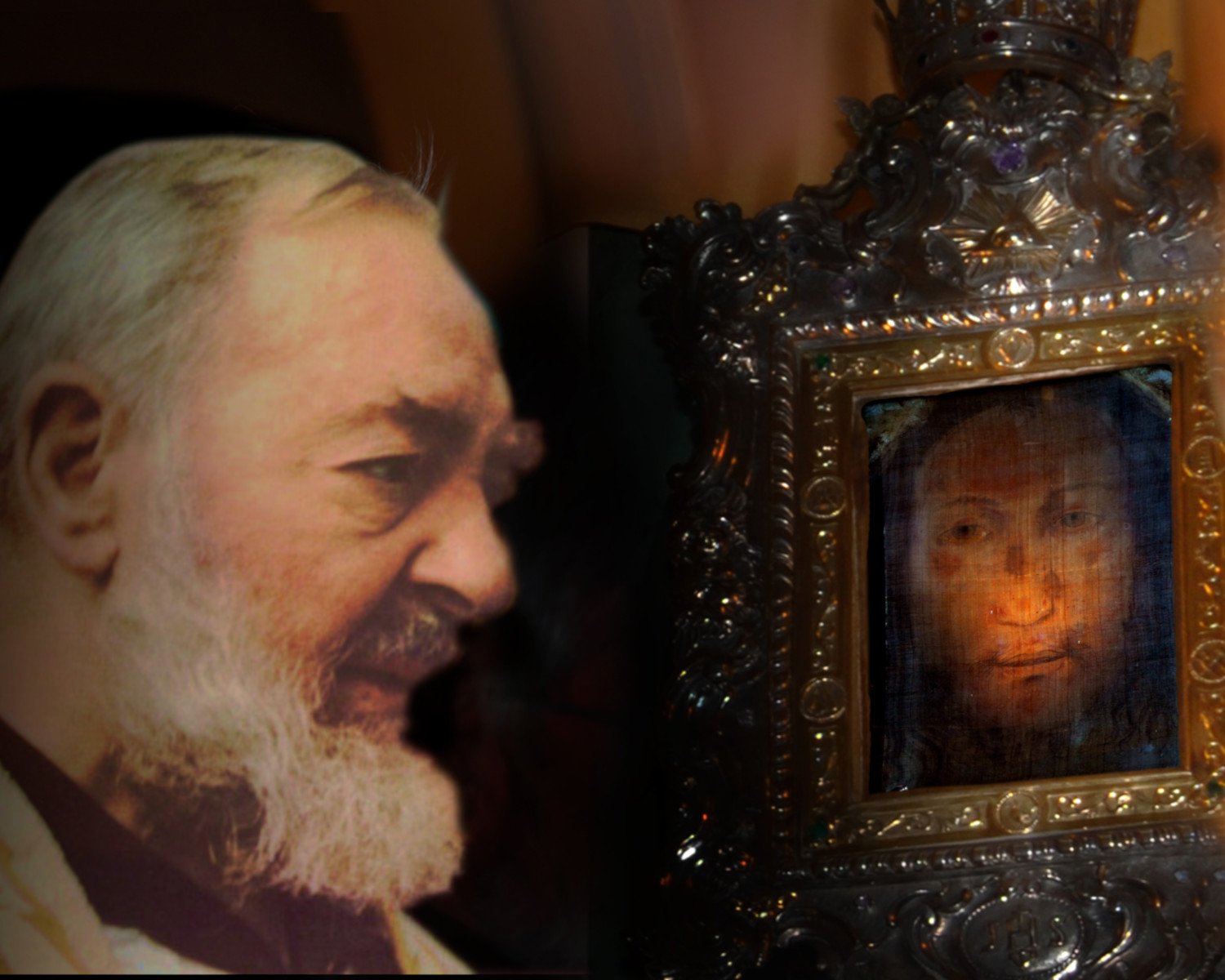
For half the 20th Century, Saint Padre Pio suffered the wounds of Christ. All of them, including the cynicism of doubt and the tyranny of false witness.
In the August-September 2012 issue of Inside the Vatican magazine, Australian journalist Paul MacLeod has a fascinating article reviewing two books by Paul Badde, The Face of God (Ignatius Press 2010) and The True Icon (Ignatius Press 2012). The two books “read like detective stories,” MacLeod wrote, as they examine in great depth two of the Church’s most revered treasures, the Shroud of Turin and the “Volto Santo,” the image of the Holy Face hidden for 400 years and believed to be the second burial cloth of Jesus, the sudarium.
The origin of the veil can be one of two sources, or a combination of both. Though the story never appears in Sacred Scripture, there is an ancient legend that a woman offered her head-cloth to wipe the face of Jesus on the way to Golgotha. When he gave it back to her, as the story has it, an impression of his face remained on the veil. What is now the Sixth Station of the Cross was legendary in Rome since the 8th Century. The name tradition has given to that woman is Veronica, a name that appears nowhere in the Gospel narrative of the Passion of Christ. The name comes from “Vera Icon,” Latin for “True Image,” a great treasure of the Church now preserved at the Shrine of the Holy Face at Manoppello in the Abruzzi region of Italy.
The veil is believed to be one of two burial cloths of Jesus, though it’s possible that both accounts are behind this treasure. On the morning of the resurrection, the Gospel of John (20:7) reports, the smaller burial cloth of Jesus — the veil covering his face — was rolled up in a place by itself as witnessed by Saint Peter and Saint John. In Jewish custom in the time of Jesus, such a veil covered the faces of dignitaries, such as the high priest, in death before being entombed. It is this veil that many now believe is enshrined at Manoppello. In contrast to that other, larger burial cloth — believed by many to be the Shroud of Turin — the image on the veil is not that of a dead man, however, but of a man very much alive, his eyes wide open. It is Jesus the Christ, having conquered death. In Inside the Vatican, Paul MacLeod described the Veil of Manoppello as:
“. . . a delicate, transparent piece of expensive material, measuring just 28 cm by 17 cm, in which the face of Jesus seems to float in light, even to store light.”
Paul MacLeod reported in the article that Capuchin priest, Father Domenico de Cese, formerly custodian of the shrine, was killed in an accident while visiting the Shroud of Turin in 1978. A decade earlier, however, Father Domenico wrote of a rather strange occurrence. On the morning of September 22, 1968, Father Domenico opened the doors of the shrine, and was startled to find Padre Pio kneeling in prayer before the image of the Holy Face. Padre Pio was at the same time 200 kilometers away at San Giovanni Rotondo, gravely ill, and near death.

“With My Body or Without It”
It was his last known occurrence of bilocation, a phenomenon that, like his visible wounds, became a source of skepticism about Padre Pio both in and outside of the Church. At 2:30 AM on the next morning — September 23, 1968 — Padre Pio died.
The two stories placed together — Padre Pio’s death and his prayer before the Veil of Manoppello — make perfect sense to me. In the hours before his death, Padre Pio contemplated the burial cloth of Christ. After fifty years of bearing the visible wounds of Christ, Padre Pio’s own soul sought out this visible link to Jesus beyond death; not Jesus crucified — a reality Padre Pio himself had lived for fifty years — but the image of the face of the risen Christ.
Padre Pio seemed most hesitant to discuss either his wounds or the reported incidents of bilocation. He seemed hesitant because in life he did not understand them at all. In fact, a Vatican investigator learned that all the events of bilocation were reported by others, and never by Padre Pio himself. It wasn’t until he was directly asked by the investigator that he described bilocation:
“I don’t know how it is or the nature of this phenomenon — and I certainly don’t give it much thought — but it did happen to me to be in the presence of this or that person, to be in this or that place; but I do not know whether I was there with my body or without it . . . Usually it has happened while I was praying . . . This is the first time I talk about this.”
— Padre Pio Under Investigation, Ignatius Press, 2008, p. 208
Those September days preceding Padre Pio’s death in 1968 must have been the strangest of his life. The visible wounds became so central to his sense of self for a half century that I imagine he had difficulty even remembering a time when the wounds were not present. Even a great burden carried for years upon years — I have learned the hard way — can become a part of who and what we are. We cannot imagine Padre Pio without these wounds. We would have never even heard of Padre Pio without these wounds. So in that sense, the wounds were not for him. They were for us.
But in the days before Padre Pio died, the wounds on his hands and feet and in his side began to close. He received those wounds on the morning of September 20, 1918. Fifty years later, on September 20, 1968, after a few days of the wounds slowly diminishing, all traces of them were gone. The wounds were then only within Padre Pio. Visible or not, they were a part of his very self.
In a previous post about Padre Pio I wrote of the day those wounds were given to him. I told the story of how this saint among us struggled with what had happened to him, and the lifelong trials that were set in motion by those visible wounds. It is a moving account of the Stigmata in Padre Pio’s own words in a letter to his Capuchin spiritual advisor, Padre Benedeto, a month after receiving the wounds.
“On the morning of the 20th of last month, in the choir, after I had celebrated Mass . . . I saw before me a mysterious person similar to the one I had seen on the evening of 5 August. The only difference was that his hands and feet and side were dripping blood. The sight terrified me and what I felt at that moment is indescribable. I thought I should die and really should have died if the Lord had not intervened and strengthened my heart which was about to burst out of my chest.
“The vision disappeared and I became aware that my hands and feet and side were dripping blood. Imagine the agony I experienced and continue to experience almost every day. The heart wound bleeds continually, especially from Thursday evening until Saturday.
“Dear Father, I am dying of pain because of the wounds and the resulting embarrassment I feel in my soul. I am afraid I shall bleed to death if the Lord does not hear my heartfelt supplication to relieve me of this condition.
“Will Jesus, who is so good, grant me this grace? Will he at least free me from the embarrassment caused by these outward signs? I will raise my voice and will not stop imploring him until in his mercy he takes away . . . these outward signs which cause me such embarrassment and unbearable humiliation.”
— Letters 1, No. 511
But it was the stories of bilocation that caused so much skeptical doubt. In May of 1921, the Vatican commenced its first of several investigations into Padre Pio’s life. The investigator, Monsignor Raffaelo Carlo Rossi, tried to refuse the assignment because he admittedly went into it with a “prejudice against Padre Pio.” After months of interrogations, depositions, interviews with other friars, and testimony by many laypeople, Bishop Rossi’s file was ordered sealed, and it remained sealed as a secret Vatican file for decades. The investigator concluded his file: “The future will reveal what today cannot be read in the life of Padre Pio of Pietrelcina.”
That investigator, we now know, left San Giovanni Rotondo with no doubt whatsoever about the true nature of Padre Pio, but it wasn’t enough to curtail years of further suspicion and persecution from within the Church. The story of Padre Pio’s treatment is best summed up by Father Paolo Rossi, former Postulator General of the Capuchin Order, and it seems a bit familiar:
“People would better understand the virtue of the man if they knew the degree of hostility he experienced from the Church… The Order itself was told to act in a certain way toward Padre Pio. So the hostility went all the way up to the Holy Office and the Vatican Secretariat of State. Faulty information was being given to Church authorities, and they acted on that information.”
— Making Saints, Simon and Schuster, 1990 p. 188

A Face on My Wall
If you look at the end of the “About” page at Beyond These Stone Walls, you may notice that this blog is published under the patronage of Saint Maximilian Kolbe and Saint Padre Pio, champions of truth, justice, and fidelity to the Risen Lord. The impact of Saint Maximilian on these prison walls is easy to see. How Saint Padre Pio insinuated himself here is a bit more mysterious.
It started with an awareness that we share an important date. The day I was convicted and taken to prison was September 23, Saint Padre Pio’s feast day and the last day of his earthly life. Only 26 years passed between those two events. Padre Pio just showed up here again, but that story needs a little background.
Despite its small size, the typical prison cell can seem a barren place. Like every prison this one has rows upon rows of cells, tiers upon tiers of them, all perfectly uniform, none with any evidence of human individualism. The whole point of prison is that its inhabitants are forced to view themselves as humans in degraded form, living a day to day existence that is entirely uniform, and devoid of any sense of the self.
The inside of these 6-by-10-foot walled and barred cells is composed of nothing but concrete. The four walls, the floor and the ceiling are bare concrete. The bunks upon which we sleep are concrete (and they hurt if I sleep too long), and so is the small counter upon which this prisoner is writing at this moment. Prison cells are distinguishable from other prison cells solely by the number above each solid steel door.
There is one small exception to the absence of human evidence, and I’ve written of it before. In “Angelic Justice: Saint Michael the Archangel and the Scales of Hesed,” I described the sole evidence of individualism in a prison cell. There are two rectangles, exactly 24 inches by 36 inches, painted on one wall with 12 inches of space in between them. Within these dark green rectangles, the two prisoners living in each cell may post a calendar, photos of their families and friends, and religious items. Nothing else.
You can learn a lot about a man from what is posted within this rectangle on his cell wall. In my first years in prison, commencing 28 years ago, I had lots of photos of family and friends, evidence of the life I once knew beyond these stone walls. Like every prisoner over time, that evidence slowly diminished. In my first five years in prison, I was moved 17 times, often with just minutes notice. Each time, I would take down all my evidence of a life, and then put it back on the wall in another cell on another tier in another building with other people. Each time, something of myself would be lost forever. Then the day came that I was moved, and nothing went back up onto the wall. The wall remained an empty space for many years.
This was true of my friend, Pornchai Moontri, as well. After 21 years in prison, beginning when he was barely 18 years old, Pornchai only vaguely recalls a life beyond and the people in it, but he no longer possesses any evidence of it. His uprootings were much more severe than mine. As you know from reading “Pornchai’s Story” he was ripped from a culture, a country, and a continent. Much was taken from him, and then, finally, so was his freedom. You know of that story which I wrote of in “Pornchai Moontri and the Long Road to Freedom.”
When we were moved to the same cell many years ago, Pornchai and I both stared each day at two green rectangles with nothing in them. Then Beyond These Stone Walls began a year later, and ever so slowly our wall became filled with images sent to us from readers. (Alas, such images are no longer allowed in mail, but the ones already on our wall can stay). Every square inch of Pornchai’s rectangle, even after he has left prison, is still filled with evidence of his very much alive Catholic faith.
But one day, I noticed that a very nice photograph of Saint Padre Pio that was in my rectangle on the wall somehow migrated over to Pornchai’s wall. On the day I noticed that my treasured image of Padre Pio “defected,” I also mentioned that I didn’t have another one and wished that someone would send me one. An hour after voicing that, the mail arrived. I opened an envelope from my friend, John Warwick, a reader in Pittsburgh.
I opened John’s envelope to find a beautiful card enrolling me and my intentions in a novena to Saint Padre Pio, and the image on the card was the very same one that took up residence over on Pornchai’s wall. It is my first experience of this great Patron Saint’s bilocation, and I treasure it. Thank you, John!
“Stay with me, Lord, for it is getting late: the day is ending, life is passing; death, judgment, eternity are coming soon … I have great need of you on this journey. It is getting late and death is approaching. Darkness, temptations, crosses and troubles beset me in this night of exile.”
— Saint Padre Pio’s Communion Prayer
