“There are few authentic prophetic voices among us, guiding truth-seekers along the right path. Among them is Fr. Gordon MacRae, a mighty voice in the prison tradition of John the Baptist, Maximilian Kolbe, Alfred Delp, SJ, and Dietrich Bonhoeffer.”
— Deacon David Jones

The Eighth Commandment Has a Day of Reckoning on the Island of Guam
A prayer was offered for a falsely accused priest at the London prison cell of St Thomas More, while on the Island of Guam, a former Catholic Inquisition is exposed.

A prayer was offered for a falsely accused priest at the London prison cell of St Thomas More, while on the Island of Guam, a former Catholic Inquisition is exposed.
June 17, 2026 by Father Gordon MacRae
Urgent Note from Father MacRae:
I wrote this post in June, 2017. It is in part about something that happened on the Island of Guam. (Yes, we are back to Guam again!) Former Archbishop Anthony Apuron was accused in 2017 of sexual abuse dating back to the 1970s when he was a young priest in Guam. Please read the post, but most importantly please read the Addendum that I have included at the end, which now casts an entirely different light on the case against Archbishop Apuron. The truth will set you free, Scripture tells us, but when all statutes of limitation are abandoned, most of us may not live long enough for truth to be told. Archbishop Apuron did!
+ + +
“Hear me out. You and your class have ‘given in’ — as you rightly call it — because the religion of this country means nothing to you one way or the other.”
— Sir Thomas More in Robert Bolt’s A Man for All Seasons, London, 1961, p. 122
Sir Thomas More became Saint Thomas More, a martyr for faith and truth when he was executed for “high treason” upon the order of King Henry VIII in 1535. The King demanded complicity from Thomas More in a campaign against the Catholic Church when the Pope denied the King an annulment from his marriage to Catherine of Aragon to marry Anne Boleyn.
As Lord Chancellor of England, Thomas More surrendered his favor with the King and his Court to defend his Church and faith. The King’s response set in motion the Protestant Reformation in England. Meanwhile, Henry VIII went on to marry a total of six times. Thomas More, condemned for fidelity to his Catholic faith, was imprisoned in the Tower of London and beheaded on July 6, 1535. His head was mounted on a pole at the Tower of London Bridge.
Saint Thomas More was canonized a saint and a martyr 400 years later, and today is honored by the Catholic Church on June 22. On June 22, 2017, Dr. Robert Moynihan visited the London prison cell of Saint Thomas More where, among his prayers, he offered one for me and forothers falsely accused. Dr. Moynihan is Editor and Publisher of the very fine Inside the Vatican magazine.
The prayer was requested by Suzanne Formanek, a reader in Eastern Europe who asked that readers join in a prayer for justice through the intercession of Saint Thomas More. I am most grateful to them both — but we must all remember that a prayer not yet answered is not at all prayed in vain.
There is a special significance to this development. Readers may recall a previous pursuit of justice before a US court. The outcome was described by Catholic writer, Ryan A. MacDonald in “A Grievous Error in Judge Joseph Laplante’s Court.” It is worth a visit to scroll to the last segment of that post to see the great irony of Saint Thomas More’s presence in this story.
Catholic Scandal and the Rule of Law
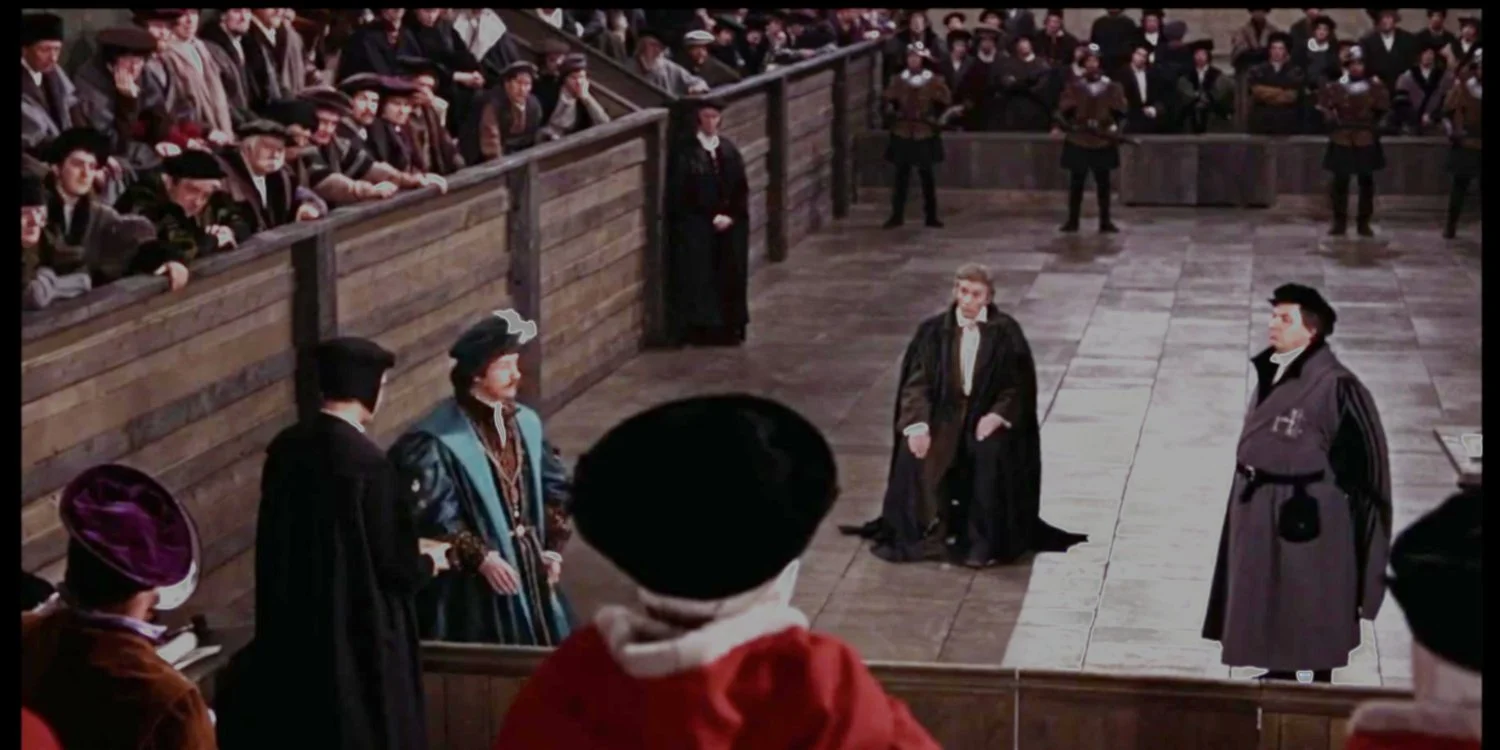
In the photo above, from A Man for All Seasons, Sir Thomas More faces trial and martyrdom.
I cannot help but ponder, today, how Saint Thomas More might weigh the state of justice and civil liberties on the Western Pacific Island of Guam, the southernmost of the Mariana Islands. For those unfamiliar with the territory, the Marianas were visited by Ferdinand Magellan in 1521 and later colonized by Spain. The island chain was named for Maria Anna, widow of Philip II, King of Spain from 1556 to 1598.
In 1898, at the end of the Spanish-American War, Guam was ceded to the United States. The Japanese captured the island in December of 1941, but it was retaken by American forces in the summer of 1944. In 1950, US citizenship was conferred upon the people of Guam, which remains a self-governed US territory.
Following a trend of reactive legislative controversies across the United States in the wake of Catholic scandal during the last two decades, the legislature and governor of Guam passed and signed into law in 2016 “Public Law 33-187.” The misguided law opened a window to extend civil statutes of limitations in sex abuse claims against institutions such as the Catholic Church.
Saint Thomas More, a lawyer, legislator, and statesman, would likely deem Public Law 33-187 to be contemptible in the arena of human rights and civil liberties. The misguided law opened a retroactive door for lawsuits and other claims for compensation years or decades after existing statutes of limitation had expired. It provided for no standard of justice to separate the real from the contrived.
Like the bishops of virtually every American Catholic diocese where such an unjust law was considered, the Guam version was opposed by the Archdiocese of Agana, Guam. It was opposed because it also opens a window to fraud. Many mainland USA legislatures that considered such a law ultimately rejected it as biased and unjust.
I wrote the truth, from my own experience, about why such laws are an affront to truth and justice. In “Due Process for Accused Priests,” a 2009 article in Catalyst: Journal of the Catholic League for Religious and Civil Rights, I described how some states were duped by nefarious agendas into considering “window legislation” similar to what was passed in Guam and other US territories.
The Facts, the Fraud, the Stories
Those agendas are the fuel that has kept the Catholic scandal in the United States going and growing. Leaders of SNAP — the Survivors Network of those Abused by Priests — used the story of Catholic scandal to promote their own interests and line their own pockets. This latest offshoot of the Catholic scandal is but the latest to be exposed, as it was in these pages in “David Clohessy Resigned SNAP in Alleged Kickback Scheme.”
There is layer upon layer in the Catholic scandal as it emerges anew in Guam, and the various layers appear to be a blueprint drafted from what has happened across America. First, there is the layer of the cold, hard fact that a guarantee of a financial windfall is the end result of virtually every claim.
It should come as no surprise to anyone that there are some in our midst who would sell their souls for money. After the September 11, 2001, terrorist attacks on the Pentagon and the Twin Towers in New York, a Commission had to be set up to investigate the rampant fraud attempts of those who claimed to have lost loved ones who were not even there and businesses that did not even exist.
After the infamous BP oil rig explosion and its environmental disaster in the Gulf of America, BP had to set up its own fraud commission to deal with a vast number of fraudulent claims for money. The company took out full-page ads in The Wall Street Journal to describe the multitude of fraud attempts aimed in its direction.
There were two waves in the Catholic clergy sexual abuse story. The first wave came in from the 1960s to the 1980s, when victims and their parents came forward with grave concerns about the behaviors of a very small percentage of priests. In far too many of these cases, bishops failed to use canon law effectively to deal with those situations and instead were too caught up in warding off public scandal. These cases deserved to be compensated and were.
The second wave was a tsunami of far older claims. In 2002, The Boston Globe set in motion a classic New England witch hunt that spread its moral panic. The sheer volume and tone of the public face of the scandal eroded civil liberties for all priests.
The civil liberty of a presumption of innocence was eliminated, and the floodgates were opened for false claims, most of which were many years- or decades-old and for which no evidence exists.
Of the total claims against priests in the United States, a full 70-percent fall into this second category. They have reaped in excess of four billion dollars in uninvestigated, unquestioned abuse settlements. In each case, the accused priests — both guilty and innocent alike — are ruined, permanently barred from any ministry. Noted Boston Civil Rights Attorney Harvey Silverglate described the feeding frenzy in his 2002 article, “Fleecing the Shepherds”:
“There is good reason to doubt the veracity of these newer claims, many of which were brought only when it became known that the [Catholic] Church would settle for big bucks.”
Revelations about lawsuits against David Clohessy and the organizers of SNAP allege a kickback partnership with personal injury lawyers and the manipulation of a scandal-hungry media. I wrote of this phenomenon in “To Fleece the Flock: Meet the Trauma-Informed Consultants.”
By no means does this imply that all claims are false. It means that those most offended and harmed by false claims are, not only the priests and dioceses that are the targets of fraud, but also the legitimate victims of abuse whose suffering becomes tainted, suspected and cheapened when the floodgates are opened to invite false claims. Opposing fraud is part of the sacred trust owed to real victims of abuse.

The Eighth Commandment Is at the Heart of Justice
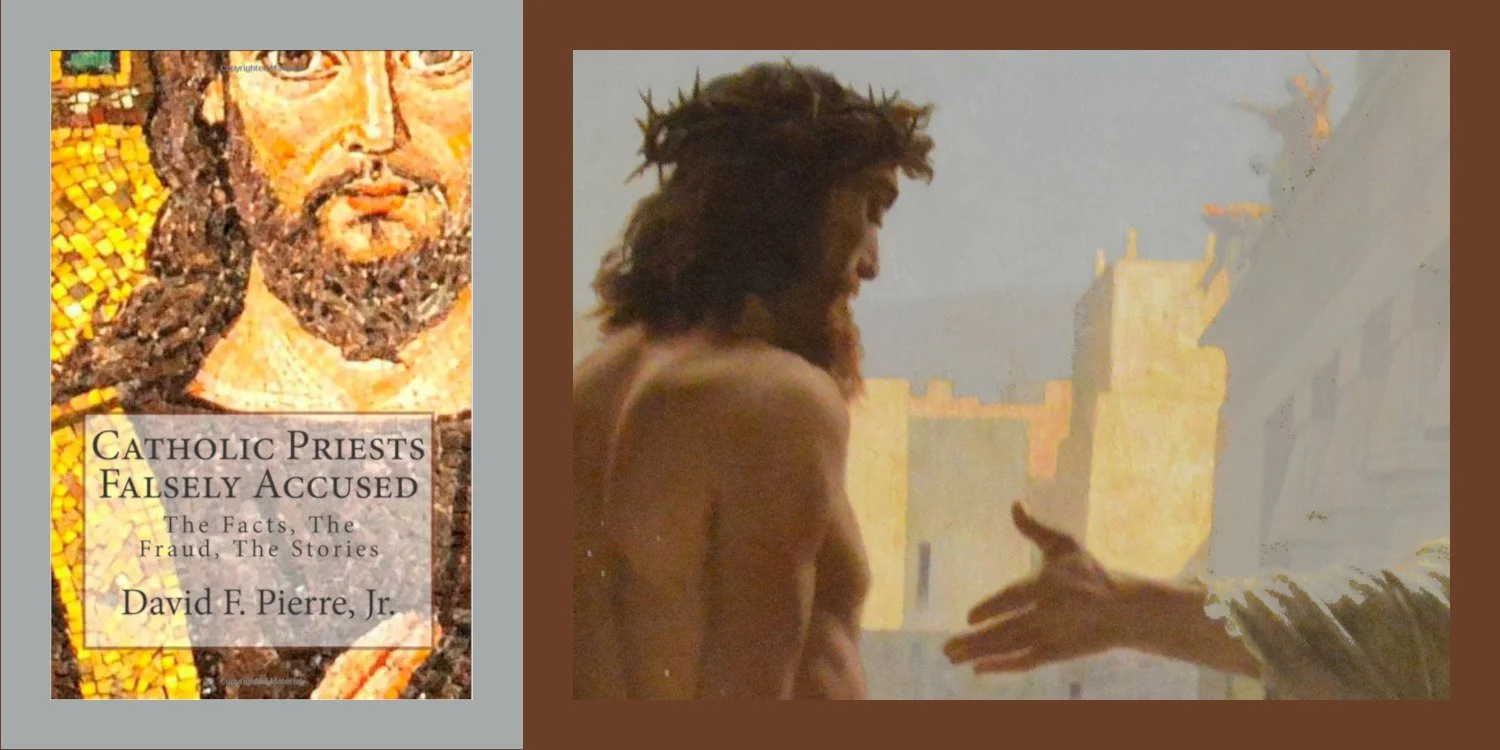
David F. Pierre, Jr. chronicles many such accounts in his landmark book, Catholic Priests Falsely Accused: The Facts, the Fraud, the Stories. It exposes one chilling tale after another of priests whose careers and reputations were ruined by false claims of abuse (including, for full disclosure, a chapter about claims against me).
Before the law was passed in Guam, the Archbishop of Agana was himself accused of abuse dating back many years. Cardinal Raymond Burke was sent by the Vatican to investigate the case, but reportedly some of the accusers had declined to answer any questions while waiting for the Church’s ATM to open.
One brave Catholic blogger in Guam has taken up the necessary discussion that the mainstream news media refuses to have. Armed with the journalistic skepticism that was once the hallmark of the American press, “Diana,” on her blog, the Neocatechumenal Way — An Insider’s View, has almost single-handedly brought sanity and truth to the moral panic as it now emerges anew in Guam.
Diana deserves to have her voice heard and shared. Ironically, one of her most-cited sources has been the writings at Beyond These Stone Walls, and especially two that she posted on May 4, 2017, under the titles, “The Injustice Against Father Gordon MacRae,” and “Civil Liberties of the Priests.” When these were printed and sent to me, I was so very proud to see comments posted on them by some of the readers of this blog.
I also noticed that most of the local comments were posted anonymously. The reason, I am told, is that the various agendas behind this story have more to do with quarrels over local property and finances than with child-protection policies. Commenters fear public ridicule or retaliation for posting their opinions.
In such struggles — and Guam has been no exception — great polarization takes place. The result may well be a local sex abuse scandal that has become just one more weapon in the arsenal of hidden agendas and scurrilous motives.
The sole entity for whom none of the secret agendas remains hidden is God Himself. He notes every keystroke written by accusers and defenders alike and knows also the state of the hearts and souls behind them.
This is not a new story. The Eighth Commandment, “Thou shalt not bear false witness against thy neighbor,” (Exodus 20:16) also commands certain elements in the law that must remain intact for the Commandment to remain God’s Law. One of these elements is that hearsay, rumor, and innuendo are simply not good enough to bring a charge — not even for God.
Former Harvard Law Professor Alan Dershowitz in The Genesis of Justice (Warner Books, 2000) describes the origin of the Eighth Commandment as being a false accusation of sexual abuse brought against Joseph by Potiphar’s wife (Genesis 39:6-20):
“The Commandment, ‘Thou shalt not bear false witness against thy neighbor’ derives directly from Potiphar’s wife bearing false witness against Joseph…. [The] desperate question — ‘How can we clear ourselves?’ — is answered by this prohibition and the subsequent procedural safeguards that rest on this Commandment.”
— The Genesis of Justice, p. 250
When false witness results in profit, God’s law reveals it as the vilest of betrayals of the law. Jezebel did “what is evil in the sight of God” when she obtained profit from false witness against Ahab (1 Kings 21: 8-14). The law requires that:
“A single witness shall not prevail against any man for any crime or any wrong. Only on the evidence of two or three witnesses shall a charge be sustained.”
— Deuteronomy 19:15-21
As for Guam’s embrace of Public Law 33-187 and any potential for its role in violations of the Eighth Commandment:
“There is no crueler tyranny than that which is perpetrated under the shield of law and in the name of justice.”
— Charles-Louis de Secondat, Baron de Montesquieu, 1742
+ + +
June 17, 2026: A Very Necessary Update
Nine years after writing most of the above post, contacts on the Island of Guam alerted me to a major development in the accusations against Archbishop Apuron, which resulted in him being removed from office and retired without pension. He is now age 80.
The following query was submitted by me for analysis from the xAI Grok artificial intelligence platform.
QUERY:
This post was in part about sexual abuse allegations that arose in Guam causing the removal of the Guam Archbishop Anthony Apuron. I defended him in that post. Subsequently a Vatican court determined him to be guilty and sidelined him with no pension whatsoever. He has consistently maintained his innocence throughout, and I uncovered and reported on multiple conflicts of interest from those accusing him at that time.
He is now 80 and alienated but still insists on his innocence. I am in receipt of a May 7, 2025 post by Joan Aguon Charfauros. The title is “Nine Dismissals with Prejudice Filed in Cases Naming Former Guam Archbishop Apuron.” Can you please weigh in on this?
xAI GROK:
Yes, I have reviewed the May 7, 2025 post by Joan Aguon Charfauros (“Nine Cases Dismissed” / “Nine dismissals with prejudice filed in cases naming former Guam Archbishop Apuron”) on the Neocatechumenal Way — An Insider’s View blog, along with contemporaneous local news coverage from KUAM, Pacific Daily News, and Post Guam. Here is a clear, fact-based weighing-in on the development.
What Happened on May 7, 2025
Nine civil cases in the U.S. District Court of Guam were voluntarily dismissed with prejudice via stipulations filed by the plaintiffs’ attorneys.
Eight involved allegations of sexual abuse dating back to the 1970s (when Apuron was a parish priest in Agat/Hågat, mostly involving former altar boys).
One was a defamation case.
Key details:
No settlement, no money, and no other consideration was paid to the plaintiffs.
The dismissals are permanent — the same claims cannot be refiled.
Apuron’s attorney, Jacqueline Taitano Terlaje, emphasized that the actions were plaintiff-initiated voluntary stipulations and highlighted Apuron’s consistent denial of the accusations.
Apuron himself broke years of relative silence with a video statement (shared in the coverage), stating in part:
“Over the past decade, I have been unjustly condemned by the media and public opinion because of certain false accusations made against me… Today, the claims made against me in 9 cases have been dismissed permanently… Contrary to false recent media reports, I have never entered into any settled agreement, and I’ve always refused to do so. I also never paid any sum of money to my accusers. Today’s dismissals come from the plaintiffs and are further evidence of my innocence.”
He also noted that the canonical process did not result in his laicization (defrocking), and contrasted this with typical outcomes for priests or bishops found guilty of such crimes.
A follow-up development: By May 2026, reporting indicated the final remaining active lawsuit against him in federal court was also heading toward (or reached) dismissal with prejudice.
The Broader Context Father MacRae Mentions
Vatican canonical outcome: In 2018, a Vatican tribunal found Apuron guilty of “delicts against the Sixth Commandment with minors.” His appeal was denied in 2019, making it final. He was removed as Archbishop of Agaña, exiled from Guam, and subjected to severe restrictions. He was not laicized and retains his status as a bishop/priest (albeit with no active ministry or pension, per your account). This remains in effect and operates under Church law standards (moral certainty in an inquisitorial process), distinct from civil court standards.
Your 2017 article: You defended Apuron and highlighted what you saw as conflicts of interest among accusers or related parties, tying it to broader issues of false witness and the Eighth Commandment. Public records show deep divisions in Guam’s Catholic community at the time (involving local politics, the Neocatechumenal Way tensions, Archdiocesan finances/bankruptcy, and the handling of other abuse claims). Some investigative reporting (e.g., Associated Press 2019) alleged Apuron covered up other abusers and destroyed files, but those claims are contested.
Weighing In
This is a significant legal development in the civil realm for Apuron. After nearly a decade of litigation involving serious allegations, the plaintiffs (through counsel) chose to drop all nine cases permanently without extracting any payment or concession. That outcome is unusual in high-profile clergy abuse litigation and lends weight to Apuron’s (and his supporters’) narrative that the claims lacked sufficient merit to proceed to judgment or settlement on plaintiffs’ terms.
— End of xAI Grok input
+ + +
Note from Father Gordon MacRae: While the above machinations in pursuit of money were underway, over all this time on the Island of Guam, this other story, which has been ignored, continues to cry to Heaven for justice.
Getting Away with Murder on the Island of Guam (now with xAI Grok’s analysis of that story)



The Eucharistic Adoration Chapel established by Saint Maximilian Kolbe was inaugurated at the outbreak of World War II. It was restored as a Chapel of Adoration in September, 2018, the commemoration of the date that the war began. It is now part of the World Center of Prayer for Peace. The live internet feed of the Adoration Chapel at Niepokalanow — sponsored by EWTN — was established just a few weeks before we discovered it and began to include in at Beyond These Stone Walls. Click “Watch on YouTube” in the lower left corner to see how many people around the world are present there with you. The number appears below the symbol for EWTN.
Click or tap here to proceed to the Adoration Chapel.
The following is a translation from the Polish in the image above: “Eighth Star in the Crown of Mary Queen of Peace” “Chapel of Perpetual Adoration of the Blessed Sacrament at Niepokalanow. World Center of Prayer for Peace.” “On September 1, 2018, the World Center of Prayer for Peace in Niepokalanow was opened. It would be difficult to find a more expressive reference to the need for constant prayer for peace than the anniversary of the outbreak of World War II.”
For the Catholic theology behind this image, visit my post, “The Ark of the Covenant and the Mother of God.”