“There are few authentic prophetic voices among us, guiding truth-seekers along the right path. Among them is Fr. Gordon MacRae, a mighty voice in the prison tradition of John the Baptist, Maximilian Kolbe, Alfred Delp, SJ, and Dietrich Bonhoeffer.”
— Deacon David Jones

Divine Mercy for Doubting Thomas and Other Spiritually Wounded
The Gospel on Divine Mercy Sunday is St John’s account of the spiritually wounded Thomas who would not know peace until surrendering his wounds to the Risen Christ.

The Gospel on Divine Mercy Sunday is St John’s account of the spiritually wounded Thomas who would not know peace until surrendering his wounds to the Risen Christ.
April 23, 2025 by Fr Gordon MacRae
There is a scene in the great World War II prisoner of war film, Stalag 17, in which an American Air Force officer (played by actor William Holden) negotiates with the German Commandant over the treatment of a fellow prisoner. I was dragged into a similar role here several years ago when I protested an injustice aimed at a friend.
For a long time I had managed to avoid efforts to recruit me for an Inmate Communications Committee (ICC), a group of eight chosen from 1,500 prisoners here. The ICC advocated for better prison conditions and due process. After protesting over another prisoner, I no longer had a valid excuse, so I reluctantly accepted.
From the start, I was saddled with doing all the writing, which included detailed minutes of every meeting for distribution to prison officials, a monthly summary of progress, and a quarterly newsletter.
The job — which payed nothing — was in addition to my Law Library job which payed next to nothing. It also meant writing endless memos, proposals, clarifications, and requests that I fielded each week. We succeeded in only about ten percent of the concessions we set out to obtain, and that is more or less on par with William Holden’s success rate in Stalag 17.
About the only high point is that I was also required to be present at a Jobs and Education Fair in the prison gymnasium twice a year. It was an effort to get the other 1,500 prisoners here into jobs, educational classes and programs, and typically about 500 showed up. Among the dozens of display tables set up, the Law Library and ICC were side by side, so I manned both.
The Veterans Affairs table was set up next to the ICC table. It was a nice display with information on veteran groups here, an annual POW/MIA Remembrance, and other programs. The table was staffed by my friend, John, whom I did not get to see as often as I would like. John was a Navy veteran in his mid to later thirties. He lost his leg during active duty in the Middle East before coming to prison. John told me that when he arrived here, his prosthetic leg was taken from him because of an infection at the amputation site with the result of consigning him to a wheelchair. John was very anxious to get the prosthetic leg back and get back on his feet again, but because of the fear of infection, the prison medical officials were withholding it. It was John, by the way, who told me of the release of my friend Martin, the U.S. Marine veteran I wrote about in “A U.S. Marine Who Showed Me What to Give Up for Lent.”
I told John that I would do some research to see if there was a precedent here that John might use to restore his prosthetic leg. Then, without thinking, I thanked him for “stepping up” to take charge of the Veteran’s table. I quickly apologized for my faux pas, but John had a good laugh.
Then he told me that he spent half his day thanking people for all sorts of small things: an assist out of the chair, a push up a steep ramp, picking up a dropped item. He said that my thanks was the first time in a long time anyone had thanked him for his service to others. That small, awkward gesture had a profound effect on John. As I left, he was beaming. I made a decision that I would find a way to help restore what he lost and get him out of that dreaded wheelchair.
I can sometimes become so aware of the spiritual warfare that engulfs me here that it diminishes my awareness of the wounds of others. We are all, in one way or another, wounded by life physically, emotionally, spiritually, and it dulls our senses.
It drives us onto self-centered islands of emotional distance and spiritual isolation. The wounds we carry foster pessimism and doubt, erode faith, and turn the joy of living into a crucible of mere existence. Peace evades wounded warriors, even in spiritual warfare.

Doubting Thomas
This is the great plague of our age. I receive lots of mail from readers asking me to pray for a husband or wife, a son or daughter, who has lost their faith in response to the wounds of life and the sheer weight of living. In a war with one’s self, faith is often the first to go and the last to come back. If this describes you or someone in your life, then pay special attention to the Apostle Thomas in the Gospel from Saint John on Divine Mercy Sunday.
There are some remarkable elements in Saint John’s account of the death of Jesus and all that came after the Cross. The first witness to the “Seventh Sign,” the Resurrection of Jesus, was a woman whose own demons Jesus had once cast out. I wrote of her and the evidence for her first-hand witness in “Mary Magdalene: Faith, Courage, and an Empty Tomb.” I would like to reproduce a scene from that post that never took place, but it is one that I have long imagined.
“Mary came to the disciples, Peter and the others, hidden by fear behind locked doors, and said, ‘I have good news and not-so-good news.’ Peter asked, ‘What’s the good news?’ Mary replied, ‘The Lord has risen and I have seen him.’ Peter then asked, ‘What’s the not-so-good news?’ Mary said, ‘He’s on his way here, and He wants a word with you about last Friday.”
The focus is so intensely on Jesus in the Resurrection accounts that it is easy to forget the wounds of everyone else in this story. They are all living with the deeply felt trauma of loss, and not only loss, but with an overwhelming sense of utter discouragement. They are devastated and stripped of hope.
John, the Beloved Disciple, stood with the mother of Jesus at the foot of the Cross and watched Him die a most gruesome death at the hands of the Roman Empire, but at the behest of his own people, the Chief Priests who answered Pilate, “We have no king but Caesar.”
Mary Magdalene stood there as well, and watched. The others fled. Peter, their leader, denied three times that he even knew Jesus. All that had been promised and hoped for had been misunderstood, and now gone forever. The Chief Priests — emboldened when Pilate caved to their “We Have No King but Caesar” — sought only to round up the rest.
It was in this state of fear that Mary Magdalene showed up in the Upper Room where the Apostles were in hiding for fear of the mobs. She had news that defied belief. And when Jesus first appeared to them behind that locked door, His demeanor was the opposite of what I imagined above to be a human response to their abandonment of Him. “Peace be with you,” He said. It is not a reference to a state of peace between disputing parties or someone subject to Earthly powers. The word the Gospel used in Greek – Eiréné – has more to do with spiritual welfare than spiritual warfare.
It refers to a state of mind, heart and soul, the equivalent of the Hebrew “Shalom”, and its usage means harmony with God within one’s self. It is the same sense that the Prophet Isaiah used in his Messianic expectation of the Prince of Peace:
“For us a child is born, to us a son is given; and the government will be upon his shoulder and his name will be called ‘Wonder Counselor, Mighty God, Everlasting Father, Prince of Peace.’”
— Isaiah 9:6
It is what Saint Paul refers to in his letter to the Colossians, “Let the peace of Christ reign in your hearts” (Col. 3:15). Once you have it, it is far more contagious than any pandemic. This peace is the foundation and gift of Divine Mercy.
But Thomas missed the whole thing. When he arrived and found them stunned and exuberant, he retreated into his own deep wounds. Thomas did not stay to see Jesus crucified. Like the others, he could not bear it. He and they fled when Jesus appeared before Pilate mocked, beaten, broken, as the accusing mob grew beyond control to threaten even Pilate himself, “Crucify him! Crucify him!” But Thomas saw enough to know that it was over, that all was lost, and all hope had gone out of the world. So when faced with the great risk of trusting and hoping again, he said,
“Unless I see the mark of the nails in his hands, and put my finger into the nail marks, and place my hand in his side, I will not believe.”
— John 20:25

Trusting Divine Mercy
For this, the Apostle is forever called, “Doubting Thomas,” but I see something more painful than his doubt. I see him also as hurting, defeated, robbed of hope. He had to touch the wounds of the Risen Christ because the wounds of the Crucified Christ had already touched him, had broken his heart, and devastated his faith, and destroyed all hope. As so many of you know only all too well, coming to trust again after such hurt is a very risky business.
I find it fascinating that the story of Thomas and his struggle with trust and hope after the events of Holy Week is the Gospel for Divine Mercy Sunday. When Jesus presented Himself to Thomas, and invited him to probe the wounds in his living hands and side, Thomas did not oblige. Instead, he surrendered his own wounds, and responded in a leap of faith, “My Lord and my God.” Pope Benedict XVI wrote of this in his magisterial book, Jesus of Nazareth: Holy Week:
“In His two appearances to the Apostles gathered in the Upper Room, Jesus repeats several times the greeting, ‘Peace be with you’… It becomes the gift of peace that Jesus alone can give because it is the fruit of his radical victory over evil… For this reason Saint John Paul II chose to call this Sunday after Easter ‘Divine Mercy,’ with a very specific image: that of Jesus’ pierced side from which blood and water flowed.”
This image, revealed to Saint Maria Faustina Kowalska as the image of Divine Mercy, is that of the same wounds transfigured:
“I saw the Lord Jesus dying on the Cross amidst great suffering, and out of the Heart of Jesus came the two rays as are in the image.”
— Diary of Saint Faustina, 414
“The two rays denote blood and water. The pale ray stands for the Water which makes souls righteous. The red ray stands for the Blood which is the life of souls… Happy is the one who will dwell in their shelter…”
— Diary of Saint Faustina, 299
I recently wrote a post entitled “Thailand’s Once-Lost Son Was Flag Bearer for the Asian Apostolic Congress.” Most of our readers know the story of what led to Pornchai Maximilian Moontri’s Divine Mercy conversion. Starting at the age of two in rural Thailand, he knew only abandonment by the very people who should have taught him trust. Forced to forage in the streets for food, he was hospitalized for malnutrition. Then at age eleven he was taken from Thailand and forced into a life marked by violence, exploitation and abuse. At age 18, after several years of adolescent homelessness, he killed a man after being pinned to the ground in a struggle. Pornchai was sent to prison for life. While there, his mother, his only contact in the free world was murdered by the man who exploited him. After many years of solitary confinement, Pornchai was moved to another prison and spent the next 15 years as my roommate.
How does anyone emerge from such wounds? How does anyone ever trust again when all prior trust was broken? On Divine Mercy Sunday in 2010, Pornchai took on a new name, “Maximilian,” after Saint Maximilian Kolbe who walked this path with him and led him to Jesus through the Immaculate Heart of Mary.
In the course of this remarkable journey, Pornchai’s wounds never healed. They are with him for life, but they have been transformed. He is a powerful figure today in the realm of Divine Mercy because he has placed his wounds in the service of the Risen Lord. Back in October of 2024, Pornchai was invited to carry the flag of the Kingdom of Thailand in procession at the Fifth Asian Apostolic Congress on Divine Mercy held in the Philippines. In the scene atop this section, Pornchai Max proudly carries the flag of Thailand before a crowd of 5,000 pilgrims in honor of Divine Mercy.
If a picture speaks a thousand words, this one below speaks volumes. This is the Face of Divine Mercy.

+ + +


And to honor our late Holy Father: “Pope Francis Had a Challenge for the Prodigal Son’s Older Brother.”

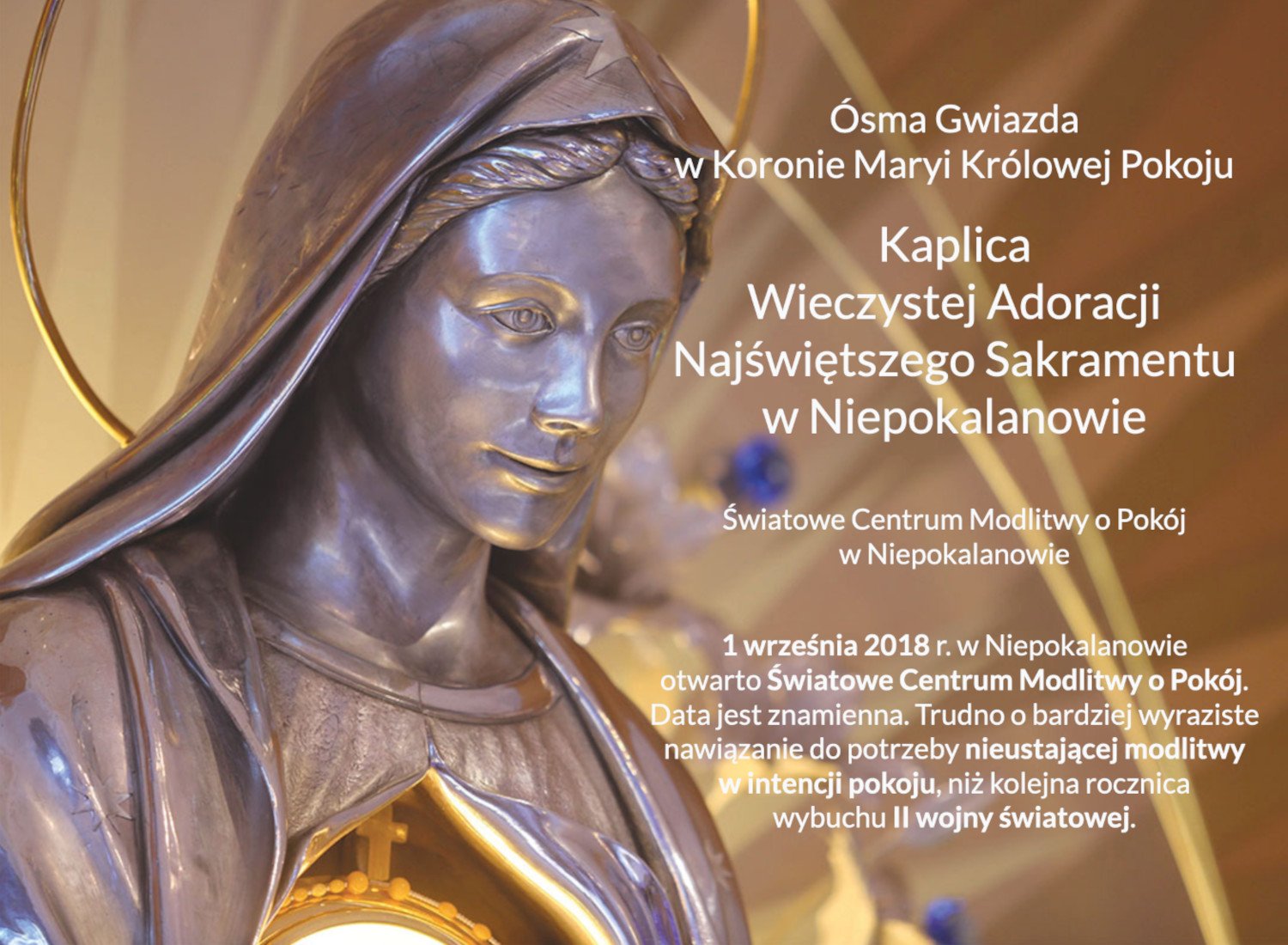

The Eucharistic Adoration Chapel established by Saint Maximilian Kolbe was inaugurated at the outbreak of World War II. It was restored as a Chapel of Adoration in September, 2018, the commemoration of the date that the war began. It is now part of the World Center of Prayer for Peace. The live internet feed of the Adoration Chapel at Niepokalanow — sponsored by EWTN — was established just a few weeks before we discovered it and began to include in at Beyond These Stone Walls. Click “Watch on YouTube” in the lower left corner to see how many people around the world are present there with you. The number appears below the symbol for EWTN.
Click or tap here to proceed to the Adoration Chapel.
The following is a translation from the Polish in the image above: “Eighth Star in the Crown of Mary Queen of Peace” “Chapel of Perpetual Adoration of the Blessed Sacrament at Niepokalanow. World Center of Prayer for Peace.” “On September 1, 2018, the World Center of Prayer for Peace in Niepokalanow was opened. It would be difficult to find a more expressive reference to the need for constant prayer for peace than the anniversary of the outbreak of World War II.”
For the Catholic theology behind this image, visit my post, “The Ark of the Covenant and the Mother of God.”
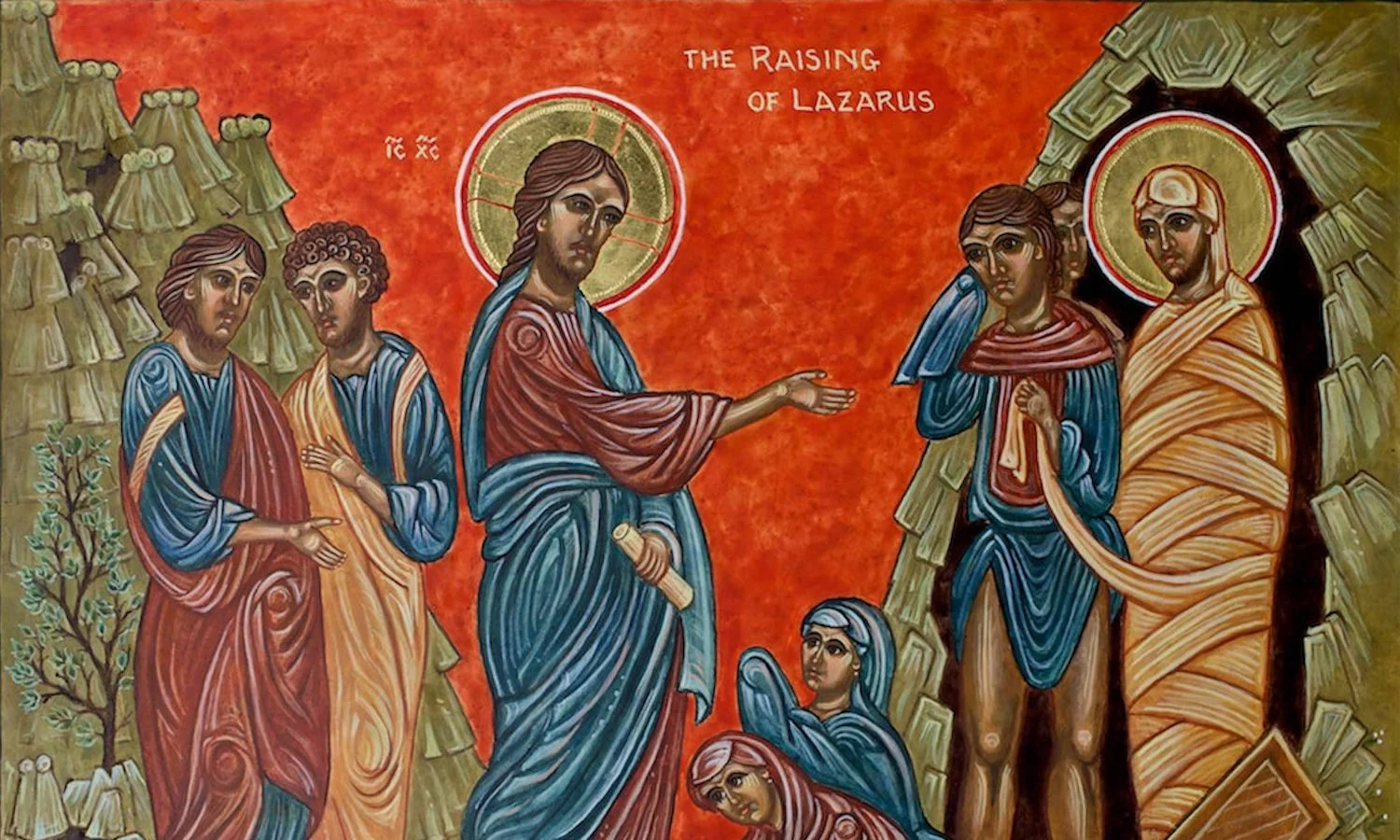
De Profundis: Pornchai Moontri and the Raising of Lazarus
The raising of Lazarus, the sixth of seven signs in the Gospel of St. John, is told “so that you may believe.” The raising of Pornchai Moontri is that story retold.

The raising of Lazarus, the sixth of seven signs in the Gospel of St. John, is told “so that you may believe.” The raising of Pornchai Moontri is that story retold.
Some very important things occurred on the day before I sat down to type this post. The day began for me at about 5:00 AM. I was alone in the dark, walking in silent solitude through the dew laden grass of the New Hampshire State Prison Ballfield. There was not another soul in sight. The day’s first light was but a hint of gray barely visible above the walls and razor wire. A few birds were stirring with the dawn’s early light, their song one of hope and serenity. I could smell the grass and the early morning air. All was beautiful. Succumbing to the hypnotic scene, I lay down in the beckoning grass and fell into a deep sleep.
And then I suddenly awoke from that dream to the harsh reality that ushers in my real day. The soft grass instantly transformed into cold concrete, the melody of songbirds into the snores of grown men, the smell of grass and the morning air into the stale and crowded confinement of what sometimes feels like a tomb.
I longed to drift back into my dream, but it was a luxury I could not afford that day. So I rolled over to the edge of my bunk, reached down to the floor, and plugged in a pot of water for coffee. Then I lay in the dark and placed before the Lord the important things of the day that lay before us.
A few minutes later, Pornchai-Max Moontri jumped down from his upper bunk and silently poured hot water into two cups of instant coffee. The other six denizens of our cell still slept as we prepared for a momentous day in prison. At 6:00 AM, Pornchai walked from our cell to a small bank of three telephones to place a long awaited call. For the first time since he was taken from his home and country at age 11 — 32 years ago — Pornchai placed a call to someone in Thailand. And it was not just ANY someone.
It was 6:00 PM in Thailand, and his first call to his homeland was to Yela Smit, a founding member of “Divine Mercy Thailand,” a group that reached across the world to embrace Pornchai with something he had once given up all hope for: a life beyond this long sleep of death in prison. This moment had its origin in one of the most compelling accounts of faith written at These Stone Walls, “Knock and the Door Will Open: Divine Mercy in Bangkok, Thailand.” Just how miraculous is that gift might be clearer below, but first, the story of Lazarus.

“I Have Come To Believe!”
Pornchai himself seemed to provide a prelude to the story of Lazarus. At Mass on the Fourth Sunday of Lent, he stood at the lectern to proclaim the Second Reading from the Letter of Saint Paul to the Ephesians. I found it difficult to distinguish the words from the life’s reality of the man proclaiming them:
“You were once darkness, but now you are light in the Lord. Live as children of light, for light produces every kind of goodness and righteousness and truth. Try to learn what is pleasing to the Lord. Take no part in the fruitless works of darkness, rather expose them, for it is shameful even to mention the things done by them in secret, but everything exposed by the light becomes visible, for everything that becomes visible is light. Therefore, it says ‘Awake, O sleeper, and arise from the dead, and Christ will give you light.’”
It amazes me how much those very words proclaimed by Pornchai-Max at Mass on the Fourth Sunday of Lent are both a summation of his life and a prelude to the raising of Lazarus in John 11:1-45. Pay special attention to this Gospel passage for the Fifth Sunday of Lent. Before we tell more, it needs a little background.
It was Winter in Jerusalem, and the Feast of the Dedication, the event known to us as Hanukkah. We began Lent at These Stone Walls this year with the background story of this Feast in “Semper Fi! Forty Days of Lent Giving Up Giving Up.” When Jesus went to the Temple at the time of this Feast (described in John 10:22-42), He was walking in the Portico of Solomon on the eastern side of the Temple mentioned in Acts of the Apostles 3:11.
Some of the Jews surrounded him, and challenged him about a circulating rumor that he is the Christ. They wanted him to claim it plainly, and they had taken up stones to execute him for blasphemy if he did. Storm clouds were gathering, and rumbling calls for his death were growing in Jerusalem.
Some Pharisees had been investigating his healing of a blind man on the Sabbath. They first thought the man had been faking his blindness, but witnesses attested that he had been blind from birth. They questioned the formerly blind man about the “sinner” who had healed him, but the man shot back, “Would God listen to a sinner?”
Now, at the Portico of Solomon in the Temple, Jesus spoke of his sheep hearing his voice. He challenged the Pharisees’ spiritual blindness, “If I am not doing the works of my Father, then do not believe me.” They took up stones and tried to arrest him, “but he escaped from their hands” (John 10:39). “The Hour of the Son of God” (the Seventh sign) had not yet come.
But then Jesus received word that Lazarus, the brother of Martha and Mary of Bethany, was ill. When Jesus heard this, he said, “This illness is not unto death; it is for the greater glory of God, so that the Son of Man may be glorified because of it.” Then he simply took his time, inexplicably letting two more days pass before departing to complete this sixth of seven signs in the Fourth Gospel’s “Book of Signs,” the raising of Lazarus from his tomb, the Gospel for the Fifth Sunday of Lent.
But first, what does the Fourth Gospel mean by its “Book of Signs?” Written in Greek, Saint John’s Gospel uses an interchangeable term – Sêmeion – for both “signs” and “miracles.” The Greek word is used sixty times through the New Testament, seventeen of them in the Fourth Gospel. Since the first six of the Gospel’s seven signs are found in Chapters one through twelve, this part of the Gospel is called “The Book of Signs.”
For this Evangelist, the signs of Jesus are mighty works, but they are also miracles told for a specific purpose. They are “signs” that lift a corner of the veil to point the readers’ gaze to the glory of God working through Christ. The signs of Jesus echo the signs of Moses during the Exodus from Egypt:
“And there has not arisen a prophet since in Israel like Moses, whom the Lord knew face to face, none like him for all the signs and wonders… and for all the mighty wonder and all the great and terrible deeds which Moses wrought in the sight of all Israel.”
The Sixth Sign, the raising of Lazarus, concludes the Book of Signs, and makes way for the rest of the Gospel and the Seventh Sign, the final and climactic sign — the Resurrection of Jesus — which Jesus elsewhere calls “The Sign of Jonah” (Matthew 12:39).
It is for this reason that the Church permanently chooses the Passion account from the Gospel According to Saint John for the proclamation of the Gospel on Good Friday. It is very different from the other three Gospel accounts. Here, the death of Christ is not just sacrifice and the path to redemption. It is also the moment of the enthronement of Christ the King upon the Cross. As the Seventh Sign, it is the fulfillment of the purpose of all the signs, in just the way that the Evangelist has Jesus presenting the illness of Lazarus: “To bring glory to God.” Martha, the sister of Lazarus, bridges the Sixth and Seventh signs in a dialogue with Jesus about the death of her brother:
“I am the resurrection and the life; he who believes in me, though he die, yet shall he live; and whoever believes in me shall never die. Do you believe this?’ She said to him, ‘Yes, Lord, I believe that you are the Christ, the Son of God, he who is coming into the world.’”

The Raising of Lazarus
Almost inexplicably in this Gospel account, once Jesus learns of the illness of Lazarus, he “stayed two days longer in the place where he was” (11:7). The account takes great pains to present that by the time Jesus arrives, Lazarus is not asleep or in a coma, but is dead, wrapped and bound in a burial shroud, and sealed in a tomb for four days. There can be no doubt.
The disciples are incredulous that Jesus would even think of going to Bethany in Judea where many of the Jews who had been in Jerusalem have now also gone. “Rabbi, the Jews were but now seeking to stone you, and you are going there again?” (John 11:8) The disciples totally misunderstand his reply — “If anyone walks in the day, he does not stumble.” Throughout the Fourth Gospel, Jesus is aware that until his “hour” comes, he can walk through all of Judea in safety. (We mined the depths of this “hour” in the Fourth Gospel in a Holy Week post, “Now Comes the Hour of the Son of God.”)
I found the response of Martha (above) to be perplexing at first: “I believe that you are the Christ, the Son of God, he who is coming into the world.” What could Martha mean by “coming into the world?” Jesus is already in the world. It’s a sort of presage of the events to come. Upon the cross, in sight of His mother and the Beloved Disciple, Jesus Himself becomes the Gate of Heaven. The raising of Lazarus is a preface to that event, and with the entire scene set, it is told in the simplest terms:
“‘Lazarus, come out!’ The dead man came out, his hands and feet bound, and his face wrapped in a cloth. Jesus said to them, ‘Unbind him, and let him go.’”
With those few words, the Fourth Gospel ends the Sixth Sign by ascribing to Jesus what was once for Israel the sole purview of Yahweh: the power over death, and life. From this point on in the Gospel of John, the Seventh Sign commences as the plot to put Jesus to death gets underway.

Another Chapter in Pornchai’s Story
There were chapters after this one awaiting in the future of Lazarus, but we will never know what they are. But this account echoes across the centuries, and still reverberates in countless lives of those called from death to life. Though Lazarus was physically dead, there is a parallel for those summoned forth from the tombs of spiritual death. One of them is our friend, Pornchai Maximilian Moontri, and his story is also told to unveil the glory of God.
I cannot tell all of it yet for some important chapters are still being written. But I can tell you this: the full account, when told, will be one of the most important Divine Mercy stories of our time. In the coming months, we hope to tell more of it, for the odds against any of it unfolding as they did are astronomical.
Pornchai’s recent telephone call to Thailand was but the latest step out of darkness into the light, and like Lazarus it leads only to his unbinding and new life. In 2009 when These Stone Walls began, we did not see this as even possible. Somehow, while buried in a prison cell in Concord, New Hampshire, we managed to tell a tale that circled the world, and when it came back around to us, it carried with it a multitude of good will and bonds of connection. For Pornchai, this tapestry of grace is still being woven, replacing the threads of only vague dreams and little hope with the powerful weaving of Divine Mercy. All has changed.
Among the instruments of that change is Viktor Weyand who is pictured in the photograph below with Pornchai Moontri. Viktor, an Austrian living in the United States, is a member of Divine Mercy Thailand and a founder of Divine Mercy School in Bangkok. During one of his many visits to Bangkok three years ago, he was asked to investigate the story of a young Thai man in an American prison in New Hampshire. That story drifted around the world from These Stone Walls. As happens among the hidden threads behind every tapestry of grace, Divine Mercy created bonds of connection that gathered strength and then rolled back the stone of Pornchai’s spiritual tomb. And as he put it, “I woke up one day with a future when up to then all I ever had was a past.”

The story of this other Lazarus is coming, and like the first, it will knock your socks off! For, now I can only give you once again the very words from Saint Paul that Pornchai read at Mass on the Fourth Sunday of Lent to open our hearts to the story of Lazarus:
“Awake, O sleeper, and arise from the dead. Christ will be your light.”
Editor’s Note: You might like these other journeys into the deeper threads of the Tapestry of God in Sacred Scripture from These Stone Walls:
Joseph’s Dream and the Birth of the Messiah
A Transfiguration Before Our Very Eyes
Casting the First Stone: What Jesus Wrote in the Sand
On the Road to Jericho: A Parable for the Year of Mercy
Upon the Dung Heap of Job: God’s Answer to Suffering
St Gabriel the Archangel: When the Dawn from On High Broke Upon Us
Angelic Justice: St Michael the Archangel and the Scales of Hesed
