“There are few authentic prophetic voices among us, guiding truth-seekers along the right path. Among them is Fr. Gordon MacRae, a mighty voice in the prison tradition of John the Baptist, Maximilian Kolbe, Alfred Delp, SJ, and Dietrich Bonhoeffer.”
— Deacon David Jones
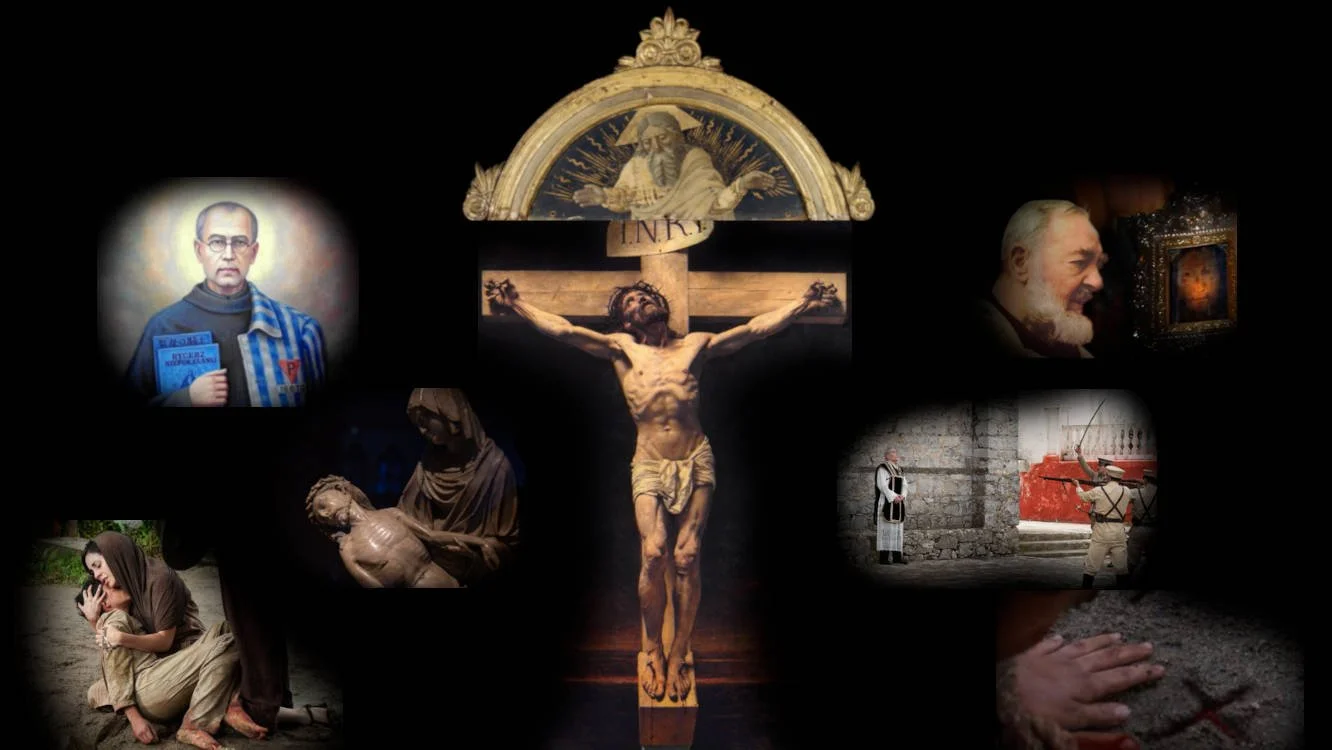
The Darkness of the Cross Enlightened on the Road to Emmaus
At Gethsemane Jesus of Nazareth agreed to bear the Cross to his own Crucifixion so that following him to Heaven’s Gate would not be a burden of impossibility for us.
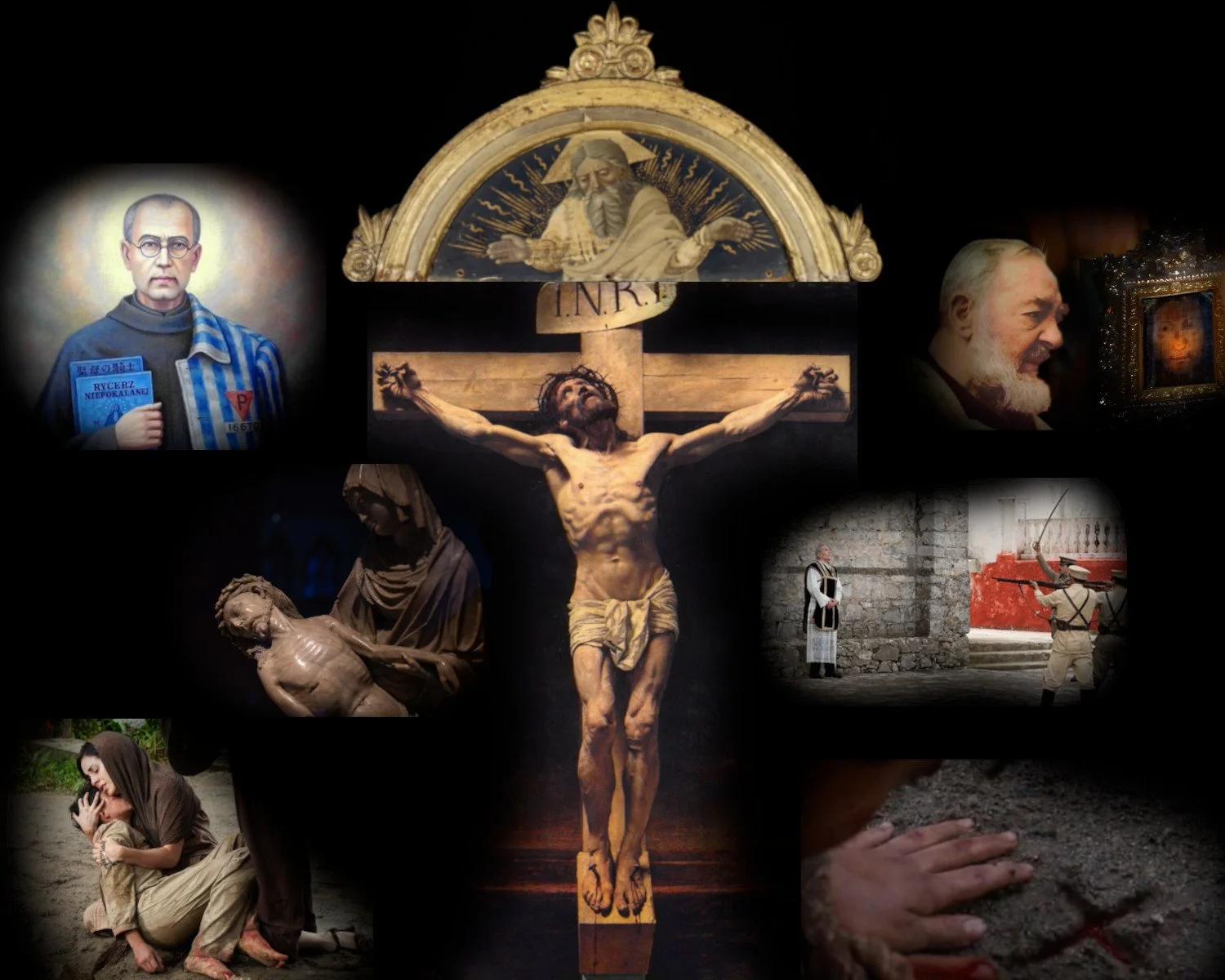
At Gethsemane Jesus of Nazareth agreed to bear the Cross to his own Crucifixion so that following him to Heaven’s Gate would not be a burden of impossibility for us.
Holy Week 2026 by Father Gordon MacRae
In all of human history, no method of execution has been devised more heinously, or delivered with more cruelty than crucifixion. In the Old Testament — no stranger to the cruel acts of men — crucifixion did not exist. It was first introduced to human history in the Sixth Century BC by the Persians, the ancestral empire of present-day Iran. I recently wrote of Iran and its place in history in “Iran, by Another Name, Was Once the Savior of Israel.”
My visual introduction to crucifixion was not so much biblical, but cinematic. Over many years I had pondered in depth its biblical presentation, but it was only when I watched the 2004 film, The Passion of the Christ directed by Mel Gibson, that I experienced and absorbed its visual impact. The brutality of the film was criticized for its excessive violence, but there was no such thing as a “gentle” crucifixion.
The Passion of the Christ contains all the elements ascribed to the event in the four Gospel accounts of the Crucifixion of Jesus in Sacred Scripture. I have read and studied those accounts many times, but I could watch that film only once and never again. It left me in a state of profound sorrow. That sorrow caused me to rethink some of the peripheral, but mysterious events that Sacred Scripture lends to the Crucifixion scene. One of them is the following excerpt from Psalm 22 attributed to King David. He never experienced crucifixion, but in Psalm 22 he wrote of it in the first person and in vivid prose 1,000 years before Jesus of Nazareth experienced it:
“My God, my God, why have you forsaken me? Why are you so far from helping me, from the words of my cry?
“O my God, I cry out by day, but you answer not, and by night, but I find no rest.
“Yet you are holy, enthroned upon the praises of Israel. In you our fathers trusted; they trusted and you delivered them. To you they cried and they were saved. In you they trusted, and were not disappointed.
“But I am worm and no man; scorned by men and despised by the people. All who see me scoff at me. They mock me with parted lips; they wag their heads. ‘He trusted in the Lord, let him deliver him. Let him rescue him if he delights in him.’
“I am poured out like water, and all my bones are wracked; my heart is like wax, it is melted within my breast. My strength is dried up like a potsherd, and my tongue cleaves to my jaws. You have laid me in the dust of death.
“Indeed, many dogs surround me; a pack of evildoers closes in upon me. They have pierced my hands and my feet. I can count all my bones; they stare and gloat over me. They divide my garments amongst them. For my clothing they cast lots.”
— Excerpted from Psalm 22, a Psalm of King David, circa 1000 BC
Most observant Jews would likely have recognized “My God, my God, why have you forsaken me?” as the opening line of Psalm 22. Mysteriously, those present for the Crucifixion of Jesus failed to do so. The Gospel quotes them as saying, “He is calling upon Elijah.” It was a distortion of the mixed Hebrew and Aramaic in the plea of Jesus from the Cross: “Eloi, Eloi, lema sabachthani.” In a magisterial treatise, Jesus of Nazareth: Part 2 Holy Week, Pope Benedict XVI wrote “Psalm 22 is Israel’s great cry of anguish, in the midst of its sufferings, addressed to the apparently silent God …. Now we hear the great anguish of the one suffering on account of God’s seeming absence.” Many of us have been here when simply calling out or pleading with God is not enough. In extreme anguish, prayer inevitably becomes a loud cry. Jesus prays this loud cry on behalf of all of us: “My God, my God, why have you forsaken me?”
What is remarkable about the four Gospel accounts of the Crucifixion is the multitude of Old Testament allusions and quotations they contain. In them, the Word of God and the events of the Gospel are deeply interwoven into the Passion Narrative. Two of these allusions, Psalm 22 and Isaiah 53, the “Suffering Servant” motif, shed light on the entire Passion event.
Isaiah begins with a direct reference to this saving act of God in a prophesy written hundreds of years before its fulfillment: “Behold, a virgin shall conceive and bear a son, and shall call his name ‘Emmanuel’” — a name which means “God with us.”
All of Sacred Scripture makes clear one consistent truth. If God is with us, we are not always with God. This becomes especially evident in the Passion Narrative of the Gospels, the arrest, interrogation, trial, scourging, and Crucifixion of Jesus. No one who followed him to this end, and who came to believe that he is the Messiah, the Christ of God, could ever have imagined that he would face humiliation, torture, Crucifixion and death. When it came, despite all promises to the contrary, most of his disciples shrank from their own promises and fled. None of us can stand in judgment of them. I wrote of one of history’s most vivid examples in “The Apostle Falls: Simon Peter Denies Christ.”
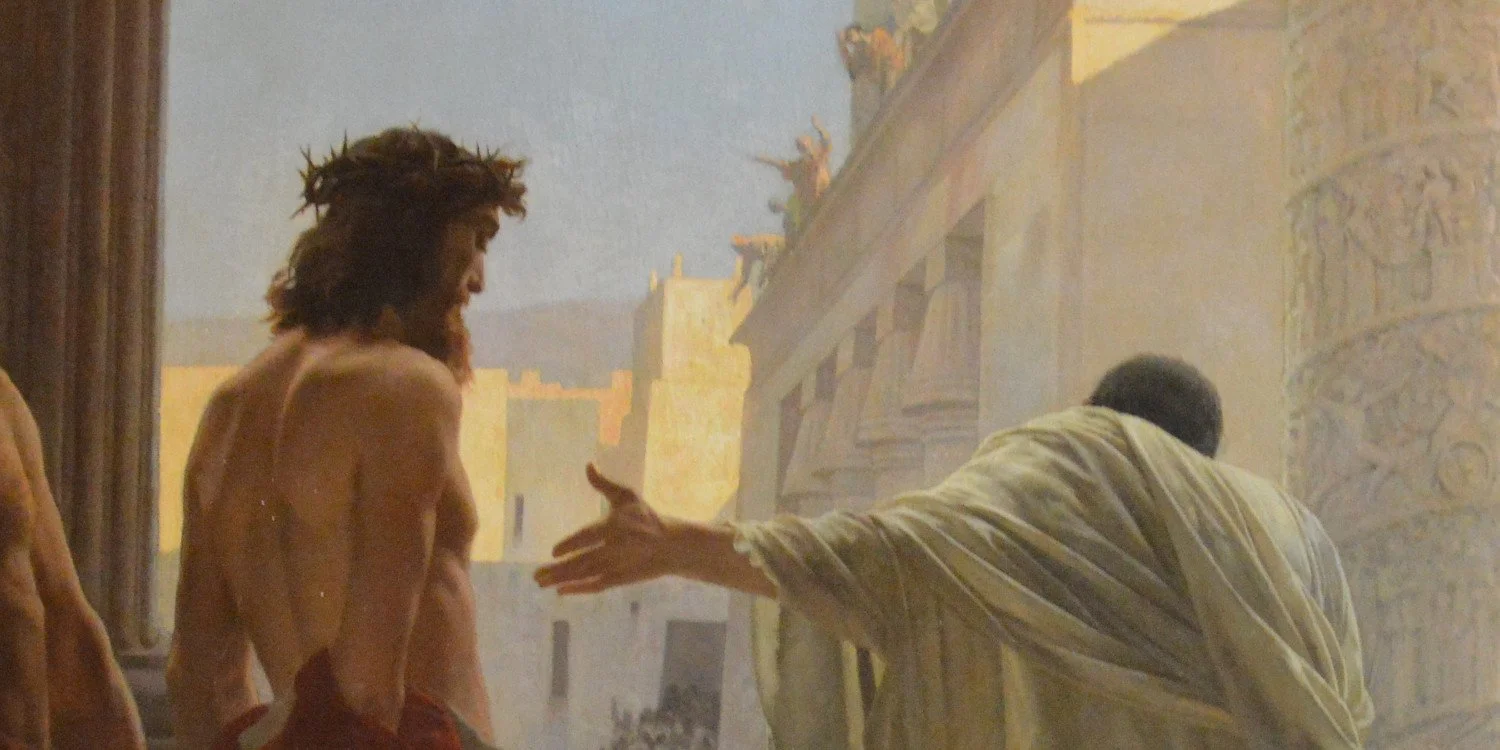
He Suffered under Pontius Pilate
But prior to all that, Jesus was interrogated by Pontius Pilate, the Roman military governor or procurator of the imperial province of Judea from 26 to 36 AD. The Jewish historian, Flavius Josephus, portrayed Pilate as a harsh administrator who failed to understand the religious convictions and national pride of the Jews. Pilate is known mainly for his connection with the trial and execution of Jesus. His culpability in the outcome has been the subject of debate ever since, and this conflicting view was implied even by Pope Benedict XVI, who wrote:
“After the interrogation, Pilate knew for certain what in principle he had already known beforehand: this Jesus was no political rebel; his message and his activity posed no threat for the Roman rulers. Whether Jesus had offended against the Torah was of no concern to Pilate as a Roman.”
— Jesus of Nazareth: Holy Week, p195
The Gospels of John and Mark present the custom of choosing a prisoner to be released on the Passover. The Gospels present a juxtaposition of the theological significance of choosing Jesus or Barabbas for release. John refers to Barabbas simply as a robber (18:40). In the political context of the time the Greek word that John used has also acquired the meaning of “terrorist,” or “rebel.” This is clear from Mark’s account: “And among the rebels in prison who had committed murder in the insurrection, there was a man called Barabbas” (Mark 15:7). It was clear that Pilate preferred to release Jesus, yet the crowd had different categories. Pilate came to understand their strong preference to release Barabbas, who had acquired the personna of a swashbuckling rebel.
The governor of Judea had complete judicial authority over all who were not Roman citizens, but many cases, especially those relating to religious matters, were decided by the Sanhedrin, the Jewish supreme council. According to the Gospel accounts, after the Sanhedrin found Jesus guilty of blasphemy it committed him to the Roman court because it lacked the authority to impose a death sentence. Pilate refused to approve their judgment without further investigation but the Sanhedrin threatened Pilate. When Pilate asked them, “Shall I crucify your king?” “The Chief Priests Answered, ‘We Have No King but Caesar’”
The Jewish priests then made other charges against Jesus, accusing him of blasphemy by calling himself a king (which he never actually did) and a son of God. Pilate appears to have been impressed with the dignity and honesty of Jesus, and tried to save him (John 18:38-39, 19:12-15). But fear of an uprising in Jerusalem and a resulting report to Roman authorities forced Pilate to accede to the Sanhedrin’s demand after the chief priests declared that freeing Jesus would mean that Pilate “is no friend of Caesar.” The false claim that Jesus was “King of the Jews,” was perceived as a threat to the Roman empire. It ended up on the inscription bearing the official nature of his offense to be affixed to his Cross.
Jesus was thus to be crucified and was handed over by Pilate for scourging, a brutal aspect of the punishment that often left the accused dead even before being crucified. Some have suggested that the scourging was intensified by Pilate to sway Jewish leaders away from crucifixion if the scourging was brutal enough. The guards saw to it that it was, but to no avail. It is very likely that Jesus carried only the crossbeam to which his hands were affixed first by ropes and then nails were added upon the height of Mount Calvary. His scourging had left his skin shredded so Simon of Cyrene was recruited to help carry the crossbeam. Only a few faithful women, including his Mother, his Mother’s sister, and Mary Magdalene remained with the beloved disciple John.
Each of the four Gospels presents a parallax view, the same scene but from a different perspective. In the Gospel according to John, the dying Jesus addressed his Mother: “Woman, behold your son” and to John, “Behold your Mother” (John 19:27). The Gospel instructs us that “from that hour the disciple took her into his own home.” Faithful Catholics have done the same ever since. Mary occupies a very special place in this scene and in our hearts.
As for Pontius Pilate, he was recalled to Rome in AD 36. According to the Roman historian, Eusebius, Pilate later committed suicide. Other traditions, however, report that Pilate secretly became a Christian and was condemned to death by the Roman Senate. Perhaps for this reason, Pilate is strangely revered by Coptic Christians as a martyr. They observe his feastday on June 25.
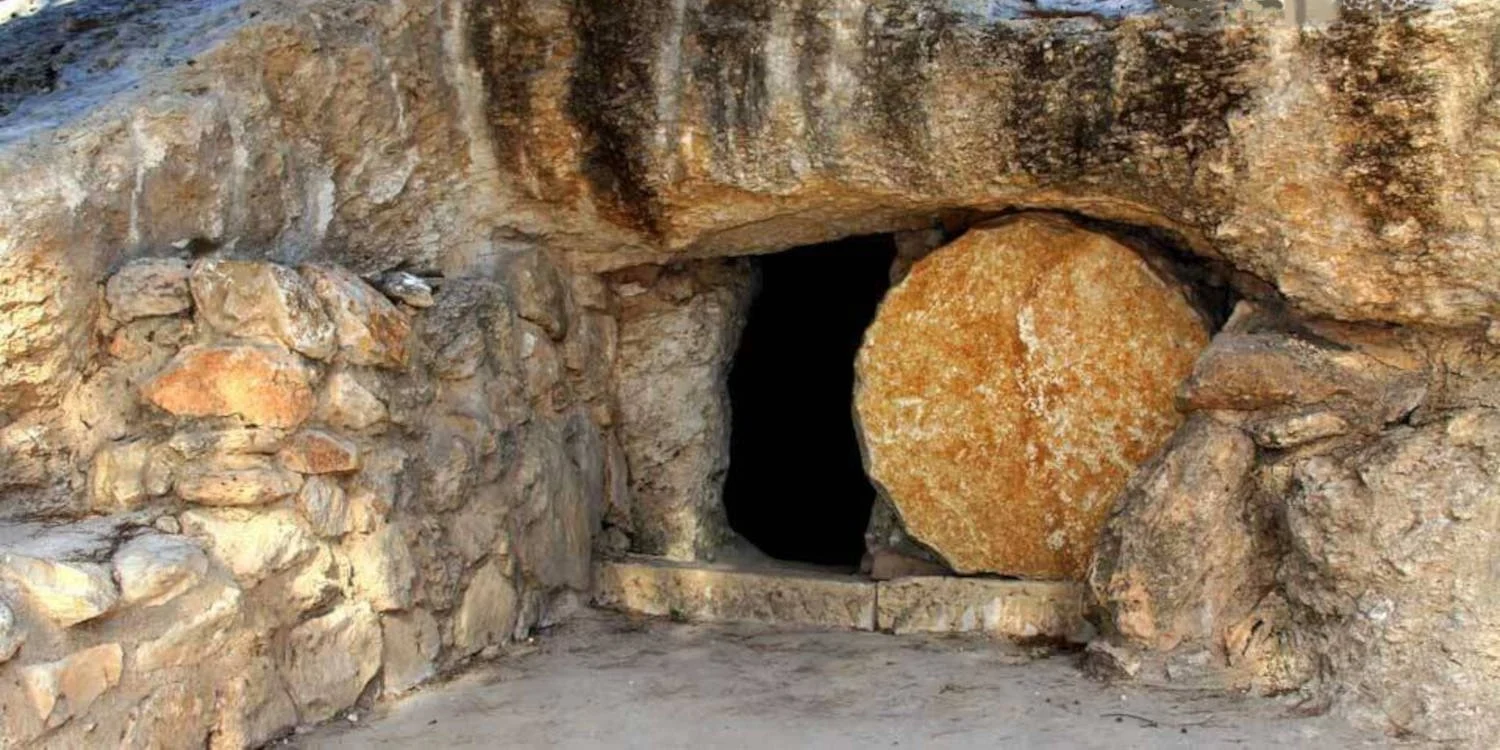
“Why Do You Seek the Living among the Dead?” (Luke 24:5)
The Resurrection of Jesus is the crowning event of the Passion Narratives of all four Gospels. Joseph of Arimathea, a member of the Sanhedrin who “was looking for the Kingdom of God” risked his standing in the Sanhedrin by asking Pilate for the body of Jesus, which was granted. Joseph interred the body in his own tomb hewn from rock (Luke 24:51). Some women went to the tomb as the Sabath was beginning. They saw the body of Jesus there then left to observe the Sabath.
On the next day, the first day of the week, these same women, now identified as Mary Magdalene, Joanna and Mary, mother of James, returned with spices to prepare the body according to the ritual law. They found the stone sealing the tomb to have been rolled away and two men in dazzling apparel frightened them asking,”Why do you seek the living among the dead?” When they told this to the disciples, they were not believed, but Peter ran to the tomb and found it just as they had said.
Later that same day, two of his disciples — one identified as Cleopas — were venturing about seven miles from Jerusalem along the road to Emmaus. They were speaking with great sorrow and trauma about the events of this and previous days. I have been where they were on that day. I do not mean that I have been on the road to Emmaus, except perhaps figuratively. I have been at a place at which all that I had ever worked for and hoped for just collapsed in irreparable ruin, and there was no justice in it. Reading about this encounter on the road to Emmaus, their deep sorrow and loss resonates with me on a personal level.
Then they encounter the Risen Christ along that road, but “Their eyes were kept from recognizing him.” (Luke 24:16) The visitor asked what their animated conversation was all about. The one named Cleopas was incredulous: “Are you the only visitor to Jerusalem who does not know the things that have happened there in these days?” “What things?” asked the stranger. Then came the outpouring of their grief:
“The things concerning Jesus of Nazareth who was a prophet might in word and deed before God and all the people, and how our chief priests and rulers delivered him up to be condemned to death, and crucified him. We had hoped that he was the one to redeem Israel. And besides all this, it is now the third day since this has happened. Now some women of our company have just amazed us. They were at the tomb early in the morning, but they did not find his body. They came back saying that they had even seen a vision of angels who said that he is alive. Some of those who were with us went to the tomb and found it just as the women said, but him they did not see.”
(To be continued.)
+ + +
Note from Father Gordon MacRae: Thank you for reading and sharing this post, which will now be added to both Our Holy Week Retreat and to our Collection called The Bible Speaks. You may also like these related posts leading up to the top of Mount Calvary:
Satan at the Last Supper: Hours of Darkness and Light
Waking Up in the Garden of Gethsemane

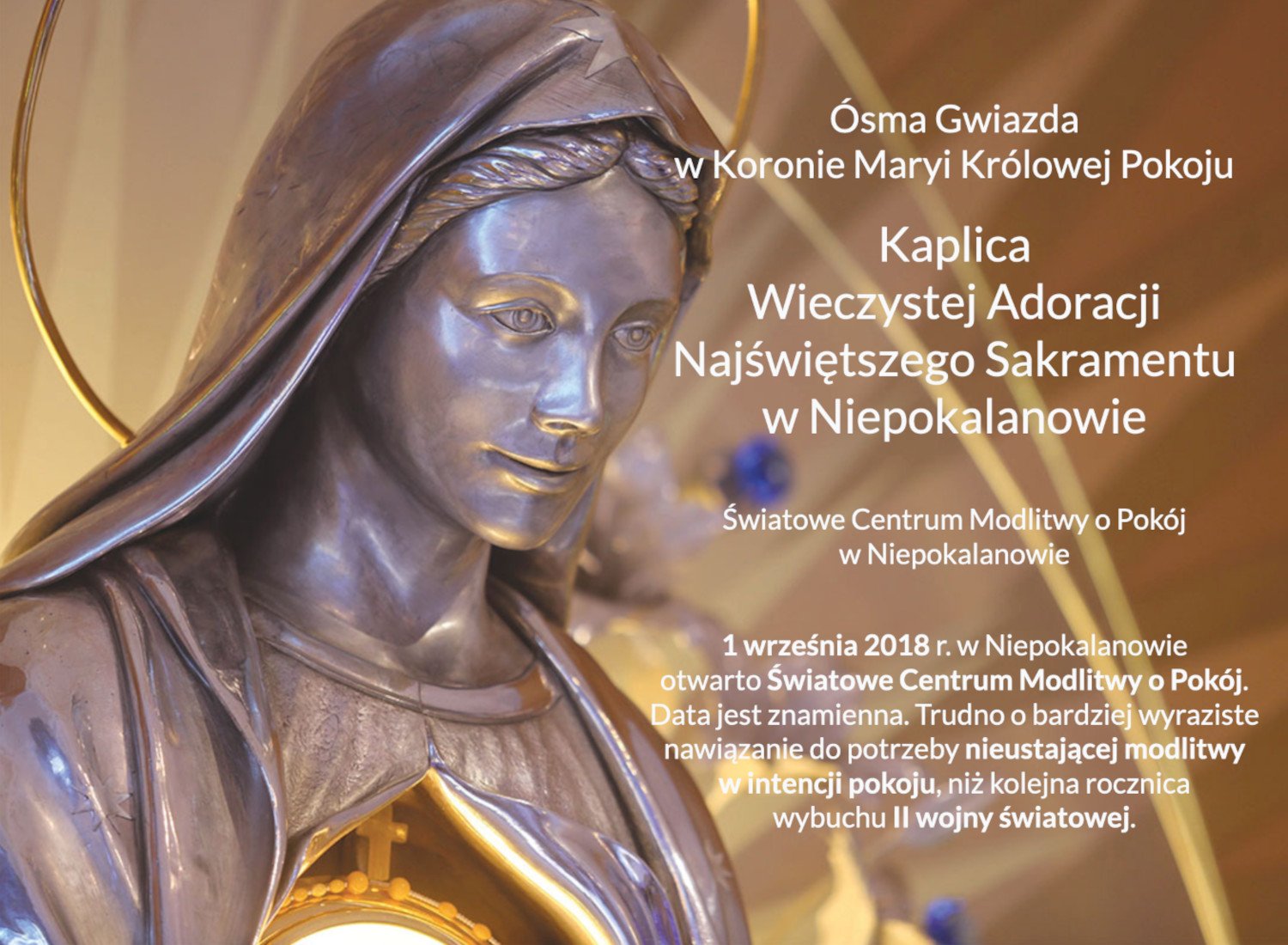

The Eucharistic Adoration Chapel established by Saint Maximilian Kolbe was inaugurated at the outbreak of World War II. It was restored as a Chapel of Adoration in September, 2018, the commemoration of the date that the war began. It is now part of the World Center of Prayer for Peace. The live internet feed of the Adoration Chapel at Niepokalanow — sponsored by EWTN — was established just a few weeks before we discovered it and began to include in at Beyond These Stone Walls. Click “Watch on YouTube” in the lower left corner to see how many people around the world are present there with you. The number appears below the symbol for EWTN.
Click or tap here to proceed to the Adoration Chapel.
The following is a translation from the Polish in the image above: “Eighth Star in the Crown of Mary Queen of Peace” “Chapel of Perpetual Adoration of the Blessed Sacrament at Niepokalanow. World Center of Prayer for Peace.” “On September 1, 2018, the World Center of Prayer for Peace in Niepokalanow was opened. It would be difficult to find a more expressive reference to the need for constant prayer for peace than the anniversary of the outbreak of World War II.”
For the Catholic theology behind this image, visit my post, “The Ark of the Covenant and the Mother of God.”

The Apostle Falls: Simon Peter Denies Christ
The fall of Simon Peter was a scandal of Biblical proportions. His three-time denial of Jesus is recounted in every Gospel, but all is not as it first seems to be.

The fall of Simon Peter was a scandal of Biblical proportions. His three-time denial of Jesus is recounted in every Gospel, but all is not as it first seems to be.
Note from Father Gordon MacRae: At Beyond These Stone Walls, I try to present many important matters of faith, but I also try not to overlook the most important of all: Salvation. In 2023 we began what I hope will be an annual Holy Week and Easter Season tradition by composing past Holy Week posts into a personal Easter retreat. The posts follow a Scriptural Way of the Cross. You are invited to ponder, pray and share them in our season of Highest Hope. They are linked again at the end of today’s post.
+ + +
Holy Week, March 27, 2024 by Fr Gordon MacRae
I had been 17 years old for only one month when I graduated from high school in May, 1970. Unlike most of my peers, I was too young to go to war in Southeast Asia. Some of my friends who went never came back. On my 17th birthday in April,1970, President Richard Nixon ordered U.S. troops into Cambodia while the U.S. withdrawal from Vietnam began. Across this nation, college campuses erupted into violence and walkouts. At Kent State in Ohio, four students were killed by national guardsmen sent to prevent rioting. In response to the protests, Congress passed an amendment to block U.S. troop incursions beyond South Vietnam.
The measure did not forbid bombing, however, so U.S. air strikes continued and increased in Cambodia until 1973. The combined effects of the incursion and bombings completely disrupted Cambodian life, driving millions of peasants from their ancestral lands into civil war. The Khmer Rouge was formed and then became one of the deadliest regimes of the 20th century. Meanwhile, the United States was yet again in a state of rage. Satan loves rage.
This was the setting of my life at seventeen. It seemed that evil was all around me then, but not yet in me. As 1970 gave way to 1971 and I turned eighteen, The Exorcist by William Peter Blatty was published by Harper and Row. I do not today recall how or why I came to have a copy of it so hot off the presses, but I read The Exorcist within weeks of its publication. I cannot say that I devoured it. At one point, I feared it might devour me.
The book left a vivid imprint on me, so much so that halfway through it I had to set it aside for a month. In its pages I came face to face with the personification of evil, accepting that it was a catalyst behind so much of this world’s agony. But I also had no delusion that I was any match for it. William Peter Blatty’s disturbing story of demonic possession seemed to be an allegory for what was happening in the world in which I lived.
Two years later, in 1973, the film version of The Exorcist was produced to scare the hell out of (or into) the rest of the nation that had not yet read the book. Because I did read the book, I was somewhat steeled against the traumatic impact that so many felt from the film. Its influence was evident in its awards. The Exorcist won the Academy Award for Best Writing and Screenplay for William Peter Blatty, and Golden Globe Awards for Best Motion Picture, Best Director, Best Screenplay, and Best Actor.
An Oscar nomination for Best Supporting Actress went to Linda Blair for her unforgettable portrayal of Regan, the possessed and tormented young target of an unnamed demon. The film’s producers hired a priest, Father William O’Malley, to portray “Father Dyer,” one of the priest-characters in the book and film. That lent itself to an aura of realism present throughout the book.
Ultimately, The Exorcist also set in motion my resolve to find something meaningful to embrace in life. I began to explore more deeply the Catholic faith that my family previously gave only a Christmas and Easter nod to. I felt called to a journey of faith just as most of my peers were abandoning theirs, but it did not last long. At the same time, my family was disintegrating and I was powerless to stem that tide and the void it left behind.
I was haunted by a sense that even as I embraced the Sacraments of Salvation, evil and its relentless pursuit of souls was never far behind in this or any age. Both seemed in pursuit of me. I was living in a verse reminiscent of Francis Thompson’s epic poem, “The Hound of Heaven” which begins:
I fled Him, down the nights and down the days ;
I fled Him, down the arches of the years ;
I fled Him, down the labyrinthine ways
Of my own mind; and in the midst of tears
I hid from Him.
Not even Satan can hide from God. I wrote the previously untold story of my path to priesthood on the 41st anniversary of my ordination. It was “Priesthood Has Never Been Going My Way.”
While pursuing a degree in psychology in the later l970’s, I had an interest in the work of psychoanalyst Erik Erikson and his stages of human development. Erikson predicted that in the latter years of our lives — the years I am in now — we enter a crisis of “generativity versus despair.” Many of us begin recalling and recalibrating the past, especially at “inflection points,” the points at which we changed. At this writing, I am 70 years old and counting. I realized only in later years that The Exorcist was an unexpected inflection point in my life, a point at which I turned from one path onto another.

The Betrayer Judas Iscariot
Even at age seventeen, the Catholic experience of Holy Week became a most important time for me. I began then to see clearly that the events of Holy Week were a nexus between the promises of Heaven and the pursuits of hell. The sneakiest thing Satan has ever done in the modern world was to get so many in this world to cease believing in him, and then to marginalize God. Many in the current generation calling itself “woke” now believe that Satan, if even real at all, has just been misunderstood.
The nightmarish story of The Exorcist was like a battleground. I was deeply impacted by a scene near the end of the book and film when the Exorcist, Father Damien Karras, tricked the demon into leaving young Regan and entering himself. He then leapt through a high window to his death on the Georgetown streets of Washington, DC down below. The scene set off a national debate. Had Father Karras despaired and committed suicide? Or had he heroically saved the devil’s victim by sacrificing himself?
Just as I was recently pondering this idea, I was struck by the photo atop this section of my post. It is my friend, Pornchai Moontri standing against a map of Southeast Asia which, I just now realized, is also where this post began. I had seen the photo previously in his January 2024 post, “A New Year of Hope Begins in Thailand,” but I failed to look more closely at it then.
Look closely at the T-shirt Pornchai is wearing in the photo. It quotes another inflection point in both his life and mine. His T-shirt bears a quote from St. Maximilian Kolbe who became a Patron Saint for us and who deeply impacted our lives. Maximilian also sacrificed his life to save another. His simple but profound quote on Pornchai’s T-shirt is, “Without Sacrifice,There Is No Love.”
That is how Father Damien Karras defeated the devil. Pornchai today says it is also how he was released from the prison of his past. And it is how Jesus conquered death and opened for us a path to Heaven. Sacrifice is the “Narrow Gate” He spoke of, the passage to our true home.
Earlier this Lent, I wrote “A Devil in the Desert for the Last Temptation of Christ.” It was about how Satan first set his demonic sights in pursuit of Jesus Himself. What utter arrogance! At the end of that account, having given it his all, the devil in the desert “departed from him until an opportune time.” (Luke 4:13)
By his very nature, the betrayer Judas Iscariot provided this opportune time. The Gospel gives many hints about his greed and ambition, traits that leave many open to the subtle infiltration of evil. Satan plays the long game, not only in human history, but also in a person’s life and soul. In the allegorical book, The Screwtape Letters, C.S. Lewis laid out the long, subtle trail upon which we humans risk the slippery slope toward evil:
“It does not matter how small sins are provided that their cumulative effect is to edge a person away from the Light and out into the Nothing ... . Indeed the safest road to Hell is the gradual one - the gentle slope, soft underfoot, without sudden turnings, without milestones, without signposts.”
— The Screwtape Letters, Letter #12, p. 60-61
Judas Iscariot gave Satan a lot to work with. He served as a treasurer for the Apostles but he embezzled from the treasury. The Gospel of John described him as “a devil” (6:70-71), “a thief” (12:6), “a son of destruction” (17:12).
The Gospel makes clear that Jesus was betrayed because “Satan entered into Judas called Iscariot” (Luke 22:3). At the Passover meal (John 13:26-30), Jesus gave a morsel of bread to Judas. When Judas consumed it, “Satan entered into him.” That would not have been possible had Judas truly believed in the Christ. The Gospel of John then ends this passage with a chilling account of the state of Judas’ life and soul: “He immediately went out, and it was night.” (John 13:30).
In the scene laid out in the Gospel of John above, Satan finds his opportune time when Judas let him in. I wrote of a deeper meaning in this account in one of our most-read posts of Holy Week, “Satan at the Last Supper: Hours of Darkness and Light.”

The Turning of Simon Peter
The Eucharist had just been instituted and shared by Jesus among his Apostles. All the Gospels capture these moments. All are inspired, but Luke is my personally most inspiring source. The Evangelist cites at the very end of the meal its true purpose: “This chalice which is poured out for you is the new covenant in my blood” (Luke 23:20). Jesus adds that “The Son of Man goes as it has been determined, but woe to that man by whom he is betrayed.”
The others at the Table of the Lord are alarmed by all this talk of Jesus being betrayed. They launch immediately into a dispute about who among them would do such a thing, who among them would never do such a thing, and finally who among them is the greatest (Luke 22:26). Simon Peter leads that last charge, but first we need to look at what has come before. How and why did Simon come to be called Peter? The answer opens some fascinating doors leading to events to come.
On a hillside in Bethsaida, a fishing village on the north side of the Sea of Galilee, a vast crowd gathered to hear Jesus. They numbered about 5,000 men. This was Simon’s hometown so he likely knew many of them. After a time, the disciples asked Jesus to send the crowd away to find food. Jesus instructed the disciples to give them something to eat. They protested that they had only seven loaves of bread and a few meager fish.
In a presage of the Eucharistic Feast, Jesus blessed and broke the bread, and with the few fish, a symbol of Christ Himself, the disciples fed the entire multitude on the hillside (Luke 9:10-17). Immediately following this, Jesus asked his disciples, “Who do you say that I am?” Simon replied, “You are the Christ, the Son of the Living God.” Simon is thus given a new and transformative name and mission:
“You are Peter (in Greek, Petra and in Aramaic, Cephas — both meaning “rock”) and on this rock I will build my Church, and the gates of Hades shall not prevail against it. I will give you the keys to the kingdom of heaven, and whatever you bind on earth will be bound in heaven, and whatever you loose on earth will be loosed in heaven.”
This is more than a figurative gesture. In the Hebrew Scriptures, Hades is the abode of the dead, the place where souls descend through its gates to an eternal Godless realm of the dead (Psalm 9:13, 17 and Isaiah 38:10) where they are held until the Last Judgment. It is the precursor to our traditional concept of hell being under the Earth, the place of the habitation of evil forces that bring about death.
In Hebrew tradition, the Foundation Stone of the Temple at Jerusalem, called in Hebrew “eben shetiyyah,” was a massive stone believed since ancient times to seal and cap off a long shaft leading to the netherworld (Revelation 9:1-2 and 20:1-3). It is this particular stone that the Evangelist seems to refer to as the rock upon which Jesus will build His Church. The Jerusalem Temple, resting securely on this impenetrable rock, was thus conceived to be the very center of the Cosmos and the junction between Heaven and Hell.
Jesus assures Peter, from the Biblical Greek meaning “rock,” that Peter and his successors will have the figurative keys to these gates and the power to hold error and evil at bay. By being equated with the very Foundation Stone itself, Peter is given the unique status of a prime minister, a position to be held for as long as the Kingdom stands.
Later in Luke’s Gospel, Simon Peter insists that he is “ready to go to prison and even death” with Jesus. Jesus corrects him saying, “Simon, Simon, behold, Satan demanded to sift you like wheat, but I have prayed for you that your faith may not fail; and when you have turned again, strengthen your brethren.” (Luke 22 : 31-32)
We all know, now, that Peter’s faith did fail. It gave way to fear and led him to three times deny being with, or even knowing, Jesus. But there is a lot more packed within that brief statement of Jesus above. The word “you” appears three times in the short verse. Like the rest of Luke’s Gospel, it is written in Biblical Greek. The word used for the first two occasions of “you” is plural. It refers to all of the Apostles, except Judas who had already gone out into the night.
The third use of the word “you” in that passage is singular, however, referring only to Peter himself. Jesus knew he would fall because his human nature had already fallen. But, “When you have turned again, strengthen your brethren.” Peter’s three-time denial of Jesus pales next to the betrayal of Judas from which there is no return. The story of Peter’s denial is remedied, and he “turns again” in the post Resurrection appearance at the Sea of Galilee (John 21:15-19).
Jesus brings restorative justice to Peter’s three-time denial by asking him three times to “feed my lambs,” “tend my sheep,” “feed my sheep.” Then Jesus tells Peter what to expect of his unique apostolate:
“Truly, truly I say to you, when you were young, you fastened your own belt and walked where you would; but when you are old, you will stretch out your hands, and another will fasten your belt for you and carry you where you do not wish to go”
— John 21:18
This was to foretell the assaults from beyond the Gates of Hell to which the Church will be subjected. And then, in John 21:19, He spoke His last words to Peter which, in Matthew 4:19, were also His first words to Peter. Through them, He speaks now also to us in this Holy Week of trials, assailed from all sides:
“Follow me.”
+ + +
“Stay sober and alert for your opponent the devil prowls about the world like a roaring lion seeking someone to devour. Resist him steadfast in the faith knowing that your brethren throughout the world are undergoing the same trials.”
— First Letter of Peter 5:8-9
+ + +

Photo by Nicolas Grevet (CC BY-NC-SA 2.0 DEED)
+ + +
Note from Father Gordon MacRae: You are invited to make our Holy Week posts a part of your Holy Week and Easter Season observance. I cannot claim that they are bound in Earth or Heaven, but we will retain them at our “Special Report” feature until the conclusion of the Easter Season at Pentecost:
The Passion of the Christ in an Age of Outrage (2020)
Overshadowing Holy Week with forced pandemic restrictions and political outrage recalls the Bar Kochba revolt of AD 132 against the Roman occupation of Jerusalem.
Satan at the Last Supper: Hours of Darkness and Light (2020)
The central figures present before the Sacrament for the Life of the World are Jesus on the eve of sacrifice and Satan on the eve of battle to restore the darkness.
Waking Up in the Garden of Gethsemane (2019)
The Agony in the Garden, the First Sorrowful Mystery, is a painful scene in the Passion of the Christ, but in each of the Synoptic Gospels the Apostles slept through it.
The Apostle Falls: Simon Peter Denies Christ (2024)
The fall of Simon Peter was a scandal of biblical proportions. His three-time denial of Jesus is recounted in every Gospel, but all is not as it first seems to be.
Behold the Man, as Pilate Washes His Hands (2014)
‘Ecce Homo,’ an 1871 painting of Christ before Pilate by Antonio Ciseri, depicts a moment woven into Salvation History and into our very souls. ‘Shall I crucify your king?’
The Chief Priests Answered, ‘We Have No King but Caesar’ (2017)
The Passion of the Christ has historical meaning on its face, but a far deeper story lies beneath where the threads of faith and history connect to awaken the soul.
Simon of Cyrene Compelled to Carry the Cross (2023)
Simon of Cyrene was just a man on his way to Jerusalem but the scourging of Jesus was so severe that Roman soldiers feared he may not live to carry his cross alone.
Dismas, Crucified to the Right: Paradise Lost and Found (2012)
Who was Saint Dismas, the Penitent Thief, crucified to the right of Jesus at Calvary? His brief Passion Narrative appearance has deep meaning for Salvation.
To the Spirits in Prison: When Jesus Descended into Hell (2022)
The Apostles Creed is the oldest statement of Catholic belief and apostolic witness. Its Fifth Article, what happened to Jesus between the Cross and the Resurrection, is a mystery to be unveiled.
Mary Magdalene: Faith, Courage, and an Empty Tomb (2015)
History unjustly sullied her name without evidence, but Mary Magdalene emerges from the Gospel a faithful, courageous, and noble woman, an Apostle to the Apostles.
The Eucharistic Adoration Chapel established by Saint Maximilian Kolbe was inaugurated at the outbreak of World War II. It was restored as a Chapel of Adoration in September, 2018, the commemoration of the date that the war began. It is now part of the World Center of Prayer for Peace. The live internet feed of the Adoration Chapel at Niepokalanow — sponsored by EWTN — was established just a few weeks before we discovered it and began to include in at Beyond These Stone Walls. Click “Watch on YouTube” in the lower left corner to see how many people around the world are present there with you. The number appears below the symbol for EWTN.
Click or tap here to proceed to the Adoration Chapel.
The following is a translation from the Polish in the image above: “Eighth Star in the Crown of Mary Queen of Peace” “Chapel of Perpetual Adoration of the Blessed Sacrament at Niepokalanow. World Center of Prayer for Peace.” “On September 1, 2018, the World Center of Prayer for Peace in Niepokalanow was opened. It would be difficult to find a more expressive reference to the need for constant prayer for peace than the anniversary of the outbreak of World War II.”
For the Catholic theology behind this image, visit my post, “The Ark of the Covenant and the Mother of God.”