“There are few authentic prophetic voices among us, guiding truth-seekers along the right path. Among them is Fr. Gordon MacRae, a mighty voice in the prison tradition of John the Baptist, Maximilian Kolbe, Alfred Delp, SJ, and Dietrich Bonhoeffer.”
— Deacon David Jones
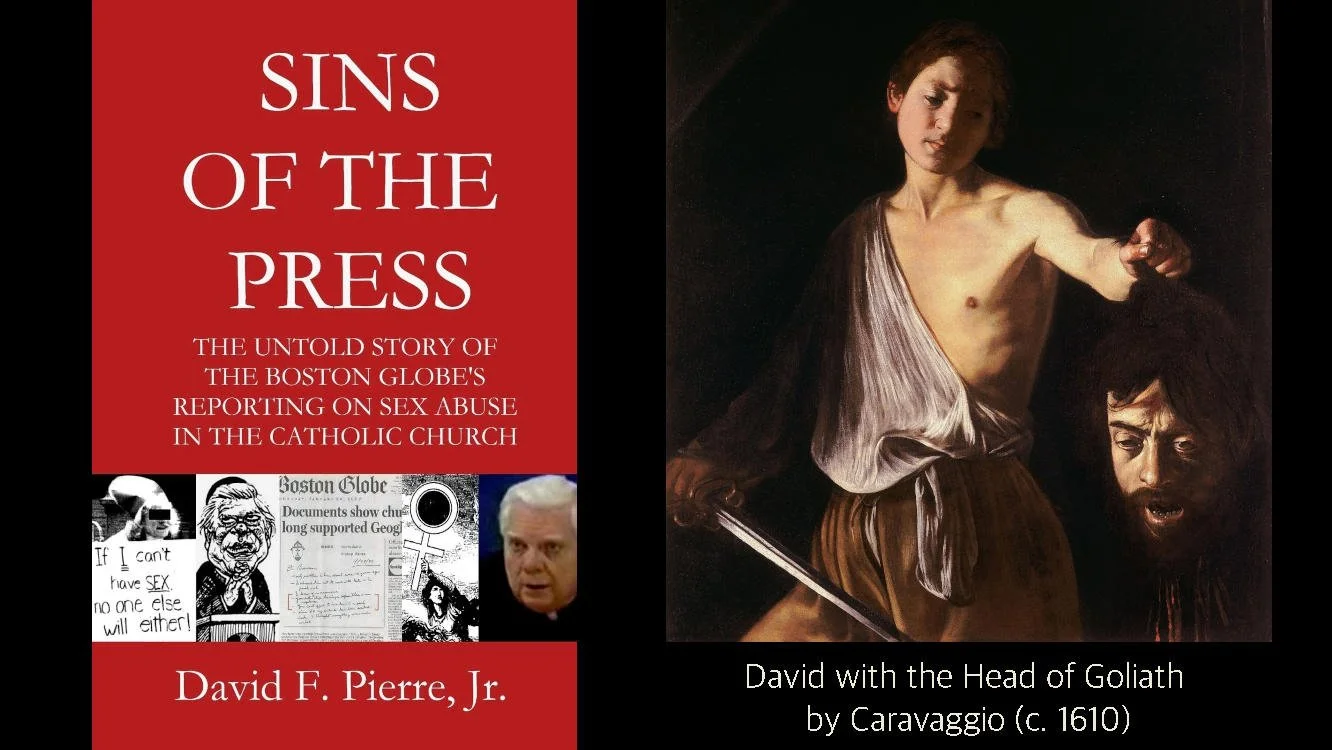
Sins of the Press: David and the Truth About Goliath
In his book, Sins of the Press, Catholic writer and media equalizer David F Pierre Jr, takes aim at a news Goliath: The Boston Globe’s Pulitzer-endorsed Prejudice.
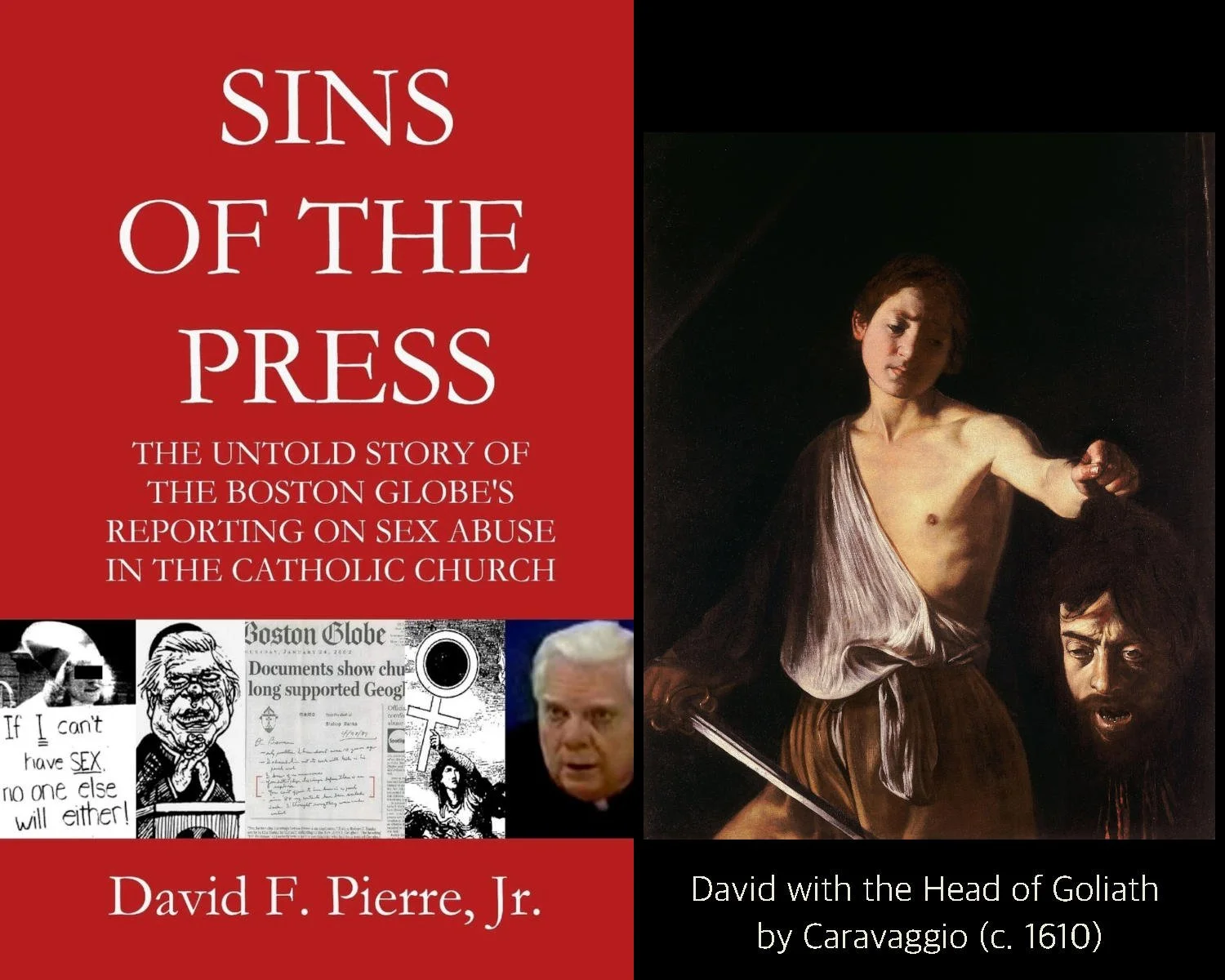
In his book, Sins of the Press, Catholic writer and media equalizer David F Pierre Jr, takes aim at a news Goliath: The Boston Globe’s Pulitzer-endorsed Prejudice.
October 15, 2025 by Father Gordon MacRae
Do you remember Robert McCall? He was The Equalizer, a retired espionage operative in a popular 1980s TV series. It was never clear whether he was CIA or MI6, but each week he placed his formidable skills in the service of some underdog up against powerful oppressors. With British actor Edward Woodward in the role of Robert McCall, The Equalizer managed to even the odds against a perfect storm of tyranny. He appeared rather benign, and at times he seemed a bit in over his head, but he was patient and bided his time. When he struck, the powerful and powerfully corrupt were unmasked and undone.
In a world of media atrocities, David F. Pierre, Jr. aims to be an equalizer. With the patience of Job, he waited a dozen years before loading his small stone of an expository book into a sling to take aim at a media Goliath, in this case The Boston Globe and its 2003 Pulitzer Prize for — don’t miss the irony in this — “Public Service.” Here’s how the Pulitzer Committee described its 2003 award to The Boston Globe…
“… for its courageous, comprehensive coverage of sexual abuse by priests, an effort that pierced secrecy, stirred local, national, and international reaction, and produced changes in the Roman Catholic Church.”
I found that description by the 2003 Pulitzer Committee to be incredibly tragic and sad. The recipients of that Pulitzer, The Boston Globe and its Spotlight Team, had an opportunity to pierce entrenched secrecy, to stir long dormant local, national and international reaction, and to produce substantive changes in the epidemic of sexual abuse from which millions in this culture have suffered. Indeed, that would have been a public service.
But the Globe let that opportunity pass for the creation of a moral panic aimed exclusively at the Catholic Church, and the Pulitzer Prize Committee chose to underwrite that fraud. It was an adventure in media narcissism, and David F. Pierre, Jr. struck the eye of that self-serving Goliath in Sins of the Press: The Untold Story of The Boston Globe's Reporting on Sex Abuse in the Catholic Church.
His publication of this book was timely. In the same year of the book’s release, Hollywood released its own version of The Boston Globe’s Pulitzer-endorsed prejudice with the film, “Spotlight” written by Thomas McCarthy, who also directed, and Josh Singer. Some have suggested that the film was on a par with the great 1976 Oscar winner, All the President’s Men that explored The Washington Post’s dogged pursuit of President Richard Nixon and the Watergate scandal. The claim was ludicrous.
David Pierre posted an exclusive here two weeks ago in “Hidden Evil: The Anti-Catholic Agenda of Bishop Accountability.” It exposed another venomous venue, Bishop Accountability, which was far more interested in exploiting Catholic scandal than covering the truth about child abuse. Sins of the Press, in contrast, was focused on The Boston Globe’s coverage of Catholic scandal which was aimed solely for the purpose of destroying one of the most important pillars of Boston, Massachusetts, its Catholicism.
On page after page of Sins of the Press, Pierre presents clear and compelling evidence of the Globe’s reckless disservice to humanity in its shameless pursuit of Catholic priests. Like David Pierre’s previous books, Catholic Priests Falsely Accused, and Double Standard, Sins of the Press is right on point without its author telling us what to think about the sordid revelations it contains. He lets the facts speak for themselves, and they do, quite loudly, sometimes with echoes that resounded in my soul and psyche for days.
Mr. Pierre was not the first to take on the Globe’s reckless and destructive pursuit of Catholic priests and their due process rights. Several years before Sins of the Press was written, we published at Beyond These Stone Walls, “The Exile of Father Dominic Menna and Transparency at The Boston Globe.” Father Menna was an 81-year-old priest in the Archdiocese of Boston living out his senior years in a rectory with other priests while he served, as best he could, a parish that loved him dearly. Then out of the blue in 2007 came a single, vague allegation against him — there had never been another before or since — that The Boston Globe exploited mercilessly while allowing its readers to believe that the allegation was something that had just taken place. In truth, it was claimed to have happened 53 years earlier and like all such claims it was settled with no regard for Father Menna’s due process rights or well-being. Thanks to the Globe’s one-sided account, Father Menna was driven out of the priesthood at age 83 and died from a broken heart. Where was the Spotlight on that?
A Spotlight When We Needed a Floodlight
What The Boston Globe did, and what the Pulitzer Prize Committee honored for the Globe’s Spotlight coverage, was patently reckless, unjust, and dishonest, not only about the Catholic Church and priests, but also about the tragic and silenced majority of victims of sexual abuse. Dave Pierre’s book exposes one media tenet clearly: “If a priest didn’t do it, we’re not interested!”
The reader is left with no doubt that the harsh glare of a spotlight brought to bear by The Boston Globe was meant for a singular purpose, to isolate the Catholic Church and priesthood as a sort of special locus of sexual abuse. At the same time, the Globe accommodated by omission the prevalence of sexual abuse in other institutions throughout not only Boston, but the nation. A spotlight leaves a lot in the dark, whereas a floodlight is all-inclusive.
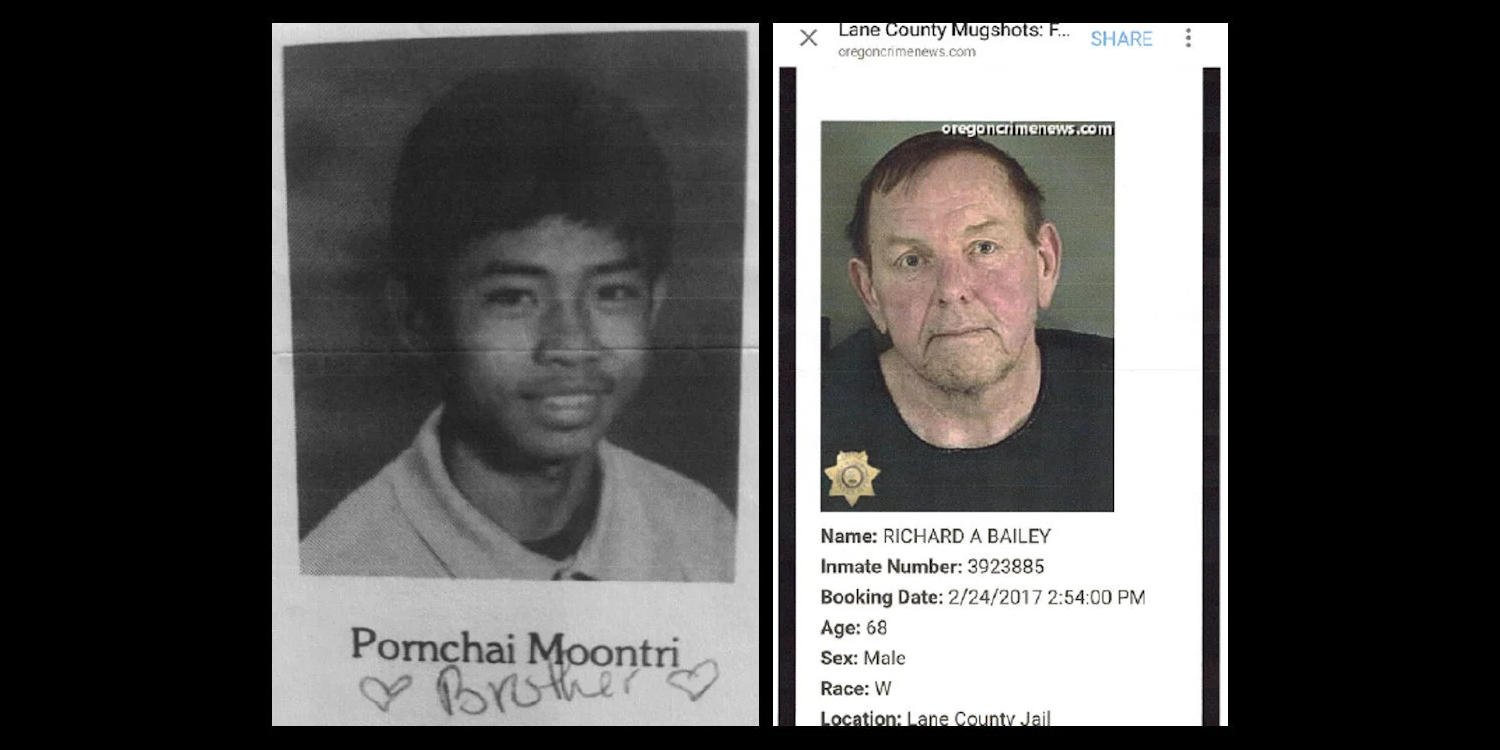
A case in point, one very familiar to our readers, is the story of what happened to Pornchai Moontri. The worst of it took place in New England, and the State of Maine, well within The Boston Globe’s coverage area. Pornchai Moontri was taken from his home in rural Thailand at age 11 and brought to Bangor, Maine, where he suffered years of horrific sexual abuse and violence. At one point he escaped only to be handed back over to his abuser by police. Having never been exposed to English, Pornchai could not articulate what had been happening to him. Then his mother was murdered, from all appearances by the same man who exploited Pornchai. He escaped into the streets as a teen where he lived under a bridge and homeless. During a struggle with a much larger man, Pornchai killed him in desperation, and was sent to life in prison with no defense. He ended up in a cell with me, and on April 10, 2010 he became a Catholic on Divine Mercy Sunday. As Pornchai much later wrote, “I could not believe all the stories of repressed memory and demands for huge amounts of money, by those who were accusing Catholic priests. I came to the Catholic Church for healing and hope, and found both. The grace of my recovery came from a priest who was falsely accused and I came to know that with every fiber of my being. He led me out of darkness into a wonderful light.”
With help from Clare Farr, an Australia attorney who read of Pornchai’s story and took an interest, we scoured cyberspace to find Pornchai’s abuser and bring him to justice. After reading what I wrote (linked at the end of this post), detectives from Maine came to interview Pornchai. On a second interview they brought the District Attorney. Pornchai’s abuser was found in Oregon and he was charged with 40 felony counts of child sexual abuse in Penobscot County Superior Court in Maine. On September 18, 2018 Richard Alan Bailey entered a plea of no contest on all counts. He was found guilty on all of them, but sentenced only to 18 years probation. There was no outrage, not even a sign that anyone noticed. The Boston Globe had zero interest in this story. There was just no cash to be had or Roman collar to be destroyed.
In September 2020, Pornchai was taken into custody by ICE and deported to his native Thailand. Hollywood called the Globe’s Oscar-winning film Spotlight. In a perverted sort of way, that was appropriate because it left in darkness, under shrouds of ignorance the real damage that had been done.
Losing the News
The Boston Globe Spotlight Team accomplished its goal with the creation of a perfect storm of moral panic. The paper’s spin presented every claim and accusation as demonstrably true, reported every settlement as evidence of guilt, spun decades-old claims to make them look as though they occurred yesterday, and never once questioned the financial motives of accusers.
In this arena, the Globe assisted in the continued abuse suffered by real victims by repeatedly giving a platform to personal injury lawyers who stood to pocket forty percent of every settlement wrested from a beleaguered and bludgeoned hierarchy while the millions abused in non-Catholic venues suffered in silence. The Globe’s “public service” was mostly to contingency lawyers.
Not all in the media were onboard with this. Writing for the contentious media platform, CounterPunch, columnist Joanne Wypijewski crowned her long career in journalism as a staff writer for The Nation with her own counter punch entitled “Oscar Hangover Special: Why “Spotlight” Is a Terrible Film.” For full transparency, much of her article was about the case against me. Armed with some healthy skepticism, the most important tool in her journalistic arsenal, she began her article thusly:
“I don’t “believe the victims”.
“I was in Boston in the Spring of 2002 reporting on the priest scandal, and because I know some of what is untrue, I don’t believe the personal injury lawyers or the Boston Globe’s “Spotlight” team or the Catholic “faithful” who became harpies outside Boston churches, carrying signs with images of Satan, hurling invective at congregants who’d just attended Mass, and at least once — this in my presence — spitting in the face of a person who dared dispute them.
“I don’t believe the prosecutors who pursued tainted cases or the therapists who revived junk science or the juries that sided with them or the judges who failed to act justly or the people who made money off any of this.
“And I am astonished (though I suppose I shouldn’t be) that, across the past few months, ever since Spotlight hit theaters, otherwise serious left-of-center people have peppered their party conversation with effusions that the film reflects a heroic journalism, the kind we all need more of.”
The lawyers, the Globe, and the seemingly endless parade of “John Does” all seemed to be on the same page in this, and it was always the front page. None of them reported that Father Dominic Menna, for example, never had any prior accusation, and that the one that destroyed his priesthood was claimed to have happened 53 years earlier and built on a dubious claim of repressed and recovered memory, a fraud that in this arena would go on to transform many lawyers into millionaires.
According to a recent Pew Research Center survey, less than half of Americans said that losing their local newspaper would harm civic life. Less than one third responded that they would miss their local newspaper if it just disappeared. Ken Paulson, President of the Newseum Institute’s First Amendment Center and a member of the USA Today Board of Contributors published an interesting column for USA Today entitled “News Media Lose Trust, Gain Allies.” Mr. Paulson cited a “State of the First Amendment Survey” with dismal results for those in the news media whose careers have been built upon reputable journalism. In the survey results, just 24% of respondents believe that the news media try to report the news without bias. That figure is down from 41% just a year earlier. However, 69% state that journalists in the news media should act in a watchdog role in reporting on government. That figure was down from 80% a year earlier. The first figure — the fact that only 24% of those surveyed believe the news media reports without bias — is alarming, and a record low for this decade-long poll. The second figure — indicating a decline in the sense that the media acts in a watchdog role — was surprising to Mr. Paulson who reported that “This nation’s founding generation insisted on a free press to act as a check on a strong central government … an enduring principle over centuries.” He added, however,
“Social media posts that call out unfairness and injustice don’t diminish this critical watchdog role. It just means a free press has many more allies.”
David F. Pierre, Jr. is one of those allies. His book, Sins of the Press is a David v. Goliath account that takes needed aim at The Boston Globe’s bias, and that is a good thing. The release of Spotlight, Hollywood’s version of this sordid story, felt a lot more like the Globe’s epitaph than any celebration of its dubious public service.
+ + +
+ + +
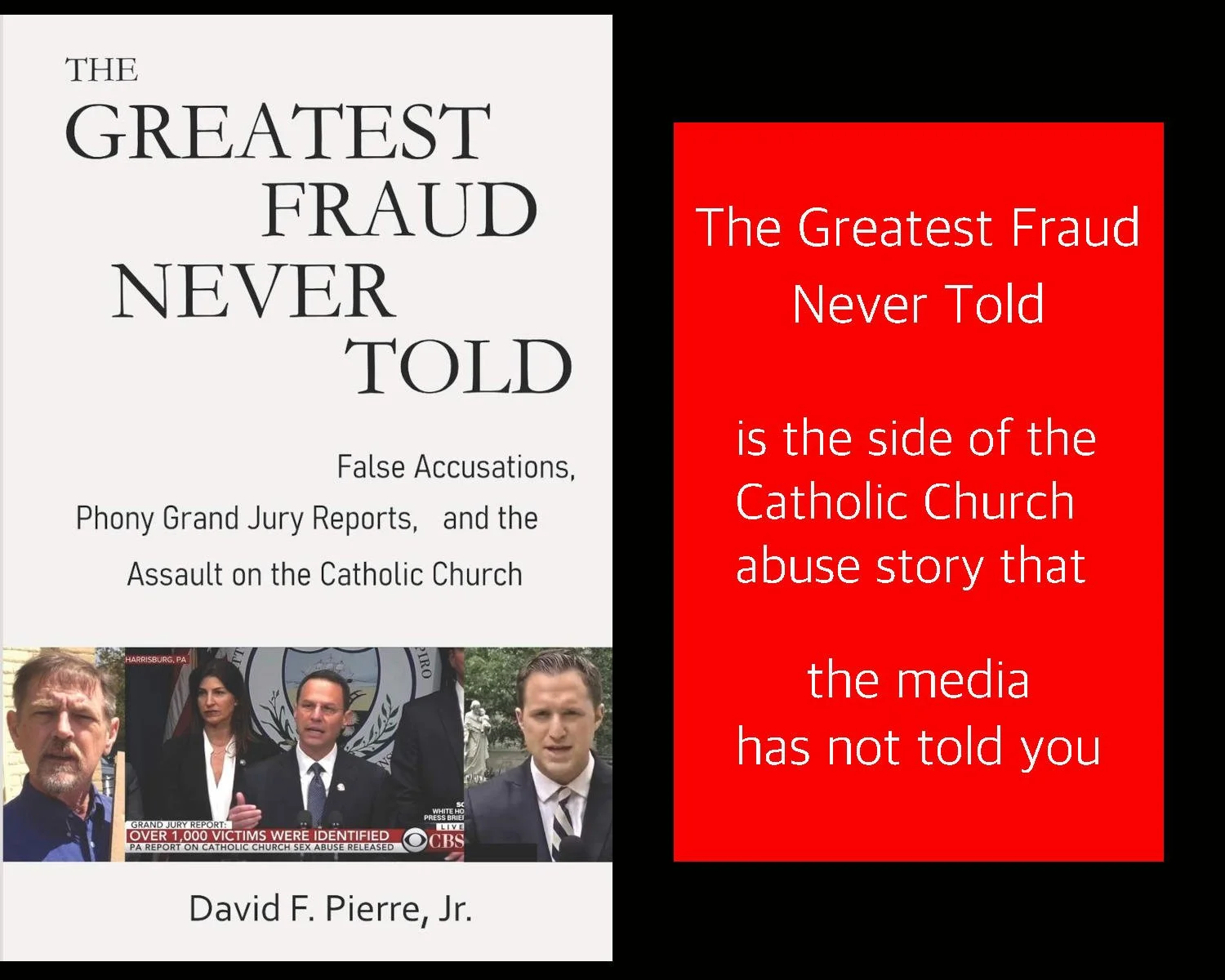
Note from Father Gordon MacRae: Thank you for reading and sharing this important post. I thank David F. Pierre, Jr. and commend him for his journalistic courage and integrity. You may review his work at TheMediaReport.com.
You may also like these related posts at Beyond These Stone Walls:
Getting Away with Murder on the Island of Guam
The Lying, Scheming Altar Boy on the Cover of Newsweek
Cardinal Bernard Law on the Frontier of Civil Rights
Hidden Evil: The Anti-Catholic Agenda of Bishop Accountability
Illumination From Down Under: Hope Springs Eternal in the Priestly Breast
+ + +

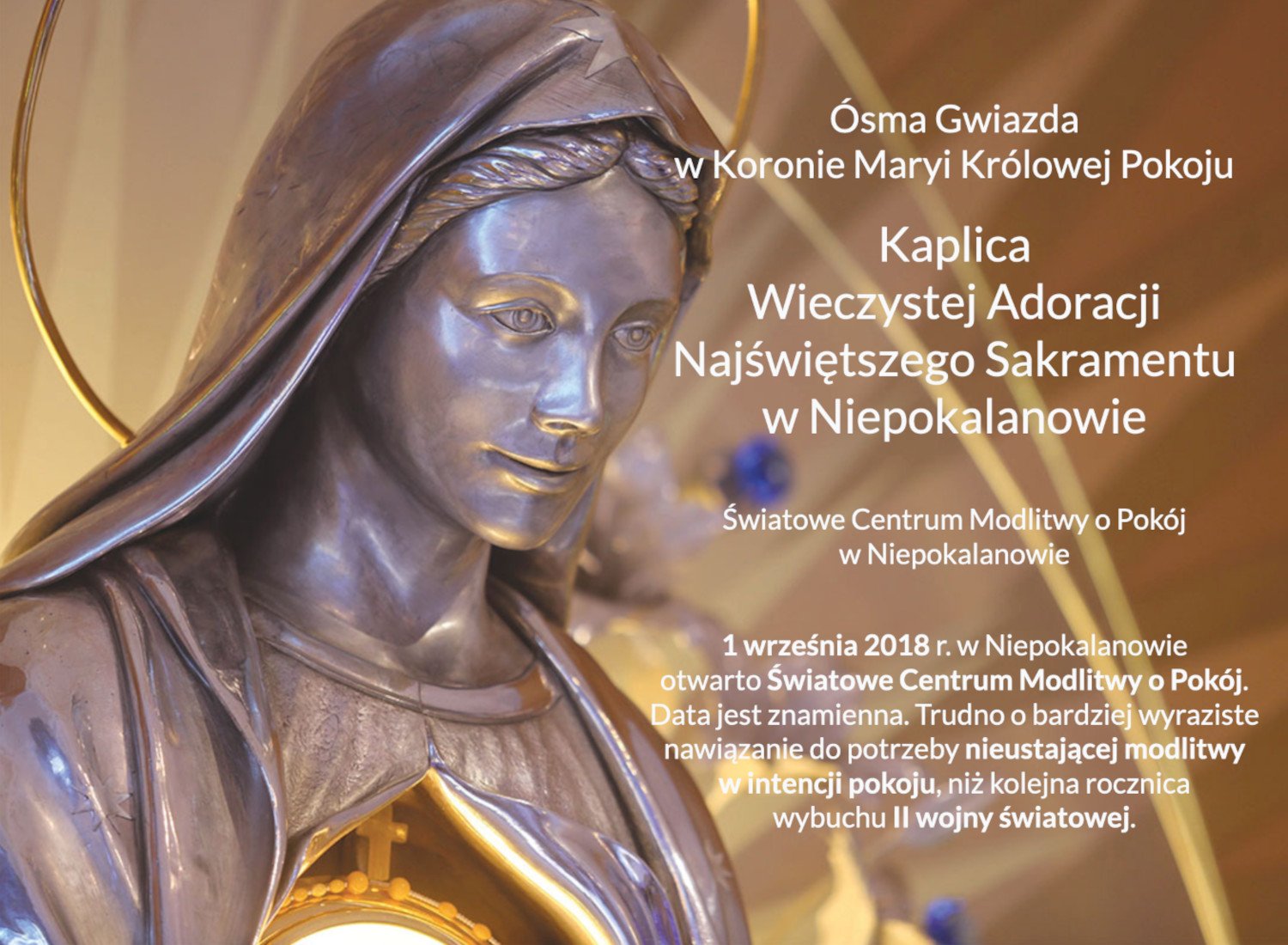

The Eucharistic Adoration Chapel established by Saint Maximilian Kolbe was inaugurated at the outbreak of World War II. It was restored as a Chapel of Adoration in September, 2018, the commemoration of the date that the war began. It is now part of the World Center of Prayer for Peace. The live internet feed of the Adoration Chapel at Niepokalanow — sponsored by EWTN — was established just a few weeks before we discovered it and began to include in at Beyond These Stone Walls. Click “Watch on YouTube” in the lower left corner to see how many people around the world are present there with you. The number appears below the symbol for EWTN.
Click or tap here to proceed to the Adoration Chapel.
The following is a translation from the Polish in the image above: “Eighth Star in the Crown of Mary Queen of Peace” “Chapel of Perpetual Adoration of the Blessed Sacrament at Niepokalanow. World Center of Prayer for Peace.” “On September 1, 2018, the World Center of Prayer for Peace in Niepokalanow was opened. It would be difficult to find a more expressive reference to the need for constant prayer for peace than the anniversary of the outbreak of World War II.”
For the Catholic theology behind this image, visit my post, “The Ark of the Covenant and the Mother of God.”

Cardinal Bernard Law on the Frontier of Civil Rights
Former Boston Archbishop, Cardinal Bernard Law was vilified by The Boston Globe and SNAP, but before that he was a champion of justice in the Civil Rights Movement.

Former Boston Archbishop, Cardinal Bernard Law was vilified by The Boston Globe and SNAP, but before that he was a champion of justice in the Civil Rights Movement.
June 19, 2024 by Fr Gordon MacRae
Note from Fr MacRae: I first wrote this post in November 2015. I wrote it in the midst of a viral character assassination of a man who had become a convenient scapegoat for what was then the latest New England witch hunt. That man was Cardinal Bernard Law, Archbishop of Boston. I have to really tug hard to free this good man’s good name from the media-fueled availability bias that so mercilessly tarnished it back then. A good deal more has come to light, and I get to have the last word.
By coincidence, and it was not planned this way, but the date of this revised reposting is June 19, 2024, the day that the United States commemorates the emancipation of African American slaves on June 19, 1865 in Galveston, Texas. As you will read herein, Cardinal Bernard Law was a national champion in the cause for Civil Rights and racial equality.
+ + +
Four years after The Boston Globe set out to sensationalize the sins of some few members of the Church and priesthood, another news story — one subtly submerged beneath the fold — drifted quietly through a few New England newspapers. After a very short life, the story faded from view. In 2006, Matt McGonagle resigned from his post as assistant principal of Rundlett Middle School in Concord, New Hampshire. Charged with multiple counts of sexually assaulting a 14-year-old high school student six years before, McGonagle ended his criminal case by striking a plea deal with prosecutors. McGonagle pleaded guilty to the charges on July 28, 2006.
He was sentenced to a term of sixteen months in a local county jail. An additional sentence of two-and-a-half to five years in the New Hampshire State Prison was suspended by the presiding judge in Merrimack County Superior Court — the same court that declined to hear evidence or testimony in my habeas corpus appeal in 2013 after having served 20 years in prison for crimes that never took place.
In a statement, Matt McGonagle described the ordeal of being prosecuted. He said it was “extraordinarily difficult,” and thanked his “many advocates” who spoke on his behalf. In the local press, defense attorney James Rosenberg defended the plea deal for a sixteen month county jail sentence:
“The sentence is fair, and accurately reflects contributions that Matt has made to his community as an educator.”
— Melanie Asmar, “Ex-educator pleads guilty in sex assault,” Concord Monitor, July 29, 2006
Four years earlier, attorney James Rosenberg was a prosecutor in the New Hampshire Attorney General’s Office from where he worked to prosecute the Diocese of Manchester for its handling of similar, but far older claims against Catholic priests.
The accommodation called for in the case of teacher/principal Matt McGonagle — an insistence that he is not to be forever defined by the current charges against him — was never even a passing thought in the prosecutions of Catholic priests. Those cases sprang from the pages of The Boston Globe, swept New England, and then went viral across America. The story marked The Boston Globe’s descent into “trophy justice.”

Cardinal Sins
I have always been aware of this inconsistency in the news media and among prosecutors and some judges, but never considered writing specifically about how it applied to Cardinal Bernard Law until I read Sins of the Press, a book by David F. Pierre, Jr. On page after page it cast a floodlight on The Boston Globe’s Pulitzer-endorsed lynching of Cardinal Law, offered up as a scapegoat for The Scandal and driven from Boston by the news media despite having never been accused, tried, or convicted of any real crime.
Does the “lynching of Cardinal Law” seem too strong a term? Historically, the word “lynching” came into the English lexicon from the name of Captain William Lynch of Virginia who acted as prosecutor, judge and executioner. He became notorious for his judgment-sans-trial while leading a band to hunt down Loyalists, Colonists suspected of loyalty to the British Crown in the War for Independence in 1776.
The term applies well to what started in Boston, then swept the country. Most of those suspected or accused in the pages of The Boston Globe, including Cardinal Bernard Law, were never given any trial of facts. As I recently wrote in, “To Fleece the Flock: Meet the Trauma-Informed Consultants,” many of the priests were deceased when accused, and many others faced accusations decades after any supportive evidence could be found, or even looked for. The Massachusetts Attorney General issued an astonishing statement given short shrift in the pages of The Boston Globe:
“The evidence gathered during the course of the Attorney General’s sixteen-month investigation does not provide a basis for bringing criminal charges against the Archdiocese and its senior managers.”
— Commonwealth of Massachusetts Attorney General Thomas Reilly, “Executive Summary and Scope of the Investigation,” July 23, 2003
So I decided to explore the story of Cardinal Bernard Law for Beyond These Stone Walls. When I first endeavored to write about him, he had been virtually chased from the United States by some in the news media and so-called victim advocates deep into lawsuits to fleece the Church. Though not intended originally, my post was to be published on November 4, 2015, which also happened to be Cardinal Law’s 84th birthday.
When I wrote of my intention to revisit the story of Cardinal Bernard Law from a less condemning perspective, it sparked very mixed feelings among some readers. A few wrote to me that they looked forward to reading my take on the once good name of this good priest. A few taunted me that this was yet another “David v Goliath” task. Others wrote more ominously, “Don’t do it, Father! Don’t step on that minefield! What if they target you next?” That reaction is a monument to the power of the news media to spin a phenomenon called “availability bias.”
A while back, I was invited by Catholic League President Bill Donohue to contribute some articles for Catalyst, the Journal of the Catholic League for Religious and Civil Rights. My second of two articles appeared in the July/August 2009 issue just as Beyond These Stone Walls began. It was entitled “Due Process for Accused Priests” and it opened with an important paragraph about the hidden power of the press to shape what we think:
“Psychologist Daniel Kahneman won the Nobel Prize in Economics in 2002 for his work on a phenomenon in psychology and marketing called ‘availability bias.’ Kahneman demonstrated the human tendency to give a proposition validity just by how easily it comes to mind. An uncorroborated statement can be widely seen as true merely because the media has repeated it. Also in 2002, the Catholic clergy sex abuse scandal swept out of Boston to dominate news headlines across the country….”
This is exactly what happened to Cardinal Law. There was a narrative about him, an impression of his nature and character that unfolded over the course of his life. I spent several months studying that narrative and it is most impressive.
Then that narrative was replaced by something else. With a target on his back, the story of Cardinal Law was entirely and unjustly rewritten by The Boston Globe. Then the rewrite was repeated again and again until it took hold, went viral, and replaced in public view the account of who this man really was.
Even some in the Church settled upon this sacrificial offering of a reputation. Perhaps only someone who has known firsthand such media-fueled bias can instinctively recognize it happening. Suffice it to say that I instinctively recognized it. I offer no other defense of my decision to visit anew the first narrative in the story of who Bernard Law was. If you can set aside for a time the availability bias created around the name of Cardinal Bernard Law, then you may find this account to be fascinating, just as I did.

From Harvard to Mississippi
As this account of a courageous life and heroic priesthood unfolded before me, I was eerily reminded of another story, one I came across many years ago. It was the year I began to seek something more than the Easter and Christmas Catholicism I inherited. It was 1968, and I was fifteen years old in my junior year at Lynn English High School just north of Boston. Two champions of the Civil Rights Movement I had come to admire and respect in my youth — Martin Luther King and Bobby Kennedy — had just been assassinated. And just as my mind and spirit were being shaped by that awful time, I stumbled upon something that would refine for me that era: the great 1963 film, The Cardinal.
Based on a book of the same name by Henry Morton Robinson (Simon & Schuster 1950), actor Tom Tryon portrayed the title role of Boston priest, Father Stephen Fermoyle who rose to become a member of the College of Cardinals after a heroic life as an exemplary priest. It was the first time I encountered the notion that priesthood might require courage, and I wondered whether I had any. I was fifteen, sitting alone at Mass for the first time in my life when this movie sparked a scary thought.
Father Fermoyle was asked by the Apostolic Nuncio to tour the southern United States “between the Great Smokies and the Mississippi River” — an area known for anti-Catholic prejudice. He was tasked with writing a report on the state of the Catholic Church there during a time of great racial unrest.
In the script (and in the book which I read later) Mississippi Chancery official, Monsignor Whittle (played in the film by actor, Chill Wills) was fearful of the racist, anti-Catholic Ku Klux Klan. He tried to dissuade Father Fermoyle from making any waves, but his mere presence there would set off a tidal wave of suspicion. In a horrific scene, Father Fermoyle was kidnapped in the night, blindfolded, and driven to the middle of a remote field — a field where many young black men had disappeared.
His blindfold removed, he found himself surrounded by men in sheets and white hoods, illuminated by the light of a burning cross. Father Fermoyle was given a crucifix and ordered to spit on it or face the scourging of Christ. Henry Morton Robinson’s book conveys the scene:
“He held the crucifix between thumb and forefinger, lofting it like a lantern in darkness…. Ancient strength of martyrs flowed into Stephen’s limbs. Eyes on the gilt cross, he neither flinched nor spoke. [The music played] ‘In Dixieland I’ll take my stand.’ Stephen prayed silently that no drop of spittle, no whimpering plea for mercy, would fall from his lips before the end… The sheeted men climbed into their cars. Not until the last taillight had disappeared had Stephen lowered the crucifix.”
— The Cardinal, pp 412-413
This could easily have been a scene from the life of Father Bernard Law. Born on 4 November 1931 in Torreon, Mexico, Bernard Francis Law spent his bilingual childhood between the United States, Latin America, and the Virgin Islands. His father was a U.S. Army Captain in World War II and Bernard was an only child. Very early in life, he learned that acceptance does not depend on race, or color, or creed, and once admonished his classmates in the Virgin Islands that “Never must we let bigotry creep into our beings.”
At age 15, Bernard read Mystici Corporis, a 1943 Encyclical of Pope Pius XII that Bernard later described as “the dominant teaching of my life.” He was especially touched by the language of inclusion of a heroic Pope in a time of great oppression. The encyclical was banned in German-occupied Belgium for “subversive” lines connecting the Mystical Body of Christ with the unity of all Christians, transcending barriers such as race or politics.
As a weird aside, I was in shock and awe as I sat typing this post when I asked out loud, “How could I find a copy of Mystici Corporis while stuck in a New Hampshire prison cell?” Then our convert friend, Pornchai Moontri jumped from his bunk, pulled out his footlocker containing the sum total of his life, and handed me a heavily highlighted copy of the 1943 Encyclical. I haven’t yet wrapped my brain around that, but it’s another post for another time.
While attending Harvard University, Bernard Law found a vocation to the priesthood during his visits to Saint Paul’s Church in Cambridge, Massachusetts. After graduating from Harvard in 1953, the year I was born, a local bishop advised him that Boston had lots of priests and he should give his talents to a part of the Church in need. At age 29, Father Bernard Law was ordained for what was the Diocese of Natchez-Jackson, Mississippi.

Standing before the Mask of Tyranny
The year was 1961. The Second Vatican Council would soon open in Rome, and the Civil Rights Movement was gathering steam (and I do mean steam!) in the United States, Father Law immersed himself in both. A Vicksburg lawyer once remarked that Father Law “went into homes as priests [there] had never done before.” With a growing reputation for erudition and bridge building on issues many others simply avoided, Bernard was summoned by his bishop to the State Capital to become editor of the diocesan weekly newspaper, then called The Mississippi Register.
It was there that the courage to proclaim the Gospel took shape in him, and became, along with his brilliant mind, his most visible gift of the Holy Spirit. Another young priest of that diocese noted that Father Law’s racial attitudes — shaped by his childhood in the Virgin Islands — were different from those of most white Mississipians. “He felt passionately about racial justice from the first moment I knew him,” the priest wrote. “It wasn’t a mere following of teaching, it came from his heart.”
I know many Mississippi Catholics today — including many who read Beyond These Stone Walls — but in the tumultuous 1960s, Catholics were a small minority in Mississippi. They were also a target for persecution by the Ku Klux Klan which was growing in both power and terror as the nation struggled with a burgeoning Civil Rights Movement.
An 1896 U.S. Supreme Court decision in “Plessy v. Ferguson” had defined the doctrine of “separate but equal” as a Constitutional nod to racial segregation, but in 1954 in “Brown v. Board of Education,” the Supreme Court based a landmark desegregation ruling on solid evidence that “separate” was seldom “equal.” Opposition to the ruling grew throughout the South, and so did terrorist Klan activities. In 1955, the murder of a black Mississippi boy, 14-year-old Emmett Till, rocked the state and the nation, as did the acquittal of his accused white killers.
This was the world of Father Bernard Law’s priesthood. Up to that time, the diocesan newspaper, The Mississippi Register, had been visibly timid on racial issues, but this changed with this priest at the helm. In June of 1963 he wrote a lead story on the evils of racial segregation citing the U.S. Bishops’ 1958 “Statement on Racial Discrimination and the Christian Conscience.”
One week later, the respected NAACP leader Medgar Evers was gunned down outside his Jackson, Mississippi home. Both Father Law and (then) Natchez-Jackson Bishop Richard Gerow boldly attended the wake for Medgar Evers under the watchful eyes of the Klan. Father Law’s next issue of The Mississippi Register bore the headline, “Everyone is Guilty,” citing a statement by his Bishop that many believe was written by Bernard Law:
“We need frankly to admit that the guilt for the murder of Mr. Evers and the other instances of violence in our community tragically must be shared by all of us… Rights which have been given to all men by the Creator cannot be the subject of conferral or refusal by men.”
Father Law and Bishop Gerow were thus invited to the White House along with other religious leaders to discuss the growing crisis in Mississippi with President John F. Kennedy and his brother, Attorney General Robert Kennedy. Later that summer, Father Law challenged local politicians in The Mississipi Register for their lack of moral leadership on racial desegregation, stating “Freedom in Mississippi is now at an alarmingly low ebb.” Massachusetts District Judge Gordon Martin, who was a Justice Department attorney in Mississippi at that time, once wrote for The Boston Globe that Father Law…
“…did not pull his punches, and the Register’s editorials and columns were in sharp contrast with the racist diatribes of virtually all of the state’s daily and weekly press.”
Later that year, Father Law won the Catholic Press Association Award for his editorials. In “Freedom Summer” 1964, when three civil rights workers were missing and suspected to have been murdered, Father Bernard Law openly accepted an invitation to join other religious leaders to advise President Lyndon Johnson on the racial issues in Mississippi. When the bodies of the three slain young men were found buried at a remote farm, the priest boldly issued a challenge to stand up to the crisis:
“In Mississippi, the next move is up to the white moderate. If he is in the house, let him now come forward.”
Later that year Father Law founded and became Chairman of the Mississippi Council on Human Relations. Then the home of a member, a rabbi, was bombed. Then another member, a Unitarian minister, was shot and severely wounded. The FBI asked Father Law to keep them apprised of his whereabouts, and Bishop Gerow, fearing for his priest’s safety, ordered him from the outskirts of Jackson to the Cathedral rectory, but Bernard Law feared not.
Cardinal Law’s life and mine crossed paths a few times over the course of my life as a priest. I mentioned above that while attending Harvard University, Bernard Law found his vocation to the priesthood during visits to Saint Paul’s Church in Cambridge. Many years later, in 1985, my uncle, Father George W. MacRae, SJ, the first Roman Catholic Dean of Harvard Divinity School and a renowned scholar of Sacred Scripture, passed away suddenly at the age of 57. I was a concelebrant at his Mass of Christian Burial at Saint Paul’s Church in Cambridge. Concelebrating with me was Cardinal Bernard Law where his life as a priest first took shape.
In 2013, The New York Times sold The Boston Globe for pennies on the dollar.
On December 20, 2017, Cardinal Bernard Law passed from this life in Rome.
Oh, that such priestly courage as his were contagious, for many in our Church could use some now. Thank you, Your Eminence, for the gift of a courageous priesthood. Let us not go gentle into The Boston Globe’s good night.
+ + +
Note from Father Gordon MacRae: I am indebted for this post to the book, Boston’s Cardinal : Bernard Law, the Man and His Witness, edited by Romanus Cessario, O.P. with a Foreword by Mary Ann Glendon (Lexington Books, 2002).
You may also like these related posts from Beyond These Stone Walls:
Saint John Paul the Great: A Light in a World in Crisis
Pell Contra Mundum: Cardinal Truths about the Synod
The Eucharistic Adoration Chapel established by Saint Maximilian Kolbe was inaugurated at the outbreak of World War II. It was restored as a Chapel of Adoration in September, 2018, the commemoration of the date that the war began. It is now part of the World Center of Prayer for Peace. The live internet feed of the Adoration Chapel at Niepokalanow — sponsored by EWTN — was established just a few weeks before we discovered it and began to include in at Beyond These Stone Walls. Click “Watch on YouTube” in the lower left corner to see how many people around the world are present there with you. The number appears below the symbol for EWTN.
Click or tap here to proceed to the Adoration Chapel.
The following is a translation from the Polish in the image above: “Eighth Star in the Crown of Mary Queen of Peace” “Chapel of Perpetual Adoration of the Blessed Sacrament at Niepokalanow. World Center of Prayer for Peace.” “On September 1, 2018, the World Center of Prayer for Peace in Niepokalanow was opened. It would be difficult to find a more expressive reference to the need for constant prayer for peace than the anniversary of the outbreak of World War II.”
For the Catholic theology behind this image, visit my post, “The Ark of the Covenant and the Mother of God.”