“There are few authentic prophetic voices among us, guiding truth-seekers along the right path. Among them is Fr. Gordon MacRae, a mighty voice in the prison tradition of John the Baptist, Maximilian Kolbe, Alfred Delp, SJ, and Dietrich Bonhoeffer.”
— Deacon David Jones
Pray, Hope and Don’t Worry: This Is Padre Pio’s Key to God’s Heart
Inspired by Padre Pio’s surrender to sacrificial suffering, this unjustly imprisoned priest has had another encounter with Padre Pio, one subtle but profound.
Inspired by Padre Pio’s surrender to sacrificial suffering, this unjustly imprisoned priest has had another encounter with Padre Pio, one subtle but profound.
September 23, 2025 by Fr. Gordon MacRae
I write this week in honor of Saint Pio of Pietrelcina, more popularly known as Padre Pio. He is one of the two Patron Saints of Beyond These Stone Walls and one who has had a living presence in my life behind these walls. The other, of course, is Saint Maximilian Kolbe. Pornchai Moontri and I share a somewhat mystical connection with both. A little time spent at “Our Patron Saints” in the BTSW Public Library might demonstrate how they have come to our spiritual aid in the darkest times of our lives here.
Though they were 20th Century contemporaries, Padre Pio and Maximilian Kolbe did not know each other except by reputation. Among the many letters of Padre Pio to pilgrims who wrote to him are several in which he urged suffering souls to enroll in the Militia Immaculata and Knights at the Foot of the Cross, the two spiritual movements founded by Maximilian Kolbe. I stumbled upon this connection after Pornchai Moontri and I enrolled in both. It is ironic that both saints were canonized by another saint. The lives of St. Padre Pio, St. Maximilian and St. John Paul II were lived with heroic virtue even as they suffered. I wrote of the latter two in another post that touched the hearts of many: “A Tale of Two Priests: Maximilian Kolbe and John Paul II.”
Padre Pio also had a global reputation for doing remarkable things, but he did them in the midst of remarkable suffering. After bearing the wounds of Christ for a half century he passed from this life on September 23, 1968, the date upon which the Church now honors him. On that same date, 26 years later, I was wrongly convicted and sent to prison for life after having tossed aside three chances to save myself and my freedom with a lie.
Since that day, September 23, 1994, Padre Pio has injected himself into my life in profoundly grace-filled ways. I have written of these encounters in multiple posts, but the two that seem to stand out the most are “Padre Pio: Witness for the Defense of Wounded Souls” and one that delves into the deeper mysteries of his life and death, “‘I Am a Mystery to Myself.’ The Last Days of Padre Pio.” We will link to them again at the end of this post and invite you to read them in his honor this week.

Agony in the Garden of Gethsemane
As long as our lives are tied to this world, we will never resolve the mystery of suffering. Like so many of you, I, too, have been confronted with the paradox of suffering. We are trapped in it because, unlike God, we live a linear existence. We see only what has come before and what is now, but we can only imagine what is to come.
But God lives in the '“nunc stans,” the “eternal now” seeing all at once our past, present, and future. Some believers expect God to be the Director of the play that is our lives, but He is more a participant than a director. He allows suffering as a means toward a specific end, but the end is His and not necessarily ours. In my post, “Waking Up in the Garden of Gethsemane,” Jesus discovers that the very first of his suffering is that he is inflicted with a human heart. He asks God to take away the great suffering that is to come, “but Thy will be done.” It is an aspect of the truth of the Resurrection that Jesus brought both His Divinity and the human heart with him when He opened the Kingdom of Heaven to us.
I have encountered this same paradox about suffering, and did so again on the night before writing this post. It comes in the night as a nagging litany of “What-Ifs.” It consists of a series of inflection points, points at which, in my own history, my current state in life could have been avoided had I turned left instead of right. I have identified about five such times and places in my life when a different decision would likely have prevented all the unseen suffering that was to follow.
But “What-Ifs” are spiritually unproductive. They deny the sacrificial nature of at least some of what we suffer and they disregard the plan God has for our souls. During my most recent nighttime Litany of “What-Ifs,” I was reminded of that prayer by St. John Henry Newman that I wrote about in “Divine Mercy in a Time of Spiritual Warfare”:
“God has created me to do Him some definite service. He has committed some work to me which he has not committed to another. I have my mission. I may never know it in this life, but I shall be told it in the next …”
— St. John Henry Newman
I do not have the gift of foresight, but my hindsight is clear. Had I allowed myself to take any of those five alternate steps that I have been reminiscing about, then the work committed to me and no other could not have taken place, and a life and soul may have been lost forever. That life and soul became important to me, but only because it was a work God committed to me and no one else. It was the life and soul of my friend, Pornchai Moontri whom God has clearly called out of darkness. It is my great honor to have been an instrument of the immense grace that transformed Pornchai, but to be such an instrument means never to ask, ”What was in it for me?”
So, if given the chance now, would I trade Pornchai’s life, freedom, and soul to erase the last three decades of my own unjust imprisonment and vilification? Our Lord answered that question with one of his own: “What father among you would give his son a stone if he asks for bread?” (Matthew 7:10). This verse is followed just a few verses further by one that I wrote about in “To the Kingdom of Heaven Through a Narrow Gate”:
“Enter through the narrow gate, for the gate is wide and the road is easy that leads to destruction, and there are many who take it. For the gate is narrow and the road is hard that leads to life, and there are few who find it.”
— Matthew 7:13-14
I could not have foreseen any meaning in what I suffered during my own agony in the garden. Such clarity is only in hindsight. Being sent to prison on false charges seemed to me the worst thing that could ever happen to a person — certainly the worst that could ever happen to a priest because a priest in such a circumstance is almost equally reviled by both Church and State. But today, when recognition of the alternative dawned — recognition that the life and soul of my friend would have been lost forever — I find that I can bear this suffering. I do not choose it. It chose me.

When Padre Pio Stepped In
The story of how Padre Pio stepped into my life as a priest and prisoner came also through Pornchai Moontri. Like Padre Pio himself, I had been shunned and vilified by Catholic activists in groups like SNAP and Voice of the “Faithful.” Out of fear, many other priests and Church officials joined in that shunning during my first decade in prison. The police, the courts, the news media, and the rumor mill in my diocese all amounted to a perfect storm that I was powerless to overcome. In 2002, the storm became a hurricane, first in Boston, then in New Hampshire and from there across the country.
In 2005, The Wall Street Journal’s explosive 2-part publication of “A Priest’s Story” altered the landscape. After it was published, Catholic League President Bill Donohue reached out to me with an invitation to write an article for the Catholic League Journal, Catalyst. My article, “Sex Abuse and Signs of Fraud” was published in the November 2005 issue.
When I received that month’s issue, I was more stricken by its front-page revelation than with my own centerpiece article. It was “Padre Pio Defamed.” I was shocked to learn, for the first time, that Padre Pio suffered more than the visible wounds of the crucified Christ. He also suffered a cascade of slander from both secular and Church officials with wild suspicions and accusations that he sexually abused women in the confessional resulting in multiple Church investigations and even the suspension of his priestly faculties. In 1952, the Congregation of the Holy Office placed in its Index of Forbidden Books all books about Padre Pio.
Heaven can be most forgiving. The bishop who suspended the priestly faculties of Padre Pio based on the rapid spread of false information was Bishop Albino Luciani. Just a few years ago after a miracle attributed to his intercession was confirmed, he was beatified as Blessed Pope John Paul I.
It is ironic — not to mention boldly courageous — that Pope John Paul II canonized Padre Pio in 2002 at the height of media vitriol during the clergy abuse scandal in the United States. One of the last investigations against Padre Pio was a 1960 report lodged by Father Carlo Maccari alleging, with no evidence, that Padre Pio had sexual liaisons with female penitents twice per week.
In the same month my Catalyst article was published, Tylor Cabot joined the slander in the November 2005 issue of Atlantic Monthly with “The Rocky Road to Sainthood.” He wrote, “despite questions raised by two papal emissaries — and despite reported evidence that [Padre Pio] raised money for right-wing religious groups and had sex with penitents — Pio was canonized in 2002.”
Fr. Maccari’s original slander also found its way into The New York Times. Maccari went on to become an archbishop. On his deathbed, Maccari recanted his story as a monstrous lie born of jealousy. He prayed on his deathbed for the intercession of Padre Pio, the victim of his slander.

A Heaven-Sent Blessing from Padre Pio
Also in November of 2005, Pornchai Moontri arrived in this prison after his experience of all the events I described in “Getting Away with Murder on the Island of Guam.” Maximilian Kolbe and Padre Pio teamed up to reverse in him a road to destruction in ways that I was powerless to even imagine. A few years later, in 2009, this blog was born and some of my earliest posts were about what Padre Pio and Maximilian Kolbe suffered in life on the road to becoming the spiritual advocates they have been for us and millions of others. Just after I wrote about Padre Pio for the first time, I received a letter from Pierre Matthews from Ostend, Belgium who had been writing to me since reading of me in The Wall Street Journal.
Learning of my faith despite false charges and imprisonment became for Pierre the occasion for his return to faith and the Church after a long European lapse. When he read my early posts about the plight of Padre Pio, Pierre excitedly told me of a mystical encounter he had with Padre Pio as a young man. A letter from his father to him at his boarding school in Italy instructed him to go to San Giovanni Rotondo to ask for the blessing of the famous stigmatic, Padre Pio.
When 16-year-old Pierre got there, a friar answering the door told him this was impossible. He then gave Pierre a blessed holy card and ushered him toward the door. Just then, while inside the cavernous Capuchin Friary, an old man with bandaged hands came slowly down a flight of stairs and walked directly to the surprised teenager. Padre Pio held Pierre there firmly with his bandaged hands upon his head while he spoke aloud a blessing and prayer. Pierre was stunned, and never forgot it.
Sixty years later, Pierre had a dream that this blessing from Padre Pio was for us, and he wanted to pass it on. He insisted that he must be permitted to become Pornchai Moontri’s Godfather when Pornchai was received into the Church on Divine Mercy Sunday, 2010.
Pierre left this life in 2020 just as Pornchai was undergoing his deportation to Thailand, his emergence from prison and the start of a new life. To this day, we both hold Padre Pio in awe as a mentor and friend. Thanks to the intercession of Pierre Matthews, Pornchai’s Godfather, Padre Pio gave us spiritual hope when there was none in sight. His advice is profoundly simple and characteristically blunt:
“Pray, hope, and don’t worry. Prayer is the key to God’s heart.”
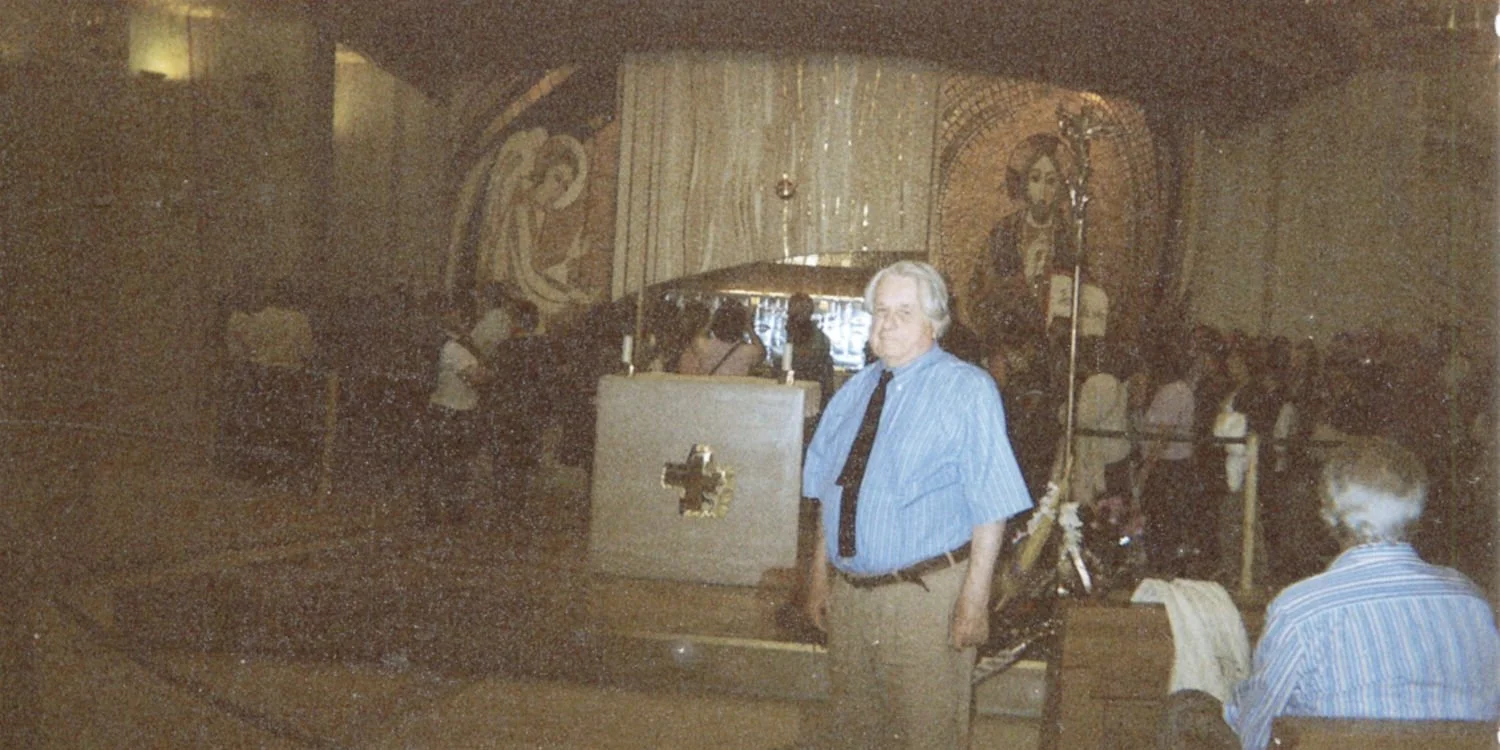
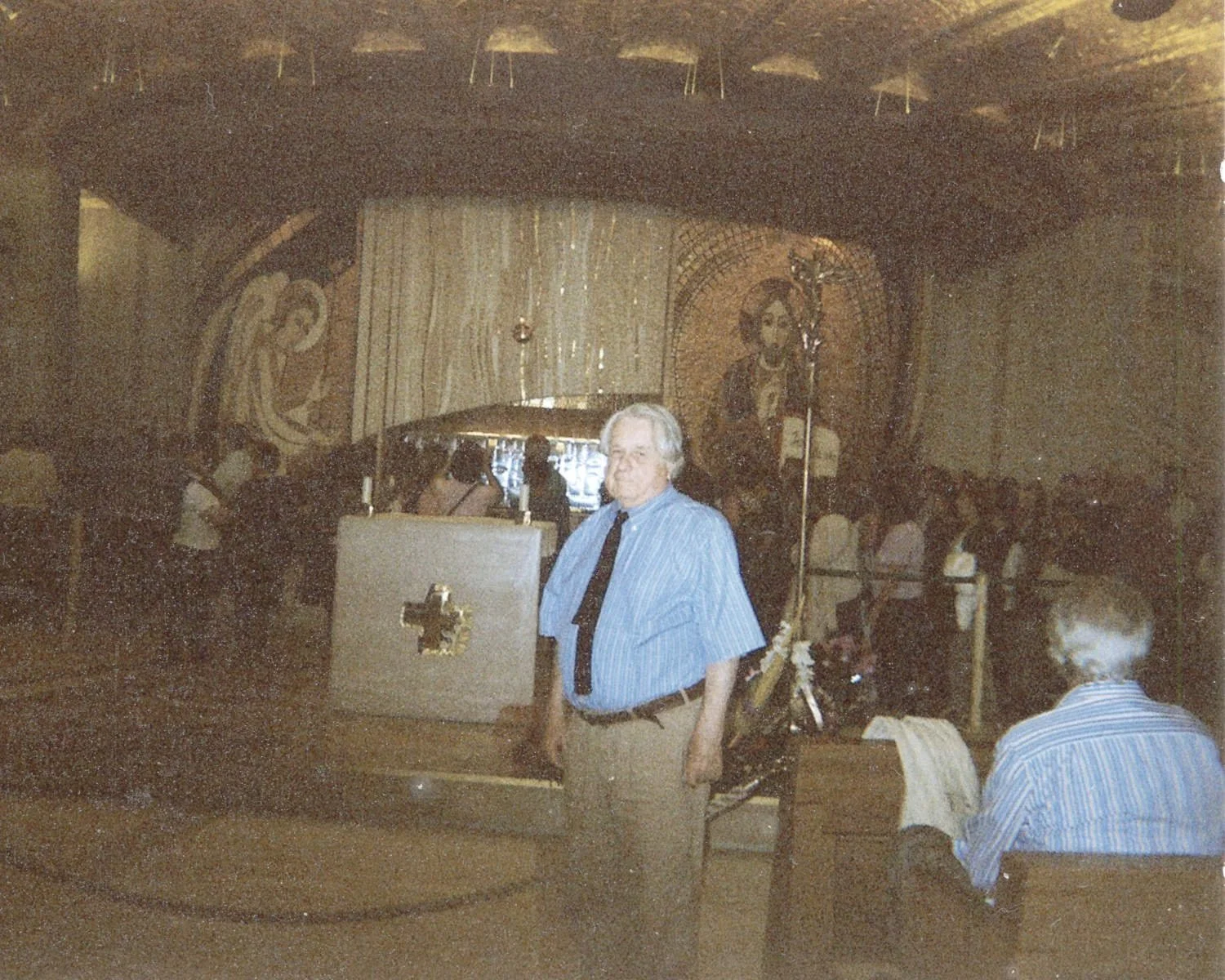
The key to our hearts, Pornchai Moontri’s and my own, was given to us by Pierre Matthews. Just weeks before his own death in 2021, the elderly Pierre ventured on another pilgrimage from his home in Ostend, Belgium to the Shrine of Padre Pio at San Giovanni Rotondo in Italy, the second most visited Catholic shrine in all the world. A photograph was taken of Pierre before the crypt of Saint Padre Pio. Pierre sent the photo to me in prison. It was the last time I heard from him in this life.
As I was preparing this post, I searched for that photo. Over a week’s time I tore my prison cell apart searching more diligently than any of the guards have ever searched. In dismay, I gave up and prepared to send this post to our Editor. Then I reached for a book that caught my eye at the last minute. When I flipped through its pages, the photo was in the book. Now it is atop this post, and I swear that I could hear Pierre and Padre Pio laughing.
+ + +
Note from Fr. Gordon MacRae: Thank you for reading. Please share this post so it may come before someone who needs it. And please Subscribe if you have not done so already. You may also like these related posts from Beyond These Stone Walls.
“I Am a Mystery to Myself.” The Last Days of Padre Pio
Padre Pio: Witness for the Defense of Wounded Souls
A Tale of Two Priests: Maximilian Kolbe and John Paul II
On the Day of Padre Pio, My Best Friend Was Stigmatized


Beyond These Stone Walls in Thailand by Pornchai Moontri
Brought to America as a child victim of human trafficking, Pornchai Moontri was deported to Thailand 36 years later. This is his progress in a life starting over.

Brought to America as a child victim of human trafficking, Pornchai Moontri was deported to Thailand 36 years later. This is his progress in a life starting over.
July 21, 2021
In the photo above, Pornchai Moontri, Fr. John Hung Le, SVD, and Pornchai's Thai language teacher, Mea Thim Chalathip, escape the heat after a day of recollection with the Bangkok Oblates of Mary Immaculate community.
Editor’s Note: This is Pornchai Moontri’s second post since his arrival in Thailand in February, 2021. His most recent was “Free at Last Thanks to God and You!” These are no longer “guest posts.” Beyond These Stone Walls is now Pornchai’s home away from home.
+ + +
To all my friends Beyond These Stone Walls, Sawasdee Kup! That is the traditional Thai greeting. I am writing to you from just a few kilometers north of the City of Bangkok, Thailand. In Thai, Bangkok is called Krung Thep meaning, “City of Angels.” (I’m not kidding! It was called that even before I got here!)
Father Gordon MacRae and I have been talking about another post from me. It is not easy for me to write because there is too much to say to fit in one post. I will send this to Father G first so he can fix it up a little. I am struggling right now between multiple confusing languages, but I will tell you more about that in a minute.
What someone wrote about Beyond These Stone Walls being sort of my “home away from home” makes me smile. It is a long time since I had a home. I told Father G once that the only place I remember feeling “at home” was in a prison cell with him for 15 years. A lot has happened since the day I said that. I left Concord, New Hampshire where I last saw Father G on September 8, 2020. The five months after that were spent in ICE detention while waiting for deportation. That was really awful and I will tell you more about it. In the five months since my arrival here, I have mostly just felt overwhelmed.
Father G wrote about the day I left in a very moving post, “Padre Pio: Witness for the Defense of Wounded Souls.” It tells the story of how, through my Godfather, the late Pierre Matthews, Padre Pio became one of our two patron saints. I will never forget the morning I left that Father G wrote about in that post. When I arrived in Thailand, I read in tears about the rest of Father Gordon’s first day without me.
I want to tell you about all the challenges I face now. Just like the local news, I will start with the weather. Thailand is south of the Tropic of Cancer and stretches down the Malay Peninsula almost to the Equator. After 36 years of my life a lot farther north on the far side of the world in Maine and New Hampshire, the tropical heat of Thailand is at the top of my list of things that take some getting used to.
On the day I am writing this in July it is 40 degrees Celsius (104 degrees Fahrenheit) and very humid. Converting to Celsius has not been easy. I am used to the other scale, so I never know what the temperature is. The choices are hot, very hot, and sizzling. The air conditioner where I live broke down a few weeks ago so I have been making do with a fan. While trying to write this, I shivered when I got my bill for a new air conditioner — 26,000 Thai baht — which thankfully turned out to be only $800. Whew!
Handling money has been another challenge. For 29 years in prison in America, I never even saw money. There is not much in the way of practical living skills that are taught to prisoners, most of whom end up with no idea of what things cost. In Thailand, that adjustment has been doubled. The Thai unit of money is the "baht," and the rate of exchange varies from week to week. Right now one U.S. dollar equals about 32 Thai baht. I was shocked once when dinner in a Thai restaurant cost 256 baht, but turned out to be only $8.00.

Technologically Challenged
Another big adjustment has been the metric system. As most of you know, I was taken from Thailand sort of traumatically at age eleven. A long and winding road brought me back at age 47 with only shadowy memories of Thailand and the people left behind here, and no memory at all of the metric system.
Father G once wrote about an episode of Family Guy in which Stuey went back to school as an adult. When the teacher handed out a math test, the students reached into their desks for calculators. But Stuey pulled out an Asian boy and poked him with his pencil saying, “Do Math. Do Math.” I am naturally good at math so whenever someone asked for help, Father G would poke me with a pencil saying, “Do math!” I was proud of the fact that I usually had the answers even before Father G could turn on his calculator.
But now the constant conversions are a way bigger math test. I walk around with calculations blazing through my mind to convert Celsius to Fahrenheit and the English system to metric. This is second on my “big adjustment” list. There are no longer inches or feet or miles, no ounces or quarts or gallons, not even pounds or tons. I lost a lot of weight in my five months in ICE. I started off at 195 pounds. Now I weigh 80 kilograms. When I work out I used to bench press 360 pounds. Now I can only manage 165 kilos.
With help, I have been learning to drive here which is also a double adjustment. I never drove a car, of course, in the 29 years I was in a U.S. prison (15 of them with Father G). Learning to drive now means learning it in reverse of what I had known. Thailand drives on the left side of the road with the steering wheel on the right side of the car. I have had a lot of help with this so far, and for that I am thankful.
But nothing is as big a challenge as technology. Father G used to joke that we will be like techno-cavemen when we leave prison. After 36 years away from my homeland and 29 years in prison, everything I do or touch is new to me. When I arrived, I had to spend 14 days in a Bangkok Holiday Inn, a period of Covid-19 quarantine required by the Thai government. Our friends here left me a really cool Samsung smart phone so I could communicate with Father G and others. I had never in my life used or even seen a smart phone.
Father G marveled at how fast I learned how to use the phone, but it was a matter of survival. I felt so alone and stranded that I spent my first night in Thailand in the hotel room finding and exploring Beyond These Stone Walls for the first time. I watched the two-hour Video Documentary Interview with Father G. It was wonderful and comforting to see and hear my friend and spiritual father again.
Father G is still behind those stone walls, and that makes me sad, but we talk for about a half hour every day by telephone. He calls me at 9:00 PM which is 8:00 AM the next morning for me. That also takes some getting used to. I am up before 6:00 AM each day which is 7:00 PM the night before for Father G. I spend the first two hours of each day working out. I have found this to be very important for my physical, mental and even spiritual well-being. So my first investment in Thailand was a weight set, mats and power bench. Father G helped me to purchase it. He calls each day right at the end of my workout.
Using the phone app on his GTL tablet, he calls me from the cell where we once both lived, and where he lives still. GTL allows internet-based calls from prison to Thailand at a cost of about 96 Thai baht for thirty minutes. That is about three U.S. dollars. It is not a big expense. Even after ten months since I left Concord, this is still an important part of my day and Father G’s.
I sometimes get impatient with myself, but Father G reminds me that I “just got here.” I feel as though I should be further along in learning Thai language, history and culture, the metric system, driving on the left side of the road, and not having to “report in” every time I do anything or go anywhere. The name, Thailand, means “Land of the Free,” but even that became part of my adjustment. I often have to remind myself that I am free. Few of the people around me understand this. The list of adjustments goes on and on but I guess I am the last to notice my progress.

The late Fr. Seraphim Michalenko, MIC, was a postulator for the cause of sainthood of St. Faustina. He interviewed Pornchai and Fr. Gordon in prison.
Suffering and Divine Providence
As most readers know, I became a Catholic in 2010 due to living with an extreme example of what that means. My journey to the Catholic faith was centered around Father G and Divine Mercy. I learned about Divine Mercy thanks to him and to my friendship with Father Michael Gaitley, Felix Carroll, and Eric Mahl. The Catholic League president, Dr. Bill Donohue, also had a hand in this.
Father Gaitley invited me to become a Marian Missionary of Divine Mercy. Felix Carroll drew me into the Association of Marian Helpers, and wrote about me in a chapter in his book, Loved, Lost, Found. Bill Donohue gave me honorary membership in the Catholic League, and also wrote about me several times. Father G and I joined St. Maximilian’s Militia of the Immaculata and Knights at the Foot of the Cross. It is a lot to take in, and all of it very much influenced my faith journey. Divine Providence was another matter. I never understood it until I found myself face to face with it.
Father G says it is hard to believe that I have been gone for ten months. I have actually been in Thailand for only five months. The other five were spent in ICE which he has written about. (See “ICE Finally Cracks! Pornchai Moontri Arrives in Thailand.”) The five long months awaiting deportation in ICE detention were a terrible ordeal, but for me and Father G it turned into a story of Divine Providence. I did not understand that at all until Father G and I had a phone conversation about it. Here is what I learned.
When a person has been deprived of good things in life, like parents, family, safety, a home, acceptance, love, freedom, even at times food and shelter, then the bad things in life become normal. When I was handed over to ICE and became buried in another overcrowded prison with total strangers in Jenna, Louisiana, all I could think of was all the good things I once had. I began to feel that I lost them all. Trust was the first thing I lost.
Father G saw to it that I had numbers to call no matter where I was. It took time for him to find me and be able to speak to me. Thanks to Claire Dion in Maine, a way was devised for us to speak each day even for a few minutes. The promised ICE flight to Thailand was delayed again and again for weeks and then months. I began to despair because of the awful circumstances in which I was living. I could not have made it through this if not for Father G.
By the fifth month of my detention, my call to Father G became routine. I was bitterly thinking that the delays will never end and he would say to me the same thing every day: “The day will come when you will walk out of there to a new life.” At first I was clinging to that, and then I started to no longer believing it. Each day, we both prayed deeply for an end to this suffering. Father G challenged me to try to help others. I did try.
Over the last eleven years since my conversion, Father G and I worked hard to come up with a plan for my future survival once we knew that I would one day be sent back to Thailand. In my mind, it was all like a big black hole. All I knew was America, and all I really knew about America was its prisons. The promise of Heaven for someone who has only known Hell can feel empty and too far beyond reach. I blocked out any expectation of good things because of my past experiences of bitter disappointment.
Then one day, in my daily call from ICE, Father G dropped a bomb with great reluctance. He told me that our plan for housing and support that we had spent years building suddenly fell apart. The founder of Divine Mercy Thailand, the man who was to take me in and give me a home, fell critically ill and was hospitalized. I prayed daily for him, but he passed away. In my mind, this was a crushing blow.
Father G did not want any surprises so he told me all of this. He said he did not want me to hear of this from anyone else. For me, it seemed as though all hope had gone out of the world. Then Yela, our Bangkok friend from the Divine Mercy apostolate, told Father G in an email that Father John Hung Le from the Missionary Society of the Divine Word had been reading about us and offered his home to me. My strongest feeling was that I did not want to be a burden for anyone, but my choices were gone.
Father G said that when everything we hope for feels gone, the only task left is trust. Father John turned out to be a very good priest and a very great friend. He is also a carpenter so we have a lot in common. He has become a good friend to Father G as well.
Some of Father John’s community and friends rallied around me when I arrived. Mea Thim, a retired Thai language teacher, began to tutor me daily in Thai language studies and has been very patient with me. She is also teaching me to drive and to acclimate to Thailand. Not having even heard Thai spoken in 36 years, and having never learned to read or write Thai, my progress feels slow but others say I am improving right on track.
Thailand is now in the middle of another strict shutdown due to a new Covid variant outbreak from India. Father G just told me that the Wall Street Journal has reported that the Thai government has lost confidence in Sinovac, a vaccine from China and the only one available in Thailand. All gatherings have been prohibited and a stay-in-place order is enforced. My required national Thai ID has been delayed for months so I cannot yet work, open a bank account, obtain medical care or a vaccine, or even board a train. Father John and I help each other, and I am busier than ever.
Strangely — Divine Providence again — the Thai headquarters for Father John’s Order are in Nong Bua Lamphu Province, nine hours drive north near the very village I was taken from 36 years ago. We have traveled up there three times for Father John’s missionary work with Vietnamese refugees, seminarians and migrant workers. We stay at the house my mother began to build before her death in 2000. My Aunt and cousins are there and I have reunited with them. After 36 years, they are now my family again. I have two families now, at opposite ends of the Kingdom of Thailand that I now call home.
And Father G, the man who showed me the Path to God, is still with me every day. He has told me that if our prayers were answered, if I had not suffered those five months in ICE, if God had given in to our pleas for my deliverance, then all would now be different and none of what I have just described in this post would be my reality.
This, he says, is the work of Divine Providence and I am astonished by it. On the day I left Father G, I said to him, “Thank you for giving me a future.” I had no idea how promising it would be.
The odds against all of this coming together are mathematically astronomical. When I come face to face with God, I want to poke Him with my pencil and say, “Do Math! Do Math!”
+ + +
A Postscript to readers from Pornchai:
I want to express my very deep gratitude to all of those who have assisted me over these months of transition. Your gifts for food, shelter, and the expense of starting life over have moved me profoundly. Please accept my apology for being unable to write to each one of you personally. You know who you are, and so do I. I pray for you every day.
With love and gratitude, Pornchai Moontri
+ + +
Editor’s Note: Please share this post. The Wall Street Journal has been reporting about recent events in Thailand. A new variation of Covid is creating havoc for the country, its economy and especially the well-being of its people. If you wish to help our friends, please also visit our “Special Events” page.
And you may also like these important related posts:
Human Traffic: The ICE Deportation of Pornchai Moontri

After Mass at the OMI Center near Bangkok. (Pornchai Moontri and Fr. John Hung Le, SVD, are third and fourth from the right. On the far right is Pornchai’s Thai teacher Mea Thim Chalathip.)