“There are few authentic prophetic voices among us, guiding truth-seekers along the right path. Among them is Fr. Gordon MacRae, a mighty voice in the prison tradition of John the Baptist, Maximilian Kolbe, Alfred Delp, SJ, and Dietrich Bonhoeffer.”
— Deacon David Jones
Woe to You, Scribes and Pharisees, Hypocrites!
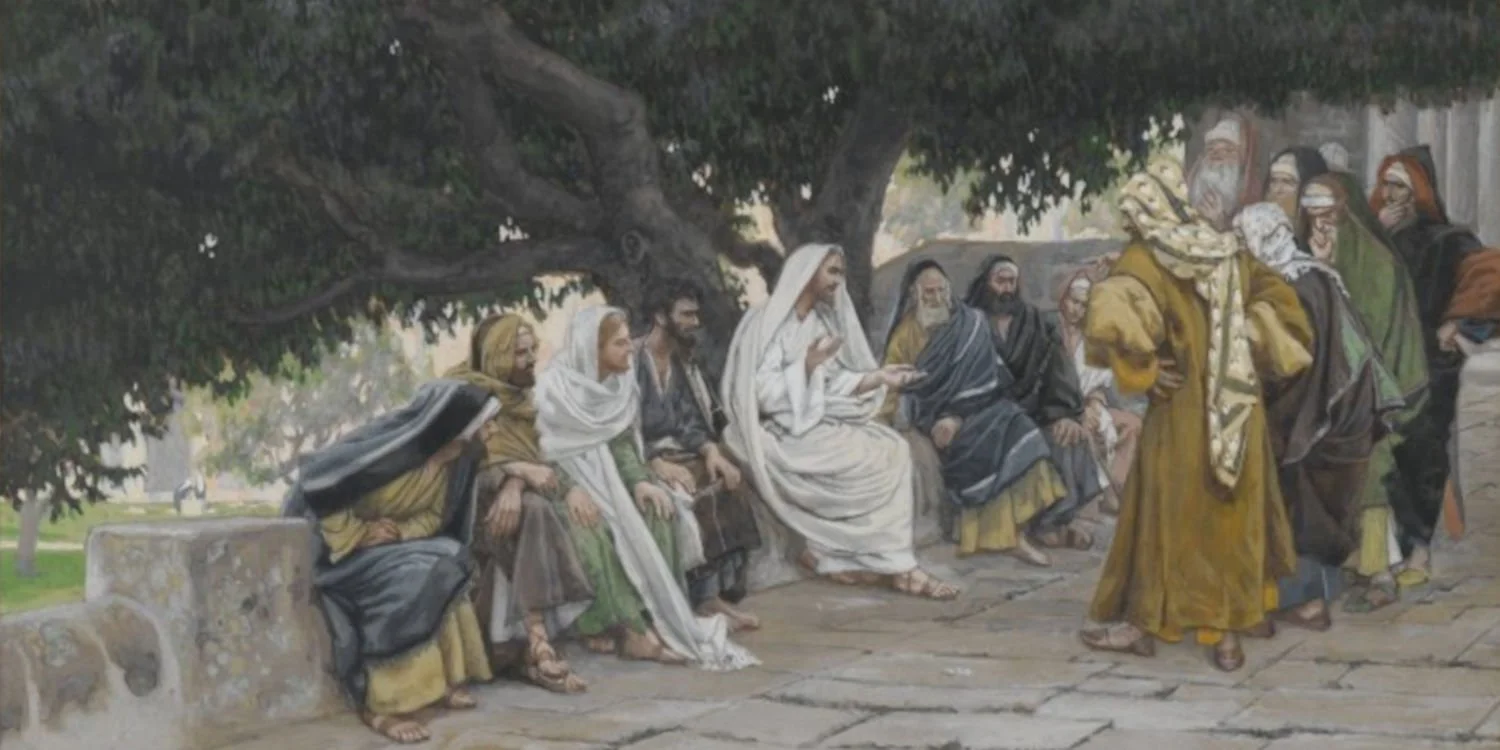
Pharisees and Sadducees appear in the Bible only in the period between the Old and New Testaments. Their only common ground was opposition to Jesus and each other.
Pharisees and Sadducees appear in the Bible only in the period between the Old and New Testaments. Their only common ground was opposition to Jesus and each other.
October 14, 2026 by Father Gordon MacRae
In Catholic liturgy, Scripture Readings follow a three-year cycle. Having a long-running blog means encountering the same Gospel passages every three years. The Gospel from Saint Matthew (22:15-21) for the Twenty-ninth Sunday in Ordinary Time describes one of the many encounters between Jesus and the Pharisees who “plotted how they might entrap Jesus in speech.” The question they posed to entrap him was “Is it lawful to pay the census tax to Caesar or not?”
Both the trap and the question turn out to be most important. I explored why this is so the last time this passage arose in our liturgy three years ago. It is a prelude to this post that has since been ensconced in our collection of Scripture posts called “The Bible Speaks.” We will link to the specific post again at the end of this one. For Salvation History to be fulfilled in our lives, we must answer the Pharisaic question for ourselves: “What Belongs to Caesar and What Belongs to God”
In Sacred Scripture, the arrival of the New Covenant in Christ signaled the end of Israel’s separation from the Gentiles and the beginning of a global family of God. We still struggle with our differences, and the Pharisees of the Gospel personify that struggle.
I have learned something about myself from them. In the United States, at least, we are in the midst of an election cycle in which our political differences take center stage. The divisions in the television ads are already getting on my nerves. Nonetheless, I find loathsome the political positions of one of those parties — the one I do not identify with, but did at one time in my life. I am learning, with a degree of humility, to loath the positions but not the persons within that party who promote them.
If I were to do so, I would cross the line between what I believe is righteous and what in effect becomes self-righteous. The Pharisees in the Gospel could not bring themselves to see through that distinction. So they faded from view in the Word of God.
In almost every instance, the Pharisees’ presence in the Gospel is beneath a dark cloud of suspicion and controversy. In the Gospel account of their question posed to Jesus about taxes and Caesar, for example, their motive was not to answer the question, but rather to expose Jesus as a false Messiah.
The Pharisees did not exist in the Old Testament. Their rise came with the Roman occupation of Palestine. In their determination to be rid of this foreign power, their agenda at every turn was at odds with the Gospel message of Jesus. Their goal was for Israel to separate itself from all gentile impurity and defilement. The very name, “Pharisee,” means “separated one.” Only in separation from all gentile influence, they believed, could God rescue his Chosen People from the political clutches of Roman occupation.
It was a tall order that the Pharisees took upon themselves, deciding in this or any outcome not with God but for God. If God had other plans, they were not immediately known to the Pharisees. The Crucifixion of Christ did not bring about the expulsion of Rome, but rather, ultimately, the conversion of Rome.
The Rise of the Sadducees
The next Sunday Gospel, for the Thirtieth Sunday in Ordinary Time (Matthew 22:34-40), begins with a statement, “When the Pharisees heard that Jesus had silenced the Sadducees, they gathered together, and one of them, a scholar of the law, tested him by asking, ‘Teacher, which commandment in the law is the greatest?’” The Sadducees accepted only the Pentateuch, the first five books of the Bible, called the Books of Moses, as authentic Scripture and the sum total of the biblical narrative. As usual the Pharisees did not ask this question to be instructed by Jesus but rather to trip him up and discredit him before the Sadducees. Jesus responded by strategically citing one of the books of Moses (Exodus 3:6),
“I am the God of your Fathers, the God of Abraham, the God of Isaac, and the God of Jacob, and Moses hid his face for he was afraid to look upon the face of God.”
The lawyer-Pharisee would discredit Jesus before the Sadducees if he cited any other Scripture.
This particular quote from Jesus is significant for both Sadducees and Pharisees. The Pharisees knew well that the Sadducees did not accept any Scripture beyond the five books of Moses. They also did not accept the Jewish belief in the immortality of the soul or life after death. What Jesus here proposed — that God is the God of the living, the God of Abraham, of Isaac and of Jacob — is theological evidence that though they were long gone from this world, they still lived in some form in another. This is a truth I wrote of in “The God of the Living and the Life of the Dead.”
For the Pharisees, the 613 commands of the Mosaic Law are distilled into two prescriptions: Love God (Deuteronomy 6:5) and your neighbor (Leviticus 19:18). These citations would have satisfied the Sadducees if the Pharisees had, as was typical, conveyed the response of Jesus to the Sadducees. They were all about promoting division, even within the Scriptures. And so Jesus answered the question of “which is the greatest commandment in the Law?” with
“You shall love the Lord your God with all your heart, and with all your soul, and with all your mind. This is the great and first commandment. And a second is like it, you shall love your neighbor as yourself. On these two commandments depend all the law and the prophets.”
The presence of the Sadducees in the Gospel is much more brief than that of the Pharisees. But, like the Pharisees, the Sadducees were also cast in a negative light, and not only by the Gospel narrative but by the Pharisees themselves. The two sects were in bitter opposition about the goals and agendas of an occupied Israel. The Sadducees emerged as a political and religious interest movement around the Second Century BC. Their name is derived from the High Priest, Zadok, who served under King Solomon (1 Kings 2:35). The Prophet Ezekiel (40:46) reports that their descendants were bestowed with exclusive rights to exercise ministry in Jerusalem. The Sadducees were closely associated with the Temple priesthood (Act 4:1, 5:17). They held official positions representing Old Covenant Judaism, and were charged with maintaining relations between Israel and the Roman occupation.
Most of the Sadducees were wealthy aristocrats. Unlike the majority of Jews, the Sadducees rejected many of the beliefs of Israel. They were notoriously opposed to the Pharisees, who were commonly respected by the masses. In addition to rejecting all Scripture except the Pentateuch, the Sadducees rejected belief in an afterlife, resurrection, angels, and the immortality of the human soul.
The Gospels reveal but a single direct dispute between the Sadducees and Pharisees, though there were likely many others. They were like a tag team, taking turns attempting to discredit Jesus while also discrediting each other. All three Synoptic Gospels report one dispute between the two factions (Matthew 22:23-33, Mark 12:18-27, Luke 20: 27-38). While Jesus was teaching in the Temple, the Sadducees posed what they contrived as a theological puzzle believing that it would implode his teaching. They presented the case of a woman who had several husbands during her life. “If all her husbands are raised, whose wife will she be in the afterlife? Knowing what they do not believe, Jesus deliberately cited the Pentateuch example of Exodus 3:6 demonstrating that souls live beyond death. This was the dispute that silenced the Sadducees and began this section of our post. The Sadducees then fade from view in the New Testament.
Scribes and the Woes of Being a Pharisee
In the Old Covenant Testament, a scribe was an officer of the King’s Court. It was a strictly political position in which the scribe would act as a secretary and ambassador of the king. The Prophet Ezra was a scribe of the Persian court before coming to Jerusalem. (See Esther 3:12.) But Ezra was also a scribe in the religious sense, becoming an expert in interpreting and applying the Laws of Moses in all the circumstances of Jewish life.
Over time these religious dimensions became the dominant identity and purpose of each scribe. By the time of the New Testament, a Jewish scribe was not a political figure at all. But the scribes became caught up in the religious dominance of Israeli life. They began to serve at the pleasure of the Pharisees.
Parallel to this development, the Pharisees’ own disciples began to reflect their masters’ dismay over the presence of Roman occupation in the lives of the Jews. Their disciples also went to extreme measures to eliminate the influence of Jesus.
And so both the Pharisees and their disciples became the objects of scorn within the Gospel narrative, which in nearly every instance presents them in a negative light.
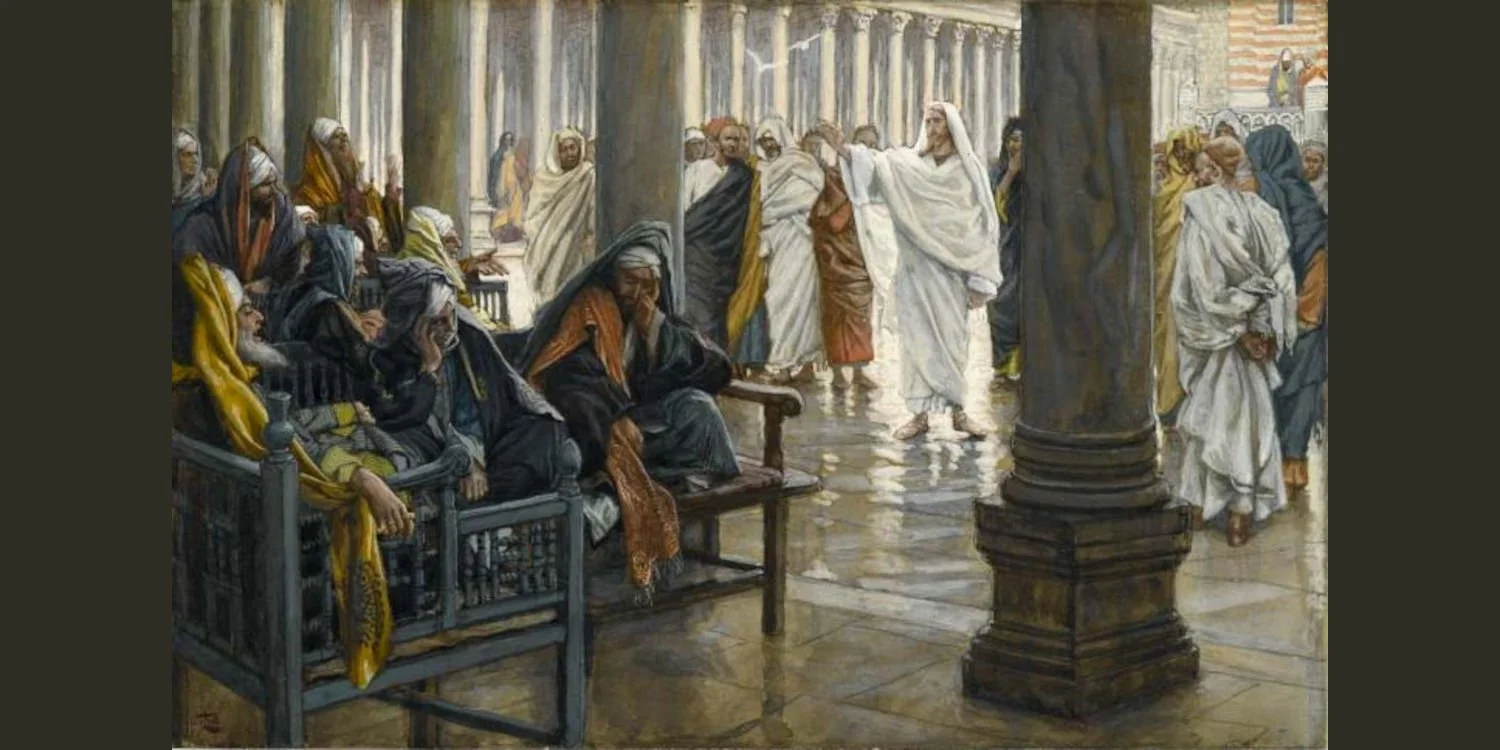
The Hebrew word, “Hoy” is translated as “Woe” in English. It is an interjection of anguish or lament offered by those who are mourning the dead (1 Kings 13:30), or an interjection of fear of a future prospect. When a person in the Bible utters a “Woe” for himself, he despairs for his life. Prophets uttered “Woe” as a warning of God’s judgement on sinful cities or nations. (Isaiah 10:5) Uttering “Woe” serves as a denunciation of evil, an oracle that one is on a path that leads to death or destruction. The Gospel of Saint Matthew, (Chapter 23) contains a litany of Woes against the scribes and Pharisees:
“Woe to you, scribes and Pharisees, hypocrites! You shut the Kingdom of Heaven against men; for you neither enter yourselves, nor allow those who would enter to go in.”
“Woe to you, scribes and Pharisees, hypocrites! For you traverse sea and land to make a single proselyte and when he becomes a proselyte, you make him twice as much a child of hell as yourselves.”
“Woe to you, blind guides, who say, ‘If anyone swears by the temple, it is nothing, but if anyone swears by the gold of the temple, he is bound by his oath. You blind fools! For which is greater, the gold or the temple that has made the gold sacred.”
“Woe to you, scribes and Pharisees, hypocrites! For you tithe mint and dill and cummin while neglecting the weightier matters of the law, such as justice and mercy and faith. … You blind guides strain out a gnat and swallow a camel!”
“Woe to you, scribes and Pharisees, hypocrites! For you cleanse the outside of the cup and the plate but inside are full of extortion and rapacity (avarice).”
“Woe to you, scribes and Pharisees, hypocrites! For you are like whitewashed tombs which outwardly appear beautiful but within are full of death and uncleanness. You, too, outwardly appear righteous to men, but within you are full of hypocrisy and iniquity.”
“Woe to you, scribes and Pharisees, hypocrites! For you build the tombs of the prophets and adorn the monuments of the righteous, saying, ‘If we had lived in the days of our fathers, we would not have taken part with them in shedding the blood of the prophets.’ Thus you witness against yourselves, but you are sons of those who murdered the prophets. Fill up then the measure of your fathers. You serpents, you brood of vipers, how are you to escape being sentenced to hell? Therefore I send you prophets and wise men and scribes, some of whom you will kill and crucify and scourge in your synagogues and persecute from town to town, that upon you may come all the righteous blood shed on earth, from the blood of innocent Abel to the blood of Zachariah, the son of Barachiah, whom you murdered between the sanctuary and the altar. Truly, I say to you, all this will come upon this generation.”
— Matthew 23:13-36
+ + +
Note from Father Gordon MacRae: We will add this post to our Sacred Scripture collection, “The Bible Speaks.”
Writing this post has caused me to undergo a good deal of self-reflection. Few of us in the priesthood can escape every facet of this stinging rebuke against the Pharisees. I do not indemnify myself, but I understand it as a summons to ongoing conversion that we must all undertake before we need the services of an undertaker. Life here is short and eternity is pressing upon us all with hope for a better future.
Please share this post. You may also like these related posts from Beyond These Stone Walls:
What Belongs to Caesar and What Belongs to God
Inherit the Wind: Pentecost and the Breath of God
The Resurrection of Christ: Further Along the Road to Emmaus
The Law and the Prophets and the Transfiguration of Christ
📢 📢 📢
To follow Beyond These Stone Walls in the public square, subscribe on this site or follow @TSWBeyond on X.
📢 📢 📢

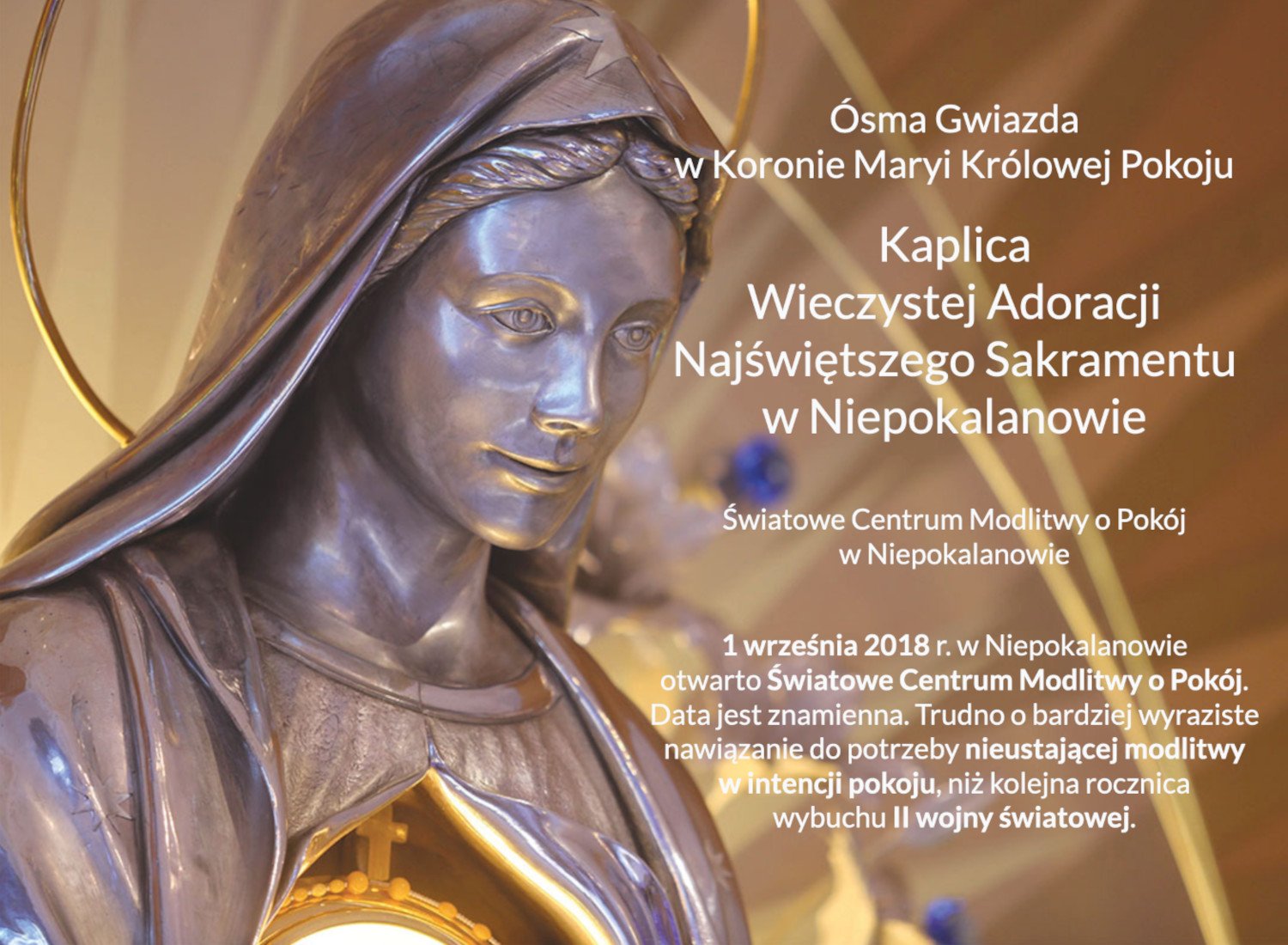

The Eucharistic Adoration Chapel established by Saint Maximilian Kolbe was inaugurated at the outbreak of World War II. It was restored as a Chapel of Adoration in September, 2018, the commemoration of the date that the war began. It is now part of the World Center of Prayer for Peace. The live internet feed of the Adoration Chapel at Niepokalanow — sponsored by EWTN — was established just a few weeks before we discovered it and began to include in at Beyond These Stone Walls. Click “Watch on YouTube” in the lower left corner to see how many people around the world are present there with you. The number appears below the symbol for EWTN.
Click or tap here to proceed to the Adoration Chapel.
The following is a translation from the Polish in the image above: “Eighth Star in the Crown of Mary Queen of Peace” “Chapel of Perpetual Adoration of the Blessed Sacrament at Niepokalanow. World Center of Prayer for Peace.” “On September 1, 2018, the World Center of Prayer for Peace in Niepokalanow was opened. It would be difficult to find a more expressive reference to the need for constant prayer for peace than the anniversary of the outbreak of World War II.”
For the Catholic theology behind this image, visit my post, “The Ark of the Covenant and the Mother of God.”
Science and Faith Are Not Mutually Incompatible
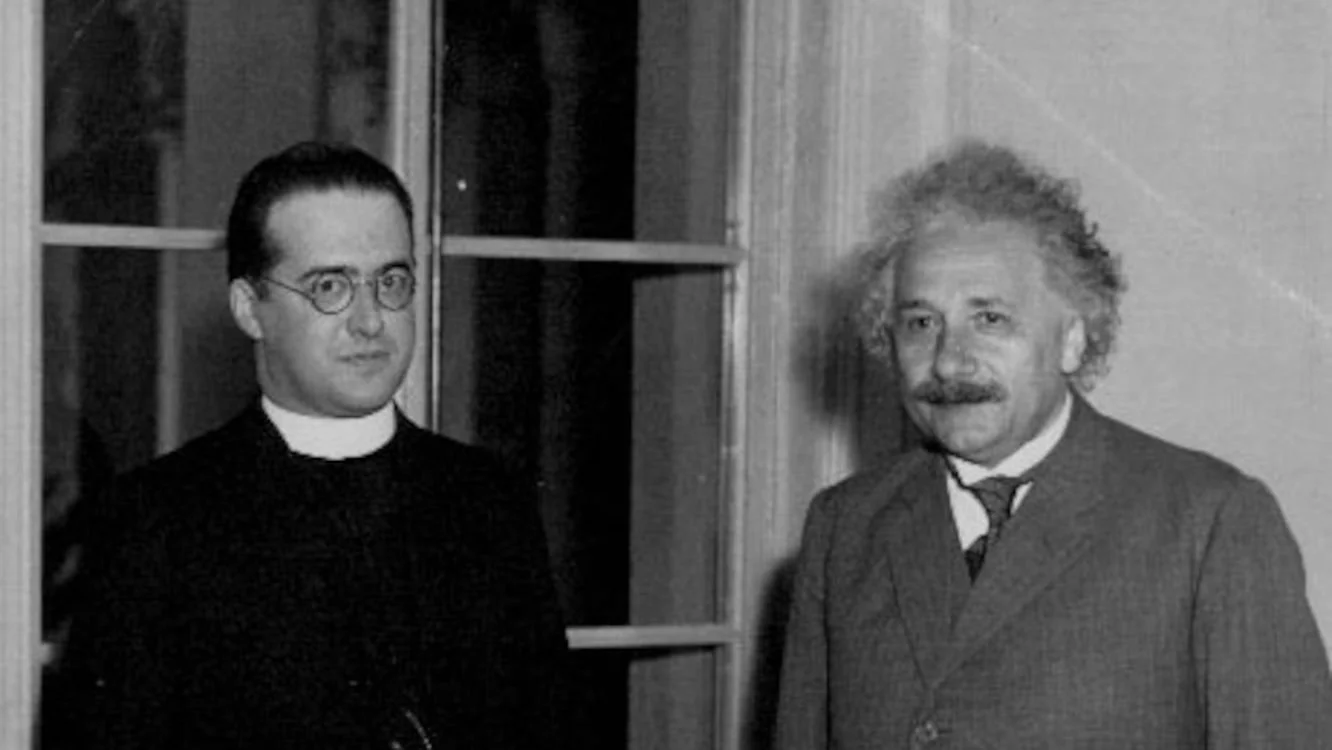
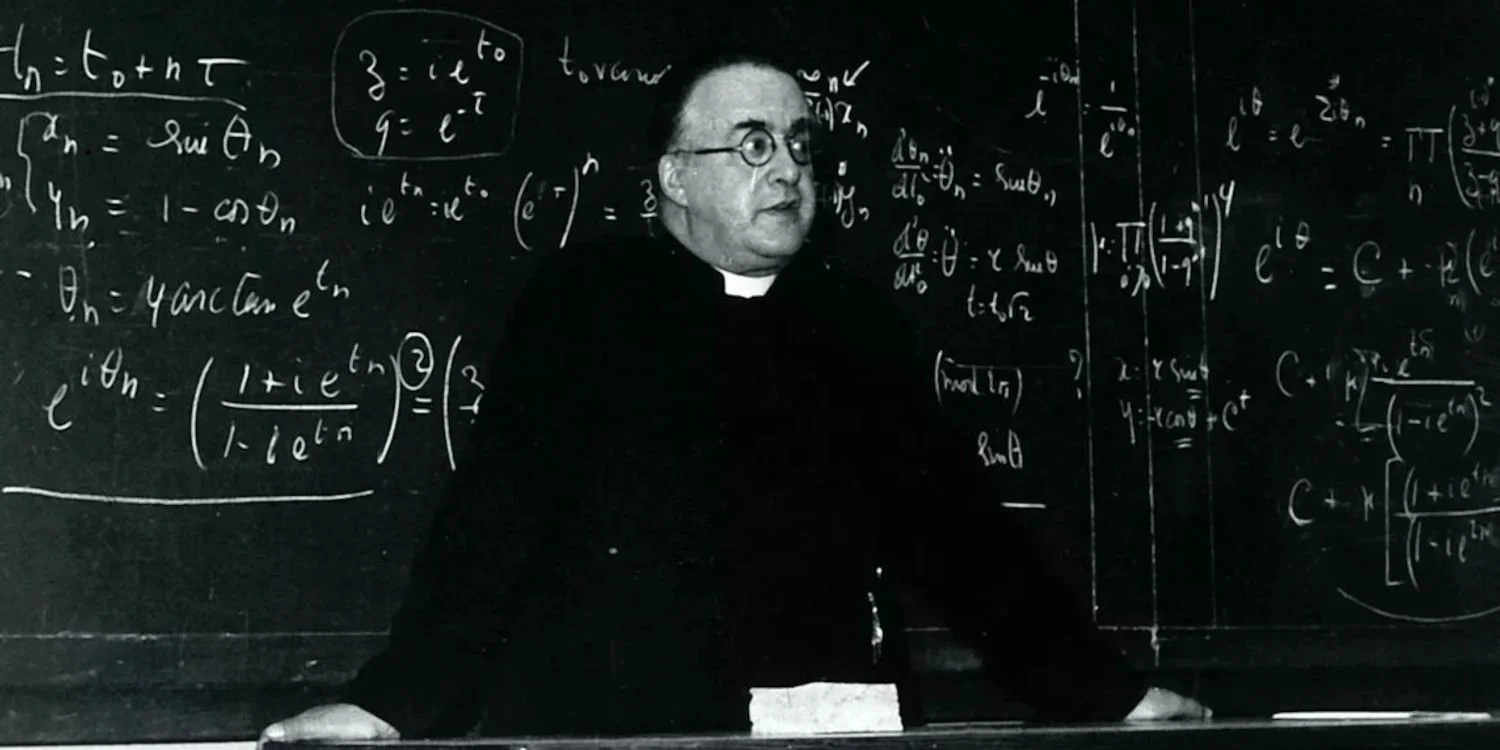
Albert Einstein honored Georges Lemaitre, the priest, physicist and mathematician whose Big Bang Theory is now the scientifically accepted origin of the universe.
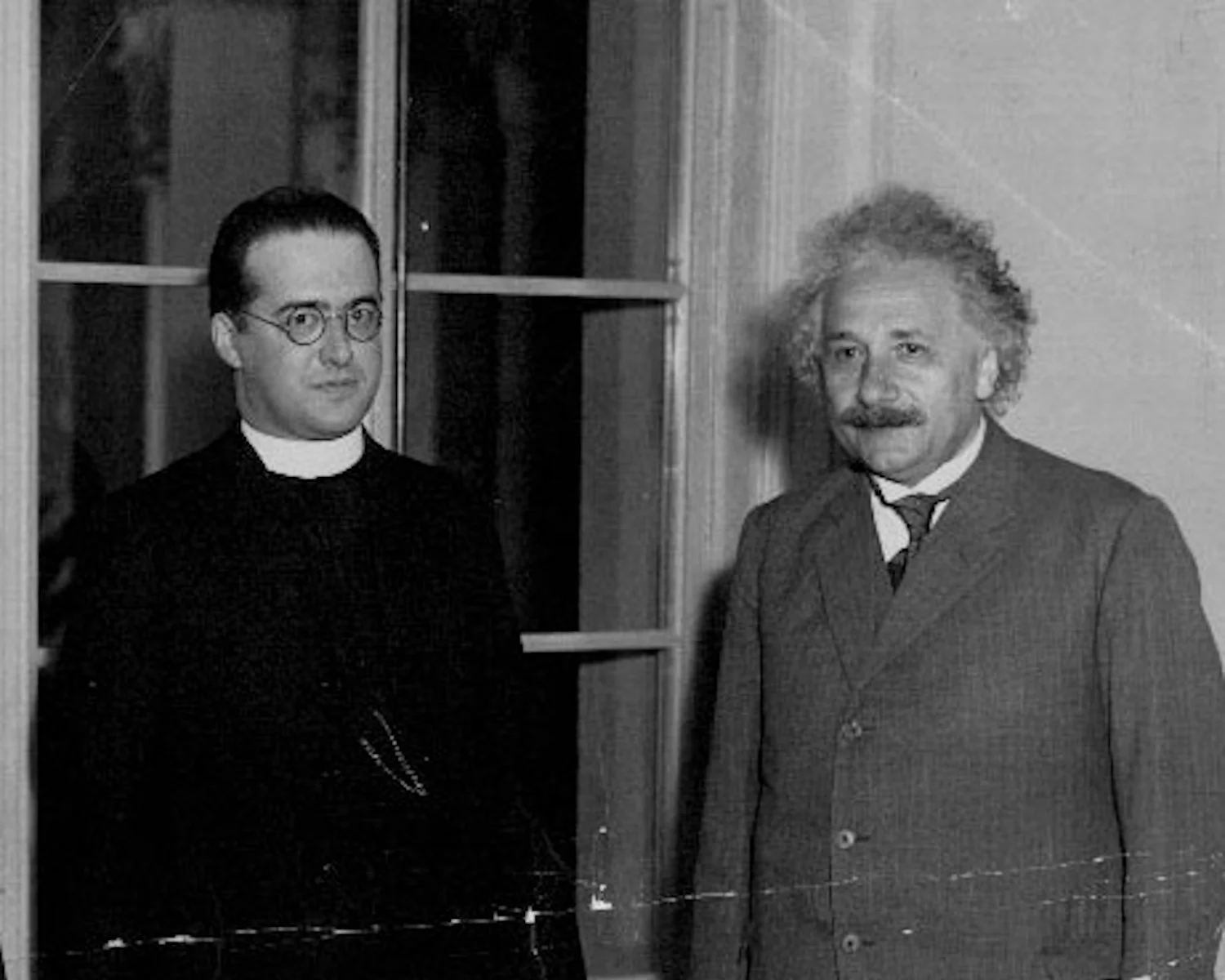
Albert Einstein honored Georges Lemaitre, the priest, physicist and mathematician whose Big Bang Theory is now the scientifically accepted origin of the universe.
March 11, 2026 by Father Gordon MacRae
In 2016, an issue of the former Catholic newspaper Our Sunday Visitor profiled some eye-opening research in an article entitled “Young People Are Leaving the Faith: Here’s Why” (August 27, 2016). It was an analysis of two national studies conducted by The Center for Applied Research in the Apostolate (CARA) to provide insight into the reasons why a third of “millennials” who were raised Catholic reject the faith of their parents as young adults.
In the CARA studies, “Millennials” are defined as those born in 1982 or later. The majority of the young adults who responded with comments on the research indicated that they left their faith for science, concluding that Catholicism cannot be reconciled with science at the high school and university level. They report finding little in the Catholic presentation of faith that challenges that view. The OSV summary included a sampling of the responses behind their decisions:
“As I learn more about the world around me and understand things that I once did not, I find the thought of an all-powerful being to be less and less believable.”
“Catholic beliefs aren’t based on fact… nothing can be disproved, but it certainly shouldn’t be taken seriously.”
“I realized that religion is in complete contradiction with the rational and scientific world, and to continue to subscribe to a religion would be hypocritical.”
“As I started to enjoy math and science more, I realized the discrepancy between religion and science… Catholicism especially did seem to clash fairly well.”
“[Faith] no longer fits into what I understand of the universe.”
These responses reflect a pattern of thought familiar to many parents of young adult Catholics and others concerned about the dismal conclusions of the CARA research. This is also one of the most common pleas I hear on a global scale from parents and grandparents and other readers of this blog.
I must seem to be an enigma to those who have left our faith or are pondering doing so. Judging from my posts of the last ten years, though it was never intended to be so, I seem to devote almost equal time to both faith and science. For example, we have recently collected in one place a number of posts dedicated to the understanding of Sacred Scripture. We called this collection, “The Bible Speaks.” Apparently it speaks quite loudly. There are presently some 43 titles in that collection, and some have broken records among the readership of this blog.
But there is a similar phenomenon that has been taking place in more recent years. I have also written several posts about science and especially the sciences of cosmology, astronomy and particle physics. One of my friends here who comes to the library where I work has asked me for copies of posts over the last few years. He recently complained of feeling a sense of whiplash, bouncing between science and religion, but he said he finds both to be fascinating. To demonstrate this phenomenon one recent post has broken all records in numbers of readers and especially in numbers of readers who come to it again and again, and who share it. That post is “Did Stephen Hawking Sacrifice God on the Altar of Science?” It seems that many people believed that he did, but I have made a case for the opposite. What strikes me most about that post is the unfathomable number of educational institutions of higher learning that are also sharing it and recommending it.
The same has held true for another recent post that blends principles of both science and faith entitled “The Higgs Boson God Particle: All Things Visible and Invisible.” Our Editor has observed and commented on the high number of academic institutions that have also been visiting religious titles on this blog. Some of these institutions are dedicated to scientific research, and yet here they are suddenly delving into the mysteries of Catholic faith. And yet no one is denouncing anything. They seem to come here to observe and to learn, not to refute.
True Believers
I have some firsthand experience with the challenging questions posed by science for the faith of younger Catholics. A decade ago at one university, the son of a reader of this blog, a science major, sent me a letter filled with questions. The previous summer, his mother had emailed him with a link to one of my forays into the science of cosmology entitled, “Science and Faith and the Big Bang Theory of Creation.” In his letter to me the student wrote that he pretty much just dismissed the post as irrelevant without having read it. He read his mother’s email, but didn’t bother clicking on the link until two months later. The student wrote that he grew up in a devout family that accepted Catholic teachings about the world and universe without question. He attended Catholic schools until switching to a public high school, then abandoned his faith in adolescence because his interest in science made faith seem irrelevant.
He believed, or rather was led to believe, that science and religion are mutually incompatible, unable to coexist in a person of science. “The bias fed to me in academia,” he wrote in a much later letter, “was that science is the new source of all faith, and to be taken seriously as a scientist requires setting aside the faith of my parents in this new world order.” And thus ended his identity as a Catholic. It is a troubling story given that for every convert entering the Catholic faith in America in recent years, more than six others left.
The exit of millennials is not at all for the reasons typically put forward by older Catholics who become disenchanted with their Church. In the CARA study, Catholic scandal and the Latin Mass are barely touched upon as influential reasons. And the millennials are not leaving to embrace some other faith. They now constitute the fastest growing expression of religious belief in America — the “Nones,” who self-identify with no religious affiliation at all. A decade ago in “A Crisis of Faith, Not of Worship,” a soul-stirring post at The Catholic Thing, (Aug. 24, 2016) Father Mark A. Pilon made this point well:
“The real underlying problem is simple: it’s a massive loss of faith… About thirty years ago, a reliable survey revealed that only about 30 percent of Catholics believed in the Real Presence of Christ in the Eucharist any longer. Why didn’t the bishops call an emergency meeting to reflect on this loss of faith, as they did in 2002 to deal with sexual abuse? … The highest priority has to be this basic question: What caused this massive loss of faith, and how do we work to resurrect that lost faith?”
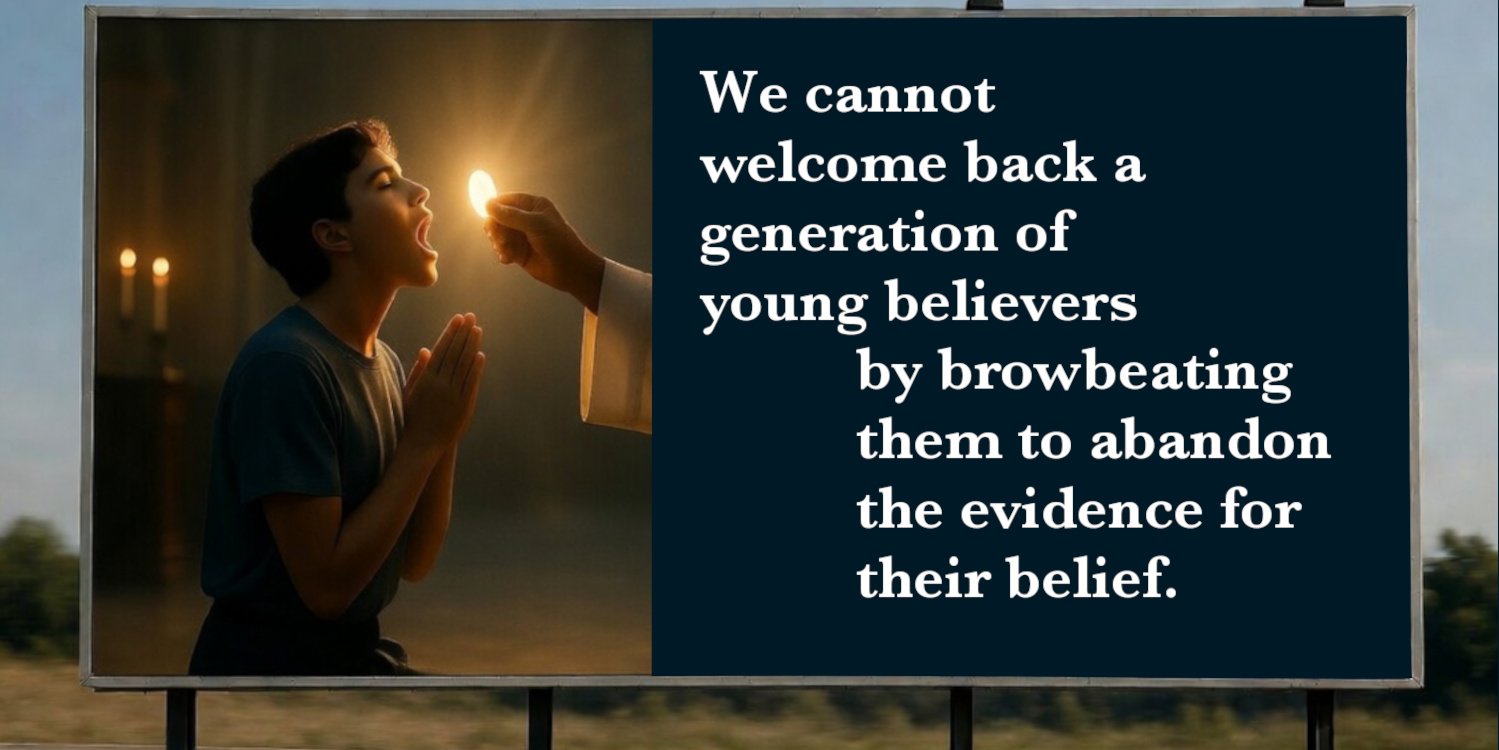
These are very relevant questions, but some have already begun to change. In early 2025 I wrote a post entitled “On the Great Biblical Adventure, the Truth Will Make You Free.” Something happened over the preceding year that signaled a great cultural change toward openness to religion and especially biblical studies. Book publishers have observed that Bible sales greatly increased by double digits toward the end of 2024. A lot of factors were proposed as contributing to this, including the election of 2024, the assassination attempts on the leading U.S. presidential candidate at that time, and later the assassination of Charlie Kirk, founder of Turning Point USA. These were inflection points causing broad swaths of America and elsewhere in the free world to pause and reassess where we are and where we are going. The biblical interest and its resulting growth of interest in faith also has continued to this day. For those who have suggested that Catholic leaders need to take advantage of this trend, a good start would be to moderate “climate change” as an example of our highest priority while abandoning other priorities, such as respect for life. Our hierarchy might also want to reconsider its revulsion for the Traditional Latin Mass and for those who find spiritual comfort in it, many of whom are younger Catholics. And a prohibition against kneeling to receive the True Presence of Christ is simply mind-boggling for true believers. We cannot welcome back a generation of young believers by browbeating them to abandon the evidence for their belief.
The Folly of Leaving Faith Behind for Science
The answer to the suspected disconnect between science and faith is not as simple as seeking relevancy by replacing faith with science. True believers in both find not only “common ground” but windows to the universe that will leave the believer in awe. The student who had been writing to me, for example, is now on his way back. As time wore on, his mother asked him what he thought about the post she sent him. He scurried to find “Science and Faith and the Big Bang Theory of Creation” buried in his inbox, and then he actually read it.
He later wrote that he was “bowled over” by it, and that it turned on its head the entire scientific orthodoxy that had been fed to him claiming that only freedom from religion could legitimately engage him with the world of science. Science with a bias against faith experience prevented him from seeing the bigger picture.
This student had many questions. First and foremost among them was this: “How is it that you, a person obviously well versed in science, could endure such injustice and still also believe in God?” It was a good question, but the answer requires something other than science’s doubts about faith. A better beginning question was the one I posed in return: “How is it that you, a science major in an American university, never before heard or read that the scientist now considered to be the Father of The Big Bang and Modern Cosmology was a Belgian astrophysicist who was also a Catholic priest?”
That question generated several letters over the last two years, suggesting BTSW posts that he has read and reread and shown to other science majors at his school. Before I get into that, however, I want to describe another development that I read some years ago by Beckie Strum in The Wall Street Journal: “U.S. Loses Top School Ranking to U.K.’s Oxford” (WSJ, Sept. 22, 2016).
For the first time, a university outside the United States was ranked the best university in the world, unseating the California Institute of Technology (Caltech) as number one. The U.K.’s Oxford University, the oldest college in the English speaking world, founded in the year 1096, took the top spot in the World University Rankings. Oxford knocked CalTech down to second place, MIT to fifth, and Harvard to sixth bin 2016. At this writing, Oxford has retained that place of primacy for a decade.
Oxford is also host to something missing from more narrowly focused American universities. Oxford is home to a research center called the Ian Ramsey Center for Science & Religion. Its Research Director at the time was Father Andrew Pinsent, a Catholic priest and particle physicist who was formerly on the science team at CERN, the European Council for Nuclear Research.
Father Andrew Pinsent holds a Ph.D. in particle physics from Oxford, a Ph.D. in philosophy from St. Louis University, and advanced degrees in theology from the Pontifical Gregorian University in Rome. He is a member of the United Kingdom Institute of Physics and the Vatican Conference for Scientists, and presently serves on the faculty and formation staff of a major U.S. seminary.
Father Pinsent has also been a guest writer at this blog. His post, “Fr Georges Lemaître, the Priest Who Discovered the Big Bang” was the final leverage that my university friend and correspondent needed to accept the fact that something essential has been missing from his education and exposure in both science and religion. The fact that his science education did not include the story of Georges Lemaitre — the astronomer, mathematician, physicist, and Catholic priest who changed the mind of Albert Einstein on the nature and origin of the universe — told him that it was science, and not faith, that deprived him of a wider world view.
This is a story that has been covered and uncovered at Beyond These Stone Walls in a series of science posts that has run parallel to our collection on Sacred Scripture. Reading these, and especially exploring Father Pinsent’s work, has opened my friend’s eyes as a young Catholic scientist, but it was a part of Father Andrew Pinsent’s guest post that more fully opened my own eyes when he wrote:
“What is to be done to help raise the profile of people like Fr Georges Lemaitre? Among Catholics with some kind of popular outreach, Fr Gordon MacRae, through his widely-read blog Beyond These Stone Walls, has done more than almost anyone I know in recent years to draw attention to Fr Lemaitre. Inspired in part by Fr Gordon’s work, my colleagues and I in England have put together a series of posters called the “Catholic Knowledge Network.”
— Fr Andrew Pinsent, “Fr Georges Lemaître, the Priest Who Discovered the Big Bang”
I think I have come to understand Father Georges Lemaitre’s science whose footprint in the history of modern cosmology is parallel to that of Albert Einstein. They were colleagues who became friends, primarily through Einstein’s great respect for Fr Lemaitre’s gifted mathematical and scientific mind. After a lecture about his theory of relativity at a European university in the 1930s, Einstein was approached by a science writer who asked him whether he thought anyone in the audience really comprehended his work. Einstein’s simple answer was “Lemaitre, certainly. As for the rest…”
The scientific dogma of the age was that the universe was static, eternal, and unchanging. Einstein also embraced this view, but it dismissed the beliefs of established religion that the universe was created from nothing.
However, Georges Lemaitre and Russian mathematician Aleksander Friedmann had more faith in Einstein’s mathematics than other scientists of their time. At first, Einstein payed little attention when they used his own equations to conclude that the universe is not static but expanding, and its rate of expansion is increasing when all established science said the opposite.
It was the American astronomer, Edwin Hubble (in whose honor the Hubble Space Telescope is named) who in 1929 discovered physical evidence that Lemaitre is right, that the universe is in fact expanding. Two years later in 1931, Father Georges Lemaitre concluded that the universe began “On a day without yesterday,” 13.8 billion years ago, with the explosion of a primordial atom from which space, time, and matter were created.
The idea was ridiculed, and “The Big Bang” was a pejorative term some scientists used to taunt the physicist priest. But he was right, and he turned science on its head with this revelation that has since been demonstrated with the discovery of cosmic background radiation emanating from The Big Bang.
Einstein, who first disagreed, ended up applauding the idea as “The most beautiful explanation of creation I have ever heard.” It was a bigger bang for science than even Einstein realized. It took the language of mathematics to comprehend that it points to what faith always told us: a universe arising out of nothing.
I think I finally came to some rudimentary understanding of the science behind this through the language of mathematics. For this I owe thanks to Robyn Arianrhod, and her book, Einstein’s Heroes: Imagining the World Through the Language of Mathematics (Oxford University Press 2005):
“In 1932, Lemaitre sowed the seeds of the Big Bang theory when he suggested that the universe had started as an explosion of a ‘primeval atom’ that… continued expanding from that explosive beginning. Some of the world’s most ancient creation myths have also imagined the world exploding from some sort of cosmic seed…”
“In 1970, English physicists Stephen Hawking and Roger Penrose showed that Einstein’s equations predicted the universe had expanded not from a tiny piece of matter located in an otherwise empty cosmos, but from a single point in four-dimensional spacetime. This meant that the Big Bang was not an ordinary explosion which took place at a specific three-dimensional location at a given time on the cosmic stage, but that Space and time themselves were actually created in the explosion, along with all matter and energy. Before this point … there was no time and no space. No geometry, no matter, nothing. The universe simply appeared out of nowhere. Out of nothing.”
— Einstein’s Heroes, p. 187
“The universe simply appeared out of nowhere. Out of nothing.” Take a moment to ponder that conclusion of science and it will sound a lot like a tenet of faith. Science, mathematics, and faith all open a window to the universe onto the same panoramic vista. And the awe this truth evokes is at one and the same time the comprehension of science and the inspiration of faith.
And as for my student-friend’s first question about the mystery of suffering in the light of faith, I can only gather up some prescientific humility to echo God against the protest of Job:
“Where were you when I laid the foundations of the earth?… Can you bind the chains of the Pleiades, or loose the cords of Orion?”
— Job 38: 4, 31

+ + +
Note from Father Gordon MacRae: Thank you for reading and sharing this post.
You might also like these other posts from Beyond These Stone Walls about the great adventure of science and faith:
On the Great Biblical Adventure, the Truth Will Make You Free
Science and Faith and the Big Bang Theory of Creation
The Higgs Boson God Particle: All Things Visible and Invisible
The Eucharistic Adoration Chapel established by Saint Maximilian Kolbe was inaugurated at the outbreak of World War II. It was restored as a Chapel of Adoration in September, 2018, the commemoration of the date that the war began. It is now part of the World Center of Prayer for Peace. The live internet feed of the Adoration Chapel at Niepokalanow — sponsored by EWTN — was established just a few weeks before we discovered it and began to include in at Beyond These Stone Walls. Click “Watch on YouTube” in the lower left corner to see how many people around the world are present there with you. The number appears below the symbol for EWTN.
Click or tap here to proceed to the Adoration Chapel.
The following is a translation from the Polish in the image above: “Eighth Star in the Crown of Mary Queen of Peace” “Chapel of Perpetual Adoration of the Blessed Sacrament at Niepokalanow. World Center of Prayer for Peace.” “On September 1, 2018, the World Center of Prayer for Peace in Niepokalanow was opened. It would be difficult to find a more expressive reference to the need for constant prayer for peace than the anniversary of the outbreak of World War II.”
For the Catholic theology behind this image, visit my post, “The Ark of the Covenant and the Mother of God.”
Christ in the Desert: A Devil of a Time
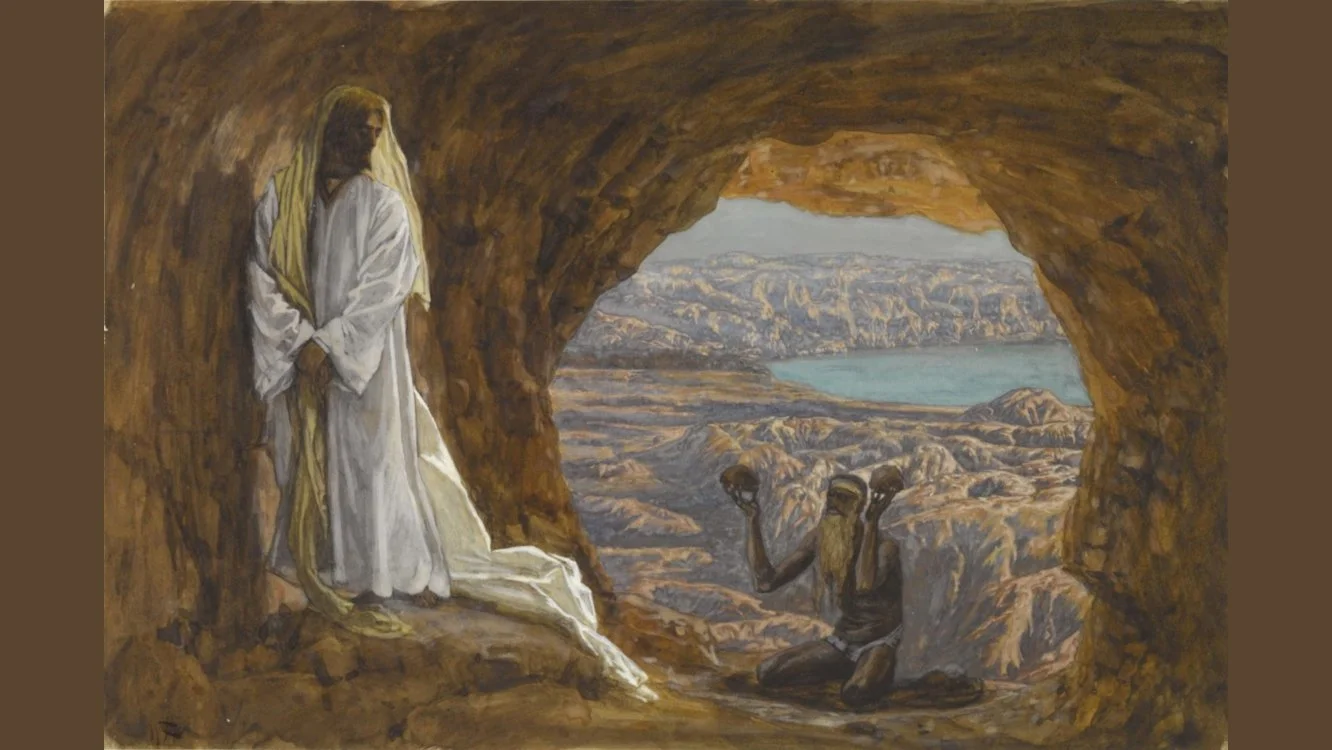
The Gospel according to St Luke tells the story of Jesus, revealed to be Son of God, led into the desert to be tested by the devil who does not give up easily.
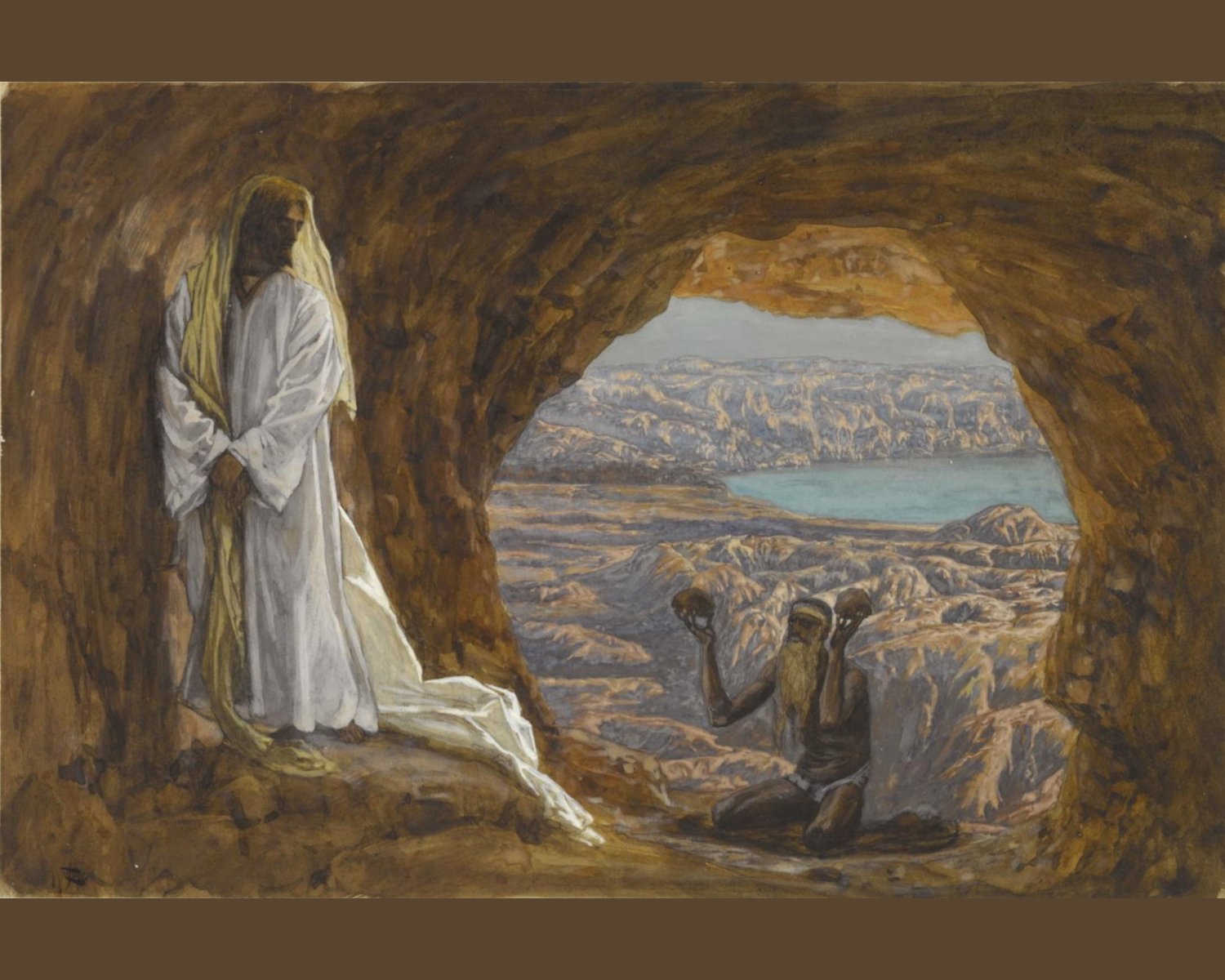
The Gospel according to St Luke tells the story of Jesus, revealed to be Son of God, led into the desert to be tested by the devil who does not give up easily.
Ash Wednesday, 2026 by Father Gordon MacRae
Many of our readers are aware that the Church follows a three-year cycle for Sunday Scripture Readings. As Ordinary Time now gives way to the Season of Lent, I explore the Gospel for the First Sunday of Lent. Being in the “A Cycle,” the Gospel from Saint Matthew (4:1-11) seemed very familiar. Like much of Scripture, I knew that I had read about this passage, but I also felt certain that I had written about it. It is the story of Jesus following the revelation that he is the Son of God revealed at his Baptism in the Jordan. In Matthew’s Gospel, Jesus is led into the desert by the Spirit to face Satan and a series of temptations for which, if he failed, his redemptive mission would end before it even began. All three of the Synoptic Evangelists, Matthew, Mark and Luke, tell the same story but from different perspectives and traditions. Saint Mark’s version appears in Year B in just three lines of Scriptural text (Mark 1:12-15). The Gospel According to Saint Luke is the most theologically nuanced of the three. So even though in our current cycle, the version from Saint Matthew is used on the First Sunday of Lent, it is very similar to that of Saint Luke. So I have chosen the latter to present in exegesis form for our post this week.
+ + +
In my estimation, one of the best movies about Catholic life in America taking a wrong turn has been deemed by some to be a bit rough around the edges. Robert DeNiro portrays Los Angeles Monsignor Desmond Spellacy, and Robert Duvall is cast as his brother, LAPD homicide detective Tom Spellacy in the 1981 film, True Confessions. The film is from a novel of the same name by John Gregory Dunne based on the famous Los Angeles “Black Dahlia” murder case of 1947.
DeNiro’s character, Monsignor Desmond Spellacy is a priest of some prominence in the Archdiocese of Los Angeles in the late 1940s at the epicenter of the power politics of a Church beginning to succumb to the world in which it thrives. Amid corruption while being groomed to become the next Archbishop, the Monsignor nonetheless clings to an honest spiritual life just starting its inevitable fraying at the edges as he is drawn ever deeper into a tangled web of deceit.
Robert Duvall portrays his older brother, Tom Spellacy, an honest and dedicated — if somewhat cynical — L.A. homicide detective whose investigation of the murder of a prostitute brings him ever closer to the perimeter of an archdiocese circling the wagons of self preservation. The Church in America would see a lot more of this in the generation to come. Actor Charles Durning portrays the thoroughly corrupt owner of a large construction firm bidding for church building projects. About to be awarded Catholic Layman of the Year by the Archbishop of Los Angeles, he is also a person of interest in the murder investigation that a lot of powerful people want quietly covered up.
Those wanting to influence and sideline Tom’s investigation come up with evidence — a photograph. It depicts the murdered woman in a social scene with a few prominent people, one of whom, standing next to her, is Monsignor Desmond Spellacy, heir apparent of the archdiocesan throne.
The photograph is entirely bening, but it becomes for Tom Spellacy, as it was intended to be, evidence that the Monsignor knew the murdered woman. Many readers would be reminded by this today of the frenzied media fiasco that has been playing out to much fanfare, recriminations, and disgust about the Jeffrey Epstein files and the many lives, some innocent and some not-so-much, who are entangled by a mere photograph in Epstein’s posthumous web of corruption and deceit. In the hands of politicians on the eve of battle in the midtern national elections, such photographs have been honed as weapons of war in our bitter partisan politics. The film ends with the case solved, but Monsignor Spellacy banished to a small parish in the California desert, his hopes for political advancement in the Church destroyed.
Nonetheless, in the hands of media and various other entities, the photograph remains evidence and a legal and political quagmire for Detective Tom Spellacy tasked with an open and public investigation of a murder scene leading to political corruption. Tom knows that any pursuit of the case that involves this photograph will inevitably destroy the career and good name of his innocent brother. Tom struggles about what to do, but in the end he does the right thing. He pursues the truth of the matter wherever it leads.
The case is eventually solved and of course Monsignor Spellacy had nothing to do with the matter at hand. Someone is convicted (You have to watch the film to find out who). But in the moral sensitivies of the time, which was very much like our time, the photo with the murdered prostitute and the Monsignor becomes more enticing for the press than the murder itself. The photo ends up on the Front Page of the LA Times, and Monsignor Spellacy ends up where our Gospel passage begins: in the desert where he is exiled to a tiny parish in obscurity.
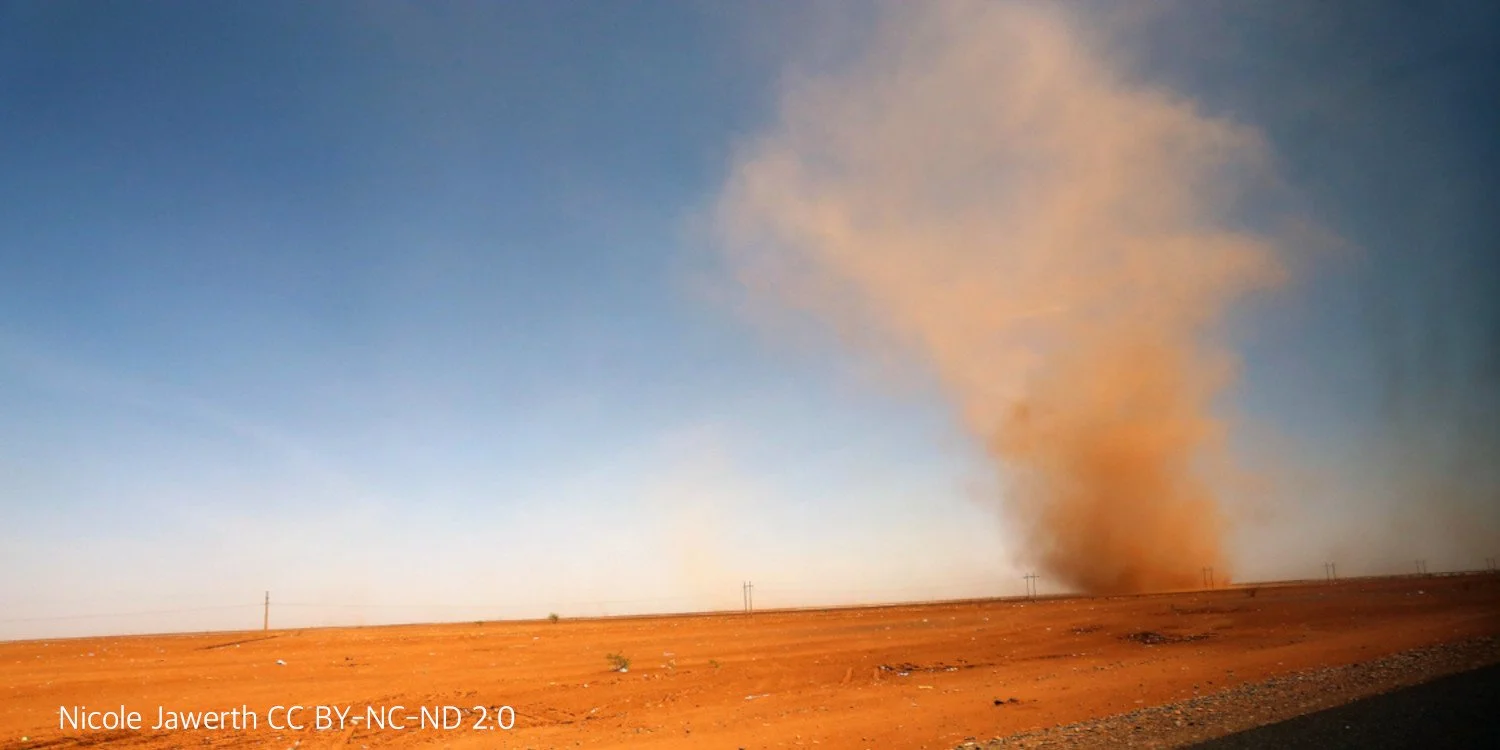
Being exiled in the desert is highly symbolic in Sacred Scripture. It has ancient roots in the Book of Leviticus. This book is composed of liturgical laws for the Levitical priesthood reaching back to 1300 BC as Moses led his people through a forty-year period of exile in the Sinai desert. Some of the ritual accounts it contains are far more ancient.
In a recent Christmas post, “Silent Night and the Shepherds Who Quaked at the Sight,” I wrote that the troubles of our time are the manifestation of spiritual warfare that has been waged in the world since God’s first covenant bonds with us. Before this covenant relationship, we were doomed. Since the covenants of God there is hope for us. We remain oblivious to spiritual warfare to our own spiritual peril. As I have written many times, we now live in a vulnerable time in God’s covenant relationship with us. The Birth of the Messiah and his walking among us are equidistant in time between our existence now in the 21st Century AD and Abraham’s first encounter with God in the 21st Century BC.
Our Day of Atonement Begins
The Gospel according to St Luke (4:1-13) is also set in the desert as the Day of Atonement begins for all humankind. Revealed in Baptism as the Son of God …
“Filled with the Holy Spirit, Jesus returned from the Jordan and was led by the Spirit into the desert for forty days to be tempted by the devil.”
— Luke 4:1
The scene has roots in an ancient ritual for the Day of Atonement described in Leviticus 16:5-10. Aaron, the high priest …
“Shall take from the congregation of the people of Israel two male goats for a sin offering .... Then he shall take the two goats and set them before the Lord at the tent of meeting; and Aaron shall cast lots upon the two goats, one for the Lord and the other lot for Azazel. And Aaron shall present the goat upon which the lot fell for the Lord, and offer it as a sin offering, but the goat upon which the lot fell for Azazel shall be presented alive before the Lord to make atonement over it, that it may be sent away into the desert wilderness to Azazel …”
— Leviticus 16:5,7-10
This describes the ritual for purification known in Hebrew as Yom Kippur, or the Day of Atonement, from Leviticus Chapter 16. The ritual reaches far beyond Moses into the time of God’s covenant with Abraham some 2000 years before the Birth of the Messiah.
There are two goats mentioned in the ritual: One for sacrifice, to Yahweh, and the other — the one bearing the sins of Israel — is “for Azazel.” This name appears only in Leviticus 16 and nowhere else in Scripture except here in the Gospel of Luke and in some of the apocryphal writings found in the Dead Sea Scrolls. One of them is the Apocryphal Book of Enoch, the name of a figure in Genesis who “walked with God” and “was taken up from the Earth.” As such, Enoch is presented in the genealogy of Jesus in Luke (3:37), and thus was spared the deluge of Noah and the destruction intended for all mankind.
The name Azazel is believed by most scholars to be the name of a fallen angel and follower of Satan. Azazel haunts the desert wilderness. Some scholars believe Azazel to be the being referred to as “the night hag” in Isaiah 34:14.
The Latin Vulgate translation of the Bible called the second goat “caper emissarius,” (“the goat sent out”). An English translation rendered it “escape goat” from which the term “scapegoat” has been derived. A scapegoat is one who is held to bear the wrongs of others, or of all. The symbolism in the Gospel of Jesus being led by the Spirit into the desert to face the devil is striking because Jesus is to become, by God’s own design, the scapegoat for the sins of all humanity.
In the Gospel for the First Sunday of Lent, Jesus is described as “filled with the Holy Spirit.” This term appears in only three other places in Scripture, all three also written by Saint Luke. In the Book of Acts of the Apostles (6:5) Stephen, “filled with the Holy Spirit” was the first to be chosen to care for widows and orphans in the daily distribution of food. Later in Acts (7:55) Stephen, “filled with the Holy Spirit gazed into heaven and saw the glory of God” as he became the first Martyr of the Church.
The witnesses who approved of the stoning of Stephen “laid their cloaks at the feet of a young man named Saul” (Acts 7:58) whose radical conversion to become Saint Paul would build the global Church.
Also in Acts (11:24) Barnabas is filled with the Holy Spirit as he founded the first Church beyond Jerusalem for the Gentiles of Antioch. The sense of the term “filled with the Holy Spirit” in Saint Luke’s passages alludes to the hand of God in our living history.
In our first Sunday Gospel for Lent, Jesus, filled with the Spirit, “having returned from the Jordan,” is led by the Spirit for forty days in the desert wilderness. The Gospel links this account to his Baptism at the Jordan at which he is revealed as “Son of God.” This revelation becomes, in the desert scene, a diabolical taunt, and knowing that Jesus has fasted becomes the devil’s first temptation: “If you are the Son of God, turn this stone into bread.” Jesus thwarts the temptation and the taunt with a quote from the Hebrew Scriptures (Deuteronomy 8:3), “Man does not live by bread alone but by every word that proceeds from the mouth of God.”
The symbolism is wonderful here. Like the Father in the Parable of the Prodigal Son — also from Luke (15:11-32) — God had two sons. In the Book of Exodus (4:21-22) Israel is called God’s “first-born son”:
“The Lord said to Moses, ‘When you go back to Egypt, see that you do before Pharaoh all the miracles which I have put in your power, but I will harden his heart so that he will not let the people go. And you shall say to Pharaoh, ‘Thus says the Lord, Israel is my first-born son, and I say to you, let my son go that he may serve me. If you refuse to let my son go, I will slay your first-born son’.”
It was the fulfillment of this command of God that finally broke the yoke of slavery and caused Pharaoh to release Israel from bondage. But, as the Parable of the Prodigal Son implies of the Prodigal Son’s older brother, Israel was not faithful to the Word of God, and spent forty years wandering in the desert as a result of its infidelity.
In the Gospel of Luke, the Second Person of the Most Holy Trinity assumed the humanity of the first son, and was led by the Spirit into the desert to save us in the Second Exodus, our release, through the Death and Resurrection of the Son of God, from the eternal bondage of sin and death.

Clerical Scandal and the Scandal of Clericalism
The second temptation is the lure of political power. In a single instant, the devil showed Jesus all the kingdoms of the world and said, “I shall give you all this power and glory for it has been handed over to me… all this will be yours if you worship me.” This has been the downfall of many, including many in our Church. Jesus again quotes from Scripture, “It is written, you shall worship the Lord your God and serve him alone” (Deuteronomy 6:13). This Gospel revisits the lure of political power immediately after the Institution of the Eucharist:
“A dispute arose among them, which of them was to be regarded as the greatest. And he said to them, ‘The kings of the Gentiles exercise lordship over them, and those in authority over them are called benefactors. But not so with you. Rather let the greatest among you become as the youngest, and the leader as one who serves… I am among you as one who serves.”
— Luke 22:24-26
The Greek in which this Gospel was written used for the word “leader” the term “hēgoumenos.” Its implication refers especially to a religious leader. The Letter to the Hebrews (13:7) uses the same Greek term for “leaders,” and it is not their Earthly power which is to be emulated, but their faith to the extent to which they reflect Christ:
“Remember your leaders, those who spoke to you the word of God, consider the outcome of their life, and imitate their faith. Jesus Christ is the same yesterday and today and forever.”
— Hebrews 13:7-8
Though it doesn’t generate the media’s obsession with sexual scandals, hubris and self-centered aggrandizement have been a far greater problem in our Church, and are the underlying catalyst for almost all other scandals, sexual, financial, and reputational. This culture has led Church leaders into the temptation of Earthly Powers, and too many have been eager participants. Some refer to this as “clericalism,” and in my opinion the best commentary on it was a brief article by the late Father Richard John Neuhaus in First Things entitled, “Clerical Scandal and the Scandal of Clericalism.”
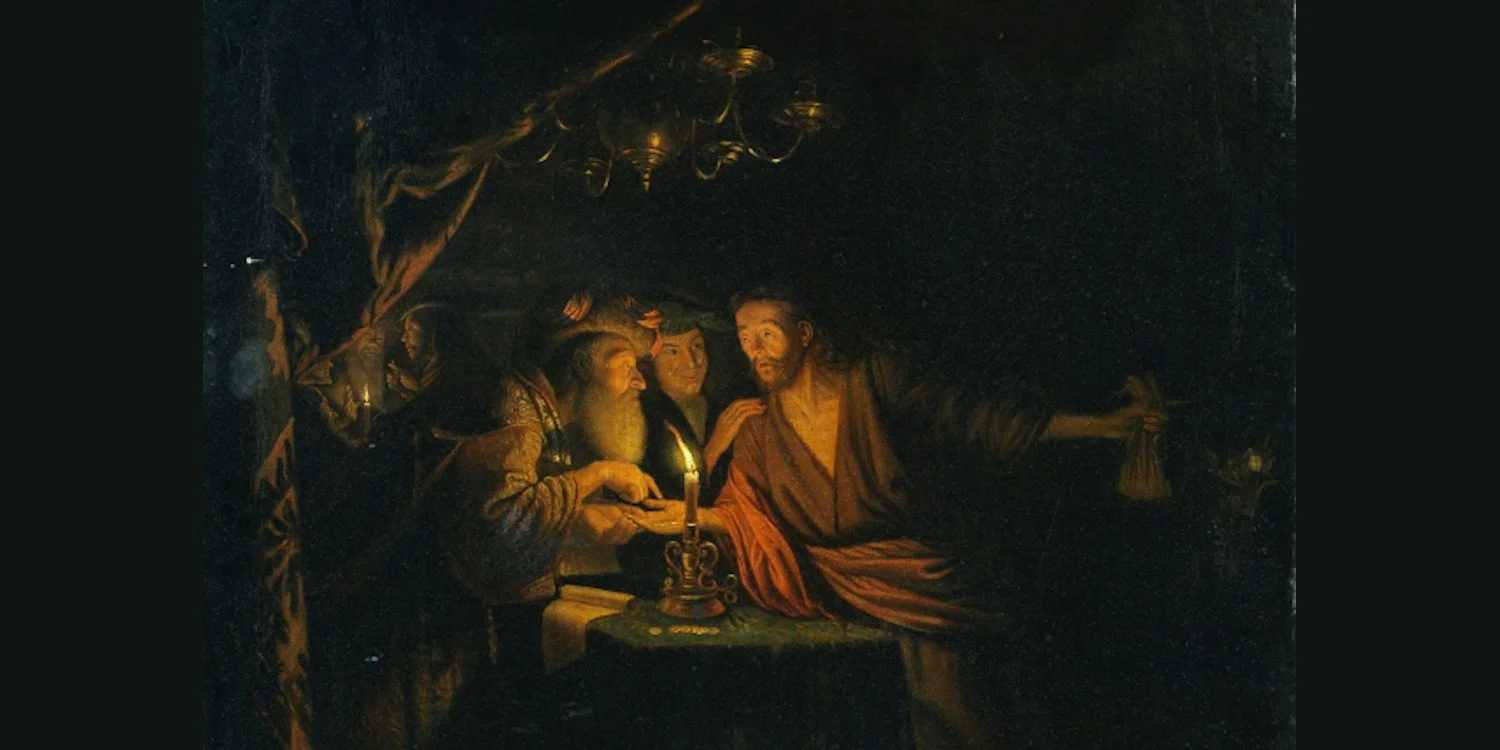
The Payment of Judas Iscariot
Catholicism in America thrived when it had to earn its dignity. Once it became politically accepted, it went on in this culture to become comfortable, and its leaders (“hēgoumenos”) perhaps a bit too comfortable. Religious authority and the sheer masses of believers spelled political power. The pedestals upon which we stood grew in height with every clerical advance, and our bishops stood upon the highest pedestals of all with palatial trappings more akin to the courts of Herod and Caesar than the Cross of Christ the King, the same yesterday, today, and forever.
It is no mystery why, as the height of our pedestals grew, so did our scandals. This is perhaps why Jesus offered to us the way to pray “Lead us not into temptation, but deliver us from evil.” It is because he alone could be led by the Spirit into the desert of temptation and emerge without dragging along behind Him the evil He encountered there.
As the last temptation of Christ unfolded in the Gospel for the First Sunday of Lent, it is now the devil, in a final effort, who dares to quote and distort the Word of God. He led Jesus to Jerusalem, and to the parapet, the highest point of the highest place, the Temple of Sacrifice. And now comes his final taunt:
“If you are the Son of God, throw yourself down from here, for it is written, ‘He will give his angels charge of you, to guard you,’ and ‘On their hands they will bear you up, lest you strike your foot against a stone’.”
— Luke 4:9-11, quoting Psalm 91
This devil of the desert takes up the argument of Jesus, the Word of God, quoting Psalm 91 (11-12). The taunt to test God and “go your own way” is far deeper than the mere words convey. In Jerusalem, the devil will take hold of Judas Iscariot (Luke 22:3) leading to the trial before Pilate and the Way of the Cross. In Jerusalem, the powers of darkness, first encountered here in the desert, are mightily at work: “This is your hour, and the power of darkness.” (Luke 22:53)
The Church in the Western world has entered a time of persecution but thus far the institutional response — having traded the Gospel for “zero tolerance” in a quest for scapegoats to cast out into the desert to Azazel — does not bode well for the faith of a Church built upon the blood of the martyrs.
Perhaps, as the Spirit leads us into this desert, it is our vocation, and not that of our leaders, that is essential. Perhaps it is not clerical reform that is needed so much as a revolution — a revolution of fidelity that can only be lived and not just talked about. We will not find the Holy Spirit in a revolution that manifests itself in blessing sin or in any politically correct acquiescence to same-sex unions that some now call the Sacrament of Holy Matrimony, and other moral distortions of our time. Those who abandon their faith in a time in the desert were leaving anyway, just waiting for the right excuse. To use the behavior of leaders to diminish and then abandon the Sacrament of Salvation is to cave to the true goal of Azazel. He could not lure Christ from us, but he can lure us from Christ and he is giving it a go.
The devil finally gives up in the desert scene of the Last Temptation of Christ in Luke Chapter 4. But the devil is not quite done. Luke’s Gospel tells that he will return “at a more opportune time.” Satan finds that time not in an effort to test Jesus, but rather to test his followers. He targets Judas Iscariot in the last place we would ever expect to find the devil: “Satan at The Last Supper: Hours of Darkness and Light.”
+ + +
Note from Father Gordon MacRae: Thank you for reading and sharing this Ash Wednesday post. You may also like these other posts from Beyond These Stone Walls as we proceed through Lent:
Pope Francis Had a Challenge for the Prodigal Son’s Older Brother
A U.S. Marine Who Showed Me What to Give Up for Lent
Satan at The Last Supper: Hours of Darkness and Light
Behold the Lamb of God Upon the Altar of Mount Moriah
We presently have 39 titles in our collection of Scriptural posts, The Bible Speaks.
The Eucharistic Adoration Chapel established by Saint Maximilian Kolbe was inaugurated at the outbreak of World War II. It was restored as a Chapel of Adoration in September, 2018, the commemoration of the date that the war began. It is now part of the World Center of Prayer for Peace. The live internet feed of the Adoration Chapel at Niepokalanow — sponsored by EWTN — was established just a few weeks before we discovered it and began to include in at Beyond These Stone Walls. Click “Watch on YouTube” in the lower left corner to see how many people around the world are present there with you. The number appears below the symbol for EWTN.
Click or tap here to proceed to the Adoration Chapel.
The following is a translation from the Polish in the image above: “Eighth Star in the Crown of Mary Queen of Peace” “Chapel of Perpetual Adoration of the Blessed Sacrament at Niepokalanow. World Center of Prayer for Peace.” “On September 1, 2018, the World Center of Prayer for Peace in Niepokalanow was opened. It would be difficult to find a more expressive reference to the need for constant prayer for peace than the anniversary of the outbreak of World War II.”
For the Catholic theology behind this image, visit my post, “The Ark of the Covenant and the Mother of God.”
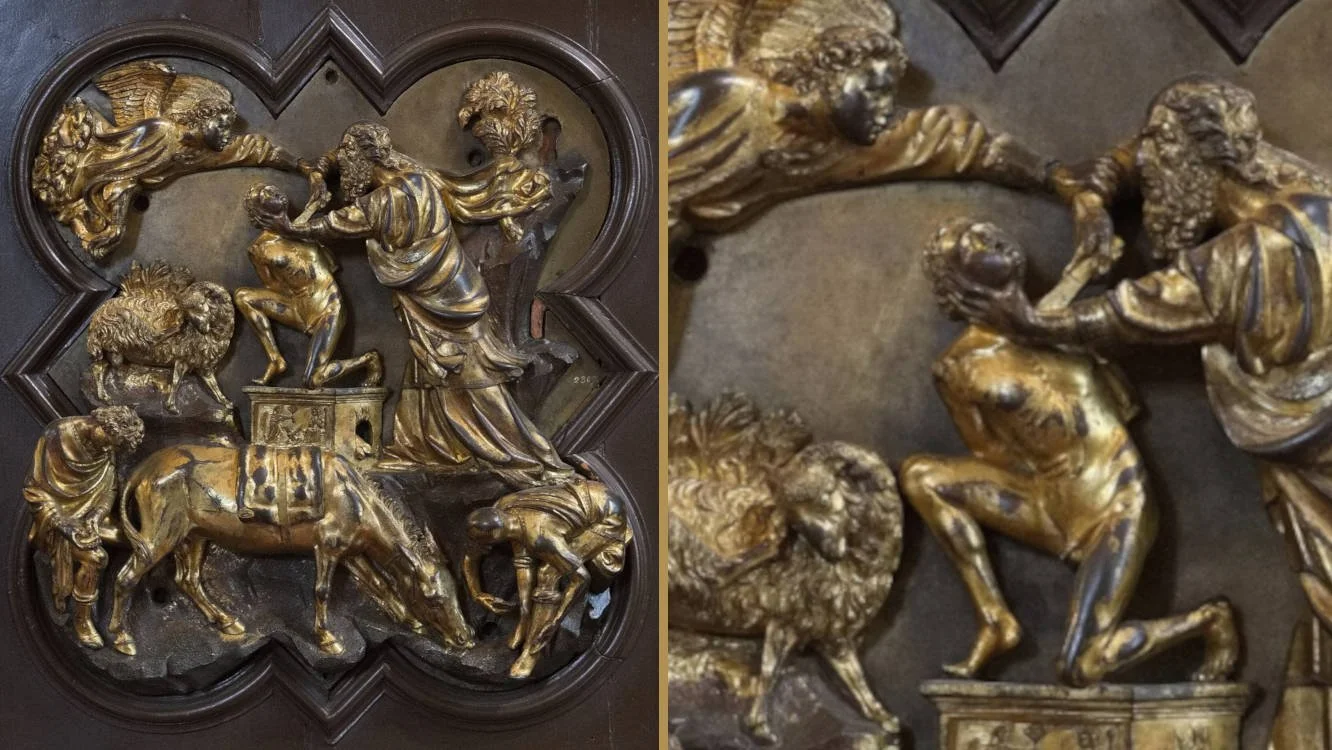
Behold, the Lamb of God
As Christmastide gives way to Ordinary Time in the Sunday Mass Gospel, John the Baptist connects the Lamb of God to the time of Abraham 2000 years before Christ.
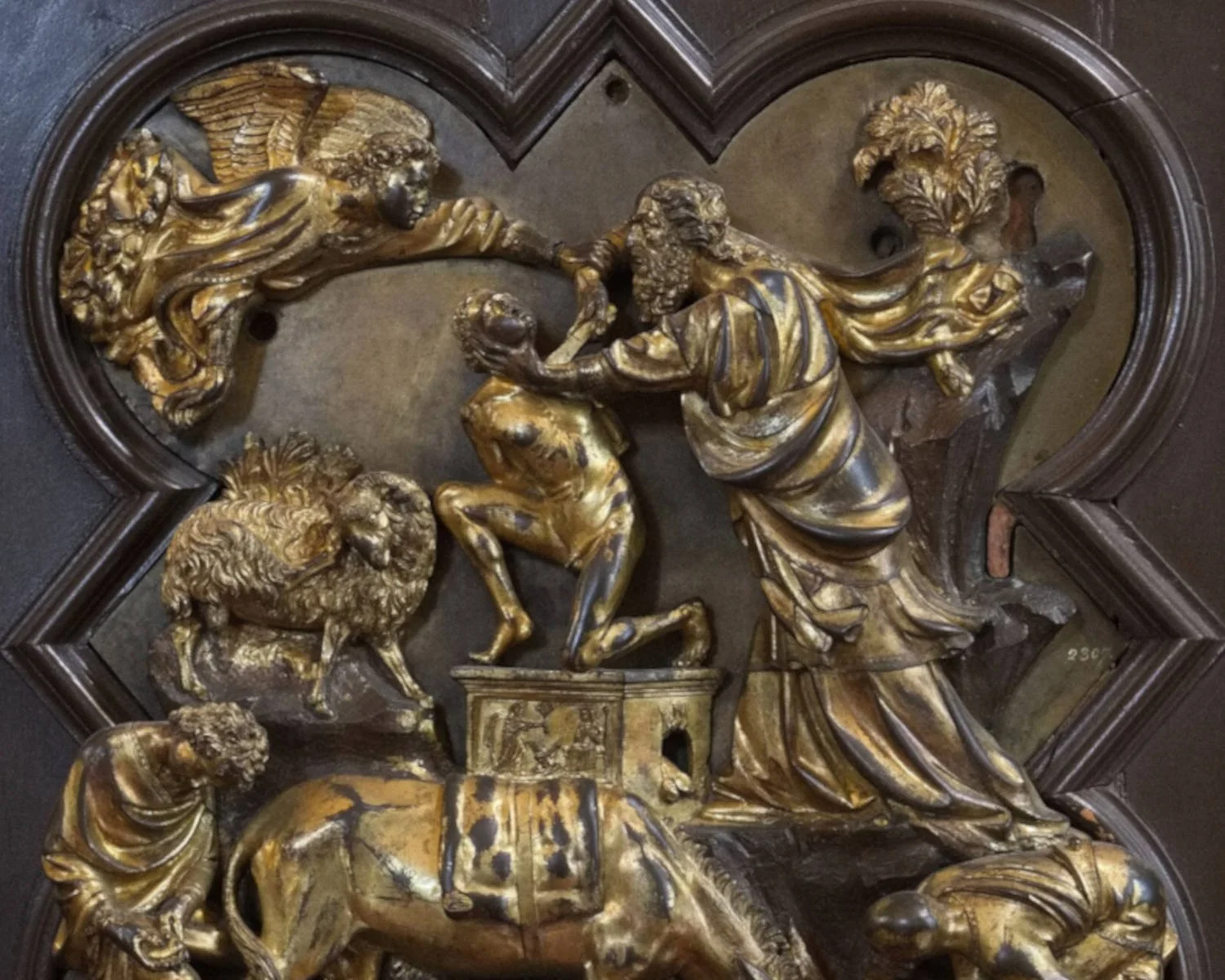
As Christmastide gives way to Ordinary Time in the Sunday Mass Gospel, John the Baptist connects the Lamb of God to the time of Abraham 2000 years before Christ.
January 14, 2026, Ordinary Time
Note from Father Gordon MacRae: In 17 years writing for this blog I have produced about 850 posts from inside a prison cell with access only to an old typewriter. After I type them, I mail them to be scanned by an editor and then published at Beyond These Stone Walls. Once I mail a post, I have no means to ever see it again except on the rare occasion when I can make a photocopy. Once published, readers can see it but I cannot. So these 850 posts, at least for me, exist only in my mind. It seems inevitable that I would eventually write content that is familiar to readers.
After the Gospel passage about the Baptism of Jesus, the Church’s liturgy enters Ordinary Time. The Sunday Gospel this week, According to Saint John (1:29-34), begins with a declaration of John the Baptist as he saw Jesus coming toward him at the River Jordan: “Behold, the Lamb of God, who takes away the sin of the world.” This is the source of the Agnus Dei, the declaration we recite three times before the reception of the Eucharist at every Mass. The declaration has its origin in this Gospel passage.
It has another origin story as well, deep in the chasms of Salvation History. I set out to write about that this week, and then realized that I already had. So this post should sound familiar. I thank you for reading and sharing it.
+ + +
“This is the night when Christ broke the prison-bars of death and rose victorious from the underworld. Our birth would have been no gain had we not been redeemed.”
— from the Easter Vigil Exultet
You might readily see the irony of my invoking the subject of this post in the haunting passage above. It is from the Exultet, that wondrous proclamation of Salvation History as the Paschal Candle is blessed at the doors of the church in the liturgy for the Easter Vigil. The imagery of Christ breaking the prison bars of death may understandably have deep meaning for me. The excerpt recalls a scene from Holy Week that I once wrote about in “To the Spirits in Prison: When Jesus Descended into Hell.”
That post conveys the story referenced in the Second Letter of Saint Peter, about what happened to Jesus on what we now call Holy Saturday, that period of darkness between the Cross and the Resurrection.
Back in February 2025, I wrote a post entitled “On the Great Biblical Adventure, the Truth Will Make You Free.” It mentioned my recent acquisition of the much anticipated Ignatius Catholic Study Bible: Old and New Testament edited by Dr. Scott Hahn. That post also referred to a recent and surprising resurgence of biblical interest throughout the free world. I learned of that explosion of interest when Ignatius Press placed me on a waiting list for that particular bible, and I had to wait for its fourth or fifth printing. I have been lugging the weighty hardcover tome, consisting of 2,314 pages, around with me for months at this writing. I don’t seem to be able to part with it for long. It is a treasure trove of biblical insight and truth, filled not only with readable and scholarly translations of Sacred Scripture, but also with scholars’ notes on the biblical texts. From a historical perspective it draws clear connections between the Old and New Testaments. From a spiritual perspective it is as though a lamp has been relit opening for me, and hopefully also for you, a world of deeper meaning embedded within the texts. As I mentioned in a previous post, my goal has been two-fold: to educate, or rather reeducate myself on the story of God and us, and to avoid dropping the very heavy book on my foot in the process.
The interpretation of a religious text is a study called exegesis. It seeks to convey and understand both the literal and spiritual sense of biblical truths. Neither should be sacrificed in pursuit of the other. I have often described it this way: There is a story on its surface, which is true, and a far greater story in its depths which points to even greater truths. One way in which the spiritual truth of Scripture is expressed is in allegory. Jesus told many allegorical accounts in parables. Most readers are clear that the truth in these precious accounts is in the lesson they convey. Two of the most famous examples are the “Parable of the Good Samaritan” and the “Parable of the Prodigal Son,” both found in the Gospel of Luke. You know these stories well, and they need no explanation.
Most of Sacred Scripture is not conveyed in parable form, but as a historical narrative. Allegory is still very much a part of that narrative, and we are cheating our understanding of a text when we suppress its allegorical content. We should start by accepting both truths: the truth of the historical content of Scripture and the equal and sometimes even greater truth in its allegorical content. In this sense allegory refers to a story, poem, or picture that can be interpreted to reveal a hidden meaning, typically a moral or religious one. In the 19th and 20th centuries, fundamentalist Scripture scholars stripped allegory from their interpretations of the text, but at great cost. More modern scholars have restored it. One of them has been Dr. Scott Hahn.
When I cited an excerpt from the Exultet Proclamation from the Easter Vigil liturgy as I opened this post, I later realized that the Second Reading for the Easter Vigil Mass is one that I have pondered for a very long time. It is from Genesis 22:1-19, the story of God calling upon Abraham to sacrifice Isaac, his beloved son. “So momentous is this event in its outcome,” wrote Scott Hahn, “that it stands as one of the defining moments of Salvation History.” I have set out to study the great depths of this account and they are astonishing.

Abraham and Isaac
Isaac is a Hebrew name, of course, and it means “He laughs.” It has its origin in Genesis 17:16-17: “ ‘I will bless (Sarah) and moreover I will give you a son by her; I will bless her and she shall be the mother of nations; kings of peoples shall come from her.’ Then Abraham fell on his face and laughed, and said to himself, ‘Shall a child be born to a man who is a hundred years old? Shall Sarah, who is ninety years old, bear a child?’ ”
Abraham apparently gave little thought to the wisdom of falling to the ground and laughing at God. The fact that he “said it to himself” is no guarantee that God would not have heard it loud and clear. And so it was that the Word of God came to give the son of Abraham and Sarah the name “Isaac,” which means “He laughs.”
Abraham was apparently not the only one laughing. God seemed to get a chuckle out of it as well.
As the story progressed, the significance of Isaac’s birth was immediate. He was to be the fulfillment of God’s promise to Abraham. Isaac was to be the bearer of the covenant into future generations: “I will establish my covenant with him as an everlasting covenant for him and his descendants after him” (Genesis 17:19). Then the drama of the Book of Genesis reaches its greatest intensity with the heart-wrenching story of God’s call to Abraham to sacrifice as a burnt offering his beloved son upon the heights of Mount Moriah. Had Abraham shown anything less than heroic faith and obedience the grand narrative of the Bible would have developed very differently thereafter. Here is the Genesis account which became the Second Reading of our Easter Vigil liturgy.
From the Book of Genesis 22:1-18:
After these things, God tested Abraham and said to him, “Take your son, your only begotten son Isaac, whom you love, and go to the land of Moriah, and offer him there as a burnt offering upon one of the mountains of which I shall tell you.” So Abraham rose early in the morning, saddled his donkey, and he cut the wood for the burnt offering, and went to the place of which God had told him. … Abraham took the wood for the burnt offering and laid it on the shoulders of his son to carry, and he took in his own hands the fire and the knife. So they went both of them together. Isaac said to his father, “Behold the fire and the wood, but where is the lamb for a burnt offering?” Abraham said, “God will provide himself the lamb for a burnt offering, my son.”
When they came to the place of which God had told him, Abraham built an altar there and laid the wood in order, and he bound Isaac his son and laid him on the altar upon the wood. Then Abraham put forth his hand and took the knife to slay his son. But the angel of the Lord called to him from heaven and said, ‘Abraham, Abraham! Do not lay your hand on your son or do anything to him for now I know that you have not withheld your only begotten son from me.” Abraham then lifted up his eyes and looked, and behold, behind him was a ram caught by his horns in a thicket. So Abraham went and took the lamb and offered it up as a burnt offering instead of his son. So Abraham called the name of that place YHWH YIR’EH, in Hebrew, “The Lord will see.”
It is from this very account that, twenty one centuries later, the Gospel of John (1:29) proclaims “Behold the lamb of God who takes away the sin of the world.”
I have always felt that this account in Genesis was a presage, a looking far ahead, to the sacrifice of Jesus upon Golgotha. It is allegorical in that sense. The account is true on its literal face but it is also true that it echoes the Greatest Story Ever Told which will come many centuries later. All the elements are there. The Second Book of Chronicles (3:1) identifies Moriah as the site upon which, nearly one thousand years later, Solomon would build the Jerusalem Temple, and Calvary, where the only begotten Son of God was crucified, is a hillock in the Moriah range. So for the Hebrew reader of the story of the Crucifixion, there is a powerful sense of déjà vu: the place, the mount, Abraham placing the wood for sacrifice upon the back of Isaac, and is not the ram caught by its horns in the thicket highly reminiscent of the Crown of Thorns? But we cannot reminisce backwards. This amazing account from Genesis is a mysterious example of the power of biblical inspiration. Only in the mind of God, in the time of Genesis, was the story of Christ evident.

From Sheol to the Kingdom of Heaven
In the Old Testament, “to die” meant to descend to Sheol. It was our final destination. To rise from the dead, therefore, meant to rise from Sheol, but no one ever did. The concept of Sheol being the “underworld” is a simple employment of the cosmology of ancient Judaism which understood the abode of God and the heavens as being above the Earth, and Sheol, the place of the dead, as below it. This is the source of our common understanding of Heaven and hell, but it omits a vast theological comprehension of the death, Resurrection and Ascension of Jesus and the human need to understand our own death in terms of faith.
If, up to the time of Jesus, “to die” meant to descend into Sheol, then Jesus introduced an entirely new understanding of death in his statement from the Cross to the penitent criminal, Dismas, who pleaded from his own cross, “Jesus remember me when you come into your kingdom.” Jesus responded, “Today you will be with me in Paradise” (Luke 23:43). This is an account that I once told entitled, “Dismas, Crucified to the Right: Paradise Lost and Found.”
It is by far the most widely read of our Holy Week posts, and not just at Holy Week. On the Cross, where the penitent criminal comes to faith while being crucified along with Jesus, God dissolves the bonds of death because death can have no power over Jesus. It is highly relevant for us that the conditions in which the penitent Dismas entered Paradise were to bear his cross and to come to faith.
It was at the moment Jesus declared, in His final word from the Cross, “It is finished,” that Heaven, the abode of God, opened for human souls for the first time in human history. The Gospels do not treat this moment lightly:
“It was now about the sixth hour [3:00 PM], and there was darkness over the whole land until the ninth hour while the sun’s light failed; and the curtain of the Temple was torn in two. Then Jesus, crying with a loud voice, said, ‘Father, into your hands I commend my spirit.’ Saying this he breathed his last.”
— Luke 23:44-46
“And behold, the curtain of the Temple was torn in two from top to bottom, and the Earth shook, and the rocks were split. The tombs also were opened, and many bodies of the saints who had fallen asleep were raised ... When the centurion, and those who were with him keeping watch over Jesus, saw the earthquake, and what took place, they were filled with awe, and said, ‘Clearly, this was the Son of God.’”
— Matthew 27:51-54
The veil of the Temple being torn in two appears also in Mark’s Gospel (15:38) and is highly significant. Two veils hung in the Jerusalem Temple. One was visible, separating the outer courts from the sanctuary. The other was visible only to the priests as it hung inside the sanctuary before its most sacred chamber in which the Holy of Holies dwelled (see Exodus 26:31-34). At the death of Jesus, the curtain of the Temple being torn from top to bottom is symbolic of salvation itself. Upon the death of Jesus, the barrier between the Face of God and His people was removed.
According to the works of the ancient Jewish historian, Josephus, the curtain barrier before the inner sanctuary that was torn in two was heavily embroidered with images of the Creation and the Cosmos. Its destruction symbolized the opening of Heaven, God’s dwelling place and the Angelic Realm, to human souls.
In ancient Israel in the time of Abraham and Isaac the concept of Sheol after death was closely connected with the grave and pictured only as a gloomy underworld hidden deep in the bowels of the Earth. There human souls descended after death (Genesis 37:35) to a joyless existence where the Lord is neither seen nor worshipped. Both the righteous and the wicked sank into the nether world (Genesis 44:31). Despite the apparent finality of death, Scripture displays great confidence in the power of God to deliver his people from its clutches. That confidence was made manifest in the deliverance of Jesus from his tomb after he displayed the power of God to the one place where he had always been absent, the realm of the dead. “For Christ also died for sins once and for all, the righteous for the unrighteous, that he might bring us to God, being put to death in the flesh but made alive in the spirit, in which he went and declared to the spirits in prison who did not formerly obey when God’s patience waited in the days of Noah.” (1 Peter 3:18-20)
The essential point for us could not be clearer or more hopeful. Besides Jesus himself, the first to be sanctioned with a promise of paradise was a condemned prisoner who, even in the intense suffering of his own cross, refused to mock Jesus but rather came to believe and then place all his final hope in that belief. As I ended “Dismas, Crucified to the Right” Dismas was given a new view from his cross, a view beyond death away from the East of Eden, across the Undiscovered Country of Death, toward his sunrise and eternal home.
I have written many times that we live in a most important time. The story of Abraham told above took place twenty one centuries before the Birth of the Messiah. We now live in the twenty first century after. Christ is now at the very center of Salvation History.
+ + +

+ + +
Note from Father Gordon MacRae: Please visit our new page: Abraham to Easter: The Bible Speaks, our collection of Scriptural exegesis for Beyond These Stone Walls.
+ + +

The Eucharistic Adoration Chapel established by Saint Maximilian Kolbe was inaugurated at the outbreak of World War II. It was restored as a Chapel of Adoration in September, 2018, the commemoration of the date that the war began. It is now part of the World Center of Prayer for Peace. The live internet feed of the Adoration Chapel at Niepokalanow — sponsored by EWTN — was established just a few weeks before we discovered it and began to include in at Beyond These Stone Walls. Click “Watch on YouTube” in the lower left corner to see how many people around the world are present there with you. The number appears below the symbol for EWTN.
Click or tap here to proceed to the Adoration Chapel.
The following is a translation from the Polish in the image above: “Eighth Star in the Crown of Mary Queen of Peace” “Chapel of Perpetual Adoration of the Blessed Sacrament at Niepokalanow. World Center of Prayer for Peace.” “On September 1, 2018, the World Center of Prayer for Peace in Niepokalanow was opened. It would be difficult to find a more expressive reference to the need for constant prayer for peace than the anniversary of the outbreak of World War II.”
For the Catholic theology behind this image, visit my post, “The Ark of the Covenant and the Mother of God.”