“There are few authentic prophetic voices among us, guiding truth-seekers along the right path. Among them is Fr. Gordon MacRae, a mighty voice in the prison tradition of John the Baptist, Maximilian Kolbe, Alfred Delp, SJ, and Dietrich Bonhoeffer.”
— Deacon David Jones
Saint Maximilian Kolbe’s Gift of Noble Defiance
At the end of July, 85 years ago in 1941, Father Maximilian Kolbe stepped out of line at Auschwitz. His gift of noble defiance has spread throughout the known world.

At the end of July, 85 years ago in 1941, Father Maximilian Kolbe stepped out of line at Auschwitz. His gift of noble defiance has spread throughout the known world.
July 30, 2026 by Father Gordon MacRae
Auschwitz 1941:
After the so-called dinner, I was invited between Blocks 18 and 19 where some prisoners had gathered among whom were several priests … Our colleague, Kolbe, spoke of the Feast of Corpus Christi, of the great omnipresent God, and of our sufferings by which He was trying to make us ready for a better life.
— A priest at Auschwitz, from Depositions of Fellow Prisoners, 1970, p. 34
+ + +
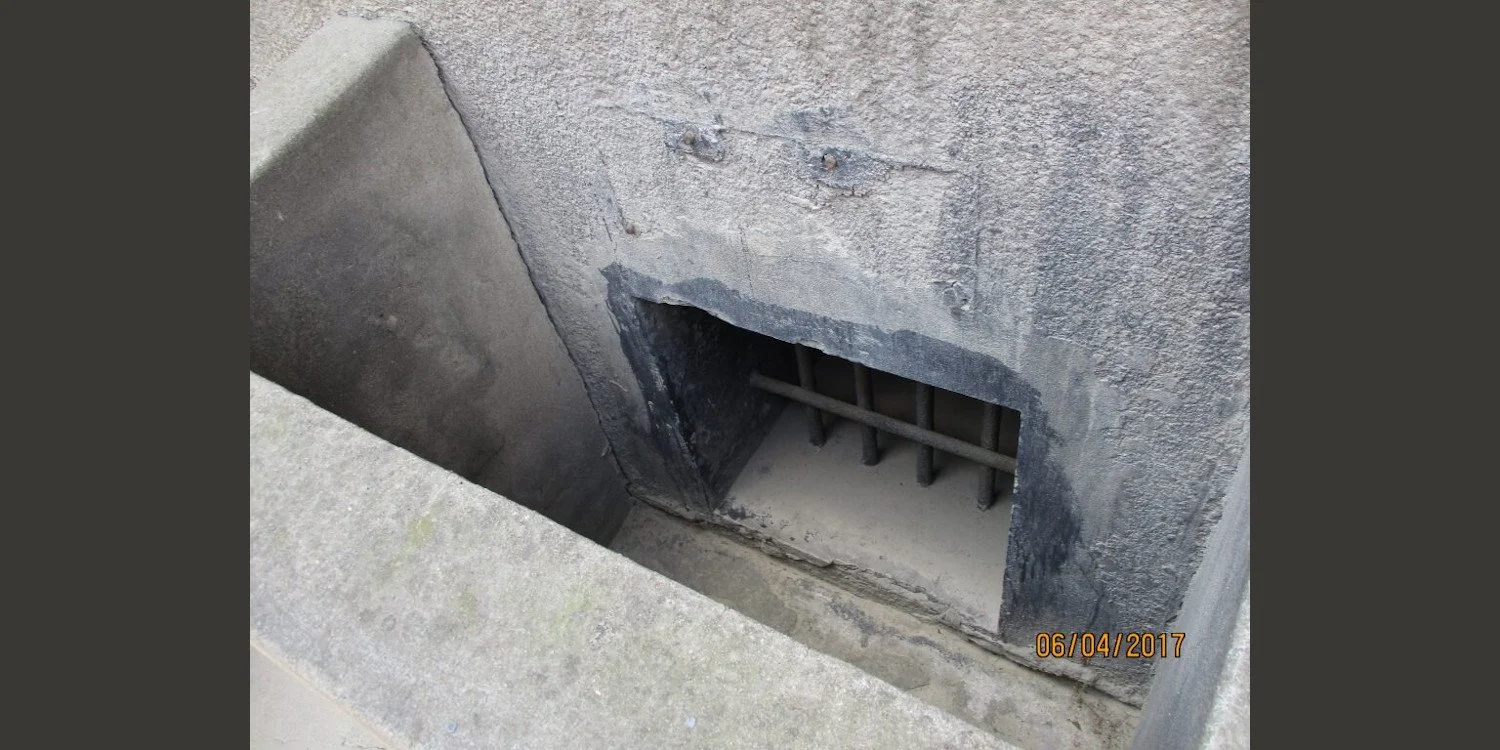
Pornchai Moontri once looked at the death chamber of Maximilian Kolbe and saw devouring jaws of evil. I saw that evil too, but choking on a brave soul’s noble defiance.
The photograph in this post has deep meaning and significance for us. BTSW reader Lupe Gwiazdowski, on a tour of the Auschwitz Concentration Camp, stood with her camera before the gaping maw of a prison window. She photographed the window of the death chamber that consumed the life of our Patron Saint but could not extinguish the light of his sacrificial priesthood.
When Lupe’s letter with the photograph arrived in early July, 2017, when Pornchai “Max” Moontri was still here with me, he and I were standing with 100 other prisoners for Mail Call. The mail handlers here reversed the pages before stuffing the letter back in its envelope so the page with this photo was on top when I unfolded the letter.
I did not know what the photo was, but right off Pornchai pointed to it. “It’s a face!” he said. “An evil face!” Study the photograph above for a moment. Once I saw what Pornchai saw, I could not look at the photo again without instantly seeing that same demonic face. You will see it too.
But what Pornchai saw as the gaping jaws of evil ready to devour, I saw those same jaws choking on whatever was inside. When I suggested this to Pornchai, he saw it too. Stare at the photo for another moment, and you may see what I mean.
Then I read the letter that accompanied Lupe’s photo, and realized with a jolt that it was behind these gaping jaws that our Patron Saint, Maximilian Kolbe, surrendered his life in defiance of the great evil that manifested itself at Auschwitz.
Over two weeks of forced starvation followed his choice to die in place of an innocent young man. When Father Kolbe did not die in a timely manner that suited his captors, his life was taken by lethal injection on August 14, 1941. After a lifetime of devotion to “The Immaculata,” death came on the Vigil of the Solemnity of the Assumption. Lupe tells the story of the photo in her letter of June 29, 2017 that touched our hearts deeply:
“Hi Father G: I wanted to send you this photo and I hope you get it. I went to Poland this month, and I made a mental note to pray for you and Pornchai “Max” Moontri at the Auschwitz cell of St Maximilian Kolbe.
“As is often the case with my mental notes, when I got to the cell I was so overwhelmed that I forgot it. As soon as we exited the block of cells I remembered. I left the group and tried to push my way back to the cell, but Polish tour guides are not to be pushed against! I didn’t make it.
“I was downcast as I caught up with the group, and then realized that the guide was pointing to the bars of the Saint’s cell window from the outside. I didn’t even hear what she was saying as I looked upon this sacred spot. I thought of how this priest and his companion prisoners died giving such powerful witness through those same bars to so many whose hope was perishing. I lifted you and Pornchai up right there, and then snapped this photo for you. Father, I do not know what else to say.
“When I got back to a computer, I saw your post, “Thoughts Upon My 35th Anniversary of Priesthood Ordination,” and realized that your anniversary was on the same day I prayed for you and Pornchai-Max at Auschwitz. Father, thank you for your priesthood.”

In Noble Defiance of Evil
Today, virtually everyone knows the story of Saint Maximilian Kolbe. His Earthly remains were reduced to smoke and ash in the ovens of Hitler to drift in the skies above Auschwitz. But what he wrote and said and did, the glow of his soul, still moves mountains and the hearts of millions.
In Father Maximilian Kolbe, evil did not destroy what it set out to destroy. It imprisoned and killed the body of a man, but the priest lived on in noble sacrifice and love. The jaws of that window choked on the goodness of the soul contained therein.
Of all the thousands of accounts about the witness and strength of Father Maximilian Kolbe, for me the most powerful account comes from Herrmann Langbein, who was a prisoner at Dachau and then at Auschwitz. He is best known for his book, Against All Hope: Resistance in the Nazi Concentration Camps, 1938-1945. He singles out one man’s defiance that I have cited in other posts about our Patron Saint:
“The best-known act of resistance was that of Maximilian Rajmund Kolbe, who deprived the camp administration of the power to make arbitrary decisions about life and death.”
— People in Auschwitz, p. 241
Langbein went on to write powerfully of the witness, not only of Father Kolbe’s sacrifice by volunteering to take upon himself the death sentence of a fellow prisoner, but of his demeanor in prison:
“Kolbe and his companions in misfortune had to spend almost three weeks [in starvation] in an unlit cell. On August 14 (1941) a lethal injection ended the suffering of the man whose bearing elicited the respect of the supervising SS men to the very end.”
— People in Auschwitz, p. 241
I pray for the gift of this brave priest’s noble defiance of evil. It is easier to just succumb to it, enduring it for as long as we can until it starts to bring about subtle changes in our resolve. My favorite passage in The Screwtape Letters by C. S. Lewis (Harper, 1942) is Letter 12. You have seen this passage before in these pages. The demonic “Uncle Screwtape” describes perfectly the slippery slope that suffering and sin conspire to spread the contagion of evil. Their cumulative effect …
“… is to edge the man away from the Light and out into the Nothing … . Indeed the safest road to Hell is the gradual one — the gentle slope, soft underfoot, without sudden turnings, without milestones, without signposts.”
— The Screwtape Letters by C. S. Lewis, Letter 12
In no place is a man or woman without defiance “edged away from the Light out into the Nothing” more than in prison. Like all prisons — whether they be prisons of iron, or fear, or trauma, or loneliness, or sickness, or pain — year upon year of it can set us upon the subtle turnings C. S. Lewis describes. For some, no doubt, resistance to the evils of our prisons seems futile.
Something happened recently — something profoundly humbling — that I thought about when I read the short passage at the top of this post from a priest-prisoner in Auschwitz with Maximilian Kolbe. The passage is from a published collection, Depositions of Fellow Prisoners, in the investigation of Maximilian Kolbe’s cause for sainthood.
More than 12,000 priests died in Auschwitz and the other camps of Germany and Poland, but the priest who wrote the passage atop this post survived. I wonder about those who perished there, those whose hope was siphoned off by the evil in their midst.
But for Maximilian Kolbe, resistance to evil was the one charism of a sacrificial priesthood available to him in a place where priesthood and sacrifice were deemed meaningless by worldly powers. Prison can quickly descend into “every man for himself,” but Maximilian lived and died on life’s road less traveled.

Priesthood Lost in Translation
Over the many years that I have been in this prison unjustly, there was another priest here. He was a priest of my Diocese, but I never knew him outside of prison. In fact, I barely knew him here. He was convicted of a sexual abuse charge in 1997, one alleged to have taken place long before then, and had been here ever since.
I know that in 2001, this priest acquiesced to a demand that he be voluntarily laicized (dismissed from the clerical state). Over the ensuing years, after 25 years of priesthood, he never again heard from our Bishop or Diocese. He was discarded. The prisoner-priest lost his faith. He became unable to be present at Mass for the next sixteen years. He was in a different prison unit than I, and I saw him only in rare passing.
However, when printed copies of some BTSW posts were mailed to me, the sender would often send two. So, with the clandestine help of friends here, I started to send the other copy to this priest. I did not send him every post, just the ones about priesthood. One post reached an untapped well of faith and hope.
It was “Saint Maximilian Kolbe: A Knight at My Own Armageddon.” It was the middle of an important three-part post, and was the only post for which the priest sent back — via the same circuitous prison channels — a request to see more. These posts were the limits of our contact.
The same week that Lupe’s letter and photo arrived, Pornchai Max and I were climbing the multiple tiers of stairs on a Sunday morning for Mass in the prison chapel. As we passed the second floor landing, the priest mentioned above was just then emerging from the prison medical unit. I greeted him and shook his hand (another act of resistance as shaking someone’s hand is forbidden here) and then something strange happened.
Pornchai did not even know who he was and I did not want to put the priest on the spot so we parted company and proceeded up the next flight of stairs. Then Pornchai turned and said, “Do you want to come with us?” The priest paused for a moment looking puzzled, and then quietly followed us up the stairs. Before we entered the chapel, I asked Pornchai to go find us some seats while the prisoner-priest told me that this was his first time at Mass in 16 years. He became reconciled, and we sat with him.
The next week — being an idiot sometimes — I took our usual seats and Pornchai stood glaring at me. “What are you doing?” he asked, and then pointed to that other priest still standing outside the door. “Go get him and bring him in to sit with us,” said Pornchai. God bless Pornchai!
In early July back in 2017, I spotted that prisoner-priest on the local news. He was appearing before the New Hampshire Parole Board with a request for medical parole because he was dying of cancer.
A physician who spoke at the hearing reported that he had no more than six months to live, and his care would be a burdensome expense for the state. After some callous remarks from a victim advocate on the State’s payroll about whether he “looks sick enough,” and whether twenty years in prison exacts sufficient reckoning, the Parole Board granted his medical parole.

On the Move
A week later, Max and I were suddenly moved — he to one place and I to another. Apart for the first time in over ten years, this had been a great hardship for us both. We were trying to reunite, but once anything like this is done here, it resists being undone. Max was trying to be moved to the same place I was in. We saw each other only once in the prison law library where I work. I invited Max to pray with me the Memorare:
“Remember, O Most Gracious Virgin Mary, that never was it known that anyone who fled to your protection, implored your help, or sought your intercession, was left unaided. Inspired with this confidence, we flee unto you, O Virgin of virgins, our Mother; to you do we come, before you we stand, sinful and sorrowful. O Mother of Word Incarnate, despise not our petitions, but in your mercy hear and answer us. Amen.”
The place I was sent to is the unit the other priest had been living in for the previous twenty years. My first week there was his last week there, and we were able to walk each morning and talk. He was restored to faith and hope that our sufferings will make us ready for a better life.
I was with him early on the morning he left prison, and went home to his sister to die. I like to think that we managed to fill in some of the cold abyss in which our Church let him wander alone in exile for twenty years. I cannot imagine, even in my most vengeful thoughts, that such alienation and abandonment are what Christ summons forth from the Apostolic witness of His Church.
Most of all, I like to think we helped to prepare my brother-priest for something essential imparted to us by a Patron Saint who guides us on a right path through prison: the gift of a noble defiance of evil with the living witness of sacrificial priesthood.
On the day after that priest left prison, one week after Max and I prayed the Memorare, I returned from work to see him living once again in the bunk above me. He remained there until he entered ICE detention to prepare for his return to Thailand in 2020.

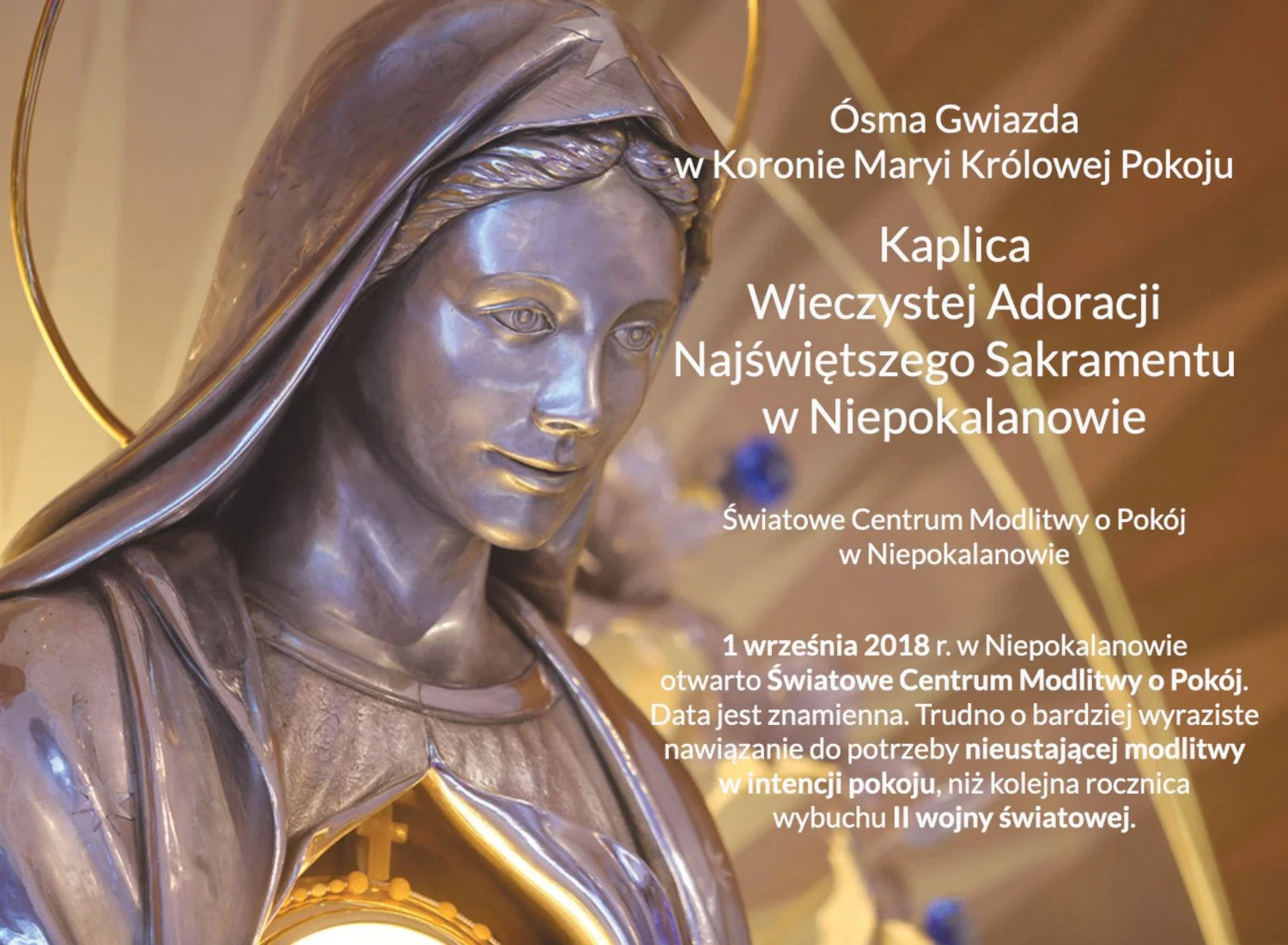
The Eucharistic Adoration Chapel established by Saint Maximilian Kolbe was inaugurated at the outbreak of World War II. It was restored as a Chapel of Adoration in September, 2018, the commemoration of the date that the war began. It is now part of the World Center of Prayer for Peace. The live internet feed of the Adoration Chapel at Niepokalanow — sponsored by EWTN — was established just a few weeks before we discovered it and began to include in at Beyond These Stone Walls. Click “Watch on YouTube” in the lower left corner to see how many people around the world are present there with you. The number appears below the symbol for EWTN.
Click or tap here to proceed to the Adoration Chapel.
The following is a translation from the Polish in the image above: “Eighth Star in the Crown of Mary Queen of Peace” “Chapel of Perpetual Adoration of the Blessed Sacrament at Niepokalanow. World Center of Prayer for Peace.” “On September 1, 2018, the World Center of Prayer for Peace in Niepokalanow was opened. It would be difficult to find a more expressive reference to the need for constant prayer for peace than the anniversary of the outbreak of World War II.”
For the Catholic theology behind this image, visit my post, “The Ark of the Covenant and the Mother of God.”

Listen to Our Mother: Mary and the Fatima Century
The century since the Miracle of Fatima in 1917 saw an explosion of Marian devotion throughout the world. For me, one skeptic priest, resistance was futile.

The century since the Miracle of Fatima in 1917 saw an explosion of Marian devotion throughout the world. For me, one skeptic priest, resistance was futile.
Back in May, 2017, Mother’s Day in the United States was on the day after the 100th anniversary of the first apparition of Our Lady of Fatima which occurred on May 13, 1917. There was a lot taking place in preparation for the observance of that day, but very little of it was available to me. Months earlier I received a wonderful letter from Annie Karto, a Catholic songwriter and music composer. She had composed a beautiful song entitled “Rise Up All People,” and she performed it in 2016 as part of a special Divine Mercy production that included a slide presentation. She wanted me to know that I was a part of that presentation and that she was dedicating the song to me. She wanted to send me a link to the video so I could hear it and see the presentation. I was most grateful to her but there was simply no format available to me in prison to make that happen.
For the previous 23 years, I had been living in what was widely understood here to be punitive housing. I was told that it was because I do not admit guilt. So for 23 years I just endured it. I endured it far longer than any other prisoner. For half of those years, Pornchai Moontri lived in a cell with me. As you know, some very important things took place in those years that were filled with grace personally inspired by Saint Maximilian Kolbe who pointed us always to the Immaculata.
During a Divine Mercy workshop in the prison chapel that year, one of the volunteers from the National Shrine of The Divine Mercy told me that Concord, NH has a Catholic radio station. I had no idea. The only radio available for purchase where I happened to be living was a small hand-held model manufactured by Sangean and sold to prisoners here for just under $50. It was a pricey item considering that there are many radios for a fraction of that price, but in prison we had no other options. I decided against the purchase because the world of concrete and steel where we lived blocked out most radio signals. So why would anyone here buy a radio? That was a question I was asking myself even as I filled out the order form to send to a friend who wanted to order one for me from a catalog of items approved for prisoners. At the time, I needed other things more than a radio. I had holes in my socks but for reasons I do not understand to this very day, a friend was insistent that I have a radio. So when my radio arrived, I installed two AAA batteries, tuned into the FM frequency that carried the signal for Ave Maria Radio, and heard nothing but disappointing static.
So in mid May 2017, the morning of Mother’s Day, the day after hearing all that static on my new radio, Pornchai and I went outside to the prison Ball Field. He was pitching for a baseball game that day, and I just wanted to walk the perimeter of the field. On our way there, after we had passed through several locked doors and barriers, Pornchai said, “Why don’t you bring your radio?” So I rushed back through multiple barriers, patiently waiting at each for unseen entities to buzz me through a multitude of electronic locks. I got back to our cell, grabbed the radio, and reversed the process of waiting at each of the locked doors.
I made it back to the Ball Field just as the last door was about to slam shut. I walked toward the back of the field, took my radio out of my pocket, and unraveled its earbud headphones. It was still tuned to the local Catholic station from which I heard only static the night before. At the moment it came alive in the Ball Field, I heard the voice of Teresa Tomeo say, “Our guest today is Catholic singer and songwriter Annie Karto to discuss her latest CD, ‘Rise Up All Peoples.’” And then I heard for the first time Annie’s now famous song. I had imagined that song in my mind many times, but never heard it. Months before, Annie Karto, produced a video for that song for a national conference on Divine Mercy, and the video included, among many images, a photograph of me from an article for the Year of Mercy entitled “The Doors that Have Unlocked.”
Having neither seen nor heard any of this before, I could only imagine it until that morning outside when I had the right receptor at just the right time to hear the music play. My friend, Pornchai Moontri was on the pitcher’s mound in a game when he stopped to wonder why I was standing mesmerized and immobilized at the far outfield.

Click or tap image to play Annie Karto’s 4-minute presentation of “Rise Up All People.”
Listening to Mary with the Right Receptors
When that was over, and Teresa Tomeo’s Catholic Connection had signed off for the day, I had another five minutes out in the field. I continued listening to a call-in show about Scripture. The first caller was a man who identified himself as a fallen away Catholic who is now a Protestant Evangelical. He said that he left the Church because of the Catholic focus on Mary as “a conduit of grace” which, he seemed to believe, is not supported by Biblical truth.
At that moment, my new radio just stopped working. It died two months after I received it. I tried everything to get it working again, but to no avail. I cannot return it, and given its limited use (outside only) I could not justify buying a new one. So now I just walk in the Ball Field in silence. But I have the strangest sense that I heard the things that I was supposed to hear when I had the right receptor to hear them. I do not know how the Catholic radio commentators responded to the Evangelical’s concern about Mary, but the answer came to me immediately. I was thunderstruck by it, and by how little thought I had ever given to this before.
The basis of religious authority for Evangelical Protestants is “Sola Scriptura,” Latin for “Scripture Alone.” The concept embraces not just Biblical authority, but also a deeply held belief in Biblical inerrancy. Both notions clearly support Catholic belief in the role of Mary in Salvation History. It’s a truth that I was once deaf to as well, because I did not employ the right receptors to hear it. There was a time as a younger priest inspired only by science, when I scoffed at notions such as Marian apparitions at Fatima. But I have come to understand that such things are highly valued in our life of faith, less by the events themselves and more by their impact on our spiritual history. I was a little slow in my heart to come to understand Mary in our life of faith as Catholics. I knew all that there was to know about her, but I did not know her. I did not “hear” Mary because I did not have inner receptors tuned to her. The deep reverence that Catholics hold for Mary, and the notion that she can be, and has been, an emissary from Heaven and a conduit of grace make total sense.
The appearances of Mary in the Gospel are like bookends for the story of salvation. Her first appearance — in the Gospel of Saint Luke (1:26-56) — opens with an angelic declaration that is unprecedented in all of Sacred Scripture:
“In the sixth month the Angel Gabriel was sent from God to a city of Galilee named Nazareth, to a virgin betrothed to a man whose name was Joseph, of the house of David; and the virgin’s name was Mary. And he came to her and said, ‘Hail, full of grace, the Lord is with you.’”
— Luke 1:26-28
Scripture contains 326 references to angelic appearances between the fall of Adam and the Resurrection of Christ. This brief passage in the Gospel of Luke is the first and only place where an angel refers to a human person with a title instead of a name. And the title — rendered “full of grace” in its English translation — is fascinating.
The term appears in only one other place, the Book of Acts of the Apostles which was also authored by Saint Luke. It’s a reference to Stephen who would become Christianity’s first martyr: “Stephen, full of grace and power, did great wonders and signs among the people” (Acts 6:8). However, these English translations of the term fail to capture the full meaning the Evangelist intended. In Saint Luke’s original Greek, the terms have very different meanings.
In the case of Stephen, the original Greek words of Luke for “full of grace” were “plērēs charitos.” You can see in this the Greek roots of the word “charity.” But in the angel’s reference to Mary, a very different Greek term was used to convey the words, “full of grace.” It was a title much more than a trait. The Greek term Saint Luke used is “kecharitomēnē,” a far more revealing concept. It refers not just to a facet of her character, as in the case of Stephen, but of her essence. “Kecharitomēnē” refers to a prior action of God in which Mary was “graced” in the sense of her being a “vessel” in multiple tenses — past, present, and future — who is instilled with divine life, a soul that magnifies the Lord.
This does not mean that Mary was divine. It means that God prepared her from the moment of her conception. Some English translations use the term “highly favored one” instead of “full of grace” in the Angel’s greeting, but this in no way captures the truth of the Evangelist’s meaning which is far more profound than “favor.” It is closer to “innate holiness.” Saint Luke’s unique Greek title became the Scriptural basis for the Catholic doctrine of the Immaculate Conception. It points not to a trait of Mary’s character, but to a revelation of her lifelong holiness and unique place in Salvation History as the Mother of both the Redeemer and the redeemed — the new Eve.
In the angelic declaration to Mary (Luke 1:28) the next phrase is rendered in English, “the Lord is with you.” Its more proper sense is, “the Lord is within you.” Her Greek title, “Theotokos,” literally “Mother of God,” was defined at the Council of Ephesus in A.D. 431 and reaffirmed by the Second Vatican Council in Lumen Gentium (53). For the entire life of the Church, Mary has been venerated — not worshipped, but venerated — as the Mother of God. This is a theological truth that I described in “The Ark of the Covenant and the Mother of God.”

The Miracles of Fatima
I owe a debt today to the Marians of the Immaculate Conception, stewards of the National Shrine of The Divine Mercy in Stockbridge, Massachusetts. I wrote of this debt, and of my all-too-human resistance to their great gift, in “Divine Mercy in a Time of Spiritual Warfare.” That debt was deepened in 2022. That is when the Church marked the 100th anniversary of our Blessed Mother’s first of six appearances to three small shepherd children in the village of Fatima, Portugal. She appeared to them in this little known, out-of-the-way village in Portugal as World War One raged on all around them. It was the time of what Pope Benedict XV (not XVI) described as “the suicide of Europe.” It was at this very time that Mary reentered human history to convey a message through the smallest of voices in a most insignificant place. Then it echoed with ever increasing volume across the century to follow.
I had never fully understood the apparitions at Fatima. My scientific mind with its natural skepticism had always been in the way, making real moments of grace hard won for me. But now I think, for the first time in my life, I understand what happened at Fatima commencing on May 13, 1917 and the 13th of each of five months to follow. And thanks to Fr Michael Gaitley’s book The Second Greatest Story Ever Told, I finally understand Fatima’s meaning in the context of faith and in the context of human history.
My understanding has also been greatly aided by a wonderful gift by a superb Catholic writer and friend of Beyond These Stone Walls, Felix Carroll. You have met Felix Carroll in these pages before. He is the Executive Editor of Marian Helper magazine, which has published two major articles about my friend Pornchai Moontri’s Divine Mercy conversion and my place in that remarkable story. Felix is also the author of the great Divine Mercy book, Loved, Lost, Found: 17 Divine Mercy Conversions with a chapter about the life of Pornchai.
As I was pondering how to approach a post about the Fatima Century, I quickly found myself wading into waters I am only now beginning to sound for spiritual depth. Knowing the facts is one thing, but knowing the necessary story under the story is quite another. The Spring 2017 issue of Marian Helper with a cover entitled “Fatima: 100 Years Later” filled in a lot of the blanks for me. I read it cover to cover in one sitting. Its centerpiece is an amazing article by Felix Carroll entitled, “Fatima. The Place. The Message.” I am simply in awe of his achievement. I urge you to visit Marian Helper and read Felix Carroll’s outstanding writing, his historical analysis, and the depth of his understanding of the message and miracle of Fatima — all in just a few very readable pages.
In 2017, at the behest of Fr Michael Gaitley and Felix Carroll, I wrote an article about the journeys of both me and Pornchai Moontri into the Heart of Jesus through the Immaculate Heart of Mary. The article was, “Behold Your Son, Behold Your Mother!” Felix told me that it “ lit up the Marians’ website as never before.” It was not me and Pornchai who got the attention of so many people. It was her. It is no mystery in our troubled time that so many are finally coming to listen to our Mother. After writing the article I received this brief reflection from an Evangelical Protestant college student:
“I finally get it! I am a college student and a lifelong Protestant. I never understood the Catholic connection to Mary until I read this. Thanks to this I finally understand Mary and her place in the life of faith.”
+ + +
Note from Fr Gordon MacRae: Please honor our Mother by sharing this post. You will behold her place in history as never before by reading and sharing with others another amazing post written for Beyond These Stone Walls and LifeSite News by Craig Turner entitled:
“How Our Lady of Fatima Saved a World in Crisis”
The 100th Anniversary of the apparitions at Fatima can be seen through a lens of history. Journalist and historian Craig Turner presents a fascinating view of the Fatima Century.
July 12, 2017 by Craig Turner with an Introduction by Fr Gordon MacRae

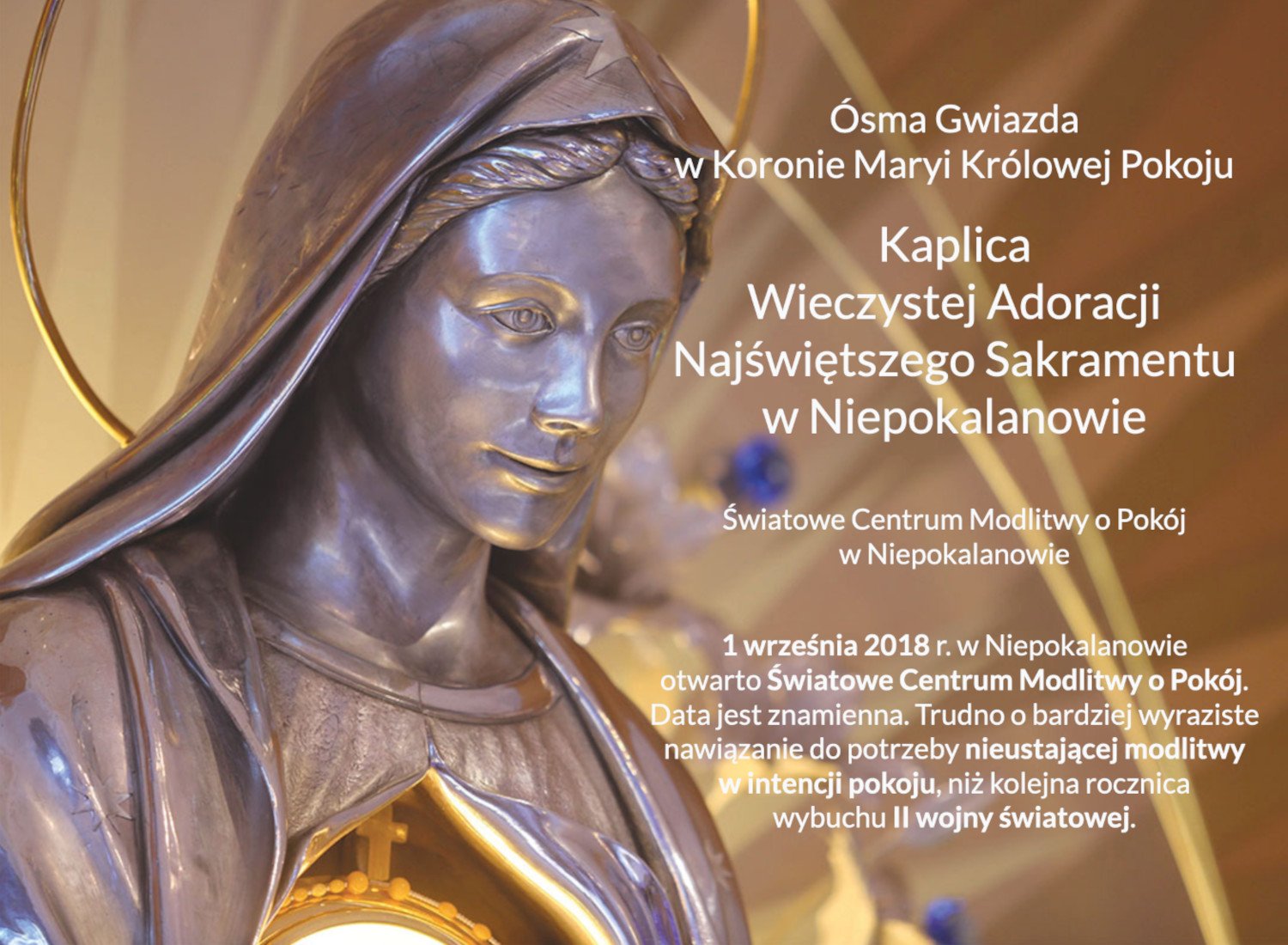

The Eucharistic Adoration Chapel established by Saint Maximilian Kolbe was inaugurated at the outbreak of World War II. It was restored as a Chapel of Adoration in September, 2018, the commemoration of the date that the war began. It is now part of the World Center of Prayer for Peace. The live internet feed of the Adoration Chapel at Niepokalanow — sponsored by EWTN — was established just a few weeks before we discovered it and began to include in at Beyond These Stone Walls. Click “Watch on YouTube” in the lower left corner to see how many people around the world are present there with you. The number appears below the symbol for EWTN.
Click or tap here to proceed to the Adoration Chapel.
The following is a translation from the Polish in the image above: “Eighth Star in the Crown of Mary Queen of Peace” “Chapel of Perpetual Adoration of the Blessed Sacrament at Niepokalanow. World Center of Prayer for Peace.” “On September 1, 2018, the World Center of Prayer for Peace in Niepokalanow was opened. It would be difficult to find a more expressive reference to the need for constant prayer for peace than the anniversary of the outbreak of World War II.”
For the Catholic theology behind this image, visit my post, “The Ark of the Covenant and the Mother of God.”