“There are few authentic prophetic voices among us, guiding truth-seekers along the right path. Among them is Fr. Gordon MacRae, a mighty voice in the prison tradition of John the Baptist, Maximilian Kolbe, Alfred Delp, SJ, and Dietrich Bonhoeffer.”
— Deacon David Jones
The Higgs Boson God Particle: All Things Visible and Invisible
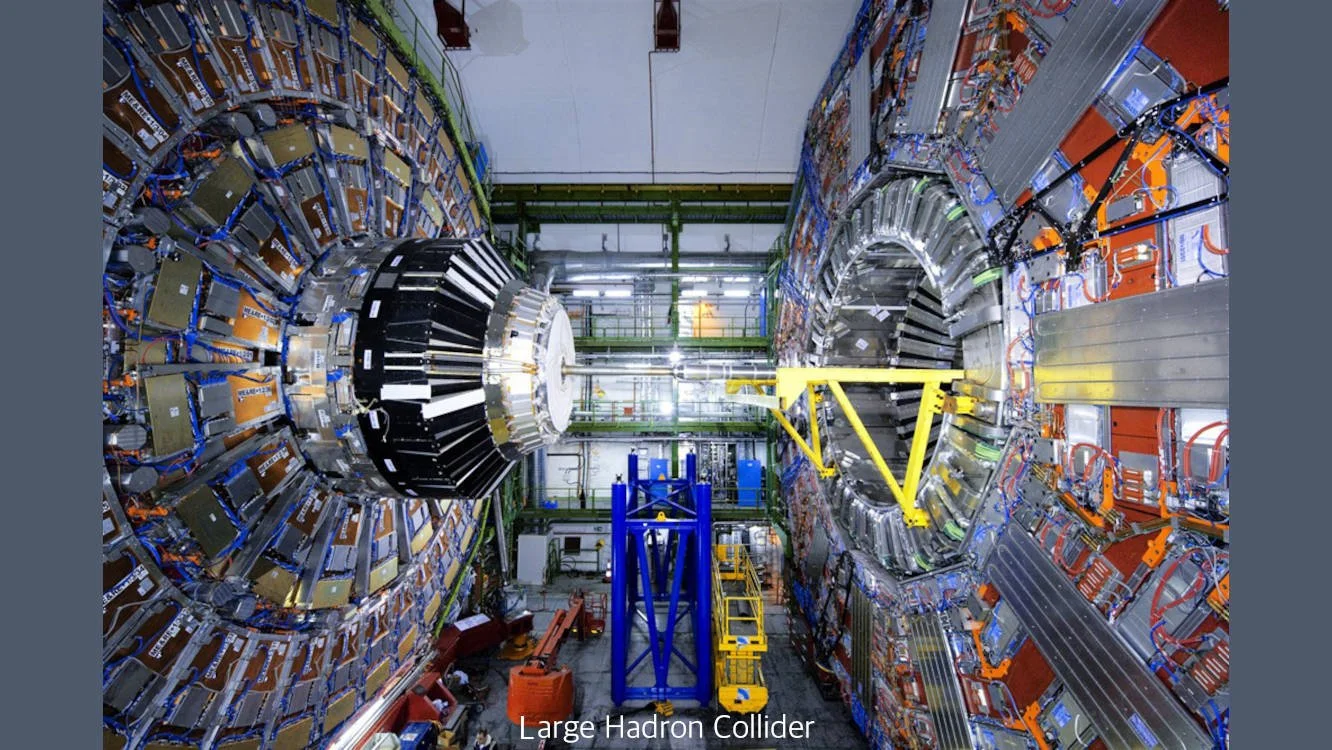
In 2012, scientists at the Large Hadron Collider detected the elusive Higgs boson, a subatomic particle dubbed the “God Particle” explaining the origin of matter.
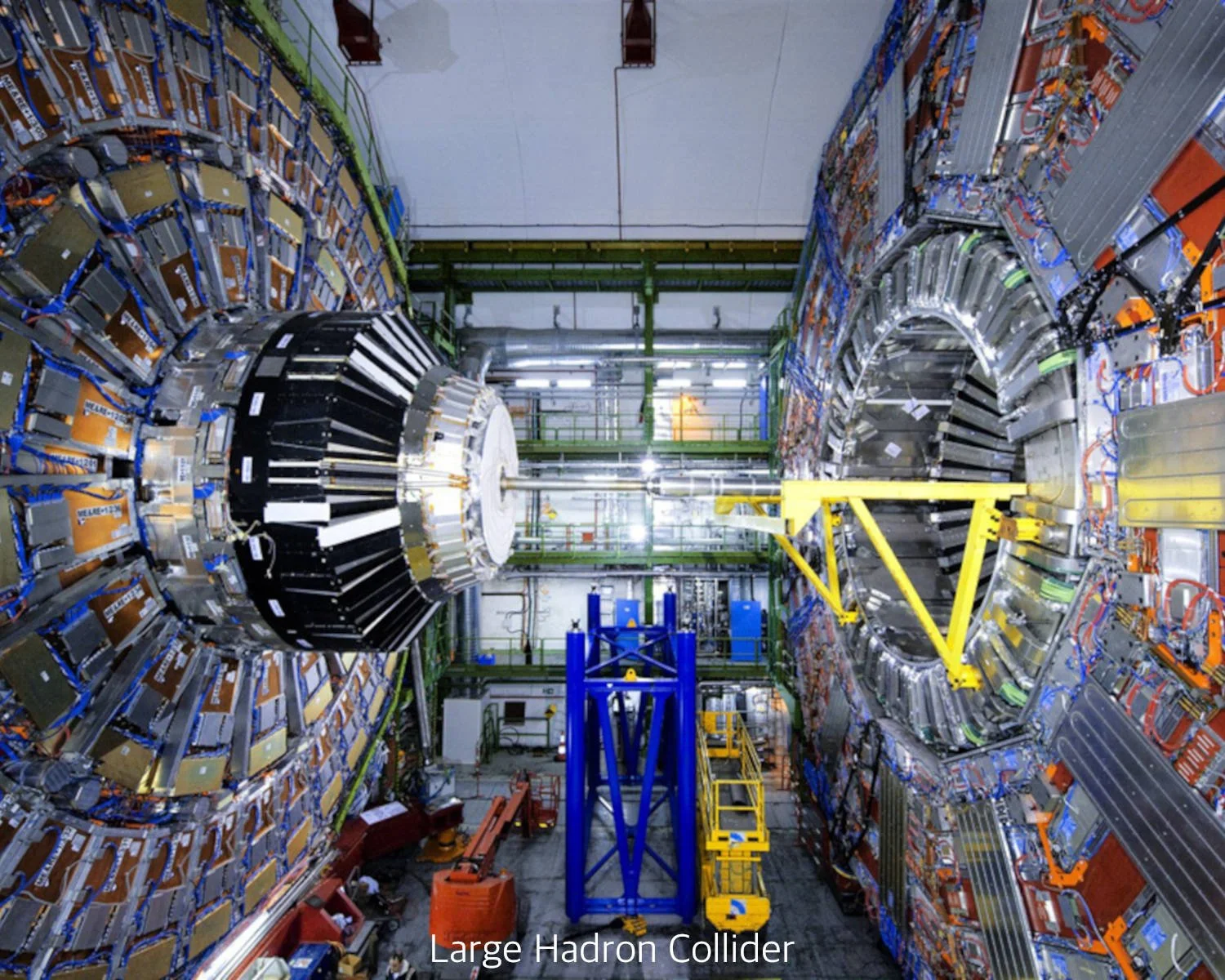
In 2012, scientists at the Large Hadron Collider detected the elusive Higgs boson, a subatomic particle dubbed the “God Particle” explaining the origin of matter.
February 4, 2026 by Father Gordon MacRae
“Two Higgs boson particles walked into a bar. Over drinks one said, ‘I hear Stephen Hawking bet $100 that we don’t exist. What if he’s right?’ The other replied, ‘No matter!’ ”
Get it? No matter? Get it? Well, hopefully you will in a few minutes. I didn’t get it either until I did some heavy-duty reading.
If this post is creating a touch of déjà vu, a sense that you have seen it before, it’s because you probably have. Something quite unusual happened here at this blog in recent weeks. In the earliest days of this blog in 2010, I was contacted by a reader in Australia about a new book by physicists Stephen Hawking and Leonard Mlodinow entitled The Grand Design (Bantam Books, 2010). The letter writer was concerned that media outlets in Australia and around the world were citing aspects of the book out of context in an attempt to demonstrate that Stephen Hawking declared that God does not exist. That was a faulty interpretation and the reader wanted me to set the record straight. It was a tall order, but I had time on my side to ponder and present a contrary point of view. So on October 6, 2010, we published “Did Stephen Hawking Sacrifice God on the Altar of Science?”
A lot of work went into that post, but to my chagrin it was met by most of our readers with a yawn the size of a giant black hole. Fifteen years later, someone (not me) submitted that post to an advanced artificial intelligence model requesting an analysis of it. The results were then read to me by our Editor. AI scoured the Internet and then referred to me as “a Catholic priest with a background in science” while singling out that post as “a significant example of bridging the gap between science and faith.”
So of course, I thought that was the nicest thing any AI had ever said about me (There was very little to compare it to.). Given this new interest in a bridge between science and faith, I decided to haul out this 15-year-old post and rehabilitate it for a new audience. On July 30, 2025, we republished “Did Stephen Hawking Sacrifice God on the Altar of Science?” The result was mind boggling, but it was not immediate. A few months later that post started showing up in our stats and then it began a viral spread. By January it was outpacing my regular weekly posts in popularity. And then by mid-January it spread all over the world in unprecedented numbers for this blog.
I cannot pretend to know why this happened. I do not understand the global attention to this one post on the space-time continuum. Perhaps my only conclusion is that when I post a bomb, just wait 15 years and post it again.
The Discovery
There is another post of mine that also bridges the gap between science and faith. I do not have an explanation for why or how, but another of my posts, this one from 2012, also began to show up in unusually large numbers with that other post. I have long wanted to repost this one with some updated information so that those who are currently reading and spreading it can see the updated version. It is “The Higgs Boson God Particle: All Things Visible and Invisible.”
I first wrote it in September 2012. It, too, was met with a rather extended yawn, but today it shows up often and everywhere. It profiles the work of the late physicist Peter Higgs who rose to prominence in the scientific community in 1964 when he theorized that the Higgs boson exists as a necessary subatomic particle which explains the existence of matter. After my post was first published, the Higgs boson was experimentally demonstrated again and Peter Higgs was awarded the Nobel Prize in Physics. He died on April 8, 2024 at the age of 94 knowing that his life’s work was a major addition to the scientific understanding of the Universe.
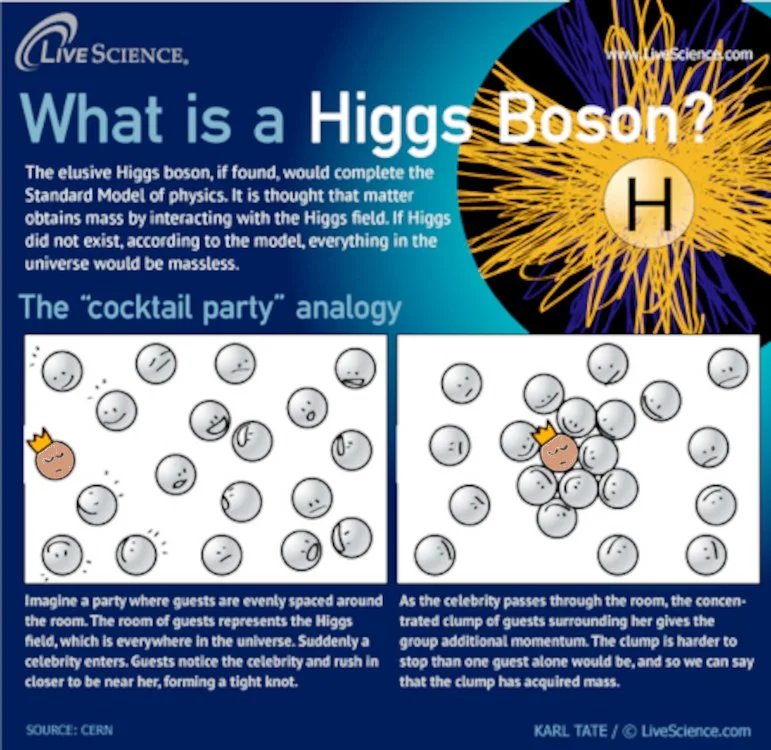
A boson in physics is a component of subatomic particles such as protons and photons, which exist in every atom of matter. As a class of particle, a boson is so-called in honor of Indian physicist, Satyenda Nath Bose, who collaborated with Albert Einstein. The existence of a then-theoretical Higgs boson resolved a puzzle in the Standard Model of physics, a widely accepted model for how particles interact. The thinking in the Standard Model was that particles such as photons — particles of light — have no mass. They should move throughout the Universe unhindered. The mathematics of the Standard Model explained successfully the existence of particles, but not mass or matter. The Higgs boson proposed by Peter Higgs in 1964 was an explanation for how particles could attain mass, and thus bring into being a Universe filled with matter that we can see or otherwise detect.
CERN, the European agency for nuclear research, operates and oversees the Large Hadron Collider. It is a donut-shaped laboratory 27-miles in circumference on the French-Swiss border. Two beams of protons were set on a collision course moving at close to the speed of light. Their collision resulted in an explosion that recreated the conditions of The Big Bang, the scientifically accepted origin of our Universe. During the collision, a supercomputer detected the presence of the Higgs boson particle and a Higgs field for a trillionth of a second. It was the first time its existence had ever been established in a laboratory
On July fourth in 2012, physicists announced that they had a momentary glimpse of the elusive Higgs boson, the subatomic particle long theorized to exist, and without which matter itself would not exist. The physicists who reported that they only found “evidence” of the Higgs boson were just being careful scientists. The discovery had a 99.9999% rate of certainty. There is no doubt left. The Higgs boson does indeed exist and that experiment has since been ratified.
So what exactly does this mean? Many scientists grimaced every time someone in the news media referred to this discovery as “the God particle.” Using science out of context to debunk religious faith is a favorite pastime of some in the media, but the reverse should also not happen.
I took a hard look at the interaction between faith and science in “Did Stephen Hawking Sacrifice God on the Altar of Science?” After publication of The Grand Design, some in the news media speculated that Hawking’s book demonstrated that gravity — and not God — is responsible for the creation of the Universe. My conclusion was simply that Stephen Hawking has thrown in with the wrong “G,” and the pundits misreading his book have confused the tools of God with God. I cited in that post a vivid example. If you were an archeologist digging in ruins in Florence, Italy and you discovered a worn chisel that was used by Michelangelo to create the Pietà, one of the most celebrated examples of sculptured marble in art history, would you then conclude that Michelangelo did not create the Pietà, his chisel did?
What I find most interesting about the recent discovery is that the Higgs boson appears nowhere in Stephen Hawking’s The Grand Design. His analysis of the science of cosmology omitted it entirely. In fact, two decades ago Stephen Hawking wagered $100 that the Higgs boson would never be detected. He lost the bet.
The discovery of the Higgs boson is a big deal in science because it presents a purely scientific explanation for how matter exists, but not why. The model for creation it implies is that a primordial atom exploded in what we call The Big Bang 13.7 billion years ago. As the explosion cooled, a force known as a “Higgs field” — which contained the Higgs boson — was formed and permeates the Universe. As other particles interacted with this field, they acquired mass allowing gravity to bring particles together. It acted sort of like a dam slowing particles so that they would mass together. The result was matter as we know and see it — everything from stars to us. It’s sort of the yeast with which God bakes bread.
A Day Without Yesterday
The Higgs boson was detected by the Large Hadron Collider’s super computers in July 2012 for a fraction of a trillionth of a second. The tiny collision sent particles in every direction producing the energy equivalent to 14 trillion electron volts and blistering temperatures. The collision recreated a tiny model of the instance of The Big Bang. Some theorize that it was the presence of the Higgs boson particle within the primordial atom that caused The Big Bang itself, and the explosion of all matter in the Universe.
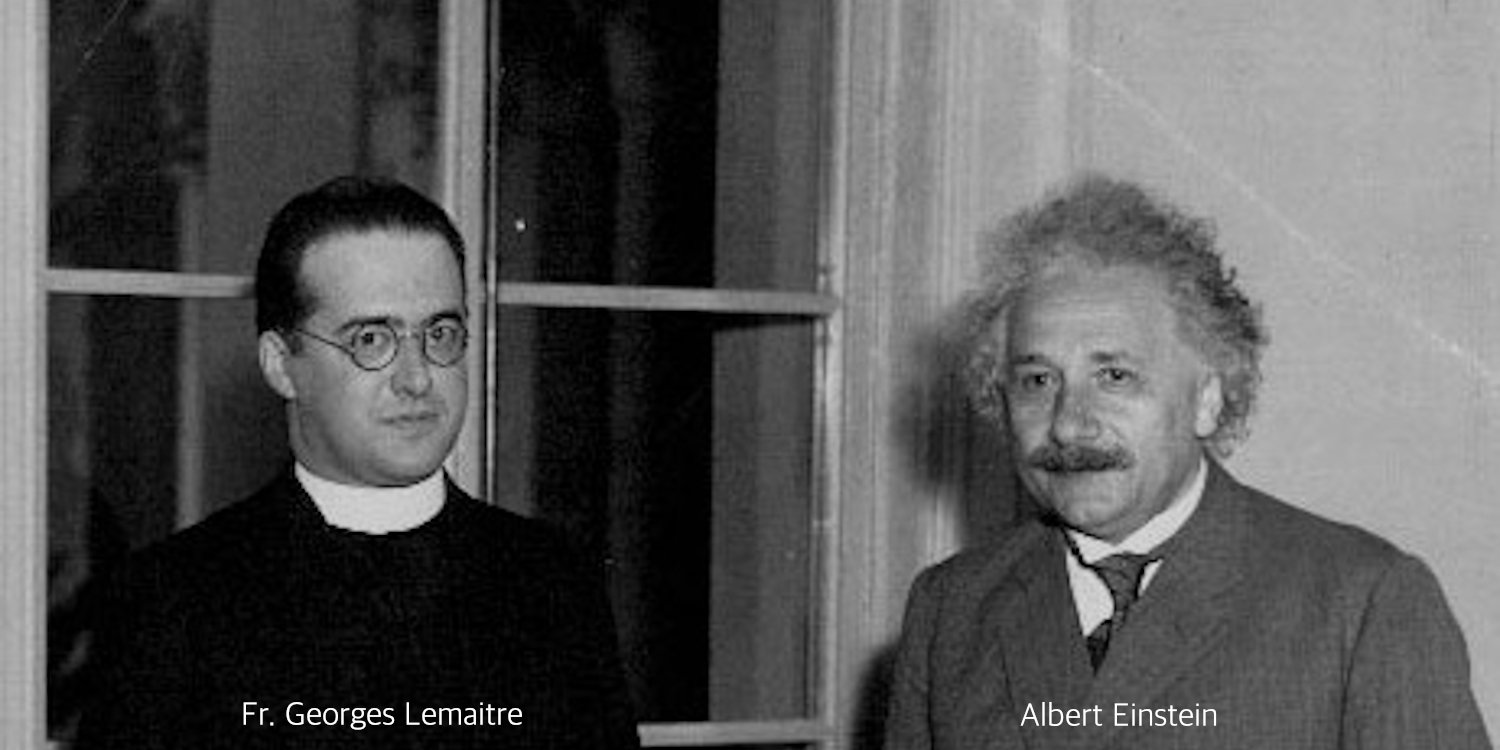
I find this all fascinating, but what is most fascinating is that the entire model was first mathematically predicted, and then demonstrated to even Albert Einstein’s satisfaction, by a Catholic priest. I wrote of the Belgian priest and physicist, Father Georges Lemaitre, in “A Day Without Yesterday:” Father Georges Lemaitre and the Big Bang. As a result of that post and others related to it, I began a correspondence with Father Andrew Pinsent, who prior to priesthood had been a physicist at CERN. We collaborated on a very special post, “Fr Georges Lemaître, the Priest Who Discovered the Big Bang.”
If ever you bristle about the typical anti-Catholic mythology that religion attempts to hold back science, remember that the originator of all the science behind this model of creation was a Catholic priest, and many of the great scientists of his time did everything they could to suppress his ideas. They failed because they could not successfully refute either his faith or his science. In the end, even Einstein bowed to Father Lemaitre, declaring that his model was “the most satisfactory explanation of creation I have ever heard.”
Pope Pius XII applauded Father Lemaitre’s discovery of The Big Bang because it challenged the acceptable science of the time which claimed that the Universe was not created, but always existed and is eternal. Einstein later acknowledged that his “Cosmological Constant” was his greatest error.
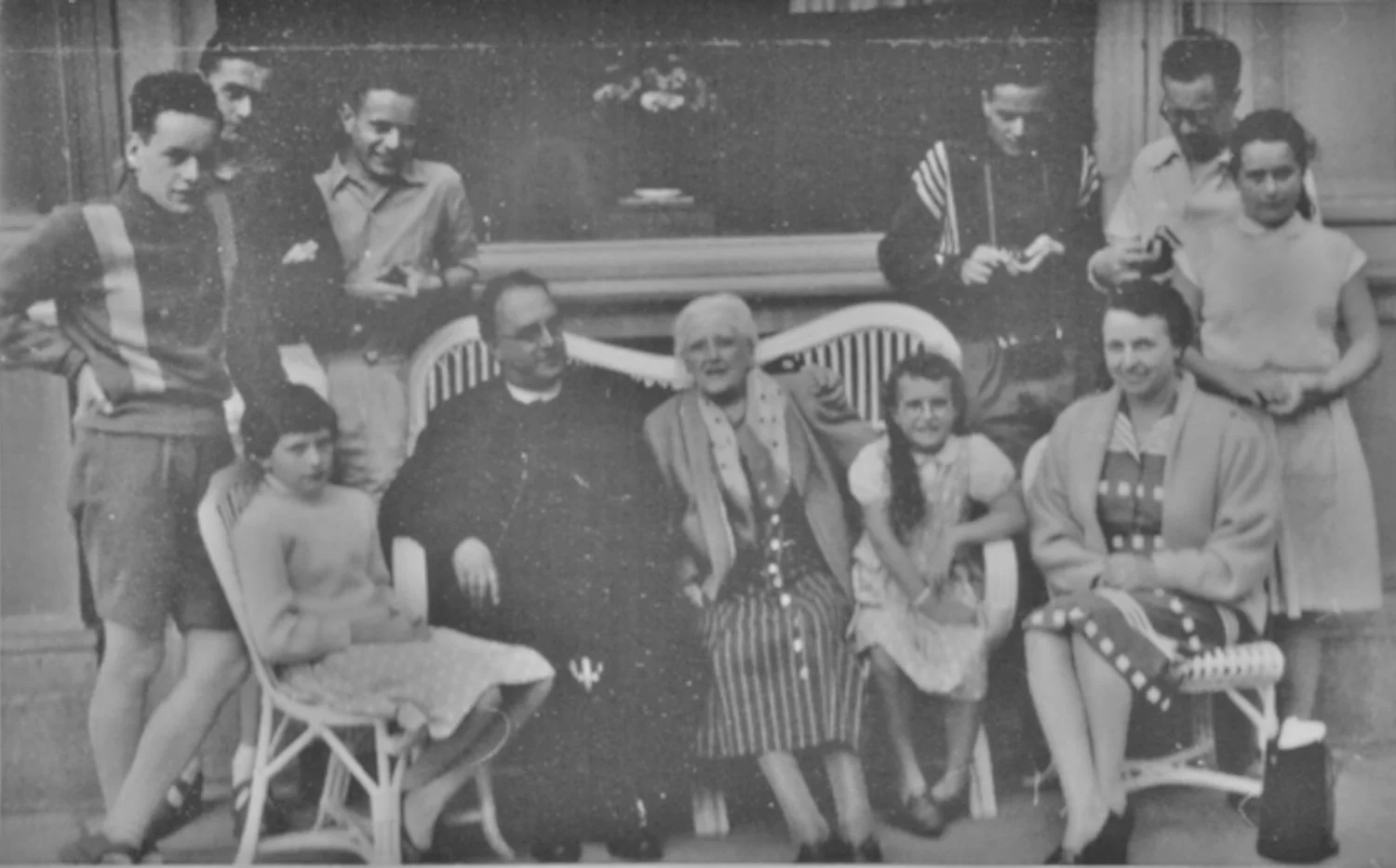
Perhaps the greatest miracle of all for me was receiving the photo below of Pornchai Moontri’s Godfather, the late Pierre Matthews, whose mother was a close friend of Father Lemaitre, who became Pierre’s Godfather. The odds that my roommate in Concord, New Hampshire would turn out to be the Godson of a man whose own Godfather discovered the Big Bang are as great as the odds of the Big Bang itself.
Michio Kaku, a professor of theoretical physics at City University of New York, wrote a brilliant and (unlike this post) brief commentary about the Higgs boson for The Wall Street Journal (“The Spark That Caused the Big Bang,” July 6, 2012). Professor Kaku wrote:
“The press has dubbed the Higgs boson the ‘God particle,’ a nickname that makes many physicists cringe. But there is some logic to it. According to the Bible, God set the Universe in motion as He proclaimed ‘Let there be light.’”
“So why did the Higgs boson particles hurry to church?
Because Mass could not start without them.”
+ + +
Note from Fr. Gordon MacRae: For open minds and enlightened souls bridges are taking shape between the realms of science and faith. You may also like these related posts from Beyond These Stone Walls:
Did Stephen Hawking Sacrifice God on the Altar of Science?
Fr Georges Lemaître, the Priest Who Discovered the Big Bang (a must-read by Father Andrew Pinsent)
The James Webb Space Telescope and an Encore from Hubble
For Those Who Look at the Stars and See Only Stars
+ + +
And then there was this: xAI Grok on Higgs Boson, God Particle, Science and Faith.

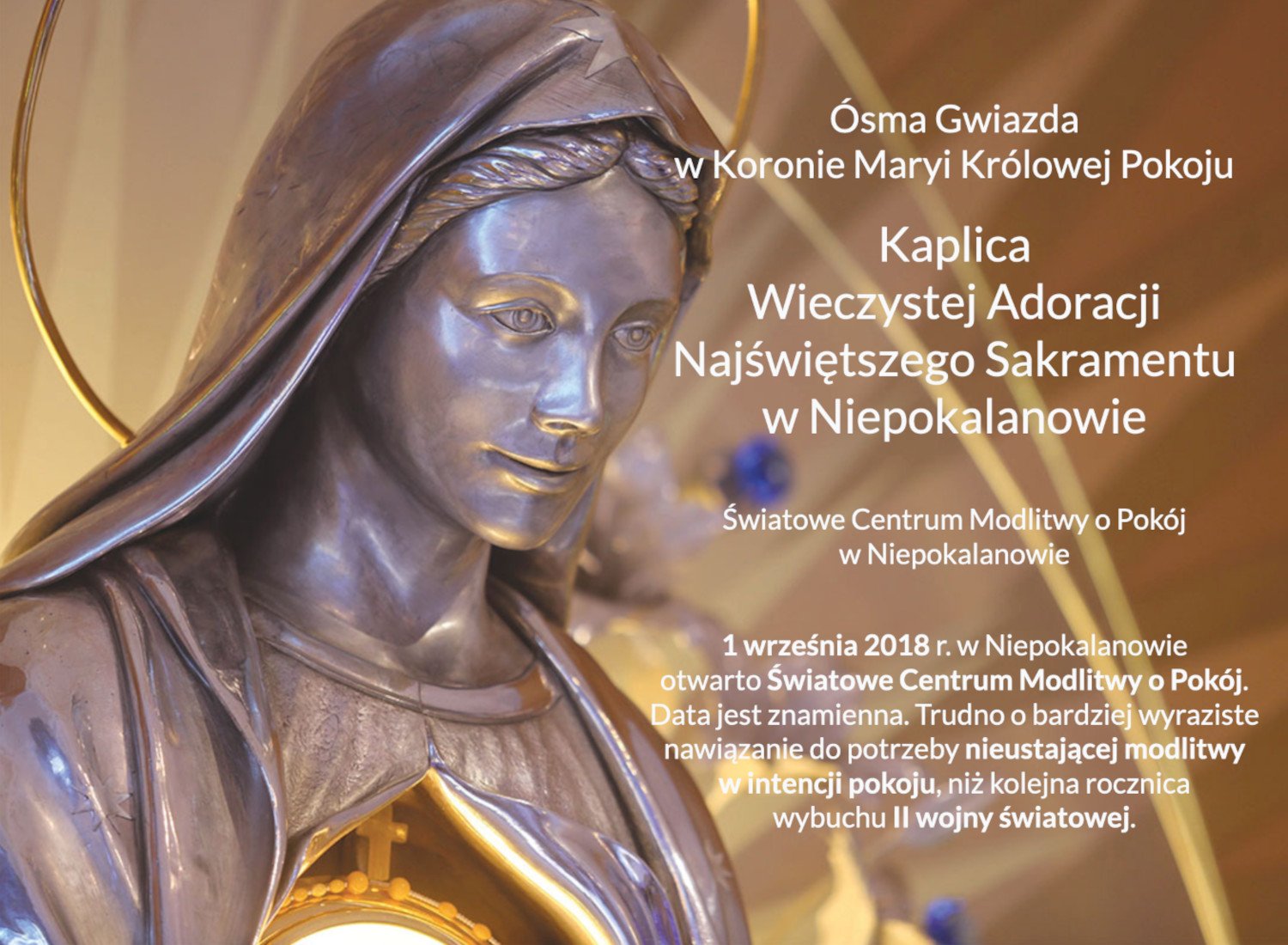

The Eucharistic Adoration Chapel established by Saint Maximilian Kolbe was inaugurated at the outbreak of World War II. It was restored as a Chapel of Adoration in September, 2018, the commemoration of the date that the war began. It is now part of the World Center of Prayer for Peace. The live internet feed of the Adoration Chapel at Niepokalanow — sponsored by EWTN — was established just a few weeks before we discovered it and began to include in at Beyond These Stone Walls. Click “Watch on YouTube” in the lower left corner to see how many people around the world are present there with you. The number appears below the symbol for EWTN.
Click or tap here to proceed to the Adoration Chapel.
The following is a translation from the Polish in the image above: “Eighth Star in the Crown of Mary Queen of Peace” “Chapel of Perpetual Adoration of the Blessed Sacrament at Niepokalanow. World Center of Prayer for Peace.” “On September 1, 2018, the World Center of Prayer for Peace in Niepokalanow was opened. It would be difficult to find a more expressive reference to the need for constant prayer for peace than the anniversary of the outbreak of World War II.”
For the Catholic theology behind this image, visit my post, “The Ark of the Covenant and the Mother of God.”
Did Stephen Hawking Sacrifice God on the Altar of Science?
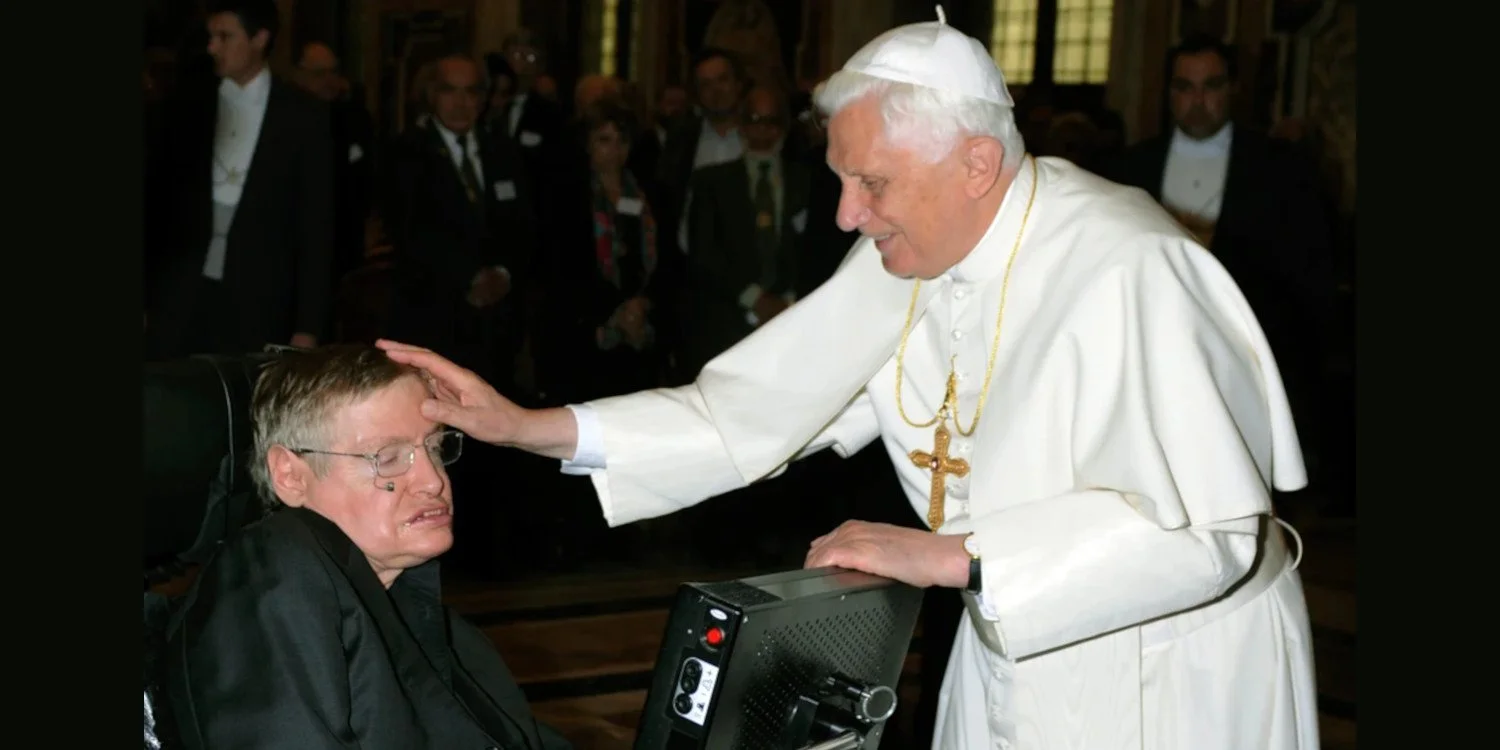
Physicist, Stephen Hawking, died on March 14, 2018. His book, The Grand Design, caused many to believe that he widened the chasm between science and faith.
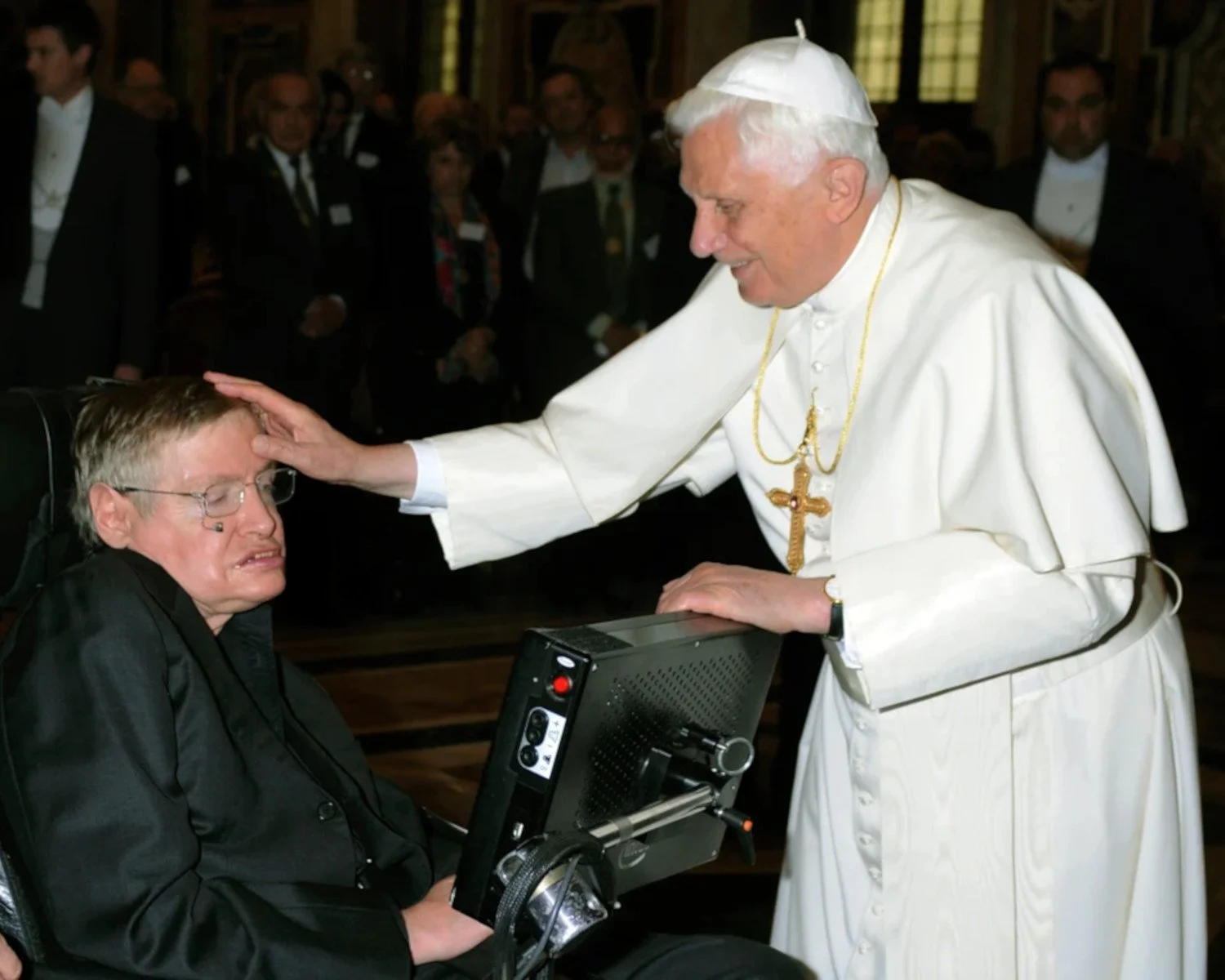
Physicist, Stephen Hawking, died on March 14, 2018. His book, The Grand Design, caused many to believe that he widened the chasm between science and faith.
July 30, 2025 by Father Gordon MacRae
Back in 2010, in the earliest days of this blog, I wrote a post about the late, great physicist, Stephen Hawking. It was among my first posts about the dichotomy between science and faith. A controversial book, The Grand Design, published not long before I wrote about Professor Hawking, caused many to believe that he was an atheist who concluded that there is no reason to believe that God created the Universe or anything else. He attributed all of creation to one overpowering force, gravity. At the time I was pondering a response, I imagined that if I had been on an archeological dig among 15th Century ruins in Rome and found a worn chisel that was known to have belonged to Michelangelo, and used to create the Pieta, what sort of controversy would that entail? Would naysayers suggest that Michelangelo did not thus create the Pieta, his chisel did. That is the simplest response to anyone who used gravity to demonstrate that Stephen Hawking did not believe in God. God created not only the material Universe, but also all the material tools that brought the Universe into being.
Also a few weeks before I first wrote about Hawking, Pope Benedict XVI beatified John Henry Cardinal Newman in Birmingham, England. The Holy Father emphasized Cardinal Newman’s “insights into the relationship between faith and reason,” and commended him for applying “his pen to many of the most pressing subjects of the day.” Without doubt, Cardinal Newman also might have had a pointed response to the media tremors after physicist and author, Stephen Hawking declared that science can explain the creation of the Universe without God.
I mentioned Stephen Hawking in another 2010 post, “A Day Without Yesterday: Father Georges Lemaitre, and The Big Bang.” His declaration about creation came in The Grand Design. Many in the media called it a definitive statement about the existence of God. It was no such thing, but the news media cannot be accused of a lack of trying to diminish the faith of billions.
I cannot claim to have even a fraction of the gifts of faith and reason that Saint John Henry Newman would call upon to respond, but as a priest who respects science, I feel driven to weigh in. First, I have to confess that I had not by then read The Grand Design, but I eventually did. However, in a full-page article in The Wall Street Journal in 2010, Stephen Hawking and Leonard Mlodinow laid out the cosmology behind the book and their conclusions (“Why God Did Not Create the Universe,” September 4-5, 2010).
It is to that article that I here respond. If you have a concern for the implications of Professor Hawking’s pronouncement that God had nothing to do with bringing you and your world into being, please read on. There is a lot at stake here. I will address this from two points of view.
My Response as a Priest
Like Father Georges Lemaitre and Saint John Henry Newman, my response is first and foremost that of a Catholic priest. I have known many priests who have struggled with faith and some who have lost their faith. I correspond regularly with a priest who lost his faith years ago. Now this declaration by Stephen Hawking feels like a nail in faith’s coffin for him. I have lived 72 years of struggle over the question of God. I have arrived — in spite of toil, trial and tribulation, and more than my share of each — at what I think is a more than tepid faith in God’s existence and in His Grand Design. I believe in His creation of our existence. I believe in His enduring and caring Presence in this life and the promised life to come. I believe that our relationship with Him can survive this life if we walk the path He has shown to us. I wrote about that path in a recent post, “What Shall I Do to Inherit Eternal Life?”
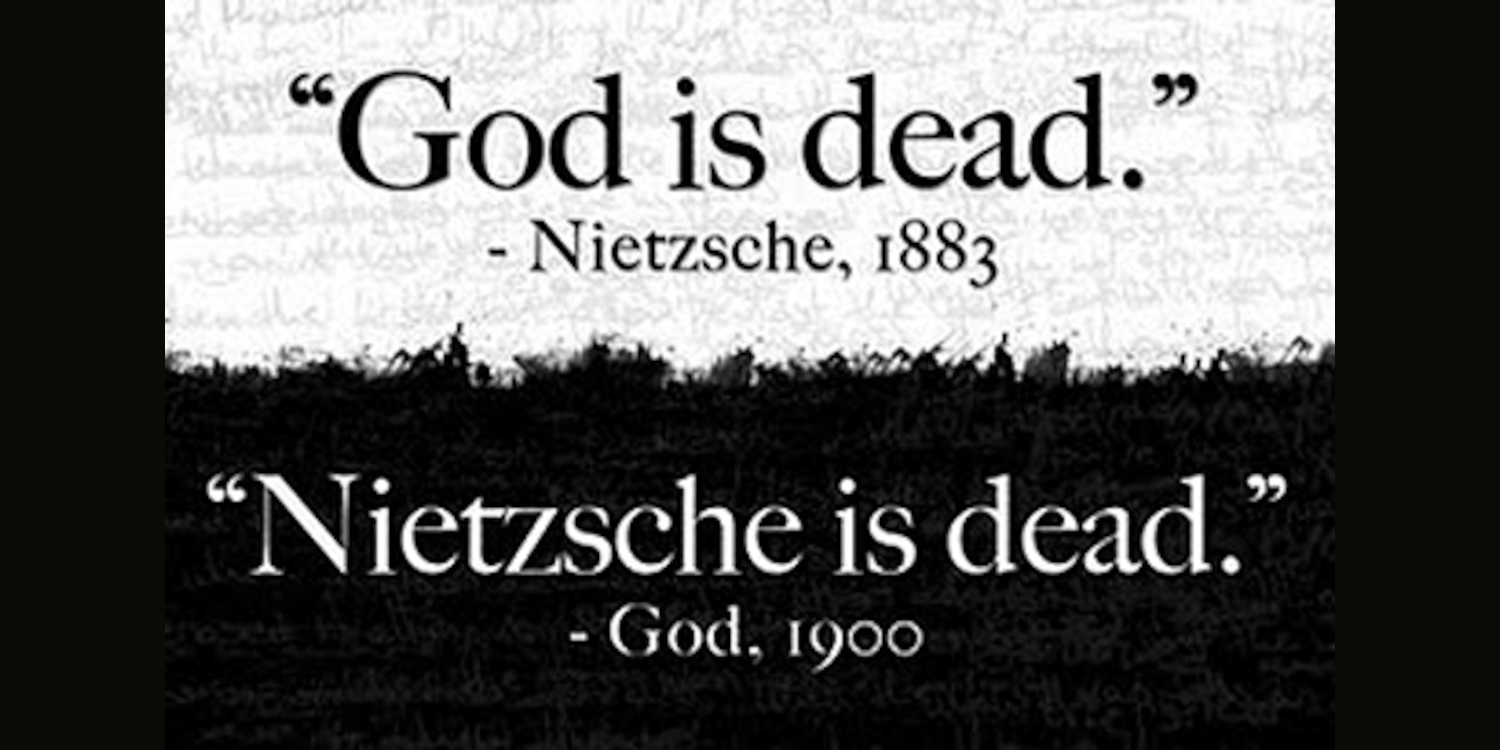
I have read nothing in any of Stephen Hawking’s writings that causes me to wonder whether my faith conclusions are valid. I write as a priest and believer. My faith and my priesthood both came into being in a time of great social upheaval. The existential philosopher, Frederick Nietzsche (1844-1900) seemed to rule the reasoning — or lack thereof — of the 1960s. His contempt for Judaism and Christianity, and his cynical view that mankind is but a herd at the mercy of the ruling and gifted intellectual elite, marked the dawn of the “God is Dead” movement. The bumper stickers were everywhere:
“GOD IS DEAD!” Nietzsche
In the 1970s, that sorry and narcissistic wave began to dissipate, but not before destroying the faith of many who bought into it. I remember buying a bumper sticker for my seminary room door in 1978:
“NIETZSCHE IS DEAD!” God
The three masters of deceit — Freud, Marx, and Nietzsche — are all dead and not only their persons but their ideologies as well. Each reduced man to his basest, soul-less drives, and each in his own way was an enemy of faith. I do not count Stephen Hawking among them. Contrary to what the news media was lifting out of his latest book — and out of context — Stephen Hawking did not denounce God, nor does he claim to have proven that God does not exist. The exact quote that so many in the media now read into from his WSJ article cited above, and from his book is this:
“The discovery recently of extreme fine-tuning of so many laws of nature could lead some back to the idea that the grand design is the work of some grand Designer. Yet the latest advances in cosmology explain why the laws of the universe seem tailor-made for humans, without the need for a benevolent creator.”
But who would then explain the identity of the Tailor? This comes as no great revelation. One might expect that I, as a priest, would proclaim that the Universe was brought into being and maintained, at least in part for our benefit, by a Divine Creator whose title is also His name: God. But did anyone really expect Stephen Hawking, or any cosmologist to make the same declaration? What Professor Hawking has written is neither new nor surprising in cosmology. I do not, and will never have a faith that depends on science to finally and definitively weigh in on God’s existence and creation of the Universe. Science should never be able to do this to the satisfaction of any person of faith. To say that science can explain creation without God is not to say that God did not create everything — including the science and scientists trying to nudge Him from center stage. Faith is far more than the dictates of reason and the pronouncements of science. Our tradition of faith does not reduce God to His quantum mechanics, and does not promise to teach all there is to know about the created Universe or the laws of physics.
Our faith promises that we can know God through Christ in a personal relationship without fully explaining God. Who in this world can claim to fully comprehend God? Certainly not I. Faith is not an event, and science does not make or break it. Faith is a pilgrimage, and like any pilgrimage, most of us will have times of wandering, and wondering whether we will ever arrive, whether we will ever get to the point at which there are no doubts. That is the point of faith. It is its own evidence.
“Faith is the assurance of things hoped for; the conviction of things unseen”
— Hebrews 11:1
Faith at some point involves an assent of the intellect (Catechism of the Catholic Church, 155) to the revealed truth about God Himself. Central to that truth is the redemption offered to us through Christ who not only reveals God to man, but “fully reveals man to himself” (Gaudium et Spes, 22). None of us looks to Stephen Hawking, or to science, to reveal the truth about God. Faith in God and His creation can no more be subjected to the scientific method than science can legitimately be subjected and defined in the light of faith. Who among us, when faced with life’s inevitable crises, ever cried out to Stephen Hawking for mercy or for redemption?
The greatest physicist of the 20th Century, Albert Einstein, never pondered God until his discussions with fellow physicist Father Georges Lemaitre. When those discussions proved to Einstein that the Universe came into being at a specific point some 13.2 Billion years earlier, Einstein responded, “I want to know God’s thoughts. The rest are just details.”
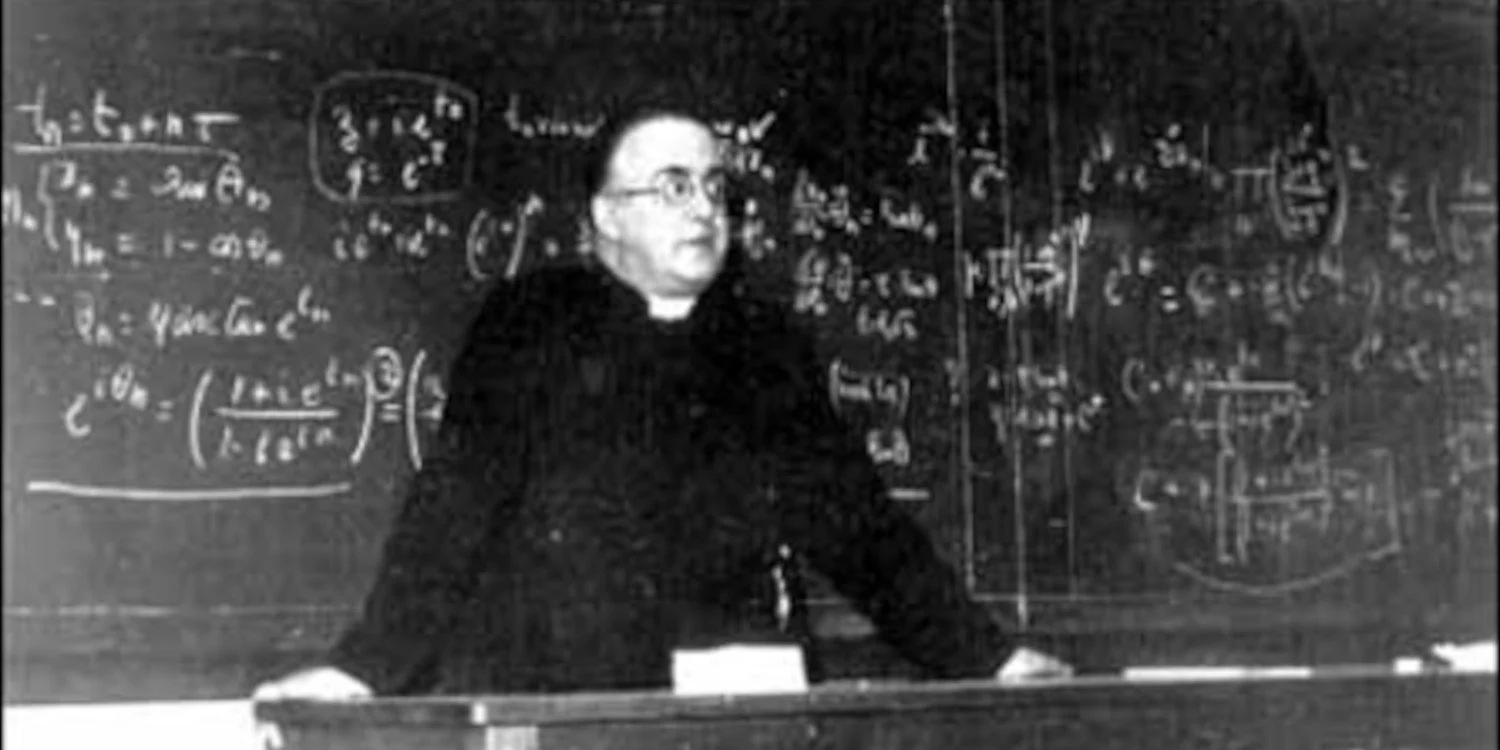
My Response as a Student of Science
I write secondly with a lifelong respect for science as a tool, not for understanding God, but for understanding the mechanics of the Universe in which we exist. This has been not so much a journey of the mind, but of the heart and soul. I at one time thought quantum mechanics referred to guys who worked on Volkswagen Beetles. To my great fortune, my mind has expanded a bit since then.
I have several times written of one of my heroes on the parallel journeys of both science and faith. One of these posts, “A Day Without Yesterday” is the story of priest, mathematician and physicist, Father Georges Lemaitre, the originator of the Big Bang explanation of cosmology and the man who changed the mind of Albert Einstein on the origin of this created Universe.
A French publication, Les Dossiers De La Recherche (No. 35, May 2009) had an interesting article entitled “Le Big Bang Histoire: De La Science A La Religion” (“The History of the Big Bang: From Science to Religion”). I am grateful to my Belgian friend, Pierre Matthews (who is also the Godfather of Pornchai Moontri). Pierre and his family knew Father Georges Lemaitre well and they translated into English this portion of the article cited above in French:
“Pope Pius XII, an enthusiastic amateur astronomer, addressed the Pontifical Academy of Sciences in 1951. His talk dealt with recent findings in cosmology stating: ‘It appears truly that today’s science going back millions of centuries has succeeded to witness the initial ‘fiat lux’ [Let there be light], coming out of nothing, that very moment of matter and ocean of light and rays, while the chemical components of particles split and assembled into millions of galaxies.’
“Pope Pius XII referred openly to Fr. Georges Lemaitre’s scenario. But this ‘concordism’ assumed to exist between revealed truth and science is counter-publicity for those, among them Fr. Georges Lemaitre, wanting a total and independent separation of the history of the Universe, evolution, and religious truth.
“Following a meeting with Fr. Lemaitre, Pope Pius XII a year later rejected, before the General Council of the International Astronomical Federation, any concordance between the two fields: science and faith. For Father Lemaitre, this was a double victory: cosmology can develop in total freedom and religion should no longer fear contrary positions based on new scientific discoveries.”
Why was Father Georges Lemaitre so insistent that the Pope should declare no concordance between faith and science? The obvious reason is that, for Father Lemaitre — a man of deep faith and a brilliant physicist and cosmologist — faith and science are parallel fields and should never limit each other. The Church suffered a black eye for its condemnation of Galileo’s views about science four centuries ago, but science has often seemed utterly ridiculous for holding the Church in contempt for not responding to science in 1660 as it would in 2025.
In 2005, noted science writer, Chet Raymo wrote a blog post entitled “The Future of Catholicism” on his Science Musings blog (April 10, 2005). Raymo wrote:
“In spite of the pope’s outreach to the scientific community, the Church has been slow to understand the theological implications of the scientific world view. The Church’s truce with modern cosmology and biology is uneasy at best, although certainly more enlightened than the outright rejection by fundamentalist faiths.”
Chet Raymo was right, but in a limited way. He very much understated the appreciation for scientific achievement demonstrated by the Church in the last century. We can expect this to improve greatly during the pontificate of Pope Leo XIV whose own education includes a degree in Mathematics, which leaves him well disposed to the work of Fr. George Lemaitre.
I had a brief discussion about this some years ago with a fundamentalist Evangelical pastor I know. He is an educated man, a university graduate, and well read but only very narrowly so. I asked for his opinion of what I have written above about Stephen Hawking’s views.
His response came as no surprise, and it was little different from what we might have heard from one of the Calvinist Puritan founders of New England in 1620. His view was an utter rejection of science. “The Universe was created by God in six days about 6,000 years ago. There is no such thing as poetic and metaphorical language in Scripture.” I asked him how he would explain the discoveries of bones that are many tens of millions of years old, or the fact that we can see galaxies that are millions of light years away. His answer was to simply ignore the questions. Of course, this man also believes that the Catholic Church is the anti-Christ, the “Whore of Babylon.” He believes it is not only science that is condemned, but the Catholic Church as well, and he would cite the Church’s nod to science as evidence for that view.
Science is the empirical examination of the physical Universe. Gone are the dark days in which science and religious dogma demanded conformity one with the other. There are legitimate forums for dialogue, however. It is more than ironic that Stephen Hawking was a lifetime member of the Pontifical Academy of Science. There were calls for him to resign after he wrote The Grand Design, but I believed then that he should retain his position. Dialog should not require conformity, and the Church should not be daunted by diverse scientific views.
Using Father Georges Lemaitre’s model, Stephen Hawking should no more publicly weigh the legitimacy of Judeo-Christian belief in Creation as a design plan of God than the Pope should affirm or deny black holes. My concern for the controversy surrounding Stephen Hawking’s 2010 book is not that it encourages masses of believers to set aside their Catholic faith, as Chet Raymo declared to have done, but that it may have the effect of encouraging some Christians, Catholics among them, to set aside science. Either approach would be tragic.
Professor Hawking’s foray into the realm of faith does not change the way I perceive God. The very fact that I perceive God at all is its own evidence, “the conviction of things unseen,” (Hebrews 11:1). What it does change is my respect for the strides taken by science to speak also to the masses of people who are not scientists, but are people of faith open to science. There is a danger that science is gradually placing itself outside the experience of the great majority of people while claiming to enlighten its own elite. In this, there is a growing rift between science and the reality experienced by billions of people of faith.
The late Stephen Hawking’s view was in danger of sparking a return to the bad old days of Nietzsche, this time by the establishment of the “uber-scientist” for whom masses of faithful believers are but an ignorant herd. It is science, and not faith, that faces the greatest harm. Stephen Hawking presented that the laws of gravity, and not God, created the Universe we live in. I am not prepared to rewrite Scripture. It is not the experience of thousands of years of belief that “In the beginning, Gravity created the heavens and the earth.”
I have a response as a prisoner, too. I certainly believe in gravity, but there’s precious little solace in it, and it speaks nothing to the reality of my soul. Sorry, Professor. I respect your cosmology greatly, but I think you should not have thrown in with the wrong “G!”
I still like you, though, and I believe God does, too. He has inspired me to pray for you.
+ + +
Note from Father Gordon MacRae: Thank you for reading and sharing this post. Sharing is important to place these pages before believers who may benefit from them. For 15 years we shared posts at various Catholic groups on Facebook. A few months ago Facebook called my posts “spam” and froze our account. I can no longer share there, but you can, and I thank you if you do so.
You may also like these related posts from Beyond These Stone Walls:
“A Day Without Yesterday:” Father Georges Lemaitre and The Big Bang
Science and Faith and the Big Bang Theory of Creation
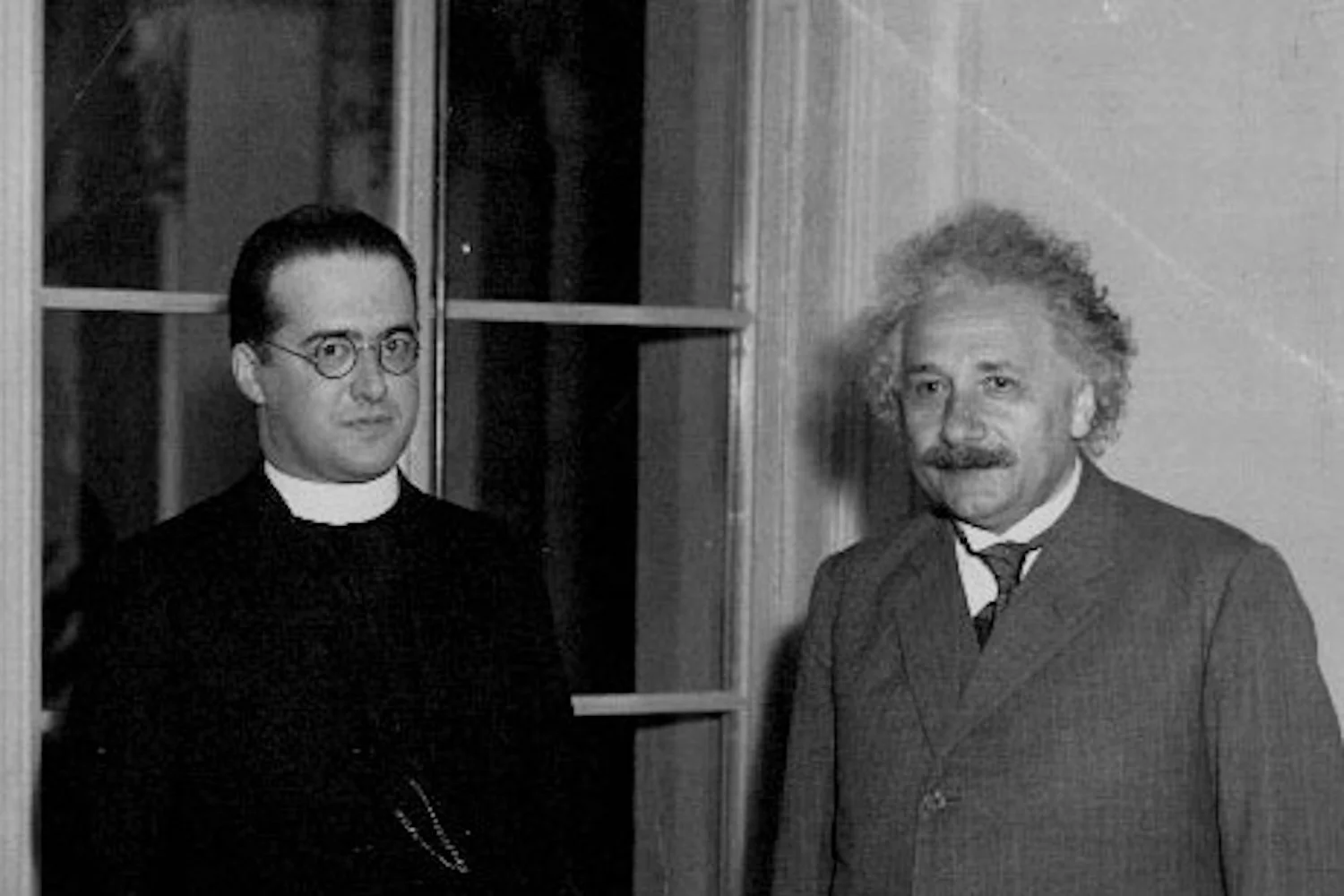
Albert Einstein and Fr. George Lemaitre at the California Institute of Technology in 1930.
"I want to know God' thoughts. The rest are just details." -- Albert Einstein
The Eucharistic Adoration Chapel established by Saint Maximilian Kolbe was inaugurated at the outbreak of World War II. It was restored as a Chapel of Adoration in September, 2018, the commemoration of the date that the war began. It is now part of the World Center of Prayer for Peace. The live internet feed of the Adoration Chapel at Niepokalanow — sponsored by EWTN — was established just a few weeks before we discovered it and began to include in at Beyond These Stone Walls. Click “Watch on YouTube” in the lower left corner to see how many people around the world are present there with you. The number appears below the symbol for EWTN.
Click or tap here to proceed to the Adoration Chapel.
The following is a translation from the Polish in the image above: “Eighth Star in the Crown of Mary Queen of Peace” “Chapel of Perpetual Adoration of the Blessed Sacrament at Niepokalanow. World Center of Prayer for Peace.” “On September 1, 2018, the World Center of Prayer for Peace in Niepokalanow was opened. It would be difficult to find a more expressive reference to the need for constant prayer for peace than the anniversary of the outbreak of World War II.”
For the Catholic theology behind this image, visit my post, “The Ark of the Covenant and the Mother of God.”