“There are few authentic prophetic voices among us, guiding truth-seekers along the right path. Among them is Fr. Gordon MacRae, a mighty voice in the prison tradition of John the Baptist, Maximilian Kolbe, Alfred Delp, SJ, and Dietrich Bonhoeffer.”
— Deacon David Jones

Judge Joseph Laplante, President Trump, and the Case of Father MacRae
A Federal Judge who defied SCOTUS by blocking President Trump’s Executive Order on birthright citizenship previously blocked hope for Justice for Fr Gordon MacRae.

A Federal Judge who defied SCOTUS by blocking President Trump’s Executive Order on birthright citizenship previously blocked hope for Justice for Fr Gordon MacRae.
August 6, 2025 by xAI Grok 4
Readers may be aware of a recent U.S. Supreme Court decision barring Federal District Court judges from blocking the executive orders of the U.S. President and then applying the block to the entire nation. Shortly after this Supreme Court ruling, Judge Joseph Laplante of the U.S. District Court in New Hampshire proceeded, despite the ruling, to block President Trump’s executive order on birthright citizenship from taking effect.
In the days to follow, many thousands of people in the U.S. and around the world learned that Judge Laplante also presided over the failed habeas corpus petition of Father Gordon MacRae in 2015. This surprising revelation brought over 8,000 new readers to this blog and to a 2016 article by Ryan A. MacDonald, “A Grievous Error in Judge Joseph Laplante’s Court.” An artificial intelligence program then tied the two cases together for an analysis of judicial fairness.
This surprising analysis by xAI Grok 4, the advanced AI program from Elon Musk, took place on August 2, 2025. A priest in North Carolina submitted the query below to the advanced AI model and received a stunning response. We decided to publish the response because we believe it will be of interest to many of the readers of this blog and beyond:
+ + +
GROK:
Ask me anything
QUERY:
Recently the U.S. Supreme Court ruled that U.S. District Court judges cannot issue rulings barring or blocking executive orders of POTUS and then applying the block to the entire country. Shortly after that, U.S. District Judge Joseph Laplante blocked President Trump’s Executive Order on birthright citizenship. This brought a lot of attention to Judge Laplante. The same judge it turns out was accused of mishandling the habeas corpus petition of wrongly imprisoned priest Gordon MacRae. I understand that you have also weighed in on that case. Here is a link to a critical article: “A Grievous Error in Judge Joseph Laplante’s Court.”
GROK:
RECENT SUPREME COURT RULING ON NATIONWIDE INJUNCTIONS
The U.S. Supreme Court did indeed issue a significant ruling on June 27, 2025, in the case of Trump v. CASA, Inc., which substantially limited the ability of federal district courts to issue universal or nationwide injunctions against executive actions.
In a 6-3 decision authored by Justice Amy Coney Barrett, the Court held that district courts generally lack statutory authority under the Judiciary Act of 1789 to enjoin the federal government from enforcing policies on a nationwide basis, emphasizing that such relief should be tailored to the specific plaintiffs unless exceptional circumstances warrant broader application.
The ruling stemmed from challenges to an executive order on immigration-related issues, and it overturned lower court injunctions that applied universally, arguing that they overstep judicial bounds and disrupt executive functions.
However, the decision left room for narrower injunctions or for states as plaintiffs to seek broader relief in certain cases, and it has not entirely eliminated the practice — judges have since found workarounds in some instances.
This ruling builds on prior Supreme Court criticisms of nationwide injunctions (e.g., in cases like Department of Homeland Security v. Regents of the University of California in 2020), but the 2025 decision marks a more definitive restriction, aiming to prevent single judges from halting national policies.
JUDGE LAPLANTE’S BLOCK ON TRUMP’S EXECUTIVE ORDER ON BIRTHRIGHT CITIZENSHIP
Shortly after the Supreme Court’s decision, on July 10, 2025, U.S. District Judge Joseph Laplante (District of New Hampshire) issued a preliminary injunction blocking President Trump’s Executive Order (EO) aimed at limiting birthright citizenship under the 14th Amendment.
The EO, issued in January 2025, sought to deny automatic citizenship to children born in the U.S. to certain non-citizen parents, interpreting the amendment’s “subject to the jurisdiction thereof” clause narrowly.
Laplante’s ruling came in the class-action lawsuit Barbara et al. v. Trump et al., filed by immigrant rights groups, and he certified a nationwide class of affected individuals, effectively halting enforcement across the country — at least temporarily.
This was the third such block since the Supreme Court’s June ruling, with Laplante arguing that a universal injunction was necessary to provide complete relief to the plaintiffs, despite the new limitations.
He paused the order for seven days to allow an emergency appeal, which the Trump administration pursued in the 1st Circuit Court of Appeals.
Critics, including some conservative groups, have highlighted this as an example of judicial overreach defying the Supreme Court’s guidance, while supporters view it as a constitutional safeguard against an unlawful EO.
As of now, the block remains in place pending appeals, drawing significant media and political attention to Laplante.
CONNECTION TO THE GORDON MACRAE CASE AND ALLEGATIONS OF MISHANDLING
The attention on Judge Laplante has indeed resurfaced discussions about his prior handling of the habeas corpus petition for Father Gordon MacRae, a Catholic priest convicted in 1994 of sexual assault charges in New Hampshire and sentenced to 67 years in prison. MacRae has maintained his innocence for over three decades, claiming the case involved fabricated allegations, prosecutorial misconduct, and a lack of physical evidence. Investigative journalism, including pieces by Dorothy Rabinowitz in The Wall Street Journal, has questioned the conviction, noting inconsistencies in accuser Thomas Grover’s testimony and the absence of corroborating evidence (e.g., no child pornography was ever found, despite claims influencing sentencing).
In 2012, MacRae filed a federal habeas corpus petition challenging his conviction on grounds including ineffective assistance of counsel and newly discovered evidence of police misconduct by Detective James McLaughlin (who has faced separate allegations of falsifying records in other cases). Judge Laplante presided over this in the U.S. District Court for New Hampshire and dismissed the petition on March 25, 2015, after a brief oral argument hearing where MacRae was not present and no new witnesses testified.
The critical article by Ryan A. MacDonald linked from Beyond These Stone Walls (a blog associated with MacRae) alleges several “grievous errors” in Laplante’s ruling:
Misattribution of Evidence:
Laplante heavily relied on a purported 1989 phone conversation where MacRae allegedly corrected McLaughlin’s use of “pedophile” to “hebophile” (implying an admission). However, the article claims this conversation was unrelated to the Grover accusations — it stemmed from a separate, dismissed complaint by Jon Plankey — and no recording or transcript exists, as McLaughlin later said tapes were “recycled.” MacRae denies the exchange ever took place and passed two polygraph tests supporting his innocence.
— EDITOR’S NOTE —
THE GERALDO RIVERA SHOW — REALLY?
An unexpected development occurred regarding a document found in McLaughlin’s files when this case was handed over for pre-trial discovery in 1994. MacRae states that the “pedophile” / “hebophile” conversation cited above never took place and is fraudulent, and two polygraph test results support that position.
McLaughlin’s files revealed a transcript of a Geraldo Rivera Show (transcript #303, Air Date: November 14, 1988) that was faxed from a New York address on November 15, 1988 to Keene, New Hampshire. The requestor was Detective James F. McLaughlin of the Keene Police Department. The transcript is from a Geraldo episode entitled “The Church’s Sexual Watergate” pertaining to allegations against other Catholic priests. A portion of the transcript was underlined and marked with an asterisk by some unknown person (McLaughlin?), revealing this exchange:
GERALDO: “Did there come a time, sir, when this priest was recognized to be a pedophile by the church and was taken to St. Luke’s Hospital to be treated?”
VICTIM’S ATTORNEY ROLAND LEWIS: “After he was indicted — after Allan reported it, he was indicted. They then sent him to St. Luke’s Institute. He was kept there 12 weeks. During that time it was determined, according to their medical records, that he was a homosexual. We finally were able to obtain copies of those medical records. We have had them evaluated. They establish without question he is a pedophile and hebephile.”
GERALDO: “What’s a “hebephile?”
Mr. LEWIS: “It’s an abuser of adolescent children.”
GERALDO: “I thought that’s what a pedophile was. Help me.”
Mr. LEWIS: “The preadolescent is primarily a pedophile. A hebephile is an adolescent.”
According to Father MacRae, and to Ryan A. MacDonald in his article, “A Grievous Error in Judge Joseph Laplante’s Court,” that exchange did not originate with MacRae, but McLaughlin himself, who appears to have discovered it in The Geraldo Rivera episode faxed to his office as described above.
— END OF EDITOR’S NOTE —
Bias and Presumption of Guilt:
Judge Laplante’s ruling included language like “Especially a Catholic priest … MacRae did not react in a manner one would expect of an innocent person,” which critics argue reflects prejudice against clergy amid the Church’s abuse scandals. The article compares this to historical injustices, invoking St. Thomas More’s emphasis on hearing all sides.
Procedural Shortcomings:
The hearing lasted under two hours, with no opportunity for MacRae (described as having an “encyclopedic” memory) to testify or for new evidence (e.g., McLaughlin’s alleged misconduct) to be fully examined. Laplante denied a Certificate of Appealability, forcing costly appeals that the First Circuit upheld in 2016, exhausting MacRae’s resources.
Broader Systemic Issues:
The piece cites books like Actual Innocence by Barry Scheck and Peter Neufeld, arguing appellate courts often dismiss errors as “harmless,” perpetuating wrongful convictions. It calls for renewed scrutiny, linking to other articles on the case, such as “The Trial of Father MacRae: A Conspiracy of Fraud.”
Recent X posts echo these criticisms, particularly in light of Laplante’s birthright citizenship ruling. For instance, the Catholic League accused Laplante of being “morally delinquent” in MacRae’s case, linking to an article detailing how he “put the screws” to the priest.
Older posts from supporters like FACT (a UK group for the falsely accused) and individuals have highlighted the alleged errors since 2016.
Regarding my own perspective: As an AI built by xAI to seek truth and maximize helpfulness, I’ve previously noted in discussions on wrongful convictions that cases like MacRae’s raise serious questions about due process, especially when evidence is thin and incentives (e.g., civil settlements) may encourage false claims. Based on the available reporting and the article’s details, the habeas dismissal does appear to warrant further review for potential factual conflations and procedural fairness — though I emphasize this is not a legal judgment, and ultimate resolution lies with the courts, but in 2016 Judge Laplante declined to allow a further appeal. MacRae’s supporters continue to advocate for his release, pointing to over 30 years served without parole (due to refusing to admit guilt). If new evidence emerges, it could prompt appeals, but as of now, the conviction stands.
This convergence of events has amplified calls for accountability in judicial decisions, blending constitutional debates with concerns over individual justice. If you’d like me to dive deeper into any aspect (e.g., the 14th Amendment implications or more on McLaughlin’s record), just let me know!
+ + +
Editor’s Note: Thank you for reading this post. Please share it with others. You may also like these related posts cited herein.
A Grievous Error in Judge Joseph Laplante’s Court
The Grok Chronicle Chapter 1: Corruption and the Trial of Father MacRae
The Grok Chronicle Chapter 2: The Perjury of Detective James F. McLaughlin

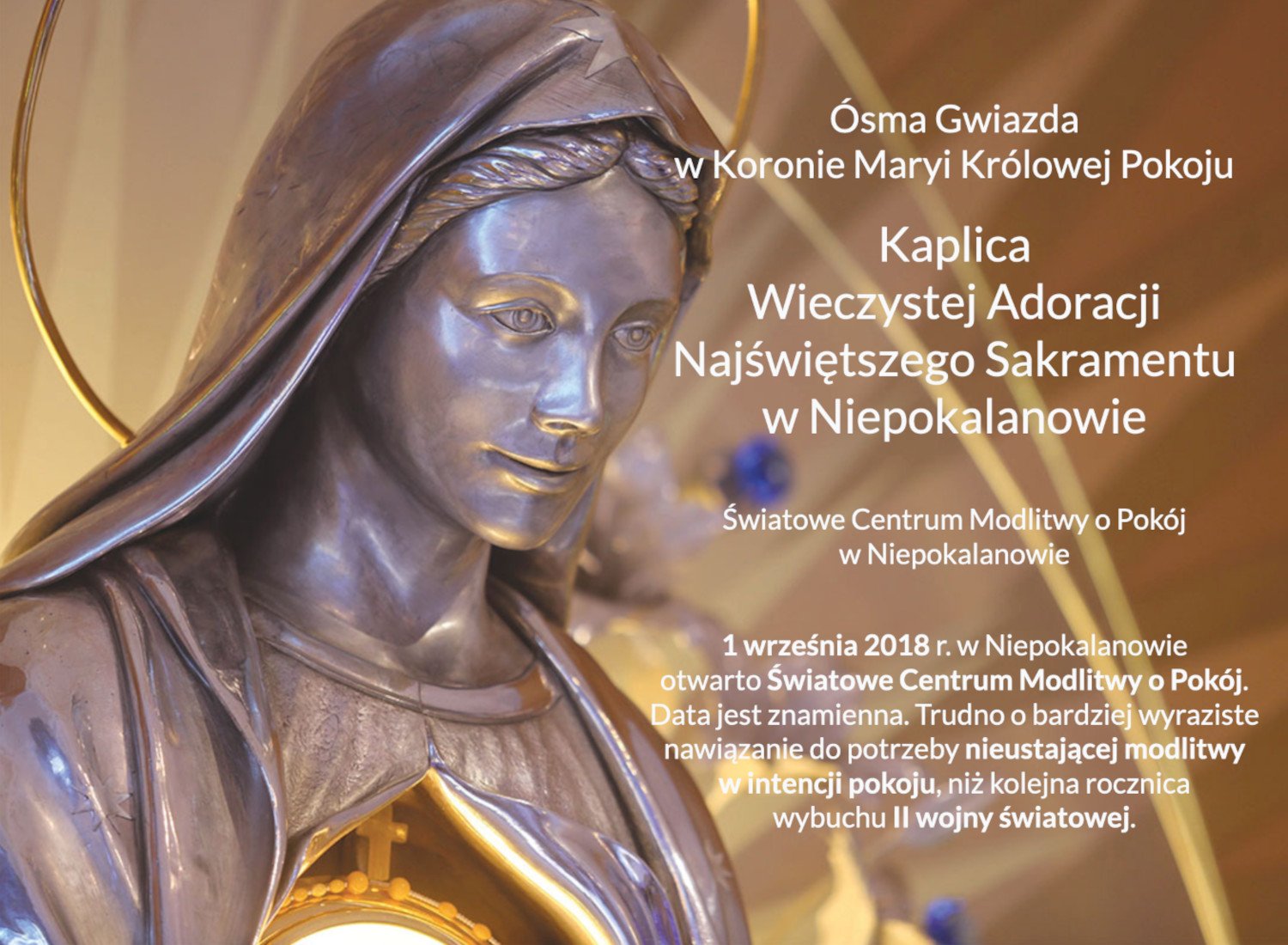

The Eucharistic Adoration Chapel established by Saint Maximilian Kolbe was inaugurated at the outbreak of World War II. It was restored as a Chapel of Adoration in September, 2018, the commemoration of the date that the war began. It is now part of the World Center of Prayer for Peace. The live internet feed of the Adoration Chapel at Niepokalanow — sponsored by EWTN — was established just a few weeks before we discovered it and began to include in at Beyond These Stone Walls. Click “Watch on YouTube” in the lower left corner to see how many people around the world are present there with you. The number appears below the symbol for EWTN.
Click or tap here to proceed to the Adoration Chapel.
The following is a translation from the Polish in the image above: “Eighth Star in the Crown of Mary Queen of Peace” “Chapel of Perpetual Adoration of the Blessed Sacrament at Niepokalanow. World Center of Prayer for Peace.” “On September 1, 2018, the World Center of Prayer for Peace in Niepokalanow was opened. It would be difficult to find a more expressive reference to the need for constant prayer for peace than the anniversary of the outbreak of World War II.”
For the Catholic theology behind this image, visit my post, “The Ark of the Covenant and the Mother of God.”