“There are few authentic prophetic voices among us, guiding truth-seekers along the right path. Among them is Fr. Gordon MacRae, a mighty voice in the prison tradition of John the Baptist, Maximilian Kolbe, Alfred Delp, SJ, and Dietrich Bonhoeffer.”
— Deacon David Jones
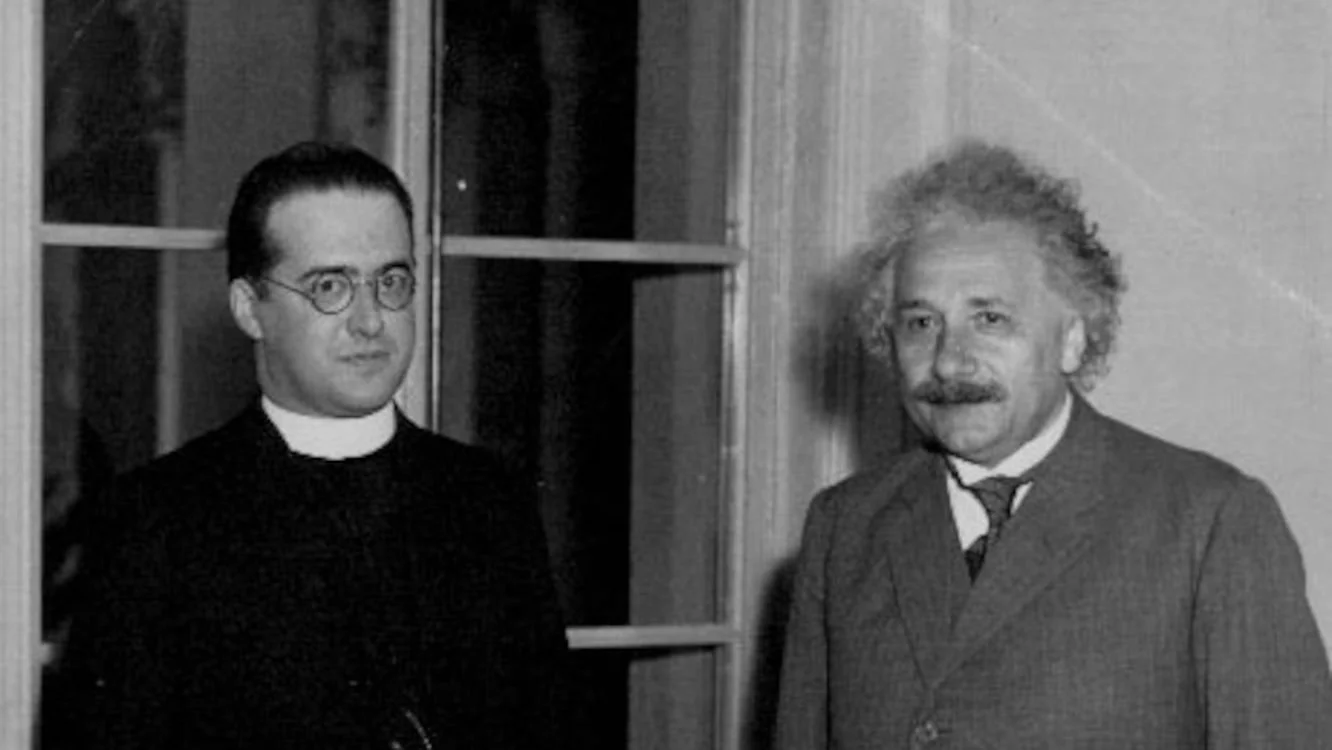
Science and Faith Are Not Mutually Incompatible
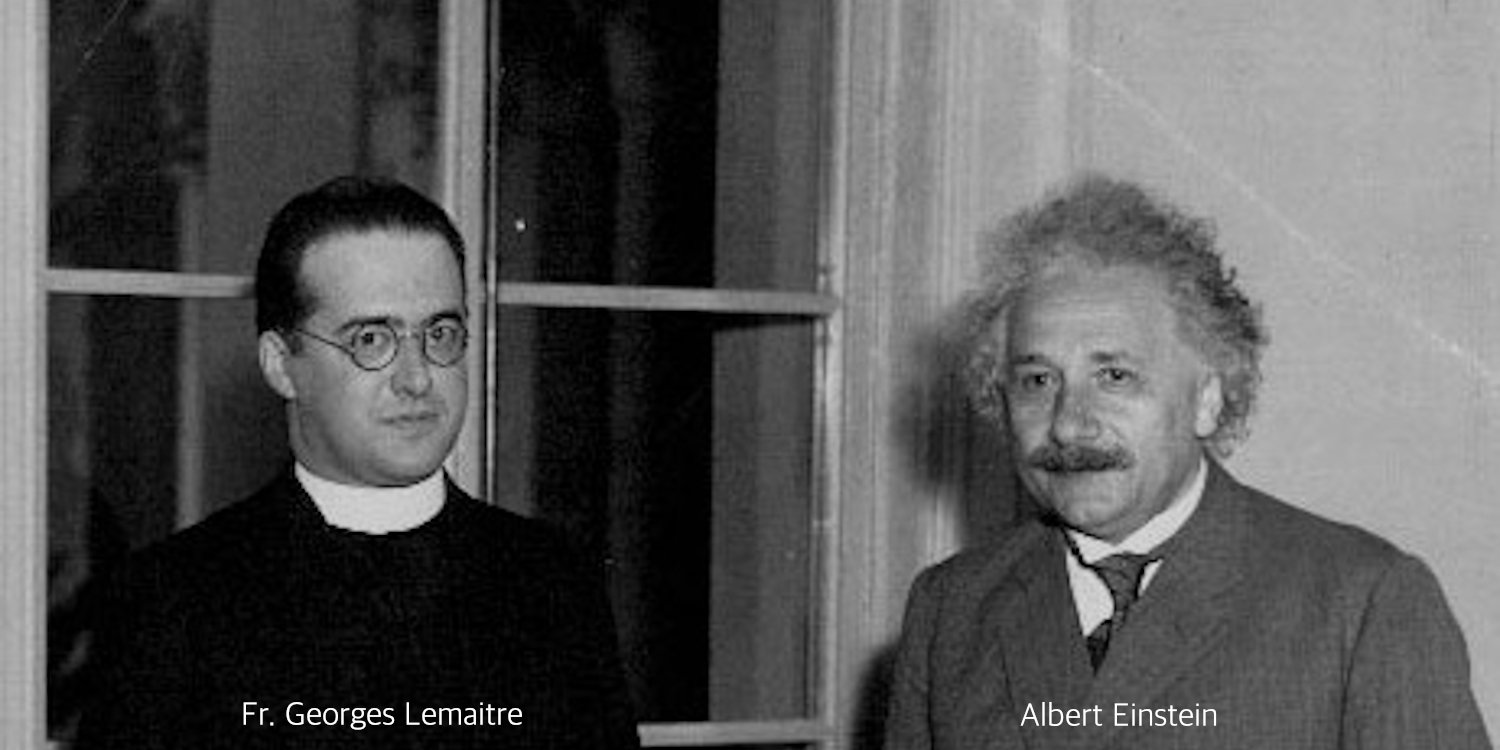
Albert Einstein honored Georges Lemaitre, the priest, physicist and mathematician whose Big Bang Theory is now the scientifically accepted origin of the universe.
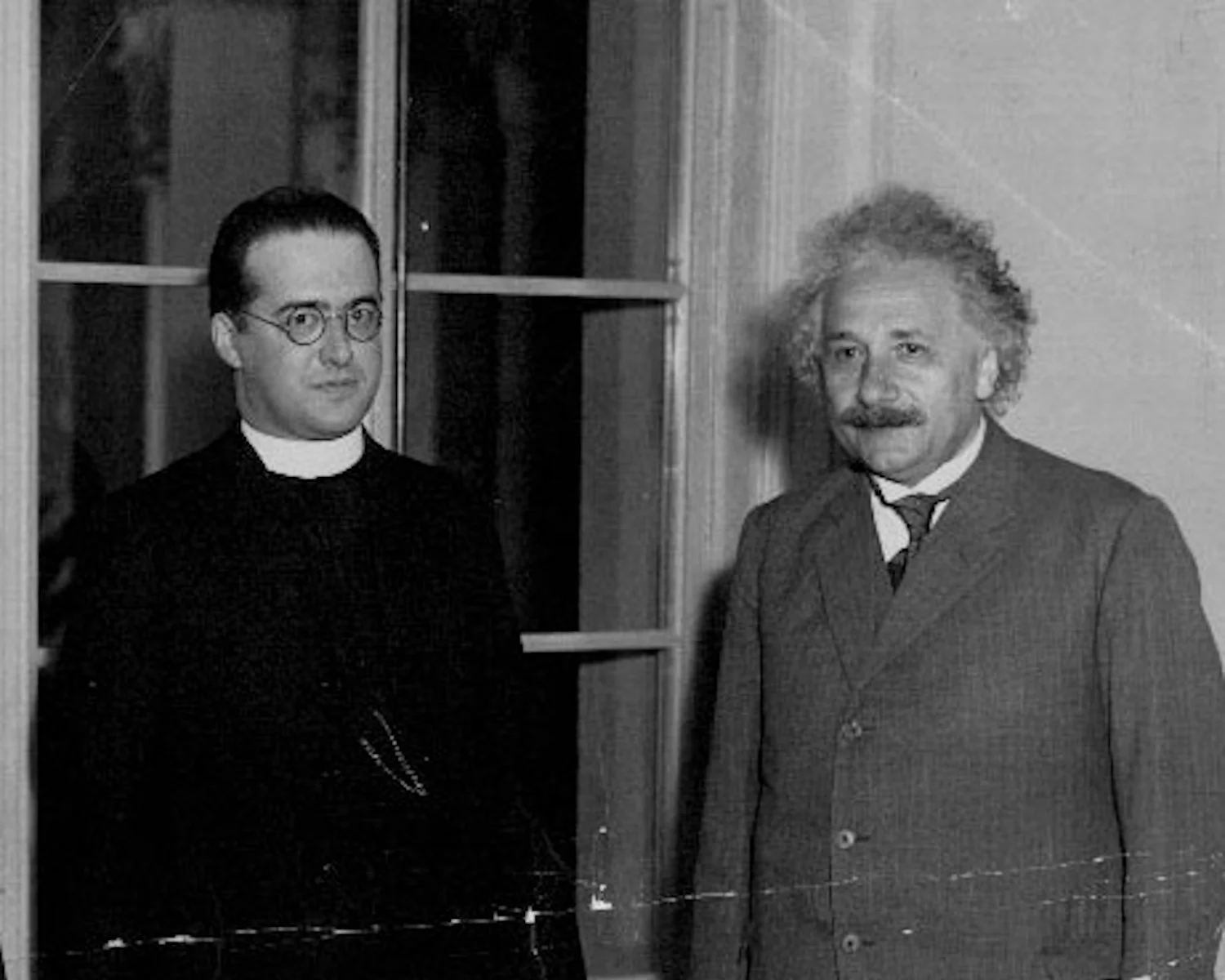
Albert Einstein honored Georges Lemaitre, the priest, physicist and mathematician whose Big Bang Theory is now the scientifically accepted origin of the universe.
March 11, 2026 by Father Gordon MacRae
In 2016, an issue of the former Catholic newspaper Our Sunday Visitor profiled some eye-opening research in an article entitled “Young People Are Leaving the Faith: Here’s Why” (August 27, 2016). It was an analysis of two national studies conducted by The Center for Applied Research in the Apostolate (CARA) to provide insight into the reasons why a third of “millennials” who were raised Catholic reject the faith of their parents as young adults.
In the CARA studies, “Millennials” are defined as those born in 1982 or later. The majority of the young adults who responded with comments on the research indicated that they left their faith for science, concluding that Catholicism cannot be reconciled with science at the high school and university level. They report finding little in the Catholic presentation of faith that challenges that view. The OSV summary included a sampling of the responses behind their decisions:
“As I learn more about the world around me and understand things that I once did not, I find the thought of an all-powerful being to be less and less believable.”
“Catholic beliefs aren’t based on fact… nothing can be disproved, but it certainly shouldn’t be taken seriously.”
“I realized that religion is in complete contradiction with the rational and scientific world, and to continue to subscribe to a religion would be hypocritical.”
“As I started to enjoy math and science more, I realized the discrepancy between religion and science… Catholicism especially did seem to clash fairly well.”
“[Faith] no longer fits into what I understand of the universe.”
These responses reflect a pattern of thought familiar to many parents of young adult Catholics and others concerned about the dismal conclusions of the CARA research. This is also one of the most common pleas I hear on a global scale from parents and grandparents and other readers of this blog.
I must seem to be an enigma to those who have left our faith or are pondering doing so. Judging from my posts of the last ten years, though it was never intended to be so, I seem to devote almost equal time to both faith and science. For example, we have recently collected in one place a number of posts dedicated to the understanding of Sacred Scripture. We called this collection, “The Bible Speaks.” Apparently it speaks quite loudly. There are presently some 43 titles in that collection, and some have broken records among the readership of this blog.
But there is a similar phenomenon that has been taking place in more recent years. I have also written several posts about science and especially the sciences of cosmology, astronomy and particle physics. One of my friends here who comes to the library where I work has asked me for copies of posts over the last few years. He recently complained of feeling a sense of whiplash, bouncing between science and religion, but he said he finds both to be fascinating. To demonstrate this phenomenon one recent post has broken all records in numbers of readers and especially in numbers of readers who come to it again and again, and who share it. That post is “Did Stephen Hawking Sacrifice God on the Altar of Science?” It seems that many people believed that he did, but I have made a case for the opposite. What strikes me most about that post is the unfathomable number of educational institutions of higher learning that are also sharing it and recommending it.
The same has held true for another recent post that blends principles of both science and faith entitled “The Higgs Boson God Particle: All Things Visible and Invisible.” Our Editor has observed and commented on the high number of academic institutions that have also been visiting religious titles on this blog. Some of these institutions are dedicated to scientific research, and yet here they are suddenly delving into the mysteries of Catholic faith. And yet no one is denouncing anything. They seem to come here to observe and to learn, not to refute.
True Believers
I have some firsthand experience with the challenging questions posed by science for the faith of younger Catholics. A decade ago at one university, the son of a reader of this blog, a science major, sent me a letter filled with questions. The previous summer, his mother had emailed him with a link to one of my forays into the science of cosmology entitled, “Science and Faith and the Big Bang Theory of Creation.” In his letter to me the student wrote that he pretty much just dismissed the post as irrelevant without having read it. He read his mother’s email, but didn’t bother clicking on the link until two months later. The student wrote that he grew up in a devout family that accepted Catholic teachings about the world and universe without question. He attended Catholic schools until switching to a public high school, then abandoned his faith in adolescence because his interest in science made faith seem irrelevant.
He believed, or rather was led to believe, that science and religion are mutually incompatible, unable to coexist in a person of science. “The bias fed to me in academia,” he wrote in a much later letter, “was that science is the new source of all faith, and to be taken seriously as a scientist requires setting aside the faith of my parents in this new world order.” And thus ended his identity as a Catholic. It is a troubling story given that for every convert entering the Catholic faith in America in recent years, more than six others left.
The exit of millennials is not at all for the reasons typically put forward by older Catholics who become disenchanted with their Church. In the CARA study, Catholic scandal and the Latin Mass are barely touched upon as influential reasons. And the millennials are not leaving to embrace some other faith. They now constitute the fastest growing expression of religious belief in America — the “Nones,” who self-identify with no religious affiliation at all. A decade ago in “A Crisis of Faith, Not of Worship,” a soul-stirring post at The Catholic Thing, (Aug. 24, 2016) Father Mark A. Pilon made this point well:
“The real underlying problem is simple: it’s a massive loss of faith… About thirty years ago, a reliable survey revealed that only about 30 percent of Catholics believed in the Real Presence of Christ in the Eucharist any longer. Why didn’t the bishops call an emergency meeting to reflect on this loss of faith, as they did in 2002 to deal with sexual abuse? … The highest priority has to be this basic question: What caused this massive loss of faith, and how do we work to resurrect that lost faith?”
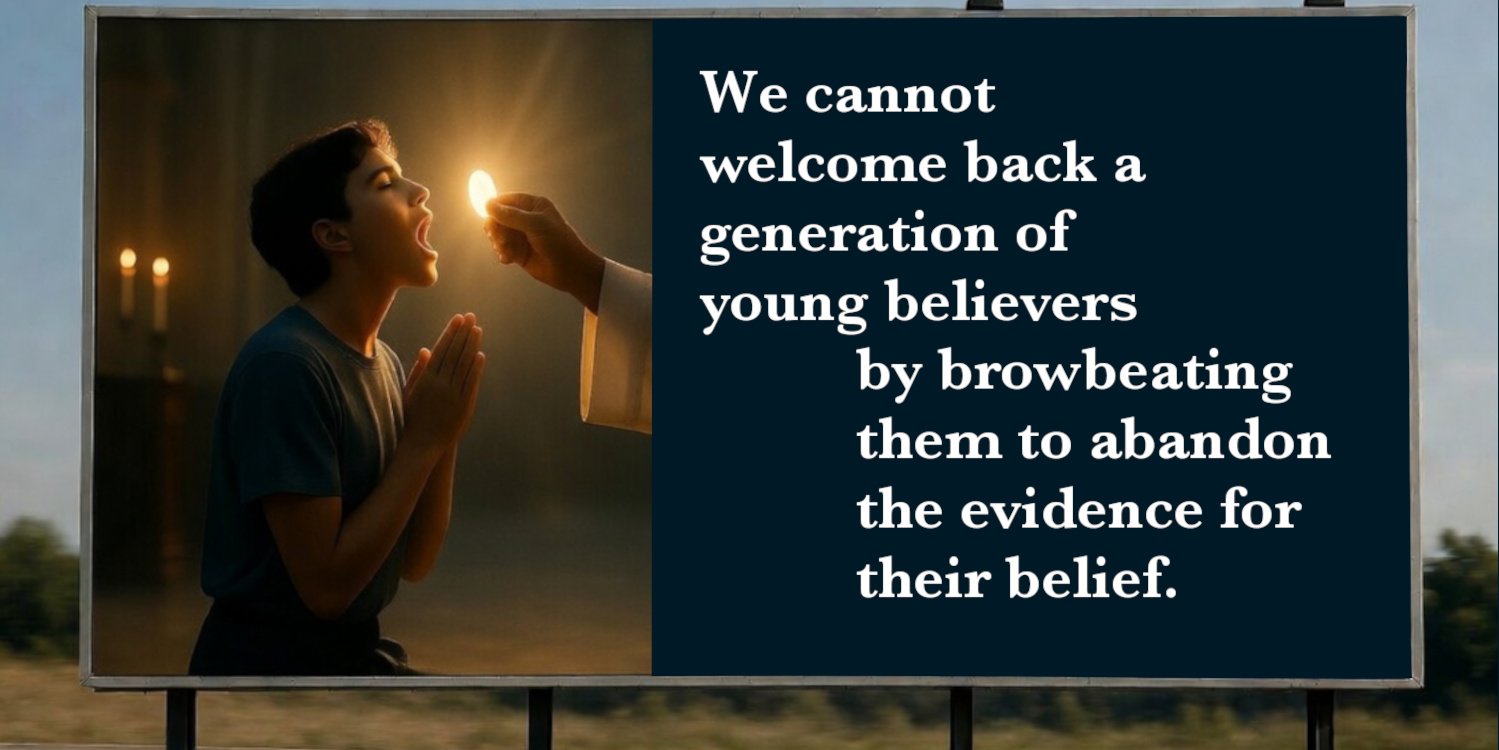
These are very relevant questions, but some have already begun to change. In early 2025 I wrote a post entitled “On the Great Biblical Adventure, the Truth Will Make You Free.” Something happened over the preceding year that signaled a great cultural change toward openness to religion and especially biblical studies. Book publishers have observed that Bible sales greatly increased by double digits toward the end of 2024. A lot of factors were proposed as contributing to this, including the election of 2024, the assassination attempts on the leading U.S. presidential candidate at that time, and later the assassination of Charlie Kirk, founder of Turning Point USA. These were inflection points causing broad swaths of America and elsewhere in the free world to pause and reassess where we are and where we are going. The biblical interest and its resulting growth of interest in faith also has continued to this day. For those who have suggested that Catholic leaders need to take advantage of this trend, a good start would be to moderate “climate change” as an example of our highest priority while abandoning other priorities, such as respect for life. Our hierarchy might also want to reconsider its revulsion for the Traditional Latin Mass and for those who find spiritual comfort in it, many of whom are younger Catholics. And a prohibition against kneeling to receive the True Presence of Christ is simply mind-boggling for true believers. We cannot welcome back a generation of young believers by browbeating them to abandon the evidence for their belief.
The Folly of Leaving Faith Behind for Science
The answer to the suspected disconnect between science and faith is not as simple as seeking relevancy by replacing faith with science. True believers in both find not only “common ground” but windows to the universe that will leave the believer in awe. The student who had been writing to me, for example, is now on his way back. As time wore on, his mother asked him what he thought about the post she sent him. He scurried to find “Science and Faith and the Big Bang Theory of Creation” buried in his inbox, and then he actually read it.
He later wrote that he was “bowled over” by it, and that it turned on its head the entire scientific orthodoxy that had been fed to him claiming that only freedom from religion could legitimately engage him with the world of science. Science with a bias against faith experience prevented him from seeing the bigger picture.
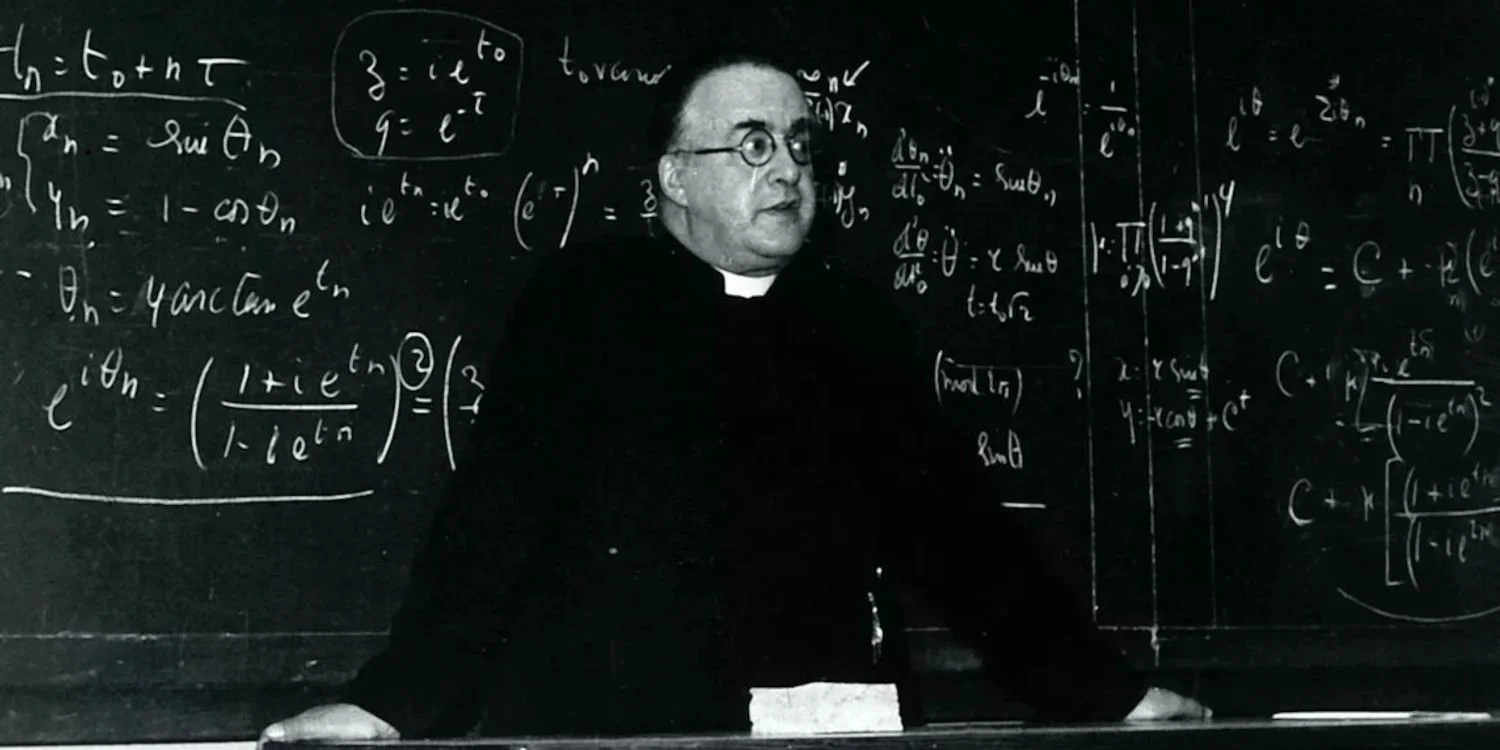
This student had many questions. First and foremost among them was this: “How is it that you, a person obviously well versed in science, could endure such injustice and still also believe in God?” It was a good question, but the answer requires something other than science’s doubts about faith. A better beginning question was the one I posed in return: “How is it that you, a science major in an American university, never before heard or read that the scientist now considered to be the Father of The Big Bang and Modern Cosmology was a Belgian astrophysicist who was also a Catholic priest?”
That question generated several letters over the last two years, suggesting BTSW posts that he has read and reread and shown to other science majors at his school. Before I get into that, however, I want to describe another development that I read some years ago by Beckie Strum in The Wall Street Journal: “U.S. Loses Top School Ranking to U.K.’s Oxford” (WSJ, Sept. 22, 2016).
For the first time, a university outside the United States was ranked the best university in the world, unseating the California Institute of Technology (Caltech) as number one. The U.K.’s Oxford University, the oldest college in the English speaking world, founded in the year 1096, took the top spot in the World University Rankings. Oxford knocked CalTech down to second place, MIT to fifth, and Harvard to sixth bin 2016. At this writing, Oxford has retained that place of primacy for a decade.
Oxford is also host to something missing from more narrowly focused American universities. Oxford is home to a research center called the Ian Ramsey Center for Science & Religion. Its Research Director at the time was Father Andrew Pinsent, a Catholic priest and particle physicist who was formerly on the science team at CERN, the European Council for Nuclear Research.
Father Andrew Pinsent holds a Ph.D. in particle physics from Oxford, a Ph.D. in philosophy from St. Louis University, and advanced degrees in theology from the Pontifical Gregorian University in Rome. He is a member of the United Kingdom Institute of Physics and the Vatican Conference for Scientists, and presently serves on the faculty and formation staff of a major U.S. seminary.
Father Pinsent has also been a guest writer at this blog. His post, “Fr Georges Lemaître, the Priest Who Discovered the Big Bang” was the final leverage that my university friend and correspondent needed to accept the fact that something essential has been missing from his education and exposure in both science and religion. The fact that his science education did not include the story of Georges Lemaitre — the astronomer, mathematician, physicist, and Catholic priest who changed the mind of Albert Einstein on the nature and origin of the universe — told him that it was science, and not faith, that deprived him of a wider world view.
This is a story that has been covered and uncovered at Beyond These Stone Walls in a series of science posts that has run parallel to our collection on Sacred Scripture. Reading these, and especially exploring Father Pinsent’s work, has opened my friend’s eyes as a young Catholic scientist, but it was a part of Father Andrew Pinsent’s guest post that more fully opened my own eyes when he wrote:
“What is to be done to help raise the profile of people like Fr Georges Lemaitre? Among Catholics with some kind of popular outreach, Fr Gordon MacRae, through his widely-read blog Beyond These Stone Walls, has done more than almost anyone I know in recent years to draw attention to Fr Lemaitre. Inspired in part by Fr Gordon’s work, my colleagues and I in England have put together a series of posters called the “Catholic Knowledge Network.”
— Fr Andrew Pinsent, “Fr Georges Lemaître, the Priest Who Discovered the Big Bang”
I think I have come to understand Father Georges Lemaitre’s science whose footprint in the history of modern cosmology is parallel to that of Albert Einstein. They were colleagues who became friends, primarily through Einstein’s great respect for Fr Lemaitre’s gifted mathematical and scientific mind. After a lecture about his theory of relativity at a European university in the 1930s, Einstein was approached by a science writer who asked him whether he thought anyone in the audience really comprehended his work. Einstein’s simple answer was “Lemaitre, certainly. As for the rest…”
The scientific dogma of the age was that the universe was static, eternal, and unchanging. Einstein also embraced this view, but it dismissed the beliefs of established religion that the universe was created from nothing.
However, Georges Lemaitre and Russian mathematician Aleksander Friedmann had more faith in Einstein’s mathematics than other scientists of their time. At first, Einstein payed little attention when they used his own equations to conclude that the universe is not static but expanding, and its rate of expansion is increasing when all established science said the opposite.
It was the American astronomer, Edwin Hubble (in whose honor the Hubble Space Telescope is named) who in 1929 discovered physical evidence that Lemaitre is right, that the universe is in fact expanding. Two years later in 1931, Father Georges Lemaitre concluded that the universe began “On a day without yesterday,” 13.8 billion years ago, with the explosion of a primordial atom from which space, time, and matter were created.
The idea was ridiculed, and “The Big Bang” was a pejorative term some scientists used to taunt the physicist priest. But he was right, and he turned science on its head with this revelation that has since been demonstrated with the discovery of cosmic background radiation emanating from The Big Bang.
Einstein, who first disagreed, ended up applauding the idea as “The most beautiful explanation of creation I have ever heard.” It was a bigger bang for science than even Einstein realized. It took the language of mathematics to comprehend that it points to what faith always told us: a universe arising out of nothing.
I think I finally came to some rudimentary understanding of the science behind this through the language of mathematics. For this I owe thanks to Robyn Arianrhod, and her book, Einstein’s Heroes: Imagining the World Through the Language of Mathematics (Oxford University Press 2005):
“In 1932, Lemaitre sowed the seeds of the Big Bang theory when he suggested that the universe had started as an explosion of a ‘primeval atom’ that… continued expanding from that explosive beginning. Some of the world’s most ancient creation myths have also imagined the world exploding from some sort of cosmic seed…”
“In 1970, English physicists Stephen Hawking and Roger Penrose showed that Einstein’s equations predicted the universe had expanded not from a tiny piece of matter located in an otherwise empty cosmos, but from a single point in four-dimensional spacetime. This meant that the Big Bang was not an ordinary explosion which took place at a specific three-dimensional location at a given time on the cosmic stage, but that Space and time themselves were actually created in the explosion, along with all matter and energy. Before this point … there was no time and no space. No geometry, no matter, nothing. The universe simply appeared out of nowhere. Out of nothing.”
— Einstein’s Heroes, p. 187
“The universe simply appeared out of nowhere. Out of nothing.” Take a moment to ponder that conclusion of science and it will sound a lot like a tenet of faith. Science, mathematics, and faith all open a window to the universe onto the same panoramic vista. And the awe this truth evokes is at one and the same time the comprehension of science and the inspiration of faith.
And as for my student-friend’s first question about the mystery of suffering in the light of faith, I can only gather up some prescientific humility to echo God against the protest of Job:
“Where were you when I laid the foundations of the earth?… Can you bind the chains of the Pleiades, or loose the cords of Orion?”
— Job 38: 4, 31

+ + +
Note from Father Gordon MacRae: Thank you for reading and sharing this post.
You might also like these other posts from Beyond These Stone Walls about the great adventure of science and faith:
On the Great Biblical Adventure, the Truth Will Make You Free
Science and Faith and the Big Bang Theory of Creation
The Higgs Boson God Particle: All Things Visible and Invisible

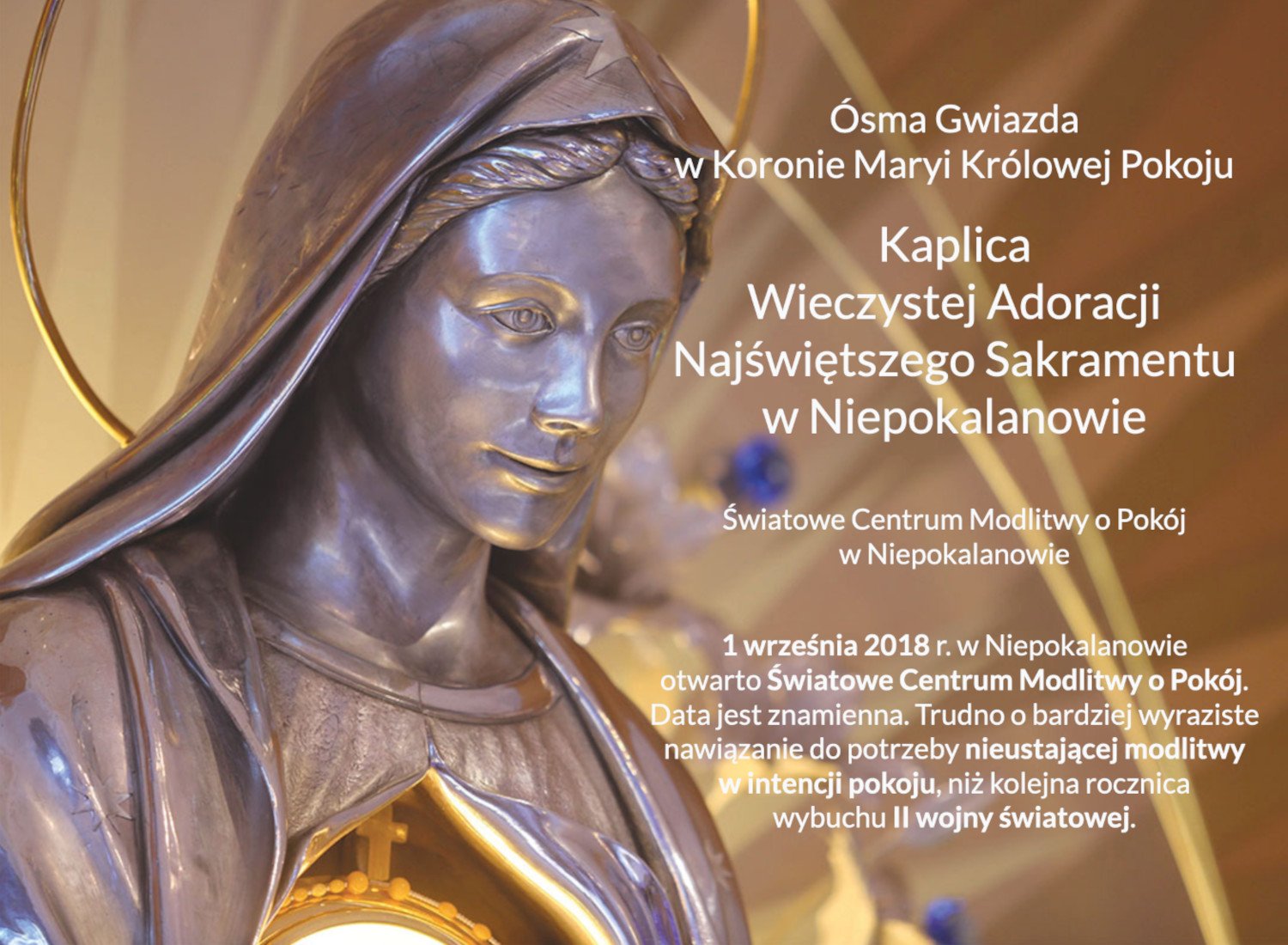

The Eucharistic Adoration Chapel established by Saint Maximilian Kolbe was inaugurated at the outbreak of World War II. It was restored as a Chapel of Adoration in September, 2018, the commemoration of the date that the war began. It is now part of the World Center of Prayer for Peace. The live internet feed of the Adoration Chapel at Niepokalanow — sponsored by EWTN — was established just a few weeks before we discovered it and began to include in at Beyond These Stone Walls. Click “Watch on YouTube” in the lower left corner to see how many people around the world are present there with you. The number appears below the symbol for EWTN.
Click or tap here to proceed to the Adoration Chapel.
The following is a translation from the Polish in the image above: “Eighth Star in the Crown of Mary Queen of Peace” “Chapel of Perpetual Adoration of the Blessed Sacrament at Niepokalanow. World Center of Prayer for Peace.” “On September 1, 2018, the World Center of Prayer for Peace in Niepokalanow was opened. It would be difficult to find a more expressive reference to the need for constant prayer for peace than the anniversary of the outbreak of World War II.”
For the Catholic theology behind this image, visit my post, “The Ark of the Covenant and the Mother of God.”
The Higgs Boson God Particle: All Things Visible and Invisible
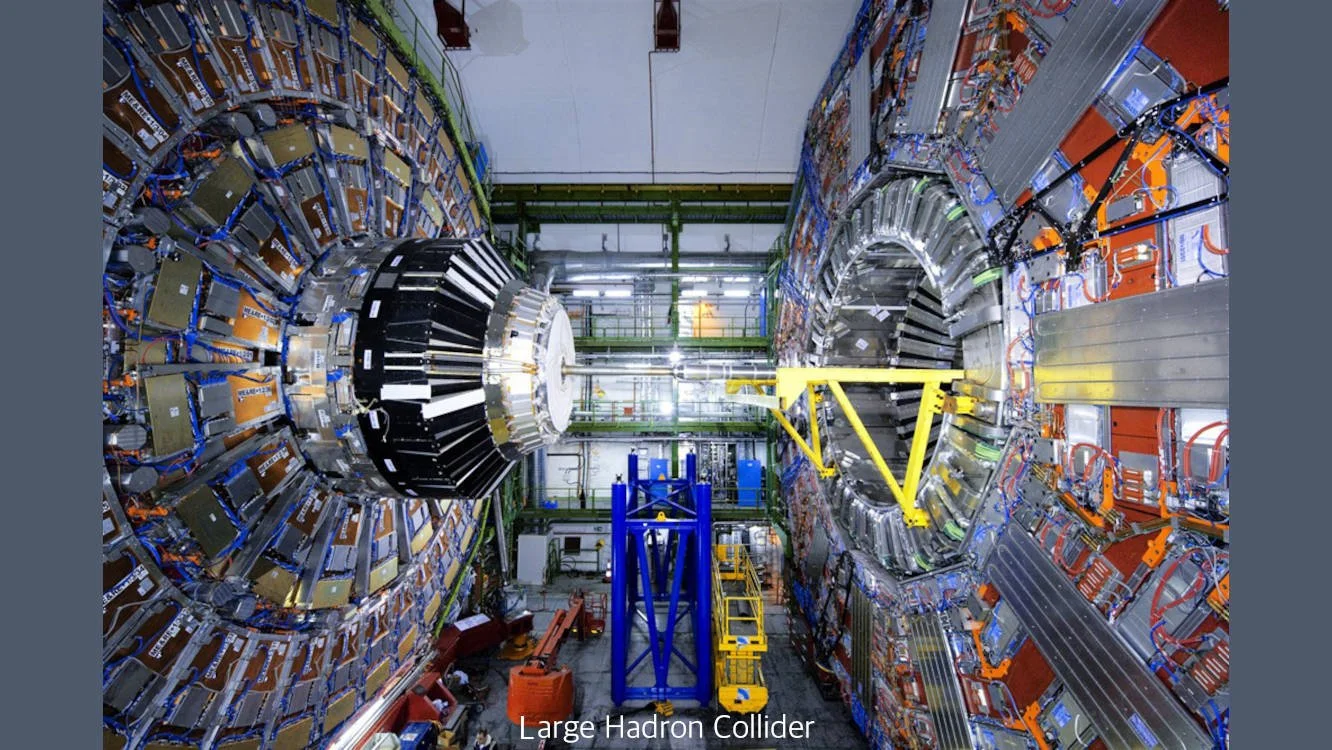
In 2012, scientists at the Large Hadron Collider detected the elusive Higgs boson, a subatomic particle dubbed the “God Particle” explaining the origin of matter.
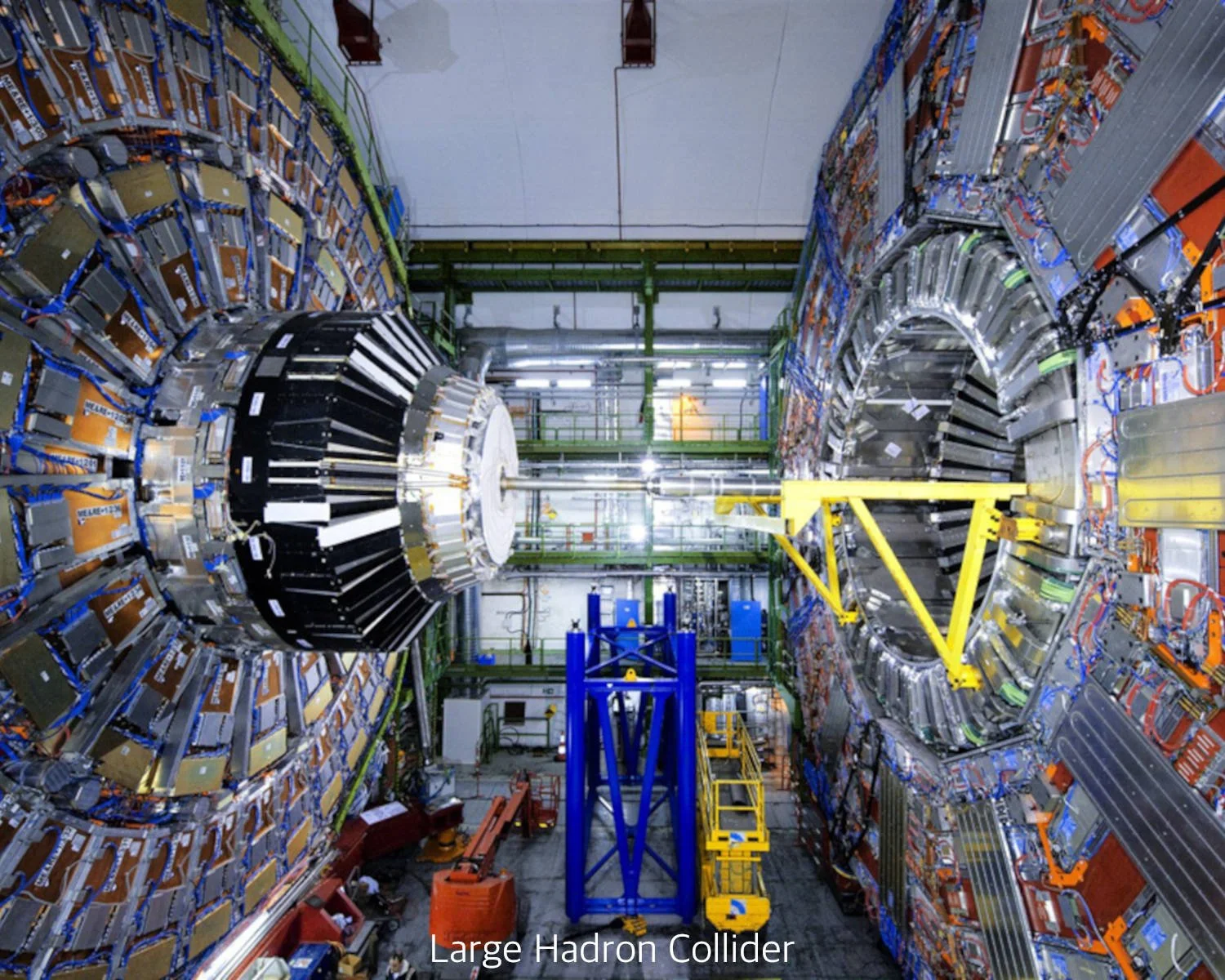
In 2012, scientists at the Large Hadron Collider detected the elusive Higgs boson, a subatomic particle dubbed the “God Particle” explaining the origin of matter.
February 4, 2026 by Father Gordon MacRae
“Two Higgs boson particles walked into a bar. Over drinks one said, ‘I hear Stephen Hawking bet $100 that we don’t exist. What if he’s right?’ The other replied, ‘No matter!’ ”
Get it? No matter? Get it? Well, hopefully you will in a few minutes. I didn’t get it either until I did some heavy-duty reading.
If this post is creating a touch of déjà vu, a sense that you have seen it before, it’s because you probably have. Something quite unusual happened here at this blog in recent weeks. In the earliest days of this blog in 2010, I was contacted by a reader in Australia about a new book by physicists Stephen Hawking and Leonard Mlodinow entitled The Grand Design (Bantam Books, 2010). The letter writer was concerned that media outlets in Australia and around the world were citing aspects of the book out of context in an attempt to demonstrate that Stephen Hawking declared that God does not exist. That was a faulty interpretation and the reader wanted me to set the record straight. It was a tall order, but I had time on my side to ponder and present a contrary point of view. So on October 6, 2010, we published “Did Stephen Hawking Sacrifice God on the Altar of Science?”
A lot of work went into that post, but to my chagrin it was met by most of our readers with a yawn the size of a giant black hole. Fifteen years later, someone (not me) submitted that post to an advanced artificial intelligence model requesting an analysis of it. The results were then read to me by our Editor. AI scoured the Internet and then referred to me as “a Catholic priest with a background in science” while singling out that post as “a significant example of bridging the gap between science and faith.”
So of course, I thought that was the nicest thing any AI had ever said about me (There was very little to compare it to.). Given this new interest in a bridge between science and faith, I decided to haul out this 15-year-old post and rehabilitate it for a new audience. On July 30, 2025, we republished “Did Stephen Hawking Sacrifice God on the Altar of Science?” The result was mind boggling, but it was not immediate. A few months later that post started showing up in our stats and then it began a viral spread. By January it was outpacing my regular weekly posts in popularity. And then by mid-January it spread all over the world in unprecedented numbers for this blog.
I cannot pretend to know why this happened. I do not understand the global attention to this one post on the space-time continuum. Perhaps my only conclusion is that when I post a bomb, just wait 15 years and post it again.
The Discovery
There is another post of mine that also bridges the gap between science and faith. I do not have an explanation for why or how, but another of my posts, this one from 2012, also began to show up in unusually large numbers with that other post. I have long wanted to repost this one with some updated information so that those who are currently reading and spreading it can see the updated version. It is “The Higgs Boson God Particle: All Things Visible and Invisible.”
I first wrote it in September 2012. It, too, was met with a rather extended yawn, but today it shows up often and everywhere. It profiles the work of the late physicist Peter Higgs who rose to prominence in the scientific community in 1964 when he theorized that the Higgs boson exists as a necessary subatomic particle which explains the existence of matter. After my post was first published, the Higgs boson was experimentally demonstrated again and Peter Higgs was awarded the Nobel Prize in Physics. He died on April 8, 2024 at the age of 94 knowing that his life’s work was a major addition to the scientific understanding of the Universe.
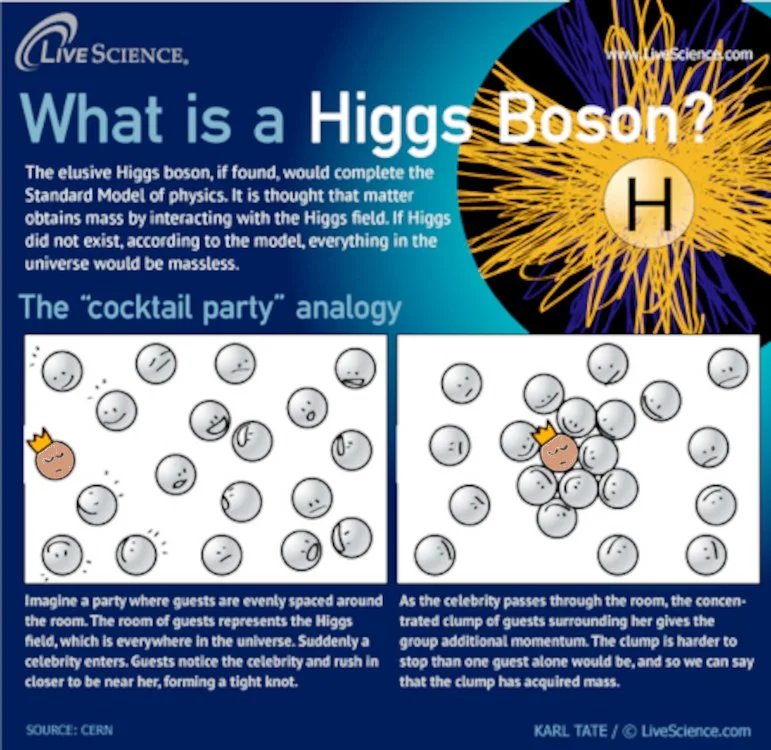
A boson in physics is a component of subatomic particles such as protons and photons, which exist in every atom of matter. As a class of particle, a boson is so-called in honor of Indian physicist, Satyenda Nath Bose, who collaborated with Albert Einstein. The existence of a then-theoretical Higgs boson resolved a puzzle in the Standard Model of physics, a widely accepted model for how particles interact. The thinking in the Standard Model was that particles such as photons — particles of light — have no mass. They should move throughout the Universe unhindered. The mathematics of the Standard Model explained successfully the existence of particles, but not mass or matter. The Higgs boson proposed by Peter Higgs in 1964 was an explanation for how particles could attain mass, and thus bring into being a Universe filled with matter that we can see or otherwise detect.
CERN, the European agency for nuclear research, operates and oversees the Large Hadron Collider. It is a donut-shaped laboratory 27-miles in circumference on the French-Swiss border. Two beams of protons were set on a collision course moving at close to the speed of light. Their collision resulted in an explosion that recreated the conditions of The Big Bang, the scientifically accepted origin of our Universe. During the collision, a supercomputer detected the presence of the Higgs boson particle and a Higgs field for a trillionth of a second. It was the first time its existence had ever been established in a laboratory
On July fourth in 2012, physicists announced that they had a momentary glimpse of the elusive Higgs boson, the subatomic particle long theorized to exist, and without which matter itself would not exist. The physicists who reported that they only found “evidence” of the Higgs boson were just being careful scientists. The discovery had a 99.9999% rate of certainty. There is no doubt left. The Higgs boson does indeed exist and that experiment has since been ratified.
So what exactly does this mean? Many scientists grimaced every time someone in the news media referred to this discovery as “the God particle.” Using science out of context to debunk religious faith is a favorite pastime of some in the media, but the reverse should also not happen.
I took a hard look at the interaction between faith and science in “Did Stephen Hawking Sacrifice God on the Altar of Science?” After publication of The Grand Design, some in the news media speculated that Hawking’s book demonstrated that gravity — and not God — is responsible for the creation of the Universe. My conclusion was simply that Stephen Hawking has thrown in with the wrong “G,” and the pundits misreading his book have confused the tools of God with God. I cited in that post a vivid example. If you were an archeologist digging in ruins in Florence, Italy and you discovered a worn chisel that was used by Michelangelo to create the Pietà, one of the most celebrated examples of sculptured marble in art history, would you then conclude that Michelangelo did not create the Pietà, his chisel did?
What I find most interesting about the recent discovery is that the Higgs boson appears nowhere in Stephen Hawking’s The Grand Design. His analysis of the science of cosmology omitted it entirely. In fact, two decades ago Stephen Hawking wagered $100 that the Higgs boson would never be detected. He lost the bet.
The discovery of the Higgs boson is a big deal in science because it presents a purely scientific explanation for how matter exists, but not why. The model for creation it implies is that a primordial atom exploded in what we call The Big Bang 13.7 billion years ago. As the explosion cooled, a force known as a “Higgs field” — which contained the Higgs boson — was formed and permeates the Universe. As other particles interacted with this field, they acquired mass allowing gravity to bring particles together. It acted sort of like a dam slowing particles so that they would mass together. The result was matter as we know and see it — everything from stars to us. It’s sort of the yeast with which God bakes bread.
A Day Without Yesterday
The Higgs boson was detected by the Large Hadron Collider’s super computers in July 2012 for a fraction of a trillionth of a second. The tiny collision sent particles in every direction producing the energy equivalent to 14 trillion electron volts and blistering temperatures. The collision recreated a tiny model of the instance of The Big Bang. Some theorize that it was the presence of the Higgs boson particle within the primordial atom that caused The Big Bang itself, and the explosion of all matter in the Universe.
I find this all fascinating, but what is most fascinating is that the entire model was first mathematically predicted, and then demonstrated to even Albert Einstein’s satisfaction, by a Catholic priest. I wrote of the Belgian priest and physicist, Father Georges Lemaitre, in “A Day Without Yesterday:” Father Georges Lemaitre and the Big Bang. As a result of that post and others related to it, I began a correspondence with Father Andrew Pinsent, who prior to priesthood had been a physicist at CERN. We collaborated on a very special post, “Fr Georges Lemaître, the Priest Who Discovered the Big Bang.”
If ever you bristle about the typical anti-Catholic mythology that religion attempts to hold back science, remember that the originator of all the science behind this model of creation was a Catholic priest, and many of the great scientists of his time did everything they could to suppress his ideas. They failed because they could not successfully refute either his faith or his science. In the end, even Einstein bowed to Father Lemaitre, declaring that his model was “the most satisfactory explanation of creation I have ever heard.”
Pope Pius XII applauded Father Lemaitre’s discovery of The Big Bang because it challenged the acceptable science of the time which claimed that the Universe was not created, but always existed and is eternal. Einstein later acknowledged that his “Cosmological Constant” was his greatest error.
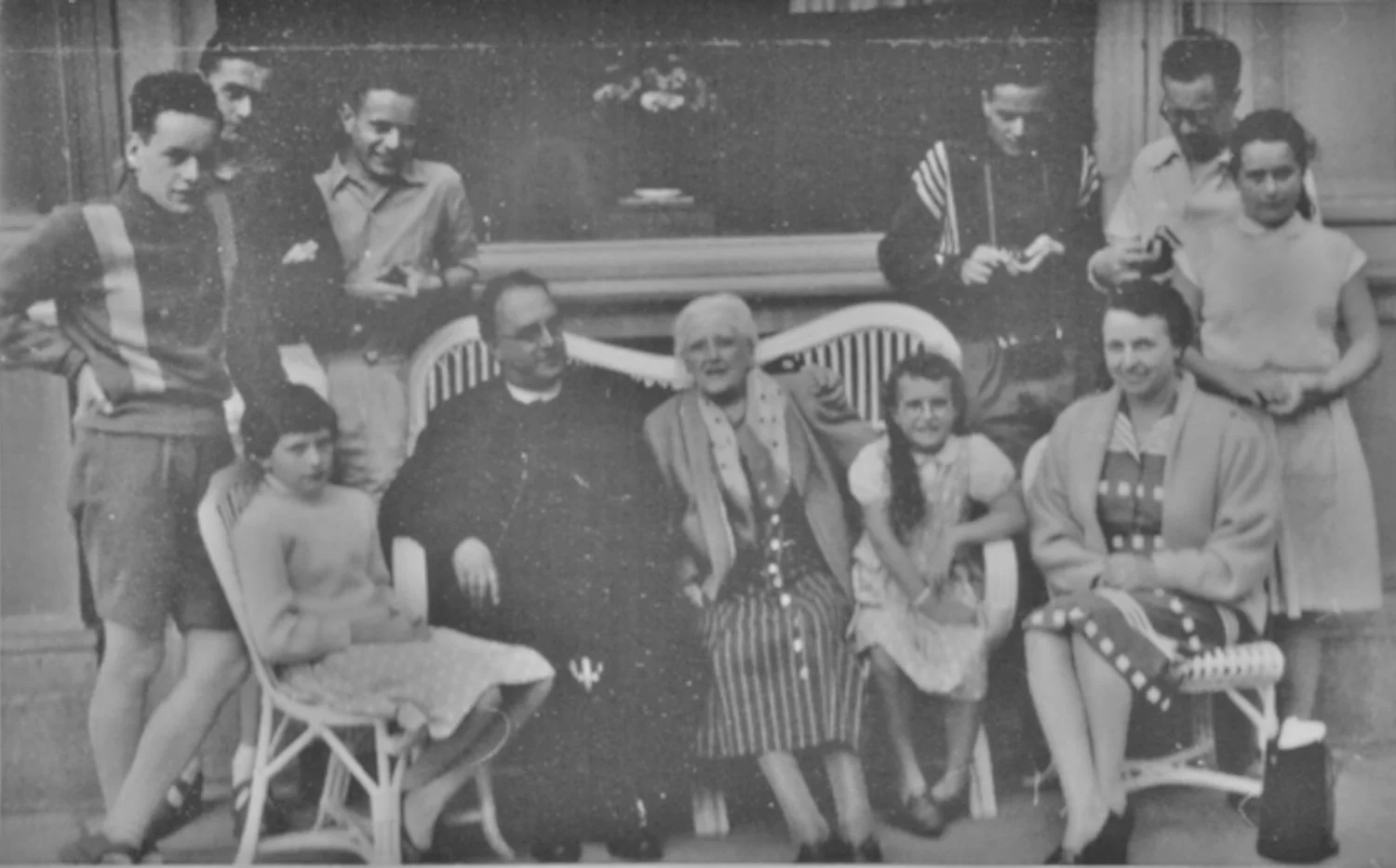
Perhaps the greatest miracle of all for me was receiving the photo below of Pornchai Moontri’s Godfather, the late Pierre Matthews, whose mother was a close friend of Father Lemaitre, who became Pierre’s Godfather. The odds that my roommate in Concord, New Hampshire would turn out to be the Godson of a man whose own Godfather discovered the Big Bang are as great as the odds of the Big Bang itself.
Michio Kaku, a professor of theoretical physics at City University of New York, wrote a brilliant and (unlike this post) brief commentary about the Higgs boson for The Wall Street Journal (“The Spark That Caused the Big Bang,” July 6, 2012). Professor Kaku wrote:
“The press has dubbed the Higgs boson the ‘God particle,’ a nickname that makes many physicists cringe. But there is some logic to it. According to the Bible, God set the Universe in motion as He proclaimed ‘Let there be light.’”
“So why did the Higgs boson particles hurry to church?
Because Mass could not start without them.”
+ + +
Note from Fr. Gordon MacRae: For open minds and enlightened souls bridges are taking shape between the realms of science and faith. You may also like these related posts from Beyond These Stone Walls:
Did Stephen Hawking Sacrifice God on the Altar of Science?
Fr Georges Lemaître, the Priest Who Discovered the Big Bang (a must-read by Father Andrew Pinsent)
The James Webb Space Telescope and an Encore from Hubble
For Those Who Look at the Stars and See Only Stars
+ + +
And then there was this: xAI Grok on Higgs Boson, God Particle, Science and Faith.
The Eucharistic Adoration Chapel established by Saint Maximilian Kolbe was inaugurated at the outbreak of World War II. It was restored as a Chapel of Adoration in September, 2018, the commemoration of the date that the war began. It is now part of the World Center of Prayer for Peace. The live internet feed of the Adoration Chapel at Niepokalanow — sponsored by EWTN — was established just a few weeks before we discovered it and began to include in at Beyond These Stone Walls. Click “Watch on YouTube” in the lower left corner to see how many people around the world are present there with you. The number appears below the symbol for EWTN.
Click or tap here to proceed to the Adoration Chapel.
The following is a translation from the Polish in the image above: “Eighth Star in the Crown of Mary Queen of Peace” “Chapel of Perpetual Adoration of the Blessed Sacrament at Niepokalanow. World Center of Prayer for Peace.” “On September 1, 2018, the World Center of Prayer for Peace in Niepokalanow was opened. It would be difficult to find a more expressive reference to the need for constant prayer for peace than the anniversary of the outbreak of World War II.”
For the Catholic theology behind this image, visit my post, “The Ark of the Covenant and the Mother of God.”