“There are few authentic prophetic voices among us, guiding truth-seekers along the right path. Among them is Fr. Gordon MacRae, a mighty voice in the prison tradition of John the Baptist, Maximilian Kolbe, Alfred Delp, SJ, and Dietrich Bonhoeffer.”
— Deacon David Jones

Science and Faith and the Big Bang Theory of Creation
The discovery of cosmic ripples from the birth of the Universe is evidence beyond reasonable doubt of the Big Bang theory first proposed by Fr Georges Lemaitre.

The discovery of cosmic ripples from the birth of the Universe is evidence beyond reasonable doubt of the Big Bang theory first proposed by Fr Georges Lemaitre (pictured above with Albert Einstein and Fr Andrew Pinsent)
June 18, 2025 by Father Gordon MacRae
“In the beginning God created the heavens and the earth. The earth was without form and void, and darkness was upon the face of the deep; and the Spirit of God was moving over the face of the waters. And God said, ‘Let there be light,’ and there was light.”
— Genesis 1:1-3
When my friend Augie was back in 2014, he used to like to stop by my room to compare notes about our favorite TV shows. We had been mesmerized by the return of Jack Bauer’s 24 back then, and we were eagerly awaiting the extra-terrestrial return of Falling Skies. One day when Augie came by my door he asked, “What do you think of The Big Bang Theory? “ I was so glad he asked. I launched into a 15-minute analysis of the science of modern cosmology and the meaning of the so-called Big Bang for both science and faith. When I finished, Augie looked dazed and said, “Umm…I meant the TV show!”
Then Mike Ciresi (“Coming Home to the Catholic Faith I Left Behind”) stopped by and asked, “What are you writing about this week?” “The Big Bang Theory,” I replied, hoping for another chance to spout off my explanation of the Cosmos. “Oh, I LOVE that show,” said Mike as he made a hasty retreat.
Okay, what had I been missing? Despite its being the most watched show on television, I had never seen an episode of the CBS hit, “The Big Bang Theory.” So I watched a few reruns. The show turned all social science on its head. I had no idea nerds were now “in!” And they even had girlfriends! Nerdhood had sure changed since I studied physics!
Alas, however, it was the OTHER Big Bang theory that I am taking on this week, but I implore you not to click me away just yet. I MUST write about this, and I hope you will read on. I am not quite as funny as Sheldon, Leonard, Howard and Raj, and of course Penny! I can only be that funny when I’m trying hard NOT to be funny! Like now!
I must write about the Big Bang theory for two reasons. First and foremost, a new discovery of cosmic microwave background radiation was big news a few years ago because it lent evidence beyond reasonable doubt to the truth of the science behind the Big Bang, a discovery first proposed by a Catholic priest who turned Twentieth Century cosmology on its head. I want to write about what this means for both the science of cosmology and the faith that we have all invested into a notion that this Universe was created by God. I will get back to that.
Finally, I must write about this because I was somehow thrown into the ring of debate about what it all means. My name showed up on a Facebook page for a quantum physics website. Mary Anne O’Hare posted in response to an article about the implications of so-called parallel universes and the “Many Worlds” theory:
“Gordon J. MacRae is one of the best authors who melds science with faith. Would be interested in his feedback.”
Thank you, Mary…I think! However, the ego bubble you built was burst just moments after I read your remark. BTSW reader Liz McKernan from England sent me a clipping from the (UK) Catholic Herald. It reminded me that my paranormal quest for science and truth beyond these stone walls is dwarfed by another priest, the U.K.’s Father Andrew Pinsent. He is one of the most accurate and prolific contemporary writers and bridge builders in the realm of science and faith. Liz McKernan’s clipping detailed Father Pinsent’s presentation to a packed room at the Newman Forum on “The Alleged Conflict Between Faith and Science.”

Are Science and Faith Mutually Exclusive?
When I decided to profile the work of Father Andrew Pinsent, I was surprised to learn (Ahem! Ahem!) that he also happens to be a reader of Beyond These Stone Walls. You also may recall a previous post of mine that revealed a connection between Father Georges Lemaitre and our friend, Pornchai Maximilian Moontri whose Belgian Godfather, Pierre Matthews, was a close family friend of Father Lemaitre. The photo above depicts Pierre Matthews and Fr. Lemaitre together during a family vacation. It came as a great shock to me to learn that Pornchai, my roommate of the previous 15 years, is probably the only person on Earth who can say that his Godfather’s Godfather is the Father of the Big Bang and Modern Cosmology.
Before I delve further into Father Andrew Pinsent’s defense of the truth about Catholic contributions to science, however, I want to comment on another television show I awaited with great anticipation. The FOX -TV production of Cosmos hosted by astrophysicist Neil deGrasse Tyson is terrific despite one very unfortunate and inaccurate anti-Catholic slur in its first segment: “The Roman Catholic Church maintained a system of courts known as the Inquisition and its sole purpose was to torment anyone who dared voice views that differed from theirs.”
It seems the Cosmos writers have been reading far too much of the sort of shoddy revisionist history put forth by novelists like Dan Brown. As the University of Dayton historian, Thomas Madden, pointed out, the Inquisition formed at a time when much of European society was in a perilous state of disorder, and the order it brought to anarchy saved thousands of lives. More importantly, Professor Madden wrote, “The Catholic Church as an institution had almost nothing to do with” the Inquisition.
The insinuation by a Cosmos background writer was that the Catholic Church has been hostile to science. However, the truth about the relationship between science and faith in the Twentieth Century demonstrates that just the reverse has more often been the case. For much of the later Twentieth Century, a fringe but vocally dominant number of scientists have been far more hostile to religion than religion has been to science. Few living scientists have done more than Father Andrew Pinsent to refute the attempts of this anti-religion fringe to replace faith in God with faith in science by always pointing to the “irrationality of believers.”
Father Pinsent, a doctoral-level physicist with a doctorate in Philosophy, has helped redeem science by exposing the truth about the great contributions to science by Catholic priests. His examples include the Jesuit astrophysicist, Fr Angelo Secchi; the father of the science of genetics, Msgr Gregor Mendel; and of course the astronomer and mathematician, Fr Georges Lemaitre. In this list, I cannot exclude Father Andrew Pinsent himself who after a career at the Ian Ramsey Centre for Science and Religion at Oxford is currently professor of Philosophy at one of the most prestigious Catholic seminaries in the United States, Mount St. Mary’s Seminary, also known as the Athenaeum.

Science from East of Eden
Still, I greatly respect and admire Neil deGrasse Tyson who went on in Cosmos to repair the damage somewhat by giving Fr Georges Lemaitre due credit as a foundational theorist of modern physics and cosmology right along with Albert Einstein.
The description of Father Lemaitre’s discovery as “The Big Bang” actually began as a term of mockery of his idea. The term first appeared in 1949, more than two decades after Lemaitre first proposed his theory. The prevailing winds of scientific thought for much of the first half of the Twentieth Century had settled on a belief that the Universe was not “created” at all, but had always existed, had no beginning, and will have no end. In that sense, for science, the Universe itself replaced God as eternal and without an origin. This was the accepted view, even by Einstein.
It was this predominant view that relegated the Judeo-Christian understanding of Creation to the shelf, treating it, and all religion, as a quaint anachronism stubbornly clinging to bygone days of scientific ignorance. Science attempted to remove all rational belief from our Biblical Creation account, and declared it to be a myth in the way we popularly understand myth. In mid-Twentieth Century science, God was obsolete, and some in philosophy were soon to follow with “God is dead!” Many in science held that if science could so undermine the very first awareness of man that God is Creator, all the rest of Judeo-Christian faith would eventually crumble.
Then, in the 1920s and 1930s, along came a brilliant mathematician-priest who subjected the conclusions of science to the rigors of mathematics. I wrote about the challenge this priest posed to the prevailing winds of science in “A Day Without Yesterday: Father Georges Lemaitre and the Big Bang.” Father Lemaitre was much respected by Albert Einstein, but far more for his mind than for his faith. At a 1933 conference in Brussels exposing his Theory of General Relativity, Einstein was asked if he believed it was understood at all by most of the scientists present. Einstein replied, “By Professor D. perhaps, and certainly by Lemaitre; as for the rest, I don’t think so.”
However, Einstein also had a fundamental disagreement with Father Lemaitre, though one — to the consternation of many in science — that was short-lived. Lemaitre used mathematics to present a model of the Universe based on Einstein’s own Theory of General Relativity which proposed that mass and energy create curvature of space-time causing particles of matter to follow a curved trajectory. Gravity, therefore, would bend not only matter, but light and even space itself. This had profound implications for science and was radically different from the reigning Newtonian physics which held that space is absolute and linear.
Even while demonstrating relativity, Einstein held to a “Steady State” theory of the Universe as being eternal, without beginning or end, and static. Using Einstein’s Theory of General Relativity, Father Lemaitre created a mathematical model for the origin of the Universe concluding in 1927 that the Universe — including space and time — came into existence suddenly, some 13.7 billion years ago, from an explosive expansion of a tiny singularity that he called the “Primeval Atom.” The Universe, and time, were born on a day without yesterday. Suddenly, a created Universe was back on the scientific table and is now the scientifically accepted truth.
Father Lemaitre conceived of nothing in existence but the relatively tiny speck into which was contained all matter and energy that we now know as the Universe. In an infinitesimal fraction of a second, the Universe came into being in a moment of immeasurable heat and light. The resistance to this view within the scientific community was enormous. As Father Andrew Pinsent himself once wrote to me:
“As late as 1948 astronomers in the Soviet Union were urged to oppose the Big Bang theory because they were told it was ‘encouraging clericalism.’ People tend to forget that the world’s first atheist state in effect banned the Big Bang and genetics, both invented by priests, for more than thirty years.”
Einstein studied Lemaitre’s 1927 paper intensely, but could find no fault in the mathematics behind his proposal. Einstein would not be a slave to mathematics, however, and simply could not conceive of his instinct about the mechanics of the Universe being wrong. “Your mathematics is perfect,” he told the priest, “but your physics is abominable.” Einstein would one day take back those words.
Two years later, in 1929, the astronomer Edwin Hubble — in whose honor is named the Hubble Space Telescope — demonstrated that the Universe was in fact not only not static, as Einstein insisted, but expanding. This lent scientific weight to Father Lemaitre’s Primeval Atom because if the Universe is expanding, then logic held that in the far distant past it must have been much, much smaller while containing the same matter, mass, and energy. In fact, Physicist Stephen Hawking would decades later calculate the density of the Primeval Atom in tons per square inch to be one followed by seventy-two zeros.
Lemaitre’s model traced the origin of the Universe back 13.7 billion years to a point of immeasurable mass and density that suddenly expanded giving birth not only to matter, but to the space-time continuum itself. Appearing at a symposium with Father Lemaitre in 1933, Einstein stood and applauded the priest declaring that his view — which is today called the Standard Model of Cosmology — “Is the most beautiful explanation of creation I have ever heard.”

Cosmic Ripples
“Let there be light!” was back in the parlance of scientific truth. Though not many cosmologists were ready to embrace the Biblical account of Creation as being the sudden appearance of immense light upon the command of God, the science suddenly supported a belief in a Universe with a genesis “created from nothing.” In 1965, Bell Laboratory technicians Arno Penzias and Robert Wilson detected the background radiation from the Big Bang. They were jointly awarded the Nobel Prize in Physics for their discovery of the background signature of Father Lemaitre’s expansion of the Universe on a day without yesterday.
Early in 2014, astronomers announced the discovery of Cosmic Microwave Background Radiation permeating the Universe caused from the ripples left over from the moment of the Big Bang 13.7 billion years ago. Even for the rigors of science and what constitutes proof, there is no longer reasonable doubt within reputable science that Father Georges Lemaitre was right.
But if you are having trouble bending your mind around all this, please don’t ask what God did before the Big Bang. On that day, time itself was created so there was no “before.” That’s a mind-boggling post for another day. And as for those theories about multiple worlds and parallel universes that Mary Anne O’Hare wanted my opinion on, the idea is theoretical, entirely without evidence, and not technically, at this juncture, in the realm of science. In a terrific book, Why Science Does Not Disprove God (William Morrow 2014) mathematician-author Amir D. Aczel described multiverse theory as a sort of “atheism of the gaps,” an attempt to plug theoretical scientific holes with anything BUT religious ideas. As G.K. Chesterton once said:
“People who do not believe in God do not believe in nothing. They believe in anything!”
The great contemporary priest-scientist, Father Robert Spitzer, SJ, wrote a wonderful book about God’s intervention in our science, Christ, Science, and Reason. Father Spitzer referred to Father Georges Lemaitre as “the founder of modern cosmology.” He quoted Albert Einstein as stating that Father Lemaitre’s discovery “is the finest description of Creation that I have ever heard.” We should find great hope in the fact that the Catechism of the Catholic Church and the findings of modern cosmology are now on the same page about the origin of the Universe as coming into existence “out of nothing.” We should have no fear after that. Surely, the God Who could do this would have no problem arranging eternal life for us who believe.
Another friend just came by to ask me what I am writing about. Finally, my moment had arrived! “What do you know about the Big Bang Theory?” I asked. The young man pondered the question for a moment then said, “I like Sheldon the best.” I can’t win!
+ + +
Important Message to Readers of Beyond These Stone Walls:
In 2020, 11 years after this blog began, we were forced to shut it down and start over. I described the circumstances for this in a 2020 post, “Life Goes On Behind and Beyond These Stone Walls.”
However, this transition left over 500 posts behind in the older version of this blog, but still discoverable in search engines, but without proper formatting.
Restoring and updating 500+ posts is a daunting task. So I choose posts to update based on how often they show up in reader searches. It amazes me that hundreds of our older posts are still being routinely read.
This week’s post was first published in 2014, but it shows up repeatedly in new searches. So we have restored and substantially updated it with new information for posting anew.
You may also like these related posts which have also been restored:
Life Goes On Behind and Beyond These Stone Walls
Fr Georges Lemaître, the Priest Who Discovered the Big Bang
“A Day Without Yesterday:” Father Georges Lemaitre and The Big Bang

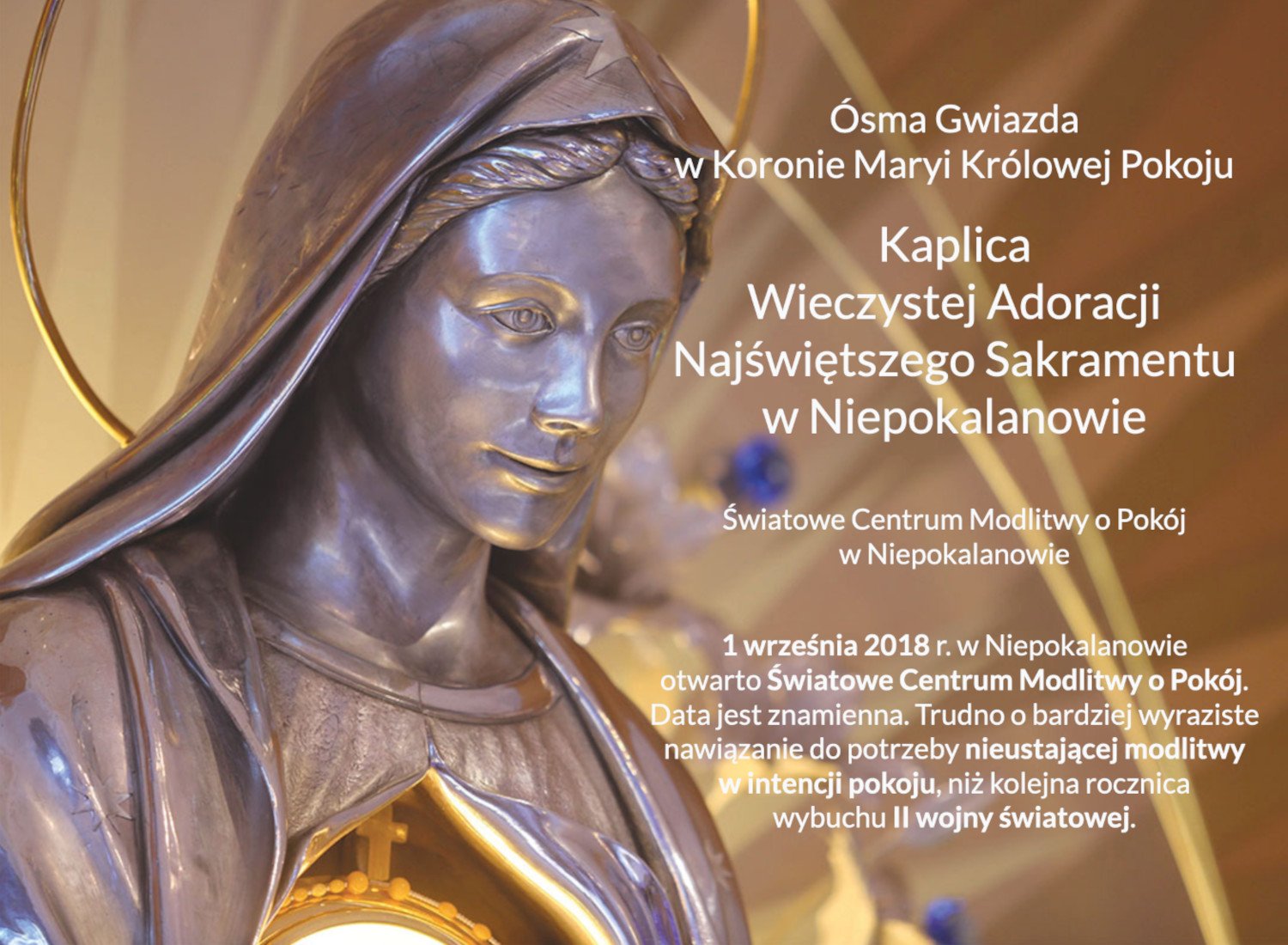

The Eucharistic Adoration Chapel established by Saint Maximilian Kolbe was inaugurated at the outbreak of World War II. It was restored as a Chapel of Adoration in September, 2018, the commemoration of the date that the war began. It is now part of the World Center of Prayer for Peace. The live internet feed of the Adoration Chapel at Niepokalanow — sponsored by EWTN — was established just a few weeks before we discovered it and began to include in at Beyond These Stone Walls. Click “Watch on YouTube” in the lower left corner to see how many people around the world are present there with you. The number appears below the symbol for EWTN.
Click or tap here to proceed to the Adoration Chapel.
The following is a translation from the Polish in the image above: “Eighth Star in the Crown of Mary Queen of Peace” “Chapel of Perpetual Adoration of the Blessed Sacrament at Niepokalanow. World Center of Prayer for Peace.” “On September 1, 2018, the World Center of Prayer for Peace in Niepokalanow was opened. It would be difficult to find a more expressive reference to the need for constant prayer for peace than the anniversary of the outbreak of World War II.”
For the Catholic theology behind this image, visit my post, “The Ark of the Covenant and the Mother of God.”

Fr Georges Lemaître, the Priest Who Discovered the Big Bang
British priest and Oxford physicist Fr Andrew Pinsent shares this amazing post about the origin of the Universe and a stunning connection that struck close to home.

British priest and Oxford physicist Fr Andrew Pinsent shares this amazing post about the origin of the Universe and a stunning connection that struck close to home.
September 1, 2021
Note from Father Gordon MacRae: I am honored to present this guest post by Father Andrew Pinsent, Research Director of the Ian Ramsey Centre for Science and Religion at Oxford University. Formerly a physicist at CERN, Father Andrew now also serves on the Faculty of Theology at Oxford. Father Andrew holds a doctorate degree in particle physics from Oxford, a doctorate in philosophy from St. Louis University, and advanced degrees in theology from the Pontifical Gregorian University in Rome. He is a member of the United Kingdom Institute of Physics, the author of many publications on science and faith, and has appeared on BBC news, EWTN, and at the Vatican conference for scientists.
+ + +
Why should anyone be interested in Fr Georges Lemaître? Here’s one reason. Being both a priest and a former particle physicist at CERN, I am often asked to give talks on faith and science. Quite often young people ask me the following question, “How can you be a priest and believe in the Big Bang?” To which I am delighted to respond, “We invented it! Or more precisely, Fr Georges Lemaître invented the theory that is today called the “Big Bang” and everyone should know about him.”
Here is a little of the historical background. The Belgian priest-astrophysicist Fr Georges Lemaître in 1927 published a paper in the Annals of the Scientific Society of Brussels presenting the idea of an expanding universe. When invited to a meeting of the British Association in London in 1931, on the subject of science and religion, Fr Lemaître proposed that the universe had expanded from an initial point, which he called the ‘Primeval Atom’. In 1949, the astronomer Fred Hoyle described Fr Lemaître’s theory as a ‘Big Bang’. Shortly before Fr Lemaître died in 1966, he learned of the discovery of cosmic microwave background radiation, widely interpreted today as the faint echo of the Big Bang itself. With some modifications, the Big Bang has today become our standard grand narrative for understanding the cosmos.
Given that this history is incontrovertible (see, for example, Helge Kragh, Cosmology and Controversy (Princeton, N.J.: Princeton University Press, 1996)), why then do young people still ask me, “How can you be a priest and believe in the Big Bang?” Many answers could be given in particular cases, but the underlying reason, I think, is that there is another kind of grand narrative at work. Part of that narrative today, absorbed from at least the age of ten in schools and from the media, is that faith is opposed to reason, and the Catholic Church in particular is opposed to science. The fact that a Catholic priest invented the Big Bang theory is therefore what might be called an ‘inconvenient truth’, something that cannot happen and therefore, for all intents and purposes, did not happen. More subtly, some people acknowledge Fr Lemaître’s achievement but deny that any significant implications can be drawn for understanding the relation of faith and science. They point out that his scientific work was distinct from his priesthood or that he is a ‘black swan’ event from which no wider conclusions can be drawn.
Such criticisms, however, overlook the value of the negative conclusion, namely that faith and revolutionary brilliance in science were clearly not incompatible in Fr Lemaître’s life, and perhaps that there are more ‘black swans’ waiting to be rescued from neglect. Moreover, even an appreciation of the extent to which Fr Lemaître is overlooked can serve as a catalyst for a broader re-examination of cultural prejudices regarding faith and science. For example, did the Catholic Church oppose the Big Bang theory? Was Fr Lemaître exiled or disgraced? No! Fr Lemaître was honoured by the Pope, who appointed him to the Pontifical Academy of Sciences in 1936. Did atheists welcome the Big Bang theory? No, or at least many did not for a surprisingly long time! As late as 1948, at a meeting in Leningrad, Soviet astronomers affirmed the need to fight against the ‘reactionary-idealistic’ theory of a ‘primeval atom,’ (i.e. the Big Bang) support for which, it was claimed, would help ‘clericalism’ (see Kragh, p. 262).
Such opponents saw, perhaps more clearly than we do today, that although aspects of the cosmos can be modelled by mathematics, to consider the formation and evolution of the cosmos as a whole requires taking up a God-like perspective in our imaginations, an implicitly hazardous prospect (at least at first) for the materialist or physicalist. Furthermore, to explore the origins, structure and evolution of the cosmos with the expectation of discerning knowable order is a habit born out of patterns of thinking shaped over centuries by the revelation of a Creator God of reason and love. As early as the first Christian century, we find, for example, Pope St Clement I referring to the sun, moon, and stars being “…put in motion by his [God’s] appointment … in harmony and without any violation of order …” (Epistle of Pope Clement I to the Corinthians, 19:2 - 20:12 (trans. C. Hoole)), a narrative of order and love that has shaped the expectations of our culture regarding the possibility and value of cosmology.
What, then, is to be done to help raise the profile of people like Fr Georges Lemaître? Among Catholics with some kind of popular outreach, Fr Gordon MacRae through his widely-read blog BTSW has done more than almost anyone I know in recent years to draw attention to Fr Lemaître. Inspired in part by Fr Gordon’s work, my colleagues and I in England have now put together some high quality laminated A3 posters that we can send worldwide in a series called the “Catholic Knowledge Network”. A copy of the A3 poster for Fr Lemaître is shown at the bottom of this post. If you would like to purchase these beautiful posters (for education institutions, parish halls, classrooms, and other public spaces), please do so from our publisher, the Catholic Truth Society in London, from where they can be sent worldwide.
As a regular reader of Beyond These Stone Walls and a contributor, I thank him for this opportunity and for the remarkable worldwide impact of his blog. I also thank those who edit and maintain this blog on his behalf.
Fr Andrew Pinsent
Theology and Religion Faculty
Oxford University

Two Phenomenal Postscripts from Fr Gordon MacRae
I am indebted to Father Andrew Pinsent for the above post. After he wrote it, I came across two discoveries related to it that I thought were phenomenal. The first is an excerpt from Einstein’s Heroes: Imagining the World Through the Language of Mathematics (Oxford University Press, 2005), a wondrous book by a brilliant mathematician, Robyn Arianrhod:
“In 1931, [Georges] Lemaitre formally sowed the seeds of the Big Bang theory when he suggested the universe had started as an explosion of a ‘primeval atom,’ and that it had continued expanding from that explosive beginning .... [From] Einstein’s equation [he] predicted the universe had expanded not from a tiny piece of matter located in an otherwise empty cosmos, but from a single point in four-dimensional space-time .... Before this point, about thirteen billion years ago, there was no time and no space. No geometry, no matter, nothing. The universe simply appeared out of nowhere. Out of nothing.”
“The Universe simply appeared out of nowhere. Out of nothing.” This is the conclusion of modern cosmology that began with the work of another brilliant mathematician-physicist, Fr. Georges Lemaître. If you wonder about the relevance of faith in the scientific world, you may be surprised to learn that science is using some of the same concepts as the Catechism of the Catho1ic Church to describe the origin of a created universe:
“God created the universe out of nothing.” — CCC 290
“We believe that God needs no pre-existent thing or any help in order to create. God created freely out of nothing." — CCC 296
“God said, ‘let there be light,’ and there was light” (Genesis 1:4). Scripture bears witness to faith in creation ‘out of nothing’ as a truth filled with promise and hope.” — CCC 297
“Since God created everything out of nothing, He can also, through the Holy Spirit, give spiritual life to sinners by creating a pure heart in them, and bodily life to the dead through the Resurrection.” — CCC 298
As Father Andrew Pinsent described, the cosmic background radiation left by the Big Bang was first detected and identified in 1965 by American astrophysicists, Arno Penzias and Robert Wilson. Father Lemaître died one year later having witnessed the final acceptance by science of the truth of his discovery about the origin of the created universe.
Between 1989 and 1993, NASA’s Cosmic Background Explorer (COBE) spacecraft mapped the cosmic background radiation. It verified that the distribution of intensity of the background radiation precisely matched that of matter that emits radiation because of its temperature, as also predicted by Father Lemaître’s Big Bang theory. For the science of cosmology, the created universe, which Father Georges Lemaître said began ‘On a Day without Yesterday,’ is no longer a theory. I hope you will read anew and share my first post about the Father of the Big Bang and Modern Cosmology, “A Day Without Yesterday: Fr Georges Lemaître and the Big Bang.”

My second postscript to Father Andrew Pinsent’s article above is more personal, but just as phenomenal. After we both posted our respective articles about Father Georges Lemaître, I received a letter from Belgium where Father Lemaître had long ago taught at the University of Louvain. The letter was written from Pornchai Moontri’s Godfather, Pierre Matthews, who read both posts. His letter revealed something astonishing, something that seems as much the work of the Hand of God as the Big Bang itself.
It turns out that Fr Georges Lemaître, Father of the Big Bang and modern cosmology, was the Godfather of Pornchai Moontri’s Godfather. The photograph above depicts Pierre’s family with Fr. Lemaître and his mother on holiday at Lake Luzern, Switzerland. That’s 14-year-old Pierre just behind and to the left of Father Lemaître. Pierre’s sister and mother are to the right of Father Lemaître’s mother. In his letter with the photo Pierre wrote:
“My mother and Fr. Lemaître were both born in the same little town, Marcinelle, in Belgium. My maternal grandparents and Fr. Lemaître’s parents were close friends so my mother grew up with Georges Lemaître. He was as an uncle to me. In the summer of 1954, as the photo depicts, we spent four weeks together at the shore of Lake Luzern, Switzerland. I thought you and Pornchai might like to have this photograph.”
It was the understatement of the year. Pierre Matthews passed away in 2020 just as his Godson, Pornchai, regained his freedom.
+ + +
Note from Father Gordon MacRae: I don’t know about you, but I needed a break from all the drama of my last several posts. Thank you for reading Fr Andrew Pinsent’s guest post and my postscript. They will be placed in our newest BTSW Library category, “Science and Faith.”
Please “Subscribe” to Beyond These Stone Walls if you have not done so already, and please visit our “Special Events” page. You may also like these related posts:
“A Day Without Yesterday:” Fr Georges Lemaitre and the Big Bang

Father Andrew Pinsent