“There are few authentic prophetic voices among us, guiding truth-seekers along the right path. Among them is Fr. Gordon MacRae, a mighty voice in the prison tradition of John the Baptist, Maximilian Kolbe, Alfred Delp, SJ, and Dietrich Bonhoeffer.”
— Deacon David Jones
Saint Maximilian Kolbe is the Man in the Mirror
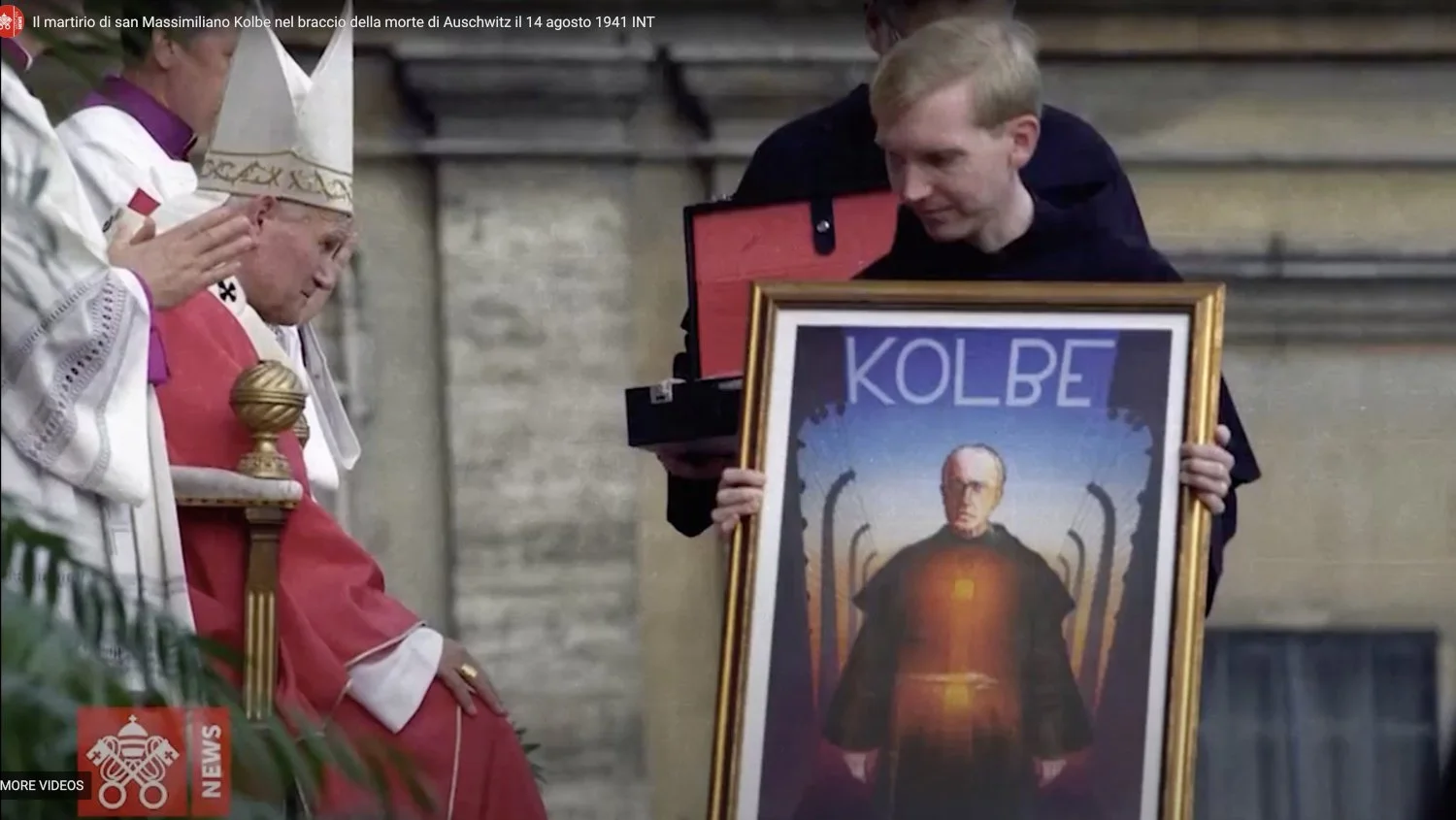
At the canonization of St Maximilian Kolbe, Pope John Paul II was gifted with a portrait of the new saint by Fr James McCurry, a friend of Beyond These Stone Walls.
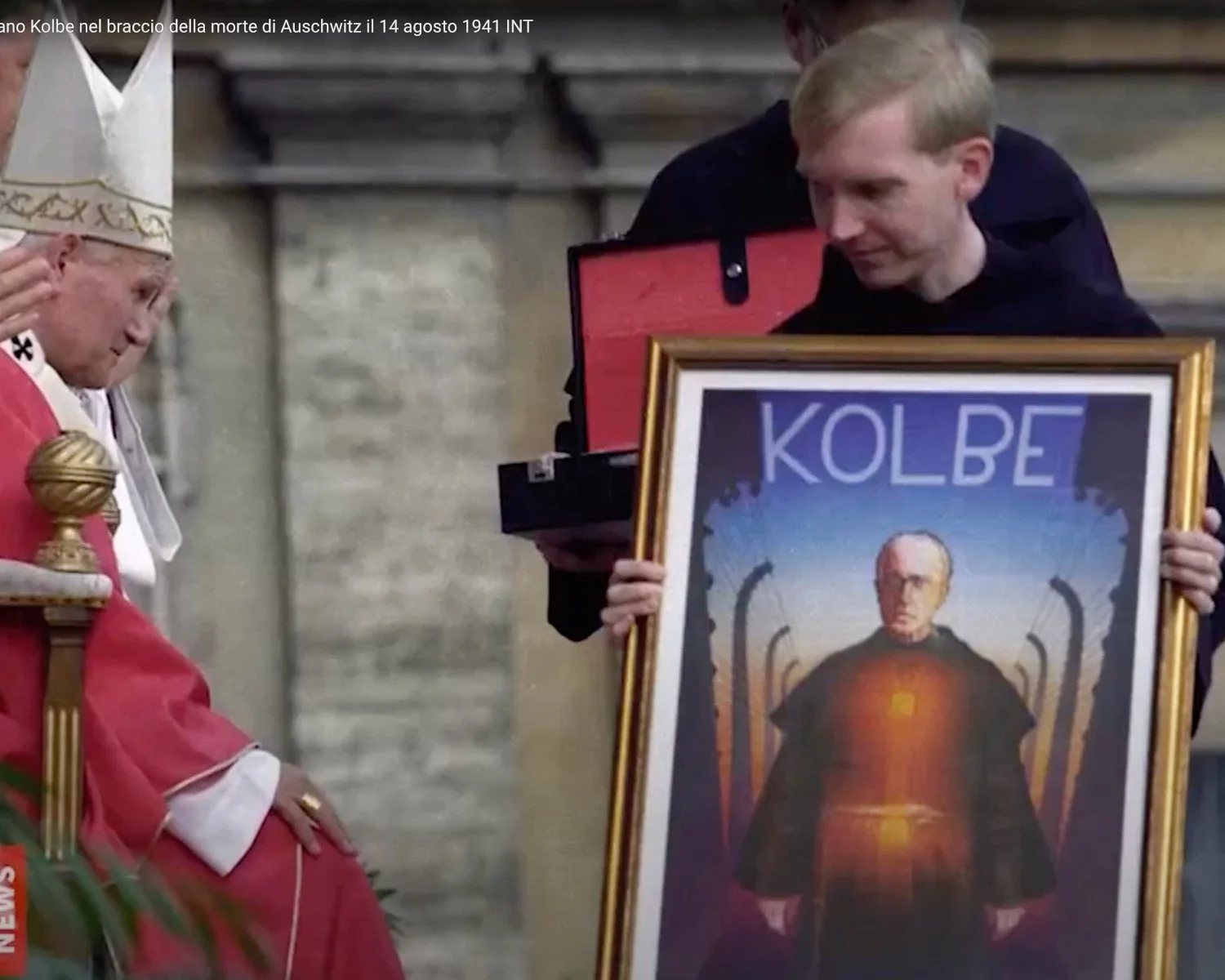
At the canonization of St Maximilian Kolbe, Pope John Paul II was gifted with a portrait of the new saint by Fr James McCurry, a friend of Beyond These Stone Walls.
August 12, 2026 by Father Gordon MacRae
As many of our readers know, this blog began early in the month of August in 2009. It came into being as a result of a phone call to Australia. The person I called in Sydney had read an article I wrote for Catalyst, the Journal of the Catholic League for Religious and Civil Rights. It was her daunting suggestion that I write a blog that would be published weekly from prison. I had no idea then how that could happen. I had already been in prison for 15 years then, and Pornchai Moontri had already been my roommate for two years.
So after my phone call to Australia, I returned to our cell and told Pornchai what had been suggested to me. Neither of us knew what a blog was. They did not exist when we first went to prison. But I told Pornchai of what had been described to me: that this could be our voice to the world from behind these prison walls. Neither of us were taking this seriously, but I asked Pornchai that if I went ahead with this project, what should I call it? He immediately suggested “These Stone Walls.”
I wrote a weekly post from 2009 to 2020 when somehow this blog ran into a wall of resistance. It had to be taken down and started anew. Both Pornchai and I thought it was the end of our voice in the wilderness, but just weeks later in September 2020 it was restored with a new name: Beyond These Stone Walls. It also had a new editor, and in the same week that all of this happened, Pornchai was taken away on September 8, 2020, at 5 AM. He was taken for ICE detention (Immigration and Customs Enforcement) where he prepared for his deportation to Thailand after 36 years in the U.S., 30 of them in prison. I wrote at the time of all that we had been facing in a widely acclaimed post, “Life Goes On Behind and Beyond These Stone Walls.”
Since then another six years have passed. Pornchai has been back in Thailand for six years at this writing, and I have now been writing these weekly posts for 17 years. At this time each year Pornchai and I both honor our patron saint, Maximilian Kolbe, who surrendered his life at Auschwitz to save the life of another prisoner.
What follows are the first three posts ever written for this blog. I think you will see why we combined them to publish anew here this month.
+ + +
St. Maximilian Kolbe and the Man in the Mirror
First published August 2009.
For someone on the outside looking in, it must seem an odd place to begin. Virtually every prison cell has one: a small stainless steel sink with a matching toilet welded to its side. Bolted to the cinderblock wall just above it is a small stainless steel mirror, dinged, dented, and scraped so badly that the image it reflects is unrecognizable.
I began each day in prison at the break of dawn by shaving in front of that mirror. That morning ritual had been repeated 5,412 times [when I first wrote of it in 2009. At this writing, I have been here for 11,750 days, but I no longer shave in front of that mirror. Rules for shaving changed sometime back. I now keep a close-cropped white beard, somewhat like the one Sean Connery wore, but without his cool Scottish accent.] Back then, I seldom cut myself shaving — a minor miracle as I could see very little of my self in that mirror. I often think of St. Paul’s cryptic image in his first letter to the Church in Corinth (13:12): “For now I see dimly, as in a mirror, but then I shall see face to face.” It is a hopeful image.
I sometimes find that my mind calculates dates and their meanings on a sort of autopilot. There came a day when I stood at the mirror to shave and realized that on that day — it was December 23, 2006 — I had been a priest in prison for the exact amount of time that I was a priest “on the streets” as prisoners like to describe their lives before prison.
From that day until now, I wonder which I see more of in that flawed mirror. Do I see the man who is a priest of 27 years? [Now 44 years] Or do I see only Prisoner 67546, the identity imposed upon me behind prison walls?
A strange thing happened on the day after I first reflected — as best I could in that mirror — on who I see. It was Christmas Eve, December 24, 2006, the day that the equation changed. It was the day that I was a priest in prison longer than anywhere else. That night at prison mail call, I had a few Christmas cards. One of them was from Father James McCurry, a Conventual Franciscan priest who once visited me in prison.
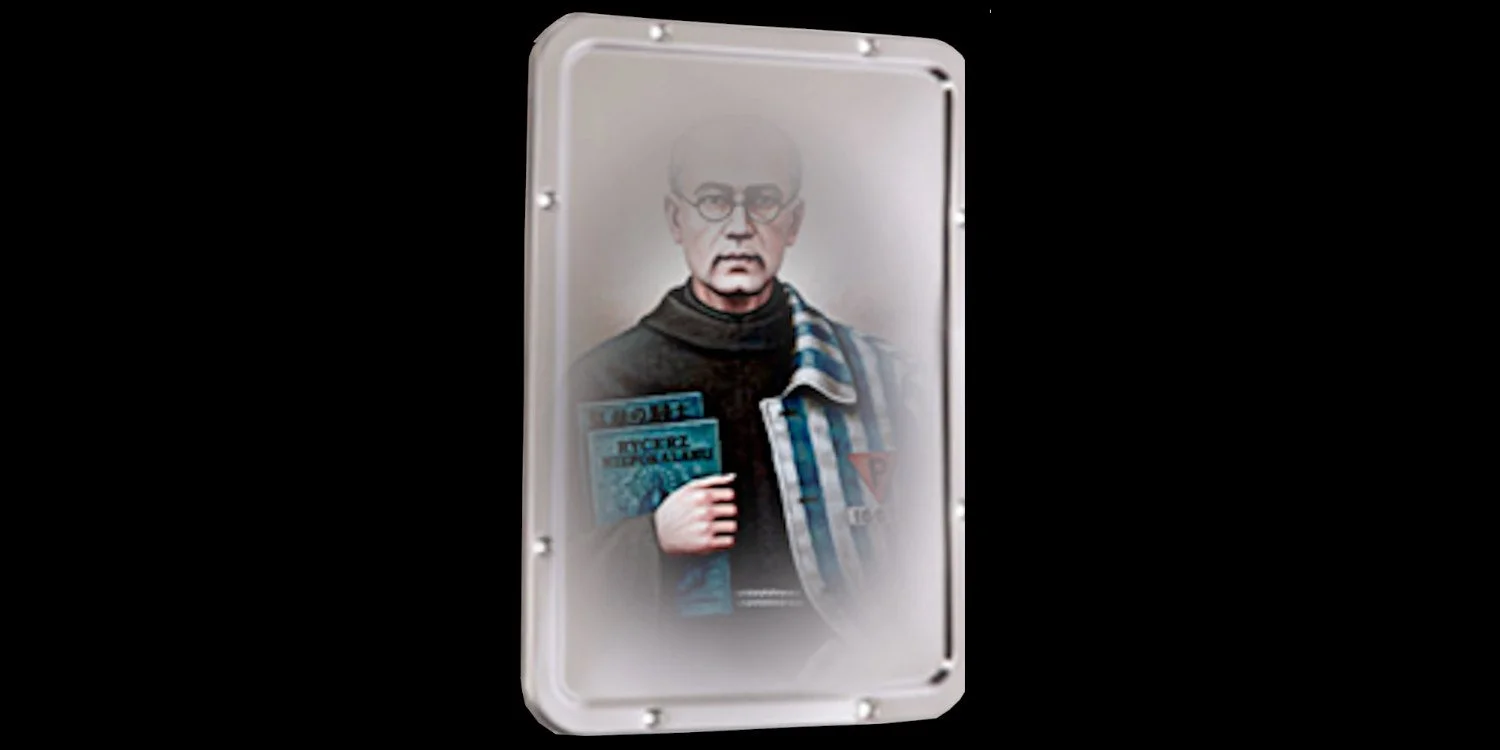
Inside Father McCurry’s Christmas card was a prayer card that is now one of my enduring treasures. It is taped to the stone wall just above the mirror in my cell and has been there ever since. In later years I was moved to other places, but the card always came with me. The holy card has an image of St. Maximilian Kolbe who offered himself for execution by starvation in place of another prisoner in Auschwitz in 1941. The card depicts Father Kolbe in his Conventual Franciscan habit. He has one sleeve in the striped jacket of his prison uniform with the number 16670 emblazoned across it. There is a scarlet “P” above the number indicating his Polish nationality. He was also a priest and a falsely accused prisoner. Does either designation extinguish the other? Father Kolbe is at once both, though only one identity was chosen by him.
The image is a haunting image for it captures fully that struggle I have so keenly felt. Father Maximilian appeared in my cell just a day after I asked the question of myself. Who am I? I thought at the time, that it was a rhetorical question, but it was a prayer. As such, it begged a reply — and got one.
Saint Maximilian and This Man’s Search for Meaning
Not long after that card first arrived, so did my friend Pornchai Moontri. He had just spent 13 years in solitary confinement in the Maine State Prison since he was age 18. When they could no longer hold him in the cruelty of such a place, they sent him here where he ended up with me. On the day he arrived in my cell, he dropped his trash bag of belongings, stared at the image above the mirror and asked, “Is this you?” That, too, was not a rhetorical question.
How I came to be in this prison is a story told elsewhere, by me and by others. How I “met” Father Maximilian Kolbe 60 years after he surrendered his life at Auschwitz is a story about actual grace. In his Catholic Catechism, Jesuit Father John Hardon defined actual grace as God’s gift of “the special assistance we need to guide the mind and inspire the will” on our path to God. Sometimes, it is very special.
My first years in prison are a blur in my memory. There is no point trying to find words to express the sense of loss, of alienation, of being cast into a dark abyss that was not of my own making — a loss that could not be grounded in any reality of my own. Thousands of days and nights had passed in the abyss before what Father Hardon described as “special assistance” crossed my path.
Someone, somewhere — I don’t know who — sent the prison’s Catholic chaplain (a layman then) a book entitled Man’s Search for Meaning by Viktor Frankl, M.D. Somewhere in my studies, I heard of this book, but only a prisoner can read it in the same light in which it is written. The chaplain called me to his office. He wanted to know whether he should recommend this book, but didn’t have time to read it. He wanted my opinion.
It had been years since anyone had asked my opinion on anything. I didn’t read Dr. Frankl’s book so much as devour it. I read it through three times in seven days. As a priest, I often counseled others that grace is a process and not an event. It is not always so. I was meant to read Man’s Search for Meaning at the precise moment that it landed upon my path. A week earlier, I would not have been ready. A week later may have been too late.
I was drowning in a solitary sea of hopelessness. I was not going to make it across. My priesthood and my soul were dying. The Book, as I have come to call it, is Viktor Frankl’s vivid account of how he alone among his family survived imprisonment in Auschwitz. This was an imprisonment imposed on him for who he was: a Jew.
There is a central message in this small book. A profound message, so clear in meaning, that it has within it the hallmark of inspired truth. Like Saul thrown from his mount, I remember sinking to the floor when I read it.
“There is a freedom that no one can ever take from you: The freedom to choose the person you are going to be in any set of circumstances.”
This changed everything. Everything! You will see how later. At the very end of his book, Dr. Frankl revealed the name of his inspiration for surviving Auschwitz. He wrote of Sigmund Freud’s cynical view that man is self-serving. And a man’s instinctual need to survive will trump “quaint notions” such as grace and sacrifice every time. For Dr. Frankl, Auschwitz provided the proof that Freud was wrong.
That proof was Father Maximilian Kolbe.
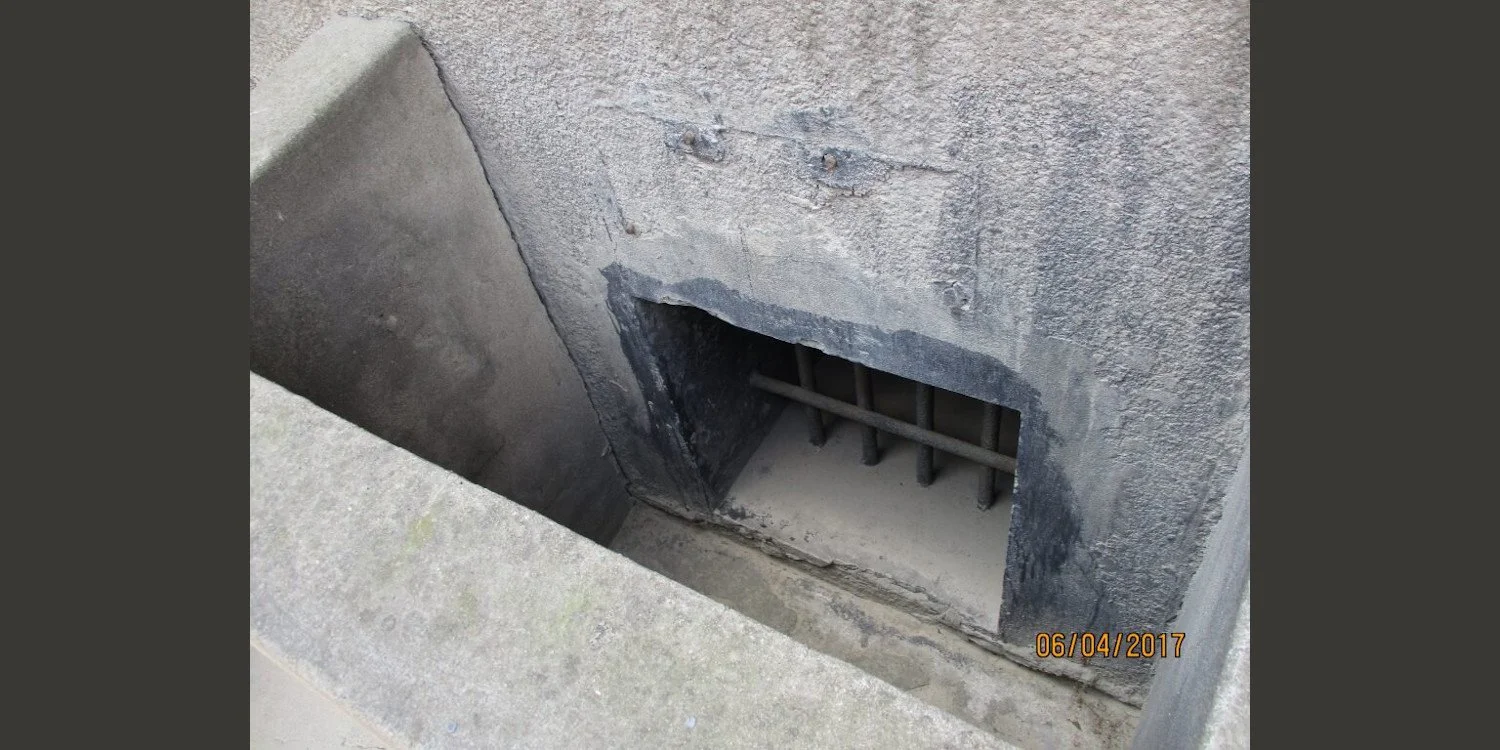
The Sacrifice of Saint Maximilian
“Greater love has no man than this: that a man lay down his life for another.”
— John 15:13
As a young priest in 1982, I was only vaguely familiar with the name Maximilian Kolbe. I remember reading of his canonization by Pope John Paul II, but Father Kolbe’s world was far removed from my modern suburban priesthood. I was far too busy to step into it.
I didn’t know that nearly two decades later, Father Kolbe’s life, death, and sainthood would be proclaimed triumphantly on the wall of my prison cell, and not only by me. I also didn’t know this would help define the person I choose to be in prison.
Being a Jew and not a Catholic, Dr. Viktor Frankl in Man’s Search for Meaning, said nothing about Maximilian’s sainthood or any miracles attributed to his intercession. Instead, Dr. Frankl was moved by the profound sacrifice of Maximilian, which defies the narcissism of our times.
For those unfamiliar with him, the story is simple.
The prisoners of Auschwitz were packed into bunkers like cattle. To encourage informants, the camp had a policy that if any prisoner escaped, 10 others would be randomly chosen for summary execution.
At the morning roll call one day, a prisoner from Maximilian’s bunker was missing. Guards chose 10 men to be executed. The 10th fell to the ground and cried for the wife and children he would never see again. Father Kolbe spontaneously stepped forward and said,
“I am a Catholic priest, and I would like to take the place of this man.”
Two weeks later, he alone was still alive among the 10 prisoners chained and condemned to starvation. Maximilian was injected with carbolic acid on August 14, 1941, and his remains unceremoniously incinerated.
For the unbeliever, all that Maximilian was went up in smoke and ash in the bleak sky above Auschwitz. Viktor Frankl shared some other corner of that horrific prison. The story of the person Father Kolbe chose to be rippled through the camp. This story offered proof to Viktor Frankl that we can be as much inspired by grace as doomed by despair. We get to choose which will define us.
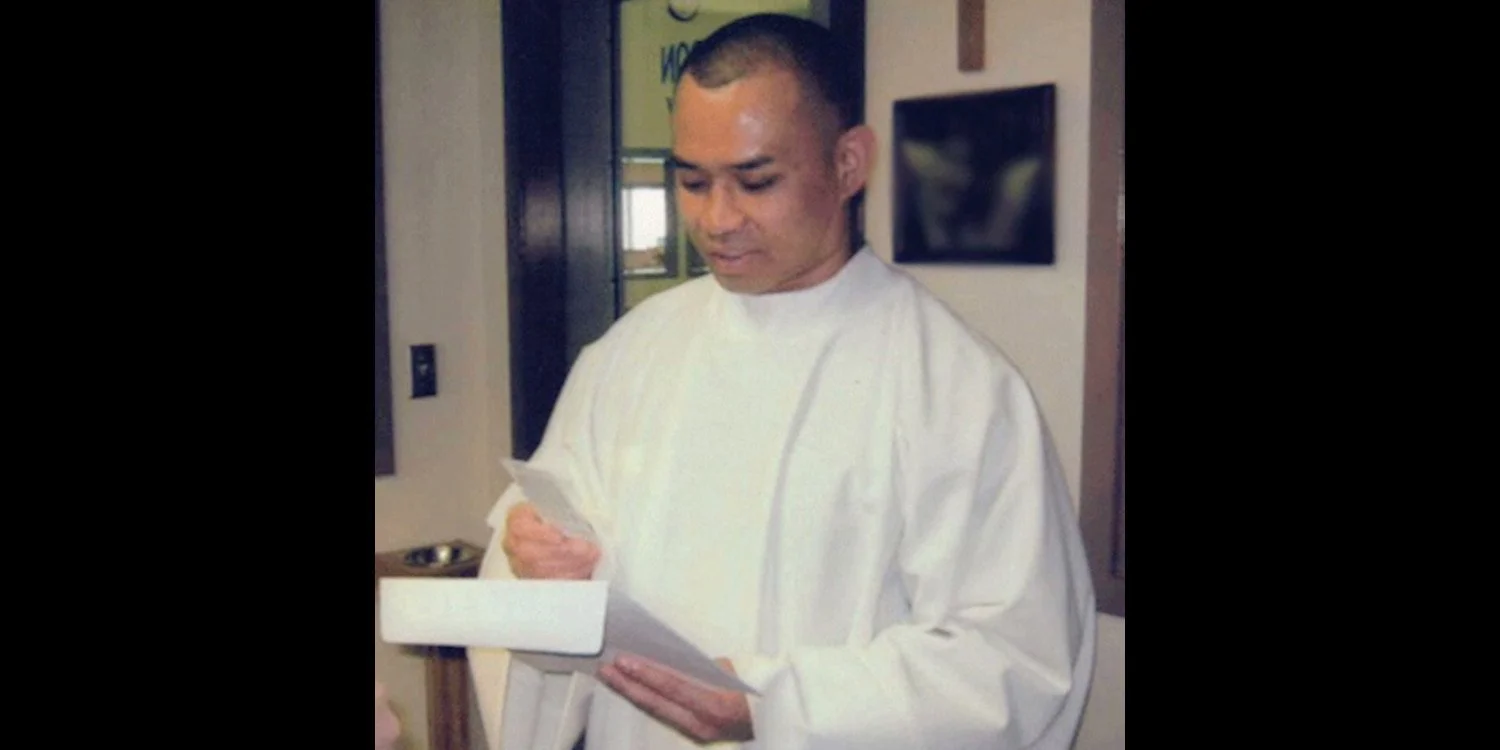
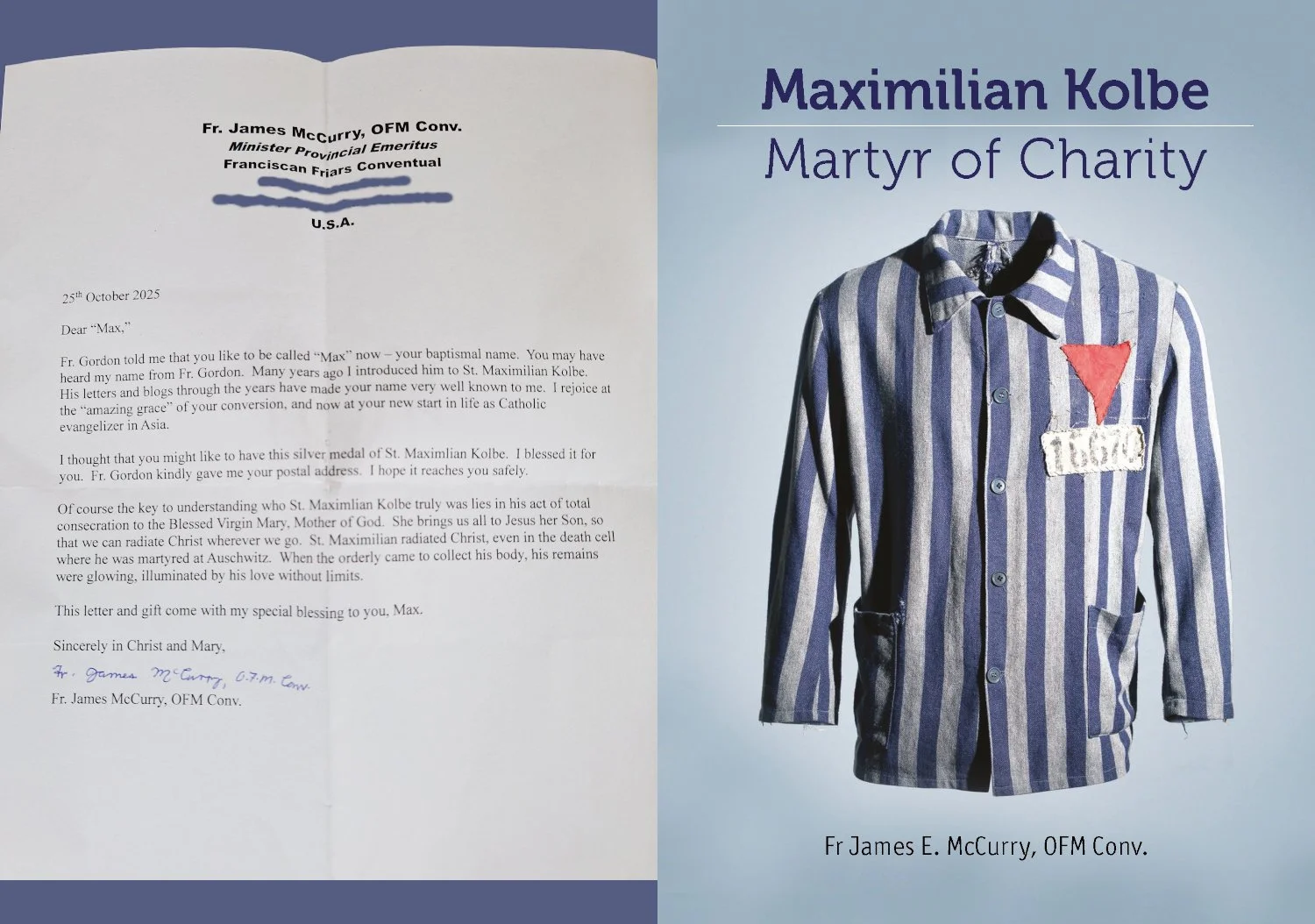
Within days of reading Man’s Search for Meaning and learning of Father Kolbe’s sacrifice, I received a letter from out of the blue. Conventual Franciscan Father James McCurry had been in an airport in Ireland when he heard an Irish priest nearby mention that he corresponds with a priest in a Concord, New Hampshire prison. Father McCurry said he was on his way to visit his order’s house in Granby, Massachusetts and would arrange to visit the Concord prison.
Weeks later, Father McCurry and I met in the prison visiting room. When I asked him what his “assignment” is, he said,
“Well I just finished a biography of St. Maximilian Kolbe. Have you heard of him?”
Father McCurry went on to say that he was involved in Father Maximilian’s Cause for Sainthood, and was officially appointed by the Vatican to be Vice-Postulator for Maximilian’s Cause. He had met the man whose life was saved by Father Kolbe.
A few years later, Father McCurry arranged a Father Maximilian Kolbe exhibit at the National Holocaust Museum. It was then that he sent me the card depicting Father Maximilian clothed in his Franciscan habit with one sleeve in his prison uniform. I keep the card above my mirror in my cell.
I can never embrace these stone walls. I can’t claim ownership of them. Passively acceding to injustice anywhere contributes to injustice everywhere. Father Maximilian never approved of Auschwitz.
One cannot understand how I now respond to these stone walls, however, without hearing of Father Maximilian’s presence here.
Above my mirror, he refocused my hope in the light of Christ. The darkness can never overcome it.
What hope and freedom there is in that fact! The darkness can never, ever, ever overcome it!
+ + +
Note from Father Gordon MacRae: I will be offering Mass late at night on August 14, the Feast of Saint Maximilian Kolbe, which is also the Vigil of the Solemnity of the Assumption of Mary, his Immaculata and ours. Regarding the letter from Father James McCurry at the end of this post, I only just now realized that it had not come to me from our editor; rather, Father McCurry sent it by U.S. mail to Pornchai Maximilian in Thailand, where it arrived after weeks with all its wrinkles still intact. Pornchai was so proud of it that he quickly took a photo and mailed it to me in prison.
You may also like these related posts in honor of our Patron Saint:
Saint Maximilian Kolbe’s Gift of Noble Defiance
The Assumption of Mary and the Assent of Saint Maximilian Kolbe