“There are few authentic prophetic voices among us, guiding truth-seekers along the right path. Among them is Fr. Gordon MacRae, a mighty voice in the prison tradition of John the Baptist, Maximilian Kolbe, Alfred Delp, SJ, and Dietrich Bonhoeffer.”
— Deacon David Jones
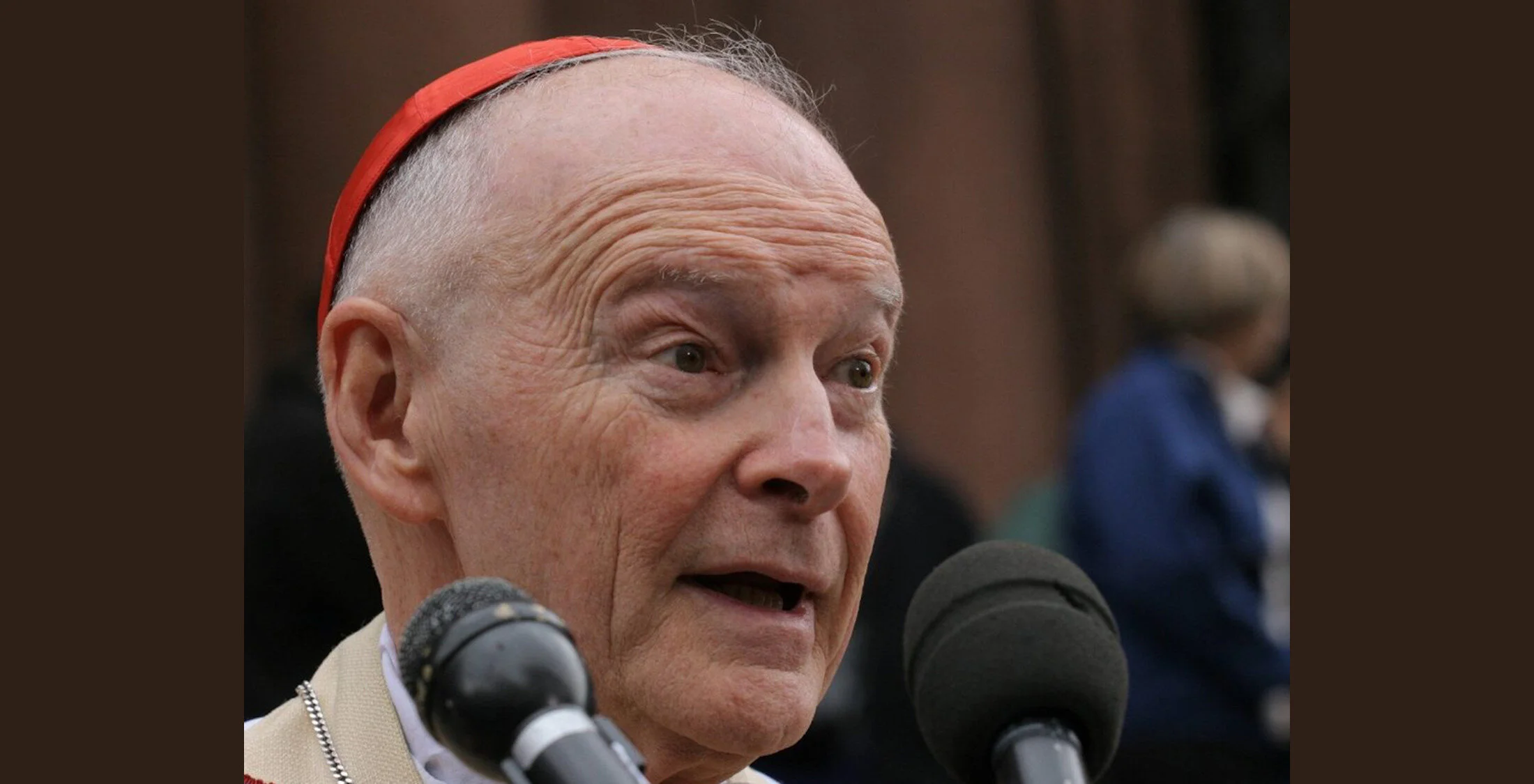
Cardinal Theodore McCarrick and the Homosexual Matrix
A claim that the former Archbishop of Washington, DC sexually assaulted a New York 16-year-old in 1971 is weighed against a broader spectrum of homosexual behaviors.

A claim that the former Archbishop of Washington, DC sexually assaulted a New York 16-year-old in 1971 is weighed against a broader spectrum of homosexual behaviors.
Now that President Donald Trump has nominated Brett Kavanaugh, a respected Constitutional scholar and devout Catholic to the U.S. Supreme Court, we can expect some anti-Catholic rhetoric in months to come. In a recent Wall Street Journal op-ed about one of the other finalists (“Inside Amy Coney Barrett’s Cult,” WSJ, July 7, 2018), I wrote this comment for the WSJ Online edition:
“The greatest tragedy to befall the Catholic Church in America was to accommodate itself too much to the culture in which it lives. Its leaders became comfortable in America, then amassed power, and then tried to hide the corruption that always accompanies the need to retain power. But the humbling of Catholic leaders has run its course, and now, from the bottom of pop culture popularity, it is time to come back swinging.
Imagine the outcries if Islamic or Jewish nominees to the Supreme Court were publicly discredited by Senator Dianne Feinstein for actually living and believing the faith they profess. It is time for Catholic leaders to reconnect with their spines. This disdain for authentic Catholicism in America was brought to the fore when “Wikileaks Found Catholics in the Basket of Deplorables.”
It was premature of me to write, “But the humbling of Catholic leaders has run its course….” Immediately after I wrote it, news surfaced that Cardinal Theodore McCarrick, former Archbishop of Washington, DC, was accused in what is described as a “credible and substantiated” claim of sexual abuse of a 16-year-old male.
My first thought was, “How can I possibly write about this?” How can I not write about it? This story has been the elephant in the sacristy for weeks. Cardinal Theodore McCarrick, age 88, has been accused of groping a 16-year-old boy in the sacristy of St. Patrick’s Cathedral in New York City when he was a priest in that archdiocese in 1971, long before he became a bishop.
But before anyone recoils in horror, the story needs a dose of perspective. I tried to bring some of that perspective in a comment on “McCarrick Accused,” a news story by Joan Frawley Desmond, a Senior Editor for the National Catholic Register.
The Register article raised many questions about who knew what and when in ‘the Cardinal McCarrick story, including whether his alleged homosexual predation was known to Pope John Paul II before McCarrick was appointed Archbishop of Washington and elevated to Cardinal. Here is my comment on that article:
“There can be no transparency on this topic as long as its cast of characters continues to wield the sex abuse story as a weapon in support of varying agendas. I have several issues with this story:
1) It is nearly a half-century old. Does anyone wonder why it surfaces only now just as a new conservative nominee to the Supreme Court is about to be named? What better way to stifle a Catholic voice than a renewed sex abuse scandal?
2) I was a first-year seminarian forty years ago and heard many stories about the homosexual exploits of then Bishop McCarrick. The stories were not passed around by seminarians who saw themselves as victims, but by young gay men who boasted of currying narcissistic favor with a bishop. I knew decades ago that Cardinal McCarrick had been strongly advised by the Apostolic Nuncio to sell his scandalous beach house.
3) There is no reason at all to believe that Pope John Paul II knew about any of this before elevating McCarrick to Cardinal Archbishop of Washington. The U.S. bishops treated this story with a wink and a nod for years and had each others’ backs.
4) What makes this newest claim of a minor “credible and substantiated?” He is not 16. He is 63, and McCarrick denies it. By what magic is this 47-year-old claim of groping “substantiated?”
5) And lastly, the BIG question: Why would American Catholic leaders go to such extreme lengths for so long to shield homosexual priests from being implicated in The Scandal? It is a monument to the power of reaction formation [a classic Freudian defense mechanism] when an entire institution prefers the term “pedophile scandal” to “homosexual scandal” even when the facts say otherwise.”

The Mirror of Justice Cracked
One of the many stinging rebukes of both Cardinal McCarrick and the American church coming out of this story was by Anthony Esolan in “Vesting in Lavender,” a blog post for The Catholic Thing. Professor Esolan wrote:
“And now this, about Cardinal McCarrick. The cardinal, choosing his words precisely, says he has no memory of ever having engaged in the sexual abuse of the erstwhile young man [who happens to be 63] who is now accusing him…
The cardinal has cautiously denied one sin, while not bothering to address the thousand others. For all these years, according to witnesses at last speaking out, he has been vesting in lavender, compromising young men in his charge… He has pointedly not said, ‘I have never had sexual relations with a seminarian or a priest.’”
Apologies to Anthony Esolan whom I much respect, but all I could think of when reading this was President Bill Clinton’s famous obfuscation, “I did not have sexual relations with that woman!” (referring to Monica Lewinski), and his later, more measured response, “It depends on what you mean by sex.”
We, too, must choose our words carefully. A man accused of a crime — like the sexual abuse of a 16-year-old — must be judged on the evidence of the crime and not on his reputation. This is why our legal system has so-called “rape shield laws.” A woman who is a victim of assault is protected from having her sexual history placed on trial. The same must be true of a defendant.
Cardinal McCarrick will not be a defendant in this story. There will be no trial of facts because American criminal law does not allow for one 47 years after such an offense was alleged to have happened. But there will be a canonical procedure because “prescription,” canon law’s version of a statute of limitations, was dispensed with after the U.S. Bishops’ “Dallas Charter.”
It’s ironic that Cardinal McCarrick was one of the Dallas Charter’s main proponents pushing it through. “Zero tolerance” and the due process rights that the Charter has so severely eroded for a multitude of accused priests will now also apply to Cardinal McCarrick. We learned a lot about the flaws in that process in Father Stuart MacDonald’s recent very popular post, “Last Rights: Canon Law in a Mirror of Justice Cracked.”
Nonetheless, Cardinal McCarrick should still be due the rights that have been denied to others. One canon lawyer who read my comment in the Register sent me a message thanking me for it adding, “Your point number four should be shouted from the rooftops again and again.” Let me reiterate point number four:
“What makes this newest claim of a minor ‘credible and substantiated?’ He is not 16. He is 63, and McCarrick denies it. By what magic is this 47-year-old claim of groping ‘substantiated?’”
I do not think that we should be so quick to accept that this is “credible and substantiated” as claimed. The 197l claim surfaced for the first time only after the Archdiocese of New York announced the existence of a fund to compensate victims of sexual abuse related to the ministry of the Archdiocese. There was a time when possible financial motives for bringing such claims were examined in a critical light.
The person who brought this claim — after waiting 47 years — is not 16 years old. He is 63. Additionally, the claim is unlike every other claim of homosexual misconduct now alleged against Cardinal McCarrick. This claim alleges force and a story that the unnamed victim had to “fight off” an alleged second assault in the sacristy of one of the busiest cathedrals on the planet.
It is also important to understand what the bishops and their Dallas Charter now mean by “credible.” It is not nearly the same “reasonable doubt” standard that should (but isn’t always) be present in a criminal trial. “Credible” simply means that it cannot immediately be disproven. If the young man lived in NYC at age 16 and did attend a specific Catholic school, then the claims could have happened. “Credible” means no more than that.
“Substantiated” is a very different standard. It requires (or at least should require) an admission of the accused. Cardinal McCarrick vehemently denies this claim. Or it should require the statement of a corroborating witness. If there is one, why would it take 47 years for that person to come forward? And why would the integrity of this snippet of memory be accepted at face value? This is why statutes of limitations exist in legal systems. They exist to promote justice, not defy it.
None of the above means that Cardinal McCarrick is not culpable for the much broader history now being claimed of him in light of this incident from nearly a half-century ago. My issue with this is that the claims are presented as though they have only now surfaced. These claims are not newly discovered.. There is nothing new here. For decades, McCarrick had been rumored to be involved in grooming seminarians and others, casting suspicion on his own sexuality. I will return to this in a moment.

The Homosexual Matrix
In a coming post, I plan to write about some recent statements of Pope Francis and his supposedly “progressive” views. For now, I want to point out something that he recently said that was about as counter-progressive as a pope could get. The news media played this down to the point of ignoring it, but Pope Francis has said something revolutionary about homosexuality and the priesthood.
He told the Italian bishops in May that they should not accept seminary candidates who exhibit same-sex attraction because “it could end in scandal.” It amazes me that the news media would hype Amoris laetitia and its suggestion of a dialog on reception of the Eucharist for those in an invalid marriage while keeping a media blackout about his statements on same-sex marriage and barring homosexual candidates from priesthood.
Prior to my current state in life, I served as Director of Admissions for a residential center that provided spiritual rehabilitation and psychological care for priests, brothers, and seminarians. The facility and its sponsoring religious order, the Servants of the Paraclete, were a profound source of good in the lives of many wounded priests.
I hope it no longer comes as a shock that there are indeed Catholic priests who have experienced same-sex attraction. Along with other conditions with the potential to compromise ministry and fidelity to priesthood, many of them had come to face this openly, and for the first time in their lives, under the care of the Servants of the Paraclete.
No one in that setting promoted homosexuality. No one condoned it. There was no “wink and nod” or looking the other way. Fidelity to the Church’s teaching was upheld and embraced while also embracing the human realities and limits we all face and cope with. Our shared inability to live an ideal is never an excuse for disposing of the ideal.
I think most Catholics are beyond feeling scandalized by the mere existence of same-sex attraction in the life of a priest. I remember being told by one priest that he could not bear the shock of others in his life learning of this. I told him that the real shock may be his revelation to them that he thought they did not already know.
For many of these men, this aspect of themselves existed only in the internal forum, wrestled with by their consciences but not involving what anyone could call a “lifestyle.” Many of these priests sought out spiritual and psychological support to address this because of their fidelity, not in spite of it.
What we tried to convey, and helped them to apply, was their responsibility for discerning and maintaining the boundaries — physical, psychological, and spiritual — between having such an attraction and acting upon it. It was my position, and a well-received one, that heterosexual priests had to discern and maintain those very same boundaries. Celibacy and other requirements of priesthood are not dispensable options.
Some priests and seminarians struggle with same-sex attraction, and those who are spiritually strengthened by their own struggle can be fine priests who live celibate lives with accountability and transparency. But I have also encountered another condition among many — but certainly not all — homosexual seminarians and priests. I found the prevalence of narcissistic personality disorder among them to be inordinately high. Perhaps it is inordinately high in the wider “gay community” as well.
I believe it is this disorder, and not simply same-sex attraction, that is the real impediment to Holy Orders. It is this that must be detected and treated as an impediment for seminary candidates. Narcissistic personality disorder is one of the most difficult personality disorders to treat and modify. One of its symptoms is the objectification of others for one’s own gratification.
Narcissistic personality disorder is manifested in a tendency to be grandiose and exhibit inflated self-importance. It is manifested in a lack of genuine empathy, seeks to be exploitive, tends toward a sense of entitlement, and takes advantage of others who are objectified and groomed with no account of what might be in their best interest.
When coupled with same-sex attraction, narcissistic personality disorder creates what I call a “homosexual matrix.” In science, a matrix is “a situation or surrounding substance within which something else originates, develops, or is contained.” There are priests with same-sex attraction who struggle for and attain fidelity and equilibrium in their lives as men and as priests.
There are others, however, for whom an identity as “gay” is the core of their being. It is their matrix, and all other aspects of their lives — including priesthood — must accommodate it and become subjugated in service to it. It becomes the centerpiece of one’s identity and renders a man incapable of living the charisms of priesthood.

I do not pretend to psychoanalyze Cardinal McCarrick — and it would be a grave injustice to do so — but I remember being a seminarian in the late 1970s when he was an auxiliary bishop of New York, and in 1981 when he became Bishop of Metuchin, New Jersey. I remember the stories about him told by young men who did not present themselves as victims, but as predators in their own right. They did not present as McCarrick’s conquests, but often rather the other way around.
Some of Bishop McCarrick’s seminarians and their friends openly boasted of what they concluded was his attraction to them. They spoke of how they fostered it, were invited to his beach house, even slept in the same bed at times, but there were no stories of overt sexual predation or force until the lure of money was at the other end of the story.
I did not travel within the seminary circles that reveled in the trading of such accounts. As a seminarian, I was in a smaller circle of men who were repulsed by them. But my instinct was clear. These young men objectified themselves, measuring their own self-worth by the quality and quantity of attention from someone like Bishop McCarrick. Some went on to ordination in a state of narcissism and objectification of others.
In his “Scandal Time” series of essays in First Things in 2002, the late Father Richard John Neuhaus described the seminary climate of the time. None of this is newly discovered news:
“Today’s newspaper brings another report, this one about a seminary in the Southwest where the influence of the ‘lavender mafia’ and the consequent and predictable scandals are coming to light. ‘I have no control over the seminary,’ the bishop is reported as saying. That is simply false…
“Now there is Michael Rose’s forthcoming book, Goodbye, Good Men (2002) which I have had a chance to read… A large part of the book is based on interviews with men who were repelled by seminaries dominated by the ‘lavender mafia.’ Rose names names…”
Cardinal McCarrick was surrounded by priests and bishops who knew the path he was on, treated it with “a wink and a nod” typical of the 1970s, and did little to foster accountability. For reasons of their own, they promote an image today that these matters are coming to light for the first time. They are not.
But this is another time, and now Theodore McCarrick is stripped of his Red Hat. Hindsight is not always the best sight. Fifty years after the brave Pope Paul VI signed Humanae vitae, we should bravely face the legacy of the sexual revolution and how it has stripped many of honor, fidelity, and dignity. Hindsight does expose one glaring truth: It was, in fact, revolting.
There is more to be said of all this, but I must repeat point number five in my National Catholic Register comment above:
“And lastly, the BIG question: Why would American Catholic leaders go to such extreme lengths for so long to shield homosexual priests from being implicated in The Scandal? It is a monument to the power of reaction formation when an entire institution prefers the term “pedophile scandal” to “homosexual scandal” even when the facts say otherwise.”
Editor’s Note: Please share this important post. You may also like these related posts from Fr. Gordon MacRae at These Stone Walls:
Catholic Scandal & the Third Reich: Rise & Fall of a Moral Panic
Cardinal George Pell Is on Trial and So Is Australia

Please share this post!
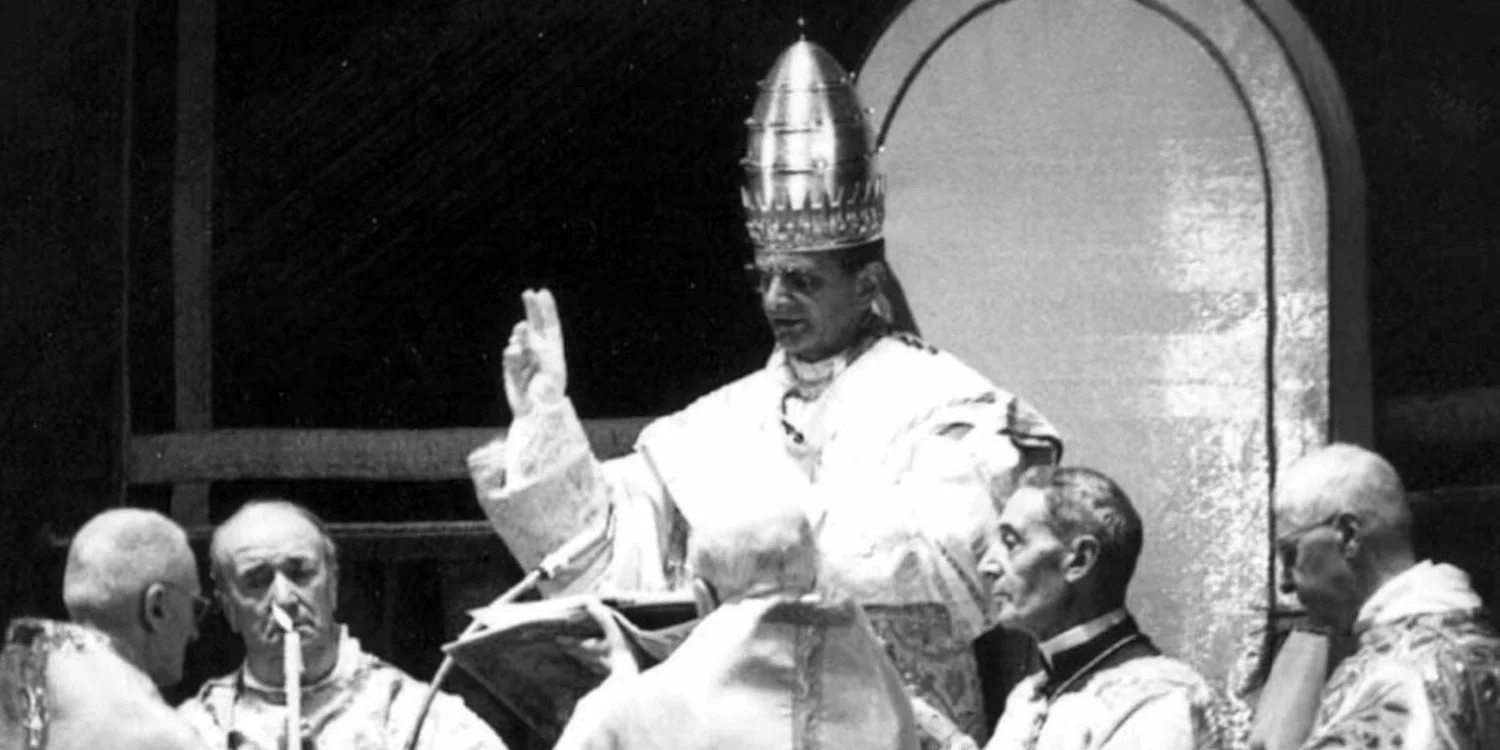
Padre Pio’s Letter to Pope Paul VI on Humanae Vitae
Less than two weeks before Saint Padre Pio of Pietrelcina died, he sent a letter on Humanae Vitae to Blessed Pope Paul VI who is himself due to be canonized 14 October, 2018.
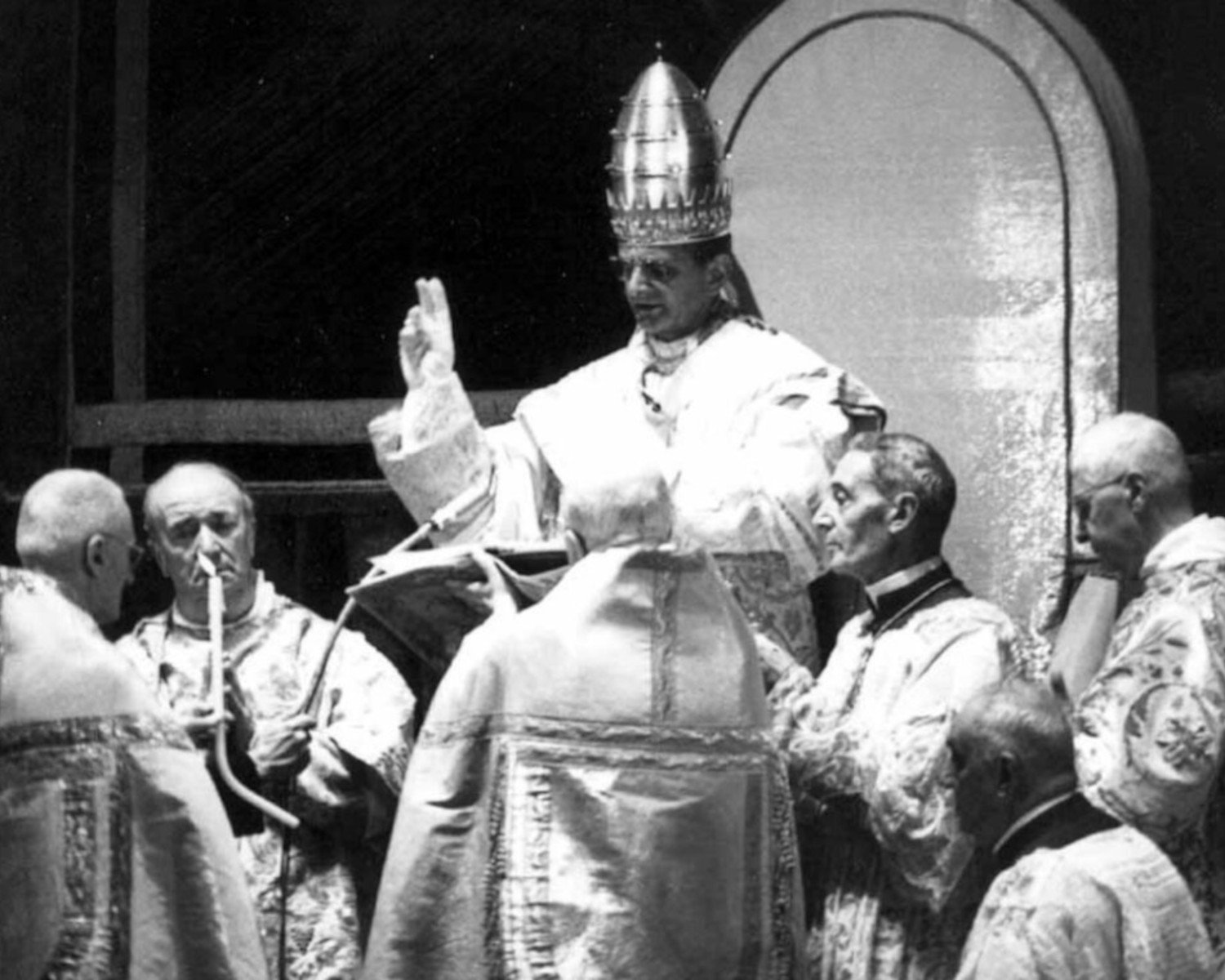
Less than two weeks before Saint Padre Pio of Pietrelcina died, he sent a letter on Humanae Vitae to Saint Pope Paul VI. The letter was discovered before Pope Paul’s 2018 canonization.
Your Holiness:
Availing myself of Your Holiness’ meeting with the Capitular Fathers, I unite myself in spirit with my Brothers, and in a spirit of faith, love and obedience to the greatness of Him whom you represent on earth, offer my respectful homage to Your August Person, humbly kneeling at Your feet.
The Capuchin Order has always been among the first in their love, fidelity, and reverence for the Holy See. I pray the Lord that its members remain ever thus, continuing their tradition of seriousness and religious asceticism, evangelical poverty, faithful observance of the Rule and Constitutions, renewing themselves in vigorous living and deep interior spirit — always ready, at the least gesture from Your Holiness, to go forward at once to assist the Church in her needs.
I know that Your heart suffers much these days on account of the happenings in the Church: for peace in the world, for the great needs of its peoples; but above all, for the lack of obedience of some, even Catholics, to the lofty teachings which You, assisted by the Holy Spirit and in the name of God, have given us. I offer Your Holiness my daily prayers and sufferings, the insignificant but sincere offering of the least of your sons, asking the Lord to comfort you with His grace to continue along the direct yet often burdensome way — in defense of those eternal truths which can never change with the times.
In the name of my spiritual sons and of the “Praying Groups” I thank Your Holiness for the clear and decisive words You have spoken in the recent encyclical, “Humanae Vitae”, and I reaffirm my own faith and my unconditional obedience to Your inspired directives.
May God grant truth to triumph, and, may peace be given to His Church, tranquility to the people of the earth, and health and prosperity to Your Holiness, so that when these disturbing clouds pass over, the Reign of God may triumph in all hearts, through the Apostolic Works of the Supreme Shepherd of all Christians.
Prostrate at Your feet, I beg you to bless me, my Brothers in religion, my spiritual sons, the “Praying Groups”, all the sick — that we may faithfully fulfill the good works done in the Name of Jesus and under your protection.
Your Holiness’ most humble servant,
PADRE PIO, Capuchin
San Giovanni Rotondo, 12th September 1968.
(l’Osservatore Romano — Weekly Edition in English — 10 October 1968)
+ + +
Editor’s note: Father Gordon’s article for this week was lost in the mail. We’ll try to put it up next week. Today is the 50th anniversary of the watershed encyclical letter Humanae Vitae, an intervention on behalf of keeping the sexual intercourse of a married couple united with an openness to life, thus proscribing contraception, abortifacients, and abortion as intrinsically dishonest. We thought it opportune to follow the lead of the Holy Spirit, republishing Padre Pio’s letter to Pope Paul VI about this, thus providing a good example of being in solidarity with the successor of Saint Peter even in the midst of controversy. At the time, some 600 theologians, many seminary professors and otherwise renegades such as Charles E. Curran and Richard A. McCormick voiced their dissent against what, some years later, Cardinal Ratzinger in his commentary on Ad Tuendam Fidem would categorize as infallible teaching. Please share this post widely on social media and take the time to read the short but entirely prophetic document praised by the saints:
Humanae Vitae promulgated on 25 July 1968 by Pope Paul VI
Note from Father Gordon J. MacRae: Please share this post. It is our first guest post by a Patron Saint. I thank Father George David Byers for following the promptings of the Holy Spirit by posting this in place of my lost missive. You may also wish to see and share a post about what happened two weeks after Padre Pio’s letter was written:
“I Am a Mystery to Myself!” The Last Days of Padre Pio
+ + +


For Darryll Bifano, the Currency of Debt Is Mercy
Men facing death in this prison at one time died alone. Darryll Bifano is a prisoner and hospice volunteer who helped change that. In the process, he changed himself.

Men facing death in this prison at one time died alone. Darryll Bifano is a prisoner and hospice volunteer who helped change that. In the process, he changed himself.
Some time ago, I wrote a Scripture post that ended up being about death and thus scared some people off from reading it. Everyone has to face it, but few want to, and many spend their lives in denial of it. That post was, “The God of the Living and the Life of the Dead.” Despite its heavy dose of theology, it drew an unusual audience for Beyond These Stone Walls and was shared some 5,000 times on Facebook and other social media. Death touches everyone.
There was a pall over this prison as summer commenced this year. One of our friends, John, age 39, died of pancreatic cancer in the prison medical unit on June 10. It was a long and grueling death that saw him drift from the vibrancy of a healthy man in his thirties to an emaciated frame of his former self. Through it all, his alert mind grasped for meaning and connection.
There was a time when prisoners here died in empty isolation. Several years ago, one of my own roommates, 52-year-old Harvey, developed stomach cancer that slowly consumed his life. When he could no longer live among us, he died alone locked in a cold, bare room with four concrete walls and little human contact.
I pleaded at the time to visit Harvey and help take care of him but overwhelmed prison medical staff responded that there was just no process in place that allows for that. But in the last three years here, this has dramatically changed. A group of men — prisoners all — have come together to form a training protocol for a hospice team. Now in three-hour shifts around the clock, they sit, talk, walk and care for fellow prisoners who are dying.
My first deeply-felt gratitude to this hospice team came when our friend, Anthony Begin, died from cancer. I wrote of that journey in a post that shocked some readers. It was “Pentecost, Priesthood, and Death in the Afternoon.” I wrote about how Anthony was such a caustic personality, that I literally threw him out of my room one day. We did not speak for over a year until Pornchai Moontri told me one day that Anthony is dying.
Pornchai and I took over the care of Anthony, and in the process, he changed. So did we. Anthony was allowed to live in a bunk just outside our cell for his final months. When his condition came to the point of no return, we had to leave him in the medical unit where we would never see him again.
This was my first experience of the immense value of hospice. The newly formed prisoner hospice team was with Anthony around the clock for the final steps of his journey which I documented in “The First of the Four Last Things.” Thanks mostly to the influence of Pornchai Moontri, Anthony experienced a religious conversion and was received into the Catholic faith just before we handed him over to hospice.
I will never forget what happened a week after he died. It turned out that Anthony left this life having committed a second crime against the State of New Hampshire: an unreturned library book. When a prisoner leaves without returning a book, an alert comes across a computer screen at my desk in the prison library. Here is what the computer told me a week after Anthony died:
“Anthony Begin — Released with book #3015: Heaven is for Real.”

A Down Payment on a Debt
The recent, untimely death of John at age 39 unsettled many prisoners and sent a shockwave throughout this prison. John was a young man in good shape until he began having symptoms of discomfort. Once the diagnosis of pancreatic cancer came, the end loomed shockingly fast. His final weeks were not easy, but he was never alone thanks to the dedication and perseverance of a few good men.
One of these men is Darryll Bifano. If his name sounds a bit familiar, it’s because you have met him before in these pages. Darryll was a pitcher on Pornchai Moontri’s intramural softball team, the Legion of Angels when it won the league pennant for the third year in a row in 2016. At 6’3” and 270 pounds, Darryll Bifano was an imposing presence both on the team and in my post, “A Legion of Angels Victorious.”
A big guy with a wide wingspan not much got past Darryll on the pitcher’s mound. He proved himself to be a team player who contributed much to our victories. Today, Darryll lives on the pod Pornchai Moontri and I moved to last summer. He was among those who spoke up for us and helped us to get there.
During the long ordeal of Darryll’s ministering to John in hospice, I was much aware of the schedule he had to keep. He has a full-time job working in the prison Recreation Department — the same place where Pornchai works. Darryll also volunteers for multiple other programs offering support to prisoners in need. He is a trained volunteer for a newly formed Peer Support program that assists with monitoring and moral support for prisoners on suicide watch, a critical and important need here.
Darryll’s presence in that endeavor seemed to naturally grow out of his commitment to hospice. Having witnessed the physical and emotional toll that hospice can exact from these men, I sat down with Darryll after the death of John. We spent time processing not only the experience but also the journey that brought Darryll to this point in his life.
We began with the most natural question of all. What brought Darryll Bifano to care for the dying through hospice? I have to let him answer this in his own words:
“I am 47 years old and in the 11th year of a 27-year-to-life sentence for second degree homicide. I grew up in the ideal American family: a loving mother and father, a brother and a sister. I am the oldest. I excelled in school and in multiple sports, graduated from two universities, and followed my passion for music, and traveled that road everywhere and anywhere it would take me.
“Through trial and error and experience, I was becoming the man I always wanted to be. I was on a path of my choosing, and as a musician I developed some talent. Then everything changed in a single foggy moment. After a night of drinking and drugs, my best friend and I argued. Then we fought. I threw a single punch that killed my dear friend, Stephen, and, in the aftermath of our drunken state, he died alone.
“I work with hospice today because I have a debt to life that I cannot fully pay, but I must try. I cannot bring back my friend, but I can honor him, and be responsible, and give this tragedy meaning.”
Darryll is one of 20 prisoners, each working in 3-hour shifts, who sit with terminally ill prisoners and accompany them to the end of life. After working all day, he often takes a shift that no one else really wants — from 1:00 to 4:00 AM. A quick two hours sleep and then Darryll is up again to get ready for his work at 7:00 AM.
I have seen this schedule take its toll on Darryll, but like the few prisoners who stand out dramatically here, he seems driven by service, and the sure knowledge that mercy was shown to others is the path to peace within himself:
“I remember, as a child, the experience of my grandfather dying of cancer in his home. This drove home fore me the importance of not dying alone.
“In hospice, you’re sitting with this guy and he is dying, and it’s treated as taboo — on one else really wants to talk about it. It’s the final stage of life.
“In prison, I often hear people say, ‘I came in alone and I’ll go out alone.’ It’s their excuse for disengagement with the world around them, but I no longer believe in this. For a life that has meaning, no one can make it alone in this world.”

Is God Dead?
In the last week of John’s life, Darryll spent about eight shifts with him, mostly in the pre-dawn hours which often seemed the toughest for John. Darryll described this time as “the ideal of what hospice is supposed to be.” He walked with John from resentment and denial to acceptance. They talked of John’s life, his family, nieces, and nephews. Darryll sat and wrote letters to them dictated by John. Along the way, Darryll was witness to a transition from torment to peace.
I am not certain that Darryll phrased this as such in his own mind, but his presence to John fulfilled a basic tenet of Viktor Frankl’s famous book, Man’s Search for Meaning. Darryll was helping John to give meaning to suffering, perhaps the greatest gift one human being can impart to another in the face of death.
For much of his life, John had reportedly described himself first as an atheist, and then, in more recent years, an agnostic. In its simplest form, agnosticism is to render the question of God moot because, for the agnostic, it is impossible to know Him or whether He even exists so there is no point trying.
As I sit here typing this post, the last book John read in this life has just landed on my desk to be checked back into the library. It’s a collection of essays by the Nineteenth Century German philosopher, Friedrich Nietzsche.
I cannot imagine what prompted John to request this book, but the reality was that in his dying state he was unable to read at all. He handed the book to his hospice volunteers. Caring for him in their 3-hour shifts, he tasked them to read aloud portions of Also Sprach Zarathustra (Thus Spake Zarathustra) Nietzsche’s treatise about the death of God.
Nietzsche developed the essay between 1883 and 1885 to explain his theory of the Übermensche (meaning superman or overman). Stating that “God is dead,” Nietzsche rejected Christian beliefs and traditional values as the source of our “collective slave morality.” Instead, Nietzsche believed in the power of superman: a person of extraordinary imagination and will who can break the destructive grip of traditional Christian values.
Only a superman, Nietzsche theorized, can institute a “master morality” to save society from the slavery of Christianity. This became the foundation for Adolf Hitler’s concept of a Master Race. It was also the foundation of the effort to dissolve Christian influence in Western Civilization that I recently described in these pages in “Fathers Day in the Land of Nod.”
This was the last book John requested of me, and it was perhaps the very last book I might have sent him in the week of his death had I been given a choice. But alas, such choices are not mine to make. Nor are they Darryll Bifano’s who dutifully read aloud Nietzsche’s words to John.
I remember once writing in these pages about the resurgence of Nietzsche’s “God is Dead” movement in the 1960s. The bumper stickers were everywhere in that radical, “question everything” age of my adolescence in 1968: “GOD IS DEAD! Signed, Nietzsche.” Then one day I saw one that presented a sobering thought: “NIETZSCHE IS DEAD! Signed, God.”
Even Nietzsche, an atheist, in the end, came to regret the impact of his own atheistic thought. He wrote that the destruction of the belief in God in the 20th Century was the greatest cataclysm humanity has ever faced: “What were we doing when we unchained this Earth from its Sun? ” he asked. “Are we not now straying as though through an infinite nothing?”
But while Darryll was reading to John, he also took questions, and these were perhaps more revealing of what was taking place in the heart and soul of a man facing death while his mind struggled with its apparent emptiness. John stopped Darryll in his reading and asked, “Do you think there is a heaven? Do you think I could go there?”
Perhaps John wasn’t buying the emptiness of Nietzsche’s ode to the dying. Perhaps Darryll wasn’t buying it either, and this post is actually more about him. He is not a man who should forever be defined by his one big mistake. He is a good man, a talented and dedicated asset to the race we call “human.”
Darryll’s footprints here leave this a better place. God knows, prison very much needs natural leaders like Darryll Bifano who draw others along a path to righteousness having long since parted ways with his own personal road to ruin.
Last summer in my post, “The Days of Our Lives,” I wrote about a concert that Darryll helped organize among the musicians here. It was worthy of Carnegie Hall, and its most unforgettable moment was Darryll’s brilliant performance of Led Zeppelin’s “Stairway to Heaven.”
Darryll didn’t offer me his answers to John’s last questions: “Do you think there is a heaven? Do you think I could go there?” “I grew up a Catholic,” Darryll told me, “and like so many of the wannabe rebels of my time, I left my faith back there.”
“Is the door to it closed or cracked?” I asked. “Well…” he pondered with a distant gaze, “I always really do enjoy talking to you, G.”
+ + +
Note: On February 17, 2023 Darryll Bifano was profiled on the television news and cultural magazine, New Hampshire Chronicle.

#MeToo and #HimToo: Jonathan Grover and Father Gordon MacRae

Jonathan Edward Grover died in Scottsdale Arizona just before his 49th birthday. His role in the case against Father Gordon MacRae leaves many unanswered questions.
Editor’s Note: The following is a guest post by independent writer Ryan A. MacDonald whose previous articles include “The Post-Trial Extortion of Father Gordon MacRae” and “A Grievous Error in Judge Joseph Laplante’s Court.”
When I read Father Gordon MacRae’s Holy Week post on These Stone Walls this year, I was struck by a revelation that he offered Mass in his prison cell for the soul of a man who helped put him there by falsely accusing him. I do not know that I could have done the same in his shoes, and even if I could, I am not so certain that I would. His post took a high road that most only strive for.
The unnamed subject of that post about Judas Iscariot was Jonathan Edward Grover who died in Arizona in February two weeks before his 49th birthday. An obituary indicated that he died “peacefully,” and cited ‘a “long career in the financial industry.” Police determined the cause of death to be an accidental overdose of self-injected opiates weeks after leaving rehab. In Arizona, he had charges for theft, criminal trespass, and multiple arrests for driving under the influence of drugs. A police report described him as “homeless.”
In the early 1990s, Jonathan Grover was one of Father MacRae’s accusers. MacRae first learned of Mr. Grover’s death from a letter written by a woman who had been a young adult friend of Grover at the time of MacRae’s trial in 1994. She wrote that she is now a social worker with “expertise in PTSD” (Post Traumatic Stress Disorder). The letter accused MacRae of having “murdered” 48-year-old Grover. This requires a rational and factual response.
Of interest, Mr. Grover’s obituary – despite his being 48 years old at the time of death – featured his 1987 Keene High School (NH) graduation photograph when Grover was 18 years old. I had seen this photo before. It was among the discovery materials in MacRae’s defense files in preparation for his 1994 trial. The photograph raised the first of many doubts about Grover’s claims.
At age 18 in 1987, Grover gave Father Gordon MacRae, his parish priest and friend at the time, a nicely framed copy of that photo with a letter written on the back. It thanked MacRae for his “friendship and support,” and “for always being there for me.” It was a typically touching letter from a young man to someone he obviously admired. It was written before addiction and the inevitable justification of enablers took hold in his life.
Five years later, apparently forgetting that he ever wrote that letter, Jonathan Grover became the first of four adult brothers to accuse MacRae of a series of sexual assaults alleged to have occurred more than a decade earlier. So what happened between writing that letter in 1987 and accusing MacRae five years later in 1992? It is one of the burning questions left behind in this story.
The framed high school photograph and its accompanying letter never found their way into MacRae’s 1994 trial, or into the public record, because the trial dealt only with the claims of Jonathan’s brother, Thomas Grover. Jonathan was the first to accuse MacRae, but a trial on his claims was deferred. His story had many holes that did not reconcile with the facts. Investigators have since uncovered a different story from the one Grover and his brothers first told.

Bombshells and Black Ops
The two common denominators in the case against Father Gordon MacRae were expectations of money and James F. McLaughlin. In the 1980s, the city of Keene, New Hampshire, with a population then of about 26,000, employed a full-time sex crimes detective on its small police force. In 1988, McLaughlin launched investigations of at least three, and possibly more, Catholic priests in the area including Father Gordon MacRae.
His targeting of MacRae seems to have begun with a bizarre and explosive letter. In September 1988, Detective McLaughlin received a letter from Sylvia Gale, a social worker with the Division of Children, Youth and Families, the New Hampshire agency tasked with investigating child abuse. Ms. Gale’s letter to McLaughlin revealed that she had uncovered information about “a man in your area, a Catholic priest named Gordon MacRae.”
The letter described explosive information from an unnamed employee of Catholic Social Services in the Diocese of Manchester, who developed a slanderous tale that MacRae had been “a priest in Florida where he molested two boys, one of whom was murdered and his body mutilated.” The letter went on to claim that the case was still unsolved, and that MacRae was removed from Florida by Catholic Church officials to avoid that investigation.
The libelous letter also named a Church official, Monsignor John Quinn, as the source of this information reportedly told to an unnamed Church employee on the condition that she would be fired if she ever divulged it. The 1988 letter generated a secret 70-page report developed by Detective James McLaughlin. He launched a dogged pursuit of MacRae who was unaware at the time that any of this was going on.
This all began to unfold one year after Jonathan Grover graduated from Keene High School and presented Father MacRae with that framed photograph and letter of thanks. Armed with Sylvia Gale’s letter, Detective McLaughlin proceeded to question 26 Keene area adolescents and their parents who had known MacRae including members of the Grover family.
Up to that point, not one person had ever actually contacted McLaughlin with a complaint against MacRae, but rather it was McLaughlin who initiated these contacts. As reported below, some of them today claim to have been solicited by McLaughlin to accuse MacRae, some with the enticement of money.
I had to read up to page 54 of McLaughlin’s 1988 report before I came across any effort to corroborate the Florida “murder and mutilation” story with Florida law enforcement officials. By the time he learned that MacRae had never served as a priest in Florida and that no such crime had been committed there, the damage to MacRae’s reputation was already done, and the seeds were sown for the Grover brothers to ponder claims yet to come.
Among those approached by McLaughlin armed with Sylvia Gale’s slanderous letter was Mrs. Patricia Grover, Jonathan’s mother. A parishioner of Saint Bernard Parish in Keene where MacRae had served from 1983 to 1987, Mrs. Grover was also a DCYF social worker and an acquaintance of Sylvia Gale. She had previously worked with McLaughlin in the handling of other cases.
Mrs. Grover also knew Father MacRae. According to McLaughlin’s 1988 report, she was alarmed by the Sylvia Gale letter but doubted that MacRae had ever served as a priest in Florida. She nonetheless vowed to talk with her young adult sons about their relationship with MacRae. Four more years passed before the first of them, Jonathan Grover, accused him.
The “fake news” in the 1988 Sylvia Gale letter set this community abuzz with anxiety and gossip about the potentially lecherous and murderous priest in its midst. Later, Monsignor John Quinn and other Diocese of Manchester officials denied having any involvement in the untrue information about MacRae. They also denied that there was ever any priest who relocated from Florida to New Hampshire under the circumstances described.
Four years later in late 1992, Jonathan Grover became the first of four members of the Grover family to accuse Father Gordon MacRae of sexual abuse dating back to approximately the early 1980s. I use the word “approximately” because Grover and his brothers each presented highly conflicting and multiple versions of their stories and the relevant time frames.
As becomes clear below, Jonathan Grover’s claims became problematic for the prosecution of MacRae, but instead of questioning Grover’s veracity, the police detective engaged a contingency lawyer on Grover’s behalf. In a September 30, 1992 letter from McLaughlin to Jonathan Grover, the detective detailed his conversations with Keene attorney William Cleary who ultimately obtained a nearly $200,000 settlement for Grover from the Diocese of Manchester. From McLaughlin’s letter to Grover:
“As agreed, I contacted William Cleary about your case. Bill believes the statute of limitations has lapsed for a civil action, but this does not rule out the church being financially responsible Bill [Cleary] states he would like to meet with you for a conference. You would not be charged for this. Your options could then be outlined and discussed.”
There is reason to question Detective McLaughlin’s police reports in this case. In most of McLaughlin’s prior cases, he practiced a protocol of audio recording every interview with complainants. In many of his other reports that I have read, he made a point of explaining that he records interviews to protect the integrity of the investigation.
Two years prior to the Grover claims, for example, McLaughlin investigated a complaint against another former Keene area priest, Father Stephen Scruton. From the outset, his reports took pains to document his practice of securing both video and audio recordings of his interviews. He even administered a polygraph test on the accuser. All were standard protocol, but McLaughlin did not create a single recording of any type with any accuser in the case of Father Gordon MacRae. This is suspect, at best, and it has never been explained.
It is made more suspicious by the emergence of other information that has been developed by former FBI Special Agent Supervisor James Abbott who spent three years investigating the MacRae case. One of MacRae’s accusers, a high school classmate of Jonathan Grover, recanted his story when questioned by Mr. Abbott in 2008. An excerpt of Steven Wollschlager’s statement may shed light on why Detective McLaughlin chose not to record these interviews.
“In 1994 I was contacted by Keene Police Detective McLaughlin… I was aware at the time of Father MacRae’s trial knowing full well that it was bogus and having heard of the lawsuits and money involved and also the reputations of those who were making accusations… The lawsuits and money were of greatest discussion, and I was left feeling that if I would go along with the story I could reap the rewards as well. McLaughlin had me believing that all I had to do was make up a story about this priest and I could receive a large sum of money as others already had.
McLaughlin reminded me of the young child and girlfriend I had and referenced that life could go easier for us with a large amount of money… I was at the time using drugs and would have been influenced to say anything they wanted for money.”
In “The Trials of Father MacRae,” a 2013 article by Dorothy Rabinowitz in The Wall Street Journal, Detective McLaughlin described the above account simply as “a fabrication.” What struck me about Mr. Wollschlager’s statement, besides the fact that he had nothing whatsoever to gain by lying, is that he never went to Detective McLaughlin with an accusation. Instead, he alleges that it was McLaughlin who approached him, and the approach alleges the enticement of money.
Steven Wollschlager was not the first person to report such an overture. Given the nature of his account and others, it is unclear today whether Jonathan Grover and his brothers initiated their first contacts with this detective. This suspicion was a contentious issue in MacRae’s 1994 trial. Thomas Grover, the brother of Jonathan Grover, was asked under oath to reveal to whom he went first with his claims, the police or a personal injury lawyer, but he refused to answer. To this very day, that question has never been answered.
What became clear, however, is hard evidence that placed Detective James McLaughlin investigating at least some of this case, not from his office in the Keene Police Department, but from the Concord, NH office of Thomas Grover’s contingency lawyer, Robert Upton, before MacRae was even charged in the case.

A Conspiracy of Fraud
In a report labeled Case No. 93010850, Detective McLaughlin produced the first of several conflicting accounts of untaped interviews with Jonathan Grover. Note that the first two digits of McLaughlin’s report, “93,” seem to indicate the year it was typed, but the date on the report is August 27, 1992. The content of this report is sexually explicit so I will paraphrase. The report has Grover claiming that when he was 12 or 13 years old he “would spend nights in the St. Bernard rectory in Keene.” During those nights, he alleged, he was sexually assaulted by both Father Gordon MacRae and Father Stephen Scruton.
But there was an immediate problem. MacRae was never at St. Bernard’s Parish in Keene until being assigned there on June 15, 1983, when Grover was 14 years old. Father Stephen Scruton was never there before June of 1985 when Grover was 16 years old. These dates were easily determined from diocesan files, but McLaughlin never investigated this. The report continued with claims alleged to have taken place in the Keene YMCA hot tub:
“It was during these times that Grover would be seated in the whirlpool and both Father MacRae and Father Scruton would be joined in conversation and they would alternate in rubbing their foot against his genitals. Grover was unsure if the priests were acting in concert or if they were unaware of each other’s actions.”
This report is highly suspicious. Just months earlier, Detective McLaughlin had previously investigated Father Stephen Scruton for an identical claim brought by another person alleged to have occurred in 1985 after Scruton’s arrival at this parish. “Todd,” the person who brought that claim against Scruton, was also a high school classmate of Jonathan Grover.
After McLaughlin’s investigation, “Todd” obtained an undisclosed sum of money in settlement from the Diocese of Manchester. That interview with “Todd” was labeled Case No. 90035705 dated just 18 months before Jonathan Grover’s identical claims emerged. Unlike the Grover interviews, the interview with Todd was tape recorded by McLaughlin. Here is an excerpt from the report:
“Father Scruton was a regular at the YMCA. Todd went to the YMCA with Father Scruton. They decided to use the hot tub… At one point, Father Scruton took one of his feet and placed it between Todd’s legs and rubbed his genitals… The touching was intentional and not a mistake. A rubbing motion was used by Father Scruton… I asked Todd where he stood on civil lawsuits.”
It defies belief that a small town police detective could write a report about a Catholic priest (Scruton) fondling a teenager’s genitals in a YMCA hot tub, then 18 months later write virtually the same report with the same claims of doing the same things in the same place, only this time adding a second priest, but nothing in the second report seemed to even vaguely remind the detective of the first report.
After “Todd’s” YMCA hot tub complaint in 1990 — 18 months before Jon Grover’s own YMCA hot tub story — Father Stephen Scruton was charged by McLaughlin with misdemeanor sexual assault. He pled guilty and received a suspended sentence and probation. One year later, McLaughlin has someone else repeat the same story, only now involving both Scruton and MacRae, but two to four years before either of them was present in Keene.
What is most suspect about this claim of Jonathan Grover involving both priests is that in 1994, one year after writing the report, McLaughlin responded to a question under oath:
On occasion, I have had conversations with Reverend Stephen Scruton, however I have no recollection of ever discussing any actions of Gordon MacRae with the Reverend Scruton.
(Cited in USDC-NM 1504-JB)
But this all becomes more suspicious still. In the investigation file on these claims was found a transcript of a November 1988 Geraldo Rivera Show entitled “The Church’s Sexual Watergate.” It was faxed by the Geraldo Show in New York to Detective McLaughlin at the Keene Police Department two months after his 1988 receipt of the Sylvia Gale “Florida letter.” It was two years before “Todd’s” YMCA hot tub claim about Father Scruton and four years before Jonathan Grover’s claims. Here is an excerpt:
“Geraldo Rivera: What did the priest do to you Greg?
Greg Ridel: Around the age of 12 or so, he and I went to a YMCA. And I was an altar boy at the time. And the first time I was ever touched… he began stroking my penis in a hot tub, I believe it was, at a YMCA. From there it went to what you might call role playing in the rectory where the priests stay.”
Detective McLaughlin’s 1993 police report also had Jonathan Grover claiming that Father MacRae paid him money in the form of checks from his own and parish checking accounts in even amounts of $50 to $100 in order to maintain his silence about the abuse. McLaughlin never investigated this, but Father MacRae’s lawyer did investigate. Father MacRae’s personal checking account was researched from between 1979 to 1988. It revealed no checks issued to Jonathan or Thomas Grover.
However, the attorney uncovered several checks written from parish accounts to both Jonathan Grover and Thomas Grover. All were in even amounts between $40 and $100 and dated between 1985 and 1987 when these two brothers were 16 to 20 years of age respectively. The checks were filled out and signed by Rev. Stephen Scruton.
Days before Father Gordon MacRae’s 1994 trial commenced, his attorney sought Father Scruton for questioning. He declined to respond. When the lawyer sought a subpoena to force his deposition, Scruton fled the state. During trial, the jury heard none of this. Because the trial involved the shady claims of Thomas Grover alone, the defense could not introduce anything involving his brother, Jonathan.
In April, 2005, The Wall Street Journal published an extensive two-part investigation report of the Father MacRae case (“A Priest’s Story” Parts One and Two), but it omitted Father Stephen Scruton’s role in the story — perhaps because he could not be located. Diocese of Manchester officials reported for years that they had no awareness of Scruton’s whereabouts.
In November 2008, former FBI Special Agent Supervisor James Abbott was retained to investigate this case. He located Father Scruton at an address in Newburyport, Massachusetts just over the New Hampshire State Line. First reached by telephone, Scruton was reportedly agitated and nervous when he learned the reason for the call. The investigator heard a clear male voice in the background saying, “Steve if this is something that might help Gordon I think you should do it.” Scruton reluctantly agreed to meet.
The former FBI agent drove from his New York office to Newburyport, MA on the agreed-upon date and time, but Scruton refused to open the door. He said only that he had “consulted with someone” and now declines to answer any questions. The investigator then sent Scruton a summary of his involvement in this case and requested his cooperation by telling the simple truth.
Days after receiving it, Stephen Scruton suffered a mysterious fall down a flight of stairs and never regained consciousness. Father Stephen Scruton died a month later in January of 2009. He took the truth with him, and now Jonathan Grover has done the same. But facts speak a truth of their own. Readers can today form their own conclusions about this story.
I have formed mine, and I remain more than ever convinced that an innocent man is in prison in New Hampshire, a blight on the American justice system. Having thus far served 24 years of wrongful imprisonment for crimes that never took place, Father Gordon MacRae still prays for the dead.
“After three years of investigation of this case, I have found no evidence that Father MacRae committed these crimes, or any crimes.”

Editor’s Note: Please share this post which could be of great importance to Father MacRae for justice in both Church and State.
Ryan A. MacDonald has published extensively in both print and online media. Ryan’s articles include:
The Trial of Father MacRae: A Conspiracy of Fraud
How Psychotherapists Helped Send an Innocent Priest to Prison
In the Fr Gordon MacRae Case, Whack-a-Mole Justice Holds Court
Justice and a Priest’s Right of Defense in the Diocese of Manchester

Judas Iscariot: Who Prays for the Soul of a Betrayer?
Judas Iscariot: The most reviled name in all of Sacred Scripture is judged only by his act of betrayal, but without him among the Apostles is there any Gospel at all?

Judas Iscariot: The most reviled name in all of Sacred Scripture is judged only by his act of betrayal, but without him among the Apostles is there any Gospel at all?
False witness and betrayal are two of the most heinous themes in all of world literature, and Sacred Scripture is no exception. Literature is filled with it because so are we. Not many of us get to live our lives without ever experiencing the false witness of an enemy or the betrayal of a friend.
Recently, I was confronted by the death of someone whom I once thought of as a friend, someone who once betrayed me with a self-serving story of false witness for nothing more redemptive than thirty pieces of silver. It’s an account that will be taken up soon by some other writer for I am not objective enough to bring justice, let alone mercy, to that story.
But for now, there is one aspect of it that I must write about at this of all times. As I was preparing to offer Mass late on a Sunday night, the thought came that I should offer it for this betrayer, this liar, this thief. Every part of my psyche and spirit rebelled against that thought, but in the end, I did what I had been beckoned to do.
It was difficult. It was very difficult. And it cost me even more of myself than that person had already taken. It cost me the perversely comforting experience of eternal resentment. I have not forgiven this false accuser. That is a grace I have not yet discovered. Nor could I so easily set aside the depth of his betrayal.
In offering the Mass, I just asked God not to see this story only as I do. I asked Him not to forever let this soul slip from His grasp, for perhaps there were influences at work that I do not know. have always suspected so.
The obituary said he died “peacefully” just two weeks before his 49th birthday. It said nothing about the cause of death nor anything about a Mass. There was a generic “celebration of his life.” False witness does not leave much to celebrate. Faith, too, had been betrayed for money.
I am still angry with this person even in death, but I take no consolation that his presence in this world has passed. My anger will have to be comfort enough because at some point I realized that my Mass was likely the only one in the world that had been sacrificed for this soul with any legitimate hope for salvation.
That’s the problem with false witness. Its purveyors tell themselves they have no need for salvation. I do not know whether he is any better off for this Mass having been offered, but I do know that I am.

Ever Ancient, Ever New
The experience also focused my attention on history’s most notorious agent of false witness and betrayal, Judas Iscariot. Who has ever prayed for the soul of a betrayer? Not I — at least, not yet — but I also just weeks ago thought it impossible that I would pray for the soul of my accuser.
I cannot get Judas off my mind this week. And as with most Biblical narratives, once I took a hard look, I found a story on its surface and a far greater one in its depths. In those depths is an account of the meaning of the Cross that I found to be staggering today. It changes the way I today see the Cross and the role of Judas in bringing it about. It strikes me that there is not a single place in the narrative of salvation history that does not reflect chaos.
Understanding the Sacrifice of Calvary requires a journey all the way back to the time of Abraham, some 2000 years before the Birth of the Messiah. God had earlier made a covenant with Abraham, a promise to make of his descendants a great nation.
The story of the birth of his son, Isaac, foreshadows that of John the Baptist who in turn foreshadows Jesus. Abraham and Sarah, like Zechariah and Elizabeth, were too old to bear a child, and yet they did. And not just any child. Isaac was the evidence and hope of God’s covenant with Abraham. “I will multiply your descendants as the stars of heaven.”
Then, in Genesis 22, God called Abraham to do the unthinkable: to sacrifice his only son, the one person who was to fulfill God’s covenant. The scene unfolds on Mount Moriah, a place later described in the Book of Chronicles (2 Ch 3:1) as the very site of the future Jerusalem Temple. In obedience, Abraham placed the wood for the sacrifice upon the back of his son, Isaac, who must carry the wood to the hilltop (Gen 22:6).
On that Via Dolorosa, the child Isaac asked his father, “Where is the lamb for the sacrifice?” Abraham’s answer “God will provide Himself the lamb for a burnt offering.” Notice the subtle play on words. There is no punctuation in the original Hebrew of the text. The thought process does not convey, “God Himself will provide the lamb…. but rather, “God will provide Himself, the lamb for sacrifice.”
An Angel of the Lord ultimately stayed Abraham’s hand, and then pointed out a ram in the thicket to complete the sacrifice. In his fascinating book, The Lamb’s Supper: The Mass as Heaven on Earth (Image Books 1999) author Scott Hahn provides a reflection on the Genesis account that I had long linked to the Cross:
“Christians would later look upon the story of Abraham and Isaac as a profound allegory for the sacrifice of Jesus on the Cross.” (p. 18)
The similarities in the two accounts, says Scott Hahn, are astonishing. The first line of the New Testament – Matthew 1:1 — identifies “Jesus the Messiah, the son of David, the son of Abraham…” Jesus, like Isaac, was a faithful father’s only son. Isaac, like Jesus, carried “the wood” for his own sacrifice upon Mount Moriah. In fact, Calvary, the place of the Crucifixion of Christ, is a hillock in the Moriah range.
This places three pivotal Scriptural accounts — each separated by about 1,000 years — in the same place: The site where Abraham was called to sacrifice Isaac, the site of the Jerusalem Temple of Sacrifice, and the site of the Crucifixion of Christ.
In Hebrew, that place is called “Golgotha,” meaning “the place of the skull.” Its origin is uncertain, but there is an ancient Hebrew folklore that the skull of Adam was discovered there. Before the Romans arrived in Palestine, it was a place used for public executions, primarily for stoning. The word “Calvary” is from the Latin “calvaria” meaning “skull.” It was translated into Latin from the Greek, “kranion,” which in turn was a translation of the Hebrew, “Golgotha.”
No angel would stay the Hand of God. God provided Himself the Lamb for the sacrifice. This interplay between these Biblical accounts separated by 2,000 years is the source for our plea in the Mass, “Lamb of God Who takes away the sins of the world, have mercy on us.”

At the Hour of Darkness
The four Gospel accounts in the Canon of Scripture all came into written form after the apostolic witnesses experienced the Resurrection of Jesus. So everything they set out to preserve for the future was seen in that light. The outcome of the story is triumphantly clear in the minds of the New Testament authors. Had the Gospel ended at the Cross, the accounts would be very different.
Judas Iscariot, therefore, is identified early in each Gospel account when he is first summoned by Jesus to the ranks of the Apostles as “the one who would betray him.” John (6:71) adds the Greek term, “diabolos” (6:70), to identify Judas. It is translated “of the devil,” but its connotation is also that of a thief, an informer, a liar, and a betrayer, one drawn into evil by the lure of money.
These adjectives are not presented only to explain the character of Judas, but also to explain that greed left Judas open to Satan. Each Gospel account is clear that Jesus chose him among the Twelve, and in all three Synoptic Gospels, Matthew, Mark, and Luke, Jesus presents a constant awareness of the coming betrayal of Judas — seemingly as a necessary part of the story.
During Holy Week this year, we hear the full account of the Passion Narrative from Mark (on Palm Sunday) and John (on Good Friday). But for this post I want to focus on the version from Luke. The Gospel of Luke is unique in Scripture. It is the only Scriptural account written by a non-Jewish author.
Luke’s Gospel is the only account with a sequel, Acts of the Apostles, which was also written by Luke. And it is the only Gospel account to include the parables of the Prodigal Son and the Good Samaritan, all of which figure into this story set in motion by the betrayal of Judas.
Luke, though a Gentile and a physician, was also a scholar. He makes few direct references to Old Testament texts, but his Gospel is filled with echoes and allusions to Old Testament themes. Greek Christians may not have readily understood this, but he also wrote his Gospel for Jewish Christians in the Diaspora who would have found in Luke a rich and valuable affirmation of salvation history in their life of faith.
What is most clear to me in Luke’s treatment of Judas is that the story is written with a theme that I readily identify with spiritual warfare. The Passion Narrative has a thread that begins with a story I have written before. In “A Devil in the Desert for the Last Temptation of Christ,” I wrote about the meaning of Satan’s temptation of Christ in the desert. It ends in Luke’s Gospel:
“When the devil had ended every temptation [of Christ], he departed from him until an opportune time.”
— Luke 4:13
Luke constructs his account of the Judas story with threads throughout his Gospel. He shows that the power of Satan, which is frustrated by Jesus in the account of his 40-day temptation in the desert “until an opportune time,” finds its opportunity, not in Jesus, but in Judas whose act of betrayal triggers “the hour of darkness” and the Passion of the Christ:
“Then Satan entered Judas, called Iscariot, who was a member of the Twelve. He went away and conferred with the chief priests….”
— Luke 22:3
The origin and meaning of “Iscariot” is uncertain. It is not known whether it is a name or a title associated with Judas. In Hebrew, it means “man of Keriot”, a small town marking the border of the territory of the Tribe of Judah (see Joshua 15:21.25), to which both Judas and Jesus belonged. Betrayal is all the more bitter when the betrayer is closely associated. The Greek Iskariotes has the cognate sicarias, meaning “assassin,” a name ascribed to a band of outlaws in New Testament times.
It is clear in Luke’s presentation that this act of Judas is equated with original sin, the sin of Adam and Eve lured by the serpent. At the Last Supper, after the Institution of the Eucharist, Jesus said:
“But behold the hand of him who is to betray me is with me at this table, for the Son of Man goes as it has been determined.”
— Luke 22:21
Jesus added, “But woe to that man by whom he is betrayed.” That “woe” is symbolized later in the way the life of Judas ends as described below. The phrase, “as it has been determined,” however, implies that the betrayal was seen not only in its own light but also as a necessary part of God’s plan.
Later, with Judas absent, Jesus warned his disciples at the Mount of Olives, “Pray that you may not enter into temptation.” They did anyway. After the arrest of Jesus at Gethsemane, they scattered. Peter, leader of the Twelve, denied three times that he even knew him. Then the cock crowed (Luke 22:61) just as Jesus predicted. This is often depicted as a literal rooster crowing, but the bugle ending the third-night watch for Roman legions at 3:00 AM was also called the “cockcrow.”
At Gethsemane, Judas betrays Jesus with a kiss, perverting a sign of friendship and affection into one of betrayal and false witness. This is what begins the Passion Narrative and the completion of Salvation History. Jesus tells Judas and the servants of the chief priest:
“When I was with you day after day in the Temple you did not lay a hand on me, but this is your hour, and the power of darkness.”
— Luke 22:53
Later, in the Acts of the Apostles (26:18) Luke identifies the power of darkness as being in opposition to the power of light, an allusion to spiritual warfare. For Luke’s Gospel, it is our ignorance of spiritual warfare that leaves us most vulnerable.
Following immediately after the betrayal of Judas, one of the disciples present draws his sword and cuts off the ear of the servant of the High Priest. In the Gospel of John, the disciple is identified as Peter. This account is very significant and symbolic of the spiritual bankruptcy that Judas set in motion.
In the well-known Parable of the Good Samaritan in Luke’s Gospel, a priest came upon the broken body of an injured man left beaten by robbers on the side of the road. Jesus says in the Parable that the priest just passed by in silence, but this was readily understandable to the Pharisee to whom the parable is told.
The Pharisee, an expert in the Old Covenant law of Moses, understood that the Book of Leviticus forbade a priest who is defiled by the dead body of an alien from offering sacrifice in the Jerusalem Temple. The severed ear of the High Priest’s servant at Gethsemane refers back to the same precept:
“So no one who has a blemish shall draw near [to the Sanctuary], no one who is blind or lame or has a mutilated face…”
— Leviticus 22:18
The symbolism here is that the spiritual bankruptcy of the High Priest, who is not present at the arrest, is represented by his servant. In Luke’s Gospel, and in Luke alone, Jesus heals the ear. It is the sole miracle story in the Passion Narrative of any of the four Gospels and represents that Jesus wields the power of God even over the High Priest and Temple sacrifice.
When the role of Judas Iscariot is complete, he faces a bizarre end in Luke. The Gospel of Matthew (26:56) has Judas despairing and returning his 30 pieces of silver to the Temple. Luke, in Acts of the Apostles (1:16-20) explains that the actions of Judas were “so that the Scriptures may be fulfilled.” But in Luke, Judas meets an even more bitter end, bursting open and falling headlong as “all his bowels gushed out.” The field where this happened then became known as the Field of Blood, and the money that purchased it, “blood money.”
The point of the story of Judas in the Gospel of Luke is that discipleship engages us in spiritual warfare, and spiritual blindness leaves us vulnerable to our own devices, as it did Judas. This life “is your hour, and the power of darkness.” The plot against Jesus was Satan’s, and Judas was but its pawn.
So who prays for the souls of our betrayers? I did, and it was difficult. It was very difficult. But I can see today why Jesus called us to pray for those who persecute us. It is not only for their sake but for ours.
+ + +
Editor’s Note: Please share this post. For further reading, the Easter Season comes alive in these other posts from Beyond These Stone Walls:

My Visit with Pornchai Maximilian Moontri by Claire Dion
Claire Dion, a contributing writer for Beyond These Stone Walls, interviewed Pornchai “Max” Moontri at the New Hampshire State Prison for a tale of hope and amazing grace.
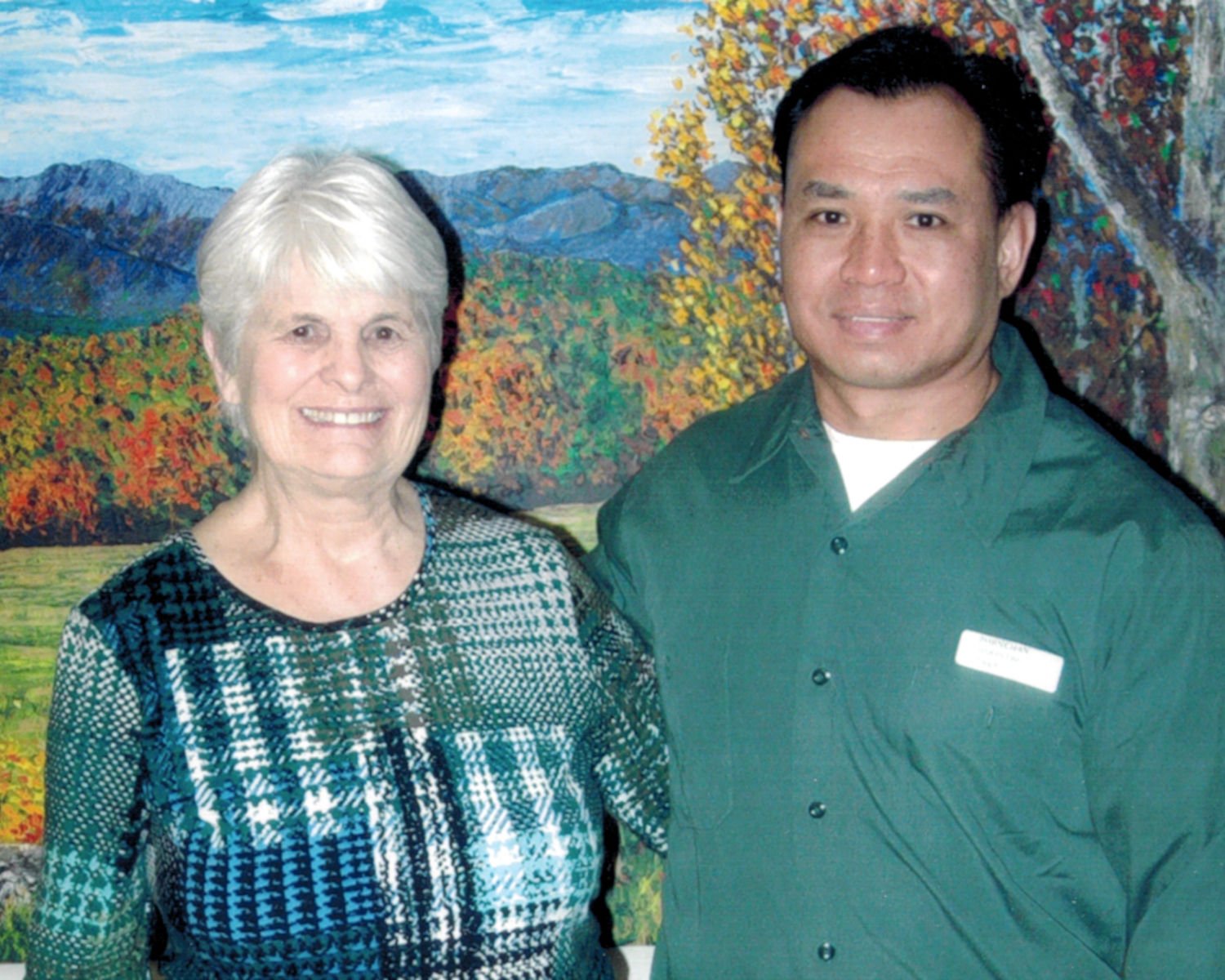
Claire Dion, a contributing writer for Beyond These Stone Walls, interviewed Pornchai “Max” Moontri at the New Hampshire State Prison for a tale of hope and amazing grace.
Preface by Father Gordon MacRae
The following is a guest post by Mrs. Claire Dion, a reader of Beyond These Stone Walls in Bridgton, Maine. Claire graced these pages with a Corporal Work of Mercy that touched our hearts in 2017. After two years with us, our friend, Kewei Chen from Shanghai, China, was transferred to the custody of Immigration and Customs Enforcement (ICE) to await his deportation.
After reading of the unique circumstances that brought Chen from China to an American prison, and the pain of our parting as well as our hopes for Chen, Claire drove from her home in Maine to meet with him at the place where he was awaiting deportation. The result of that visit became her first guest post on Beyond These Stone Walls, “My Visit with Kewei Chen in ICE Detention.”
Her post was comforting. From my perspective, and that of Pornchai Moontri who had become Chen’s older brother, the void in our hearts could not be filled, but Claire’s guest post left it not quite so empty. It ended with a wonderful photograph of Chen emailed from the Shanghai airport as he saw his parents for the first time after his unplanned three-year absence.
More recently, Claire asked if she could visit me and Pornchai, a much further winter drive for her. Since prison rules allow for being on the visitor list of only one prisoner, I asked her to visit Pornchai, to treat it as an interview, and to write another guest post for Beyond These Stone Walls.
I did this because, as I have hinted in some previous posts, there is a very special story coming, one that I know will both break your hearts and then mend them again with evidence of the immense power of Divine Mercy to restore the human soul. This story is coming when I am able to fully tell it, and it will be unlike anything you have ever read before on Beyond These Stone Walls.
So as a prelude, I want to present Pornchai “Max” Moontri through the eyes of a reader meeting our friend for the first time. His story should begin, after all, not upon the dung heap of Job where life took him, but at the point to which Divine Mercy has redeemed him out of darkness into a very great light.
Claire Dion is a wife and mother of five adult daughters and a devoted grandmother. She is currently retired from a career as a registered nurse in obstetrics at Lynn, Massachusetts General Hospital. She today lives in Bridgton, Maine where she has been part of the Faith Formation Team at Saint Joseph Parish and a follower of Father Michael Gaitley’s 33 Days to Morning Glory and Marian Consecration. It’s an honor to present Claire Dion.

Saturday – January 8, 2018 at 8:00 AM
I pulled into the parking lot of the New Hampshire State Prison for Men in Concord. I will be meeting Pornchai Moontri, a man I have come to know and love from reading Beyond These Stone Walls. Walking into the visiting area where I have to sign in, I feel a little uneasy. I did not have a clue what I was to do and I had not slept the night before as I was afraid I would do something wrong and the visit would be canceled.
Everything went well until I passed through a metal detector and the alarms went off. What was I thinking? I should have realized that two knee replacements and a hip replacement might present a problem. After being sent back to the waiting room with alarm bells ringing, some guards questioned me, and then led me into the visiting room. It was a large room with metal tables and chairs screwed to the floor. Each table was numbered, and I was instructed to go to table number twenty-four.
From a distance I saw Pornchai walk into the visiting room. I realized that he had not seen me before, but I recognized him from Beyond These Stone Walls. So I waved and smiled, and he smiled back. When he got to the table, I asked him if I could give him the allowed “three-second hug.” He laughed while I hugged this man whom I had only read about but was very anxious to meet.
While I was waiting for Pornchai to arrive, I wondered how we were going to fill in a two-hour visit. I was not allowed to bring anything with me so I had no notes to help me remember what I wanted to talk to him about and all the questions I had. I knew that Father Gordon wanted me to write about this visit for Beyond These Stone Walls.
We sat next to each other at the table in a room filled with cameras. The large room was also full of visitors, and, as many of them were children visiting their fathers on a Saturday morning, it was noisy. It took only seconds for us to relax and start talking. From the moment we sat down, I had a sense that I already knew this very special person.
We continued to talk nonstop for the entire two hours. We both felt that it was amazing that we were sitting here together, Pornchai from Thailand and me from Lynn, Massachusetts (which, by the way, is the city just North of Boston where Father Gordon grew up).
Soon we were talking about Pornchai’s incredible journey from a village in Northeast Thailand to Bangor, Maine and ending at the New Hampshire State Prison. I learned that Pornchai was abandoned by his mother at age two and that a teenage relative found him and brought him to live with his family.
Nine years later, when Pornchai was age eleven, his mother returned to Thailand. He did not recognize or even remember her, but against Pornchai’s will he was taken from Thailand and brought to America. A series of traumatic events broke his heart and his soul. That is another story that hopefully Father Gordon will be telling soon at Beyond These Stone Walls.
When Pornchai was fourteen years old, he ran away. He became — though not by choice — a homeless child living on the streets for the second time in his young life, and he spoke little English. While still a teen, he was involved in a struggle that resulted in the death of another man, and he was sent to prison.
While listening to his story, my heart ached as I could see and feel his pain over these events from so long ago. Sentenced to 45 years in a Maine prison, Pornchai continued to have outbursts of anger and rage which landed him in solitary confinement for many years in Maine’s “supermax” prison. [Note: PBS Frontline did a gripping story on that very place and time.]
Pornchai told me that his only plan for life was to never leave prison. It sounded as though he knew he was going to die there, and that was what he wanted. It was his “Plan B” for his life. However, God had other plans for Pornchai Moontri. Fourteen years later, he was moved to a prison in New Hampshire for the rest of his sentence, and Father Gordon MacRae stepped into the story of his life.
Here Pornchai’s eyes and expression softened as he spoke about meeting Father Gordon whom he and other prisoners call “G.” At this point, Pornchai said he felt completely alone, still angry and trusting no one. Another prisoner, a young man from Indonesia, introduced him to a man called “G” and said that G helped him a lot and that he trusted G.
Pornchai watched how G in a caring and patient way helped others and how they trusted him. In his life, the very idea of trust was entirely new. Slowly and cautiously, Pornchai let G into his life and a friendship began.
We talked for awhile about G and I learned that no matter what happens in prison G stays calm. He is a humble, steady person in the midst of the constant turmoil and darkness of prison life, and is always available to any prisoner who comes to him. With a chuckle, I have to add here that I remember Chen telling me that G is a very good man “but you don’t bother him when he is typing a BTSW post!”

“When I Was in Prison, You Came to Me” —Matthew 25:36
It was quite awhile before Pornchai found out that G is a Catholic priest. We spoke about how Father Gordon’s strong faith impressed Pornchai even though many in the Church had abandoned him. Pornchai told me that G’s faith shines in prison, and has attracted some of the prisoners to join him at Sunday Mass and in retreats sponsored by Father Michael Gaitley and the Marians of the National Shrine of The Divine Mercy.
Pornchai also said that Father Gordon constantly reaches out to those he feels he can help, and Pornchai was one of them. It was during this conversation that I asked Pornchai to tell Father Gordon how much I love, respect and honor his priesthood.
Through him, Christ’s presence is being felt there, and it is making a difference for many behind those stone walls and many of us BTSW readers.
As their friendship grew, Father Gordon told Pornchai that he must start taking positive steps with his life. He encouraged Pornchai to leave aside “Plan B” and plan instead for a future.
Pornchai began taking education courses, spending his days in school instead of in a cell. He proudly told me that he earned his high school diploma in prison and was Valedictorian of his 2012 graduating class. I listened and learned that his educational journey was just beginning. With Father G’s help, he then enrolled in courses in social work and psychology at Stratford Career Institute earning academic certificates “with highest honors.” This was followed by studies through a scholarship at Catholic Distance University where he took courses in theology with a straight “A” average.
What Pornchai has accomplished is nothing short of amazing given that he learned English in prison. He and “Father G” encourage other prisoners to become educated, and Pornchai now spends time mentoring and tutoring them, especially in mathematics in which he excels. He also spends his days in the woodworking and Hobby Craft shop where he teaches safety training to other prisoners on the use of carpentry tools and machines.
Pornchai designs and builds handcrafted model ships, beautiful Divine Mercy keepsake boxes, and other creations in wood. Some of these are made as gifts and some are sold in a store near the prison grounds. Pornchai used the proceeds to pay for his education courses. Father Gordon later told me that Pornchai is modest about his great skill in woodworking. One of his ships is on display in Belgium where a curator posted a brass plaque indicating that it was designed and created by “Master Craftsman Pornchai Moontri, Concord, New Hampshire.”

Divine Mercy Conversion
As Pornchai’s friendship with Father Gordon deepened, and Pornchai was influenced by his patient practice of faith, he made a decision to become a Catholic. Seeing in the many comments how much Father Gordon’s posts spiritually affect BTSW readers, we talked about how becoming Catholic has helped Pornchai in prison. He received the Sacraments of Baptism and Confirmation on April 10, 2010. He chose “Maximilian” as his Christian name to honor St Maximilian Kolbe.
On the next day, he received his First Eucharist from Bishop John McCormack. When this was first being planned, neither Pornchai nor Father Gordon realized the date was Divine Mercy Sunday. On that day, Jesus showered Pornchai with His love and mercy and Pornchai felt it. He said that before he became a Catholic he was always feeling unloved and alone. Now he could feel that God was with him and loved him. He also spoke about his love for the Blessed Mother. As he told me this, there was a sense of peace within him.
When I asked Pornchai what he would like me to tell BTSW readers, he became very serious. He said that he and Father Gordon are deeply impacted by the support they receive and that BTSW could not exist without it. They deeply appreciate the love, prayers, and encouragement they receive from readers all over the world. He kept going back to the BTSW readers and how important they are to both of them. He spoke of how he has done nothing to earn this outpouring of love.
Pornchai spoke about the lawyer who has helped him and Chen so much, Clare Farr in Western Australia, and how she learned of him through BTSW. He spoke of Suzanne Sadler, BTSW’s Australian-based webmaster and publisher. He spoke of Father George David Byers who helps ready Father G’s posts for publishing. He spoke of Mrs. LaVern West who prints and mails him the BTSW comments.
Pornchai also said that Father Gordon corresponds with Father Andrew Pinsent, a scientist at Oxford University who has cited his science writings. I mentioned that Father Gordon’s science posts are over my head and Pornchai said with a smile, “Mine too!” In an astonishing connection that Father Gordon later told me about, Father Georges Lemaître, the priest-physicist considered in science to be “Father of The Big Bang and Modern Cosmology,” was a close family friend of Mr. Pierre Matthews in Belgium who today is Pornchai Moontri’s Godfather.
And Pornchai also spoke of Charlene Duline who helps Father G communicate with readers, and is Pornchai’s Godmother. She once sent him a letter in which she called him “precious,” and then other prisoners teased him about it, but he laughed and said that they are jealous because no one calls them precious.
Suddenly the lights in the room flashed on and off. Our visit was over, but not before we were able to have a photograph taken together. With a hug (three seconds only) we said goodbye. I was truly blessed to meet this amazing young man, Pornchai Maximilian Moontri, and to see Father Gordon through his eyes. I know I will visit him again.
On the coldest day of winter, I left the New Hampshire State Prison with summer in my heart.
+ + +
Note from Father Gordon MacRae:
I thank Claire Dion for this snapshot into our lives. In my recent post, “The Days of Our Lives,” I wrote that Pornchai Moontri and our friend, J.J. Jennings work together in the woodworking and Hobby Craft center. The photos below are of their latest project, a Jewelry Cabinet.
The design for a cabinet of this size was by J.J. Jennings, who collaborated with Pornchai Moontri for the highly skilled construction. The one on the right was made by J.J. and the one on the left by Pornchai. The woods for both are solid maple and black walnut. The drawer fronts are maple or black walnut with poplar sides and bottoms. The drawers and side cabinetry doors are lined with velour.
These beautiful pieces are 20” high, 14” width, and 8.5” depth, and are customized with wood-burned or painted designs and brass fittings. The top is hinged with a 2.5”-deep display area. Two of the drawers are for rings and the other drawers are deeper. The intricate side cabinets are for hanging jewelry such as necklaces, bracelets, and rosaries. Other photos of their work can be seen on the Pinterest Board, “Woodworking and Model Shipbuilding by Pornchai Moontri.”

Saint Maximilian Kolbe and the Gift of Noble Defiance
Pornchai Moontri looked on the death chamber of Maximilian Kolbe and saw devouring jaws of evil. I saw that evil too, but choking on a brave soul’s noble defiance.

Pornchai Moontri looked on the death chamber of Maximilian Kolbe and saw devouring jaws of evil. I saw that evil too, but choking on a brave soul’s noble defiance.
Auschwitz 1941:
“After the so-called dinner, I was invited between Blocks 18 and 19 where some prisoners had gathered among whom were several priests… Our colleague, Kolbe, spoke of the Feast of Corpus Christi, of the great omnipresent God, and of our sufferings by which He was trying to make us ready for a better life.”
The photograph in this post has deep meaning and significance for us. TSW reader Lupe Gwiazdowski stood with her camera before the gaping maw of a prison window at the Auschwitz Concentration Camp in Poland. She photographed the window of the death chamber that consumed the life of our Patron Saint but could not extinguish the light of his sacrificial priesthood.
When Lupe’s letter with the photograph arrived in early July, Pornchai “Max” Moontri and I were standing with 100 other prisoners for Mail Call. The mail handlers here reversed the pages before stuffing the letter back in its envelope so the page with this photo was on top when I unfolded the letter.
I did not know what the photo was, but right off Pornchai pointed to it. “It’s a face!” he said. “An evil face!” Study the photograph above for a moment. Once I saw what Pornchai saw, I could not look at the photo again without instantly seeing that same demonic face. You will see it too.
But what Pornchai saw as the gaping jaws of evil ready to devour, I saw those same jaws choking on whatever was inside. When I suggested this to Pornchai, he saw it too. Stare at the photo for another moment, and you may see what I mean.
Then I read the letter that accompanied Lupe’s photo, and realized with a jolt that it was behind these gaping jaws that our Patron Saint, Maximilian Kolbe, surrendered his life in defiance of the great evil that manifested itself at Auschwitz.
Over two weeks of forced starvation followed his choice to die in place of an innocent young man. When Father Kolbe did not die in a timely manner that suited his captors, his life was taken by lethal injection on August 14, 1941. After a lifetime of devotion to “The Immaculata,” death came on the Vigil of the Solemnity of the Assumption. Lupe tells the story of the photo in her letter of June 29, 2017 that touched our hearts deeply:
“Hi Father G: I wanted to send you this photo and I hope you get it. I went to Poland this month, and I made a mental note to pray for you and Pornchai “Max” Moontri at the Auschwitz cell of St Maximilian Kolbe.
”As is often the case with my mental notes, when I got to the cell I was so overwhelmed that I forgot it. As soon as we exited the block of cells I remembered. I left the group and tried to push my way back to the cell, but Polish tour guides are not to be pushed against! I didn’t make it.
”I was downcast as I caught up with the group, and then realized that the guide was pointing to the bars of the Saint’s cell window from the outside. I didn’t even hear what she was saying as I looked upon this sacred spot. I thought of how this priest and his companion prisoners died giving such powerful witness through those same bars to so many whose hope was perishing. I lifted you and Pornchai up right there, and then snapped this photo for you. Father, I do not know what else to say.
When I got back to a computer, I saw your post, “Thoughts Upon My 35th Anniversary of Priesthood Ordination,” and realized that your anniversary was on the same day I prayed for you and Pornchai-Max at Auschwitz. Father, thank you for your priesthood.”

In Noble Defiance of Evil
Today, virtually everyone knows the story of Saint Maximilian Kolbe. His Earthly remains were reduced to smoke and ash in the ovens of Hitler to drift in the skies above Auschwitz. But what he wrote and said and did, the glow of his soul, still moves mountains and the hearts of millions.
In Father Maximilian Kolbe, evil did not destroy what it set out to destroy. It imprisoned and killed the body of a man, but the priest lived on in noble sacrifice and love. The jaws of that window choked on the goodness of the soul contained therein.
Of all the thousands of accounts about the witness and strength of Father Maximilian Kolbe, for me the most powerful account comes from Herrmann Langbein who was a prisoner at Dachau and then at Auschwitz. He is best known for his book, Against All Hope: Resistance in the Nazi Concentration Camps, 1938-1945. He singles out one man’s defiance that I have cited in other posts about our Patron Saint:
“The best-known act of resistance was that of Maximilian Rajmund Kolbe, who deprived the camp administration of the power to make arbitrary decisions about life and death.”
Langbein went on to write powerfully of the witness, not only of Father Kolbe’s sacrifice by volunteering to take upon himself the death sentence of a fellow prisoner, but of his demeanor in prison:
“Kolbe and his companions in misfortune had to spend almost three weeks [in starvation] in an unlit cell. On August 14 (1941) a lethal injection ended the suffering of the man whose bearing elicited the respect of the supervising SS men to the very end.”
I pray for the gift of this brave priest’s noble defiance of evil. It’s easier to just succumb to it, enduring it for as long as we can until it starts to bring about subtle changes in our resolve. My favorite passage in The Screwtape Letters by C. S. Lewis (Harper, 1942) is Letter 12. You have seen this passage before in these pages. The demonic “Uncle Screwtape” describes perfectly the slippery slope that suffering and sin conspire to spread the contagion of evil. Their cumulative effect …
“… is to edge the man away from the Light and out into the Nothing…. Indeed the safest road to Hell is the gradual one — the gentle slope, soft underfoot, without sudden turnings, without milestones, without signposts.”
In no place is a man or woman without defiance “edged away from the Light out into the Nothing” more than in prison. Like all prisons — whether they be prisons of iron, or fear, or trauma, or loneliness, or sickness, or pain — year upon year of it can set us upon the subtle turnings C. S. Lewis describes. For some, no doubt, resistance to the evils of our prisons seems futile.
Something happened recently — something profoundly humbling — that I thought about when I read the short passage at the top of this post from a priest-prisoner in Auschwitz with Maximilian Kolbe. The passage is from a published collection, “Depositions of Fellow Prisoners,” in the investigation of Maximilian Kolbe’s cause for sainthood.
More than 12,000 priests died in Auschwitz and the other camps of Germany and Poland, but the priest who wrote the passage atop this post survived. I wonder about those who perished there, those whose hope was siphoned off by the evil in their midst.
But for Maximilian Kolbe, resistance to evil was the one charism of a sacrificial priesthood available to him in a place where priesthood and sacrifice were deemed meaningless by worldly powers. Prison can quickly descend into “every man for himself,” but Maximilian lived and died on life’s road less traveled.

Priesthood Lost in Translation
Over the last twenty of the nearly twenty-three years that I have been in this prison unjustly, there has been another priest here. He is a priest of my diocese, but I never knew him outside of prison. In fact, I barely knew him here. He was convicted of a sexual abuse charge in 1997, one alleged to have taken place long before then, and has been here ever since.
I know that in 2001, this priest acquiesced to a demand that he be voluntarily laicized (dismissed from the clerical state). Over the ensuing years, after 25 years of priesthood, he never again heard from our bishop or diocese. He was discarded. The prisoner-priest lost his faith. He became unable to be present at Mass for the next sixteen years. He was in a different prison unit than me, and I saw him only in rare passing.
However, when printed copies of some TSW posts were mailed to me, the sender would often send two. So, with the clandestine help of friends here, I started to send the other copy to this priest. I did not send him every post, just the ones about priesthood. One post reached an untapped well of faith and hope.
It was “St Maximilian Kolbe: A Knight at My Own Armageddon” posted one year ago this week. It was the middle of an important three-part post, and was the only post for which the priest sent back — via the same circuitous prison channels — a request to see more. These posts were the limits of our contact.
The same week that Lupe’s letter and photo arrived, Pornchai Moontri and I were climbing the multiple tiers of stairs on a Sunday morning for Mass in the prison chapel. As we passed the second floor landing, the priest mentioned above was just then emerging from the prison medical unit. I greeted him and shook his hand (another act of resistance as shaking someone’s hand is forbidden here) and then something strange happened.
Pornchai did not even know who he was and I did not want to put the priest on the spot so we parted company and proceeded up the next flight of stairs. Then Pornchai turned and said, “Do you want to come with us?” The priest paused for a moment looking puzzled, and then quietly followed us up the stairs. Before we entered the Chapel, I asked Pornchai to go find us some seats while the prisoner-priest told me that this is his first time at Mass in 16 years. He became reconciled, and we sat with him.
The next week — being an idiot sometimes — I took our usual seats and Pornchai stood glaring at me. “What are you doing?” he asked, and then pointed to that other priest still standing outside the door. “Go get him and bring him in to sit with us,” said Pornchai. God bless Pornchai!
In early July I spotted that prisoner-priest on the local news. He was appearing before the New Hampshire Parole Board with a request for medical parole because he was dying of cancer.
A physician who spoke at the hearing reported that he has no more than six months to live, and his care would be a burdensome expense for the state. After some callous remarks from a victim advocate on the State’s payroll about whether he “looks sick enough,” and whether twenty years in prison exacts sufficient reckoning, the Parole Board granted his medical parole.

On the Move
A week later, Pornchai and I were suddenly moved — he to one place and me to another. Apart for the first time in over ten years, this has been a great hardship for us both. We are trying to reunite, but once anything like this is done here, it resists being undone. Pornchai is trying to be moved to the same place I am in. I plan to write more of this very soon, and hopefully will have a happier ending for you.
The place I was sent to is the unit the other priest has been living in for the last twenty years. My first week there was his last week there, and we were able to walk each morning and talk. He is restored to faith and hope that our sufferings will make us ready for a better life.
I was with him early in the morning as he left prison a few days ago, and went home to his sister to die. I like to think that we managed to fill in some of the cold abyss in which our Church let him wander alone in exile these twenty years. I cannot imagine, even in my most vengeful thoughts, that such alienation and abandonment are what Christ summons forth from the Apostolic witness of His Church.
Most of all, I like to think we helped to prepare my brother priest for something essential imparted to us by a Patron Saint who guides us on a right path through prison: the gift of a noble defiance of evil while living the witness of a sacrificial priesthood.
+ + +
Editor’s Note: Fourteen days after this was posted, Pornchai Moontri was moved to the same building as Father MacRae, an extremely rare event. Two days later he and Father G were moved to the same cell. Neither had formally requested this.

Cardinal George Pell Is on Trial, and So Is Australia
The trial of Cardinal George Pell for “historic” sexual abuse claims is underway in Australia, but the state of Australian justice also has the world’s attention.
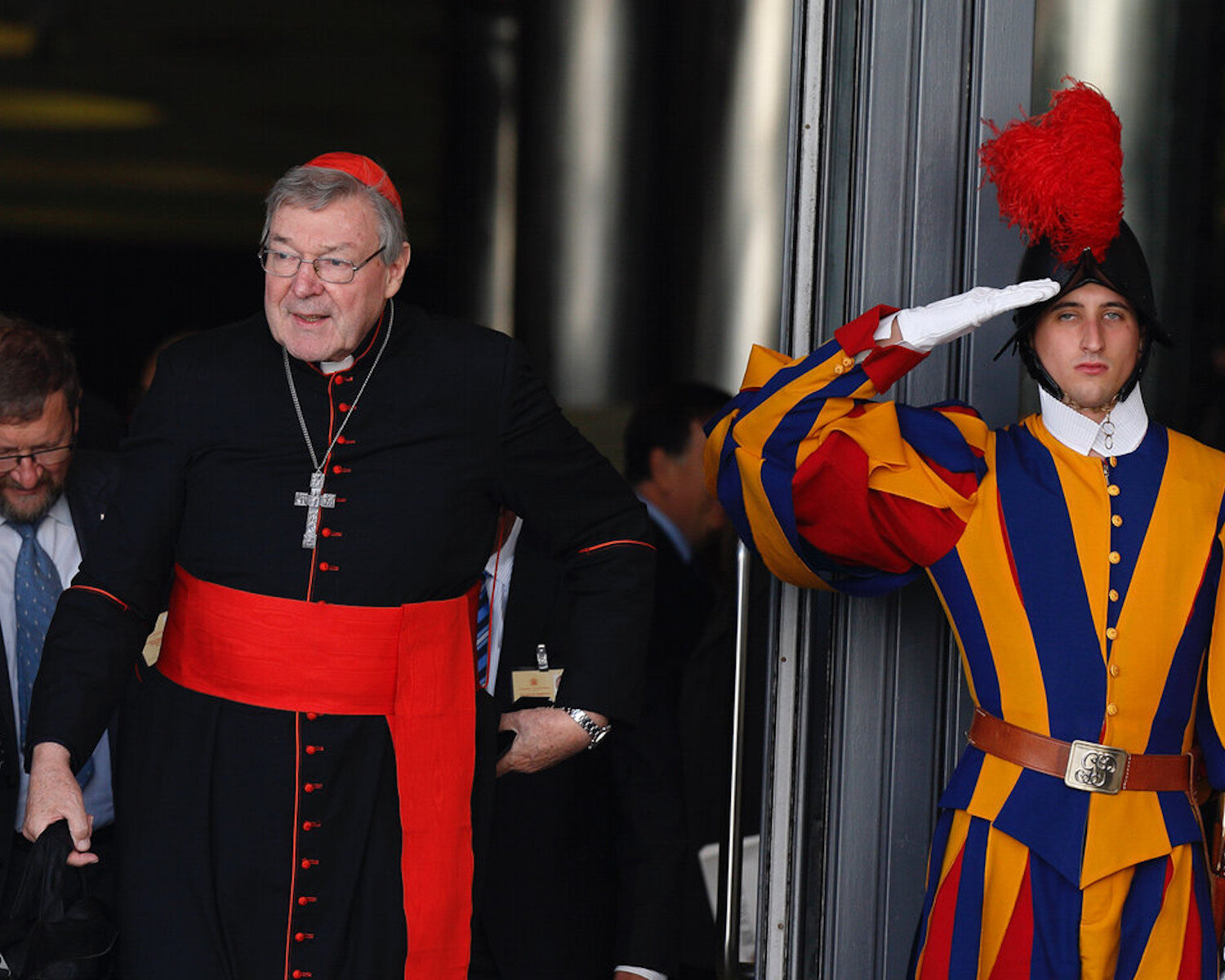
The trial of Cardinal George Pell for “historic” sexual abuse claims is underway in Australia, but the state of Australian justice also has the world’s attention.
“Why have a trial at all? Just take the man into the Outback and shoot him.”
“Trial by Media.” The ominous term has already been a part of the public record in regard to Australia’s Cardinal George Pell. I used the term myself in a post two years ago entitled, “Peter Saunders and Cardinal Pell: A Trial by Media.”
The concern for the poisoning of justice through leaks to a toxic and predatory news media is nothing new, but “Trial by Media” hangs like the burial shroud of justice itself over the trial of Cardinal Pell on 40-year-old claims of sexual abuse.
Lest anyone doubt the power of the media to both generate such claims and shape justice and due process in a case like this, consider a recent issue of The Week, a popular weekly news magazine. The Week presents itself as “The Best of the U.S. and International Media.” It selects excerpts from online media and newspapers throughout the world and presents them as the best written accounts of the week’s top stories.
In its July 21, 2017 issue, The Week chose as the best of the media from Australia a column by Barney Zwartz in The Age entitled, “The Nation’s Top Catholic in the Dock.” It should raise the alarm for anyone concerned for the media’s role in all this, and the slant it presents. Here is an excerpt:
“After decades of rumors, Australia’s highest-ranking Catholic, Cardinal George Pell, is finally facing trial for child sexual abuse. At this point, Australians are numb to the horror, having endured years of parliamentary reports that produced damning evidence against so many priests…”
We can only hope that Australians are not so “numb” that they don’t see through this language. It is an open invitation to a lynch mob. The phrase, “after decades of rumors” should alarm everyone from the start. For any objective observer of this story, the only “damning evidence” is the accusations themselves and the fact that there has been a sexual abuse scandal in the Catholic Church in Australia.
This is the state of the evidence thus far presented against Cardinal Pell as this “Trial by Media” gets underway. To incite a community to forego due process in favor of emotion is the very foundation of all witch hunts. An “availability bias” has been built that places Catholic priests in a suspect class. I described its momentum in “How SNAP Brought McCarthyism to American Catholics.”
Conditioned by a predatory media, Australians are now invited to ignore the abyss that is empty of evidence, and weigh the claims against Cardinal Pell with nothing of substance except “decades of rumors” that left Australians “numb to the horror.” The same media-fueled moral panic swept America and spread like a virus.
Now some of those who used it for profit are themselves before the bar of justice — (See “David Clohessy Resigns SNAP in Alleged Kickback Scheme”). But Mr. Zwartz and The Week present other “evidence” as well, and it is a central but unspoken feature in the indictment of Cardinal Pell:
“A combative participant in Australia’s culture wars,” the ultraconservative Pell had long been a divisive figure in Australia because of his `relentless, overbearing’ style. He was ruthless in punishing priests who deviated from doctrine by advocating changes to Mass or supporting ordination of women.”
Actual evidence of any offense from forty years ago does not exist in the Pell case, but for too many about the business of news and fake news, it need not exist. His Eminence is guilty of “other things”: fidelity to Catholic teaching, a conservative mindset, and an insistence that priests support orthodoxy. This is enough for the Trial by Media to rush to judgment.
Whether it is enough for the people of Australia remains to be seen. I think not. Even after my own experience of justice, I remain open to the hope that the better nature of thoughtful people will prevail. I know many Australians, and they are neither unjust nor “numb” as some in the news media suggest.

Where Are Your Accusers? (John 8:10)
Who are the current accusers in the trial of Cardinal Pell? It strikes me as bizarre that so many in the news media have focused this story only on the wider scandal and Cardinal Pell’s conservative mindset without much inquiry into the rest of the equation. Most in the media have said nothing about Pell’s accusers except to freely identify them as “victims,” and to insinuate that unnamed others contemplate coming forward.
There’s just enough smoke to create the impression of a raging fire Down Under. On June 30, The Media Report, an ever vigilant source of the rest of the sobering story, posted “Now This: The Media’s Cardinal Pell Disinformation Campaign.”
David F. Pierre, Jr. at The Media Report focused on a sobering fact that most other reports have omitted or downplayed. These accusations are from forty years ago. Much of the news media will not identify the accusers because of politically correct policies to withhold the identities of sexual abuse victims, but these accusers are not children; they are men in their fifties.
They have criminal records of their own. Although that in itself does not discredit their claims, it should be sufficient enough for a closer look. The Media Report pointed out (with supportive links) that one of the accusers, Lyndon Monument, is an “admitted drug addict” who served a term in prison for criminal assault stemming from a drug debt. He also previously accused a childhood teacher of sexual abuse.
The other accuser, Damian Dignan, “has a criminal history for assault and drunk driving.” He has a history of alcohol abuse, and also previously accused a childhood teacher of assault. Both men are raising their claims against Cardinal Pell for the first time, forty years later, and only when the climate would lend itself to less scrutiny over financial settlements.
Experience tells me that both the justice system and the news media should be especially cautious in forming judgments in such a case. In 2005, during the height of the priesthood scandal in America, I wrote an article for Catalyst entitled “Sex Abuse and Signs of Fraud.”
The article details multiple cases of men with criminal records who concocted schemes to obtain financial settlements through fraudulent claims about Catholic priests. They took advantage of the very climate now smoldering behind the Pell case.
Then there was the story of Shamont Lyle Sapp that I exposed in “Catholic Priests and the Perversions of Predators.” Before he was investigated and exposed by a vigilant U.S. Attorney, Mr. Sapp, from his prison cell, accused several priests in multiple states using details and “evidence” gathered from Internet accounts of other accusations against priests. It was only a fluke that Sapp was investigated and caught in the scam.

Weapons of Mass Destruction
The Media Report also reminded us that back in 2002, Cardinal Pell was previously accused by a “career criminal” who had been convicted of tax evasion, narcotics charges, illegal gambling operations, and organized crime with “an impressive 39 court convictions under his belt.” He accused Cardinal Pell of abusing him in 1962, but Pell was exonerated and cleared of the charge.
“Cardinal George Pell and Other Martyrs for a Nefarious Cause” raised the specter that claims like these 40-year-old charges are used by some as “weapons of mass destruction” in order to bolster other agendas. At the popular site, Whispers in the Loggia (“For the Cardinal Prefect, ‘My Day in Court’” June 29), Rocco Palmo raised the same “historical” abuse case from the 1960s in which Pell had been cleared, but he attributed its momentum, and its treatment in Rome, to other agendas:
“Two decades of revelations of abuse and cover-up have been treated as a political football among the Church’s ideological camps.”
There is no evidence or reason for treating the current forty-year-old “historical abuse” case as any different. The mere fact that charges were brought in such a case could have a lot more to do with Pell being a target for political factions that are happy to see him in the dock of justice knowing that, regardless of the outcome, Pell is permanently maligned and out of the way.
But among all the toxic press, there are many sounding the alarm that “Trial by Media” in Australia is itself facing trial. In National Review (“The Persecution of Cardinal George Pell,” June 29, 2017) author George Weigel described the campaign against Pell in Australia as…
“…a thoroughly poisonous public climate exacerbated by poorly sourced but widely disseminated allegations, no respect for elementary fairness, and a curious relationship between elements of the Australian media and the Victoria police…”
George Weigel cited comments from several Australians who have refused to become caught up in the climate of moral panic and nefarious agendas. These voices are worth hearing out. Attorney Robin Speed, President of the Australian Rule of Law Institute warned against prosecutors acting against Pell “in response to the baying of a section of the mob.”
Angela Shanahan in The Australian summarized the trajectory of the case:
“Conspiracy and rumor reign, logic and fact have gone out the window in the case of Cardinal Pell…. In all this sound and fury, the Cardinal has acted impeccably. He has said nothing except to state his innocence.”
Columnist Peter Craven, writing in the Sydney Morning Herald (June 9) concluded,
“One can only hope to God that in the present climate people will be capable of realizing this is a case being mounted for a witch trial”
Voices of dissent against the blind orthodoxy of victimhood are a minority in Australia just as they are a minority in America. Some of these voices have been courageous in their defense, not only of Cardinal Pell, but of justice as an ideal that is now itself under indictment. Australian political commentator Amanda Vanstone, a former Ambassador to Italy and “no fan of organized religion,” wrote,
“George Pell’s trial by media has to stop. What we are seeing is no better than a lynch mob from the dark ages… The public arena is being used to trash a reputation and probably prevent a fair trial.”
Andrew Halphen, co-chairman of criminal law at the Law Institute of Victoria addressed the leaks to the media about Pell as a startling affront to the legal system. He expressed grave concern over whether Pell could now have a fair trial. He added that he could not think of any other case in which a charge against a public figure “finds its way to the front page of a major news publication before a person is actually charged.”
After I posted “Cardinal George Pell and Other Martyrs for a Nefarious Cause,” a first-time reader in Ballarat, Australia sent a comment that I want to post here because it speaks volumes about the climate in which Cardinal Pell faces trial. It begins with a quote from the above post:
“‘This nonsense continues because of the clamor of a few and the silence of many.’ Ahh, the irony of your comment. I am a Ballarat resident. My childhood bore witness to the culture of pedophilia that thrived here. And as an adult, the impact of the sexual abuse that happened to so many in my community continues.
“I am appalled by your lack of compassion for victims. Your want to dismiss the validity of these crimes because of the delay in victims coming forward and/or charges laid, and your implied belief that our Australian justice system is flawed.
“Our community knows its truths. The Catholic Church cannot conceal this truth as it once did. Your comments are just “clamor.” Hurtful clamor. Pell and the rest of “your fellow sufferers” [quoted from Cardinal Avery Dulles on TSW’s “About” page] cannot demand the silence of so many impacted because it doesn’t fit your narrative.”
— a resident of Ballarat, Australia
The defense rests its case. My heart goes out to Australians who have suffered the unspeakable, but the above comment makes the case for me. If what other priests did to other victims is now sufficient “evidence” to indict and convict Cardinal Pell then why have a trial at all? If it is too late to salvage justice from vengeance, then just take the man into the Outback and shoot him.


How Our Lady of Fatima Saved a World in Crisis
The 100th Anniversary of the apparitions at Fatima can be seen through a lens of history. Journalist Craig Turner presents a fascinating view of the Fatima Century.

The 100th Anniversary of the apparitions at Fatima can be seen through a lens of history. Journalist Craig Turner presents a fascinating view of the Fatima Century.
Note to readers from Father Gordon MacRae: In “Mary and the Fatima Century,” a recent post at Beyond These Stone Walls, I wrote of the 100th anniversary of the apparitions of Our Lady of Fatima that began on May 13, 1917. They continued on the 13th of each of several months to follow.
Before posting it, I received a message from journalist and historian Craig Turner writing from Virginia. He sent along the outline of a CD he produced for Lighthouse Catholic Media entitled “The Rise and Fall of Communism: How Our Lady of Fatima Saved a world in Crisis.” He described his historical analysis as “How Mary intervened during a time of great crisis in the Church and the world, to save us from a great evil.”
As I read through the outline, I discovered that Mr. Turner’s description was the understatement of the year. His historical summation of world events parallel to the apparitions at Fatima is fascinating: So I invited him to submit his outline as a guest post. It is a privilege to present this riveting overview of the Fatima Century by Craig Turner.
+ + +
Tours, France
In 1847 a young Carmelite nun made the astonishing claim that Jesus had begun appearing to her. Upon telling her superior, the claim was met with skepticism. In 1846, Jesus warned her of an approaching storm: “the malice of revolutionary men.” The following year, on March 14, he appeared again to her, stating that a society known as the “Communists” was working to spread…
On March 30, 1848, Jesus appeared to her for the last time telling her that she had completed her earthly mission and would soon die. Though she was in good health, she accepted this revelation with peace. She suddenly developed pulmonary tuberculosis and died on July 8, 1848, at the young age of 33.
Brussels, Belgium
At the same time Jesus appeared to the nun in Tours, France in 1847, an unknown political theorist living in exile in Brussels wrote his social contract called The Communist Manifesto. His name was Karl Marx. His financier and fellow author was Frederick Engels. Shortly after the work was published, a wave of unexplainable revolutions broke out in Europe.
The Manifesto presented what it claimed to be an answer to class struggle, and was quickly published in other languages. In France, socialists set up a government after the fall of Napoleon, but their government was overthrown and many of its members executed.
In Germany, the German Socialist-democratic party was created in 1875 but it was deemed a threat to the country and outlawed by the German government led by Otto von Bismarck. In 1890 it was once again legalized and fully adopted Marxist principles. In 1893, Karl Marx died in poverty, but The Communist Manifesto continued to attract adherents. Standing over his grave, Engels declared him to be the greatest thinker of their age.

Vatican City
On October 13, 1884, Pope Leo XIII had an extraordinary vision: He had just finished offering Mass at the Vatican when he was knocked to the floor of his chapel by a supernatural force and heard the voices of Jesus and the devil in conversation.
The devil declared in a raspy and guttural voice that he can conquer the world and boasts he will have ultimate victory, but needs time and power “to those who have given themselves over to my service.” [It was at this time that Pope Leo XIII composed the well-known Prayer to Saint Michael the Archangel.]
Russia
By 1905, three competing parties evolved in Russia. The Marxist Russian Social Democratic Labor Party advocated for a complete revolution. Social upheaval erupted in Russia and Europe. Though Karl Marx stated that Russia was an unlikely candidate for communism, it proceeded slowly along this path.
Western Europe
Other parts of Europe experienced socialist leanings and anti-religious fervor. The conflicts centered around two factions: those wanting to retain their personal liberties vs. the new forms of socialist governments and a conflict between the Catholic Church and atheist communism. [How history repeats!]
At this time, religious persecution broke out in Portugal. Between 1911 and 1916, 1,700 priests and religious were murdered. Religious property was confiscated and a law passed forbidding public religious ceremonies. Alfonso Costa, the head of state, publicly declared that “Thanks to this law, Portugal within two generations will have succeeded in completely eliminating Catholicism.”
On May 12, 1914, two weeks before the outbreak of World War I, 22 people mowing fields in Hrushiv, Ukraine saw an apparition of the Virgin Mary who told them, “There will be a war; Russia will become a Godless country, and their country will suffer terribly for 80 years, and will have to live through the world wars [spoken in the plural] but afterward will be free.”
Two weeks later, World War I broke out across Europe. Coupled with a global epidemic of tuberculosis, the war claimed tens of millions of lives. By 1917, more than 1.3 million Russian men had been killed in battle, 4.2 million were wounded, and another 2.4 million were captured. In the midst of this desperate struggle, Pope Benedict XV issued a public letter with an urgent plea to Mary to help bring peace to the world.
Fatima, Portugal
On May 13, 1917, eight days after the Pope made his plea, three shepherd children in a remote region of Portugal experienced the vision of a magnificently beautiful woman who descended from the sky surrounded by a supernatural light. She stood suspended at the top of a large tree. They asked where she was from, and she said, “I am from Heaven.” She asked that the children return on the 13th of each month for five more months. During the following months, great crowds began to assemble.
On the third visit, July 13, 1917, the “Beautiful Lady,” as the three children called her, declared that war is going to end, but that if the people do not cease offending God, a worse war will break out “When you see a night illuminated by an unknown light, know that this is the great sign” of the impending future war, she said, as well as persecutions of the Church.
She promised to return to ask for the consecration of Russia to her, a form of entrustment or dedication. She did this in a future visit to one of the visionaries in 1929. Russia, she continued at Fatima, will soon become Communist.
On October 13,1917, the final apparition, more than 70,000 people witnessed the Miracle of the Sun. For 12 minutes, they saw the sun spin and “dance” in the sky but their eyes were not harmed. It was exactly 33 years to the day since Pope Leo XIII had seen his vision in the Vatican chapel.
Moscow, Russia
In the same hour in which the Miracle of the Sun took place at Fatima, Vladimir Lenin entered Russia with a plan to establish a Communist state. At that same time, Bolsheviks in Moscow seized control of the great cathedral of the city, built by the Czars, and destroyed it. The miraculous and prized icon of Kazan housed in the cathedral was swiftly taken to safety outside Russia. Less than one month later, all of Russia fell to communism.
Lenin, the leader of Communist Russia, declared that religion is the “opiate of the masses,” and worked to stamp out religious belief. In 1918 he dissolved democracy and began remodeling the country upon Marxist principles by nationalizing industries and confiscating land. In 1922, he formally founded the Union of Soviet Socialist Republics.
Lenin was succeeded by Joseph Stalin, who would ultimately be responsible for 20 million deaths. He believed that religion must be removed in order for the ideal Communist society to be constructed. As a result, the government promoted atheism as the state belief system and carried out a campaign of terror against religious adherents.
In the 1930s, it became dangerous to be openly religious in Russia as churches were destroyed or confiscated and religion was violently persecuted. In 1917, there were 54,000 Russian Orthodox parishes in Russia. By 1939, they numbered only in the hundreds, and tens of thousands of priests, monks, and nuns had been persecuted or killed. Approximately 100,000 people were shot during the religious purge of 1937-1938.
In Spain, Catholics fared no better than the Orthodox in Russia. During the Spanish Civil War, 11,000 priests and nuns were killed by communist loyalists, and more than 20,000 churches, convents, and Catholic schools were desecrated or destroyed.
Berlin, Germany
On the evening of January 25, 1938, an enormous light appeared in the sky across the globe, attributed later to be the greatest aurora borealis since 1709. The New York Times headline the following day was “Aurora Borealis Startles Europe.” Though usually seen in northern climates, the lights were seen as far south as southern Australia and knocked out radio transmissions.
Ten days later, Adolf Hitler took command of the armed forces of Germany. The following month he began his plan of world conquest by marching troops into Austria. The war that followed was devastating and catastrophic as disparate countries were pulled into the conflict. Several nations were ravaged by war, fulfilling the prophecy of the “Beautiful Lady” at Fatima.
By 1945 the tide had turned and World War II in Europe was nearly over, but with a staggering cost: 50 million dead. The most viciously persecuted were the Jews. Catholics fared only a little better. Of the 20,000 Catholic priests in Germany when Hitler came to power, 14,364 were killed, imprisoned, or exiled.
Seeing that his failure was imminent, Hitler dictated his will, blaming the Jews for World War II, and justifying their extermination. The following day he swallowed a cyanide capsule and died.
Japan was also at war with the United States and her allies in the Pacific. On August 6, 1945, the United States dropped an atomic bomb on the Japanese city of Hiroshima. It leveled every building within one mile of the center of the blast with the exception of one structure: a parish house, eight blocks from the epicenter where eight Jesuits were living and had prayed the rosary daily.
Included in their prayers each day was a plea given at Fatima, “save us from the fires of hell.” They were the only people within a four-mile radius to have survived.
Eastern Europe
In an ironic twist of fate, Japan had attacked Pearl Harbor on the eve of the Solemnity of the Immaculate Conception, the patroness of the United States. On the day of the feast itself, the United States declared war on Japan. Japan was forced to surrender and accept the terms of the Potsdam Declaration on the Feast of the Assumption of Mary (also the name of the church in Hiroshima where the eight Jesuits survived).
On May 13, 1955, the 38th anniversary of the first apparition at Fatima, the Soviets began to withdraw their troops from Austria after a massive prayer campaign. In 1950, 66 years after Pope Leo XIII had his vision, Pope Pius XII defined as dogma the Assumption of Mary.
Meanwhile, communism had spread from the countries of Eastern Europe to China. In 1949, Mao Zedong established The People’s Republic of China as a communist nation. That same year, Western nations for NATO — the North Atlantic Treaty Organization — aligned as a defense against the spread of communism. In 1955 the Warsaw Pact formed among the communist nations. In 1961, construction of the Berlin Wall began, a symbol of the Cold War.

Pope John Paul II after being shot multiple times at point-blank range in Saint Peter’s Square.
Vatican City
In 1978, a little-known cardinal from Communist Poland was elected pope. He subsequently condemned both communism and “unbridled capitalism.” The following year, a trade union at the Gdansk, Poland shipyard went on strike demanding freedom and democracy. The new pope managed to keep communist Polish authorities from succeeding in suppressing the strikers.
On May 13, 1981, the 64th anniversary of the first appearance of Mary at Fatima, Pope John Paul II was shot and nearly killed in Saint Peter’s Square by a man with ties to Bulgarian Communism. The following year, Pope John Paul visited Fatima and stated that Mary “guided the bullet” saving his life.
The surgeon who removed the bullet affirmed that its trajectory should have passed directly through the main arteries of his heart, but somehow moved around the organ sparing the Pope’s life.
Seeing the connection between these events, Pope John Paul II asked for the documents pertaining to Fatima in the Vatican Archives. He read them, concluding that the consecration of Russia to Mary, in union with the bishops of the world, would fulfill Mary’s request and end Russian Communism.
One hundred years after Pope Leo XIII had his vision of satanic influence, Pope John Paul II consecrated Russia to Mary in a ceremony in Saint Peter’s Square. The following year, an obscure communist, Mikhail Gorbachev, became leader of the USSR. Pope John Paul, in a letter to the last surviving Fatima visionary, asked if the consecration was done correctly. She responded, “Our Lady will keep her promises.”
On April 27, 1987, there were reports of the Virgin Mary appearing again in Hrushiv, Ukraine to a 12-year-old above a small church. Other reports followed in the ensuing months. Suddenly, and almost without warning, the Berlin Wall fell in November of 1989 and citizens passed freely between the East and the West. That same year, Poland, Hungary, Czechoslovakia, Bulgaria, and Romania became independent states followed by the Ukraine in 1991.
Later in 1991, Mikhail Gorbachev appeared for a news conference on Russian television and announced that he is dissolving the Soviet Union and ending Russian Communism. The date was December 25, 1991, Christmas Day.
Craig Turner is a columnist and business owner in Washington, DC. He began his career in journalism in the 1980s covering Capitol Hill for Government Information Services. He has worked in both communications and public relations. His articles have been published in both print and online media including MSNBC, Business Week, and Reuters.


The Chief Priests Answered, ‘We Have No King but Caesar’
The Passion of the Christ has historical meaning on its face, but a far deeper story lies beneath where the threads of faith and history connect to awaken the soul.
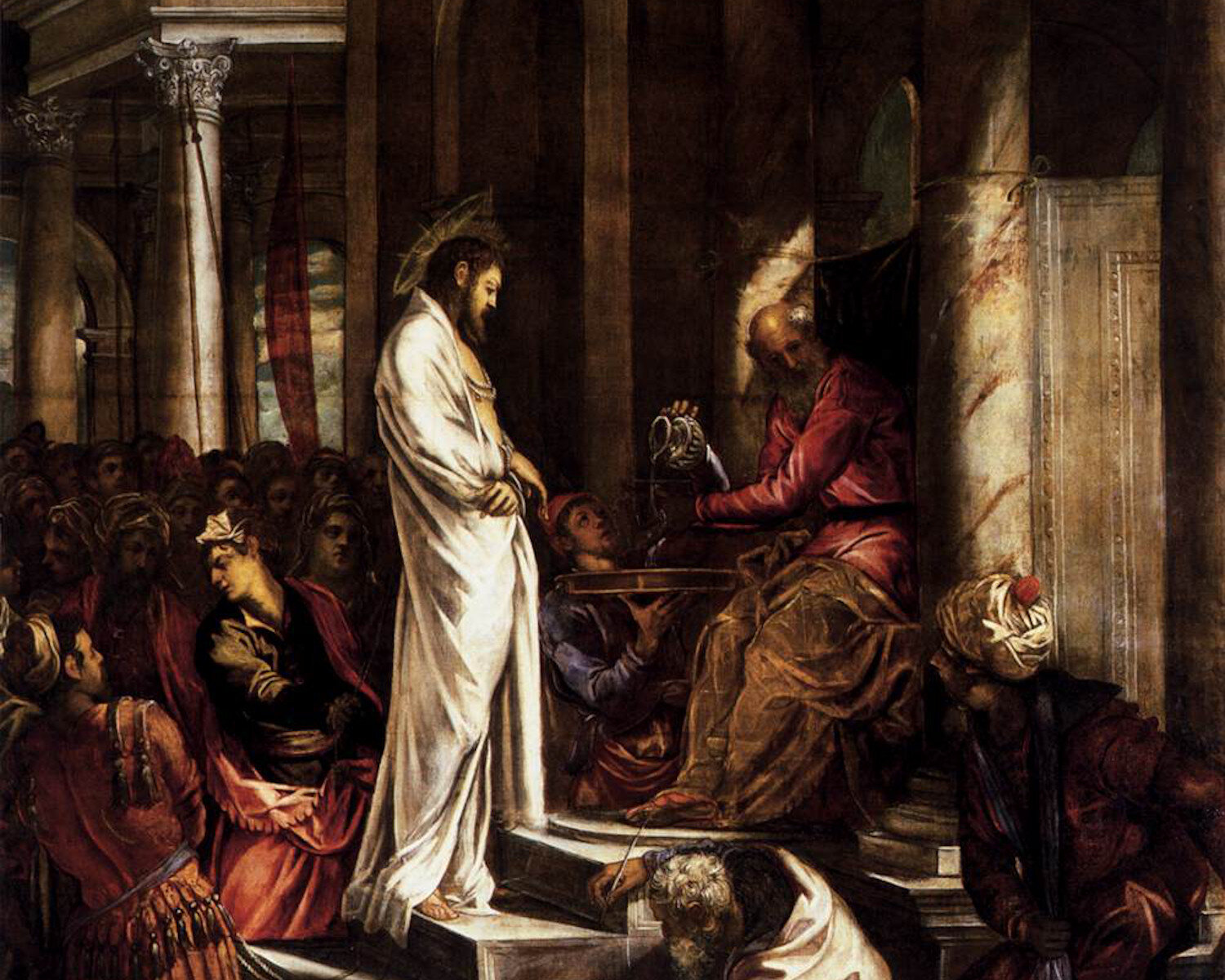
The Passion of the Christ has historical meaning on its face, but a far deeper story lies beneath where the threads of faith and history connect to awaken the soul.
There are few things in life that a priest could hear with greater impact than what was revealed to me in a recent letter from a reader of These Stone Walls. After stumbling upon TSW several months ago, the writer began to read these pages with growing interest. Since then, she has joined many to begin the great adventure of the two most powerful spiritual movements of our time: Marian Consecration and Divine Mercy. In a recent letter she wrote, “I have been a lazy Catholic, just going through the motions, but your writing has awakened me to a greater understanding of the depths of our faith.”
I don’t think I actually have much to do with such awakenings. My writing doesn’t really awaken anyone. In fact, after typing last week’s post, I asked my friend, Pornchai Moontri to read it. He was snoring by the end of page two. I think it is more likely the subject matter that enlightens. The reader’s letter reminded me of the reading from Saint Paul’s Letter to the Ephesians read by Pornchai a few weeks ago, quoted in “De Profundis: Pornchai Moontri and the Raising of Lazarus”:
“Awake, O sleeper, and rise from the dead, and Christ will give you light.”
I may never understand exactly what These Stone Walls means to readers and how they respond. That post generated fewer comments than most, but within just hours of being posted, it was shared more than 1,000 times on Facebook and other social media.
Of 380 posts published thus far on These Stone Walls, only about ten have generated such a response in a single day. Five of them were written in just the last few months in a crucible described in “Hebrews 13:3 Writing Just This Side of the Gates of Hell.” I write in the dark. Only Christ brings light.
Saint Paul and I have only two things in common — we have both been shipwrecked, and we both wrote from prison. And it seems neither of us had any clue that what we wrote from prison would ever see the light of day, let alone the light of Christ. There is beneath every story another story that brings more light to what is on the surface. There is another story beneath my post, “De Profundis.” That title is Latin for “Out of the Depths,” the first words of Psalm 130. When I wrote it, I had no idea that Psalm 130 was the Responsorial Psalm for Mass before the Gospel account of the raising of Lazarus:
“Out of the depths I cry to you, O Lord!
Lord hear my voice!
Let your ears be attentive
to my voice in supplication…
”I wait for the Lord, my soul waits,
and I hope in his word;
my soul waits for the Lord
more than sentinels wait for the dawn,
more than sentinels wait for the dawn.”
Notice that the psalmist repeats that last line. Anyone who has ever spent a night lying awake in the oppression of fear or dark depression knows the high anxiety that accompanies a long lonely wait for the first glimmer of dawn. I keep praying that Psalm — I have prayed it for years — and yet Jesus has not seen fit to fix my problems the way I want them fixed. Like Saint Paul, in the dawn’s early light I still find myself falsely accused, shipwrecked, and unjustly in prison.
Jesus also prayed the Psalms. In a mix of Hebrew and Aramaic, he cries out from the Cross, “Eli, Eli làma sabach-thàni?” It is not an accusation about the abandonment of God. It is Psalm 22, a prayer against misery and mockery, against those who view the cross we bear as evidence of God’s abandonment. It is a prayer against the use of our own suffering to mock God. It’s a Psalm of David, of whom Jesus is a descendant by adoption through Joseph:
“Eli, Eli làma sabach-thàni?
My God, my God, why have you forsaken me?
Why are You so far from my plea,
from the words of my cry? …
… All who see me mock at me;
they curse me with parted lips,
they wag their heads …
Indeed many dogs surround me,
a pack of evildoers closes in upon me;
they have pierced my hands and my feet.
I can count all my bones …
They divide my garments among them;
for my clothes they cast lots.”
So maybe, like so many in this world who suffer unjustly, we have to wait in hope simply for Christ to be our light. And what comes with the light? Suffering does not always change, but its meaning does. Take it from someone who has suffered unjustly. What suffering longs for most is meaning. People of faith have to trust that there is meaning to suffering even when we cannot detect it, even as we sit and wait to hear, “Upon the Dung Heap of Job: God’s Answer to Suffering.”

The Passion of the Christ
Last year during Holy Week, two Catholic prisoners had been arguing about why the date of Easter changes from year to year. They both came up with bizarre theories, so one of them came to ask me. I explained that in the Roman Church, Easter falls on the first Sunday after the first full moon after the vernal equinox (equinox is from the Latin, “equi noctis,” for “equal night”). The prisoner was astonished by my ignorance and said, “What BS! Easter is forty days after Ash Wednesday!”
Getting to the story beneath the one on the surface is important to understand something as profound as the events of the Passion of the Christ. You may remember from my post, “De Profundis,” that Jesus said something perplexing when he learned of the illness of Lazarus:
“This illness is not unto death; it is for the glory of God, so that the Son of God may be glorified by means of it”
The irony of this is clearer when you see that it was the raising of Lazarus that condemned Jesus to death. The High Priests were deeply offended, and the insult was an irony of Biblical proportions (no pun intended). Immediately following upon the raising of Lazarus, “the chief priests and the Pharisees gathered the council” (the Sanhedrin). They were in a panic over the signs performed by Jesus. “If he goes on like this,” they complained, “the Romans will come and destroy both our holy place (the Jerusalem Temple) and our nation” (John 11 47-48).
The two major religious schools of thought in Judaism in the time of Jesus were the Pharisees and the Sadducees. Both arose in Judaism in the Second Century B.C. and faded from history in the First Century A.D. At the time of Jesus, there were about 6,000 Pharisees. The name, “Pharisees” — Hebrew for “Separated Ones” — came as a result of their strict observance of ritual piety, and their determination to keep Judaism from being contaminated by foreign religious practices. Their hostile reaction to the raising of Lazarus had nothing to do with the raising of Lazarus, but rather with the fact that it occurred on the Sabbath which was considered a crime.
Jesus actually had some common ground with the Pharisees. They believed in angels and demons. They believed in the human soul and upheld the doctrine of resurrection from the dead and future life. Theologically, they were hostile to the Sadducees, an aristocratic priestly class that denied resurrection, the soul, angels, and any authority beyond the Torah.
Both groups appear to have their origin in a leadership vacuum that occurred in Jerusalem between the time of the Maccabees and their revolt against the Greek king Antiochus Epiphanies who desecrated the Temple in 167 B.C. It’s a story that began Lent on These Stone Walls in “Semper Fi! Forty Days of Lent Giving Up Giving Up.”
The Pharisees and Sadducees had no common ground at all except a fear that the Roman Empire would swallow up their faith and their nation. And so they came together in the Sanhedrin, the religious high court that formed in the same time period the Pharisees and Sadducees themselves had formed, in the vacuum left by the revolt that expelled Greek invaders and their desecration of the Temple in 165 B.C.
The Sanhedrin was originally composed of Sadducees, the priestly class, but as common enemies grew, the body came to include Scribes (lawyers) and Pharisees. The Pharisees and Sadducees also found common ground in their disdain for the signs and wonders of Jesus and the growth in numbers of those who came to believe in him and see him as Messiah.
The high profile raising of Lazarus became a crisis for both, but not for the same reasons. The Pharisees feared drawing the attention of Rome, but the Sadducees felt personally threatened. They denied any resurrection from the dead, and could not maintain religious influence if Jesus was going around doing just that. So Caiaphas, the High Priest, took charge at the post-Lazarus meeting of the Sanhedrin, and he challenged the Pharisees whose sole concern was for any imperial interference from the Roman Empire. Caiaphas said,
“You know nothing at all. You do not understand that it is expedient for you that one man should die for the people, so that the whole nation should not perish”
The Gospel of John went on to explain that Caiaphas, being High Priest, “did not say this of his own accord, but to prophesy” that Jesus was to die for the nation, “and not for the nation only, but, to gather into one the children of God” (John 11: 41-52). From that moment on, with Caiaphas being the first to raise it, the Sanhedrin sought a means to put Jesus to death.
Caiaphas presided over the Sanhedrin at the time of the arrest of Jesus. In the Sanhedrin’s legal system, as in our’s today, the benefit of doubt was supposed to rest with the accused, but … well … you know how that goes. The decision was made to find a reason to put Jesus to death before any legal means were devised to actually bring that about.
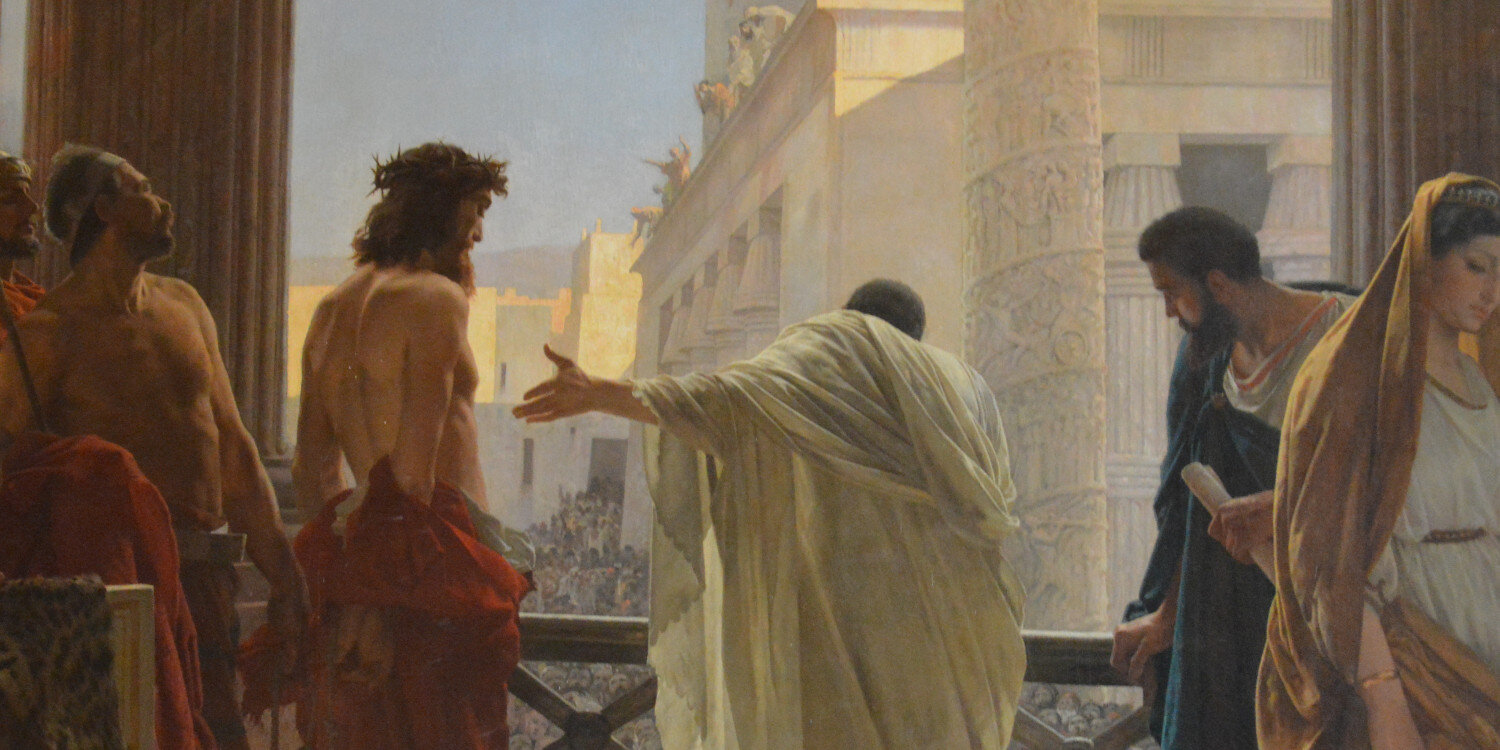
Behold the Man!
The case found its way before Pontius Pilate, the Roman Prefect of Judea from 25 to 36 A.D. Pilate had a reputation for both cruelty and indecision in legal cases before him. He had previously antagonized Jewish leaders by setting up Roman standards bearing the image of Caesar in Jerusalem, a clear violation of the Mosaic law barring graven images.
All four Evangelists emphasize that, despite his indecision about the case of Jesus, Pilate considered Jesus to be innocent. This is a scene I have written about in a prior Holy Week post, “Behold the Man as Pilate washes His Hands.”
On the pretext that Jesus was from Galilee, thus technically a subject of Herod Antipas, Pilate sent Jesus to Herod in an effort to free himself from having to handle the trial. When Jesus did not answer Herod’s questions (Luke 23: 7-15) Herod sent him back to Pilate. Herod and Pilate had previously been indifferent, at best, and sometimes even antagonistic to each other, but over the trial of Jesus, they became friends. It was one of history’s most dangerous liaisons.
The trial before Pilate in the Gospel of John is described in seven distinct scenes, but the most unexpected twist occurs in the seventh. Unable to get around Pilate’s indecision about the guilt of Jesus in the crime of blasphemy, Jewish leaders of the Sanhedrin resorted to another tactic. Their charge against Jesus evolved into a charge against Pilate himself: “If you release him, you are no friend of Caesar” (John 19:12).
This stopped Pilate in his tracks. “Friend of Caesar” was a political honorific title bestowed by the Roman Empire. Equivalent examples today would be the Presidential Medal of Freedom bestowed upon a philanthropist, or a bishop bestowing the Saint Thomas More Medal upon a judge. Coins of the realm depicting Herod the Great bore the Greek insignia “Philokaisar” meaning “Friend of Caesar.” The title was politically a very big deal.
In order to bring about the execution of Jesus, the religious authorities had to shift away from presenting Jesus as guilty of blasphemy to a political charge that he is a self-described king and therefore a threat to the authority of Caesar. The charge implied that Pilate, if he lets Jesus go free, will also suffer a political fallout.
So then the unthinkable happens. Pilate gives clemency a final effort, and the shift of the Sadducees from blasphemy to blackmail becomes the final word, and in pronouncing it, the Chief Priests commit a far greater blasphemy than the one they accuse Jesus of:
“Shall I crucify your king? The Chief Priests answered, ‘We have no king but Caesar.”
Then Pilate handed him over to be crucified.