“There are few authentic prophetic voices among us, guiding truth-seekers along the right path. Among them is Fr. Gordon MacRae, a mighty voice in the prison tradition of John the Baptist, Maximilian Kolbe, Alfred Delp, SJ, and Dietrich Bonhoeffer.”
— Deacon David Jones

Joe Biden, Cardinal McCarrick and the Betrayal of Life
Joe Biden is only the fourth Catholic presidential nominee in U.S. history but his pro-abortion stance leaves him in broken communion with his profession of faith.

Joe Biden is only the fourth Catholic presidential nominee in U.S. history but his pro-abortion stance leaves him in broken communion with his profession of faith.
Millions of American Catholics who uphold the Right to Life as a foundational human right in accord with Catholic teaching and the Bill of Rights were disappointed in recent weeks. Supreme Court Chief Justice John Roberts sided with the four liberal justices in a matter of life and death. The question before the Court was whether a Louisiana law requiring abortion practitioners to have admitting privileges at a local hospital was unconstitutional.
In the split (5-4) decision in favor of abortion providers, Chief Justice Roberts voted with the majority in a matter from which he had earlier dissented. This may not be the setback some in the pro-life movement have feared. The Court’s ruling in support of the precedent set in Planned Parenthood v. Casey did not address the precedent itself which inserted into the Constitution a right to abortion. This is a distinction that I wrote about early this year in “March for Life: A New Great Awakening.”
The timing of publishing this decision — in the final months of a highly charged presidential battle for the soul of America — reminded me of something that unfolded in these pages during the 2016 election. At that time, I wrote a post entitled “Wikileaks Found Catholics in the Basket of Deplorables.”
Among a vast media leak from the Hillary Clinton campaign back then was a set of email exchanges between Clinton campaign manager John Podesta and some progressive U.S. Catholics. The leaks exposed a plan to recreate U.S. Catholicism into an entity more appealing to the Democratic Party and its ever descending slide toward the left.
The central tenet of that plan was to move American Catholics away from any identification as a “Roman” Catholic Church into a state of mere symbolic authority from Rome. The result would be something more akin to the U.S. Episcopal church and its open embrace of identity politics, reproductive rights, same-sex marriage, transgender ideology, and a much-weakened moral voice in the public square.
Climate change, open borders, and a global identity were to be the new moral imperatives. Abortion without limits would quietly fall without challenge into the politically correct category of “settled law.” It is easy for the living, while descending toward the left, to compartmentalize their consciences and deny a right to life to the most vulnerable among us.
Back in 2016, Pope Francis raised an alarm among conservative Catholics and the pro-life mission when he was quoted in the media as suggesting that the Church cannot speak only about abortion. The left arm in Catholicism seized upon that, but since then Pope Francis has offered some clarity. You may not know about it because the mainstream media only hypes his more trite sayings such as “Who am I to judge?”
On the matter of life, however, Francis has been as unequivocal as his predecessors, articulating clearly his support for and continuance of the pro-life emphasis of Saint John Paul II and Pope Benedict XVI. Pope Francis affirms that the foundational human right is the right to life. He has stated that the right to life and transgender ideology are the most pressing moral issues of our time. To say that the Church should not speak only of these issues does not at all suggest what the 2016 Clinton and Podesta agenda suggested: that we just set them aside and not speak of them at all.

Joe Biden’s Catholic Communion
Among the moral issues of our time, Pope Francis agrees with the U.S. Bishops that the right to life is the most fundamental human right in Catholic moral teaching. This places Democratic nominee Joe Biden far outside the moral life and teaching of his professed faith. In response to the Covid-19 pandemic lockdown, Joe Biden said from his basement campaign forum:
“We need to ensure that women have access to all health services during this crisis. Abortion is an essential health care service.”
Joe Biden is only the fourth Catholic in U.S. history to become the presidential nominee of a major political party. All four have been Democrats. The first was New York Governor Alfred Smith who was easily defeated by Republican Herbert Hoover in 1928. Smith’s Catholic faith was widely seen as a cause of his defeat. The anti-Catholic political ice was not broken again until 1960 when John F. Kennedy became the first Catholic U.S. President.
Neither Al Smith nor President Kennedy faced a pro-life question because Planned Parenthood v. Casey had not yet happened. The matter of Catholic identity and abortion first arose in 2004 when Massachusetts Senator John Kerry became the nation’s third Catholic nominee for president exposing a wide contradiction between his professed Catholic faith and his public promotion of abortion rights.
Senator Kerry lost the election when President George W. Bush won a second term. Throughout his campaign, Kerry openly defied Church teaching on abortion. For that he was endorsed by the Planned Parenthood Action Fund. His open defiance launched a debate among bishops about responding to pro-abortion Catholic politicians who receive the Eucharist, the ultimate sign of communion with their faith.
The argument was based on Canon 915 in the Code of Canon Law which holds that those who “obstinately persevere in manifest grave sin are not to be admitted to Holy Communion.” For an analysis of how this has applied to Catholic political candidates, I rely on an excellent account in the National Catholic Register by Lauretta Brown: “Biden and the U.S. Bishops” (May 24, 2020).
The matter of promoting abortion while pretending to be Catholic has been raised anew in the candidacy of former Vice President Joe Biden. As a Delaware Senator and vice-presidential nominee on the ticket with Barack Obama in 2008, Joe Biden declared on Meet the Press that he “was prepared as a matter of faith to accept that life begins at the moment of conception.” He qualified his belief, however, by stating that he would not impose that belief by promoting laws that reflect it.
Archbishop Charles Chaput and Bishop James Conley published a rebuttal, stating that the beginning of life is a matter not only of faith but of scientific truth. Embracing objective truth has nothing to do with imposing it on anyone. The two bishops wrote:
“If, as Senator Biden said, ‘I am prepared as a matter of faith to accept that life begins at the moment of conception,’ then he is not merely wrong about the science of new life; he also fails to defend the innocent life he already knows is there.”
Mr. Biden was also criticized by Bishop Francis Malooly during the 2008 presidential campaign for his public misrepresentation of Church teaching on abortion. And he was criticized by Bishop John Ricard for receiving Communion during a campaign trip to Florida. This raised anew the debate among bishops about Communion for Catholic politicians who promote abortion.

Now Comes Cardinal Theodore McCarrick — Again!
Cardinal Raymond Burke, then Archbishop of St. Louis, was one of the first bishops to state in 2004 that he would deny Communion to Catholic candidate John Kerry due to his public stance on abortion. Many bishops joined him in support of that view. In June of 2004, the U.S. Bishops Conference released a document entitled “Catholics in Political Life.” It communicated the U.S. Bishops’ unqualified “commitment to the legal protection of life from the moment of conception until natural death.”
Previous to the publication of that document, however, Cardinal Theodore McCarrick, then Archbishop of Washington DC, was appointed by the bishops to chair a USCCB Task Force on Catholic Bishops and Catholic Politicians. McCarrick quietly lobbied other bishops to oppose denying Communion to pro-abortion politicians. There was significant foul play in McCarrick’s lobbying effort.
In 2004, The USCCB Task Force received a letter from Cardinal Joseph Ratzinger, then Prefect of the Congregation for the Doctrine of the Faith. This was a year before the death of Pope John Paul II and Cardinal Ratzinger’s election at the Conclave of 2005. As Task Force Chair, McCarrick received the letter from Cardinal Ratzinger on behalf of the other members. The future Pope Benedict’s letter was entitled, “Worthiness to Receive Communion: General Principles.” Here is one of its major points:
“[R]egarding the grave sin of abortion or euthanasia, when a person’s formal cooperation becomes manifest (understood in the case of a Catholic politician as his consistently campaigning and voting for permissive abortion and euthanasia laws) his pastor should instruct the person about the Church’s teaching and tell him not to present himself for Communion.”
However, in his own report Cardinal McCarrick misrepresented the Ratzinger letter and manipulated the Task Force findings and recommendations to the U.S. Bishops in 2004. He instead reported to the bishops that it was the Task Force Commission’s conclusion that denial of Holy Communion to Catholic politicians could further divide our Church and could have serious unintended consequences.” The report concluded:
“In light of these and other concerns, the Task Force urges for the most part renewed efforts and persuasion, not penalties.”
An official who assisted Cardinal Ratzinger in the writing of that letter tells me today that it carefully referenced Canon 915, instructing that those who obstinately persevere in manifest grave sin are not to be admitted to Holy Communion.
In revealing his Task Force Report to the U.S. bishops in 2004, Cardinal McCarrick attempted to hide the Cardinal-Prefect’s letter and his misrepresentation of it. The letter from Cardinal Ratzinger was later leaked by an unknown source exposing the manipulation, but only after the bishops accepted McCarrick’s more accommodating view — that pro-abortion politicians should be instructed but not penalized.

The Pro-Life Sensus Fidelium
What those “unintended consequences” cited by Cardinal McCarrick were can only be imagined. However, hindsight sheds some light on them. There are some who viewed McCarrick in the same way he apparently viewed himself — as a power-broker in the politics of both Church and state.
The full report on Theodore McCarrick’s rise and fall will likely soon be released by the Holy See. It will be interesting to see whether and how it reflects this, and reflects his manipulation of the U.S. Bishops’ collective approach to politicians who claim to be Catholic while dissenting with impunity from Catholic moral teaching on something as fundamental as the Right to Life.
In 2020, the U.S. Bishops formulated a new letter for Catholic voters that specifically cited the priority of life and abortion as “preeminent” priorities. It adopted the language of Saint John Paul II and Pope Benedict XVI with clarity about the central importance of life issues in the current political climate.
Meanwhile, Candidate Joe Biden continues to espouse his Catholic identity while moving even further left in his promotion of abortion rights up to and including late-term abortion. In recent months he has withdrawn his four decades of support for the Hyde Amendment, a 1974 bilateral agreement between parties that protected U.S. taxpayers from violating their consciences by government application of their tax dollars for abortions.
There are few steps left to take for a Catholic candidate who openly rejects the Right to Life and other tenets of Catholic moral teaching, but Candidate Joe Biden has discovered them. He has officiated at a same-sex “marriage” and promotes the full spectrum of LGBTQ+ ideology and identity politics. Most recently Mr. Biden has called for codifying the right to abortion in federal law. After a recent Supreme Court decision on religious liberty, he vowed to roll back rights extended to the Little Sisters of the Poor concerning forced contraception coverage.
Some courageous bishops would deny him Communion for the simple but grave fact that he is no longer in communion with his faith. Other pro-life Catholics have asked for his excommunication.
Canon Law limits such a step to those who actively perform or otherwise cause abortion.
Joe Biden’s unabashedly pro-abortion rhetoric and promotion may collectively rise to that standard. In such a case, the Sensus Fidelium may call for something as decisive as excommunication. It would not be a penalty, but a discipline, an invitation to tend to the state, not only of Mr. Biden’s politics, but of his soul.
And how utterly strange and unacceptable that the current Archbishop of Washington, DC, while remaining silent on the Democratic nominee’s pro-abortion politics, chose this moment for a public repudiation of the only major party candidate who has been unequivocal in his support for the Right to Life, his promotion of religious liberty, and his efforts to appoint pro-life judges to the federal judiciary.
I can only ask the same question that has been on the minds of many faithful Catholics in recent weeks:
What in Hell is going on here?
+ + +
Editor’s Note: Please give some volume to this Voice in the Wilderness by sharing this post with others and on your social media. Please Subscribe to BeyondThese Stone Walls and Follow us on Facebook.

U.S. Cardinal Theodore E. McCarrick of Washington and Bishop Wilton D. Gregory, president of the U.S. Conference of Catholic Bishops, look on during a news conference at the Vatican April 24, 2002. (CNS photo/Vincenzo Pinto, Reuters)

The State of Our Freedom, The Content of Our Character
Washington DC Archbishop Wilton Gregory, the Becket Law firm, and social justice warriors at The New York Times have cast a shadow over the state of our freedoms.

“I have a dream that one day this nation will rise up and live out the true meaning of its creed: ‘We hold these truths to be self-evident, that all men are created equal.’ … I have a dream that my four little children will one day live in a nation where they will not be judged by the color of their skin but by the content of their character.”
Character matters, so may it not come up short as the world watches what America does with our hard-won freedoms in this age of discontent. What becomes of them determines what becomes of us. Character matters for me, too, but sometimes there is just no way to retain it except by writing the bare-knuckled truth. I admit that, like most priests in America, I fear the repercussions, but there is just no safe, politically correct way to write what I must now write.
There had been a decades-long progression of examples reflecting patently dishonest character and leadership in the Archdiocese of Washington, D.C. When Archbishop Wilton Gregory succeeded Cardinal Donald Wuerl, who in turn succeeded Cardinal Theodore McCarrick, one of Archbishop Gregory’s first messages to his people was, “I will always tell you the truth.”
In light of that promise of transparency, what a disappointment the downward slide has been. In “The Death of George Floyd: Breaking News and Broken Trust,” I wrote of a visit by President Donald Trump to the Saint John Paul II Shrine in Washington. After the visit, Washington Archbishop Wilton Gregory stated that he learned of the visit only on the night before, adding:
“I find it baffling and reprehensible that any Catholic facility would allow itself to be so egregiously misused and manipulated in a fashion that violates our religious principles, which call us to defend the rights of all people even those with whom we might disagree… Saint John Paul II was an ardent defender of the rights and dignity of human beings. His legacy bears vivid witness to that truth.”
Many now find it far more baffling and reprehensible that Archbishop Gregory would so blatantly mischaracterize the long-planned purpose of the President’s visit and snub it with both his absence and his disdain. It turns out that the Archbishop did know of the visit. He was invited by the White House to participate in it, but declined the invitation to be with the President due to a “previous commitment.”
Archbishop Gregory should also have been well aware of what took place before and during the President’s appearance at the Saint John Paul II Shrine on the 2nd of June, 2020. Its significance was spelled out in “A Big Step for Religious Freedom,” (June 12, 2020) a Wall Street Journal editorial by Nina Shea, a Senior Fellow at the Hudson Institute who served as a member of the U.S. Commission on International Religious Freedom:
“[I]n a rare ray of light this dark spring, America’s defining right has been recognized at the highest level as a ‘moral and national security imperative.’ This is more than a symbolic gesture. On June 2, President Trump signed an executive order that declares support for religious freedom a foreign policy ‘priority.’ It mandates that ‘the United States will respect and vigorously promote this freedom’ abroad… The Trump administration has elevated the cause of religious freedom since the president came into office.”
Ms. Shea refers to Religious Liberty as “America’s defining right,” highlighting its importance as the most fundamental of our freedoms. It is President Trump’s emphasis on this right that Archbishop Wilton Gregory dismissed as “reprehensible,” and denigrated its culmination in a presidential visit to the Saint John Paul II Shrine as a “Catholic facility [that] would allow itself to be so egregiously misused and manipulated” for a partisan political purpose.
Nina Shea writes in the WSJ that the President’s executive order puts teeth in the International Religious Freedom Act’s listing of severe religious persecution in countries like Nigeria and China, notorious for their suppression of religious freedoms. The order allocates funding for programs that protect religious rights in communities abroad through economic sanctions and other measures against oppressive governments.

Wading in the Washington Swamp
It would be informative to know whether Archbishop Gregory objected when President Barack Obama received an honorary degree at the University of Notre Dame ignoring his global promotion of abortion. To dismiss President Trump’s visit to the Saint John Paul II Shrine as “reprehensible” is… well… reprehensible. In a recent comment on These Stone Walls, a reader from Texas expressed a widely felt dismay:
“Whatever it is, the way you tell your story online can make all the difference. Archbishop Gregory denigrated the visit by President Trump to the Saint John Paul II Shrine. Turns out the Archbishop was invited to be with Trump but declined. This after he claimed to not have known about the visit. What an embarrassment!”
The drama in Washington became more mysterious six days later. At a time when the Archdiocese was still under a ban from public Masses and an order to maintain social distancing, priests of the Archdiocese received a highly unusual June 8 email from the Chancery Office. They were asked to participate in a protest in front of the White House.
The email specifically asked that the priests wear a cassock or black clerical clothing along with a mask. It instructed them to bring protest placards. Several priests of the Archdiocese said they were surprised by this given the volatile atmosphere of the protests descending into riots at that time and the fact that priests of the Archdiocese were still under a conflicting order to maintain social distancing and refrain from any gatherings related to their ministry.
Two priests spoke with the Catholic News Agency on condition of anonymity because they, too, feared repercussions from the Archdiocese. So much for religious freedom and freedom of speech. The priests told the Catholic News Agency:
“We have been told for weeks that we cannot meet in groups of the faithful, open our churches, serve in our parishes. Now they want us to take to the streets.”
Other priests objected that media photographs of them in clerical garb protesting in front of the White House had the appearance of doing exactly what Archbishop Gregory accused President Trump of doing: creating a photo opportunity for partisan political purposes “manipulated in a fashion that violates our religious principles which call us to defend the rights of all people even those with whom we might disagree.”
Was there any reason to believe that the rights of priests would be protected against media criticism of such a clerical protest? Archbishop Wilton Gregory was no champion for the rights of his priests. As President of the U.S. Conference of Catholic Bishops in 2002, Archbishop Gregory extended invitations to SNAP, the Survivors Network of those Abused by Priests, to address the Bishops’ Dallas conference representing the voices of victims.
SNAP director, David Clohessy, and founder, Barbara Blame offered emotional, but highly contrived testimony while bishops tripped over each other to get their tears on camera. There was no rebuttal except that propounded by Cardinal Avery Dulles who opposed the Dallas Charter in “The Rights of Accused Priests.”
The objections of Cardinal Dulles were ignored. Under the leadership and direction of Archbishop Gregory, the standard employed for removing accused priests from ministry was the lowest standard possible. If an accusation is “credible” on it’s face — meaning only that it cannot be immediately disproven — then the cleric is out forever or until he is indisputably able to prove his innocence. In First Things magazine, a shocked Father Richard John Neuhaus described the end result:
“Zero Tolerance. One strike and you’re out. Boot them out of ministry. Our bishops have succeeded in scandalizing the faithful anew by adopting in the Dallas Charter a thoroughly unbiblical, untraditional, and unCatholic approach to sin and grace. They ended up adopting a policy that was sans repentance, sans conversion, sans forbearance, sans prudential judgment, sans forgiveness, sans almost everything one might have hoped for from the bishops of the Church of Jesus Christ.”
Scandal Time, 2002
“Will No One Rid Me of This Turbulent Priest?”
One of the main developers and proponents of that standard was also one of Archbishop Gregory’s predecessors in Washington, former Cardinal Theodore McCarrick whose own history is about to be published in a soon-to-be-released Vatican report. SNAP and its director, David Clohessy, were also later accused of extensive corruption in a lawsuit from a SNAP employee reported by Bill Donohue and the Catholic League in “SNAP Exposed” and by me in “David Clohessy Resigns SNAP in Alleged Kickback Scheme.”
In the 12 Century, Thomas à Becket, Archbishop of Canterbury and Chancellor of the King, excommunicated some of the corrupt barons of King Henry II after they summarily executed two accused priests. The King raged at Becket’s affront to his authority saying, “Will no one rid me of this turbulent priest?”
Four of the King’s men, taking that as a directive, murdered the archbishop at Mass in his cathedral on December 29, 1170. In the end, King Henry had to accede to canon law and the jurisdiction of church courts over clergy. As for Becket, he became a saint and martyr canonized in 1173.
It pains me greatly that an organization I deeply respect, the Becket Law firm, defenders of religious liberty taking its name from the legacy of Saint Thomas à Becket, published a defense of “credibly accused” as sufficient for denying the civil rights of Catholic priests, but no one else. Maria Montserrat Alvarado wrote on behalf of the Becket Law firm:
“In ‘Diocese of Lubbock v. Guerrero,’ the plaintiff, a Catholic clergyman, sued for defamation after the Diocese of Lubbock included him on a list of credibly accused clergy. The lower courts sided with Guerrero [saying] that because the Diocese published the information that could be seen… outside the confines of the church [it] could be used to sue the Church… The lower court’s strange view runs counter to Pope Francis and USCCB’s specific call for greater transparency”
The above was posted by Becket Law on Twitter, but These Stone Walls does not have the reach that the Becket Law firm has. My rebuttal was but a mere whisper, posted nonetheless, so maybe you can make it a bit louder by sharing this post:
“I must register my objection and grave disappointment with Becket Law for statements about the defamation lawsuit by a priest whose name appears on his bishop’s list of the ‘credibly accused.’ Becket’s website cites Pope Francis in a call for transparency. Pope Francis also said in 2019 that the names of accused priests should only be published if the accusations are proven. The U.S. bishops adopted a ‘credible’ standard that does not even come close to that. It is of deep concern that Becket Law appears to either not know this or not care… for the great damage done by this practice.” (See “The Credibility of Bishops on Credibly Accused Priests”)
For over a decade on These Stone Walls, I have warned against the practice of bishops citing a false and unjust “transparency” as justification for publishing lists of priests who have been merely accused with little to no effort at real substantiation. This is the legacy of the Dallas Charter and “credibly accused.”
It is for good reason that Catholic League President Bill Donohue, reflecting on my own case on NBC’s “Today” show on October 13, 2005 said:
“There is no segment of the American population which has less civil liberties protection than the average American Catholic priest.”

A Dire Threat to Freedom of the Press — from Within
Another grave threat to our freedoms is the diminishment of Freedom of the Press by stewards not quite up to the task. Most people who read newspapers have seen the term, “op-ed,” but few know its true origin. It began as a feature of The New York Times once America’s most respected flagship newspaper but now slowly collapsing under the weight of its own hubris. “Op-ed” was newspeak for “Opposite the Editorial Page.”
Its meaning was both literal and figurative. It was a feature by a guest writer invited by the Times for an opinion piece that would appear on the page opposite the newspaper’s own main editorial page. Over time, it also came to be symbolic of the Times’ commitment to integrity in journalism. The “op-ed” also provided a forum in which writers could reflect positions that were opposite of those the editors propounded on their editorial page. Thus, “op-ed” came to have a double meaning.
The old liberal order for which The New York Times and other newspapers became a sometimes honorable mouthpiece has given way to a more radical form of liberalism and what today is manipulated as news coverage. Along with its rise, two of America’s signature freedoms, Freedom of the Press and Freedom of Speech, have fallen.
The most recent evidence for that is something that just happened in the editorial offices of two formerly liberal newspapers, The New York Times and the Philadelphia Inquirer. At the Times, a revolution has occurred in the newsroom when Senator Tom Cotton, a Republican from Arkansas, wrote an op-ed defending President Donald Trump’s statement that the 1807 Insurrection Act could be invoked to call upon the military to quell rioting and massive destruction in our cities.

Senator Cotton alluded (as did I in these pages in recent weeks) that Democrat President Lyndon Johnson summoned the military to quell riots following the 1968 assassination of Rev. Martin Luther King. And Republican President George H.W. Bush also invoked the Insurrection Act to call for military intervention against 1992 Los Angeles riots following the acquittal of four L.A.P.D. officers who brutally beat Rodney King. Today, the progressively manipulated media wants us to believe that this was an original but unconstitutional idea of President Trump.
A Wall Street Journal editorial referred to the Times reporters as “social justice warriors” who ransacked an opinion piece by Senator Cotton because it expressed a view that “millions of Americans support if the police cannot handle the rioting and violence.” As a result of the Times reporters’ rebellion and rage over allowing such views in public view, The New York Times demurred and accepted its Editorial Page editor’s resignation.
The once honorable concept of the “op-ed” is now dead, murdered by activist reporters whose politics now take precedence over the news. The long-time editor of the Philadelphia Inquirer was also pushed out because that newspapers’ own activist reporters revolted over an opinion piece headline, “Buildings Matter, Too” by Architecture Critic, Inga Saffron. It was seen by the reporters as an affront to the “Black Lives Matter” movement and a demand was made to remove it, and remove its author.
This all began unchecked in America’s universities where sensitive ears cannot bear to hear opposing views and college administrators cave as militant protesters scream down conservative voices. I recently had a headline posted on Facebook and Google along with a link to my post, “The Feast of Corpus Christi and the Order of Melchizedek.” The headline was “Eternal Life Matters.” It was seen and “liked” by several readers before being silenced by both Facebook and Google, both of which deny placing limits on conservative viewpoints.
In “I Have a Dream,” The Rev. Martin Luther King’s famous ode to liberty, he included the moving sentence:
“I have a dream that my four little children will one day live in a nation where they will not be judged by the color of their skin but by the content of their character.”
The great irony for Martin is that his much needed voice would not be heard today had not his very life been forfeit. And the irony for me is that I could not be free to write today had not freedom itself been taken from me.
It is the content of our character that determines the state of our freedom. America is at a tipping point, but it is not too late to save our freedoms from madness. The content of our character is what unites us, not as Black Americans, or White Americans, or Native Americans, but as Americans.
+ + +
Note from Father Gordon MacRae: My late friend, father Richard John Neuhaus, said there are only three things required to address the madness of our time: Fidelity, Fidelity, and Fidelity. I thank you for yours. Please Subscribe to BeyondThese Stone Walls and Follow us on Facebook. You may also like to read and share these related eye-openers:

Don’t Defund Police. Defund Unions that Cover Up Corruption
Democrat presidential candidate Joe Biden is against defunding police departments. He instead wants to disarm police officers who can then “de-escalate things.”

Democrat presidential candidate Joe Biden is against defunding police departments. He instead wants to disarm police officers who can then “de-escalate things.”
This was to be the post I wrote for These Stone Walls two weeks ago. Most of America was in the throes of protest and urban riots over the death of George Floyd at the hands of Minneapolis police officer, Derek Chauvin while other officers passively looked on. To the horror of once-civilized America, life was crushed out of Mr. Floyd with an officer’s knee on his neck in full view of cameras in a nine-minute video. I first covered this story in these pages in “The Death of George Floyd: Breaking News and Broken Trust.”
This threw America into political, social, and moral chaos in the final months of a contentious and volatile presidential election year. This nation was already reeling from a global pandemic that took over 110,000 American lives in a matter of months. As a direct consequence of the pandemic, economic recession choked the life out of businesses and terminated millions of jobs in what had been the strongest economy since World War II. And then the George Floyd injustice happened and millions of Americans who have just “had it” took to the streets.
It also drew the problem of police abuse and other misconduct into the public forum, but not for the first time. Cooler heads will eventually prevail, but as of this writing, movements like the tone deaf “Defund Police” are gaining momentum. You might imagine that behind these stone walls I am surrounded by men who would be right on board with such a movement, but that is not so.
It may seem surprising that some of the “cooler heads” we need to prevail are right here in prison and none of them want to put police out of business. As the Law Clerk in a prison law library, I have fielded hundreds of George Floyd related questions and comments in the recent weeks. Prisoners watch the news. Many compensate for being separated from the world by watching the news relentlessly.
Every prisoner where I live is aware that New Hampshire currently has one prisoner on death row even though the state repealed the death penalty a year ago, and outvoted the governor’s veto of the repeal effort. The one prisoner on death row is an African American man who shot and killed Manchester, New Hampshire police officer, Michael Briggs. Officer Briggs and his assailant were both armed in that Manchester alley.
Officer Briggs’s partner, John Breckinridge, was also there. His description of what took place is a riveting account in which he spoke of his insistence upon the death penalty for Michael Briggs’ killer. Mr. Breckinridge also told the story of how his long road to Catholic reversion led him to Divine Mercy and a reversal of his position on the death penalty in “A Matter of Life and Death” (Parable, Jan/Feb 2014).
From what I have read, I know of the chilling likelihood that two police officers may have died on that night in Manchester, New Hampshire if they were the only ones there who were unarmed. Turning all this into political theater, former Vice President Joe Biden stated his opposition to the “Defund Police” movement. He suggests instead that officers should be disarmed so they can “deescalate things.” No one should take up that hapless solution without first talking to John Breckinridge.

Police Misconduct Takes Many Forms
I have seen no evidence of any glee among prisoners in any of this. Not one has spoken in favor of defunding or in any way diminishing police in our society. On the contrary, few Americans have a more accurate sense of what would happen in this nation without police. Believe it or not, prisoners want their families well protected. Like most, prisoners want crime prevented when possible, investigated when not, and perpetrators prosecuted to the full extent of the law.
They just want it done justly and evenly. They want police who are colorblind, without manipulation or entrapments, without planted evidence, without beatings, without coerced plea deals, without “testilying” or any of the other malfeasance with which some police — but certainly not all — have abused their power without a physical knee on someone’s neck.
Michael Gallagher’s recent TSW guest post, “A Teacher’s Worst Nightmare,” was an eye-opener for many and a painfully familiar account for me. Too many people believe that protecting the civil rights of those accused of crimes just provides the guilty-accused with an avenue to “get off” on a technicality. But what about the innocent-accused? They exist in greater numbers than most Americans know. Mike Gallagher’s haunting story presents a compelling case for protecting the rights of the accused.
The police misconduct in that case was not as glaring as in the case of George Floyd, but the story leaves no doubt that it was destructive, and not only for Mike Gallagher and his family. The erosion of trust in the American justice system is the most enduring fallout of stories like Mike’s.
Court rulings have upheld the practice of some police to lie to the accused during the investigation of a suspected crime. When teacher Mike Gallagher took and passed a polygraph test, for example, he was told by police that he had failed it miserably. As dirty as the tactic was, it is not technically considered police misconduct because it is not against their rules.
But it was a different story when the police told the District Attorney prosecuting the case that Mike failed the polygraph. The police in that case, as in so many other accusations of child sexual abuse, justified the lie because they presumed from the start that Mike must be guilty.
From that point on, the search for evidence in the case was filtered through a powerful bias in favor of guilt. There are volumes of studies showing how “investigator bias” among police leads to wrongful convictions. When the police officer lied to the District Attorney by stating that Mike failed the polygraph test it could have had only one cause. The police bias was so strong that any evidence to the contrary was suppressed.
As unfortunate as that case was, Mike Gallagher himself is a very fortunate man. The case fell apart of its own accord because an honest District Attorney had doubts and tested them out. If the case remained in the hands of the biased police, Mike would only just about now, some 25 years later, be emerging from prison.
There are many more nefarious examples of police misconduct that lead directly to wrongful convictions. This includes a long list of illegal infractions like withholding exculpatory evidence, inventing fictitious crimes, planting evidence, and the widespread practice of “testilying,” a term police use instead of perjury to describe lying under oath to bolster their case.
Coercive plea bargaining is then used by over-burdened or unethical prosecutors to get a conviction without having any of the above practices exposed and tested in court. Of nearly 80,000 defendants in federal criminal cases in 2018, just two-percent of them went to trial. The other 98-percent were resolved by plea bargains.
In the Southern District of New York in 2018, the plea bargain figure was almost 95-percent. This holds true in almost every jurisdiction in America. The real danger is that innocent defendants will end up spending much longer in prison than guilty defendants who are well motivated to take the deal.
About 25-percent of the DNA exonerations in America involved cases in which innocent defendants were coerced to plead guilty to avoid spending the rest of their lives in prison. This is a practice I wrote about in “Plea Deals or a Life Sentence in the Live Free or Die State.”

Defund Public Sector Unions That Cover-up Corruption
A lot of ink is now being invested in an analysis of what happened to General Michael Flynn. In 2016, he served just 24 days as President Trump’s National Security Advisor before being ensnared in an FBI probe about fictitious Russian collusion now entirely dismantled as a fraud heavily hyped by the get-Trump-at-all-costs media.
General Flynn’s decision to accept a plea deal, which was also a fraud, was coerced with lies and threats from the investigating FBI agents that they would arrest and charge his son. The nation today can agree on only one thing. The FBI used to be better than this, and could be again if and when this whole truth comes out.
In the case of the late George Floyd of Minneapolis, the officer who killed him had 18 prior abuse complaints in his record. They resulted in just two letters of reprimand in his personnel file, a file that is beyond the reach of citizens thanks to the “progressive” city’s collective bargaining with the police union.
One of those cases involved a 2006 case in which Derek Chauvin was one of six officers who fatally shot 42-year-old Wayne Reyes. The prosecuting attorney in the case was Amy Klobuchar who reportedly declined to place the matter before a grand jury for indictments. Ms. Klobuchar is now Senator Klobuchar, a former Democratic presidential candidate and potential running mate for Joe Biden.
In fairness to senator Klobuchar, she explains that she was elected to the U.S. Senate before that case was resolved without prosecution by her successor. She added that she in hindsight believes that using the grand jury to decide prosecution of this and multiple other cases of alleged police misconduct in Minneapolis was a mistake. The point I want to make is that all of this was kept from the public by levels of secrecy secured by the police union.
Minneapolis Mayor Jacob Frey exhibited leadership and courage when he stood up to a chanting mob recently in opposition to defunding and disbanding his police department. He was screamed at, taunted, called names, and violently harassed by the mob as he walked through them after courageously stating views considered heresy by the mob. The Minneapolis City Council caved in completely with a call to dismantle their police force.
Even before the protests and riots this year, several other Democrat-controlled “progressive” cities saw marked increases in violent crime. In the first six months of 2020, shootings in Minneapolis had risen 60-percent. In New York City shootings had risen 18-percent; in San Francisco, 19-percent; in Philadelphia, 51-percent. Mr. Biden would have the police as the only unarmed characters in these urban dramas. We all know how that would end.
There were 492 homicides in Chicago in 2019. Only three of them involved police. The vast majority of others involved crimes perpetrated by young African Americans upon other young African Americans. This points to a serious problem in American cities, but not necessarily the one CNN and other venues are telling you.
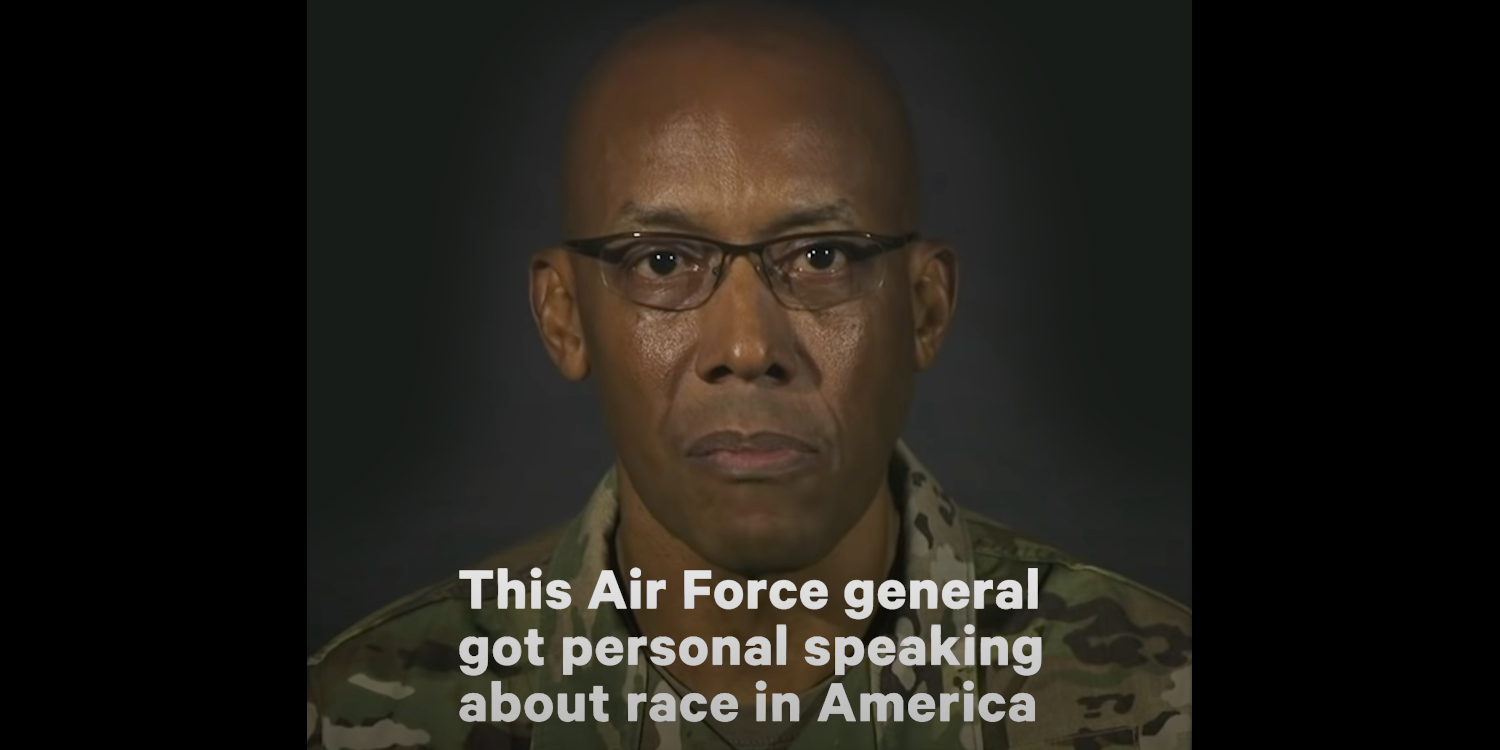
This does not mean racism does not exist. It certainly does, but in my world it is overshadowed by something much more subtle: racial bias. The current President’s appointment of General Charles Q. Brown to be the first African American to serve as Air Force Chief of Staff has raised a discussion about racial bias. It was raised by General Brown himself whose appointment was in the works well before the current racial tension in America. In a brilliant video address on June 5, General Brown stated:
“I’m thinking about my Air Force career, where I was often the only African American in my squadron, or as a senior officer the only African American in the room. I’m thinking about wearing the same flight suit, with the same wings on my chest as my peers, and then being questioned by another military member: ‘Are you a pilot?’ I’m thinking about how some of my comments were perceived to represent the African American perspective when it’s just my perspective…”
[ Editor’s note: please watch the following video for the full context. ]
That such subtle bias still exists in the blind corners of our attitudes should be a cause for soul searching for all Americans. I am proud to be in a nation that can look past such bias and recognize greatness in General Brown. We are a better — and safer — nation for his service.
As for Disarming the Police …
One widely Tweeted solution to police misconduct was this: “Almost every role in our community a police officer fills would be better handled by a social worker.” I asked other prisoners about Mr. Biden’s idea that police should be disarmed, and about the suggestion that police could be replaced by social workers. I never got any straight answers. They could not stop laughing.
The real criminals around me — they are not all real criminals but the real criminals are in the majority — sneer at these suggestions. Then they express worry about their families who still live in the same Blue State broken communities from which their offenses were committed.
But what they sneer at the most is the revelation that the City of Minneapolis received over 2,600 citizen complaints about just a small percentage of abusive police officers since 2015 and took action in only twelve of those cases thanks to the public sector police union’s political clout. If real reform is the real goal of protesters, #DefundPublicSectorUnions, and not #DefundPolice, would be our antiphon to the memory of George Floyd.
+ + +
Note from Father Gordon MacRae: Thank you for reading with open hearts and minds. Please Subscribe to Beyond These Stone Walls and Follow us on Facebook.


The Faithful Departed: Bishops Who Bar Catholics from Mass
As President Trump called upon governors to classify churches as essential, a Catholic Bishop in a state among the least impacted by Covid-19 suspended public Mass.

As President Trump called upon governors to classify churches as essential, a Catholic Bishop in a state among the least impacted by Covid-19 suspended public Mass.
I have to write about this now because I wrote about it then. During the now notorious presidential election of 2016, I wrote “Wikileaks Found Catholics in the Basket of Deplorables.” If you missed it then, you probably should not miss it now. I and many others naively lent credence to all the media hype about Russian collusion back then — now proven to be entirely false and an egregious injustice to General Michael Flynn. The above post actually commended the Russian hackers for providing transparency often promised but rarely delivered by American politicians.
That post was about revelations found in the emails of Hillary Clinton’s campaign manager, John Podesta, about the Democratic Party’s plans for the Catholic Church in America. I wrote the post just after Mrs. Clinton’s now infamous debate declaration: “Supporters of Donald Trump are a Basket of Deplorables.” I was not one of Donald Trump’s supporters, but I knew that Hillary lost the election then and there. Attacking candidates is just politics as usual. Attacking voters is political suicide.
The post above cited several examples of emails between the Clinton campaign and various Catholic entities with overtures to move the Church from a pro-life agenda toward a more left-leaning script for Catholic social progress. Climate change and open borders are to be the moral imperatives of the day.
I had more or less forgotten about the now famous Basket of Deplorables until the current election raised it anew — though not in so many words. Three years after the term was first
uttered, many in the news media still apply it by inference to everything and everyone in any way connected to the current American President.
Now thrust upon his growing heap of media scorn is a call from the President to America’s governors to give churches and other houses of worship the same treatment some of them have bestowed upon liquor stores, abortion clinics, and beauty salons. This President wants churches to be deemed “essential.” He at first threatened to “override” any governor who balks at this, a notion that the news media has gone to great lengths to ridicule. In a hastily scheduled White House Press Conference, Trump said:
“I call upon the governors to allow our churches or places of worship to open. If they don’t do it, I will override the governors. The ministers, pastors, rabbis, imams and other faith leaders will make sure their congregations are safe as they gather and pray.”
On May 22, 2020, the Centers for Disease Control supplemented the President’s request by laying out a series of guidelines for houses of worship to safely provide services. These include the usual recommendations for social distancing, cleaning practices, and face coverings all of which churches could easily observe.

The Real Presence and the Present Absence
But what do we do when it is Catholic bishops, and not politicians, closing church doors to faithful Catholics? As the American President deemed churches to be essential and called to reopen them, the Catholic Bishop of Manchester, New Hampshire, one of the states least impacted by the contagion, issued his formal “Decree Establishing Liturgical Norms During Covid-19 Pandemic”:
“Mindful that the dignity of the human person requires the pursuit of the common good (CCC 1926) and as Bishop of the Diocese of Manchester understanding my responsibility to issue liturgical norms by which all are bound (Canon 838:4), I hereby decree [that] the public celebration of Mass remains suspended… until such time as I deem it prudent to modify [this decree].”

There are a multitude of reasons why the ongoing suspension of Catholic Mass in this of all states is an unintended assault upon the religious needs of the people. In a surprising juxtaposition of roles, as some bishops closed churches and barred the faithful from Mass, the Centers for Disease Control issued a statement that should give pause to secular and spiritual leaders alike: “Millions of Americans embrace worship as an essential part of life.”
I would have expected such a sentiment from our bishops, not from a government entity established to control contagion. Sadly, however, that truth professed by the CDC applies less to New Hampshire than any other state. According to the Pew Research Center, New Hampshire is ranked 50th out of the fifty states for religious identity, observance, and influence. It also ranks 50th out of the fifty states in charitable giving.
In publishing his recent Decree, the Bishop of the Diocese of Manchester, NH, Bishop Peter A. Libasci, stated that as of May 18, 2020, over 3,600 New Hampshire citizens [out of a population of over 1.3 million] have tested positive for Covid-19, and 172 of our neighbors have lost their lives.” This is true, and at this writing the death toll in New Hampshire stands at about 250. Tragically, all but 65 of them were residents of nursing homes, the most vulnerable among us but they would not have been present at Mass anyway. These figures pale next to how Covid-19 has impacted some other states where governors and bishops are reopening churches while applying the norms for safety recommended by the CDC.
But there is another New Hampshire statistic that should be far more alarming to both the Governor and the Bishop. Among the fifty states, New Hampshire has the nation’s highest and most hopeless rate of death among working age young adults between the ages of 16 and 40. This is driven by another, far more deadly contagion: opiate addiction and all the physical, mental and spiritual hopelessness it entails. I wrote about this Grim Reaper in “America’s Opioid Epidemic Is Wreaking Havoc in this Prison.”
That post described a wall of sorrows in one unit in this prison containing the photos of young men who have lost their lives to addiction after leaving prison. The 37 photos on that wall of death included only those who lived in this one unit of 288 prisoners. And just as I sat down to type this post, a 38th photo was added. One of our good friends just tragically ended up on that wall.
Jerry came to prison at age 19 in 2005. In recent years, he attended Sunday Mass with Pornchai Moontri and me. Before the Covid-19 shut down he was able to come and talk to me in the prison Law Library where I work. On Friday, May 15, 2020 he was released from prison having completed his sentence at age 33. He lived in freedom for only a single day before losing his life to a fentanyl overdose. This is a painfully familiar story here as young prisoners face the reality that life in freedom sometimes means bringing the bondage of addiction home with them.
Bishop Libasci’s Decree cited his justification for keeping the churches closed: “172 of our neighbors have lost their lives” to Covid-19 statewide. This pales next to the grim truth of those in his Diocese who lost their lives in hopeless addiction. The New Hampshire Chief Medical Examiner reports that 2,500 young lives were lost to opioid drug overdoses in this small state since 2015.
Most of these deaths were those of young men and women from 16 to 40 years of age. One small New Hampshire city recently saw over 400 drug overdose deaths in a single year. There is likely no other state more in need of the spiritual strength and solace of open churches and the Sacrifice of the Mass than New Hampshire.

Trusting Faithful Catholics
One commenter on this subject in a Facebook discussion (which I could not see because I have never seen Facebook) commended Bishop Libasci and other bishops for helping to keep people safe by closing churches. I could only think of a statement of Saint Paul in his letter to the Corinthians:
“When I was a child, I spoke like a child, I thought like a child, I reasoned like a child. When I became a man, I gave up childish ways.”
The point should be obvious. When I was seven, I needed the help of adults to take care of myself. At sixty-seven that is simply no longer so. The Centers for Disease Control issued guidelines for what we adults must do to keep ourselves and our loved ones safe in public environments, including at Mass.
This is a point for which conservatives and Libertarians refer to the Left as purveyors of Big Government and “The Nanny State.” And it’s a point for which George Orwell cautioned us all in his dystopian 1949 novel, Nineteen Eighty-Four. We surrender our freedoms when we hand the interpretation of them over to “Big Brother.” Remember the cautionary words of the late President Ronald Reagan:
“The most dangerous words in the English language are, ‘Hello, I’m from the government and I’m here to help.’”
America is vigilant about concessions to totalitarian governments but too many turn a blind eye to how our political, social, economic, intellectual, and spiritual narratives are dominated in our media by the extreme left of our cultural elite. For someone to make the decision for us by denying Mass to the faithful when they should be entrusted with caring for themselves is insulting, at best.
When that decision leaves faithful Catholics in spiritual deprivation, they are placed at even greater risk by traveling long distances to seek out Mass in a more reasonable Diocese. This point was made by some readers of a recent post of mine. One comment that stands out is this one by “Judith” posted on “Pandemic Lockdown: Before the Walls Close In.”
“Here in the trenches, we recently received a communiqué from the Minister of Compliance in the Department of the State-Sanctioned Religious Observance informing us of the new rules regarding worship. If the Church / State requires masks, reception of Communion after Mass, and taking down our names and contact information in order to attend Mass, I will be assisting at the SSPX Mass an hour-and-forty-minutes away [which happens to be in Bishop Libasci’s diocese]. I know for a fact they don’t put up with this… God forbid you exercise your free will by choosing to risk your life to follow the precepts of the Church.”
Congressman Dan Crenshaw, a former Navy Seal and one of the most honorable members of Congress, wrote a March 19, 2020 op-ed for The Wall Street Journal entitled, “Why Does Reopening Polarize Us?” He raises an interesting twist of political psychology. Liberal and conservative brain functioning shows differences in their mapping when risk-taking is considered.
But it is now the conservatives who “are the ones ready to confront risk head-on.” He says this is also consistent with his experience in the military, and may explain why the vast majority of Special Forces operatives identify as political and social conservatives. But he cautions that liberals lagging behind in re-opening society may have another agenda, treating the lockdowns and consequent economic devastation as an opportunity to restructure America into a socialist utopia.”
In the National Catholic Register, Thomas M. Farr, President of the Religious Freedom Institute, has a recent column entitled, “Coronavirus and Religious Freedom.” He cites that the line drawn between “essential and nonessential” businesses and services by government decree is highly suspect. He singled out Virginia Governor Ralph Northam, a Democrat, former pediatrician, and notorious proponent of late-term abortion, as declaring that religious services are not essential,” but abortion clinics and liquor stores are.
Thomas Farr also adds that for Catholics, access to the Sacrifice of the Mass is “essential to our happiness in this life and the next.” I can only repeat what Father James Altman so courageously declared in a recent, now viral, homily entitled, “Memo to the Bishops of the World”:
“The faithful do not need you to look after their bodies. They need you to follow the Supreme Law of the Church and look after their souls.”
Effective June 6, 2020, Bishop Libasci modified his Decree to allow public Masses to resume in his diocese with strict conditions and limitations in addition to those recommended by the CDC.
Elsewhere, on the topic of faithful priests with courage, Father George David Byers had a memorable quote in a recent post, “Coronavirus ‘Creativity’ for Mass: ‘Just do it in the Parking Lot.’ No. And… Hell no!”
“I’m not going to be a Parking Lot Priest just to look up-to-date. No! … Hell no!”
But I am giving the last word to Saint Paul’s Second letter to Timothy:
“I charge you in the presence of God and of Christ Jesus who is to judge the living and the dead, and by his appearing and his kingdom: preach the word, be urgent in season and out of season, convince, rebuke, and exhort; be unfailing in patience and in teaching. For the time is coming when people will not endure sound teaching, but having itchy ears they will accumulate for themselves teachers to suit their own likings, and will turn away from listening to the truth and wander into myths. As for you, always be steady, endure suffering, do the work of an evangelist, fulfill your ministry.”
+ + +
Note from Father Gordon MacRae: You may also wish to read and share these memorable related posts:
The Once and Future Catholic Church
Wikileaks Found Catholics in the Basket of Deplorables
In the Diocese of Manchester, Transparency and a Hit List
Grand Jury, St. Paul’s School, and the Diocese of Manchester

Please share this post!

The Chinese Communist Party and the True Origin of Covid-19
Conspiracy theories abound about the new coronavirus and Covid-19 pandemic. Evidence now points to an origin other than what the Chinese Communist Party has claimed.

Conspiracy theories abound about the new coronavirus and Covid-19 pandemic. Evidence now points to an origin other than what the Chinese Communist Party has claimed.
March 5, 2023 — Note from Father Gordon MacRae:
Early in 2020, I wrote the post below about the burgeoning pandemic of Covid 19. My post rejected the Chinese Communist Government’s explanation of its origin. The CCG claimed, and still claims, that the SARS-CoV-2 virus originated by natural means through an animal sold at the Wuhan, China open market. I laid out a case for why this is likely not so, and why it is much more likely that the virus escaped from inside the Wuhan Institute of Virology where gain-of-function research and other experimentation was being conducted since 2013. This week, a classified intelligence report provided to the White House and key members of Congress concluded, along with the Department of Energy and the FBI, that the Covid pandemic most likely arose from a Wuhan laboratory.
If the Chinese Communist Government had been transparent from the beginning, the world may have had a better response to this pandemic. But please remember: China is by force the People’s Republic, but Covid is by no means the people’s pandemic. The good people of China had nothing to do with this.
+ + +
My niece, Emily is a Registered Nurse in the specialized Covid-19 treatment unit of a large inner city hospital near Boston. Working many 16-hour days, she and many of the other RNs from that unit were told weeks ago that they cannot go home. Between grueling double shifts they have been staying at a local hotel because of their daily exposure.
Emily has two small children at home where her husband, a native of Hong Kong, is now caring for them while working from home. Recently, Emily took a quick break for a ten-minute virtual Face-Time visit with her family. A still from the visit was sent to my GTL tablet. Emily is masked, covered in her protective gear, and looking tired but resolute. Emily is a warrior on the front lines of battle. I am most proud of her and all medical staff working tirelessly to help contain a pandemic.
I am among those who bristle when some refer to the virus that causes Covid-19 as “the China virus.” I knew that some lurking in the darker corners of America would thus see a new enemy in the many Asian Americans who contribute to the welfare of this nation. Pointing fingers of blame at them is an ignorant and inhumane response to a pandemic that needs unity much more than it needs a fraudulent place to level blame.
There is no evidence to support some of the wilder theories that the virus behind Covid-19 was created and unleashed to destroy the economies of America and other democracies. That is nonsense. There is no economy more imperiled by this global pandemic than that of the People’s Republic of China.
But even among some of the wilder conspiracy theories there has emerged some grains of truth. The official story told by the Chinese Communist government has been that the virus originated entirely by accident at a wildlife market in Wuhan, central China and it likely began with a bat that was either sold at the market or infected another mammal sold at the market. I recently wrote of the plausibility of this in “Holy Week, Coronavirus, Loneliness, Politics, Yikes!”
That official account now seems only partially true. In a recent edition of The Wall Street Journal, Matt Ridley — a science writer from the United Kingdom where he is also a member of the House of Lords — wrote an intriguing and eye-opening account in “The Bats Behind the Pandemic” (WSJ, April 11-12, 2020). Here is his stunning revelation:
“RaTG13 is the name, rank and serial number of an individual horseshoe bat of the species, Rhinolophus affinis, or rather a sample of its feces collected in 2013 in a cave in Yunnan, China [over 1,000 miles from Wuhan]. The sample was collected by hazmat-clad scientists from the Institute of Virology in Wuhan that year. Stored away and forgotten until January [2020], the sample … contains the virus that causes Covid-19.”
As Lord Ridley points out, bats are sold in markets and provided to restaurants across China. The horseshoe bat, however, is a small species that is not typically consumed by humans nor is it sold in Wuhan’s now infamous wildlife market or “wet market.”
It is thus a “horrible coincidence” that China’s Institute of Virology, where the virus that causes Covid-19 has been studied since 2013, just happens to be in Wuhan, the origin of the current pandemic that the Chinese government is blaming on a marketplace. The Washington Post has reported that U.S. officials are now investigating whether the Wuhan lab is the actual source for the global pandemic.

A Global Pandemic from a Communist State
Such an investigation is very difficult to conduct without the cooperation of the Chinese Communist government which, like all such regimes, seeks to preserve itself more than its people. In China, the government filters all information through the Chinese Communist Party (CCP). Early in the viral spread, the government expelled foreign journalists from The Wall Street Journal and The Washington Post, first from Wuhan and then from the nation.
In 2018, the U.S. Embassy in Beijing dispatched science diplomats to visit and assess the Wuhan Institute of Virology. The result was a pair of cables sent to Washington warning of inadequate safety measures and “a serious shortage of appropriately trained technicians” at the lab. The diplomats called for additional funding for the lab from the Chinese government to address these safety concerns. The funding recommendation was ignored. The Chinese government continues to cite the wildlife market as the accidental origin of the virus.
In December, 2019, a team of Wuhan CDC researchers were the subjects of a documentary film about their collection of virus samples from bats in caves across China. The researchers expressed concern about the risk of infection from the samples they obtained. The government then silenced under threat of arrest several local journalists and scientists who began to voice concerns over the emergence of the new virus.
In January, 2020, well after the virus was discovered and began its viral spread, the government allowed an immense banquet with 40,000 families in attendance to take place in Wuhan. At 11 million inhabitants, Wuhan is larger than any U.S. city. Its airport and train depots transport thousands of people per day to points all around the globe.
Of interest, Chinese researchers reported as recently as January 24 that the outbreak had no connection with the Wuhan market. The bat species now known to cause Covid-19 is not found anywhere near Wuhan. Writing for The Wall Street Journal, U.S. Senator Tom Cotton reported that Yuan Zhiming, a top researcher at the Wuhan Institute of Virology, denied any connection with the lab and accused the Senator of “deliberately trying to mislead the people.” Yuan Zhiming also serves as Secretary for the lab’s Communist Party Committee.
It is also a “horrible coincidence” — horrible for the people of China, at least — that this global pandemic originated and was spread just in time to terminate the growing pro-democracy demonstrations in Hong Kong that were beginning to spill over into mainland China. I am not suggesting that this coincidence is evidence of intent, for all that I have written here is merely circumstantial evidence. But there are rumblings now in Hong Kong to resume the pro-democracy movement. Never has there been a more important time to lend Western voices in support of them.
There is growing evidence that the whole truth has not been told. China has misled the world about this pandemic in other ways by continuing to falsify vital information. In a classified report to the White House, the U.S. intelligence community concluded that China has severely underreported the number of deaths related to the virus and its incidence of transmission.
There is evidence that the total number of cases that China has concealed is greater than the total number reported throughout the rest of the world. This deceit, according to Wall Street Journal columnist Walter Russell Mead, “allowed a local outbreak to turn into a global disaster on a massive scale.”

The People’s Republic but NOT the People’s Pandemic
None of this, however, is the fault of the Chinese people. There is a vast difference between the Communist Chinese government (CCG) which is imposed on the people, and the people themselves. They are subjects of the People’s Republic of China but this is clearly not the people’s pandemic. Assessing a pandemic requires accurate knowledge of its origin, timeline, and rate of contagion but in a communist regime, truth is filtered through an agenda more interested in preserving the regime than its subjects.
Since childhood, I have had a fascination with and high regard for China and its people. The first urban community among the Chinese people dates back to the Xia Dynasty in pre-history. When Yu, the last of the ancient Chinese kings died, the people acclaimed his eldest son to take his place.
This was the first example of hereditary “dynastic” leadership. The Xia Dynasty survived for fourteen generations beginning two centuries before Melchizedek blessed Abraham in the 21st Century B.C. (For some historical context, see “The Feast of Corpus Christi and the Order of Melchizedek”).
The stories of Chinese history that I treasured the most in my youth, however, were those told by Marco Polo thirty-four centuries later. Marco Polo’s father and uncle, Niccolo and Maffeo Polo, left Venice in 1260 on a commercial venture to Constantinople (now Istanbul). They were forced by an outbreak of war behind them to continue moving east along the Volga River into present day Russia where they were trapped for three years. Then they joined a diplomatic mission to China to the Court of Kublai Khan.
Kublai Khan, grandson of the great Mongol warrior-king, Genghis Khan, received them warmly. The Khan (which means “ruler”) had embraced Buddhism and made it the Chinese state religion. But his reign also tolerated other religions. The Khan was fascinated with Christianity. He asked the Polo brothers to return home and persuade the pope to send scholars to China so he may learn more.
In 1269 A.D., nine years after their departure from Venice, the elder Polo brothers returned to present the Khan’s request to Pope Gregory X. The pope agreed to fund another journey to China to include two missionaries and Niccolo’s son, Marco Polo. Five years later, in 1275, the group reached the court of Kublai Khan where they spent the next 17 years.
The Khan took a great liking to Marco Polo whose stories of his adventures in China would later fascinate the Western World and open the Asian continent for trade with the West. During his time with Kublai Khan, the emperor sent Marco on several diplomatic missions to represent him in Sichuan province in the south of China and Yunnan province in the southwest.
Marco asked several times for the Khan to grant him leave to return to Venice, but the Khan would not agree. Finally, he asked Marco to escort a Chinese princess to Persia (now Iran) to marry its Mongol ruler and then return to Europe. Marco Polo arrived home in 1295, twenty years after leaving. Five centuries after Kublai Khan and Marco Polo brought China to the West, in the 17th Century Ming Dynasty, the Emperor Kangxi invited Jesuit priests to serve as astronomers and allowed them to instruct Catholic converts.
The relationship ended, however, when Pope Alexander VII ruled that the Jesuits must not permit converts to also practice their ancient Chinese ancestral rites. This did not irreparably disrupt Catholicism in China, however. Converts continue to be drawn to it up to the present day, but a threat to religious liberty is China’s other contagion, a story told in my recent post on the “Vatican-China Deal.”
What We Obtain Too Cheap, We May Esteem Too Lightly
Thanks for indulging me in all this history. It is told for a reason, and the reason is to convey that the Chinese people lived for nearly four millennia in a culture rich in honorable customs and openness to the world, including openness to science, faith and technology.
Communism and socialism were once seen as interchangeable terms. There are differences, but their goals remain the same. The socialist doctrine demands state ownership and control of all fundamental means of production and distribution of wealth. Unlike communism, socialism achieves its ends not by violent revolution, but by reconstruction of capitalist political systems through peaceful, democratic, means.
Communism and socialism advocate for the nationalization of natural resources, public utilities, banking and credit, and industry and trade. These are the tenets of the Socialist Party of the U.S., the Labour Party of the U.K., and the labor or social democratic parties of various other democracies.
What they advocate is a slippery slope. Americans and the Western World would do well to remember that the rise of socialism is not historically conducive to the preservation of individual rights and freedoms, including and especially religious freedoms. Like the Chinese Communist Party, in a socialist system the state is always in danger of becoming its own religion.
In China, it was not until the rise of the Chinese Communist Party under Mao Zedong in 1949 that communism became the official state religion of what from then on became the People’s Republic of China. Like all oppressive communist regimes, the real battle is over the minds and souls of the people. The Party views all competing loyalties — especially religious ones — with contempt.
But there is one result of the global pandemic unleashed in China that might today bring another snicker of contempt to the faces of the ruling regime. At Holy Week and Easter, 2020, State governments across America — the Cradle of Liberty and self-proclaimed bastion of the Freedom of Religion — ordered churches closed while the liquor stores remained open.
America may not be entirely free of government self-interest either. In the place where I live in captivity — though not by choice or by any act that justifies it — the state just happens to own all the liquor stores.
+ + +
Editor’s Note: Please share these posts on social media and with your contacts. Please subscribe to These Stone Walls, and Like and Follow us on Facebook.
You may also like this related post:

Please share this post!

From Down Under, the Exoneration of George Cardinal Pell
Seven judges of the Australia Supreme Court unanimously ruled that Cardinal George Pell was wrongly convicted and imprisoned. He and we deserve to know how and why.
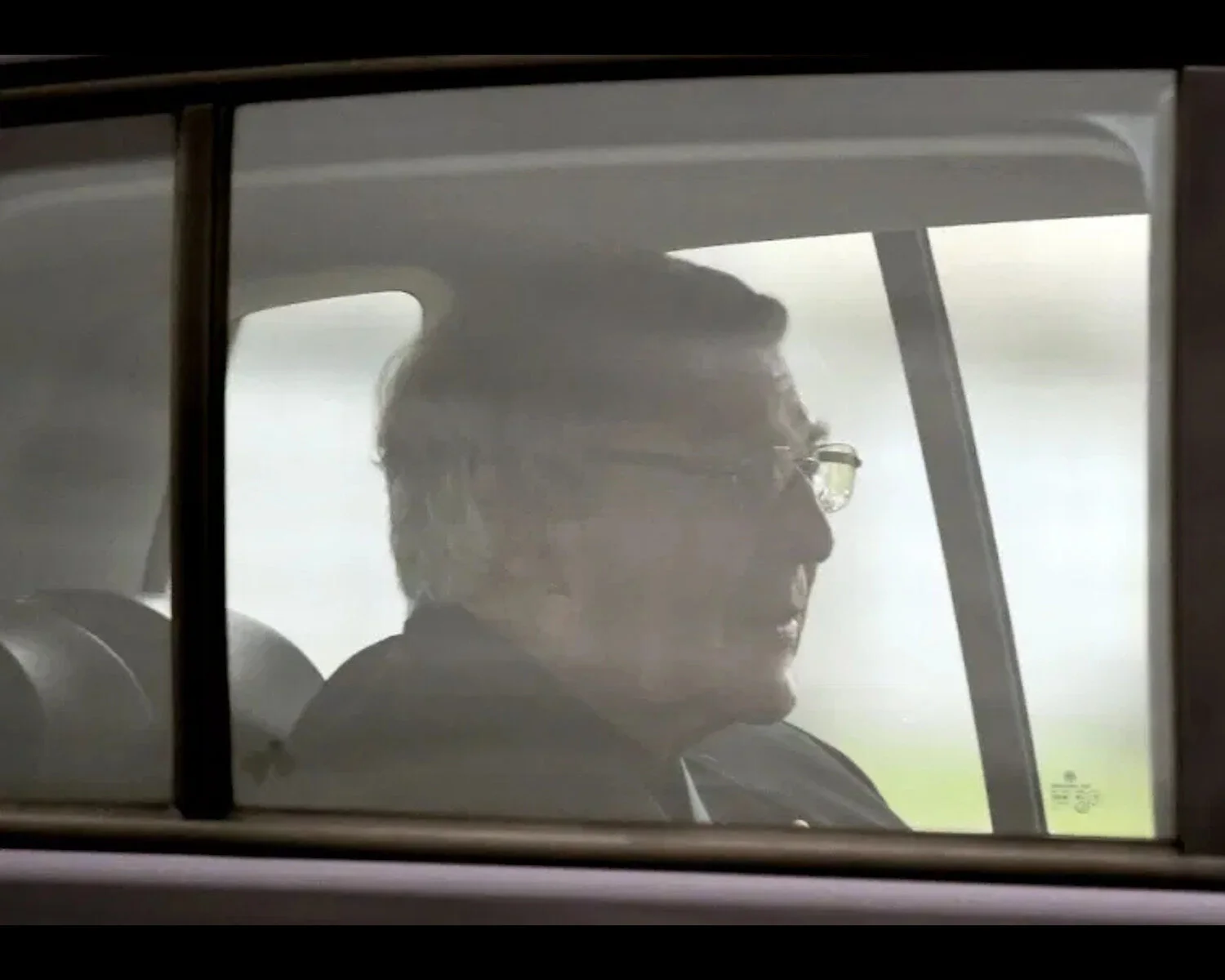
Seven judges of the Australia Supreme Court unanimously ruled that Cardinal George Pell was wrongly convicted and imprisoned. He and we deserve to know how and why.
Strange things had been happening in the weeks leading up to Holy Week 2020. For the first time in our lifetimes, Catholic churches were inaccessible to most Catholics observing Holy Week and Easter as a community of believers.
Then, in the midst of all the church closures due to the Covid-19 global pandemic, Cyrus Habib, the Democratic Lieutenant Governor of Washington State, announced that he is leaving politics to study for the Catholic priesthood. This was not the sort of hopeful news the news media likes to hype in Holy Week so it was barely noticed. Then the Supreme Court of Australia announced that, on Tuesday of Holy Week, it would release its decision on the final hope for appeal in the case of Cardinal George Pell.
I did not greet this news with a sense of hope. Far back in April of 2010, I wrote a post with the controversial title, “Breaking News: I Got Stoned with the Pope.” It was about how some consistently anti-Catholic news outlets have a tradition of exploiting Catholic scandal during or just prior to Holy Week.
The pope in question back then was Benedict XVI. For full disclosure, neither he nor I inhaled anything illicit. That was not what I meant by getting stoned with the pope. It was meant in the Biblical sense, the same sense found in one of the most popular posts on These Stone Walls, “Casting the First Stone: What Jesus Wrote in the Sand.”
The type of stoning that brutally took a person’s life in Biblical times is carried out today in another way. Instead of taking a life, a person’s reputation is destroyed. False witness and sensational headlines are now the stones of choice. We have all seen the “gotcha” media at work. You cannot sit through a White House press conference without witnessing firsthand how some in the news media insinuate, inflame, and then exploit the interpretations that too often today pass for real journalism.
A vivid example came during the 2016 Presidential election cycle. A group of 200 noisy white supremacists demonstrated in Virginia using slogans such as “Make America Great Again.” For much of the far left mainstream news media, this was evidence enough to link them with Donald Trump implying falsely that he must support racism because some racists support him.
The real scandal is the news media itself. By giving these marginal racists a spotlight, the news media took their tiny microphone and turned it into a national megaphone. The news media does not even try to justify its viral coverage of 200 white supremacists while turning a blind eye to 200,000 prolife advocates at the annual March for Life in Washington DC.
I admit that I was cynical and suspicious when I learned that the High Court of Australia chose Tuesday of Holy Week to announce its long awaited final verdict on Cardinal Pell. As soon as the decision was announced, victim groups and some in the media went into high gear to denounce the finding and declare that it is not an exoneration or acquittal.
This is nonsense. The unanimous finding that Cardinal Pell’s charges were fatally flawed, his trial unjust, his convictions unsupported by evidence, are in fact an exoneration. He stands convicted of no crime. It exposed for all the world to see the harsh reality that — as for so many other priests facing the cruel tyranny of false witness in the current age — Cardinal Pell was considered guilty merely for being accused.

The Integrity of Justice Itself Is at Stake
Four hundred and five days! That is how long 78-year-old George Cardinal Pell spent in prison before Australian justice woke up. On the day of his exoneration, I marked 9,350 days of wrongful imprisonment. I do not write that as a comparison, but rather as an expression of deepest empathy for what Cardinal Pell endured.
Throughout his ordeal, I believed in his innocence; I supported him with my prayers, and I offered some of my own unjust imprisonment in spiritual alliance with him. I hope this was evident in my series of widely-read posts about his plight that I will link at the end of this one. When I say that those end posts were widely read, the truth is that they were widely read everywhere but in Australia.
The first of these posts was “Cardinal George Pell Is on Trial, and So Is Australia.” Its focus was on the fact that the whole world was watching these charges as they proceeded to trial with no real evidence and much media exploitation. In the end, it is Australia’s justice system that now seems indicted and facing trial in the court of public opinion.
I hope this exoneration brings some much-needed soul searching to the people of Australia, the Australian courts, and the police and prosecutors who ignored much exculpatory evidence to bring these charges. However, evidence for that soul-searching was not reflected in the public statement of Daniel Andrews, Premier of Victoria State where Cardinal Pell was convicted.
After the unanimous Supreme Court exoneration, the public statement of the Victoria State Premier addressed none of what the Court covered or decided. He instead addressed himself to what the media calls victims and survivors but what the legal system must treat as accusers. His statement to them was: “I see you. I hear you. I believe you.”
On its face, that seems benign, but it isn’t. It is perhaps the most dangerous affront to justice in a case like this. It is grotesquely irresponsible to reduce the application of justice to a set of hashtags instead of evidence. Why have courts and trials at all if the personal beliefs of police, prosecutors and state officials are all that is needed to convict and condemn?
In the United States, the Center for Prosecutor Integrity has joined over 100 legal scholars in a petition to the department of Justice to cease its support for #BelieveSurvivors and guilt-presuming investigations. It is one of the most prolific causes of wrongful convictions and other injustices. When police and prosecutors — and the governments on whose behalf they operate — launch “Victim-Centered Investigations” they begin with a faulty assumption that crimes did occur and that the accused is guilty.
The Prosecutor Integrity website lists hundreds of scholarly articles by legal experts about how innocent defendants like Cardinal Pell are victimized by investigators wearing blinders. Police and prosecutor misconduct were central factors in 42-percent of wrongful convictions. One article at the Wrongful Convictions site is “The Intersection Between Innocence, Expert Witness and Religion: The Case of Rev. Gordon MacRae.”
Victim-Centered instead of fact-centered investigations result in a failure of the justice system to look honestly at itself. The Australian police and prosecutors — and the two judges who upheld a guilty verdict against Cardinal Pell in his first appeal — have some explaining to do.
I know only too well what the trashing of Cardinal Pell’s good name has cost him, but the other damage is to the integrity of the criminal justice system. I also know well the treachery of those — both inside and outside the Church — who disregard a lack of evidence or substantiation, mindlessly poised to believe any lurid tale regarding any priest so accused.
On social media after this exoneration, some in Australia suggested that, innocent or not, Cardinal Pell should have remained in prison in reparation for the sins of other priests. This is nothing more than evidence of the moral panic this story set in motion. It is easy to offer up someone else’s good name and freedom for a politically correct cause.
Minds should not be made up because the media celebrates the fall of Catholic priests and prelates. Minds should be made up by clear and compelling evidence, and there was none. Anything less is to surrender our own personal integrity to the news media and to reduce justice to a lynch mob.

Priestly Scandal: A Pandemic of Trophy Justice
Accusations against a high profile cardinal and member of the curia too easily result in “Trophy Justice,” a term that also has grave implications for the integrity of the justice system. Cardinal Pell spent 405 days in prison because those empowered to impart justice were too reluctant to give up their trophy.
Since his exoneration there has been no shortage of biased treatment in the news. The much needed voice of Bill Donohue at the Catholic League for Religious and Civil Rights has been, as usual, on the front lines exposing this. Annual membership in the Catholic League is the best $30 investment I have ever made.
Ironically, in the wake of this exoneration, editorials in The New York Times and The Boston Globe have criticized a lack of transparency in the Australian justice system. Bill Donohue rightly pointed out that neither newspaper ever questioned its transparency when Cardinal Pell was found guilty without evidence, or when he was sentenced to prison, or when a lower court disregarded the shoddy work of prosecutors to uphold an unjust verdict. That was all perfectly transparent.
And it was all front page news. The exoneration did not at all receive anything even close to equal treatment. I am thankful to Bill Donohue for informing us that The Boston Globe reported Cardinal Pell’s exoneration on page 19. Why any thinking, reasonable Catholic is still reading The New York Times or The Boston Globe is a mystery. There are alternatives. In ten years of writing behind These Stone Walls, I have never seen anti-Catholic bias and media distortion in The Wall Street Journal.
I am ashamed to add to the above that some Catholic media have fared little better. After Cardinal Pell’s first appeal to a lower court failed in a two-to-one decision, Our Sunday Visitor reported in its news section that his conviction was upheld by a three-judge panel. In a letter of protest to the editors, I pointed out that this was inaccurate and misleading.
Judge Weinberg the most experienced judge on that Australian three-judge panel, published a blistering dissent against the conclusions of the other two, but Our Sunday Visitor did not publish my letter clarifying this. After Cardinal Pell spent another six months unjustly in prison, the seven judges of Australia’s Supreme Court agreed with Judge Weinberg’s dissent.
Why should we support obviously biased or agenda-driven news outlets? When we know the truth behind a mishandled story, logic requires that we ask how many other stories are misrepresented in the news without our awareness. The Catholic League has never retreated from reporting on the crisis in the Church without sacrificing the rights of priests. In the March 2020 issue of Catalyst, just weeks before the exoneration of Cardinal Pell, Catholic League President Bill Donohue wrote of both our cases:
“Cardinal George Pell, who is in an Australian prison for alleged sexual abuse (awaiting a final appeal) was accused as far back as 1962. The case was dismissed because nothing could be substantiated. His accuser had been convicted 39 times for offenses ranging from assault to drug use. He was a violent drug addict…. There is another priest, Father Gordon MacRae, who is still in prison in New Hampshire for crimes he vehemently denies, and whose accuser, Thomas Grover, has a history of theft, drugs, and violence. Even his former wife and stepson call him a compulsive liar and manipulator.”
— Catalyst, Accused Priests Deserve Better
Pope John Paul II once cautioned that the Church must be a mirror of justice to the world. The mirror of justice has since cracked, however, when the American bishops adopted merely “credible” as sufficient evidence to discredit and discard a priest, and then pressed Rome to apply that standard throughout the Church. The result is the treatment that we have just witnessed in the case of Cardinal Pell.
Too many in the media — sadly including some in the Catholic media — simply presumed his guilt just as they presume the guilt of most priests so accused. But there were other, even darker agendas at work in the case of Cardinal Pell, and real transparency will require getting to the bottom of them.
Some in Rome, convinced of his innocence, remained silent while others may have been complicit with getting Cardinal Pell and his financial reforms out of the way. It has been suggested recently by Paul Kelly, an Australian political commentator for The Australian, that “State power had been recruited in an effort to destroy Pell.”
Cardinal Pell was a scapegoat who was targeted by enemies of the Church — enemies perhaps both foreign and domestic. Pope Francis had been careful to withhold any public statement until the Cardinal Pell case had exhausted all appeals. On Tuesday of Holy Week, just hours after Cardinal Pell’s release from prison, Pope Francis released this remarkable statement via Twitter:
“In these days of Lent, we have been witnessing the persecution that Jesus underwent and how He was judged ferociously, even though He was innocent. Let us pray together today for all those persons who suffer due to an unjust sentence because someone had it in for them.”
Someone had it in for Cardinal Pell. He and we deserve to know who and why. And as for Pope Francis, his summation sure sounds like an exoneration to me.
+ + +
Note from Father Gordon MacRae: Please pray for Cardinal Pell, for his restoration from this years-long ordeal, and for a just and honest reckoning about the process that brought it about. You may also wish to read this related post:
Satan at The Last Supper: Hours of Darkness and Light
The central figures present before the Sacrament for the Life of the World are Jesus on the eve of Sacrifice and Satan on the eve of battle to restore the darkness.

The central figures present before the Sacrament for the Life of the World are Jesus on the eve of Sacrifice and Satan on the eve of battle to restore the darkness.
As I begin this eleventh Holy Week post behind These Stone Walls all the world is thrust under a shroud of darkness. A highly contagious and pernicious coronavirus threatens an entire generation of the most vulnerable among us on a global scale. Many Catholics face Holy Week without the visible support and consolation of a faith community. Many of our older loved ones face it entirely alone, separated from social networks and in dread of an unknown future darkness.
A week or so before writing this, I became aware of a social media exchange between two well-meaning Catholics. One had posted a suggestion that a formula for “exorcized holy water” would repel this new viral threat. The other cautioned how very dangerous such advice could be for those who would substitute it for clear and reasoned clinical steps to protect ourselves and others. I take a middle view. All the medical advice for social distancing and prevention must be followed, but spiritual protection should not be overlooked. Satan may not be the cause of all this, but he is certainly capable of manipulating it for our hopelessness and spiritual demise.
This “down time” might be a good time to reassess where we are spiritually. A sort of “new age” culture has infiltrated our Church in the misinterpretations of the Second Vatican Council since the 1960s. There is a secularizing trend to reduce Jesus to the nice things He said in the Beatitudes and beyond to the exclusion of who He was and is, and what Jesus has done to overcome the darkest of our dark. In a recent post, I asked a somewhat overused question with its answer in the same title: “What Would Jesus Do? He Would Raise Up Lazarus — and Us.” Without that answer, faith is reduced to just a series of quotes.
By design or not I do not know, but the current darkness drew me in this holiest of weeks to a scene in the Gospel that is easy to miss. There are subtle differences in the Passion Narratives of the Gospels which actually lend credence to the accounts. They reflect the testimony of eye witnesses rather than scripts. One of these subtle variations involves the mysterious presence of Satan in the story of Holy Week.
This actually begins early in the Gospel of Luke (Ch. 4) in an account I wrote about in “To Azazel: The Fate of a Church That Wanders in the Desert.” Placed in Luke’s Gospel after the Baptism of Jesus and God’s revelation that Jesus is God’s “Beloved Son,” Jesus is led by the Spirit into the desert wilderness for forty days. He is subjected there to a series of temptations by the devil. In the end, unable to turn Jesus from his path to light, “the devil departed from him until an opportune time.” (Luke 4:13)
That opportune time comes later in Luke’s Gospel, in Chapter 22. There, just as preparations for the Passover are underway, the conspiracy to kill Jesus arises among the chief priests and scribes. They must do this in the dead of night for Jesus is surrounded by crowds in the light of day. They need someone who will reveal where Jesus goes to rest at night and how they can identify him in the darkness.
Remember, there is no artificial light. The dark of night in First Century Palestine is a blackness like no one today has ever seen. This will require someone who has been slyly and subtly groomed by Satan, someone lured by a lust for money. This is the opportune time awaited by the devil in the desert:
“Then Satan entered into Judas called Iscariot, who was of the number of the Twelve. He went away and conferred with the chief priests and the captains how he might betray him to them. And they were glad, and engaged to give him money. So he agreed and sought an opportunity to betray him to them in the absence of the multitude.”

The Hour of Darkness
In Catholic tradition, the Passion Narrative from the Gospel of John is proclaimed on Good Friday. In that account, there is a striking difference in the chronology. Satan enters Judas, not in the preparations for Passover, but later the same day, shockingly at the Table of the Lord at the Last Supper on the eve of Passover:
“So when he dipped the morsel, Jesus gave it to Judas, the son of Simon Iscariot. Then, after the morsel, Satan entered into him. Jesus said to him, ‘What you are going to do, do quickly.’… So after receiving the morsel, he immediately went out, and it was night.”
Who could not be struck by those last few words, “and it was night”? They describe not only the time of day, but also the spiritual condition into which Judas has fallen. Judas and Satan are characters in this account from the Temptation of Jesus in the desert to the betrayal of Jesus in the hour of darkness. But darkness itself is also a character in this story. The word “darkness” appears 286 times in Sacred Scripture and “night” appears 365 times (which, ironically, is the exact number of nights in a year).
For their spiritual meaning, darkness and night are often used interchangeably. In St. John’s account of the betrayal by Judas, the fact that he “went out, and it was night” is highly symbolic. In the Hebrew Scriptures, our Old Testament, darkness was the element of chaos. The primeval abyss in the Genesis Creation story lay under chaos. God’s first act of creation was to dispel the darkness with the intrusion of light. “God separated the light from the darkness” (Genesis 1:4) which, in the view of Saint Augustine, was the moment Satan fell. In the Book of Job, God stores darkness in a chamber away from the path to light. God uses this imagery to challenge Job to know his place in spiritual relation to God:
“Have you, Job, commanded the dawn since your days began, and caused it to take hold of the skirts of the Earth for the wicked to be shaken out of it? … Do you know the way to the dwelling of light? Do you know the place of darkness?”
In the Book of Exodus, darkness is one of the plagues imposed upon Egypt. For the Prophet Amos (8:9) the supreme disaster is darkness at noon. In Isaiah (9:1) darkness implies defeat, captivity, oppression. It is the element of evil in which the wicked does its work (Ezekiel 8:12). It is the element of death, the grave, and the underworld (Job 10:21). In the Dead Sea Scrolls is a document called, “The Sons of Light and the Sons of Darkness.” In the great Messianic Proclamation of Isaiah (9:2): “The People who walked in darkness have seen a great light.”
In the New Testament, the metaphors of light and darkness deepen. In the Gospel of Matthew (8:12, 22:13) sinners shall be cast into the darkness. In the Gospel of Mark (13:24) is the catastrophic darkness of the eschatological judgment. The Gospel of John is filled with metaphors of darkness and light. Earlier in the Gospel of John, Jesus confronts those who plot against him as under the influence of darkness and Satan:
“If God were your Father, you would love me, for I proceeded and came forth from God. I came not of my own accord, but He sent me. Why do you not understand what I say? It is because you cannot bear to hear my word. You are of your father, the devil, and your will is to do your father’s desires. He was a murderer from the beginning, and has nothing to do with the truth because there is no truth in him. When he lies, he speaks according to his own nature, for he is a liar and the father of lies.”
I once wrote about the person of Judas and the great mystery of his betrayal, his life, and his end in “Judas Iscariot: Who Prays for the Soul of the Betrayer?” At the Passover meal and the Table of the Lord, he dipped his morsel only to exit into the darkness. In the original story of the Passover in Exodus (13:15-18) God required the lives of the firstborn sons of Pharoah and all Egypt to deliver His people from bondage. Now, in the Hour of Darkness set in motion by Satan and Judas, God will exact from Himself that very same price, and for the very same reason.

The Hour of Light
Biblical Hebrew had no word for “hour,” nor was such a term used as a measure of time. In the Roman and Greek cultures of the New Testament, the day was divided into twelve units. The term “hour” in the New Testament does not signify a measure of time but rather an expectation of an event. The “Hour of Jesus” is prominent in the Gospel of John and also mentioned in the Synoptic Gospels. Jesus is cited in John as saying that His Hour has not yet come (7:30 and 8:20). When it does come, it is the Hour in which the Son of Man is glorified (John 12:23; 17:1).
In the Gospel of Luke (22:53), Jesus said something ominous to the chief priests and captains of the Temple who came, led by Judas (and Satan), to arrest Him: “When I was with you day after day in the Temple, you did not lay hands on me but this is your hour, and the power of darkness.”
In all of Salvation History there has never been an Hour of Darkness without an Hour of Light. In the Passion of the Christ the two were not subsequent to each other, but rather parallel, arising from the same event rooted in sacrifice. This was the ultimate thwarting of Satan’s “opportune time.” Jesus, through sacrifice, did not just defeat Satan’s plan, but used its Hour of Darkness to bring about the Hour of Light.
Amazingly, “Light” and “Darkness” each appear exactly 288 times in Sacred Scripture. It is especially difficult to separate the darkness from the light in the Passion Narratives of the Gospel. Both are necessary for our redemption. Without darkness there is no sacrifice or even a need for sacrifice.
The Hour of Light began, not at Calvary, but at the Institution of the Eucharist at The Last Supper, the Passover meal with Jesus and His Apostles. The Words of Institution of the Eucharist are remarkably alike in substance and form in each of the Synoptic Gospels and in St. Paul’s First letter to the Corinthians (11:23).
The sacrificial nature of the Words of Institution and their intent at bringing about communion with God are most prominent in the oldest to come into written form, that of Saint Paul:
“For I received from the Lord what I also delivered to you, that the Lord Jesus, on the night when he was betrayed took bread, and when he had given thanks he broke it, and said, ‘This is my body which is for you. Do this in remembrance of me.’ In the same way also the chalice, after supper, saying, ‘This chalice is the new covenant in my blood. Do this, as often as you drink it, in remembrance of me.’ For as often as you eat this bread and drink the chalice, you proclaim the Lord’s death until he comes.”
The enormity of this gift, the beginning of the Hour of Light, comes in the midst of words like “betrayal” and “death.” It is most interesting that the Gospel of John, which has Satan enter Judas at the Passover Table of the Lord, has no words for the formula of Institution of the Eucharist. But John clearly knows of it. The Gospel of John presents a clear theological allusion to the Eucharistic Feast in John 6:47-51:
“Truly, Truly I say to you, he who believes has eternal life. I am the bread of life. Your fathers ate manna in the desert and they died. This is the bread which comes down from heaven, that a man may eat of it and not die. I am the living bread which came down from heaven; if anyone eats this bread he will live for ever; and the bread which I shall give for the life of the world is my flesh.”
The term “will live forever” appears only three times in all of Sacred Scripture: twice in the above passage from John, and once in the Septuagint, the Greek translation of the Hebrew Scriptures in Genesis 3:22. There, God expels Adam and Eve from Eden for attempting to be like God. It is a preventive measure in Genesis “lest they eat from the Tree of Life and live forever.” For John’s Gospel, what was denied to Adam is now freely given through the Sacrifice of Christ.
It is somewhat of a mystery why the Gospel of John places so beautifully his account of the Institution of the Eucharist there in Chapter 6 just after Jesus miraculously feeds the multitude with a few loaves of bread and a few fish, and then omits the actual Words of Institution from the Passover meal, the setting for The Last Supper in each of the other Gospels and in Saint Paul’s account.
Perhaps, on a most basic level, the Apostle John, beloved of the Lord, could not bring himself to include these words of sacrifice with Satan having just left the room. At a more likely level, John implies the Eucharist theologically through the entire text of his Gospel. In the end, after a theological and prayerful discourse at table, Jesus prays for the Church:
“When Jesus had spoken these words, he lifted up his eyes to heaven and said, ‘Father, the hour has come; glorify your Son that the Son may glorify you, since you have given him power over all flesh, to give eternal life to all whom you have given him. And this is eternal life, that they know you, the only true God, and Jesus Christ whom you have sent.”
Now Comes the Hour of the Son of God, The Cross stood only for darkness and death until souls were illumined by the Cross of Christ. From the Table of the Lord, the lights stayed on in the Sanctuary Lamp of the Soul.
+ + +
Note from Father Gordon MacRae: Take a time out from anxiety and isolation this Holy Week by spending time in the Hour of Light with these related posts from Beyond These Stone Walls:
A Personal Holy Week Retreat at Beyond These Stone Walls
Waking Up in the Garden of Gethsemane
The Chief Priests Answered, ‘We Have No King But Caesar’


Catholics, Communist China, and Hope for Hong Kong
James W. Harris, a friend of These Stone Walls, writes of the state of the Church in China since a 2018 concordat between Pope Francis and the Communist government.

James W. Harris, a friend of These Stone Walls, writes of the state of the Church in China since a 2018 concordat between Pope Francis and the Communist government.
Introduction by Father Gordon MacRae
In September, 2018, Pope Francis signed a concordat with the Communist government of the People’s Republic of China. The details of the Sino-Vatican agreement have never been published. One of its known tenets, however, allows the Communist government of China to select Catholic bishops in a State-approved Catholic church while the Underground Church that remains loyal to Rome is suppressed.
With this agreement, Pope Francis stands in stark contrast to the papacy of Saint John Paul II whose role in ending Communist rule in Poland is legendary. The Sino-Vatican agreement was signed by Pope Francis one year after a September, 2017 crackdown by the Chinese government enforcing strict requirements on churches and religious adherents of the traditional Church in China.
On Christmas Eve this year, The Wall Street Journal published column by Walter Russell Mead entitled “Pompeo Champions the Faithful” about the Trump administration’s commitment to protecting religious freedom. Mr. Mead wrote:
“Persecution hangs over beleaguered Christian communities in much of the world… The most alarming developments are taking place in China… China’s Communist rulers are well aware that Christians have led democracy movements in many countries… Some of the most visible leaders of the Hong Kong protests are prominently identified as Christians.”
Thomas Farr, President of the Religious Freedom Institute in Washington, D.C., wrote in “Diplomacy and Persecution in China”, (First Things, May 2019):
“The assault on religion currently taking place [in China] under President Xi Jinping is the most comprehensive attempt to manipulate and control religious communities since the Cultural Revolution.”
Early in 2017, while living near Shanghai, China, James W. Harris discovered These Stone Walls. At the time, his outreach to us was a sign of Divine Providence. James provided helpful guidance in my efforts to assist a young friend who was stranded and delayed in the ICE deportation system while awaiting documents from the Chinese consulate so he could return to his family in China.
After graduating from Seton Hall University in 2010, James taught English at a bilingual Catholic school in Honduras. Also fluent in Mandarin Chinese, James subsequently spent several years in China where he taught English at the Hua Mao Foreign Language School. It was in China that James met his wife to whom he has been married for over six years. They have a five-year-old son.
While in China, James was also co-founder of Real English Learning, a linguistic organization formed to teach Chinese students the use of English language in business and other real life settings, and also to introduce them to Western Culture. Together, the young family left China and relocated to the United States a year before Pope Francis signed a troubling concordat with the Chinese Communist government.
Since his return from China with his family, James taught religion and Mandarin Chinese at Paramus Catholic High School in New Jersey. Today, James works in the technology field as a Senior Sales Development Representative for ThoughtSpot. I invited James to write of his experiences as a Catholic in the People’s Republic of China. Due to the nature of this post and its first-hand witness, some names, events, and locations are redacted. It is a privilege to bring to our readers the following account from James W. Harris.

Catholics, Communist China, and Hope for Hong Kong
The three and a half years I spent in China contain some of the most precious and memorable moments of my life: the Sacrament of Holy Matrimony, the study of thousands of years of ancient history, the best boost to my career, and much more… but I have no plans on going back. It is unfortunate to say this about a country and place I view as my second home, though it is true, and the number one reason I am not looking to return to China is the Chinese Communist Party.
To protect the folks to be mentioned in this writing, names and specific locations will not be given. In 2012, after I broke the news to numerous people in the United States that I was about to begin a new adventure in China, several of them became nervous about my safety. They said the Chinese government was dangerous. I shrugged it off, pointing out that many foreigners from around the world were living and working in China.
Yet, while in China, I soon found out from first-hand interviews with the Chinese people the truth about the evil dictatorship of the Chinese Communist government. The first account goes back to the mid-Twentieth Century in central China. A well-liked family owned land and a farm with several hired laborers who helped with the farm work. They received word that Mao Zedong’s army was approaching the area and would kill all landlords and plunder any possessions of value that could be found.
The family began to destroy, hide, and rid themselves of every possession that they owned. They actively made themselves appear as poor as possible so that the army might spare them the fate suffered by thousands of other landowners. From that day forward, they lived an impoverished life for the rest of their lives.
Another story from the same area revolves around a man who founded and became principal of a school. Every person who knew this man while he was alive spoke highly of his integrity and good will. Since the Communist Party controlled all education as well as food distribution at the time, the school received a fixed amount of food that could be distributed to students. The rations were meager and the students were suffering.
After months of bearing with the lack of nutrition, the principal stated in an internal school meeting with his colleagues that “One steamed bun per day is not enough nutrition for the students.” A student who had heard the words of the principal informed on him with the government for being anti-communist. Soldiers came to the school, arrested the principal, and tortured him to death. For decades after this event, students and colleagues who knew the man spoke highly of him and treated his family well.
There are dozens of these stories from the 20th Century to share, but let’s fast forward to 2012 when I arrived in China. Businesses were thriving; food was abundant; cars and Western clothing were seen, and spoken English was heard, throughout the country. There were a large number of Catholic churches in the various places I visited and lived in. I thought this was quite a different Communist regime from the one that previously ruled.

The Chinese Patriotic Catholic Association
While in the United States, I heard of the Underground Church in China, but for my first two years there little was spoken of it. The churches had pictures of Pope Benedict XVI and distributed his writings in addition to praying for him at every Mass. They sold Catholic books and Bibles published by a Catholic diocese and not the State-approved Chinese Patriotic Catholic Association (CPCA).
All seemed well between the Catholic Church in China and the government controlled CPCA until I began to learn what was going on behind the scenes. A parishioner described to me that there are priests, who are “with the Pope” and priests who are “with the government.” “Some people say [this priest in this particular church] is with the government,” the parishioner said.
I had been told by a seminarian that the local seminary had been shut down by the government so his studies were delayed. The government does not recognize seminarians for their academic achievements and forbids societal recognition of their bachelors, masters, or doctorate degrees. The bishop of that diocese was not allowed to celebrate Mass publicly and was forced — until his death — to reside at the seminary without permission to leave.
I also attended a Christmas Eve practice session at a church to be an altar server for the Traditional Latin Mass on Christmas Day. When Christmas Day came, the Novus Ordo in Latin was offered instead. It turned out that the parish priest could not obtain permission from the government to offer Mass in the Extraordinary Form.
It became increasingly evident how government entities controlled the Catholic Church in China. Though far from the style of persecution in decades past, there was an uptick in anti-Catholic and anti-Christian activity by the Chinese government around 2015-2016. A popular Catholic pilgrimage site that I had visited in 2013 was no longer open to pilgrims because the government had closed it down.
This was confirmed by a priest whose cell phone was wiretapped. He was planning a pilgrimage for a group of parishioners, but on the day they were due to leave, the police arrived at the church, interrogated the priest about the pilgrimage, and told him that the group was not permitted to go. It was then that I realized that underground or above ground — all priests in China are subject to being persecuted at any time.
It was around this same time that the “de-crossing” saga began. Thousands of crosses were forcibly removed by police from the steeples and facades of churches. Apparently, a government official was jealous after seeing crosses from Christian churches present in the skyline of one area so he ordered that all crosses be removed. Thus began outright persecution of Christians and their churches in broad daylight. Parishioners who resisted were beaten or arrested. There was little they could do.
A song then began to be sung in Christian churches throughout China: “The Cross Is My Glory.” I remember singing that hymn in a church where the priest was afraid to leave lest the government show up to remove the cross from the rooftop of his church. This was not even the saddest event at that time. I received news that the body of a priest in the Underground Church was found in a river. This was the lowest that things could go, and I began seeking employment in the U.S. not long after these events took place
[Editor’s Note: It was at this time that Mr. Harris contacted Father MacRae through These Stone Walls, but he was not able to be candid then about what he had encountered in China.]
How could the Chinese Communist Party commit such grievous sins against its own people? Many may not realize it, but the Chinese government professes and embraces atheism. In order to become a member of the Chinese Communist Party, or to work for the government, one must openly and publicly adhere to atheist beliefs. Although some government officials are secretly Christian most are not and work to further the Communist agenda.
This is why I could not disagree more with the decision of Pope Francis to recognize Catholic bishops appointed by the Chinese Communist government instead of by the Vatican. What kind of bishops does the Communist Party elect? Are they bishops who would speak out against forced abortions, the killing of priests, the forced removal of crosses from churches? No. The Chinese Communist Party appoints as bishops atheists who agree to further the Communist agenda in China.
About a year ago, police began showing up in local villages throughout China. They had a two-part agenda. First, it was made illegal for parents to bring their children to church. Second, fires were started and villagers were ordered to throw their Bibles into the fires. Arrests would be made any time there was a failure to comply. This was confirmed to me by a Chinese person forced to throw a Bible into the fire.

Hope for Hong Kong
It is not by accident that we arrive today in 2020 Hong Kong where millions of people have been protesting in the streets over the last year against the overreaching arm of the Chinese Communist government. While those in mainland China have suffered decades of hiding from the government — hiding their faith, burying their Catholic objects, and having Masses offered secretly in their homes — Hong Kong up to this point had not suffered the same fate as the protesters at Tiananmen Square in 1989.
For the people of Hong Kong, the Chinese Communist Party is more of an external force than an internal one. Google, Facebook, Twitter, and YouTube are permitted in Hong Kong while barred in the rest of China. A visa is required for U.S. citizens to travel to China, but not so for Hong Kong. The list of differences between life in mainland China and that in Hong Kong is extensive. It should be no surprise that the current protests arose as China began to impose more laws on the people of Hong Kong.
Every Catholic who has been frustrated with the rise of religious persecution in China over recent years must pray for the success of the people of Hong Kong in this conflict. The alternative would be the same fate as the murdered underground priest multiplied a thousand times over the course of many years.
Hope and pray for the freedom of the Chinese people to own private property, to be educated and employed without government tyranny, and to practice the fullness of Catholic faith openly. This will not come from Beijing — neither the government nor the people. The majority of the good people of China have had their spirit of protest wiped out after decades of murder, mind control and oppression.
If anyone in China develops the spirit to resist the evil of Communist tyranny, a physical beating would be the most favorable outcome. Hong Kong, on the other hand, is a rallying point for anyone who believes that an atheistic and tyrannical government must be stopped.
Unfortunately, the events in Hong Kong are suppressed throughout the rest of China and cannot be viewed by the people there. However, there are many Chinese Americans who are hoping and praying for Hong Kong so that their heritage and former home in China may become a place of faith and freedom.
What lessons can we learn from China? How much do we tolerate evil behavior in our own country? What do we do when there is a small or large injustice committed against our faith and our freedom?
The stories I have shared in this writing took place in China, one particular country. Yet, there are forms of atheism, Communism, and many worse ideologies in every country across the globe where followers of those beliefs try to suppress religious freedom. Catholics must work harder than them all to put into practice the teachings of Jesus Christ and His Holy Church.
Thank you for reading, and God bless you.
+ + +
Editor’s Note: Visit James W. Harris on LinkedIn
Notes from Father Gordon MacRae: I am most grateful to James Harris for this outstanding and important post. Please share it on your social media as a sign of hope for the people of Hong Kong and those in mainland China who will not be permitted to read it.
These Stone Walls was once cited by Today’s Martyrs for original reporting on the suppression of human rights for a specific population: Catholic priests. I invite you to visit Today’s Martyrs for a periodic report on the suppression of rights in China and throughout the world.


Our Bishops Have Inflicted Grave Harm on the Priesthood
Pope Francis issued 2019 guidelines for preserving a right of defense for accused priests and limits on publishing their names. Many U.S. bishops just ignored these.

Pope Francis issued 2019 guidelines for preserving a right of defense for accused priests and limits on publishing their names. Many U.S. bishops just ignored them.
Editor’s Note: The following guest post by Ryan A. MacDonald is an important sequel to his previous post, In the Diocese of Manchester, Transparency and a Hit List.
+ + +
In the above-captioned article at These Stone Walls, I wrote about a decision of The Most Rev. Peter Libasci, Bishop of the Diocese of Manchester, New Hampshire, to publish a list of the names of priests “credibly” accused in that state over the past fifty years. At the time the list was published in August 2019, the Bishop and Diocese issued a press release citing ‘transparency” as the reason for publishing it.
The list contained the names of 73 accused priests. More than half are deceased. Only five of the 73 ever had a case for prosecution before any New Hampshire court. None of the claims were current. Most alleged misconduct from three to five decades ago. Virtually all were brought with a financial demand that resulted in a monetary settlement from the diocese.
Bishop Peter Libasci’s published list was generated, not by any semblance of due process, but rather by a one-sided grand jury investigation of the diocese launched in 2002. That investigation treated all claims in civil lawsuits and other demands for settlement as demonstrably true with no standard of evidence whatsoever.
Bishop Libasci’s press release revealed that the claims against all 73 priests were determined to be “credible.” This is a standard that the United States bishops adopted at their Dallas meeting in 2002. “Credible,” as the bishops are applying it, means only “possible.” If it could have happened, it’s credible.
A 2003 grand jury investigation of the Diocese was the source for the recently published list. In that investigation, none of the accused — the few who were still living, anyway — were permitted to appear to offer any defense. That is the nature of a grand jury investigation. It is a strictly prosecutorial affair that is supposed to determine whether indictments and trials should follow. None of the subjects on Bishop Libasci’s list were indicted after the 2003 grand jury report became public.
My article cited above was followed by a related and stunning article by Fr. Gordon MacRae, one of the priests whose name appears on the bishop’s list. His category was unique on the list. It was simply, “convicted.” It was published without nuance by a diocese whose previous bishop told others in secret that he knows Father MacRae to be innocent and unjustly imprisoned. “Transparency,” however, has its limits.
Father MacRae’s article is “A Grand Jury, St. Paul’s School, and the Diocese of Manchester.” Amazingly, from reports I have seen generated by These Stone Walls, the article was heavily read around the world, most notably in Washington D.C., at the Holy See, and throughout Rome. In New Hampshire, it was the most-read article of the year at These Stone Walls.
My article, “In the Diocese of Manchester, Transparency and a Hit List,” focused on injustices behind the scenes in a decision of the Bishop and Diocese to publish that list anew. Father MacRae’s remarkable sequel contrasts the 2003 grand jury investigation of his Diocese with a similar 2018 investigation of a nationally known Concord, New Hampshire academy, St. Paul’s School, with historic ties to the Episcopal church. Fr. MacRae brought to light a judicial ruling that publishing these grand jury reports — and by extension the Bishop’s list of names — is actually forbidden under New Hampshire law.
Grave Injustice in the ‘Live Free or Die’ State
Father MacRae’s article revealed a grave injustice in the Diocese of Manchester and multiple other U.S. dioceses. Fifteen years after the Diocese and Attorney General signed a deal in secret to publish a grand jury report in 2003, New Hampshire Superior Court Judge Richard McNamara ruled that the report, and one involving a 2018 St Paul’s School grand jury investigation, cannot legally be published.
New Hampshire Attorney General Gordon MacDonald pressed to allow publication of the St. Paul’s School report. He cited the 2003 Diocese of Manchester precedent in which a report and files were published — the source for the names on Bishop Libasci’s list.
Father MacRae revealed that in 2003, the current N.H. Attorney General was part of a legal team representing the Diocese when release of the report was agreed upon in secret. It was the Attorney General’s citing the precedent that triggered Judge McNamara’s 23-page Order dated August 12, 2019, ten days after Bishop Libasci published his list.
Given the various one-sided grand jury investigations of Catholic dioceses across the U.S., Judge McNamara’s Court Order should give Catholics pause. The judicial findings summarized below cast doubt on the U.S. bishops’ collective decisions to publish lists of names arising from grand jury investigations:
The OAG [Office of the Attorney General] argues that a common law precedent for such a report does in fact exist because the Hillsborough County [NH] Superior Court [in 2003] authorized an agreement between the OAG and the Diocese of Manchester to waive the secrecy of a grand jury investigation …
The Hillsborough County Superior Court endorsed the Diocese-OAG Agreement without explanation and without any written Order. This Court respectfully disagrees with the decision to approve the Diocese-OAG Agreement [in 2003].
The Diocese-OAG Agreement fulfilled none of the traditional purposes of the common law grand jury.
The Court cannot find that the use of grand jury materials and the breach of grand jury secrecy in order to prepare a report is a practice authorized by New Hampshire common law.
Rather than investigation of crime, the report is a post hoc summary of information the grand jury considered, but did not indict on. It did not protect the privacy interests of those witnesses and subjects that were never charged with a crime by the grand jury.
The deficiency of the Diocese-OAG Agreement is cast in bold relief by [a] December 2018 decision of the Pennsylvania Supreme Court Pennsylvania has a statute that specifically authorizes investigative grand juries and investigative reports. However, as in most states, the statute contains statutory procedures to provide individuals with due process protections for their reputational rights … the petitioners were entitled to have a report published with redactions of their names in order to protect their right to reputation. [emphasis added]
A grand jury is not an adversary hearing in which guilt or innocence is established. Rather, it is an ex parte investigation to determine whether a crime has been committed and whether criminal proceedings should be instituted against any person.
Grand jury testimony can involve all sorts of false, damaging, and one-sided information and New Hampshire has no historical or legal basis for releasing such information.
An allegation of wrongdoing or impropriety, based on half-truths, illegally seized evidence, or rumor, innuendo or hearsay may blight a person’s life indefinitely.
Mark Twain famously said that a lie is half way around the world while the truth is putting on its shoes. In an internet age, he might have added that the lie will forever outrun the truth as search engines become more efficient.
Accordingly, the Court DENIES the OAG Motion to Produce and Disclose. The OAG may not produce any report that contains any material characterized as a “Grand Jury Report.”
[Source Order of Judge Richard B. McNamara In Re: Grand Jury No. 217-2018-CV-00382, August 12, 2019.]

Now Comes the Pope
The Court Order should have applied to the Bishop of Manchester as well. He took it upon himself to do what the law forbids the State to do: to prosecute and convict in the public square those who were not indicted, were not tried or convicted, but were merely accused. I find it a disturbing coincidence that Bishop Peter Libasci’s decision to publish a list of the names of 73 accused priests — the vast majority of whom are merely accused — took place just days before the Order by Judge McNamara was issued.
This is ironic, at best, and at worst highly suspect. Had the Order preceded the release of names, the priests involved — those still living, anyway — may have had legal standing to challenge it. But this all pales next to published guidelines of another authority the bishops should be heeding.
On November 12, 2019, Archbishop Christoph Pierre, Apostolic Nuncio to the United States, addressed the U.S. Conference of Catholic Bishops in Washington, D.C. His address emphasized that “The pastoral thrust of this pontificate must reach the American people.” The bishops can fulfill this, he said, with “tangible signs of their communion with the Holy Father.”
Among the “pastoral thrusts” of the pontificate of Pope Francis that might require communion with his bishops was a February 21, 2019 issuance of a set of guidelines that bishops should follow on how allegations of sexual abuse by priests are to be handled. The list included 21 points that Pope Francis asked the bishops to observe. Point Number 14 is as follows:
“The right to defense: the principle of natural and canon law of a presumption of innocence must also be safeguarded until the guilt of the accused is proven. Therefore, it is necessary to prevent the lists of the accused being published, even by dioceses, before the preliminary investigation and a definitive condemnation.”
Rev. Msgr. Thomas G. Guarino, Professor of Systematic Theology and a prolific author, has published what I consider to be a landmark article entitled “The Dark Side of the Dallas Charter (First Things, October 2, 2019). Father Guarino characterized the 2002 Dallas Charter — the operable document under which accused priests are removed from all ministry:
“The harried bishops, with their Dallas Charter of 2002… passed Draconian norms that come close to venturing beyond Catholic teaching. The American bishops decreed ‘zero tolerance’ for priests accused of sexual abuse, a norm that, as Cardinal Avery Dulles acknowledged in 2002, violates equitable treatment for priests. Dulles added, ‘Having been so severely criticized for exercising poor judgment in the past, the bishops apparently wanted to avoid making any judgments in these cases’”
Father Guarino’s article points out that Pope Francis has been reluctant to invoke the term “zero-tolerance.” The Wall Street Journal reported that of the twenty countries in the world with the largest Catholic populations, only the Bishops of the United States have invoked a policy of “zero tolerance.”
In 2000, the U.S. bishops issued a pastoral document critical of the American criminal justice system. The bishops rejected terms such as “zero tolerance” and “three-strikes” in the application of punishments in the criminal justice system. They urged lawmakers to focus on rehabilitation and restorative justice while imposing sentences.
But two years later, at Dallas in 2002, under the harsh glare of the news media and victim advocates such as S.N.A.P. (who were directly invited by the bishops) the U.S. bishops inflicted the same panic-driven one-size-fits-all policy on their priests that they asked the justice system NOT to inflict on all other U.S. citizens. Cardinal Avery Dulles wrote in rebuttal in 2004:
“The Church must protect the community from harm, but it must also protect the human rights of each individual who may face an accusation… Some of the measures adopted [at Dallas] went far beyond the protection of children… [Bishops] undermined the morale of their priests and inflicted a serious blow to the credibility of the Church as a mirror of justice.”
— Avery Cardinal Dulles, “The Rights of Accused Priests,” America 2004
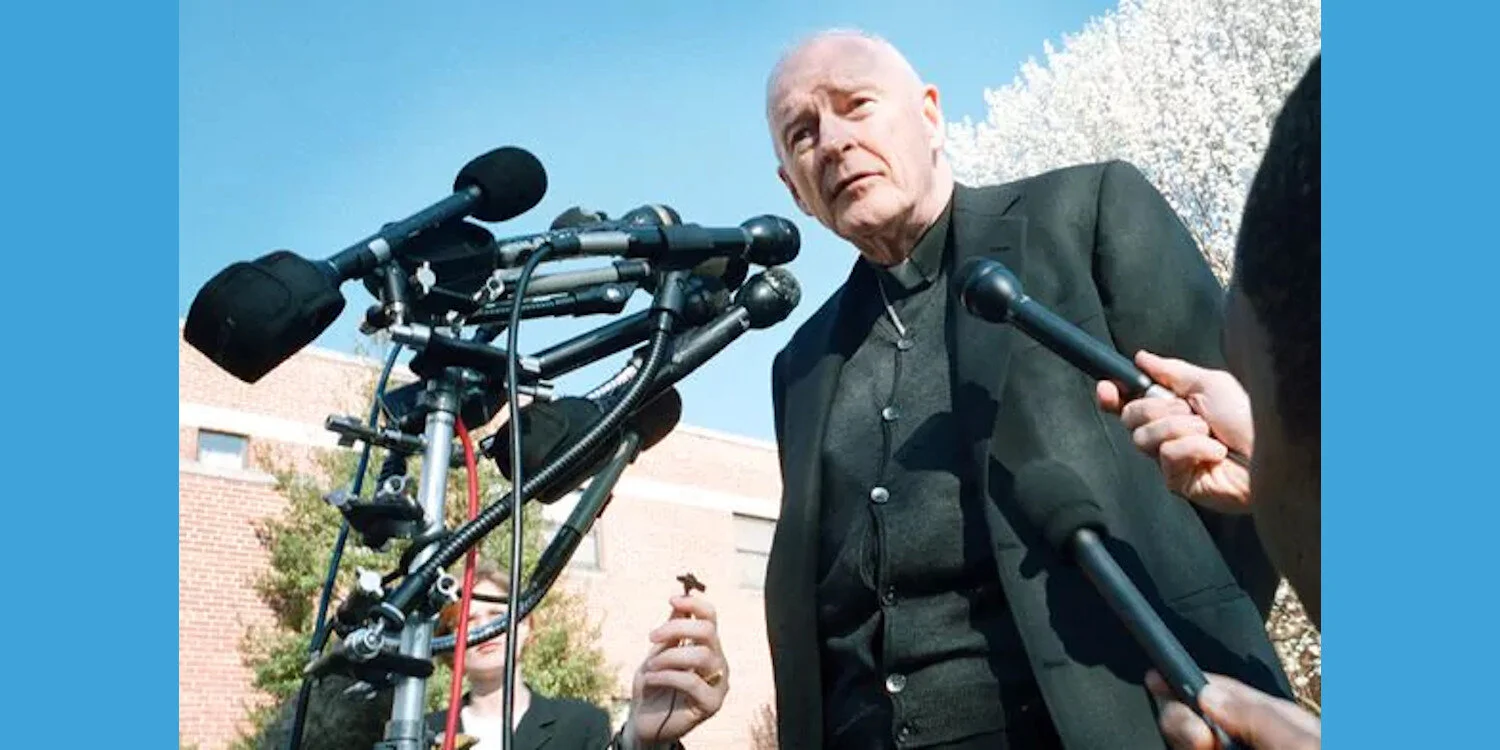
The Dark Side of the Dallas Charter
As Father Gordon MacRae exposed in “A Grand Jury, St. Paul’s School, and the Diocese of Manchester,” the late Father Richard John Neuhaus interviewed an American prelate who was one of the unnamed principal architects of the U.S. Bishops’ Dallas Charter. Father Neuhaus quoted him in a First Things article: “It may be necessary for some innocent priests to suffer for the good of the Church.” That prelate, according to Father MacRae, was Cardinal Theodore McCarrick.
As Father Guarino points out in “The Dark Side of the Dallas Charter,” a significant problem with the Bishops’ policy is that most accused priests have not actually been found guilty of abuse. Of the 73 priests, both living and deceased, on Bishop Peter Libasci’s published list, only five ever had due process in any court of law. Three of those were by plea deals, and one, as Bishop Libasci’s predecessor has acknowledged in secret, is wrongfully convicted.
For all the other names on the Diocese of Manchester list — and for the vast majority of the hundreds of American priests who have been removed from ministry, the allegations against them were only considered “credible,” meaning only that it is possible that they happened. If any other American citizens from any walk of life were subjected to such a standard before being shamed in the public square, libel and slander lawsuits would flood the courts.
Perhaps the greatest insult to Catholics in the pews is the statement of Bishop Libasci — and other bishops who have published lists of names of the accused — that this is done for the purpose of “transparency.” I have personally attempted to review the required canonical investigations of Father MacRae that a previous official of the Diocese of Manchester insisted were carried out. I was told that these investigations are confidential.
I have requested to see the list of settlements meted out to the accusers in his case which have been called into question by The Wall Street Journal and other interested parties. I was told that these settlements are confidential.
Father MacRae himself requested of a previous bishop, the Most Rev. John McCormack, that he be permitted to see the canonical investigation that the bishop claimed was forwarded to the Holy See. Father MacRae was reportedly told that this, too, is confidential. He was later told by another official of the Diocese that no required canonical investigation ever took place. This was before MacRae learned from a New Hampshire attorney and a PBS producer that Bishop McCormack revealed, after requesting secrecy, that “I firmly believe Father MacRae is innocent and should not be in prison.”
“Zero Tolerance” is an insult to Catholic theology and to our priests who are disenfranchised from their priesthood, and from their civil rights as citizens, on the whim of a bishop after being accused.
“Transparency,” however, is an insult to all the rest of us who have waited under shrouds of duplicity for our bishops to reflect the mirror of justice that this world needs the Church to be.
+ + +
Editor’s Note: Please share this important post with the priests and Catholic laity you know. You are also invited to Subscribe to These Stone Walls and to Follow on Facebook some inspiring related graphic presentations of these posts.
You may learn more on the story of Catholic priests falsely accused from these relevant articles:
In the Diocese of Manchester, Transparency and a Hit List by Ryan A. MacDonald
The Prison of Father MacRae: A Conspiracy of Silence by Ryan A. MacDonald
Bishops, Priests and Weapons of Mass Destruction by Father Stuart A. MacDonald, JCL
The Trials of Father MacRae by Dorothy Rabinowitz, The Wall Street Journal

Apocalypse Now? Jesus and the Signs of the Times
The Gospel According to St Luke for the 33rd Sunday in Ordinary Time warns of destruction and persecution. Do we face the End Times or a summons to self-assessment?

The Gospel According to St Luke for the 33rd Sunday in Ordinary Time warns of destruction and persecution. Do we face the End Times or a summons to self-assessment?
You might remember Comet Shoemaker-Levy. The size of a major U.S. city, it was discovered and tracked by astronomers — for whom it was named — wandering through our solar system in the vicinity of Jupiter in March, 1993. A previous pass near the powerful gravity of Jupiter a year earlier broke the comet into a series of town-sized debris that ended up colliding with the giant planet.
It sent a thrill through the world of astronomy and a chill through just about everyone else. What gave Jupiter a mere black eye or two would have obliterated all life on Planet Earth. This was, for science, clear evidence that an extinction level event that wiped out the dinosaurs and most life on Earth 66 million years ago was more likely than not a comet or asteroid the size of a city.
Since 1993, the scientific evidence has become clearer. That asteroid exploded with the force of a million nuclear bombs in the sea near what is now, Mexico. The event triggered massive tidal waves, earthquakes, and a global rain of red-hot debris that blocked out all sunlight for decades. Most vegetation on the Planet was gone, and would take 700,000 years to regenerate.
On the outskirts of Colorado Springs recently, researchers uncovered thousands of fossils that show how the age of mammals arose from the dust and ashes of that event. The age of mammals was allowed to happen because the age of dinosaurs was put to an end by the collision. The fossil trove of mammalian species discovered near Colorado Springs demonstrates how life on Earth was reset through that event giving way, eventually, to us.
That, at least, is the analysis of geoscientists published in the Proceedings of the National Academy of Sciences on October 21, 2019. According to the fossil record, it took 40,000 years for life in the sea to even begin to recover from the event.
So when Jesus addressed the crowd in the Gospel of St. Luke, He may have been prophetic when He said, “When these things begin to take place, look up.” Today’s listeners have a frame of reference:
“And there will be signs in the sun and moon and stars, and upon the earth distress of nations in perplexity with the roaring of the sea and the waves, men fainting with fear and with foreboding of what is coming in the world, for the powers of the heavens will be shaken. And then they will see the Son of Man coming in a cloud with power and great glory. Now when these things begin to take place, look up and raise your heads, because your redemption is drawing near.”
The above passage is immediately preceded in Luke’s Gospel by the passages that constitute the Gospel proclamation for the 33rd Sunday in Ordinary Time, the penultimate Sunday liturgy of the Church’s Liturgical Year and the Sunday preceding the Solemnity of Christ the King. The Gospel verses immediately preceding the above passage — the one you will soon hear at Sunday Mass — are filled with the doomsday language about cosmic events:
“Nation will rise against nation, and kingdom against kingdom; there will be great earthquakes, famines, pestilences and great signs from heaven. But before this they will lay their hands on you and persecute you, delivering you up to the synagogues and prisons.”
Delivering us up to prisons? Lord, have mercy, not again!

Carlos Caso-Rosendi is an accomplished linguist, translator, writer and historian. Writing from Buenos Aires, Argentina, the home of Pope Francis, Carlos penned a moving and incisive summary of the state of justice in my regard awhile back. It was a brief but powerful article published simultaneously in Portuguese, Spanish, and English entitled, “Behold the Man.”
Carlos also writes periodically for other venues including The Lepanto Institute, a Catholic organization that takes its name from the Battle of Lepanto, a naval battle fought on October 7, 1571 in the Gulf of Lepanto (now called the Gulf of Corinth). The battle between the Ottoman Empire and the Holy League formed by Pope Julius II aligned the Papal States with Spain, Venice, and Genoa.
Though vastly outnumbered and outgunned, the Holy League was decisively victorious, but not without suffering the loss of many lives. The victory delivered thousands of Christian slaves and captured more than 100 ships. The battle was the first major victory of the Christians against the Ottoman Empire.
More recently, Carlos has been writing about “The Signs of the Times”, building a case for the emergence of the End Times that Jesus seems to be prophesying in the above Gospel passages. Many readers have been following his “End Time” posts. I would not even think of refuting Carlos in this. He could run circles around me with his knowledge of Prophetic literature, apocalyptic traditions, and original languages.
Several TSW readers have mentioned his posts with various levels of concern — and sometimes excitement — that Carlos might be entirely right. I do not know whether The End is near, but in a sense it is near for all of us and we should approach our days with an eye toward what may come, as Saint Paul warned, “like a thief in the night” (1 Thes. 5:2). It is folly to get caught up in the drama all around us when heaven awaits — or not, if nothing changes.
It is difficult to refute the End Time discourse raised by Carlos, but in this both science and our faith are on the same page. Life on Earth has ended before and the scientific odds are clear that it will happen again. It is generally agreed in science that the millions of similar comets and asteroids traveling randomly through space pose an existential threat to life on Earth. It is not a matter of whether Earth will again find itself in the crosshairs of a giant asteroid, but when.
And there are other doomsday scenarios set forth, not by Scripture, but by science. It is known today that the magnetic polarity of the Earth has shifted its positive and negative poles every few hundred thousand years. Magnetic North shifts its polarity to the South Pole. Earth is now about 100,000 years overdue for the next unpredictable shift. Our ancient ancestors may not have even noticed, but today our dependence on technology could leave us stranded in chaos for decades if global power grids and all computers suddenly became irreparably disabled by a global electromagnetic pulse.

The Temple and the Covenant
I am also always aware of the multiple layers of meaning in the parables and teachings of Jesus in the Gospels. I do not discount the literal interpretation of Prophetic and Apocalyptic Literature in Sacred Scripture, but there are other, parallel meanings in the end-of-all-things scenario that St Luke’s Gospel describes.
The above Gospel passages presented by St Luke take place on the Mount of Olives and collectively they are known as the “Olivet Discourse.” The Mount of Olives is an ancient hill to the East of Jerusalem that overlooks the city across the Kidron Valley (see 2 Samuel 15:30 and Zechariah 14:40). The Mount was famous for the large number of olive trees that grew there in the time of Jesus.
As I addressed in another post, “Waking up in the Garden of Gethsemane,” the Mount of Olives was the scene of the betrayal of Jesus in the Garden of Gethsemane, and it was the scene of His Ascension. A thousand years earlier, it was also the scene of the agony of King David after his betrayal by his son, Absalom. It is a scene of great Biblical importance for Hebrew and Christian ears.
The Gospel for the end of Ordinary Time begins with an observation by Jesus’ disciples about the “noble stones” that adorn the Temple in Jerusalem. They could be seen across the Kidron Valley from the Mount of Olives. Herod the Great began an expansion of the Temple in 19 BC. The Temple was immense, and its “noble stones” at its foundation are equally immense. Some measured forty feet in length.
Jesus tells his disciples that the indestructible appearance of the Temple is an illusion “As for these things that you see, the days will come when there shall not be left here one stone upon another” (Luke 21:6). A similar discourse also takes place in the Gospel of Matthew (24-25) and it too speaks of end times, cosmic catastrophes, heavenly signs, and the future judgment of God.
But looking at the words of Jesus in the context of his original hearers and the traditions of ancient Judaism provides a parallel meaning at the literal-historical level. Jesus was also speaking of the destruction of the Jerusalem Temple, symbolic of the Old Covenant. This places the entire “End Time” discourse in the context of His words about the Temple, the stones of which “shall not be left here one stone upon another.”
Hearing this at the Mount of Olives, the disciples of Jesus might recall something described in a recent post, “Pope Francis, President Trump, and the Rise of the Nones.” In 597 BC Babylonian invaders destroyed the Temple sending the Jews into exile.
As described in that post, King Cyrus gathered the Babylonians into an Empire and then ordered his army to restore what they had destroyed. In 538 BC, King Cyrus restored the Jews to their Promised Land and rebuilt the Temple of Solomon. It was from this period that Messianic expectations permeated Israel.
Cyrus is strikingly referred to by the Prophet Isaiah as “the Lord’s Anointed” (Isaiah 45:1), a title that Israel previously reserved only for its kings and for the expectation of a Messiah. The prophecy of Jesus at the Mount of Olives was confirmed when Roman soldiers sacked Jerusalem and destroyed the Temple in 70 AD claiming the lives of more than one million Jews.

The Image of the Invisible God
The End Times discourse of Jesus may also have referred to the future destruction of the Temple by the Roman Empire in 70 AD. The Jews regarded their Temple as a representation or microcosm of the world, an architectural model of the universe fashioned by God. The universe itself was seen by the Jews as a sort of “macrotemple,” the place where God presides and throughout which His Divine Presence permeates.
This is summarized in the Psalms “He built His sanctuary like the high heavens, like the earth which he founded forever” (Psalm 78:69). There are other Old Testament references to equating the Temple with the world. After the Genesis account of the creation of the world, God rested from all his work which he had done (Genesis 2:3). The Temple was seen as the sacred place of God’s rest. He commissioned the building of his Temple by Solomon as “his resting place forever” (Psalm 132:14 and 1 Chronicles 6:41).
The symbolism of the number “seven” also links the Temple with the Hebrew world view. In the Books of Job (38:4-6) and Amos (9:6) God’s creation of the world is described as a Temple completed and blessed on the seventh day. Solomon built the Jerusalem Temple in seven years (1 Kings 6:38) and dedicated it on the seventh month (1 Kings 8:2) during the seven day Feast of Booths — also known as the harvest Feast of the Ingathering (1 Kings 8:65).
The Prophet Isaiah’s vision of the Lord (Isaiah 6:1-7) makes a comparison that the Temple and the Cosmos are interchangeably filled with God’s glory. The train of God’s robe “fills the Temple” (Isaiah 6:1) and the angels cry out that “the whole earth is filled with his glory” (Isaiah 6:3). For the Prophet Isaiah, the Temple and the cosmos are both the house of God.
Other Jewish writers in the time of Jesus described in great detail the Temple as a model for the universe. The historians, Josephus and Philo, and the late rabbinic writings, described the Temple’s divisions, furnishings, and architecture as symbols of the cosmos, the celestial Temple.
The declarations of Jesus on the Mount of Olives in the Gospels of Saints Matthew and Luke may well portend the end of the world as Carlos Caso-Rosendi and others looking at End Time prophecy interpret them. I will not say they are wrong, for this world is most certainly turning its gaze away from God and back onto itself.
We are living in the age of humanity’s narcissism. The signs of the times certainly point to the possibility that we are witnessing the signs of an Apocalypse as large swaths of humanity desecrate the Covenant sealed with the Blood of Christ.
But the destruction of the Jerusalem Temple was also seen as an apocalypse. It was the symbolic termination of the Old Covenant and the rise of the New — in Jesus Himself. As I have written in some past posts, we live today in a spiritually very important time. Jesus is equidistant in time between us today and God’s First Covenant with Abraham.
The end may indeed be near, but regardless, life is too short to waste it in the folly of this world. Jesus is the epicenter of our time and is in Himself the Temple Covenant of Sacrifice with God. As the Second Reading for the upcoming Solemnity of Christ the King proclaims:
“He is the image of the Invisible God, the firstborn of all creation. For in him were created all things in heaven and on earth, the visible and the invisible.”
