“There are few authentic prophetic voices among us, guiding truth-seekers along the right path. Among them is Fr. Gordon MacRae, a mighty voice in the prison tradition of John the Baptist, Maximilian Kolbe, Alfred Delp, SJ, and Dietrich Bonhoeffer.”
— Deacon David Jones

“I Am a Mystery to Myself.” The Last Days of Padre Pio
For half the 20th Century, Saint Padre Pio suffered the wounds of Christ. All of them, including the cynicism of doubt and the tyranny of false witness.
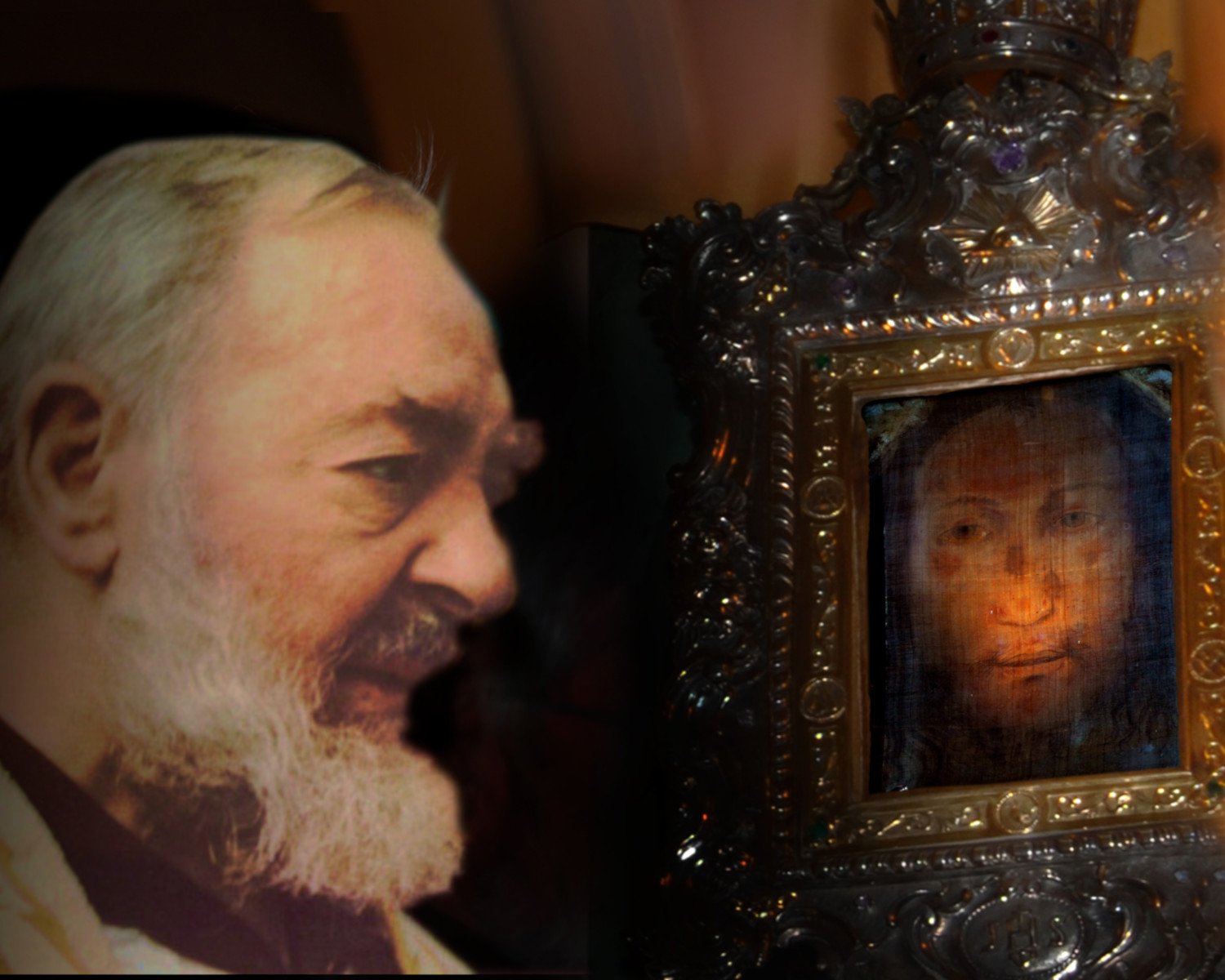
For half the 20th Century, Saint Padre Pio suffered the wounds of Christ. All of them, including the cynicism of doubt and the tyranny of false witness.
In the August-September 2012 issue of Inside the Vatican magazine, Australian journalist Paul MacLeod has a fascinating article reviewing two books by Paul Badde, The Face of God (Ignatius Press 2010) and The True Icon (Ignatius Press 2012). The two books “read like detective stories,” MacLeod wrote, as they examine in great depth two of the Church’s most revered treasures, the Shroud of Turin and the “Volto Santo,” the image of the Holy Face hidden for 400 years and believed to be the second burial cloth of Jesus, the sudarium.
The origin of the veil can be one of two sources, or a combination of both. Though the story never appears in Sacred Scripture, there is an ancient legend that a woman offered her head-cloth to wipe the face of Jesus on the way to Golgotha. When he gave it back to her, as the story has it, an impression of his face remained on the veil. What is now the Sixth Station of the Cross was legendary in Rome since the 8th Century. The name tradition has given to that woman is Veronica, a name that appears nowhere in the Gospel narrative of the Passion of Christ. The name comes from “Vera Icon,” Latin for “True Image,” a great treasure of the Church now preserved at the Shrine of the Holy Face at Manoppello in the Abruzzi region of Italy.
The veil is believed to be one of two burial cloths of Jesus, though it’s possible that both accounts are behind this treasure. On the morning of the resurrection, the Gospel of John (20:7) reports, the smaller burial cloth of Jesus — the veil covering his face — was rolled up in a place by itself as witnessed by Saint Peter and Saint John. In Jewish custom in the time of Jesus, such a veil covered the faces of dignitaries, such as the high priest, in death before being entombed. It is this veil that many now believe is enshrined at Manoppello. In contrast to that other, larger burial cloth — believed by many to be the Shroud of Turin — the image on the veil is not that of a dead man, however, but of a man very much alive, his eyes wide open. It is Jesus the Christ, having conquered death. In Inside the Vatican, Paul MacLeod described the Veil of Manoppello as:
“. . . a delicate, transparent piece of expensive material, measuring just 28 cm by 17 cm, in which the face of Jesus seems to float in light, even to store light.”
Paul MacLeod reported in the article that Capuchin priest, Father Domenico de Cese, formerly custodian of the shrine, was killed in an accident while visiting the Shroud of Turin in 1978. A decade earlier, however, Father Domenico wrote of a rather strange occurrence. On the morning of September 22, 1968, Father Domenico opened the doors of the shrine, and was startled to find Padre Pio kneeling in prayer before the image of the Holy Face. Padre Pio was at the same time 200 kilometers away at San Giovanni Rotondo, gravely ill, and near death.

“With My Body or Without It”
It was his last known occurrence of bilocation, a phenomenon that, like his visible wounds, became a source of skepticism about Padre Pio both in and outside of the Church. At 2:30 AM on the next morning — September 23, 1968 — Padre Pio died.
The two stories placed together — Padre Pio’s death and his prayer before the Veil of Manoppello — make perfect sense to me. In the hours before his death, Padre Pio contemplated the burial cloth of Christ. After fifty years of bearing the visible wounds of Christ, Padre Pio’s own soul sought out this visible link to Jesus beyond death; not Jesus crucified — a reality Padre Pio himself had lived for fifty years — but the image of the face of the risen Christ.
Padre Pio seemed most hesitant to discuss either his wounds or the reported incidents of bilocation. He seemed hesitant because in life he did not understand them at all. In fact, a Vatican investigator learned that all the events of bilocation were reported by others, and never by Padre Pio himself. It wasn’t until he was directly asked by the investigator that he described bilocation:
“I don’t know how it is or the nature of this phenomenon — and I certainly don’t give it much thought — but it did happen to me to be in the presence of this or that person, to be in this or that place; but I do not know whether I was there with my body or without it . . . Usually it has happened while I was praying . . . This is the first time I talk about this.”
— Padre Pio Under Investigation, Ignatius Press, 2008, p. 208
Those September days preceding Padre Pio’s death in 1968 must have been the strangest of his life. The visible wounds became so central to his sense of self for a half century that I imagine he had difficulty even remembering a time when the wounds were not present. Even a great burden carried for years upon years — I have learned the hard way — can become a part of who and what we are. We cannot imagine Padre Pio without these wounds. We would have never even heard of Padre Pio without these wounds. So in that sense, the wounds were not for him. They were for us.
But in the days before Padre Pio died, the wounds on his hands and feet and in his side began to close. He received those wounds on the morning of September 20, 1918. Fifty years later, on September 20, 1968, after a few days of the wounds slowly diminishing, all traces of them were gone. The wounds were then only within Padre Pio. Visible or not, they were a part of his very self.
In a previous post about Padre Pio I wrote of the day those wounds were given to him. I told the story of how this saint among us struggled with what had happened to him, and the lifelong trials that were set in motion by those visible wounds. It is a moving account of the Stigmata in Padre Pio’s own words in a letter to his Capuchin spiritual advisor, Padre Benedeto, a month after receiving the wounds.
“On the morning of the 20th of last month, in the choir, after I had celebrated Mass . . . I saw before me a mysterious person similar to the one I had seen on the evening of 5 August. The only difference was that his hands and feet and side were dripping blood. The sight terrified me and what I felt at that moment is indescribable. I thought I should die and really should have died if the Lord had not intervened and strengthened my heart which was about to burst out of my chest.
“The vision disappeared and I became aware that my hands and feet and side were dripping blood. Imagine the agony I experienced and continue to experience almost every day. The heart wound bleeds continually, especially from Thursday evening until Saturday.
“Dear Father, I am dying of pain because of the wounds and the resulting embarrassment I feel in my soul. I am afraid I shall bleed to death if the Lord does not hear my heartfelt supplication to relieve me of this condition.
“Will Jesus, who is so good, grant me this grace? Will he at least free me from the embarrassment caused by these outward signs? I will raise my voice and will not stop imploring him until in his mercy he takes away . . . these outward signs which cause me such embarrassment and unbearable humiliation.”
— Letters 1, No. 511
But it was the stories of bilocation that caused so much skeptical doubt. In May of 1921, the Vatican commenced its first of several investigations into Padre Pio’s life. The investigator, Monsignor Raffaelo Carlo Rossi, tried to refuse the assignment because he admittedly went into it with a “prejudice against Padre Pio.” After months of interrogations, depositions, interviews with other friars, and testimony by many laypeople, Bishop Rossi’s file was ordered sealed, and it remained sealed as a secret Vatican file for decades. The investigator concluded his file: “The future will reveal what today cannot be read in the life of Padre Pio of Pietrelcina.”
That investigator, we now know, left San Giovanni Rotondo with no doubt whatsoever about the true nature of Padre Pio, but it wasn’t enough to curtail years of further suspicion and persecution from within the Church. The story of Padre Pio’s treatment is best summed up by Father Paolo Rossi, former Postulator General of the Capuchin Order, and it seems a bit familiar:
“People would better understand the virtue of the man if they knew the degree of hostility he experienced from the Church… The Order itself was told to act in a certain way toward Padre Pio. So the hostility went all the way up to the Holy Office and the Vatican Secretariat of State. Faulty information was being given to Church authorities, and they acted on that information.”
— Making Saints, Simon and Schuster, 1990 p. 188

A Face on My Wall
If you look at the end of the “About” page at Beyond These Stone Walls, you may notice that this blog is published under the patronage of Saint Maximilian Kolbe and Saint Padre Pio, champions of truth, justice, and fidelity to the Risen Lord. The impact of Saint Maximilian on these prison walls is easy to see. How Saint Padre Pio insinuated himself here is a bit more mysterious.
It started with an awareness that we share an important date. The day I was convicted and taken to prison was September 23, Saint Padre Pio’s feast day and the last day of his earthly life. Only 26 years passed between those two events. Padre Pio just showed up here again, but that story needs a little background.
Despite its small size, the typical prison cell can seem a barren place. Like every prison this one has rows upon rows of cells, tiers upon tiers of them, all perfectly uniform, none with any evidence of human individualism. The whole point of prison is that its inhabitants are forced to view themselves as humans in degraded form, living a day to day existence that is entirely uniform, and devoid of any sense of the self.
The inside of these 6-by-10-foot walled and barred cells is composed of nothing but concrete. The four walls, the floor and the ceiling are bare concrete. The bunks upon which we sleep are concrete (and they hurt if I sleep too long), and so is the small counter upon which this prisoner is writing at this moment. Prison cells are distinguishable from other prison cells solely by the number above each solid steel door.
There is one small exception to the absence of human evidence, and I’ve written of it before. In “Angelic Justice: Saint Michael the Archangel and the Scales of Hesed,” I described the sole evidence of individualism in a prison cell. There are two rectangles, exactly 24 inches by 36 inches, painted on one wall with 12 inches of space in between them. Within these dark green rectangles, the two prisoners living in each cell may post a calendar, photos of their families and friends, and religious items. Nothing else.
You can learn a lot about a man from what is posted within this rectangle on his cell wall. In my first years in prison, commencing 28 years ago, I had lots of photos of family and friends, evidence of the life I once knew beyond these stone walls. Like every prisoner over time, that evidence slowly diminished. In my first five years in prison, I was moved 17 times, often with just minutes notice. Each time, I would take down all my evidence of a life, and then put it back on the wall in another cell on another tier in another building with other people. Each time, something of myself would be lost forever. Then the day came that I was moved, and nothing went back up onto the wall. The wall remained an empty space for many years.
This was true of my friend, Pornchai Moontri, as well. After 21 years in prison, beginning when he was barely 18 years old, Pornchai only vaguely recalls a life beyond and the people in it, but he no longer possesses any evidence of it. His uprootings were much more severe than mine. As you know from reading “Pornchai’s Story” he was ripped from a culture, a country, and a continent. Much was taken from him, and then, finally, so was his freedom. You know of that story which I wrote of in “Pornchai Moontri and the Long Road to Freedom.”
When we were moved to the same cell many years ago, Pornchai and I both stared each day at two green rectangles with nothing in them. Then Beyond These Stone Walls began a year later, and ever so slowly our wall became filled with images sent to us from readers. (Alas, such images are no longer allowed in mail, but the ones already on our wall can stay). Every square inch of Pornchai’s rectangle, even after he has left prison, is still filled with evidence of his very much alive Catholic faith.
But one day, I noticed that a very nice photograph of Saint Padre Pio that was in my rectangle on the wall somehow migrated over to Pornchai’s wall. On the day I noticed that my treasured image of Padre Pio “defected,” I also mentioned that I didn’t have another one and wished that someone would send me one. An hour after voicing that, the mail arrived. I opened an envelope from my friend, John Warwick, a reader in Pittsburgh.
I opened John’s envelope to find a beautiful card enrolling me and my intentions in a novena to Saint Padre Pio, and the image on the card was the very same one that took up residence over on Pornchai’s wall. It is my first experience of this great Patron Saint’s bilocation, and I treasure it. Thank you, John!
“Stay with me, Lord, for it is getting late: the day is ending, life is passing; death, judgment, eternity are coming soon … I have great need of you on this journey. It is getting late and death is approaching. Darkness, temptations, crosses and troubles beset me in this night of exile.”
— Saint Padre Pio’s Communion Prayer
+ + +


Father Benedict Groeschel at EWTN: Time for a Moment of Truth
In the media crucible reserved for high profile priests, Father Benedict Groeschel was next in line to be smeared. There’s more to this story, and here it is.

In the media crucible reserved for high profile priests, Father Benedict Groeschel was next in line to be smeared. There’s more to this story, and here it is.
I have known Father Benedict Groeschel since 1975. I began religious life as a Capuchin in the New York Province when Father Groeschel served on the Provincial and formation staffs. He was a mentor and a friend when I was a young man of 22 trying to discern competing calls to the priesthood and religious life. Having completed a novitiate year, I was a young friar bound by simple profession, but left the Capuchins after four years to commence theological studies in preparation for diocesan priesthood in 1978. Over the ensuing years and decades, Father Benedict Groeschel and I remained in occasional contact.
Later, Father Groeschel and seven others broke ranks from the Capuchin order to found the Franciscan Friars of the Renewal, a movement that reflected his deeply felt longing to live a life that was outwardly faithful to the spirit of poverty and charism of Saint Francis of Assisi. In the decades to follow, Father Groeschel has gifted the Church with a valiant priestly life marked by sacrifice, fidelity and true Gospel witness. His legacy to the Church as a priest, a friar, an author and lecturer, a psychologist and revered spiritual adviser, is a monument to all that is good and holy in our Church.
Now he has resigned under a cloud from his participation as a host at EWTN. Perhaps it is simply time that he did. Perhaps, at nearly age 80 and having survived a crippling and devastating accident several years ago, age and infirmity have caught up with this good priest. We should not refute his decision to step down, but we who are loyal to any semblance of truth and witness to the Gospel must not allow to stand the cloud of doubt under which he now removes himself from EWTN’s important television ministry. To paraphrase Sheriff Buford Pusser in my post, “Walking Tall: The Justice Behind the Eighth Commandment,” if we let America’s self-serving, self-righteous, and spiritually bankrupt news media have the last word on Father Benedict Groeschel, “then we give ’em the eternal right to do the same damn thing to anyone of us!”
I don’t need to reframe and speculate upon the single, out-of-context phrase of Father Groeschel’s that has so roiled the news media and its pundits against him. In my view, his inability to predict the uproar his comment brought about may be evidence enough that his judgment has been compromised by age and infirmity. This entire story should have ended with little more said than that.
There is an irony to all this, however. The truth is that Father Groeschel has long been known among treatment professionals to take a hard line in regard to credible accusations against Catholic priests. He has long been known to advocate for the removal from all public ministry when priests are credibly accused. He has not advocated for forced laicization, a process that simply discards an accused priest, but he has for decades taken a position that no priest known by the Church to have been an abuser can EVER minister in a parish again. The truth is that if Father Benedict Groeschel had been heeded more closely over the decades of the 1980s and 1990s, the scandal of 2002 might have looked very different.
Father Groeschel strongly advocated for strict supervision and strictly enforced internal administrative assignments in all cases in which abuse by a priest was determined to be true. His public and private positions have always been the same, and were the polar opposite of what some in the news media now attribute to him.
A few years after the tidal wave of scandal swept over the Church and priesthood, Father Groeschel wrote to me in prison. It was shortly after I wrote an article for Catalyst entitled “Sex Abuse and Signs of Fraud” (November, 2005). It was the same article for which Avery Cardinal Dulles asked me to consider writing more frequently as documented in our “About” page. This is a paragraph from Father Groeschel’s 2005 letter:
“For the good of the Church and the priesthood, Father Gordon, I join the voices of others who urge you to stand always by the truth and to proclaim it boldly. Truth is always what will be in the best interest of the Church and priesthood. At the same time, I also want to caution you that not every case involving a priest is like the case against you. Some priests have used their office to commit grave offenses. Some have harmed vulnerable people and have harmed the priesthood and the Church. At the same time, like you, I also stand by efforts to assure a full hearing and due process for all priests who have been accused. False accusations must be immensely painful. I pray for you as you continue to pursue your innocence and expose the whole truth. The Church must face with courage both realities: the falsely accused and the plight of truthful victims of sexual abuse.”
Later in his life, Father Groeschel had the personal courage and integrity to voice concern for a growing proliferation of false claims against many priests, and he stood by them in their hope for justice. He stood by me. He stood by what I had written, and he encouraged me to write. Never for a single moment did he compromise his deeply felt concern for justice for victims of abuse.
The sun must not go down on Father Benedict Groeschel’s good name and stellar priestly life under a cloud inflated by a news media lying in wait for any high profile priest it can smear. Not this time! Not this priest! I call upon EWTN and all Catholics of faith and conscience to set aside this latest 15 minutes of scandal and honor Father Benedict Groeschel for the courageous life of faithful priestly witness with which he has served the Church selflessly for over a half century. The sun must not go down on this media slur against Father Benedict Groeschel.
POSTSCRIPT:
To its great credit, and no doubt by public acclaim, EWTN restored Father Benedict Groeschel’s Sunday night meditations to its broadcast schedule.
+ + +
Note from Fr Gordon MacRae: Thank you for reading and sharing this post in support of Father Groeschel and Truth. You may also like these related posts:
When Priests Are Falsely Accused: The Mirror of Justice Cracked
David Clohessy Resigns SNAP in Alleged Kickback Scheme


In the Absence of Fathers: A Story of Elephants and Men
Are committed fathers an endangered species in our culture? Fr. Gordon MacRae draws a troubling corollary between absent fathers and burgeoning prisons.

Are committed fathers an endangered species in our culture? Fr. Gordon MacRae draws a troubling corollary between absent fathers and burgeoning prisons.
Wade Horn, Ph.D., President of the National Fatherhood Initiative, had an intriguing article entitled “Of Elephants and Men” in a recent issue of Fatherhood Today magazine. I found Dr. Horn’s story about young elephants to be simply fascinating, and you will too. It was sent to me by a reader who wanted to know if there is any connection between the absence of fathers and the shocking growth of the American prison population.
Some years ago, officials at the Kruger National Park and game reserve in South Africa were faced with a growing elephant problem. The population of African elephants, once endangered, had grown larger than the park could sustain. So measures had to be taken to thin the ranks. A plan was devised to relocate some of the elephants to other African game reserves. Being enormous creatures, elephants are not easily transported. So a special harness was created to air-lift the elephants and fly them out of the park using helicopters.
The helicopters were up to the task, but, as it turned out, the harness wasn’t. It could handle the juvenile and adult female elephants, but not the huge African bull elephants. A quick solution had to be found, so a decision was made to leave the much larger bulls at Kruger and relocate only some of the female elephants and juvenile males.
The problem was solved. The herd was thinned out, and all was well at Kruger National Park. Sometime later, however, a strange problem surfaced at South Africa’s other game reserve, Pilanesburg National Park, the younger elephants’ new home.
Rangers at Pilanesburg began finding the dead bodies of endangered white rhinoceros. At first, poachers were suspected, but the huge rhinos had not died of gunshot wounds, and their precious horns were left intact. The rhinos appeared to be killed violently, with deep puncture wounds. Not much in the wild can kill a rhino, so rangers set up hidden cameras throughout the park.
The result was shocking. The culprits turned out to be marauding bands of aggressive juvenile male elephants, the very elephants relocated from Kruger National Park a few years earlier. The young males were caught on camera chasing down the rhinos, knocking them over, and stomping and goring them to death with their tusks. The juvenile elephants were terrorizing other animals in the park as well. Such behavior was very rare among elephants. Something had gone terribly wrong.
Some of the park rangers settled on a theory. What had been missing from the relocated herd was the presence of the large dominant bulls that remained at Kruger. In natural circumstances, the adult bulls provide modeling behaviors for younger elephants, keeping them in line.
Juvenile male elephants, Dr. Horn pointed out, experience “musth,” a state of frenzy triggered by mating season and increases in testosterone. Normally, dominant bulls manage and contain the testosterone-induced frenzy in the younger males. Left without elephant modeling, the rangers theorized, the younger elephants were missing the civilizing influence of their elders as nature and pachyderm protocol intended.
To test the theory, the rangers constructed a bigger and stronger harness, then flew in some of the older bulls left behind at Kruger. Within weeks, the bizarre and violent behavior of the juvenile elephants stopped completely. The older bulls let them know that their behaviors were not elephant-like at all. In a short time, the younger elephants were following the older and more dominant bulls around while learning how to be elephants.

Marauding in Central Park
In his terrific article, “Of Elephants and Men,” Dr. Wade Horn went on to write of a story very similar to that of the elephants, though it happened not in Africa, but in New York’s Central Park. The story involved young men, not young elephants, but the details were eerily close. Groups of young men were caught on camera sexually harassing and robbing women and victimizing others in the park. Their herd mentality created a sort of frenzy that was both brazen and contagious. In broad daylight, they seemed to compete with each other, even laughing and mugging for the cameras as they assaulted and robbed passersby. It was not, in any sense of the term, the behavior of civilized men.
Appalled by these assaults, citizens demanded a stronger and more aggressive police presence. Dr. Horn asked a more probing question. “Where have all the fathers gone?” Simply increasing the presence of police everywhere a crime is possible might assuage some political pressure, but it does little to identify and solve the real social problem behind the brazen Central Park assaults. It was the very same problem that victimized rhinos in that park in Africa. The majority of the young men hanging around committing those crimes in Central Park grew up in homes without fathers present.
That is not an excuse. It is a social problem that has a direct correlation with their criminal behavior. They were not acting like men because their only experience of modeling the behaviors of men had been taught by their peers and not by their fathers. Those who did have fathers had absent fathers, clearly preoccupied with something other than being role models for their sons. Wherever those fathers were, they were not in Central Park.
Dr. Horn pointed out that simply replacing fathers with more police isn’t a solution. No matter how many police are hired and trained, they will quickly be outnumbered if they assume the task of both investigating crime and preventing crime. They will quickly be outnumbered because presently in our culture, two out of every five young men are raised in fatherless homes, and that disparity is growing faster as traditional family systems break down throughout the Western world.
Real men protect the vulnerable. They do not assault them. Growing up having learned that most basic tenet of manhood is the job of fathers, not the police. Dr. Horn cited a quote from a young Daniel Patrick Moynihan written some forty years ago:
“From the wild Irish slums of the 19th Century Eastern Seaboard to the riot-torn suburbs of Los Angeles, there is one unmistakable lesson in American history: A community that allows a large number of young men to grow up in broken homes, dominated by women, never acquiring any stable relationship to male authority, never acquiring any rational expectations for the future — that community asks for and gets chaos.”

When Prisons Replace Parents
It’s easy in the politically correct standards of today to dismiss such a quote as chauvinistic. But while we’re arguing that point, our society’s young men are being tossed away by the thousands into prison systems that swallow them up. Once in prison, this system is very hard to leave behind. The New Hampshire prison system just released a dismal report two weeks ago. Of 1,095 prisoners released in 2007, over 500 were back in prison by 2010. Clearly, the loss of freedom does not compensate for the loss of fathers in managing the behavior of young men.
There is very little that happens in the punishment model of prison life that teaches a better way to a young man who has broken the law. The proof of that is all around us, but — especially in an election year — getting anyone to take a good hard look inside a prison seems impossible. We live in a disposable culture, and when our youth are a problem, we simply do what we do best. We dispose of them, sometimes forever. Anyone who believes that punishment, and nothing but punishment, is an effective deterrent of criminal behavior in the young is left to explain why our grotesquely expensive prisons have a 50 percent recidivism rate.
As I have written before, the United States has less than five percent of the world’s population, but twenty-five percent of the world’s prisoners. The U.S. has more young men in prison today than all of the leading 35 European countries combined. The ratio of prisoners to citizens in the U.S. is four times what it is in Israel, six times what it is in Canada and China, and thirteen times what it is in Japan. The only governments with higher per capita rates of prisoners are in Third World countries, and even they are only slightly higher.
For a nation struggling with its racial inequities, the prison system is a racial disaster. Currently, young men of African-American and Latino descent comprise 30 percent of our population, but 60 percent of our prison population. But prison isn’t itself an issue that falls conveniently along racial divides.
New Hampshire, where I have spent the last twenty-six years in prison, is one of the whitest states in the United States, and yet it is first in the nation not only in its Presidential Primary election, but in prison growth relative to population growth. Between 1980 and 2005, New Hampshire’s state population grew by 34 percent. In that same period, its prison population grew by a staggering 600 percent with no commensurate increase in crime rate.
In an election year, politicizing prisons is just counter-productive and nothing will ever really change. Albert R. Hunt of Bloomberg News had a recent op-ed piece in The New York Times (“A Country of Inmates,” November 20, 2011) in which he decried the election year politics of prisons.
“This issue [of prison growth] almost never comes up with Republican presidential candidates; one of the few exceptions was a debate in September when audiences cheered the notion of executions in Texas.”
This may be so, but it’s the very sort of political blaming that undermines real serious and objective study of our national prison problem. I am not a Republican or a Democrat, but in fairness I should point out that the recent Democratic governor of New Hampshire had but one plan for this State’s overcrowded and ever growing prison system: build a bigger prison somewhere. And as far as executions are concerned, the overwhelmingly Republican state Legislature in New Hampshire voted overwhelmingly to overturn the state’s death penalty ten years ago. Governor Jeanne Shaheen (now U.S. Senator Jeanne Shaheen), a Democrat, vetoed the repeal saying that this State “needs a death penalty.” (In 2020, the death penalty was finally rescinded in New Hampshire.)
More dismal still, New Hampshire is also first in the nation in deaths of young men between the ages of 16 and 34. This is largely attributed to opiates addiction and all the hopelessness it entails. Young men growing up in fatherless homes are exponentially more likely than any others to fall prey to addiction.
Eighty percent of the young men I have met in prison grew up in homes without fathers. The problem seems clear. When prisons and police replace fathers, chaos reigns, and promising young lives are sacrificed.
Before we close the door on Father’s Day this year, let’s revisit whether we’re prepared for the chaos of a fatherless America. “Fathers” and “Fatherhood” are concepts with 1,932 direct references in the Old and New Testaments. Without a doubt, fatherhood has long been on the mind of God.
+ + +
Don’t miss these related posts from Beyond These Stone Walls:

Please share this post!

Upon a Midnight Not So Clear, Some Wise Men from the East Appear
There is a back story to the Magi of Saint Matthew's account of the Birth of Christ, and it is the Gospel for the Epiphany of the Lord.

There’s a back story to the Magi of Saint Matthew’s account of the Birth of Christ, and it is the Gospel for the Epiphany of the Lord.
At Christmas by Fr Gordon MacRae
In early December each year, prisoners here can purchase a 20-lb food package from a vendor. They drop hints to their families, and those without families scrape and save their meager prison pay all year. No one here wants to pass up a chance to purchase food they otherwise won’t see again until next year. Most are practical about it. They skip the candy and cookies to buy more sustaining items like real coffee, and meal alternatives they can save for the worst days in the prison chow hall.
The packages arrived last week, and for days prisoners have been bringing me samples of their culinary creations. They come to my cell door with an endless parade of sandwiches, wraps, and pizzas. I learned long ago that refusing the food leaves a lot of hurt feelings. They not only insist that I eat it, but they insist on staying until I declare that their culinary skill surpasses all others. It’s beginning to look a lot like Christmas when I have to struggle into my pants in the morning.
There’s a point to these visits. Prisoners tell me about their own back stories, and the prospect of another Christmas in prison. They want to hear that they are not without hope. Most of all, they want to know that Christmas means more than the empty, shallow “holiday season” it has become on TV.
But this morning, my Japanese friend, Koji, stopped by with some coffee he brewed using an old sock. (Trust me, you don’t want the gory details!). Koji handed me a cup — it’s pretty good, actually — and asked, “What can you tell me about the Magi?” That was odd because I’ve been thinking of writing about the Magi for Christmas. I told Koji I’ll let him read this post when finished. Maybe he’ll bring me more coffee made with that old sock of his. Lord, give me the strength to bear my blessings! Anyway, there’s no better place to begin the Magi story than St. Matthew’s own words:
“Now when Jesus was born in Bethlehem of Judea in the days of Herod the king, behold, wise men from the East came to Jerusalem, saying, ‘Where is he who has been born king of the Jews? For we have seen his star in the East, and have come to worship him.’ When Herod the king heard this, he was troubled, and all Jerusalem with him; and assembling all the chief priests and scribes of the people, he inquired of them where the Christ was to be born. They told him, ‘In Bethlehem of Judea; for so it is written by the prophet:
‘And you, 0 Bethlehem, in the land of Judah, are by no means least among the rulers of Judah; for from you shall come a ruler who will govern my people, Israel.’
Then Herod summoned the wise men secretly and ascertained from them what time the star had appeared; and he sent them to Bethlehem, saying, ‘Go and search diligently for the child, and when you have found him bring me word, that I too may come and worship him.’ When they had heard the king, they went their way; and lo, the star which they had seen in the East went before them, till it came to rest over the place where the child was. When they saw the star, they rejoiced exceedingly with great joy; and going into the house they saw the child with Mary his mother, and they fell down and worshipped him. Then, opening their treasures, they offered him gifts, gold, frankincense and myrrh. And being warned in a dream not to return to Herod, they departed to their own country by another way.”

Myth, Midrash, or Both?
This story, as Saint Matthew relates it, is a myth. But don’t get me wrong. That does not mean the story isn’t true. In fact, I firmly believe that it is true. The word, “myth,” coming from the Greek “mythos,” simply means “story,” and makes no judgement on whether a story is historical. Myth is not synonymous with falsehood despite how its more modern meaning has been twisted into such a conclusion. In theology and Biblical studies, myth simply denotes a story imbued with rich theological and symbolic meaning, but that does not mean it’s devoid of historical truth.
Biblical myth is distinguished from legends and “folklore” by the way it offers explanations about the facts of a story. In myth, the explanations stand whether the facts stand or not, and the value of the story does not depend on its historical accuracy. Perhaps the best example is the Creation story of Genesis, Chapter 1. In my post, “A Day Without Yesterday,” the great Belgian physicist, Father Georges Lemaitre, turned modern cosmology on its head with his theory of the Big Bang. For Pope Pius XI, this proof of a universe that begins and ends in history affirmed the elemental truth of Biblical Creation.
When I say that the story of the Magi is true, however, I mean truth in both senses. The understanding the story conveys is the truth. The historical facts of the story are also the truth, and we have no reason to doubt them.
The account of the Magi is also a “midrash.” Midrash is a Hebrew term meaning “interpretation.” It’s a characteristic of many of the reflections in the Aggadah — which in Hebrew means “narrative.” The Aggadah is a collection of Rabbinic reflection and teaching gathered over a thousand years. Midrash is a type of literature from the Aggadah that interprets Biblical texts by linking them together and discerning their hidden meanings.
Like myth, midrash is not a declaration that a Biblical passage is not historical or true just because it contains elements of other Biblical texts. In Saint Matthew’s Gospel, the Magi story points to many elements in Old Testament Scriptures. Jewish Christians hearing Saint Matthew’s account of the Magi, for example, would connect the Star in the East witnessed by the Magi with the star Balaam (a sort of Magus figure) envisioned arising out of Jacob in a dream-like account described in the Book of Numbers 24:17. Herod’s affront with the idea of a Hebrew King in the Magi account echoes Balaam’s vision as well. Herod is of the Edomite clan. In Balaam’s vision, the star arising out of Jacob is a portent that “Edom shall be dispossessed.” (Numbers 24:18).
The account of wicked King Herod feeling threatened by the life of the infant Jesus recalls clearly the Exodus account of a wicked Pharaoh who, having enslaved the Jews, seeks the life of the infant Moses. And in the Infancy Narrative of Saint Luke’s Gospel, the story of Zechariah and Elizabeth conceiving a child in their old age is clearly an echo of the Genesis story of Abraham, Sarah, and Isaac.
In “Saint Gabriel the Archangel: When the Dawn from On High Broke Upon Us,” I wrote of how St. Luke drew many midrashic links with the Hebrew Scriptures in his account of the Angelic visit to Mary at the Annunciation. The account of Mary visiting Elizabeth in the hill country of Judea recalls David visiting the very same place to retrieve the Ark of the Covenant as told in 2 Samuel, Chapter 6. Even the story of the future John the Baptist leaping in his mother’s womb in the presence of Mary is midrashic. In 2 Samuel, David leaps for joy in the presence of the Ark of the Covenant. I find these echoes of the Old Testament to be fascinating, but they don’t leave the story’s historical truth in question, including the Magi story.
I have a modern analogy in my own family. I wrote about my father’s conversion in “What Do John Wayne and Pornchai Moontri Have in Common?” My father’s parents had four children. He grew up with two brothers and a sister. One of his brothers became a priest. A generation later, my father and mother had four children. I also grew up with two brothers and a sister. Both I and my father’s brother who became a priest were the second son in our families. Many of the stories of my own childhood have eerie echoes in my father’s childhood. This is what is meant by midrash.

The Epiphany is depicted in a mural titled “Adoration of the Magi” in the Basilica of the Immaculate Conception at Conception Abbey in Conception, MO. Painted by Benedictine monks in the late 1800s.
The Gifts of the Magi
There are elements within our popular understanding of the story of the Magi, however, that history has added over the centuries. For example, nothing in Saint Matthew’s account indicates that the Magi were three in number. The sole hint is in the number of their gifts: gold, frankincense, and myrrh. And despite the popular Christmas carol, “We Three Kings,” there is nothing in Saint Matthew’s account to indicate that they were kings. This account became linked to a passage in Isaiah:
“And nations shall come to your light, and kings to the brightness of your rising . . . they shall bring gold and frankincense, and shall proclaim the praise of the Lord.”
And linked as well was a passage about kings bringing tribute in Psalm 72:
“May the kings of Tarshish and of the isles render him tribute; may the kings of Sheba and Seba bring gifts”
Much theological symbolism for the gifts themselves was reflected upon later. Saint Ireneaus held that the Gifts of the Magi signify Christ Incarnate. Gold, a symbol of royalty, signifies Christ the King. Frankincense, used throughout ancient Israel in the worship of God, signifies divinity, and myrrh, an anointing oil for burial, signifies the Passion and death of the Messiah.
Saint Gregory the Great added to this interpretation with the Gifts of the Magi symbolizing our duty toward Christ in our daily lives. Gold signifies Christ’s wisdom and our deference. Frankincense signifies our prayer and adoration of Christ, and myrrh signifies our daily sacrifices as a share in the suffering of Christ. The names of the Magi — Gaspar, Melchior, and Balthazar — came out of a sixth century legend.
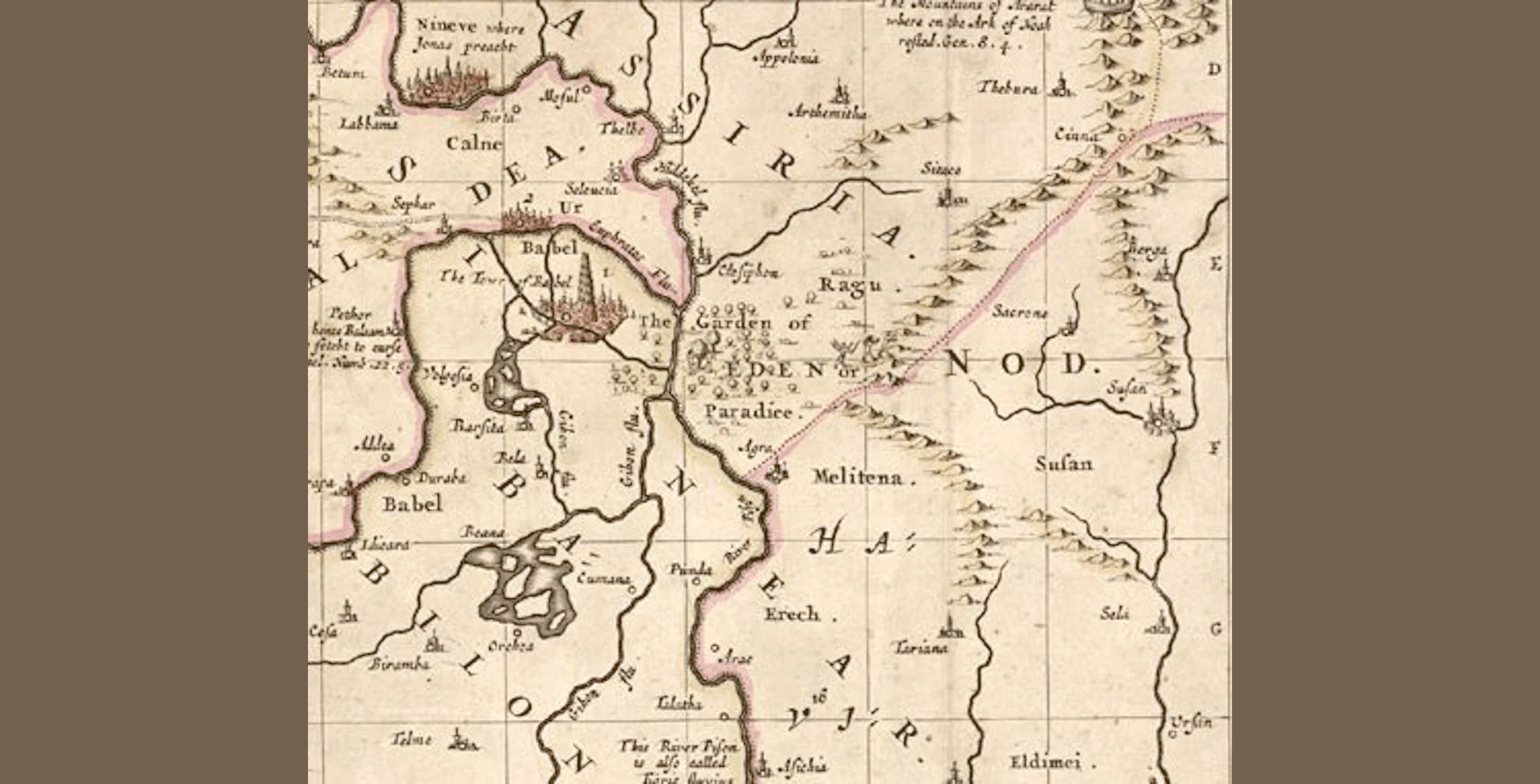
East of Eden
It’s widely held in Catholic scholarship that the Magi represent the first Gentiles to come to worship the Christ. There is one strain of scholarship that makes reference to the fact that they were astrologers who represented the world of magic. Most scholars see the Magi as followers of Zoroaster, an Indo-Iranian prophet who lived 12 centuries before Christ. Throughout the eastern world, followers of Zoroaster dominated religious thought for centuries. And yet there they are, kneeling in the presence of Christ. The symbolism is that as Christ reigns supreme, all other magic goes out of the world and loses its power and authority. It’s a beautiful and powerful image of the universal Kingship of Christ for all time, and the vast change his birth brought to the history of humankind.
I have an additional theory of my own about the hidden meaning of the account of the Magi, but I have been unable to find any reference to it in the work of any Biblical scholar, Catholic or otherwise. So I’m on my own in this wilderness of midrashic symbols. It’s true that the Magi represent all the world beyond Judaism coming into a covenant relationship with God through Christ. But great pains are taken by Saint Matthew to remind us repeatedly that the Magi are coming out of the East — and he capitalized “East.” It seems to me to be intended to designate more than just a compass point. The fact that they came from the East, and saw his star in the East, is repeated by Saint Matthew three times in this brief account.
In one of my posts on These Stone Walls — “In the Land of Nod, East of Eden” — I wrote of how both Adam and Eve were banished East of Eden after the Fall of Man (Genesis 3:24). It was both a punishment and a deterrent. God then placed a Cherubim with a flaming sword to the East of Eden to bar Man’s return.
A generation later, after the murder of his brother, Abel, Cain was also banished. Cain “went away from the presence of the Lord and dwelt in the Land of Nod, East of Eden (Genesis 4:14). The “Land of Nod” has no other reference in all of Scripture, and is widely interpreted to have its origin in the Hebrew term, “nad,” which means “to wander.” Cain himself described his fate in just this way:
“From thy face I shall be hidden; I shall be a fugitive and a wanderer on the earth.”
I count 21 references to an ill wind from the East throughout Sacred Scripture, but not one such reference after the Birth of Christ. An example is this one from the Prophet Isaiah:
“Measure by measure, by exile thou didst contend with them; he removed them with his fierce blast in the day of the east wind.”
For me, the Magi represent also those who have fallen, who have become alienated from God and banished East of Eden. They saw his star there, and followed its light. I am in a place filled with men who lived their entire lives East of Eden, and for them the Magi are a sign of Good News — the very best news. Freedom can be found in only one place: and the way there is the Star of Bethlehem.

Amid the Encircling Gloom
My cell window faces West so my gaze is always out of the East. On this cold and gray December day, the sun is just now setting behind the high prison wall, and glistening upon the spirals of razor wire like tinsel. Its final glimmer of light is just now fading from view. I am reminded of my favorite prayer, a gift from another wise man, Blessed John Henry Newman, and it has become a tradition of sorts as the Sun sets on These Stone Walls at Christmas. I can hear the Magi praying this as they follow that Star out of the East. On my 18th Christmas in prison, this is my prayer for you as well:
“Lead, kindly Light, amid the encircling gloom,
Lead Thou me on.
The night is dark, and I am far from home;
Lead Thou me on
Keep Thou my feet; I do not ask to see
The distant scene; One step enough for me.
I was not ever thus,
Nor prayed that Thou shouldst lead me on;
I loved to choose and see my path,
But now lead Thou me on.
I loved the garish day, and, spite of fears,
Pride ruled my will; remember not past years.
So long Thy power hath blessed me,
Sure it still will lead me on
O’er moor and fen, o’er crag and torrent
Till the night is gone,
And with the morn those Angel faces smile,
Which I have loved long since, and lost awhile.”
The readers of These Stone Walls have cast a light into the darkness and isolation of prison this year. It’s a light that illuminates the path from East of Eden, and it is magnified ever so brightly, in my life and in yours, by the Birth of Christ. The darkness can never, ever, ever overcome it.
+ + +
Please share this post!
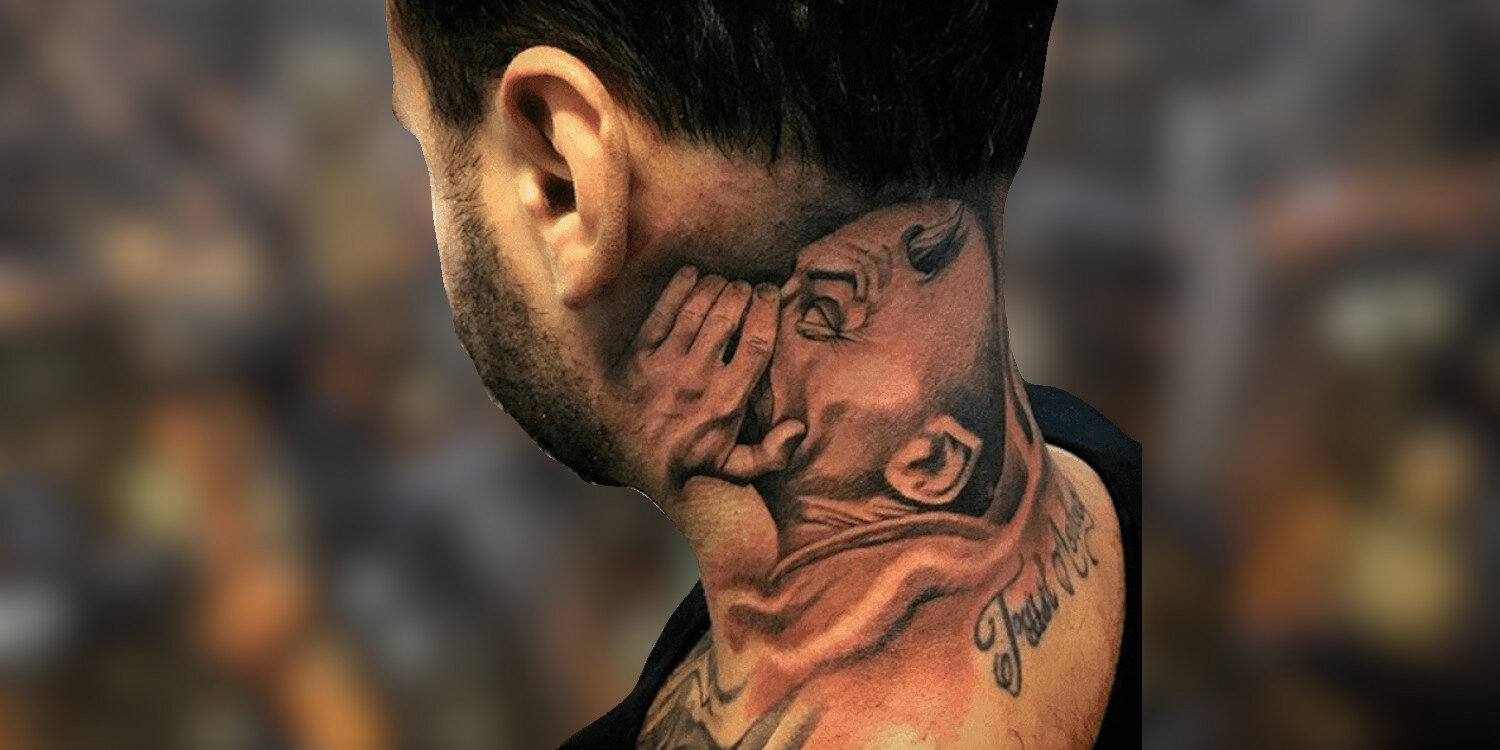
Be Wary of Crusaders! The Devil Sigmund Freud Knew Only Too Well
Some of Sigmund Freud’s map of the human psyche has been debunked in modern psychology, but Freud also knew well that some moral crusaders doth protesteth too much.

Some of Sigmund Freud’s map of the human psyche has been debunked in modern psychology, but Freud also knew well that some moral crusaders doth protesteth too much.
I have debated this post in my mind for days, arguing with myself whether I really wanted to write it. I have always dreaded offending people, and there’s just no way I’m going to be able to write this without someone feeling offended. But I also believe that simply not ever offending anyone is not a worthy goal for either a writer or a priest. I once asked a priest why he decided not to preach on the sanctity of life on “Respect Life Sunday.” He responded that he just doesn’t like offending anyone and someone is always offended when he preaches a pro-life homily. Sometimes, not offending anyone means avoiding ever speaking the truth.
It takes a degree of courage to point out the truth to ears that would rather not hear it. One newer reader of this blog has a recent example. Chris Tressa discovered Beyond These Stone Walls because Spero News reprints some of my posts. Spero News is sort of the online frontier. Like many sites, civil discourse takes a back seat to free flowing reader opinion. So Spero News posts pretty much anything anyone wants to say.
We can’t really fault Spero News for this when standards for civil discourse don’t apply on many Catholic sites as well. Some of the comments posted on just about any subject in the Catholic Church by readers of the National Catholic Reporter demonstrate the steep decline in online Catholic civility.
Spero News seems to have a lot of readers, but not a lot of comments. The relatively rare comments on my articles there are often printed and mailed to me. Some are very positive, but some are just outright attacks. I’m never offended, however. Invariably, the attacks are turned around by other readers and often backfire on their authors — who never identify themselves, by the way.
Sometimes this is even humorous. One writer identifying herself as an unnamed SNAP leader wrote in a comment that she finds it “despicable and deplorable” that an accused and convicted Catholic priest is given a voice online at a site called Beyond These Stone Walls. The sole comment posted in response made me laugh out loud:
“I clicked on that link and just spent several hours reading Beyond These Stone Walls. I found it to be riveting and uplifting. Thank you for telling us of this wonderful site.”
I don’t think that’s the response the SNAP writer hoped for, but Chris Tressa learned of BTSW in just that way. A man who leaves negative comments about priests throughout the Catholic online world posted a really toxic one on the Spero News reprint of one of my recent posts there. It was obvious that he didn’t actually read that post before spouting off, because he demonstrated in graphic prose the very points I set out to make. What was really of interest to me, however, was Chris Tressa’s comment in response:
“In one brief comment, the writer above used the term ‘pedophile priest’ five times, along with multiple variations of ‘child rape’ — all in just a few sentences of text. Who does that? To paraphrase Shakespeare, ‘The man doth protesteth too much, me thinks!’ This sounds to me like classic reaction formation. Is it time to visit the shrink?”
From an analysis of typical comments in Catholic media, it might appear that a lot of people have ongoing and extremely negative views about Catholic priests. That may not be the case. What’s really going on is that a relatively small number of crusaders are “seeding” the Internet with their comments. If you take the time — and have the stomach for it — to track comments throughout the Catholic online world, and at mainstream media articles about Catholic scandal, you’ll see the same few screen names over and over.
They seem to be everywhere, and Chris Tressa ran into one of them. They are on a very personal crusade, but what makes this so personal for them? As Chris Tressa asked, “Who does that?” Is it because they are victims of sexual abuse? Perhaps so, but I know MANY adult victims of sexual abuse who are not crusaders. This prison and prisons everywhere are filled with men who were seriously victimized as children. A number of the readers and supporters of Beyond These Stone Walls are survivors of childhood sexual abuse who resent the venom being spewed in their names.
But it’s also a fact that many of the most vocal crusaders at SNAP, Voice of the Faithful (VOTF), and Bishop-Accountability are not victims of sexual abuse. So what’s behind the nasty crusade of vilification and suspicion?

SNAP leaders offered to provide protesters with fake “Holy Childhood photos” to hold up for news cameras.
Classic Defense Mechanisms
We got a hint of the answer in the case of Dr. Steve Taylor, a Louisiana psychiatrist and member of SNAP who has been one of the more vocal advocates for an end to all civil rights for accused priests. Dr. Taylor has argued loudly for an end to any state respect for the seal of the Catholic confessional. Dr. Taylor was also the founder of a local chapter of SNAP. “We have faces now,” he bitterly exclaimed to legislators and news cameras while SNAP members held up the contrived “Holy Childhood photos” described in “SNAP Exposed” by Catholic League President Bill Donohue.
Over the last three years, Dr. Steve Taylor has lost his medical license to practice psychiatry. He is now serving a sentence in a federal prison convicted on multiple charges of possessing child pornography.
Before he was sentenced to prison, SNAP founder Barbara Blaine and anti-Catholic author Jason Berry both pleaded for leniency for Dr. Taylor citing that his “problem” does not undo or overshadow all the good he has done. I had this solidly in mind when SNAP leaders vilified Bishop Robert Finn, charged with a misdemeanor for not reporting a priest fast enough when the priest was allegedly discovered with child pornography.
The crusade against accused priests that Dr. Steve Taylor was on has many of the elements of classic reaction formation, a concept first proposed by the father of modern psychiatry, Sigmund Freud. His descriptions of human ego defense mechanisms and hysteria included this entirely unconscious phenomenon which he described as an attempt to cover up something unacceptable in oneself by adopting a stance in opposition to it. It is the formation of a reaction to an encounter with self. When something disdained is discovered there, defense mechanisms like reaction formation can develop into an elaborate ruse in which the thing feared in oneself becomes the thing attacked in others.
There are many modern examples. Congressman Mark Foley railed in Congress for bills targeting those who would sexually exploit young people. In 2006, Congressman Foley resigned after he was confronted with sending sexually explicit e-mail and text messages to teenage male pages working for the U.S. House of Representatives.
The televangelist scandals of the 1980’s involving famed TV preachers Jimmy Swaggart, PTL’s Jim Baker, and others also come to mind. Week after week, they railed against the licentiousness of the modern era while caught in their own sexual and financial scandals. Former New York Attorney General Elliot Spitzer mercilessly prosecuted officials caught in prostitution and other crimes before he was himself arrested in a prostitution sting. In the 1970’s, Covenant House Founder, Father Bruce Ritter testified before Congress to expose what he called the rampant exploitation of homeless youth on America’s streets only to leave the country when several of the very young people he claimed to be saving accused him of sexual abuse.

Debbie Nathan on “Sybil” and Hysteria
Much of what Sigmund Freud brought to the field of psychology and its understanding of hysteria has been debunked. One of the latest debunkings — and one of the finest — is a book by Debbie Nathan entitled Sybil Exposed (Free Press, 2011). Debbie Nathan serves on the advisory board of the National Center for Reason and Justice. (For full disclosure, I should tell you that this heroic organization endorses Beyond These Stone Walls and assists in sponsorship of my own defense).
Debbie Nathan is also the author (with Michael Snedeker) of an earlier landmark book, Satan’s Silence, which exposed the great fraud behind the ritual sex abuse stories of the 1980’s. Debbie Nathan continues this theme in Sybil Exposed, a riveting account of the fraud perpetrated in the story of Shirley Mason, known to the world as “Sybil.” Debbie Nathan here exposes the truth behind the world’s most famous case of multiple personality ever brought to print and the silver screen.
Sybil, aided by an ambitious psychiatrist, claimed to have sixteen separate personalities brought on by a childhood traumatized by sexual and physical abuse. But Debbie Nathan exposed that it was all an elaborate hoax, a hoax that sold six million copies of Flora Rheta Schreiber’s 1973 book, Sybil. It turns out that neither the abuse nor the multiple personalities were real. In Sybil Exposed, Debbie Nathan has performed a great service to victims of the “hysteria prosecution” craze.
The story of Sybil was also a fraud on the American courts. The two decades from 1980 to 2000 saw multiple cases of “victims” claiming to have trauma-induced repressed and recovered memories of sexual abuse. Many men — including some Catholic priests — went to prison on those fraudulent claims. Some are still in prison. Writer Ryan MacDonald wrote of how the “psychological trauma” fraud played out in my own case in “Psychotherapists Helped Send an Innocent Priest to Prison.”
But “reaction formation,” one of Freud’s signature theories about hysteria and ego defense mechanisms, has survived all the debunking. One of the most advanced modern psychology studies demonstrating the power of reaction formation (Adams. Wright & Lohr, 1996) was on the topic of homophobia. It pointed out the difference between a moral belief that society should not promote homosexuality as a social good, and a more personal belief that society should persecute homosexuals. They are not one and the same. The 1996 study found that people who cross the line between a moral opposition and a moral crusade are often “protesting too much” a tendency in themselves that they find unacceptable.
Reaction formation also influences our views about what constitutes prejudice. Political or religious opposition to same-sex marriage, for example, is often — and wrongly — interpreted as active persecution and outright bigotry. I have known gay rights activists who interpret any opposition to their political goals and social agenda as religious persecution and a denial of their civil rights. This is the second way reaction formation is manifested. People who see all disagreement as judgment, condemnation, and persecution may really be passing judgment on themselves. I have read repeatedly that the Catholic Church “condemns gay people.” This is simply untrue.

Reaction Formation against Prejudice
American society since the 1960s has been especially conscious of any appearance of racial bias or prejudice, and has widely endorsed strong norms condemning prejudice. If Americans are led to believe that they may hold unacceptable prejudiced beliefs, or if they even believe that others are seeing them in this light, “they may respond with exaggerated displays of not being prejudiced” (Adams, Wright and Lohr, 1996).
The debate that surrounded same-sex marriage may have been an example of that response. When concerns were raised that same-sex marriage laws are an example of legislation and social reform by judicial fiat instead of by a democratic process, gay rights activists typically, and wrongly, dismissed the objection as bigotry. The media has given strength to that interpretation by underwriting it, and many Americans have withdrawn or silenced their opposition to same-sex marriage because of a politically correct fear of appearing prejudiced.
A striking example of how the fear of appearing prejudiced creates reaction formation is something that occurred in the Episcopal church in New Hampshire. The World Wide Anglican Communion has been in a state of civil war since the 2003 election of Bishop Gene Robinson. At the time he was nominated as bishop, he was a divorced, openly-gay man in a relationship with another man. This has played out in New Hampshire almost perfectly parallel to the Catholic sexual abuse crisis, but never the two shall meet.
And yet I have no doubt whatsoever that if Gene Robinson was not a gay man — if he was simply a heterosexual divorcee living with another woman, he would never have been a candidate for bishop in any U.S. Episcopalian diocese. This seems an example of a group so wishing to demonstrate its lack of prejudice that a new standard for its episcopacy was created. Bishop Robinson was not elected bishop in spite of being openly gay, but because of it. The global Anglican Communion has been torn asunder by this one example of reaction formation. Yet I have read repeatedly that one of the goals of “reform” groups like Voice Of the Faithful is to foster an American Catholic church that mirrors the Episcopal church and its “sensitivity” to politically correct American values. Thanks, but no thanks.
In New Hampshire, Bishop Gene Robinson campaigned for the passage of a same-sex marriage law. Once it was passed, he and his partner were among the first to enter a same-sex marriage in this state. Then he checked himself into rehab. Then he got divorced. Finally, having torn the entire Worldwide Anglican Communion asunder, he retired.
This same politically correct fear of appearing prejudiced has also radically altered the U.S. Bishops’ collective response to the Catholic sex abuse scandal. When the John Jay College of Criminal Justice was commissioned to study the causes and contexts, both the researchers and the bishops were left with a conundrum. The results were clear that this was not a crisis involving pedophilia as it is clinically defined — though that did exist on a much smaller scale. The problem was predominantly, and clearly, claims of homosexual predation of adolescent and young adult males during the sexual revolution of the 1960s to 1980s. There is no greater evidence of the power of reaction formation than when an entire institution would prefer the term “pedophile scandal” to “homosexual scandal” even when the facts say otherwise.
Truth and honesty are truly golden things, and most of you, in your own heart of hearts, know them when you see them. We are in a culture, however, in which the views of many are manipulated by the agendas of a few. But sometimes the few are themselves manipulated by the quirks of their own psyches. Be wary of crusaders. Freud and Shakespeare both knew the truth about them. Sometimes they doth protesteth too much.

The Holy Longing: An All Souls Day Spark for Broken Hearts
The concept of Purgatory is repugnant to those who do not understand Scripture, and a source of fear for many who do, but beyond the Cross, it is a source of hope.

The concept of Purgatory is repugnant to those who do not understand Scripture, and a source of fear for many who do, but beyond the Cross, it is a source of hope.
All Souls Day
Twenty-four hours after this is posted, it will no longer be All Souls Day. I risk losing everyone’s interest as we all move on to the daily grind of living. But I am not at all concerned. We’re also in the daily grind of dying. Death is all around us — it’s all around me, at least — and never far from conscious concern. Death was part of the daily prayer of Saint Padre Pio as well:
“Stay with me, Lord, for it is getting late; the days are coming to a close and life is passing. Death, judgment and eternity are drawing near.”
I have never feared death. At least, I have never feared the idea of dying. It’s just the inconvenience of it that bothers me most, not knowing when or how. The very notion of leaving this world with my affairs undone or half done is appalling to me. The thought that Someone knows of that moment but won’t share this news with me makes me squirm. “You know not the day nor the hour” (Matthew 24:36) is, for me, one of the most ominous verses in all of Scripture.
But even when a lot younger, I never thought I would have to be dragged kicking and screaming out of this life and into the next one. I think it’s because I have always had a strong belief in Purgatory. It’s one of the most wonderful and hopeful tenets of the Catholic faith that salvation isn’t necessarily a black and white affair driven solely by the peaks and valleys of this life. I have never been so arrogant as to believe that my salvation is a done deal. I have also never been so self-deprecating as to believe that God waits for the extinction of both our lives and our souls.
It is the mystery of “Hesed,” the balance of justice with mercy that I wrote of in “Angelic Justice,” that is the foundation of Purgatory. In God’s great Love for us, and in His Divine Mission to preserve that part of us that is in His image and likeness — something this world cannot possibly do — God has left a loophole in the law. It’s a way for sinners who love and trust Him, and seek to know Him, to come to Him through Christ to be redeemed. The very notion of Purgatory fills me with hope, and I’m hoping for it. It’s largely because of Purgatory that I do not fear death.
All Souls Day was first observed in the Catholic Church in the monastery of Cluny in France in the year 988. It was originally about Purgatory, and not just death. The monks at Cluny set aside the day after the Feast of All Saints — which began two centuries earlier — to devote a day of prayer and giving alms to assist the souls of our loved ones in Purgatory. In the Second Book of Maccabees (12:46) Judas Maccabeus “made atonement for the dead that they might be delivered from their sin.”
Purgatory itself has, since the earliest Christian traditions, been a tenet of faith in which the souls of those who have left this world in God’s friendship are purified and made ready for the Presence of God. The Eastern and Latin churches agree that it is a place of intense suffering, and I’m looking forward to my stint.
Okay, I’ll admit that sounds a little weird. It isn’t as though thirty years in prison has conditioned me for ever more punishment. I do not find punishment to be addictive at all, especially when I did not commit the crime. The punishment of Purgatory, however, is something I know I cannot evade. The intense suffering of Purgatory is entirely a spiritual suffering, and it begins with our experience of death right here. The longing with which we sometimes agonize over the loss of those we love is but a shadow of something spiritual we have yet to share with them: The Holy Longing they must endure as they await being in the Presence of God. That Holy Longing is Purgatory. It is the delay of the beatific vision for which we were created, and that delay and its longing is a suffering greater than we can imagine.

Death, Drawing Near
Years ago, an old friend came to me after having lost his wife of sixty years. I could only imagine what this was like for him. After her funeral and burial all his relatives finally went home, and he was alone in his grief. When we met, he told me of the intensity of his suffering. My heart was broken for him, but something in his grief struck me. I asked him not to waste this suffering, but rather to see it as a part of the longing his dear wife now has as she awaits her place in the fullness of God’s Presence. I suggested that his longing for her was but a shadow of her intense longing for God and perhaps they could go through this together. I asked him to offer his daily experience of grief for the soul of his wife.
He later told me that this advice sparked something in him that made him embrace both his grief and his loss by seeing it in a new light. Every moment in those first days and weeks and months without her was an agony that he found himself offering for her and on her behalf. He said this didn’t make any of his suffering go away, but it filled him with hope and a renewed sense of purpose. It gave meaning to his suffering which would otherwise have seemed empty.
Though I could not possibly relate to his loss, I know only too well the experience of being stranded by the deaths of others. In early Advent one year, I wrote “And Death’s Dark Shadow Put to Flight.” The title was a line from the hauntingly beautiful Advent hymn, “0 Come, 0 Come Emmanuel” that we will all be hearing in a few weeks.
That post, however, was about the death of Father Michael Mack, a Servant of the Paraclete, a co-worker, and a dear friend who was murdered in the first week of Advent. It took place on December 7th. It was a senseless death — by our standards, anyway — brought upon this 60-year-old priest and good friend by Stephen A. Degraff, a young man who took Father Mike’s life for the contents of his wallet. A part of my share in his Purgatory was to pray not only for Michael Mack, but for Stephen Degraff as well.
On the evening of December 7, 2001, Father Michael Mack returned to his home after some time helping out in a remote New Mexico diocese. Saint Paul wrote that “the Day of the Lord will come like a thief in the night” (1 Thessalonians 5:2). For Father Michael, it did just that. But for me in prison 2,000 miles away, awareness of this loss took time. No one can telephone me in prison, and I can usually only be reached by mail. It turned out that Father Michael sat at a desk in his home and wrote a letter to me on the night he died — all the while oblivious to the danger lurking in a closet in that same room. Father Mike took the letter outside to his mailbox and then walked back inside and into the moment of his death.
Three days later, after prison mail call, I sat at a small table outside my cell with the letter from Father Mike in my hands. I was so glad to hear from him. As I sat there reading the letter with a smile on my face, another prisoner asked if I wanted to see the previous day’s Boston Globe. With Father Mike’s letter in my left hand, I absentmindedly turned to page two of the Globe to see a tiny headline under National News: “New Mexico priest murdered.” Father Michael Mack’s name jumped from the page, and a part of me died just there.
All the Catholic rituals through which we bid farewell and accept the reality of death in hope are denied to a prisoner. I had only that last letter describing all Father Mike’s hopes and dreams and renewed energy for a priestly ministry to other wounded priests. Then after he signed it and scribbled in a PS — “Looking forward to hearing from you” — he walked right into his death.
This wasn’t the last time such a thing happened. This is the 30th time I mark All Souls Day in prison, and the list of souls I once knew in this life — and still know — has grown longer. In “A Corner of the Veil,” I wrote of the death of my mother — imprisoned herself during three years of grueling sickness just seventy miles from this prison, but I could not see her, speak with her, or assure her in any way except through letters that could not be answered. She died November 5, 2006. Last week, I received a letter from BTSW readers Tom and JoAnn Glenn which included a beautiful photograph of my mother imprinted on a prayer card. They found the photograph on line. I had never seen it, and was so grateful that they sent this to me.
No news of death has ever come to me with more devastation than that of my friend, Father Clyde Landry. Father Mike Mack, Father Clyde, and I were co-workers and good friends, sharing office space in the years we worked in ministry to wounded priests at the Servants of the Paraclete Center in New Mexico. I was Director of Admissions and Father Clyde was Director of Aftercare. A priest of the Diocese of Baton Rouge, Louisiana, Father Clyde had a Cajun accent reminiscent of that famous Cajun television chef, Justin Wilson — “I Gar-on-TEE!”
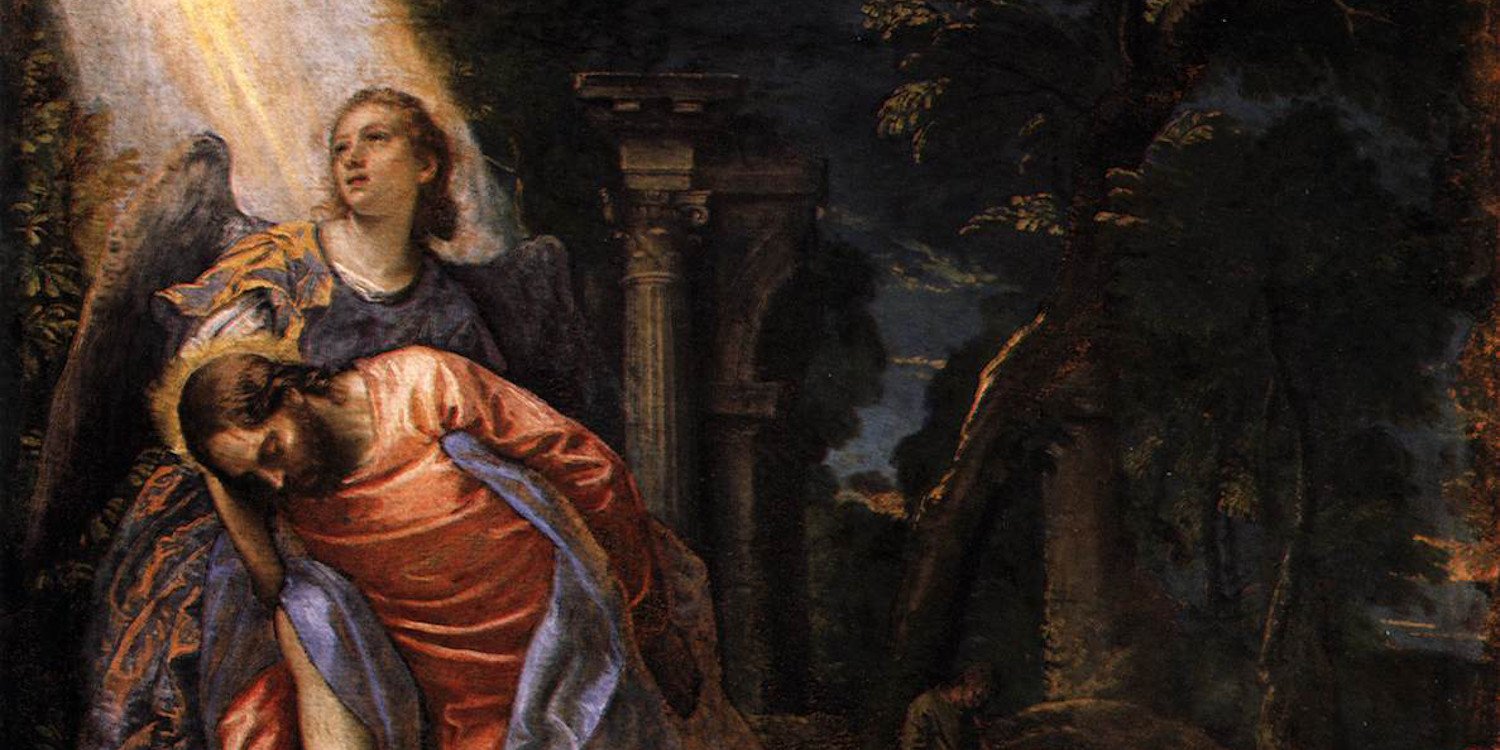
The Dark Night of the Soul
On that night of Gethsemane when I was falsely accused and arrested, it was Father Clyde who first came to my aid, and stood by me throughout. When I was sent to prison, Father Clyde became my lifeline to the outside world. I called him every Saturday. It became a part of my routine, like clockwork. It was through Father Clyde that once a week I reached out to the outside world for news of friends and news of freedom. He held a small account for me to help with expenses such as telephone costs, food and clothing, small things that make a prisoner’s life more bearable. Most important of all, Father Clyde volunteered to be the keeper of everything of value that I owned.
By “everything of value,” I do not mean riches. I never had any. He kept the Chalice that was given to me at priesthood ordination. He kept the stoles that were made for me, and the small things that were dear to my life and priesthood.
He kept the irreplaceable photos of my parents — both gone now — and all the things that were a lifetime’s proof of my own existence. Everything that I left behind for prison hoping to one day see again was in the possession of Father Clyde.
A year after Father Michael Mack’s tragic death, I received a joyous letter from Father Clyde. He had a new life in ministry as administrator of a very busy retreat center in New Mexico, and he was looking forward to starting. He had also purchased a small home near the center in a beautiful part of Albuquerque. It was the first time in his 52 years that he had owned any home. It was a sign of the stability that he longed for, and a sign of his great love for the retreat ministry he was undertaking.
Father Clyde’s letter was very careful to include me in this transition. He had packed all my possessions and would place them in his spare room which he promised would be available to me whenever I was released from my nightmare. His letter was the last he wrote from his vacant apartment, all his boxes stacked just next to him. He wanted me to know that by the time I received his letter he would be moved and settled and ready for my call the following Saturday.
I received Father Clyde’s letter on a Friday evening, and tried to call his new number the next day. I got only a recorded message that the number was disconnected. In prison, no one can call me and I am unable to leave messages on any answering machine or voice mail. So I called another friend to ask if he would please send an e-mail message for me. My friend fired up his computer and asked, “Where’s it going?” I gave him the e-mail address and started my message.
“Hello Clyde,” I said. “I hope you are getting settled.” Instead of hearing the clicks of my friend’s keyboard, however, I heard only silence. He wasn’t typing. I asked him what was wrong, and knew instantly from his hesitation that something was very wrong.
“Oh, My God!” he said. “You don’t know!” He then told me that my friend, Father Clyde, never made it to his new home. When he did not show up for the signing appointment with his realtor, a search was underway. Father Clyde was found in his apartment on the floor next to the last box he had packed. At age 52, he had suffered a fatal heart attack.
Father Clyde had been gone three days by the time I learned this. No one could reach me. With Father Clyde’s letter in my left hand, I was stunned as my friend described all he knew of Father Clyde’s death, which wasn’t much. It would be many days before I could learn anything more.
In the weeks and months to follow, I was stranded in a way that I had never experienced before. I was not just alone in my grief. I was alone in prison, 2,000 miles from the world I knew and the only contacts I had, and my sole connection with the outside world was gone. It would be another seven years before the idea of this blog emerged, and I would once again reach out from prison to the outside world.
But for those seven years, I was stranded. On the Saturday after I learned of Fr. Clyde’s death, I recall sitting in my cell from where I could see the bank of prisoner telephones along one wall out in the dayroom, and I cried for the first time in many, many years. In the months to follow, everything that I once hoped one day to see again was lost. I do not know what became of any of Father Clyde’s things, or my own. I have come to know that this happens to many prisoners. Cut off from the world outside, our losses can be catastrophic.
But I came to know that grief is a gift, and I have offered it not only for the souls of Fathers Clyde, Mike, and Moe — and for my dear mother — but for the souls of all who touched my life, and in that offering I had something to share with them — a Holy Longing.
When I wrote “The Dark Night of a Priestly Soul,” it was about Purgatory. It was about my continued hope for the soul of Father Richard Lower, a brother priest driven to take his own life in a dark night all alone when all trust was broken and hope seemed but a distant dream. I have been where he was, and my response to his death was “There, but for the grace of God, go I.”
At the end of “The Dark Night of a Priestly Soul,” I included a portion of the “Prayer of Gerontius” by Saint John Henry Newman. It’s a beautiful verse about Purgatory that calls forth the abiding hope we have for our loved ones who have died, and also recalls that one thing we have left to share with them — a Holy Longing for their presence, and, in their company, for the Presence of God:
Softly and gently, dearly-ransomed soul,
In my most loving arms I now enfold thee,
And, o’er the penal waters, as they roll,
I poise thee, and I lower thee, and hold thee.
And carefully, I dip thee in the lake,
And thou, without a sob or a resistance,
Dost through the flood thy rapid passage take,
Sinking deep, deeper, into the dim distance.
Angels, to whom the willing task is given,
Shall tend, and nurse, and lull thee, as thou liest;
And Masses on the Earth and prayers in Heaven,
Shall aid thee at the throne of the most Highest.
Farewell, but not forever! Brother dear;
Be brave and patient on thy bed of sorrow;
Swiftly shall pass thy night of trial here,
And I will come and wake thee on the morrow.
— John Henry Cardinal Newman, Conclusion, “The Prayer of Gerontius”
+ + +
Note from Fr. Gordon MacRae: Thank you for reading. Please share this post so that it may come before someone who is grieving. You may also wish to read these related posts linked herein:
Angelic Justice: Saint Michael the Archangel and the Scales of Hesed


Angelic Justice: Saint Michael the Archangel and the Scales of Hesed
Saint Michael the Archangel is often depicted wielding a sword and a set of scales to vanquish Satan. His scales have an ancient and surprising meaning.

Saint Michael the Archangel is often depicted wielding a sword and a set of scales to vanquish Satan. His scales have an ancient and surprising meaning.
I worked for days on a post about Saint Michael the Archangel. I finally finished it this morning, exactly one week before the Feast of the Archangels, then rushed off to work in the prison library. When I returned four hours later to print the post and get it into the mail to Charlene, my friend Joseph stopped by. You might remember Joseph from a few of my posts, notably “Disperse the Gloomy Clouds of Night” in Advent and “Forty Days and Forty Nights” in Lent.
Well, you can predict where this is going. As soon as I returned to my cell, Joseph came in to talk with me. Just as I turned on my typewriter, Joseph reached over and touched it. He wasn’t aware of the problem with static charges from walking across these concrete floors. Joseph’s unintentional spark wiped out four days of work and eight pages of text.
It’s not the first time this has happened. I wrote about it in “Descent into Lent” last year, only then I responded with an explosion of expletives. Not so this time. As much as I wanted to swear, thump my chest, and make Joseph feel just awful, I couldn’t. Not after all my research on the meaning of the scales of Saint Michael the Archangel. They very much impact the way I look at Joseph in this moment. Of course, for the 30 seconds or so after it happened, it’s just as well that he wasn’t standing within reach!
This world of concrete and steel in which we prisoners live is very plain, but far from simple. It’s a world almost entirely devoid of what Saint Michael the Archangel brings to the equation between God and us. It’s also a world devoid of evidence of self-expression. Prisoners eat the same food, wear the same uniforms, and live in cells that all look alike.
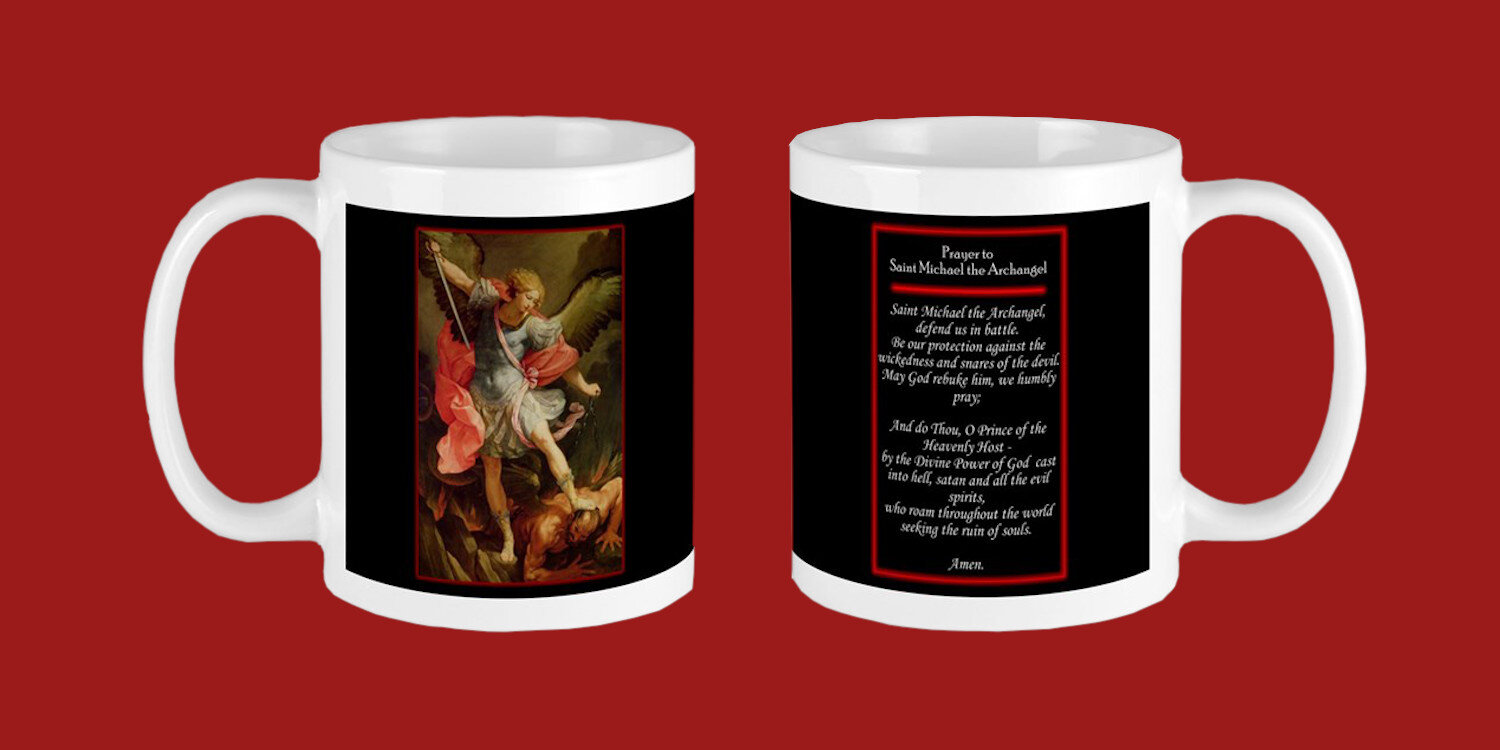
Off the Wall, And On
In these cells, the concrete walls and ceilings are white — or were at one time — the concrete floors are gray, and the concrete counter running halfway along one wall is dark green. On a section of wall for each prisoner is a two-by-four foot green rectangle for posting family photos, a calendar and religious items. The wall contains the sole evidence of self-expression in prison, and you can learn a lot about a person from what’s posted there.
My friend, Pornchai, whose section of wall is next to mine, had just a blank wall two years ago. Today, not a square inch of green shows through his artifacts of hope. There are photos of Joe and Karen Corvino, the foster parents whose patience impacted his life, and Charlene Duline and Pierre Matthews, his new Godparents. There’s also an old photo of the home in Thailand from which he was taken at age 11, photos of some of the ships described in “Come, Sail Away!” now at anchor in new homes. There’s also a rhinoceros — no clue why — and Garfield the Cat. In between are beautiful icons of the Blessed Mother, Saint Maximilian Kolbe, Saint Pio, and one of Saint Michael the Archangel that somehow migrated from my wall over to Pornchai’s.
My own wall evolved over time. The only family photos I had are long lost, and I haven’t seen my family in many years. It happens to just about every prisoner after ten years or so. In my first twelve years in prison I was moved sixteen times, and each time I had to quickly take my family photos off the wall. Like many prisoners here for a long, long time, there came a day when I took my memories down to move, then just didn’t put them back up again. A year ago, I had nothing on the wall, then a strange transformation of that small space began to take shape.
When These Stone Walls — the blog, not the concrete ones — began last year, some readers started sending me beautiful icons and holy cards. The prison allows them in mail as long as they’re not laminated in plastic. Some made their way onto my wall, and slowly over the last year it filled with color and meaning again.
It’s a mystery why, but the most frequent image sent to me by TSW readers is that of Saint Michael the Archangel. There are five distinct icons of him on the wall, plus the one that seems to prefer Pornchai’s side. These stone walls — the concrete ones, not the blog — are filled with companions now.
There’s another icon of Saint Michael on my coffee cup — the only other place prisoners always leave their mark — and yet another inside and above the cell door. That one was placed there by my friend, Alberto Ramos, who went to prison at age 14 and turned 30 last week. It appeared a few months ago. Alberto’s religious roots are in Caribbean Santeria. He said Saint Michael above the door protects this cell from evil. He said this world and this prison greatly need Saint Michael.
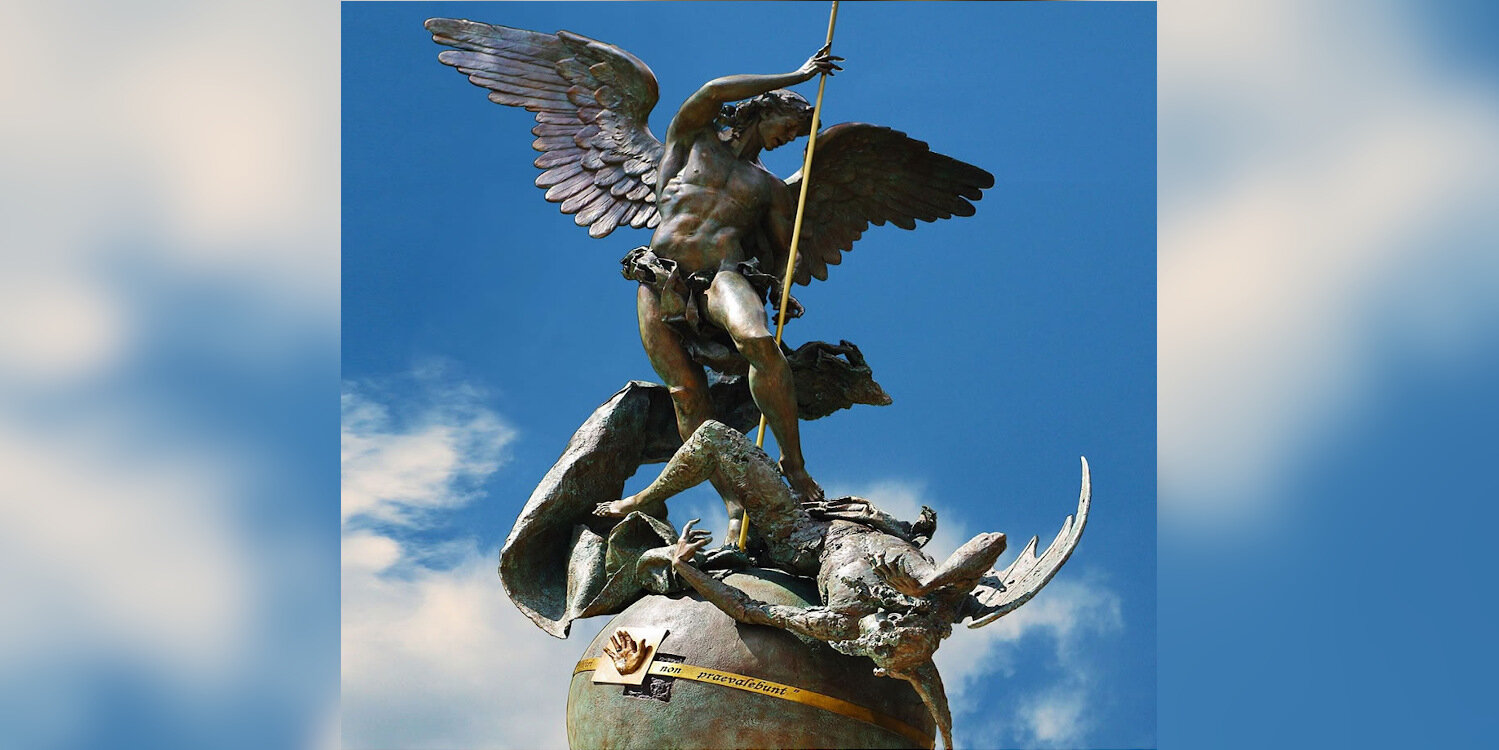
Who Is Like God?
The references to the Archangel Michael are few and cryptic in the canon of Hebrew and Christian Scripture. In the apocalyptic visions of the Book of Daniel, he is Michael, your Prince, “who stands beside the sons of your people.” In Daniel 12:1 he is the guardian and protector angel of Israel and its people, and the “Great Prince” in Heaven who came to the aid of the Archangel Gabriel in his contest with the Angel of Persia (Daniel 10:13, 21).
His name in Hebrew — Mikha’el — means “Who is like God?” It’s posed as a question that answers itself. No one, of course, is like God. A subsidiary meaning is, “Who bears the image of God,” and in this Michael is the archetype in Heaven of what man himself was created to be: the image and likeness of God. Some other depictions of the Archangel Michael show him with a shield bearing the image of Christ. In this sense, Michael is a personification, as we’ll see below, of the principal attribute of God throughout Scripture.
Outside of Daniel’s apocalyptic vision, the Archangel Michael appears only two more times in the canon of Sacred Scripture. In Revelation 12:7-9 he leads the army of God in a great and final battle against the army of Satan. A very curious mention in the Epistle of Saint Jude (Jude 1:9) describes Saint Michael’s dispute with Satan over the body of Moses.
This is a direct reference to an account in the Apocrypha, and demonstrates the importance and familiarity of some of the apocryphal writings in the Israelite and early Christian communities. Saint Jude writes of the account as though it is quite familiar to his readers. In the Assumption of Moses in the apocryphal Book of Enoch, Michael prevails over Satan, wins the body of Moses, and accompanies him into Heaven.
It is because of this account that Moses and Elijah appear with Jesus in the account of the Transfiguration in Matthew 11. Moses and Elijah are the two figures in the Hebrew Scriptures to hear the voice of God on Mount Sinai, and to be assumed bodily into Heaven — escorted by Saint Michael the Archangel according to the Aggadah, the collection of milennia of rabbinic lore and custom.

Saint Michael as the Divine Measure of Souls
In each of the seven images of Saint Michael the Archangel sent to me by TSW readers, he is depicted brandishing a sword in triumph over Satan subdued at his feet. In five of the icons, he also holds a set of scales above the head of Satan. A lot of people confuse the scales with those of “Lady Justice” the famous American icon. Those scales symbolize the equal application of law and justice in America. It’s a high ideal, but one that too often isn’t met in the American justice system. I cited some examples in “The Eighth Commandment.”
The scales of Saint Michael also depict justice, but of another sort. Presumably that’s why so many readers sent me his image, and I much appreciate it. However, some research uncovered a far deeper symbolic meaning for the Archangel’s scales. The primary purpose of the scales is not to measure justice, but to weigh souls. And there’s a specific factor that registers on Saint Michael’s scales. They depict his role as the measure of mercy, the highest attribute of God for which Saint Michael is the personification. The capacity for mercy is what it most means to be in the image and likeness of God. The primary role of Saint Michael the Archangel is to be the advocate of justice and mercy in perfect balance — for justice without mercy is little more than vengeance.
That’s why God limits vengeance as summary justice. In Genesis chapter 4, Lamech, a descendant of Cain, vows that “if Cain is avenged seven-fold then Lamech is avenged seventy-seven fold.” Jesus later corrects this misconception of justice by instructing Peter to forgive “seventy times seven times.”
Our English word, “Mercy” doesn’t actually capture the full meaning of what is intended in the Hebrew Scriptures as the other side of the justice equation. The word in Hebrew is ”hesed,” and it has multiple tiers of meaning. It was translated into New Testament Greek as “eleos,” and then translated into Latin as “misericordia” from which we derive the English word, “mercy.” Saint Michael’s scales measure ”hesed,” which in its most basic sense means to act with altruism for the good of another without anything of obvious value in return. It’s the exercise of mercy for its own sake, a mercy that is the highest value of Judeo-Christian faith.
Sacred Scripture is filled with examples of hesed as the chief attribute of God and what it means to be in His image. That ”the mercy of God endures forever” is the central and repeated message of the Judeo-Christian Scriptures. The references are too many to name, but as I was writing this post, I spontaneously thought of a few lines from Psalm 85:
“Mercy and faithfulness shall meet. Justice and peace shall kiss. Truth shall spring up from the Earth, and justice shall look down from Heaven.”
The domino effect of hesed-mercy is demonstrated in Psalm 85. Faithfulness and truth will arise out of it, and together all three will comprise justice. In researching this, I found a single, ancient rabbinic reference attributing authorship of Psalm 85 to the only non-human instrument of any Psalm or verse of Scripture: Saint Michael the Archangel, himself. According to that legend, Psalm 85 was given by the Archangel along with the Torah to Moses on Mount Sinai.
Saint Thomas Aquinas described Saint Michael as “the breath of the Redeemer’s spirit who will, at the end of the world, combat and destroy the Anti-Christ as he did Lucifer in the beginning.” This is why St. Michael is sometimes depicted bearing a shield with the image of Christ. It is the image of Christ in His passion, imprinted upon the veil of St. Veronica. Veronica is a name that appears nowhere in Scripture, but is simply a name assigned by tradition to the unnamed woman with the veil. The name Veronica comes from the Latin “vera icon” meaning “true image.”
Saint Thomas Aquinas and many Doctors of the Church regarded Saint Michael as the angel of Exodus who, as a pillar of cloud and fire, led Israel out of slavery. Christian tradition gives to Saint Michael four offices: To fight against Satan, to measure and rescue the souls of the just at the hour of death, to attend the dying and accompany the just to judgment, and to be the Champion and Protector of the Church.
His Feast Day, assigned since 1970 to the three Archangels of Scripture, was originally assigned to Saint Michael alone since the sixth century dedication of a church in Rome in his honor. This Feast Day is observed annually in the Catholic Calendar on September 29. The Feast was originally called Michaelmas meaning, “The Mass of St. Michael.” The great prayer to Saint Michael, however, is relatively new. It was penned on October 13, 1884, by Pope Leo XIII after a terrifying vision of Saint Michael’s battle with Satan:
St. Michael the Archangel, defend us in battle. Be our protection against the wickedness and snares of the devil. May God rebuke him, we humbly pray, and do thou, 0 Prince of the heavenly Host, by the power of God, cast into Hell Satan and all the evil spirits who prowl about the world seeking the ruin of souls. Amen.
It’s an important prayer for the Church, especially now. I know the enemies of the Church lurk here, too. There are some who come here not for understanding, or the truth, but for ammunition. For them the very concept of mercy, forgiveness, and inner healing is anathema to their true cause. I once scoffed at the notion that evil surrounds us, but I have seen it. I think every person falsely accused has seen it.
+ + +
Note from Father Gordon MacRae: Since the election of Pope Leo XIV at the Conclave of 2025, renewed interest has been directed to Pope Leo XIII, at least in part for his vision of Saint Michael and the prayer above, which is a small part of the intercession written by Pope Leo XIII. You may also be interested in these related posts from Beyond These Stone Walls:
Saint Michael the Archangel Contends with Satan Still
St. Michael the Archangel and the Scales of Our Salvation
Saint Gabriel the Archangel: When the Dawn from On High Broke Upon Us


Saints and Sacrifices: Maximilian Kolbe and Edith Stein at Auschwitz
Saint Maximilian Kolbe and Saint Teresa Benedicta of the Cross — Edith Stein — are honored this week as martyrs of charity and sacrifice.

Saint Maximilian Kolbe and Saint Teresa Benedicta of the Cross — Edith Stein — are honored this week as martyrs of charity and sacrifice.
In a post some years ago I invited our readers to join my friend Pornchai Moontri and me in a personal Consecration to Saint Maximilian Kolbe’s dual movements: the Militia of the Immaculata and the Knights at the Foot of the Cross. Our Consecration took place at Mass on the night of August 15, the Solemnity of the Assumption, and the day after Saint Maximilian’s Feast Day. Visit the website of the Militia of the Immaculata for instructions for enrolling in the Militia Immaculata and the Knights at the Foot of the Cross.
We’re very moved by the number of people who have pledged to join us in this Consecration. The invitation remains always open.
Consecration as members of Saint Maximilian’s M.I. or Knights at the Foot of the Cross does not mean I plan to take on any more suffering or that I will never again complain. It does not even mean that I accept with open arms whatever crosses I bear and embrace them.
A person who is unjustly imprisoned must do all in his power to reverse that plight just as a person with cancer must do everything possible to be restored to health. Consecration does not mean we will simply acquiesce to suffering and look for more. It means we embrace the suffering of Christ, and offer our own as a share in it. In the end, I know I cannot empty myself, as Christ did, but I can perhaps attain the attitude of “Simon of Cyrene: Compelled to Carry the Cross,” of which my own is but a splinter.
I have written in the past that history has a tendency to treat its events lightly. The centuries have made Saint Patrick, for example, a sort of whimsical figure. History has distorted the fact that he became the saint he is after great personal suffering. Patrick was kidnapped by Irish raiders at the age of 16, forced from his home and family, taken across the Irish Sea and forced into slavery.
The life and death of Saint Maximilian are still too recent to be subjected to the colored glasses through which we often view history and sainthood. As with nearly all the saints — and with some of us who simply struggle to believe — great suffering was imposed on Maximilian Kolbe and he responded in a way that revealed a Christ-centered rather than self-centered life. What happened to Father Maximilian Kolbe must not be removed from what the Germans would call his “sitz im leben,” the “setting in life” of Auschwitz and the Holocaust. As evil as they were, they were the forges in which Maximilian cast off self and took on the person of Christ.

Scene from the 1978 mini-series “Holocaust”
“And the Winner Is . . .”
Do you remember the television “mini-series” productions of the 1970s and 1980s? After the great success of bringing Alex Haley’s “Roots” to the screen, several other forays into history were aired in our living rooms. One of them was a superb and compelling series entitled “Holocaust” that debuted on NBC on April 16, 1978. It was a brilliant and powerful example of television’s potential.
“Holocaust” won several Emmy Awards for NBC in 1978 for outstanding Limited Series, Best Director (Marvin Chomsky), Best Screenplay (Gerald Green), Best Actor (Michael Moriarty), Best Actress (Meryl Streep) and a number of Supporting Actor and other awards. As a historical narrative, however, “Holocaust” was deeply disturbing and shook an otherwise comfortable generation all too inclined to want to forget and move on. That was a complaint during the famous Nuremberg Trials of 1945 and 1946.
Just two years after the Allied Invasion of Germany and Poland ended the war and exposed the Death Camps, writers complained that Americans had lost interest and were not reading about the Nuremberg Trials. The aftermath of war revealed the sheer evil of the Nazi Final Solution, and it was more than most of us could bear to look at — so many did not look.
As I wrote in “Catholic Scandal and the Third Reich,” there are some who would have you believe that the Catholic Church is to be the moral scapegoat of the 20th Century. Viewing “Holocaust” (the miniseries) would quickly shatter any such revisionist history. Its first episode was so graphic in its depiction of Nazi oppression, and caused me so much anguish, that I struggled with whether to watch the rest.
I was 25 years old when it first aired, and finishing senior year at Saint Anselm College, a Benedictine school in New Hampshire. I was a double major in philosophy and psychology, and was in the middle of writing my psychology thesis on the relationship between trauma and depression when “Holocaust” kept me awake all night.
The morning after that first episode, I sought out a friend, an elderly Benedictine monk on campus who recommended the series to me. I thought he might tell me to turn my television off, but I was wrong. “This happened in my lifetime,” he said. “We cannot run from it. So don’t look away. Stare straight into its heart of darkness, and never forget what you see.”
He was right, and his words were eerily similar to those of biographer, George Weigel, who wrote of Pope John Paul II and his interest in Saint Maximilian Kolbe in Witness to Hope (HarperCollins, 1999):
Maximilian Kolbe . . . was the ‘saint of the abyss’ — the man who looked into the modern heart of darkness and remained faithful to Christ by sacrificing his life for another in the Auschwitz starvation bunker while helping his cellmates die with dignity and hope.
— Witness to Hope, p. 447
That was what the Holocaust was: “the modern heart of darkness.” I have been a student of the Holocaust since, but I am no closer to understanding it than I was on that sleepless night in 1978. As I asked in “Catholic Scandal and the Third Reich”:
“How did a society come to stand behind the hateful rhetoric of one man and his political machine? How did masses of people become convinced that any ideology of the state was worth the horror unfolding before their eyes?”
We have all been reading about the breakdown of faith in Europe, and about how decades-old scandals are now being used to justify the abandonment of Catholicism in European culture. This is not a new phenomenon. This madness engulfed Europe just eighty years ago, and before it was over, six million of our spiritual ancestors were deprived of liberty, and then life, for being Jews.
Hitler’s “Final Solution” exterminated fully two-thirds of the Jewish men, women, and children of Europe — and millions of others who either stood in his way or spoke the truth. Among those imprisoned and murdered were close to 12,000 Catholic priests and thousands more women religious and other Catholics. The determination to rid Europe of the Judeo-Christian faith did not begin with claims of sexual abuse, and this is not the first time such claims were used to further that agenda.

The Great Lie and Revealed Truth
This of all weeks keeps me riveted on the Holocaust. It was in this week that two of my dearest spiritual friends were murdered a year apart at Auschwitz by that madman, Hitler, and his monstrous Third Reich. Father Maximilian Kolbe traded his life for that of a fellow prisoner on August 14, 1941, and Edith Stein — who became Carmelite Sister Teresa Benedicta of the Cross — was dragged from a cattle train and murdered along with her sister, Rosa, immediately upon arrival at Auschwitz on August 9, 1942.
We must not forget this line from Adolf Hitler’s Mein Kampf (Vol. 1, Ch.10, 1925): “The great mass of people … will more easily fall victim to a big lie than to a small one.” In order for a lie to disseminate and prevail, the truth must be controlled. In 1933, the Third Reich imposed the “Editor’s Law” in Germany requiring that editors and publishers join the Third Reich’s Literary Chamber or cease publishing. In 1933 there were over 400 Catholic newspapers and magazines published in Germany. By 1935 there were none.
The Nazi law was imposed in each country invaded by the Reich. In Poland, Father Maximilian was one of many priests sent to prison for his continued writings, but time in prison did not teach him the lesson intended by the Nazis. He was imprisoned again, and he would not emerge alive from his second sentence at Auschwitz. He was not alone in this. Nearly 12,000 priests were sent to their deaths in concentration camps.

“Come, Let Us Go For Our People.”
Edith Stein was the youngest of eleven children in a devout Jewish family in Germany. She was born on Yom Kippur, the Day of Atonement, on October 12, l891. As a young woman, Edith broke her mother’s heart by abandoning her Jewish faith in adolescent rebellion. She was also brilliant, and it was difficult to win an argument with her using reason and logic. She was a master of both.
Edith received her doctorate in philosophy under the noted phenomenologist, Edmund Husserl, and taught at a German university when the Nazis came to power in 1933. During this time of upheaval, Edith converted to Catholicism after stumbling across the autobiography of Saint Teresa of Avila. “This is the truth,” Edith declared after reading it through in one sleepless night. A few years after her conversion, Edith Stein entered a Carmelite convent in Germany taking the name Sister Teresa Benedicta of the Cross (Blessed by the Cross).
March 27, 1939 was Passion Sunday, the beginning of Holy Week. In response to a declaration of Adolf Hitler that the Jews would bring about their own extinction, Sister Teresa Benedicta of the Cross wrote a private note to her Carmelite superior. She offered herself in prayer as expiation against the Anti-Christ who had cast all of Europe into a spiritual stranglehold. In her letter to her superior, Sister Teresa offered herself as expiation for the Church, for the Jews, for her native Germany, and for world peace.
As the Nazi horror overtook Europe, Sister Teresa grew fearful that she was placing her entire convent at risk because of her Jewish roots. Edith was then assigned to a Carmelite Convent in Holland. Her sister, Rosa, who also converted to Catholicism, joined her there as a postulant.
Catholics in France, Belgium, Holland and throughout Europe organized to rescue tens of thousands of Jewish children from deportation to the Death Camps. Philip Friedman, in Roads to Extinction: Essays on the Holocaust (The Jewish Publication Society, 1980) commended the Catholic bishops of the Netherlands for their public protest about the Nazi deportation of Jews from Holland. In retaliation for those bishops’ actions, however, even Jews who had converted to Catholicism were rounded up for deportation to Auschwitz.
A 2010 book by Paul Hamans — Edith Stein and Companions: On the Way to Auschwitz — details the horror of that day. Hundreds of Catholic Jews were arrested in Holland in retaliation for the bishops’ open rebellion, and most were never seen again. This information stands in stark contrast to the often heard revisionist history that Pope Pius XII “collaborated” with the Nazis through his “silence.” He was credited by the chief rabbi of Rome, Eugenio Zolli, with having personally saved over 860,000 Jews and preventing untold numbers of deaths.
The last words heard from Sister Teresa as she was forced aboard a cattle car packed with victims were spoken to her sister, Rosa, “Come, let us go for our people.” On August 9, 1942, Sister Teresa emerged from the cramped human horror of that cattle train into the Auschwitz Death Camp to face The Sorting.
Nobel Prize winner and Holocaust survivor Elie Wiesel described The Sorting:
“How do you describe the sorting out on arriving at Auschwitz, the separation of children who see a father or mother going away, never to be seen again? How do you express the dumb grief of a little girl and the endless lines of women, children and rabbis being driven across the Polish or Ukranian landscapes to their deaths? No, I can’t do it. And because I’m a writer and teacher, I don’t understand how Europe’s most cultured nation could have done that.”
That August 9th, Edith Stein went no further into the depths of Auschwitz than The Sorting. Some SS officer glared at this brilliant 50-year-old nun in the tattered remains of her Carmelite habit, and declared that she was not fit for work. This woman who had worked every day of her life, who taught philosophy to Germany’s graduate students, who scrubbed convent floors each night, was determined to be “unfit for work” by a Nazi officer who knew it was a death sentence.
Edith and Rosa were taken directly to a cottage along with 113 others, packed in, the doors sealed, and they were gassed to death. Their remains, like those of Maximilian Kolbe a year earlier, went unceremoniously up in smoke to drift through the sky above Auschwitz. And Europe thinks it would be better off now without faith!
“Thus the way from Bethlehem leads inevitably to Golgotha, from the crib to the Cross. (Simeon’s) prophecy announced the Passion, the fight between light and darkness that already showed itself before the crib … The star of Bethlehem shines in the night of sin. The shadow of the Cross falls on the light that shines from the crib. This light is extinguished in the darkness that is Good Friday, but it rises all the more brilliantly in the sun of grace on the morning of the Resurrection.
“The way of the incarnate Son of God leads through the Cross and Passion to the glory of the Resurrection. In His company the way of everyone of us, indeed of all humanity, leads through suffering and death to this same glorious goal.”
— Edith Stein/Sister Teresa Benedicta of the Cross
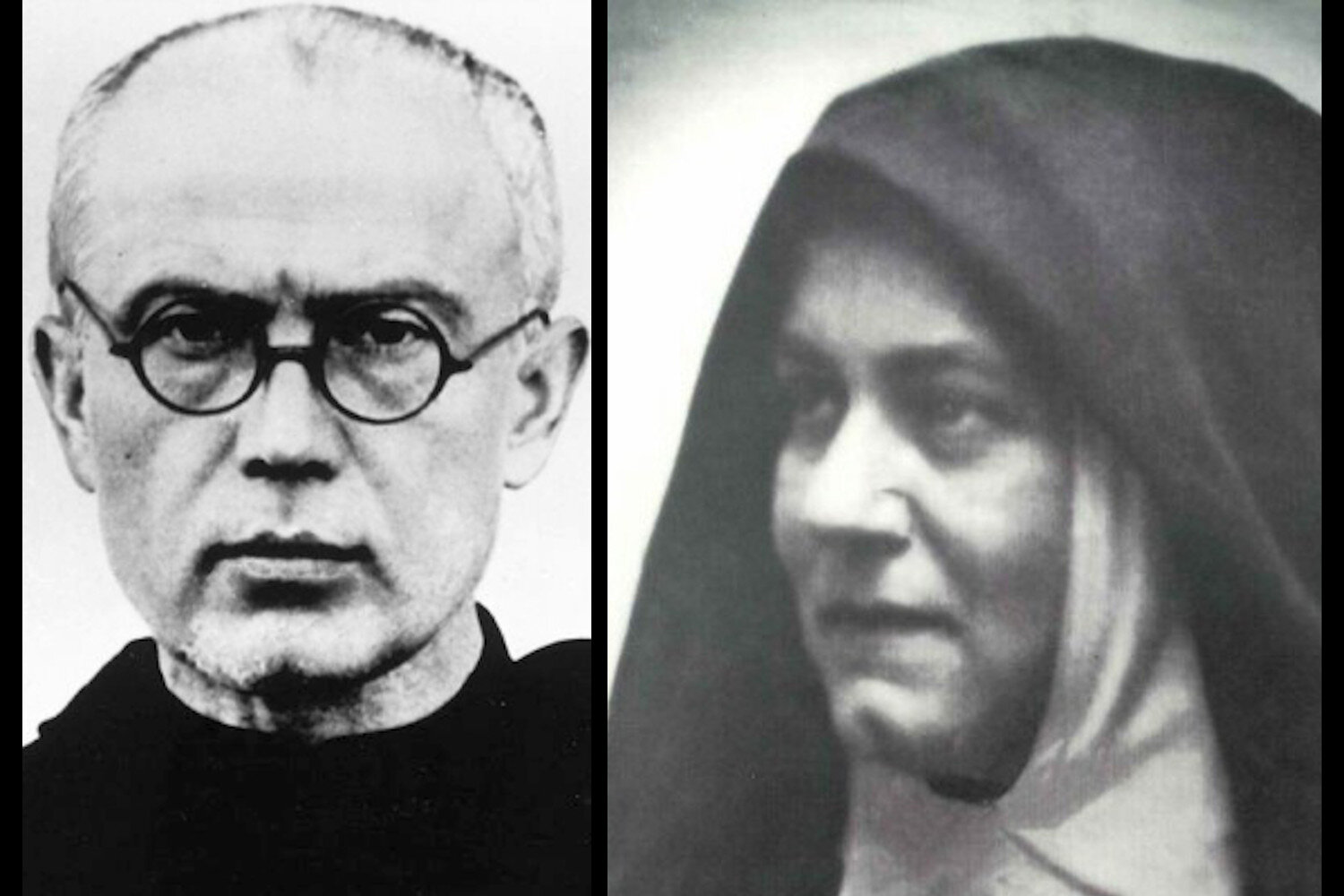

The Exile of Father Dominic Menna and Transparency at The Boston Globe

As Father Dominic Menna, a senior priest at Saint Mary’s in Quincy, MA, was sent into exile, The Boston Globe’s role in the story of Catholic Scandal grew more transparent.
“I’m a true Catholic, and I think what these priests are doing is disgusting!” One day a few weeks ago, that piece of wisdom repeated every thirty minutes or so on New England Cable News, an around-the-clock news channel broadcast from Boston. I wonder how many people the reporter approached in front of Saint Mary’s Church in Quincy, Massachusetts before someone provided just the right sound bite to lead the rabid spectacle that keeps 24-hour news channels afloat.
The priest this hapless “true Catholic” deemed so disgusting is Father F. Dominic Menna, an exemplary priest who has been devoting his senior years in service to the people of God at Saint Mary’s. At the age of 80, Father Menna has been accused of sexual abuse of a minor.
There is indeed something disgusting in this account, but it likely is not Father Menna himself. He has never been accused before. Some of the news stories have not even bothered to mention that the claim just surfacing now for the first time is alleged to have occurred in 1959. No, I did not transpose any numbers. The sole accusation that just destroyed this 80-year-old priest’s good name is that he abused someone fifty-one years ago when he was 29 years old.
Kelly Lynch, a spokesperson for the Archdiocese of Boston, announced that Father Menna was placed on administrative leave, barred from offering the Sacraments, and ordered to pack up and leave the rectory where he had been spending his senior years in the company of other priests. These steps, we are told, are designed to protect children lest this 80-year-old priest — if indeed guilty — suddenly decides to repeat his misconduct every half century or so.
Ms. Lynch declined to reveal any further details citing, “the privacy of those involved.” That assurance of privacy is for everyone except Father Menna, of course, whose now tainted name was blasted throughout the New England news media last month. Among the details Kelly Lynch declines to reveal is the amount of any settlement demand for the claim.
Some of the fair-minded people who see through stories like this one often compare them with the 1692 Salem witch trials which took place just across Massachusetts Bay from Father Menna’s Quincy parish. The comparison falls short, however. No one in 1692 Salem ever had to defend against a claim of having bewitched a child fifty-one years earlier.
Archdiocesan spokesperson Kelly Lynch cited “the integrity of the investigation” as a reason not to comment further to The Boston Globe. Does some magical means exist in Boston to fairly and definitively investigate a fifty-one year old claim of child abuse? Is there truly some means by which the Archdiocese could deem such a claim credible or not?
Ms. Lynch should have chosen a word other than “integrity” to describe the “investigation” of Father Menna. Integrity is the one thing no one will find anywhere in this account — except perhaps in Father Menna himself if, by some special grace, he has not utterly lost all trust in the people of God he has served for over fifty years.

Transparency at The Boston Globe
The June 3rd edition of The Boston Globe buried a story on page A12 about the results of an eight-year investigation into the Archdiocese of Los Angeles. Eight years ago, it was front page news all over the U.S. that the Los Angeles Archdiocese was being investigated for a conspiracy to cover-up sexual abuse claims against priests.
After eight years of investigation at taxpayer expense, California prosecutors reluctantly announced last month that they have found insufficient evidence to support the charges. That news story was so obviously buried in the back pages of The Boston Globe that the agenda could not be more transparent. The story of sexual abuse in the Catholic Church is front page news only when it accommodates the newspaper’s editorial bias. That much, at least, is clear.
But all transparency ends right there. The Globe article attributed the lack of evidence of a conspiracy by Catholic bishops to the investigation being “stymied by reluctant victims.” Now, that’s an interesting piece of news!
The obvious question it raises is whether these claimants were reluctant to speak BEFORE obtaining financial settlements in their claims against the Archdiocese. If they are reluctant witnesses now, then, at best, it may be because the true goal of some has long since been realized and there is nothing in it for them to keep talking. At worst, the silence of claimants in the conspiracy investigation could be interpreted as an effort to fend off pointed questions about their claims. Perhaps prosecutors were investigating the wrong people.
I have seen this sort of thing play out before. Last year, a New Hampshire contingency lawyer brought forward his fifth round of mediated settlement demands against the Diocese of Manchester. During that lawyer’s first round of mediated settlements in 2002 — in which 28 priests of the Diocese of Manchester were accused in claims dating from the 1950s to the 1980s — the news media announced a $5.5 million settlement. The claimants’ lawyer was astonished that $5.5 million was handed over with no real effort at proof or corroboration sought by Diocesan representatives before they paid up and deemed the claims “credible.” The lawyer was quoted in the news media:
“During settlement negotiations, diocesan officials did not press for details such as dates and allegations for every claim. I’ve never seen anything like it.”
“He and his clients did not encounter resistance from the Diocese of Manchester in their six months of negotiations. Some victims made claims in the last month, and because of the timing of negotiations, gained closure in just a matter of days.”
That lawyer’s contingency fee for the first of many rounds of mediated settlements was estimated to be in excess of $1.8 million. When the mediation concluded, the news media reported that at the attorney’s and his clients’ request, the diocese agreed not to disclose the claimants’ names or any details of their claims or the amounts they received in settlement. “No confidentiality was sought by the Diocese,” the lawyer declared.
In contrast, the names of the accused priests — many of whom were deceased and none of whom faced criminal charges — were repeatedly released and publicized throughout the news media. This process served one purpose: to invite new claimants against those same priests with assurances that their names would remain private and no real corroborating details would ever be elicited. It was clear that non-disclosure clauses were demanded by the contingency lawyer and his clients, though the diocese and its lawyers were eager to oblige as part of the settlement.
It is fascinating that the news media now blames “reluctant victims” for stifling an investigation into cover-ups in the Catholic Church. That is a scandal worthy of the front page, but we won’t ever see it there. If the news media now has concerns about the very people whose cause it championed in 2002, we won’t be reading about it in the news media. Transparency in the news media, after all, is a murky affair.

Transparency and the U.S. Bishops
Writer Ryan A. MacDonald has a number of contributions published on These Stone Walls. His most recent is, “Should the Case Against Father Gordon MacRae Be Reviewed?” I am told that Mr. MacDonald has an essay published in the June/July, 2010 issue of Homiletic & Pastoral Review entitled, ”Anti-Catholicism and Sex Abuse.” In the essay, the writer also recommends These Stone Walls to H&PR readers. Though I subscribe to the well respected H&PR, I have not at this writing seen the current issue.
Ryan MacDonald also has a letter published in a recent issue of Our Sunday Visitor (“Raising the Alarm,” June 13, 2010). Ryan makes a point very similar to one I made last month in “As the Year of the Priest Ends, Are Civil Liberties for Priests Intact?” Here is an excerpt from Ryan’s OSV letter:
“A number of courageous bishops have argued in opposition to retroactive application of revised civil statutes of limitations. Such revised statutes typically expose the Catholic Church to special liability while exempting public institutions.
“But I must raise the alarm here. As a body, American bishops lobbied the Holy See for retroactive extension of the time limits of prescription, the period of time in which a delict (a crime) exists and can be prosecuted under Church law …
“… Many accused priests now face the possibility of forced laicization with no opportunity for defense or appeal because our bishops have embraced routine dispensation from the Church’s own statute of limitations. The bishops cannot argue this point from two directions. Some have defended this duplicity citing that the delicts involve criminal and not civil matters. This is so, but these men are also American citizens, and the U.S. Constitution prohibits retroactive application of criminal laws as unconstitutional.
“Statutes of limitations exist in legal systems to promote justice, not hinder it. Our bishops cannot have it both ways on this issue.”
Ryan MacDonald made this point far better than I ever could. The issue for me is not just the obvious double standard applied when the spirit of Church law is set aside. The issue is one of fundamental justice and fairness, and what Cardinal Dulles called “The great scandal of the Church’s failure to support Her priests in their time of need.” Pope John Paul II said that the Church must be a mirror of justice. Let’s hope our bishops can respond to the public scandal of sexual abuse without perpetrating a private scandal of their own.
There are people in groups like S.N.A.P. and Voice of the Faithful who clamor for the Church to ignore the rights of priests in favor of an open embrace of “survivors.” It is always easy to deny someone else’s rights and restrict someone else’s civil liberties, and that, historically, is how witch hunts begin.
+ + +


“A Day Without Yesterday:” Father Georges Lemaitre and The Big Bang
The Catholic Church in Belgium can take pride in the story of Georges Lemaitre, the priest and mathematician who changed the mind of Einstein on the creation of The Universe.

The Catholic Church in Belgium can take pride in the story of Georges Lemaitre, the priest and mathematician who changed the mind of Einstein on the creation of The Universe.
(This post needs a disclaimer, so here it is. It’s a post about science and one of its heroes. It’s a story I can’t tell without a heavy dose of science, so please bear with me. I read the post to my friends Pornchai, Joseph, and Skooter. Pornchai loved the math parts. Joseph said it was “very interesting,” and Skooter yawned and said, “You CAN’T print this.” When I told Charlene about the post, she said, “Well, people may never read your blog again.” Well, I sure hope that’s not the case. I happen to think this is a really cool story, so please indulge me these few minutes of science and history.)
The late Carl Sagan was a professor of astronomy at Cornell University when he wrote his 1980 book, Cosmos. It spent 77 weeks on the New York Times Best Seller List. Later in the 1980s, Dr. Sagan narrated a popular PBS series also called “Cosmos,” based on his book. Sagan was much imitated for his monotone intonation of “BILLions and BILLions of stars.” I taped all the installments of “Cosmos,” and watched each at least twice.

More than once, I fell asleep listening to Sagan’s monotone “BILLions and BILLions of stars.” I hope you’re not doing the same right now. Science was my first love as a geeky young man. Religion and faith eventually overtook it, but science never left me. Astronomy has been a lifelong fascination, and Carl Sagan was one of its icons. That’s why I was enthralled 25 years ago to walk out of a bookstore with my reserve copy of Sagan’s first and only novel, Contact (Simon & Shuster, 1985).
Contact was about radio astronomy and the SETI project — the Search for Extraterrestrial Intelligence. It wasn’t science fiction in the way “Star Trek” was science fiction. Contact was science AND fiction, a novel crafted with real science, and no one but Carl Sagan could have pulled it off. The sheer vastness of the Cosmos unfolded with crystal clarity in Sagan’s prose, a vastness the human mind can have difficulty fathoming. Anyone who thinks we are visited by aliens from other planets doesn’t understand the vastness of it all.
The central theme of Contact was the challenge astronomy poses to religion. In the story, SETI scientist Eleanor Arroway — a wonderful character portrayed in the film version by actress Jodie Foster — becomes the first radio astronomer to detect a signal emitting from another civilization. The signal came from a planet orbiting Vega, a star, not unlike our own, about 26 light years from Earth. The message of the book (and film) is clear: if another species like us exists, and we are ever to have contact, it will be in just this way — via radio waves moving through space at light speed.

Here comes the geeky part. For those who never caught the science bug, a “light year” is a unit of distance, not time. Light moves through space at a known rate of speed — about 186,000 miles per second. At that rate, light travels through space about 5.86 trillion miles in one year. That’s a “light year,” and in numbers it represents 5,860,000,000,000 miles. In the vacuum of space, radio waves also travel at the speed of light.
The galaxy in which we live — the one we call “The Milky Way” — is a more or less flat spiral disk comprised of about 100 billion stars. The Milky Way measures about 100,000 light years across. That’s a span of about 6,000,000,000,000,000,000 miles, give or take a few. Please don’t ask me to convert this to kilometers!
This means that light — or radio waves — from across our galaxy can take up to 100,000 years to reach Earth. One of The Milky Way Galaxy’s approximately 100 billion stars is shining in my cell window at this moment. Our galaxy is one of about fifty billion galaxies now known to comprise The Universe. The largest known to us is thirteen times larger than The Milky Way. You get the picture. The Universe is immense.

If E.T. Phones Home, Make Sure It’s Collect!
In a recent post I made a cynical comment about UFOs. I wrote, “The real proof of intelligent life in The Universe is that they don’t come here.” It was an attempt at humor, but the problem with searching for extraterrestrial intelligence is one of practical physics. The limit of our ability to “listen” is a mere few hundred light years from Earth, a tiny fraction of the galaxy — a mere survey of our own backyard. If there is another civilization out there, we may never know it.
Even if we hear from them some day, it will be a one-sided conversation. The signal we may one day receive might have been broadcast hundreds — perhaps thousands — of years earlier. If we respond, it will take hundreds or thousands of years for our response to be detected. We sure won’t be trading recipes, or asking, “What’s new?” If there’s anyone out there — and so far we know of no one else — we can forget about any exchange of ideas, let alone ambassadors.
Still, I devoured Contact twice in 1985, then I wrote Carl Sagan a letter at Cornell. I understood that Sagan was an atheist, but the central story line of Contact was the effect the discovery of life elsewhere might have on religion, especially on fundamentalist Protestant sects who seemed the most threatened by the discovery.
I thought Carl Sagan handled the controversy quite well, without judgments, and even with some respect for the religious figures among his characters. In my letter, I pointed out to Dr. Sagan that Catholicism, the largest denomination of Christians in America, would not necessarily share in the anxiety such a discovery would bring to some other faiths. I wrote that if our galactic neighbors were embodied souls, like us, then they would be in need of redemption in the same manner in which we have been redeemed.
Weeks later, when an envelope from Cornell University’s Department of Astronomy and Space Sciences arrived, I was so excited my heart was beating BILLions and BILLions of times! Carl Sagan was most gracious. He wrote that my comments were very meaningful to him, and he added, “You write in the spirit of Georges Lemaitre!”
I framed that letter and put it on my rectory office wall. I wanted everyone I knew to see that Carl Sagan compared me with Georges Lemaitre! I was profoundly moved. But no one I knew had a clue who Georges Lemaitre was. I must remedy that. He was one of the enduring heroes of my life and priesthood. He still is!

Father of the Big Bang
Georges Lemaitre died on June 20, 1966 when I was 13 years old. It was the year “Star Trek” debuted on network television and I was mesmerized by space and the prospect of space travel. Georges Lemaitre was a Belgian scientist and mathematician, a pioneer in astrophysics, and the originator of what became known in science as “The Big Bang” theory — which, by the way, is no longer considered in cosmology to be a theory.
But first and foremost, Father Lemaitre was a Catholic priest. He was ordained in 1923 after earning doctorates in mathematics and science. Father Lemaitre studied Einstein’s celebrated general theory of relativity at Cambridge University, but was troubled by Einstein’s model of an always-existing, never changing universe. It was that model, widely accepted in science, that developed a wide chasm between science and the Judeo-Christian understanding of Creation. Einstein and others came to hold that The Universe had no beginning and no end, and therefore the word “Creation” could not apply.
Father Lemaitre saw problems with Einstein’s “Steady State” theory, and what Einstein called “The Cosmological Constant” in which he maintained that The Universe was relatively unchanging over time. From his chair in science at Catholic University of Louvain in Belgium from 1925 to 1931, Father Lemaitre put his formidable mind to work.
He developed both a mathematical equation and a scientific basis for what he termed the “primeval atom,” a sort of cosmic egg from which The Universe was created. He also concluded that The Universe is not static, as Einstein believed, but expanding at an ever increasing rate, and he put forward a mathematical model to prove it. In 1998, Father Lemaitre was proven to be correct.
Einstein publicly disagreed with Lemaitre’s conclusions, and the priest was not taken seriously by mainstream science largely because of that. In his book, The Universe in a Nutshell (Bantam Books, 2001), mathematician and physicist Stephen Hawking addressed the controversy:
“If galaxies are moving apart now, it means they must have been closer together in the past. About fifteen billion years ago, they would have been on top of each other, and the density would have been very large. This state was called the “primeval atom” by the Catholic priest Georges Lemaitre, who was the first to investigate the origin of the universe that we call the big bang. Einstein seems never to have taken the big bang seriously”
Stephen Hawking actually calculated the density of Father Lemaitre’s “Primeval Atom” just prior to The Big Bang. It was 1,000,000,000,000,000,000,000,000,000,000,000,000,000,000,000,000,000,000,000,000,000,000,000,000, tons per square inch. I haven’t checked this math myself, so we’ll take Professor Hawking’s word for it.
Though Einstein disagreed with Father Lemaitre at first, he respected his brilliant mathematical mind. When Einstein presented his theories to a packed audience of scientists in Brussels in 1933, he was asked if he thought his ideas were understood by everyone present. “By Professor D, perhaps,” Einstein replied, “And certainly by Lemaitre, as for the rest, I don’t think so.”
When Father Lemaitre presented his concepts of the “primeval atom” and an expanding universe, Einstein told him, “Your mathematics is perfect, but your grasp of physics is abominable.”
They were words Einstein would one day have to take back. When Edwin Hubble and other astronomers read Father Lemaitre’s paper, they became convinced that it was Einstein’s physics that was flawed. They could only conclude that the priest and scientist was correct about the creation and expansion of The Universe from the “primeval atom,” and the fact that time, space and matter actually did begin at a moment of creation, and that The Universe will end.
It’s an ironic twist that science often accuses religion of holding back the truth about science. In the case of Father Lemaitre and The Big Bang, it was science that refused to believe the evident truth that a Catholic priest proposed to a mathematical certainty: that the true origin of The Universe, and of time and space, is its creation on “a day without yesterday.”

For his work, Father Lemaitre was inducted into the Royal Academy of Belgium, and was awarded the Franqui prize by an international commission of scientists. Pope Pius XI applauded Father Lemaitre’s view of the creation of the universe and appointed him to the Pontifical Academy of Science. Later, Pope Pius XII declared that Father Lemaitre’s work was a vindication of the Biblical account of creation.
The Pope saw in Father Lemaitre’s brilliance a scientific model of a created Universe that bridged science and faith and halted the growing sense that each must entirely reject the other.
Einstein finally came around to endorse, if not openly embrace Father Lemaitre’s conclusions. He admitted that his concept of an eternal, unchanging universe was an error. “The Cosmological Constant was my greatest mistake,” he said.
In January, 1933, Father Georges Lemaitre traveled to California to present a series of seminars. When Father Lemaitre finished his lecture on the nature and origin of The Universe, a man in the back stood and applauded, and said, “This is the most beautiful and satisfying explanation of creation to which I have ever listened.” Everyone present knew that voice. It was Albert Einstein, and he actually said the “C” word so disdained by the science of his time: “Creation!”
“I want to know how God created this world. I am not interested in this or that phenomenon, in the spectrum of this or that element. I want to know God’s thoughts; the rest are details.”
“The more we know of the universe, the more profoundly we are struck by a Reason whose ways we can only contemplate with astonishment” … Albert Einstein once said that in the laws of nature, ‘there is revealed such a superior Reason that everything significant which has arisen out of human thought and arrangement is, in comparison with it, the merest empty reflection.’ In what is most vast, in the world of heavenly bodies, we see revealed a powerful Reason that holds the world together.”
“In the Beginning, God created the heavens and the earth. The earth was without form and void, and darkness was upon the face of the deep; and the spirit of God was moving over the face of the waters.”
“Live long and prosper.”
For Further Reading:
