“There are few authentic prophetic voices among us, guiding truth-seekers along the right path. Among them is Fr. Gordon MacRae, a mighty voice in the prison tradition of John the Baptist, Maximilian Kolbe, Alfred Delp, SJ, and Dietrich Bonhoeffer.”
— Deacon David Jones

When Justice Came to Pornchai Moontri Mercy Followed
Clare Farr, a Western Australia trademarks attorney, read about Pornchai Moontri at These Stone Walls and set in motion a Divine Mercy saga spanning five continents

Clare Farr, a Western Australia trademarks attorney, read about Pornchai Moontri at These Stone Walls and set in motion a Divine Mercy saga spanning five continents.
Introduction by Father Gordon MacRae

The following is a guest post by Clare Farr, a registered trademarks attorney in Western Australia. Clare is partner with her husband, Malcolm Farr, principal of the Farr Intellectual Property law firm near Perth. She is the mother of five young adults. In 2003, while reading These Stone Walls, Clare and Malcolm immersed themselves, entirely pro bono, in the cause of Pornchai Moontri.
Clare, especially, served as a bridge to find and cultivate essential contacts for Pornchai to secure a future in Thailand, and to seek justice for him in the United States. Without Clare Farr’s assistance, this story I told in “Pornchai Moontri: Bangkok to Bangor, Survivor of the Night” could not have come entirely to light.
Please share Clare’s amazing account of Divine Mercy that connects people on five continents for a story that Pornchai Moontri once summarized in a single sentence: “I awoke one day with a future when up to then all I ever had was a past.” It is an honor to present this guest post by Clare Farr.
When Justice Came to Pornchai Moontri, Mercy Followed
It was in about the year 2010 when I first read about the plight of Fr Gordon and his cellmate, Pornchai Moontri. The more I read about Fr Gordon, I became convinced of his innocence and outraged that this holy and devout Catholic priest could be sent to prison given the paucity and quality of the evidence against him.
Many people including highly regarded journalists and lawyers find this case very troubling yet the higher ups in the Diocese of Manchester, government lawyers, politicians and those in the judiciary must have very thick skins and are prepared to let this case rest and turn their gaze the other way. They must rest their laurels on the fact that the “legal system did its job.” Well, it didn’t — it was an abysmal failure. Quite frankly, the outcome is deeply unsettling and a blight on the justice system of the United States.
The Fr Gordon MacRae that I have come to know is a man of tremendous intellect and wisdom who counsels and shares his insight and understanding of the Catholic faith to the many among his global readership as well as his fellow prisoners in the New Hampshire Prison for Men. He is just about as fine a priest as I have ever known, and the way that he has been treated by the Diocese of Manchester and many other Catholic priests is quite disgraceful.
Before the commencement of MacRae’s trial, he was not given any chance to respond to the allegations against him, yet the Diocese issued a press release in which it stated:
“The Church has been a victim of the actions of Gordon MacRae just like these individuals…”
If the Church believed Fr Gordon was guilty — what was a jury to think? The trial was compromised before it even began — sabotaged by the Diocese of Manchester.
Three years ago Bishop Libasci wrote to me “…please be assured that both my predecessor and I have understood and fulfilled our obligations as bishops with respect to Father MacRae’s rights under civil and canon law”. At the time of the press release, Bishop Leo O’Neil was the head of the diocese and he was not Bishop Libasci’s predecessor but rather, one of his predecessors. However, the upshot of acts undertaken during Bishop O’Neil’s term as Bishop have had a never-ending adverse impact on Fr Gordon and this should be acknowledged and addressed by his successors.
I’m certainly no expert on canon law though I as far as I know canonical equity dictates that there must be a balance between the spirit of the Gospel and the salvation of souls. I fail to see how doing nothing to address past wrongs done to Fr Gordon, including but not limited to dealing with Fr Gordon’s incarceration as a live issue (which is partly the Diocese’s own fault) and the payment of a regular stipend, has met these requirements.
Whatever Fr Gordon’s fate is, there is one thing for sure: when he passes on to the next life he will be greatly rewarded for all the good he has done in his life. Similarly, those who have lied about him, who have persecuted him or who have added to his misery and his circumstances will also have to stand before the Creator and account for their actions — or inaction. Heaven help them.

Bangor, Maine
A Stranger in a Strange Land
In late 2013 I chanced upon an article about Pornchai Moontri by Charlene Duline, “Pornchai Moontri is Worth Saving.” Charlene was pleading for anyone who could advocate on behalf of Pornchai, so I contacted her. I thought that even though I live in Western Australia, I might be able to help somehow. At that stage Pornchai had been in prison for more than 20 years. There was no question that he was involved in the death of Michael Scott McDowell and that a jury had found him guilty of murder. I knew that he was far from a model prisoner at the start of his sentence, but that he had a remarkable conversion to the Catholic faith and that he had achieved an abundance of qualifications in prison. Indeed, he seemed to be a model prisoner.
From everything I had read about Pornchai and the trial, and from all that I have come to know about this story, it seems that a 45-year sentence is grossly excessive. Pornchai had unsuccessfully appealed the sentence decision many years ago — so it seemed that the only recourse for him was to petition the Governor of Maine to exercise clemency for his release from prison. After a great deal of research into Pornchai’s life, in March 2015 we submitted a petition to the Governor of Maine seeking an order of executive clemency. In October 2015 it was rejected.
Pornchai has never had an opportunity to tell a court about his life and what led to his conviction. He has never really told the full story, some of which he did not even know about — but I know it. Father Gordon knows about it too and wrote much of it in these pages last week. What follows is the story that I want to emphasize, so here goes…
Pornchai was born to a family in Thailand and at age two he and his brother were abandoned by both parents and raised by their maternal grandparents for the next 9 years. With them, he had a wonderful family life and he and his brother were happy and well looked after. With their mother absent for so long, they came to believe that their aunt was their real mother. Pornchai was much loved by his mother’s family.
When he was 11, his mother, Wannee came to retrieve the boys. She told them that she was their mother and that she was going to take them with her to live in America, and that they would have a good life with her and her new American husband, Richard Alan Bailey. Within two weeks of arriving in Maine, Pornchai was violently sexually abused by Bailey. Wannee had unknowingly married a sexual predator and the two brothers became his victims. Pornchai ran away from home but was returned home by the police. He tried to tell them what had been happening but he couldn’t speak English and they couldn’t understand him, so he was returned to live in the home of his abuser. He had only just turned 12 years of age. It was December of 1985.
Pornchai was unable to tell his mother at that time because Bailey had threatened what would happen if he told anyone. About a week later he did tell her about the abuse and her reaction was to refuse to believe him and to punish him for telling lies. The abuse was ongoing, and Pornchai ran away again and again until eventually he had no home to return to. He became a homeless teenager on the streets of a foreign country. For several years he was in and out of juvenile detention centers, stayed when he could in the homes of friends, lived in a treehouse, under a bridge and found shelter wherever he could. He was often forced to steal food to survive. Eventually the court would punish him with detention and other penalties. He spent time in juvenile detention facilities and he had some counselling. At these facilities he formed good relationships with a lot of people but there was always some bullying and racial vilification by other students and with the emotional baggage that he was carrying, sometimes it was all too much to bear and he would become enraged. Eventually he was expelled from the school when he acted up against this abuse.
At two separate juvenile detention facilities he disclosed the abuse by his stepfather. His teachers and therapists believed him and reported the allegations to their superiors. Referring to the abuse allegation, one 1988 report to Child Protection stated:
“….Totally destroyed boy’s faith in family — mother made aware — did nothing. Boy began to habitually run away — Boy terrified father will take out some type of revenge on mother.”
When Pornchai was still living in Bailey’s home, his mother felt too threatened by Bailey to believe her son’s story of abuse. She then became especially hostile to him, called him names and lashed out at him in a number of ways. His home life had become highly dysfunctional and his mother was also physically and emotionally abusing him and telling him that she wished he hadn’t been born, most likely as a symptom of her own frustration and anger in living in a highly toxic environment with a violent and abusive man.
Eventually Wannee did accept that he told the truth but notwithstanding, she put much pressure on Pornchai not to discuss the abuse with anyone. She was living in fear herself.
After his expulsion from the Goodwill Hinckley School shortly before his 18th birthday, Pornchai tried to lead a normal life and get a job, finally finding work as a bus boy with a chain restaurant, but he was fired because he couldn’t provide a residential address which had been a condition of his employment.
As he lived on the streets and had received threats, he began to carry a knife for protection. At 18 years of age and after becoming very drunk one night, he went with his friend Danny Williams to a supermarket. There he got into an altercation in the parking lot. When tackled by a much larger and heavier man, in a reflex reaction he pulled the knife and Michael Scott McDowell died. It was unintentional, but nevertheless it was a terrible action for which an innocent man died. For the last 26 years Pornchai has carried with him the life of the man who died and after his conversion prayed diligently for his soul.
Whilst there is no excuse for the death of Michael Scott McDowell — I ask the reader to consider that moment when Pornchai, a small and light framed 18-year-old was tackled by a much heavier built man. Given his history of sexual assault by an older man — isn’t it just possible that mixed up with the distress of the moment there was the revulsion and terror of having a large man pin him down and take control of him? I can definitely see the connection and understand why using a knife in these drunken circumstances would have occurred.
While he was in prison and awaiting trial, Wannee visited Pornchai and pleaded with him not to mention the sexual assaults in court, as she would suffer at the hands of Richard Bailey if he did so. Against legal advice, Pornchai, fearing for his mother’s safety, refused to present any defence at trial.
In the sentencing phase of the trial, Bailey had written to the trial judge on behalf of himself and Wannee and essentially blamed Pornchai’s situation on him getting in with a bad crowd and his difficulty in adjusting to life in America. He wrote:
“As a father, who is prejudiced by love for his son, and also a former law enforcement officer that a lengthy sentence for such a young man would not serve the State of Maine, the McDowell family, or Pornchai Moontri.”
That’s about as kind as he had ever been to Pornchai. He has never once visited him in prison, has written only one letter to him and even then, he merely apologised to Pornchai for being so hard on him. He has never provided any material support for him since Pornchai was arrested.
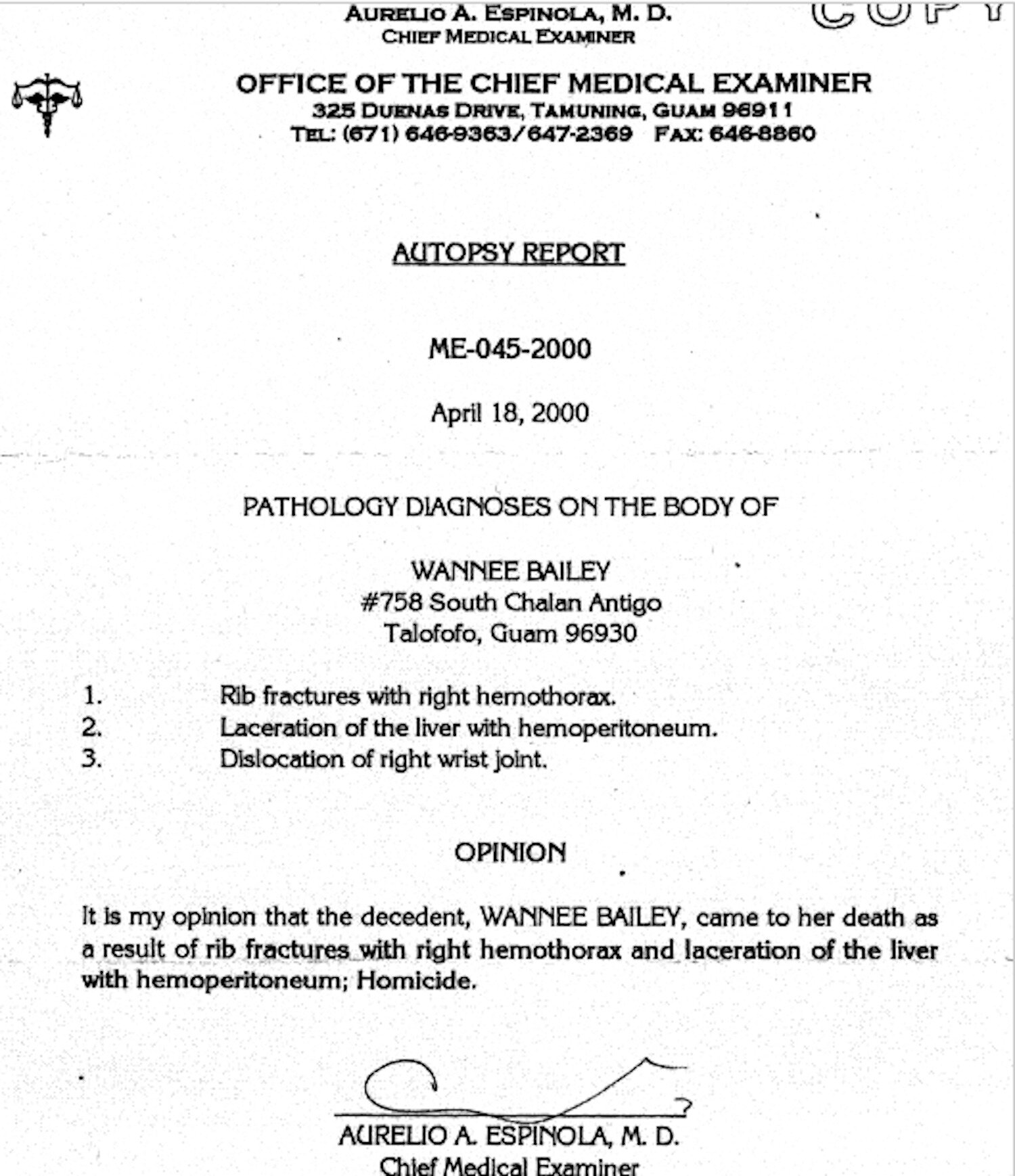
Wannee divorced Bailey in 2000. By that time, she and Bailey had relocated to Guam where they owned property. They agreed on a division of assets and court orders were made including an order that their home be sold. In February 2000 Wannee returned to Guam in order to confront Bailey about delays in the sale of the home and the payment of monies which he was supposed to pay her. Not long afterwards, Bailey reported her missing from their isolated home in Guam and the following day he reported that he found her body. Her autopsy report and death certificate note that her death was the result of a homicide. No one has ever been charged for her death.
On the night she went missing she telephoned her niece and told her that Bailey was in a rage and that if she didn’t return from Guam, it meant she had been murdered. Prophetic words…
Under the court orders Bailey was to pay certain money to Wannee beyond April 2000. It appears that the administrator of Wannee’s estate was not aware that Bailey still owed money to the Estate so the debt was not pursued. At the time of her death Pornchai was in prison so there was no one around who would have known about the court orders other than Bailey.
Following a police investigation and grand jury indictments, in early 2017 Bailey was charged with 40 counts of Gross Sexual Misconduct. The victims were Pornchai and his brother Priwan.
Knowing that there has been a criminal case against Bailey has been difficult for Pornchai over the past few years because he has had to relive the past, give statements and go over things again and again. Thank God that his cellmate is Fr Gordon MacRae who provides spiritual advice and good counsel. Fr Gordon has had a huge positive impact on Pornchai’s life. Without his continuous efforts to pursue justice and for Pornchai’s story to be made known, the truth would never have come out.
In March 2017 the Bailey case went before the Superior Court of Maine, and following a number of arraignments, the matter was before the Court September 11, 2018. On that date, Bailey formally entered a plea of nolo contendere — his attorney indicated that Bailey denied any wrongdoing but that he would not contest the charges and agreed to be sentenced by the court. The Victims Impact Statements of both brothers were read to the court and the judge was quite shaken and deeply moved by the statements. The case was adjourned to the following day, September 12.
As is common in the US legal system, the Office of the District Attorney had agreed on a plea deal with Bailey’s attorney which provided for a suspended sentence of 17 years with a probation period imposing strict conditions — but the length of such probation had not been agreed upon. However, the judge found Bailey guilty on all 40 charges and imposed a longer suspended sentence of 18 years, the whole of which would be subject to very strict probation conditions. It appears that the judge had to take Bailey’s claims of poor health into consideration (he is four years older than Fr Gordon), but also the impact of a trial on both brothers. At the hearing, Pornchai’s brother was quite visibly distraught. Despite there being no prison term for Bailey, I think that justice has been served in this case. The judge was obviously more than satisfied that Bailey is guilty and ordered a longer sentence on probation than in the plea agreement that was submitted to the court.

The Divine Mercy Redemption
Over the past few years, myself and others have been planning what happens with Pornchai when he is eventually deported at the end of his sentence. Then out of the blue, a wonderful lady from Bangkok named Yela Smit contacted Fr Gordon to find out how she could help. Yela was the co-director of the Divine Mercy Apostolate in Thailand. She has since gathered a lot of support for Pornchai and offered practical assistance. We have spoken a number of times on the phone and I distinctly remember her saying to me “He’s going to have a wonderful life in Thailand, he’ll wonder why he ever stayed so long in America”. Yela’s input was invaluable. Knowing about Pornchai’s conversion and his Marian consecration — to find Yela was a Godsend as are her friends, Khun Peter in Thailand and Viktor Weyand, an American travel agent. Viktor was a co-founder of a Divine Mercy orphanage and school in Thailand, and two years ago travelled to Thailand for the priesthood ordination of the first resident of the orphanage. Viktor has since become a very dear friend to Pornchai, and he and his wife have visited Pornchai at Christmas time.
In “A Stitch in Time: Threads of the Tapestry of God”, Fr Gordon wrote about this amazing tapestry where the lives of people from all over the world touch each other, and I am proud to have been part of it. Fr Gordon wrote:
“This story now connects people on five continents who have no obvious connection beyond their interest in Pornchai’s life and their immersion in the work of Divine Mercy.”
People from around the world have all used their skills and life experience to help Pornchai, all being driven and guided by Heaven. We all had an important part to play and we did what was expected of us.
Pornchai’s story is a great story on so many different levels. It is a story of faith and Divine Mercy. It’s a story of great tragedy followed by a dramatic conversion, a Marian consecration and a faith filled life. It’s the story of a young agnostic child in Bangkok who became a truly holy and devout man with hope for tomorrow and who survived the most brutal prison life. He is not just prisoner number 77948 — he is a truly remarkable and unique man who will give witness and glory to God.
It’s also a story of the power of prayer and of Divine Providence. None of us could have achieved anything without help from above. All of you who have prayed and fasted and given practical assistance to Pornchai and Fr Gordon are also a very important part of the tapestry. Without faith and prayer, nothing would have been achieved. So, consider it a collective effort guided by the Lord with a lot of help from Our Lady. All of the key players who have and are helping Pornchai have a connection with Divine Mercy and are Marian devotees and we all came together to help Pornchai.
Fr Gordon has spoken about Fr Seraphim Michalenko’s involvement in Pornchai’s life. Several years ago, a friend asked me if I wanted to go to a talk by a visiting priest to be held at the home of a friend in the Perth hill in Western Australia. I had never heard of the priest before but knew that he was going to give a talk on Divine Mercy. His name was Fr Seraphim Michalenko. At the talk I found out more about St Faustina’s revelations and of the two miracles that led to the canonisation of Faustina. I even had a private chat with Fr Seraphim.
In the 2014 post, Fr Seraphim Michalenko on a Mission of Divine Mercy, Fr Gordon told us that the Felix Carroll book, Love Lost Found – 17 Divine Mercy Conversions with its chapter about Pornchai was sent by Fr Seraphim to Yela Smit in Thailand. That’s how Yela became involved. Another Divine Mercy connection is that Fr Seraphim was the director of the National Shrine of The Divine Mercy in Stockbridge, Massachusetts and he has been a visiting priest to the chapel of the New Hampshire Prison for Men and has also participated in a Divine Mercy Retreat at the prison. What are the odds that I would ever meet Fr Seraphim? — and the fact that he has a connection to Pornchai and Fr Gordon is amazing. The tapestry Fr Gordon wrote about gets more amazing by the day and I know that I will never know the full extent of it.
Pornchai will probably be in prison until at least the first half of 2021 when he will be eligible for release and once released he will be held in detention by Immigrations and Customs Enforcement. He will then be deported to his native Thailand because he is not an American citizen.
Pornchai has made the most of prison life and has received a good education and has many vocational skills. He is not bitter at all. As for his thoughts on Bailey — when asked by the Assistant District Attorney if he wanted Bailey to go to prison — Pornchai said to her, “No, I don’t want him to go to prison — I just want him to know that what he did was wrong.” Awesome! I don’t know if I could utter those words if I was in Pornchai’s position but whilst old memories will always be there, he has forgiven Bailey. He looks back on the past with great sadness, but doesn’t dwell on it and he has great hope for the future. It will be a culture shock to return to a country where he no longer speaks the language but he has new friends to meet and a career to begin.
Many people have prayed for Pornchai and continue to keep him in their prayers. Without a doubt this has helped him enormously and God’s providence has also rained down upon him.
Please keep him in your prayers and pray that he will transition smoothly into Thai life, that he will forge a good career that will make him financially independent and that he will truly find peace.
And continue to pray for Fr Gordon MacRae who in my eyes is a living saint. Without him, his tenacity and unwavering efforts to help Pornchai, this story would have never come to light.

Pornchai Moontri: Bangkok to Bangor, Survivor of the Night
This is the long-awaited story of Pornchai Moontri and Fr. Gordon MacRae, two lives denied justice and deprived of hope that converged upon the Great Tapestry of God.
This is the long-awaited story of Pornchai Moontri and Fr. Gordon MacRae, two lives denied justice and deprived of hope that converged upon the Great Tapestry of God.
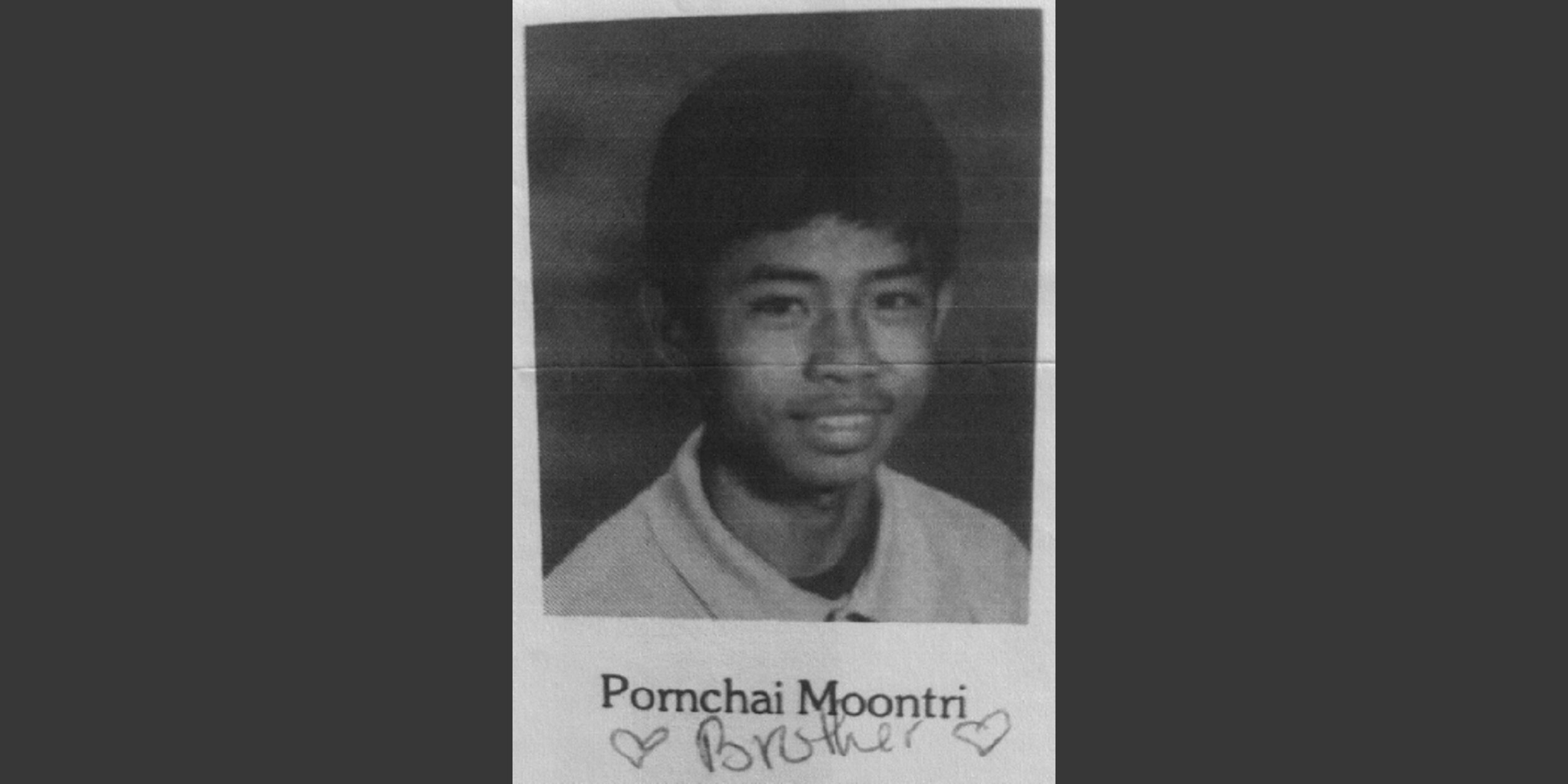
Editor’s note: The photo of Pornchai Moontri at the top of this post was a middle school yearbook photo taken at age 12 just after his arrival in America and just prior to the onset of events described in this post. His brother Priwan wrote the word “Brother” with the two hearts under the photo in the yearbook.
In nine years of writing for Beyond These Stone Walls, this is the most important post I have ever composed. If you have never before shared my posts on social media or emailed them to friends, I urge you to share this one. It is not about me — at least, not directly. It is about something that has haunted my every day for the last twelve years. It’s about someone who committed a ‘real’ and tragic criminal act, but was himself the victim of a horrible crime. It is something so ironic it defies belief.
I recently hinted that this story was coming. After twelve years in the making it came to its apex this month on the Feast of the Most Holy Name of Mary. Here’s what I wrote in a recent post about “Mary, Undoer of Knots”:
“I want to put some unexpected context on the significance of that day — September 10, 1985 — as I eulogized my beloved Uncle near Harvard. Unbeknownst to me, on that same day and moment on the far side of the world, Pornchai Moontri turned 12 years old in Bangkok, Thailand where he was reunited with his mother after her ten-year absence from his life. On that day, he began a journey to a promised new life in America.”
Six-and-a-half years later, on Saturday evening, March 21, 1992, in a state of intoxication, 18-year-old Pornchai Moontri walked into a Bangor, Maine supermarket and tried to walk out with a six-pack of beer. He was chased into the parking lot. In his drunken state Pornchai had trouble piecing together what came next. He heard much of it for the first time sitting in court.
As he fled across the Shop’n Save parking lot that night, 27 year-old Michael Scott McDowell injected himself into the scene. He saw store employees chasing a young Asian man and assumed it was for shoplifting. The much larger McDowell tackled Pornchai and wrestled him to the ground. Pinned down and helpless, Pornchai described this moment in “Pornchai’s Story” as “something that lived in me got out.”
Pornchai remembers getting up and running, running, running. Later that night he wandered the streets alone, exhausted and confused. He lived on those streets, a homeless teenager in a small port city of 31,000 in a foreign country. He slept under a bridge. As he fled, hunted, through the streets of Bangor that night, a car pulled up. A man he neither knew nor remembers told him to get in.
There, in that vehicle, he sat in silence until the police came for him. To this day, he knows nothing of the identity of the man who sheltered him. Pornchai was charged with assault with a deadly weapon, a knife he carried for protection while living on the streets. The next morning, the police told him that the charge is upgraded to murder. Michael Scott McDowell had died.
On Thursday, September 30, 1992, journalist Steve Kloehn penned a report for the Bangor Daily News entitled, “McDowell murder closed with a verdict, not a reason.” Its opening paragraph set the stage for the mystery contained therein:
“Thomas Goodwin, representing the state of Maine, was trying to explain to a jury the inexplicable: how Pornchai Moontri walked into the Shop’n Save a teenager and came out a murderer.”
Until now, I have not been able to write the whole truth of my last twelve years behind these stone walls. I have alluded to some of it in cryptic prose, but not everyone caught it. But many understood that there is an important story coming, a true story of unimaginable pain, power, and consequence. This is the most important post I have ever written.
If you have been reading these pages with any regularity at all, then you have come to know Pornchai “Maximilian” Moontri. This is his story, and it may bring tears. It should. But the sun also rises, and with the long awaited dawn comes — if not rejoicing — then at least a modicum of peace.

Solitary Confinement
Pornchai and I first met at the New Hampshire State Prison in 2006. He had been transferred from a “Supermax” prison in the State of Maine where he served the previous fourteen years — half of them in the utter cruelty of solitary confinement. He had a short fuse. He lived with a despair and a rage that walls could not contain.
The system deemed Pornchai to be dangerous, unfit for the presence of other human beings. A day in his life in Maine’s “supermax” prison was chronicled by the social justice site, “Solitary Watch” in an article entitled, “Welcome to Supermax.” After fourteen years in and out of that horror — including nearly four years in one long grueling stretch — Pornchai was transferred to another state.
The transfer from a prison in Maine to one in New Hampshire was administrative and not at Pornchai’s request. His arrival in 2006 took him to a very familiar place: an initial stay in solitary confinement. After a few months he was sent to a close custody unit, and finally to a unit in the general prison population where he and I met and became friends in early 2007.
I remember the first time we met. I was walking through the prison “chow hall” carrying my tray of food. As I made my way among the crowded tables looking for a seat, I heard my name. “Hey G, sit here with us.” I spotted my young Indonesian friend, Jeclan Wawarunto sitting next to the meanest looking young Asian man I had ever encountered. I could instantly see why the other two seats at their table were still empty.
“Come sit with us,” said the ever-smiling Jeclan. “This is my new friend, Ponch. He just got here.” As I sat down, I looked into the dark eyes of the young man across from me and saw anger, but it was anger masking something else, a hurt and pain I had never imagined possible. “Ponch wants to ask you a question,” said Jeclan. His friend looked so agitated that I looked quickly away. “I just want to know if you can help me transfer to a prison in Bangkok, Thailand,” said Pornchai with hostility.
I had, ironically, just finished reading a book — 4,000 Days — about the horror of life in a Bangkok prison. I told the young man that I would not help him do something that would only destroy him. “Who is this jerk?” he asked Jeclan. Weeks later, I was surprised to see that same young Asian man dragging a trash bag with his belongings into the housing unit where I lived. I approached him and said, “I’m glad you’re here.” He glared at me as though I were crazy.
We slowly became friends. I cannot really explain this long, slow, gradual building of trust with someone for whom trust is a deadly affair. I today know the courage it took for Pornchai to trust me. One day, his assigned cell mate came to me and said that he did not know what to do. He said that Pornchai had not spoken, eaten or even gotten out of bed for days.
I went to see Pornchai. He was known for having a short fuse, but I told him I would not leave until he got out of that bunk and spoke with me. I told him that I know what is under how he feels right now. I asked him to let me try to help him.
Some time later, his cell mate moved. Prison officials were cautious in imposing a new cell mate on Pornchai, so they told him to find someone he wanted to live with. He asked me and I said yes. It was early 2007. Over time, as trust developed, the story of Pornchai’s life was drawn out of him — de profundis — from out of the depths. It is a remarkable account that is now fully corroborated, and it is shocking.

From Thailand to Terror
Pornchai was born on September 10, 1973 near the village of Bua Nong Lamphu in the Northeast of Thailand beyond the city of Khon Kaen. His father was a Thai marshal arts fighter who earned a hard-won living traveling from town to town for bouts. He was sometimes away for long periods. When Pornchai was two years old, and his brother, Priwan, was four, their mother, Wannee, left telling them that she was going to the city. She did not return. The two boys were abandoned and stranded.
Their father came home weeks later to find Pornchai and Priwan foraging for food in the streets. Pornchai was hospitalized for severe malnutrition. When he left the hospital, his father was also gone, leaving them in the custody of another woman. She eventually put them out into the street where again they had to forage for food and shelter.
Learning of this, the extended family of Pornchai’s missing mother sent a 17-year-old uncle to search for the two boys and bring them to their small farm. Pornchai and Priwan grew up there raising rice, sugar cane, and water buffalo. They worked hard, but they were happy. Over time, Pornchai forgot his mother. He came to believe that his Aunt Mae Sin was his mother.
It was 1975 when Wannee left Pornchai and Priwan at ages two and four. She went to Bangkok to find work. While there she met Richard Bailey, an American military veteran and air traffic controller from Bangor, Maine who was a frequent visitor to Thailand. He brought Wannee to the United States.
Nine years passed. In 1985, when Pornchai was 11 years old, his mother, Wannee, suddenly reappeared in Thailand to claim her sons. Pornchai had no memory of her, and was traumatized to be taken away by a stranger. He never saw his home and family again. Wannee took Pornchai and Priwan to Bangkok for several months to await passports and travel documents. Pornchai turned 12 in Bangkok on September 10, 1985. Wannee told Pornchai and his brother that in America, they would never be hungry again.
In early December, 1985, they flew from Bangkok to Boston where Wannee’s husband, Richard Bailey, met them. On the long drive from Boston to Bangor, Pornchai and Priwan had their first meal in America at a McDonalds drive-thru. Both boys vomited the meal out the back seat windows of the car.
From the moment of their arrival in Bangor, the tone changed rapidly. Richard controlled their money, their speech, and their every move. The two boys and their mother were forbidden from speaking Thai in Bailey’s presence, and neither boy spoke or understood English.
Richard Bailey’s sister, who always treated Pornchai and Priwan with kindness, asked them what they wanted for Christmas. The boys did not know much about Christmas, but they understood that it involves presents. Pornchai’s adjustment had been traumatic. He asked for a watch and a teddy bear.
I caution you that from here on, this story may be difficult to read but please be brave for our friend who lived it. That night Pornchai was awakened from sleep and brought to a basement room by Richard Bailey. While there, Pornchai was forcibly raped by Bailey, an event that was to be repeated too many times to count. Pornchai was traumatized and terrified.
He did not understand what was being said, but its meaning was clear. If he resisted or told, the consequences to his mother would be severe. To demonstrate this, Bailey beat Wannee in the presence of both boys. When they tried to stop him, he beat them as well. They were treated as slaves.
Bailey then arranged separate bedrooms for the two brothers. Only much later did Pornchai learn that Bailey also raped his brother Priwan. In fear for each others’ safety, they both kept silent. They lived in a nightmare from which they saw no escape.
Witnesses who grew up in Bangor, and had read of Pornchai at this blog, have come forward with accounts of the 12-year-old who showed up at their homes traumatized, beaten and bloody. One man reports that he confronted Richard Bailey who later beat Pornchai again while forbidding him to interact with neighbors. Others have similar accounts. A school nurse reported his injuries. Nothing happened.
The first police intervention came when Pornchai was 13. He had run away, following railroad tracks out of Bangor. After a day or two, Richard Bailey reported him missing. Sheriff’s deputies pursued Pornchai through the woods and caught him. They did not understand his protests as they handed him back over to Bailey, but they filed a report alluding to their suspicions. Nothing happened.

Lost in America
By the time Pornchai was 14 in 1987, his brother, Priwan, traumatized and broken, fled Bangor. Pornchai was alone. He ran away again and again, and while evading police he lived for months on the streets of Bangor. For the second time in his life, he was forced to forage for food in the street. He also amassed a police record for stealing food, for truancy, and for being a chronic runaway.
At one point, Wannee asked Pornchai why he keeps running away. Pornchai broke down and told her in Thai what Richard Bailey had been doing to him. She warned Pornchai never to speak of this again. She said Bailey would beat her and then send her back to Thailand with no means to support them.
In the summer Pornchai lived in the woods, or under a downtown Bangor bridge (photo above) where his mother would sometimes bring him food. She held a job as a hotel maid arranged by Richard Bailey, but he tightly controlled her earnings. In the winter, Pornchai would sleep in vacant buildings or at times in the homes of friends whose parents’ welcome of him was at times generous but sometimes not. At 15, he was sentenced to reform school, the Maine Youth Center, and became a ward of the state.
While there, social worker Nancy Cochrane built some trust with Pornchai. When she learned of the severity of the physical and sexual violence he suffered, she filed a formal report with the Sheriff’s department. Deputies interviewed Richard Bailey, but no one else. Bailey convinced them that he heroically gave Pornchai a home in America and Pornchai made this whole story up. The deputies dropped the case without questioning Pornchai or his mother or brother or the social worker treating Pornchai.
The Maine Youth Center staff did not drop the matter so easily. They brought it to other authorities. During the investigation, Wannee visited Pornchai at the facility where he was held. She told him that the police questioned Bailey who then sent her to warn Pornchai to withdraw his claims. The implication — the truth of which Pornchai had already witnessed — was that Wannee would face Richard Bailey’s violence.
Fearing for his mother’s safety, Pornchai refused to cooperate further with the investigation. She was his only contact in both worlds, the nightmare he lived in America and the world he left behind in Thailand. He suffered in silence, consuming the injustices visited upon him like a toxin.
For many years, Pornchai believed that his mother chose to protect Bailey over him and Priwan. But at that moment Pornchai came to see that Wannee was as much a victim of Richard Bailey as he was. The evidence for that belief was still looming on the horizon.
State officials did not understand what was behind Pornchai’s silence. He was transferred to the Goodwill Hinckley School in Maine where he met Joe and Karen Corvino, foster parents who, for a brief period, became instrumental in his life. He later lost contact with them. Their tearful reunion with him came twenty years later when they discovered him by discovering this blog.
Pornchai did well at the Hinckley School. He excelled in Math and Soccer, and the Corvinos recognized the special child who had come to them. They considered legal adoption of Pornchai, but were told this would be difficult given that his biological mother still lived in Maine.
One day, at a soccer match with a rival school, a group of players realized that they could not win with Pornchai on the Hinckley team, so they targeted him for harassment. They pushed him, struck him, checked him, and he endured it all. Finally they shouted slurs about his mother. In seconds, all three of the larger boys were on the ground.
Pornchai was expelled from the game. The next day, over the strenuous objections of Joe and Karen Corvino, he was also expelled from the school. Joe and Karen had no choice but to put the 16-year-old alone on a bus to Bangor. They were told that a social worker would be at the other end but there was no one. At 16, Pornchai was again living on the streets. Sleeping in alleys and doorways, he began to carry a knife for protection.
Pornchai went in search of his brother, Priwan, and found him living in an Asian community in Lowell, Massachusetts. But because Pornchai was still a minor, authorities required that he return to Maine. He petitioned to be emancipated from being a ward of the state. At 17, Pornchai’s legal emancipation was processed by a reluctant Maine Youth Center staff.

The Fateful Day and the Loss of All Hope
At age 18, on March 21, 1992, Pornchai became intoxicated and the tragic offense that began this story took place. It was the last day Pornchai knew freedom, but in reality, his freedom had been taken from him six-and-a-half years earlier at age 12.
This is the context, the “why” that journalist Steve Kloehn asked in the Bangor Daily News at the end of Pornchai’s trial in 1992. Once charged, Pornchai was held without bail for months while awaiting trial in the Penobscot County Jail.
He was assigned a public defender. After a month, Wannee came to visit Pornchai once. Again sent by Richard Bailey, she pleaded with him to protect her by saying nothing of his past life. Convinced his mother was in danger, he again became silent, refusing to allow any defense that included an evaluation of his life. Under duress, he refused to participate in his own defense.
Pornchai’s brother, Priwan, told the public defender of the years of traumatic sexual and physical abuse, but Pornchai refused to discuss this and refused to allow the lawyer to raise it. He was never evaluated, and none of what happened to him became part of the court record. The judge mistook Pornchai’s silence for a defiant lack of remorse. Citing that he “had many opportunities in America but squandered them,” she sentenced 18 year-old Pornchai to 45 years in the Maine State Prison.
After the trial, Richard Bailey sold his Bangor home, took Wannee, and purchased land and a home on the U.S. Territorial Island of Guam in the Western Pacific. At age 18, alone and in prison, Pornchai was thousands of miles from his only contact with the outside world.
Eight years passed before he saw his mother again. She traveled to Thailand, and then to Maine to visit Pornchai in prison. She told him she was returning to Guam to finalize her divorce from Richard Bailey and financial settlements in the Guam courts. The year was 2000, Pornchai’s eighth year in prison.
To this day, the financial agreements ordered in the divorce decree have not been met. A cousin of Wannee in Thailand today reports that, upon her return to Guam, Wannee called her in 2000. Richard could be heard shouting in the background. The cousin states that Wannee cried that she is being threatened, and if she is found dead, she wants her cousin to demand an investigation.
Weeks later, Pornchai learned in prison that his mother had been murdered on the Island of Guam. He could learn no details except that it was filed as a homicide. The autopsy report indicates that she had been beaten to death and her body left on a beach. A Guam police report shows that Richard Bailey reported her missing, then the next day reported finding her body himself. No one has been charged. It remains today a “cold case” unsolved homicide in Guam.
This was a breaking point for Pornchai. He gave up, and ended up spending the next nearly seven years in and out of solitary confinement in Maine’s supermax prison. After seven years in hell, Pornchai was transferred to the New Hampshire State prison where we met. You know most of what followed, but not all. [Editor: WGBH-PBS Frontline’s documentary “Locked Up in America – Solitary Nation” depicts the nightmare of Pornchai’s solitary confinement. The prisoners you see were in solitary with him in adjacent cells. We’ve been having problems with the link, but this one to WGBH works well Frontline Solitary Nation.]
Once I learned the entire story, I could not let it go. I began several years ago to make discreet inquiries into Pornchai’s life in both Thailand and Maine. In 2007, shortly after we became friends and cell mates, a U.S. Immigration judge ordered that Pornchai is to be deported from the United States upon completion of his sentence. I assisted him in an appeal based on the severity of his life and his need for asylum, but to no avail.
I told Pornchai that we will need to build some connections in Thailand. He said that he did not even know where to begin. Pornchai felt overwhelmed, and took refuge in his imagined “Plan B” — his own final self-destruction. I challenged him to trust. A few years later, on Divine Mercy Sunday, 2010, Pornchai became a Catholic, and accepted my challenge to place his future in God’s hands with the guidance of his chosen Patron Saint, Maximilian Kolbe, whose name Pornchai chose as his own.
Then, Felix Carroll and Marian Press published Loved, Lost, Found with a beautiful chapter about Pornchai’s conversion. Felix graciously made the chapter available for posting. It made its way to Thailand where it moved many people in Bangkok to become involved in Pornchai’s story. A group called “Divine Mercy Thailand” organized to help bring him home. They have assured him of a home and support system when he returns.

Richard Alan Bailey at the time of his arrest on forty counts of felonious sexual assault.
A Day in Court
After being received into the Church, I convinced Pornchai to seek some treatment in the prison system. He was diagnosed with acute anxiety and severe Post Traumatic Stress Disorder. He is working with a counselor and is prescribed a medication for acute anxiety and another to inhibit nightmares.
The inquiries I had been making produced some amazing results. Clare and Malcolm Farr, a husband/wife team from an intellectual property law firm in Perth, Australia had been reading Beyond These Stone Walls. Entirely pro bono, they immersed themselves in Pornchai’s story with overtures to the government of Thailand and the State of Maine. Clare Farr, one of the attorneys, has been in daily contact with us over the last three years.
Their tireless efforts gained the notice of the Thai Consulate in New York from where officials have since visited Pornchai and involved themselves in his plight. This story also gained the attention of law enforcement in the State of Maine from where an investigation was launched. Detectives from the Bangor police traveled to Concord, NH to interview Pornchai and also met with his brother, Priwan. An Assistant District Attorney came on the second interview.
In 2017, Richard Alan Bailey was indicted on forty felony counts of gross sexual misconduct for his well documented victimization of Pornchai and his brother. He was arrested at his West Lake, Oregon home and released on $49,000 cash bond. On September 12, 2018, the Feast of the Most Holy Name of Mary, Richard Bailey entered a plea of no contest but was found guilty and stands convicted of the charges. At this writing, the 2000 Guam case remains an open unsolved homicide.
Bailey’s sentence may bring the biggest gasp of all, forty-four years in prison, but all suspended, and eighteen years of supervised probation. He will not serve a day in prison. This was a hard truth for me. I am serving 67 years in prison for crimes that never took place, with a fraction of the charges faced by Richard Bailey and with none of the evidence. It is clear. He is not ‘Father’ Richard Bailey.
Covering this story for the Bangor Daily News, reporter Judy Harrison referred to Pornchai as “the now 45-year-old convicted killer.” Fully one third of her brief coverage of this story focused not on Richard Bailey’s crimes, but on Pornchai’s. Judy Harrison turned a deaf ear to the profoundly troubling serial victimization that his Victim Impact Statement describes.
The shallowness of reporters notwithstanding, Pornchai has also learned the ways of Divine Mercy. He learned them from me. In his submitted impact statement, he asked the court for justice but also for mercy for his tormentor, the very person who has haunted his nightmares for all these years. From Pornchai’s Victim Impact Statement presented in court:
“My brother has struggled with gambling and alcohol addictions and my mother is dead. Richard carried out more sexual assaults against me than there are current charges against him. His actions have robbed me of a normal life which I can never reclaim. Fortunately I have since had a lot of counseling and with the guidance of a wonderful Catholic priest I have found faith and a firm belief in God… I asked God to help me to forgive Richard and through my strong faith I have done this… I cannot forget what he has done but I do forgive him. The law must pass a just sentence, but I agree with the terms of this plea agreement.”

But there is something even more compelling in this story. Pornchai Moontri came to me, a Catholic priest whom he believes with all his heart to be innocent of the very things that stole his hope and his ability to trust. The irony sends me to my knees in thanksgiving for an opportunity. The most important mission of my life as a man and as a priest has been walking with Pornchai Moontri from dusk to dawn in his survival of the darkest night.
Editor’s Note: Thank you for reading and sharing this important post. You may also like these related posts:
Getting Away with Murder on the Island of Guam by Fr Gordon MacRae
Pornchai Moontri and the Long Road to Freedom by Fr Gordon MacRae
Elephants and Men and Tragedy in Thailand by Pornchai Maximilian Moontri

Pope Francis in the Dock by Archbishop Carlo María Viganò
Described as “an atomic bomb dropped on the Roman Curia,” a former Apostolic Nuncio to the United States has accused Pope Francis of covering up some Cardinal sins.

Described as “an atomic bomb dropped on the Roman Curia,” a former Apostolic Nuncio to the United States accused Pope Francis of covering up some Cardinal sins.
I was just sitting on my bunk in my prison cell on Sunday night, August 26, after a tiring day on multiple fronts. I went through the day without a single message on the GTL tablet I was holding. It was unusual, the calm before the storm. I spent a few minutes at night playing one of its solitaire games that I can never seem to win. Several minutes later I exited the game to find a surprise. In that brief ten minutes, l9 messages had come into my GTL inbox. Before the night was over, there were nine more.
The summer of Catholic scandal had just detonated its third and most explosive bomb, and several readers sent me alerts and commentary. Archbishop Carlo María Viganò (pro. “vee-ga-NO”), a former Apostolic Nuncio to the United States, published an 11-page letter on two Catholic websites.
The published letter charged that Pope Francis, six months after assuming the papacy in 2013, revoked restrictions placed by Pope Benedict XVI on the ministry of Cardinal Theodore McCarrick when Pope Benedict learned of his history of sexual abuse of seminarians. Archbishop Viganò claims that he personally made Pope Francis aware that Cardinal McCarrick had been restricted to a life of prayer and penance, but simply ignored it.
The letter also claimed, among other charges, that Pope Francis ignored it as well, restoring Cardinal McCarrick to a position of power and influence as a papal advisor. Cardinal McCarrick, according to the letter, thus became instrumental in the naming of two other American prelates, Cardinal Joseph Tobin in Newark and Cardinal Blase Cupich in Chicago.
On the day this all exploded, it made for dismal reading long into the night. You need a scorecard to sort out the details of this three-strike story. First in the summer of Catholic scandal came revelations that Cardinal McCarrick, age 88, stands accused of groping a 16-year-old boy in the sacristy of St. Patrick’s Cathedral in New York City in 1971, long before he became a bishop and then a cardinal.
The claim has been presented as both credible and substantiated, but in a post, on Beyond These Stone Walls (linked below) I described this to be a matter related more to expediency than evidence. “Credible” simply means that both McCarrick and the 16-year-old lived in New York City in 1971. “Substantiated” is another matter and, absent evidence, eyewitness testimony, or an admission of the accused — and there were none of these — it defies belief. As I have pointed out, the 16-year-old is now 63.
But this bombshell has morphed into a bigger one that is far more credible and substantiated. A barrage of sordid stories has emerged about Cardinal McCarrick engaging in a decades-long pattern of homosexual predation of seminarians and younger priests. He became notorious for this, the current disclaimers of bishops notwithstanding.
These tales, and those of his now infamous beach house were familiar to many former seminarians and priests east of the Mississippi in the 1980s and 1990s. I was one of them. Meanwhile, every bishop and fellow prelate has either feigned ignorance or kept silent. In “Cardinal Theodore McCarrick and the Homosexual Matrix,” I speculated upon three questions:
Who knew what and when did they know it?
What did they do once they did know it?
Why is this all coming up now?
The central point of that post was something that each of the polar camps seldom considers as this story heightens a debate about the moral prerequisites for priesthood:
“I have encountered another condition among many, but certainly not all, homosexual seminarians and priests. I found the prevalence of narcissistic personality disorder among them to be inordinately high. Perhaps it is inordinately high in the wider ‘gay community’ as well.
I believe it is this disorder, and not simply same-sex attraction, that is the real impediment to Holy Orders. It is this that must be detected and treated as an impediment for seminary candidates. Narcissistic personality disorder is one of the most difficult personality disorders to treat and modify. One of its symptoms is the objectification of others for one’s own gratification.”
In other words, there is a developmental and psychological difference between a person who experiences same-sex attraction but remains celibate, and one who becomes a predator. Behaviors such as stalking and grooming are inherently narcissistic.
But before anyone launches a Catholic witch hunt, narcissism is a pathology not at all related to sexual orientation, although I and others have cited a higher presence of narcissistic behavior among homosexual men than heterosexual men. This was supported in a subsequent article by Dr. Rick Fitzgibbons, MD, on LifeSiteNews.
I did not intend to analyze Cardinal McCarrick in the above post, but if the behaviors with seminarians now attributed to him are true, then one could legitimately conclude that he became a manipulative, narcissistic predator. Some of what Archbishop Viganò now alleges in his 11-page bombshell letter lends credibility to this. He wrote that McCarrick was privately disciplined for these behaviors by Pope Benedict XVI in 2009, but the Cardinal “openly flouted the papal sanctions.”

The Second Bombshell: Pennsylvania
The news media, for the most part, looked the other way during the Cardinal McCarrick bombshell, and the reasons for that were political. I examined them in “The McCarrick Report and the Silence of the Sacrificial Lambs.” Then another bomb dropped, this time in Pennsylvania but with reverberations across the country and around the world.
Pennsylvania Attorney General Josh Shapiro published a Grand Jury report that exposed 300 Pennsylvania priests accused of sexually abusing 1,000 victims over a period of seventy years. Nothing in this report is new, some of it is untrue, and much of it is politically motivated. I wrote about this report in detail in “Attorney General Josh Shapiro and Joseph Goebbels In ‘The Reckoning’.”
I think I speak for many conscientious Catholics when I say that we have grown tired of upwardly mobile political careerists like AG Shapiro who allude that questioning claimants or asking for evidence “re-victimizes the victims.” Claims in the Pennsylvania report date back as far as World War II and most of the priests accused are long deceased. Many others who are still living were denied any opportunity to defend themselves. There are serious flaws, and multiple injustices, associated with this report. (Note: In the elections of November 2022, Josh Shapiro was elected Democratic Governor of Pennsylvania.)
The news media that ignored or minimized the Cardinal McCarrick story pounced on the Pennsylvania story ignoring its many flaws, lack of due process and substantiation, and the fact that it was a grotesque abuse of the grand jury system. It served a purpose for the leftist media by momentarily moving the spotlight back onto the moral panic about child abuse and off a politically less desirable truth: that homosexual predatory behavior has been the real ground-zero of the crisis.
That crisis is manifested in a 50-year history of narcissistic homosexual inclination and behavior among a significant number of seminarians, priests, and bishops. And according to Archbishop Viganò’s published letter, it is a reality with tentacles that have reached deeply into Vatican affairs.
The hypocrisy it has borne along with it never ceases. In light of the third and biggest bombshell, the accusations brought by Archbishop Viganò, USCCB President Daniel Cardinal Dinardo had this to say:
“Archbishop Viganò’s letter raised questions that deserve answers that are conclusive and based on evidence. Without those answers, innocent men may be tainted by false accusations and the guilty may be left to repeat sins of the past.”
I agree. But with all due respect, Your Eminence, there are many accused U.S. priests who deserve answers that are conclusive and based on evidence. Innocent men have been tainted — imprisoned even — by false accusations, and Cardinal McCarrick is evidence that some of the apparently guilty have been left to repeat the sins of the past. The U.S. Bishops’ Dallas Charter applied only to priests while exempting bishops.

The “Atomic Bomb” and Its Fallout
Now, with the revelations of Archbishop Carlo María Viganò, it seems that some who feigned shock over Cardinal McCarrick already knew, and had known for years, about his history of luring seminarians into a homosexual Catholic subculture of predation, compromise, and secrecy.
Archbishop Viganò’s document alleges that he personally informed Pope Francis of the above in Rome shortly after the conclave of 2013. Without apparent consultation with Pope Emeritus Benedict, Pope Francis met with McCarrick, appeared to revoke the canonical sanctions imposed by Pope Benedict, and restored Cardinal McCarrick to a position of power and influence. The media coverage of this story has been amazing. A lead editorial in The Wall Street Journal (“Pope Francis in the Dock,” August 29, 2018) chided the left for downplaying the story:
“The archbishop’s charges have split the Catholic community. Some defend [Acb. Viganò’s] reputation for honesty and professionalism while others suggest he is motivated by dislike for Pope Francis. Some secular defenders who like the pope’s politics, and are stalwarts of the #MeToo movement, want to excuse the episode… But motives are irrelevant here, or at least should be. The question is whether the archbishop’s claims are true.”
In an op-ed in The New York Times (“A Catholic Civil War?” August 27, 2018) First Things senior editor Matthew Schmitz described the fallout of the bombs of the summer of 2018 and Archbishop Viganò’s letter to be evidence of our polar ideologies:
“No matter what Francis does now, the Catholic Church has been plunged into all-out civil war. On one side are the traditionalists, who insist that abuse can be prevented only by tighter adherence to church doctrine. On the other side are liberals, who demand that the church cease condemning homosexual acts and allow gay priests to step out of the closet.”
I do not at all agree with this assessment of the state of affairs in the Holy See. This is not a matter of simple polarity, but of truth. Getting at that truth is something owed to the Church. How best to do this is the next big question. Some more conservative commentators have cast a series of doubts about the integrity of Pope Francis in the light of what is presently alleged. Others on the left attack Viganò.
Those in the media, often of a more liberal mindset, have suggested that Archbishop Viganò should be treated with a degree of skepticism. John Allen, formerly Rome Correspondent for the National Catholic Reporter and presently president of Crux Catholic Media wrote that “The proper attitude is to take [the Viganò letter] seriously but with a large grain of salt [and] healthy skepticism.”
Mr. Allen cited as a reason for “healthy skepticism” Archbishop Viganò’s “unsubstantiated” accusations against other church leaders in the same document, and the Archbishop’s history as an emphatic critic of the pope’s liberal views on divorce and homosexuality. The Rev. Robert Imbelli, emeritus professor of theology at Boston College — in the epicenter of the 2002 abuse scandal — suggested that the pope “leaves it to journalists and their professional competence to evaluate the truth.”
I am sorry, but “journalists and their professional competence” may seem a cruel joke to anyone who has been victimized by the news media’s total lack of John Allen’s “healthy skepticism” when it comes to coverage — and the most basic truth-telling — about Catholic scandal. For the best commentary on the media’s lack of “healthy skepticism” see JoAnn Wypijewski’s courageous media comeuppance: “Spotlight Oscar Hangover: Why ‘Spotlight’ Is a Terrible Film.”

Vigano: Impeccable Integrity or Caped Crusader?
Despite some of the aspersions against his integrity and motives, any honest assessment of Archbishop Viganò’s Vatican-based career can lead to only one conclusion. He has been a servant of the Church of the highest caliber, exhibiting moral fortitude and integrity — sometimes at great cost to himself.
In 2012, the Vatican’s most powerful powerbroker under Pope Benedict XVI, Secretary of State Cardinal Tarcisio Bertone, engineered a plot to move Acb. Viganò out of Rome. He was transferred against his will from his position as Deputy Governor of Vatican City to a post as Apostolic Nuncio to the United States, a position that Viganò interpreted as “exile.”
America is not normally considered a place of exile, but it’s easy to understand why Viganò saw it that way. His reforms in the financial structure of Vatican City halted the scourge of nepotism and corruption. His department went from a 10 million Euro Debt to a 30 million Euro surplus in one year. He ended corrupt contracts and replaced them with legitimate ones. In the ordinary course, this would be a good reason to keep him around.
So his “exile” was perplexing. His letter of appeal to Pope Benedict was never answered when he was sent to Washington DC. It was from this move that Acb. Viganò was unwittingly placed in a position between the affairs of Rome and the Archdiocese of Washington where, he says, Cardinal Donald Wuerl also became keenly aware of censures placed on Cardinal McCarrick by Pope Benedict, but chose not to enforce them. Cardinal Wuerl denies this, a position that grows weaker by the day.
This is not the last word. Without doubt, there is more to come. Until it does, I am a loyal and steadfast supporter of the pope until clear evidence loosens that knot. Nonetheless, every visible and credible source measures Archbishop Carlo María Viganò as a man of great integrity and courage. We would all be fools not to listen.
+ + +
Editor’s Note: This article and others like it can be found in our “Inside the Vatican” category in the BTSW Public Library. Please share this important post. And please consider these other related posts from Father Gordon MacRae and Beyond These Stone Walls:

Cardinal Theodore McCarrick and the Homosexual Matrix
A claim that the former Archbishop of Washington, DC sexually assaulted a New York 16-year-old in 1971 is weighed against a broader spectrum of homosexual behaviors.

A claim that the former Archbishop of Washington, DC sexually assaulted a New York 16-year-old in 1971 is weighed against a broader spectrum of homosexual behaviors.
Now that President Donald Trump has nominated Brett Kavanaugh, a respected Constitutional scholar and devout Catholic to the U.S. Supreme Court, we can expect some anti-Catholic rhetoric in months to come. In a recent Wall Street Journal op-ed about one of the other finalists (“Inside Amy Coney Barrett’s Cult,” WSJ, July 7, 2018), I wrote this comment for the WSJ Online edition:
“The greatest tragedy to befall the Catholic Church in America was to accommodate itself too much to the culture in which it lives. Its leaders became comfortable in America, then amassed power, and then tried to hide the corruption that always accompanies the need to retain power. But the humbling of Catholic leaders has run its course, and now, from the bottom of pop culture popularity, it is time to come back swinging.
Imagine the outcries if Islamic or Jewish nominees to the Supreme Court were publicly discredited by Senator Dianne Feinstein for actually living and believing the faith they profess. It is time for Catholic leaders to reconnect with their spines. This disdain for authentic Catholicism in America was brought to the fore when “Wikileaks Found Catholics in the Basket of Deplorables.”
It was premature of me to write, “But the humbling of Catholic leaders has run its course….” Immediately after I wrote it, news surfaced that Cardinal Theodore McCarrick, former Archbishop of Washington, DC, was accused in what is described as a “credible and substantiated” claim of sexual abuse of a 16-year-old male.
My first thought was, “How can I possibly write about this?” How can I not write about it? This story has been the elephant in the sacristy for weeks. Cardinal Theodore McCarrick, age 88, has been accused of groping a 16-year-old boy in the sacristy of St. Patrick’s Cathedral in New York City when he was a priest in that archdiocese in 1971, long before he became a bishop.
But before anyone recoils in horror, the story needs a dose of perspective. I tried to bring some of that perspective in a comment on “McCarrick Accused,” a news story by Joan Frawley Desmond, a Senior Editor for the National Catholic Register.
The Register article raised many questions about who knew what and when in ‘the Cardinal McCarrick story, including whether his alleged homosexual predation was known to Pope John Paul II before McCarrick was appointed Archbishop of Washington and elevated to Cardinal. Here is my comment on that article:
“There can be no transparency on this topic as long as its cast of characters continues to wield the sex abuse story as a weapon in support of varying agendas. I have several issues with this story:
1) It is nearly a half-century old. Does anyone wonder why it surfaces only now just as a new conservative nominee to the Supreme Court is about to be named? What better way to stifle a Catholic voice than a renewed sex abuse scandal?
2) I was a first-year seminarian forty years ago and heard many stories about the homosexual exploits of then Bishop McCarrick. The stories were not passed around by seminarians who saw themselves as victims, but by young gay men who boasted of currying narcissistic favor with a bishop. I knew decades ago that Cardinal McCarrick had been strongly advised by the Apostolic Nuncio to sell his scandalous beach house.
3) There is no reason at all to believe that Pope John Paul II knew about any of this before elevating McCarrick to Cardinal Archbishop of Washington. The U.S. bishops treated this story with a wink and a nod for years and had each others’ backs.
4) What makes this newest claim of a minor “credible and substantiated?” He is not 16. He is 63, and McCarrick denies it. By what magic is this 47-year-old claim of groping “substantiated?”
5) And lastly, the BIG question: Why would American Catholic leaders go to such extreme lengths for so long to shield homosexual priests from being implicated in The Scandal? It is a monument to the power of reaction formation [a classic Freudian defense mechanism] when an entire institution prefers the term “pedophile scandal” to “homosexual scandal” even when the facts say otherwise.”

The Mirror of Justice Cracked
One of the many stinging rebukes of both Cardinal McCarrick and the American church coming out of this story was by Anthony Esolan in “Vesting in Lavender,” a blog post for The Catholic Thing. Professor Esolan wrote:
“And now this, about Cardinal McCarrick. The cardinal, choosing his words precisely, says he has no memory of ever having engaged in the sexual abuse of the erstwhile young man [who happens to be 63] who is now accusing him…
The cardinal has cautiously denied one sin, while not bothering to address the thousand others. For all these years, according to witnesses at last speaking out, he has been vesting in lavender, compromising young men in his charge… He has pointedly not said, ‘I have never had sexual relations with a seminarian or a priest.’”
Apologies to Anthony Esolan whom I much respect, but all I could think of when reading this was President Bill Clinton’s famous obfuscation, “I did not have sexual relations with that woman!” (referring to Monica Lewinski), and his later, more measured response, “It depends on what you mean by sex.”
We, too, must choose our words carefully. A man accused of a crime — like the sexual abuse of a 16-year-old — must be judged on the evidence of the crime and not on his reputation. This is why our legal system has so-called “rape shield laws.” A woman who is a victim of assault is protected from having her sexual history placed on trial. The same must be true of a defendant.
Cardinal McCarrick will not be a defendant in this story. There will be no trial of facts because American criminal law does not allow for one 47 years after such an offense was alleged to have happened. But there will be a canonical procedure because “prescription,” canon law’s version of a statute of limitations, was dispensed with after the U.S. Bishops’ “Dallas Charter.”
It’s ironic that Cardinal McCarrick was one of the Dallas Charter’s main proponents pushing it through. “Zero tolerance” and the due process rights that the Charter has so severely eroded for a multitude of accused priests will now also apply to Cardinal McCarrick. We learned a lot about the flaws in that process in Father Stuart MacDonald’s recent very popular post, “Last Rights: Canon Law in a Mirror of Justice Cracked.”
Nonetheless, Cardinal McCarrick should still be due the rights that have been denied to others. One canon lawyer who read my comment in the Register sent me a message thanking me for it adding, “Your point number four should be shouted from the rooftops again and again.” Let me reiterate point number four:
“What makes this newest claim of a minor ‘credible and substantiated?’ He is not 16. He is 63, and McCarrick denies it. By what magic is this 47-year-old claim of groping ‘substantiated?’”
I do not think that we should be so quick to accept that this is “credible and substantiated” as claimed. The 197l claim surfaced for the first time only after the Archdiocese of New York announced the existence of a fund to compensate victims of sexual abuse related to the ministry of the Archdiocese. There was a time when possible financial motives for bringing such claims were examined in a critical light.
The person who brought this claim — after waiting 47 years — is not 16 years old. He is 63. Additionally, the claim is unlike every other claim of homosexual misconduct now alleged against Cardinal McCarrick. This claim alleges force and a story that the unnamed victim had to “fight off” an alleged second assault in the sacristy of one of the busiest cathedrals on the planet.
It is also important to understand what the bishops and their Dallas Charter now mean by “credible.” It is not nearly the same “reasonable doubt” standard that should (but isn’t always) be present in a criminal trial. “Credible” simply means that it cannot immediately be disproven. If the young man lived in NYC at age 16 and did attend a specific Catholic school, then the claims could have happened. “Credible” means no more than that.
“Substantiated” is a very different standard. It requires (or at least should require) an admission of the accused. Cardinal McCarrick vehemently denies this claim. Or it should require the statement of a corroborating witness. If there is one, why would it take 47 years for that person to come forward? And why would the integrity of this snippet of memory be accepted at face value? This is why statutes of limitations exist in legal systems. They exist to promote justice, not defy it.
None of the above means that Cardinal McCarrick is not culpable for the much broader history now being claimed of him in light of this incident from nearly a half-century ago. My issue with this is that the claims are presented as though they have only now surfaced. These claims are not newly discovered.. There is nothing new here. For decades, McCarrick had been rumored to be involved in grooming seminarians and others, casting suspicion on his own sexuality. I will return to this in a moment.

The Homosexual Matrix
In a coming post, I plan to write about some recent statements of Pope Francis and his supposedly “progressive” views. For now, I want to point out something that he recently said that was about as counter-progressive as a pope could get. The news media played this down to the point of ignoring it, but Pope Francis has said something revolutionary about homosexuality and the priesthood.
He told the Italian bishops in May that they should not accept seminary candidates who exhibit same-sex attraction because “it could end in scandal.” It amazes me that the news media would hype Amoris laetitia and its suggestion of a dialog on reception of the Eucharist for those in an invalid marriage while keeping a media blackout about his statements on same-sex marriage and barring homosexual candidates from priesthood.
Prior to my current state in life, I served as Director of Admissions for a residential center that provided spiritual rehabilitation and psychological care for priests, brothers, and seminarians. The facility and its sponsoring religious order, the Servants of the Paraclete, were a profound source of good in the lives of many wounded priests.
I hope it no longer comes as a shock that there are indeed Catholic priests who have experienced same-sex attraction. Along with other conditions with the potential to compromise ministry and fidelity to priesthood, many of them had come to face this openly, and for the first time in their lives, under the care of the Servants of the Paraclete.
No one in that setting promoted homosexuality. No one condoned it. There was no “wink and nod” or looking the other way. Fidelity to the Church’s teaching was upheld and embraced while also embracing the human realities and limits we all face and cope with. Our shared inability to live an ideal is never an excuse for disposing of the ideal.
I think most Catholics are beyond feeling scandalized by the mere existence of same-sex attraction in the life of a priest. I remember being told by one priest that he could not bear the shock of others in his life learning of this. I told him that the real shock may be his revelation to them that he thought they did not already know.
For many of these men, this aspect of themselves existed only in the internal forum, wrestled with by their consciences but not involving what anyone could call a “lifestyle.” Many of these priests sought out spiritual and psychological support to address this because of their fidelity, not in spite of it.
What we tried to convey, and helped them to apply, was their responsibility for discerning and maintaining the boundaries — physical, psychological, and spiritual — between having such an attraction and acting upon it. It was my position, and a well-received one, that heterosexual priests had to discern and maintain those very same boundaries. Celibacy and other requirements of priesthood are not dispensable options.
Some priests and seminarians struggle with same-sex attraction, and those who are spiritually strengthened by their own struggle can be fine priests who live celibate lives with accountability and transparency. But I have also encountered another condition among many — but certainly not all — homosexual seminarians and priests. I found the prevalence of narcissistic personality disorder among them to be inordinately high. Perhaps it is inordinately high in the wider “gay community” as well.
I believe it is this disorder, and not simply same-sex attraction, that is the real impediment to Holy Orders. It is this that must be detected and treated as an impediment for seminary candidates. Narcissistic personality disorder is one of the most difficult personality disorders to treat and modify. One of its symptoms is the objectification of others for one’s own gratification.
Narcissistic personality disorder is manifested in a tendency to be grandiose and exhibit inflated self-importance. It is manifested in a lack of genuine empathy, seeks to be exploitive, tends toward a sense of entitlement, and takes advantage of others who are objectified and groomed with no account of what might be in their best interest.
When coupled with same-sex attraction, narcissistic personality disorder creates what I call a “homosexual matrix.” In science, a matrix is “a situation or surrounding substance within which something else originates, develops, or is contained.” There are priests with same-sex attraction who struggle for and attain fidelity and equilibrium in their lives as men and as priests.
There are others, however, for whom an identity as “gay” is the core of their being. It is their matrix, and all other aspects of their lives — including priesthood — must accommodate it and become subjugated in service to it. It becomes the centerpiece of one’s identity and renders a man incapable of living the charisms of priesthood.

I do not pretend to psychoanalyze Cardinal McCarrick — and it would be a grave injustice to do so — but I remember being a seminarian in the late 1970s when he was an auxiliary bishop of New York, and in 1981 when he became Bishop of Metuchin, New Jersey. I remember the stories about him told by young men who did not present themselves as victims, but as predators in their own right. They did not present as McCarrick’s conquests, but often rather the other way around.
Some of Bishop McCarrick’s seminarians and their friends openly boasted of what they concluded was his attraction to them. They spoke of how they fostered it, were invited to his beach house, even slept in the same bed at times, but there were no stories of overt sexual predation or force until the lure of money was at the other end of the story.
I did not travel within the seminary circles that reveled in the trading of such accounts. As a seminarian, I was in a smaller circle of men who were repulsed by them. But my instinct was clear. These young men objectified themselves, measuring their own self-worth by the quality and quantity of attention from someone like Bishop McCarrick. Some went on to ordination in a state of narcissism and objectification of others.
In his “Scandal Time” series of essays in First Things in 2002, the late Father Richard John Neuhaus described the seminary climate of the time. None of this is newly discovered news:
“Today’s newspaper brings another report, this one about a seminary in the Southwest where the influence of the ‘lavender mafia’ and the consequent and predictable scandals are coming to light. ‘I have no control over the seminary,’ the bishop is reported as saying. That is simply false…
“Now there is Michael Rose’s forthcoming book, Goodbye, Good Men (2002) which I have had a chance to read… A large part of the book is based on interviews with men who were repelled by seminaries dominated by the ‘lavender mafia.’ Rose names names…”
Cardinal McCarrick was surrounded by priests and bishops who knew the path he was on, treated it with “a wink and a nod” typical of the 1970s, and did little to foster accountability. For reasons of their own, they promote an image today that these matters are coming to light for the first time. They are not.
But this is another time, and now Theodore McCarrick is stripped of his Red Hat. Hindsight is not always the best sight. Fifty years after the brave Pope Paul VI signed Humanae vitae, we should bravely face the legacy of the sexual revolution and how it has stripped many of honor, fidelity, and dignity. Hindsight does expose one glaring truth: It was, in fact, revolting.
There is more to be said of all this, but I must repeat point number five in my National Catholic Register comment above:
“And lastly, the BIG question: Why would American Catholic leaders go to such extreme lengths for so long to shield homosexual priests from being implicated in The Scandal? It is a monument to the power of reaction formation when an entire institution prefers the term “pedophile scandal” to “homosexual scandal” even when the facts say otherwise.”
Editor’s Note: Please share this important post. You may also like these related posts from Fr. Gordon MacRae at These Stone Walls:
Catholic Scandal & the Third Reich: Rise & Fall of a Moral Panic
Cardinal George Pell Is on Trial and So Is Australia

Please share this post!
Padre Pio’s Letter to Pope Paul VI on Humanae Vitae
Less than two weeks before Saint Padre Pio of Pietrelcina died, he sent a letter on Humanae Vitae to Blessed Pope Paul VI who is himself due to be canonized 14 October, 2018.
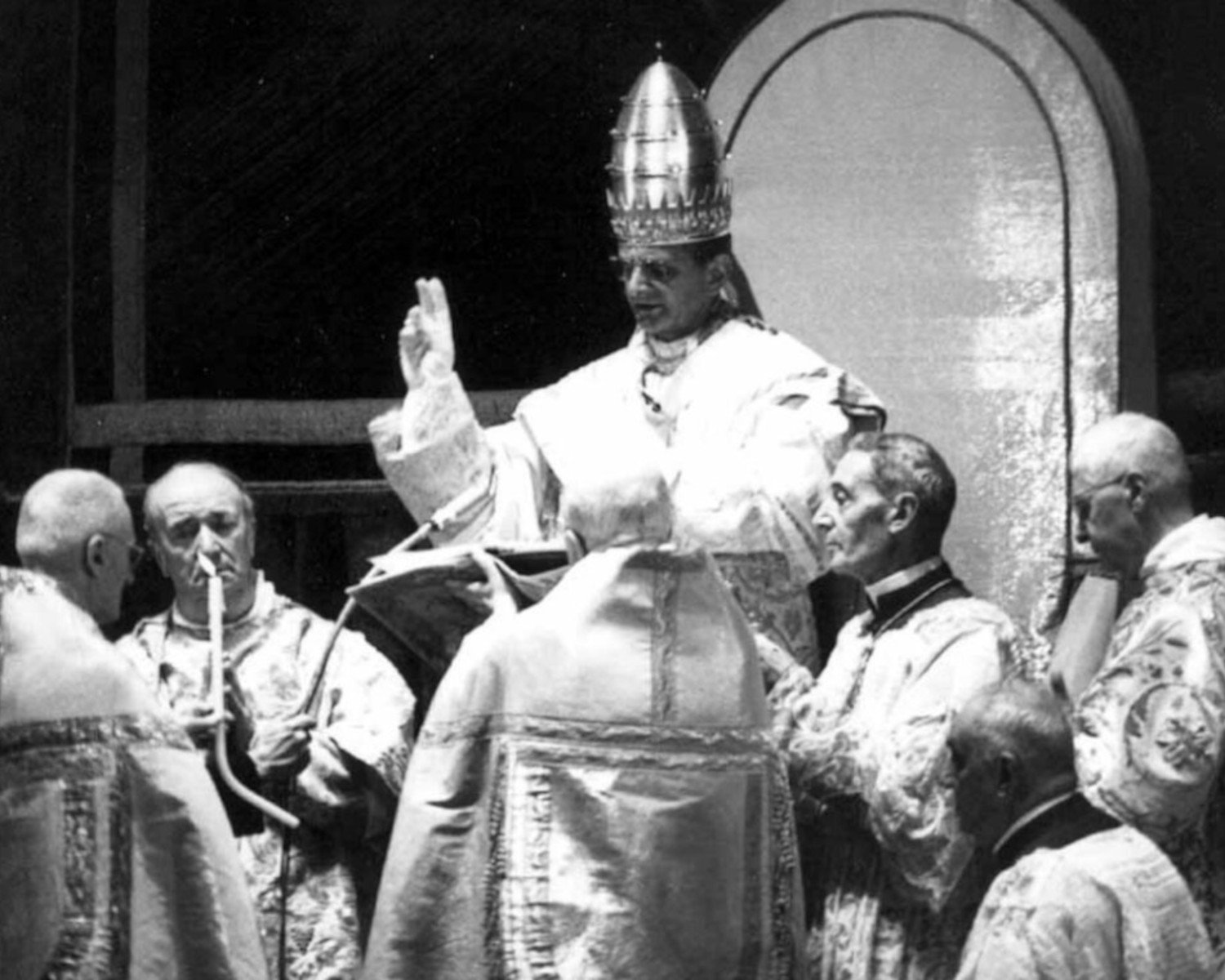
Less than two weeks before Saint Padre Pio of Pietrelcina died, he sent a letter on Humanae Vitae to Saint Pope Paul VI. The letter was discovered before Pope Paul’s 2018 canonization.
Your Holiness:
Availing myself of Your Holiness’ meeting with the Capitular Fathers, I unite myself in spirit with my Brothers, and in a spirit of faith, love and obedience to the greatness of Him whom you represent on earth, offer my respectful homage to Your August Person, humbly kneeling at Your feet.
The Capuchin Order has always been among the first in their love, fidelity, and reverence for the Holy See. I pray the Lord that its members remain ever thus, continuing their tradition of seriousness and religious asceticism, evangelical poverty, faithful observance of the Rule and Constitutions, renewing themselves in vigorous living and deep interior spirit — always ready, at the least gesture from Your Holiness, to go forward at once to assist the Church in her needs.
I know that Your heart suffers much these days on account of the happenings in the Church: for peace in the world, for the great needs of its peoples; but above all, for the lack of obedience of some, even Catholics, to the lofty teachings which You, assisted by the Holy Spirit and in the name of God, have given us. I offer Your Holiness my daily prayers and sufferings, the insignificant but sincere offering of the least of your sons, asking the Lord to comfort you with His grace to continue along the direct yet often burdensome way — in defense of those eternal truths which can never change with the times.
In the name of my spiritual sons and of the “Praying Groups” I thank Your Holiness for the clear and decisive words You have spoken in the recent encyclical, “Humanae Vitae”, and I reaffirm my own faith and my unconditional obedience to Your inspired directives.
May God grant truth to triumph, and, may peace be given to His Church, tranquility to the people of the earth, and health and prosperity to Your Holiness, so that when these disturbing clouds pass over, the Reign of God may triumph in all hearts, through the Apostolic Works of the Supreme Shepherd of all Christians.
Prostrate at Your feet, I beg you to bless me, my Brothers in religion, my spiritual sons, the “Praying Groups”, all the sick — that we may faithfully fulfill the good works done in the Name of Jesus and under your protection.
Your Holiness’ most humble servant,
PADRE PIO, Capuchin
San Giovanni Rotondo, 12th September 1968.
(l’Osservatore Romano — Weekly Edition in English — 10 October 1968)
+ + +
Editor’s note: Father Gordon’s article for this week was lost in the mail. We’ll try to put it up next week. Today is the 50th anniversary of the watershed encyclical letter Humanae Vitae, an intervention on behalf of keeping the sexual intercourse of a married couple united with an openness to life, thus proscribing contraception, abortifacients, and abortion as intrinsically dishonest. We thought it opportune to follow the lead of the Holy Spirit, republishing Padre Pio’s letter to Pope Paul VI about this, thus providing a good example of being in solidarity with the successor of Saint Peter even in the midst of controversy. At the time, some 600 theologians, many seminary professors and otherwise renegades such as Charles E. Curran and Richard A. McCormick voiced their dissent against what, some years later, Cardinal Ratzinger in his commentary on Ad Tuendam Fidem would categorize as infallible teaching. Please share this post widely on social media and take the time to read the short but entirely prophetic document praised by the saints:
Humanae Vitae promulgated on 25 July 1968 by Pope Paul VI
Note from Father Gordon J. MacRae: Please share this post. It is our first guest post by a Patron Saint. I thank Father George David Byers for following the promptings of the Holy Spirit by posting this in place of my lost missive. You may also wish to see and share a post about what happened two weeks after Padre Pio’s letter was written:
“I Am a Mystery to Myself!” The Last Days of Padre Pio
+ + +


For Darryll Bifano, the Currency of Debt Is Mercy
Men facing death in this prison at one time died alone. Darryll Bifano is a prisoner and hospice volunteer who helped change that. In the process, he changed himself.

Men facing death in this prison at one time died alone. Darryll Bifano is a prisoner and hospice volunteer who helped change that. In the process, he changed himself.
Some time ago, I wrote a Scripture post that ended up being about death and thus scared some people off from reading it. Everyone has to face it, but few want to, and many spend their lives in denial of it. That post was, “The God of the Living and the Life of the Dead.” Despite its heavy dose of theology, it drew an unusual audience for Beyond These Stone Walls and was shared some 5,000 times on Facebook and other social media. Death touches everyone.
There was a pall over this prison as summer commenced this year. One of our friends, John, age 39, died of pancreatic cancer in the prison medical unit on June 10. It was a long and grueling death that saw him drift from the vibrancy of a healthy man in his thirties to an emaciated frame of his former self. Through it all, his alert mind grasped for meaning and connection.
There was a time when prisoners here died in empty isolation. Several years ago, one of my own roommates, 52-year-old Harvey, developed stomach cancer that slowly consumed his life. When he could no longer live among us, he died alone locked in a cold, bare room with four concrete walls and little human contact.
I pleaded at the time to visit Harvey and help take care of him but overwhelmed prison medical staff responded that there was just no process in place that allows for that. But in the last three years here, this has dramatically changed. A group of men — prisoners all — have come together to form a training protocol for a hospice team. Now in three-hour shifts around the clock, they sit, talk, walk and care for fellow prisoners who are dying.
My first deeply-felt gratitude to this hospice team came when our friend, Anthony Begin, died from cancer. I wrote of that journey in a post that shocked some readers. It was “Pentecost, Priesthood, and Death in the Afternoon.” I wrote about how Anthony was such a caustic personality, that I literally threw him out of my room one day. We did not speak for over a year until Pornchai Moontri told me one day that Anthony is dying.
Pornchai and I took over the care of Anthony, and in the process, he changed. So did we. Anthony was allowed to live in a bunk just outside our cell for his final months. When his condition came to the point of no return, we had to leave him in the medical unit where we would never see him again.
This was my first experience of the immense value of hospice. The newly formed prisoner hospice team was with Anthony around the clock for the final steps of his journey which I documented in “The First of the Four Last Things.” Thanks mostly to the influence of Pornchai Moontri, Anthony experienced a religious conversion and was received into the Catholic faith just before we handed him over to hospice.
I will never forget what happened a week after he died. It turned out that Anthony left this life having committed a second crime against the State of New Hampshire: an unreturned library book. When a prisoner leaves without returning a book, an alert comes across a computer screen at my desk in the prison library. Here is what the computer told me a week after Anthony died:
“Anthony Begin — Released with book #3015: Heaven is for Real.”

A Down Payment on a Debt
The recent, untimely death of John at age 39 unsettled many prisoners and sent a shockwave throughout this prison. John was a young man in good shape until he began having symptoms of discomfort. Once the diagnosis of pancreatic cancer came, the end loomed shockingly fast. His final weeks were not easy, but he was never alone thanks to the dedication and perseverance of a few good men.
One of these men is Darryll Bifano. If his name sounds a bit familiar, it’s because you have met him before in these pages. Darryll was a pitcher on Pornchai Moontri’s intramural softball team, the Legion of Angels when it won the league pennant for the third year in a row in 2016. At 6’3” and 270 pounds, Darryll Bifano was an imposing presence both on the team and in my post, “A Legion of Angels Victorious.”
A big guy with a wide wingspan not much got past Darryll on the pitcher’s mound. He proved himself to be a team player who contributed much to our victories. Today, Darryll lives on the pod Pornchai Moontri and I moved to last summer. He was among those who spoke up for us and helped us to get there.
During the long ordeal of Darryll’s ministering to John in hospice, I was much aware of the schedule he had to keep. He has a full-time job working in the prison Recreation Department — the same place where Pornchai works. Darryll also volunteers for multiple other programs offering support to prisoners in need. He is a trained volunteer for a newly formed Peer Support program that assists with monitoring and moral support for prisoners on suicide watch, a critical and important need here.
Darryll’s presence in that endeavor seemed to naturally grow out of his commitment to hospice. Having witnessed the physical and emotional toll that hospice can exact from these men, I sat down with Darryll after the death of John. We spent time processing not only the experience but also the journey that brought Darryll to this point in his life.
We began with the most natural question of all. What brought Darryll Bifano to care for the dying through hospice? I have to let him answer this in his own words:
“I am 47 years old and in the 11th year of a 27-year-to-life sentence for second degree homicide. I grew up in the ideal American family: a loving mother and father, a brother and a sister. I am the oldest. I excelled in school and in multiple sports, graduated from two universities, and followed my passion for music, and traveled that road everywhere and anywhere it would take me.
“Through trial and error and experience, I was becoming the man I always wanted to be. I was on a path of my choosing, and as a musician I developed some talent. Then everything changed in a single foggy moment. After a night of drinking and drugs, my best friend and I argued. Then we fought. I threw a single punch that killed my dear friend, Stephen, and, in the aftermath of our drunken state, he died alone.
“I work with hospice today because I have a debt to life that I cannot fully pay, but I must try. I cannot bring back my friend, but I can honor him, and be responsible, and give this tragedy meaning.”
Darryll is one of 20 prisoners, each working in 3-hour shifts, who sit with terminally ill prisoners and accompany them to the end of life. After working all day, he often takes a shift that no one else really wants — from 1:00 to 4:00 AM. A quick two hours sleep and then Darryll is up again to get ready for his work at 7:00 AM.
I have seen this schedule take its toll on Darryll, but like the few prisoners who stand out dramatically here, he seems driven by service, and the sure knowledge that mercy was shown to others is the path to peace within himself:
“I remember, as a child, the experience of my grandfather dying of cancer in his home. This drove home fore me the importance of not dying alone.
“In hospice, you’re sitting with this guy and he is dying, and it’s treated as taboo — on one else really wants to talk about it. It’s the final stage of life.
“In prison, I often hear people say, ‘I came in alone and I’ll go out alone.’ It’s their excuse for disengagement with the world around them, but I no longer believe in this. For a life that has meaning, no one can make it alone in this world.”

Is God Dead?
In the last week of John’s life, Darryll spent about eight shifts with him, mostly in the pre-dawn hours which often seemed the toughest for John. Darryll described this time as “the ideal of what hospice is supposed to be.” He walked with John from resentment and denial to acceptance. They talked of John’s life, his family, nieces, and nephews. Darryll sat and wrote letters to them dictated by John. Along the way, Darryll was witness to a transition from torment to peace.
I am not certain that Darryll phrased this as such in his own mind, but his presence to John fulfilled a basic tenet of Viktor Frankl’s famous book, Man’s Search for Meaning. Darryll was helping John to give meaning to suffering, perhaps the greatest gift one human being can impart to another in the face of death.
For much of his life, John had reportedly described himself first as an atheist, and then, in more recent years, an agnostic. In its simplest form, agnosticism is to render the question of God moot because, for the agnostic, it is impossible to know Him or whether He even exists so there is no point trying.
As I sit here typing this post, the last book John read in this life has just landed on my desk to be checked back into the library. It’s a collection of essays by the Nineteenth Century German philosopher, Friedrich Nietzsche.
I cannot imagine what prompted John to request this book, but the reality was that in his dying state he was unable to read at all. He handed the book to his hospice volunteers. Caring for him in their 3-hour shifts, he tasked them to read aloud portions of Also Sprach Zarathustra (Thus Spake Zarathustra) Nietzsche’s treatise about the death of God.
Nietzsche developed the essay between 1883 and 1885 to explain his theory of the Übermensche (meaning superman or overman). Stating that “God is dead,” Nietzsche rejected Christian beliefs and traditional values as the source of our “collective slave morality.” Instead, Nietzsche believed in the power of superman: a person of extraordinary imagination and will who can break the destructive grip of traditional Christian values.
Only a superman, Nietzsche theorized, can institute a “master morality” to save society from the slavery of Christianity. This became the foundation for Adolf Hitler’s concept of a Master Race. It was also the foundation of the effort to dissolve Christian influence in Western Civilization that I recently described in these pages in “Fathers Day in the Land of Nod.”
This was the last book John requested of me, and it was perhaps the very last book I might have sent him in the week of his death had I been given a choice. But alas, such choices are not mine to make. Nor are they Darryll Bifano’s who dutifully read aloud Nietzsche’s words to John.
I remember once writing in these pages about the resurgence of Nietzsche’s “God is Dead” movement in the 1960s. The bumper stickers were everywhere in that radical, “question everything” age of my adolescence in 1968: “GOD IS DEAD! Signed, Nietzsche.” Then one day I saw one that presented a sobering thought: “NIETZSCHE IS DEAD! Signed, God.”
Even Nietzsche, an atheist, in the end, came to regret the impact of his own atheistic thought. He wrote that the destruction of the belief in God in the 20th Century was the greatest cataclysm humanity has ever faced: “What were we doing when we unchained this Earth from its Sun? ” he asked. “Are we not now straying as though through an infinite nothing?”
But while Darryll was reading to John, he also took questions, and these were perhaps more revealing of what was taking place in the heart and soul of a man facing death while his mind struggled with its apparent emptiness. John stopped Darryll in his reading and asked, “Do you think there is a heaven? Do you think I could go there?”
Perhaps John wasn’t buying the emptiness of Nietzsche’s ode to the dying. Perhaps Darryll wasn’t buying it either, and this post is actually more about him. He is not a man who should forever be defined by his one big mistake. He is a good man, a talented and dedicated asset to the race we call “human.”
Darryll’s footprints here leave this a better place. God knows, prison very much needs natural leaders like Darryll Bifano who draw others along a path to righteousness having long since parted ways with his own personal road to ruin.
Last summer in my post, “The Days of Our Lives,” I wrote about a concert that Darryll helped organize among the musicians here. It was worthy of Carnegie Hall, and its most unforgettable moment was Darryll’s brilliant performance of Led Zeppelin’s “Stairway to Heaven.”
Darryll didn’t offer me his answers to John’s last questions: “Do you think there is a heaven? Do you think I could go there?” “I grew up a Catholic,” Darryll told me, “and like so many of the wannabe rebels of my time, I left my faith back there.”
“Is the door to it closed or cracked?” I asked. “Well…” he pondered with a distant gaze, “I always really do enjoy talking to you, G.”
+ + +
Note: On February 17, 2023 Darryll Bifano was profiled on the television news and cultural magazine, New Hampshire Chronicle.

#MeToo and #HimToo: Jonathan Grover and Father Gordon MacRae

Jonathan Edward Grover died in Scottsdale Arizona just before his 49th birthday. His role in the case against Father Gordon MacRae leaves many unanswered questions.
Editor’s Note: The following is a guest post by independent writer Ryan A. MacDonald whose previous articles include “The Post-Trial Extortion of Father Gordon MacRae” and “A Grievous Error in Judge Joseph Laplante’s Court.”
When I read Father Gordon MacRae’s Holy Week post on These Stone Walls this year, I was struck by a revelation that he offered Mass in his prison cell for the soul of a man who helped put him there by falsely accusing him. I do not know that I could have done the same in his shoes, and even if I could, I am not so certain that I would. His post took a high road that most only strive for.
The unnamed subject of that post about Judas Iscariot was Jonathan Edward Grover who died in Arizona in February two weeks before his 49th birthday. An obituary indicated that he died “peacefully,” and cited ‘a “long career in the financial industry.” Police determined the cause of death to be an accidental overdose of self-injected opiates weeks after leaving rehab. In Arizona, he had charges for theft, criminal trespass, and multiple arrests for driving under the influence of drugs. A police report described him as “homeless.”
In the early 1990s, Jonathan Grover was one of Father MacRae’s accusers. MacRae first learned of Mr. Grover’s death from a letter written by a woman who had been a young adult friend of Grover at the time of MacRae’s trial in 1994. She wrote that she is now a social worker with “expertise in PTSD” (Post Traumatic Stress Disorder). The letter accused MacRae of having “murdered” 48-year-old Grover. This requires a rational and factual response.
Of interest, Mr. Grover’s obituary – despite his being 48 years old at the time of death – featured his 1987 Keene High School (NH) graduation photograph when Grover was 18 years old. I had seen this photo before. It was among the discovery materials in MacRae’s defense files in preparation for his 1994 trial. The photograph raised the first of many doubts about Grover’s claims.
At age 18 in 1987, Grover gave Father Gordon MacRae, his parish priest and friend at the time, a nicely framed copy of that photo with a letter written on the back. It thanked MacRae for his “friendship and support,” and “for always being there for me.” It was a typically touching letter from a young man to someone he obviously admired. It was written before addiction and the inevitable justification of enablers took hold in his life.
Five years later, apparently forgetting that he ever wrote that letter, Jonathan Grover became the first of four adult brothers to accuse MacRae of a series of sexual assaults alleged to have occurred more than a decade earlier. So what happened between writing that letter in 1987 and accusing MacRae five years later in 1992? It is one of the burning questions left behind in this story.
The framed high school photograph and its accompanying letter never found their way into MacRae’s 1994 trial, or into the public record, because the trial dealt only with the claims of Jonathan’s brother, Thomas Grover. Jonathan was the first to accuse MacRae, but a trial on his claims was deferred. His story had many holes that did not reconcile with the facts. Investigators have since uncovered a different story from the one Grover and his brothers first told.

Bombshells and Black Ops
The two common denominators in the case against Father Gordon MacRae were expectations of money and James F. McLaughlin. In the 1980s, the city of Keene, New Hampshire, with a population then of about 26,000, employed a full-time sex crimes detective on its small police force. In 1988, McLaughlin launched investigations of at least three, and possibly more, Catholic priests in the area including Father Gordon MacRae.
His targeting of MacRae seems to have begun with a bizarre and explosive letter. In September 1988, Detective McLaughlin received a letter from Sylvia Gale, a social worker with the Division of Children, Youth and Families, the New Hampshire agency tasked with investigating child abuse. Ms. Gale’s letter to McLaughlin revealed that she had uncovered information about “a man in your area, a Catholic priest named Gordon MacRae.”
The letter described explosive information from an unnamed employee of Catholic Social Services in the Diocese of Manchester, who developed a slanderous tale that MacRae had been “a priest in Florida where he molested two boys, one of whom was murdered and his body mutilated.” The letter went on to claim that the case was still unsolved, and that MacRae was removed from Florida by Catholic Church officials to avoid that investigation.
The libelous letter also named a Church official, Monsignor John Quinn, as the source of this information reportedly told to an unnamed Church employee on the condition that she would be fired if she ever divulged it. The 1988 letter generated a secret 70-page report developed by Detective James McLaughlin. He launched a dogged pursuit of MacRae who was unaware at the time that any of this was going on.
This all began to unfold one year after Jonathan Grover graduated from Keene High School and presented Father MacRae with that framed photograph and letter of thanks. Armed with Sylvia Gale’s letter, Detective McLaughlin proceeded to question 26 Keene area adolescents and their parents who had known MacRae including members of the Grover family.
Up to that point, not one person had ever actually contacted McLaughlin with a complaint against MacRae, but rather it was McLaughlin who initiated these contacts. As reported below, some of them today claim to have been solicited by McLaughlin to accuse MacRae, some with the enticement of money.
I had to read up to page 54 of McLaughlin’s 1988 report before I came across any effort to corroborate the Florida “murder and mutilation” story with Florida law enforcement officials. By the time he learned that MacRae had never served as a priest in Florida and that no such crime had been committed there, the damage to MacRae’s reputation was already done, and the seeds were sown for the Grover brothers to ponder claims yet to come.
Among those approached by McLaughlin armed with Sylvia Gale’s slanderous letter was Mrs. Patricia Grover, Jonathan’s mother. A parishioner of Saint Bernard Parish in Keene where MacRae had served from 1983 to 1987, Mrs. Grover was also a DCYF social worker and an acquaintance of Sylvia Gale. She had previously worked with McLaughlin in the handling of other cases.
Mrs. Grover also knew Father MacRae. According to McLaughlin’s 1988 report, she was alarmed by the Sylvia Gale letter but doubted that MacRae had ever served as a priest in Florida. She nonetheless vowed to talk with her young adult sons about their relationship with MacRae. Four more years passed before the first of them, Jonathan Grover, accused him.
The “fake news” in the 1988 Sylvia Gale letter set this community abuzz with anxiety and gossip about the potentially lecherous and murderous priest in its midst. Later, Monsignor John Quinn and other Diocese of Manchester officials denied having any involvement in the untrue information about MacRae. They also denied that there was ever any priest who relocated from Florida to New Hampshire under the circumstances described.
Four years later in late 1992, Jonathan Grover became the first of four members of the Grover family to accuse Father Gordon MacRae of sexual abuse dating back to approximately the early 1980s. I use the word “approximately” because Grover and his brothers each presented highly conflicting and multiple versions of their stories and the relevant time frames.
As becomes clear below, Jonathan Grover’s claims became problematic for the prosecution of MacRae, but instead of questioning Grover’s veracity, the police detective engaged a contingency lawyer on Grover’s behalf. In a September 30, 1992 letter from McLaughlin to Jonathan Grover, the detective detailed his conversations with Keene attorney William Cleary who ultimately obtained a nearly $200,000 settlement for Grover from the Diocese of Manchester. From McLaughlin’s letter to Grover:
“As agreed, I contacted William Cleary about your case. Bill believes the statute of limitations has lapsed for a civil action, but this does not rule out the church being financially responsible Bill [Cleary] states he would like to meet with you for a conference. You would not be charged for this. Your options could then be outlined and discussed.”
There is reason to question Detective McLaughlin’s police reports in this case. In most of McLaughlin’s prior cases, he practiced a protocol of audio recording every interview with complainants. In many of his other reports that I have read, he made a point of explaining that he records interviews to protect the integrity of the investigation.
Two years prior to the Grover claims, for example, McLaughlin investigated a complaint against another former Keene area priest, Father Stephen Scruton. From the outset, his reports took pains to document his practice of securing both video and audio recordings of his interviews. He even administered a polygraph test on the accuser. All were standard protocol, but McLaughlin did not create a single recording of any type with any accuser in the case of Father Gordon MacRae. This is suspect, at best, and it has never been explained.
It is made more suspicious by the emergence of other information that has been developed by former FBI Special Agent Supervisor James Abbott who spent three years investigating the MacRae case. One of MacRae’s accusers, a high school classmate of Jonathan Grover, recanted his story when questioned by Mr. Abbott in 2008. An excerpt of Steven Wollschlager’s statement may shed light on why Detective McLaughlin chose not to record these interviews.
“In 1994 I was contacted by Keene Police Detective McLaughlin… I was aware at the time of Father MacRae’s trial knowing full well that it was bogus and having heard of the lawsuits and money involved and also the reputations of those who were making accusations… The lawsuits and money were of greatest discussion, and I was left feeling that if I would go along with the story I could reap the rewards as well. McLaughlin had me believing that all I had to do was make up a story about this priest and I could receive a large sum of money as others already had.
McLaughlin reminded me of the young child and girlfriend I had and referenced that life could go easier for us with a large amount of money… I was at the time using drugs and would have been influenced to say anything they wanted for money.”
In “The Trials of Father MacRae,” a 2013 article by Dorothy Rabinowitz in The Wall Street Journal, Detective McLaughlin described the above account simply as “a fabrication.” What struck me about Mr. Wollschlager’s statement, besides the fact that he had nothing whatsoever to gain by lying, is that he never went to Detective McLaughlin with an accusation. Instead, he alleges that it was McLaughlin who approached him, and the approach alleges the enticement of money.
Steven Wollschlager was not the first person to report such an overture. Given the nature of his account and others, it is unclear today whether Jonathan Grover and his brothers initiated their first contacts with this detective. This suspicion was a contentious issue in MacRae’s 1994 trial. Thomas Grover, the brother of Jonathan Grover, was asked under oath to reveal to whom he went first with his claims, the police or a personal injury lawyer, but he refused to answer. To this very day, that question has never been answered.
What became clear, however, is hard evidence that placed Detective James McLaughlin investigating at least some of this case, not from his office in the Keene Police Department, but from the Concord, NH office of Thomas Grover’s contingency lawyer, Robert Upton, before MacRae was even charged in the case.

A Conspiracy of Fraud
In a report labeled Case No. 93010850, Detective McLaughlin produced the first of several conflicting accounts of untaped interviews with Jonathan Grover. Note that the first two digits of McLaughlin’s report, “93,” seem to indicate the year it was typed, but the date on the report is August 27, 1992. The content of this report is sexually explicit so I will paraphrase. The report has Grover claiming that when he was 12 or 13 years old he “would spend nights in the St. Bernard rectory in Keene.” During those nights, he alleged, he was sexually assaulted by both Father Gordon MacRae and Father Stephen Scruton.
But there was an immediate problem. MacRae was never at St. Bernard’s Parish in Keene until being assigned there on June 15, 1983, when Grover was 14 years old. Father Stephen Scruton was never there before June of 1985 when Grover was 16 years old. These dates were easily determined from diocesan files, but McLaughlin never investigated this. The report continued with claims alleged to have taken place in the Keene YMCA hot tub:
“It was during these times that Grover would be seated in the whirlpool and both Father MacRae and Father Scruton would be joined in conversation and they would alternate in rubbing their foot against his genitals. Grover was unsure if the priests were acting in concert or if they were unaware of each other’s actions.”
This report is highly suspicious. Just months earlier, Detective McLaughlin had previously investigated Father Stephen Scruton for an identical claim brought by another person alleged to have occurred in 1985 after Scruton’s arrival at this parish. “Todd,” the person who brought that claim against Scruton, was also a high school classmate of Jonathan Grover.
After McLaughlin’s investigation, “Todd” obtained an undisclosed sum of money in settlement from the Diocese of Manchester. That interview with “Todd” was labeled Case No. 90035705 dated just 18 months before Jonathan Grover’s identical claims emerged. Unlike the Grover interviews, the interview with Todd was tape recorded by McLaughlin. Here is an excerpt from the report:
“Father Scruton was a regular at the YMCA. Todd went to the YMCA with Father Scruton. They decided to use the hot tub… At one point, Father Scruton took one of his feet and placed it between Todd’s legs and rubbed his genitals… The touching was intentional and not a mistake. A rubbing motion was used by Father Scruton… I asked Todd where he stood on civil lawsuits.”
It defies belief that a small town police detective could write a report about a Catholic priest (Scruton) fondling a teenager’s genitals in a YMCA hot tub, then 18 months later write virtually the same report with the same claims of doing the same things in the same place, only this time adding a second priest, but nothing in the second report seemed to even vaguely remind the detective of the first report.
After “Todd’s” YMCA hot tub complaint in 1990 — 18 months before Jon Grover’s own YMCA hot tub story — Father Stephen Scruton was charged by McLaughlin with misdemeanor sexual assault. He pled guilty and received a suspended sentence and probation. One year later, McLaughlin has someone else repeat the same story, only now involving both Scruton and MacRae, but two to four years before either of them was present in Keene.
What is most suspect about this claim of Jonathan Grover involving both priests is that in 1994, one year after writing the report, McLaughlin responded to a question under oath:
On occasion, I have had conversations with Reverend Stephen Scruton, however I have no recollection of ever discussing any actions of Gordon MacRae with the Reverend Scruton.
(Cited in USDC-NM 1504-JB)
But this all becomes more suspicious still. In the investigation file on these claims was found a transcript of a November 1988 Geraldo Rivera Show entitled “The Church’s Sexual Watergate.” It was faxed by the Geraldo Show in New York to Detective McLaughlin at the Keene Police Department two months after his 1988 receipt of the Sylvia Gale “Florida letter.” It was two years before “Todd’s” YMCA hot tub claim about Father Scruton and four years before Jonathan Grover’s claims. Here is an excerpt:
“Geraldo Rivera: What did the priest do to you Greg?
Greg Ridel: Around the age of 12 or so, he and I went to a YMCA. And I was an altar boy at the time. And the first time I was ever touched… he began stroking my penis in a hot tub, I believe it was, at a YMCA. From there it went to what you might call role playing in the rectory where the priests stay.”
Detective McLaughlin’s 1993 police report also had Jonathan Grover claiming that Father MacRae paid him money in the form of checks from his own and parish checking accounts in even amounts of $50 to $100 in order to maintain his silence about the abuse. McLaughlin never investigated this, but Father MacRae’s lawyer did investigate. Father MacRae’s personal checking account was researched from between 1979 to 1988. It revealed no checks issued to Jonathan or Thomas Grover.
However, the attorney uncovered several checks written from parish accounts to both Jonathan Grover and Thomas Grover. All were in even amounts between $40 and $100 and dated between 1985 and 1987 when these two brothers were 16 to 20 years of age respectively. The checks were filled out and signed by Rev. Stephen Scruton.
Days before Father Gordon MacRae’s 1994 trial commenced, his attorney sought Father Scruton for questioning. He declined to respond. When the lawyer sought a subpoena to force his deposition, Scruton fled the state. During trial, the jury heard none of this. Because the trial involved the shady claims of Thomas Grover alone, the defense could not introduce anything involving his brother, Jonathan.
In April, 2005, The Wall Street Journal published an extensive two-part investigation report of the Father MacRae case (“A Priest’s Story” Parts One and Two), but it omitted Father Stephen Scruton’s role in the story — perhaps because he could not be located. Diocese of Manchester officials reported for years that they had no awareness of Scruton’s whereabouts.
In November 2008, former FBI Special Agent Supervisor James Abbott was retained to investigate this case. He located Father Scruton at an address in Newburyport, Massachusetts just over the New Hampshire State Line. First reached by telephone, Scruton was reportedly agitated and nervous when he learned the reason for the call. The investigator heard a clear male voice in the background saying, “Steve if this is something that might help Gordon I think you should do it.” Scruton reluctantly agreed to meet.
The former FBI agent drove from his New York office to Newburyport, MA on the agreed-upon date and time, but Scruton refused to open the door. He said only that he had “consulted with someone” and now declines to answer any questions. The investigator then sent Scruton a summary of his involvement in this case and requested his cooperation by telling the simple truth.
Days after receiving it, Stephen Scruton suffered a mysterious fall down a flight of stairs and never regained consciousness. Father Stephen Scruton died a month later in January of 2009. He took the truth with him, and now Jonathan Grover has done the same. But facts speak a truth of their own. Readers can today form their own conclusions about this story.
I have formed mine, and I remain more than ever convinced that an innocent man is in prison in New Hampshire, a blight on the American justice system. Having thus far served 24 years of wrongful imprisonment for crimes that never took place, Father Gordon MacRae still prays for the dead.
“After three years of investigation of this case, I have found no evidence that Father MacRae committed these crimes, or any crimes.”

Editor’s Note: Please share this post which could be of great importance to Father MacRae for justice in both Church and State.
Ryan A. MacDonald has published extensively in both print and online media. Ryan’s articles include:
The Trial of Father MacRae: A Conspiracy of Fraud
How Psychotherapists Helped Send an Innocent Priest to Prison
In the Fr Gordon MacRae Case, Whack-a-Mole Justice Holds Court
Justice and a Priest’s Right of Defense in the Diocese of Manchester

Judas Iscariot: Who Prays for the Soul of a Betrayer?
Judas Iscariot: The most reviled name in all of Sacred Scripture is judged only by his act of betrayal, but without him among the Apostles is there any Gospel at all?

Judas Iscariot: The most reviled name in all of Sacred Scripture is judged only by his act of betrayal, but without him among the Apostles is there any Gospel at all?
False witness and betrayal are two of the most heinous themes in all of world literature, and Sacred Scripture is no exception. Literature is filled with it because so are we. Not many of us get to live our lives without ever experiencing the false witness of an enemy or the betrayal of a friend.
Recently, I was confronted by the death of someone whom I once thought of as a friend, someone who once betrayed me with a self-serving story of false witness for nothing more redemptive than thirty pieces of silver. It’s an account that will be taken up soon by some other writer for I am not objective enough to bring justice, let alone mercy, to that story.
But for now, there is one aspect of it that I must write about at this of all times. As I was preparing to offer Mass late on a Sunday night, the thought came that I should offer it for this betrayer, this liar, this thief. Every part of my psyche and spirit rebelled against that thought, but in the end, I did what I had been beckoned to do.
It was difficult. It was very difficult. And it cost me even more of myself than that person had already taken. It cost me the perversely comforting experience of eternal resentment. I have not forgiven this false accuser. That is a grace I have not yet discovered. Nor could I so easily set aside the depth of his betrayal.
In offering the Mass, I just asked God not to see this story only as I do. I asked Him not to forever let this soul slip from His grasp, for perhaps there were influences at work that I do not know. have always suspected so.
The obituary said he died “peacefully” just two weeks before his 49th birthday. It said nothing about the cause of death nor anything about a Mass. There was a generic “celebration of his life.” False witness does not leave much to celebrate. Faith, too, had been betrayed for money.
I am still angry with this person even in death, but I take no consolation that his presence in this world has passed. My anger will have to be comfort enough because at some point I realized that my Mass was likely the only one in the world that had been sacrificed for this soul with any legitimate hope for salvation.
That’s the problem with false witness. Its purveyors tell themselves they have no need for salvation. I do not know whether he is any better off for this Mass having been offered, but I do know that I am.

Ever Ancient, Ever New
The experience also focused my attention on history’s most notorious agent of false witness and betrayal, Judas Iscariot. Who has ever prayed for the soul of a betrayer? Not I — at least, not yet — but I also just weeks ago thought it impossible that I would pray for the soul of my accuser.
I cannot get Judas off my mind this week. And as with most Biblical narratives, once I took a hard look, I found a story on its surface and a far greater one in its depths. In those depths is an account of the meaning of the Cross that I found to be staggering today. It changes the way I today see the Cross and the role of Judas in bringing it about. It strikes me that there is not a single place in the narrative of salvation history that does not reflect chaos.
Understanding the Sacrifice of Calvary requires a journey all the way back to the time of Abraham, some 2000 years before the Birth of the Messiah. God had earlier made a covenant with Abraham, a promise to make of his descendants a great nation.
The story of the birth of his son, Isaac, foreshadows that of John the Baptist who in turn foreshadows Jesus. Abraham and Sarah, like Zechariah and Elizabeth, were too old to bear a child, and yet they did. And not just any child. Isaac was the evidence and hope of God’s covenant with Abraham. “I will multiply your descendants as the stars of heaven.”
Then, in Genesis 22, God called Abraham to do the unthinkable: to sacrifice his only son, the one person who was to fulfill God’s covenant. The scene unfolds on Mount Moriah, a place later described in the Book of Chronicles (2 Ch 3:1) as the very site of the future Jerusalem Temple. In obedience, Abraham placed the wood for the sacrifice upon the back of his son, Isaac, who must carry the wood to the hilltop (Gen 22:6).
On that Via Dolorosa, the child Isaac asked his father, “Where is the lamb for the sacrifice?” Abraham’s answer “God will provide Himself the lamb for a burnt offering.” Notice the subtle play on words. There is no punctuation in the original Hebrew of the text. The thought process does not convey, “God Himself will provide the lamb…. but rather, “God will provide Himself, the lamb for sacrifice.”
An Angel of the Lord ultimately stayed Abraham’s hand, and then pointed out a ram in the thicket to complete the sacrifice. In his fascinating book, The Lamb’s Supper: The Mass as Heaven on Earth (Image Books 1999) author Scott Hahn provides a reflection on the Genesis account that I had long linked to the Cross:
“Christians would later look upon the story of Abraham and Isaac as a profound allegory for the sacrifice of Jesus on the Cross.” (p. 18)
The similarities in the two accounts, says Scott Hahn, are astonishing. The first line of the New Testament – Matthew 1:1 — identifies “Jesus the Messiah, the son of David, the son of Abraham…” Jesus, like Isaac, was a faithful father’s only son. Isaac, like Jesus, carried “the wood” for his own sacrifice upon Mount Moriah. In fact, Calvary, the place of the Crucifixion of Christ, is a hillock in the Moriah range.
This places three pivotal Scriptural accounts — each separated by about 1,000 years — in the same place: The site where Abraham was called to sacrifice Isaac, the site of the Jerusalem Temple of Sacrifice, and the site of the Crucifixion of Christ.
In Hebrew, that place is called “Golgotha,” meaning “the place of the skull.” Its origin is uncertain, but there is an ancient Hebrew folklore that the skull of Adam was discovered there. Before the Romans arrived in Palestine, it was a place used for public executions, primarily for stoning. The word “Calvary” is from the Latin “calvaria” meaning “skull.” It was translated into Latin from the Greek, “kranion,” which in turn was a translation of the Hebrew, “Golgotha.”
No angel would stay the Hand of God. God provided Himself the Lamb for the sacrifice. This interplay between these Biblical accounts separated by 2,000 years is the source for our plea in the Mass, “Lamb of God Who takes away the sins of the world, have mercy on us.”

At the Hour of Darkness
The four Gospel accounts in the Canon of Scripture all came into written form after the apostolic witnesses experienced the Resurrection of Jesus. So everything they set out to preserve for the future was seen in that light. The outcome of the story is triumphantly clear in the minds of the New Testament authors. Had the Gospel ended at the Cross, the accounts would be very different.
Judas Iscariot, therefore, is identified early in each Gospel account when he is first summoned by Jesus to the ranks of the Apostles as “the one who would betray him.” John (6:71) adds the Greek term, “diabolos” (6:70), to identify Judas. It is translated “of the devil,” but its connotation is also that of a thief, an informer, a liar, and a betrayer, one drawn into evil by the lure of money.
These adjectives are not presented only to explain the character of Judas, but also to explain that greed left Judas open to Satan. Each Gospel account is clear that Jesus chose him among the Twelve, and in all three Synoptic Gospels, Matthew, Mark, and Luke, Jesus presents a constant awareness of the coming betrayal of Judas — seemingly as a necessary part of the story.
During Holy Week this year, we hear the full account of the Passion Narrative from Mark (on Palm Sunday) and John (on Good Friday). But for this post I want to focus on the version from Luke. The Gospel of Luke is unique in Scripture. It is the only Scriptural account written by a non-Jewish author.
Luke’s Gospel is the only account with a sequel, Acts of the Apostles, which was also written by Luke. And it is the only Gospel account to include the parables of the Prodigal Son and the Good Samaritan, all of which figure into this story set in motion by the betrayal of Judas.
Luke, though a Gentile and a physician, was also a scholar. He makes few direct references to Old Testament texts, but his Gospel is filled with echoes and allusions to Old Testament themes. Greek Christians may not have readily understood this, but he also wrote his Gospel for Jewish Christians in the Diaspora who would have found in Luke a rich and valuable affirmation of salvation history in their life of faith.
What is most clear to me in Luke’s treatment of Judas is that the story is written with a theme that I readily identify with spiritual warfare. The Passion Narrative has a thread that begins with a story I have written before. In “A Devil in the Desert for the Last Temptation of Christ,” I wrote about the meaning of Satan’s temptation of Christ in the desert. It ends in Luke’s Gospel:
“When the devil had ended every temptation [of Christ], he departed from him until an opportune time.”
— Luke 4:13
Luke constructs his account of the Judas story with threads throughout his Gospel. He shows that the power of Satan, which is frustrated by Jesus in the account of his 40-day temptation in the desert “until an opportune time,” finds its opportunity, not in Jesus, but in Judas whose act of betrayal triggers “the hour of darkness” and the Passion of the Christ:
“Then Satan entered Judas, called Iscariot, who was a member of the Twelve. He went away and conferred with the chief priests….”
— Luke 22:3
The origin and meaning of “Iscariot” is uncertain. It is not known whether it is a name or a title associated with Judas. In Hebrew, it means “man of Keriot”, a small town marking the border of the territory of the Tribe of Judah (see Joshua 15:21.25), to which both Judas and Jesus belonged. Betrayal is all the more bitter when the betrayer is closely associated. The Greek Iskariotes has the cognate sicarias, meaning “assassin,” a name ascribed to a band of outlaws in New Testament times.
It is clear in Luke’s presentation that this act of Judas is equated with original sin, the sin of Adam and Eve lured by the serpent. At the Last Supper, after the Institution of the Eucharist, Jesus said:
“But behold the hand of him who is to betray me is with me at this table, for the Son of Man goes as it has been determined.”
— Luke 22:21
Jesus added, “But woe to that man by whom he is betrayed.” That “woe” is symbolized later in the way the life of Judas ends as described below. The phrase, “as it has been determined,” however, implies that the betrayal was seen not only in its own light but also as a necessary part of God’s plan.
Later, with Judas absent, Jesus warned his disciples at the Mount of Olives, “Pray that you may not enter into temptation.” They did anyway. After the arrest of Jesus at Gethsemane, they scattered. Peter, leader of the Twelve, denied three times that he even knew him. Then the cock crowed (Luke 22:61) just as Jesus predicted. This is often depicted as a literal rooster crowing, but the bugle ending the third-night watch for Roman legions at 3:00 AM was also called the “cockcrow.”
At Gethsemane, Judas betrays Jesus with a kiss, perverting a sign of friendship and affection into one of betrayal and false witness. This is what begins the Passion Narrative and the completion of Salvation History. Jesus tells Judas and the servants of the chief priest:
“When I was with you day after day in the Temple you did not lay a hand on me, but this is your hour, and the power of darkness.”
— Luke 22:53
Later, in the Acts of the Apostles (26:18) Luke identifies the power of darkness as being in opposition to the power of light, an allusion to spiritual warfare. For Luke’s Gospel, it is our ignorance of spiritual warfare that leaves us most vulnerable.
Following immediately after the betrayal of Judas, one of the disciples present draws his sword and cuts off the ear of the servant of the High Priest. In the Gospel of John, the disciple is identified as Peter. This account is very significant and symbolic of the spiritual bankruptcy that Judas set in motion.
In the well-known Parable of the Good Samaritan in Luke’s Gospel, a priest came upon the broken body of an injured man left beaten by robbers on the side of the road. Jesus says in the Parable that the priest just passed by in silence, but this was readily understandable to the Pharisee to whom the parable is told.
The Pharisee, an expert in the Old Covenant law of Moses, understood that the Book of Leviticus forbade a priest who is defiled by the dead body of an alien from offering sacrifice in the Jerusalem Temple. The severed ear of the High Priest’s servant at Gethsemane refers back to the same precept:
“So no one who has a blemish shall draw near [to the Sanctuary], no one who is blind or lame or has a mutilated face…”
— Leviticus 22:18
The symbolism here is that the spiritual bankruptcy of the High Priest, who is not present at the arrest, is represented by his servant. In Luke’s Gospel, and in Luke alone, Jesus heals the ear. It is the sole miracle story in the Passion Narrative of any of the four Gospels and represents that Jesus wields the power of God even over the High Priest and Temple sacrifice.
When the role of Judas Iscariot is complete, he faces a bizarre end in Luke. The Gospel of Matthew (26:56) has Judas despairing and returning his 30 pieces of silver to the Temple. Luke, in Acts of the Apostles (1:16-20) explains that the actions of Judas were “so that the Scriptures may be fulfilled.” But in Luke, Judas meets an even more bitter end, bursting open and falling headlong as “all his bowels gushed out.” The field where this happened then became known as the Field of Blood, and the money that purchased it, “blood money.”
The point of the story of Judas in the Gospel of Luke is that discipleship engages us in spiritual warfare, and spiritual blindness leaves us vulnerable to our own devices, as it did Judas. This life “is your hour, and the power of darkness.” The plot against Jesus was Satan’s, and Judas was but its pawn.
So who prays for the souls of our betrayers? I did, and it was difficult. It was very difficult. But I can see today why Jesus called us to pray for those who persecute us. It is not only for their sake but for ours.
+ + +
Editor’s Note: Please share this post. For further reading, the Easter Season comes alive in these other posts from Beyond These Stone Walls:

My Visit with Pornchai Maximilian Moontri by Claire Dion
Claire Dion, a contributing writer for Beyond These Stone Walls, interviewed Pornchai “Max” Moontri at the New Hampshire State Prison for a tale of hope and amazing grace.
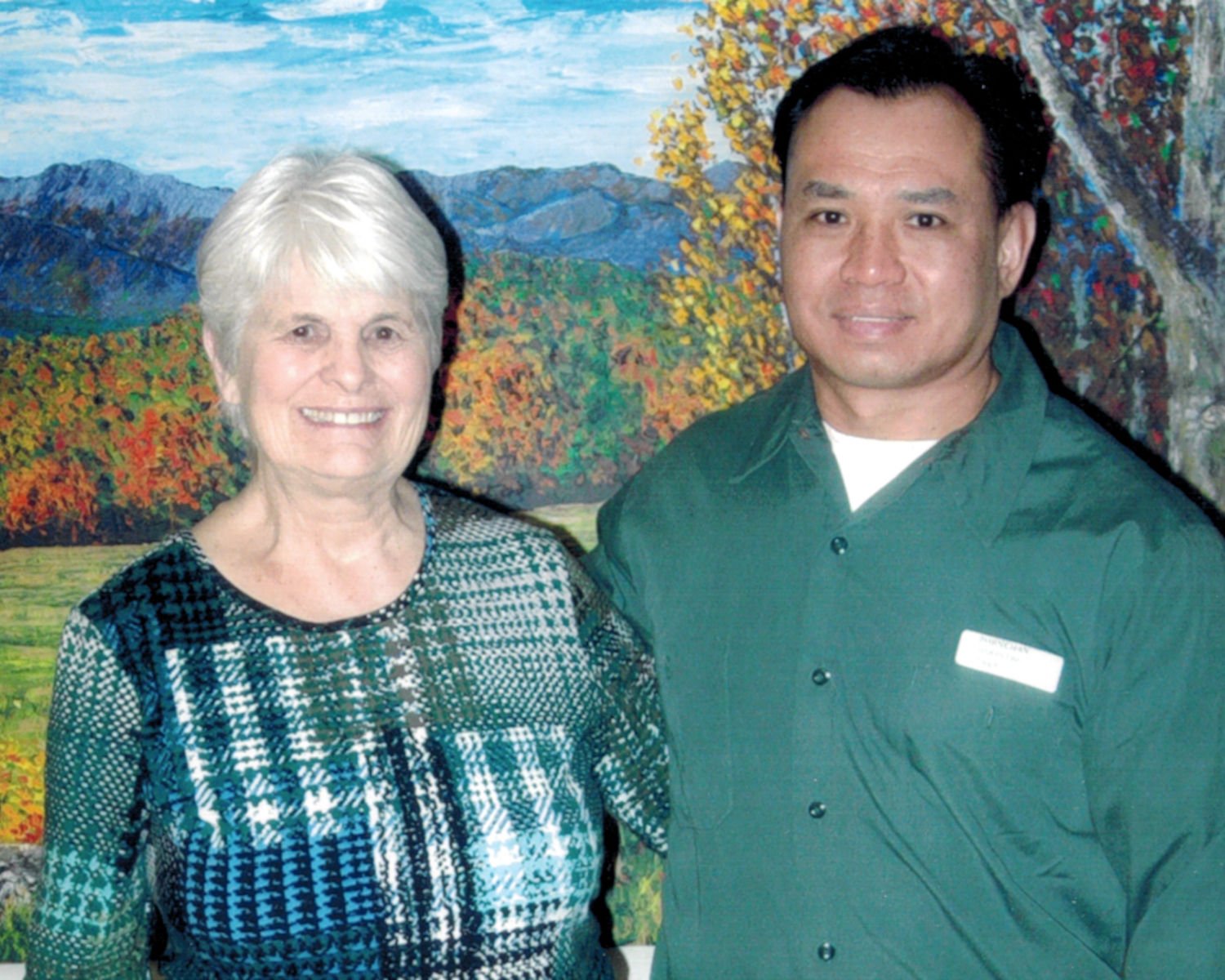
Claire Dion, a contributing writer for Beyond These Stone Walls, interviewed Pornchai “Max” Moontri at the New Hampshire State Prison for a tale of hope and amazing grace.
Preface by Father Gordon MacRae
The following is a guest post by Mrs. Claire Dion, a reader of Beyond These Stone Walls in Bridgton, Maine. Claire graced these pages with a Corporal Work of Mercy that touched our hearts in 2017. After two years with us, our friend, Kewei Chen from Shanghai, China, was transferred to the custody of Immigration and Customs Enforcement (ICE) to await his deportation.
After reading of the unique circumstances that brought Chen from China to an American prison, and the pain of our parting as well as our hopes for Chen, Claire drove from her home in Maine to meet with him at the place where he was awaiting deportation. The result of that visit became her first guest post on Beyond These Stone Walls, “My Visit with Kewei Chen in ICE Detention.”
Her post was comforting. From my perspective, and that of Pornchai Moontri who had become Chen’s older brother, the void in our hearts could not be filled, but Claire’s guest post left it not quite so empty. It ended with a wonderful photograph of Chen emailed from the Shanghai airport as he saw his parents for the first time after his unplanned three-year absence.
More recently, Claire asked if she could visit me and Pornchai, a much further winter drive for her. Since prison rules allow for being on the visitor list of only one prisoner, I asked her to visit Pornchai, to treat it as an interview, and to write another guest post for Beyond These Stone Walls.
I did this because, as I have hinted in some previous posts, there is a very special story coming, one that I know will both break your hearts and then mend them again with evidence of the immense power of Divine Mercy to restore the human soul. This story is coming when I am able to fully tell it, and it will be unlike anything you have ever read before on Beyond These Stone Walls.
So as a prelude, I want to present Pornchai “Max” Moontri through the eyes of a reader meeting our friend for the first time. His story should begin, after all, not upon the dung heap of Job where life took him, but at the point to which Divine Mercy has redeemed him out of darkness into a very great light.
Claire Dion is a wife and mother of five adult daughters and a devoted grandmother. She is currently retired from a career as a registered nurse in obstetrics at Lynn, Massachusetts General Hospital. She today lives in Bridgton, Maine where she has been part of the Faith Formation Team at Saint Joseph Parish and a follower of Father Michael Gaitley’s 33 Days to Morning Glory and Marian Consecration. It’s an honor to present Claire Dion.

Saturday – January 8, 2018 at 8:00 AM
I pulled into the parking lot of the New Hampshire State Prison for Men in Concord. I will be meeting Pornchai Moontri, a man I have come to know and love from reading Beyond These Stone Walls. Walking into the visiting area where I have to sign in, I feel a little uneasy. I did not have a clue what I was to do and I had not slept the night before as I was afraid I would do something wrong and the visit would be canceled.
Everything went well until I passed through a metal detector and the alarms went off. What was I thinking? I should have realized that two knee replacements and a hip replacement might present a problem. After being sent back to the waiting room with alarm bells ringing, some guards questioned me, and then led me into the visiting room. It was a large room with metal tables and chairs screwed to the floor. Each table was numbered, and I was instructed to go to table number twenty-four.
From a distance I saw Pornchai walk into the visiting room. I realized that he had not seen me before, but I recognized him from Beyond These Stone Walls. So I waved and smiled, and he smiled back. When he got to the table, I asked him if I could give him the allowed “three-second hug.” He laughed while I hugged this man whom I had only read about but was very anxious to meet.
While I was waiting for Pornchai to arrive, I wondered how we were going to fill in a two-hour visit. I was not allowed to bring anything with me so I had no notes to help me remember what I wanted to talk to him about and all the questions I had. I knew that Father Gordon wanted me to write about this visit for Beyond These Stone Walls.
We sat next to each other at the table in a room filled with cameras. The large room was also full of visitors, and, as many of them were children visiting their fathers on a Saturday morning, it was noisy. It took only seconds for us to relax and start talking. From the moment we sat down, I had a sense that I already knew this very special person.
We continued to talk nonstop for the entire two hours. We both felt that it was amazing that we were sitting here together, Pornchai from Thailand and me from Lynn, Massachusetts (which, by the way, is the city just North of Boston where Father Gordon grew up).
Soon we were talking about Pornchai’s incredible journey from a village in Northeast Thailand to Bangor, Maine and ending at the New Hampshire State Prison. I learned that Pornchai was abandoned by his mother at age two and that a teenage relative found him and brought him to live with his family.
Nine years later, when Pornchai was age eleven, his mother returned to Thailand. He did not recognize or even remember her, but against Pornchai’s will he was taken from Thailand and brought to America. A series of traumatic events broke his heart and his soul. That is another story that hopefully Father Gordon will be telling soon at Beyond These Stone Walls.
When Pornchai was fourteen years old, he ran away. He became — though not by choice — a homeless child living on the streets for the second time in his young life, and he spoke little English. While still a teen, he was involved in a struggle that resulted in the death of another man, and he was sent to prison.
While listening to his story, my heart ached as I could see and feel his pain over these events from so long ago. Sentenced to 45 years in a Maine prison, Pornchai continued to have outbursts of anger and rage which landed him in solitary confinement for many years in Maine’s “supermax” prison. [Note: PBS Frontline did a gripping story on that very place and time.]
Pornchai told me that his only plan for life was to never leave prison. It sounded as though he knew he was going to die there, and that was what he wanted. It was his “Plan B” for his life. However, God had other plans for Pornchai Moontri. Fourteen years later, he was moved to a prison in New Hampshire for the rest of his sentence, and Father Gordon MacRae stepped into the story of his life.
Here Pornchai’s eyes and expression softened as he spoke about meeting Father Gordon whom he and other prisoners call “G.” At this point, Pornchai said he felt completely alone, still angry and trusting no one. Another prisoner, a young man from Indonesia, introduced him to a man called “G” and said that G helped him a lot and that he trusted G.
Pornchai watched how G in a caring and patient way helped others and how they trusted him. In his life, the very idea of trust was entirely new. Slowly and cautiously, Pornchai let G into his life and a friendship began.
We talked for awhile about G and I learned that no matter what happens in prison G stays calm. He is a humble, steady person in the midst of the constant turmoil and darkness of prison life, and is always available to any prisoner who comes to him. With a chuckle, I have to add here that I remember Chen telling me that G is a very good man “but you don’t bother him when he is typing a BTSW post!”

“When I Was in Prison, You Came to Me” —Matthew 25:36
It was quite awhile before Pornchai found out that G is a Catholic priest. We spoke about how Father Gordon’s strong faith impressed Pornchai even though many in the Church had abandoned him. Pornchai told me that G’s faith shines in prison, and has attracted some of the prisoners to join him at Sunday Mass and in retreats sponsored by Father Michael Gaitley and the Marians of the National Shrine of The Divine Mercy.
Pornchai also said that Father Gordon constantly reaches out to those he feels he can help, and Pornchai was one of them. It was during this conversation that I asked Pornchai to tell Father Gordon how much I love, respect and honor his priesthood.
Through him, Christ’s presence is being felt there, and it is making a difference for many behind those stone walls and many of us BTSW readers.
As their friendship grew, Father Gordon told Pornchai that he must start taking positive steps with his life. He encouraged Pornchai to leave aside “Plan B” and plan instead for a future.
Pornchai began taking education courses, spending his days in school instead of in a cell. He proudly told me that he earned his high school diploma in prison and was Valedictorian of his 2012 graduating class. I listened and learned that his educational journey was just beginning. With Father G’s help, he then enrolled in courses in social work and psychology at Stratford Career Institute earning academic certificates “with highest honors.” This was followed by studies through a scholarship at Catholic Distance University where he took courses in theology with a straight “A” average.
What Pornchai has accomplished is nothing short of amazing given that he learned English in prison. He and “Father G” encourage other prisoners to become educated, and Pornchai now spends time mentoring and tutoring them, especially in mathematics in which he excels. He also spends his days in the woodworking and Hobby Craft shop where he teaches safety training to other prisoners on the use of carpentry tools and machines.
Pornchai designs and builds handcrafted model ships, beautiful Divine Mercy keepsake boxes, and other creations in wood. Some of these are made as gifts and some are sold in a store near the prison grounds. Pornchai used the proceeds to pay for his education courses. Father Gordon later told me that Pornchai is modest about his great skill in woodworking. One of his ships is on display in Belgium where a curator posted a brass plaque indicating that it was designed and created by “Master Craftsman Pornchai Moontri, Concord, New Hampshire.”

Divine Mercy Conversion
As Pornchai’s friendship with Father Gordon deepened, and Pornchai was influenced by his patient practice of faith, he made a decision to become a Catholic. Seeing in the many comments how much Father Gordon’s posts spiritually affect BTSW readers, we talked about how becoming Catholic has helped Pornchai in prison. He received the Sacraments of Baptism and Confirmation on April 10, 2010. He chose “Maximilian” as his Christian name to honor St Maximilian Kolbe.
On the next day, he received his First Eucharist from Bishop John McCormack. When this was first being planned, neither Pornchai nor Father Gordon realized the date was Divine Mercy Sunday. On that day, Jesus showered Pornchai with His love and mercy and Pornchai felt it. He said that before he became a Catholic he was always feeling unloved and alone. Now he could feel that God was with him and loved him. He also spoke about his love for the Blessed Mother. As he told me this, there was a sense of peace within him.
When I asked Pornchai what he would like me to tell BTSW readers, he became very serious. He said that he and Father Gordon are deeply impacted by the support they receive and that BTSW could not exist without it. They deeply appreciate the love, prayers, and encouragement they receive from readers all over the world. He kept going back to the BTSW readers and how important they are to both of them. He spoke of how he has done nothing to earn this outpouring of love.
Pornchai spoke about the lawyer who has helped him and Chen so much, Clare Farr in Western Australia, and how she learned of him through BTSW. He spoke of Suzanne Sadler, BTSW’s Australian-based webmaster and publisher. He spoke of Father George David Byers who helps ready Father G’s posts for publishing. He spoke of Mrs. LaVern West who prints and mails him the BTSW comments.
Pornchai also said that Father Gordon corresponds with Father Andrew Pinsent, a scientist at Oxford University who has cited his science writings. I mentioned that Father Gordon’s science posts are over my head and Pornchai said with a smile, “Mine too!” In an astonishing connection that Father Gordon later told me about, Father Georges Lemaître, the priest-physicist considered in science to be “Father of The Big Bang and Modern Cosmology,” was a close family friend of Mr. Pierre Matthews in Belgium who today is Pornchai Moontri’s Godfather.
And Pornchai also spoke of Charlene Duline who helps Father G communicate with readers, and is Pornchai’s Godmother. She once sent him a letter in which she called him “precious,” and then other prisoners teased him about it, but he laughed and said that they are jealous because no one calls them precious.
Suddenly the lights in the room flashed on and off. Our visit was over, but not before we were able to have a photograph taken together. With a hug (three seconds only) we said goodbye. I was truly blessed to meet this amazing young man, Pornchai Maximilian Moontri, and to see Father Gordon through his eyes. I know I will visit him again.
On the coldest day of winter, I left the New Hampshire State Prison with summer in my heart.
+ + +
Note from Father Gordon MacRae:
I thank Claire Dion for this snapshot into our lives. In my recent post, “The Days of Our Lives,” I wrote that Pornchai Moontri and our friend, J.J. Jennings work together in the woodworking and Hobby Craft center. The photos below are of their latest project, a Jewelry Cabinet.
The design for a cabinet of this size was by J.J. Jennings, who collaborated with Pornchai Moontri for the highly skilled construction. The one on the right was made by J.J. and the one on the left by Pornchai. The woods for both are solid maple and black walnut. The drawer fronts are maple or black walnut with poplar sides and bottoms. The drawers and side cabinetry doors are lined with velour.
These beautiful pieces are 20” high, 14” width, and 8.5” depth, and are customized with wood-burned or painted designs and brass fittings. The top is hinged with a 2.5”-deep display area. Two of the drawers are for rings and the other drawers are deeper. The intricate side cabinets are for hanging jewelry such as necklaces, bracelets, and rosaries. Other photos of their work can be seen on the Pinterest Board, “Woodworking and Model Shipbuilding by Pornchai Moontri.”

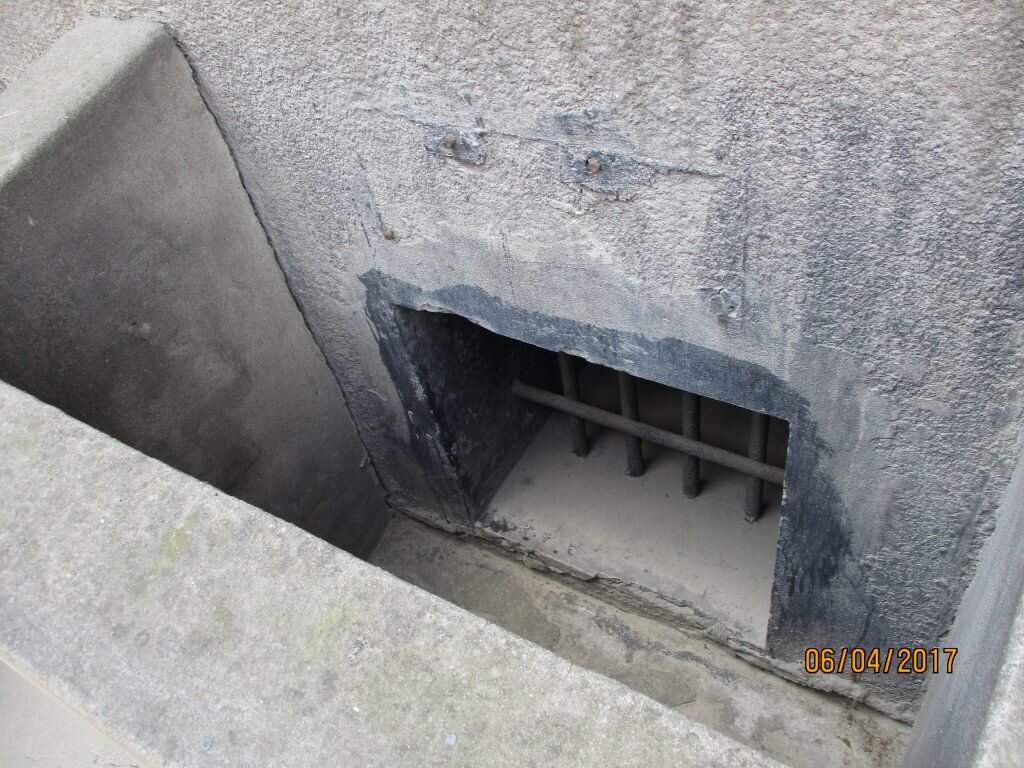
Saint Maximilian Kolbe and the Gift of Noble Defiance
Pornchai Moontri looked on the death chamber of Maximilian Kolbe and saw devouring jaws of evil. I saw that evil too, but choking on a brave soul’s noble defiance.

Pornchai Moontri looked on the death chamber of Maximilian Kolbe and saw devouring jaws of evil. I saw that evil too, but choking on a brave soul’s noble defiance.
Auschwitz 1941:
“After the so-called dinner, I was invited between Blocks 18 and 19 where some prisoners had gathered among whom were several priests… Our colleague, Kolbe, spoke of the Feast of Corpus Christi, of the great omnipresent God, and of our sufferings by which He was trying to make us ready for a better life.”
The photograph in this post has deep meaning and significance for us. TSW reader Lupe Gwiazdowski stood with her camera before the gaping maw of a prison window at the Auschwitz Concentration Camp in Poland. She photographed the window of the death chamber that consumed the life of our Patron Saint but could not extinguish the light of his sacrificial priesthood.
When Lupe’s letter with the photograph arrived in early July, Pornchai “Max” Moontri and I were standing with 100 other prisoners for Mail Call. The mail handlers here reversed the pages before stuffing the letter back in its envelope so the page with this photo was on top when I unfolded the letter.
I did not know what the photo was, but right off Pornchai pointed to it. “It’s a face!” he said. “An evil face!” Study the photograph above for a moment. Once I saw what Pornchai saw, I could not look at the photo again without instantly seeing that same demonic face. You will see it too.
But what Pornchai saw as the gaping jaws of evil ready to devour, I saw those same jaws choking on whatever was inside. When I suggested this to Pornchai, he saw it too. Stare at the photo for another moment, and you may see what I mean.
Then I read the letter that accompanied Lupe’s photo, and realized with a jolt that it was behind these gaping jaws that our Patron Saint, Maximilian Kolbe, surrendered his life in defiance of the great evil that manifested itself at Auschwitz.
Over two weeks of forced starvation followed his choice to die in place of an innocent young man. When Father Kolbe did not die in a timely manner that suited his captors, his life was taken by lethal injection on August 14, 1941. After a lifetime of devotion to “The Immaculata,” death came on the Vigil of the Solemnity of the Assumption. Lupe tells the story of the photo in her letter of June 29, 2017 that touched our hearts deeply:
“Hi Father G: I wanted to send you this photo and I hope you get it. I went to Poland this month, and I made a mental note to pray for you and Pornchai “Max” Moontri at the Auschwitz cell of St Maximilian Kolbe.
”As is often the case with my mental notes, when I got to the cell I was so overwhelmed that I forgot it. As soon as we exited the block of cells I remembered. I left the group and tried to push my way back to the cell, but Polish tour guides are not to be pushed against! I didn’t make it.
”I was downcast as I caught up with the group, and then realized that the guide was pointing to the bars of the Saint’s cell window from the outside. I didn’t even hear what she was saying as I looked upon this sacred spot. I thought of how this priest and his companion prisoners died giving such powerful witness through those same bars to so many whose hope was perishing. I lifted you and Pornchai up right there, and then snapped this photo for you. Father, I do not know what else to say.
When I got back to a computer, I saw your post, “Thoughts Upon My 35th Anniversary of Priesthood Ordination,” and realized that your anniversary was on the same day I prayed for you and Pornchai-Max at Auschwitz. Father, thank you for your priesthood.”

In Noble Defiance of Evil
Today, virtually everyone knows the story of Saint Maximilian Kolbe. His Earthly remains were reduced to smoke and ash in the ovens of Hitler to drift in the skies above Auschwitz. But what he wrote and said and did, the glow of his soul, still moves mountains and the hearts of millions.
In Father Maximilian Kolbe, evil did not destroy what it set out to destroy. It imprisoned and killed the body of a man, but the priest lived on in noble sacrifice and love. The jaws of that window choked on the goodness of the soul contained therein.
Of all the thousands of accounts about the witness and strength of Father Maximilian Kolbe, for me the most powerful account comes from Herrmann Langbein who was a prisoner at Dachau and then at Auschwitz. He is best known for his book, Against All Hope: Resistance in the Nazi Concentration Camps, 1938-1945. He singles out one man’s defiance that I have cited in other posts about our Patron Saint:
“The best-known act of resistance was that of Maximilian Rajmund Kolbe, who deprived the camp administration of the power to make arbitrary decisions about life and death.”
Langbein went on to write powerfully of the witness, not only of Father Kolbe’s sacrifice by volunteering to take upon himself the death sentence of a fellow prisoner, but of his demeanor in prison:
“Kolbe and his companions in misfortune had to spend almost three weeks [in starvation] in an unlit cell. On August 14 (1941) a lethal injection ended the suffering of the man whose bearing elicited the respect of the supervising SS men to the very end.”
I pray for the gift of this brave priest’s noble defiance of evil. It’s easier to just succumb to it, enduring it for as long as we can until it starts to bring about subtle changes in our resolve. My favorite passage in The Screwtape Letters by C. S. Lewis (Harper, 1942) is Letter 12. You have seen this passage before in these pages. The demonic “Uncle Screwtape” describes perfectly the slippery slope that suffering and sin conspire to spread the contagion of evil. Their cumulative effect …
“… is to edge the man away from the Light and out into the Nothing…. Indeed the safest road to Hell is the gradual one — the gentle slope, soft underfoot, without sudden turnings, without milestones, without signposts.”
In no place is a man or woman without defiance “edged away from the Light out into the Nothing” more than in prison. Like all prisons — whether they be prisons of iron, or fear, or trauma, or loneliness, or sickness, or pain — year upon year of it can set us upon the subtle turnings C. S. Lewis describes. For some, no doubt, resistance to the evils of our prisons seems futile.
Something happened recently — something profoundly humbling — that I thought about when I read the short passage at the top of this post from a priest-prisoner in Auschwitz with Maximilian Kolbe. The passage is from a published collection, “Depositions of Fellow Prisoners,” in the investigation of Maximilian Kolbe’s cause for sainthood.
More than 12,000 priests died in Auschwitz and the other camps of Germany and Poland, but the priest who wrote the passage atop this post survived. I wonder about those who perished there, those whose hope was siphoned off by the evil in their midst.
But for Maximilian Kolbe, resistance to evil was the one charism of a sacrificial priesthood available to him in a place where priesthood and sacrifice were deemed meaningless by worldly powers. Prison can quickly descend into “every man for himself,” but Maximilian lived and died on life’s road less traveled.

Priesthood Lost in Translation
Over the last twenty of the nearly twenty-three years that I have been in this prison unjustly, there has been another priest here. He is a priest of my diocese, but I never knew him outside of prison. In fact, I barely knew him here. He was convicted of a sexual abuse charge in 1997, one alleged to have taken place long before then, and has been here ever since.
I know that in 2001, this priest acquiesced to a demand that he be voluntarily laicized (dismissed from the clerical state). Over the ensuing years, after 25 years of priesthood, he never again heard from our bishop or diocese. He was discarded. The prisoner-priest lost his faith. He became unable to be present at Mass for the next sixteen years. He was in a different prison unit than me, and I saw him only in rare passing.
However, when printed copies of some TSW posts were mailed to me, the sender would often send two. So, with the clandestine help of friends here, I started to send the other copy to this priest. I did not send him every post, just the ones about priesthood. One post reached an untapped well of faith and hope.
It was “St Maximilian Kolbe: A Knight at My Own Armageddon” posted one year ago this week. It was the middle of an important three-part post, and was the only post for which the priest sent back — via the same circuitous prison channels — a request to see more. These posts were the limits of our contact.
The same week that Lupe’s letter and photo arrived, Pornchai Moontri and I were climbing the multiple tiers of stairs on a Sunday morning for Mass in the prison chapel. As we passed the second floor landing, the priest mentioned above was just then emerging from the prison medical unit. I greeted him and shook his hand (another act of resistance as shaking someone’s hand is forbidden here) and then something strange happened.
Pornchai did not even know who he was and I did not want to put the priest on the spot so we parted company and proceeded up the next flight of stairs. Then Pornchai turned and said, “Do you want to come with us?” The priest paused for a moment looking puzzled, and then quietly followed us up the stairs. Before we entered the Chapel, I asked Pornchai to go find us some seats while the prisoner-priest told me that this is his first time at Mass in 16 years. He became reconciled, and we sat with him.
The next week — being an idiot sometimes — I took our usual seats and Pornchai stood glaring at me. “What are you doing?” he asked, and then pointed to that other priest still standing outside the door. “Go get him and bring him in to sit with us,” said Pornchai. God bless Pornchai!
In early July I spotted that prisoner-priest on the local news. He was appearing before the New Hampshire Parole Board with a request for medical parole because he was dying of cancer.
A physician who spoke at the hearing reported that he has no more than six months to live, and his care would be a burdensome expense for the state. After some callous remarks from a victim advocate on the State’s payroll about whether he “looks sick enough,” and whether twenty years in prison exacts sufficient reckoning, the Parole Board granted his medical parole.

On the Move
A week later, Pornchai and I were suddenly moved — he to one place and me to another. Apart for the first time in over ten years, this has been a great hardship for us both. We are trying to reunite, but once anything like this is done here, it resists being undone. Pornchai is trying to be moved to the same place I am in. I plan to write more of this very soon, and hopefully will have a happier ending for you.
The place I was sent to is the unit the other priest has been living in for the last twenty years. My first week there was his last week there, and we were able to walk each morning and talk. He is restored to faith and hope that our sufferings will make us ready for a better life.
I was with him early in the morning as he left prison a few days ago, and went home to his sister to die. I like to think that we managed to fill in some of the cold abyss in which our Church let him wander alone in exile these twenty years. I cannot imagine, even in my most vengeful thoughts, that such alienation and abandonment are what Christ summons forth from the Apostolic witness of His Church.
Most of all, I like to think we helped to prepare my brother priest for something essential imparted to us by a Patron Saint who guides us on a right path through prison: the gift of a noble defiance of evil while living the witness of a sacrificial priesthood.
+ + +
Editor’s Note: Fourteen days after this was posted, Pornchai Moontri was moved to the same building as Father MacRae, an extremely rare event. Two days later he and Father G were moved to the same cell. Neither had formally requested this.