“There are few authentic prophetic voices among us, guiding truth-seekers along the right path. Among them is Fr. Gordon MacRae, a mighty voice in the prison tradition of John the Baptist, Maximilian Kolbe, Alfred Delp, SJ, and Dietrich Bonhoeffer.”
— Deacon David Jones

Catholics, Communist China, and Hope for Hong Kong
James W. Harris, a friend of These Stone Walls, writes of the state of the Church in China since a 2018 concordat between Pope Francis and the Communist government.

James W. Harris, a friend of These Stone Walls, writes of the state of the Church in China since a 2018 concordat between Pope Francis and the Communist government.
Introduction by Father Gordon MacRae
In September, 2018, Pope Francis signed a concordat with the Communist government of the People’s Republic of China. The details of the Sino-Vatican agreement have never been published. One of its known tenets, however, allows the Communist government of China to select Catholic bishops in a State-approved Catholic church while the Underground Church that remains loyal to Rome is suppressed.
With this agreement, Pope Francis stands in stark contrast to the papacy of Saint John Paul II whose role in ending Communist rule in Poland is legendary. The Sino-Vatican agreement was signed by Pope Francis one year after a September, 2017 crackdown by the Chinese government enforcing strict requirements on churches and religious adherents of the traditional Church in China.
On Christmas Eve this year, The Wall Street Journal published column by Walter Russell Mead entitled “Pompeo Champions the Faithful” about the Trump administration’s commitment to protecting religious freedom. Mr. Mead wrote:
“Persecution hangs over beleaguered Christian communities in much of the world… The most alarming developments are taking place in China… China’s Communist rulers are well aware that Christians have led democracy movements in many countries… Some of the most visible leaders of the Hong Kong protests are prominently identified as Christians.”
Thomas Farr, President of the Religious Freedom Institute in Washington, D.C., wrote in “Diplomacy and Persecution in China”, (First Things, May 2019):
“The assault on religion currently taking place [in China] under President Xi Jinping is the most comprehensive attempt to manipulate and control religious communities since the Cultural Revolution.”
Early in 2017, while living near Shanghai, China, James W. Harris discovered These Stone Walls. At the time, his outreach to us was a sign of Divine Providence. James provided helpful guidance in my efforts to assist a young friend who was stranded and delayed in the ICE deportation system while awaiting documents from the Chinese consulate so he could return to his family in China.
After graduating from Seton Hall University in 2010, James taught English at a bilingual Catholic school in Honduras. Also fluent in Mandarin Chinese, James subsequently spent several years in China where he taught English at the Hua Mao Foreign Language School. It was in China that James met his wife to whom he has been married for over six years. They have a five-year-old son.
While in China, James was also co-founder of Real English Learning, a linguistic organization formed to teach Chinese students the use of English language in business and other real life settings, and also to introduce them to Western Culture. Together, the young family left China and relocated to the United States a year before Pope Francis signed a troubling concordat with the Chinese Communist government.
Since his return from China with his family, James taught religion and Mandarin Chinese at Paramus Catholic High School in New Jersey. Today, James works in the technology field as a Senior Sales Development Representative for ThoughtSpot. I invited James to write of his experiences as a Catholic in the People’s Republic of China. Due to the nature of this post and its first-hand witness, some names, events, and locations are redacted. It is a privilege to bring to our readers the following account from James W. Harris.

Catholics, Communist China, and Hope for Hong Kong
The three and a half years I spent in China contain some of the most precious and memorable moments of my life: the Sacrament of Holy Matrimony, the study of thousands of years of ancient history, the best boost to my career, and much more… but I have no plans on going back. It is unfortunate to say this about a country and place I view as my second home, though it is true, and the number one reason I am not looking to return to China is the Chinese Communist Party.
To protect the folks to be mentioned in this writing, names and specific locations will not be given. In 2012, after I broke the news to numerous people in the United States that I was about to begin a new adventure in China, several of them became nervous about my safety. They said the Chinese government was dangerous. I shrugged it off, pointing out that many foreigners from around the world were living and working in China.
Yet, while in China, I soon found out from first-hand interviews with the Chinese people the truth about the evil dictatorship of the Chinese Communist government. The first account goes back to the mid-Twentieth Century in central China. A well-liked family owned land and a farm with several hired laborers who helped with the farm work. They received word that Mao Zedong’s army was approaching the area and would kill all landlords and plunder any possessions of value that could be found.
The family began to destroy, hide, and rid themselves of every possession that they owned. They actively made themselves appear as poor as possible so that the army might spare them the fate suffered by thousands of other landowners. From that day forward, they lived an impoverished life for the rest of their lives.
Another story from the same area revolves around a man who founded and became principal of a school. Every person who knew this man while he was alive spoke highly of his integrity and good will. Since the Communist Party controlled all education as well as food distribution at the time, the school received a fixed amount of food that could be distributed to students. The rations were meager and the students were suffering.
After months of bearing with the lack of nutrition, the principal stated in an internal school meeting with his colleagues that “One steamed bun per day is not enough nutrition for the students.” A student who had heard the words of the principal informed on him with the government for being anti-communist. Soldiers came to the school, arrested the principal, and tortured him to death. For decades after this event, students and colleagues who knew the man spoke highly of him and treated his family well.
There are dozens of these stories from the 20th Century to share, but let’s fast forward to 2012 when I arrived in China. Businesses were thriving; food was abundant; cars and Western clothing were seen, and spoken English was heard, throughout the country. There were a large number of Catholic churches in the various places I visited and lived in. I thought this was quite a different Communist regime from the one that previously ruled.

The Chinese Patriotic Catholic Association
While in the United States, I heard of the Underground Church in China, but for my first two years there little was spoken of it. The churches had pictures of Pope Benedict XVI and distributed his writings in addition to praying for him at every Mass. They sold Catholic books and Bibles published by a Catholic diocese and not the State-approved Chinese Patriotic Catholic Association (CPCA).
All seemed well between the Catholic Church in China and the government controlled CPCA until I began to learn what was going on behind the scenes. A parishioner described to me that there are priests, who are “with the Pope” and priests who are “with the government.” “Some people say [this priest in this particular church] is with the government,” the parishioner said.
I had been told by a seminarian that the local seminary had been shut down by the government so his studies were delayed. The government does not recognize seminarians for their academic achievements and forbids societal recognition of their bachelors, masters, or doctorate degrees. The bishop of that diocese was not allowed to celebrate Mass publicly and was forced — until his death — to reside at the seminary without permission to leave.
I also attended a Christmas Eve practice session at a church to be an altar server for the Traditional Latin Mass on Christmas Day. When Christmas Day came, the Novus Ordo in Latin was offered instead. It turned out that the parish priest could not obtain permission from the government to offer Mass in the Extraordinary Form.
It became increasingly evident how government entities controlled the Catholic Church in China. Though far from the style of persecution in decades past, there was an uptick in anti-Catholic and anti-Christian activity by the Chinese government around 2015-2016. A popular Catholic pilgrimage site that I had visited in 2013 was no longer open to pilgrims because the government had closed it down.
This was confirmed by a priest whose cell phone was wiretapped. He was planning a pilgrimage for a group of parishioners, but on the day they were due to leave, the police arrived at the church, interrogated the priest about the pilgrimage, and told him that the group was not permitted to go. It was then that I realized that underground or above ground — all priests in China are subject to being persecuted at any time.
It was around this same time that the “de-crossing” saga began. Thousands of crosses were forcibly removed by police from the steeples and facades of churches. Apparently, a government official was jealous after seeing crosses from Christian churches present in the skyline of one area so he ordered that all crosses be removed. Thus began outright persecution of Christians and their churches in broad daylight. Parishioners who resisted were beaten or arrested. There was little they could do.
A song then began to be sung in Christian churches throughout China: “The Cross Is My Glory.” I remember singing that hymn in a church where the priest was afraid to leave lest the government show up to remove the cross from the rooftop of his church. This was not even the saddest event at that time. I received news that the body of a priest in the Underground Church was found in a river. This was the lowest that things could go, and I began seeking employment in the U.S. not long after these events took place
[Editor’s Note: It was at this time that Mr. Harris contacted Father MacRae through These Stone Walls, but he was not able to be candid then about what he had encountered in China.]
How could the Chinese Communist Party commit such grievous sins against its own people? Many may not realize it, but the Chinese government professes and embraces atheism. In order to become a member of the Chinese Communist Party, or to work for the government, one must openly and publicly adhere to atheist beliefs. Although some government officials are secretly Christian most are not and work to further the Communist agenda.
This is why I could not disagree more with the decision of Pope Francis to recognize Catholic bishops appointed by the Chinese Communist government instead of by the Vatican. What kind of bishops does the Communist Party elect? Are they bishops who would speak out against forced abortions, the killing of priests, the forced removal of crosses from churches? No. The Chinese Communist Party appoints as bishops atheists who agree to further the Communist agenda in China.
About a year ago, police began showing up in local villages throughout China. They had a two-part agenda. First, it was made illegal for parents to bring their children to church. Second, fires were started and villagers were ordered to throw their Bibles into the fires. Arrests would be made any time there was a failure to comply. This was confirmed to me by a Chinese person forced to throw a Bible into the fire.

Hope for Hong Kong
It is not by accident that we arrive today in 2020 Hong Kong where millions of people have been protesting in the streets over the last year against the overreaching arm of the Chinese Communist government. While those in mainland China have suffered decades of hiding from the government — hiding their faith, burying their Catholic objects, and having Masses offered secretly in their homes — Hong Kong up to this point had not suffered the same fate as the protesters at Tiananmen Square in 1989.
For the people of Hong Kong, the Chinese Communist Party is more of an external force than an internal one. Google, Facebook, Twitter, and YouTube are permitted in Hong Kong while barred in the rest of China. A visa is required for U.S. citizens to travel to China, but not so for Hong Kong. The list of differences between life in mainland China and that in Hong Kong is extensive. It should be no surprise that the current protests arose as China began to impose more laws on the people of Hong Kong.
Every Catholic who has been frustrated with the rise of religious persecution in China over recent years must pray for the success of the people of Hong Kong in this conflict. The alternative would be the same fate as the murdered underground priest multiplied a thousand times over the course of many years.
Hope and pray for the freedom of the Chinese people to own private property, to be educated and employed without government tyranny, and to practice the fullness of Catholic faith openly. This will not come from Beijing — neither the government nor the people. The majority of the good people of China have had their spirit of protest wiped out after decades of murder, mind control and oppression.
If anyone in China develops the spirit to resist the evil of Communist tyranny, a physical beating would be the most favorable outcome. Hong Kong, on the other hand, is a rallying point for anyone who believes that an atheistic and tyrannical government must be stopped.
Unfortunately, the events in Hong Kong are suppressed throughout the rest of China and cannot be viewed by the people there. However, there are many Chinese Americans who are hoping and praying for Hong Kong so that their heritage and former home in China may become a place of faith and freedom.
What lessons can we learn from China? How much do we tolerate evil behavior in our own country? What do we do when there is a small or large injustice committed against our faith and our freedom?
The stories I have shared in this writing took place in China, one particular country. Yet, there are forms of atheism, Communism, and many worse ideologies in every country across the globe where followers of those beliefs try to suppress religious freedom. Catholics must work harder than them all to put into practice the teachings of Jesus Christ and His Holy Church.
Thank you for reading, and God bless you.
+ + +
Editor’s Note: Visit James W. Harris on LinkedIn
Notes from Father Gordon MacRae: I am most grateful to James Harris for this outstanding and important post. Please share it on your social media as a sign of hope for the people of Hong Kong and those in mainland China who will not be permitted to read it.
These Stone Walls was once cited by Today’s Martyrs for original reporting on the suppression of human rights for a specific population: Catholic priests. I invite you to visit Today’s Martyrs for a periodic report on the suppression of rights in China and throughout the world.


Our Bishops Have Inflicted Grave Harm on the Priesthood
Pope Francis issued 2019 guidelines for preserving a right of defense for accused priests and limits on publishing their names. Many U.S. bishops just ignored these.

Pope Francis issued 2019 guidelines for preserving a right of defense for accused priests and limits on publishing their names. Many U.S. bishops just ignored them.
Editor’s Note: The following guest post by Ryan A. MacDonald is an important sequel to his previous post, In the Diocese of Manchester, Transparency and a Hit List.
+ + +
In the above-captioned article at These Stone Walls, I wrote about a decision of The Most Rev. Peter Libasci, Bishop of the Diocese of Manchester, New Hampshire, to publish a list of the names of priests “credibly” accused in that state over the past fifty years. At the time the list was published in August 2019, the Bishop and Diocese issued a press release citing ‘transparency” as the reason for publishing it.
The list contained the names of 73 accused priests. More than half are deceased. Only five of the 73 ever had a case for prosecution before any New Hampshire court. None of the claims were current. Most alleged misconduct from three to five decades ago. Virtually all were brought with a financial demand that resulted in a monetary settlement from the diocese.
Bishop Peter Libasci’s published list was generated, not by any semblance of due process, but rather by a one-sided grand jury investigation of the diocese launched in 2002. That investigation treated all claims in civil lawsuits and other demands for settlement as demonstrably true with no standard of evidence whatsoever.
Bishop Libasci’s press release revealed that the claims against all 73 priests were determined to be “credible.” This is a standard that the United States bishops adopted at their Dallas meeting in 2002. “Credible,” as the bishops are applying it, means only “possible.” If it could have happened, it’s credible.
A 2003 grand jury investigation of the Diocese was the source for the recently published list. In that investigation, none of the accused — the few who were still living, anyway — were permitted to appear to offer any defense. That is the nature of a grand jury investigation. It is a strictly prosecutorial affair that is supposed to determine whether indictments and trials should follow. None of the subjects on Bishop Libasci’s list were indicted after the 2003 grand jury report became public.
My article cited above was followed by a related and stunning article by Fr. Gordon MacRae, one of the priests whose name appears on the bishop’s list. His category was unique on the list. It was simply, “convicted.” It was published without nuance by a diocese whose previous bishop told others in secret that he knows Father MacRae to be innocent and unjustly imprisoned. “Transparency,” however, has its limits.
Father MacRae’s article is “A Grand Jury, St. Paul’s School, and the Diocese of Manchester.” Amazingly, from reports I have seen generated by These Stone Walls, the article was heavily read around the world, most notably in Washington D.C., at the Holy See, and throughout Rome. In New Hampshire, it was the most-read article of the year at These Stone Walls.
My article, “In the Diocese of Manchester, Transparency and a Hit List,” focused on injustices behind the scenes in a decision of the Bishop and Diocese to publish that list anew. Father MacRae’s remarkable sequel contrasts the 2003 grand jury investigation of his Diocese with a similar 2018 investigation of a nationally known Concord, New Hampshire academy, St. Paul’s School, with historic ties to the Episcopal church. Fr. MacRae brought to light a judicial ruling that publishing these grand jury reports — and by extension the Bishop’s list of names — is actually forbidden under New Hampshire law.
Grave Injustice in the ‘Live Free or Die’ State
Father MacRae’s article revealed a grave injustice in the Diocese of Manchester and multiple other U.S. dioceses. Fifteen years after the Diocese and Attorney General signed a deal in secret to publish a grand jury report in 2003, New Hampshire Superior Court Judge Richard McNamara ruled that the report, and one involving a 2018 St Paul’s School grand jury investigation, cannot legally be published.
New Hampshire Attorney General Gordon MacDonald pressed to allow publication of the St. Paul’s School report. He cited the 2003 Diocese of Manchester precedent in which a report and files were published — the source for the names on Bishop Libasci’s list.
Father MacRae revealed that in 2003, the current N.H. Attorney General was part of a legal team representing the Diocese when release of the report was agreed upon in secret. It was the Attorney General’s citing the precedent that triggered Judge McNamara’s 23-page Order dated August 12, 2019, ten days after Bishop Libasci published his list.
Given the various one-sided grand jury investigations of Catholic dioceses across the U.S., Judge McNamara’s Court Order should give Catholics pause. The judicial findings summarized below cast doubt on the U.S. bishops’ collective decisions to publish lists of names arising from grand jury investigations:
The OAG [Office of the Attorney General] argues that a common law precedent for such a report does in fact exist because the Hillsborough County [NH] Superior Court [in 2003] authorized an agreement between the OAG and the Diocese of Manchester to waive the secrecy of a grand jury investigation …
The Hillsborough County Superior Court endorsed the Diocese-OAG Agreement without explanation and without any written Order. This Court respectfully disagrees with the decision to approve the Diocese-OAG Agreement [in 2003].
The Diocese-OAG Agreement fulfilled none of the traditional purposes of the common law grand jury.
The Court cannot find that the use of grand jury materials and the breach of grand jury secrecy in order to prepare a report is a practice authorized by New Hampshire common law.
Rather than investigation of crime, the report is a post hoc summary of information the grand jury considered, but did not indict on. It did not protect the privacy interests of those witnesses and subjects that were never charged with a crime by the grand jury.
The deficiency of the Diocese-OAG Agreement is cast in bold relief by [a] December 2018 decision of the Pennsylvania Supreme Court Pennsylvania has a statute that specifically authorizes investigative grand juries and investigative reports. However, as in most states, the statute contains statutory procedures to provide individuals with due process protections for their reputational rights … the petitioners were entitled to have a report published with redactions of their names in order to protect their right to reputation. [emphasis added]
A grand jury is not an adversary hearing in which guilt or innocence is established. Rather, it is an ex parte investigation to determine whether a crime has been committed and whether criminal proceedings should be instituted against any person.
Grand jury testimony can involve all sorts of false, damaging, and one-sided information and New Hampshire has no historical or legal basis for releasing such information.
An allegation of wrongdoing or impropriety, based on half-truths, illegally seized evidence, or rumor, innuendo or hearsay may blight a person’s life indefinitely.
Mark Twain famously said that a lie is half way around the world while the truth is putting on its shoes. In an internet age, he might have added that the lie will forever outrun the truth as search engines become more efficient.
Accordingly, the Court DENIES the OAG Motion to Produce and Disclose. The OAG may not produce any report that contains any material characterized as a “Grand Jury Report.”
[Source Order of Judge Richard B. McNamara In Re: Grand Jury No. 217-2018-CV-00382, August 12, 2019.]

Now Comes the Pope
The Court Order should have applied to the Bishop of Manchester as well. He took it upon himself to do what the law forbids the State to do: to prosecute and convict in the public square those who were not indicted, were not tried or convicted, but were merely accused. I find it a disturbing coincidence that Bishop Peter Libasci’s decision to publish a list of the names of 73 accused priests — the vast majority of whom are merely accused — took place just days before the Order by Judge McNamara was issued.
This is ironic, at best, and at worst highly suspect. Had the Order preceded the release of names, the priests involved — those still living, anyway — may have had legal standing to challenge it. But this all pales next to published guidelines of another authority the bishops should be heeding.
On November 12, 2019, Archbishop Christoph Pierre, Apostolic Nuncio to the United States, addressed the U.S. Conference of Catholic Bishops in Washington, D.C. His address emphasized that “The pastoral thrust of this pontificate must reach the American people.” The bishops can fulfill this, he said, with “tangible signs of their communion with the Holy Father.”
Among the “pastoral thrusts” of the pontificate of Pope Francis that might require communion with his bishops was a February 21, 2019 issuance of a set of guidelines that bishops should follow on how allegations of sexual abuse by priests are to be handled. The list included 21 points that Pope Francis asked the bishops to observe. Point Number 14 is as follows:
“The right to defense: the principle of natural and canon law of a presumption of innocence must also be safeguarded until the guilt of the accused is proven. Therefore, it is necessary to prevent the lists of the accused being published, even by dioceses, before the preliminary investigation and a definitive condemnation.”
Rev. Msgr. Thomas G. Guarino, Professor of Systematic Theology and a prolific author, has published what I consider to be a landmark article entitled “The Dark Side of the Dallas Charter (First Things, October 2, 2019). Father Guarino characterized the 2002 Dallas Charter — the operable document under which accused priests are removed from all ministry:
“The harried bishops, with their Dallas Charter of 2002… passed Draconian norms that come close to venturing beyond Catholic teaching. The American bishops decreed ‘zero tolerance’ for priests accused of sexual abuse, a norm that, as Cardinal Avery Dulles acknowledged in 2002, violates equitable treatment for priests. Dulles added, ‘Having been so severely criticized for exercising poor judgment in the past, the bishops apparently wanted to avoid making any judgments in these cases’”
Father Guarino’s article points out that Pope Francis has been reluctant to invoke the term “zero-tolerance.” The Wall Street Journal reported that of the twenty countries in the world with the largest Catholic populations, only the Bishops of the United States have invoked a policy of “zero tolerance.”
In 2000, the U.S. bishops issued a pastoral document critical of the American criminal justice system. The bishops rejected terms such as “zero tolerance” and “three-strikes” in the application of punishments in the criminal justice system. They urged lawmakers to focus on rehabilitation and restorative justice while imposing sentences.
But two years later, at Dallas in 2002, under the harsh glare of the news media and victim advocates such as S.N.A.P. (who were directly invited by the bishops) the U.S. bishops inflicted the same panic-driven one-size-fits-all policy on their priests that they asked the justice system NOT to inflict on all other U.S. citizens. Cardinal Avery Dulles wrote in rebuttal in 2004:
“The Church must protect the community from harm, but it must also protect the human rights of each individual who may face an accusation… Some of the measures adopted [at Dallas] went far beyond the protection of children… [Bishops] undermined the morale of their priests and inflicted a serious blow to the credibility of the Church as a mirror of justice.”
— Avery Cardinal Dulles, “The Rights of Accused Priests,” America 2004
The Dark Side of the Dallas Charter
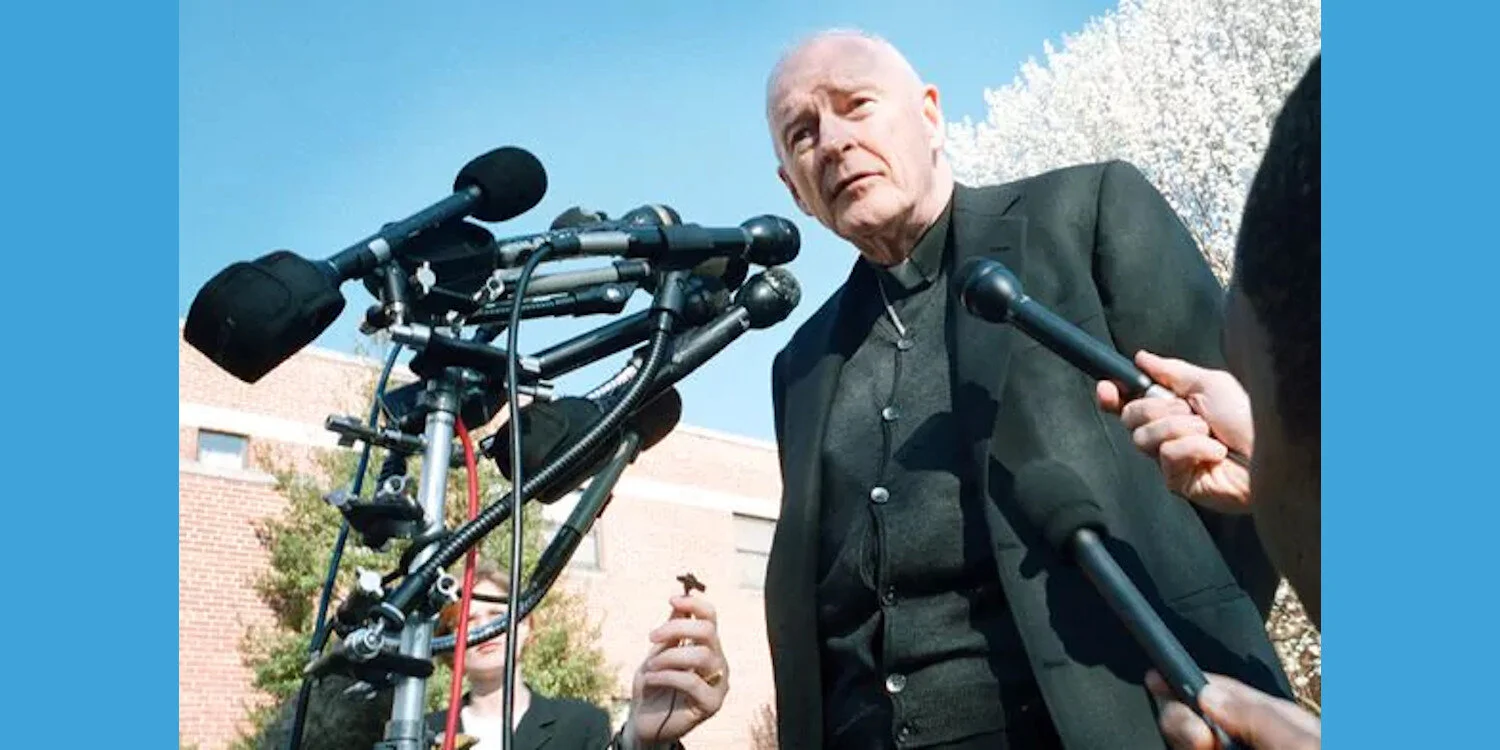
As Father Gordon MacRae exposed in “A Grand Jury, St. Paul’s School, and the Diocese of Manchester,” the late Father Richard John Neuhaus interviewed an American prelate who was one of the unnamed principal architects of the U.S. Bishops’ Dallas Charter. Father Neuhaus quoted him in a First Things article: “It may be necessary for some innocent priests to suffer for the good of the Church.” That prelate, according to Father MacRae, was Cardinal Theodore McCarrick.
As Father Guarino points out in “The Dark Side of the Dallas Charter,” a significant problem with the Bishops’ policy is that most accused priests have not actually been found guilty of abuse. Of the 73 priests, both living and deceased, on Bishop Peter Libasci’s published list, only five ever had due process in any court of law. Three of those were by plea deals, and one, as Bishop Libasci’s predecessor has acknowledged in secret, is wrongfully convicted.
For all the other names on the Diocese of Manchester list — and for the vast majority of the hundreds of American priests who have been removed from ministry, the allegations against them were only considered “credible,” meaning only that it is possible that they happened. If any other American citizens from any walk of life were subjected to such a standard before being shamed in the public square, libel and slander lawsuits would flood the courts.
Perhaps the greatest insult to Catholics in the pews is the statement of Bishop Libasci — and other bishops who have published lists of names of the accused — that this is done for the purpose of “transparency.” I have personally attempted to review the required canonical investigations of Father MacRae that a previous official of the Diocese of Manchester insisted were carried out. I was told that these investigations are confidential.
I have requested to see the list of settlements meted out to the accusers in his case which have been called into question by The Wall Street Journal and other interested parties. I was told that these settlements are confidential.
Father MacRae himself requested of a previous bishop, the Most Rev. John McCormack, that he be permitted to see the canonical investigation that the bishop claimed was forwarded to the Holy See. Father MacRae was reportedly told that this, too, is confidential. He was later told by another official of the Diocese that no required canonical investigation ever took place. This was before MacRae learned from a New Hampshire attorney and a PBS producer that Bishop McCormack revealed, after requesting secrecy, that “I firmly believe Father MacRae is innocent and should not be in prison.”
“Zero Tolerance” is an insult to Catholic theology and to our priests who are disenfranchised from their priesthood, and from their civil rights as citizens, on the whim of a bishop after being accused.
“Transparency,” however, is an insult to all the rest of us who have waited under shrouds of duplicity for our bishops to reflect the mirror of justice that this world needs the Church to be.
+ + +
Editor’s Note: Please share this important post with the priests and Catholic laity you know. You are also invited to Subscribe to These Stone Walls and to Follow on Facebook some inspiring related graphic presentations of these posts.
You may learn more on the story of Catholic priests falsely accused from these relevant articles:
In the Diocese of Manchester, Transparency and a Hit List by Ryan A. MacDonald
The Prison of Father MacRae: A Conspiracy of Silence by Ryan A. MacDonald
Bishops, Priests and Weapons of Mass Destruction by Father Stuart A. MacDonald, JCL
The Trials of Father MacRae by Dorothy Rabinowitz, The Wall Street Journal

Apocalypse Now? Jesus and the Signs of the Times
The Gospel According to St Luke for the 33rd Sunday in Ordinary Time warns of destruction and persecution. Do we face the End Times or a summons to self-assessment?

The Gospel According to St Luke for the 33rd Sunday in Ordinary Time warns of destruction and persecution. Do we face the End Times or a summons to self-assessment?
You might remember Comet Shoemaker-Levy. The size of a major U.S. city, it was discovered and tracked by astronomers — for whom it was named — wandering through our solar system in the vicinity of Jupiter in March, 1993. A previous pass near the powerful gravity of Jupiter a year earlier broke the comet into a series of town-sized debris that ended up colliding with the giant planet.
It sent a thrill through the world of astronomy and a chill through just about everyone else. What gave Jupiter a mere black eye or two would have obliterated all life on Planet Earth. This was, for science, clear evidence that an extinction level event that wiped out the dinosaurs and most life on Earth 66 million years ago was more likely than not a comet or asteroid the size of a city.
Since 1993, the scientific evidence has become clearer. That asteroid exploded with the force of a million nuclear bombs in the sea near what is now, Mexico. The event triggered massive tidal waves, earthquakes, and a global rain of red-hot debris that blocked out all sunlight for decades. Most vegetation on the Planet was gone, and would take 700,000 years to regenerate.
On the outskirts of Colorado Springs recently, researchers uncovered thousands of fossils that show how the age of mammals arose from the dust and ashes of that event. The age of mammals was allowed to happen because the age of dinosaurs was put to an end by the collision. The fossil trove of mammalian species discovered near Colorado Springs demonstrates how life on Earth was reset through that event giving way, eventually, to us.
That, at least, is the analysis of geoscientists published in the Proceedings of the National Academy of Sciences on October 21, 2019. According to the fossil record, it took 40,000 years for life in the sea to even begin to recover from the event.
So when Jesus addressed the crowd in the Gospel of St. Luke, He may have been prophetic when He said, “When these things begin to take place, look up.” Today’s listeners have a frame of reference:
“And there will be signs in the sun and moon and stars, and upon the earth distress of nations in perplexity with the roaring of the sea and the waves, men fainting with fear and with foreboding of what is coming in the world, for the powers of the heavens will be shaken. And then they will see the Son of Man coming in a cloud with power and great glory. Now when these things begin to take place, look up and raise your heads, because your redemption is drawing near.”
The above passage is immediately preceded in Luke’s Gospel by the passages that constitute the Gospel proclamation for the 33rd Sunday in Ordinary Time, the penultimate Sunday liturgy of the Church’s Liturgical Year and the Sunday preceding the Solemnity of Christ the King. The Gospel verses immediately preceding the above passage — the one you will soon hear at Sunday Mass — are filled with the doomsday language about cosmic events:
“Nation will rise against nation, and kingdom against kingdom; there will be great earthquakes, famines, pestilences and great signs from heaven. But before this they will lay their hands on you and persecute you, delivering you up to the synagogues and prisons.”
Delivering us up to prisons? Lord, have mercy, not again!

Carlos Caso-Rosendi is an accomplished linguist, translator, writer and historian. Writing from Buenos Aires, Argentina, the home of Pope Francis, Carlos penned a moving and incisive summary of the state of justice in my regard awhile back. It was a brief but powerful article published simultaneously in Portuguese, Spanish, and English entitled, “Behold the Man.”
Carlos also writes periodically for other venues including The Lepanto Institute, a Catholic organization that takes its name from the Battle of Lepanto, a naval battle fought on October 7, 1571 in the Gulf of Lepanto (now called the Gulf of Corinth). The battle between the Ottoman Empire and the Holy League formed by Pope Julius II aligned the Papal States with Spain, Venice, and Genoa.
Though vastly outnumbered and outgunned, the Holy League was decisively victorious, but not without suffering the loss of many lives. The victory delivered thousands of Christian slaves and captured more than 100 ships. The battle was the first major victory of the Christians against the Ottoman Empire.
More recently, Carlos has been writing about “The Signs of the Times”, building a case for the emergence of the End Times that Jesus seems to be prophesying in the above Gospel passages. Many readers have been following his “End Time” posts. I would not even think of refuting Carlos in this. He could run circles around me with his knowledge of Prophetic literature, apocalyptic traditions, and original languages.
Several TSW readers have mentioned his posts with various levels of concern — and sometimes excitement — that Carlos might be entirely right. I do not know whether The End is near, but in a sense it is near for all of us and we should approach our days with an eye toward what may come, as Saint Paul warned, “like a thief in the night” (1 Thes. 5:2). It is folly to get caught up in the drama all around us when heaven awaits — or not, if nothing changes.
It is difficult to refute the End Time discourse raised by Carlos, but in this both science and our faith are on the same page. Life on Earth has ended before and the scientific odds are clear that it will happen again. It is generally agreed in science that the millions of similar comets and asteroids traveling randomly through space pose an existential threat to life on Earth. It is not a matter of whether Earth will again find itself in the crosshairs of a giant asteroid, but when.
And there are other doomsday scenarios set forth, not by Scripture, but by science. It is known today that the magnetic polarity of the Earth has shifted its positive and negative poles every few hundred thousand years. Magnetic North shifts its polarity to the South Pole. Earth is now about 100,000 years overdue for the next unpredictable shift. Our ancient ancestors may not have even noticed, but today our dependence on technology could leave us stranded in chaos for decades if global power grids and all computers suddenly became irreparably disabled by a global electromagnetic pulse.

The Temple and the Covenant
I am also always aware of the multiple layers of meaning in the parables and teachings of Jesus in the Gospels. I do not discount the literal interpretation of Prophetic and Apocalyptic Literature in Sacred Scripture, but there are other, parallel meanings in the end-of-all-things scenario that St Luke’s Gospel describes.
The above Gospel passages presented by St Luke take place on the Mount of Olives and collectively they are known as the “Olivet Discourse.” The Mount of Olives is an ancient hill to the East of Jerusalem that overlooks the city across the Kidron Valley (see 2 Samuel 15:30 and Zechariah 14:40). The Mount was famous for the large number of olive trees that grew there in the time of Jesus.
As I addressed in another post, “Waking up in the Garden of Gethsemane,” the Mount of Olives was the scene of the betrayal of Jesus in the Garden of Gethsemane, and it was the scene of His Ascension. A thousand years earlier, it was also the scene of the agony of King David after his betrayal by his son, Absalom. It is a scene of great Biblical importance for Hebrew and Christian ears.
The Gospel for the end of Ordinary Time begins with an observation by Jesus’ disciples about the “noble stones” that adorn the Temple in Jerusalem. They could be seen across the Kidron Valley from the Mount of Olives. Herod the Great began an expansion of the Temple in 19 BC. The Temple was immense, and its “noble stones” at its foundation are equally immense. Some measured forty feet in length.
Jesus tells his disciples that the indestructible appearance of the Temple is an illusion “As for these things that you see, the days will come when there shall not be left here one stone upon another” (Luke 21:6). A similar discourse also takes place in the Gospel of Matthew (24-25) and it too speaks of end times, cosmic catastrophes, heavenly signs, and the future judgment of God.
But looking at the words of Jesus in the context of his original hearers and the traditions of ancient Judaism provides a parallel meaning at the literal-historical level. Jesus was also speaking of the destruction of the Jerusalem Temple, symbolic of the Old Covenant. This places the entire “End Time” discourse in the context of His words about the Temple, the stones of which “shall not be left here one stone upon another.”
Hearing this at the Mount of Olives, the disciples of Jesus might recall something described in a recent post, “Pope Francis, President Trump, and the Rise of the Nones.” In 597 BC Babylonian invaders destroyed the Temple sending the Jews into exile.
As described in that post, King Cyrus gathered the Babylonians into an Empire and then ordered his army to restore what they had destroyed. In 538 BC, King Cyrus restored the Jews to their Promised Land and rebuilt the Temple of Solomon. It was from this period that Messianic expectations permeated Israel.
Cyrus is strikingly referred to by the Prophet Isaiah as “the Lord’s Anointed” (Isaiah 45:1), a title that Israel previously reserved only for its kings and for the expectation of a Messiah. The prophecy of Jesus at the Mount of Olives was confirmed when Roman soldiers sacked Jerusalem and destroyed the Temple in 70 AD claiming the lives of more than one million Jews.

The Image of the Invisible God
The End Times discourse of Jesus may also have referred to the future destruction of the Temple by the Roman Empire in 70 AD. The Jews regarded their Temple as a representation or microcosm of the world, an architectural model of the universe fashioned by God. The universe itself was seen by the Jews as a sort of “macrotemple,” the place where God presides and throughout which His Divine Presence permeates.
This is summarized in the Psalms “He built His sanctuary like the high heavens, like the earth which he founded forever” (Psalm 78:69). There are other Old Testament references to equating the Temple with the world. After the Genesis account of the creation of the world, God rested from all his work which he had done (Genesis 2:3). The Temple was seen as the sacred place of God’s rest. He commissioned the building of his Temple by Solomon as “his resting place forever” (Psalm 132:14 and 1 Chronicles 6:41).
The symbolism of the number “seven” also links the Temple with the Hebrew world view. In the Books of Job (38:4-6) and Amos (9:6) God’s creation of the world is described as a Temple completed and blessed on the seventh day. Solomon built the Jerusalem Temple in seven years (1 Kings 6:38) and dedicated it on the seventh month (1 Kings 8:2) during the seven day Feast of Booths — also known as the harvest Feast of the Ingathering (1 Kings 8:65).
The Prophet Isaiah’s vision of the Lord (Isaiah 6:1-7) makes a comparison that the Temple and the Cosmos are interchangeably filled with God’s glory. The train of God’s robe “fills the Temple” (Isaiah 6:1) and the angels cry out that “the whole earth is filled with his glory” (Isaiah 6:3). For the Prophet Isaiah, the Temple and the cosmos are both the house of God.
Other Jewish writers in the time of Jesus described in great detail the Temple as a model for the universe. The historians, Josephus and Philo, and the late rabbinic writings, described the Temple’s divisions, furnishings, and architecture as symbols of the cosmos, the celestial Temple.
The declarations of Jesus on the Mount of Olives in the Gospels of Saints Matthew and Luke may well portend the end of the world as Carlos Caso-Rosendi and others looking at End Time prophecy interpret them. I will not say they are wrong, for this world is most certainly turning its gaze away from God and back onto itself.
We are living in the age of humanity’s narcissism. The signs of the times certainly point to the possibility that we are witnessing the signs of an Apocalypse as large swaths of humanity desecrate the Covenant sealed with the Blood of Christ.
But the destruction of the Jerusalem Temple was also seen as an apocalypse. It was the symbolic termination of the Old Covenant and the rise of the New — in Jesus Himself. As I have written in some past posts, we live today in a spiritually very important time. Jesus is equidistant in time between us today and God’s First Covenant with Abraham.
The end may indeed be near, but regardless, life is too short to waste it in the folly of this world. Jesus is the epicenter of our time and is in Himself the Temple Covenant of Sacrifice with God. As the Second Reading for the upcoming Solemnity of Christ the King proclaims:
“He is the image of the Invisible God, the firstborn of all creation. For in him were created all things in heaven and on earth, the visible and the invisible.”
+ + +


Grand Jury, St Paul’s School and the Diocese of Manchester
Blocking a grand jury report on sex abuse at an elite NH prep school, a judge ruled that an NH Catholic diocese defamed its priests without due process of law.

Blocking a grand jury report on sex abuse at an elite NH prep school, a judge ruled that an NH Catholic diocese defamed its priests without due process of law.
October 23, 2019 (updated December 27, 2021)
“Did my bishop throw his priests under the bus illegally?”
This post is by necessity contentious, so it must begin with a disclaimer. The current Bishop of the Diocese of Manchester is not in any way complicit with the events described herein with one exception: his recent publication of a list of priests who have been “credibly” accused. Ryan MacDonald wrote of this in his article, “In the Diocese of Manchester, Transparency and a Hit List.”
The term “credibly” accused has serious due process problems which even some bishops now acknowledge, but only because the standard is now also being applied to them. I described this affront to justice in “The Credibility of Bishops on Credibly Accused Priests.” Now there is a new and stunning development in this story. Saint Paul’s School in Concord, New Hampshire, with historic ties to the Episcopal church, has a long and storied history as a prestigious American prep school. Its distinguished alumni list reads like a Who’s Who of Washington political insiders. It includes congressmen and senators, ambassadors and Secretaries of State, and the children and grandchildren of U.S. presidents.
Graduates of St. Paul’s include Watergate Special Prosecutor Archibald Cox, Former “Russia Probe” Special Prosecutor Robert Mueller, and Democratic Senators John Kerry (MA) and Sheldon Whitehouse (RI). In 2011, Princeton University Press published Privilege: The Making of an Adolescent Elite at St Paul’s School by Shamus Khan.
In recent years, St. Paul’s School has been embroiled in a sexual abuse controversy. In 2015, former student Owen Labrie was tried and convicted for the statutory rape of a 15-year-old freshman while in his senior year, a story reportedly connected to an unsanctioned school custom called “Senior Salute.”
In 2017, St. Paul’s School was the subject of a sexual misconduct investigation led by former Massachusetts Attorney General Scott Harshbarger. His investigation included allegations over a forty year period from 1948 to 1988.
In July, 2017, then New Hampshire Attorney General Gordon MacDonald convened a grand jury to investigate allegations of abuse at the school. The grand jury completed its investigation late in 2018 at which point a plea deal was signed between the Attorney General and St Paul’s School administration.
The plea deal was nearly identical to one arranged in 2002-2003 by the New Hampshire Attorney General with Bishop John McCormack, former Bishop of the Catholic Diocese of Manchester, and his Chief Compliance Officer, Rev. Edward J. Arsenault. Both deals allowed their respective targets — St Paul School and the Diocese of Manchester — to squash a possible misdemeanor charge of endangering the welfare of minors in exchange for a five-year plan of staff training and improved monitoring.
A central tenet of both deals was that the prestigious school and the Catholic diocese would waive grand jury confidentiality so the respective reports and documents could be published. Officials of both the Diocese of Manchester in 2003 and St Paul’s School in 2018 signed these waivers. In the case of the Diocese, the grand jury report and related files were published with massive local and regional media coverage in March, 2003.
This is why Ryan MacDonald published “In the Diocese of Manchester, Transparency and a Hit List,” a well-researched report of how this closed-door deal and its behind-the-scenes manipulation by some central staff of the Diocesan Chancery Office sabotaged due process rights for me and other priests.

Now Comes Judge Richard McNamara
Ryan MacDonald’s article laid out the closed-door duplicity at work at the time the deal was carried out. My defense file and a vast amount of exculpatory material were requested by the Bishop’s Chief Compliance Officer, Rev. Edward Arsenault, under the false pretense of securing legal counsel for me. Once obtained, the confidential files were turned over to state prosecutors to be selectively published after the removal of exculpatory material.
The deal allowed the diocese to arrange for each accused priest to have a ten-day review to challenge in court any material deemed to be confidential. I was the only priest of this diocese to be denied that right. In the end, as Ryan reports, I protested the deal between my bishop and the state because of its blatant sabotage and misuse of privileged files.
My protest was sent to Bishop John McCormack’s appointed Delegate, Father Edward Arsenault, who seemed to be behind most of the suppression of rights. Like all other attempts to address this with my diocese, my multiple letters were met with silence.
I then wrote directly to Bishop McCormack who responded that the diocese tried in good faith, but without success, to prevent release and publication of confidential materials. He claimed that the Attorney General issued a subpoena to take indiscriminate custody of the priests’ files with no opportunity to challenge their publication.
In contrast, Assistant Attorney General William Delker (now Judge Delker) wrote in a letter to me that under New Hampshire law, grand jury investigations, reports, and files are confidential. For the report and related documents to be published, he wrote, the Bishop of Manchester had to waive confidentiality, and did waive confidentiality, on behalf of all parties involved.
Now, sixteen years later in a stunning development, New Hampshire Superior Court Judge Richard McNamara has denied publication of the grand jury report and investigation files in the case of St Paul’ School. In his 23-page order, Judge McNamara dropped a bombshell that should shake the earth beneath the feet of Catholic bishops and their lawyers across the land. In denying the Attorney General’s Motion to publish, he wrote:
“For hundreds of years, the grand jury has been a buffer between the power of the state and the citizen. Confidentiality of witness and cooperator information has been an essential part of how the grand jury works since colonial times.”
Making this development more stunning still, the Attorney General argued that there is in fact a precedent in New Hampshire for publishing grand jury reports: The 2003 Agreement with the Diocese of Manchester. It is easy to see why Attorney General Gordon MacDonald cited this precedent. In 2003 he was an attorney representing the Diocese of Manchester in the matter of negotiating settlements. He was also involved in negotiating the settlements with the Diocese of Manchester and the Attorney General’s Office over which he would one day preside.

Judge: “All Sorts of False, Damaging, One-Sided Information”
The following are excerpts from Judge McNamara’s 23-page Court Order denying the Attorney General’s motion to publish the St Paul’s School report using the precedent of the 2003 Diocese of Manchester Grand Jury Report:
“The OAG [Office of the Attorney General] argues that a common law precedent for such a report does in fact exist because the Hillsborough County Superior Court authorized an agreement between the OAG and the Diocese of Manchester to waive the secrecy of a grand jury investigation … and to authorize the release of sealed subpoenas, pleadings, and orders related to the grand jury investigation … The Hillsborough County Superior Court endorsed the Diocese-OAG Agreement without explanation and without any written order.
“The Court respectfully disagrees with the decision of the Hillsborough County Superior Court to approve the Diocese-OAG Agreement. The Agreement … fulfilled none of the traditional purposes of the common law grand jury. Rather than investigation of crime, the report is a post hoc summary of information the grand jury considered but did not indict on. It did not protect the privacy interests of those witnesses and subjects that were never charged with a crime by the grand jury.”
Judge McNamara explained that he is blocking publication of the St Paul’s School grand jury report for the same reasons that the Diocese of Manchester report and files should have been blocked in 2003. He wrote that grand jury testimony can involve “all sorts of false, damaging and one-sided information.” In holding that the Diocese of Manchester Report did not protect the privacy rights of those named, Judge McNamara concluded:
“Mark Twain famously said that a lie is halfway around the world while the truth is putting on its shoes. In an internet age, he might have added that the lie will forever outrun the truth as search engines become ever more efficient.”
It is for these reasons, Judge McNamara ordered, that grand jury investigations in New Hampshire are confidential. As a reporter for the New Hampshire Union Leader observed, “His ruling decided a case that had been argued in secret” (see Mark Hayward, “Judge blocks release of St Paul’s grand jury info,” New Hampshire Union Leader, Oct 1, 2019).

Transparency in the Diocese of Manchester
There are some alarming questions that arise from the handling of these reports, the potential for conflicts of interest, and the apparent absence of effective judicial oversight of the Diocese of Manchester grand jury report in 2003.
Publication of that report sabotaged the due process rights of many priests and placed damning information in public view resulting in condemnation without trial. The content from this report was then absorbed by the toxic site, Bishop-Accountability which was established for a singular purpose: to foster new accusations against priests with no effort to corroborate any of the claims gathered and published there.
Judge McNamara’s Order explains that a grand jury is seated for the purpose of investigating and prosecuting crime. In the cases of the Diocese of Manchester in 2003 and St Paul’s School in 2018, no indictments were issued. The Judge wrote:
“Grand jury reports that criticize individuals are extremely controversial. A grand jury report that does not result in an indictment but references supposed misconduct results in a quasi-official accusation of wrongdoing drawn from secret ex-parte proceedings in which there is no opportunity available or presented for a formal defense. The Florida Supreme Court described such a grand jury report as ‘not far removed from … and no less repugnant to traditions of fair play than lynch law.’ ”
The respective “deals” contain a hint of extortion. A misdemeanor criminal charge could be avoided if the administrations of the two institutions agreed to waive grand jury confidentiality and allow the reports to be published. The threat of prosecution weighed heavily on Bishop John McCormack who wrote in a December 10, 2002 letter to priests:
“The substance of the [grand jury’s] conclusion was to weave 40 years of history into one moment, and based on some rather complicated legal understanding of knowledge and intention, they concluded that they had enough evidence to indict the Diocese of Manchester for the endangerment of the welfare of children…
“I agreed with the Attorney General that it was in the best interest of the Church and the people of the State to resolve this matter by a public Agreement between the Diocese of Manchester and the State of New Hampshire… Let me assure you that no archival material regarding any priest, other than those against whom we have had a credible accusation … was submitted to the Office of the Attorney General.”
— December 10, 2002 letter to priests of the Diocese of Manchester sent to every priest except Fr. Gordon MacRae
But was the threat of prosecution against either St. Paul’s School or the Diocese even realistic? Louisiana State University Law Professor John S. Baker had doubts. Writing for the Boston College Law Review in 2004 Professor Baker revealed that the New Hampshire Attorney General admitted in 2004 that the theory of law behind the threat of such a charge was “novel” at best, and highly unlikely. The statute of limitations for a misdemeanor child endangerment charge is one year while the time period of the grand jury report dated back forty years or more. The report unveiled not a single contemporary case. So why did Bishop McCormack sign such an agreement? The question remains unanswered, but it set a dangerous precedent for the Catholic Church in America. Prof. Baker wrote:
“The Church should recognize the New Hampshire settlement for what it potentially is: the camel’s nose inside the tent.’… This intrusion by a state prosecutor into the jurisdiction of the Church may encourage and be the basis for actions by other state prosecutors… The decision by the Diocese to enter into this agreement represents a dangerous capitulation by one diocese that may have created a serious threat to the other dioceses in the United States.”
— John S. Baker, “Prosecuting Dioceses and Bishops,” Boston College Law Review, 1061, 2004
The claims of transparency in the Diocese of Manchester are highly selective. There is much related to this matter that is far from transparent. It would be difficult to believe that Edward Arsenault — who would later be charged, convicted, imprisoned and dismissed from the clerical state for his embezzlement of $300,000 from the Diocese and other sources — was not involved in the Kafkaesque diocesan affairs of 2003. He has since changed his name and is now officially known as Edward J. Bolognini.
In his published resumé, which has been removed from public view, Arsenault identified himself as “Chief Operating Officer / Chief Compliance Officer” for the Diocese of Manchester from 2000 to 2009. He was thus at the center of all that Ryan MacDonald wrote about in his report, “In the Diocese of Manchester, Transparency and a Hit List.” The resumé went on to describe Arsenault’s role:
“[To] provide advice and counsel to the Bishop of Manchester for pastoral governance, strategic management, and operational oversight of the Diocese of Manchester including but not limited to the successful settlement of over 250 civil claims associated with sexual abuse.”
In the strangest twist, the lawyer retained by staff and former staff, of St Paul’s School who successfully challenged publication of the grand jury report was Attorney David Vicinanzo, the same lawyer who Father Arsenault claimed was retained by the Diocese to represent me at the time Father Arsenault obtained my defense files under false pretense. Neither Arsenault nor Mr. Vicinanzo ever responded to my multiple requests for explanation in 2003 or after.
Strangely, in December of 2003, nine months after the grand jury report and files exploded in the press, Arsenault wrote in a letter to me: “I have not yet had a chance to discuss with Attorney Vicinanzo the matters we previously discussed.” I never heard from Arsenault again.
In his successful blocking of the 2018 grand jury report on St. Paul’s School, Attorney Vicinanzo was quoted in the news media. He called Judge McNamara’s Order “a full-throated defense of the grand jury as an institution.”
Judge McNamara issued his Order stating that the 2003 grand jury report on the Diocese of Manchester should not have been published because it failed to protect the privacy rights of those involved. Just a few days previously, Bishop Peter A. Libasci, the current Bishop of Manchester, published a list of all 73 priests of his diocese who have been “credibly” accused. He did this, he says, for transparency.
There is much more to come on the murkiness that is now called “transparency.”
+ + +

Postscript: An Update on This Story
December 27, 2021
Now Bishop Peter A. Libasci has himself been “credibly accused.” On July 22, 2021, the New Hampshire Union Leader newspaper, in an article by Mark Hayward, reported, “NH Bishop accused of sexual abuse by an altar boy decades ago.” Whatever differences I have had with Bishop Peter Libasci and his published list, I was and am deeply saddened by this development. The accusation stems from 1983, the same year as the accusations against me. The lawsuit, filed in Suffolk County, New York, alleges that then Father Peter Libasci sexually assaulted a boy aged 12 to 13 “on numerous occasions” at a parish and Catholic school in Deer Park in the Diocese of Rockville Center, New York.
Unlike the cases of any similarly accused Catholic priest, Bishop Libasci has to date faced no restrictions on his ministry. This matter contains none of the transparency that Bishop Libasci cited as his singular motive for publishing a list of 73 priests accused — merely accused — and in the same manner in which he himself has now been accused. For this complete story see “Bishop Peter A. Libasci Was Set Up by Governor Andrew Cuomo”
+ + +
Note from Father Gordon MacRae: David F. Pierre Jr. of The Media. Report has an excellent brief analysis of the above along with some links to how it connects to and impacts my own situation. See TheMediaReport.com (October 9, 2019): “Stunner: New Hampshire Judge Says 2003 Diocese of Manchester Grand Jury Report Never Should Have Been Released.”
You may also wish to read and share
In the Diocese of Manchester, Transparency and a Hit List
and these related articles from some very accomplished writers:
Justice and a Priest’s Right of Defense in the Diocese of Manchester by Ryan A MacDonald at A Ram in the Thicket
Journalism Outside the Box: Wall St. Journal Bravely Profiles Stunning Case of Wrongfully Convicted Priest by David F. Pierre, Jr. at The Media Report
The Ordeal of Father MacRae by Catholic League President Bill Donohue
Spotlight Oscar Hangover: Why ‘Spotlight’ Is a Terrible Film by JoAnn Wypijewski in CounterPunch
+ + +
“In the course of my 1994 trial, and while sentenced to life in prison, and during State and habeas corpus appeals I have never been allowed to utter a single word in my own defense. In 2011 a two-part documentary video was made of my testimony. It went missing for several years and has just turned up.”
— Fr Gordon MacRae

Saint Luke the Evangelist, Dear and Glorious Physician
The Church honors St. Luke the Evangelist on October 18. Author of a unique Gospel and Acts of the Apostles, Luke is the source of the most cited parables of Jesus.

The Church honors St. Luke the Evangelist on October 18. Author of a unique Gospel and Acts of the Apostles, Luke is the source of the most cited parables of Jesus.
In “February Tales,” an early post on Beyond These Stone Walls, I wrote of some of the books that captivated my imagination in childhood. Working today in a library, I have come across some of them decades later in adulthood and gave them a second look. It’s a testimony to growing up that most of the books I thought were masterpieces of Western literature in my youth are only laughable today. But a rare few have stood the test of time.
One of them is a book I stumbled upon at age 16. It was 1969 and I was in my senior year of high school. I wrote a short biography of what my life was like then against the backdrop of a culture in the early days of its long moral and social decline. You could find those biographical paragraphs early on in my recent post, “Where Were You When Neil Armstrong Walked on the Moon?”
Somehow in 1969, I discovered among the tattered paperbacks of the Lynn English High School Library a historical novel that would leave its mark on my mind and soul for decades to come. Though first published in 1959, it is a testament to its literary stature that its most recent hardcover edition was published over a half century later in 2012, twenty-seven years after the author’s death. The book is Dear and Glorious Physician by Taylor Caldwell who described its long path:
“This book has been forty-six years in the writing. The first version was written when I was twelve years old, the second when I was twenty-two, the third when I was twenty-six, and all through those years work did not cease on this book. It was impossible to complete, as the other versions were impossible to complete, until my husband and I visited the Holy Land in 1956.”
Taylor Caldwell published forty-three novels to much acclaim in her literary career. Among them were some stand-out historical novels. Her most famous was Captains and the Kings (1972) about the wave of Irish immigrations to America. It became an equally acclaimed television mini-series later in the 1970s.
Caldwell’s first novel was published in 1939. Her last, Unto All Men, was posthumously found and published by her grandchildren in 2012. At that time, they also republished Dear and Glorious Physician, Ms Caldwell’s labor of love that spanned decades in its writing. No other book of my youth has withstood the test of time with such power and majesty.
The author imagined the life of Saint Luke the Evangelist with such realism that it seemed as though she had followed him through it taking notes. It is impossible to know of the birth and upbringing of any of the Gospel characters. But where their life stories were absent, Ms Caldwell spent years, with the assistance of a Catholic priest and historian, researching life and culture in early First Century Antioch — which today is Southern Turkey, the world from which Saint Luke emerged.

She was also aided in this adventure by a wealth of legends about Saint Luke that surfaced in the first few centuries, some of them known to the early Church Fathers, from Antioch, Greece, and Egypt. Like many stories surrounding Biblical legends, some were built upon grains of truth. She was aided in this effort by a collection of these extra-Biblical legends surrounding Saint Luke in the possession of a Catholic nun living in Antioch during the years of her research. The end result is a remarkable volume described by Taylor Caldwell with shades of the pilgrimage of her own life:
“This book is only indirectly about Our Lord. No novel, no historical book, can convey the story of His life so well as our Sacred Scripture. The story of Lucanus, St Luke, is the story of every man’s pilgrimage through despair and life’s darkness, through suffering and anguish, through bitterness and sorrow, doubt and cynicism, rebellion and hopelessness, to the Feet and the understanding of God. The search for God and the final revelation are the only meaning in life for men.”

The Spiritual Legacy of Saint Luke
In the Roman Rite, the Church honors and remembers Saint Luke the Evangelist on October 18. At least some of the readers of Beyond These Stone Walls may have gleaned from my posts that among the four Gospel writers, I have long been especially drawn to the work of Saint Luke. Many of my posts have been built upon Gospel passages that are unique to Luke alone. We will link to a few of the more important ones at the end of this post.
There are several factors that make Luke unique among the four Evangelists. He was the only Gentile author to compose a book in the Canon of Sacred Scripture. All others were of Israelite descent. Saint Paul hints at Luke’s Gentile identity and profession when he refers to him as “Luke the beloved physician” (Colossians 4:14).
Luke is also the only Evangelist to have composed a sequel to his Gospel. The Acts of the Apostles is the second of a two-volume work that picks up immediately where Luke’s Gospel ends. It continues the Gospel narrative with a revelation of how, after the Ascension of Jesus, the Holy Spirit continued to work in the living community of Christ’s mystical body, the Church.
The early manuscripts of the third Gospel, all of which were composed in highly sophisticated Greek, had the title, “Kata Loukan,” meaning “According to Luke.” Though Luke was not an Apostle (nor was Saint Mark) this title serves as a signpost of apostolic tradition in the Gospel. There was no debate whatsoever among the early Christian Church that the author of this work was indeed Luke, the companion of Saint Paul.
Like Paul, Luke had never known Jesus directly, but rather experienced Him in His post-Resurrection presence to the apostolic community and its birth at Pentecost. The Church Fathers were unanimous as far back as A.D. 170 that Luke is indeed the author of both the third Gospel and the Acts of the Apostles.
The only professional disagreement among scholars is the time period in which the Gospel transformed from oral tradition to written form. Luke himself possessed highly refined Greek linguistic ability, and his Gospel clearly reflects it. So there is no reason to believe that Luke relied on anyone else to put his Gospel in written form.
Estimates of the date of authorship vary from about A.D. 60 to A.D. 80. There is much evidence, however, to hold to the earlier date because of the close connection between this Gospel and Acts of the Apostles. The latter, which was the second to be written, concludes with Saint Paul in prison in Rome in A.D. 62. There is no hint at all of the outcome of Paul’s trial or any subsequent activity.
In Acts of the Apostles, much attention is given by Luke to the interactions between the earliest Christians and imperial Rome. However Luke presents no apparent awareness of the open persecution of Christians later in the 60s, nor does he ever mention the late 60s martyrdom of his two central characters in Acts: Saints Peter and Paul. Luke’s writings also seem unaware of the events of A.D. 70 when Jerusalem was utterly destroyed by the Romans.
The Gospel According to Luke is also unique in its near complete absence of Hebrew terms. His one theme that towers above all others is his proclamation of universal salvation for all who embrace Christ. As a writer from Antioch steeped in Greek language and culture, Luke writes for Gentile believers.
This explains his lack of Hebrew terminology. However, he also displays a profound knowledge of the Hebrew Scriptures, and an ability to incorporate them into his Gospel narrative by way of inference. There are a multitude of examples, but here is one from my post “Waking up in the Garden of Gethsemane.”
In the Gospel of Luke (22:31ff ) Jesus is alone and apart from the others as He prays in agony in the face of death. “Father, if you are willing, remove this chalice from me, but Thy will, and not mine, be done.” For Hebrew ears, Luke’s account of Jesus at Gethsemane (referred to only as the Mount of Olives in Luke) is a mirror image in reverse of a scene that occurred at that very same site 1,000 years earlier.
It was a story of a son not obedient unto death, but of a son who betrayed his father. It was the agony of King David and his flight from his son, Absalom, who betrayed him:
“David went up the ascent of the Mount of Olives, weeping as he went, with his head covered and walking barefoot.”
— 2 Samuel 15:30

The Magnificat and Two Powerful Parables
It seems clear that Luke had an awareness of the Gospel of Mark which he incorporates as a source, but he also had sources that none of the other Evangelists had. Luke’s Gospel is the sole source of the glorious Magnificat, the proclamation of Mary in her pre-Christmas visit to her cousin, Elizabeth. Many believe that Luke was given this by Mary herself (Luke 1:46-56):
“My soul magnifies the Lord, and my spirit rejoices in God my Savior, for he has regarded the low estate of his handmaiden. For behold, henceforth all generations will call me blessed, for he who is mighty has done great things for me, and holy is his name. His mercy is on those who fear him in every generation. He has shown strength with his arm, and has scattered the proud in their conceit. He has cast down the mighty from their thrones and has lifted up the lowly. He has filled the hungry with good things and the rich he has sent empty away. He has come to the help of his servant, Israel remembering his promise of mercy as he spoke to our fathers, to Abraham and his children forever.”
Women are especially honored throughout the Gospel of Luke. His portrayal of Mary the Mother of God is unparalleled in the New Testament. He is the sole source of the Archangel Gabriel’s declaration of Annunciation — “Hail, Full of Grace” (Luke 1:28), another example of the belief of many that Mary or someone close to her was one of his sources. Luke also pays close attention to the presence of Elizabeth (1:39-45), Anna (2:36-38), the widow of Nain (7:11-17), Mary Magdalene (8:2), Mary and Martha of Bethany (10:38-42), Joanna and Susanna (8:3) and others.
Saint Luke’s Gospel presents the sole account of the Parable of the Prodigal Son and the Parable of the Good Samaritan, two of the most important stories and most reflected-upon moral lessons in the life of the Church. At the end of this post, I will link to some of the BTSW posts that highlight popular parables unique to Luke’s Gospel. Those parables are held to be masterpieces of Catholic spirituality.
Saint Luke composed a two-part spiritual masterpiece for the ages. Taylor Caldwell would make no such claim, but by having brought Saint Luke to life some 2000 years later with such clarity, beauty and majesty, she deserves at least one not-so-coveted award to honor her accomplishment. Beyond These Stone Walls’ Stuck-Inside Literary Award is presented posthumously to Taylor Caldwell for Dear and Glorious Physician.
+ + +
Note from Father Gordon MacRae: Please share this post on social media. It would also help the cause of justice if you Subscribe to Beyond These Stone Walls.
You may also like these other tributes to the Gospel According to St. Luke:
To Christ the King Through the Immaculate Heart of Mary
The Ark of the Covenant and the Mother of God
St. Gabriel the Archangel: When the Dawn from On High Broke Upon Us
We invite you to visit our Sacred Scripture series called From Abraham to Easter category at the BTSW Library.


In the Diocese of Manchester, Transparency and a Hit List
Citing “transparency” the Catholic Diocese of Manchester posted the names of 73 accused priests. Most are dead. The only one in prison is innocent, and they know it.

Citing “transparency” the Catholic Diocese of Manchester posted the names of 73 accused priests. Most are dead. The only one in prison is innocent, and they know it.
August 21, 2019 by Ryan A. MacDonald (last updated April 8, 2024)
Note: The following is a guest post by Ryan A. MacDonald whose previous articles include “#MeToo & #HimToo” and “Justice and a Priest’s Right of Defense in the Diocese of Manchester.”
Church officials in the Archdiocese of Detroit, in apparent disregard of canon law, published the name of a priest who had been accused of sexual misconduct. The priest is Father Eduard Perrone. Reportedly, the Archdiocese published his name and a statement that the claims against him are “credible” while failing to publicly acknowledge that Father Perrone maintains his innocence and has a right of defense. The original claim was forty years old and came from a claim of repressed memory, a highly dubious and dangerous source according to experts in the field of psychology.
Weeks later, attorneys for Father Perrone issued a statement that he has conclusively passed a series of expert polygraph examinations that support his innocence. To date, the Archdiocese has been unresponsive to that fact as well, and so has the Catholic news media commenting on the story while acting as little more than a public relations outlet for the Archdiocese. This all has a chilling ring of the familiar.
On Wednesday, July 31, 2019, for no apparent reason other than the fact that everyone else is doing it, Bishop Peter A. Libasci of the Diocese of Manchester, New Hampshire published a list of 73 Catholic priests accused of sexual abuse of minors. Fully two-thirds of the priests named on the list are dead and thus in no position to defend themselves. The only one currently in prison is innocent. Officials of the diocese publicly suppress that fact after privately admitting it. So much for transparency.
The treatment of Father Eduard Perrone in the Archdiocese of Detroit pales next to the sabotage of justice and basic civil rights that took place in New Hampshire in the case of Father Gordon MacRae. Refusing multiple plea deals offering him a mere one year in prison in 1994, MacRae was asked by his lawyer to consider taking a series of polygraph tests with an expert.
Like Father Perrone in Detroit, MacRae agreed without hesitation.
He was scheduled for three polygraph exams with questions based on police reports itemizing the specific claims of each alleged victim. The third one was cancelled because MacRae passed the first two so conclusively. When that fact was made known to the Diocese of Manchester before jury selection in MacRae’s 1994 trial, the Diocese published a press release with this statement:
“The Diocese mourns with those who were victimized prior to the discovery of his problems… The Church has been a victim of the actions of Gordon MacRae as well as these individuals.”
There was little left for a jury to do. Armed with that statement, Prosecutor Bruce Elliott Reynolds compared MacRae to Hitler in his closing arguments before a heavily manipulated jury. A decade after the trial, a second prosecutor took his own life.
In a case brought twelve years after the alleged crimes, with no evidence of guilt at all to review and weigh, the jury reached a verdict of “guilty” on all charges in only 90 minutes. This account has been vividly exposed by Dorothy Rabinowitz in a series in The Wall Street Journal concluding with “The Trials of Father MacRae.”

The Predecessor: Bishop John McCormack
After his 1994 trial, MacRae had languished in prison with little contact with or from the outside world for the next seven years. Five years after the trial, Bishop John McCormack arrived in Manchester after a stint as Auxiliary Bishop of Boston promoted by Cardinal Bernard Law.
In 2000, rumblings began to occur pointing to some troubling media interest in the case of Father Gordon MacRae — troubling, at least, to those who put him in prison and kept him there. The initial hints of inquiry came from The Wall Street Journal and PBS Frontline. The media interest ultimately resulted in the creation of two sworn affidavits by persons entirely unrelated and unaware of each other. The following is an excerpt from the affidavit of a New Hampshire attorney:
“Upon acting in a clerk capacity for [the 1994 trial] I became firmly convinced that the charges against Father MacRae were false and brought for financial gain… In June of 2000, I met with New Hampshire Bishop John McCormack at the Diocesan office in Manchester, New Hampshire. During this meeting with Bishop McCormack and [Auxiliary] Bishop Francis Christian, they both expressed to me their belief that Father MacRae was not guilty of the crimes for which he was incarcerated.”
Four months later in 2000, an official of WGBH-TV, the flagship PBS station and production house in Boston, arranged a meeting with Bishop John McCormack. In that four-month period, something happened that drove off auxiliary Bishop Christian who was — by the way — the author of the press release declaring MacRae guilty before jury selection in his trial. What follows are excerpts of a sworn affidavit from the WGBH official:
“The WGBH Educational Foundation wanted to produce a segment of Frontline. This production would have resulted in a national story about Father MacRae. I had contacted assistant Bishop Francis Christian from my office at WGBH to inquire about the story because he was the only person remaining in the Manchester Chancery Office who was present during the time of the accusations against Father MacRae. Bishop Christian wanted nothing to do with my inquiry regarding Father MacRae but did offer to arrange a meeting for me with Bishop McCormack.
“The [October 2000] meeting with Bishop McCormack began with him saying, ‘Understand, none of this is to leave this office. I believe Father MacRae is not guilty and his accusers likely lied. There is nothing I can do to change the verdict.’”
Far more telling, however, is a transcript of notes documented by the PBS official Leo Demers after his meeting with Bishop McCormack. The notes reveal a diocese compromised by the demands of lawyers and insurance companies and a Bishop struggling to retain his moral center in a time of moral panic. The transcript was compiled in 2000, but MacRae was unaware of it until 2009 when a former FBI agent began to investigate. Here are excerpts:
[Auxiliary] Bishop Christian: “This is not my responsibility. I have nothing to do with that. You’ll have to speak with Bishop McCormack.”
Leo Demers: “But you were part of what happened at that time and would have firsthand knowledge of all that occurred. Bishop McCormack was in Boston when all this happened… I would rather meet with you.”
[A few days later I received a phone call from a Chancery Office secretary regarding a meeting schedule. I explained that I would be in the Middle East and Rome for the next two weeks. The meeting was scheduled for Friday, October 13, 2000. I arrived at the Chancery Office and was escorted to the Bishop’s office… The first words out of his mouth were…]
Bishop McCormack: “I do not want this to leave this office because I have struggles with some people within the Chancery office that are not consistent with my thoughts, but I firmly believe that Father MacRae is innocent and should not be in prison… I do not believe the Grovers [accusers at trial] were truthful.”
Leo Demers: The Grover brothers viewed this Chancery Office as an ATM machine, and why shouldn’t they? They’ll likely be back to make another withdrawal.”
Bishop McCormack: “You know that I cannot discuss any settlement agreements.”
Leo Demers: “The specifics of settlements are of no concern to me. What concerns me is the ease with which such settlements are reached.”
Bishop McCormack: “I mentioned to you that I believe he is innocent.”
Leo Demers: “You said that your hands were tied because of your belief in his innocence. How can you help him?”
Bishop McCormack: “I want to do what I can to make his life more bearable under the circumstances of prison life. I cannot reverse the decision of the court system. What can I do?”

Monsignor Edward J. Arsenault
It is striking who is not on the newly released list of accused Manchester priests. Former Monsignor Edward J. Arsenault is not found there. At the time he was elevated to “Monsignor” in 2009, Arsenault landed a $170,000 per year position as Executive Director of St. Luke Institute in Maryland. Simultaneously, Arsenault billed for over $100,000.00 in “consultation” services for Catholic Medical Center in New Hampshire. Bishop John McCormack was the sole U.S. bishop serving on the St. Luke Institute Board of Directors at that time.
Most of those who are today involved in an investigation of the case against Father MacRae believe that Arsenault was the person referred to in Bishop McCormack’s statement to the PBS Executive above:
“I do not want this to leave this office because I have struggles with some people within the Chancery office that are not consistent with my thoughts, but I firmly believe that Father MacRae is innocent and should not be in prison.”
Over the previous two years, Arsenault had risen to become McCormack’s right-hand man and the hub of all diocesan administration and finances. By 2001, Father Arsenault had effectively become the power behind the diocesan throne. In that capacity, according to his resume published online (but since removed), Arsenault personally negotiated mediated settlements in over 250 claims of sexual abuse alleged against priests of the Diocese of Manchester.
The newly published list of these accused priests is deceiving. Most claims were never brought before any court of law, but were simply demands made by letters from lawyers representing the claimants whose claims were often thirty or forty years old. In 2002, Plaintiffs’ attorney Peter Hutchins, who later claimed to have received 250 such settlements — a curious coincidence — revealed the climate in which these settlements were made. The following newspaper excerpts are from “NH Diocese Will Pay $5 Million to 62 Victims,” (Mark Hayward, NH Union Leader, Nov. 27, 2002):
“The Catholic Diocese of Manchester will pay more than $5 million to 62 people who claim they were abused by priests… The incidents took place as long ago as the 1950s and as recently as the 1980s and involved 28 priests… The Diocese disclosed the names of the priests.
“None of these men will exercise any pastoral ministry in the Church ever again,” said the Rev. Edward J. Arsenault, delegate of the Bishop for Sexual Misconduct.
“‘It shows good faith on the part of the diocese that victims of abuse will be treated and that their needs will be met,’ said Donna Sytek, Chairman of the Diocesan Task Force on Sexual Abuse Policy [and now Chairperson of the New Hampshire Parole Board].
“‘During settlement negotiations, diocesan officials did not press for details such as dates and allegations for every claim’ [Attorney Peter] Hutchins said. ‘I’ve never seen anything like it!’
“[N]o one will receive more than $500,000… but at the request of Hutchins’ clients, the diocese will not disclose their names, the details of the abuse or the amounts of individual settlements.”
Simultaneous to his positions and role in negotiating settlements in the Diocese, Rev. Edward J. Arsenault also served as Chairman of the Board of The National Catholic Risk Retention Group, an oversight conglomerate of insurance providers for a multitude of Catholic dioceses and institutions across the United States that covered the settlements.

Hypocrisy and a Double Life Unmasked
On April 23, 2014, Monsignor Arsenault was convicted in a plea deal that would prevent full public disclosure of the facts of his case and make them anything but transparent. The above handshake with his prosecutor became for some a symbol of the closed-door justice behind the deal.
Charged with embezzlement of $288,000 from the Diocese of Manchester and the estate of a deceased priest — funds used to groom and support a homosexual relationship with a young musician — Arsenault was sentenced to a prison term of four to twenty years. However someone had a vested interest in keeping Father MacRae from asking too many questions.
After a brief initial stay in the Concord prison receiving area, someone took the highly unusual step of arranging for Arsenault to be moved to a county jail to serve out his sentence. It was a move that some believe was orchestrated to prevent MacRae from learning anything about Arsenault’s handling of his own case.
Arsenault served only two years of his four-to-twenty year sentence before his prison term was commuted to home confinement. Somehow, even while in prison without income, his entire $288,000 restitution bill was paid in full. In February of 2019, Arsenault’s remaining twenty year sentence was mysteriously and quietly vacated and commuted. Many in the State and the Diocese of Manchester, though no one would go on the record, state their belief that Monsignor Arsenault received very special treatment in the Justice System. This was less true in the Church at higher levels. Before his sentence was terminated, Arsenault was dismissed from the clerical state by Pope Francis. Today, as “Mr. Arsenault,” he is managing a multimillion dollar contract for the City of New York.
Of interest, one of the charges against Monsignor Arsenault was that he had forged Bishop McCormack’s signature on travel and hotel vouchers for himself and his “guest” to the tune of tens of thousands of dollars. Arsenault also created and forged phony invoices from a psychologist for $15,000.
It seems that Arsenault developed his forgery technique directly from the case of Father MacRae. Between 2002 and 2005, Arsenault is alleged to have forged Bishop McCormack’s signature on official letters sent to MacRae in prison and on documents sent to the Vatican seeking canonical dismissal of Father MacRae from the priesthood. This commenced two to four years after Bishop McCormack stated his informed belief that MacRae is innocent and unjustly imprisoned.
It seems clear who Bishop McCormack’s “struggle” was with. It was in the interest of Arsenault’s ties and commitments with insurance companies that all claims against the diocese be settled. MacRae’s obstinacy in refusing to accept plea deals and settlements proved an obstacle that had to be removed. From 2001 to 2005, Father Arsenault carried out a pattern of misinformation to the Vatican and collusion with attorneys to summarily deprive the imprisoned priest of his rights to canonical, civil, and criminal due process. The manipulation against MacRae is its own scandal.
In 2002, Arsenault had Prisoner MacRae summoned to a prison office to engage him in a telephone conversation for a proffered deal. If MacRae would sever all communications with Dorothy Rabinowitz and The Wall Street Journal, Arsenault reportedly said, the diocese would retain counsel on his behalf for a new appeal.
Having just learned that all documentation sent to The Wall Street Journal was destroyed in the terrorist attacks of September 11, 2001, MacRae felt he had no other options. In March of 2002, Arsenault asked MacRae to send to his office all his defense files used at trial for the purpose of consultation with Attorney David Vicinanzo, a lawyer Arsenault claimed was retained to review MacRae’s case.
Six months later, MacRae learned that his legal files were never given to Attorney Vicinanzo, but were instead turned over to the NH Attorney General’s Office. Multiple letters to Arsenault and Attorney Vicinanzo for an explanation were never answered.
In January, 2003, MacRae was informed by other lawyers hired by Arsenault that a vast public release of files would take place as part of a diocese-wide settlement with the Attorney General in March of that year. MacRae was assured that he would be given a ten-day notice to review files in his regard and to challenge their release. Among all 73 priests on the list of the “credibly” accused newly published by Bishop Peter Libasci, MacRae was the only one never provided with the ten-day notice or any opportunity to review and challenge the release of his own privileged files.
Father MacRae’s letters of protest to Arsenault were never answered. His letter to Bishop McCormack resulted in a claim that the Attorney General issued a subpoena on the Diocese and walked off with priests’ files without regard for their source or for legal confidentiality.
In contrast, the Attorney General wrote to MacRae stating that, over the course of a week, the Diocese provided unfettered access to its files with no attempt at oversight. Further, the Attorney General wrote that all the files were reviewed as a result of a Grand Jury subpoena and were to remain confidential by law. However Bishop McCormack had signed a waiver surrendering the rights of all the priests involved. It is unclear, given the history above, who actually signed that waiver.
To their great credit, Vatican officials have not seen fit to move with a canonical process against this wrongly imprisoned priest. They have, however, administratively dismissed Monsignor Arsenault from the clerical state. He has since changed his name and is now known as Edward J. Bolognini.
To release a list of names of the accused today under the guise of transparency with Father Gordon MacRae identified solely as “convicted” is anything but transparent. It only further obscures this travesty of justice and turns it into just another kind of cover-up.
+ + +
Editor’s Note: Ryan A. MacDonald has published on the abuse crisis in multiple Catholic and secular publications. Please share this important post. You may also wish to read these related posts:
Grand Jury, St Paul’s School and the Diocese of Manchester
Bishop Peter A. Libasci Was Set Up by Governor Andrew Cuomo

St. Maximilian Kolbe Led Us into the Heart of Mary
A new battle in spiritual warfare; a new catastrophe behind these stone walls. Hope was at the brink as a Patron Saint spoke to broken hearts: “Behold your Mother!”

A new battle in spiritual warfare; a new catastrophe behind these stone walls. Hope was at the brink as a Patron Saint spoke to broken hearts: “Behold your Mother!”
“We fly to thy protection O holy Mother of God. Despise not our petitions in our necessities, but deliver us from all danger, O ever glorious and blessed Virgin.”
— Sub Tuum Praesiduum, 250 A.D.
I usually try to shield readers from the darker realities of prison, but in 2016 I wrote a rare post entitled “Hebrews 13:3: Writing Just This Side of the Gates of Hell.” I presumed wrongly that most readers would not want to know about what really happens in the shadowy background behind these stone walls, but that post turned out to be among the most read and shared of the year. The wildly popular site, SpiritDaily.com featured that post, and sent readers to it by the thousands.
Of all the posts that I thought might get Spirit Daily’s attention that one came as a total surprise. It was an eye-opener for many about just how bad a few bad days in prison can be. We lived in another place then, under far more trying circumstances. Violence and treachery were daily events there, and the constant vigilance needed to cope with them took a mental and spiritual toll.
We were delivered from that place in 2017. I had been confined there for 23 years, and my friend, Pornchai Moontri was there for twelve years after having spent thirteen years in another prison, including seven in that prison’s solitary confinement. I described the relative freedom of the place to which we were moved, and our arduous path to get there, in “Pornchai Moontri at a Crossroads Behind These Stone Walls.”
We hoped this new place would be free of the drug culture and the violence and shady deals it spawns, but this is still prison. There has been less of it, for sure, but it is always lurking in the background. Complicating this, I was warned recently by a spiritually astute reader who told me of a troubling dream. In it, I became a target of the Evil One and the snares with which he engages in spiritual warfare.
There was a time when I may not have taken such a dream seriously. That time has long since passed. To tell you the story that I must convey to you now requires that I include our most recent round of spiritual battle that took us once again into darkness. Brace yourselves, for this account brought us to the very brink of ruin.
On Saturday, July 20, 2019, at 8:30 PM, Pornchai Moontri walked out of our cell, as he does every night at that time, for the trek outside and down eight flights of stairs for med-call. At that time, prisoners line up in the dark to enter an office two at a time for prescribed medications. You may recall that Pornchai takes meds at night to treat PTSD and to inhibit nightmares. But they could not prevent the nightmare about to unfold.
It was 100 degrees Fahrenheit in Concord, New Hampshire that night. The frayed nerves of an already unstable balance among prisoners had begun to unravel. I was on a telephone call on my GTL tablet up in our cell while Pornchai waited patiently in line for his medications down below. Fifteen minutes after he left the cell in which I now write this, someone walked in and handed me a scribbled note with four ominous words: “Pornchai is being lugged.”

The Truth Will Set You Free … Maybe
“Being lugged” is prison-speak for being taken away in restraints to solitary confinement. If you know of Pornchai and his history, this had shocking reverberations. I quickly ended my call and went down below to find out what I could — which was not much. All I heard was a collection of muddled stories and conflicting accounts about a quick but brutal outburst of violence.
The initial story — the one told first and loudest — is too often the one that prevails. That story was that Pornchai violently assaulted two prisoners, sending one to the hospital. I was told that Pornchai may never be back. Two hours later, at 10:30 PM, officers showed up in our cell with bags. They asked me to pack all of Pornchai’s belongings and bring them down to the office for inventory — a sure sign that he may not be returning.
I cannot convey in words what that night was like. After thirteen years as Pornchai’s roommate — thirteen years of pulling him, in his own words, “out of a deep dark pit” and rebuilding a shattered life — all was wiped out in an instant. I was determined, however, to find out the real story and get at the truth. But in prison, “truth” is often clouded by dark agendas, gang ties, and identity politics at their worst.
Sunday brought another day of 100-degree heat. After a sleepless night pondering what could have happened, I approached the Unit Sergeant at 7:00 AM. I knew that if he filled the empty bunk in my cell, as would usually happen, then Pornchai could never return. There was a lot at stake. Many had just labored for years to bring about the elusive restorative justice that Australian attorney Clare Farr described in these pages: “When Justice Came to Pornchai Moontri, Mercy Followed.”
I asked the Unit Sergeant if he would wait two days to reassign Pornchai’s bunk until we could discover exactly what took place. He said he would leave the bunk empty until Wednesday — three days away — while he investigates the story told by the two “victims.” Fortunately, he and other dedicated prison staff members did not immediately buy the story as told. Their knowledge and experience of Pornchai did not support what they were first told.
Meanwhile, over the next three days, Pornchai languished in intense heat and sleepless solitary confinement. He was unable to communicate or to learn anything at all. He kept running what happened through his mind, wondering what he could have done differently. As the hours in solitary stretched interminably, his hope began to fray.
The immensity of loss began to weigh heavily as he fought against despair. This was the setback of all setbacks for him. He knew and trusted that I would be working on it, but he also knew that prison imposes grave limitations. He began to pray, asking his Patron Saint, Maximilian Kolbe, for guidance and the preservation of hope. As time wore on, however, darkness enveloped him.
Pornchai could not know that the real story slowly unfolded as several more reliable witnesses were summoned to give statements. Then staff had the tedious job of reviewing camera footage and other evidence to corroborate them. This is what was learned:
As Pornchai stood in line that night, just as his turn to enter the door to retrieve his medications was coming up, two prisoners rushed up on either side of him and cut into the line in front of him. He politely asked them to go to the end of the line, telling them that this is unfair to him and to all the prisoners waiting in line. The two then turned on him in hostile confrontation.
Not knowing Pornchai at all, one claimed to be an “ex Golden Gloves boxer” and then threatened Pornchai to stay out of their way. The second wasn’t waiting for a reply. He delivered two violent blows to Pornchai’s face. In a split second, Pornchai’s instincts for self-defense — and they are formidable — kicked in. The man who delivered the blows was delivered to the ground while “Mr. Golden Gloves” ran away.
It turned out that the two of them had devised a plan to attempt to retrieve and sell their prescribed drugs to help pay off their mounting debts for contraband Street drugs. It’s a process common in prison — or at least attempting it is common. Their plan required that they provide cover for each other to distract the person dispensing the meds.
They would then tuck the medication capsule into a cheek, and then pretend they swallowed it only to retrieve it for sale once out of view of security staff. Carrying out this plan meant having to present themselves for meds at the same time, and that meant cutting in line.
Now Comes a Patron Saint
The man who delivered the one-two punch into Pornchai’s face was taken to a hospital where he was found to have multiple injuries. As is protocol for such events in prison, the last man standing was presumed to be the aggressor and was taken away in restraints for a stint in solitary confinement. “Mr Golden Gloves” ran to his cell where he concocted a story about the out-of-control Asian who violently attacked them unprovoked. The truth slowly unfolded.
I commend the professionalism of officers here who did not jump to conclusions. It turned out that most of the real assailant’s injuries were the result of multiple other fights that he had been in. This is the stock in trade of the illicit drug scene in prison. But even after all of this became known by Monday night, I was still being told that Pornchai would not be returning.
So on that night, I did the only thing left to do. The one item of Pornchai’s that I had not packed, but held onto for safekeeping, was the St. Maximilian Rosary made for him by BTSW reader Kathleen Riney in Texas. So once again facing a sleepless night, I spent it in prayer for Pornchai, asking his namesake, Saint Maximilian Kolbe, for his intercession.
As he always does, he reminded me early on Tuesday morning that I had neglected something. As I awoke at 5:00 AM after just an hour or two of fitful sleep, my first thought was that I should pray the Memorare. I imagined Saint Maximilian himself praying that same prayer in his final hours on the morning of August 14, 1941, when he did not starve to death fast enough to suit his captors.
Remember, O most gracious Virgin Mary, that never was it known that anyone who fled to your protection, implored your help, or sought your intercession was left unaided. Inspired by this confidence, I fly unto you, O Virgin of virgins, my Mother. To you do I come, before you I stand, sinful and sorrowful. O Mother of the Word Incarnate, despise not my petitions, but in your mercy hear and answer me. Amen.
As you know, Saint Maximilian was in that cell dying because he chose to sacrifice himself for the life of another prisoner. As I prayed the prayer, a thought came to me. I quickly rummaged through the “working on it” stack of paper in a corner of my tiny cell to find a copy of “Pornchai Moontri: Bangkok to Bangor, Survivor of the Night.”
Armed with that document, I made my way in the dark of early morning to the offices down below, the scene of the “crime.” At 6:45 AM, the Unit Lieutenant arrived for his shift. A fair and “by the book” man, I asked for a few minutes. In his office, I gave him the copy of that post and challenged him: “Before you decide the fate of someone under your authority, I believe you should at least know the person and what has gone on in his life.” He said he would read it.
I learned later that Pornchai, after his third fitful night in solitary confinement also awoke at 5:00 AM, and he also asked for guidance from his patron saint who also reminded him to pray the Memorare. Sitting on the concrete floor in the dark, he did the best he could going solely on memory. “You know what is in my heart, Blessed Mother,” he prayed, “and thanks to Saint Maximilian I know what is in yours.”
Three hours past, then his cell door opened. In walked Lieutenant Brown, the rolled-up article still in his hand. “Mr. Moontri,” he said. “The investigation has cleared you of culpability in this matter. After all you have been through, it is time you had a break. I’ll try to have you out of here this afternoon.”
“Where am I going?” Pornchai asked. “Back where you belong,” the Lieutenant said.
Addendum
I returned from work that afternoon to a traumatized but much relieved roommate sitting on his upper bunk surrounded by plastic bags filled with the sum total of his worldly possessions. It was a while before he could speak. For the next hour, we both recounted those three days and nights from our own perspective. The saddest moment was when Pornchai told me that from the tiny window in his solitary confinement cell he could see up over a wall to the very top of the door of the cell that we live in. It only deepened his sadness and sense of loss.
After showering and sleeping — neither of which he was able to do in solitary confinement — Pornchai was up early the next morning waiting for Lieutenant Brown’s arrival down below. He asked the Lieutenant what has happened to the young man who punched him. “He is now where you were,” said the Lieutenant, “but he finally told the whole truth.” Pornchai asked if that man could be allowed to come back.
“He needs a time out for a month or two because of his behavior,” said the Lieutenant, “Why are you asking?” “Maybe I could work with him; maybe I could show him a better way,” said Pornchai. “Why?” asked the surprised Lieutenant. “It’s what someone did for me. It’s what our Mother would want from me,” said Pornchai. “It’s what I want from myself.”
+ + +


Eric Mahl, and Pornchai Moontri: A Lesson in Freedom
For another 33 Days to Morning Glory retreat, our friends behind These Stone Walls sought the true source of freedom and brought a captive soul along for the ride.

For another 33 Days to Morning Glory retreat, our friends behind These Stone Walls sought the true source of freedom and brought a captive soul along for the ride.
I received an unexpected letter in the snail mail recently. It was startling, really, because it was hand written on plain white paper with absolutely nothing but its contents to signify its importance. It was from Father Michael Gaitley, MIC, a far more prolific writer than me, and the last person I expected to have time to write to me. What made its arrival so striking was how much it lifted me up from yet another round of spiritual warfare that came just before it.
I’ll get back to Father Gaitley’s letter in a moment. Things like our latest spiritual battle are very difficult to put into writing. Most people have had the experience of seeing their world unexpectedly disrupted. There are times when the solid ground upon which we stand just seems to collapse out from under us. There is no place where this happens more than in prison.
I returned to my cell one day weeks ago to find my friend and roommate, Pornchai “Max” Moontri packed and gone. He had apparently been summoned out of his job and told that he can no longer live with me and must move immediately. In a world in which we have little control over our lives, such things are a jarring and alarming experience.
Pornchai was forced to move in with a notorious transgender activist who was back in prison for the third or fourth time. Everyone around us, staff and prisoners alike, expressed their utter dismay and bewilderment with this arrangement. I was angry and perplexed that some bureaucrat for whom we are sight unseen could make such decisions for us and make them stick.
With the help of some dedicated prison staff members, it took 24 hours to get to the bottom of what happened and why. It turned out that this was the result of a bureaucratic decision set in motion in the prison computer system five years earlier when we lived in another place. It was not based on any reality anyone could determine. Once discovered, all was restored just as quickly as it was disrupted.
Pornchai was rattled but much relieved when he was able to move back with me the next day. Just how quickly this was rectified was even more startling to me. Sometimes when such decisions are made, even poor or unjust decisions, they are often not rectified at all. It could have taken weeks or months to fix this.
To ponder just how difficult such things can be here, take a new look at a moving August 16, 2017 post in which Mary herself decided how and where we would live. I mean that literally. It seems that she will just not be thwarted in her plan. That post was “Pornchai Moontri at a Crossroads.”
Father Michael Gaitley’s most welcome letter arrived right in the middle of all this madness. In it, he referred to Pornchai and me as “The Special Ops in The Marian Missionaries of Divine Mercy.” He asked for the support of our prayers for a writing project in which he is now engaged.

For Freedom Christ Has Set Us Free
Readers may remember an important turning point in our lives behind These Stone Walls called 33 Days to Morning Glory (Part I – Part II). We were the first prisoners in the world to have an opportunity to take part in this retreat experience written by Father Gaitley. The Spring, 2014 issue of Marian Helper magazine carried a description of our experience with the above photo in an article by Felix Carroll entitled, “Mary Is at Work Here.” Here is a striking excerpt:
“The Marians believe that Mary chose this particular group of inmates to be the first. That reason eventually was revealed. It turned out that one of the participating inmates was Pornchai Moontri, who was featured in last year’s Marian Press title, Loved, Lost, Found: 17 Divine Mercy Conversions.
“Moreover, before joining the Marians’ Evangelization Department a year ago and helping to spearhead the 33 Days initiative, Eric Mahl was also featured in the book. Eric and Pornchai met for the first time when Eric presented to the inmates during one of the six weekly meetings for the group retreat. ‘I felt like I met my brother, someone I’ve known my whole life,’ Eric said afterwards.
“Fr. Gordon MacRae — who chronicles his life in his celebrated website, TheseStoneWalls.com — joined Pornchai in [Marian] consecration and called it ‘a great spiritual gift’ that ‘opened a door to the rebirth of trust’ at a particularly dark time for both men.”
That was in 2014. In 2016, as the Jubilee Year of Mercy came to a close, I was asked by Marian Helper editor Felix Carroll to write an article entitled “The Doors That Have Unlocked,” about living out our faith in the Year of Mercy. My article included this brief paragraph about our 2014 Marian Consecration:
“Our consecration did not result in thunder and lightning. Our spiritual warfare continues. That’s the nature of prison life. Only in hindsight could we see the immense transformative grace that was given to us. The consecration to Jesus through Mary changed not only our interior lives, but our environment as well.”
I saw that “immense transformative grace” manifest itself again after our most recent trials that preceded Father Gaitley’s letter. The Marians were in the process of offering another
33 Days to Morning Glory retreat program in the prison. Catholic inmates were invited to consider taking part in it, but fifteen were required for the program and only thirteen signed up.
So, given that yet another set of dark days immediately preceded this for us, I asked Pornchai if he would like to sign us both up for a renewal. I said I felt that we were being strangely invited by the circumstances. And just as in 2014, we also both felt reluctant, but we have learned the hard way that reluctance is just another battleground in spiritual warfare.

Eric Mahl (left), a Marian lay aggregate, has helped spearhead the Marians’ evangelization efforts. Standing in front of New Hampshire State Prison for Men, he is joined by prison ministry volunteers Jean Fafard, Nate Chapman, David Kemmis, and Fr. Wilfred Deschamps.
A League of Extraordinary Gentlemen
On Sunday, June 30, the third 33 Days to Morning Glory retreat commenced at the New Hampshire State Prison, and two of its participants had also been present for the first. To our great joy, Eric Mahl showed up from the National Shrine of the Divine Mercy in Stockbridge, Massachusetts for an opening presentation. It was a spellbinding meditation based upon that day’s Second Reading from St. Paul to the Galatians which Eric read:
“For Freedom Christ has set us free. For you were called to freedom, only do not use your freedom as an opportunity for the flesh, but through love be servants of one another. For the whole law is fulfilled in one word: ‘You shall love your neighbor as yourself.’”
I love it when the Lord is ironic. The prisoners around us devoured Eric’s message giving voice to Saint Paul “For freedom Christ has set us free.” A team of Catholic Prison Ministry volunteers was on hand to begin our 33 Days retreat. Nate Chapman, David Kemmis, Jim Preisendorfer, Jean Fafard, Peter Arnoldy, Andy Bashelor, and Father Bill Deschamps comprise a League of Extraordinary Gentlemen.
The next week, July 7, the first installment began. As happens with all spiritual endeavors here, we had to line up at random, and then count off by fours. All the ones would thus be at one small group table for the duration of the 33 Days. The same for twos, threes, etc.
Pornchai and I and our friend CJ — who we dragged along with us — all ended up at the same table, though not by any design of our own. You have met CJ in these pages before in a most important post, “Catholic Priests, Catholic Survivors, Moral Quagmires.”
That post was, in part at least, about how Pornchai and CJ share a similar trauma in their lives that is entirely unknown to each other. I pondered in that post how we could even begin to help him cope with what was taken from him and the impact it has had on his life. A number of readers commented and sent private messages that they are praying for CJ.
So there we were, sitting at this one table with Catholic Ministry volunteer Andy Bashelor. The first point for us to ponder after watching and listening to Father Michael’s Gaitley’s introductory video was, “Consider a special need in your life that you entrusted to the intercession of Mary or a favorite saint.”
A long, uncomfortable silence followed, and then Pornchai opened up. He mentioned our recent trials, and how, very early in our friendship, I challenged him to the great adventure of faith. He said that I told him that his way of doing things had not been working out so well, and invited him to try my way for awhile. Pornchai spoke with a crack in his voice about how doors then began to open, in both his future and his past.
Andy Bashelor, interrupted at that point and said, “I should tell you that I read a powerful article about you.” Then, (turning to me) he said, “And it was written by you.” Pornchai and I knew that he was speaking of “Pornchai Moontri: Bangkok to Bangor, Survivor of the Night.”
Our friend CJ sat there mesmerized, instinctively knowing that something painful but important was now on the table. Pornchai went on to speak of how he was sent here after fourteen years in prison, seven of them in solitary confinement in a supermax prison. He spoke of how his life seemed without hope, of how he trusted no one and had no vision beyond prison. He spoke of how his very soul was imprisoned from a painful and traumatic past.
And then Pornchai spoke of a priest who saw him beaten and left in ruins on the side of the road, but did not pass by. He spoke of how he was led to Saint Maximilian Kolbe, and then to Mary, and then to Christ, and of how all has now changed. Pornchai then repeated something that always leaves me with a lump in my throat. He said he woke up one day and suddenly saw before him a future when up to then all he ever had was a past.
“Now there is hope,” Pornchai said triumphantly. He spoke of how setbacks no longer defeat him, and of how God has not waited for his prayers, but has opened doors one by one to bring light to both the traumas of the past and the worries of the future.
And all this while, the Holy Spirit was speaking through Pornchai to someone else. CJ sat there in stunned silence and spoke not a word. The next day he came to me in the prison library, clearly shaken. He was stricken to the core by what he heard, and asked me to help him begin the process of becoming Catholic. Then he asked me to ask Pornchai Moontri to help him face the past and teach him how to hope for a future.
“I can’t yet deal with how weird it is,” CJ said, “That I had to come to prison to learn what it means to be free.”
+ + +
Note from Father Gordon MacRae: Please share this post. The great adventure of 33 Days to Morning Glory is a saving grace that my friend, Father Michael Gaitley, set in motion as a seminarian and published after just one year of priesthood. Today, over two million copies of 33 Days to Morning Glory are in circulation. To read more of what this has meant to us behind These Stone Walls please see these related sites and posts:
Behold Your Son / Behold Your Mother (Marian.org).


Please share this post!

The Feast of Corpus Christi and the Order of Melchizedek
The Priest-King Melchizedek appears in only two verses in the Old Testament but in Salvation History he is a link in a chain from Noah to Abraham to Christ the King.

The Priest-King Melchizedek appears in only two verses in the Old Testament but in Salvation History he is a link in a chain from Noah to Abraham to Christ the King.
The Feast of Corpus Christi by Father Gordon MacRae
“The Lord has sworn and he will not repent; you are a priest forever according to the order of Melchizedek.”
— Psalm 110:4
The readers of Beyond These Stone Walls have read and heard a lot about priesthood in the trenches in recent years. However, readers have told me that nothing could have prepared them for the shock and awe of our first-ever video post about what happened in my priesthood, “A Documentary Interview with Father Gordon MacRae.”
Many readers have said that they did not know whether to cheer or cry by its end. I hope you do neither. The truth is its own reward and solace, and I am grateful for an opportunity to stand by it. As I told Louisville, Kentucky attorney Frank Friday who was instrumental in finding and publishing this long-lost video, “For a priest in my situation, being heard now feels almost as important as being free! Almost!”
For many readers who have read and listened, one truth is clear. The assault on the priesthood both from within and from without in recent decades is a story of spiritual warfare. Anyone who enters this battle unaware of its real source and meaning is doomed. We who have faced spiritual warfare no longer doubt this.
On the Solemnity of Corpus Christi, Catholics are introduced in the First Reading at Mass to Melchizedek, a priest of God Most High and the King of Salem which, in time, will become “Jerusalem.” He is the first person in the Bible to be referred to as a priest.
This story reaches back in time to the earliest point in Salvation History bearing historical and spiritual resonance with Christ. But first, I must take a short side road into another mystery with a tiny thread of connection in this Great Tapestry of God.
I have long pondered the hidden meaning of one of the most difficult passages to interpret in all of Sacred Scripture. From the Church Fathers of the first few centuries to the present day, scholars have struggled with its meaning. The passage is in the First Letter of Peter.
“For Christ died for sins once for all, the righteous for the unrighteous, that he might bring us to God, being put to death in the flesh but made alive in the spirit, in which he went and preached to the spirits in prison, who formerly did not obey, when God’s patience waited in the days of Noah.”
— 1 Peter 3:18-20
These words, put forth by the first Vicar of Christ in the mid-First Century Anno Domini, are cryptic and mysterious. For obvious reasons, I was drawn to the notion that the Risen Christ “went and preached to the spirits in prison, who formerly did not obey.” The connection with “the days of Noah” broadens the possible meanings of this Biblical mystery. For an in-depth look at the theological meaning of this, see my post “To the Spirits in Prison: When Jesus Descended into Hell.”

In the Time of Noah
It is difficult to ponder back 2,000 years into the mindset of Peter and the post-Resurrection early Church. And when we consider Melchizedek’s role in all this, we have to ponder backwards yet another 2,000 years to the time of Abraham. But this reach back into time becomes even more complex. There is a connection to Noah as well, and it reaches back into time immemorial.
I have written in several posts that spiritually, we live in a very important time. We exist today in the 21st Century after Christ while the summons of Abraham — humanity’s first Covenant with God, the first since the Great Flood of Noah’s time — took place in the 21st Century before Christ. It is no cosmic mystery that believers encounter spiritual battle in our time.
For some, St Peter’s reference to Christ attending to “the spirits in prison” refers to what the Apostles Creed declares as “he descended into hell.” In the early Third Century, St Cyril of Alexandria interpreted the above verses from the First Letter of Peter to mean that on Holy Saturday, Christ descended to the dead to make a final offer of salvation to the deceased sinners of Noah’s day.
St Augustine, in the Fifth Century, proposed a more complex interpretation. Citing the “preexistent divinity” of Christ, a theological concept I described in “Waking Up in the Garden of Gethsemane,” Christ urged the ancient world, through the person of Noah, to repent before being swept away in the floodwaters of God’s judgment.
Modern scholarship proposes another possibility. Some suggest that “the spirits in prison” were never human at all, but rather rebel angels, “the Watchers” who corrupted the world of men before the Flood. This accords with the frequent use of “spirits” for angels in the New Testament (see Matthew 12:45, Luke 10:20, and Hebrews 1:14).
Whether evil or merely unrepentant, this descent to spirits in the spiritual underworld is consistent with millennia of Jewish tradition and, for Christians, a declaration that Christ has reversed the fall of man.
His post-Resurrection descent “to the spirits in prison” may well be a proclamation of victory to the infernal spirits whose power had been crushed by his redeeming death. For those who have faced spiritual battle, this verse from Saint Peter reveals Christ as a cosmic refuge from evil.

Abraham meets Melchizedek, mosaic at Saint Mark’s Basilica in Venice
In the Order of Melchizedek
The above is background for a fascinating theological connection Saint Peter draws between Christ’s post-Resurrection visit to the nether world and the story of Noah and the Great Flood. That in turn connects to the Priest-King Melchizedek, his blessing upon Abraham, and the Solemnity of Corpus Christi.
In consulting extensive scholarly research on the Melchizedek story, I discovered that much of it was compiled in the Jerome Biblical Commentary by my late uncle, Father George W. MacRae, S.J., Rector of the École biblique et archéologique française de Jérusalem and later Dean of Harvard Divinity School.
Here’s the short version of the back story to the First Reading from Genesis on the Solemnity of Corpus Christi. In the 21st Century before the Birth of the Messiah, in the Eighth Century before Moses encountered Yahweh in the Burning Bush, Abram encountered God as “El Shaddai,” a name which in Hebrew means “God on the Mountain” or “God Most High.”
At Shechem in the Book of Genesis (17:5) El Shaddai established a covenant with Abram promising him descendants and the land of Canaan. At this time God changed Abram’s name to Abraham. Later, a raiding party sent by the Mesopotamian overlords of Canaan was pursued by Abraham after they ravaged his encampment and took prisoners, including his nephew, Lot. Abraham prevailed in battle, rescued the prisoners, including Lot, and restored the bounty of what would one day become Israel.
On his return route, Abraham was met at Salem (later called Jeru-Salem) by its king, Melchizedek. The First Reading at Mass for the Solemnity of Corpus Christi tells this story. With echoes of the Eucharistic Feast, and in a dramatic variation from the Hebrew tradition of animal sacrifice…
“Melchizedek, King of Salem, brought out bread and wine, and being a priest of God Most High [God on the Mountain], he blessed Abram with these words: ‘Blessed be Abram by God Most High, the creator of heaven and earth; and blessed be God Most High, who delivered your foes into your hand.’”
— Genesis 14:18-20
This story preserved for Judaism the living memory of what would become its spiritual capital, Jeru-Salem. Besides being the King of Salem, Melchizedek is the first person in Sacred Scripture to be called a priest. His dominant position in the brief narrative in Genesis (14:18-20) reveals him as King of Kings, the first of the Canaanite kings. His name in Hebrew is “Malchi-Zedek” meaning “My King Is Righteous.” Hebrew tradition ascribes to him another title: Prince of Peace.
Being a patriarch, Melchizedek possessed both ruling authority as a king and religious authority as a priest. His identity as both is widely seen as a foreshadowing of the Kingship and Priestly ministry of Christ. The link between Melchizedek and the patriarchal priesthood is clear in both Jewish and Christian traditions, and is a centerpiece of the New Testament Letter to the Hebrews.
But before I describe that, it is a fascinating revelation that ancient scholarship from both Jewish and Christian sources identifies Melchizedek as the Patriarch Shem, the first-born son of Noah and a righteous survivor of the Great Flood and the Ark. According to the genealogy of Noah in Genesis, Shem lived hundreds of years, well into the time of Abraham.
The genealogy of Jesus in the Gospel of Saint Luke places his lineage from Shem through the line of David to the adoption of the Christ Child by Joseph. The Hebrew tradition that Melchizedek is actually Shem, son of Noah, is in the oldest translations of Genesis. It appears also in the earliest Patristic writings, in the Letters of St Jerome (Letter 73) and in the Commentary on Hebrews by St Thomas Aquinas.
In the New Testament Letter to the Hebrews, Christ is linked to Melchizedek through His Royal Priesthood. For much of the Old Testament, the offices of king and priest stemmed from two different traditions. Aaron (brother of Moses) and his descendants were priests from the tribe of Levi. David and his descendants from the tribe of Judah comprised the line of kings. In only two Biblical figures are these roles combined: Melchizedek and Jesus.
The ministry of Melchizedek in Salem (the early Jerusalem) foreshadows the ministry of Christ in the heavenly Jerusalem (Hebrews 12:22) . The notion of divine inheritance is also present. God has raised his first born Son, exalting him even over the angels (Hebrews 7:26) as well as over the Mosaic Covenant (Hebrews 9:15). Melchizedek, as Shem, is the first born son who inherits the Covenant with Noah.
Lastly, and most importantly for this post, Jesus chooses the elements of his sacrifice in the Eucharistic Feast as bread and wine. In the Heavenly Sanctuary, Jesus continues to offer the Father the sacrifice of His Body and Blood with the sacramental appearance of bread and wine.
The origin of bread and wine as elements of transubstantiation is found in these verses in Genesis (14:18-20) and cited in the Roman Canon of the Mass, which at one time was the only Canon of the Mass, as “the offering of your high priest, Melchizedek.” The solemnity of Corpus Christi reaches across the millennia to the very foundations of the covenant between humanity and God. It extends across the eons between us and Father Abraham, and at its very center in time stands Christ the King and High Priest.
“Eternal Father, I offer you the Body and Blood, Soul and Divinity, of Your dearly Beloved Son, our Lord Jesus Christ, in atonement for our sins and the sins of the whole world.”
— From the Divine Mercy Chaplet of Saint Maria Faustina
Note from Father Gordon MacRae: Thank you for reading and sharing this post in honor of the Solemnity of Corpus Christi. Please share it so it has a chance to come before someone who might need it. You may also like these related posts from Beyond These Stone Walls:
On the Great Biblical Adventure, the Truth Will Make You Free
Behold the Lamb of God Upon the Altar of Mount Moriah


Was Cardinal George Pell Convicted on Copycat Testimony?
Striking similarities exist between claims of Cardinal George Pell’s accuser and those in a discredited case hyped by Sabrina Rubin Erdely in Rolling Stone magazine.

Striking similarities exist between claims of Cardinal George Pell’s accuser and those in a discredited case hyped by Sabrina Rubin Erdely in Rolling Stone magazine.
Back in 2016, before the American presidential election that shook our politics, Catholic League President Bill Donohue was quoted in a NewsMax article entitled “Trump Taps into Mass Distrust.” Dr. Donohue, who happens to be a well-published sociologist, cited a poll by the Media Insight Project and the American Press Institute that measured the confidence voters have in American institutions.
Topping the list of those earning the public’s trust were, in order: The U.S. military, the scientific community, the U.S. Supreme Court, organized religion (yes, even still!), and America’s financial institutions. At the bottom of the list were the institutions Americans trust least. The last two came as no surprise. Only six percent of Americans reported having trust in the news media. Only four percent reported having trust in members of Congress.
Bill Donohue also cited another study. In 1985, a Pew Research Center poll revealed that 55 percent of Americans trust the news media to report facts truthfully. By 2011, that figure dropped to 25 percent. In the same poll in 1985, 45 percent of Americans thought the media was biased. By 2011, it jumped to 63 percent.
Bill Donohue gleaned from the fine print of these polls that the two most cited reasons for wide-spread mistrust of news media were inaccurate reporting and media bias. There is another reason, but it may not be so evident to casual consumers of the news. The media has abandoned skepticism in favor of quick and easy “gotcha” news.
The most articulate analysis of media bias comes from journalist JoAnn Wypijewski in a news-busting CounterPunch article about the Catholic priesthood scandal. Her against-the-tide article is “Oscar Hangover Special: Why ‘Spotlight’ Is a Terrible Film” (For full disclosure my own charges are examined therein).
“I don’t believe the personal injury lawyers … I don’t believe the prosecutors who pursued tainted cases, or the therapists who revived junk science or the juries that sided with them or the judges who failed to act justly or the people who made money off any of this …
“I don’t believe the claims of all who say they are victims or who prefer the tough-minded label, survivor — because ready belief is not part of a journalist’s mental kit, but also because what happened in 2002 makes it difficult to distinguish real claims from fraudulent or opportunistic ones without independent research.”
This article would never win recognition for public service from the news media because it goes so vividly against the current tide of political correctness. The news media has abandoned the necessary skepticism that was once “part of a journalist’s mental kit.” To be merely accused today is to be guilty.

Manipulating the Court of Public Opinion
This, says JoAnn Wypijewski, is “the legacy of the courtroom of panic that made ‘the pedophile priest’ a cultural bogeyman, a devil, who need not be real but only named to light the fires of wrath.” I became a target of that courtroom of panic and those fires of wrath, and so, it now seems, did Cardinal George Pell.
In a time of moral panic, convictions happen in the public eye long before they happen in a court of law. For many prosecutors, arriving at the truth is now less important than winning. The necessary “independent research” cited by Ms. Wypijewski happens only when the smoke of an unjust trial clears, if at all.
The case against Cardinal Pell had already raised concerns for real justice even before it ended in a courtroom. One of the best commentaries on this has come from David F. Pierre, Jr., host of The Media Report, in “The Witch Hunt Against Australia’s Cardinal George Pell: Five Facts You Need to Know.” The five facts summarized by David Pierre are these:
The Australian government began investigating Cardinal Pell over five years ago even though there had been no crime reported against him.
Pell’s publicly known accusers include career criminals, admitted drug addicts, and others who have lodged similar complaints before.
Even secular observers have admitted that Pell was not treated fairly.
Accusations against Pell were widely circulated in a 2017 book that has been thoroughly discredited.
Cardinal Pell vehemently and consistently denies the accusations against him.
Before the trial, some of the charges were withdrawn by prosecutors. Now there is a new source of grave doubt about the justice meted out to Cardinal Pell. An alert reader of These Stone Walls first spotted this story in an account at LifeSite News by Dorothy Cummings McLean entitled, “Cardinal Pell’s Accuser Copied Testimony from Old Rolling Stone Report, Journalist Claims.”
The writer who first uncovered this is Keith Windschuttle, an Australian journalist and historian. He used the professional skepticism and deep-sourcing that were once mainstays of the news media but have sadly been abandoned in favor of quick sound bites and the strip-mining of news.
Mr. Windschuttle discovered some eerie similarities between the claims brought against Cardinal Pell and a lurid story of abuse by American Catholic priests that appeared in Rolling Stone magazine in 2011. His findings listed a series of identical, sometimes verbatim, allegations seemingly lifted from the pages of Rolling Stone.
The magazine and that article would have been readily available to Pell’s accuser when he first described his “abuse” to police in 2015. The LifeSite News summary of the article lists the similarities, and they leave little doubt, according to Windschuttle:
“What is the difference between this account of child sex abuse in a Catholic church in Philadelphia and the evidence given by a sole accuser in the Victorian [AU] court case that convicted Cardinal George Pell? … Not much. The two stories were so close to being identical that the likelihood of the Australian version being original is most implausible. There were too many similarities for the likeness to be dismissed as ‘coincidence.’”

Sabrina Rubin Erdely & the Predatory News Media
You may read for yourselves in the LifeSite News article the striking similarities that raise a specter of plagiarism in the charges against Cardinal Pell. The 2011 Rolling Stone article from which Pell’s accuser seems to have copied his claims was “The Catholic Church’s Secret Sex Crime Files” written by a now disgraced and discredited former journalist, Sabrina Rubin Erdely.
Readers may remember that name from “A Rape on Campus,” an explosive story in the November 2014 issue of Rolling Stone. Sabrina Rubin Erdely profiled the story of “Jackie,” a student at the University of Virginia who claimed to be a victim of gang rape at a UVA fraternity party in 2012. Rolling Stone’s front page cried out:
“A RAPE ON CAMPUS: Jackie was just starting her freshman year at the University of Virginia when she was brutally assaulted by seven men at a frat party. When she tried to hold them accountable, a whole new kind of abuse began.”
Erdely’s account depicted UVA administrators as having callous disregard for the pain and suffering of the anonymous “Jackie” and, by extension, for the plight of other victims of sexual assault on campus. The story helped launch a national debate about rape on college campuses across the nation.
It contributed to a moral panic that went all the way to the Obama White House where legislation was promoted to drastically curtail the due process rights of accused college students. In the fallout from the story, UVA administrators called for resignations and expulsions even before all the facts were in. Like most such media events, the story was accepted as Gospel truth once it appeared in print.
But then someone began to do some of the independent research that journalist JoAnn Wypijewski calls for above. “Jackie’s” account turned out to be a massive lie, and Sabrina Rubin Erdely’s coverage of it a massive betrayal of journalistic standards. No one could corroborate any of “Jackie’s” story and Erdely never even bothered to try. She did no fact checking. She just ran with the story, riding a wave of public hysteria about sexual assault and abuse.
A civil trial took place just before the 2016 presidential election. From the witness stand, Sabrina Rubin Erdely cited the same tactic that countless contingency lawyers have used against the Catholic Church: “It takes trauma victims some time to come forward with all the details,” she testified to excuse her disregard for journalistic standards.
“It is not unusual,” Erdely testified to explain away “Jackie’s” ever-changing details of her story. In the end, with streaming tears, Erdely blamed it all on “Jackie,” saying, “It was a mistake to rely on someone whose intent was to deceive me.”
The bar for proving defamation and negligence against a journalist is steep. A jury must conclude, as it did in this case, that a journalist or media venue published what it knew to be false, or did so with reckless disregard for truth. In the end, when the entire account was heard, a jury found Rolling Stone guilty of negligence and defamation, and imposed a $7.5 million dollar jury award to the falsely accused fraternity students.
Sabrina Rubin Erdely was found liable for actual malice in the writing and publication of this story. By the December 2016 edition of Rolling Stone, her name was removed from the masthead of contributing editors, and she disappeared from the world of journalism.

That Lying Scheming Altar Boy Again!
But there is another reason readers of these pages may recall Ms Erdely and Rolling Stone. A news media in pursuit of the whole truth instead of its own agenda would have scoured Ms Erdely’s previous work, but they did not. They did not because doing so would have required delving into another story by Ms Erdely that raises the same hard questions. It is a story that I have written about in multiple posts, including “The Lying, Scheming Altar Boy on the Cover of Newsweek.”
Three years before “A Rape on Campus,” Sabrina Rubin Erdely and Rolling Stone launched another moral panic by exploding a story of a Pennsylvania Catholic sex-abuse ring among priests in “The Catholic Church’s Secret Sex-Crime Files.” It is a story, as I have written elsewhere in These Stone Walls, that turned Father Charles Engelhardt into a martyr and Daniel Gallagher into a millionaire.
And lest you have questions about media influence on judges, Father Engelhardt’s judge, Philadelphia Common Pleas Judge M. Teresa Sarmina, objected to a defense question posed to jurors:
“Anybody that doesn’t think there is widespread sexual abuse in the Catholic Church is living on another planet.”
Before falling for “Jackie’s” fraud, Ms. Erdely fell for a much larger one brought by Daniel Gallagher, assured anonymity by Ms. Erdely as “Billy Doe” in the pages of Rolling Stone. It is this story, and Rolling Stone’s presentation of it, that is now the apparent source of copycat testimony in the case against Cardinal George Pell.
But, like Erdely’s “A Rape on Campus,” this story was also a fraud. It was written with the same malice and disregard for truth as Erdely’s other story, but it nonetheless launched a witch hunt in the Commonwealth of Pennsylvania with tentacles extending into the present day. Now it seems that some of those tentacles washed up in Australia as well.
The facts in this story are staggering, and though I have written extensively of them, the best source for a succinct summary is by journalist Ralph Cipriano writing for the January-February issue of the Catholic League journal, Catalyst in “The Legacy of Billy Doe.”
It is ironic that Cardinal Pell’s accuser picked this story to serve as a model to concoct false charges. Of course, this happened long before the story of Daniel Gallagher was exposed as a fraud. Up until last year it was a great success for the newly minted millionaire, Daniel Gallagher, who is yet to be brought to justice because it would be greatly embarrassing for Pennsylvania justice officials to do so.
I highly recommend Ralph Cipriano’s “The Legacy of Billy Doe.” In only two pages, he blew apart the narrative that has prevailed in the media to date. It is a narrative that now raises questions about the character of the case against Cardinal Pell as well. We owe it to him to make this known. There is a reason why no other news media figure has taken up this story as Mr. Cipriano has, and as I have here at These Stone Walls.
And it is a frightening reason, frightening for anyone concerned with the integrity of our news media and the tyranny it can create through false witness. No one has articulated this better than The Wall Street Journal' s Pulitzer Prize-winning expositor of truth in justice, Dorothy Rabinowitz, in her 2005 book, No Crueler Tyrannies: Accusation, False Witness, and Other Terrors of Our Times:
“Arguing for due process on behalf of a person charged with child sex abuse violated the progressive views held by many toward crimes involving special categories of victims like women and children. [T]here [is] a school of advanced political opinion of the view that to take up for those falsely accused of sex abuse charges was to undermine the battle. It was to betray all other victims of sexual predators. Where advanced reasoning of this sort prevailed, the facts of a case were simply irrelevant.”
And that, my friends — for anyone who has counted on the news media to champion truth and justice — may be the cruelest tyranny of all.
+ + +
Note from Father Gordon MacRae: Please help share this story with others. I believe we owe that much to Cardinal Pell.