“There are few authentic prophetic voices among us, guiding truth-seekers along the right path. Among them is Fr. Gordon MacRae, a mighty voice in the prison tradition of John the Baptist, Maximilian Kolbe, Alfred Delp, SJ, and Dietrich Bonhoeffer.”
— Deacon David Jones

Cry Freedom! Saint Paul and a Prisoner of the Apocalypse
Two prior posts from Beyond These Stone Wa11s revisit the idea1 of freedom, what it means to find it, what it costs to keep it, what it takes to give it to another.
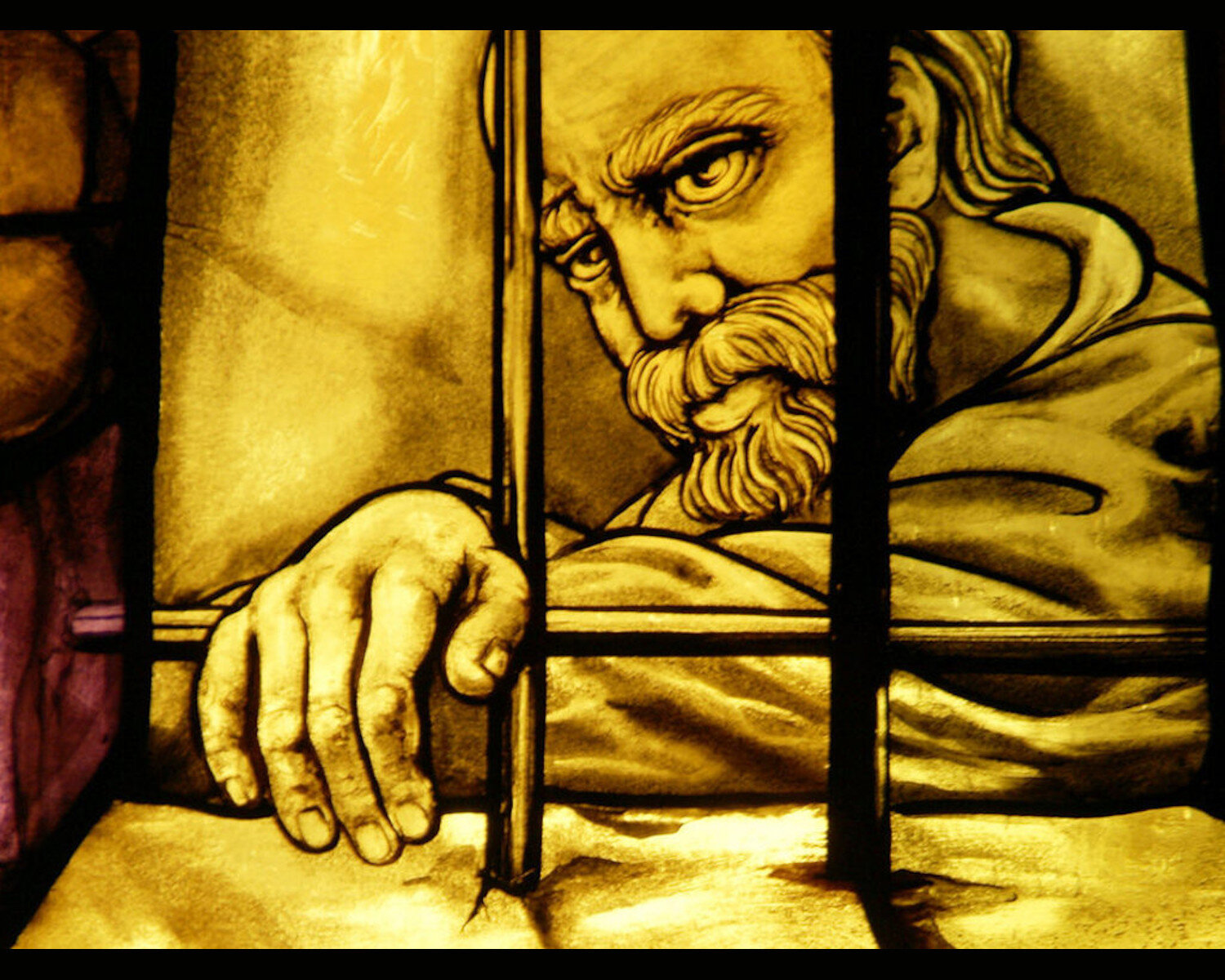
Two prior posts from Beyond These Stone Walls revisit the ideal of freedom, what it means to find it, what it costs to keep it, what it takes to give it to another.
Some readers who are aware of my day to day life as a guest of the state have heard that I was held in a high security quarantine dormitory setting for the entire month of May and part of June in 2021. I did write briefly of this just before it happened, but it seems that what I wrote was too cryptic. I just received a letter from a reader who wanted to launch a petition over my continued heightened confinement. Please don’t show up here with picket signs. I am now liberated from my dungeon.
I was not technically in quarantine. Due to a planned construction project where I was living, I and 23 others were moved to an unused dormitory space that had been previously set up as a Covid-19 triage and quarantine area. It commenced on May 1 and was supposed to last for just ten days at which time, it was promised, we would all move back to our housing assignments.
The construction ran into obstacles, however, and the predicted ten days ultimately turned into forty. During that time, I was pretty much locked into a crowded, noisy room with 23 other disgruntled prisoners. I had no access to my typewriter while there so writing was extremely difficult. Somehow, I still managed to write three posts, but with great difficulty. One of them was for my 39th anniversary of priesthood entitled, “It Is the Duty of a Priest to Never Lose Sight of Heaven.”
I wrote that post “by fits and starts,” a term meaning “haphazardly” that has gone out of style in writing. I wrote that post only in my mind. I was still able to work, as needed but with greatly reduced hours, in the prison law library where I am the sole legal clerk. There is an old manual typewriter there, so I managed to type that post over two hours one afternoon. I mailed it just at the final deadline to have it posted on time. I hope its troubled creation was not so evident.
I could not bring myself to complain about the forty-day confinement. I was constantly aware that our friend, Pornchai Moontri, spent five full months in ICE detention awaiting deportation in a room of the same size, but housing 60 to 70 detainees at any one time. That story should become another BTSW classic post on freedom. The gripping story is told in “ICE Finally Cracks: Pornchai Moontri Arrives in Thailand.”
More importantly, it was also impossible for me to offer Mass during my stay in what I can only describe as “a FEMA shelter without the disaster.” I had hoped to offer Mass on June 6, the Solemnity of Corpus Christi this year and the anniversary of my First Mass on the day after my priesthood ordination on June 5, 1982. But it was not meant to be. After forty days, we were all finally liberated and returned to the place in which I have lived since July of 2017.
It is difficult for me to believe that it was four years ago this month that Pornchai and I were finally moved to that better housing. For the previous 23 years — 12 for Pornchai — we were prisoners in a building housing 504 prisoners but built for half that number. There was little to no access to the outside. It contained all the trouble and chaos that such constant confinement brings.
But we are now free from that. Even in a state of unjust imprisonment, I can thank God for the freedoms I have. I am free to write to the world beyond these stone walls which means more to me than you may know.
As I pondered Independence Day in America this year, I realized that it falls on the Fourteenth Sunday in Ordinary Time. This time is anything but ordinary for me and Pornchai. When I looked at the Mass readings for that day, I noted that I wrote of those same readings for Independence Day six years ago. So I want to invite you to visit that post anew. It is the story of Saint Paul and his plea to be free of his famous but cryptic “thorn in the flesh.”
The second post I want to present anew is a memorable one you also may have previously read. It is brief, but you should not miss it.
+ + +
Independence Day: St Paul and His Thorn in the Flesh

A Mass Reading from Second Corinthians on the 14th Sunday in Ordinary Time conveys Saint Paul’s thorny lesson about freedom and power. Our world has it all wrong.
It is not by design, but the Fourteenth Sunday in Ordinary Time falls on Independence Day in the United States in 2021. The Mass readings assigned to that day (Lectionary 101 – Year B) have an important lesson about the nature of freedom and the source of true power. The lesson’s focal point, as in every Mass, is the Gospel (Mark 6:1-6). Jesus concludes that the people in his own “native place” would not hear Him, but “only took offense at Him.” I certainly know the feeling.
These were his own people. The Gospel mentions that they knew Joseph. They knew Mary. They knew some of the Apostles, but Jesus “was amazed by their lack of faith.” He concluded famously that “A prophet is not without honor except in his native place, and among his own kin, and in his own house” (Mark 6:4). It is having confronted that reality that the Mission of Christ Universal begins to unfold.
As I read this Gospel passage, I thought of a letter sent to me two years ago by Cardinal Raymond Burke. In it, he expressed his concern for my plight and asked for my prayers for him and for the Church. His words suggesting that I offer some of what I endure for a greater good — “pro bono Ecclesiae,” a phrase taught to us recently in Father Stuart MacDonald’s provocative post, “Last Rights: Canon Law in a Mirror of Justice Cracked.”
Cardinal Burke’s request that I suffer for something greater than suffering was an honor without measure. I wrote of this in a Christmas post last year. Here is an excerpt from my post, “Silent Night and the Dawn of Redeeming Grace.”
This letter is among the best Christmas gifts I have received out here among the Church’s debris, and it came as a source of grace, a sort of awakening. What follows may be the most important sentence in this post: There is no greater service to those who suffer than to give meaning to what they suffer.
A few months after my receipt of Cardinal Burke’s letter, a bishop came to this prison to offer Mass on Divine Mercy Sunday. Our friend, Pornchai Moontri and I were among the fifty Catholic prisoners gathered in the prison chapel for Mass. You know Divine Mercy Sunday is a special day for us.
After the Mass, as we filed out, the Bishop grasped my hand and said something very strange to me. He had obviously been reading These Stone Walls. As he took my hand, he bent forward a bit and said quietly but forcefully, “You are a prophet! YOU are a prophet.” There was no further exchange.
As we descended down the long flights of stairs outside, my friend, Pornchai said, “Wow! That was weird. What do you think it means?” I responded sarcastically, “If the Church is consistent, it means my head is about to be lopped off!”
Our prophets do not fare very well. In Scripture, some were thrown into prison. The Prophet Jeremiah was stoned to death. According to legend, the Prophet Isaiah was sawed in half. The Prophet Jonah was thrown overboard. John the Baptist was beheaded. Saint Paul was shipwrecked, beaten, imprisoned, and finally martyred.
As the great Saint Teresa of Avila once said to God in prayer, “Lord, if this is how you treat your friends, it is no wonder that you have so few!”
The Gospel is, of course, the centerpiece of the Liturgy of the Word, but on the 14th Sunday in Ordinary Time it is the Second Reading that really leaps off the page in my quest for my own Independence Day. It is Saint Paul’s famous account from the Second Letter to the Corinthians (12:7-10) about his thorn in the flesh:
“… A thorn in the flesh was given to me, an angel of Satan, to beat me, to keep me from being too elated. Three times I begged the Lord about this, that it might leave me, but he said to me, ‘My grace is sufficient for you, for my power is made perfect in weakness.’ ”
Scripture scholars — both real and imagined — have pondered for centuries to decipher what this cryptic thorn in the flesh could mean. Some have interpreted it to mean a physical ailment or disability of some sort that rendered Paul weak and challenged. His phrase, “my power is made perfect in weakness” lends itself to that theory when you consider the vast influence he has had on the growth of Christianity.
THE AGENT OF SATAN

Others have suggested that his thorn in the flesh was the manifestation of some mental illness which, in Saint Paul’s time, was often described in Jewish tradition as a manifestation of Satan or some other demonic attack. His words, “to beat me, to keep me from being too elated” suggest a sense of personal diminishment that could support a theory about some mental condition such as bouts of chronic depression or anxiety.
In more modern times, some have suggested with a straight face that the thorn in the flesh could be an allusion to some morally compromising sexual proclivity over which Paul experienced little self-control. I believe that all three of these theories are incorrect, and the third one is far more descriptive of the preoccupations of our own time than Saint Paul’s.
I have formed my own conclusions about Paul’s mysterious “thorn in the flesh,” and they come from a more panoramic understanding not just of what he wrote, but also of who he was — and is. I believe his “thorn in the flesh” is a person, someone who stood in hostile opposition to Paul and his missionary activities.
Saint Paul, formerly Saul, was a Jew born in the town of Tarsus in the Roman Province of Celicia. In his Letter to the Romans (11:1) he revealed that he was from the Tribe of Benjamin. He was also a Roman citizen which gave him certain rights and privileges. In Acts of the Apostles (22:25-29) Paul was about to be scourged by a Roman tribune. When it was learned that he was a Roman citizen by birth, the punishment was halted.
Paul was also a zealous member of the Pharisees (Acts 26:5). This meant that in Jewish circles, he was highly educated in the law and Jewish Scripture and traditions. His writing has to be seen in this context, and the phrases he used have to be weighed against the Hebrew Scriptures with which he was thoroughly familiar.
In those Scriptures, the word, “thorns” is often symbolically used to refer to enemies. The context for its use by Paul in the excerpt from Second Corinthians cited above was not that the “thorn in my flesh” was placed there by Satan, but rather is described as “an agent of Satan.” This presents an impression that this thorn is a person in hostile opposition to Paul.
As a Pharisee, Paul would have been thoroughly familiar with the Torah, the Books of Moses held to be especially sacred. The Book of Numbers, which is a re-telling of the Exodus story and the arrival of the Israelites in the Promised Land, contains an allusion with which Paul would have been very familiar:
“But if you do not drive out the inhabitants of the land from before you, then those whom you let remain shall be as barbs in your eyes and thorns in your side.”
Saint Paul’s description of this “thorn” as a “servant” or “angel” (messenger) of Satan suggests that Paul was faced with a growing personal hostility and oppression from someone within his own community. By “his own community,” I mean his Jewish community and not the community of believers in “The Way.” It was more likely someone in the Jewish community who oppressed Paul because his allusion to the thorn as depicting an enemy is a purely Old Testament Jewish symbolism.
So the only remaining mystery is not “what” the thorn in his flesh was but rather who. It was during Paul’s Second Missionary Journey commencing in 50 A.D. that he established the Church in Corinth, a city in Greece on the Isthmus of Corinth. Paul remained there for over a year, but before departing he was viciously attacked by an unnamed enemy (2 Corinthians 11:13).
The unnamed enemy may well be the thorn in Saint Paul’s flesh. Paul was a Pharisee who had previously persecuted Christians, capturing them and handing them over for stoning. He was deeply committed to the Pharisaic tradition of maintaining legal and ritual purity for the Jews. Now Paul was promoting this new faith, and not only promoting it, but actively welcoming gentiles to its ranks.
It was during his Third Missionary Journey to Macedonia that he wrote the Second Letter to the Corinthians in 53 A.D. He wrote it from Philippi in Macedonia. Then, proceeding to Corinth, he wrote his Letter to the Romans. At the time he wrote both Second Corinthians and Romans, he began to speak of his impending imprisonment and martyrdom.
Saint Paul’s allusion that “Three times I begged the Lord” about the thorn in his flesh, i.e., the hostility he encountered — likely refers to a leader in the Jewish community. Using the past tense, “begged,” infers that he has stopped begging, and has accepted the answer that came to him:
“My grace is sufficient for you, for my power [the power of God] is made perfect in [your] weakness.”
The power Paul encounters is manifested in his acceptance of weakness, meaning his acceptance that it is not his own gifts and talents that are driving the bus on this mission:
“I will rather boast: most gladly of my weaknesses, in order that the power of Christ may dwell with me. Therefore I am content with weaknesses, insults, hardships, persecutions, and constraints for the sake of Christ; for when I am weak, then I am strong.”
Independence Day thus dawned for the Apostle Paul.
+ + +
Left Behind: In Prison for the Apocalypse

This medium security prison has a library where I have been a prisoner-clerk for the last ten years. Its shelves are stocked with 21,000 volumes. With an average of 1,000 visits, and some 3,000 books checked out each month, the library is a literary hub intersecting virtually every facet of prison life. But there is a lot more going on than books flying off the shelves.
There are few proud moments in prison, but one of mine came in the form of a second-hand message from my friend Skooter, now free. Two months after Skooter ascended through the corrections system to finally hit the streets, another friend of his was sent back to prison for a parole violation.
That friend came to the library one day, and standing at my desk, said, “You’re the guy who broke Skooter out of prison!” The man explained that he lived near Skooter in a seedy urban rooming house while both were unemployed and barely surviving in their first few months on parole. He said that Skooter had been unable to land a job, working in temp jobs for minimum wage and at times faced with a choice between food and rent.
It is an all-too-familiar account for young men struggling to emerge not just from a prison, but from a past. Skooter came very close to giving up, the friend said, but often spoke of his “wanting very much not to disappoint you” by coming back to prison. “So he stayed the course,” said the friend, “and now he’s gotten his life together.”
I first met Skooter several years earlier, one of the scores of aimless, rootless, fatherless, uneducated young men for whom prison can become a warehouse, a place in which thousands of “Skooters” store their aimless, hopeless futures. One day as we slowly ascended the multiple flights of stairs to be checked in at the Education Floor where the prison library is located, Skooter told me with a sense of shame that, at age 24, he had never learned to read or write.
Having resisted all the concerted efforts to recruit him into any number of prison gangs that would only foster his ignorance and exploit it, Skooter became a regular fixture in the prison library. For an hour a day there, I and other prisoners worked with Skooter to teach him to read and write.
My friend, Pornchai Moontri tutored him in math, Skooter’s most feared academic nemesis. We made sure he didn’t starve, and in return, he struggled relentlessly toward earning his high school diploma in prison, a steep ascent in a place that by its very nature fosters humiliation and shuns personal empowerment.
One day, shortly before his high school graduation in May 2011, Skooter came charging into the library looking defeated. He plopped before me the previous day’s copy of USA Today, opened to a full-page ad by some self-proclaimed Prophet-of-the-End-Time announcing that the world is to end on May 21, 2011, a week before Graduation Day.
“It’s just my luck’” lamented Skooter. “I do all this work and the world’s gonna end just before I graduate.” “It’s not true,” I said calmly. “It MUST be true,” Skooter shot back. “They wouldn’t put it in the paper if it wasn’t true!” Like many prisoners, and far too many others, Skooter believed that all truth was carefully vetted before ending up in newsprint.
Apocalyptic predictions sometimes play out strangely in prison. I told Skooter that back in 1999, a prisoner I knew became convinced of dire consequences from a looming technological Armageddon called “Y2K.” ‘That prisoner deduced somehow that prison officials would release toxic gas at the turn of the millennium so he spent the night of December 31 sewing his lips and eyes shut. Skooter wanted to know how the guy managed to sew that second eyelid, a small tribute to his deductive reasoning.
I pointed out to Skooter in the USA Today ad’s smaller print that this newest End-Time prediction was actually a revision of the author’s previous one set in 1994. I strongly urged Skooter not to put off studying for final exams because of this. Skooter stayed the course.
Since then, a subsequent prison policy barred all prisoners from teaching and tutoring other prisoners, a decision that effectively eliminated all of the positive influence, and none of the negative influence, that takes place in prison, driving the former underground.
Still, that graduation was Skooter’s finest moment, and one of my own as well. It was a direct result of a prison library subculture that grants every prisoner a few hours a week out of prison into an arena of books, a world of ideas, a release of huddled neurons yearning to be free.
A week after graduation, Skooter showed up in the library with a copy of The Wall Street Journal opened to an article by science writer, Matt Ridley. The article explored evidence that the Earth’s magnetic core shifts polarity every few hundred thousand years, and pointed out with dismal foreboding that it is 780,000 years overdue. Mr. Ridley stressed that no one knows its potential impact on our global technological infrastructure.
“It’s just my luck!” lamented Skooter as he plopped the article on my desk. “Just when I was thinkin’ about college!”
+ + +
Note from Father Gordon MacRae: Please visit our “Special Events” page.
+ + +

Cardinal Sins in the Summer of Media Madness
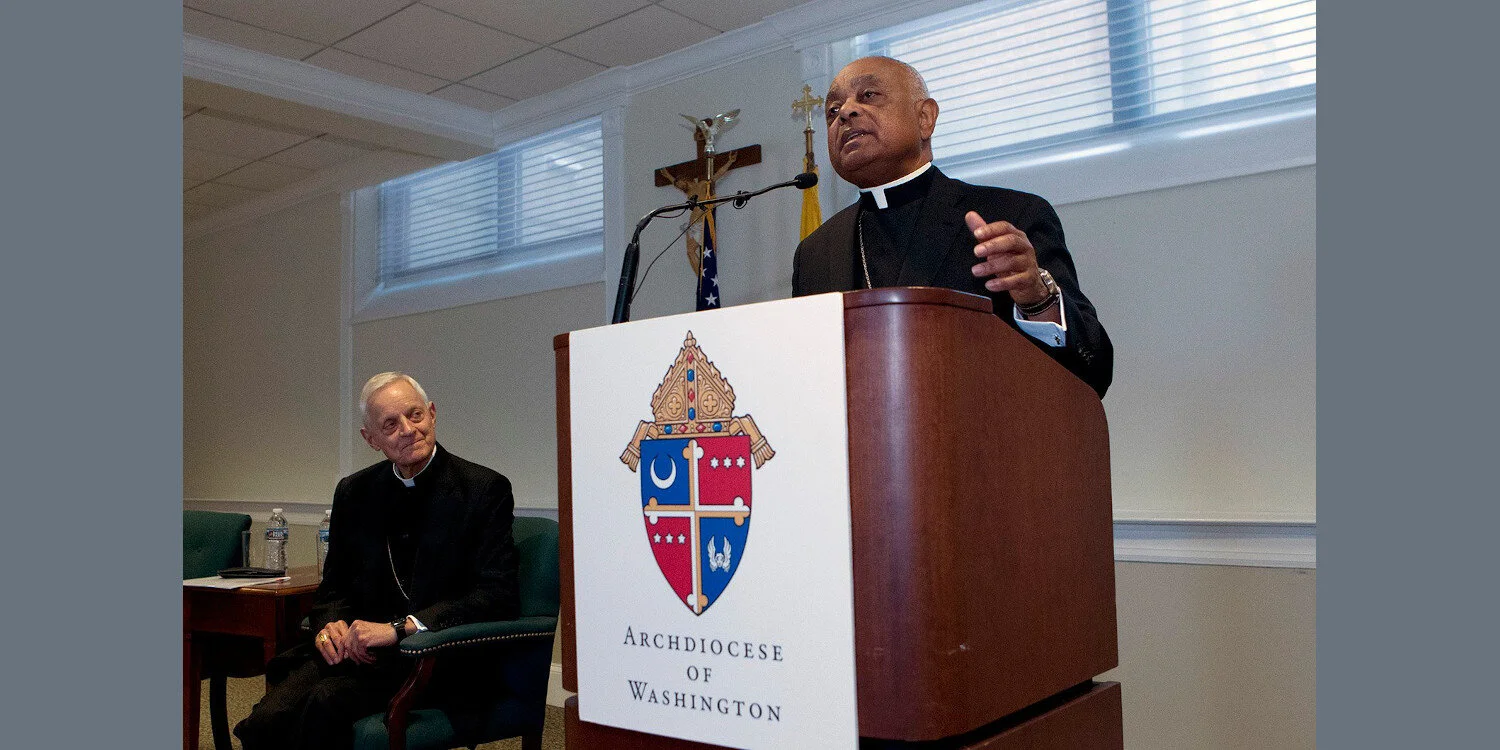
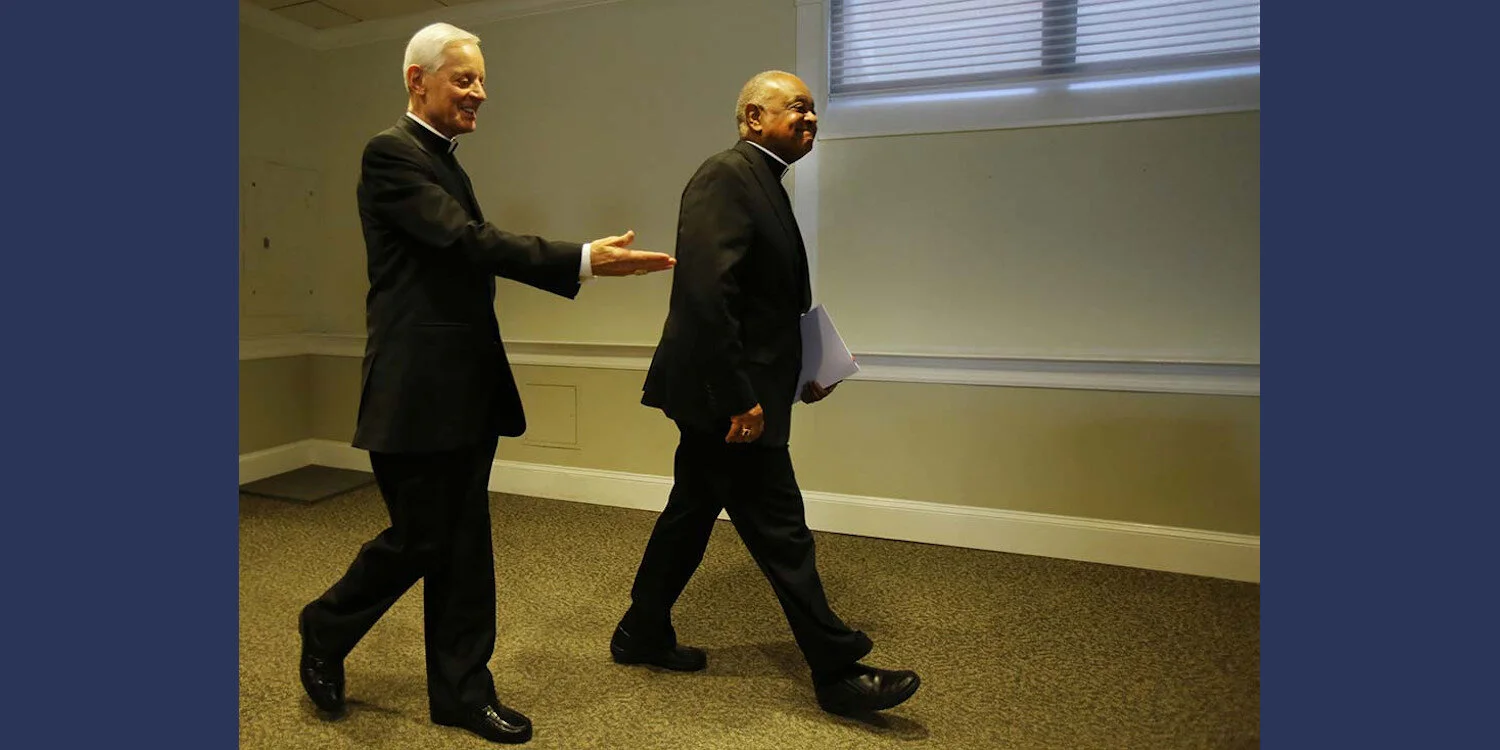
Cardinal Wilton Gregory was among the outraged when President Trump ordered Capitol Police to forcefully remove demonstrators for a photo op, but was it even true?
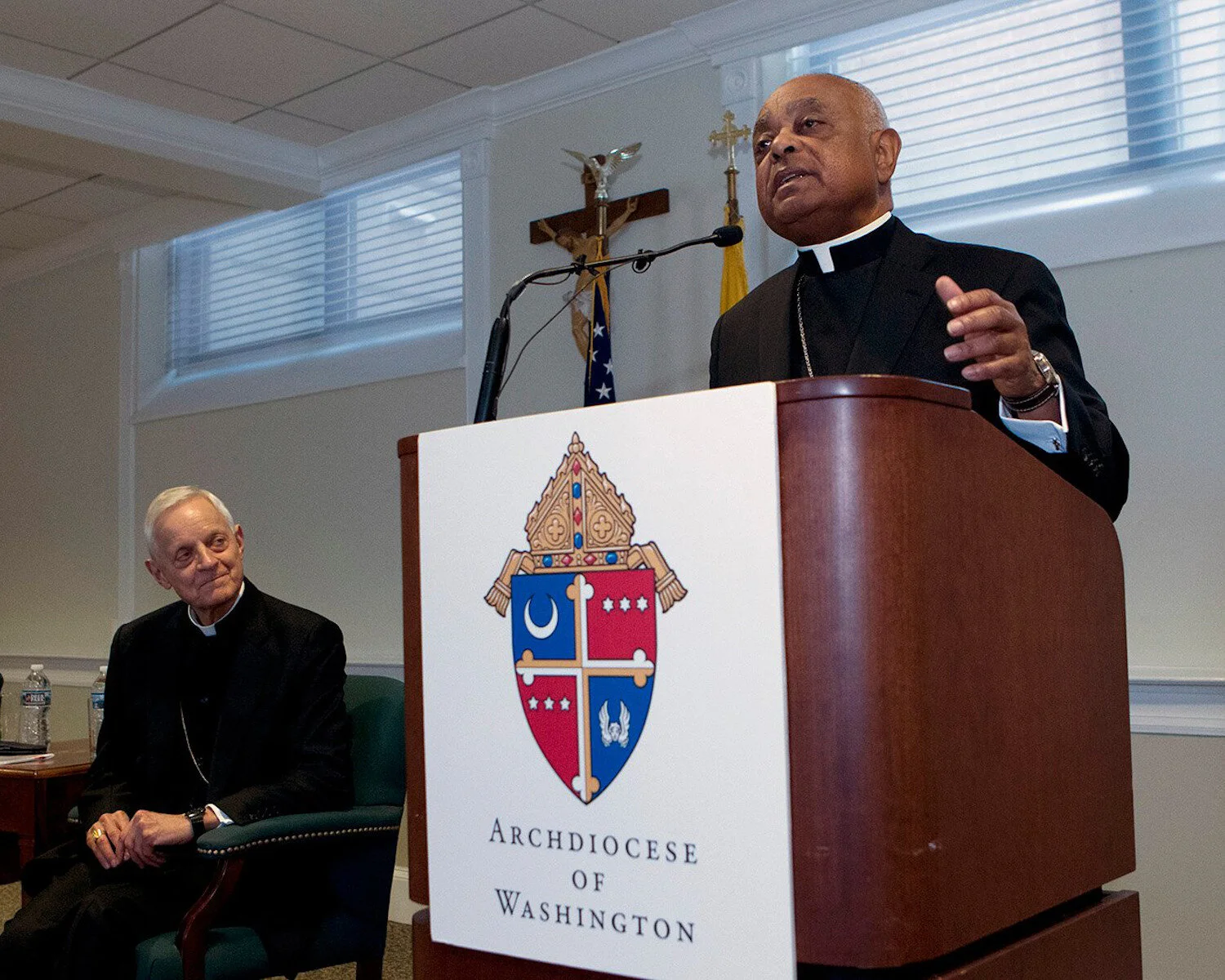
Cardinal Wilton Gregory was among the outraged when President Trump ordered Capitol Police to forcefully remove demonstrators for a photo op, but was it even true?
A few weeks ago in these pages I wrote a post entitled, “Covid: The Chinese Communist Party and the U.S. News Media.” It made the point — now well documented — that the primary reason why some in the partisan news media rejected even the idea that the virus causing Covid-19 may have been leaked from a Wuhan laboratory is because it was President Trump and Senator Tom Cotton who first suggested it. I was warned to stay out of that minefield, but here I am again.
Those who assist me in publishing this blog share these posts on social media accounts which I have never seen and likely never will. We have all struggled with the advisability of wading into the social media swamp, but it is where people are. Placing before them a fair, just, and truthful idea seems to me to be a good thing. We have a presence in about thirty Catholic platforms on Facebook alone with a combined membership of hundreds of thousands. For the most part, what I write is well received there.
I was really smacked down, however, when we ventured into Reddit. The Catholicism Forum there rejected my recent post on the origin of Covid saying that it was off topic and of no interest to Catholics. Is there something about Catholics that makes them immune to Covid? I’m Catholic and I had it. It was awful. Trust me, we are not immune.
So after the Reddit Catholicism moderator’s terse rejection, we found a home for that post on Reddit’s News Media Forum. It felt as though I had stepped into one of the riots of 2020. Some people thanked me for writing it, but most openly condemned it — and me — for mentioning Donald Trump in something other than the required disparaging and condemning tone. “The author of this article is a convicted Catholic priest,” one commenter wrote. “So keep that in mind when judging his credibility.”
Several others reacted in fury, but no one disputed any of the facts I presented in that post. One person came to my defense, suggesting that who and where I am does not in any way alter the facts I presented in that post. Thankfully, another person challenged the commenter’s condemnation by telling him to do some homework. She wrote that The Wall Street Journal published a three-part series which determined the case against me to be a monstrous fraud, and many others concur with that assessment.
Most of the rest of the comments were the typical tribal insults accusing Catholic priests of sticking their noses into politics where, they insist, we do not belong. They actually made my point for me. Determining the origin of Covid-19 is about finding the scientific truth. It is not about Trump, or partisan politics , or any other realm into which our partisan news media let it descend.
Can anyone explain to me the dynamic in which the mere mention of Donald Trump in a benign, factual, but non-derogatory manner sends some people into a frenzy unleashing a diatribe of “woke” suspicion?
It’s like Deja Vu All over Again!
It seems that I have not learned my lesson, however, for I am about to walk into that media minefield again. One year ago this week, I wrote a post entitled, “The State of Our Freedom, The Content of Our Character.” It was about a series of events that unfolded in Washington, DC during the summer of 2020. My post was not a defense of Donald Trump. I do not have a defense of Donald Trump. It was merely about truth, and having the good character to tell it.
Before I go into what I mean by that, I want to refer you to Catholic League President Bill Donohue and his recent press release entitled, “The Bishops Are Not Partisans.” He made the point that our bishops, acting as a whole, do not support any political party, nor do they speak toward a political goal. If they speak on politics at all, it is to clarify the Church’s teaching on a matter of faith or morals.
I agree entirely that this is what should happen when bishops speak as representatives of the Church. It is not always what does happen, however, but Dr. Donohue’s statement lends further clarity to what went wrong in Washington in June of 2020. I wrote extensively in the above cited post about these events.
What prompts me to write of this again is a recent statement summarizing a year-long investigation by the Inspector General of the U.S. Department of the Interior and the Attorney General of the United States, Merrick Garland, who recently testified at a Senate hearing in words quite similar to those of Bill Donohue in reference to Catholic bishops:
“The job of the Justice Department in making decisions of law is not to back any administration or impose one rule for Democrats and another for Republicans.”
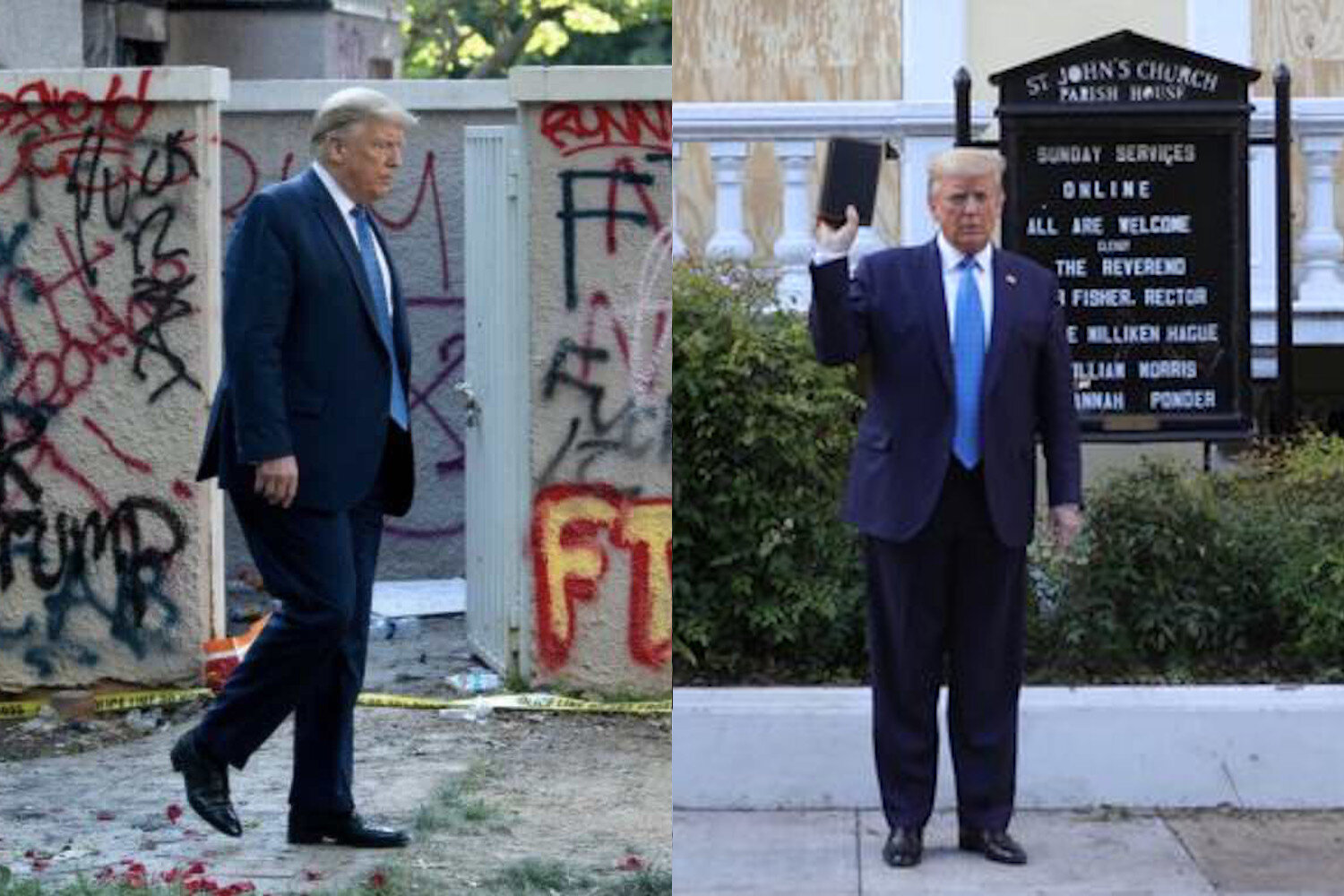
I much respect Attorney General Merrick Garland for the content of his character. The context for that statement immediately preceded the release of the Inspector General’s report about events in Washington, DC in early June 2020. The most egregious of these was a widely disseminated media condemnation of Donald Trump for using the Office of the President to order Capitol Police to forcibly clear Lafayette Square adjacent to the White House to make way for the President’s “photo op” holding a Bible in front of Saint John’s Episcopal Church. He supposedly had the police use gas to disperse the crowd.
But it is not true, and it was never true. The Inspector General’s Report — released to a mostly disinterested partisan news media — concluded that the dispersement of the crowd took place several hours before Trump’s spontaneous decision to go stand in front of that church. The two events, the IG Report states, were not at all related. And the crowd dispersed earlier that day was not at all a “peaceful protest” as characterized in the media. The decision to use force to disperse the crowd came after 49 officers were injured trying to stop the mob from destroying property.
In “The State of Our Freedom, The Content of Our Character” written one year ago this month, I wrote that Trump’s decision to go stand in front of that church was not to force the mob out. As the IG report states, they were removed four hours earlier. I wrote that Trump went there to force the news media to cover the extensive damage inflicted upon the facade of that church. Even then, after calling the riots “peaceful demonstrations,” CNN and most (but not all) news venues zoomed in on the President holding the Bible and thus keeping from public view the damage done to the church. This is not a defense of Trump. It is a defense of truth.

Cardinal Sins
Some of the untrue rhetoric and misplaced public condemnation of the President that day came from a surprising and alarming source. At a time when the nation was in a state of violent chaos in the early days of June, 2020, Washington, DC Archbishop Wilton Gregory stepped far afield of the call for a pastoral and non-partisan demeanor called for by Dr. Bill Donohue of the Catholic League.
On June 1, 2020, President Donald Trump and First Lady Melania Trump visited the St. John Paul II Shrine in Washington to commemorate Pope John Paul’s papal visit to his native Poland on that same day in 1979. That event is widely hailed today as the beginning of the end of the Soviet Union and European Communism. After the President and First Lady prayed at the Shrine, they proceeded to the White House where the President signed an Executive Order in support of International Religious Freedom.
The Wall Street Journal Editorial Board hailed that Order and visit to the Shrine as a remarkable message to the world that religious liberty must be affirmed. On the next day, however, Archbishop Wilton Gregory condemned these events in a statement given center stage in The Washington Post and America magazine:
“I find it baffling and reprehensible that any Catholic facility would allow itself to be so egregiously misused and in a fashion that violates our religious principles.”
Archbishop Gregory stated at the time that he had no prior awareness of a plan for the President to visit the Shrine, nor was he consulted in advance. In contrast, the White House stated that the Archbishop was invited to be present but declined the invitation to appear with the President due to “a prior commitment.” A shocking irony of the Archbishop’s statement above is that it could truthfully apply to the current President if you just substitute the words, “Catholic facility” with “Catholic Sacrament”:
“I find it baffling and reprehensible that a Catholic Sacrament would be so egregiously misused and in a fashion that violates our religious principles”
Later on June 2, 2020, President Trump made a highly controversial appearance holding a Bible in front of St. John Episcopal Church in Lafayette Square. The immediate media narrative was that he had Attorney General Bill Barr order Capitol Police to forcibly clear the park using tear gas to accommodate his “photo op.” That narrative took on the force of unquestioned Biblical truth. Democratic Presidential contender Senator Elizabeth Warren immediately called for an investigation into the “sickening and appalling measures to clear the park for a photo op.”
Senator Warren got the investigation that she called for. Earlier this month, the Inspector General for the U.S. Department of the Interior dismissed the story as entirely untrue. The report states, as described above, that the park was cleared of demonstrators hours earlier to protect both property and the Park police, many of whom were injured. This is the report of the current Inspector General and Attorney General in the Biden Administration.
It was an election year, and no one really expects partisan politicians to pass up a chance to distort the truth in favor of political points without checking the facts. That should not apply, however, to the Catholic Archbishop of Washington who issued a statement that day that was widely disseminated by The Washington Post and other venues:
“Pope John Paul II was a defender of the dignity of humans who would certainly not condone the use of tear gas and other deterrents to silence, scatter, or intimidate them for a photo op in front of a place of worship and peace.”
On the next day, the Archbishop’s office issued a group email to all priests of the Archdiocese of Washington summoning them to appear with protest placards while wearing cassocks or other clerical garb to join protesters in a staged demonstration in front of the White House that week. It is unclear how many, if any, of the priests obliged. Several said that this expectation was a violation of existing policy about engaging in partisan politics. It was also a violation of policy about pandemic social distancing. Others were alarmed that this placed priests in harm’s way.
After the Inspector General’s Report discredited the false media narrative about these events, The Washington Post issued a retraction of its earlier presentation. It also retracted its 2020 dismissal of the Wuhan laboratory Covid source theory as conspiracy theory. It is not easy for a major news outlet to issue a retraction of such explosive news coverage. However, there is to date no sign of a retraction, explanation, apology, or clarification from the Archbishop of Washington.
Four months after the events described in this post, Pope Francis announced his decision to elevate Archbishop Wilton Gregory to the College of Cardinals, an honor also bestowed on his two immediate predecessors, Cardinal Donald Wuerl and Cardinal Theodore McCarrick.
+ + +
Note from Father Gordon MacRae: Please visit our “Special Events” page. You may also want to read and share these related posts from Beyond These Stone Walls.
The State of Our Freedom and the Content of Our Character

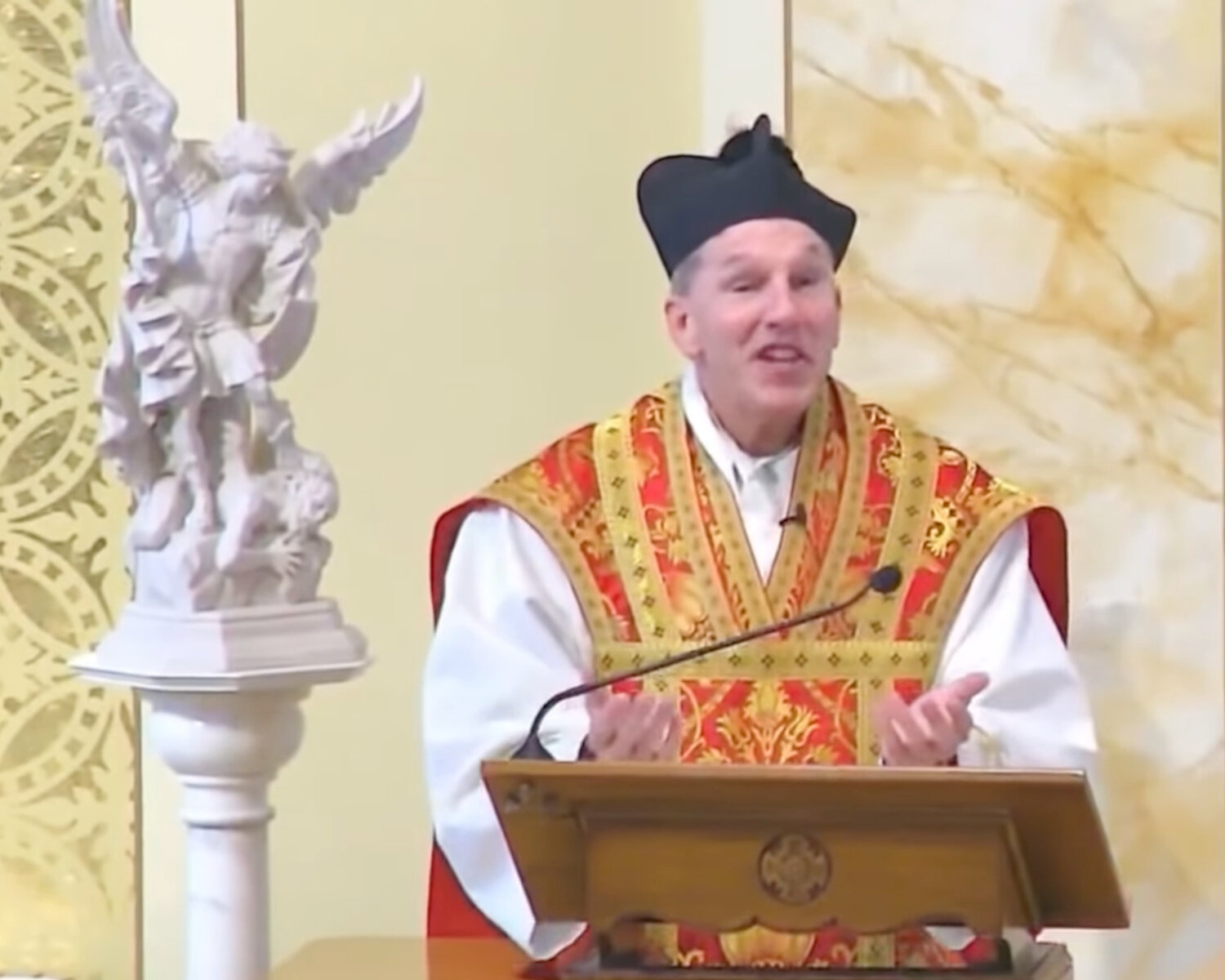
Catholics to Fr James Altman: ‘We Are Starving Out Here!’
Fr James Altman was removed from his assignment sparking appeals from the faithful in unprecedented numbers. Does this signal a growing distrust of our bishops?
Fr James Altman was removed from his assignment sparking protests from the faithful in unprecedented numbers. Does this signal a growing distrust of some bishops?
I was recently informed by a reader that her parish priest launched into a tirade against her and other parishioners for their dedicated pro-life activity. He reportedly stooped pointing to the ground shouting, “Of all the issues facing the Church and country right now, abortion is way down here!” In another incident, the same priest launched a tirade at a college-student parishioner in the confessional insisting that her involvement in pro-life causes is badly misguided.
Both incidents, and others like them, resulted in letters of concern to the diocesan bishop. Weeks later, the bishop replied that he has instructed the priest to cease allowing his political views to invade his pastoral ministry. Political views?
The last time I looked, the Church’s pro-life position and activity reflect a moral mandate of grave concern and utmost importance. The pro-life centricity of Catholic moral teaching has been clearly articulated by Popes John Paul II, Benedict XVI, and Francis.
I dread writing any criticism of Catholic bishops. In over 600 posts of the last twelve years, only a few have had such content. Pope Francis has recently spoken against clericalism in the form of careerism in the Church, and he has also spoken recently of a concern for the morale of priests. The concern is well placed, but the former very much impacts the latter. Bishops have nearly ultimate authority in their own dioceses, but bishops who aspire to more prestigious positions sometimes find themselves bending to the will of some other bishops with more clout.
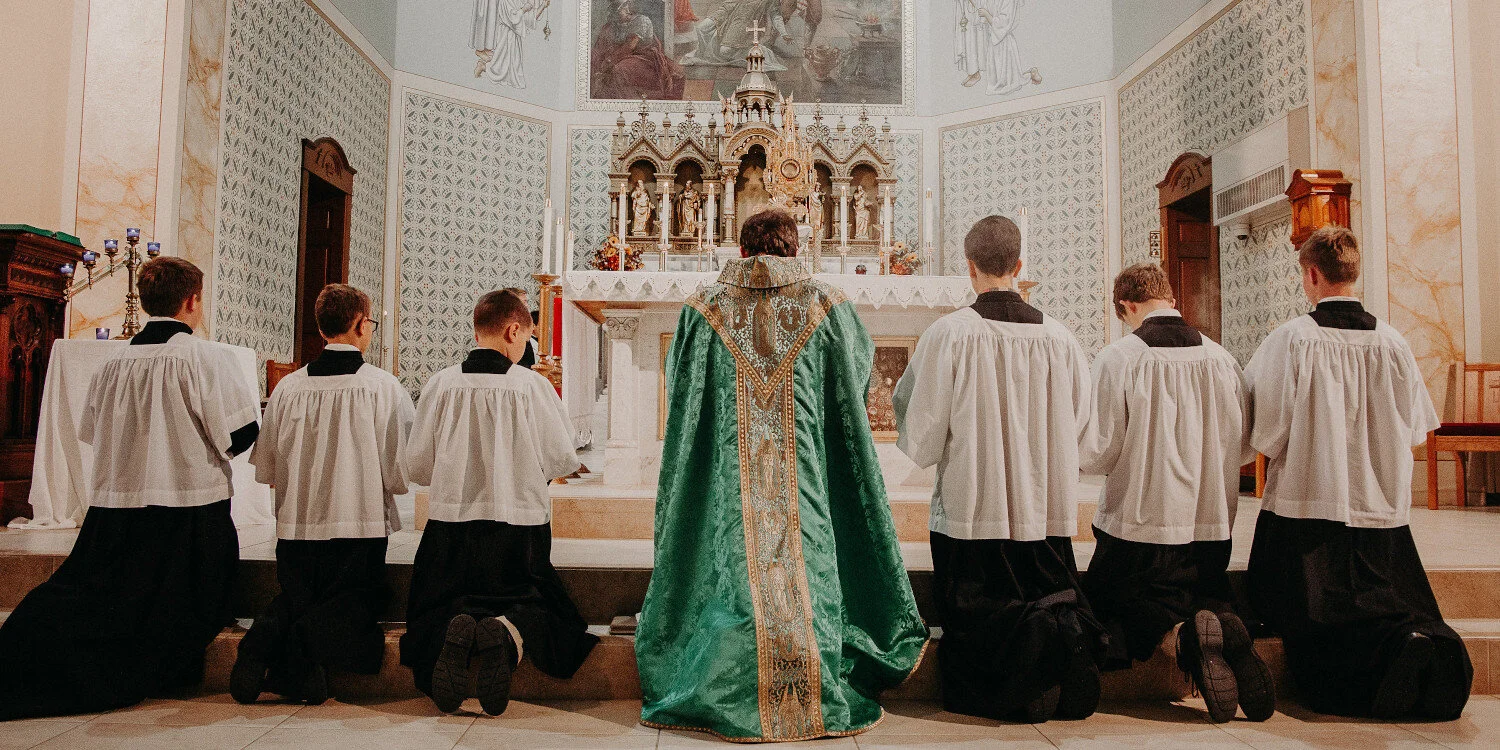
Pro-Catholic, Pro-life, Pushed Out
On Friday, May 21, 2021, Father James Altman was instructed by La Crosse, Wisconsin Bishop William Patrick Callahan to resign from his parish over the Bishop’s concern that the volume and tone of his “political” rhetoric has rendered him divisive and ineffective. Father Altman — who until weeks ago had been pastor of Saint James the Lesser Catholic Church in La Crosse — has said some very challenging things in his preaching on the Gospel but nothing he has said to date contradicts Church teaching.
In his now notorious “Memo to the Bishops of the World,” Father Altman called on the U.S. Bishops to stop issuing guidance for the care of our physical health at the expense of care for our souls. He called for the bishops to present faithful and unapologetic adherence to and promotion of Church teaching.
But volume and tone may not have really been at the heart of Bishop Callahan’s expressed concerns. Though unstated, it seems that a small minority of Catholics dismissing Father Altman’s rhetoric as “dabbling in the political” clearly wanted him silenced, and it seems that his bishop obliged. It is also now widely suspected that pressure came from other bishops who were uncomfortable with Father Altman’s growing fame in his homiletic broadsides against abortion, same-sex marriage, transgender ideology, and, most recently, the shuttering of churches, first by politicians and then by some bishops, during the Covid pandemic.
I admit that I have sometimes grimaced at Father Altman’s tone in his fiery homilies, and thought he could be more effective if he lowered the volume just a bit. Nonetheless, in recent posts, I have said some of the very same things he has said. (See, “The Faithful Departed: Bishops Who Bar Catholics from Mass” and “A Year in the Grip of Earthly Powers.” )
I have written about all of these things, but a small voice from the wilderness of prison is a lot easier to ignore than a YouTube video homily gone viral. Some of Father Altman’s more fiery prophetic witness has drawn the attention of faithful Catholics across the continent and around the world. When he announced his imminent removal during a Pentecost homily this year, there were audible gasps from his congregation. Father Altman explained to them,
“For the record, through my efforts at preaching the truth ... somehow the truth has gone viral over the past eleven months and people all over the globe — as far away as Borneo — have written over 4,000 letters and cards — even more than that in emails — all saying the same thing: ‘We are starving out here!’”
However, something far more interesting than Father Altman’s reaction to his removal has occurred. A crowd funding page was established online to assist in retaining a canon lawyer to appeal his removal to higher ecclesiastical authorities. A funding goal of $20,000 was set. In less than a week, the fund grew to $250,000. A week later, it rose to $650,000. On the day this is posted, the fund is approaching $700,000 while an online petition garnered nearly 100,000 signatures.
The Church, the Bishops, the Eucharist
Instead of silencing Father Altman, the bishops might ask themselves why so many are listening to him so intently. This is a different sort of Sensus Fidelium — the sense of the faithful — than the Church is accustomed to. The bishops would be wise to listen. The setting aside of this one priest over what has been dismissed as “political” activism may signal a far greater concern about the bishops’ collective ability to discern between moral and political issues.
It seems no mere coincidence that Father James Altman was removed from ministry just in time to accommodate those who want the rhetoric on another development lowered to a mere whisper. You likely already know what has transpired regarding a simultaneous embarrassment among our bishops, but here is the short version.
On the day this is posted, the United States Conference of Catholic Bishops (USCCB) is scheduled to meet to discuss what is turning out to be a heavily manipulated agenda. The meeting “may” include “the drafting of a formal statement on the meaning of the Eucharist in the life of the Church” and its application to pro-abortion Catholic politicians who receive the Eucharist. That any of our bishops may actually need such clarity on this is alarming in its own right.
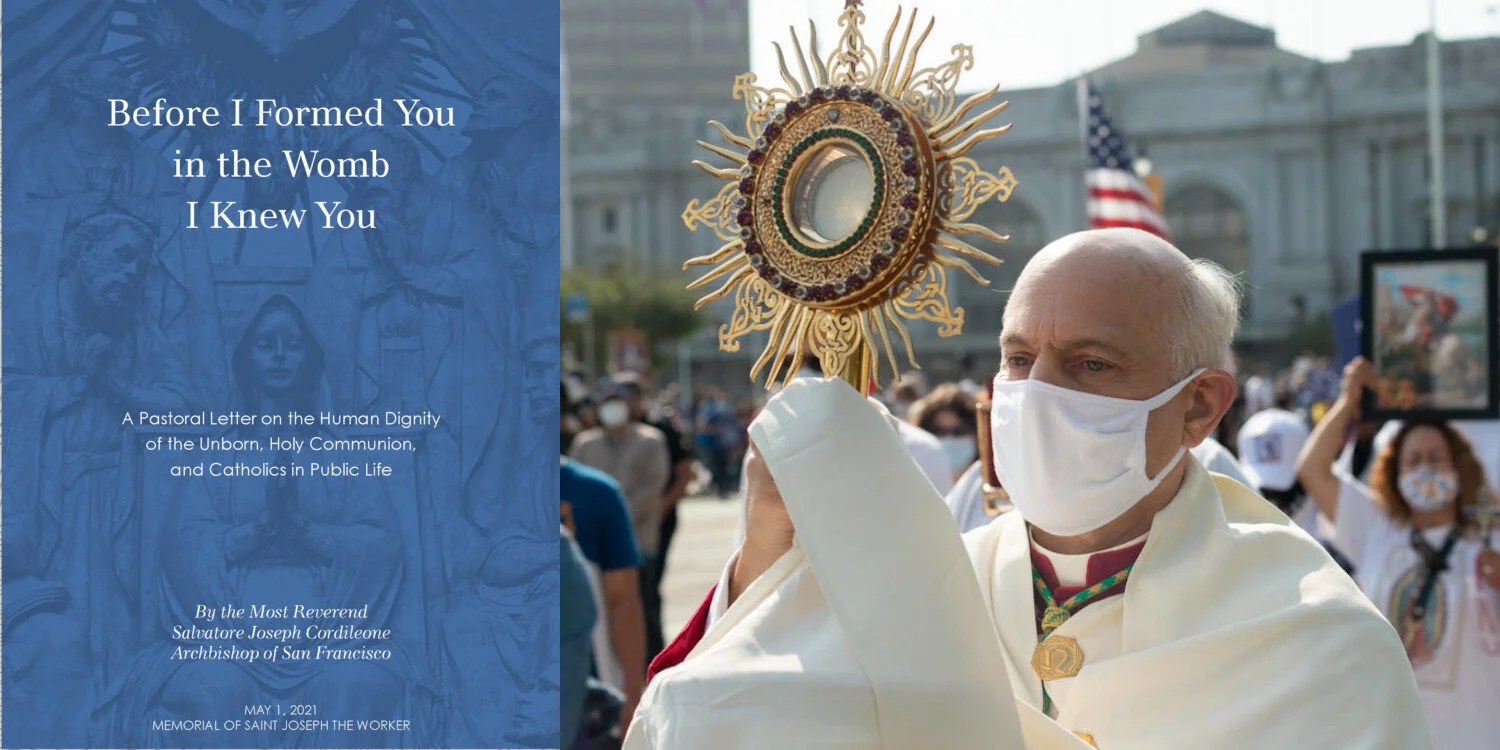
That clarity has recently come from two sources, Archbishop Salvatore Cordileone of San Francisco and Bishop Thomas Olmstead of Phoenix. I recently wrote of Archbishop Cordileone and his defense of religious liberty. Since then he has published, Before I Formed You in the Womb I Knew You: A Pastoral Letter on the Human Dignity of the Unborn, Holy Communion, and Catholics in Public Life.
In my post, some readers challenged me in comments stating that I overlooked the fact that this concern should have been raised by the Bishops “when it really mattered” before the 2020 presidential election. I will get back to that in a future post after the results of the USCCB meeting become public. Suffice it to say that it also really matters now.
I wrote above that clarity on the meaning of the Eucharist “may” be on the agenda because a group of 67 U.S. bishops — representing only 15-percent of the USCCB’s voting members — has lobbied USCCB President Archbishop José Luis Gomez to remove this topic from the agenda. All the bishops are careful not to say it, but this entire discussion is about the controversy of a pro-abortion activist who has presented himself as a devout Catholic and now occupies the White House.
Two of the signatories have since asked to have their names redacted from the letter saying they had not fully been informed of its purpose and were manipulated into signing it. Others have since stated that they never agreed to sign this letter and do not even know how or why their names were added.
The protest letter seems to have been spearheaded by Cardinal Wilton Gregory, Archbishop of Washington, DC, who reportedly composed the letter on his letterhead. He has gone on record to insist that he would not deny the Eucharist to pro-abortion Catholic President Joe Biden. The letter was also signed by Cardinal Joseph Tobin of Newark, Cardinal Sean Patrick O’Malley of Boston, and Cardinal Blase Cupich of Chicago. Cardinals Cupich and Tobin met in Rome with Cardinal Luis F. Ladaria, SJ, Prefect of the Congregation for the Doctrine of the Faith, just prior to the letter being sent to the USCCB President.
As this post was being written, it was just announced that Pope Francis planned to meet or otherwise confer with President Joe Biden on the day before the U.S. Bishops’ meeting. This had raised some alarm among many faithful Catholics who support the bishops’ effort to develop a uniform policy on Communion for Catholic politicians who openly promote abortion, legislate to restrict religious freedom, and support same-sex marriage and transgender ideology. President Biden, who professes to be Catholic, has promoted all of these. He has also stated his intent to repeal the Hyde Amendment which since 1974 has protected taxpayers from forced violations of their consciences by using taxpayer funds to promote and provide abortions.
However, in the eleventh hour, there has been a new development. On June 15, the day before we publish this post, Catholic News Agency issued the following statement: “The President’s entourage had originally requested for Biden to attend Mass with the Pope early in the morning, but the proposal was nixed by the Vatican after considering the impact that Biden receiving Holy Communion from the Pope would have on the discussions the USCCB is planning to have during their meeting starting Wednesday, June 16.”
I suggest reading the rest of the brief CNA article. However, it requires a little reading between the lines. It seems that it was President Biden's Administration that requested the meeting with the Holy Father to take place after the G7 Summit while the President is still in Europe. Once the Vatican agreed to the meeting, it seems that President Biden's entourage made a subsequent request for Biden to attend Mass with the Holy Father. The timing of this leads me and many others to believe that the real objective here was for a photo-op of Biden receiving the Eucharist from the Pope on the eve of the U.S. Bishops' meeting on that very subject.
Vatican officials saw through this and declined to allow the Mass to take place. It seems that the Biden Administration then cancelled the meeting because its real objective had been negated.

The Two Father Jameses
Father Dwight Longenecker has written an intriguing post entitled, “The Tale of Two Fr. Jameses.” He contrasts the activism and public statements of Father James Altman and Father James Martin, SJ, two priests on polar ends of the Catholic theological and political spectrum. He contrasts the two priests thusly:
“Both priests have somewhat of a prophetic voice in the Church — Fr. Altman from the conservative side and Fr. Martin from the liberal. Fr. Altman castigates Catholics who voted for Joe Biden. Fr. Martin openly supports Biden. As such, the two Fr. Jameses are poster boys for the two Catholic Churches in America today. Fr. Altman for the traditional, orthodox, strict version of Catholicism. Fr. Martin for the accommodating, relativistic, and subjective version of Catholicism. Fr. Altman: doctrinal. Fr. Martin: pastoral. Fr. Altman: Rational. Fr. Martin: Sentimental.”
The article is brief, but I have a fundamental disagreement with a part of it. Father Longenecker went on to characterize Father Altman as one who “campaigns against a Catholic hierarchy that is in bed with the Democratic Party” while Father Martin, “in manipulative and disingenuous ways has used his media platform to promote the blessing of same-sex unions and to encourage homosexuality.” Father Longenecker asks an important question:
“Fr. Altman ... has fearlessly upheld the traditional Catholic faith and has never come close to preaching anything contrary to the Gospel. His sin? To be ‘divisive.’ Why, may I ask, has no one suggested that New Ways Ministry and Fr. Martin (who have scandalized thousands of Catholics) are divisive?”
Father Longenecker went on to suggest that the clash between the two churches (left and right) in America today recalls the Jansenist-Jesuit conflict in 18th Century France. As the faith came under attack by Protestantism and the Enlightenment, French Catholics lapsed into Jansenism, a kind of “Catholic Calvinism.” He suggests that Fr. Altman’s style is an example of this Catholic Calvinism. I disagree.
The reason I disagree is laid out in a post of mine entitled, “The Once and Future Catholic Church.” It makes a case for why the traditional stress on Catholic orthodoxy and fidelity is the most pastoral approach a priest can take in a society drifting rapidly toward “Cancel Culture” socialism. Father James Martin seems to not want to rest until American Catholicism breaks from Rome and becomes indistinguishable from the Episcopal church and its determination to tear the Worldwide Anglican Communion asunder.
In these pages recently, priest and canon lawyer, Father Stuart MacDonald, wrote “Bishops, Priests, and Weapons of Mass Destruction.” He wrote of the trajectory from the U.S. Bishops adoption of “zero tolerance” in 2002 to a policy emerging now in which bishops may discipline and remove priests for any vague cause whatsoever. And believe me, it will be the Father Altmans, and not the Father Martins, who are subjected to this policy. It is difficult to believe that Pope Francis has allowed this while at the same time speaking of his concern for the morale of priests.
This policy transforms the Holy Father into an Orwellian Big Brother and our bishops into enforcers of Orwell’s progressive GroupThink. Such a policy is beloved of “Cancel Culture” progressivism. It lends itself to the suppression of rights. It promotes witch hunts, and at its heart it is far more Calvinist than Catholic.
+ + +
Note from Father Gordon MacRae: Please visit our Special Events page. You may also like these related posts:
The Once and Future Catholic Church


Covid: The Chinese Communist Party and the U.S. News Media
Our 2020 post on the origin of Covid-19 cited a Wuhan lab as a possible source for the global pandemic, but it was dismissed as a conspiracy theory — until now.

Our 2020 post on the origin of Covid-19 cited a Wuhan lab as a possible source for the global pandemic, but it was dismissed as a conspiracy theory — until now.
June 9, 2021 by Father Gordon MacRae
Former Secretary of State Mike Pompeo stated that there has been a cover-up of the true origin of Covid-19. If so, the cover-up has been the work of some of our highly partisan American news media as much as that of the Chinese Communist Party.
+ + +
Early in the global pandemic, on May 6, 2020, I wrote a post for Beyond These Stone Walls entitled “The Chinese Communist Party and the True Origin of Covid-19.” What readers did not know at the time was that I had a vested interest in the subject. While writing that post I was recovering from a month-long bout with Covid-19 that made me wonder toward the end whether I would actually survive. It is difficult to keep a highly contagious virus from spreading through a contained, crowded environment.
Obviously, I did survive and did so without treatment. However, the above post did not fare quite as well. It addressed with much doubt the origin of Covid-19 that had been settled upon in the official account of the Chinese Communist Party. Since then, the World Health Organization (WHO) has conducted its own investigation with conclusions that conveniently matched those of China’s communist regime.
However, the cooperation of the Chinese government was sorely lacking, and some WHO investigators were not satisfied that the whole truth had been uncovered and told to the world. I am certainly no wild conspiracy theorist, but the science part of me had doubts about the reigning dogma: that a Wuhan wildlife market was the source of the virus despite evidence that the nearby Wuhan Institute of Virology had been handling that same virus since its initial quiet discovery in an abandoned mine in Southwest China in 2012.
It was discovered then when six Chinese citizens entered a mine in Yunnan Province to gather samples of bat droppings. All six became quite ill within days. Three of them died. Now new evidence has emerged from a previously undisclosed U.S. intelligence report that in November 2019, a month before the world even heard of Covid-19, three Wuhan Institute of Virology researchers became ill and were hospitalized. The Biden administration, which had earlier shut down any inquiry into a possible laboratory source for the virus, has now and only reluctanly called for further review. There is a lot more to this story.
I have written that there was zero evidence to support the conspiracy theory that this is a weaponized virus intentionally unleashed on the world. I can only wish that were still true. However, newly released emails from Dr. Anthony Fauci reveal that he was warned in early 2020 by immunology expert Kristian Andersen that “the virus had some unusual features hinting at manipulation in a lab setting.” Dr. Andersen stated that the virus was not compatible with evolutionary theory leading him to believe that it was manipulated in a lab. Four other experts in his team agreed with that assessment. Then suddenly it was withdrawn without explanation. From 2014 to 2019 the National Institutes of Health (NIH) sent $3.4 million to the Wuhan Institute of Virology culminating with a note of thanks for sticking by the “natural origin" theory.
Evidence that something is amiss here continues to mount. In recent weeks, Kristian Andersen has deleted thousands of tweets with information related to his initial assessment of the virus. In early June Dr. Andersen deleted his Twitter account and as of this writing has declined to respond to media questions.
According to a June 4, 2021 Wall Street Journal report, the NIH money was spent on researching bat coronaviruses, “and it is likely that the Wuhan Institute of Virology conducted gain-of-function research to make them more deadly or infectious.” In a February 2020 email, Dr. Fauci sent his deputy a paper about this gain-of-function research. The email instructed the deputy, “Read this paper. You will have tasks today that must be done.” His deputy replied that he would “try to determine if we have any distant ties to this work abroad.” Dr. Fauci has said to date that his organization did not fund gain-of-function research, but “I can’t guarantee everything that’s going on in the Wuhan lab.”
Dr. Steven Quay and physics professor Richard Muller have an op-ed in The Wall Street Journal (June 7, 2021) revealing that the gene sequence of a virus that has been subjected to gain-of-function adaptations is not typically naturally occurring. And yet it does appear in SARS-CoV-2, the virus that causes Covid-19. “The scientific evidence,” they say, “points to the conclusion that the virus was developed in a laboratory.” If true, the world is left to determine whether the leak was indeed an accident.
There have always been many reasons to question China’s official explanation — for which there is also zero evidence — that humans visiting a Wuhan market contracted the virus from an animal that had been bitten by a bat, and then it spread from Wuhan across the globe. Again, the science part of me concludes that there would be many other examples of a similar natural transmission of deadly viruses if this scenario were so. Given the stakes for humanity and for the future, the truth must be uncovered. However, in both China and the United States this inquiry has been suppressed for political bias having nothing to do with scientific truth.
After I and others wrote about the origin of Covid-19 in 2020, the concept of a possible laboratory leak as the source of the virus was widely and quickly dismissed. A New York Times reporter recently admitted that the Times dismissed the theory only because it was the Trump administration that first raised it. CNN dismissed it as an unhelpful conspiracy theory in 2020, but now reluctantly calls for further investigation. Also early in 2020, 27 leading scientists signed an open letter condemning conspiracy theories that suggest Covid-19 did not have a natural origin like the one officially proffered by the Chinese government. Now several of the signatories have withdrawn that position.

The People’s Republic but Not the People’s Pandemic
In early January 2020, international news media began reporting on a viral outbreak of unknown origin in Wuhan, China. On January 30, 2020, Senator Tom Cotton warned that “Wuhan has China’s only biosafety level-four laboratory that works with the world’s most deadly pathogens.” The Chinese Communist Party (CCP) immediately dismissed this suspicion of a laboratory involvement as “absolutely crazy.”
Much of the mainstream U.S. news media immediately took up representation of the CCP denouncement, not because Senator Cotton’s idea was not worthy of scientific inquiry, but because of an unspoken media mandate to disparage the people who proposed it: Senator Tom Cotton and President Donald Trump. The Washington Post declared, “Tom Cotton keeps repeating a coronavirus conspiracy theory that was absolutely debunked.” The New York Times followed with the headline, “Senator Tom Cotton Repeats Fringe Theory of Coronavirus Origin.”
We should never again have a global pandemic during a U.S. presidential election year. From that point on, anyone who published any evidence for why the posssibility of a laboratory connection should be considered was labeled on CNN and MSNBC and most major news networks as “fringe” or “a conspiracy theorist.” I was hit with those same labels after my May 2020 post linked above.
On February 6, 2020, Botao Xiao, a molecular biologist and researcher at South China University of Technology, published a paper in which he concluded that the novel coronavirus “probably originated from a laboratory in Wuhan.” Under pressure from the CCP, he quickly withdrew that publication.
Now, over a year later, a group of 18 scientists from Harvard, Yale, and Stanford universities have signed an open letter in the journal, Science, calling for a more serious consideration of the theory that the virus could have been of natural origin that, after discovery in a cave, was brought back to a laboratory intentionally or by accident, and then escaped.
Now the CCP has obstructed any further investigation. The mine in Yunnan Province set up a checkpoint that bars journalists and investigators from entering. Dr. Anthony Fauci has also gone on record, now, to state that he no longer has a firm conviction that the natural origin source is the truth.
The body of evidence gathered by the World Health Organization investigation is not at all compelling and is not supported by newly emerging evidence. It is important to get to the bottom of this to prevent an outbreak like Covid-19, or something even far worse, from ever occurring again. There is now evidence that the virus has mutations, and if those mutations continue, Covid may become a serious seasonal illness like influenza, but more deadly, that will plague us for decades to come.
I invite readers to review again my initial post on this matter. Keep in mind that it was written from a place with few resources and limited freedom to find them. It was also written months before the presidential election of 2020 and reflects all the uncertainty of that time. It is linked again at the end of this post.
But its most important point is one that I must stress again. The Chinese Communist Party and government are not a reflection of the will, minds, or hearts of the Chinese people. Anti-Asian bigotry is not an acceptable response to this pandemic. The good people of China exist under an oppressive Communist regime. China is called the People’s Republic, but Covid-19 is not the people’s pandemic.
Former Secretary of State Mike Pompeo stated that there has been a cover-up of the true origin of Covid-19. If so, the cover-up has been the work of some of our highly partisan American news media as much as that of the Chinese Communist Party.
+ + +
Note to readers from Father Gordon MacRae: Thank you for reading and sharing this post. You may also be interested in the following links:
The Chinese Communist Party and the True Origin of Covid-19
Catholics, Communist China, and Hope for Hong Kong by James W. Harris

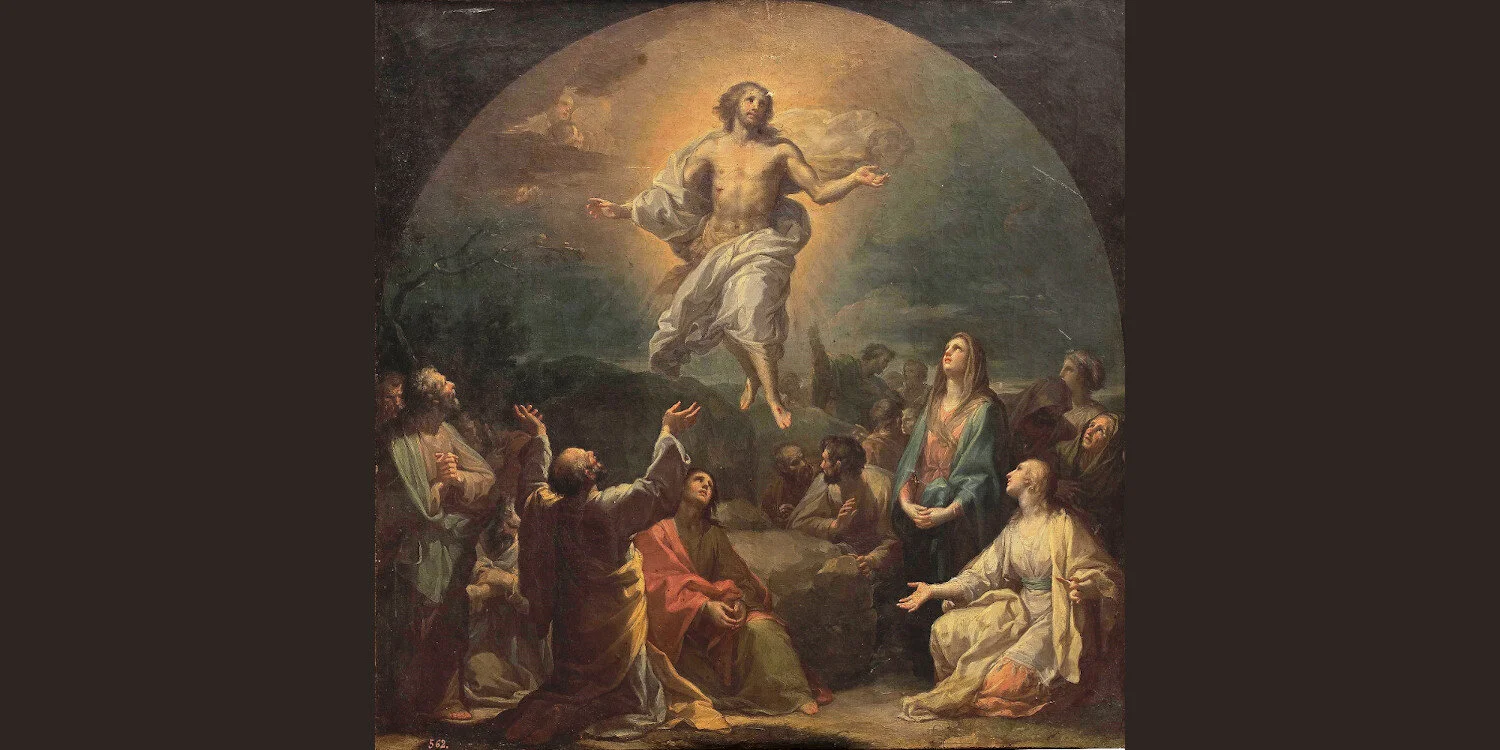
It Is the Duty of a Priest to Never Lose Sight of Heaven
Marking 39 years of priesthood, 27 of them unjustly in prison, this priest guides readers to higher truths. For those who suffer in life, eternal life matters more.

Marking 40 years of priesthood, 28 of them unjustly in prison, this priest guides readers to a higher truth. For those suffering in life, eternal life matters more.
“When suffering is far away, we feel that we are ready for everything. Now that we have occasion to suffer, we must take advantage of it to save souls.”
I am indebted to my friend, Father Stuart MacDonald, JCL, for his remarkable and timely guest post, “Bishops, Priests, and Weapons of Mass Destruction.” In it, he concluded that some of our bishops have acted in regard to their priests by caving into the cancel culture mob even before it was called that. “The mob can be a frightening place when we have lost sight of heaven,” he boldly wrote. I was struck by this important insight which lends itself to my title for this post: It is the duty of a priest to never lose sight of heaven.
In the weeks before I mark forty years of priesthood, I have heard from no less than three good priests who have been summarily removed from ministry without a defense. Like many others, they are banished into exile following 30-year-old claims for which there exists no credible evidence beyond the accusations themselves and demands for money.
This sad reality, imposed by our bishops in a panicked response to the Catholic abuse crisis, has been the backdrop of nearly half of my life as a priest. As Father Stuart mentioned in his post, I wrote of this a decade ago in regard to the demise of the celebrated public ministry of Father John Corapi at EWTN. Given the resurgence of priests falsely accused, I decided to update and republish that post on social media. It is “Goodbye, Good Priest! Fr. John Corapi’s Kafkaesque Catch-22.”
The point of it was not Father Corapi himself, but rather the matters of due process and fundamental justice and fairness that have suffered in regard to the treatment of accused priests. In republishing it, I was struck by how little has changed in this regard since I first wrote of Father Corapi a decade earlier.
My article presents no new information on the priesthood of Father Corapi, but lest our spiritual leaders think that interest in this story among Catholics has diminished, within 24 hours of publishing, that post was visited by over 6,500 readers and shared on social media 3,700 times. (Note: We now give it a permanent home in the “Catholic Priesthood” Category at the BTSW Library.)
The only priests who land in the news these days are those accused of sexual or financial wrongdoing and those who make their disobedience to Church authority in matters of faith and morals a media event. In regard to the latter, several priests and bishops in Germany have openly defied Pope Francis and his decision to bar priests from blessing same-sex unions.
Blessing the individuals involved would not be an issue, but, as Pope Francis put it, “The Church cannot bless sin.” The open defiance of this among some German priests brought them 15 minutes of fame in our cancel culture climate in recent weeks, but it does nothing to bring us any closer to heaven.
Appearing on The World Over with Raymond Arroyo recently, Catholic theologian and author, George Weigel, addressed the German situation plainly:
“These bishops think that they know more about marriage than Jesus, that they know more about worthiness for the Eucharist than Saint Paul. This is apostasy, and it is time to call it what it really is.”

The Setting for My Priesthood
In every age, people tend to see the struggles of their current time as the worst of times. My priesthood ordination took place on June 5, 1982. It was the only ordination in the Diocese of Manchester, New Hampshire that year. President Ronald Reagan was in the second year of his first term in office. The U.S. economy was suffering its most severe decline since the Great Depression of the 1930s. Unemployment was at its highest level in decades and the housing industry was on the verge of collapse.
Just over a year earlier, on May 13, 1981, Pope John Paul II was shot four times at close range as he entered Saint Peter’s Square to mark the 64th anniversary of the first appearance of Our Lady of Fatima in Portugal. John Paul was severely wounded and so was the spirit of the global Catholic Church. He recovered, though a lesser man might not have.
One year later, three weeks before my ordination, Pope John Paul made a thanksgiving visit to Fatima on May 12, 1982. It was the day before the anniversary of both the Visions of Fatima and the attempt on his life. As the Pope walked toward the altar of the Fatima shrine, a man in clerical garb lunged at him with a bayonet, coming within inches of killing John Paul before being subdued by security guards.
The assailant was Juan Fernandez y Krohn, then age 32, a priest ordained by the suspended traditionalist French Archbishop Marcel Lefebvre. Fernandez was subsequently expelled from Lefebvre's movement. As he lunged at the Pope with his bayonet, he shouted in denouncement of the Second Vatican Council while accusing Pope John Paul of collaborating with the dark forces behind the spread of Communism.
That latter accusation was highly ironic. Over the next decade, Ronald Reagan and Pope John Paul II collaborated to become the two major forces behind the collapse of the Soviet Union and European Communism that had held the Western World in the grip of Cold War since the end of World War II.
In 1989, the Berlin Wall was torn down by a crowd of citizens from both East and West as soldiers watched in silence. On Christmas Day, 1991, Soviet President Mikhail Gorbachev announced his resignation in a television address. The next day, the Soviet parliament passed its final resolution ratifying the dissolution of the Soviet Union. Within a week, all residual functions of the Soviet Communist state ceased. The USSR was no more, thanks to the strength and fidelity of a Pope and a President.
The footprints of Ronald Reagan and Pope John Paul on modern human history are immense. This and the chaos of the world at that time formed the backdrop against which I became a priest in 1982. I wrote of this in “Priesthood: The Signs of the Times and the Sins of the Times.”
The sins of the times were many. On the world stage, Pope John Paul courageously confronted the Marxist “cancel culture” movement of his time. His bold witness to the world and his fidelity are highlighted in a new and important book by George Weigel entitled Not Forgotten.
In contrast, much of the current Catholic ecclesial leadership seems bogged down in demonstrations of tolerance for dissent and the rise of socialism and Marxist ideology that again springs up anew as “cancel culture.” Some bishops cannot even decide whether open promotion of abortion should bar its adherents who are nominally Catholic from presenting themselves for the Eucharist.
Ironically, recent polls have suggested that 66-percent of American Catholics are uncertain whether they still even believe in the Real Presence of Christ in the Eucharist. It is that exact same percentage who also believe that President Biden should be admitted to the Eucharist without question despite his open promotion of abortion as a civil right. Our Catholic crisis is not just one of fidelity. It is a crisis of identity. But as has been famously asked by another well-known priest, “Who am I to judge?”

Witnessed in a Prison Journal
Now here I stand, 39 years into my priesthood on the peripheries with 27 of those years in wrongful imprisonment for abuse claims that never took place. I could have left prison 26 years ago had the truth meant nothing to me. I have been reading the far better known story of another falsely accused priest in the Prison Journal of George Cardinal Pell published by Ignatius Press.
I find in it much solace and peace. I am strengthened in my priesthood by the great effort of Cardinal Pell to maintain his identity as a priest even in prison. I know from long experience - too long - that there is nothing in prison, absolutely nothing that sustains an identity of priesthood. It is so easy and a constant temptation to simply give up. For page after page in the Journal, I find myself thinking, “I felt that very same way,” or “I did these very same things.” Our prisons were similar, although from Cardinal Pell descriptions, Australia’s prisons seem a bit more humane.
Cardinal Pell was in prison for 400 days before his unjust convictions were recognized as such in a unanimous exoneration by Australia’s High Court. On my 39th anniversary of ordination on June 5th this year, I mark 9,750 days in wrongful imprisonment. I do not point this out to contrast my experience with that of Cardinal Pell. His ordeal, like mine, was defined by his first failed appeals after which he had every reason to believe that prison could thus define the rest of his life.
I have no known recourse because, unlike Australia, the United States courts have given greater weight to states’ rights to finality in criminal cases than to innocent defendants’ rights to a case review. When I had new witnesses and evidence, the court not only declined to hear it, but declined to allow any further appeals. We even appealed that, but to no avail.
But a distinction between justice for Cardinal Pell and for me is not the point I want to make. I felt the lacerations to his good name in every step of his Way of the Cross as news media in Australia and globally exploited the charges against him. What a trophy his wrongful conviction was for those who hate the Church!
I felt the scourging he endured as multiple false claimants tried to use his cross for financial gain. I felt his condemnation in the halls of the high priests as cowardly men of the Church denounced him, at worst, or at best stood speechless in the shadows of silence, rarely mentioning his name, and even then only in whispers.
Reading Volume One of Cardinal Pell’s Prison Journal has been both consoling and distressing. Consoling in that when all else was stripped away, truth and priesthood, even more than freedom, were still at the heart of this good priest’s identity. The measure of a man is not when all is going well, but when all that is dear and familiar has been stripped away. Cardinal Pell held up well. I like to think I have, too.
I have reserved a copy of Volume Two of the Prison Journal. I am told by those who know that in a few of its pages, Cardinal Pell also wrote about me. That struck me as highly ironic in that I wrote several times about his plight, the last being “From Down Under, the Exoneration of George Cardinal Pell.”
And by “From Down Under,” I do not just mean Australia!
The Last Years of My Priesthood
I expect that I will die in prison. This is not a statement out of despair. No one has taken my faith in Divine Providence and Divine Mercy. There came a time in my imprisonment when I recognized a pattern of grace that began with the insinuation of Saint Maximilian Kolbe into my life as both a priest and a prisoner. This grace has been profound, and staggering in its visibility and power. Our readers — all but the most spiritually blind — have seen it.
After a lifetime of devoting himself as a priest in Consecration to Jesus through Mary, Maximilian coped with his suffering as grace rather than torment. This story culminated, as you know, in his spontaneous decision to surrender his life so that another could live. This act of sacrifice has long been heralded as an exemplar of the words of Jesus, “No greater love has a man than this, that he lay down his life for his friends.” (John 15:13)
There came a point in my imprisonment when it was clear that all I tried to do to bring about justice was in vain. So I asked for Divine Mercy and the ability to find grace in this story. A life without grace is far worse than a life without justice. It was at that very point at which my friend, Pornchai Maximilian Moontri, arrived upon my road as a priest. He had been mercilessly beaten down in life, and robbed of all trust and hope.
I could have been the priest who saw him on that road and passed him by like the priest in the Parable of the Samaritan. But I stopped, and when I learned the whole truth of his life, I set my own hope for justice aside. It became clear to me that this was God’s action in my life and a task that He has given only to me. It became clear that Pornchai has a special connection to Christ through the Immaculate Heart of Mary and I was to be his Saint Joseph.
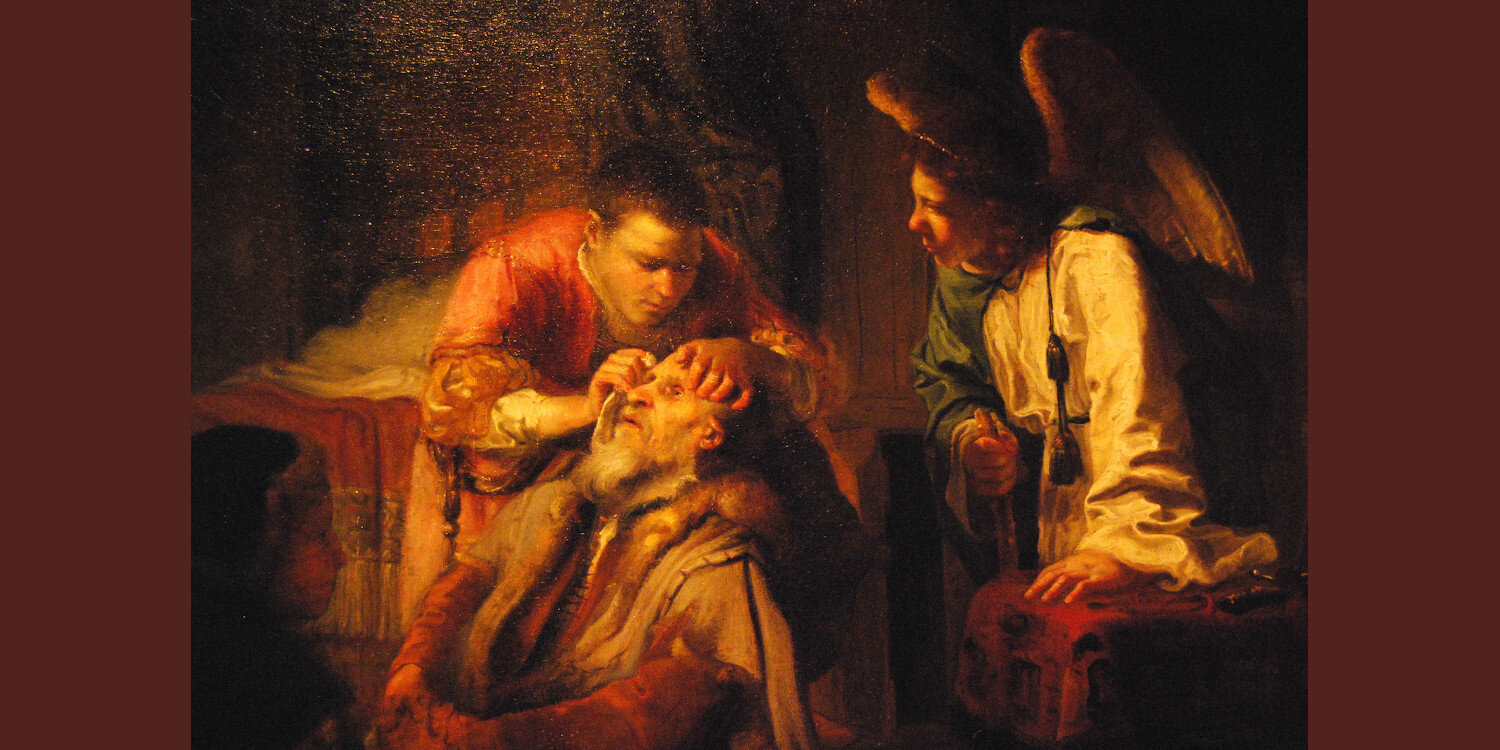
I wrote a post about this healing mission which I contrasted with the Book of Tobit and the mission of Saint Raphael the Archangel to be God’s instrument of healing. I wrote of this in one of my own favorite posts at Beyond These Stone Walls in “Archangel Raphael on the Road with Pornchai Moontri.”
You should not miss that post, and if you do read it, you would do well to ponder for awhile the mysteries of grace on your own life’s path. It was well after writing and posting it that I learned something that stunned me into a better awareness of the irony of grace.
Over the course of time, the Church has devised a Lectionary that reveals all of Sacred Scripture in the readings for the Church’s liturgy spread over a three-year cycle. I discovered only while writing this post for the occasion of my 39th anniversary of priesthood ordination that the First Reading at Mass on that day — Saturday, June 5, 2021 — is the story of the Archangel Raphael sent by God to restore life and sight to Tobit and bring deliverance and healing to two souls — Tobias and Sarah — whose lives and sufferings converged upon Tobit’s at that point in time.
As I mark thirty nine years as a priest in extraordinary circumstances, the weight of imprisonment does not leave me broken. But the irony of grace leaves me hopeful — even now.
Thank you for being a part of my life as a priest. Thank you for being here with me at this turning of the tide.
+ + +
Note from Father Gordon MacRae: We have a most important message for readers. Please visit our “Special Events” page.
+ + +
You may also like these related posts:
From Down Under, the Exoneration of Cardinal George Pell
Priesthood, The Signs of the Times and the Sins of the Times

Bishops, Priests and Weapons of Mass Destruction
Pope Francis promulgated Vos estis, a law applicable to bishops. Previously, if a bishop was accused of a canonical offense, only the Pope could bring him to task.

Pope Francis promulgated Vos estis, a law applicable to bishops. Previously, if a bishop was accused of a canonical offense, only the Pope could bring him to task.
Recently, behind the scenes at Beyond These Stone Walls, people have been working to restore and update Father Gordon MacRae’s older posts and save them in multiple categories in the Library at BTSW. One of the categories is Catholic Priesthood where this post, I expect, will find its permanent home. One such article was “Goodbye, Good Priest!” It was an updated reflection on the story of Father John Corapi, posted anew without any notice or fanfare. Nonetheless, it received more than 6,000 visits and 3,700 shares on social media in the first 24 hours after it was posted. This happened even before Fr John Zuhlsdorf — the famous Fr Z — posted a link to another blog informing readers that Fr Corapi, thanks be to God, had reconciled with his religious order several years ago and has been living a quiet life of prayer in one of its community houses. Fr Z’s post was “If you do not forgive men their trespasses neither will your Father forgive your trespasses.”
We had not heard about Fr Corapi for many years. His, we thought, was one of the many forgotten tales about priests, guilty, or even merely accused, of horrendous sins, whose cases often were treated with little regard for human, civil or canonical rights or due process. Fr Gordon and I were commenting that, being reminded of Fr Corapi, we realize that we have not progressed very far in the last twenty years. What Fr Gordon and I see now is that Father Corapi’s case was a small seed planted in our collective psyche that has germinated, now affecting all priests.
When the sexual abuse scandal exploded in the American press in 2002, many bishops were faced with the reality that their predecessors had known about sexual abuse of minors by priests and handled it in a way that was seen as pastoral at the time but which failed to meet today’s expectations. Back then, accused priests were shuffled off for psychological treatment, reassigned on the advice of the medical professionals to new parishes for a fresh start; sometimes they reoffended, or quietly retired to live in peace with their consciences. Even though the Vatican quietly had promulgated new laws in 2001 to deal with the crime of sexual abuse of a minor among some other of the more serious offenses in the Church, in the wake of the Boston Globe’s 2002 exposé, bishops threw up their hands and said to the Vatican, “My predecessor did this; you have to help me get out of this mess!”
And so dawned the era of the Dallas Charter. In the face of unrelenting public pressure and criticism, the Church, beginning in the United States but soon almost everywhere, began to treat allegations as proven crimes, to treat priests like chattel, to put money over preaching the Gospel. The Dallas Charter ushered in an era that means one strike and you’re out, and, in fact you don’t even have to prove that it was a strike: credibly accused quickly became the operative expression. In effect, the first decade of the 21st century witnessed the Church take on the notion that the priesthood was more disposable than it ever had been before. It was a reaction of fear.
Soon after, file upon file was sent to the Congregation for the Doctrine of the Faith (CDF) as bishops scoured their personnel files for any priest previously accused of sexual abuse. Even though the case had been dealt with already, according to the pastoral plan mentioned above, current bishops were looking for Rome to revisit the case and, it was expected, remove the priest permanently from ministry if not the clerical state itself. The caseload became so heavy that the CDF had to notify bishops that a deadline was being set after which no historical cases could be submitted. Apparently, someone had forgotten to inform everyone involved that law, especially penal law, cannot, in justice, be applied retroactively.
So far, we have only been talking about accusation of sexual abuse of minors. Fr John Corapi was never accused of that. He was accused of sexual misconduct, perhaps even concubinage, with an adult woman among supected financial misdeeds. In the heat of the abuse scandal, his case was being treated as if the Dallas Charter applied, which it did not. Father Corapi realized that he would never be treated according to the canon law of the Church. He knew he was considered guilty; nothing was going to change that, so he walked away. It is a sad commentary on the Church that such a gifted man was driven to near despair, that Church officials could be so indifferent to basic tenets of justice and due process. But that’s where we were.
Jump forward several years. In 2019, Pope Francis promulgated Vos estis, a set of laws applicable to bishops. Prior to those laws, bishops were directly responsible to the Pope alone. If a bishop was accused of a crime, like sexual abuse of a minor, only the Pope could bring him to task. Canon law assumes that people with authority in the Church, like bishops, are not saints, but at least God-fearing men seeking virtue. In fact, canon law only really works when that’s the case. People like Theodore McCarrick, the former Cardinal and Archbishop, got away with his misconduct for so long because a lot of bishops are not God-fearing men. McCarrick was relieved of his clerical obligations in 2019 and is now a layman.
With everything the Pope has to do, he certainly does not have time to micro-manage the lives of 5,000 bishops. The problem, becoming apparent, was that not only priests were being accused. The ravenous press and hysterical crowd were not satisfied. Bishops were next on the hit list. Hence, Pope Francis set up a system whereby bishops are now accountable for their own misconduct, even historical accusations from when they were yet priests. They are accountable, as well, for how they handle, as bishops, accusations of sexual abuse of minors by priests subject to them. With Pope Francis’ new legislation, the Congregation for Bishops is authorized to investigate accusations made about bishops in much the same way that the Congregation for the Doctrine of the Faith was authorized in 2001 to do the same regarding priests. This is new territory and bishops are clearly anxious.

Guilty Merely for Being Accused?
Since the promulgation of Vos estis, several bishops have been removed from office or disciplined in some way: Bishop Richard Malone, emeritus of Buffalo; Bishop Michael Bransfield, emeritus of Wheeling-Charleston; Archbishop Henryk Gulbinowicz, emeritus of Wroclaw, Poland; Bishop Michael Hoeppner, emeritus of Crookston to name just a few. It’s a new world out there since 2019. What bishops have done to priests since 2002 is now being done to them.
“ The measure with which you measure will be measured out to you.”
Pope Francis, in Vos estis, expressed his wish that bishops conferences set up confidential reporting mechanisms such that people who know of misconduct committed by a bishop could safely report it knowing that action would be taken to investigate. The Canadian bishops conference announced a few weeks ago just such a mechanism. Anyone can now call a confidential line, or submit an online report, to a third-party agency which will receive the information and, in turn, pass on a report to the appropriate bishop. That bishop, in receipt of the report, will consult the Congregation for Bishops on how to proceed. Whatever else it is, and it is many things, this move is a lot of virtue signaling. Nothing guarantees that the report will be taken seriously. The only certainty is that a secular third party is being paid to receive and pass on information.
There is no real transparency to the procedures that are used to investigate a bishop — and I’m not arguing there should be, in this or any investigation of a priest — it is not evident that such things belong to the realm of public knowledge. Instead, we must trust that what is being done is just and legal — there’s no sense having a code of law in the Church if it means nothing or is not going to be used. Unfortunately, the Church’s track record in this regard leaves us with very little trust. With these new initiatives, nothing says that the bishop reporting to Rome about his brother bishop will not convince the Vatican that the allegation is unfounded or exaggerated. And, to be fair, understand that the Vatican has to trust the bishop consulting them. If they can’t, how is the Vatican to know and what is it supposed to do? We’re back to the headline: “Needed: God-fearing men trying to live lives of virtue.”
Now that bishops are being held to the same standards, or lack thereof, they have become hypervigilant of their priests, or, rather, of their own reputations. Virtue signaling abounds: bishops are tough on clerical misconduct. Now, not only accusation of sexual abuse of a minor leads a bishop to remove a priest from ministry, but, indeed, any misconduct whatsoever. That was the seed planted by Father Corapi’s case. Anything done by a priest that is going to cause publicity, or a lawsuit, is now treated in the same way as an allegation of sexual abuse of a minor. A priest is put on so-called administrative leave, his faculties are removed, he is not allowed to perform any priestly ministry except the celebration of Mass in private, which means alone.
This is all done, they say, just like they did in the early 2000’s, pro bono ecclesiae — for the good of the Church. This is being done by bending the law to the point of breaking. What priest, especially if he is guilty of something, is going to challenge his bishop’s abuse of the law. Priests who have been accused of misconduct, not involving minors, are now being removed from ministry under the guise that they are not suitable for assignment because of their misconduct, even though that misconduct may have been adjudicated and punished already — justly or not is another question. Bishops go so far as to encourage the priest to petition for laicization. The bishop can’t force a priest out of the priesthood because whatever he is alleged to have done doesn’t warrant such a punishment. But the bishop doesn’t want to be responsible for the ‘unassignable’ priest for the rest of his life, nor does he want to continue paying the priest.
Check any “Policy for Cases of Misconduct” published by a diocese. Many of them have clauses that say a priest found guilty of misconduct will never minister in the diocese again. Of course, such clauses are not allowed by canon law. No one questions what procedures will be used to determine the guilt or innocence of the accused priest. But what looks good is the policy itself. The Church has gone tough, not just on abusing minors, but on any misdeed. Try to find a definition of misconduct, or a list of behaviors that is classified as misconduct — you won’t. Vague is good: it allows those in authority to cite the law while interpreting it as they wish. Those are the parameters we are operating within today.
Fear and panic, there’s the problem. Instead of turning to Christ, we look to the world for our sense of self-worth as a Church. Are we held to impossible standards by the world? Yes. Does the world despise us because the Gospel preaches something counter-cultural? Yes. Are they going to sue us for every penny we own? Probably. Jesus told us, “If the world hates you, be aware that it hated me before it hated you” (John 15:18). The Church certainly has made mistakes in the last half-century or more. One of the biggest ones was turning a blind eye to immorality, especially sexual immorality among clergy and the faithful. In its zeal to be pastoral as a way of opening up to the world — a mantra of Vatican II — she failed to enforce her laws, or use her laws to bring justice and transparency to cases of crime and misconduct. The way out of this mess is not more laws, not more father turning on son and brother on brother tactics reminiscent of Nazi Germany. The answer is to read and heed the Gospel.

“For They Do Not Practice What They Preach” (Matthew 23:3)
In July 2013, Pope Francis was questioned about a Monsignor whom the Holy Father had appointed to a Vatican office. The Monsignor, according to reports, engaged in homosexual activity several times. The press wanted to know from the Pope how this person could be assigned given his past. Pope Francis came out with his now infamous line, “If someone is gay and he searches for the Lord and has good will, who am I to judge?” The press, to this day, wildly misinterprets what the Holy Father said, namely, that someone who was seeking the Lord with good will, i.e., repenting of past sin and seeking the right path, ought not to be judged by us. The rationale behind that is nothing other than the whole Christian message: Christ died so that all of us sinners could be redeemed. The Pope was saying, in essence, that someone could be a very sinful person, but repentance is always possible. Furthermore, he was pointing out that someone’s sinful past does not necessarily disqualify one from working in the Church — to be sure, sometimes it does, but not always. How would any of the apostles survive as priests or bishops in today’s climate?
In our Lord’s day, the religious leaders were worried about the popularity of Jesus. They didn’t want the people, the mob, to turn against them. In the end, it was they who, in the midst of the mob, told Pilate that they had no King but Caesar. It was they who instigated the mob’s choice of Barabbas over Jesus. The mob can be a frightening place when we have lost sight of Heaven. Jesus Himself was confronted with a mob. When they brought to Him the woman caught in adultery, the mob was after Him, not so much the woman who had been caught flagrantly in sin. They wanted to trip Him up about the law. Jesus was uncowed by their bullying. He didn’t lash out at the mob; rather, he showed them mercy by His retort, “Let anyone who is without sin, cast the first stone.” He gave the mob room to see its error. The Gospel of John (8:3-11) points out the seemingly insignificant detail that Jesus looked down so that they could walk away while saving face.
At the same time, Jesus healed the woman, wounded by her own sinfulness and maltreated as a pawn by the mob. He sends her off, with the consolation of “Neither do I condemn you. Go your way, and from now on do not sin again” (John 8:11). Our Lord showed that the mob, the world, CAN learn the truth about sin and redemption. He showed her that compunction was enough to receive mercy and the need to learn from one’s sins. He did not tell her not to pay attention to the Pharisees — in fact, in another place Jesus warned the people, “Obey them and do everything they tell you. But do not do what they do, for they do not practice what they preach” (Matthew 23:3). He didn’t say they were not qualified for the job as Pharisees because they were sinful. He also told her to learn from the mercy she received and to put aside her sinfulness. All of that is an important meditation for us because little mercy is being shown priests.
When I think of Father Gordon MacRae and the injustice he is enduring with such equanimity and grace, I am reminded that God’s grace is still active in this messy world. Beyond These Stone Walls is a visible sign of grace, allowing Father Gordon to preach from his pulpit, his unjust imprisonment, to make so many aware of the reality of injustice even in the Church. He and this blog are a sign of grace, a sign that such corruption is not a reason to turn against God or His Church but to work even harder to bring about a community of God-fearing men trying to live lives of virtue.
+ + +

Fr. Stuart MacDonald is a priest of the Diocese of St Catharines, Canada. Ordained in 1997, he is a graduate of McGill University, St. Augustine’s Seminary and the Pontifical Gregorian University where he earned a licentiate in Canon Law. In addition to being pastor of various parishes, he has worked as a judge and defender of the bond for the Toronto Regional Marriage Tribunal and as an official for the Congregation for the Doctrine of the Faith at the Holy See. He is the author of several published articles on Canon Law and the priesthood. His most recent post for BTSW was “On Our Battle-Weary Priesthood.”
You may also want to read and share these related posts:


The Last Full Measure of Devotion: Civil Rights and the Right to Life
Racial justice and a dubious idea of critical race theory are now center stage in our culture, but they give no voice to the most urgent Civil Rights issue of all.

Racial justice and a dubious idea of critical race theory are now center stage in our culture, but they give no voice to the most urgent Civil Rights issue of all.
For the entire second term in the presidency of Barack Obama, Ohio Republican congressman John Boehner was Speaker of the House of Representatives. He left that office in 2015. A devout Catholic, he had been honored by the University of Notre Dame with the Laetare Medal, a distinction awarded to Catholics in public life who witness to their faith in extraordinary ways. During Speaker Boehner’s first address to the House of Representatives in 2011, he said that “America is more than a country. It’s an idea.” Like any great idea, it did not begin in its current form. The idea of America evolved with fits and starts in response to both prophets and protests — and wars, and great losses, and immense sacrifices. From my perspective, in the decade from 1963 to 1973 the very idea of America gave birth to a Civil Rights movement that was hard fought and continues to be. Milestones were reached, but the Civil Rights movement never ended. It now just takes another form.
Civil Rights as an idea is not yet a done deal. Just as the idea formed and took shape for some in America, it failed an entire class of others. Just as the idea of Civil Rights embraced our fellow Americans living lives marked by racial divisions and distinctions, it failed millions of others not yet living outside the womb.
In the decade of the 1970s, it sometimes felt like I would be in school forever. After four years studying psychology and philosophy at Saint Anselm College, a Benedictine school just outside Manchester, NH, I commenced another four years at Saint Mary Seminary and University in Baltimore, Maryland from where I was awarded a Master of Divinity and a Pontifical degree in Sacred Theology. Saint Mary’s is the oldest Catholic seminary in the United States and, at that time at least, was the most academically demanding.
Like many seminarians then, I was chronically poor. During the rationing and long gas lines of the late 1970s, I paid $900 for a clunker of a 1969 Chevy Malibu. It had a V-8 engine that could pass everything but gas stations, and when I bought it, it burned almost as much oil as gasoline. A friend and I spent all our spare time in the summer of 1978 rebuilding its engine before I drove it off to Baltimore to begin the great adventure of faith seeking understanding. I was proud of the fact that we got the Malibu’s gas mileage up to a point where I could sit in the long gas lines with a clear conscience, though I don’t think General Motors would have still recognized its engine. I loved that car, not the least for where it took me.
Roaring around Baltimore from 1978 to 1982, I quickly learned that the great city was second only to my native Boston for the lure and lore of its history. Outside the seminary, there was a whole other field of education within 100 miles of Baltimore in any direction. So Saturdays in the seminary were devoted to field trips to the birth and growth of America; to the places where the idea first took shape. That’s when visiting history became my hobby, and an important part of my education. Much more than my loss of freedom, now, I mourn the passing of the world beyond these stone walls.

Upon the Field of Battle
One place stands out strikingly against the background of monuments and memories I visited and studied. I had some friends among the seminarians at Mount Saint Mary Seminary in Emmitsburg, Maryland, a two+ hour drive from Baltimore. On several Saturdays, my speedy Malibu drove north to pick up my friends and head for Gettysburg, just a few miles from Emmitsburg straddling the Maryland and Pennsylvania state line.
It’s hard to describe what I felt the first time I stood surveying the very heart of America’s most terrible war. The Battle of Gettysburg was fought there over the first four days of July in 1863. President Abraham Lincoln’s famous Gettysburg Address was delivered on that field on November 19, 1863, just three months after the horrific four-day battle that took the lives of over 80,000 Americans.
For some reason, standing on that field of battle for the first time in 1979, I thought of John F. Kennedy and his signature cause, the Civil Rights movement which was in turn taken up by President Lyndon Baines Johnson after Kennedy’s untimely death in 1963. It came as a shock to me to realize that the defining battle of the American Civil War — that I once thought to be ancient history — was fought and then immortalized in Lincoln’s great speech just l00 years before the assassination of John F. Kennedy. It was exactly 100 years, barely three generations in the lives of men. The Battle of Gettysburg, and all that led up to it, took place in the lifetime of my grandfather’s grandfather.
Suddenly, with that revelation, I felt linked to all that came before. Michael Shaara’s Pulitzer Prize winning 1974 historical novel, The Killer Angels relived this most decisive battle of the American Civil War, and my first visit came just after this great work of historical storytelling.
It felt strange standing for the first time upon Cemetery Hill where the Civil War pivoted toward victory for the North. But there was really no victory. It was America against itself, and the powerful imprint of death and sacrifice was still upon that battlefield as I stood there 116 years later. It was both eerie and inspiring. My friends went off to tour the museum and stare at row upon row of cannonballs and muskets, but I couldn’t leave that field. I realized standing there for the first time just what an idea can cost, and what hardship and sacrifice it can demand from those who serve it.

The Right to Life and the Cost of Liberty
By the time the Civil War was over, it demanded of America more lives of its citizens than World War I and World War II combined. Some 500,000 lost their lives fighting this nation’s war against itself. I didn’t understand then just how this happened, but standing on that Gettysburg field, I resolved to one day understand. Men and women can sacrifice their lives for an idea, or an ideal, or a principle that is far greater than themselves. They can sacrifice freedom, even, to stand firm on a ground made solid by conscience.
Many historians and legal scholars draw a direct line between the outbreak of the American Civil War in 1861 and a single case decided before the U.S. Supreme Court four years earlier in 1857. As a causal connection, the decision in Dred Scott v. Sanford enraged conscience-driven abolitionists and encouraged slave owners. It broadened the political and ideological abyss between the North and the South, and it led directly to a war of nothing less than the demands of conscience versus the realities of economic necessity and convenience.
Dred Scott was a fugitive slave. In 1848 at the age of 62, having spent decades in secret learning to read and write, he brought suit to claim his freedom on the ground that he resided in a free territory established by the 1820 Missouri Compromise. This is a piece of American history that must not be overlooked or forgotten, though many would prefer not to know. Dred Scott was purchased and lived his life as a slave, but was then taken by his “master”, an Army surgeon, to a free territory rendered free by the Missouri Compromise.
In Dred Scott v. Sanford, Supreme Court Justice Roger Taney wrote for the majority that the Missouri Compromise was unconstitutional and violated the Fifth Amendment because it deprived Southerners of a right to bring their private property — i.e., slaves — wherever they wanted. The decision further ruled that Congress did not have the authority to establish free territory, and in its most alarming language, Justice Taney’s decision established that black men are not citizens of the United States and had “no rights any white man is bound to respect.”
Reflecting upon this now, five generations later, is made all the more painful by the recognition that Supreme Court Chief Justice Roger Taney was a Catholic, though one who surely put the realities of national economics above the tenets of faith or conscience. As I wrote in “The True Story of Thanksgiving,” the Catholic Church had three centuries earlier established slavery as a moral evil, and declared it unacceptable in any Catholic country. It would take another 250 years from the founding of America for this nation to put economic interest aside and catch up with the conscience of the Catholic Church.
Justice Taney’s decision caused some in his day to conclude that there is a higher moral law than the Supreme Court’s interpretation of the Constitution at any given time in history. There is a higher moral law, and it led the nation on a direct path from Dred Scott to Civil War. The war came as a result of the conscience of individuals gradually forming a consensus about slavery, racial justice and the rights of man.

Rev. Martin Luther King and Father John Crowley
One hundred years after that war was fought, its ripples continued throughout this nation. In 1968, Rev. Martin Luther King was assassinated for his unwavering and prophetic public witness in a story that we all know only too well. My friend, the late Father Richard John Neuhaus (who contributed to our “About” page) wrote of the radical grace exemplified by Martin Luther King in American Babylon: Notes of a Christian Exile. He wrote of Dr. King’s notion of “The Beloved Community” and described his movement as a new order . . .
“. . . sought by all who know love’s grief in refusing to settle for a community of less than truth and justice uncompromised.”
Think for a moment, please, about that statement. There are not many of us who escape love’s grief — unless we become so shallow as to so steel ourselves against grief that we can ignore it. What a tragedy! Those of us who know love’s grief and refuse to settle for a community — a nation, a Church — of less than truth and justice uncompromised are in for some prophetic suffering.
Three years before Martin Luther King was assassinated, Father John Crowley, a heroic Catholic priest, was nearly driven from Selma, Alabama when he took out a full-page ad in the Selma Times-Journal on February 7, 1965.
His ad contained a brilliant essay entitled “The Path to Peace in Selma.” It urged the white community to speak out against racial segregation and discrimination not for the good of the black man and woman, but for the good of ALL men and women. Like the famous Lutheran Pastor, Dietrich Bonhoeffer, executed on the personal orders of Adolf Hitler on April 9, 1945, Father John Crowley called upon fellow priests and other Catholics to put aside their fears of loss and stand by the truth uncompromised. I share a date of birth with the date of Dietrich Bonhoeffer’s death, and I share my June 5th date of priesthood ordination with Father John Crowley. These very special men compel me to stand always by the truth uncompromised, and not to fear its cost.

Stand against the Culture of Death
Martin Luther King lost his life just five years before another divisive Supreme Court decision with grave implications for Civil Rights. There are some, and they are many, who see in the 1857 decision in Dred Scott the roots of the 1973’s Supreme Court decision in Roe v. Wade. Justice Antonin Scalia and Justice Anthony Kennedy have both cited this connection. In 1973, after the Supreme Court handed down its divided decision in Roe v. Wade, the State of Texas joined other states in filing a petition for a rehearing before the full Court. The Texas dissent declared that the decision in Roe that an unborn child was not a human being with rights to be protected was not at all unlike the decision in Dred Scott that virtually no just person in this nation would ever stand by today.
And just as Dred Scott inspired dissidents of conscience to hear the Commandments of a Higher Authority, Roe v. Wade has inspired similar heroism, most of it barely noticed in the mainstream media, or, worse, taunted. Have you noticed that much of the loudest ridicule of the Catholic Church in America comes on the heels of legislation that chips away at the right to life and human dignity? Many a media barrage against the Catholic Church has been for the purpose of silencing its pro-life voice in the public square.
Life Site News has carried the stories of two Canadian women whose sacrifices on behalf of civil rights for the unborn had landed them in prison. Linda Gibbons, a grandmother and prisoner of conscience, spent seven years in an Ontario prison because she refused to comply with a court order demanding that she cease and desist from standing on the sidewalk near an Ontario clinic to present alternatives to abortion. In eerie echoes of the Dred Scott decision, the clinic staff and the Ontario court charged her with interfering with fair commerce by suggesting to clients another way. Linda Gibbons first went to prison at the same time I did, in September 1994.
Mary Wagner took leave from a French convent to “witness to life” as Life Site News has called her sacrifice. In Holy Week, 2010, Mary was arrested by Vancouver police and remained in jail for months for refusing to obey court orders to cease talking to abortion clinic clients about Project Rachel.
And you may have heard of the late Norma McCorvey. She’s better known as “Jane Roe,” the plaintiff in the 1973 Roe v. Wade Supreme Court decision. Norma became a Catholic in 1998 and also became a dedicated pro-life activist. She was author of the 1998 book, Won by Love. In 2005, the U.S. Supreme Court rejected a petition by Norma McCorvey to reverse Roe v. Wade. In May 2009, she was among the Catholic pro-life witnesses arrested at the University of Notre Dame during President Obama’s Commencement address.
We can deduce where Martin Luther King would stand on the pressing civil rights issues of this day. There is some annual controversy that his niece, Dr. Alveda King, endeavors to clear up. She staunchly defends Rev. King against claims that he would be a pro-choice or pro-abortion supporter today. She insists that his civil rights agenda would today include a defense of life. It’s no irony that the week that begins in honor of his martyrdom for civil rights ends with the National March for Life in Washington, DC.
Beginning in the fall of 2004, 40 Days for Life has held prayer vigils at 238 locations in the U.S., Canada, England, and Australia. The US Catholic Bishops would do well to heed the courageous voices of those who have sacrificed much for the pro-life cause while the bishops debate the sanctity of the Eucharist and the demeanor necessary to receive the Body of Christ. The great Lutheran pastor, Deitrich Bonhoeffer, went to prison for writing to his fellow Lutherans that they cannot both profess their belief in Christ and support the Third Reich and its culture of death.

Conceived in Liberty
On the Saturday after my first visit to Gettysburg in 1979, I drove an hour south from Baltimore to Washington, DC. I went first to the Lincoln Memorial where the famous Gettysburg Address is etched into the stone behind the immense man’s monumental presence. The great speech immortalized the struggle for civil rights as an ongoing struggle that must never be set aside if the idea of America is to survive.
As I read it, I thought of that awful battlefield where I stood 116 years later, and also of the civil rights battlefields of today where millions are denied the right to life, and the millions more who sacrifice to witness for them. Lincoln’s memorable words apply no less to them.
Fourscore and seven years ago our fathers brought forth upon this continent a new nation, conceived in liberty and dedicated to the proposition that all men are created equal.
Now we are engaged in a great civil war, testing whether that nation or any nation so conceived and so dedicated can long endure. We are met on a great battle field of that war. We have come to dedicate a portion of that field as a final resting place for those who gave their lives that that nation might live. It is altogether fitting and proper that we should do this.
But, in a larger-sense, we can not dedicate — we can not consecrate — we can not hallow — this ground. The brave men, living and dead, who struggled here, have consecrated it far above our power to add or detract. The world will little note, nor long remember, what we say here, but it can never forget what they did here. It is for us the living, rather, to be dedicated here to the unfinished work which they who fought here have thus far so nobly advanced.
It is rather for us to be here dedicated to the great task remaining before us – that from those honored dead we take increased devotion to that cause for which they gave the last full measure of devotion — that we here highly resolve that these dead shall not have died in vain — that this nation, under God, shall have a new birth of freedom — and that government of the people, by the people, for the people, shall not perish from the earth.
+ + +
Note from Father Gordon MacRae: As readers know, we have restored a few older posts in the last three weeks while I have been unable to write. This post was first written in 2011. It has been substantially updated and revised so it is actually a new post. Among the several pro-life posts I have written, many readers thought this one to stand out.
The Supreme Court has announced that it will review limits on abortion which in turn could lead to a review of Roe v Wade. President Biden just announced his new commission to study packing the Court. There is too much at stake to stay on the sidelines. Please share this post.
You might also be interested in this related post:
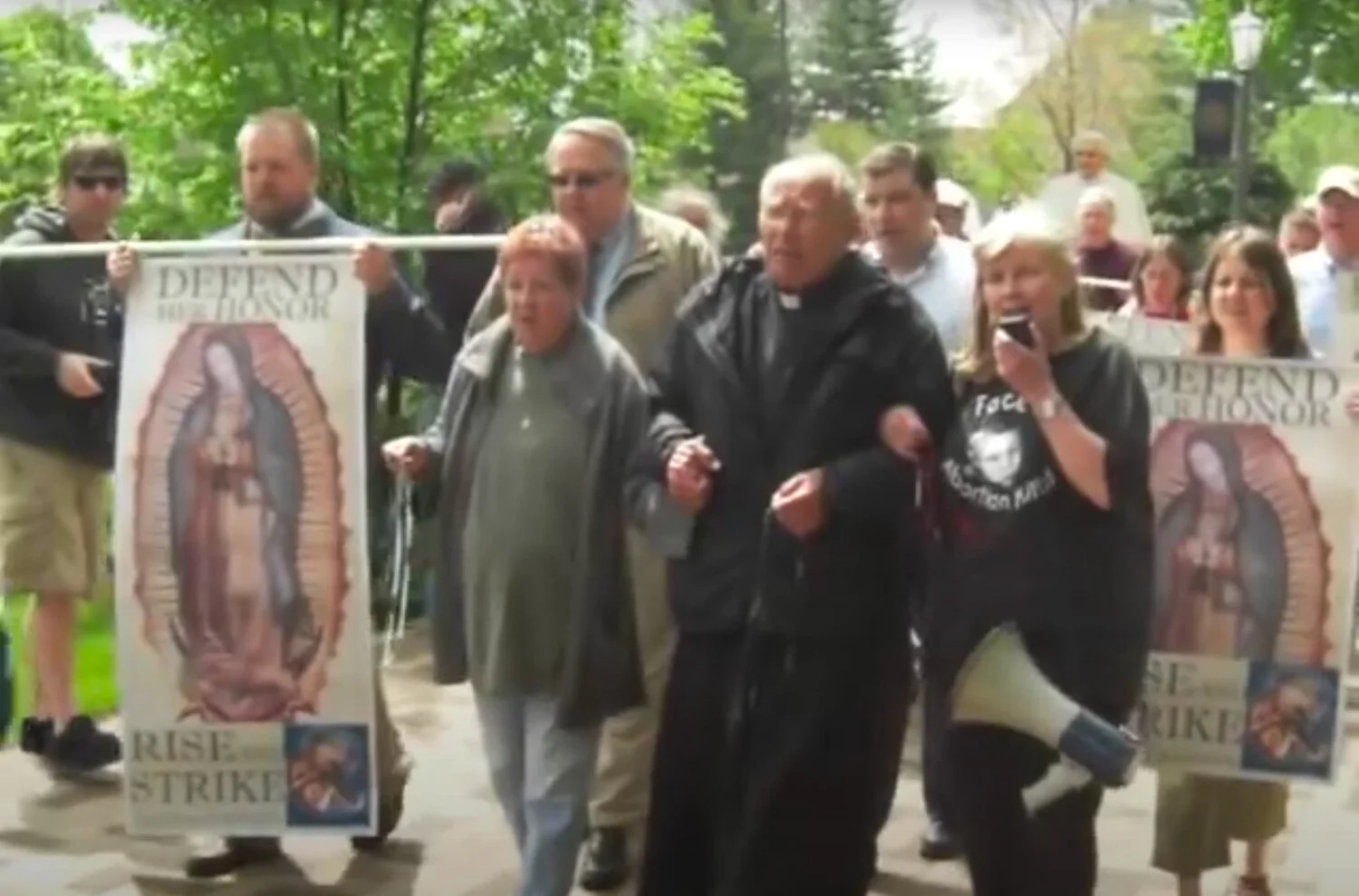

The Hand of God and the Story of a Soul
In two inspiring posts, Fr Gordon MacRae wrote of Michelangelo and an ancient sculpture unearthed out of legend and the legend come true from St Therese of Lisieux.

In two inspiring posts, Fr Gordon MacRae wrote of Michelangelo and an ancient sculpture unearthed out of legend and a legend come true from St Therese of Lisieux.
Note to readers from Father Gordon MacRae: I recently wrote that a prison construction project has caused me and others where I live to be temporarily relocated for a few weeks to a crowded dormitory from where I am unable to write. Once the project is completed later this month, I will be moved back and will hopefully resume writing new posts.
I am currently living in a room with 23 other prisoners crowded into a small and noisy space. At first sight it reminded me of a FEMA shelter, but at least there was no disaster that preceded it. I cannot complain. Our friend Pornchai Moontri spent five full months in ICE detention in a similar space packed with 70 detainees awaiting deportation. You should not miss that nightmare and his final liberation in “ICE Finally Cracks: Pornchai Moontri Arrives in Thailand.”
During my writing hiatus some relevant older posts are being restored at Beyond These Stone Walls and added to our various Library Categories. Our site developer thinks that some of these posts deserve a new audience or a second look. This week we are presenting two at a time when inspiration might be in short supply. I hope you will read and share them.
+ + +
Michelangelo and the Hand of God
Michelangelo Buonarroti was born in 1475 in the small Italian village of Caprese. He grew up in Florence, the artistic center of the early Renaissance, a period of artistic innovation and accomplisnhment that began at the time Michelangelo was born. In many ways, the masterpieces surrounding him in Florence were themselves his best teachers. They included ancient Greek and Roman statuary and the paintings, sculpture, and architecture of the early Renaissance masters.
As a child, Michelangelo preferred drawing to schoolwork which often earned his father’s stern disapproval. For historical context, Columbus arrived in the New World in 1492 just as thirteen year old Michelangelo was apprenticed to a sculptor in Florence. From there, he took up residence in the home of Lorenzo dé Medici, the leading art patron of Florence.
The Medici household was a gathering place for artists, poets, and philosophers. During this time, Michelangelo studied under Bertoldo di Giovanni, an aging master who had trained with Donatello, the greatest sculptor of 15th-century Florence. This exposure proved providencial when, at the age of 30, Michelangelo was on hand in Rome to help unearth and identify the excavation of a sculptural legend, The Laocoön (pronounce Low-OCK-oh-one), a massive ancient sculpture dating from the Second Century BC that had been missing for over a thousand years.
The Laocoön also had a massive influence on all future sculptures and paintings by Michelangelo that became the enduring treasures of the Catholic Church. The Laocoön stands today in the Vatican Museum. This is that story, and it is fascinating. Don’t miss:
Michelangelo and the Hand of God: Scandal at the Vatican.
+ + +
A Shower of Roses
Saint Therese of Lisieux was a French Carmelite nun called “The Little Flower of Jesus.” She became one of the most beloved saints of the Catholic Church in modern times. Born at Alencon, France, with the name, Therese Martin, she was deeply pious from childhood and entered the Carmelite Convent at Lisieux at the young age of 15.
Therese exemplified what she called her “Little Way,” a devotion to God both childlike and profound. She sought holiness through the offering of small actions and humble tasks. Her goodness was so remarkable that her superiors asked her to write an account of her life and spiritual journey.
The result was “Story of a Soul” written in French in 1898 and translated into English in 1958. It is today the most widely read spiritual memoir of our time. Therese died at the young age of 24 and was canonized in 1925. She is today a Doctor of the Church.
The many miracles attributed to Saint Therese gave meaning to her cryptic promise, “After my death, I will let fall a shower of roses.” One of them, a small one, fell to me. Please read and share anew,
A Shower of Roses.

In Honor of Mom: A Corner of the Veil
Pornchai Moontri and Fr Gordon MacRae have met the challenge of honoring their mothers during a most difficult time in life, the latter through this moving 2009 post.

The photograph above is the house where Father Gordon MacRae grew up just north of Boston. It is the home where his single-parent mother raised three sons and a daughter alone. The stone wall in the front was built by Father Gordon and his brother at ages 15 and 16. It still stands today.
Pornchai Moontri and Fr Gordon MacRae have met the challenge of honoring their mothers during a most difficult time in life, the latter through this moving 2009 post.
Note from Father Gordon: This post, which is dear to my heart, was first published in 2009 three years after my mother’s death. After I decided to repost it, Pornchai Moontri sent me some photos of how he has honored his mother in northern Thailand last month. For the first time in his life, Pornchai took part in the April celebrations of Songkhram, the Thai New Year, and Loy Krathong, the annual Water Festival and its ritual cleansing of the tombs of his mother and grandmother at a Buddhist temple in the village of his birth. (Note: Pornchai wants everyone to know that the shirt was a gift from one of his cousins!)

+ + +
When I was first sent to prison, my mother visited me weekly. She lived North of Boston, about a ninety minute drive from Concord, NH. She was usually brought here by my sister and her husband or by my younger brother. I was very concerned about how my imprisonment affected my mother. The mothers of most priests enjoy a sort of vicarious respect that they cherish with pride. My mother was visiting her priest-son in prison.
My mother was painfully aware that I could have left prison after only one or two years had I been willing to plead guilty to something that never took place. I knew she knew this. One day when we were alone during a visit, I took her hand and asked her if she was disappointed that I did not take a “deal” for the easy way out. She pondered this for a moment, squeezed my hand, and said,
“No, I would have been disappointed if you lived a lie. There’s no freedom in living a lie. I want you to fight for the truth.”
I was very proud of my mother, for in those few simple words she, too, put herself and her pride aside for principle. A few days after our visit, my mother sent me a simple card. It was a quote from Winston Churchill, plain white text on a black background, “Never, ever, ever give up!” It was one of my treasures. The card spent several years on my cell wall, then disappeared one day, lost —as are many such things when I was moved from place to place in the prison.
In the years to follow, my mother became very ill. Her visits were fewer and further between. I witnessed the digression as she appeared in the prison visiting room one day with a cane, then a walker, then a wheelchair — and then I saw her no more. Over the next two years, I could only speak with my mother by telephone. In the last year of her life, my mother and I could not speak at all.
It was a special agony to know that my mother was dying just seventy miles away. As her son and as a priest, I had lost any means to offer support for her except through prayer. I wrote to a priest-friend in Boston, Franciscan Father Raymond Mann, who graciously prepared my mother spiritually for death in my stead. I was most grateful to him, and to my sister and her family who cared for our mother every moment of her last years in this life. On November 5, 2006, my mother died.
Most of you cannot imagine being unable to see or comfort a loved one dying just seventy miles away. There is a barrier between the imprisoned and the free — almost as impenetrable as the barrier between the living and the dead. My duty as her son and as a priest would be carried out in silence in my own heart.

Redemptive Suffering
When I saw the Mel Gibson film, “The Passion of the Christ,” I was struck by the powerful, silent scenes in which Mary viewed her Son’s path to Calvary from a short distance, and yet could not touch him, could not speak to him. I felt as though I was living the reverse of those scenes, that I witnessed from the far side of an abyss the suffering and death of my mother, and could not be present. It was as though I had died before her — already, but not yet.
I was angry. As her son and as a priest, being present to my mother in death was a sacred duty, but one denied to her and to me through the false witness of accusers and the enticement of money — an enticement that has played a far greater role in the Church’s scandal than our bishops and the plaintiff lawyers will admit. How could I not be angry?
“One of the great temptations I have had to face in prison is the impulse to keep a litany of losses. It is a naturally human response to injustice, but the resentment to ensue would be a spiritually toxic weapon of self-destruction.”
My first post on These Stone Walls was “St. Maximilian Kolbe and the Man in the Mirror.” In it, I described something that occurred just six weeks after the death of my mother. I had been standing at the mirror in my cell shaving on the morning of December 23, 2006. I suddenly realized that the equation of my life had just changed, that on that very day I was a priest in prison longer than anywhere else.
The sense of loss and futility was overwhelming until later that same day when I received in the mail an image of Father Maximilian Kolbe in both his Franciscan habit and his prison uniform. I have described in several posts my encounter with St. Maximilian Kolbe just at the point at which the equation changed — the point at which more of my life as a priest was spent in prison than in freedom.
Father Kolbe’s sacrifice of his life for another made me realize the power that exists in sacrifice and especially in the sacrifice of unjust suffering. I have come to know without doubt that suffering offered for another is redemptive of both. It’s a difficult concept for someone on the wrong end of injustice to grasp, and I struggled with it at first. I began to offer my days in prison as a share in the suffering of Christ in the final weeks of my mother’s life. It was all I had to give her.

Newfoundland
My mother, Sophie Kavanagh MacRae, emigrated to the United States from Newfoundland at age 22 in 1949. The oldest of six, she was close to her three sisters and two brothers who remained in Newfoundland. My mother was closest in age and in friendship to her sister, Frances, two years younger.
In 2003, my mother visited her childhood home for the last time.
Even in sickness and in pending death, my mother never lost her Irish sense of humor. During the visit my mother sent me a postcard with a scene from a high cliff overlooking Saint John’s Harbour. She wrote the following message:
“Dear Gordon,
Newfoundland is simply beautiful. I am writing this while visiting Redcliff, a 200-foot sheer cliff where Newfoundlander mothers of old would take their most troublesome sons and threaten to heave them over the edge.
Wish you were here. Love, Mom”
She also sent me a terrific photograph of herself with her sister, Frances at Logy Bay, just north of St. John’s on the Avalon Peninsula where they grew up.
It was the only photo I had of my mother in her last years. I put the photo away, and then lost it. When my mother died, Pornchai helped me search our cell for the photo, but it was gone. It’s difficult for prisoners to hold onto such things. Prisoners’ cells are routinely searched — sometimes even ransacked in the process — and we have very little ability to preserve items we treasure such as photographs. The photo of my mother was lost.
In the July/August, 2009 issue of This Rock magazine (which later became Catholic Answers ), Father Dwight Longenecker has an interesting article, “Weird Things Happen.” He wrote of an experience in the Chapel of the Convent of Saint Gildard in Nevers, France as he prayed before the uncorrupted body of St. Bernadette:
“I kept silence there and noticed a beautiful fragrance of flowers. As I prayed, the fragrance grew stronger, and I felt transported by a presence that was beyond my understanding.”
Father Longenecker — who hosts the Standing on My Head blog — wrote of other phenomena that defy logical explanation in our repository of faith experience. He wrote of Padre Pio’s stigmata, apparitions of the Blessed Mother, healings in the presence of sacred relics. In a later issue of This Rock, Father Longenecker took some heat for what was wrongly interpreted as his dismissal of such experiences.
I found his article to be respectful and serious, with but one small flaw. Father Longenecker later questioned what, exactly, happened to him in that chapel before the body of St. Bernadette, and suggested that we need to be both believing and skeptical.
“Whenever a natural explanation for a seemingly supernatural event is available,” he wrote, “it is to be preferred”
But why should natural explanations preclude the miraculous? Naturally occurring events can be powerful catalysts of actual grace, and as such they seem miraculous. We have all had the experience of coincidence that is so unlikely, so personally shaking that it defies explanation. Who hasn’t picked up the telephone to call a loved one only to find that person already there calling you?
It seems a minor miracle when it happens, something inexplicable and astonishing, then the experience slowly diminishes as doubt and natural skepticism reinterpret the event for us. The task of getting on with life causes us to shrug off the experience over time. Sometimes the balance between belief and skepticism in the modern world can lean too heavily toward the latter.
I wrote of such an event in "A Shower of Roses" in October. While accompanying teenage Michelle through the last weeks of her life, I spoke of St. Therese, the Little Flower, who promised a shower of roses. Michelle, a day away from death, pointed at the ceiling where drifted a helium balloon with a vivid rose imprinted upon it. It left me stunned — for awhile, but in time the trials of life diminished the light of that event. How common are the signs and wonders that come to people of faith? Can we always see them when they arrive?

The Undiscovered Country
In Hamlet Shakespeare called death, “The Undiscovered Country.” I know many people who have suffered the death of someone they love. Think, in the midst of that suffering, of the incredible gift that it contains. Loss is not felt at all but for love, and love is a direct result of grace. It is what folds back a corner of the veil — what links the living to the dead. We have something very special to share with those whose physical life is lost to us: the grace of redemptive suffering, the hope of our prayers, the sacrifice of our trials.
Eight months after my mother’s death, I learned that her beloved sister, Frances, died in Newfoundland. She died on July 10,2007, but I did not learn of it for several days. Prisoners cannot be reached by telephone, so it was July 14th when I received my sister’s letter about the death of my aunt. The next day, July 15th, was my mother’s birthday, the first since her death the previous November. Late that night, I prepared to offer Mass in my cell for the souls of my mother and her sister. Pornchai Moontri was with me for the Mass and told me this week that he remembers this story very well.
Just as Mass began, a prisoner came to my cell to borrow a book. I was irritated. Couldn’t he wait? I had to pull a foot locker from under my bunk and rummage for the book. I found the book and handed it to him, and he left.
I turned back to the Mass, and a moment later there he was again at my door. He walked into my cell and plopped something right onto the corporal I had laid down for Mass. Pornchai and I were both stunned. It was the photo of my mother and Frances that I had lost four years earlier — the photo we searched for in vain when my mother died. It’s the photo above. Just as Mass began on my mother’s birthday — at the very moment I was offering the Mass for her and her sister — their last photograph together found me
An accident? Mere coincidence? It’s a greater leap of faith to dismiss such events as coincidence than to accept them for what they are: personally miraculous gifts of actual grace.
When I looked at the photograph, it was as though someone had lifted a tiny corner of the veil between life and death. I saw something in the photo I hadn’t noticed before. The two sisters stood side by side — my mother on the right — on the shore of a new life, being prepared for the Presence of God. I never saw my mother look happier. I never saw more contentment and hope in her eyes. I never felt so happy for her, so filled with promise that her journey is near its end: Home, her New Found Land.
+ + +
Please share this post in honor of Mother’s Day. You may also wish to visit the posts linked herein:

Spring Cleaning for the Cover of Better Cells and Gardens
Inspection time means cleaning and decluttering life in sixty square feet while two men simultaneously live in it. We are decluttering Beyond These Stone Walls too.

Inspection time means cleaning and decluttering life in sixty square feet while two men simultaneously live in it. We are decluttering Beyond These Stone Walls too.
Having used it twice in the above description for this post, it troubles me that “declutter” is not actually a word. It should be. I cannot think of another way to describe the process of making a disastrous-looking space look as though no one actually lives in it. It’s an annual process in prison called spring inspection and it takes place this week.
“Clutter,” all by itself, is an interesting word. It means “a confused or disorganized state,” or “to litter a space in a piled or disorganized manner.” It comes from the Middle English word, “cloteren” meaning “to clot or lump together, as in a pile.” I am writing a shorter than usual post this week because I must spend a few days decluttering, sanitizing, and humanizing the 60-square feet in which I live with another person.
In the sixteen years in which I lived with Pornchai Moontri, who is much missed, he happily left most of the decluttering to me. My current roommate had the idea that decluttering simply means moving most of his clutter around in the room. So I am honoring a past tradition and taking command of the process. It cannot be any other way. Two grown men cannot declutter such a space at the same time and still be speaking at the end of the day.
I am not controlling by nature, but most prisoners are packrats. I am the rare exception. So instead of having to call for a one-to-one vote on every empty plastic container that made its way into this cell for some unknown possible but improbable future use, I have assumed the task of decluttering while discerning treasure from trash.

The Clutter of a Patron Saint
The process is made worse this year due to the long periods in pandemic lockdown. We spent a lot more time trapped in this cell among our clutter. I am no paradigm of neatness either. Whereas my assigned roommate’s treasure of choice is plastic, mine is paper: newspaper, writing paper, photocopies, clippings, articles, just about everything I have come across in my ravenous reading that I thought I might someday write about.
Last year, a reader sent me a printed photo of the personal desk of St. Maximilian Kolbe just before he was taken to Auschwitz. His desk, pictured above, made me feel more accepting of my clutter. The reader wanted to know if my desk looks like this. I don’t actually have a desk so I thought it safe to ask Pornchai-Max about my neatness. “Your bed sometimes looks worse than that desk,” he said.
Pornchai was right. I pile onto my bunk everything I am working on each day. By the end of the day, I must either finish a post or pile everything somewhere else so I can sleep. When I type a post, I place a trash can next to my bunk. Then I place on top of it a large covered clear plastic storage box about the size of a 50-gallon aquarium. It holds the sum total of my life’s work. Then I place my typewriter on top of the box on top of the trash can and sit on the edge of my bunk to type. It makes for a wobbly typing desk, but so far we have avoided any catastrophes.
So before the day of reckoning arrives this week, I have two trash bags ready, one for plastic and one for paper. “I can’t watch!” said my roommate, John, as he shuddered at the coming decluttering. I know he will want to measure the results. The amount of discarded plastic had better not be greater than the amount of discarded paper. I recall the words of Jesus: “The measure with which you measure will be measured out to you.” (Luke 6:38)

Decluttering Beyond These Stone Walls
September 23, 2020 marked the completion of my 26th year in prison. On that same day, we posted “Padre Pio: Witness for the Defense of Wounded Souls.” It was to honor our other Patron Saint whose Feast Day is also the date I was sent to prison. I will never be able to forget all that was happening as I wrote that post. Two weeks earlier, on September 8th, Pornchai Moontri was taken away by ICE agents to commence what neither of us knew would be a grueling five months in ICE detention awaiting deportation during a global pandemic.
Early on that day, I stood on the walkway outside my cell high above the prison yard. After sixteen years as friends and roommates through many trials and crosses, I saw Pornchai down below in what was to be my last glimpse of him in this life. I shouted the traditional Thai greeting and farewell, “Sawasdee kup, Khun Pornchai.” It echoed off the walls as he turned and waved, and then he walked through the gate and was gone.
In that same week, I learned that something strange was happening in the background of These Stone Walls, the blog for which I had written for eleven years. Posts that were very important to me were being altered and images removed without explanation. Not long after my post on Padre Pio appeared, These Stone Walls had to be taken down.
It was some weeks before I was able to speak with Pornchai held in gruesome circumstances in ICE detention in a private, for-profit facility in Louisiana. I told him the awful news that TSW had come to an end. “It can’t end!” he insisted. This venue for reaching out to the world had become of critical importance to both of us. I wrote of all that happened next in “Life Goes On Behind and Beyond These Stone Walls.”
Within a day of that phone conversation with Pornchai, all had changed. I learned that a mysterious reader in New York had a premonition that caused her to copy over to her hard drive eleven years of writing and other content on These Stone Walls. The reader, who chooses to remain anonymous, contacted me with a request that I allow her to find another hosting venue to allow this blog to continue. After reviewing several website builders, she settled on one called “Squarespace.” She then meticulously built the framework for Beyond These Stone Walls.
So far, readers seem to like the new format. Most find it easier to read, and the graphics are inspiring. However, in the process, all the posts I wrote before September 2020 retained their content but lost all formatting. If you find a past post in a search on Bing or Google, chances are that it will just appear as one long narrative with no paragraphs.
So, in addition to formatting and preparing each new post for publication, the new volunteer editor has the daunting task of reformatting some 600 past posts one by one. She tells me that she has made this her new hobby, and loves the mission of Divine Mercy this has become. For me, however, the last seven months have been a nail biting series of losses and drastic changes. But each step of the way, just the right person seems to enter orbit to provide just the right assistance with just the right set of skills.

The BTSW Library Is Open
I want to invite readers to use the new Library feature at Beyond These Stone Walls. Instead of just having a long chronological list of past posts as they are being restored, they are sorted into categories such as you might find in a card catalog of a real library. We have thus far developed and labeled 28 categories. The first two are “Father Gordon MacRae Case” and “Pornchai Moontri.”
I am most grateful for the inclusion of that second category. It features posts both by and about my friend, but it also serves as a way for Pornchai to remain involved in this blog, a welcome measure that helps to keep us connected. He now heads up the Bangkok bureau of Beyond These Stone Walls.
We will be able to add new categories as needed. We have a current set into which most of the content at BTSW will be listed with links that you can click on to review a past post. To date, fourteen of the categories now have restored content. We will be adding much more as past posts are restored. Among the categories ready for perusal are Sacred Scripture, Mysteries of History, and Vatican News. We have identified and labeled fourteen additional categories that await restored posts and links. Our Library is now open, but is still a work in progress with much more content to come.
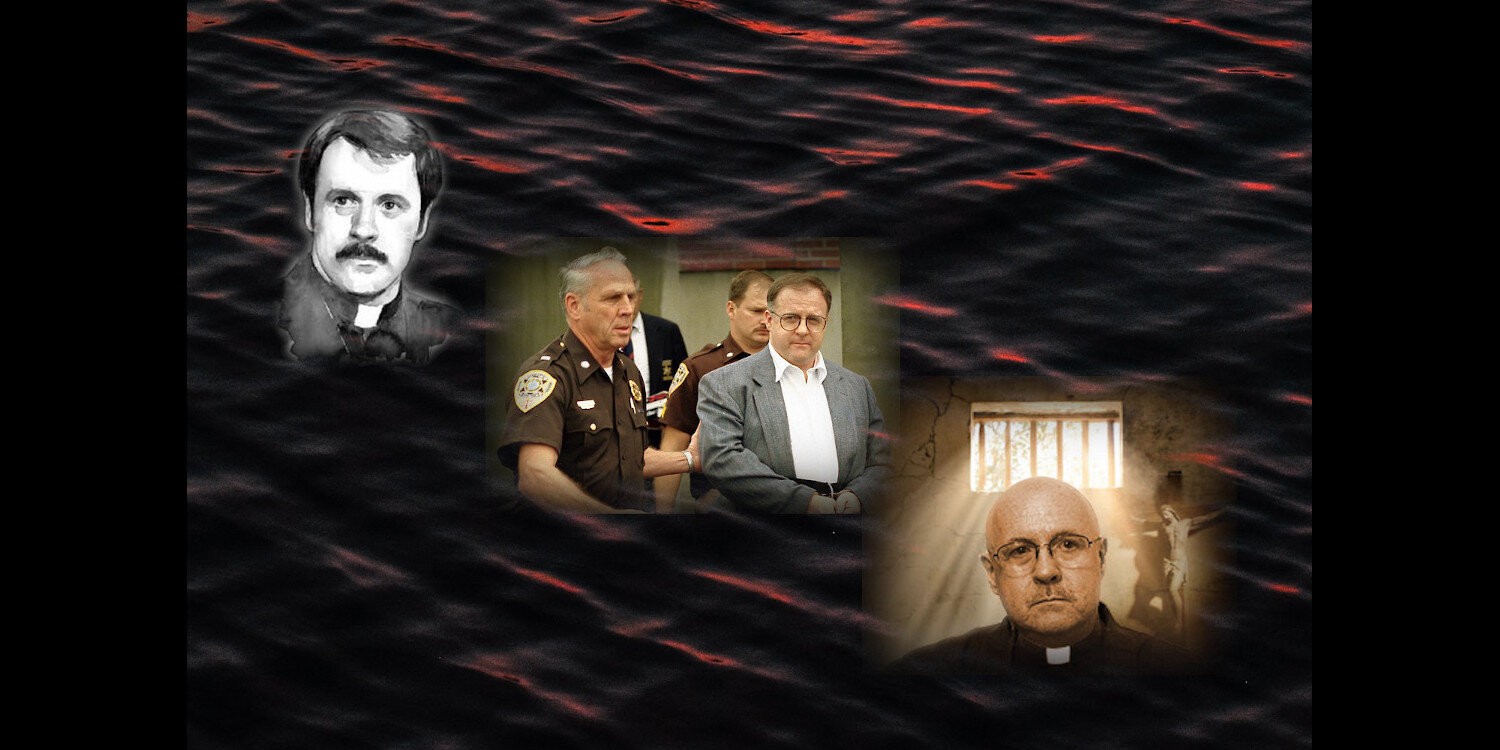
Most blogs and websites have some sort of “About” page describing what can be found there and the nature of the site. Beyond These Stone Walls has a much-expanded “About Page” with a summary of the site, links to important related articles by Dorothy Rabinowitz of The Wall Street Journal and a must-see ten minute video interview with her. There are additional articles by journalist Ryan A. MacDonald and some powerful and very useful content by David F. Pierre Jr. of The Media Report. There are also audio interviews on my story with Catholic League President Bill Donohue and Teresa Tomeo, and a two-hour video documentary interview with me that most readers describe as “compelling.”
That interview got our friend, Pornchai, through a very painful first night in quarantine in Bangkok. Alone and quite overwhelmed, a Samsung smart phone was left for him by our contacts there. He had never before used one, or even seen one, but he managed to somehow find his way to that interview. It eventually calmed his frayed nerves enough to put him to sleep. I can only hope it does not have the same effect on you!
Many of our older posts are being restored with inspiring new graphics. In the chaos of our partisan politics and a pandemic, Beyond These Stone Walls is a comforting place to hang out for awhile. I hope you will, and I hope you will invite others to have a look as well. I will only have a voice for as long as someone out there is listening.
May the Lord Bless you and keep you.
+ + +
Note from Father Gordon MacRae: I have just learned that everyone living in the prison unit where I have lived for the last nearly four years will be relocated to a large dormitory on May 2 in order to accommodate a construction project in this building. We are told that we will be returning to our current housing when the project is completed about two weeks later. During this time, I will be unable to write. We are selecting two older posts for readers to revisit, and hopefully also a guest post from a prominent writer. May the Lord Bless you and keep you, Father G.
I also invite you to read and share the related posts metioned herein:
The Milky Way Galaxy seen over the Karl G. Jansky Very Large Array west of Socorro, New Mexico. Photo by NRAO/AUI/NSF, Jeff Hellerman